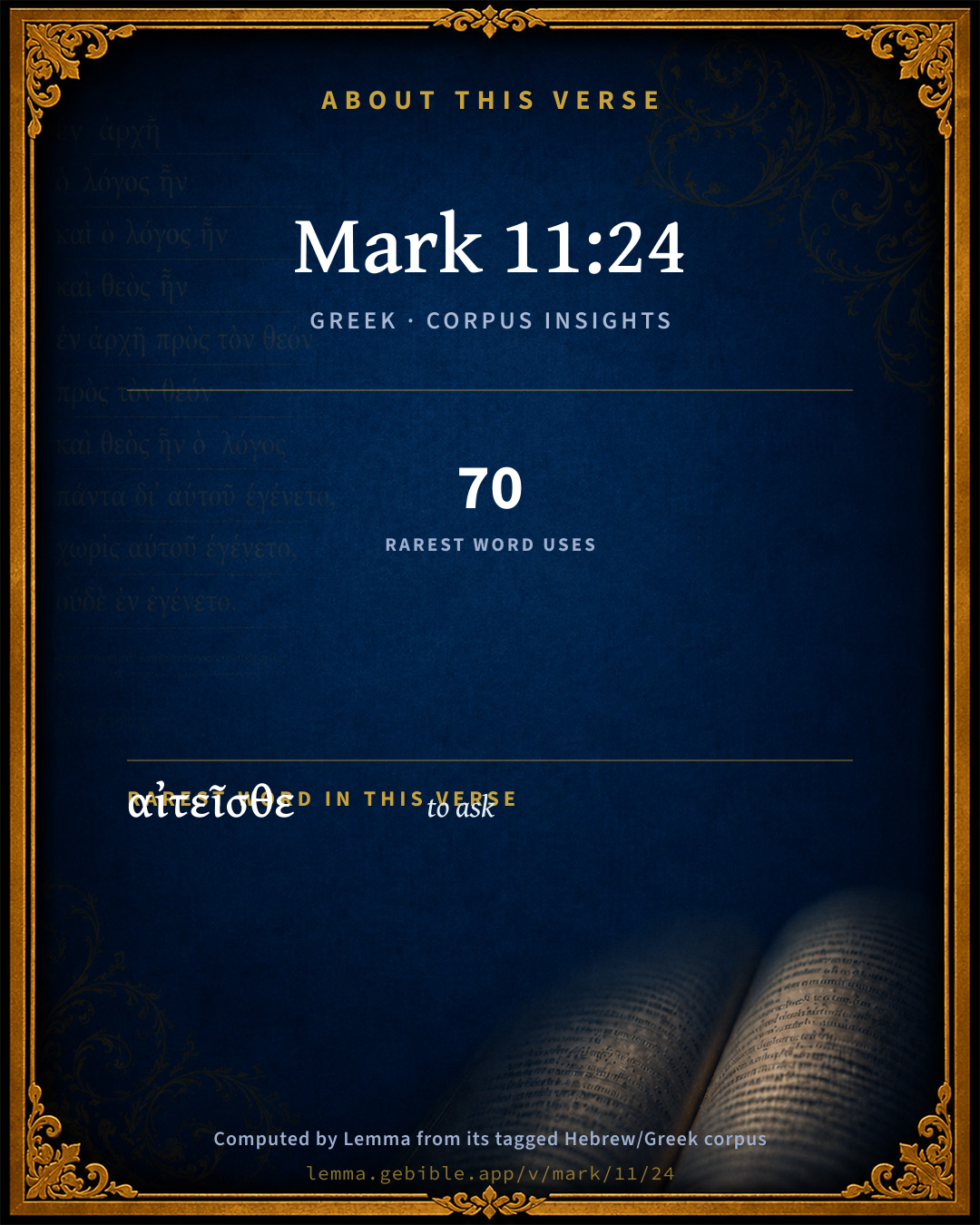
Mark 11:24

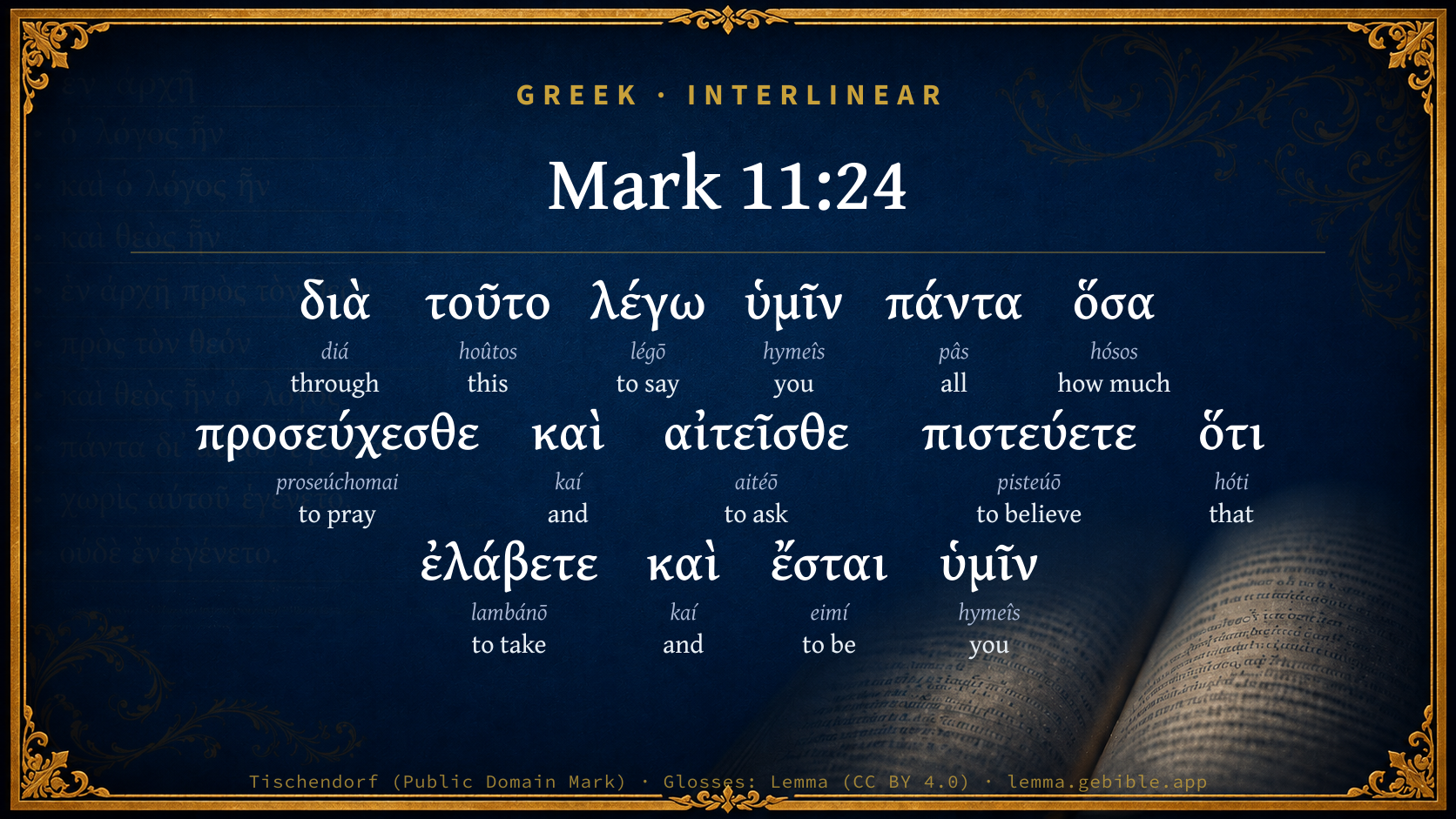
Greek (Tischendorf 8th ed.) Mark 11:24 appears in the Greek New Testament. The text above is from the Tischendorf 8th edition. Each word links to its Strong’s number and a concise gloss. Click any word for its full Thayer’s Greek Lexicon entry.
Download image
Cite this verse

Mark 11:24 (World English Bible). Public Domain. Lemma interlinear Bible study tool, https://lemma.gebible.app/v/mark/11/24.

Show BibTeX & RIS
BibTeX
RIS
English Translation
Therefore I tell you, all things whatever you pray and ask for, believe that you receive them, and you shall have them.
World English Bible · Public Domain
Download a study sheet

One document with this verse’s original text, its word-by-word gloss line, the meaning frame, cross-references with their text, attributed commentary, and full source and license credits — printable, and it pastes into notes with its structure intact.

This verse Autodidact and up

Study sheet (.html) Plain text (.txt)

A passage Seminary Student

Up to 50 verses in one chapter. A passage sheet keeps up to 6 commentary sources and 12 cross-references per verse, in the order this page ranks them, and says so on the sheet whenever that leaves anything out. Ask for a single verse and you get the Autodidact verse sheet above.

Everything on this page stays free to read, with no account — the sheet is a download of what is already on screen, not access to it.

Want to remove ads? Support Godless Engineer
Compare translations 3

The same verse in 3 English versions, stacked beneath the original-language interlinear above. Click any original word for its lexicon entry.

Each is an independent rendering of the whole verse — the interlinear is not word-aligned to these translations.

Highlighted words mark where these versions differ — a whole-verse word diff, not a word-by-word alignment.

  • World English Bible Public Domain
    Therefore I tell you, all things whatever you pray and ask for, believe that you receive them, and you shall have them.
  • King James Version Public Domain
    Therefore I say unto you, What things soever ye desire, when ye pray, believe that ye receive them, and ye shall have them.
  • unfoldingWord Literal Text CC BY-SA 4.0
    Because of this, I say to you, everything, as much as you pray and request, believe that you have received, and it will be to you.

unfoldingWord Literal Text — © unfoldingWord, licensed CC BY-SA 4.0. Word-aligned USFM3 via Door43 (git.door43.org/unfoldingWord/en_ult).

Versions to compare (up to 4)

3 of 4 selected

Show all 19 translations

Every available English version of this verse, each an independent rendering of the whole verse.

  • World English Bible Public Domain
    Therefore I tell you, all things whatever you pray and ask for, believe that you receive them, and you shall have them.
  • Berean Standard Bible Public Domain
    Therefore I tell you, whatever you ask for in prayer, believe that you have received it, and it will be yours.
  • Majority Standard Bible Public Domain
    Therefore I tell you, whatever you ask for in prayer, believe that you have received it, and it will be yours.
  • King James Version Public Domain
    Therefore I say unto you, What things soever ye desire, when ye pray, believe that ye receive them, and ye shall have them.
  • American Standard Version (1901) Public Domain
    Therefore I say unto you, All things whatsoever ye pray and ask for, believe that ye receive them, and ye shall have them.
  • Revised Version (1885) Public Domain
    Therefore I say unto you, All things whatsoever ye pray and ask for, believe that ye have received them, and ye shall have them.
  • Geneva Bible (1599) Public Domain
    Therefore I say vnto you, Whatsoeuer ye desire when ye pray, beleeue that ye shall haue it, and it shalbe done vnto you.
  • Douay-Rheims (1899) Public Domain
    Therefore I say unto you, all things, whatsoever you ask when ye pray, believe that you shall receive; and they shall come unto you.
  • Young's Literal Translation Public Domain
    Because of this I say to you, all whatever -- praying -- ye do ask, believe that ye receive, and it shall be to you.
  • Literal Standard Version CC BY-SA 4.0
    Because of this I say to you, all whatever—praying—you ask, believe that you receive, and it will be to you.
  • Unlocked Literal Bible CC BY-SA 4.0
    Therefore I say to you: Everything you pray and ask for, believe that you received it, and it will be yours.
  • unfoldingWord Literal Text CC BY-SA 4.0
    Because of this, I say to you, everything, as much as you pray and request, believe that you have received, and it will be to you.
  • Darby Bible Public Domain
    For this reason I say to you, All things whatsoever ye pray for and ask, believe that ye receive it, and it shall come to pass for you.
  • World Messianic Bible Public Domain
    Therefore I tell you, all things whatever you pray and ask for, believe that you have received them, and you shall have them.
  • Webster's Bible Public Domain
    Therefore I say to you, Whatever things ye desire when ye pray, believe that ye receive them, and ye shall have them.
  • Free Bible Version CC BY-SA 4.0
    I'm telling you that whatever you pray for, whatever you ask, trust that you've received it, and it's yours.
  • Bible in Basic English Public Domain
    For this reason I say to you, Whatever you make a request for in prayer, have faith that it has been given to you, and you will have it.
  • Text-Critical English NT CC BY 4.0
    Therefore I tell you, whatever you ask for in prayer, believe that you are receiving it, and it will be yours.
  • Tyndale New Testament (1534) Public Domain
    Therfore I saye vnto you what soever ye desyre when ye praye beleve that ye shall have it and it shalbe done vnto you.

Literal Standard Version (2020), Covenant Press — licensed CC BY-SA 4.0. Text via the HelloAO Bible API (eBible.org). Unlocked Literal Bible (unfoldingWord) — licensed CC BY-SA 4.0. Text via the HelloAO Bible API (eBible.org). unfoldingWord Literal Text — © unfoldingWord, licensed CC BY-SA 4.0. Word-aligned USFM3 via Door43 (git.door43.org/unfoldingWord/en_ult). Free Bible Version, Dr. Jonathan Gallagher — licensed CC BY-SA 4.0. Text via the HelloAO Bible API (eBible.org).

Word by word

More ways to search: Search by grammar → Find every occurrence → Compare this word →

Practice this passage: Drill this verse → Learn its vocabulary →

αἰτεῖσθε
aitéō
G154
“to ask”
Verb, Present, Middle, Indicative, 2nd person, Plural
Part of Speech
Verb
Tense
Present
Voice
Middle
Mood
Indicative
Person
2nd person
Number
Plural
Full Thayer's Definition

Origin: of uncertain derivation

TDNT: 04:11,3

1. to ask, beg, call for, crave, desire, require
  1. διὰ diá G1223 “through” Preposition
  2. τοῦτο hoûtos G3778 “this” Demonstrative pronoun, Accusative, Singular, Neuter
  3. λέγω légō G3004 “to say” Verb, Present, Active, Indicative, 1st person, Singular
  4. ὑμῖν hymeîs G5210 “you” Personal pronoun, 2nd person, Dative, Plural
  5. πάντα pâs G3956 “all” Adjective, Accusative, Plural, Neuter
  6. ὅσα hósos G3745 “how much” Correlative pronoun, Accusative, Plural, Neuter
  7. προσεύχεσθε proseúchomai G4336 “to pray” Verb, Present, Middle or Passive deponent, Indicative, 2nd person, Plural
  8. καὶ kaí G2532 “and” Conjunction
  9. πιστεύετε pisteúō G4100 “to believe” Verb, Present, Active, Imperative, 2nd person, Plural
  10. ὅτι hóti G3754 “that” Conjunction
  11. ἐλάβετε lambánō G2983 “to take” Verb, Aorist, Active, Indicative, 2nd person, Plural
  12. καὶ kaí G2532 “and” Conjunction
  13. ἔσται eimí G1510 “to be” Verb, Future, Middle deponent, Indicative, 3rd person, Singular
  14. ὑμῖν hymeîs G5210 “you” Personal pronoun, 2nd person, Dative, Plural

About this verse

These counts appear in no published source. They are computed here, from the morphology-tagged text and Lemma’s own curated glosses. What Lemma adds →

15
words
13
distinct lemmas
Gospels
section

Repetition

Words recur within this verse:

Cross-references

12

Topical passages linked to Mark 11:24 in the Treasury of Scripture Knowledge — connected by theme and wording, ordered by reader-vote popularity; previews shown in the World English Bible.

  • Matthew 21:22 All things, whatever you ask in prayer, believing, you will receive."
  • 1 John 5:14–15 This is the boldness which we have toward him, that, if we ask anything according to his will, he listens to us.
  • 1 John 3:22 and whatever we ask, we receive from him, because we keep his commandments and do the things that are pleasing in his sight.
  • James 1:5–6 But if any of you lacks wisdom, let him ask of God, who gives to all liberally and without reproach; and it will be given to him.
  • Matthew 18:19 Again, assuredly I tell you, that if two of you will agree on earth concerning anything that they will ask, it will be done for them by my Father who is in heaven.
  • John 15:7 If you remain in me, and my words remain in you, you will ask whatever you desire, and it will be done for you.
  • John 14:13 Whatever you will ask in my name, that will I do, that the Father may be glorified in the Son.
  • Matthew 7:7–11 "Ask, and it will be given you. Seek, and you will find. Knock, and it will be opened for you.
  • Luke 11:9–13 "I tell you, keep asking, and it will be given you. Keep seeking, and you will find. Keep knocking, and it will be opened to you.
  • John 16:23–27 "In that day you will ask me no questions. Most assuredly I tell you, whatever you may ask of the Father in my name, he will give it to you.
  • James 5:15–18 and the prayer of faith will heal him who is sick, and the Lord will raise him up. If he has committed sins, he will be forgiven.
  • Luke 18:1–8 He also spoke a parable to them that they must always pray, and not give up,

Cross-references courtesy of OpenBible.info (CC BY 4.0).

Commentary

Notes on Mark 11:24 from classic Christian and Jewish commentators (each source and its license shown beneath its notes). The classic Christian expositions comment on the surrounding passage and are grouped to its opening verse, so a note may address several verses; the Jewish commentaries on the Tanakh (Rashi and others) are per-verse, so they appear only where the commentator wrote on this verse.

Lemma curates 59 commentaries, every one of them public domain or Creative Commons licensed, each selected and text-cleaned for this edition rather than reprinted as found. About our sources →

The Biblical Illustrator

Joseph S. Exell

Mar_11:24

What things soever ye desire when ye pray.

Combined action of prayer and faith

The apostles, when the Lord was taken away from them, would have to commend His doctrine to the world by miracles. To this end it was needful that their faith in God, as the Bestower of all power to do such things, should be raised. For the real doer of every miracle or sign was God, and God only. When the apostles healed suddenly any sick person, or cast out any evil spirit, it was by the combined exercise of prayer and faith. They secretly or openly called upon God, and they implicitly believed that He would accompany their word with His power. Now, being men totally ignorant of science, and so unable to form a conception of the kind or amount of power put forth in the performance of any miracle, they would naturally look upon it as a matter of size, or weight, or extension. They would, as a matter of course, look upon the removal of the Mount of Olives as a far greater thing, demanding far greater power, than the sudden drying up of the life juices of a single fig tree; but it may not really be greater by any means. On the contrary, the sudden touching and arresting the springs of life in the living thing may require far more knowledge of the greatest secret of all-the secret of life, and far more real power in applying that knowledge, than the removal of the most stupendous mass of dead matter. Now the apostles, though they could not understand this, must yet act as if it were so. They must not judge by the sight of their eyes of the difficulty or easiness of anything which they felt moved by the Spirit to perform. They must think of nothing but the almighty power of God, and His pledge to accompany their prayers or words with that power. (M. F. Sadler, M. A.)

The miracle of faith

True prayer is sure power.

I. Look at the text to see the essential qualities necessary to any great success in prayer. There must be-

1. Definite things prayed for. No rambling, or drawing the bow at a venture. Use no mock modesty with God. Be simple and direct in your pleadings. Speak plainly, and make a straight aim at the object of your supplications.

2. Earnest desire. Plead as for your life. There was a beautiful illustration of true prayer addressed to man in the conduct of two noble ladies, whose husbands were condemned to die and were about to be executed, when they came before George I and supplicated for their pardon. The king rudely and cruelly repulsed them. But they pleaded again and again; and could not be got to rise from their knees; and they had actually to be dragged out of court, for they refused to leave till their petition was granted. That is the way we must pray to God. We must have such a desire for the thing we want that we will not rise until we have it,-but in submission to His Divine will, nevertheless.

3. Faith. No questioning whether God can or will grant the prayer. The prayers of Gods people are but Gods promises breathed out of living hearts; and those promises are the decrees only put into another form and fashion. When you can plead His promise, then your will is His will.

4. A realizing expectation. We should be able to count over the mercies before we have got them, believing that they are on the road.

II. Look about you and judge by the tenor of the text.

1. Public meetings for prayer. How often, at these meetings, does this advice of an old preacher need to be remembered: The Lord will not hear thee because of the arithmetic of thy prayers; He does not count their numbers: nor because of their rhetoric; He does not care for the eloquent language in which they are couched: nor for their geometry; He does not compute them by their length or their breadth: nor yet will He regard thee because of the music of thy prayers; He cares not for sweet voices and harmonious periods. Neither will He look at thee because of the logic of thy prayers-because they are well arranged and excellently comparted. But He will hear thee, and He will measure the amount of the blessing He will give thee, according to the divinity of thy prayers. If thou canst plead the person of Christ, and if the Holy Ghost inspire thee with zeal and earnestness, the blessings thou askest will surely come to thee.

2. Your private intercessions. There is no place that some of us need to he so ashamed to look at as our closet door. Shame on our hurried devotions, our lip services, our distrust. See to it that an amendment be made, and God make you more mighty and more successful in your prayers than heretofore.

III. Look above and you will see enough to make you-

1. Weep. God has given us a mighty weapon, and we have let it rust. If the universe were as still as we are where should we be? God gives light to the sun, and he shines with it. To the winds He gives force, and they blow. To the air He gives life, and it moves, and men breathe thereof. But to His people He has given a gift that is better far than force, or life, or light, and yet they neglect and despise it! Constantine, when he saw that on the coins of the other emperors their images were in an erect position, triumphing, ordered that his image should be struck kneeling, for, said he, This is the way in which I have triumphed. The reason why we have been so often defeated, and why our banners trail in the dust, is because we have not prayed.

2. Rejoice. For, though you have sinned against God, He loves you still. You may not as yet have gone to the fountain, but it still flows as freely as ever.

3. Amend your prayers from this time forth. Look on prayer no longer as a romantic fiction or an arduous duty, but as a true power and a real pleasure. When philosophers discover some latent power they delight to put it in action. Test the bounty of the Eternal. Take to Him all your petitions and wants, and see if He does not honour you. Try whether, if you believe Him, He will not fulfil His promise, and richly bless you with the anointing oil of His Spirit, by which you will be strong in prayer. (C. H. Spurgeon.)

Lessons on prayer

I. God hears prayers of any magnitude; much wrong might have been prevented or cured, much good done, if only we had prayed.

II. Success for prayer depends on goodness; without the soul health of trust and love we cannot pray.

III. Let our unanswered prayers be a mirror in which we see our faults. (R. Glover.)

If our doubts do not prevail so far as to make us leave off praying, our prayers will prevail so far as to make us leave off doubting. (H. Hickman.)

Prayer a key

Prayer is a key which, being turned by the hand of faith, unlocks Gods treasures. (Anon.)

The sum and substance of every prayer should be the will of God

The exercise of prayer can only be a blessing to our souls when our own will is entirely merged in the will of our heavenly Father. If we only knew the truth, we should find that prayer is more connected with the discipline of the will than we generally imagine. Our will is not naturally in harmony with Gods. The carrying out of our own will, when bent on some desired object, is what invariably characterises us. It becomes habitual to us. We carry it, more or less, as a habit into the presence of God. It must not be, however. Wilfulness is not a characteristic of one of Gods children. He is but a child, and he must know it. The Fathers will is best; the child must know no will but His. It must be crossed, however painful it may be. To subdue that will, to blend it with His, and to make us perfectly happy under the conviction that our own is not to be carried out, is the only true explanation of many an unanswered prayer, many a bitter cup still unremoved, and many a thorn still left rankling in the flesh. But when the heart has been brought into that state when it can, with happy, confiding trust, look up and say, Father, not my will, but Thine, be done! then will relief come. The thorn, indeed, may not be extracted, the cup may not be removed, but there will appear the strengthening angel from heaven enabling us to bear it. (F. Whitfield.)

Scope and limit of prayer

In other places the promise is considerably qualified, We shall receive, not whatever we ask, but the Holy Spirit, i.e., we are to spread out our case, our needs, our desires, before God, for that is the way to come into close relations with Him; He will do the rest. The answer shall be the gift we ask for, and our demand shall be the needful link in the chain of causes which brings us and our hearts desire together; in other words, the answer shall be the Holy Spirit, who shall mould our wills into accord and illuminated acquiescence with His good will. In any case, prayer is seen to be the ways and means of bringing us into communication with One who is above all, and over all, and through all. Direct demands are the most obvious, simple, childlike forms of prayer; but the spiritual value of prayer is, after all, not this-to get exactly what we want, when we want it, like the magic ring in the fairy tale; but this-to bring the human into close relation with the Divine. (H. R. Haweis, M. A.)

The foundation of faithful prayer

I remember asking an old friend of mine, who is now between seventy and eighty years of age, and who, I think, as far as I have been permitted to know Christian men, is mightier with God than almost any man I have met, Do tell me the secret of your success in prayer. He said, I will tell you what it is. I say to myself, Is that which I am asking for promised? Is it according to the mind of God? If it is, I plant my foot upon it as upon a firm rock, and I never allow myself to doubt that my Father will give me according to my petition. (Bp. Bickersteth.)

The links that unite earth and heaven

Give me these links;

(1) sense of need;

(2) desire to get;

(3) belief that, though He withhold for a while, He loves to be asked;

(4) belief that asking will obtain-give me these links, and the chain will reach from earth to heaven, bringing all heaven down to me, or bearing me up into heaven. (T. Guthrie, D. D.)

Faith and prayer

Faith is to prayer as the feather is to the arrow; faith feathers the arrow of prayer, and makes it fly swifter and pierce the throne of grace. Prayer that is faithless is fruitless. (T. Watson.)

Earnestness in prayer

The arrow that is shot from a loose cord drops powerless to the ground, but from the tightly-drawn bowstring it springs forward, soars upward, and reaches the object to which it is directed. So it is not the loose utterance of attempted prayer that is effectual, but the strong earnestness of the heart sending its pointed petition to heaven, that reaches the Divine ear and obtains the desired blessing. (Bowden.)

Perseverance in prayer

I saw the other day a man attempting to split a rock with a sledge hammer. Down came the sledge upon the stone as if it would crush it, but it merely rebounded, leaving the rock as sound as before. Again the ponderous hammer was swung, and again it came down, but with the same result. Nothing was accomplished. The rock was still without a crack. I might have asked (as so many are disposed to ask concerning prayer) what good could result from such a waste of time and strength. But that man had faith. He believed in the power of that sledge. He believed that repeated blows had a tendency to split that rock. And so he kept at it. Blow after blow came down; all apparently in vain. But still he kept on without a thought of discouragement. He believed that a vigorously swung sledge has great power. And at last came one more blow and the work was done. That is the way in which we ought to use prayer. God has told us that the earnest prayer of the righteous man has great power. We ought to believe it, just as that man believed that his sledge had power. And believing it, we ought to use prayer for the attainment of spiritual results with just such confidence of success as that man used his sledge. We may not secure our answer at once. That rock was not split at the first blow, or the second. But that man believed that if he continued his blows, he was more likely to succeed every blow he struck. So we are to believe that there is a spiritual power in prayer, just as there was a physical power in that sledge; and that, the more perseveringly and earnestly we use it, the more certain are we to accomplish something by it.

Ye shall have them: Divine answers to prayer

Is the direct Divine answer to prayer a reality? Call the witnesses and let them testify. Let the martyrs of the early church answer, from their exile, from the prisons where they were chained, from the amphitheatre whose sands were crimsoned with their blood, from the chariots of flame in which they swept up to glory. Let the Covenanters, kneeling on the heather, or hiding in the grey fastnesses of the crags; let the Pilgrims, with their faces vet with the cold, salt spray, and the gloom of the wilderness overshadowing them; let Christian heroes everywhere-missionaries passing through belts of pestilence, women in army hospitals, philanthropists in jails and lazar houses-let all these testify whether prayer has anything more than a reflex influence. Let thousands of death beds answer. Let the myriad homes of sorrow, wrapped in darkness that may be felt, answer. Let every man or woman who has ever really prayed, answer. From each and all comes one and the same testimony: The Lord is nigh unto all that call upon Him, unto all that call upon Him in truth. (Ed. S. Attwood.)

Expecting answer to prayer

A few years ago there was a time of much dryness in a certain part of England. No rain had fallen for several weeks, and it seemed as if the crops would all perish for want of moisture. A few pious farmers who believed in the power of prayer asked their minister to make a special supplication on a particular Sunday for the needed blessing of rain. The day came, and was as bright and cloudless as those which had preceded it. Among the congregation the minister noticed a little Sunday scholar, who carried a large old-fashioned umbrella. Why, Mary, he exclaimed, what could have induced you to bring an umbrella on such a lovely morning as this? I thought, sir, answered Mary, that as we were going to pray for rain I should be sure to want the umbrella. The minister patted her cheek good naturedly and the service began. Presently the wind rose, the clouds gathered, and at length the long-desired rain fell in torrents. Mary and the minister went home together under the umbrella, while the rest of the congregation reached their dwellings well drenched. Let us follow Marys example, and always pray, not only hoping that God may hear, but believing that He does hear, and will send us what we ask if it is good for us.

The most mighty force

Thou hast power in prayer, and thou standest today amongst the most potent ministers in the universe that God has made. Thou hast power over angels, they will fly at thy will. Thou hast power over fire and water, and the elements of earth. Thou hast power to make thy voice heard beyond the stars; where the thunders die out in silence thy voice shall make the echoes of eternity. (C. H. Spurgeon.)

Power of prayer

Oh, God, thou hast given us a mighty weapon, and we have permitted it to rust. Would it not be a vile crime if a man had an eye given him which he would not open, or a hand that he would not lift up, or a foot that grew stiff because he would not use it. (C. H. Spurgeon.)

Pleading prayer

It was said of John Bradford that he had a peculiar art in prayer, and when asked for his secret he said: When I know what I want I always stop on that prayer until I feel that I have pleaded it with God, and until God and I have had dealings with each other upon it. (C. H. Spurgeon.)

The limit of prayer

I. Prayers limit. All things soever ye desire, believe and ye shall have them. The boundary line of desire and of faith.

1. The boundary line of faith. Faith is vast, recognizes the covenant of the promises, and whatever comes outside the promises for which she can find anywhere a direct engagement of Almighty God to do. Faith is the turning of an infinite future, into a present real receiving; it can go confidently when it treads on Scripture ground. So the Bible becomes, in a measure, prayer; you must try to bring prayer up to the mind of God in it.

2. Desire has a gracious limit. A man well acquainted with Gods Word lives under the teaching of the Holy Spirit, and his mind is conformed to the mind of God, and his desires gradually blend with the wishes of the Almighty.

II. Prayers reach.

III. Prayers warrant. The blood of Christ and the worth of this warrant.

1. It is personal.

2. It is present.

3. It is absolute. (J. Vaughan, M. A.)

The Biblical Illustrator, edited by Joseph S. Exell (c. 1880s–1900s) — public domain. Text from a community e-Sword module.

Tyndale Open Study Notes

Tyndale Open Resources

11:24-25 Two additional sayings on prayer are tied to 11:23 by the word believe. In the first (11:24), we are told that we will receive what we ask for (see Matt 7:7) if we pray with the faith described in Mark 11:23. • Forgiveness is the second condition for answered prayer. Only when we forgive others can our most important prayer, that God forgive us, be answered (Matt 5:23-24; 6:12, 14-15; Luke 6:37; 11:4; cp. Luke 7:41-43, 47; Eph 4:32; Col 3:13).

Tyndale Open Study Notes — © Tyndale Open Resources, licensed CC BY-SA 4.0. Text via the HelloAO Bible API.

Expositor's Greek Testament

ed. W. Robertson Nicoll

Mar 11:24 . ἐλάβετε ; this reading ( [104] [105] [106] [107] [108] ) Fritzsche pronounces absurd. But its very difficulty as compared with λαμβάνετε (T.R.) guarantees its genuineness. And it in not unintelligible if, with Meyer, we take the aorist as referring to the divine purpose, or even as the aorist of immediate consequence, as in Joh 15:6 ( ἐβλήθη ). So De Wette, vide Winer, sec. xl. 5 b.

[104] Codex Sinaiticus (sæc. iv.), now at St. Petersburg, published in facsimile type by its discoverer, Tischendorf, in 1862.

[105] Codex Vaticanus (sæc. iv.), published in photographic facsimile in 1889 under the care of the Abbate Cozza-Luzi.

[106] Codex Ephraemi

[107] Codex Regius--eighth century, represents an ancient text, and is often in agreement with א and B.

[108] Codex Sangallensis, a Graeco-Latin MS. of the tenth century, and having many ancient readings, especially in Mark.

The Expositor's Greek Testament, edited by W. Robertson Nicoll (1897–1910) — public domain. Text from a community e-Sword module.

Geneva Bible (1599)

Geneva Bible translators

Word for word, that you receive it speaking in the time that now is, to show the certainty of the thing and the performance indeed.

Geneva Bible (1599) marginal notes — public domain. Text via Bolls.life.

Ellicott's Commentary for English Readers

(24) Believe that ye receive them.—The better MSS. give the latter verb in the past tense, “Believe that ye received them.” It is obvious that, as a rule, such words imply prayer for spiritual rather than temporal blessings. In that region the subjective faith becomes an objective reality. We are to believe, not that we shall one day have what we pray for in a future more or less distant, but that we actually receive it as we pray. In most, if not in all cases, in prayer for peace, pardon, illumination, the promise, though it sounds hyperbolical, is psychologically true.

A Bible Commentary for English Readers, edited by Charles John Ellicott (1878–1897) — public domain. Text from a community e-Sword module.

The Cambridge Bible for Schools and Colleges

gen. ed. J. J. S. Perowne

24. What things soever ye desire, when ye pray] Because Prayer is the very language of Faith, He passes on to speak concerning Prayer.

The Cambridge Bible for Schools and Colleges (gen. ed. J. J. S. Perowne; Cambridge University Press, 1878–1918) — public domain. Text from a community e-Sword module.

John Gill's Exposition

And when ye stand praying,.... Are about to engage in that work, or are engaged in it, performing it in such a posture; for standing was an usual posture in praying; See Gill on Mat 6:5;

forgive, if ye have ought against any, that your Father also in heaven may forgive you your trespasses. The sense is, that if, while a man is praying, it comes into his mind that such an one has committed a trespass against him, has done him an injury, of which he has just reason to complain; but instead of complaining of it before God, and calling upon him to avenge his cause, he should immediately in his heart, and from his heart, forgive him, even though he is not present to acknowledge his sin, and ask his pardon; and such an one may expect forgiveness of God, and a manifestation of it to his soul; which is one the things he is constantly praying for, as his daily case makes it necessary: not that it is to be understood as though his for, giving the person that has offended him, is the cause, or condition, of his receiving remission of sin at the hand of God; for then it would not be through the blood of Christ, and according to the riches of his grace; but this points at a temper and disposition of mind well pleasing to God, and describes persons who may expect this favour from him; See Gill on Mat 6:14.

John Gill's Exposition of the Whole Bible (1746–1763) — public domain (CC PDM 1.0). Text via the HelloAO Bible API.

Trapp's Complete Commentary

John Trapp

24 Therefore I say unto you, What things soever ye desire, when ye pray, believe that ye receive them, and ye shall have them.

Ver. 24. What things soever ye desire, &c.] To an effectual prayer two things are here required: 1. An earnest desire after the thing prayed for; "the desire of the righteous shall be satisfied," Pro 10:24; but a cold suitor begs a denial. 2. A confident expectation of a gracious answer. He that prayeth and doubteth shutteth heaven’s gates against his own prayers, Jas 1:7.

Believe that ye receive them] Even as soon as you ask, as the word λαμβαντετ signifies. See Dan 9:20-21; Dan 9:24.

John Trapp, A Commentary or Exposition upon All the Books of the Old and New Testament (1647–1656) — public domain. Text from a community e-Sword module.

Matthew Poole's English Annotations

See Poole on "Mat 21:22". See Poole on "Mat 6:14-15". See Poole on "Mat 7:7", in which texts we before met with what we have in these verses, teaching us the necessity of faith and charity to those who would so pray as to find acceptance with God. This also lets us know the necessity of people’s full satisfaction, that what things they ask of God in prayer are according to the will of God, without which it is not possible they should pray with a full persuasion that they shall receive whatsoever they in prayer ask of God. And because it is impossible we should in this point be fully satisfied, without a Divine revelation, as to things not necessary to salvation, our faith or persuasion can rise no higher, than a full persuasion, that if things of this nature, when we ask them of God in prayer, be such as are for our good, and for God’s glory, we shall receive them. The cause was otherwise as to those to whom Christ had given a power to work miracles; what they asked of that nature they must know it was the will of God to effect by them, and they could not without sin doubt of it.

Matthew Poole's English Annotations on the Holy Bible (1683–1685) — public domain. Text from a community e-Sword/MySword module.

Whedon's Commentary on the Bible

Daniel D. Whedon

24. Therefore — In view of this readiness of God to make your faith true the instant that it exists. I say — I declare this high privilege of the faithful soul. Unto you — Who have attained full communion with God. Believe that ye receive them — Trust that God is already granting while ye pray. And ye shall have them — The gift shall commence as soon as the faith is complete. While ye trust that it is being granted, it is being granted. The prayer and the answer are coexistent, as instantaneous cause and effect.

Daniel D. Whedon (gen. ed.), Commentary on the Old and New Testaments (1874–1909) — public domain. Text from a community e-Sword module.

The Pulpit Commentary

All things whatsoever ye pray and ask for, believe that ye have received them; and ye shall have them. But you must "ask in faith, nothing wavering."

The Pulpit Commentary (1880–1919), ed. H.D.M. Spence-Jones & Joseph S. Exell — public domain. Text from a community e-Sword module.

Kretzmann's Popular Commentary

Paul E. Kretzmann

v. 24. Therefore I say unto you, What things soever ye desire, when ye pray, believe that ye receive them, and ye shall have them.

v. 25. And when ye stand praying, forgive if ye have aught against any, that your Father also which is in heaven may forgive you your trespasses.

v. 26. But if ye do not forgive, neither will your Father which is in heaven forgive your trespasses.

There are two factors which defeat the ends of prayer. The first is the lack of trust in efficacy of prayer. There are things which people need, which they desire, which they bring to God in prayer, and yet they lack assurance, they exhibit hesitation, fear as to the outcome. But Christ here states that every prayer of faith is heard. It may be that the fulfillment of wishes comes in a different form than the believer anticipated, in a manner more conducive to his temporal and eternal welfare, but the fact of God’s hearing prayer is unassailable. The second reason why prayers often have no effect is because of the condition of the person’s heart that presumes to pray. There cannot be, in the heart of a praying person, enmity, hatred, rancor, ill will, or any other unfriendly feeling which is at variance with the demand of God that a forgiving spirit must dominate our actions. No matter whether Christians have been wronged with or without reason, whether they feel hurt rightfully or wrongfully, their hearts must be filled with forgiveness toward all men. If they refuse to forgive, no matter what the occasion or the provocation, they thereby erect a wall, an impenetrable and insurmountable obstacle between themselves and God. They make God’s forgiveness of their own sins impossible, and God will not hear the prayers of such as have no clean record before Him, whose sins are not daily and richly forgiven them through the Gospel. Since they refuse their neighbor forgiveness, they shut themselves out from God’s mercy and goodness, and render their prayer of none effect.

Paul E. Kretzmann, Popular Commentary of the Bible (1921–1924) — public domain. Text from a community e-Sword module.

unfoldingWord translationNotes

Door43 World Missions Community

Therefore I say to you

"So I tell you" (See: Connecting Words)

it will be yours

It is understood that this will happen because God will provide what you ask for. This can be stated clearly. AT: "God will give it to you" (See: Assumed Knowledge and Implicit Information)

When you stand and pray

It is common in Hebrew culture to stand when praying to God. AT: "When you pray"

whatever you have against anyone

"whatever grudge you have against anyone." Here the word "whatever" refers to any grudge you hold against someone for sinning against you or any anger you have against someone.

translationWords

pray

believe

forgive

God the Father

heaven

transgress

unfoldingWord translationNotes — © Distant Shores Media and the Door43 World Missions Community, licensed CC BY-SA 4.0. Source: git.door43.org/Door43/en_tn.

Cambridge Greek Testament for Schools and Colleges

24. ἐλάβετε ([2573][2574][2575][2576][2577][2578]) rather than λαμβάνετε ([2579][2580][2581][2582][2583]).

[2573] Codex Sinaiticus. 4th cent. Discovered by Tischendorf in 1859 at the Monastery of St Katharine on Mount Sinai. Now at St Petersburg. The whole Gospel, ending at Mar 16:8. Photographic facsimile, 1911.

[2574] Codex Vaticanus. 4th cent., but perhaps a little later than א. In the Vatican Library almost since its foundation by Pope Nicolas V., and one of its greatest treasures. The whole Gospel, ending at Mar 16:8. Photographic facsimile, 1889.

[2575] Codex Ephraemi. 5th cent. A palimpsest: the original writing has been partially rubbed out, and the works of Ephraem the Syrian have been written over it; but a great deal of the original writing has been recovered; of Mark we have Mar 1:17 to Mar 6:31, Mar 8:5 to Mar 12:29, Mar 13:19 to Mar 16:20. In the National Library at Paris.

[2576] Codex Regius. 8th cent. An important witness. At Paris. Contains Mar 1:1 to Mar 10:15; Mar 10:30 to Mar 15:1; Mar 15:20 to Mar 16:20, but the shorter ending is inserted between Mar 16:8 and Mar 16:9, showing that the scribe preferred it to the longer one.

[2577] Codex Sangallensis. 9th or 10th cent. Contains the Gospels nearly complete, with an interlinear Latin translation. The text of Mark is specially good, agreeing often with CL. At St Gall.

[2578] Codex Athous Laurae. 8th cent. Like N and Σ, it is written in silver letters on purple vellum. Contains Mar 9:5 to Mar 16:20, and, as in L, the shorter ending is inserted between Mar 16:8 and Mar 16:9. As in Δ, the text of Mark is specially good.

[2579] Codex Alexandrinus. 5th cent. Brought by Cyril Lucar, Patriarch of Constantinople, from Alexandria, and afterwards presented by him to King Charles I. in 1628. In the British Museum. The whole Gospel. Photographic facsimile, 1879.

[2580] Codex Purpureus. 6th cent. Full text in Texts and Studies v. No. 4, 1899. Contains Mar 5:20 to Mar 7:4; Mar 7:20 to Mar 8:32; Mar 9:1 to Mar 10:43; Mar 11:7 to Mar 12:19; Mar 14:25 to Mar 15:23; Mar 15:33-42. See below on Ψ.

[2581] Codex Monacensis. 10th cent. Contains Mar 6:47 to Mar 16:20. Many verses in 14, 15, 16 are defective.

[2582] Codex Oxoniensis. 9th cent. Contains Mark, except Mar 3:35 to Mar 6:20.

[2583] Codex Petropolitanus. 9th cent. Gospels almost complete. Mar 16:18-20 is in a later hand.

24. προσεύχεσθε καὶ αἰτεῖσθε. So [2645][2646][2647][2648][2649][2650]. See on Joh 11:22; προσεύχομαι (nowhere in Jn) is reserved for prayer to God (Mar 1:35, Mar 6:46); αἰτέομαι may be used of requests to man (Mar 6:24, Mar 15:8). Syr-Sin. omits καὶ αἰτεῖσθε.

[2645] Codex Sinaiticus. 4th cent. Discovered by Tischendorf in 1859 at the Monastery of St Katharine on Mount Sinai. Now at St Petersburg. The whole Gospel, ending at Mar 16:8. Photographic facsimile, 1911.

[2646] Codex Vaticanus. 4th cent., but perhaps a little later than א. In the Vatican Library almost since its foundation by Pope Nicolas V., and one of its greatest treasures. The whole Gospel, ending at Mar 16:8. Photographic facsimile, 1889.

[2647] Codex Ephraemi. 5th cent. A palimpsest: the original writing has been partially rubbed out, and the works of Ephraem the Syrian have been written over it; but a great deal of the original writing has been recovered; of Mark we have Mar 1:17 to Mar 6:31, Mar 8:5 to Mar 12:29, Mar 13:19 to Mar 16:20. In the National Library at Paris.

[2648] Codex Bezae. 6th cent. Has a Latin translation (d) side by side with the Greek text, and the two do not quite always agree. Presented by Beza to the University Library of Cambridge in 1581. Remarkable for its frequent divergences from other texts. Contains Mark, except Mar 16:15-20, which has been added by a later hand. Photographic facsimile, 1899.

[2649] Codex Regius. 8th cent. An important witness. At Paris. Contains Mar 1:1 to Mar 10:15; Mar 10:30 to Mar 15:1; Mar 15:20 to Mar 16:20, but the shorter ending is inserted between Mar 16:8 and Mar 16:9, showing that the scribe preferred it to the longer one.

[2650] Codex Sangallensis. 9th or 10th cent. Contains the Gospels nearly complete, with an interlinear Latin translation. The text of Mark is specially good, agreeing often with CL. At St Gall.

πιστεύετε ὅτι ἐλάβετε. Always believe that ye received them—“at the moment when ye asked for them.”

Cambridge Greek Testament for Schools and Colleges (Cambridge University Press, 1896; 21 vols, various authors incl. Carr, Maclear, Plummer, Farrar, Lumby, Moule, M. R. James, Simcox) — public domain. Text from a community e-Sword module.

Alford’s Greek Testament

Henry Alford

24.] ἐλάβετε is aor., because the reception spoken of is the determination in the divine counsels coincident with the request—believe that when you asked, you received, and the fulfilment shall come, ἔσται.

Henry Alford, The Greek Testament (1849–1861) — public domain. Text from a community e-Sword module.

International Critical Commentary

24. διὰ τοῦτο—on this account, referring to what he has just said of the efficacy of faith. He generalizes from the extreme case of the mountain. πάντα ὅσα προσεύχεσθε κ. αἰτεῖσθε, πιστεύετε ὅτι ἐλάβετε—all things whatever ye pray and ask for, believe that you received them. The aor. is a rhetorical exaggeration of the immediateness of the answer: it antedates even the prayer in the mind of the petitioner.

προσεύχεσθε καὶ, instead of ἂν προσευχόμενοι, pray and ask, instead of praying ask, Tisch. Treg. WH. RV. אBCDL Δ mss. Lat. Vet. Pesh. ἐλάβετε, instead of λαμβάνετε, Tisch. Treg. WH. RV. אBCL Δ Memph.

It is noticeable that here, and in the case of the demoniac following the Transfiguration, Jesus seeks to turn the thought of the disciples to faith, as a matter of dependence on God, and to the absoluteness of the power thus invoked by them. If we add to this the desire to impress on them the reality of prayer as a means of securing for themselves the exercise of that power, we shall have the substance of Jesus’ teaching on the subject. The power that we invoke is not an impersonal cause, that grinds out its results with the absoluteness of a machine, but a Person whose limitless power is available for him who fulfils the conditions implied in faith.

International Critical Commentary — older volumes (1896–1929), various authors — public domain. Text from a community e-Sword module.

Vincent's Word Studies in the New Testament

Marvin R. Vincent

Receive [ελαβετε] . More lit., received. Rev., have received.

Marvin R. Vincent, Word Studies in the New Testament (1887–1900) — public domain. Text from a community e-Sword/MySword module.

Lesson kit

Teaching starters — assembled from the data on this page, not authored interpretation. Every prompt links to the verse data it draws on. Edit before teaching.

Mark, in the Gospels, opens this verse with 15 words (13 distinct Greek lemmas). Its most distinctive word is aitéō (“to ask”). A historical commentator’s framing appears above. Read the whole chapter for the surrounding context.

Discussion questions

  1. How does “to ask” (aitéō) shape what this verse is saying?
  2. How does Matthew 21:22, which shares this passage’s theme, read alongside this verse?
  3. What does the repetition of “you” (2× in this one verse) do in this verse?
  4. The translations on this page render this verse differently — a whole-verse word diff, not a word-by-word alignment. What might account for the different wordings?
  5. Compare how The Biblical Illustrator and Tyndale Open Study Notes read this verse. Where do they agree or differ?

Things to notice

Reading settings

Reading text

Shown beneath each verse's original-language words.

Old Testament
Old Testament edition

Read the OT as the Masoretic Hebrew (MT) or the Greek Septuagint (LXX).

English shown for the Greek Septuagint (in the Hebrew ↔ Greek comparison).

Comparing translations? Open the Compare panel on any verse page to stack up to four side by side.