
Hebrews 9:19

Greek (Tischendorf 8th ed.) Hebrews 9:19 appears in the Greek New Testament. The text above is from the Tischendorf 8th edition. Each word links to its Strong’s number and a concise gloss. Click any word for its full Thayer’s Greek Lexicon entry.
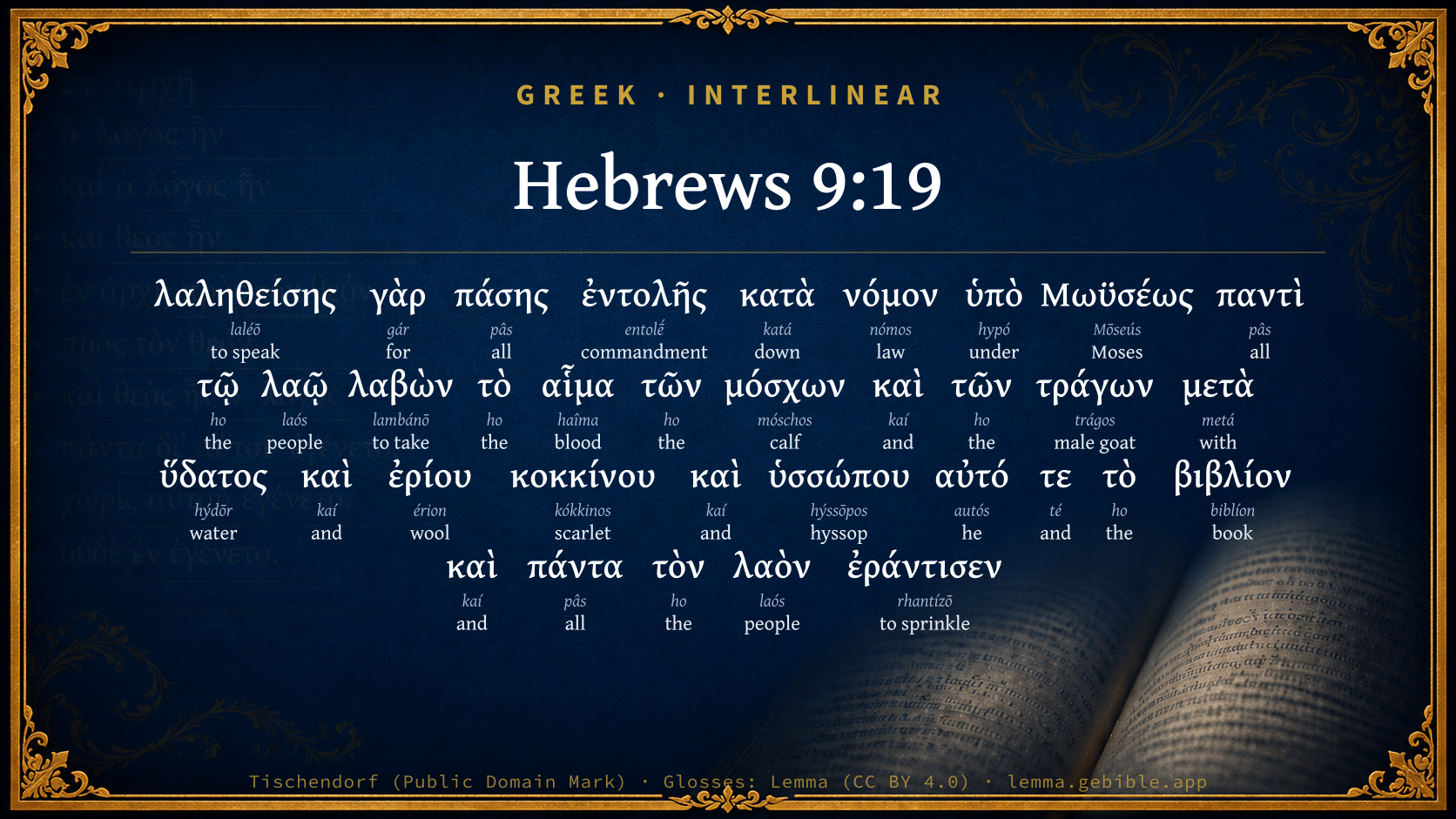
Download image
Cite this verse

Hebrews 9:19 (World English Bible). Public Domain. Lemma interlinear Bible study tool, https://lemma.gebible.app/v/hebrews/9/19.

Show BibTeX & RIS
BibTeX
RIS
English Translation
For when every commandment had been spoken by Moses to all the people according to the law, he took the blood of the calves and the goats, with water and scarlet wool and hyssop, and sprinkled both the book itself and all the people,
World English Bible · Public Domain
Highlights
  • 1 first appearance in the Greek New Testament
Full analysis ↓
Download a study sheet

One document with this verse’s original text, its word-by-word gloss line, the meaning frame, cross-references with their text, attributed commentary, and full source and license credits — printable, and it pastes into notes with its structure intact.

This verse Autodidact and up

Study sheet (.html) Plain text (.txt)

A passage Seminary Student

Up to 50 verses in one chapter. A passage sheet keeps up to 6 commentary sources and 12 cross-references per verse, in the order this page ranks them, and says so on the sheet whenever that leaves anything out. Ask for a single verse and you get the Autodidact verse sheet above.

Everything on this page stays free to read, with no account — the sheet is a download of what is already on screen, not access to it.

Want to remove ads? Support Godless Engineer
Compare translations 3

The same verse in 3 English versions, stacked beneath the original-language interlinear above. Click any original word for its lexicon entry.

Each is an independent rendering of the whole verse — the interlinear is not word-aligned to these translations.

Highlighted words mark where these versions differ — a whole-verse word diff, not a word-by-word alignment.

  • World English Bible Public Domain
    For when every commandment had been spoken by Moses to all the people according to the law, he took the blood of the calves and the goats, with water and scarlet wool and hyssop, and sprinkled both the book itself and all the people,
  • King James Version Public Domain
    For when Moses had spoken every precept to all the people according to the law, he took the blood of calves and of goats, with water, and scarlet wool, and hyssop, and sprinkled both the book, and all the people,
  • unfoldingWord Literal Text CC BY-SA 4.0
    For every command having been spoken according to the law by Moses to all the people, having taken the blood of the calves and the goats, with water and red wool and hyssop, he sprinkled both the scroll itself and all the people,

unfoldingWord Literal Text — © unfoldingWord, licensed CC BY-SA 4.0. Word-aligned USFM3 via Door43 (git.door43.org/unfoldingWord/en_ult).

Versions to compare (up to 4)

3 of 4 selected

Show all 19 translations

Every available English version of this verse, each an independent rendering of the whole verse.

  • World English Bible Public Domain
    For when every commandment had been spoken by Moses to all the people according to the law, he took the blood of the calves and the goats, with water and scarlet wool and hyssop, and sprinkled both the book itself and all the people,
  • Berean Standard Bible Public Domain
    For when Moses had proclaimed every commandment of the law to all the people, he took the blood of calves and goats, along with water, scarlet wool, and hyssop, and sprinkled the scroll and all the people,
  • Majority Standard Bible Public Domain
    For when Moses had proclaimed every commandment of the law to all the people, he took the blood of calves and goats, along with water, scarlet wool, and hyssop, and sprinkled the scroll and all the people,
  • King James Version Public Domain
    For when Moses had spoken every precept to all the people according to the law, he took the blood of calves and of goats, with water, and scarlet wool, and hyssop, and sprinkled both the book, and all the people,
  • American Standard Version (1901) Public Domain
    For when every commandment had been spoken by Moses unto all the people according to the law, he took the blood of the calves and the goats, with water and scarlet wool and hyssop, and sprinkled both the book itself and all the people,
  • Revised Version (1885) Public Domain
    For when every commandment had been spoken by Moses unto all the people according to the law, he took the blood of the calves and the goats, with water and scarlet wool and hyssop, and sprinkled both the book itself, and all the people,
  • Geneva Bible (1599) Public Domain
    For when Moses had spoken euery precept to the people, according to the Law, he tooke the blood of calues and of goates, with water and purple wooll and hyssope, and sprinckled both the booke, and all the people,
  • Douay-Rheims (1899) Public Domain
    For when every commandment of the law had been read by Moses to all the people, he took the blood of calves and goats, with water, and scarlet wool and hyssop, and sprinkled both the book itself and all the people,
  • Young's Literal Translation Public Domain
    for every command having been spoken, according to law, by Moses, to all the people, having taken the blood of the calves and goats, with water, and scarlet wool, and hyssop, he both the book itself and all the people did sprinkle,
  • Literal Standard Version CC BY-SA 4.0
    for every command having been spoken, according to law, by Moses, to all the people, having taken the blood of the calves and goats, with water, and scarlet wool, and hyssop, he sprinkled both the scroll itself and all the people,
  • Unlocked Literal Bible CC BY-SA 4.0
    For when Moses had given every command in the law to all the people, he took the blood of the calves and the goats, with water, red wool, and hyssop, and sprinkled both the scroll itself and all the people.
  • unfoldingWord Literal Text CC BY-SA 4.0
    For every command having been spoken according to the law by Moses to all the people, having taken the blood of the calves and the goats, with water and red wool and hyssop, he sprinkled both the scroll itself and all the people,
  • Darby Bible Public Domain
    For every commandment having been spoken according to [the] law by Moses to all the people; having taken the blood of calves and goats, with water and scarlet wool and hyssop, he sprinkled both the book itself and all the people,
  • World Messianic Bible Public Domain
    For when every commandment had been spoken by Moses to all the people according to the Torah, he took the blood of the calves and the goats, with water and scarlet wool and hyssop, and sprinkled both the book itself and all the people,
  • Webster's Bible Public Domain
    For when Moses had spoken every precept to all the people according to the law, he took the blood of calves and of goats, with water, and scarlet wool, and hyssop, and sprinkled both the book and all the people,
  • Free Bible Version CC BY-SA 4.0
    After Moses had given all the commandments of the law to everyone, he took the blood of calves and goats, and together with water, scarlet wool, and hyssop, sprinkled the book itself and all the people.
  • Bible in Basic English Public Domain
    For when Moses had given all the rules of the law to the people, he took the blood of goats and young oxen, with water and red wool and hyssop, and put it on the book itself and on all the people,
  • Text-Critical English NT CC BY 4.0
    For when Moses had proclaimed every commandment of the law to all the people, he took the blood of calves and goats, along with water, scarlet wool, and hyssop, and sprinkled the scroll itself and all the people,
  • Tyndale New Testament (1534) Public Domain
    For when all the commaundementes were redde of Moses vnto all the people he toke the bloud of calves and of Gotes with water and purple woll and ysope and sprynkled both the boke and all the people

Literal Standard Version (2020), Covenant Press — licensed CC BY-SA 4.0. Text via the HelloAO Bible API (eBible.org). Unlocked Literal Bible (unfoldingWord) — licensed CC BY-SA 4.0. Text via the HelloAO Bible API (eBible.org). unfoldingWord Literal Text — © unfoldingWord, licensed CC BY-SA 4.0. Word-aligned USFM3 via Door43 (git.door43.org/unfoldingWord/en_ult). Free Bible Version, Dr. Jonathan Gallagher — licensed CC BY-SA 4.0. Text via the HelloAO Bible API (eBible.org).

Word by word

More ways to search: Search by grammar → Find every occurrence → Compare this word →

Practice this passage: Drill this verse → Learn its vocabulary →

ἐρίου
érion
G2053
“wool”
Noun, Genitive, Singular, Neuter
Part of Speech
Noun
Case
Genitive
Number
Singular
Gender
Neuter
Full Thayer's Definition

Origin: of obscure affinity

TDNT: None

a. wool
  1. λαληθείσης laléō G2980 “to speak” Verb, Aorist, Passive, Participle, Genitive, Singular, Feminine
  2. γὰρ gár G1063 “for” Conjunction
  3. πάσης pâs G3956 “all” Adjective, Genitive, Singular, Feminine
  4. ἐντολῆς entolḗ G1785 “commandment” Noun, Genitive, Singular, Feminine
  5. κατὰ katá G2596 “down” Preposition
  6. νόμον nómos G3551 “law” Noun, Accusative, Singular, Masculine
  7. ὑπὸ hypó G5259 “under” Preposition
  8. Μωϋσέως Mōseús G3475 “Moses” Noun, Genitive, Singular, Masculine
  9. παντὶ pâs G3956 “all” Adjective, Dative, Singular, Masculine
  10. τῷ ho G3588 “the” Article, Dative, Singular, Masculine
  11. λαῷ laós G2992 “people” Noun, Dative, Singular, Masculine
  12. λαβὼν lambánō G2983 “to take” Verb, Aorist, Active, Participle, Nominative, Singular, Masculine
  13. τὸ ho G3588 “the” Article, Accusative, Singular, Neuter
  14. αἷμα haîma G129 “blood” Noun, Accusative, Singular, Neuter
  15. τῶν ho G3588 “the” Article, Genitive, Plural, Masculine
  16. μόσχων móschos G3448 “calf” Noun, Genitive, Plural, Masculine
  17. καὶ kaí G2532 “and” Conjunction
  18. τῶν ho G3588 “the” Article, Genitive, Plural, Masculine
  19. τράγων trágos G5131 “male goat” Noun, Genitive, Plural, Masculine
  20. μετὰ metá G3326 “with” Preposition
  21. ὕδατος hýdōr G5204 “water” Noun, Genitive, Singular, Neuter
  22. καὶ kaí G2532 “and” Conjunction
  23. κοκκίνου kókkinos G2847 “scarlet” Adjective, Genitive, Singular, Neuter
  24. καὶ kaí G2532 “and” Conjunction
  25. ὑσσώπου hýssōpos G5301 “hyssop” Noun, Genitive, Singular, Masculine
  26. αὐτό autós G846 “he” Personal pronoun, Accusative, Singular, Neuter
  27. τε té G5037 “and” Particle
  28. τὸ ho G3588 “the” Article, Accusative, Singular, Neuter
  29. βιβλίον biblíon G975 “book” Noun, Accusative, Singular, Neuter
  30. καὶ kaí G2532 “and” Conjunction
  31. πάντα pâs G3956 “all” Adjective, Accusative, Singular, Masculine
  32. τὸν ho G3588 “the” Article, Accusative, Singular, Masculine
  33. λαὸν laós G2992 “people” Noun, Accusative, Singular, Masculine
  34. ἐράντισεν rhantízō G4472 “to sprinkle” Verb, Aorist, Active, Indicative, 3rd person, Singular

About this verse

These counts appear in no published source. They are computed here, from the morphology-tagged text and Lemma’s own curated glosses. What Lemma adds →

35
words
24
distinct lemmas
General Epistles
section

Notable vocabulary

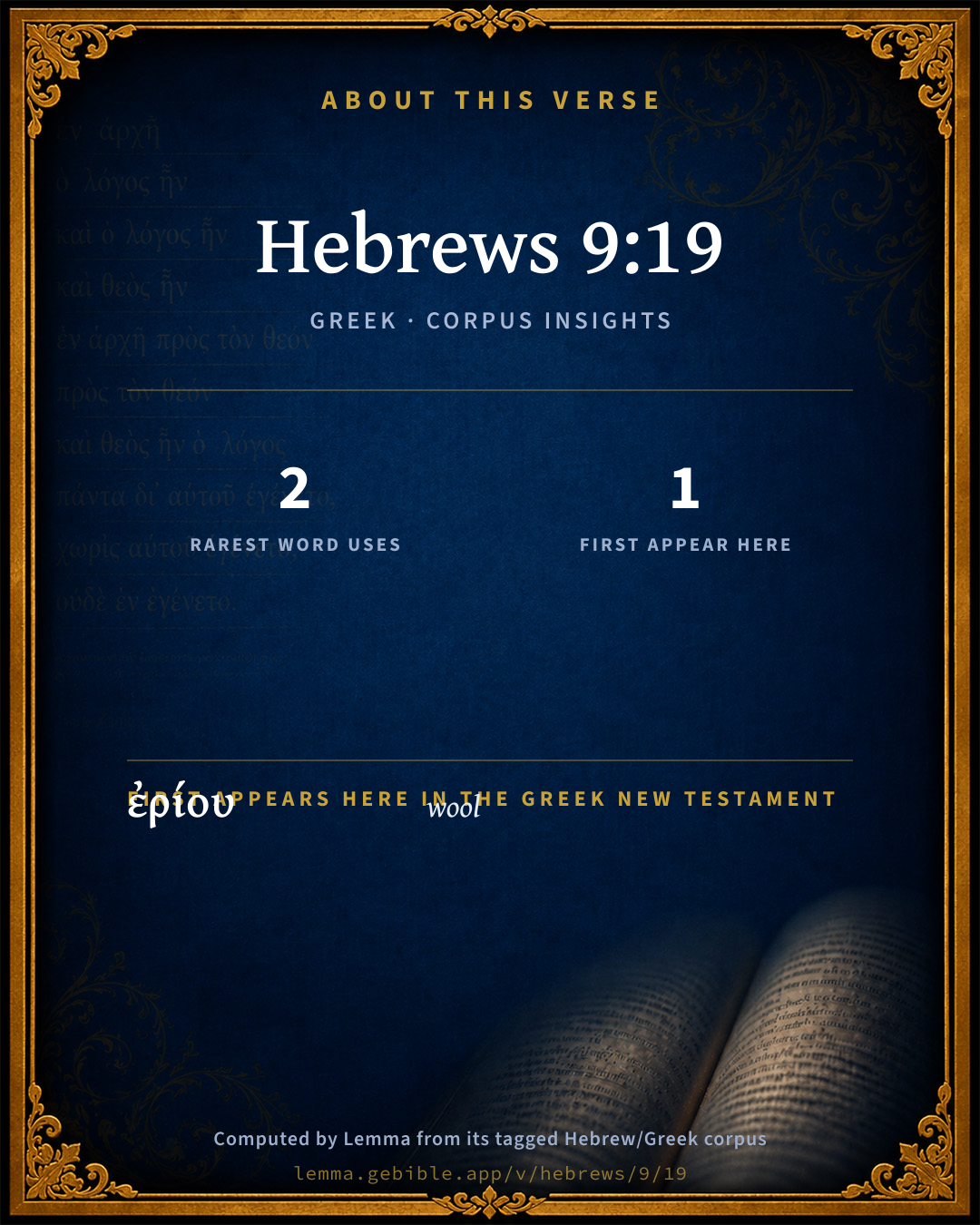
The rarest word here is ἐρίου wool G2053 — appearing just 2 times in the whole Greek New Testament.

First appearance in Scripture

This word makes its first canonical appearance in the Greek New Testament here:

Shared distinctive vocabulary

ἐρίου wool G2053 occurs in 2 verses of the Greek New Testament. Also found in:
Repetition

Words recur within this verse:

Cross-references

21

Topical passages linked to Hebrews 9:19 in the Treasury of Scripture Knowledge — connected by theme and wording, ordered by reader-vote popularity; previews shown in the World English Bible.

  • Exodus 24:5–11 He sent young men of the children of Israel, who offered burnt offerings and sacrificed peace-offerings of oxen to Yahweh.
  • Numbers 19:6 and the priest shall take cedar-wood, and hyssop, and scarlet, and cast it into the midst of the burning of the heifer.
  • Numbers 19:18 and a clean person shall take hyssop, and dip it in the water, and sprinkle it on the tent, and on all the vessels, and on the persons who were there, and on him who touched the bone, or the slain, or the dead, or the grave:
  • Ezekiel 36:25 I will sprinkle clean water on you, and you shall be clean: from all your filthiness, and from all your idols, will I cleanse you.
  • Hebrews 9:12 nor yet through the blood of goats and calves, but through his own blood, entered in once for all into the Holy Place, having obtained eternal redemption.
  • Hebrews 10:4 For it is impossible that the blood of bulls and goats should take away sins.
  • Leviticus 14:4–7 then the priest shall command them to take for him who is to be cleansed two living clean birds, and cedar wood, and scarlet, and hyssop.
  • Leviticus 16:14–18 He shall take some of the blood of the bull, and sprinkle it with his finger on the mercy seat on the east; and before the mercy seat he shall sprinkle some of the blood with his finger seven times.
  • 1 Peter 1:2 according to the foreknowledge of God the Father, in sanctification of the Spirit, that you may obey Jesus Christ and be sprinkled in his blood: Grace to you and peace be multiplied.
  • Exodus 12:22 You shall take a bunch of hyssop, and dip it in the blood that is in the basin, and strike the lintel and the two side-posts with the blood that is in the basin; and none of you shall go out of the door of his house until the morning.
  • Leviticus 1:2–3 "Speak to the children of Israel, and tell them, 'When anyone of you offers an offering to Yahweh, you shall offer your offering of the cattle, from the herd and from the flock.
  • Leviticus 1:10 "'If his offering is from the flock, from the sheep, or from the goats, for a burnt offering, he shall offer a male without blemish.
  • Leviticus 3:6 "'If his offering for a sacrifice of peace offerings to Yahweh is from the flock; male or female, he shall offer it without blemish.
  • Leviticus 14:49–52 To cleanse the house he shall take two birds, and cedar wood, and scarlet, and hyssop.
  • Isaiah 52:15 so shall he sprinkle many nations; kings shall shut their mouths at him: for that which had not been told them shall they see; and that which they had not heard shall they understand.
  • Matthew 27:28 They stripped him, and put a scarlet robe on him.
  • Mark 15:17 They clothed him with purple, and weaving a crown of thorns, they put it on him.
  • Mark 15:20 When they had mocked him, they took the purple off of him, and put his own garments on him. They led him out to crucify him.
  • John 19:2 The soldiers twisted thorns into a crown, and put it on his head, and dressed him in a purple garment.
  • John 19:5 Jesus therefore came out, wearing the crown of thorns and the purple garment. Pilate said to them, "Behold, the man!"
  • Psalms 51:7 Purify me with hyssop, and I will be clean. Wash me, and I will be whiter than snow.

Cross-references courtesy of OpenBible.info (CC BY 4.0).

Commentary

Notes on Hebrews 9:19 from classic Christian and Jewish commentators (each source and its license shown beneath its notes). The classic Christian expositions comment on the surrounding passage and are grouped to its opening verse, so a note may address several verses; the Jewish commentaries on the Tanakh (Rashi and others) are per-verse, so they appear only where the commentator wrote on this verse.

Lemma curates 59 commentaries, every one of them public domain or Creative Commons licensed, each selected and text-cleaned for this edition rather than reprinted as found. About our sources →

Whedon's Commentary on the Bible

Daniel D. Whedon

d. As by a profuse typical blood the earthly ritual things are purified, so with a better sacrifice are the heavenly things consecrated, Heb_9:19-28.

The profuseness of blood application in the types, 19-22; the correspondences in the antitype, 23-28.

19. For—To show with what tokens of death the first covenant testament was dedicated, our apostle goes back to the memorable scene when Jehovah and Israel first formed their covenant under Moses. Exo_24:3-8. Fresh from Sinai, Moses, having written the law in a book, reads it to the people, who fully assent to the compact between law and obedience. To ratify this compact or covenant, Moses is here described as taking the usual sprinkling-brush—a sprig of hyssop tipped with red wool—dipping it into the blood of slain animals, and sprinkling it over book and people, and, at a later period, (see note Heb_9:21,) over tabernacle and vessels used in the ceremonial ministry. Blood, shed forth or sprinkled, was the emblem of that death which the sinner deserved; of that death which the victim’s death symbolized for him instead of his own death; and which symbolized that death which symbolizes and is made substitute for the death of the world of sinners. As a symbol of the Substitute’s death, the blood represents the offerer’s remission of sin, and so purification, sanctification, and life. And with the sinner’s purification all his ritual surroundings must be purified. As these surroundings are made by sinful man they are tainted with his impurity, and must be purified; and blood is the sole, sovereign, universal, ritual purifier. Blood-besprinkled, they are holy; and so this newly made holy man walks and works amid holy things, a type of the holy beings of a holy heaven.

Had spoken—Had read from the book by him written for the purpose.

According to the law—The authority for all this use of typical blood.

Calves… goats—Calves and goats are not mentioned, but were doubtless used, as appears from other passages of the law. In Exo_24:5, (the narrative of the dedication,) “it is said that Moses sent young men who offered burnt offerings, and sacrificed sacrifices, which (Hebrews) were peace offerings to Jehovah, even bullocks. Now, although goats are not mentioned here, yet it is quite probable that the burnt offerings on this occasion were goats; for a burnt offering is a holocaust; that is, an offering entirely consumed by fire; while the peace offerings were mostly eaten by the offerers. That goats were used for all kinds of sacrifices, as well as bullocks, is quite evident from a mere inspection of the Levitical law; for example, goats are named as a burnt offering, Lev_1:10; Lev_4:24; Lev_4:28, etc., and elsewhere. It is altogether probable, then, that the holocausts or burnt offerings mentioned in Exo_24:5, as offered on the occasion of renewing the covenant, were goats; and were, of course, understood by a Jewish reader to be such, inasmuch as the peace offerings only are affirmed to have been bullocks.”—Stuart.

Water, scarlet wool, and hyssop—”That water was used as well as blood in order to sprinkle various things is clearly implied in Lev_14:4-7, compared with Lev_14:49-52; Num_19:18; Psa_51:7; Eze_36:25. The scarlet wool was connected with a branch of hyssop in order to make a convenient instrument for receiving and sprinkling the blood and water. It is not, indeed, expressly mentioned in Exodus xxiv, but it is, doubtless, implied; for this was the common instrument by which the rite of sprinkling was performed. So in Exo_12:7, direction is simply given to sprinkle the door posts of the Israelites with blood; and afterwards, in Heb_9:22, it is mentioned that this was to be done with a branch of hyssop. So in Lev_14:4-7, the scarlet wool and the hyssop are mentioned as employed in the office of sprinkling; and again in Lev_14:49-52. The hyssop is also mentioned in Num_19:18; Psa_51:7.”—Stuart.

The book of the law—”That Moses did sprinkle the book with blood no intimation is given in Exo_24:3-8. Yet nothing can be more probable than that such was the fact. Aaron, and his sons, and their garments, were sprinkled with blood when consecrated to the priest’s office. Exo_29:19-21. The blood of sacrifices was sprinkled upon the altar, Exo_29:16; Lev_1:5; Lev_1:11; Lev_3:2; Lev_3:13; also before the veil of the sanctuary, Lev_4:6; Lev_4:17; compare Lev_6:27; Lev_7:14; Lev_8:15; Lev_8:19; Lev_8:24; Lev_8:30; Lev_9:12; Lev_9:18, and others. Philo (de Vita Mosis, page 675, B.) has a passage which speaks of all the various apparatus of the tabernacle as being anointed with holy oil, and the vestments of the priests being sprinkled with blood. So Josephus, also, speaks of sprinkling the garments of Aaron and his sons with the blood of the slain beasts, and with spring water and holy chrism.”—Stuart.

Daniel D. Whedon (gen. ed.), Commentary on the Old and New Testaments (1874–1909) — public domain. Text from a community e-Sword module.

Godbey's Commentary on the New Testament

William B. Godbey

ARGUMENT 9

THE TWO BAPTISMS.

19-22. Here we learn that Moses sprinkled the tabernacle, the Pentateuch, and all the people assembled at the tabernacle door, with water tinged with blood, upon the ratification of the Sinai covenant and the dedication of the tabernacle in the wilderness. Washings in Heb 9:10 is baptisms in the Greek. In Heb 9:13 it is said they were performed by sprinkling the bloody water on the bodies of the people for the sanctification of their flesh from ceremonial pollution. In Heb 9:19 the Holy Spirit says Moses sprinkled all the people, i.e., three millions, at the tabernacle door in the use of hyssop and scarlet wool, by which he sprinkled the bloody water on the people and the tabernacle. If you want a case of Scriptural baptism by sprinkling you have it here on a grand scale. When Moses sprinkled three millions of people at the tabernacle door, the Holy Spirit says he baptized them (Heb 9:10). I am no stickler on water baptism. I care nothing about modes. However, it is absolutely certain that they baptized by sprinkling in the days of Moses and the prophets. Water baptism in our day is an eliminated survivor of the copious catharisms peculiar to Judaism, and has nothing whatever to do with salvation. It merely typifies the baptism with the Spirit.

23. “Therefore truly it is necessary that the patterns of things in these heavens be purified, but the heavenlies themselves by greater sacrifices than these.” We have here the Greek epourania, the heavenlies, rendered emphatic by the specific pronoun auta. Now, what are these heavenlies which must be purified by greater sacrifices than the constituencies of the material kingdom, i.e., the tabernacle and the physical bodies of the people? The literal meaning of epourania is the heavenlies, and simply means our immortal spirits, which become heavenly by virtue of this wonderful purification, and are destined to live in heaven forever, associated eternally with celestial entities. Now you are prepared to appreciate this beautiful argument given by the inspired Apollos. Just as it was absolutely necessary under the Mosaic law that the bodies of the people should be sprinkled, i.e., baptized with water and animal blood before they were allowed to enter the visible tabernacle and enjoy its privileges, even so is it pre-eminently essential that our immortal spirits shall be baptized, i.e., sanctified by the Holy Ghost, typified by the water which Moses sprinkled on the people, and the blood of Jesus symbolized by the animal blood, with which Moses sprinkled the people. Here you see the beautiful and powerful analogy between the type and the antitype, the physical and the spiritual, the earthly and the heavenly, Moses and Christ, the water and the Holy Ghost, the blood of bulls and goats and the blood of Jesus. We are fortunate to live in the spiritual dispensation, after the evanescence of all the types and shadows, and the glorious sunburst of the long anticipated Antitype on the world.

William B. Godbey, Commentary on the New Testament (1896–1900) — public domain. Text from a community e-Sword module.

Bengel's Gnomon

Johann Albrecht Bengel

Heb 9:19. Λαληθείσης, having been recited or spoken) Exo 24:16, etc.—πάσης ἐντολῆς κατὰ νόμον, every precept according to the law) Moses had recited or read those commandments which occur in Exodus 20, and perhaps also those which occur in the following chapters. And the brief indication of the written book was tantamount to a recapitulation of all that was recited.—τῶν μόσχων καὶ τράγων, of calves and goats) In Exo 24:5 they are expressly called μοσχάρια, little calves: the word ὁλοκαυτώματα, in that passage implies the τράγους, spoken of here.—μετὰ ὕδατος καὶ ἐρίου κοκκίνου καὶ ὑσσώπου, with water and scarlet wool and hyssop) These are not found in the passage quoted, but are taken for granted as already well known from other passages in the writings of Moses, Lev 14:5-6. The scarlet wool corresponds to the Hebrew שני החולעת. The LXX. translate תילעת κόκκινον, שני κλωστὸν διπλοῦν, double spun (twined), from its form: the apostle terms it from its material (wool); scarlet colour, viz. as being like blood.—βιβλίον) Many, and the Latins too from the Vulgate, construe this word with ἐῤῥάντισε, he sprinkled; but it should evidently be construed with λαβὼν, having taken, as Exo 24:7, καὶ λαβὼν τὸ βιβλίον τῆς διαθήκης, and having taken the book of the covenant. There is an elegance in the conjunction; τὸ αἷμα αὐτό τε τὸ βιβλίον, as appears by comparing those words, τοῦτο τὸ αἷμα τῆς διαθήκης; that in this ceremony the blood may be shown by itself; the testament, by the showing of the book; and that ἑγκαινισμὸς, the dedication, may be perfected by that double exhibition (showing): αὐτὸ, itself, is added, because the testament described in the book, was of more importance than that blood. Τε does not always refer to the following καὶ, Heb 9:1; Joh 2:15, where the τε connects the discourse rather with what goes before, than with what follows: also the sheep and the oxen: comp. moreover Act 26:11; wherefore it is not necessary here to construe αὐτό τε τὸ βιβλίον καὶ πάντα τὸν λαὸν ἐῤῥάντισε. The other things which are here mentioned by the apostle, and yet are not found in the 24th chap. of Exod., may be derived from other passages; but respecting the sprinkling of the book, which notwithstanding, if true, would constitute a very large portion of that ceremony, we find nothing in all the books of Moses. Furthermore, if the book had been sprinkled, and if the apostle had spoken of that sprinkling, he would have joined it, not with the sprinkling of the people, but with the sprinkling of the tabernacle and the vessels, and therefore of the altar; comp. Van Hoeke, p. 190. See, however, Jun. I. 1209, l. 54. But indeed it was not befitting that the book itself should be even sprinkled, for the book, containing the word of GOD, represented there GOD Himself, as Flacius in Gloss. says; where, however, he is of opinion that the book was also sprinkled. No doubt the tabernacle along; with the vessels [the tabernacle being at that very time adapted to the altar, Exo 24:6-8; Exo 25:8.—V. g.] needed purification, Heb 9:21; Lev 16:16; Lev 16:19-20; Lev 16:33; 2Ch 29:21; but the book, or the word of GOD, did not need it. And since these things are so, yet καὶ before πάντα is not only no disadvantage, but has much elegance. For the sentence is copulative: ΚΑΙ πάντα τὸν λαὸν ἐῤῥάντισε, “Moses sprinkled all the people,” on the one side; ΚΑΙ τὴν σκηνὴν δὲ—ἐῤῥἁντισεν (Heb 9:21), “and the tabernacle indeed—he the same sprinkled,” on the other. The Latins say, et, et vero, both, and indeed, or, non modo, verum etiam, not only, but also. So οὔτε—καὶ οὐ, Rev 9:20-21.—πάντα τὸν λαὸν ἐῤῥάντισε) LXX., κατεσκέδασε τοῦ λαοῦ, in the place quoted above. But elsewhere they often put ῥαίνω, ῥαντίζω, κ.τ.λ.

Bengel's Gnomon of the New Testament — English translation (T&T Clark, Edinburgh, 1860) — public domain. Text from a community e-Sword module.

Meyer's Critical & Exegetical Commentary

Heinrich August Wilhelm Meyer

Heb_9:19-20. Historic proof for the assertion, Heb_9:18, with a free reference to Exo_24:3-8.

κατὰ τὸν νόμον] is taken by Schlichting, Calov, Jac. Cappellus, Seb. Schmidt, Bengel, Storr, Böhme, Bleek, Bisping, al., along with πάσης ἐντολῆς: every precept according to the law, i.e. as it was contained in the law. So already the Vulgate: lecto enim omni mandato legis. But against this construction the absence of the connecting article and the strangeness of the preposition κατά. Rightly, therefore, have Oecumenius, Faber Stapulensis, Erasmus, Vatablus, Calvin, Beza, Grotius, Wittich, Braun, Schulz, Kuinoel, Klee, Bloomfield, Delitzsch, Alford, Maier, Moll, Hofmann, and others referred κατὰ τὸν νόμον to λαληθείσης. Only we must not explain, as is ordinarily done, in accordance with the commandment received of God, but the sense is: after, in accordance with the law received of God, every precept had been proclaimed by Moses to the whole people. The standard for the proclamation of the ἐντολαί was the νόμος, since it contained these ἐντολαί.

παντὶ τῷ λαῷ] Exo_24:3 stands only διηγήσατο τῷ λαῷ. But παντί resulted from the ἀπεκρίθη δὲ πᾶς ὁ λαός there immediately following.

καὶ τῶν τράγων] and of the goats. Of goats slain in sacrifice the underlying narrative of Exodus says nothing. Schlichting, Jac. Cappellus, Grotius, Bengel, Böhme, and others therefore suppose that the author had in view the burnt-offerings mentioned before the thank-offerings of oxen, Exo_24:5; inasmuch as, according to Lev_1:10 ff; Lev_4:23 ff; Lev_9:2-3, Num_6:10-11; Num_7:27, rams and he-goats, as well as other smaller animals, might be selected for burnt-offerings. Nevertheless, it is also possible that, as conjectured by Bleek, de Wette, and Bisping, there was present to the mind of the author that sacrifice of bullocks and goats already referred to, Heb_9:12-13, which the high priest was to offer on the great day of atonement.

μετὰ ὕδατος καὶ ἐρίου κοκκίνου καὶ ὑσσώπου] along with water and crimson wool and hyssop. With regard to this also, nothing is stated in the corresponding passage of Exodus. But all three things are elsewhere mentioned in connection with legally enjoined aspersions for purification. Comp. Num_19:6; Num_19:17 f.; Lev_14:2 ff., Lev_14:49 ff. In accordance therewith, a mixture of fresh spring water in some cases with the ashes of the red heifer, in others with the blood of a slain bird, was prescribed in the case of aspersions which were appointed for the cleansing of one defiled by contact with a corpse or by leprosy. In like manner, according to the passages above referred to, hyssop (אֵזוֹב, comp. on this plant, Winer, Bibl. Realwörterb. Bd. II. 2 Aufl. p. 819 f.) and crimson wool. With the latter the hyssop stem was probably bound round, and this served as a brush for sprinkling the blood. Comp. this use of hyssop in Exo_12:22.

αὐτό τε τὸ βιβλίον καὶ πάντα τὸν λαὸν ἐράντισεν] he sprinkled as well the book itself as also the whole people. τὸ βιβλίον is the βιβλίον τῆς διαθήκης, Exo_24:7. Of a sprinkling likewise of this book of the covenant, nothing, however, is told us in Exodus. It has therefore been proposed, by way of removing the difference, to make τὸ βιβλίον still dependent upon the preceding λαβών. So, after the precedent of the Coptic and Armenian versions, Grotius, Wittich, Surenhus, Cramer, Bengel, Michaelis, Storr, Morus, Ewald, and others. But the καί following βιβλίον renders this impossible. For the setting aside of this καί by pronouncing it spurious (Colomesius, Valckenaer), or by the assumption of a pleonasm (so ordinarily), is an act of violence; while we are prevented from placing it, with Bengel and Ewald, in correspondence with the καί, Heb_9:21, as et … et vero, or non modo … vero etiam,apart from the clumsiness of construction thus arising, and leaving out of consideration the inconvenient δέ,by the twice occurring of the verb ἐράντισεν, Heb_9:19; Heb_9:21.

πάντα τὸν λαόν] LXX. Heb_9:8 : Λαβὼν δὲ Μωϋσῆς τὸ αἷμα κατεσκέδασε τοῦ λαοῦ. Schlichting: Omnem autem populum conspersisse dicitur, quia qui ex proxime astantibus conspersi fuerant, universi populi personam hac in parte gessere, ita ut totus populus conspersus fuisse censeretur.

ἐράντισεν] sc. for consecration and purification.

Meyer — Critical and Exegetical Commentary on the New Testament — English translation by Peter Christie, edited by Frederick Crombie (T&T Clark, 1880) — public domain. Text from a community e-Sword module.

Geneva Bible (1599)

Geneva Bible translators

He useth to sprinkle.

As the Lord had commanded.

Geneva Bible (1599) marginal notes — public domain. Text via Bolls.life.

Jamieson, Fausset & Brown

Robert Jamieson, A. R. Fausset & David Brown

For--confirming the general truth, Heb 9:16.

spoken . . . according to the law--strictly adhering to every direction of "the law of commandments contained in ordinances" (Eph 2:15). Compare Exo 24:3, "Moses told the people all the words of the Lord, and all the judgments; and all the people answered with one voice," &c.

the blood of calves--Greek, "the calves," namely, those sacrificed by the "young men" whom he sent to do so (Exo 24:5). The "peace offerings" there mentioned were "of oxen" (Septuagint, "little calves"), and the "burnt offerings" were probably (though this is not specified), as on the day of atonement, goats. The law in Exodus sanctioned formally many sacrificial practices in use by tradition, from the primitive revelation long before.

with water--prescribed, though not in the twenty-fourth chapter of Exodus, yet in other purifications; for example, of the leper, and the water of separation which contained the ashes of the red heifer.

scarlet wool, and hyssop--ordinarily used for purification. Scarlet or crimson, resembling blood: it was thought to be a peculiarly deep, fast dye, whence it typified sin (see on Isa 1:18). So Jesus wore a scarlet robe, the emblem of the deep-dyed sins He bore on Him, though He had none in Him. Wool was used as imbibing and retaining water; the hyssop, as a bushy, tufty plant (wrapt round with the scarlet wool), was used for sprinkling it. The wool was also a symbol of purity (Isa 1:18). The Hyssopus officinalis grows on walls, with small lancet-formed woolly leaves, an inch long, with blue and white flowers, and a knotty stalk about a foot high.

sprinkled . . . the book--namely, out of which he had read "every precept": the book of the testament or covenant. This sprinkling of the book is not mentioned in the twenty-fourth chapter of Exodus. Hence BENGEL translates, "And (having taken) the book itself (so Exo 24:7), he both sprinkled all the people, and (Heb 9:21) moreover sprinkled the tabernacle." But the Greek supports English Version. Paul, by inspiration, supplies the particular specified here, not in Exo 24:7. The sprinkling of the roll (so the Greek for "book") of the covenant, or testament, as well as of the people, implies that neither can the law be fulfilled, nor the people be purged from their sins, save by the sprinkling of the blood of Christ (Pe1 1:2). Compare Heb 9:23, which shows that there is something antitypical to the Bible in heaven itself (compare Rev 20:12). The Greek, "itself," distinguishes the book itself from the "precepts" in it which he "spake."

Jamieson, Fausset & Brown — Commentary Critical and Explanatory on the Whole Bible (1871) — public domain (CC PDM 1.0). Text via the HelloAO Bible API.

Adam Clarke's Commentary

Verse 19. When Moses had spoken every precept] The place to which the apostle alludes is Ex 24:4-8, where the reader is requested to consult the notes.

And sprinkled both the book] The sprinkling of the book is not mentioned in the place to which the apostle refers, (see above,) nor did it in fact take place. The words αυτο τε το βιβλιον, and the book itself, should be referred to λαβων, having taken, and not to ερραντισε, he sprinkled; the verse should therefore be read thus: For after every commandment of the law had been recited by Moses to all the people, he took the blood of the calves, and of the goats, with water and scarlet wool, and the book itself, and sprinkled all the people. The rite was performed thus: Having received the blood of the calves and goats into basins, and mingled it with water to prevent it from coagulating, he then took a bunch of hyssop, and having bound it together with thread made of scarlet wool, he dipped this in the basin, and sprinkled the blood and water upon the people who were nearest to him, and who might be considered on this occasion the representatives of all the rest; for it is impossible that he should have had blood enough to have sprinkled the whole of the congregation.

Some think that the blood was actually sprinkled upon the book itself, which contained the written covenant, to signify that the covenant itself was ratified by the blood.

Adam Clarke's Commentary on the Bible (1810–1826) — public domain. Text from a community e-Sword/MySword module.

Ellicott's Commentary for English Readers

(19) Every precept.—Or, commandment. See Exo_24:3; where we read that Moses “told the people all the words of the Lord, and all the judgments.” These he wrote in a book (Heb_9:4), and this “book of the covenant” (Heb_9:7) he “read in the audience of the people.” The contents would probably be the Ten Commandments, and the laws of Exo_20:22 to Exo_23:33.

Of calves and of goats.—In Exodus (Heb_9:5) we read of “burnt offerings” and of “peace offerings of oxen.” The “goats” may be included in the burnt offerings; for though Jewish tradition held that a goat was never sacrificed as a burnt offering, Lev_1:10 is clear on the other side. It is possible that “the calves and the goats” may be only a general expression for “the sacrificial victims.” (See Heb_9:12.)

With water, and scarlet wool, and hyssop.—In Exodus 24 there is no mention of these details, but similar notices are found in other parts of the Pentateuch, where the ceremony of sprinkling for purification is described (Exo_12:22; Lev_14:4; Lev_14:6; and Num_19:6; Num_19:17-18). The water (itself an emblem and means of cleansing) was designed to prevent the coagulation of the blood, and to increase the quantity of the purifying fluid. The “scarlet wool” may have been used to bind the hyssop to the stick of cedar-wood, which was the instrument of sprinkling. The precise notices in the Law forbid us to doubt that each of these substances had a definite symbolical meaning, but to us the subject is involved in obscurity.

Both the book and all the people.—The Greek is more emphatic: both the book itself and all the people. The latter fact alone is mentioned in Exodus (Heb_9:8). The sprinkling of the book of the covenant may be regarded from two points of view. It may depend either on the same principle as the (later) sprinkling of the Tabernacle (Heb_9:22), and the “reconciling” of the Tabernacle and the Holy Place (Lev_16:20) on the Day of Atonement; or on the symbolism of the covenant as noticed above (Heb_9:15-17). In the latter case we must suppose that, as the blood was divided into two portions (Exo_24:6) in token of the two parties to the covenant, and part “cast upon the altar,” the book of the covenant was associated with the altar as representing the presence of Jehovah.

A Bible Commentary for English Readers, edited by Charles John Ellicott (1878–1897) — public domain. Text from a community e-Sword module.

The Cambridge Bible for Schools and Colleges

gen. ed. J. J. S. Perowne

19. and of goats] This is not specially mentioned, but it may be supposed that “goats” were among the burnt-offerings mentioned in Exo_24:5.

water, and scarlet wool, and hyssop] These again are not mentioned in Exo_24:6, but are perhaps added from tradition on the analogy of Exo_12:22; Num_19:6; and Lev_14:4-6.

hyssop] the dry stalks of a plant resembling marjoram.

both the book] See Exo_24:6-8, where however it is not specially mentioned that the Book was sprinkled. The Jewish tradition was that it lay upon the altar (see Exo_24:7). The “book” seems to have been the written record of what was uttered to Moses in Exo_20:22 to Exo_23:33. This is one of several instances in which the writer shews himself learned in the Jewish legends (Hagadoth).

The Cambridge Bible for Schools and Colleges (gen. ed. J. J. S. Perowne; Cambridge University Press, 1878–1918) — public domain. Text from a community e-Sword module.

John Gill's Exposition

For when Moses had spoken every precept,.... Contained in the decalogue, in the book of the covenant, everyone of the precepts in Exo 22:1 for this is to be understood of the written law, and not of the oral law the Jews talk of, which they say Moses first delivered by word of mouth to Aaron, then to his two sons, Eleazar and Ithamar, then to the seventy elders of Israel, and then to the whole congregation; so that Aaron heard it four times, his sons thrice, the seventy elders twice, and all Israel once (g): but this is the written law which he spoke audibly, and in a known language,

to all the people according to the law; which God gave him on the Mount: this may instruct persons concerned in the public ministry, to speak out plainly and clearly the whole counsel of God, to all to whom they are sent, according to the word of God, which is the rule of faith and practice:

he took the blood of calves, and of goats; in the relation of this affair in Exo 24:5 which is referred to, only mention is made of oxen, bullocks, or heifers, here called calves, which were sacrificed for peace offerings, and not of goats; though perhaps they may be intended by the burnt offerings there spoken of, since they were sometimes used for burnt offerings, Lev 1:10. The Syriac version only reads, "he took the blood of an heifer"; and the Arabic version, "he took the blood of calves"; but all the copies, and other versions, read both. "With water, and scarlet wool, and hyssop"; neither of these are mentioned in Exo 24:1, but since sprinkling is there said to be used, and blood and water mixed together, and scarlet and hyssop were used in sprinkling, as in sprinkling the leper, and the unclean house, Lev 14:5 the apostle justly concludes the use of them here; the blood, with water, was typical of the blood and water which sprung from the side of Christ pierced on the cross, the one signifying justification by him, the other sanctification; the scarlet wool, which is originally white, but becomes scarlet by being dyed, may denote the native purity of Christ, and his bloody sufferings and death; the hyssop may signify his humility, and the purging virtue of his blood, and the sweet smelling savour of his person, righteousness, and sacrifice. The apostle calls scarlet, scarlet wool; though whenever the word is used in the Jewish laws of the Old Testament, wool is not expressed, but it is always intended; for it is a rule with the Jews (h), that

"the blue, which is spoken of in every place, is wool dyed of a sky colour; purple is wool dyed red, and scarlet is wool dyed in scarlet.''

And sprinkled both the book, and all the people. In Exo 24:8 no mention is made of the sprinkling of the former, only of the latter, which the apostle either concludes from the sprinkling of the blood upon the altar, upon which the book might lie, or from tradition, or from divine revelation: some think it does not necessarily follow from the text, that the book was sprinkled; and repeating the word "he took", read the words, "and he took the book and sprinkled all the people"; but this seems not natural, but forced; and besides, all the Oriental versions are express for the sprinkling of the book: the book of the law was sprinkled, not because of any impurity in it, but to show the imperfection of it, and its insufficiency to justify men; or rather the imperfection of man's obedience to it, and to point out what the law requires in case of disobedience, even the blood and life of men; and what it would be, was it not sprinkled with blood, or satisfied by the blood of Christ, namely, an accusing, cursing, and condemning law: the people, all of them, being sprinkled with the blood, were typical of God's peculiar people, even all the elect of God, being sprinkled with the blood of Christ, called the blood of sprinkling, by which they are redeemed, and which speaks peace and pardon to them. Some have thought only the seventy elders were sprinkled, as representing the whole congregation; and others, that the twelve pillars were only sprinkled, as representing the twelve tribes of Israel; but Moses and the apostle agree, that they were the people that were sprinkled.

(g) Maimon. Praefat. ad Yad Chazaka. (h) lb. Hilchot Cele Hamikdash, c. 8. sect. 13.

John Gill's Exposition of the Whole Bible (1746–1763) — public domain (CC PDM 1.0). Text via the HelloAO Bible API.

Trapp's Complete Commentary

John Trapp

19 For when Moses had spoken every precept to all the people according to the law, he took the blood of calves and of goats, with water, and scarlet wool, and hyssop, and sprinkled both the book, and all the people,

Ver. 19. He took the blood] See Exo 24:8.

And sprinkled both the book] Which, as it seemeth, was laid on the altar to be sanctified thereby. The very book of God is sprinkled with the blood of Christ, that it may be opened and of use to the faithful.

John Trapp, A Commentary or Exposition upon All the Books of the Old and New Testament (1647–1656) — public domain. Text from a community e-Sword module.

Albert Barnes' Notes on the Bible

For when Moses had spoken every precept to all the people - When he had recited all the Law, and had given all the commandments entrusted him to deliver; Exo 24:3.

He took the blood of calves and of goats - This passage has given great perplexity to commentators from the fact that Moses in his account of the transactions connected with the ratification of the covenant with the people, Exo. 24, mentions only a part of the circumstances here referred to. He says nothing of the blood of calves and of goats; nothing of water, and scarletwool, and hyssop; nothing of sprinkling the book, the tabernacle, or the vessels of the ministry. It has been made a question, therefore, whence Paul obtained a knowledge of these circumstances? Since the account is not contained in the Old Testament, it must have been either by tradition, or by direct inspiration. The latter supposition is hardly probable, because:

(1) The information here can hardly be regarded as of sufficient importance to have required an original revelation; for the illustration would have had sufficient force to sustain his conclusion if the literal account in Exodus only had been given, that Moses sprinkled the people, but

(2) Such an original act of inspiration here would not have been consistent with the object of the apostle. In that argument it was essential that he should state only the facts about the ancient dispensation which were admitted by the Hebrews themselves. Any statement of his own about things which they did not concede to be true, or which was not well understood as a custom, might have been called in question, and would have done much to invalidate the entire force of the argument. It is to be presumed, therefore, that the facts here referred to had been preserved by tradition; and in regard to this, and the authority due to such a tradition, we may remark:

(1)That it is well known that the Jews had a great number of traditions which they carefully preserved;

(2)That there is no improbability in the supposition that many events in their history would be preserved in this manner, since in the small compass of a volume like the Old Testament it cannot be presumed that all the events of their nation had been recorded;

(3)Though they had many traditions of a trifling nature, and many which were false (compare notes on Mat 15:2), yet they doubtless had many that were true;

(4)In referring to those traditions, there is no impropriety in supposing that Paul may have been guided by the Spirit of inspiration in selecting only those which were true; and,

(5)Nothing is more probable than what is here stated. If Moses sprinkled “the people;” if he read “the book of the law” then Exo 24:7, and if this was regarded as a solemn act of ratifying a covenant with God, nothing would be more natural than that he should sprinkle the book of the covenant, and even the tabernacle and its various sacred utensils.

We are to remember also, that it was common among the Hebrews to sprinkle blood for the purpose of consecrating, or as an emblem of purifying. Thus, Aaron and his sons and their garments were sprinkled with blood when they were consecrated to the office of priests, Exo 29:19-21; the blood of sacrifices was sprinkled on the altar, Lev 1:5, Lev 1:11; Lev 3:2, Lev 3:13; and blood was sprinkled before the veil of the sanctuary, Lev 4:10, Lev 4:17; compare Lev 6:27; Lev 7:14. So Josephus speaks of the garments of Aaron and of his sons being sprinkled with “the blood of the slain beasts, and with spring water.” “Having consecrated them and their garments,” he says, “for seven days together, he did the same to the tabernacle, and the vessels thereto belonging, both with oil and with the blood of bulls and of rams.” Ant. book iii, chapter 8, section 6. These circumstances show the strong “probability” of the truth of what is here affirmed by Paul, while it is impossible to prove that Moses did not sprinkle the book and the tabernacle in the manner stated. The mere omission by Moses cannot demonstrate that it was not done. On the phrase “the blood of calves and of goats,” see note on Heb 9:12.

With water - Agreeably to the declaration of Josephus that “spring water was used.” In Lev 14:49-51, it is expressly mentioned that the blood of the bird that was killed to cleanse a house from the plague of leprosy should be shed over running water, and that the blood and the water should be sprinkled on the walls. It has been suggested also (see Bloomfield), that the use of water was necessary in order to prevent the blood from coagulating, or so as to make it possible to sprinkle it.

And scarlet wool - Margin, “Purple.” The word used here denotes crimson, or deep-scarlet. The colour was obtained from a small insect which was found adhering to the shoots of a species of oak in Spain and in Western Asia, of about the size of a pea. It was regarded as the most valuable of the colours for dyeing, and was very expensive. Why the wool used by Moses was of this colour is not known, unless it be because it was the most expensive of colours, and thus accorded with everything employed in the construction of the tabernacle and its utensils. Wool appears to have been used in order to absorb and retain the blood.

And hyssop - That is, a bunch of hyssop intermingled with the wool, or so connected with it as to constitute a convenient instrument for sprinkling; compare Lev 14:51. Hyssop is a low shrub, regarded as one of the smallest of the plants, and hence, put in contrast with the cedar of Lebanon. It sprung out of the rocks or walls, 1Ki 4:33, and was used for purposes of purification. The term seems to have comprised not only the common hyssop, but also lavender and other aromatic plants. Its fragrance, as well as its size, may have suggested the idea of using it in the sacred services of the tabernacle.

And sprinkled both the book - This circumstance is not mentioned by Moses, but it has been shown above not to be improbable. Some expositors, however, in order to avoid the difficulty in the passage, have taken this in connection with the word λαβὼν labōn - rendered “he took” - meaning “taking the blood, and the book itself;” but the more natural and proper construction is, that the book was sprinkled with the blood.

And all the people - Moses says, “and sprinkled it on the people;” Exo 24:8. We are not to suppose that either Moses or Paul designs to say that the blood was actually sprinkled on each one of the three millions of people in the wilderness, but the meaning doubtless is that the blood was sprinkled over the people, though in fact it might have fallen on a few. So a man now standing on an elevated place, and surrounded by a large assembly, if he should sprinkle water over them from the place where he stood, might be said to sprinkle it on the people, though in fact but few might have been touched by it. The act would be equally significant whether the emblem fell on few or many.

Albert Barnes' Notes on the Bible (1834–1885) — public domain. Text from a community e-Sword/MySword module.

Matthew Poole's English Annotations

For when Moses had spoken every precept to all the people according to the law: that the Old Testament was ratified by blood the Spirit proveth by instance, Moses as mediator having spoken every command, promise, and article of the covenant to all Israel, who came out of Egypt, according to God’s charge, reading all to them out of the book, wherein by God’s order he had written it; and the people declaring their assent and consent unto this covenant, as Exo 24:3,4,7, as God covenanted and bound himself to his part of it.

He took the blood of calves, &c.: the Mediator then took, according to the common rite in such ratifying acts, a sprinkling bush made of scarlet wool, cedar wood, and hyssop, Lev 14:4,6; Num 19:6,18; to which David alludeth, Psa 51:7; and with this bunch sprinkles the blood and water (which he had received into basons from the sacrifices, killed by the first-born, for burnt-offerings and peace-offerings, and there mixed, Exo 24:5,6; Le 9:3,4; 14:51) on the altar, book of the covenant, and all Israel, Exo 24:6-8, confirming and ratifying the covenant on God’s part and theirs, as the words annexed, Heb 9:20, and Exo 24:8, affirm: Behold the blood by which this covenant is made firm and inviolable. All this is but a shadow and type of the ratification of the new covenant with sinners by the death of Christ; he is the Mediator that brings God’s testamental covenant to them; he dieth and puts it in force; by his blood ratifieth it on God’s part and theirs, by his Spirit applying it to them, and sprinkling it on them; he brings home the testamental blessings to them, Heb 10:22; 11:28; 12:24; Isa 52:15; Eze 36:25; 1Pe 1:2.

Matthew Poole's English Annotations on the Holy Bible (1683–1685) — public domain. Text from a community e-Sword/MySword module.

The Pulpit Commentary

Vers. 19, 20. For when Moses had spoken every precept to all the people according to the Law, he took the blood of the calves and the goats, with water anti scarlet wool, and hyssop, and sprinkled both the book itself and all the people, saying, This is the blood of the covenant (A.V testament) which God enjoined unto you (strictly, to you-ward; i.e. enjoined to me for you). The reference is to Exo_24:3-9, where the account is given of the inauguration of the covenant between God and the Israelites through Moses. He "came and told the people all the words of the LORD, and all the judgments: and all the people answered with one voice, and said, All the words which the LORD hath said will we do." And then he wrote all the words of the LORD in a book, and builded an altar under the mount, and sacrifices were offered, and half of the blood was sprinkled on the altar, and the words were read from the book, and again the people undertook to observe them, and the other half of the blood was sprinkled on the people, and so the covenant was ratified. The essential part of the whole ceremony being the "bloodshedding," it is of no importance for the general argument that the account in Exodus is not exactly followed. The variations from it are these:

(1) The mention of goats as well as calves or bullocks of water of the scarlet wool and hyssop and of the sprinkling of the book, instead of the altar, as in Exodus.

(2) The words spoken by Moses are differently given, touto being substituted for idou o Yeov for Kuriov and eneteilato for dieyeto . On these variations we may observe that the mention of goats may have been suggested to the writer"s mind by the ceremonies of the Day of Atonement, previously alluded to; and it is not inconsistent with the account in Exodus, where the victims used for the "burnt offerings" are not specified, only the bullocks for "peace offerings." Nor is there inconsistency in the other additions to the ceremonial. The scarlet wool and hyssop were the usual instruments of aspersion. (a bunch of the latter being apparently bound by the former to a stick of cedar; cf. Exo_12:22 Lev_14:50 Num_19:6, Num_19:18) It may have been usual to mix water with the blood used for aspersion, if only to prevent coagulation, (see Lightfoot on Joh_19:34) though in some cases certainly also with a symbolical meaning; (cf. Lev_14:5, Lev_14:50) and, if the book was, as it was likely to be, on the altar when the latter was sprinkled, (Exo_24:6, Exo_24:7) it would itself partake of this sprinkling, and, being thus consecrated, would be then taken from the altar to be read from to the people and to receive their assent, previously to the sprinkling of themselves with the moiety of the blood reserved. Probably the whole account, as here given, was the traditional one at the time of writing (see below, on ver. 21). With regard to the slightly altered form of the words spoken by Moses, it is an interesting suggestion that the writer may have had in his mind our Lord"s corresponding words in the institution of the Eucharist, beginning in all the accounts with touto , and being thus worded: in St. Luke, Touto to pothrion h kainh diayhkh en tw aimati mou to upe : and in St. Matthew and St. Mark, Touto esti to aima mou to thv kainhv diayhkhv to peri pollwn ekcunomenon , St. Matthew adding eiv afesin amartiwn . That Christ in these words referred to those of Moses is obvious, speaking of his own outpoured blood as the antitype of that wherewith the old diayhkh was dedicated; and it is likely that the writer of the Epistle would have Christ"s words in his mind.

The Pulpit Commentary (1880–1919), ed. H.D.M. Spence-Jones & Joseph S. Exell — public domain. Text from a community e-Sword module.

John Wesley's Explanatory Notes

He took the blood of calves - Or heifers. And of goats, with water, and scarlet wool, and hyssop - All these circumstances are not particularly mentioned in that chapter of Exodus, but are supposed to be already known from other passages of Moses. And the book itself - Which contained all he had said. And sprinkled all the people - Who were near him. The blood was mixed with water to prevent its growing too stiff for sprinkling; perhaps also to typify that blood and water, John xix, 34. Exod. xxiv, 7, 8

John Wesley, Explanatory Notes Upon the Whole Bible (1754–1765) — public domain. Text via the GEBible commentary corpus.

The People's New Testament

B. W. Johnson

19. For when Moses. For the events alluded to, see Exod. 24:1–8. All that God had proclaimed in the ten commandments and the accompanying precepts (Ex. 21–23) was written in the book of the covenant. This was read to the people, and they promised obedience. Then the book and all the people were sprinkled with blood.

B. W. Johnson's The People's New Testament with Notes (1889–1891) — public domain. Electronic text from the Christian Classics Ethereal Library (CCEL) ThML edition.

Cambridge Greek Testament for Schools and Colleges

19. ἐράντισεν. Better supported than the ἐῤῥάντισεν of the rec.

19. καὶ τῶν τράγων. This is not specially mentioned, but it may be supposed that “goats” were among the burnt-offerings mentioned in Exo 24:5.

ὕδατος καὶ ἐρίου κοκκίνου καὶ ὑσσώπου. These again are not mentioned in Exo 24:6, but are perhaps added from tradition on the analogy of Exo 12:22; Num 19:6; and Lev 14:4-6.

ὑσσώπου. The dry stalks of a plant resembling marjoram.

αὐτό τε τὸ βιβλίον. See Exo 24:6-8, where however it is not specially mentioned that the Book was sprinkled. The Jewish tradition was that it lay upon the altar (see Exo 24:7). The “book” seems to have been the written record of what was uttered to Moses in Exo 20:22 to Exo 23:33. This is one of several instances in which the writer shews himself learned in the Jewish legends (Haggadoth).

Cambridge Greek Testament for Schools and Colleges (Cambridge University Press, 1896; 21 vols, various authors incl. Carr, Maclear, Plummer, Farrar, Lumby, Moule, M. R. James, Simcox) — public domain. Text from a community e-Sword module.

Alford’s Greek Testament

Henry Alford

19.] For (explanation of the assertion in last verse) when every commandment had been spoken according to the law (these last words, κατὰ τὸν νόμον, belong not to ἐντολῆς, as vulg. (“lecto enim omni mandato legis”), Schlicht., Calov., Jac. Cappell., Seb. Schmidt, Bengel, Chr. F. Schmid, Böhme, Bleek, De Wette, al., which would be more naturally τῆς κατὰ τ. ν. (as indeed Thl. gives it in his altern.: τουτέστι, καθὼς ὁ θεὸς ἐνομοθέτησεν ἵνα λαληθῶσιν εἰς τὰ ὦτα παντὸς τοῦ λαοῦ· ἤ, πάσης ἐντολῆς τῆς κατὰ τὸν νόμον, τουτέστι τῆς νομοθετηθείσης),—but to λαληθείσης, spoken according to the law, i. e. as the law directed, not varying from it in any point. The law was ὁ νόμος τῶν ἐντολῶν, and these ἐντολαί were faithfully reported) by Moses to all the people (see Exo 24:3, καὶ διηγήσατο τῷ λαῷ πάντα τὰ ῥήματα τοῦ θεοῦ καὶ τὰ δικαιώματα. The παντί, not given in Exodus, may be inferred from ἀπεκρίθη δὲ πᾶς ὁ λαός, which follows in the same verse), taking the blood (the additional detail of Exo 24:5 is omitted, viz. that “he sent young men of the children of Israel, which offered burnt-offerings, and sacrificed peace-offerings of oxen unto the Lord.” It was of this blood that Moses took) of the calves and goats (the former only are mentioned in Exodus: שְׁלָמִים ליהֹוָה פָּרִים. But this is only said of the peace-offerings. The burnt-offerings (see above) after the analogy of the rites on the day of atonement, might be presumed to be goats. Indeed the key to the additions made here to the text of Exodus is, that the account is filled up by subsequent usage. We may presume, that the solemn legal appointment of various ceremonial details was in fact only a divine sanction of practices already existing: sacrifice having been long in use, and that under the direction and approval of God Himself) with water (prescribed, in Num 19:6, Num 19:17, to be mixed with the ashes of the red heifer which were to be kept for purifying: cf. also Lev 14:50 f.: see above), and scarlet wool and hyssop (see Lev 14:49 ff.: by comparing which with Num_19 as above, it may fairly be inferred, as our text here assures us was the fact, that these instruments were the ordinary ones in cleansing and sprinkling, even before their positive enactment as such by the law. The hyssop indeed we find thus prescribed, ref. Exod., in sprinkling the blood on the door-posts at the Passover. As to the manner of using, the stalk or bunch of hyssop was wrapt round with scarlet wool to make it absorb the blood, being tied with the same wool to a staff of cedar-wood to keep it stiff. On hyssop itself, there are various opinions, enumerated in Winer, Realw., “Ysop.” The most approved makes it to be a plant growing on walls, ‘hyssopus officiualis,’ with small lancet-formed woolly leaves, about an inch long, a knotty stalk from 1 foot to 1½ high, with blue (sometimes white) flowers), he sprinkled both the book itself (nothing is said of this in Exo_24. And hence some have endeavoured to take αὐτό τε τὸ βιβλίον with λαβών, not with ἐράντισεν. So the Coptic and Armen. versions: and so Grot., Wittich, Cramer, Bengel, Michaelis, Storr, al. But it is obvious, that the καί after βιβλίον renders this impossible. The book is of course that out of which he had just read the ordinances of God: τὸ βιβλίον τῆς διαθήκης. If, as Stier supposes, Moses took the book (Exo 24:7) from off the altar, where it was lying when he sprinkled the altar with blood, then the book was sprinkled likewise: but nothing in the text of Exodus implies this) and all the people (LXX, λαβὼν δὲ Μωυσῆς τὸ αἷμα, κατεσκέδασεν τοῦ λαοῦ. Of course the words πάντα τὸν λαόν are not to be taken to mean that he sprinkled every individual; but merely the whole mass, as they stood), saying,

Henry Alford, The Greek Testament (1849–1861) — public domain. Text from a community e-Sword module.

Vincent's Word Studies in the New Testament

Marvin R. Vincent

The statement of verse 18 historically confirmed by the story of the establishment of the law - covenant, Exodus 24.

Of calves and goats [των μοσχων και των τραγων] . Not mentioned in the O. T. account. The goat was always for a sin - offering, and the sacrifices on this occasion were oxen, and are described as burnt offerings and sacrifices of peace, Exo 24:5. In the original covenant with Abraham a she - goat and a heifer are specially mentioned, Gen 14:9.

Water, scarlet wool, hyssop - sprinkled the book [υδατος, εριου κοκκινου, υσσωπου αυτο τε το βιβλιον εραντισεν] . None of these are mentioned in the O. T. account, which the writer appears to have filled up from the details of subsequent usage. Comp. the additions in vers. 5,

Heb 9:10It will also be observed that the sacrifices on the occasion of establishing the law covenant were not made according to the Mosaic ritual. They were offered, not by the priests, but by the young men, Exo 24:5. For kokkinov scarlet, see on Mt 27:6. %Usswpov hyssop appears in Exo 12:22; Lev 14:4, 6, 49; Num 19:6, 18; Psa 51:9; Joh 19:29. Mostly in connection with lustral ceremonies. The vexed question of the precise botanical character of the plant has never been decisively settled. 213

Marvin R. Vincent, Word Studies in the New Testament (1887–1900) — public domain. Text from a community e-Sword/MySword module.

Lesson kit

Teaching starters — assembled from the data on this page, not authored interpretation. Every prompt links to the verse data it draws on. Edit before teaching.

Hebrews, in the General Epistles, opens this verse with 35 words (24 distinct Greek lemmas). Its most distinctive word is érion (“wool”). A historical commentator’s framing appears above. Read the whole chapter for the surrounding context.

Discussion questions

  1. How does “wool” (érion) shape what this verse is saying?
  2. This is the first place “wool” appears in Scripture (first appears here). What does its debut here establish?
  3. How does Revelation 1:14, which shares the word «wool», read alongside this verse?
  4. What does the repetition of “all” (3× in this one verse) do in this verse?
  5. These translations render this verse differently. What is at stake in choosing one wording over another?
  6. Compare how Whedon's Commentary on the Bible and Godbey's Commentary on the New Testament read this verse. Where do they agree or differ?

Things to notice

  • 1 word makes its first canonical appearance in Scripture here.
  • These translations choose different wording for 14 words in this verse.
  • “all” occurs 3× in this single verse.
  • 24 distinct Greek lemmas span 35 words in this verse.

Reading settings

Reading text

Shown beneath each verse's original-language words.

Old Testament
Old Testament edition

Read the OT as the Masoretic Hebrew (MT) or the Greek Septuagint (LXX).

English shown for the Greek Septuagint (in the Hebrew ↔ Greek comparison).

Comparing translations? Open the Compare panel on any verse page to stack up to four side by side.