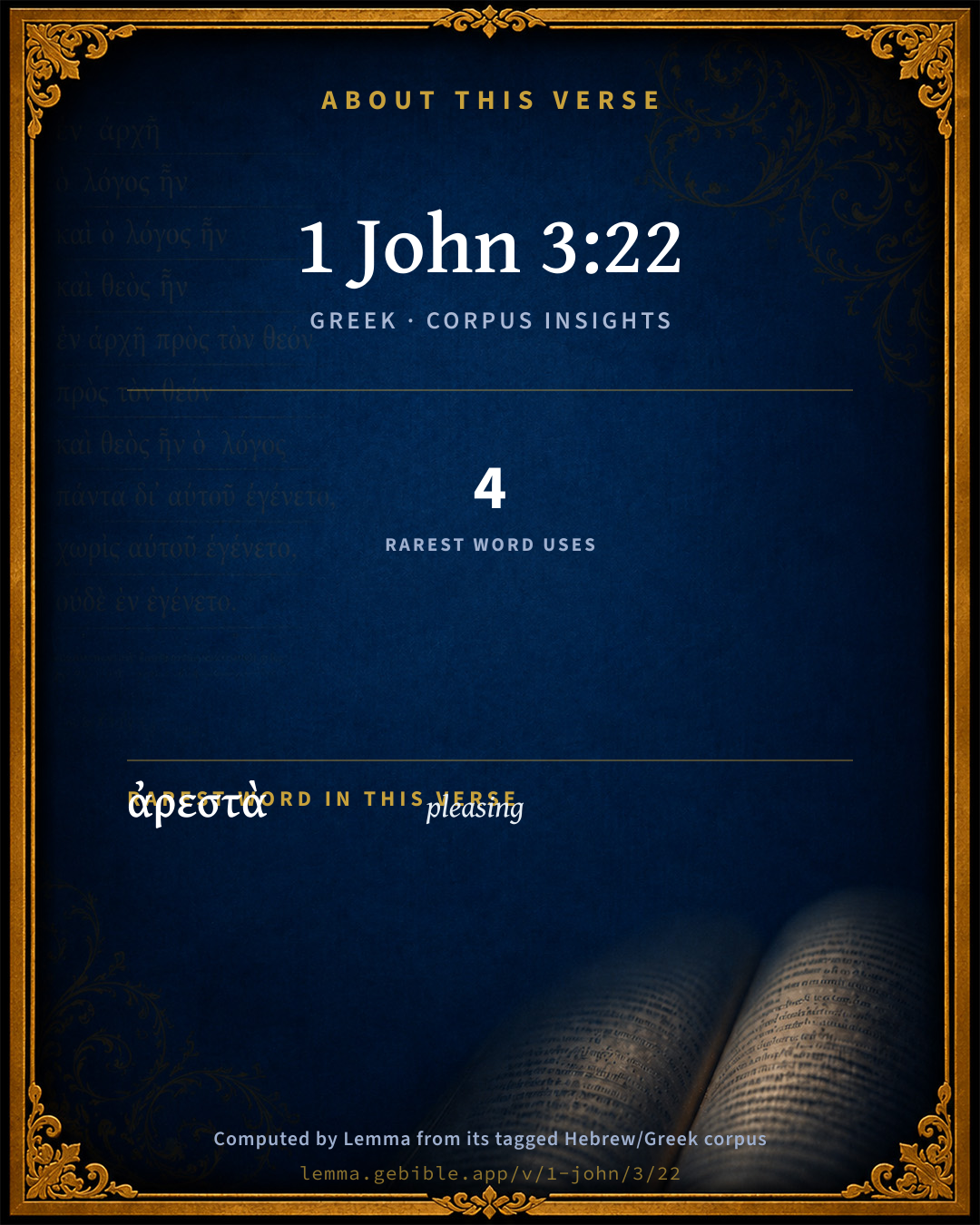
1 John 3:22

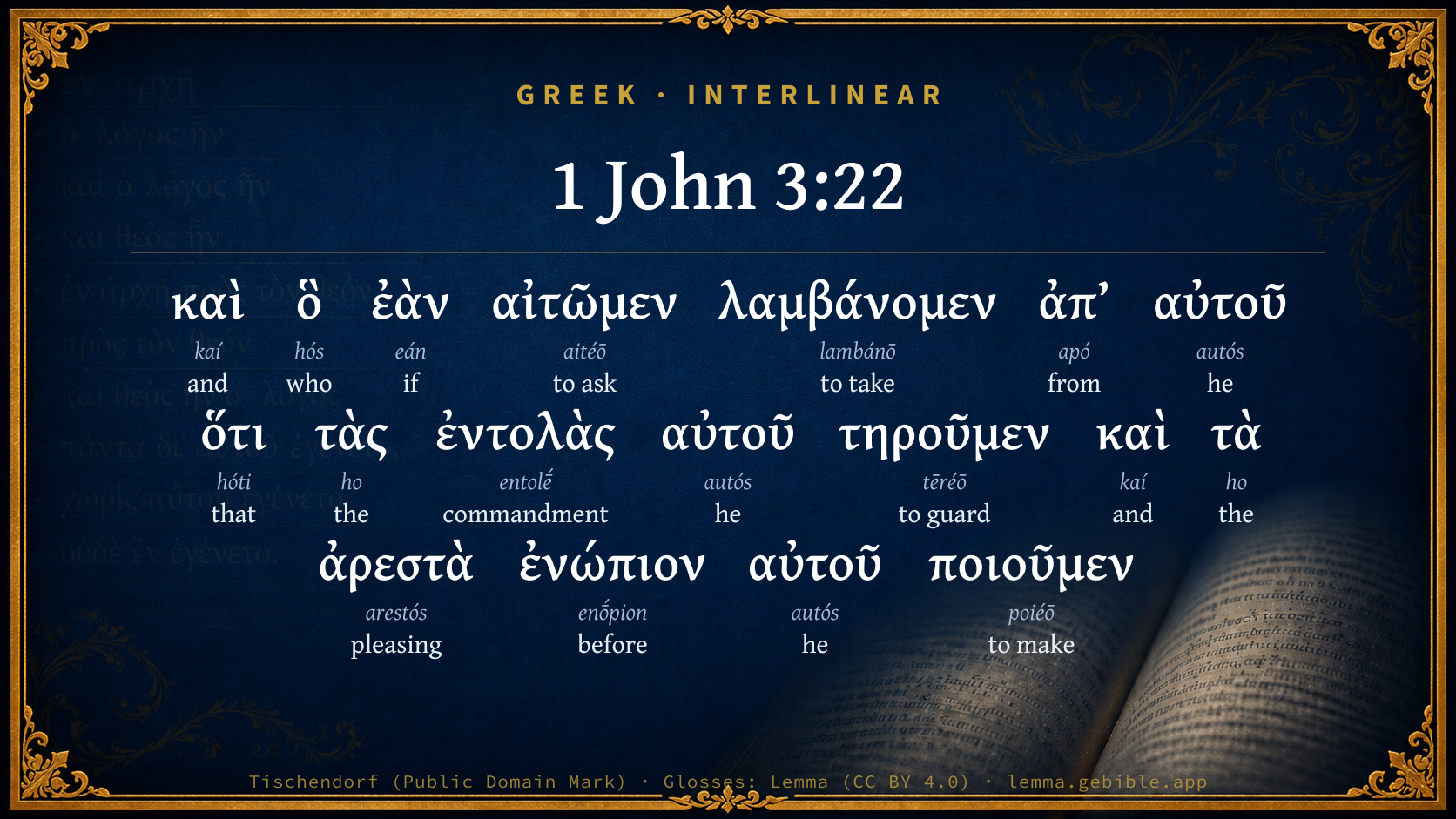
Greek (Tischendorf 8th ed.) 1 John 3:22 appears in the Greek New Testament. The text above is from the Tischendorf 8th edition. Each word links to its Strong’s number and a concise gloss. Click any word for its full Thayer’s Greek Lexicon entry.
Download image
Cite this verse

1 John 3:22 (World English Bible). Public Domain. Lemma interlinear Bible study tool, https://lemma.gebible.app/v/1-john/3/22.

Show BibTeX & RIS
BibTeX
RIS
English Translation
and whatever we ask, we receive from him, because we keep his commandments and do the things that are pleasing in his sight.
World English Bible · Public Domain
Download a study sheet

One document with this verse’s original text, its word-by-word gloss line, the meaning frame, cross-references with their text, attributed commentary, and full source and license credits — printable, and it pastes into notes with its structure intact.

This verse Autodidact and up

Study sheet (.html) Plain text (.txt)

A passage Seminary Student

Up to 50 verses in one chapter. A passage sheet keeps up to 6 commentary sources and 12 cross-references per verse, in the order this page ranks them, and says so on the sheet whenever that leaves anything out. Ask for a single verse and you get the Autodidact verse sheet above.

Everything on this page stays free to read, with no account — the sheet is a download of what is already on screen, not access to it.

Want to remove ads? Support Godless Engineer
Compare translations 3

The same verse in 3 English versions, stacked beneath the original-language interlinear above. Click any original word for its lexicon entry.

Each is an independent rendering of the whole verse — the interlinear is not word-aligned to these translations.

Highlighted words mark where these versions differ — a whole-verse word diff, not a word-by-word alignment.

  • World English Bible Public Domain
    and whatever we ask, we receive from him, because we keep his commandments and do the things that are pleasing in his sight.
  • King James Version Public Domain
    And whatsoever we ask, we receive of him, because we keep his commandments, and do those things that are pleasing in his sight.
  • unfoldingWord Literal Text CC BY-SA 4.0
    and whatever we ask, we receive from him, because we keep his commandments and we do the pleasing things before him.

unfoldingWord Literal Text — © unfoldingWord, licensed CC BY-SA 4.0. Word-aligned USFM3 via Door43 (git.door43.org/unfoldingWord/en_ult).

Versions to compare (up to 4)

3 of 4 selected

Show all 19 translations

Every available English version of this verse, each an independent rendering of the whole verse.

  • World English Bible Public Domain
    and whatever we ask, we receive from him, because we keep his commandments and do the things that are pleasing in his sight.
  • Berean Standard Bible Public Domain
    and we will receive from Him whatever we ask, because we keep His commandments and do what is pleasing in His sight.
  • Majority Standard Bible Public Domain
    and we will receive from Him whatever we ask, because we keep His commandments and do what is pleasing in His sight.
  • King James Version Public Domain
    And whatsoever we ask, we receive of him, because we keep his commandments, and do those things that are pleasing in his sight.
  • American Standard Version (1901) Public Domain
    and whatsoever we ask we receive of him, because we keep his commandments and do the things that are pleasing in his sight.
  • Revised Version (1885) Public Domain
    and whatsoever we ask, we receive of him, because we keep his commandments, and do the things that are pleasing in his sight.
  • Geneva Bible (1599) Public Domain
    And whatsoeuer we aske we receiue of him, because we keepe his commandements, and do those things which are pleasing in his sight.
  • Douay-Rheims (1899) Public Domain
    And whatsoever we shall ask, we shall receive of him: because we keep his commandments, and do those things which are pleasing in his sight.
  • Young's Literal Translation Public Domain
    and whatever we may ask, we receive from Him, because His commands we keep, and the things pleasing before Him we do,
  • Literal Standard Version CC BY-SA 4.0
    and whatever we may ask, we receive from Him, because we keep His commands, and we do the things pleasing before Him,
  • Unlocked Literal Bible CC BY-SA 4.0
    Whatever we ask we will receive from him, because we keep his commandments and do the things that are pleasing before him.
  • unfoldingWord Literal Text CC BY-SA 4.0
    and whatever we ask, we receive from him, because we keep his commandments and we do the pleasing things before him.
  • Darby Bible Public Domain
    and whatsoever we ask we receive from him, because we keep his commandments, and practise the things which are pleasing in his sight.
  • World Messianic Bible Public Domain
    so whatever we ask, we receive from him, because we keep his commandments and do the things that are pleasing in his sight.
  • Webster's Bible Public Domain
    And whatever we ask, we receive from him, because we keep his commandments, and do those things that are pleasing in his sight.
  • Free Bible Version CC BY-SA 4.0
    We'll receive from him whatever we ask him for, because we follow his commands and do what pleases him.
  • Bible in Basic English Public Domain
    And he gives us all our requests, because we keep his laws and do the things which are pleasing in his eyes.
  • Text-Critical English NT CC BY 4.0
    and receive from him whatever we ask, because we keep his commandments and do what is pleasing in his sight.
  • Tyndale New Testament (1534) Public Domain
    and what soever we axe we shall receave of him: be cause we kepe his commaundementes and do those thinges which are pleasinge in his sight.

Literal Standard Version (2020), Covenant Press — licensed CC BY-SA 4.0. Text via the HelloAO Bible API (eBible.org). Unlocked Literal Bible (unfoldingWord) — licensed CC BY-SA 4.0. Text via the HelloAO Bible API (eBible.org). unfoldingWord Literal Text — © unfoldingWord, licensed CC BY-SA 4.0. Word-aligned USFM3 via Door43 (git.door43.org/unfoldingWord/en_ult). Free Bible Version, Dr. Jonathan Gallagher — licensed CC BY-SA 4.0. Text via the HelloAO Bible API (eBible.org).

Word by word

More ways to search: Search by grammar → Find every occurrence → Compare this word →

Practice this passage: Drill this verse → Learn its vocabulary →

ἀρεστὰ
arestós
G701
“pleasing”
Adjective, Accusative, Plural, Neuter
Part of Speech
Adjective
Case
Accusative
Number
Plural
Gender
Neuter
Full Thayer's Definition

Origin: from G700

TDNT: 08:36,8

1. pleasing, agreeable
  1. καὶ kaí G2532 “and” Conjunction
  2. ὃ hós G3739 “who” Relative pronoun, Accusative, Singular, Neuter
  3. ἐὰν eán G1437 “if” Conditional
  4. αἰτῶμεν aitéō G154 “to ask” Verb, Present, Active, Subjunctive, 1st person, Plural
  5. λαμβάνομεν lambánō G2983 “to take” Verb, Present, Active, Indicative, 1st person, Plural
  6. ἀπ’ apó G575 “from” Preposition
  7. αὐτοῦ autós G846 “he” Personal pronoun, Genitive, Singular, Masculine
  8. ὅτι hóti G3754 “that” Conjunction
  9. τὰς ho G3588 “the” Article, Accusative, Plural, Feminine
  10. ἐντολὰς entolḗ G1785 “commandment” Noun, Accusative, Plural, Feminine
  11. αὐτοῦ autós G846 “he” Personal pronoun, Genitive, Singular, Masculine
  12. τηροῦμεν tēréō G5083 “to guard” Verb, Present, Active, Indicative, 1st person, Plural
  13. καὶ kaí G2532 “and” Conjunction
  14. τὰ ho G3588 “the” Article, Accusative, Plural, Neuter
  15. ἐνώπιον enṓpion G1799 “before” Adverb
  16. αὐτοῦ autós G846 “he” Personal pronoun, Genitive, Singular, Masculine
  17. ποιοῦμεν poiéō G4160 “to make” Verb, Present, Active, Indicative, 1st person, Plural

About this verse

These counts appear in no published source. They are computed here, from the morphology-tagged text and Lemma’s own curated glosses. What Lemma adds →

18
words
14
distinct lemmas
General Epistles
section

Notable vocabulary

The rarest word here is ἀρεστὰ pleasing G701 — appearing just 4 times in the whole Greek New Testament.

Shared distinctive vocabulary

ἀρεστὰ pleasing G701 occurs in 4 verses of the Greek New Testament. Also found in:

Repetition

Words recur within this verse:

  • αὐτοῦ he G846 ×3
  • καὶ and G2532 ×2
  • τὰς the G3588 ×2

Cross-references

33

Topical passages linked to 1 John 3:22 in the Treasury of Scripture Knowledge — connected by theme and wording, ordered by reader-vote popularity; previews shown in the World English Bible.

  • John 15:7 If you remain in me, and my words remain in you, you will ask whatever you desire, and it will be done for you.
  • John 9:31 We know that God doesn't listen to sinners, but if anyone is a worshipper of God, and does his will, he listens to him.
  • Matthew 21:22 All things, whatever you ask in prayer, believing, you will receive."
  • 1 John 5:14 This is the boldness which we have toward him, that, if we ask anything according to his will, he listens to us.
  • Mark 11:24 Therefore I tell you, all things whatever you pray and ask for, believe that you receive them, and you shall have them.
  • John 16:23–24 "In that day you will ask me no questions. Most assuredly I tell you, whatever you may ask of the Father in my name, he will give it to you.
  • Psalms 34:4 I sought Yahweh, and he answered me, And delivered me from all my fears.
  • Proverbs 15:29 Yahweh is far from the wicked, But he hears the prayer of the righteous.
  • Matthew 7:7–8 "Ask, and it will be given you. Seek, and you will find. Knock, and it will be opened for you.
  • John 14:13 Whatever you will ask in my name, that will I do, that the Father may be glorified in the Son.
  • Psalms 145:18–19 Yahweh is near to all those who call on him, To all who call on him in truth.
  • Jeremiah 29:12–13 You shall call on me, and you shall go and pray to me, and I will listen to you.
  • James 1:5 But if any of you lacks wisdom, let him ask of God, who gives to all liberally and without reproach; and it will be given to him.
  • Jeremiah 33:3 Call to me, and I will answer you, and will show you great things, and difficult, which you don't know.
  • John 8:29 He who sent me is with me. The Father hasn't left me alone, for I always do the things that are pleasing to him."
  • James 5:16 Confess your offenses to one another, and pray one for another, that you may be healed. The effective, earnest prayer of a righteous man is powerfully effective.
  • 1 John 3:23–24 This is his commandment, that we should believe in the name of his Son, Jesus Christ, and love one another, even as he commanded.
  • Psalms 34:15–17 Yahweh's eyes are toward the righteous. His ears listen to their cry.
  • Psalms 50:15 Call on me in the day of trouble. I will deliver you, and you will honor me."
  • Isaiah 55:6–7 Seek you Yahweh while he may be found; call you on him while he is near:
  • Matthew 7:24–25 "Everyone therefore who hears these words of mine, and does them, I will liken him to a wise man, who built his house on a rock.
  • Colossians 1:10 that you may walk worthily of the Lord, to please him in all respects, bearing fruit in every good work, and increasing in the knowledge of God;
  • Luke 11:9–13 "I tell you, keep asking, and it will be given you. Keep seeking, and you will find. Keep knocking, and it will be opened to you.
  • Psalms 66:18–19 If I cherished sin in my heart, The Lord wouldn't have listened.
  • John 6:29 Jesus answered them, "This is the work of God, that you believe in him whom he has sent."
  • Hebrews 13:21 make you complete in every good work to do his will, working in you that which is well pleasing in his sight, through Jesus Christ, to whom be the glory forever and ever. Amen.
  • Psalms 10:17 Yahweh, you have heard the desire of the humble. You will prepare their heart. You will cause your ear to hear,
  • Proverbs 28:9 He who turns away his ear from hearing the law, Even his prayer is an abomination.
  • Isaiah 1:15 When you spread forth your hands, I will hide my eyes from you; Yes, when you make many prayers, I will not hear. Your hands are full of blood.
  • Matthew 17:5 While he was still speaking, behold, a bright cloud overshadowed them. Behold, a voice came out of the cloud, saying, "This is my beloved Son, in whom I am well pleased. Listen to him."
  • John 15:10 If you keep my commandments, you will remain in my love; even as I have kept my Father's commandments, and remain in his love.
  • Acts 17:30 The times of ignorance therefore God overlooked. But now he commands that all people everywhere should repent,
  • Philippians 4:18 But I have all things, and abound. I am filled, having received from Epaphroditus the things that came from you, a sweet-smelling fragrance, an acceptable and well-pleasing sacrifice to God.

Cross-references courtesy of OpenBible.info (CC BY 4.0).

Commentary

Notes on 1 John 3:22 from classic Christian and Jewish commentators (each source and its license shown beneath its notes). The classic Christian expositions comment on the surrounding passage and are grouped to its opening verse, so a note may address several verses; the Jewish commentaries on the Tanakh (Rashi and others) are per-verse, so they appear only where the commentator wrote on this verse.

Lemma curates 59 commentaries, every one of them public domain or Creative Commons licensed, each selected and text-cleaned for this edition rather than reprinted as found. About our sources →

The Biblical Illustrator

Joseph S. Exell

1Jn_3:22-24

And whatsoever we ask, we receive of Him, because we keep His commandments

The conditions of power in prayer

I.

The essentials of power is prayer. We must make a few distinctions at the outset. I take it there is a great difference between the prayer of a soul that is seeking mercy and the prayer of a man who is saved. I would say to every person present, whatever his character, if you sincerely seek mercy of God through Jesus Christ you shall have it. Qualifications for the sinners first prayer I know of none except sincerity; but we must speak in a different way to those of you who are saved. You have now become the people of God, and while you shall be heard just as the sinner would be heard, and shall daily find the needful grace which every seeker receives in answer to prayer, yet you are under a special discipline peculiar to the regenerated family. There is something for a believer to enjoy over and above bare salvation; there are mercies, and blessings, and comforts, which render his present life useful, happy, and honourable, and these he shall not have irrespective of character. To give a common illustration: If a hungry person were at your door, and asked for bread, you would give it him, whatever might be his character; you will also give your child food, whatever may be his behaviour; you will never proceed in any course of discipline against him, so as to deny him his needful food, or a garment to shield him from the cold; but there are many other things which your child may desire, which you will give him if he be obedient, but which you will not give if he be rebellious to you. I take it that this illustrates how far the paternal government of God will push this matter, and where it will not go. Understand also, that the text refers not so much to Gods hearing a prayer of His servants now and then, for that He will do, even when His servants are out of course with Him; but the power in prayer here intended is continuous and absolute power with God; so that, to quote the words of the text, whatsoever we ask of Him we receive. For this prayer there are certain prerequisites.

1. The first is child-like obedience: Whatsoever we ask, we receive of Him, because we keep His commandments.

2. Next to this is another essential to victorious prayer, viz., child-like reverence. We receive what we ask, because we keep His commandments, and do those things that are pleasing in His sight. Suppose any of us should be self-willed, and say, I shall not do what pleases God, I shall do what pleases myself. Then observe what would be the nature of our prayers? Our prayers might then be summed up in the request, Let me have my own way. And can we expect God to consent to that?

3. In the third place, the text suggests the necessity of child-like trust: And this is His commandment, that we should believe on the name of His Son Jesus Christ. Let us come back to our family similitudes again. Suppose a child in the house does not believe his fathers word; suppose, indeed, that he tells his brothers and sisters that his faith in his father is very weak. He mentions that wretched fact, but is not at all shocked that he should say such a thing, but he rather feels that he ought to be pitied, as if it were an infirmity which he could not avoid. I think a father so basely distrusted would not be in a very great hurry to grant such a sons requests; indeed, it is very probable that the petitions of the mistrustful son would be such as could not be complied with, even if his father were willing to do so, since they would amount to a gratification of his own unbelief and a dishonour to his parent. Expect not, therefore, to be heard when your prayer is suggested by an unbelieving heart: Commit thy way unto the Lord; trust also in Him, and He shall bring it to pass.

4. The next essential to continued success in prayer is child-like love: That we should believe on the name of His Son, Jesus Christ, and love one another as He gave us commandment. We should abound in love to God, love to Christ, love to the Church, love to sinners, and love to men everywhere. You must get rid of selfishness before God can trust you with the keys of heaven; but when self is dead, then He will enable you to unlock His treasuries, and, as a prince, shall you have power with God and prevail.

5. Next to this, we must have child-like ways as well. He that keepeth His commandments, dwelleth in Him, and He in him. It is one of a childs ways to love its home. Suppose one of you had a boy, who said, Father, I do not like my home, I do not care for you; and I will not endure the restraints of family rule; I am going to live with strangers. But mark, father, I shall come to you every week, and I shall require many things of you; and I shall expect that you will give me whatever I ask from you. Why, if you are at all fit to be at the head of the house, you will say, My son, how can you speak to me in such a manner? If you are so self-willed as to leave my house, can you expect that I will do your bidding? If you utterly disregard me, can you expect me to support you in your cruel unkindness and wicked insubordination. No, my son; if you will not remain with me and own me as a father, I cannot promise you anything. And so it is with God.

6. One thing more: it appears from the text that we must have a child-like spirit, for hereby we know that He abideth in us, by the Spirit which He hath given us. What is this but the Spirit of adoption--the Spirit which rules in all the children of God? The Holy Spirit if He rules in us, will subordinate our nature to His own sway, and then the prayers which spring out of our renewed hearts will be in keeping with the will of God, and such prayers will naturally be heard.

II. The prevalence of these essential things. If they be in us and abound, our prayers cannot be barren or unprofitable.

1. First, if we have faith in God, there is no question about Gods hearing our prayer. If we can plead in faith the name and blood of Jesus, we must obtain answers of peace. But a thousand cavils are suggested. Suppose these prayers concern the laws of nature, then the scientific men are against us, What of that? The Lord has ways of answering our prayers irrespective of the working of miracles or suspending laws. Perhaps there are other forces and laws which He has arranged to bring into action just at times when prayer also acts, laws just as fixed and forces just as natural as those which our learned theorisers have been able to discover. The wisest men know not all the laws which govern the universe, nay, nor a tithe of them. If there be but faith in God, God must either cease to be, or cease to be true, or else He must hear prayer. The verse before the text says, If our heart condemn us not, then have we confidence toward God; and whatsoever we ask, we receive of Him. He who has a clear conscience comes to God with confidence, and that confidence of faith ensures to him the answer of his prayer.

2. But next, love must succeed too, since we have already seen that the man who loves in the Christian sense is in accord with God. God always hears the prayers of a loving man, because those prayers are the shadows of His own decrees.

3. Again, the man of obedience is the man whom God will hear, because his obedient heart leads him to pray humbly and with submission, for he feels it to be his highest desire that the Lords will should be done.

4. Again, the man who lives in fellowship with God will assuredly speed in prayer, because if he dwells in God and God dwells in him, he will desire what God desires.

5. And here, again let us say, our text speaks of the Christian man as being filled with Gods Spirit: We know that He abideth in us, by the Spirit which He hath given us. Who knows the mind of a man but the spirit of a man? So, who knows the things of God but the Spirit of God? And if the Spirit of God dwells in us, then He tells us what Gods mind is; He makes intercession in the saints according to the will of God.

Practical improvement:

1. The first is, we want to pray for a great blessing as a church. Very well. Have we the essentials for success? Are we believing in the name of Jesus Christ? Are we full of love to God and one another?

2. Next, are we doing that which is pleasing in Gods sight?

3. The next question is, do we dwell in God?

4. Lastly, does the Spirit of God actuate us, or is it another spirit? (C. H. Spurgeon.)

Righteousness essential to our pleasing God and to His hearing us

I. We keep His commandments, and do those things that are pleasing in His sight. So John writes; and so also Jesus speaks (Joh_8:29). The language is the very same; the sense and spirit in which it is used must be the very same also. Jesus uttered the words for our sakes; and as expressing a human feeling which we may understand, and with which He would have us to sympathise. That human feeling in the bosom of Jesus must have been very simple and intensely filial; realising intensely His filial relation to the Father and His filial oneness with the Father. There is, if I may venture so to speak, a child-like simplicity, a sort of artless straightforwardness, in His saying so confidingly, so lovingly, so naturally, I do always those things that please Him. He has the Cross in view. Men, displeased with Him, are to lift Him up, and leave Him to die in His agony alone. Not so the Father. He leaves me not alone; He is with me; for I do always those things that please Him. Somewhat similar are the circumstances in which John would have us to say; we do those things that are pleasing in His sight. Oh! to be converted, and become as little children! First, to be made willing as little children, that all this misunderstanding should be ended, and this breach thoroughly healed at once, and once for all, as the Father would have it to be, in the Son. And then, as little children, to know something of a little childs touching and artless simplicity, as we look with loving eye into the loving eye of the Father, and lovingly lisp out the touching words: We keep His commandments and do those things that are pleasing in His sight.

II. And whatsoever we ask, we receive of Him. In this saying also we have the countenance of Jesus (Joh_11:41-42). Thou hearest me always! It is a blessed assurance. And the blessedness of it really lies, not so much in the good he gets from the Fathers hearing him, as in the Fathers hearing him itself; not so much in what he receives, as in his receiving it from the Father. For this is the charm, the joy, the consolation, of that access to the Father and that influence with the Father which you now have in common with the Son. It is not that you may enrich and gratify yourselves with what you win by asking from Him. But it is literally that whatever you ask you receive of Him, as His gift; the proof that He is ever with you and heareth you always. Ah! how then shall I ask anything at all? If such is my position, in and with Christ, how shall I have the heart or the hardihood to ask anything at all of the Father, except only that He may deal with me according to His good pleasure? If I am really on such a footing with the Father that He heareth me always, and whatsoever I ask I receive of Him; if I have such influence with Him; if, as His dear child, pleasing Him, and doing what pleases Him, I can so prevail with Him that He can refuse me nothing; what can I say? What can I do? I can but cast myself into His arms and cry, Thou knowest better than I, oh my Father! Father, Thy will be done. (R. S. Candlish, D. D.)

Answers to prayer

We must make a wide distinction between a cause and a condition. The cause of anything is the actual reason why it is--the source from which it flows. The condition is something which comes in afterwards--super added--to limit and to guide the actings of the first cause. Just, for example, as the rain is not caused by the particular state of the atmosphere, but it depends upon it; and there must be a certain rarity in the air, without which the rain would not fall. This is its condition. In like manner, keeping the commandments is not the cause of our prayers being answered, but it is the condition. Your prayers will not be answered unless yon keep the commandments. If we ask, what is the reason why any prayer prevails with God? the explanation lies very deep. You will find it among the grandnesses of the Holy Trinity. It is because God is a Father, and therefore of Himself loves to listen to His childrens petitions, and to give them everything they ask. It is because every believer praying, prays in Christ--he presents Christ--he is in Christ. Hence the almost omnipotence of prayer. It is because whatever true prayer goes up to the throne of God, it is the Holy Ghost who prays it. Thus the whole Trinity meets to make the prayer of the weakest Christian, and this is the cause why prayer gets answered. Who has not asked of God a great many things? Who does not believe that many, at least, of the things which he asks are the legitimate, nay, the covenanted subjects of prayer? Who has not the evidence of his own heart that for many of these things, at all events, he has prayed, and is praying very earnestly. And yet, who has not to feel My prayers are not answered; I do not obtain what I ask? And who has not wondered why it is thus with his prayers? Now what is the reason? Certainly the cause cannot be in God; it must be in you. But where in you? I answer deliberately--in your life, in your heart. In some way or other, you are not keeping some commandment, you are not doing those things that are pleasing in His sight. Let us now pause upon the thought that the life rules the prayer--that according as you are holy, so wilt you receive answers to your prayers--that the condition of prayer is obedience, and without obedience prayer loses its prerogative. If a man is leading a religious life--not grieving his conscience--a man of pure thoughts and holy pleasures--that man grows into such a state of mind that he will only wish such things as God has promised to give him, he will not desire many temporal things; but his tastes will be spiritual, therefore his prayers are always keeping within the bounds of the promises. He will not ask nor long for anything which is not after the will of God to give. The Spirit which is in him will take care of that for him.

1. And here is the first grand secret of the success of a good mans prayer, which arises out of a conformity of his mind to the mind of God, and that conformity of his mind to the mind of God arises out of his daily habits of life.

2. Secondly, blessings may be ready to come down, and they may pour, but unless your heart be in a right state to receive them, they will pour in vain. The heart is hard, and they cannot come in; or it is so crowded that there is no room; or it is so weak that there is no holding. Now any state of wilful sin puts the heart in that state. Hence, prayer cannot be answered--for even should the answer come, it will not find entrance.

3. Thirdly, remember this; that when God says that a man must keep His commandments if he will have his prayers answered, part of the commandments is faith in Jesus Christ; and therefore the passage runs thus in very emphatic order--Whatsoever we ask, we receive of Him, because we keep His commandments, and do those things that are pleasing in His sight. And this is His commandment, That we should believe on the name of His Son Jesus Christ.

4. And then fourthly, it is quite evident that what God gives to those who are leading a godly and devoted life, He gives to the promotion of His own glory; because, either directly or indirectly, they will use the gift for the extension of His kingdom, and this gives a plain reason why their prayer should be granted. For shall God give to a man whose life has two faces--one face in practice, and another face in prayer? Shall He give to a sheer hypocrite?

5. And once more, why should not our heavenly Father do what all fathers do, love to give His good things to the child who tries to please Him most, and who delights in His society? (J. Vaughan, M. A.)

And this is His commandment, That we should believe on the name of His Son Jesus Christ, and love one another--

On the importance of faith in Christ and love to Christians

I. The gospel, wherever it comes, requires a firm trust in the merits and grace of the Lord Jesus Christ.

1. It is necessary to obtain pardon of sin.

2. It is necessary to produce purity of heart.

3. It is necessary to promote vital union with God, the fountain of life and felicity.

II. The gospel requires brotherly love, as a primary and most important duty.

1. Let us consider the nature and extent of that brotherly love which the gospel inculcates and demands. It is esteem, complacence, compassion, benevolence.

(1) Love is evinced by sincerely sympathising with our Christian brethren in their sufferings.

(2) Love is evinced by cheerfully communicating of our substance to relieve the wants of our Christian brethren.

2. The grounds and obligations of brotherly love.

(1) Faith in Christ, and love to Christians are represented as closely and inseparably connected.

(2) There is an express and very particular command of Christ, enjoining brotherly love upon His followers.

(3) The basis of our obligation is the cause of God.

There are two cases to which this subject may be applied.

1. Let it serve as a test or touchstone of our personal piety.

2. Let this subject rouse us to more seriousness, activity, and zeal. (Essex Remembrancer.)

The warrant of faith

The true believer has learned to look away from the killing ordinances of the old law. He turns with loathing from all trust in his own obedience and lays hold with joy upon the hope set before him in the one commandment contained in my text.

I. The matter of believing, or what is it that a man is to believe in order to eternal life? That faith which saves the soul is believing on a person, depending upon Jesus for eternal life. We must believe Him to be Gods Son--so the text puts it--His Son. We must grasp with strong confidence the great fact that He is God: for nothing short of a Divine Saviour can ever deliver us from the infinite wrath of God. Furthermore, we must accept this Son of God as Jesus, the Saviour. We must believe that Jesus Christ, the Son of God, became man out of infinite love to man, that He might save His people from their sins. We must look upon Jesus as Christ, the anointed of the Father, sent into this world on salvations errand, not that sinners might save themselves, but that He, being mighty to save, might bring many sons Unto glory. Moreover, we should rejoice that as Jesus Christ, by His dying, put away forever the sin of His people, so by His living He gave unto those who trust in Him a perfect righteousness, in which, despite their own sins, they are accepted in the Beloved. We are also taught that if we heartily trust our soul with Christ, our sins, through His blood, are forgiven, and His righteousness is imputed to us. The mere knowledge of these facts will not, however, save us, unless we really trust our souls in the Redeemers hands.

II. The warrant of believing. This is the commandment, that ye believe on His Son Jesus Christ.

1. First, negatively.

(1) That any other way of preaching the gospel warrant is absurd. Are we to go running up and down the world proclaiming life to the living, casting bread to those who are fed already, and holding up Christ on the pole of the gospel to those who are already healed?

(2) To tell the sinner that he is to believe on Christ because of some warrant in himself, is legal. If I lean on Christ because I feel this and that, then I am leaning on my feelings and not on Christ alone, and this is legal indeed.

(3) Again, any other way of preaching than that of bidding the sinner believe because God commands him to believe, is a boasting way of faith. When we tell a sinner that filthy as he is, without any preparation or qualification, he is to take Jesus Christ to be his all in all, finding in Him all that he can ever need, we leave no room for self-glorification, all must be of grace. Law and boasting are twin brothers, but free grace and gratitude always go together.

(4) Any other warrant for believing on Jesus than that which is presented in the gospel is changeable. Since everything within changes more frequently than ever does an English sky, if my warrant to believe in Christ be based within, it must change every hour; consequently I am lost and saved alternately. Can these things be so?

(5) Again, any other warrant is utterly incomprehensible. Multitudes preach an impossible salvation. Personally, I do not remember to have been told from the pulpit to believe in Jesus as a sinner. I heard much of feelings which I thought I could never get, and frames after which I longed; but I found no peace until a true, free grace message came to me, Look unto Me and be ye saved, all the ends of the earth.

(6) Yet again, I believe that the preaching of alarms of conscience and repentance as qualifications for Christ is unacceptable to the awakened sinner. Oh, I am ashamed of myself when I think of the way in which I have sometimes talked to awakened sinners. I am persuaded that the only true remedy for a broken heart is Jesus Christs most precious blood.

(7) Any other warrant for the sinners faith than the gospel itself, is false and dangerous. It is as false as God is true, that anything in a sinner can be his warrant for believing in Jesus. There cannot be a true and real hatred of sin where there is not faith in Jesus. All the sinner knows and feels before faith is only an addition to his other sins, and how can sin which deserves wrath be a warrant for an act which is the work of the Holy Spirit. How dangerous is the sentiment I am opposing. Take care of resting in your own experience. All that is of natures spinning must be unravelled, and everything that getteth into Christs place, however dear to thee, and however precious in itself, must he broken in pieces. Sinners, Jesus wants nothing of you, nothing whatsoever, nothing done, nothing felt; He gives both work and feeling. Ragged, penniless, just as ye are, lost, forsaken, desolate, with no good feelings and no good hopes, still Jesus comes to you, and in these words of pity He addresses you, Him that cometh to Me I will in no wise cast out.

2. But now, positively, and as the negative part has been positive enough, we will be brief here. This is the commandment. Do you want any warrant for doing a thing better than Gods command to do it? The command to believe in Christ must be the sinners warrant, if you consider the nature of our commission. How runs it? Go ye into all the world, and preach the gospel to every creature. It ought to run, according to the other plan, preach the gospel to every regenerate person, to every convinced sinner, to every sensible soul. But it is not so; it is to every creature. Then how is it put?--He that believeth and is baptised shall be saved; he that believeth not shall be damned. Where is there a word about the prerequisites for believing.

(1) I shall only add, that the blessings which flow from preaching Christ to sinners as sinners, are of such a character as prove it to be right. Do you not see that this levels us all? We have the same warrant for believing, and no one can exalt himself above his fellow.

(2) Then how it inspires men with hope and confidence; it forbids despair. No man can despair if this be true; or if he do, it is a wicked, unreasonable despair, because if he has been never so bad, yet God commands him to believe.

(3) Again, how it makes a man live close to Christ! If I am to come to Christ as a sinner every day, and I must do so, for the Word saith, As ye have received Christ Jesus the Lord, so walk ye in Him; if every day I am to come to Christ as a sinner, why then, how paltry all my doings look! what utter contempt it east upon all my fine virtues, my preachings, my prayings, and all that comes of my flesh I and though it leads me to seek after purity and holiness, yet it teaches me to live on Christ and not on them, and so it keeps me at the fountain head. (C. H. Spurgeon.)

Gods one commandment

Every thoughtful reader of the Word of God must have been struck with the very great importance that the sacred writers attach to names. In the opening chapter of the Sacred Volume we read of God giving their names to the works of His hands: God called the light Day, and the darkness He called Night. The very first thing that Adam, the first man, does, is by Gods direction to give names to all Gods creatures. Then, when God entered into covenant with Abram, He changed his name from Abram to Abraham. When God wrestled with Jacob, He changed his name from Jacob to Israel. But we must pass on to the New Testament. It also begins with God giving a name. On its very title page we have God sending an angel to give a name to One not yet born--that Second Adam--that Beginning of the New Creation of God, whom He sent into the world. In the very first chapter of the New Testament we have two names assigned to the Saviour. First, the angels say, Thou shalt call His name Jesus, for He shall save His people from their sins. Then the name of Emmanuel, given to Him in the spirit by Isaiah, the prophet, is also claimed as His by the Evangelist. These two names, given to the Second Adam in the first chapter of the book of the New Covenant, answer to the two names by which God made Himself known to the children of Israel. Emmanuel signifies what the Saviour is in Himself--God with us; God in our nature. Jesus rather signifies what He is to His people--their Saviour from sin. It means literally, The Lord is salvation, or The Lord Our salvation.

I. What is meant by believing in the name of Jesus Christ? It must mean more than believing that some years ago a person came into this world who had such a name given to him. It is believing that Jesus Christ is to us what His name means. Now let us take the best known name of our Saviour--Jesus Christ, His only Son our Lord. We know Him as the only Son of God--as Jesus--as Christ. Take the first of these--the Son of God. See how our Lord insists upon our believing in this, as His name, in His discourse with Nicodemus (Joh_3:18). Now a man who believes this respecting the Person who was then speaking to Nicodemus, and who was afterwards crucified and raised again, believes in the greatest possible instance of Gods love. It is quite clear, also, that any interpretation which attaches to the term Son of God a lower meaning than that of only-begotten Son, really destroys all the testimony which such a text as God so loved the world that He gave His only-begotten Son bears to the exceeding love of God. Now let us proceed to the human name by which we know the Son of God--Jesus Christ. The name Jesus signifies the Lord our salvation. He has saved us from the guilt of sin by His sacrifice on the Cross. Again, He saves us from the power of sin by His indwelling Spirit making us partakers of His nature, so that His risen life is in us our spiritual life. And so with that title of Messiah, or Christ, or Anointed One, to which is joined His name of Jesus. It is implied in the very fact of His being called Christ that He has been anointed by the Holy Ghost to be the Prophet, Priest, and King of His people. Believing in the name of Gods Son, Jesus, then, is believing that Gods Son is that very Lord, our Saviour, which His name implies. This is Gods commandment. No, no; it is only part of Gods commandment: for the one commandment of God, which God inspired the beloved disciple to give to His people, is made up of two things. This is His commandment, that we believe on the name of His Son Jesus Christ, and love one another, as He--i.e. as Christ Himself--gave us commandment. Anyone who knows anything of the history of the Church, or about religious society, knows well that a man may have, or at least may express, not only belief in the name, but the sincerest trust in the finished work of Christ, and yet be bitter to those who differ from him, uncharitable to those who oppose him, and churlish to those who are at all in his way. St. Paul writes his Epistle to the Ephesians to men who realised the gospel far better than any Christians now do; and instead of leaving the gospel to itself, and simply insisting on believing in Christ crucified, the apostle actually bids those who are supposed to believe the gospel not to lie, nor to steal, nor to use bad language, nor to grieve the Holy Spirit, but to walk in love, and put away all bitterness, wrath, anger, clamour, and evil speaking. Similarly with St. Peter. If there is any place in which he declares the precious truths of the gospel in terms full of consolation and good hope, it is in the first chapter of his Epistle; but, so far from thinking that all this would do its own work, he tells them at the beginning of the very next chapter to lay aside all malice, and all guile, and hypocrisies, and envies, and all evil speakings. But what is loving one another? Why, according to St. Paul, the apostle of justification, it is keeping the last six commandments (Rom_13:8). And in the next chapter he reckons working ill to our neighbours soul, as well as to his body, as a breach of love. But what, according to St. John, is loving one another? This is His commandment, that ye believe in all the power and grace that is contained in the name of His Son Jesus Christ, and seek out, visit, relieve, and comfort your sick and needy fellow Christians. This is His commandment, that ye believe in the name of the only begotten Son of God, and be kindly affectioned one to another, in honour preferring one another. This is His commandment, that ye believe in the name of Him who saves His people from their sins, and put away from you all bitterness, and wrath, and anger, and clamour, and evil speaking, and all malice. This is His commandment, that ye believe in the name of Him who was anointed by God to be a Prince and a Saviour, and covet earnestly that best gift of a charity that suffereth long, is kind, etc. (M. F. Sadler, M. A.)

Faith a work

I. The word believe, which enters this Epistle for the first time at this point, is one of the royal words of the New Testament. It contains three ideas.

1. First there is knowledge. That which you believe must first announce itself as a fact to your intellect. It must enter the crystal chamber of consciousness.

2. Then follows assent. That is the answer of your mind to the claims made upon it by the fact.

3. Then comes the last and most important of all, viz., trust. You say to yourself, This is truth--this will bear, and you put your whole weight upon it.

II. But what is to be dons with it? To what shall a man attach himself by means of this threefold cord? The object around which we are bid throw our faith is no series of propositions--not any Church--not even the Bible as a whole, but the full name of Jesus Christ. The full title of Christ, as given here, gathers up into itself every ray of spiritual truth diffused through the whole Bible. His Son Jesus Christ. Say that seriously, simply, honestly, without qualification or reserve, and you have repeated the full Christian creed. That name is the gospel.

III. This is Gods commandment. Note that well. Faith is set before us as a duty, as a work. Now, if God commands us to believe, then surely belief is something that is possible to us all. We cannot imagine God commanding the impossible. Then, too, unbelief is a sin. It is positive disobedience. And further, St. John says that belief in Christ is not simply a commandment, but that it is the commandment. Faith working by love is the spiritual unity of all commandments, and unbelief is therefore the root of all sins.

IV. Now, how far have we the power to believe in Christ? To what extent is faith subject to our will? It is worth while finding this out, for the measure of our power to believe will be the measure of our sin and of our punishment if we disbelieve.

1. If we look into the Bible we shall find two sets of texts. One set ascribes the whole work of redemption to God--faith, repentance, love, holiness, are all declared to be gifts of God. Another whole class of texts describes repentance, faith, purification, and love as acts which each man ought to, and therefore can perform himself.

2. Again, in the teaching of the Church we have two opposite camps of opinion on this matter. Augustine held very strong views on this point. He taught that when Adam fell he lost his freedom of will; the will sank into a state of infirmity, in which it had no power of choice at all between good and evil--only the power of always choosing the wrong; and through his sin all his successors fell into the same state of bondage. In fact, as one said, he taught that in the fall of man one whole piece of human nature had fallen out! But out of this mass of mutilated humanity God has elected a number to be saved. These must be saved. Gods grace overpowers them, and they are saved by a fiat of the Almighty Will. As to the others, they must be lost--they are reprobate. Pelagius held very strong views on the subject of our text. All men, he said, are as free to choose as Adam was. The will is not impaired, and can of itself, at any moment, free itself from sin. Man stands at the parting of the ways, and he has full power to choose either. Man--mans own power, is the note that is heard sounding all through his teaching. Grace scarcely appears at all. Thus, while the one almost did away with the free will of man, the other almost did away with the grace of God. And these two men divided the Christian world into opposing factions. The majority followed Augustine, though many too followed Pelagius. And so from age to age the pendulum of opinion swung from extreme to extreme.

3. Neither of these views is right. The first libels both God and man. It represents God as partial and arbitrary. It reduces man to a poor puppet of destiny. It robs religion of morality and deprives heaven of holiness. It takes away the guilt of sin, and lifts the blame of hell from the souls of men and lays it at the feet of God. Equally distant from the New Testament truth is the other view. It renders the best half of Scripture meaningless, and the whole mediatorial work of Christ needless. It peoples the earth with an imaginary race of moral giants, each of whom is sufficient in himself, and fills heaven with a multitude of self-saved souls.

4. But while the many thus swung from one extreme to another, there have always been in the Church of Christ a party of common sense men, able, like Melancthon, to combine the two sets of texts, and to see that they are not contradictions--only the two opposite poles of one great truth. Salvation, they teach, is a work of Gods grace, in which each man is required and enabled to take an active part. Mankind is a fallen race, but not an abandoned race. Man cannot save himself, yet Gods preparing grace has kept alive in each man enough of moral life to respond to the offer of Christ, a something living in each man to which the Christ can make His appeal. So men are utterly unable to save themselves. But they are not literally lifeless like a stone or stick. Faith is preeminently a matter of will. The text does not say, Believe this doctrine or that, but Trust yourselves in Christs hands--trust Christ as your Saviour. (J. M. Gibbon.)

The Biblical Illustrator, edited by Joseph S. Exell (c. 1880s–1900s) — public domain. Text from a community e-Sword module.

Meyer's Critical & Exegetical Commentary

Heinrich August Wilhelm Meyer

1Jn_3:22. By καί the following is closely connected with the preceding, inasmuch as it states what further happens when, in consequence of non-condemnation on the part of the heart, the παῤῥησία πρὸς τὸν Θεόν exists; it is not merely the consciousness of the hearing of our prayers, but it is this hearing itself.

ὃ ἐὰν αἰτῶμεν] is to be taken quite generally, and must not be spoiled by arbitrary limitations; the necessary limitation lies, on the one hand, in the subject itself: the child of God asks for nothing which is contrary to his Fathers will, comp. 1Jn_5:14; and, on the other hand, in the παῤῥησία with which he prays; comp. Mat_21:22; the contrary in Jam_1:6-7.

λαμβάνομεν ἀπʼ αὐτοῦ] i.e. τοῦ Θεοῦ. The present is not used instead of the future (Grotius); the subject is here not something future, but what constantly occurs in the life of believers. Augustine suitably says: Charitas ipsa gemit, charitas ipsa orat, contra hanc aures claudere non novit, qui illam dedit.

ὅτι τὰς ἐντολὰς αὐτοῦ κ.τ.λ.] ὅτι is connected with the immediately preceding λαμβάνομεν, and states the ground of Gods manifestation of love in the hearing of prayer; this ground, which, however, is not to be regarded as the causa meritoria, is the childlike obedience of him who prays, wherein God recognises him as His child; the idea of obedience is expressed in two mutually co-ordinate sentences (similar to the Hebrew parallelism): τὰς ἐντολὰς αὐτοῦ and τὰ ἀρεστὰ ἐνώπιον αὐτοῦ are synonymous;[248] by ΠΟΙΕῖΝ the obedience is specified as active; the second clause indicates that it consists, not in a slavish subjection to the commandment, but in a childlike fulfilment of that which is pleasing to God. In Joh_8:29, ἀρεστόν is construed with the dative; only in Act_6:2; Act_12:3 is the word besides found; similar is the expression: ἈΠΌΔΕΚΤΟΝ ἘΝΏΠΙΟΝ ΤΟῦ ΘΕΟῦ (1Ti_5:4).

[248] Meyer actually thinks that by ἀρεστά are meant the so-called consilia evangelica, by which ordinary Christians are not bound, but which are voluntarily undertaken by Christians who are specially holy!

Meyer — Critical and Exegetical Commentary on the New Testament — English translation by Peter Christie, edited by Frederick Crombie (T&T Clark, 1880) — public domain. Text from a community e-Sword module.

Geneva Bible (1599)

Geneva Bible translators

The conclusion: That faith in Christ, and love one towards another, are things joined together, and therefore the outward testimonies of sanctification must and do answer that inward testimony of the Spirit given unto us.

Geneva Bible (1599) marginal notes — public domain. Text via Bolls.life.

Jamieson, Fausset & Brown

Robert Jamieson, A. R. Fausset & David Brown

we receive--as a matter of fact, according to His promise. Believers, as such, ask only what is in accordance with God's will; or if they ask what God wills not, they bow their will to God's will, and so God grants them either their request, or something better than it.

because we keep his commandments--Compare Psa 66:18; Psa 34:15; Psa 145:18-19. Not as though our merits earned a hearing for our prayers, but when we are believers in Christ, all our works of faith being the fruit of His Spirit in us, are "pleasing in God's sight"; and our prayers being the voice of the same Spirit of God in us, naturally and necessarily are answered by Him.

Jamieson, Fausset & Brown — Commentary Critical and Explanatory on the Whole Bible (1871) — public domain (CC PDM 1.0). Text via the HelloAO Bible API.

Adam Clarke's Commentary

Verse 22. Whatsoever we ask] In such a spirit, we receive of him, for he delights to bless the humble, upright, and sincere soul.

Because we keep his commandments] Viz., by loving him and loving our neighbour. These are the great commandments both of the old covenant and the new. And whoever is filled with this love to God and man will do those things which are pleasing to him; for love is the very soul and principle of obedience.

The word heart is used in the preceding verses for conscience; and so the Greek fathers interpret it, particularly Origen, Nicephorus, and OEcumenius; but this is not an unfrequent meaning of the word in the sacred writings.

Adam Clarke's Commentary on the Bible (1810–1826) — public domain. Text from a community e-Sword/MySword module.

John Calvin's Commentaries

22 And whatsoever we ask These two things are connected, confidence and prayer. As before he shewed that an evil conscience is inconsistent with confidence, so now he declares that none can really pray to God but those who with a pure heart, fear and rightly worship him. The latter follows from the former. It is a general truth taught in Scripture, that the ungodly are not heard by God, but that on the contrary, their sacrifices and prayers are an abomination to him. Hence the door is here closed up against hypocrites, lest they should in contempt of him rush into his presence.

He does not yet mean that a good conscience must be brought, as though it obtained favor to our prayers. Woe to us if we look on works, which have nothing in them but what is a cause of fear and trembling. The faithful, then, cannot otherwise come to God’s tribunal than by relying on Christ the Mediator. But as the love of God is ever connected with faith, the Apostle, in order that he might the more severely reprove hypocrites, deprives them of that singular privilege with which God favors his own children; that is, lest they should think that their prayers have an access to God.

By saying, because we keep his commandments, he means not that confidence in prayer is founded on our works; but he teaches this only, that true religion and the sincere worship of God cannot be separated from faith. Nor ought it to appear strange that he uses a causal particle, though he does not speak of a cause; for an inseparable addition is sometimes mentioned as a cause as when one says, Because the sun shines over us at midday, there is more heat; but it does not follow that heat comes from light.

John Calvin's Commentaries (1540-1563) — public domain. Text from the Calvin Translation Society English edition (1840s-50s) via the Christian Classics Ethereal Library (ccel.org). Calvin's coverage is partial (roughly two-thirds of the Bible); uncommented books and verses are honest gaps, never fabricated. The 19th-century editor's footnotes and remarks are omitted so the notes are faithfully Calvin's own voice.

The Cambridge Bible for Schools and Colleges

gen. ed. J. J. S. Perowne

22. This verse is so closely connected with the preceding one, that not more than a comma or semicolon should be placed between them. When a good conscience gives us boldness towards God our prayers are granted, for children in such relations to their heavenly Father cannot ask anything which He will refuse.

And whatsoever we ask] The ‘and’ is probably epexegetic, as in 1Jn_3:20, and explains the special character of our boldness. See on 1Jn_3:15.

we receive of him] The present is to be taken quite literally; not as the present for the future. It may be a long time before we see the results of our prayer; but it is granted at once. As S. Augustine says, ‘He who gave us love cannot close His ears against the groans and prayers of love’.

because we keep his commandment] This should certainly be plural, commandments: previous English Versions have the plural, and there seems to be no trace of a various reading, so that one suspects a misprint in the edition of 1611. ‘Because’ depends upon ‘receive’, not upon ‘have boldness’: we receive because we are loyal. This is in harmony with the Gospel and with Scripture generally: ‘We know that God heareth not sinners: but if any man be a worshipper of God, and do His will, him He heareth’ (Joh_9:31); ‘The Lord is far from the wicked, but He heareth the prayer of the righteous’ (Pro_15:29; comp. Psa_66:18-19; Job_27:8-9; Isa_1:11-15). For ‘keep His commandments’ see on 1Jn_2:3.

do those things which are pleasing in his sight] Not the same as ‘keeping His commandments’: the one is obedience, which may be slavish, the other is love. We seem here to have another reminiscence of the Gospel (Joh_8:29): ‘Because the things pleasing to Him I always do’. Excepting Act_6:2; Act_12:3, the word for ‘pleasing’ occurs nowhere else in N. T. Comp. Heb_13:21; 1Ti_2:3.

The Cambridge Bible for Schools and Colleges (gen. ed. J. J. S. Perowne; Cambridge University Press, 1878–1918) — public domain. Text from a community e-Sword module.

John Gill's Exposition

And this is his commandment,.... Having mentioned the keeping of the commandments of God, the apostle proceeds to show what they are; that they are faith in Christ, and love to one another; which two are reduced to one, because they are inseparable; where the one is, the other is; faith works by love.

That we should believe on the name of his Son Jesus Christ; Christ is the object of faith, and he is no, as he is Jesus, a Saviour; faith deals with him as such, and will have no other Saviour but he: and now to believe in him, is not merely to believe that he is the Son of God, the true Messiah, the Saviour of the world, that he is come in the flesh, has suffered, and died, and rose again from the dead, is ascended into heaven, and is set down at the right hand of God, makes intercession for his people, and will come again to judge the quick and dead; but it is to go forth in special and spiritual acts upon him, such as looking at him, coming to him, venturing on him, trusting in him for life and salvation, committing all into his hands, and expecting all from him. And this is called a "commandment", and comes under the notion of one; not that it is properly a law, or belongs to the law; for faith in Christ Jesus is a fruit of electing grace, and a blessing of the covenant of grace; it is the free gift of God, and the operation of his Spirit, and is peculiar to the elect of God, and sheep of Christ; and so cannot belong to the law of works; but, as the Hebrew words, and both signify any doctrine, and instruction in general; see Psa 19:7; so the word here used designs an evangelical doctrine, a divine instruction of our Lord Jesus Christ, in the Gospel, which declares that he that believes in Christ shall be saved; and so the word is used for a doctrine in this epistle, Jo1 2:7; and that of the next command or doctrine, which follows,

and love one another as he gave us commandment; that is, as Christ taught and instructed his disciples, Joh 13:34.

John Gill's Exposition of the Whole Bible (1746–1763) — public domain (CC PDM 1.0). Text via the HelloAO Bible API.

Trapp's Complete Commentary

John Trapp

22 And whatsoever we ask, we receive of him, because we keep his commandments, and do those things that are pleasing in his sight.

Ver. 22. And whatsoever we ask] sc. According to his will. Fiat voluntas mea, quia tua, said Luther. I can have what I will of God, said one; for my will shall be concentric with his will.

Because we keep] The obedience of faith emboldens us; yet may no man say as the prodigal, "Give me the portion that belongeth to me." It was a proud speech of that emperor (Antonin. Philo.) that said, Non sic Deum coluimus, aut sic viximus, ut ille nos vinceret, We have not so served God, that the enemy should overcome us. It was much worse in that arrogant Papist that said, God forbid that we should enjoy heaven as of alms to us; no, we have it by purchase or conquest.

John Trapp, A Commentary or Exposition upon All the Books of the Old and New Testament (1647–1656) — public domain. Text from a community e-Sword module.

Albert Barnes' Notes on the Bible

And whatsoever we ask, we receive of him - If we are truly his children, and ask in a proper manner. See the notes at Mat 7:7. Compare Mar 11:24; Luk 11:9; Luk 18:1 ff; Joh 14:13; Joh 15:7; 1Jo 5:14. The declaration here made must be understood with these limitations:

(1)That we ask in a proper manner, Jam 4:3; and,

(2)That the thing asked shall be such as will be consistent for God to give; that is, such as he shall see to be best for us, 1Jo 5:14. See the notes at this latter passage.

Because we keep his commandments - Not that this is the meritorious ground of our being heard, but that it furnishes evidence that we are his children, and he hears his children as such.

And do those things that are pleasing in his sight - As a parent is disposed to bestow favors on obedient, affectionate, and dutiful children, so God is on those who please him by their obedience and submission to his will. We can have no hope that he will hear us unless we do so live as to please him.

Albert Barnes' Notes on the Bible (1834–1885) — public domain. Text from a community e-Sword/MySword module.

Matthew Poole's English Annotations

It is supposed, where there is that accord with God, that what was last, and is next after, said implies, there will be no disposition to ask any thing disagreeable to his will, or otherwise than as he hath expressed his will about the matter of prayer. And then,

whatsoever we ask, we receive, i.e. are as sure to receive it, in the kind or in equivalence, as if we had it, 1Jo 5:14.

Because we keep his commandments; i.e. this is the cause of our certainty, being the evidence of our state God-ward, Psa 66:18,19; not of our receiving the things prayed for, which we only owe to his free promised mercy in Christ.

Matthew Poole's English Annotations on the Holy Bible (1683–1685) — public domain. Text from a community e-Sword/MySword module.

Whedon's Commentary on the Bible

Daniel D. Whedon

22. And—We feel full access in prayer.

Whatsoever—In this frame of sweet accord with God we ask, we receive. That spirit of accord will, indeed, circumscribe our ask within the limits of God’s will that we should have. And the Spirit grants delightful contentment and resignation to our lot within that blessed sphere.

Keep his commandments—For without this objective test no subjective assurance is genuine. Our apostle gives no comfort to a mere emotional self-gratulation which is not confirmed by the volitional and active keeping and doing the positive commandments, that is, doing in all respects what is conscientious and right. The old Mosaic decalogue is not repealed in our behalf. The emotionalism that repeals the commandments is antinomianism.

Daniel D. Whedon (gen. ed.), Commentary on the Old and New Testaments (1874–1909) — public domain. Text from a community e-Sword module.

The Pulpit Commentary

And (as a guarantee that this confidence is not baseless or misdirected) whatsoever we ask, we receive from him. Note the present tense: lambanomen, not lhyomeqa. Whatever the child of God asks as such, he ipso facto obtains. (Joh_15:7) This is the ideal condition of things; for the child of God cannot ask what displeases his Father. And we are his children "because we keep his commandments." The oti must not be connected too closely with lambanomen, as if our obedience were the cause of God"s hearing our prayers. Our obedience shows that we are such as can pray efficaciously. (For the parallelism, comp. Exo_15:26; Isa_38:3)

The Pulpit Commentary (1880–1919), ed. H.D.M. Spence-Jones & Joseph S. Exell — public domain. Text from a community e-Sword module.

Burkitt's Expository Notes on the New Testament

William Burkitt

Observe here, 1. An extraordinary favour and privilege insured, Whatsoever we ask, we receive of him; that is, whatsoever we ask according to his will, we are sure to receive, either in kind or in equivalency. It shall either be given in mercy, or denied in love; for verily God is as kind in denying some of our requests, as in answering others; we often cry for that which it would be cruelty for God to give; we know not what is best to beg, but an infinitely wise God knoweth what is fittest to give. Dat pre jocundis aptissima.

Observe, 2. The qualification of the persons to whom this precious privilege does belong. They keep God’s commandments, and do the things that please him. According to our hearing God’s commandments, so he hears and answers our prayers; with what measure we mete to God, God will measure to us again. If God’s commands be trod under our feet, no wonder that all our prayers fall to the ground. God hears not us, if we hear not him. If we keep his commandments, whatsoever we ask, we receive of him.

William Burkitt's Expository Notes on the New Testament (1700–1703) — public domain. Text from a community e-Sword module.

The People's New Testament

B. W. Johnson

22. And whatsoever we ask. We can then believe that he will hear our prayers because we are keeping his commandments.

B. W. Johnson's The People's New Testament with Notes (1889–1891) — public domain. Electronic text from the Christian Classics Ethereal Library (CCEL) ThML edition.

Cambridge Greek Testament for Schools and Colleges

22. For παρ ̓ αὐτοῦ ([678][679]) read ἀπʼ αὐτοῦ ([680][681][682][683]).

[678] 9th century. All three Epistles.

[679] 9th century. All three Epistles.

[680] 4th century. Discovered by Tischendorf in 1859 at the monastery of S. Catherine on Mount Sinai, and now at Petersburg. All three Epistles.

[681] 5th century. Brought by Cyril Lucar, Patriarch of Constantinople, from Alexandria, and afterwards presented by him to Charles I. in 1628. In the British Museum. All three Epistles.

[682] 4th century. Brought to Rome about 1460. It is entered in the earliest catalogue of the Vatican Library, 1475. All three Epistles.

[683] 5th century. A palimpsest: the original writing has been partially rubbed out and the works of Ephraem the Syrian have been written over it. In the National Library at Paris. Part of the First and Third Epistles; 1Jn 1:1 to 1Jn 4:2; 3Jn 1:3-14. Of the whole N.T. the only Books entirely missing are 2 John and 2 Thessalonians.

22. This verse is so closely connected with the preceding one, that not more than a comma or semicolon should be placed between them. When a good conscience gives us boldness towards God our prayers are granted, for children in such relations to their heavenly Father cannot ask anything which He will refuse.

καὶ ὃ ἐὰν αἰτῶμεν. The καί is probably epexegetic, as in 1Jn 3:20, and explains the special character of our boldness. See on 1Jn 5:15.

λαμβάνομεν. The present is to be taken quite literally; not as the present for the future. It may be a long time before we see the results of our prayer; but it is granted at once. As S. Augustine says, “He who gave us love cannot close His ears against the groans and prayers of love.” For λαμβάνειν ἀπό see on 1Jn 2:27.

τὰς ἐντολὰς αὐτ. τ. This should certainly be plural, commandments: previous English Versions have the plural, and there seems to be no trace of a various reading, so that one suspects a misprint in the edition of 1611. Ὅτι depends upon λαμβάνομεν, not upon παῤῥησίαν ἔχομεν: we receive because we are loyal. This is in harmony with the Gospel and with Scripture generally: ‘We know that God heareth not sinners: but if any man be a worshipper of God, and do His will, him He heareth’ (Joh 9:31); ‘The Lord is far from the wicked, but He heareth the prayer of the righteous’ (Pro 15:29; comp. Psa 66:18-19; Job 27:8-9; Isa 1:11-15). For τὰς ἐντολὰς τηρεῖν see on 1Jn 2:3.

τὰ ἀρεστὰ … ποιοῦμεν. Not the same as τὰς ἐντολὰς τηρεῖν: the one is obedience, and may be slavish; the other is love, and is free. We seem to have here another reminiscence of the Gospel: ὄτι ἐγὼ τὰ ἀρεστὰ αὐτῷ ποιῶ πάντοτε (Joh 8:29). Excepting Act 6:2; Act 12:3, ἀρεστός occurs nowhere else in N.T. The different phrases ἔμπροσθεν αὐτοῦ (1Jn 3:19) and ἐνώπιον αὐτοῦ suit their respective contexts. Both indicate the Divine Presence: but ἔμπροσθεν brings out the man’s regard to God, ἐνώπιον God’s regard to him.

Cambridge Greek Testament for Schools and Colleges (Cambridge University Press, 1896; 21 vols, various authors incl. Carr, Maclear, Plummer, Farrar, Lumby, Moule, M. R. James, Simcox) — public domain. Text from a community e-Sword module.

International Critical Commentary

22. The second result of the favourable verdict. All requests are granted which can be put forward in the freedom of intercourse which has been described. For the conditions which make it possible are obedience to the Divine commands, and willing and active serving in doing whatever is known to be according to His will. Every true prayer is the expression of the desire to obey and to do the will in those matters with which the request is concerned. We may compare the noble Jewish saying, “Do His Will as if it were thine, that He may do thy will as if it were His.”

The two clauses express the two duties of obedience and willing service. True obedience to the Will of God must become spontaneous before it is made perfect.τὰ ἀρεστά] The particular things which are pleasing in His sight, in the circumstances with reference to which the prayer is offered. Cf. Joh 8:29, οὐκ ἀφῆκέν με μόνον, ὅτι ἐγὼ τὰ ἀρεστὰ αὐτῷ ποιῶ πάντοτε, the only other instance of the use of τὰ ἀρεστά in the New Testament (ἀρεστόν,Act 12:3, Act 6:2). Cf. the Pauline εὐάρεστος, Eph 5:10, δοκιμάζοντες τί ἐστιν εὐάρεστον τῷ κυρίῳ: Col 3:20, τοῦτο γὰρ εὐάρεστόν ἐστιν ἐν κυρίῳ. Cf. Heb 13:21, ποιῶν ἐν ἡμῖν τὸ εὐάρεστον ἐνώπιον αὐτοῦ διὰ Ἰησοῦ Χριστοῦ.

For the general teaching of this verse on the subject of prayer, cf. Mar 11:24, διὰ τοῦτο λέγω ὑμῖν, πάντα ὅσα προσεύχεσθε καὶ αἰτεῖσθε, πιστεύετε ὅτι ἐλάβετε, καὶ ἔσται ὑμῖν: Joh 14:12, Joh 14:13, Joh 14:16:23, Joh 14:9:31. The most interesting parallel is to be found in Job 22:23-27, of which the present verse may contain reminiscences, as Holtzmann suggests; cf. especially ver. 26 f. εἶτα παρρησιασθήσῃ ἐναντίον Κυρίου, ἀναβλέψας εἰς τὸν οὐρανὸν ἱλαρῶς. εὐξαμένου δέ σου πρὸς αὐτὸν εἰσακούσεταί σου, δώσει δέ σοι ἀποδοῦναιτὰς εὐχάς.

ο εαν] οτι ανK 500 (45).

εαν] αν B 31. 42. 105 ascr Dam.

αιτωμεν A B C K L al. omnuid] αιτωμεθα א Or.: αιτησομενIa 173, δ454 (156).

λαμβανομεν] accipiemus vg. boh. arm-codd. sah. syr. Cyp. Lcif.

απ] א A B C 5. 13 27. 29. 33. 34. 68. 69. 137 ascr 8pe Dam.] παρ K L al. pler. cat. Or. Dam. Thphyl. Oec.

τηρουμεν B C L al. plu. Dam.] τηρωμεν א A K 40. 98 Rev_4.

International Critical Commentary — older volumes (1896–1929), various authors — public domain. Text from a community e-Sword module.

Vincent's Word Studies in the New Testament

Marvin R. Vincent

We ask [αιτωμεν] . See on Luk 11:9.

We receive of Him [λαμβανομεν απ αυτου] On the form of expression, see on 1 5. For the thought, compare Joh 14:7.

We keep [τηρουμεν] . See on 1Pe 1:5. Note the combination of keep and do. Watchful discernment and habitual practice. Compare Psa 123:2. The same combination occurs 1Jo 5:2, 3, where instead of the first thrwmen keep, read poiwmen do.

Pleasing [αρεστα] . See Joh 8:29.

In His sight [ενωπιον αυτου] . Compare emprosqen aujtou before Him, or in His presence (ver. 19). In His sight "accentuates the thought of the divine regard. Compare Joh 7:37 and Joh 20:30" (Westcott).

Marvin R. Vincent, Word Studies in the New Testament (1887–1900) — public domain. Text from a community e-Sword/MySword module.

Westcott on Hebrews & the Epistles of John

Brooke Foss Westcott

22. καὶ ὃ ἂν αἰτῶμεν] et guodcunque peticrimus V., and whatsoever we ask... The expression of our wants is followed by the satisfying of them. The words describe the actual] present experience of the believer (airapev) and the assertion is absolute. Every prayer is granted. But Augustine rightly adds: Discernamus exauditiones Dei. Invenimus enim quosdam non exauditos ad voluntatem exauditos ad salutem ; et rursus quosdam invenimus exauditos ad voluntatem et non exauditos ad salutem.

Here the thought is of the actual perception of the gift by the believer 24 (ἐλάβετε) the thought is of the divine response in the eternal order. For λαμβ. ἀπό see ¢. ii, 27 note.

ὅτι.. .τηροῦμεν] because ewe observe... Obedience is not alleged as the ground but as the assurance of the fulfilment. The answer to prayer is given not as a reward for meritorious action, but because the prayer itself rightly understood coincides with God’s will (comp. John viii. 29, xi. 42). The sole object of the believer is to do thoroughly the part which has been assigned to him: his petitions are directed to this end and so are necessarily granted. Comp. John xv. 7.

τηροῦμεν.. ποιοῦμεν] keep...do...The eyes of the believer are turned watchfully to discern (τηροῦμεν) the will of God for the future, and at the present he is engaged in executing that which is pleasing to Him. Under this twofold aspect right action is presented both as a work of obedience and asa

work of freedom, as enjoined and also as spontaneous.

For the sense of τηρεῖν see John xvii. 12 note, and for τηρεῖν τ. évr.c. ii. 3 note. Τηρεῖν and ποιεῖν occur again together in V. 2. 3.

τὰ ἀρεστά] ea quae sunt placita V., the things that are pleasing...not simply ‘things pleasing,’ but definitely those which correspond with our position and duty.

Compare John viii. 29.

ἐνώπιον αὐτοῦ] coram 60 V., in His sight. Comp. Hebr. xiii. 21; Acts iv. 19; I Pet. iii. 4; 1 Tim. ii. 3; v. 4. But we find ἀρεστὰ αὐτῷ John viii. 29.

The slight shade of difference between ἔμπροσθεν αὐτοῦ (Ὁ. 19) and ἐνώπιον αὐτοῦ seems to be expressed by the phrases ‘in His presence’ and ‘in His sight.’ The latter phrase accentuates the thought of the Divine regard. Comp. John xii. 37 (ἔμπ. av.) and xx. 30 (ἐνώπ. τ. μι).

Brooke Foss Westcott (1825–1901), The Epistle to the Hebrews (1889) and The Epistles of St John (1883) — public domain (pre-1929). Text recovered from Internet Archive / Google Books OCR scans. Westcott’s Gospel of John commentary is not included (its OCR lost the chapter running-heads required for reliable verse-keying). Some Greek quoted in the Hebrews volume is imperfectly rendered by the OCR.

Lesson kit

Teaching starters — assembled from the data on this page, not authored interpretation. Every prompt links to the verse data it draws on. Edit before teaching.

1 John, in the General Epistles, opens this verse with 18 words (14 distinct Greek lemmas). Its most distinctive word is arestós (“pleasing”). A historical commentator’s framing appears above. Read the whole chapter for the surrounding context.

Discussion questions

  1. What does “pleasing” (arestós) contribute to the verse as a whole?
  2. How does John 8:29, which shares the word «pleasing», read alongside this verse?
  3. What does the repetition of “he” (3× in this one verse) do in this verse?
  4. These translations render this verse differently. What is at stake in choosing one wording over another?
  5. Compare how The Biblical Illustrator and Meyer's Critical & Exegetical Commentary read this verse. Where do they agree or differ?

Things to notice

Reading settings

Reading text

Shown beneath each verse's original-language words.

Old Testament
Old Testament edition

Read the OT as the Masoretic Hebrew (MT) or the Greek Septuagint (LXX).

English shown for the Greek Septuagint (in the Hebrew ↔ Greek comparison).

Comparing translations? Open the Compare panel on any verse page to stack up to four side by side.