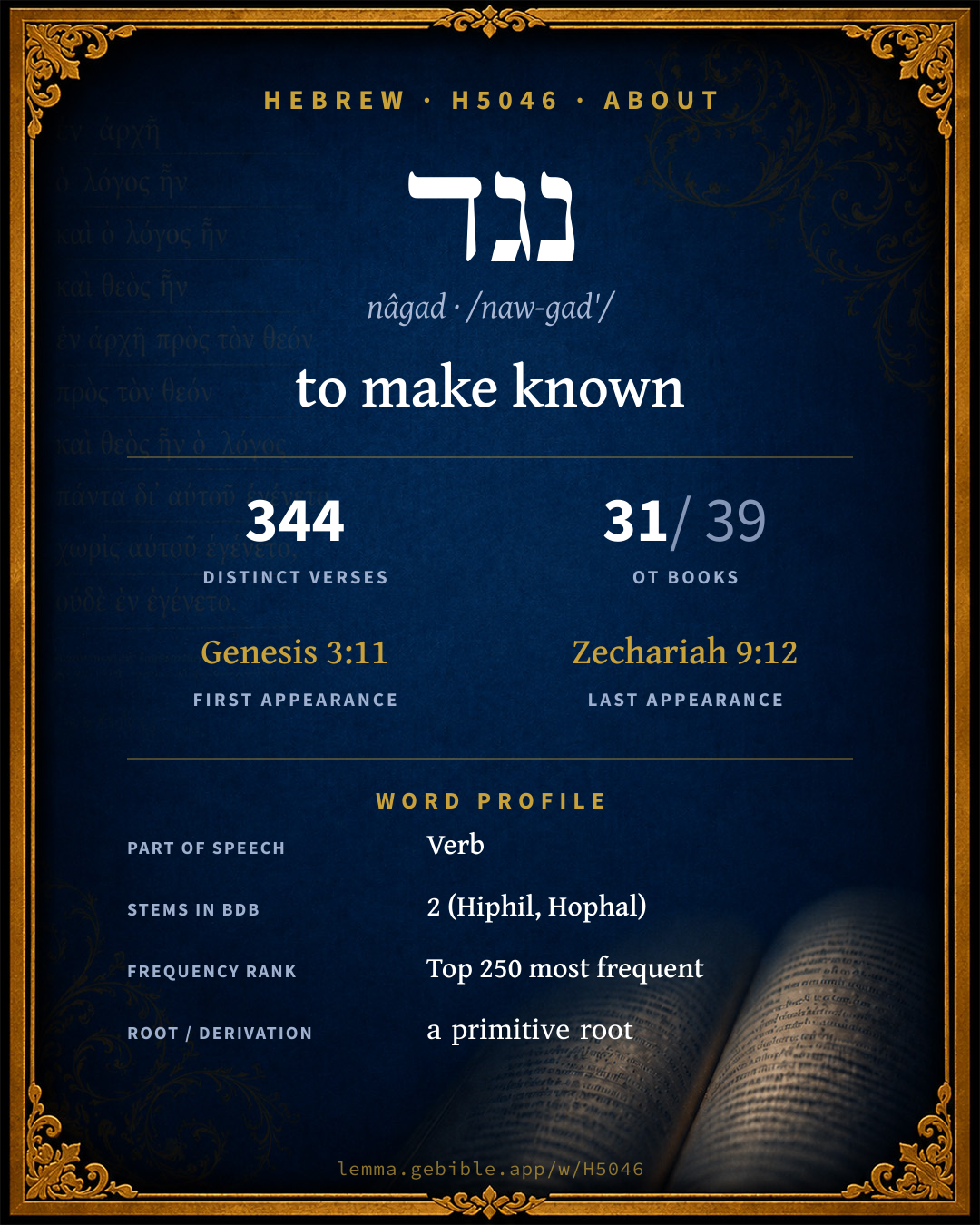
נָגַד
to make known
‘to make known’ is one of 3 main senses fuller range ↓
Full lexicon entry — Brown-Driver-Briggs (BDB)
From Brown-Driver-Briggs (BDB)
Where this word appears
See every Hiphil verb in the Hebrew Bible →
Grammar key — what these labels mean
Part of speech
- Verb
- An action or state-of-being word.
Stem
- Hiphil
- The causative active stem (“he caused / brought about”). Here: ‘tell’
- Hophal
- The passive counterpart of the Hiphil (“he was caused to…”).
Form
- Sequential Imperfect
- An imperfect with prefixed waw — the standard past-narrative form (waw-consecutive imperfect).
- Infinitive Construct
- A bound verbal noun, frequently with prepositions (“to write / in writing”).
- Perfect
- A completed action or state — Hebrew marks aspect (completeness) more than strict tense (“he wrote”).
- Imperfect
- An incomplete, ongoing, or future action (“he will / would write”).
- Imperative
- A direct command (“write!”).
- Participle Active
- A verbal adjective expressing ongoing or characteristic action (“writing / one who writes”).
- Infinitive Absolute
- An unbound verbal noun, often intensifying or standing in for a finite verb.
- Sequential Perfect
- A perfect with prefixed waw continuing a preceding imperfect or command (waw-consecutive perfect).
- Jussive
- A third- or second-person volitional form expressing wish or command (“let him write”).
- Cohortative
- A first-person volitional form expressing wish or resolve (“let me / let us write”).
State
- Absolute
- The independent form of a noun, not bound to a following word.
- Construct
- A noun bound to a following noun in a possessive / “of” relationship (the construct chain).
Person
- 3rd Person
- The one spoken about (“he / she / it / they”).
- 1st Person
- The speaker (“I / we”).
- 2nd Person
- The one addressed (“you”).
Gender
- Masculine
- Grammatically masculine.
- Common
- Either gender — not distinguished for this form.
- Feminine
- Grammatically feminine.
Number
- Singular
- One.
- Plural
- More than one (in Hebrew, generally three or more).
Grammatical forms 41 distinct
- Verb, Hiphil, Sequential Imperfect, 3rd Person, Masculine, Singular 45 times (12%)
- Verb, Hiphil, Sequential Imperfect, 3rd Person, Masculine, Plural 40 times (11%)
- Verb, Hiphil, Infinitive Construct 28 times (8%)
- Verb, Hiphil, Imperfect, 3rd Person, Masculine, Singular 26 times (7%)
- Verb, Hiphil, Imperative, 2nd Person, Masculine, Singular 26 times (7%)
- Verb, Hophal, Sequential Imperfect, 3rd Person, Masculine, Singular 24 times (6%)
- Verb, Hiphil, Perfect, 3rd Person, Masculine, Singular 24 times (6%)
- Verb, Hiphil, Participle Active, Masculine, Singular, Absolute 18 times (5%)
+33 more forms (140 occurrences)
Parsed forms decoded from the imported morphology (morphhb / Westminster Leningrad Codex — WLC text public domain, morphhb tagging CC BY 4.0), counted across 371 parsed occurrences — not distinct verses.
Page 2 of 2 — showing verses 201–344 of 344 distinct verses where H5046 appears, across 31 books. Click any verse to open its interlinear word-by-word view. Verse text shown in the World English Bible for context — . Each verse’s Hebrew form is shown with its reference; the English is not keyword-highlighted, since the data carries no word-level English alignment. Use “Compare translations” on any verse to read it across multiple English versions. This concordance covers the Hebrew Bible; Septuagint (Greek Old Testament) occurrences are not indexed here.
2 Kings 22 verses
- 2 Kings 9:18 וַ/יַּגֵּ֤ד conj + Hiphil wimpf 3ms So there went one on horseback to meet him, and said, Thus says the king, Is it peace? Jehu said, What have you to do with peace? turn you behind me. The watchman told, saying, The messenger came to them, but he isn't coming back.
- 2 Kings 9:20 וַ/יַּגֵּ֤ד conj + Hiphil wimpf 3ms The watchman told, saying, He came even to them, and isn't coming back: and the driving is like the driving of Jehu the son of Nimshi; for he drives furiously.
- 2 Kings 9:36 וַ/יַּגִּ֣ידוּ conj + Hiphil wimpf 3mp Therefore they came back, and told him. He said, This is the word of Yahweh, which he spoke by his servant Elijah the Tishbite, saying, In the portion of Jezreel shall the dogs eat the flesh of Jezebel;
- 2 Kings 10:8 וַ/יַּגֶּד conj + Hiphil wimpf 3ms There came a messenger, and told him, saying, They have brought the heads of the king's sons. He said, Lay you them in two heaps at the entrance of the gate until the morning.
- 2 Kings 18:37 וַ/יַּגִּ֣דוּ conj + Hiphil wimpf 3mp Then came Eliakim the son of Hilkiah, who was over the household, and Shebna the scribe, and Joah the son of Asaph the recorder, to Hezekiah with their clothes torn, and told him the words of Rabshakeh.
- 2 Kings 22:10 וַ/יַּגֵּ֞ד conj + Hiphil wimpf 3ms Shaphan the scribe told the king, saying, Hilkiah the priest has delivered me a book. Shaphan read it before the king.
1 Chronicles 3 verses
- 1 Chronicles 17:10 וָ/אַגִּ֣ד conj + Hiphil wimpf 1cs and [as] from the day that I commanded judges to be over my people Israel; and I will subdue all your enemies. Moreover I tell you that Yahweh will build you a house.
- 1 Chronicles 19:5 וַ/יַּגִּ֨ידוּ conj + Hiphil wimpf 3mp Then there went certain persons, and told David how the men were served. He sent to meet them; for the men were greatly ashamed. The king said, Stay at Jericho until your beards be grown, and then return.
- 1 Chronicles 19:17 וַ/יֻּגַּ֣ד conj + Hophal wimpf 3ms It was told David; and he gathered all Israel together, and passed over the Jordan, and came on them, and set the battle in array against them. So when David had put the battle in array against the Syrians, they fought with him.
2 Chronicles 4 verses
- 2 Chronicles 9:2 וַ/יַּגֶּד הִגִּ֖יד conj + Hiphil wimpf 3ms Hiphil pf 3ms Solomon told her all her questions; and there was not anything hid from Solomon which he didn't tell her.
- 2 Chronicles 9:6 הֻגַּד Hophal pf 3ms However I didn't believe their words, until I came, and my eyes had seen it; and, behold, the half of the greatness of your wisdom was not told me: you exceed the fame that I heard.
- 2 Chronicles 20:2 וַ/יַּגִּ֤ידוּ conj + Hiphil wimpf 3mp Then there came some who told Jehoshaphat, saying, There comes a great multitude against you from beyond the sea from Syria; and, behold, they are in Hazazon Tamar (the same is En Gedi).
- 2 Chronicles 34:18 וַ/יַּגֵּ֞ד conj + Hiphil wimpf 3ms Shaphan the scribe told the king, saying, Hilkiah the priest has delivered me a book. Shaphan read therein before the king.
Ezra 1 verse
Nehemiah 4 verses
- Nehemiah 2:12 הִגַּ֣דְתִּי Hiphil pf 1cs I arose in the night, I and some few men with me; neither told I any man what my God put into my heart to do for Jerusalem; neither was there any animal with me, except the animal that I rode on.
- Nehemiah 2:16 הִגַּֽדְתִּי Hiphil pf 1cs The rulers didn't know where I went, or what I did; neither had I as yet told it to the Jews, nor to the priests, nor to the nobles, nor to the rulers, nor to the rest who did the work.
- Nehemiah 2:18 וָ/אַגִּ֨יד conj + Hiphil wimpf 1cs I told them of the hand of my God which was good on me, as also of the king's words that he had spoken to me. They said, Let us rise up and build. So they strengthened their hands for the good [work].
- Nehemiah 7:61 לְ/הַגִּ֤יד prep + Hiphil inf.cs These were those who went up from Tel-melah, Tel Harsha, Cherub, Addon, and Immer; but they could not show their fathers' houses, nor their seed, whether they were of Israel:
Esther 12 verses
- Esther 2:10 הִגִּ֣ידָה תַגִּֽיד Hiphil pf 3fs Hiphil impf 3fs Esther had not made known her people nor her relatives; for Mordecai had charged her that she should not make it known.
- Esther 2:20 מַגֶּ֤דֶת Hiphil ptcp.act fs Esther had not yet made known her relatives nor her people; as Mordecai had charged her: for Esther did the commandment of Mordecai, like as when she was brought up with him.
- Esther 2:22 וַ/יַּגֵּ֖ד conj + Hiphil wimpf 3ms The thing became known to Mordecai, who shown it to Esther the queen; and Esther told the king [of it] in Mordecai's name.
- Esther 3:4 וַ/יַּגִּ֣ידוּ הִגִּ֥יד conj + Hiphil wimpf 3mp Hiphil pf 3ms Now it came to pass, when they spoke daily to him, and he didn't listen to them, that they told Haman, to see whether Mordecai's matters would stand: for he had told those who he was a Jew.
- Esther 3:6 הִגִּ֥ידוּ Hiphil pf 3cp But he scorned the thought of laying hands on Mordecai alone; for they had made known to him the people of Mordecai: therefore Haman sought to destroy all the Jews who were throughout the whole kingdom of Ahasuerus, even the people of Mordecai.
- Esther 4:4 וַ/יַּגִּ֣ידוּ conj + Hiphil wimpf 3mp Esther's maidens and her chamberlains came and told it her; and the queen was exceedingly grieved: and she sent clothing to clothe Mordecai, and to take his sackcloth from off him; but he didn't receive it.
- Esther 4:7 וַ/יַּגֶּד conj + Hiphil wimpf 3ms Mordecai told him of all that had happened to him, and the exact sum of the money that Haman had promised to pay to the king's treasuries for the Jews, to destroy them.
- Esther 4:8 וּ/לְ/הַגִּ֣יד conj + prep + Hiphil inf.cs Also he gave him the copy of the writing of the decree that was given out in Shushan to destroy them, to show it to Esther, and to declare it to her, and to charge her that she should go in to the king, to make supplication to him, and to make request before him, for her people.
- Esther 4:9 וַ/יַּגֵּ֣ד conj + Hiphil wimpf 3ms Hathach came and told Esther the words of Mordecai.
- Esther 4:12 וַ/יַּגִּ֣ידוּ conj + Hiphil wimpf 3mp They told to Mordecai Esther's words.
- Esther 6:2 הִגִּ֨יד Hiphil pf 3ms It was found written that Mordecai had told of Bigthana and Teresh, two of the king's chamberlains, of those who kept the threshold, who had sought to lay hands on the king Ahasuerus.
- Esther 8:1 הִגִּ֥ידָה Hiphil pf 3fs On that day did the king Ahasuerus give the house of Haman the Jews' enemy to Esther the queen. Mordecai came before the king; for Esther had told what he was to her.
Job 17 verses
- Job 1:15 לְ/הַגִּ֥יד prep + Hiphil inf.cs and the Sabeans attacked, and took them away. Yes, they have killed the servants with the edge of the sword, and I alone have escaped to tell you."
- Job 1:16 לְ/הַגִּ֥יד prep + Hiphil inf.cs While he was still speaking, there also came another, and said, "The fire of God has fallen from the sky, and has burned up the sheep and the servants, and consumed them, and I alone have escaped to tell you."
- Job 1:17 לְ/הַגִּ֥יד prep + Hiphil inf.cs While he was still speaking, there came also another, and said, "The Chaldeans made three bands, and swept down on the camels, and have taken them away, yes, and killed the servants with the edge of the sword; and I alone have escaped to tell you."
- Job 1:19 לְ/הַגִּ֥יד prep + Hiphil inf.cs and, behold, there came a great wind from the wilderness, and struck the four corners of the house, and it fell on the young men, and they are dead. I alone have escaped to tell you."
- Job 11:6 וְ/יַגֶּד conj + Hiphil impf 3ms That he would show you the secrets of wisdom! For true wisdom has two sides. Know therefore that God exacts of you less than your iniquity deserves.
- Job 12:7 וְ/יַגֶּד conj + Hiphil impf 3ms "But ask the animals, now, and they shall teach you; The birds of the sky, and they shall tell you.
- Job 15:18 יַגִּ֑ידוּ Hiphil impf 3mp (Which wise men have told From their fathers, and have not hidden it;
- Job 17:5 יַגִּ֣יד Hiphil impf 3ms He who denounces his friends for a prey, Even the eyes of his children shall fail.
- Job 21:31 יַגִּ֣יד Hiphil impf 3ms Who shall declare his way to his face? Who shall repay him what he has done?
- Job 26:4 הִגַּ֣דְתָּ Hiphil pf 2ms To whom have you uttered words? Whose spirit came forth from you?
- Job 31:37 אַגִּידֶ֑/נּוּ Hiphil impf 1cs + sfx pers 3ms I would declare to him the number of my steps. As a prince would I go near to him.
- Job 33:23 לְ/הַגִּ֖יד prep + Hiphil inf.cs "If there is beside him an angel, An interpreter, one among a thousand, To show to man what is right for him;
- Job 36:9 וַ/יַּגֵּ֣ד conj + Hiphil wimpf 3ms Then he shows them their work, And their transgressions, that they have behaved themselves proudly.
- Job 36:33 יַגִּ֣יד Hiphil impf 3ms The noise of it tells about him, And the cattle also concerning the storm that comes up.
- Job 38:4 הַ֝גֵּ֗ד Hiphil impv 2ms "Where were you when I laid the foundations of the earth? Declare, if you have understanding.
- Job 38:18 הַ֝גֵּ֗ד Hiphil impv 2ms Have you comprehended the earth in its breadth? Declare, if you know it all.
- Job 42:3 הִ֭גַּדְתִּי Hiphil pf 1cs You asked, 'Who is this who hides counsel without knowledge?' Therefore I have uttered that which I did not understand, Things too wonderful for me, which I didn't know.
Psalms 20 verses
- Psalms 9:11 הַגִּ֥ידוּ Hiphil impv 2mp Sing praises to Yahweh, who dwells in Zion, And declare among the people what he has done.
- Psalms 19:1 מַגִּ֥יד Hiphil ptcp.act ms The heavens declare the glory of God. The expanse shows his handiwork.
- Psalms 22:31 וְ/יַגִּ֣ידוּ conj + Hiphil impf 3mp They shall come and shall declare his righteousness to a people that shall be born, For he has done it.
- Psalms 30:9 הֲ/יַגִּ֥יד ptcl inter + Hiphil impf 3ms "What profit is there in my destruction, if I go down to the pit? Shall the dust praise you? Shall it declare your truth?
- Psalms 38:18 אַגִּ֑יד Hiphil impf 1cs For I will declare my iniquity. I will be sorry for my sin.
- Psalms 40:5 אַגִּ֥ידָה Hiphil coh 1cs Many, Yahweh, my God, are the wonderful works which you have done, And your thoughts which are toward us. They can't be set in order to you; If I would declare and speak of them, they are more than can be numbered.
- Psalms 50:6 וַ/יַּגִּ֣ידוּ conj + Hiphil wimpf 3mp The heavens shall declare his righteousness, For God himself is judge. Selah.
- Psalms 51:15 יַגִּ֥יד Hiphil impf 3ms Lord, open my lips. My mouth shall declare your praise.
- Psalms 52:1 וַ/יַּגֵּ֪ד conj + Hiphil wimpf 3ms Why do you boast of mischief, mighty man? God's loving kindness endures continually.
- Psalms 64:9 וַ֭/יַּגִּידוּ conj + Hiphil wimpf 3mp All mankind shall be afraid. They shall declare the work of God, And shall wisely ponder what he has done.
- Psalms 71:17 אַגִּ֥יד Hiphil impf 1cs God, you have taught me from my youth. Until now, I have declared your wondrous works.
- Psalms 71:18 אַגִּ֣יד Hiphil impf 1cs Yes, even when I am old and gray-haired, God, don't forsake me, Until I have declared your strength to the next generation, Your might to everyone who is to come.
- Psalms 75:9 אַגִּ֣יד Hiphil impf 1cs But I will declare this forever: I will sing praises to the God of Jacob.
- Psalms 92:2 לְ/הַגִּ֣יד prep + Hiphil inf.cs To proclaim your loving kindness in the morning, And your faithfulness every night,
- Psalms 92:15 לְ֭/הַגִּיד prep + Hiphil inf.cs To show that Yahweh is upright. He is my rock, And there is no unrighteousness in him.
- Psalms 97:6 הִגִּ֣ידוּ Hiphil pf 3cp The heavens declare his righteousness. All the peoples have seen his glory.
- Psalms 111:6 הִגִּ֣יד Hiphil pf 3ms He has shown his people the power of his works, In giving them the heritage of the nations.
- Psalms 142:2 אַגִּֽיד Hiphil impf 1cs I pour out my complaint before him. I tell him my troubles.
- Psalms 145:4 יַגִּֽידוּ Hiphil impf 3mp One generation will commend your works to another, And will declare your mighty acts.
- Psalms 147:19 מַגִּ֣יד Hiphil ptcp.act ms He shows his word to Jacob; His statutes and his ordinances to Israel.
Proverbs 2 verses
Ecclesiastes 4 verses
- Ecclesiastes 6:12 יַגִּ֣יד Hiphil impf 3ms For who knows what is good for man in life, all the days of his vain life which he spends like a shadow? For who can tell a man what will be after him under the sun?
- Ecclesiastes 8:7 יַגִּ֥יד Hiphil impf 3ms For he doesn't know that which will be; for who can tell him how it will be?
- Ecclesiastes 10:14 יַגִּ֥יד Hiphil impf 3ms A fool also multiplies words. Man doesn't know what will be; and that which will be after him, who can tell him?
- Ecclesiastes 10:20 יַגֵּ֥יד Hiphil impf 3ms Don't curse the king, no, not in your thoughts; And don't curse the rich in your bedchamber: For a bird of the sky may carry your voice, And that which has wings may tell the matter.
Song of Solomon 2 verses
- Song of Solomon 1:7 הַגִּ֣ידָ/ה Hiphil impv 2ms + sfx h Tell me, you whom my soul loves, Where you graze your flock, Where you rest them at noon; For why should I be as one who is veiled Beside the flocks of your companions? Lover
- Song of Solomon 5:8 תַּגִּ֣ידוּ Hiphil impf 2mp I adjure you, daughters of Jerusalem, If you find my beloved, That you tell him that I am faint with love. Friends
Isaiah 28 verses
- Isaiah 3:9 הִגִּ֖ידוּ Hiphil pf 3cp The look of their faces testify against them. They parade their sin like Sodom. They don't hide it. Woe to their soul! For they have brought disaster upon themselves.
- Isaiah 7:2 וַ/יֻּגַּ֗ד conj + Hophal wimpf 3ms It was told the house of David, saying, "Syria is allied with Ephraim." His heart trembled, and the heart of his people, as the trees of the forest tremble with the wind.
- Isaiah 19:12 וְ/יַגִּ֥ידוּ conj + Hiphil juss 3mp Where then are your wise men? and let them tell you now; and let them know what Yahweh of Hosts has purposed concerning Egypt.
- Isaiah 21:2 הֻגַּד Hophal pf 3ms A grievous vision is declared to me; the treacherous man deals treacherously, and the destroyer destroys. Go up, Elam; besiege, Media; all the sighing of it have I made to cease.
- Isaiah 21:6 יַגִּֽיד Hiphil impf 3ms For thus has the Lord said to me, Go, set a watchman: let him declare what he sees:
- Isaiah 21:10 הִגַּ֥דְתִּי Hiphil pf 1cs You my threshing, and the grain of my floor! that which I have heard from Yahweh of hosts, the God of Israel, have I declared to you.
- Isaiah 36:22 וַ/יַּגִּ֣ידוּ conj + Hiphil wimpf 3mp Then came Eliakim the son of Hilkiah, who was over the household, and Shebna the scribe, and Joah, the son of Asaph, the recorder, to Hezekiah with their clothes torn, and told him the words of Rabshakeh.
- Isaiah 40:21 הֻגַּ֥ד Hophal pf 3ms Have you not known? have yet not heard? has it not been told you from the beginning? have you not understood from the foundations of the earth?
- Isaiah 41:22 וְ/יַגִּ֣ידוּ הַגִּ֜ידוּ conj + Hiphil impf 3mp Hiphil impv 2mp Let them bring forth, and declare to us what shall happen: declare you the former things, what they are, that we may consider them, and know the latter end of them; or show us things to come.
- Isaiah 41:23 הַגִּ֨ידוּ֙ Hiphil impv 2mp Declare the things that are to come hereafter, that we may know that you are gods: yes, do good, or do evil, that we may be dismayed, and see it together.
- Isaiah 41:26 הִגִּ֤יד מַגִּ֗יד Hiphil pf 3ms Hiphil ptcp.act ms Who has declared it from the beginning, that we may know? and before, that we may say, [He is] right? yes, there is none who declares, yes, there is none who shows, yes, there is none who hears your words.
- Isaiah 42:9 מַגִּ֔יד Hiphil ptcp.act ms Behold, the former things have happened, and new things do I declare. Before they spring forth I tell you of them.
- Isaiah 42:12 יַגִּֽידוּ Hiphil impf 3mp Let them give glory to Yahweh, and declare his praise in the islands.
- Isaiah 43:9 יַגִּ֣יד Hiphil impf 3ms Let all the nations be gathered together, and let the peoples be assembled: who among them can declare this, and show us former things? let them bring their witnesses, that they may be justified; or let them hear, and say, It is truth.
- Isaiah 43:12 הִגַּ֤דְתִּי Hiphil pf 1cs I have declared, and I have saved, and I have shown; and there was no strange [god] among you: therefore you are my witnesses, says Yahweh, and I am God.
- Isaiah 44:7 וְ/יַגִּידֶ֤/הָ יַגִּ֥ידוּ conj + Hiphil impf 3ms + sfx pers 3fs Hiphil impf 3mp Who, as I, shall call, and shall declare it, and set it in order for me, since I established the ancient people? and the things that are coming, and that shall happen, let them declare.
- Isaiah 44:8 וְ/הִגַּ֖דְתִּי conj + Hiphil pf 1cs Don't fear, neither be afraid: haven't I declared to you of old, and shown it? You are my witnesses. Is there a God besides me? Indeed, there is not. I don't know any Rock.
- Isaiah 45:19 מַגִּ֖יד Hiphil ptcp.act ms I have not spoken in secret, in a place of the land of darkness; I didn't say to the seed of Jacob, Seek you me in vain: I, Yahweh, speak righteousness, I declare things that are right.
- Isaiah 45:21 הַגִּ֣ידוּ הִגִּידָ֗/הּ Hiphil impv 2mp Hiphil pf 3ms + sfx pers 3fs Declare you, and bring [it] forth; yes, let them take counsel together: who has shown this from ancient time? who has declared it of old? Haven't I, Yahweh? and there is no God else besides me, a just God and a Savior; there is no one besides me.
- Isaiah 46:10 מַגִּ֤יד Hiphil ptcp.act ms declaring the end from the beginning, and from ancient times things that are not [yet] done; saying, My counsel shall stand, and I will do all my pleasure;
- Isaiah 48:3 הִגַּ֔דְתִּי Hiphil pf 1cs I have declared the former things from of old; yes, they went forth out of my mouth, and I shown them: suddenly I did them, and they happened.
- Isaiah 48:5 וָ/אַגִּ֤יד conj + Hiphil wimpf 1cs therefore I have declared it to you from of old; before it came to pass I shown it you; lest you should say, My idol has done them, and my engraved image, and my molten image, has commanded them.
- Isaiah 48:6 תַגִּ֑ידוּ Hiphil impf 2mp You have heard it; see all this; and you, will you not declare it? I have shown you new things from this time, even hidden things, which you have not known.
- Isaiah 48:14 הִגִּ֣יד Hiphil pf 3ms Assemble yourselves, all you, and hear; who among them has declared these things? He whom Yahweh loves shall perform his pleasure on Babylon, and his arm [shall be on] the Chaldeans.
- Isaiah 48:20 הַגִּ֤ידוּ Hiphil impv 2mp Go you forth from Babylon, flee you from the Chaldeans; with a voice of singing declare you, tell this, utter it even to the end of the earth: say you, Yahweh has redeemed his servant Jacob.
- Isaiah 57:12 אַגִּ֖יד Hiphil impf 1cs I will declare your righteousness; and as for your works, they shall not profit you.
- Isaiah 58:1 וְ/הַגֵּ֤ד conj + Hiphil impv 2ms Cry aloud, don't spare, lift up your voice like a trumpet, and declare to my people their disobedience, and to the house of Jacob their sins.
- Isaiah 66:19 וְ/הִגִּ֥ידוּ conj + Hiphil wpf 3cp I will set a sign among them, and I will send such as escape of them to the nations, to Tarshish, Pul, and Lud, who draw the bow, to Tubal and Javan, to the isles afar off, who have not heard my fame, neither have seen my glory; and they shall declare my glory among the nations.
Jeremiah 24 verses
- Jeremiah 4:5 הַגִּ֣ידוּ Hiphil impv 2mp Declare you in Judah, and publish in Jerusalem; and say, Blow you the trumpet in the land: cry aloud and say, Assemble yourselves, and let us go into the fortified cities.
- Jeremiah 4:15 מַגִּ֖יד Hiphil ptcp.act ms For a voice declares from Dan, and publishes evil from the hills of Ephraim:
- Jeremiah 5:20 הַגִּ֥ידוּ Hiphil impv 2mp Declare you this in the house of Jacob, and publish it in Judah, saying,
- Jeremiah 9:12 וְ/יַגִּדָ֑/הּ conj + Hiphil impf 3ms + sfx pers 3fs Who is the wise man, that may understand this? and [who is] he to whom the mouth of Yahweh has spoken, that he may declare it? why is the land perished and burned up like a wilderness, so that none passes through?
- Jeremiah 16:10 תַגִּיד֙ Hiphil impf 2ms It shall happen, when you shall show this people all these words, and they shall tell you, Why has Yahweh pronounced all this great evil against us? or what is our iniquity? or what is our sin that we have committed against Yahweh our God?
- Jeremiah 20:10 הַגִּ֨ידוּ֙ וְ/נַגִּידֶ֔/נּוּ Hiphil impv 2mp conj + Hiphil impf 1cp + sfx pers 3ms For I have heard the defaming of many, terror on every side. Denounce, and we will denounce him, [say] all my familiar friends, those who watch for my fall; peradventure he will be persuaded, and we shall prevail against him, and we shall take our revenge on him.
- Jeremiah 31:10 וְ/הַגִּ֥ידוּ conj + Hiphil impv 2mp Hear the word of Yahweh, you nations, and declare it in the isles afar off; and say, He who scattered Israel will gather him, and keep him, as shepherd does his flock.
- Jeremiah 33:3 וְ/אַגִּ֧ידָה conj + Hiphil coh 1cs Call to me, and I will answer you, and will show you great things, and difficult, which you don't know.
- Jeremiah 36:13 וַ/יַּגֵּ֤ד conj + Hiphil wimpf 3ms Then Micaiah declared to them all the words that he had heard, when Baruch read the book in the ears of the people.
- Jeremiah 36:16 הַגֵּ֤יד נַגִּיד֙ Hiphil inf.abs Hiphil impf 1cp Now it happened, when they had heard all the words, they turned in fear one toward another, and said to Baruch, We will surely tell the king of all these words.
- Jeremiah 36:17 הַגֶּד Hiphil impv 2ms They asked Baruch, saying, Tell us now, How did you write all these words at his mouth?
- Jeremiah 36:20 וַ/יַּגִּ֨ידוּ֙ conj + Hiphil wimpf 3mp They went in to the king into the court; but they had laid up the scroll in the chamber of Elishama the scribe; and they told all the words in the ears of the king.
- Jeremiah 38:15 אַגִּ֣יד Hiphil impf 1cs Then Jeremiah said to Zedekiah, If I declare it to you, will you not surely put me to death? and if I give you counsel, you will not listen to me.
- Jeremiah 38:25 הַגִּֽידָ/ה Hiphil impv 2ms + sfx h But if the princes hear that I have talked with you, and they come to you, and tell you, Declare to us now what you have said to the king; don't hide it from us, and we will not put you to death; also what the king said to you:
- Jeremiah 38:27 וַ/יַּגֵּ֤ד conj + Hiphil wimpf 3ms Then came all the princes to Jeremiah, and asked him; and he told them according to all these words that the king had commanded. So they left off speaking with him; for the matter was not perceived.
- Jeremiah 42:3 וְ/יַגֶּד conj + Hiphil juss 3ms that Yahweh your God may show us the way in which we should walk, and the thing that we should do.
- Jeremiah 42:4 אַגִּ֣יד Hiphil impf 1cs Then Jeremiah the prophet said to them, I have heard you; behold, I will pray to Yahweh your God according to your words; and it shall happen that whatever thing Yahweh shall answer you, I will declare it to you; I will keep nothing back from you.
- Jeremiah 42:20 הַגֶּד Hiphil impv 2ms For you have dealt deceitfully against your own souls; for you sent me to Yahweh your God, saying, Pray for us to Yahweh our God; and according to all that Yahweh our God shall say, so declare to us, and we will do it:
- Jeremiah 42:21 וָ/אַגִּ֥ד conj + Hiphil wimpf 1cs and I have this day declared it to you; but you have not obeyed the voice of Yahweh your God in anything for which he has sent me to you.
- Jeremiah 46:14 הַגִּ֤ידוּ Hiphil impv 2mp Declare you in Egypt, and publish in Migdol, and publish in Memphis and in Tahpanhes: say you, Stand forth, and prepare you; for the sword has devoured round about you.
- Jeremiah 48:20 הַגִּ֣ידוּ Hiphil impv 2mp Moab is disappointed; for it is broken down: wail and cry; tell you it by the Arnon, that Moab is laid waste.
- Jeremiah 50:2 הַגִּ֨ידוּ Hiphil impv 2mp Declare you among the nations and publish, and set up a standard; publish, and don't conceal: say, Babylon is taken, Bel is disappointed, Merodach is dismayed; her images are disappointed, her idols are dismayed.
- Jeremiah 50:28 לְ/הַגִּ֣יד prep + Hiphil inf.cs The voice of those who flee and escape out of the land of Babylon, to declare in Zion the vengeance of Yahweh our God, the vengeance of his temple.
- Jeremiah 51:31 וּ/מַגִּ֖יד מַגִּ֑יד לְ/הַגִּיד֙ conj + Hiphil ptcp.act ms Hiphil ptcp.act ms prep + Hiphil inf.cs One post shall run to meet another, and one messenger to met another, to show the king of Babylon that his city is taken on every quarter:
Ezekiel 5 verses
- Ezekiel 23:36 וְ/הַגֵּ֣ד conj + Hiphil impv 2ms Yahweh said moreover to me: Son of man, will you judge Oholah and Oholibah? then declare to them their abominations.
- Ezekiel 24:19 תַגִּ֥יד Hiphil impf 2ms The people said to me, Won't you tell us what these things are to us, that you do so?
- Ezekiel 37:18 תַגִּ֥יד Hiphil impf 2ms When the children of your people shall speak to you, saying, Will you not show us what you mean by these?
- Ezekiel 40:4 הַגֵּ֛ד Hiphil impv 2ms The man said to me, Son of man, see with your eyes, and hear with your ears, and set your heart on all that I shall show you; for, to the intent that I may show them to you, are you brought here: declare all that you see to the house of Israel.
- Ezekiel 43:10 הַגֵּ֤ד Hiphil impv 2ms You, son of man, show the house to the house of Israel, that they may be ashamed of their iniquities; and let them measure the pattern.
Daniel 4 verses
- Daniel 2:2 לְ/הַגִּ֥יד prep + Hiphil inf.cs Then the king commanded to call the magicians, and the enchanters, and the sorcerers, and the Chaldeans, to tell the king his dreams. So they came in and stood before the king.
- Daniel 9:23 לְ/הַגִּ֔יד prep + Hiphil inf.cs At the beginning of your petitions the commandment went forth, and I am come to tell you; for you are greatly beloved: therefore consider the matter, and understand the vision.
- Daniel 10:21 אַגִּ֣יד Hiphil impf 1cs But I will tell you that which is inscribed in the writing of truth: and there is none who holds with me against these, but Michael your prince."
- Daniel 11:2 אַגִּ֣יד Hiphil impf 1cs Now will I show you the truth. Behold, there shall stand up yet three kings in Persia; and the fourth shall be far richer than they all: and when he has grown strong through his riches, he shall stir up all against the realm of Greece.
Hosea 1 verse
Amos 1 verse
Jonah 2 verses
- Jonah 1:8 הַגִּידָ/ה Hiphil impv 2ms + sfx h Then they asked him, "Tell us, please, for whose cause this evil is on us. What is your occupation? Where do you come from? What is your country? Of what people are you?"
- Jonah 1:10 הִגִּ֖יד Hiphil pf 3ms Then were the men exceedingly afraid, and said to him, "What is this that you have done?" For the men knew that he was fleeing from the presence of Yahweh, because he had told them.
Micah 3 verses
- Micah 1:10 תַּגִּ֔ידוּ Hiphil juss 2mp Don't tell it in Gath, Don't weep at all. At Beth Ophrah I have rolled myself in the dust.
- Micah 3:8 לְ/הַגִּ֤יד prep + Hiphil inf.cs But as for me, I am full of power by the Spirit of Yahweh, And of judgment, and of might, To declare to Jacob his disobedience, And to Israel his sin.
- Micah 6:8 הִגִּ֥יד Hiphil pf 3ms He has shown you, O man, what is good. What does Yahweh require of you, but to act justly, To love mercy, and to walk humbly with your God?
Zechariah 1 verse
About this entry
At a glance — auto-summarized from this page’s data, not written by a person. Every figure links to its source below. This summary describes the numbers; it doesn’t interpret them.
נגד (nâgad) is a Hebrew verb most often rendered “to make known.” Older and newer Bibles part ways — “told” in the King James Version, “declare” (unfoldingWord Literal Text) in modern versions. See the renderings breakdown. It turns up in 344 verses across 31 books, a common footprint. Scripture first uses it in Genesis 3:11. Read the stem: it spans 2 stems, including Hiphil and Hophal. The sections below give every sense, occurrence, and version rendering.
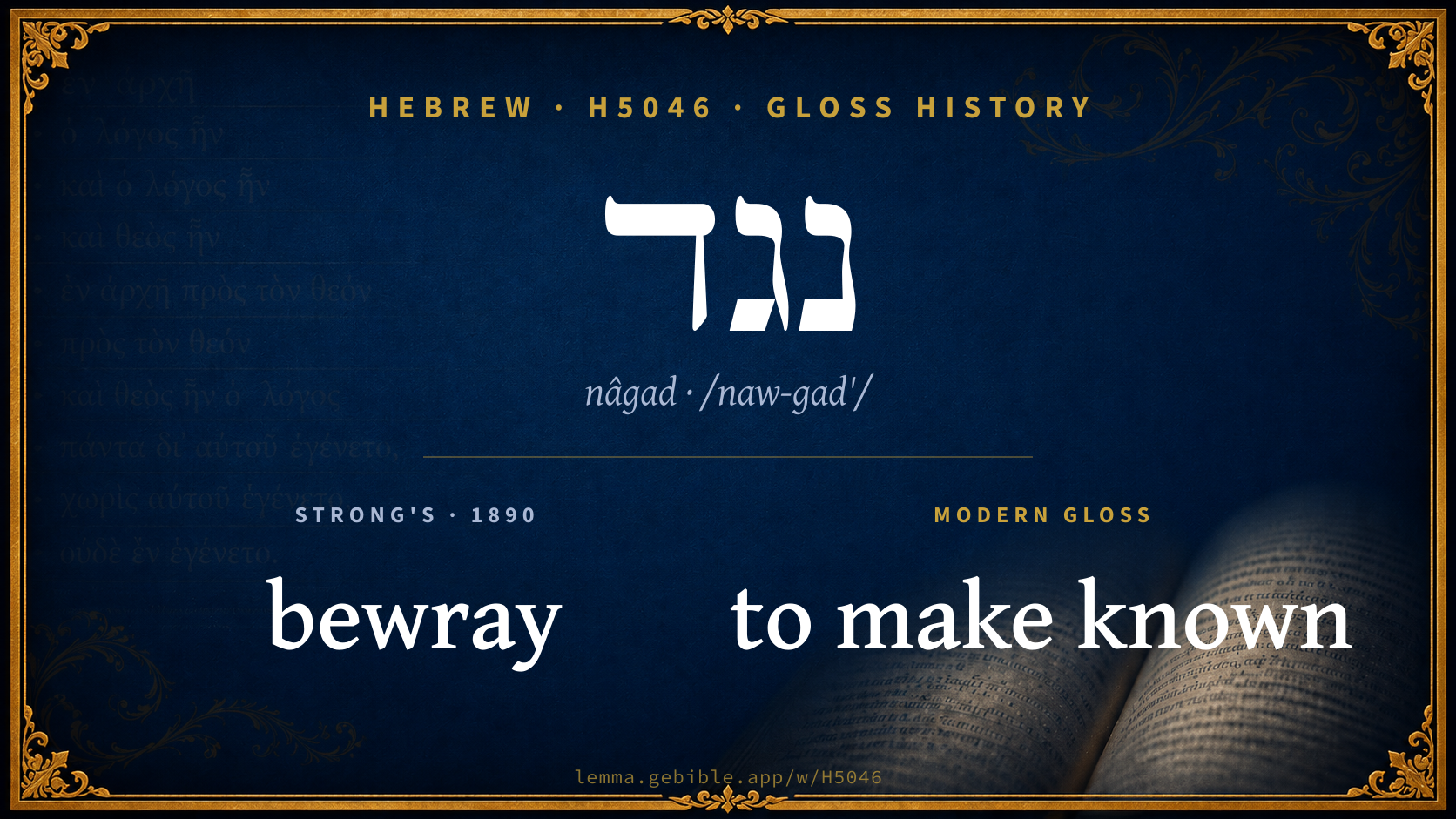
Gloss history
Strong's 1890 vs modern scholarship
About this word
Strong's H5046 catalogs a Hebrew word from the Hebrew Old Testament.
These counts are not copied from any lexicon or concordance. They are computed here, from the morphology-tagged Hebrew Old Testament. What Lemma adds →
- 344
- distinct verses
- The word appears in 344 distinct verses.
- 31 / 39
- OT books
- The word appears in 31 of 39 Old Testament books.
- #136
- by frequency
- Top 250 most frequent Hebrew words (rank 136 of 8,640 Hebrew words by occurrence).
View all 344 occurrences in the concordance →
By section of the Old Testament
By traditional corpus
Conventional, traditional groupings — biblical authorship is debated, so this is a traditional corpus grouping, not an authorship claim. Each share is this word’s portion of its verses in that division of the Hebrew canon. Each figure is a share of the word’s 344 distinct verses.
- Prophets (Nevi'im) 213 verses · 62%
- Writings (Ketuvim) 78 verses · 23%
- Torah (Pentateuch) 53 verses · 15%
How translations render this word
Counts come from each version’s own published word-to-Strong’s tagging or interlinear alignment — an approximate guide to how each version renders this word, not a word-level alignment the data otherwise carries. Because each total is that version’s own tagged count, the per-version totals vary from one another and need not match the appearance or distinct-verse counts above. These counts may also differ from a printed concordance because Lemma counts each distinctly tagged rendering and does not collapse phrase taggings into a single head-word total. This is a fixed set of word-tagged versions (KJV, ASV, BSB, ULT) and does not change with the reading translation you choose elsewhere. Each version’s license is shown beside its name below (and on Sources).
- King James Version: Told 64×, Tell 32×, Was told 25×
- American Standard Version: Told 58×, Tell 28×, Declare 23×
- Berean Standard Bible: Tell 49×, Told 36×, Was told 18×
- unfoldingWord Literal Text: Declare 57×, Declared 35×, Tell 23×
King James Version Public Domain
Renders H5046 across 370 tagged occurrences — most commonly:
Plus other, less common renderings. Plus 118 renderings that appear only once — usually multi-word phrases or single function words the recovered tagging swept in, not distinct renderings.
American Standard Version Public Domain
Renders H5046 across 369 tagged occurrences — most commonly:
Plus other, less common renderings. Plus 120 renderings that appear only once — usually multi-word phrases or single function words the recovered tagging swept in, not distinct renderings.
Berean Standard Bible Public Domain
Renders H5046 across 359 tagged occurrences — most commonly:
Plus other, less common renderings. Plus 120 renderings that appear only once — usually multi-word phrases or single function words the recovered tagging swept in, not distinct renderings. Not rendered by a distinct English word in 11 further occurrences.
unfoldingWord Literal Text CC BY-SA 4.0
Renders H5046 across 431 tagged occurrences — most commonly:
Plus other, less common renderings. Plus 84 renderings that appear only once — usually multi-word phrases or single function words the recovered tagging swept in, not distinct renderings.
7 senses and sub-senses in the full BDB
Hebrew verbs can shift meaning by stem (binyan): Qal is the basic action, Niphal is often passive or reflexive, Piel often intensifies or makes it factitive, and Hiphil is typically causative. The senses below are grouped under the stem BDB assigns to each. This entry also uses Hophal (the passive of Hiphil).
What do BDB’s symbols mean?
BDB uses these scholarly abbreviations:
| Symbol | Meaning |
|---|---|
| 𝔊 | the Septuagint (the ancient Greek translation, LXX) |
| 𝔙 | the Vulgate (the Latin translation) |
| 𝔖 | the Syriac version (the Peshitta) |
| 𝔗 | the Targum (the Aramaic translation) |
| ψ | the Psalms |
| √ | root (the underlying root or stem) |
| ‖ | parallel passage (a synonymous or contrasted parallel) |
| † | the dagger: every passage where the word occurs is cited |
The 7 senses and sub-senses the full Brown-Driver-Briggs lexicon distinguishes for this word, in lexicon order (not ranked by frequency), with BDB’s own verbatim wording and sub-sense lettering. Shown in Hebrew script with BDB’s own scholarly abbreviations. The condensed entry is in the Lexicon Entry tab. See also the Forms in the corpus table below.
Hiphil
- Pf. הִגִּיד Gn 3:11 +, 3 fs. הִגִּ֫ידָה 1 S 25:19 +, הִגַּדְתָּ Gn 12:8 +, etc.; Impf. יַגִּיד 1 S 9:6 +; וַיַּגֵּד Gn 9:22 +; sf. יַגִּידֶ֫הָ Is 44:7; יַגִּדָהּ Je 9:11; יַגֵּֽדְךָ Dt 32:7 (juss.), etc.; Imv. הַגֵּד 2 S 18:21 +; הַגִּ֫ידָה Gn 29:15 +, etc.; Inf. abs. הַגֵּד Ju 14:12 + 2 times; הַגִּיד Je 36:16; cstr. לְהַגִּיד Gn 32:6 +; לגיד 2 K 9:15 Kt. (Qr לְהַגּ׳); Pt. מַגִּיד Gn 41:24; +; f. מַגֶּ֫דֶת Est 2:20; pl. cstr. מַגִּידֵי Ju 14:19;—declare, tell [usually sq. לְ of indir. obj. Gn 3:11 + often; ins. also 1 S 12:7 2 S 13:34 𝔊 Th We Klo Dr Kit Bu, so HPS 2 S 13:34 (1 S 12:7 he foll. ℌ as more diff.); sq. אֶל Ex 19:9 1 S 3:15; sq. לִפְנֵי 1 S 17:31 ψ 142:3; עַל־פָּנָיו Jb 21:31; בְּאָזְנֵי Je 36:20; sq. בְּ loc. (instead of indir. obj.) chiefly proph. Je 4:5; 5:20; 31:10 +; also 1 S 4:13 2 S 1:20 2 K 9:15 Mi 1:10; rarely sq. acc. pers. 2 S 15:31 (but read וּלְדָוִד הִגִּיד HPS (indef. subj.), or ולד׳ הֻגַּד We Dr Kit, 𝔊 𝔙 Th Klo Bu favour הֻגַּד), 2 K 7:9, 11 Ez 43:10 Jb 17:5; 26:4; 31:37; sq. dir. obj. in acc. Gn 45:13 + often; sq. cl. wi. כִּי Gn 3:11 + often; sq. cl. wi. אֲשֶׁר = כִּי (late) Est 3:4; 6:2; sq. cl. wi. מָה Gn 29:15 Ju 16:15 Est 8:1 +; sq. cl. wi. מִי 2 K 6:11; sq. cl. wi. אֵיכָה Ct 1:7, once sq. cl. wi. הֲ Gn 43:6, etc.; often no dir. obj., sq. לֵאמֹר Ex 13:8 1 S 25:14 +; sq. וַיֹּאמֶר Gn 47:1 +; אמר then foll. by orat. rect.; הִגּ׳ alone sq. orat. rect. Zc 9:12; sq. עַל concerning, 1 S 27:11 Est 6:2; often indir. obj. om. 1 S 24:19 +; dir. obj. om. Ju 13:10 +; both om. Lv 5:1 +]. In Hex. rarely P, †Lv 5:1; 14:35 Ex 16:22†; J, Gn 3:11; 12:18 Ex 13:8 + 18 times; E, Gn 21:6; 31:20; 41:25 + 15 times; D, Dt 17:9; 26:3; 30:18 + 5 times;— e.g. Genesis 3:11
- 1. tell, announce, report, usually human subj. Gn 9:22; 24:23; 32:6 Lv 14:35 Ju 13:6 1 S 3:18 1 K 1:23 Ne 2:12 Est 2:10(×2) Jb 12:7 ψ 142:3 Is 19:12 Je 5:20 Ez 24:19 + e.g. Genesis 9:22
- 2. declare, make known, expound, especially of something before not understood, concealed or mysterious, Gn 3:11; 12:18, etc.; 1 K 10:3 = 2 Ch 9:2; a riddle Ju 14:12, 15, 16(×3), 19; dream Dn 2:2; secret Jb 11:6, etc.; of י׳ as revealing, Gn 41:25 2 S 7:11 2 K 4:27 Mi 6:8 Je 42:3 ψ 147:19; of declaring by י׳’s agents Dt 5:5 Mi 3:8 1 S 15:16 2 S 24:13 Je 50:28 Is 58:1; by divin. Ho 4:12. e.g. Genesis 3:11
- 3. inform of (play the informer concerning) Jos 2:14, 20 Je 20:10 Jb 17:5 Lv 5:1 Pr 29:24. e.g. Joshua 2:14
- 4. publish, declare, proclaim, especially of proclaiming wisdom, power, loving-kindness, etc., of י׳ (especially ψψ): ψ 9:12; 22:32; 51:17; 92:3, 16; 145:4 +, subj. heavens ψ 19:2; 50:6; 97:6; Is 42:12; 57:12. e.g. Psalms 9:12
- 5. avow, acknowledge, confess: Is 3:9 ψ 38:19, cf. Is 48:6.—Pt. = messenger 2 S 15:13 Je 51:31(×2) cf. הַנַּ֫עַר הַמַּגִּיד 2 S 1:5, 6, 13; הָאִישׁ הַמּ׳ 2 S 18:11. e.g. Isaiah 3:9
Hophal
- Pf. הֻגַּד Jos 9:24 +; Impf. וַיֻּגַּד Gn 22:20 +; Inf. abs. הֻגֵּד Jos 9:24 Ru 2:11;—be told, announced, reported, always sq. לְ (sometimes impers., logical subj. in acc., cf. Gn 27:42 2 S 21:11, c. fem. Is 21:2; not in P): Gn 27:42 (J), 31:22 (E), Dt 17:4 Jos 9:24(×2) (D), Ru 2:11(×2) Ju 9:25 2 S 10:17; 19:2; 21:11 1 K 10:7; 18:13 1 Ch 19:17 2 Ch 9:6 Is 21:2; 40:21; sq. לֵאמר Gn 22:20; 38:13, 24 (all J), Jos 10:17 (JE), 1 S 15:12; 19:19 2 S 6:12 1 K 1:51 2 K 6:13; 8:7 Is 7:2; sq. cl. with כִּי Ex 14:5 (J), Ju 9:47 1 S 23:7, 13; 27:4 1 K 2:29, 41. e.g. Joshua 9:24
Senses from the full Brown-Driver-Briggs lexicon (Brown, Driver, Briggs; Oxford 1906 — public domain), digitized via Sefaria, supplemented by the OpenScriptures HebrewLexicon (CC BY 4.0). Full attribution on Sources.
Word origin
vb. be conspicuous (NH in deriv.; Ph. n.pr.m. נגד; Arabic نَجَدَ conquer, overcome, also be apparent, conspicuous; نَجْدٌ high land or country; نَجُدَ be courageous, vigorous, effective, نَجِدٌ courageous, efficient; Aramaic ܢܓܰܕ, נְגַד drag, draw, lead; ܢܳܓܽܘܕܳܐ, נָגוֹדָא leader; Ethiopic ነገደ: is travel);—
— Brown-Driver-Briggs (Oxford 1906, public domain), digitized via Sefaria, supplemented by the OpenScriptures HebrewLexicon (CC BY 4.0). See Sources.
Origin: a primitive root
Jastrow Dictionary
A second Hebrew/Aramaic lexicon for comparison, covering Aramaic and post-biblical (Talmudic, Targumic, Midrashic) usage that the biblical-Hebrew BDB does not. Matched by lemma rather than by Strong’s number, so a lemma may carry more than one Jastrow headword (shown separately below), and the entries cover usage well beyond the Bible.
אִינְגַּד
- prolong! go further! Git. 58ᵃ א׳ פוסתא וכ׳ go one page and a half further, (and you will find it). [Rashi: a little = אִי־נְגַד, v. אי III.]
נָגַד
- (b. h.) to draw a line; denom. נֶגֶד.
- (denom. of נֶגֶד) to show; to announce, tell; to testify. Tanḥ. Tsav 13 ומשם … והִגִּידָה לאהרן from there Miriam learned it and told Aaron. Ib. מַגִּיד שהכל מודים וכ׳ this shows (intimates) that all agreed as to her beauty. Snh. IV, 5 להַגִּיד גדולתו וכ׳ to show the greatness &c. Ib. 44ᵇ, a. e. (ref. to Lev. V, 1) כיון שה׳ שוב אינו חוזר ומַגִּיד after he has once testified, he cannot again testify, i.e. is not permitted to retract; a. v. fr.—[Pes. 87ᵃ, v. אָגַד.]—V. מַגִּיד. e.g. Leviticus 5:1
- to be told, proclaimed. Yalk. Koh. 989 שה׳ לה בסיני the word which has been proclaimed at Sinai; a. e.
- to oppose. Yeb. 63ᵃ; Yalk. Gen. 23 (ref. to כנגדו, Gen. II, 18) זכה כנגדו לא זכה מְנַגַּדְתּוֹ if he is favored, she will be corresponding to (in harmony with) him, if not, she will oppose him (Rashi: ‘she will be a lash to him’, v. נִגְדָּא II); Pirké’ d’R. El. ch. XII א"ת כנגדו אלא לנגדו אם זכה תהיה לו עזר ואם לאו לנַגְּדוֹ להלחם read not k’negdo, but l’nagg’do; if he is favored, she will be a help to him, if not, ‘to oppose him’, to fight. e.g. Genesis 2:18
נְגַד
- 1. (corresp. to h. מָשַׁךְ, נָטָה a. אָרַךְ) to stretch; to draw, pull, spread. Targ. Jud. XVI, 30. Targ. Deut. XXI, 3. Targ. Jer. XLIII, 10.—Targ. Ps. LV, 4 יִיגְּדוּן ed. Lag. (ed. Wil. יגרון; h. text ימיטו). Targ. Y. Deut. XVII, 20. Targ. Y. Ex. XII, 21 נגודו ידיכון וכ׳ withdraw your hands from (v. מָשַׁךְ); a. fr.—Succ. 4ᵇ גּוּד אסיק וכ׳ stretch and raise the partitions, i.e. adopt the legal fiction that the partitions around the stand are prolonged so as to reach the ceiling (v. דּוֹפָן). Sabb. 101ᵃ גוּד אחית וכ׳ stretch and bring the partitions down, i.e. adopt the fiction that the walls are prolonged so as to reach the bottom. Erub. 4ᵇ לְגוּד, v. לָבוּד. Gitt. 68ᵇ נְגִידוּ מיניה מיכליה (Rashi: נְגוּדוּ) withdraw his food from him, reduce his rations. B. Mets. 74ᵃ למידש ולמִנְגַּד to tread the grapes and to conduct the wine into the pit. Ib. 84ᵇ נַגְדוּ מתותיה וכ׳ they drew from under him sixty &c., v. מְשִׂיכְלָא. B. Bath. 111ᵇ גוד לית וכ׳ draw (take me away from here), this man does not want to learn. Pesik. B’shall., p. 90ᵃ; Koh. R. to X, 8 גוד חמי לי lead the way, show it to me. Bekh. 44ᵇ נגדו ליה גלימא they spread for him (held up between him and the people) a cloak. Erub. 94ᵃ שקולו … נְגִידוּ בה take a cloak and spread it (as a partition); a. v. fr.—Ab. I, 13 נְגַד שמא וכ׳ he who stretches his fame (is ambitious), will lose his name.
- 2. to lash, v. Pa.
- 3. to guide, rule. Targ. Ruth I, 1 (h. text שפט).
- 4. to grow long; to be drawn, follow after; to flow. Targ. Job XXI, 33 (h. text ימשוך). Targ. Jer. VI, 4 (h. tex ינטו). Targ. Cant. I, 4 נְגִדְנָא וכ׳ we are drawn after &c. Targ. Deut. XXXIII, 13; 22; a. fr. (v. נְגַר).—B. Bath. 91ᵇ והוה נָגֵיד חוטא וכ׳ a line of honey flowed over both his arms; Y. Peah VII, 20ᵃ bot. ונ׳ מלא וכ׳ and honey flowed as much as my hands could hold; a. e.—Part. pass. נְגִיד stretched, fainting (v. Ithpe.). Targ. Ps. LXXXVIII, 16.—Sabb. 152ᵃ, v. Ithpe.
- (denom. of נִגְדָּא II) to lash, punish. Targ. Cant. VII, 5 למִינְגַּד … לנַגָּדָא.—Keth. 33ᵇ נַגְּדוּהָ, v. אִלְמָלֵא. Kidd. 12ᵇ נַגְּדֵיה כרב punish him in accordance with Rab’s practice. Pes. 52ᵃ ולִינַגְּדֵיה מר נַגּוּדֵי Ms. (ed. נגידי, corr. acc.) why do you not order him to be lashed?; a. e.
- to declare liable to lashes. Kidd. l. c.; Yeb. 52ᵃ, a. e. רב מַנְגִּיד (על) וכ׳ Rab decreed punishment for him who &c. Kidd. l. c. לא מינגיד רב (read: מנגיד, as) Yeb. l. c.
- , אִינְּגִיד, Ithpa. אִתְנַגַּד
- 1. to be drawn, to extend; to run. Targ. Is. XXXIV, 11. Targ. Y. Num. XXV, 8. Targ. Y. Gen. XLV, 19. Targ. Is. XLIV, 3; a. e.
- 2. to spread, invade. Targ. I Sam. XXVII, 10 (h. text פשט); a. e.
- 3. to be withdrawn. Targ. Josh. IV, 18; a. e.
- 4. [to stretch one’s self,] to faint, fall away, die (h. גָּוַע). Targ. Gen. XXV, 8; a. fr.—Pes. 50ᵃ חלש וא׳ כי וכ׳ was sick and fainted (seemed to be dead), and when he came to &c.; B. Bath. 10ᵇ. Snh. 39ᵃ א׳ ואתנח he became faint and sighed; Sabb. 152ᵃ נגיד ואתנח.
- 5. to be lashed. Macc. 11ᵃ; Pes. 113ᵇ מִינְּגִיד, v. זִיגּוֹד.—[Kidd. 12ᵇ מינגיד, v. supra.]
נֶגֶד
- line, direction; prep. נֶ׳, mostly כְּנֶ׳ towards, opposite, corresponding to. Sifra Tsav, Milluim, Par. 1 והלא כבר זיוג … זה נ׳ זה has not the Scripture, before this, paired the two rams, one to correspond with the other? Tam. II, 5 (29ᵃ) כנ׳ מערבית דרומית משוך וכ׳ (Mish. ed. מִכְּנֶ׳) in a line with the south-west corner of the altar continued northward to a distance of &c.; Zeb. 58ᵃ. Ib. אם שחטן כְּנֶגְדָּן בקרקע if he slaughtered them in the corresponding direction, but in the ground. Mekh. Yithro, Baḥod, s. 11 (ref. to Ex. XX, 24) כְּנֶגְדּוֹ ‘alav means in a certain direction opposite the altar (not on top of it). Ber. 10ᵃ הנהו … כנ׳ מי אמרן with reference to whom did David compose these five psalms beginning with bar’khi nafshi? Ib. 26ᵇ כנ׳ תמידין corresponding to the daily offerings. Num. R. s. 18 המחלוקת הזו אינה כְּנֶגְדֵּנוּ אלא כנ׳ וכ׳ this rebellion is not directed against us but against &c.; a. v. fr.—Yeb. 63ᵃ (ref. to Gen. II, 18) זכה … לא זכה כנגדו if he is favored, she will be his help, if not, she will be against him; ib. כתיב כנַגְּדוֹ וקרינן כְּנֶיגְדּוֹ (missing in Yalk. Gen. 23) following the writing we may read k’nagg’do (opposing him, v. נָגַד), but the Massoretic reading is k’negdo (corresponding to him); Gen. R. s. 17 זכה עזר ואם לאו כנגדו; Pirké d’R. El. ch. XII, v. נָגַד.—מִנֶּ׳ at a distance. Num. R. s. 2 (ref. to Num. II, 2) מהו מנ׳ what distance is meant by minneged?. Ib. ילפינן מנ׳ מנ׳ וכ׳ we draw an analogy between minneged (Num. l. c.) and minneged (Gen. XXI, 16) &c.; Gen. R. s. 53 הא למדנו נגד מנגד. e.g. Exodus 20:24
A Dictionary of the Targumim, the Talmud Babli and Yerushalmi, and the Midrashic Literature (Marcus Jastrow; London, Luzac, 1903) — Public Domain. Digitized via Sefaria. Digitized via Sefaria. Full attribution on Sources.
Forms in the corpus
The 180 distinct written forms H5046 takes in the Hebrew Bible, most frequent first — each parse links to that stem’s occurrences in the concordance. Hebrew forms include their vowel points and cantillation, so a single lemma takes many written forms.
The 60 most common forms are shown; 120 rarer forms follow in the full concordance.
Same root — word family
Other BDB entries built from the same root as H5046, grouped by Strong’s listed origin. These share a root / origin per the lexicon — not necessarily a shared meaning. Each links to that word’s own entry.
Derived from this word
Compare all same-root words → They share a root, not necessarily a meaning.
Septuagint verse parallels
This word appears in 327 verses that also exist in the Greek Old Testament (Septuagint), out of the 344 Hebrew verses it occurs in. You can read those verses in Greek by switching the Old Testament edition to the Septuagint.
Read these verses in the Septuagint
- Genesis 3:11
- Exodus 4:28
- Leviticus 5:1
- Numbers 11:27
- Deuteronomy 4:13
- Joshua 2:14
- Judges 4:12
- Ruth 2:11
- 1 Samuel 3:13
- 2 Samuel 1:4
- 1 Kings 1:20
- 2 Kings 4:2
This is a verse-level parallel only — the same verses exist in both the Hebrew and Greek Old Testaments. No word-level Hebrew↔Greek correspondence is claimed: the data carries no such alignment, so no Greek word is shown as this Hebrew word’s translation. Coverage is not total — the Septuagint omits the deuterocanon and renumbers the Psalms, so some Hebrew verses have no direct Greek parallel.