Isaiah 42:9

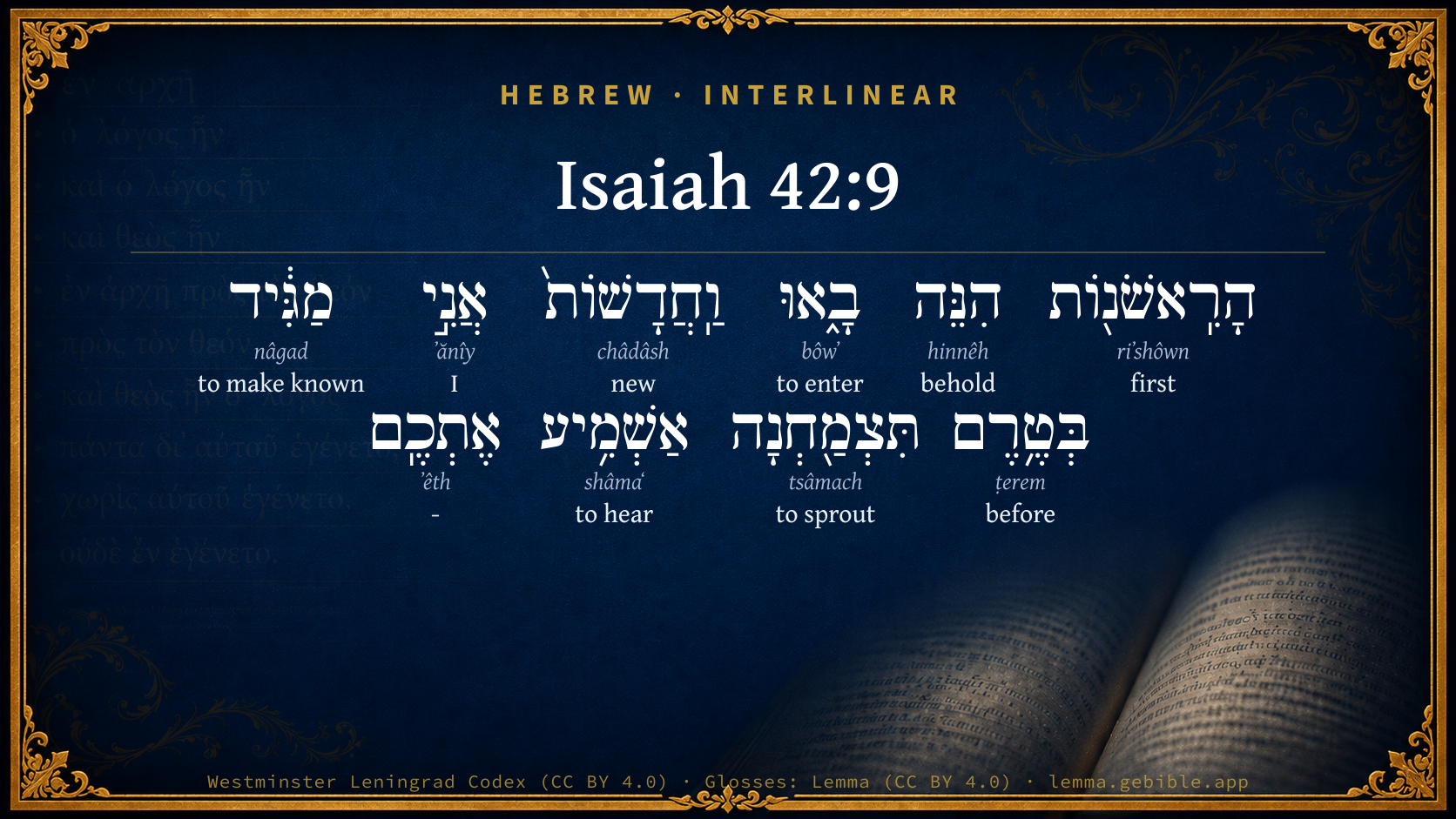
Hebrew (Westminster Leningrad Codex) Isaiah 42:9 appears in the Hebrew Old Testament. The text above is from the Westminster Leningrad Codex. Each word links to its Strong’s number, a concise gloss, and parsing drawn from the Open Scriptures Hebrew Bible morphology. Click any word for its full Brown-Driver-Briggs (BDB) entry.
Download image
Cite this verse

Isaiah 42:9 (World English Bible). Public Domain. Lemma interlinear Bible study tool, https://lemma.gebible.app/v/isaiah/42/9.

Show BibTeX & RIS
BibTeX
RIS
English Translation
Behold, the former things have happened, and new things do I declare. Before they spring forth I tell you of them.
World English Bible · Public Domain
Download a study sheet

One document with this verse’s original text, its word-by-word gloss line, the meaning frame, cross-references with their text, attributed commentary, and full source and license credits — printable, and it pastes into notes with its structure intact.

This verse Autodidact and up

Study sheet (.html) Plain text (.txt)

A passage Seminary Student

Up to 50 verses in one chapter. A passage sheet keeps up to 6 commentary sources and 12 cross-references per verse, in the order this page ranks them, and says so on the sheet whenever that leaves anything out. Ask for a single verse and you get the Autodidact verse sheet above.

Everything on this page stays free to read, with no account — the sheet is a download of what is already on screen, not access to it.

Want to remove ads? Support Godless Engineer
Compare translations 3

The same verse in 3 English versions, stacked beneath the original-language interlinear above. Click any original word for its lexicon entry.

Each is an independent rendering of the whole verse — the interlinear is not word-aligned to these translations.

Highlighted words mark where these versions differ — a whole-verse word diff, not a word-by-word alignment.

  • World English Bible Public Domain
    Behold, the former things have happened, and new things do I declare. Before they spring forth I tell you of them.
  • King James Version Public Domain
    Behold, the former things are come to pass, and new things do I declare: before they spring forth I tell you of them.
  • unfoldingWord Literal Text CC BY-SA 4.0
    The former, behold, they have come, and the new, I am declaring. Before they sprout, I make you hear.” q1

unfoldingWord Literal Text — © unfoldingWord, licensed CC BY-SA 4.0. Word-aligned USFM3 via Door43 (git.door43.org/unfoldingWord/en_ult).

Versions to compare (up to 4)

3 of 4 selected

Show all 18 translations

Every available English version of this verse, each an independent rendering of the whole verse.

  • World English Bible Public Domain
    Behold, the former things have happened, and new things do I declare. Before they spring forth I tell you of them.
  • Berean Standard Bible Public Domain
    Behold, the former things have happened, and now I declare new things. Before they spring forth I proclaim them to you.”
  • Majority Standard Bible Public Domain
    Behold, the former things have happened, and now I declare new things. Before they spring forth I proclaim them to you.”
  • King James Version Public Domain
    Behold, the former things are come to pass, and new things do I declare: before they spring forth I tell you of them.
  • American Standard Version (1901) Public Domain
    Behold, the former things are come to pass, and new things do I declare; before they spring forth I tell you of them.
  • Revised Version (1885) Public Domain
    Behold, the former things are come to pass, and new things do I declare: before they spring forth I tell you of them.
  • Geneva Bible (1599) Public Domain
    Beholde, the former thinges are come to passe, and newe things doe I declare: before they come foorth, I tell you of them.
  • Douay-Rheims (1899) Public Domain
    The things that were first, behold they are come: and new things do I declare: before they spring forth, I will make you head them.
  • Young's Literal Translation Public Domain
    The former things, lo, have come, And new things I am declaring, Before they spring up I cause you to hear.
  • Literal Standard Version CC BY-SA 4.0
    The former things, behold, have come, || And I am declaring new things, || Before they spring up I cause you to hear.
  • Unlocked Literal Bible CC BY-SA 4.0
    See, the previous things came to pass, now I am about to declare new events. Before they begin to occur I will tell you about them.”
  • unfoldingWord Literal Text CC BY-SA 4.0
    The former, behold, they have come, and the new, I am declaring. Before they sprout, I make you hear.” q1
  • Darby Bible Public Domain
    Behold, the former things are come to pass, and new things do I declare: before they spring forth will I cause you to hear them.
  • World Messianic Bible Public Domain
    Behold, the former things have happened and I declare new things. I tell you about them before they come up.”
  • Webster's Bible Public Domain
    Behold, the former things have come to pass, and new things do I declare: before they spring forth I tell you of them.
  • Free Bible Version CC BY-SA 4.0
    Notice that what I foretold has come true, as will the new things I'm saying to you now. I tell you what will happen before it does.”
  • Bible in Basic English Public Domain
    See, the things said before have come about, and now I give word of new things: before they come I give you news of them.
  • JPS Tanakh (1917) Public Domain
    Behold, the former things are come to pass, and new things do I declare; before they spring forth I tell you of them.

Literal Standard Version (2020), Covenant Press — licensed CC BY-SA 4.0. Text via the HelloAO Bible API (eBible.org). Unlocked Literal Bible (unfoldingWord) — licensed CC BY-SA 4.0. Text via the HelloAO Bible API (eBible.org). unfoldingWord Literal Text — © unfoldingWord, licensed CC BY-SA 4.0. Word-aligned USFM3 via Door43 (git.door43.org/unfoldingWord/en_ult). Free Bible Version, Dr. Jonathan Gallagher — licensed CC BY-SA 4.0. Text via the HelloAO Bible API (eBible.org).

Word by word

More ways to search: Search by grammar → Find every occurrence → Compare this word →

Practice this passage: Drill this verse → Learn its vocabulary →

תִּצְמַ֖חְנָה
tsâmach
H6779
“to sprout”
Verb, Qal, Imperfect, 3rd Person, Feminine, Plural
Part of Speech
Verb
Stem
Qal
Form
Imperfect
Person
3rd Person
Gender
Feminine
Number
Plural
Full BDB Definition

Origin: a primitive root

TWOT: 1928

to sprout, spring up, grow up - (Qal) - to sprout, spring up - of plants - of hair - of speech (figuratively) - (Piel) to grow abundantly or thickly - (Hiphil) - to cause to grow - to cause to sprout
  1. הָרִֽאשֹׁנ֖וֹת riʼshôwn H7223 “the · first” Particle, Definite Article + Adjective, Adjective, Feminine, Plural, Absolute
  2. הִנֵּה hinnêh H2009 “behold” Particle, Demonstrative
  3. בָ֑אוּ bôwʼ H935 “to enter” Verb, Qal, Perfect, 3rd Person, Common, Plural
  4. וַֽחֲדָשׁוֹת֙ châdâsh H2319 “and · new” Conjunction + Adjective, Adjective, Feminine, Plural, Absolute
  5. אֲנִ֣י ʼănîy H589 “I” Pronoun, Personal, 1st Person, Common, Singular
  6. מַגִּ֔יד nâgad H5046 “making known” Verb, Hiphil, Participle Active, Masculine, Singular, Absolute
  7. בְּטֶ֥רֶם ṭerem H2962 “in/at · before” Preposition + Adverb
  8. אַשְׁמִ֥יע shâmaʻ H8085 “to hear” Verb, Hiphil, Imperfect, 1st Person, Common, Singular
  9. אֶתְכֶֽם ʼêth H853 “- · you” Particle, Direct Object + Suffix, Personal, 2nd Person, Masculine, Plural

About this verse

These counts appear in no published source. They are computed here, from the morphology-tagged text and Lemma’s own curated glosses. What Lemma adds →

10
words
10
distinct lemmas
Prophets
section

Shared distinctive vocabulary

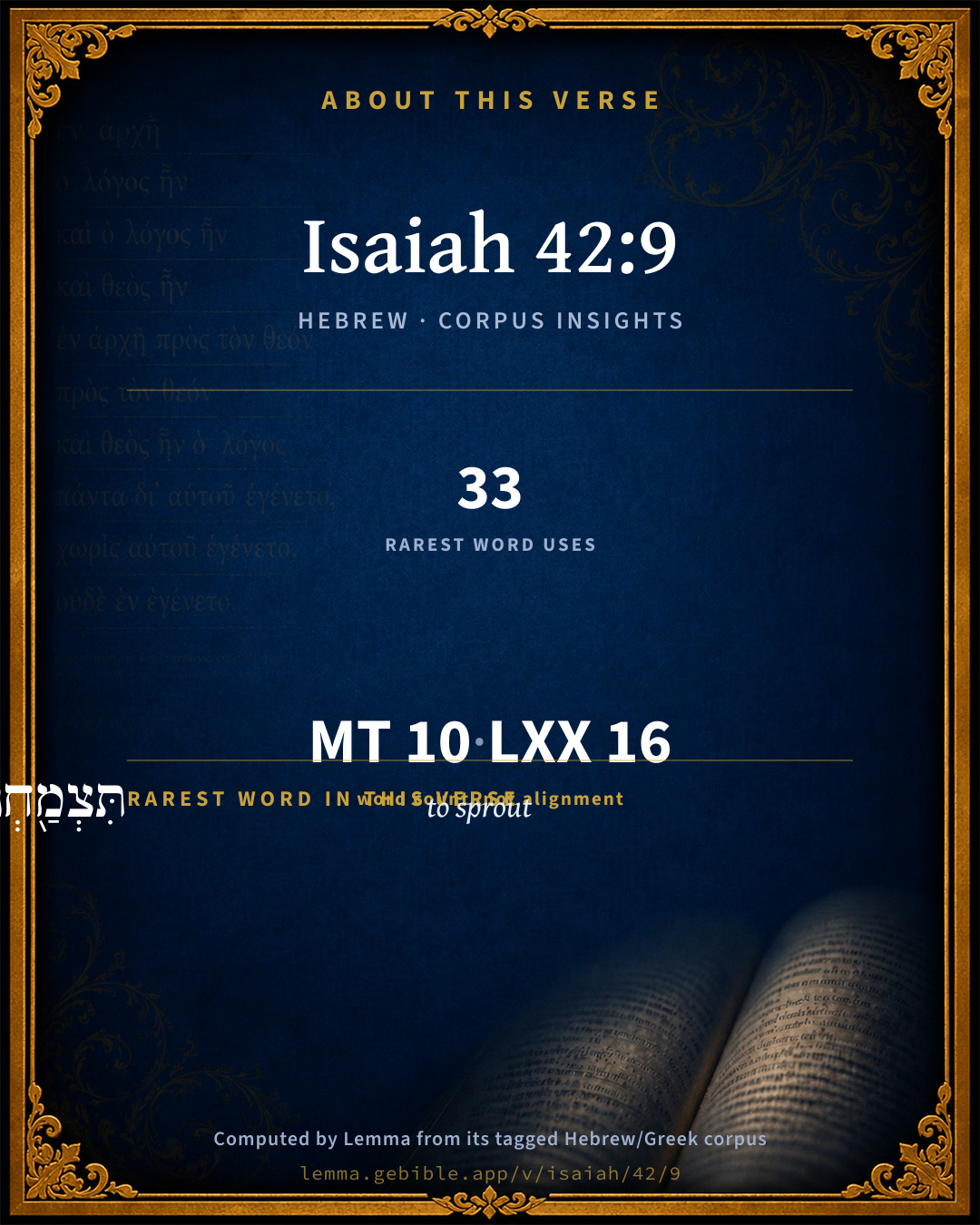
תִּצְמַ֖חְנָה to sprout H6779 occurs in 32 verses of the Hebrew Bible. Also found in:

Grammatical profile

  • 4 verbs
  • 2 adjectives
  • 1 pronoun
  • 1 adverb
  • 2 particles

Verb forms

  • בָ֑אוּ Qal · Perfect
  • מַגִּ֔יד Hiphil · Participle Active
  • תִּצְמַ֖חְנָה Qal · Imperfect
  • אַשְׁמִ֥יע Hiphil · Imperfect

Hebrew & Septuagint length

In English translation the verse runs 21 words from the Hebrew and 29 from the Septuagint (LXX English) — closely comparable.

A rough comparison of the two English renderings, which tokenize alike — not a word-level alignment.

Word counts can differ between the Hebrew and the Greek without any difference in meaning — e.g. the Hebrew direct-object marker אֵת has no separate Greek word, and Greek often adds the article ὁ.

In the original languages it is 10 Hebrew tokens and 16 Greek tokens — but the two are counted differently (Hebrew bundles its prefixes and suffixes into one token; the Greek is in lemma form), so that isn’t a like-for-like length.

Cross-references

12

Topical passages linked to Isaiah 42:9 in the Treasury of Scripture Knowledge — connected by theme and wording, ordered by reader-vote popularity; previews shown in the World English Bible.

  • Isaiah 43:19 Behold, I will do a new thing; now shall it spring forth; shall you not know it? I will even make a way in the wilderness, and rivers in the desert.
  • Isaiah 46:9–10 Remember the former things of old: for I am God, and there is none else; [I am] God, and there is none like me;
  • John 13:19 From now on, I tell you before it happens, that when it happens, you may believe that I AM.
  • 2 Peter 1:19–21 We have the more sure word of prophecy; whereunto you do well that you take heed, as to a lamp shining in a dark place, until the day dawns, and the day star arises in your hearts:
  • Isaiah 44:7–8 Who, as I, shall call, and shall declare it, and set it in order for me, since I established the ancient people? and the things that are coming, and that shall happen, let them declare.
  • Joshua 23:14–15 Behold, this day I am going the way of all the earth: and you know in all your hearts and in all your souls, that not one thing has failed of all the good things which Yahweh your God spoke concerning you; all are happen to you, not one thing has failed of it.
  • Joshua 21:45 There failed not anything of any good thing which Yahweh had spoken to the house of Israel; all came to pass.
  • 1 Kings 8:15–20 He said, Blessed be Yahweh, the God of Israel, who spoke with his mouth to David your father, and has with his hand fulfilled it, saying,
  • Isaiah 41:22–23 Let them bring forth, and declare to us what shall happen: declare you the former things, what they are, that we may consider them, and know the latter end of them; or show us things to come.
  • 1 Peter 1:10–12 Concerning this salvation, the prophets sought and searched diligently, who prophesied of the grace that would come to you,
  • Genesis 15:12–16 When the sun was going down, a deep sleep fell on Abram. Now terror and great darkness fell on him.
  • 1 Kings 11:36 To his son will I give one tribe, that David my servant may have a lamp always before me in Jerusalem, the city which I have chosen me to put my name there.

Cross-references courtesy of OpenBible.info (CC BY 4.0).

Hebrew and Greek witnesses Masoretic Hebrew ↔ Greek Septuagint

The same verse in the two great witnesses to the Old Testament, shown verse-for-verse.

These are two independent witnesses, not word-aligned to each other, and the Septuagint is shown in lemma (dictionary) form.

Hebrew Isaiah 42:9 Masoretic · Westminster Leningrad Codex

הָרִֽאשֹׁנ֖וֹת הִנֵּה בָ֑אוּ וַֽחֲדָשׁוֹת֙ אֲנִ֣י מַגִּ֔יד בְּטֶ֥רֶם תִּצְמַ֖חְנָה אַשְׁמִ֥יע אֶתְכֶֽם

Behold, the former things have happened, and new things do I declare. Before they spring forth I tell you of them.

World English Bible · Public Domain

Greek LXX Isaiah 42:9 Septuagint · lemma form

ὁ ἀπό ἀρχή ἰδού ἥκω καί καινός ὅς ἐγώ ἀναἀγγέλλω καί πρό ὁ ἀνατέλλω δηλόω σύ

Behold, the ancient things have come to pass, and so will the new things which I tell you: yes, before I tell them they are made known to you.

LXX2012 (modern English Septuagint) · Public Domain

Hebrew: Westminster Leningrad Codex (CC BY 4.0). Greek: Septuagint (public domain); English from LXX2012 (modern English Septuagint) (Public Domain). How the Septuagint differs from the Hebrew →

Targum (Aramaic paraphrase)

1

The Targum is the ancient Jewish Aramaic paraphrase of the Hebrew Scriptures — an interpretive translation, not the Hebrew text itself. Onkelos (literal) and Pseudo-Jonathan (expansive) render the Torah, and Jonathan the Prophets. Coverage is partial: where no permissively-licensed English translation exists for a verse, only the Aramaic is shown. This is verse-level text, not a word-by-word alignment to the Hebrew.

  1. Targum Jonathan Prophets (Joshua–Malachi)
    קַדְמָיָתָא הָא אֲתָאָה וְחַדְתָּן אֲנָא מְחַוֵי עַד לָא אַתְיַן אֶבְסַר יַתְכוֹן:

    Behold, the former things are come to pass, and new things do I declare: I apprize you of them before they come to pass.

    Targum Jonathan — Aramaic: “Mikraot Gedolot” (public domain). English: “Sefaria Community Translation” (CC0 1.0 (public-domain dedication)); “London "Chaldee Paraphrase," 1871” (public domain). Text via Sefaria.

Commentary

Notes on Isaiah 42:9 from classic Christian and Jewish commentators (each source and its license shown beneath its notes). The classic Christian expositions comment on the surrounding passage and are grouped to its opening verse, so a note may address several verses; the Jewish commentaries on the Tanakh (Rashi and others) are per-verse, so they appear only where the commentator wrote on this verse.

Lemma curates 59 commentaries, every one of them public domain or Creative Commons licensed, each selected and text-cleaned for this edition rather than reprinted as found. About our sources →

Trapp's Complete Commentary

John Trapp

Isa 42:9 Behold, the former things are come to pass, and new things do I declare: before they spring forth I tell you of them.

Ver. 9. Behold, the former things are come to pass.] The prophecies are fulfilled.

Before they spring forth, I tell you of them.] Therefore I am the true God undoubtedly, and the doctrine of my prophets is true assuredly, veriora quam quae ex tripode. Siquidem Satan etsi semel videatur verax, millies est mendax, et semper fallax.

John Trapp, A Commentary or Exposition upon All the Books of the Old and New Testament (1647–1656) — public domain. Text from a community e-Sword module.

The Biblical Illustrator

Joseph S. Exell

Isa_42:9

Behold, the former things are come to pass

The philosophy of promise

One may observe, in reading Scripture, the general principle that God usually gives a promise of that which He means to bestow.

Before Christ came, the Father was continually speaking of His coming. Love meets man as a heralding fragrance before the actual bestowal of blessing. Why are covenant blessings the subject of promises?

I. IN ORDER TO DISPLAY GODS GRACE.

1. The freeness of His grace. The promise to which the text specially alludes is to open the blind eyes, etc. The blind referred to were not born in the days of Isaiah. God promises before we know our need or seek His face. There are many conditional promises in Scripture; but all Gods promises rest on an unconditioned covenant of grace (Rom_9:25).

2. The fulness of His grace. It is unmerited; Christ died for the ungodly.

3. The power of it. He will open the blind eyes, etc. God is great in nature, but greater in grace.

II. TO AROUSE OUR HOPES. Religious inquirers should find the promises of God unspeakably precious. There are promises enough in the Scriptures to stimulate hope in all. Christian believers even need to be told of what God will do, in order to encourage their hope.

III. TO EXERCISE OUR FAITH. God desires to exercise our confidence in Him.

IV. TO EXCITE OUR PRAYER. Prayer is sure to follow hope and faith. All Gods promises which are not fulfilled are meant to stimulate prayer.

V. TO FOSTER GRATITUDE AND ASSURANCE WHEN THE MERCY HAS BEEN RECEIVED. Man is made glad when he sees that Gods Word has not returned to Him void; then comes the inference, if He has done all this for me in the past, He will do as much for me in the future. In the next chapter the argument is, I will do, because I have done. This is the firm foundation of our hope,--our past experience of the faithfulness of God; and strong faith is Gods due. (C. H. Spurgeon.)

Former things and new things

Former things, i.e things formerly predicted. These predictions do not belong to the present prophet, but to others. The new things are the redemption of Israel from Babylon, and, through it, the revelation of the true God to all nations. (Prof. A. B. Davidson, D. D.)

The Biblical Illustrator, edited by Joseph S. Exell (c. 1880s–1900s) — public domain. Text from a community e-Sword module.

The Preacher's Complete Homiletical Commentary

Joseph S. Exell (gen. ed.)

THE PHILOSOPHY OF PROMISE

Isa_42:9. Behold, the former things are come to pass, &c.

One may observe, in reading Scripture, the general principle that God usually gives a promise of that which He means to bestow. Before Christ came the Father was continually speaking of His coming. Love meets man as a heralding fragrance before the actual bestowal of blessing.

Why are covenant blessings the subject of promises?

I. IN ORDER TO DISPLAY GOD’S GRACE.

To display—

1. The freeness of His grace. The promise to which the text specially alludes is to open the blind eyes, &c. The blind referred to were not born in the days of Isaiah. God promises before we know our need or seek His face. There are many conditional promises in Scripture; but all God’s promises rest on an unconditioned covenant of grace (Rom_9:25).

2. The fulness of His grace. It is unmerited; Christ died for the ungodly.

3. The power of it. He will open the blind eyes, &c. God is great in nature, but greater in grace. Man is a free agent, but he is not, and cannot be, more powerful in any respect than the Lord of all.

II. TO AROUSE OUR HOPES.

Religious inquirers should find the promises of God unspeakably precious. Some come to Christ easily, others with great difficulty; but there are promises enough in the Scriptures to call forth and stimulate hope in all (Heb_7:25). Christian believers, even, need to be told of what God will do, in order, at times, to encourage their hope (1Co_2:9-10).

III. TO EXERCISE OUR FAITH.

God desires to educate our confidence in Him. If Christian truth had been made so clear that we could make an axiom of it, there would have been no room for faith. Faith could not then have been the all-important thing it is in the manward aspect of salvation. Faith is the pivot upon which Christian character turns. It is neither a hard nor a wrong thing that God requires from us.

The Lord has told us what great things He is going to do for sinners. Do we believe that He can do what He says? Do we believe in His willingness to do it? Then it is ours to cast ourselves upon His power and will.

IV. TO EXCITE OUR PRAYER.

Prayer is sure to follow hope and faith. Note the order—first, grace, then hope, faith, prayer. Faith soon brings a man to his knees; and while he is pleading, God is hearing. All God’s promises which are not fulfilled are meant to stimulate to prayer.

V. TO FOSTER GRATITUDE AND ASSURANCE WHEN THE MERCY HAS BEEN RECEIVED.

Man is made glad when he sees and feels that God’s Word has not returned to Him void; then comes the inference,—If He has done all this for me in the past, He will do as much for me in the future. In the next chapter the argument is, I will do because I have done. “I have redeemed thee; when thou passest through the waters, I will be with thee.” This is the firm foundation for our hope, our past experience of the faithfulness of God; and strong faith is God’s due.—C. H. Spurgeon: Metropolitan Tabernacle Pulpit, vol. xxv. pp. 685–696.

The Preacher's Complete Homiletical Commentary (gen. ed. Joseph S. Exell; Funk & Wagnalls, c. 1892) — public domain (pre-1929). A full-Bible homiletical/sermon-outline anthology covering 65 of 66 books (2 John is absent from the source module). Text from a community e-Sword module.

Geneva Bible (1599)

Geneva Bible translators

As in time past I have been true in my promises, so will I be in time to come.

Geneva Bible (1599) marginal notes — public domain. Text via Bolls.life.

Jamieson, Fausset & Brown

Robert Jamieson, A. R. Fausset & David Brown

former things--Former predictions of God, which were now fulfilled, are here adduced as proof that they ought to trust in Him alone as God; namely, the predictions as to Israel's restoration from Babylon.

new--namely, predictions as to Messiah, who is to bring all nations to the worship of Jehovah (Isa 42:1, Isa 42:4, Isa 42:6).

spring forth--The same image from plants just beginning to germinate occurs in Isa 43:19; Isa 58:8. Before there is the slightest indication to enable a sagacious observer to infer the coming event, God foretells it.

Jamieson, Fausset & Brown — Commentary Critical and Explanatory on the Whole Bible (1871) — public domain (CC PDM 1.0). Text via the HelloAO Bible API.

The Cambridge Bible for Schools and Colleges

gen. ed. J. J. S. Perowne

9. the former things] the things formerly predicted. The reference probably is to prophecies just fulfilled in the successes of Cyrus. The new things are the substance of the present prophecy, the exaltation of the Servant, the redemption of Israel, and the conversion of the heathen. (see Introd., p. xxi.)

The Cambridge Bible for Schools and Colleges (gen. ed. J. J. S. Perowne; Cambridge University Press, 1878–1918) — public domain. Text from a community e-Sword module.

John Gill's Exposition

Behold, the former things are come to pass,.... Which the Lord had foretold in former times, as to Abraham, concerning the affliction of his posterity in Egypt, the bringing them out from thence, and settling them in the land of Canaan; and other things by Moses and Joshua, and other prophets; and by Isaiah; and particularly the captivity of the ten tribes, which was now come to pass in the times of Hezekiah:

and new things do I declare; as the captivity of Judah and Benjamin, and their restoration by Cyrus; and more especially the mission and incarnation of Christ, his sufferings and death, and redemption and salvation by him; which were not only things to come, but new things, famous and excellent ones:

before they spring up I tell you of them or "before they bud forth" (r); while the seeds of them were under ground, sown in the purposes and decrees of God, he spoke of them in prophecy; and now former prophecies being fulfilled, and new ones delivered out, concerning things of which there was no appearance, and yet there was the greatest reason to believe their accomplishment, from the fulfilment of the former; this must be a strong proof and confirmation of the Lord being the true God, and the only one.

(r) "antequam pullulent", Montanus, Cocceius; "germinent", Vatablus; "antequam propullulent vel efflorescant", Vitringa.

John Gill's Exposition of the Whole Bible (1746–1763) — public domain (CC PDM 1.0). Text via the HelloAO Bible API.

Albert Barnes' Notes on the Bible

Behold, the former things are come to pass - That is, the former things which he had foretold. This is the evidence to which he appeals in proof that he alone was God, and this is the basis on which he calls upon them to believe that what he had predicted in regard to future things would also come to pass. He had by his prophets foretold events which had now been fulfilled, and this should lead them to confide in him alone as the true God.

And new things do I declare - Things pertaining to future events, relating to the coming of the Messiah, and to the universal prevalence of his religion in the world.

Before they spring forth - There is here a beautiful image. The metaphor is taken from plants and flowers, the word צמח tsâmach properly referring to the springing up of plants, or to their sending out shoots, buds, or flowers. The phrase literally means, ‘before they begin to germinate,’ that is, before there are any indications of life, or growth in the plant. The sense is, that God predicted the future events before there was anything by which it might be inferred that such occurrences would take place. It was not done by mere sagacity - as men like Burke and Canning may sometimes predict future events with great probability by marking certain political indications or developments. God did this when there were no such indications, and when it must have been done by mere omniscience. In this respect, all his predictions differ from the conjectures of man, and from all the reasonings which are founded on mere sagacity.

Albert Barnes' Notes on the Bible (1834–1885) — public domain. Text from a community e-Sword/MySword module.

Haydock's Catholic Bible Commentary

Them. The completion of former predictions enforces the belief of those which are yet to come. (Calmet)

George Leo Haydock (1774–1849), Haydock's Catholic Family Bible and Commentary, 1859 edition — public domain. Excludes Psalms (Douay-Rheims chapter numbering differs from Protestant) and Deuterocanonical books (Catholic canon only).

Matthew Poole's English Annotations

The former things are come to pass, and new things do I declare: as all things which I have formerly promised or foretold have exactly come to pass in their proper seasons, and not one of them failed, as was noted, Jos 23:14; so you have great reason to believe that what I now promise, though it be new and strange to you, shall infallibly be accomplished.

Before they spring forth I tell you of them, that when they come to pass, you may know that I am God, and that this is my work. Compare Joh 13:19.

Matthew Poole's English Annotations on the Holy Bible (1683–1685) — public domain. Text from a community e-Sword/MySword module.

Whedon's Commentary on the Bible

Daniel D. Whedon

9. The former things — “Former” prophecies, respecting which some suppose earlier predictions are meant. This breaks the continuity of the present course of thought in these chapters, to preserve which the sense must be that the rise of Cyrus is here intended, with the agitation of the nations it is to occasion. The events, though yet future, are prophetically accomplished. As God sees them in historical succession they are essentially past, and the prophet so treats them; since, having once announced them, that they will occur is, in his mind, certain. The new things now foretold before visible development, concern the restoration of God’s people and the great gospel blessings which are bound up with that event. The simple return is, to what is visible; but springing out of this are also unseen spiritual effects.

Daniel D. Whedon (gen. ed.), Commentary on the Old and New Testaments (1874–1909) — public domain. Text from a community e-Sword module.

The Pulpit Commentary

Vers. 9-17. ANNOUNCEMENT OF THE COMING DELIVERANCE OF ISRAEL FROM BABYLON, AND CALL ON THE NATIONS FOR A SONG OF PRAISE AND JUBILATION. Jehovah is still the speaker. He begins by promising a new revelation (ver. 9). Then, before the revelation is made, he calls upon the nations especially those in the vicinity of Palestine to rejoice at what is about to happen (vers. 10-12). After this he proceeds to make the announcement promised in ver. 9 an announcement that he is about to deliver his people (ver. 16) and to execute vengeance on their enemies (vers. 13-15 and 17).

Behold, the former things are come to pass; i.e. former prophecies have been fulfilled. Israel has been led lute captivity, and in her captivity has suffered grievous things. The reference is, perhaps, especially to such prophecies as Isa_39:5-7. And new things do I declare. (Isa_43:19) The voluntary restoration of a captive people to their own land by the power to which they were subject, and which could compel their services, was emphatically a "new thing" in the world"s history. How unwilling the sovereign power was ordinarily to lose such services may be seen by the narrative in Exodus (Exodus 5-14), and again by the account which Herodotus gives (1:73, 74) of the ground of quarrel between Alyattes and Cyaxares. Before they spring forth; or, shoot forth. The metaphor is one taken from the vegetable world. (comp. Isa_43:19 Isa_45:8)

The Pulpit Commentary (1880–1919), ed. H.D.M. Spence-Jones & Joseph S. Exell — public domain. Text from a community e-Sword module.

John Wesley's Explanatory Notes

I tell you - That when they come to pass, you may know that I am God, and that this is my work.

John Wesley, Explanatory Notes Upon the Whole Bible (1754–1765) — public domain. Text via the GEBible commentary corpus.

Keil & Delitzsch

C. F. Keil & F. Delitzsch

First the overthrow of idolatry, then the restoration of Israel and conversion of the Gentiles: this is the double work of Jehovah's zeal which is already in progress. "The first, behold, is come to pass, and new things am I proclaiming; before it springs up, I let you hear it." The "first" is the rise of Cyrus, and the agitation of the nations which it occasioned - events which not only formed the starting-point of the prophecy in these addresses, whether the captivity was the prophet's historical or ideal standpoint, but which had no less force in themselves, as the connection between the first and second halves of the v. before us imply, as events both foreknown and distinctly foretold by Jehovah. The "new things" which Jehovah now foretells before their visible development (Isa 43:19), are the restoration of Israel, for which the defeat of their oppressors prepares the say, and the conversion of the heathen, to which an impulse is given by the fact that God thus glorifies Himself in His people.

Keil & Delitzsch — Biblical Commentary on the Old Testament (1861–1891) — public domain (CC PDM 1.0). Text via the HelloAO Bible API. (Old Testament only.)

J. A. Alexander on Isaiah

Joseph Addison Alexander

“The first (or former) things, lo, they have come, and new, things I (am) telling; before they spring forth (sprout or germinate) I will make (or let) you hear (them).” This is an appeal to former prophecies already verified, as grounds of confidence in those yet unfulfilled. The strong and beautiful expression in the last clause can only mean that the events about to be predicted were beyond the reach of human foresight, and is therefore destructive of the modern notion, that these prophecies were written after Cyrus had appeared, and at a time when the further events of his history could be foreseen by an observer of unusual sagacity. Such a prognosticator, unless he was also a deliberate deceiver, a charge which no one brings against this writer, could not have said of what he thus foresaw, that he announced it before it had begun to germinate, (i.e., while the seed was in the earth, and before any outward indications of the plant could be perceived). As this embraces all the writer’s prophecies, it throws the date of composition back to a period before the rise of Cyrus, and thereby helps to invalidate the arguments in favor of regarding it as contemporaneous with the Babylonish exile.

Joseph Addison Alexander, The Prophecies of Isaiah (1846–1847; New York: Scribner, 1870–1878) — public domain. Text from a community e-Sword module.

Scofield Reference Notes

C. I. Scofield

former things

That is, Isaiah’s prediction of Sennacherib’s invasion and its results, Isaiah 10, 37. See also, (Isa 41:21-23); (Isa 43:8-12); (Isa 44:7); (Isa 48:3); (Isa 48:5); (Isa 48:16). This appeal of the prophet to the fulfilment of his former predictions strongly confirms the unity of the book.

The Scofield Reference Bible (1917 edition), notes by C. I. Scofield — public domain. Text from a community e-Sword module.

Rashi

Rabbi Shlomo Yitzchaki (Rashi)

The former things that I promised Abraham concerning the exile of Egypt (Gen. 15:14), “And also the nation etc.”

behold they have come to pass I kept My promise, and now new things I tell My people, to promise them concerning a second exile.

Rashi on the Tanakh — English translations: “The Judaica Press complete Tanach with Rashi, translated by A. J. Rosenberg” (CC BY 4.0); “Pentateuch with Rashi's commentary by M. Rosenbaum and A.M. Silbermann, 1929-1934” (public domain); “The Metsudah Tanach series, Lakewood, N.J” (CC BY 4.0); and “The Book of Joshua, Metsudah Publications, 1997” (CC BY 4.0). Text via Sefaria.

Lesson kit

Teaching starters — assembled from the data on this page, not authored interpretation. Every prompt links to the verse data it draws on. Edit before teaching.

Isaiah, in the Prophets, opens this verse with 10 words (10 distinct Hebrew lemmas). Its most distinctive word is tsâmach (“to sprout”). A historical commentator’s framing appears above. Read the whole chapter for the surrounding context.

Discussion questions

  1. The word tsâmach carries the sense “to sprout.” How does it shape the verse?
  2. Genesis 2:5 shares the word «to sprout» with this verse. How do the two illuminate each other?
  3. The translations on this page render this verse differently — a whole-verse word diff, not a word-by-word alignment. What might account for the different wordings?
  4. The verb «בָ֑אוּ» is Qal Perfect. How does its form color the action?
  5. Reading how Trapp's Complete Commentary and The Biblical Illustrator read this verse, where do the two commentators agree and where do they part?

Things to notice

Reading settings

Reading text

Shown beneath each verse's original-language words.

Old Testament
Old Testament edition

Read the OT as the Masoretic Hebrew (MT) or the Greek Septuagint (LXX).

English shown for the Greek Septuagint (in the Hebrew ↔ Greek comparison).

Comparing translations? Open the Compare panel on any verse page to stack up to four side by side.