
Ecclesiastes 10:20

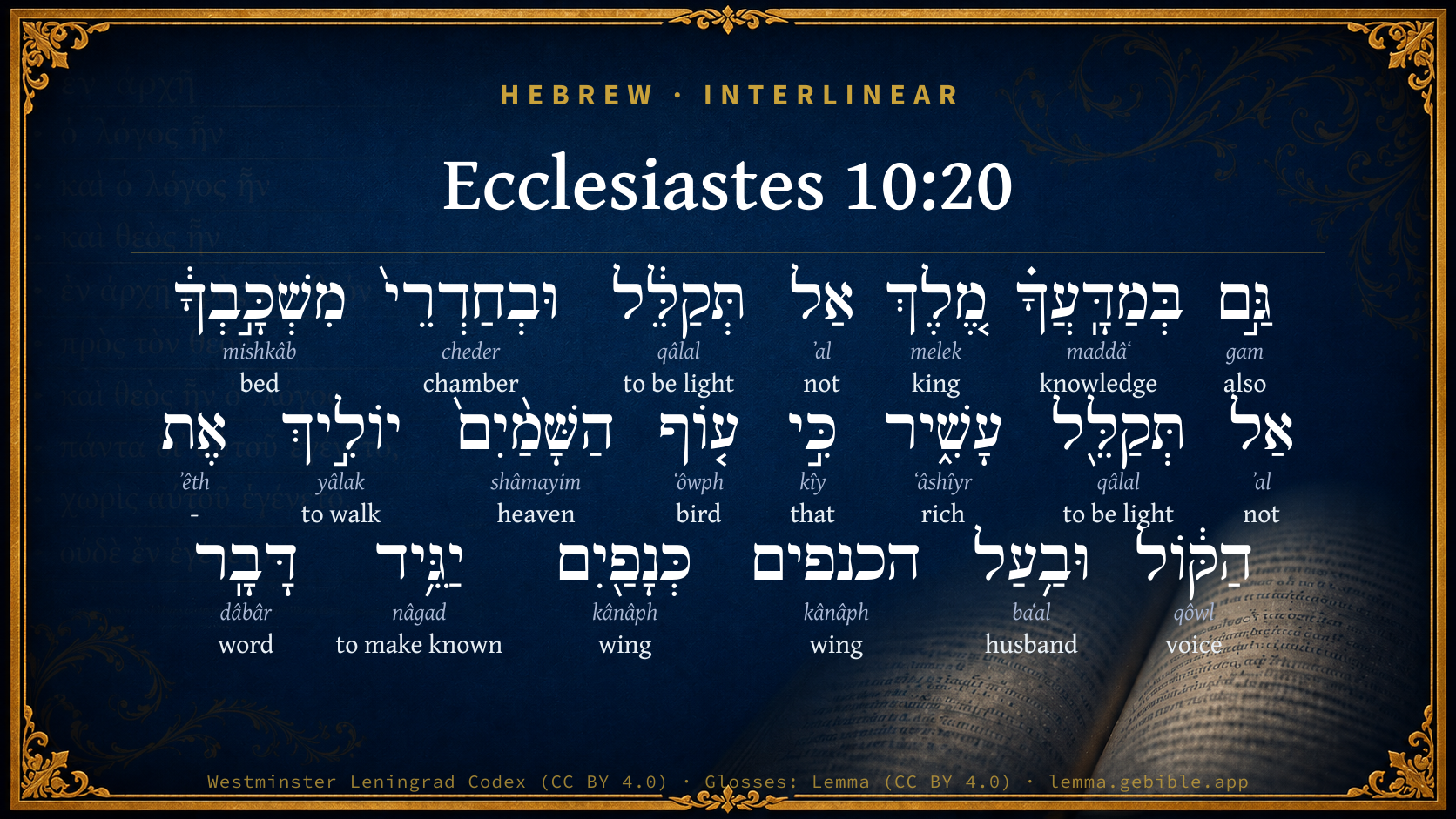
Hebrew (Westminster Leningrad Codex) Ecclesiastes 10:20 appears in the Hebrew Old Testament. The text above is from the Westminster Leningrad Codex. Each word links to its Strong’s number, a concise gloss, and parsing drawn from the Open Scriptures Hebrew Bible morphology. Click any word for its full Brown-Driver-Briggs (BDB) entry.
Download image
Cite this verse

Ecclesiastes 10:20 (World English Bible). Public Domain. Lemma interlinear Bible study tool, https://lemma.gebible.app/v/ecclesiastes/10/20.

Show BibTeX & RIS
BibTeX
RIS
English Translation
Don't curse the king, no, not in your thoughts; And don't curse the rich in your bedchamber: For a bird of the sky may carry your voice, And that which has wings may tell the matter.
World English Bible · Public Domain
Download a study sheet

One document with this verse’s original text, its word-by-word gloss line, the meaning frame, cross-references with their text, attributed commentary, and full source and license credits — printable, and it pastes into notes with its structure intact.

This verse Autodidact and up

Study sheet (.html) Plain text (.txt)

A passage Seminary Student

Up to 50 verses in one chapter. A passage sheet keeps up to 6 commentary sources and 12 cross-references per verse, in the order this page ranks them, and says so on the sheet whenever that leaves anything out. Ask for a single verse and you get the Autodidact verse sheet above.

Everything on this page stays free to read, with no account — the sheet is a download of what is already on screen, not access to it.

Want to remove ads? Support Godless Engineer
Compare translations 3

The same verse in 3 English versions, stacked beneath the original-language interlinear above. Click any original word for its lexicon entry.

Each is an independent rendering of the whole verse — the interlinear is not word-aligned to these translations.

Highlighted words mark where these versions differ — a whole-verse word diff, not a word-by-word alignment.

  • World English Bible Public Domain
    Don't curse the king, no, not in your thoughts; And don't curse the rich in your bedchamber: For a bird of the sky may carry your voice, And that which has wings may tell the matter.
  • King James Version Public Domain
    Curse not the king, no not in thy thought; and curse not the rich in thy bedchamber: for a bird of the air shall carry the voice, and that which hath wings shall tell the matter.
  • unfoldingWord Literal Text CC BY-SA 4.0
    Even in your thought, do not belittle a king, and in the room of your bed, do not belittle a rich, for a bird of the heavens will carry the voice, and a master of wings will declare word.

unfoldingWord Literal Text — © unfoldingWord, licensed CC BY-SA 4.0. Word-aligned USFM3 via Door43 (git.door43.org/unfoldingWord/en_ult).

Versions to compare (up to 4)

3 of 4 selected

Show all 18 translations

Every available English version of this verse, each an independent rendering of the whole verse.

  • World English Bible Public Domain
    Don't curse the king, no, not in your thoughts; And don't curse the rich in your bedchamber: For a bird of the sky may carry your voice, And that which has wings may tell the matter.
  • Berean Standard Bible Public Domain
    Do not curse the king even in your thoughts, or curse the rich even in your bedroom, for a bird of the air may carry your words, and a winged creature may report your speech.
  • Majority Standard Bible Public Domain
    Do not curse the king even in your thoughts, or curse the rich even in your bedroom, for a bird of the air may carry your words, and a winged creature may report your speech.
  • King James Version Public Domain
    Curse not the king, no not in thy thought; and curse not the rich in thy bedchamber: for a bird of the air shall carry the voice, and that which hath wings shall tell the matter.
  • American Standard Version (1901) Public Domain
    Revile not the king, no, not in thy thought; and revile not the rich in thy bedchamber: for a bird of the heavens shall carry the voice, and that which hath wings shall tell the matter.
  • Revised Version (1885) Public Domain
    Curse not the king, no, not in thy thought; and curse not the rich in thy bedchamber: for a bird of the air shall carry the voice, and that which hath wings shall tell the matter.
  • Geneva Bible (1599) Public Domain
    Curse not the King, no not in thy thought, neither curse the rich in thy bed chamber: for the foule of the heauen shall carie the voice, and that which hath wings, shall declare the matter.
  • Douay-Rheims (1899) Public Domain
    Detract not the king, no not in thy thought; and speak not evil of the rich man in thy private chamber: because even the birds of the air will carry thy voice, and he that hath wings will tell what thou hast said.
  • Young's Literal Translation Public Domain
    Even in thy mind a king revile not, And in the inner parts of thy bed-chamber Revile not the rich: For a fowl of the heavens causeth the voice to go, And a possessor of wings declareth the word.
  • Literal Standard Version CC BY-SA 4.0
    Even in your mind do not revile a king, || And in the inner parts of your bed-chamber do not revile the rich: For a bird of the heavens causes the voice to go, || And a possessor of wings declares the word.
  • Unlocked Literal Bible CC BY-SA 4.0
    Do not curse the king, not even in your mind, and do not curse rich people in your bedroom. For a bird of the sky might carry your words; whatever has wings can spread the matter.
  • unfoldingWord Literal Text CC BY-SA 4.0
    Even in your thought, do not belittle a king, and in the room of your bed, do not belittle a rich, for a bird of the heavens will carry the voice, and a master of wings will declare word.
  • Darby Bible Public Domain
    Curse not the king, no, not in thy thought; and curse not the rich in thy bedchamber: for the bird of the air will carry the voice, and that which hath wings will tell the matter.
  • World Messianic Bible Public Domain
    Don’t curse the king, no, not in your thoughts; and don’t curse the rich in your bedroom, for a bird of the sky may carry your voice, and that which has wings may tell the matter.
  • Webster's Bible Public Domain
    Curse not the king, no not in thy thought; and curse not the rich in thy bed-chamber: for a bird of the air will carry the voice, and that which hath wings will tell the matter.
  • Free Bible Version CC BY-SA 4.0
    Don't talk badly about the king, not even in your thoughts. Don't talk badly about leaders, even in the privacy of your bedroom. A bird may hear what you say and fly away to tell them.
  • Bible in Basic English Public Domain
    Say not a curse against the king, even in your thoughts; and even secretly say not a curse against the man of wealth; because a bird of the air will take the voice, and that which has wings will give news of it.
  • JPS Tanakh (1917) Public Domain
    Curse not the king, no, not in thy thought, and curse not the rich in thy bedchamber; for a bird of the air shall carry the voice, and that which hath wings shall tell the matter.

Literal Standard Version (2020), Covenant Press — licensed CC BY-SA 4.0. Text via the HelloAO Bible API (eBible.org). Unlocked Literal Bible (unfoldingWord) — licensed CC BY-SA 4.0. Text via the HelloAO Bible API (eBible.org). unfoldingWord Literal Text — © unfoldingWord, licensed CC BY-SA 4.0. Word-aligned USFM3 via Door43 (git.door43.org/unfoldingWord/en_ult). Free Bible Version, Dr. Jonathan Gallagher — licensed CC BY-SA 4.0. Text via the HelloAO Bible API (eBible.org).

Word by word

More ways to search: Search by grammar → Find every occurrence → Compare this word →

Practice this passage: Drill this verse → Learn its vocabulary →

בְּמַדָּֽעֲךָ֗
maddâʻ
H4093
“in/at · knowledge · your”
Preposition + Noun, Common, Masculine, Singular, Construct + Suffix, Personal, 2nd Person, Masculine, Singular
Part of Speech
Preposition + Noun
Type
Common
Gender
Masculine
Number
Singular
State
Construct
Full BDB Definition

Origin: from H3045

TWOT: 848g

knowledge, thought - knowledge - mind, thought, place of knowledge
  1. גַּ֣ם gam H1571 “also” Particle, Accusative
  2. מֶ֚לֶךְ melek H4428 “king” Noun, Common, Masculine, Singular, Absolute
  3. אַל ʼal H408 “not” Particle, Negative
  4. תְּקַלֵּ֔ל qâlal H7043 “to be light” Verb, Piel, Jussive, 2nd Person, Masculine, Singular
  5. וּבְחַדְרֵי֙ cheder H2315 “and · in/at · chambers of” Conjunction + Preposition + Noun, Common, Masculine, Plural, Construct
  6. מִשְׁכָּ֣בְךָ֔ mishkâb H4904 “bed · your” Noun, Common, Masculine, Singular, Construct + Suffix, Personal, 2nd Person, Masculine, Singular
  7. אַל ʼal H408 “not” Particle, Negative
  8. תְּקַלֵּ֖ל qâlal H7043 “to be light” Verb, Piel, Jussive, 2nd Person, Masculine, Singular
  9. עָשִׁ֑יר ʻâshîyr H6223 “rich” Adjective, Adjective, Masculine, Singular, Absolute
  10. כִּ֣י kîy H3588 “that” Conjunction
  11. ע֤וֹף ʻôwph H5775 “bird of” Noun, Common, Masculine, Singular, Construct
  12. הַשָּׁמַ֨יִם֙ shâmayim H8064 “the · heaven(s)” Particle, Definite Article + Noun, Common, Masculine, Plural, Absolute
  13. יוֹלִ֣יךְ yâlak H3212 “to walk” Verb, Hiphil, Imperfect, 3rd Person, Masculine, Singular
  14. אֶת ʼêth H853 “-” Particle, Direct Object
  15. הַקּ֔וֹל qôwl H6963 “the · voice” Particle, Definite Article + Noun, Common, Masculine, Singular, Absolute
  16. וּבַ֥עַל baʻal H1167 “and · husband of” Conjunction + Noun, Common, Masculine, Singular, Construct
  17. הכנפים kânâph H3671 “the · wings” Particle, Definite Article + Noun, Common, Feminine, Dual, Absolute
  18. כְּנָפַ֖יִם kânâph H3671 “wings” Noun, Common, Feminine, Dual, Absolute
  19. יַגֵּ֥יד nâgad H5046 “to make known” Verb, Hiphil, Imperfect, 3rd Person, Masculine, Singular
  20. דָּבָֽר dâbâr H1697 “word” Noun, Common, Masculine, Singular, Absolute

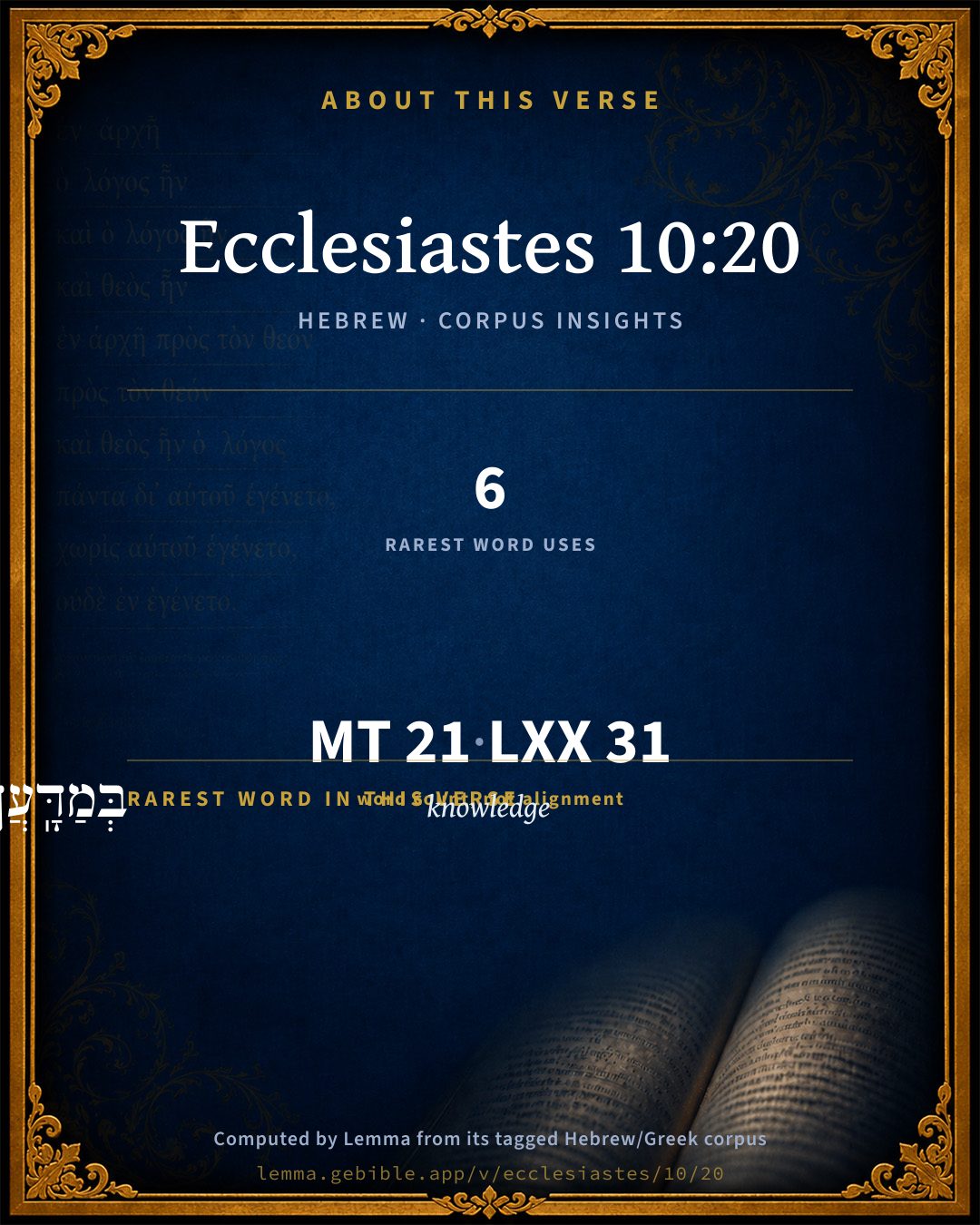
About this verse

These counts appear in no published source. They are computed here, from the morphology-tagged text and Lemma’s own curated glosses. What Lemma adds →

21
words
18
distinct lemmas
Wisdom
section

Notable vocabulary

The rarest word here is בְּמַדָּֽעֲךָ֗ knowledge H4093 — appearing just 6 times in the whole Hebrew Bible.

Shared distinctive vocabulary

בְּמַדָּֽעֲךָ֗ knowledge H4093 occurs in 6 verses of the Hebrew Bible. Also found in:

Grammatical profile

  • 4 verbs
  • 11 nouns
  • 1 adjective
  • 1 conjunction
  • 4 particles

Verb forms

  • תְּקַלֵּ֔ל Piel · Jussive
  • תְּקַלֵּ֖ל Piel · Jussive
  • יוֹלִ֣יךְ Hiphil · Imperfect
  • יַגֵּ֥יד Hiphil · Imperfect

Repetition

Words recur within this verse — often emphatic in Hebrew:

  • תְּקַלֵּ֔ל to be light H7043 ×2
  • הכנפים wing H3671 ×2
  • אַל not H408 ×2

Hebrew & Septuagint length

In English translation the verse runs 36 words from the Hebrew and 35 from the Septuagint (LXX English) — closely comparable.

A rough comparison of the two English renderings, which tokenize alike — not a word-level alignment.

Word counts can differ between the Hebrew and the Greek without any difference in meaning — e.g. the Hebrew direct-object marker אֵת has no separate Greek word, and Greek often adds the article ὁ.

In the original languages it is 21 Hebrew tokens and 31 Greek tokens — but the two are counted differently (Hebrew bundles its prefixes and suffixes into one token; the Greek is in lemma form), so that isn’t a like-for-like length.

Cross-references

8

Topical passages linked to Ecclesiastes 10:20 in the Treasury of Scripture Knowledge — connected by theme and wording, ordered by reader-vote popularity; previews shown in the World English Bible.

  • Acts 23:5 Paul said, "I didn't know, brothers, that he was high priest. For it is written, 'You shall not speak evil of a ruler of your people.'"
  • Luke 12:2–3 But there is nothing covered up, that will not be revealed, nor hidden, that will not be known.
  • 2 Kings 6:12 One of his servants said, No, my lord, O king; but Elisha, the prophet who is in Israel, tells the king of Israel the words that you speak in your bedchamber.
  • Exodus 22:28 "You shall not blaspheme God, nor curse a ruler of your people.
  • Ecclesiastes 7:21–22 Also don't take heed to all words that are spoken, lest you hear your servant curse you;
  • Isaiah 8:21 They shall pass through it, sore distressed and hungry; and it shall happen that when they shall be hungry, they shall fret themselves, and curse by their king and by their God, and turn their faces upward:
  • Luke 19:40 He answered them, "I tell you that if these were silent, the stones would cry out."
  • Luke 10:40 But Martha was distracted with much serving, and she came up to him, and said, "Lord, don't you care that my sister left me to serve alone? Ask her therefore to help me."

Cross-references courtesy of OpenBible.info (CC BY 4.0).

Hebrew and Greek witnesses Masoretic Hebrew ↔ Greek Septuagint

The same verse in the two great witnesses to the Old Testament, shown verse-for-verse.

These are two independent witnesses, not word-aligned to each other, and the Septuagint is shown in lemma (dictionary) form.

Hebrew Ecclesiastes 10:20 Masoretic · Westminster Leningrad Codex

גַּ֣ם בְּמַדָּֽעֲךָ֗ מֶ֚לֶךְ אַל תְּקַלֵּ֔ל וּבְחַדְרֵי֙ מִשְׁכָּ֣בְךָ֔ אַל תְּקַלֵּ֖ל עָשִׁ֑יר כִּ֣י ע֤וֹף הַשָּׁמַ֨יִם֙ יוֹלִ֣יךְ אֶת הַקּ֔וֹל וּבַ֥עַל הכנפים כְּנָפַ֖יִם יַגֵּ֥יד דָּבָֽר

Don't curse the king, no, not in your thoughts; And don't curse the rich in your bedchamber: For a bird of the sky may carry your voice, And that which has wings may tell the matter.

World English Bible · Public Domain

Greek LXX Ecclesiastes 10:20 Septuagint · lemma form

καί γέ ἐν συνείδησις σύ βασιλεύς μή καταῥάομαι καί ἐν ταμιεῖον κοιτών σύ μή καταῥάομαι πλούσιος ὅτι πετεινόν ὁ οὐρανός ἀποφέρω σύν ὁ φωνή καί ὁ ἔχω ὁ πτέρυξ ἀποἀγγέλλω λόγος

Even in your conscience, curse not the king; and curse not the rich in your bedchamber: for a bird of the air shall carry your voice, and that which has wings shall report your speech.

LXX2012 (modern English Septuagint) · Public Domain

On this verse, The Pulpit Commentary discusses the Septuagint’s reading. Read the note in Commentary ↓

Hebrew: Westminster Leningrad Codex (CC BY 4.0). Greek: Septuagint (public domain); English from LXX2012 (modern English Septuagint) (Public Domain). How the Septuagint differs from the Hebrew →

Commentary

Notes on Ecclesiastes 10:20 from classic Christian and Jewish commentators (each source and its license shown beneath its notes). The classic Christian expositions comment on the surrounding passage and are grouped to its opening verse, so a note may address several verses; the Jewish commentaries on the Tanakh (Rashi and others) are per-verse, so they appear only where the commentator wrote on this verse.

Lemma curates 59 commentaries, every one of them public domain or Creative Commons licensed, each selected and text-cleaned for this edition rather than reprinted as found. About our sources →

Trapp's Complete Commentary

John Trapp

Ecc 10:20 Curse not the king, no not in thy thought; and curse not the rich in thy bedchamber: for a bird of the air shall carry the voice, and that which hath wings shall tell the matter.

Ver. 20. Curse not the king, no not in thy thought.] Or, In thy conscience; but in this or any other kind,

“Turpe quid acturus, te sine teste time.” - Auson.

The present government is ever grievous, and nothing more usual than to grudge against it; {a} but take heed of wishing hurt to rulers (thought is not free), much more of uttering it, though in hugger mugger. Kings have long ears, heavy hands; walls also and hedges have ears. Some may overhear thee, as Mordecai did the two traitors, {Est 2:22} or thou mayest unwittingly and unwillingly betray thyself, as our gunpowder plotters.

That which hath wing, &c.] It was a quill, a piece of a wing, that discovered that hellish plot. Wilful murder and treason will out by one means or other. Those two traitors sent by Mohammed to kill Scanderbeg, falling out between themselves, let fall something that brought all to light and themselves to punishment. {b} The like befell that gentleman of Normandy that confessed to a priest his intent to have killed King Francis. {c}

{a} ’Aει το παρον, βαπυ - Thucyd.

{b} Turkish History, fol. 460.

{c} French History.

John Trapp, A Commentary or Exposition upon All the Books of the Old and New Testament (1647–1656) — public domain. Text from a community e-Sword module.

Joseph Benson's Commentary

Ecc 10:20. Curse not the king — Having spoken of the miscarriages of kings, he now gives a caution to their subjects, that they should not thence take occasion to speak irreverently or contemptuously of them, or wish or design any evil against their persons or government. For though vices may be condemned wheresoever they are, yet both reverence and obedience are due to magistrates, as they are God’s deputies and vicegerents, and that, notwithstanding their vices, as is manifest from Rom 13:1, &c.; 1Pe 2:13. No, not in thy thought — In the most secret manner, by giving way to such thoughts and affections, for these would very probably break forth into disloyal words and practices: and curse not the rich — The princes or governors under the king, who are commonly rich; for a bird, &c., shall carry the voice — The king will hear of it by unknown and unsuspected hands, as if a bird had heard and carried the report of it.

Joseph Benson's Commentary on the Old and New Testaments (1811–1818) — public domain. Text from a community e-Sword module.

Tyndale Open Study Notes

Tyndale Open Resources

10:20 It is often a mystery how someone knows what we have said. The best way to control our reputation is to control our thoughts.

Tyndale Open Study Notes — © Tyndale Open Resources, licensed CC BY-SA 4.0. Text via the HelloAO Bible API.

Geneva Bible (1599)

Geneva Bible translators

Thou canst not work evil so secretly, but it shall be known.

Geneva Bible (1599) marginal notes — public domain. Text via Bolls.life.

Jamieson, Fausset & Brown

Robert Jamieson, A. R. Fausset & David Brown

thought--literally, "consciousness."

rich--the great. The language, as applied to earthly princes knowing the "thought," is figurative. But it literally holds good of the King of kings (Psa. 139:1-24), whose consciousness of every evil thought we should ever realize.

bed-chamber--the most secret place (Kg2 6:12).

bird of the air, &c.--proverbial (compare Hab 2:11; Luk 19:40); in a way as marvellous and rapid, as if birds or some winged messenger carried to the king information of the curse so uttered. In the East superhuman sagacity was attributed to birds (see on Job 28:21; hence the proverb).

Next: Ecclesiastes Chapter 11

Jamieson, Fausset & Brown — Commentary Critical and Explanatory on the Whole Bible (1871) — public domain (CC PDM 1.0). Text via the HelloAO Bible API.

Adam Clarke's Commentary

Verse 20. Curse not the king] Do not permit thyself even to think evil of the king; lest thy tongue at some time give vent to thy thoughts, and so thou be chargeable with treason.

For a bird of the air shall carry the voice] Does he refer here to such fowls as the carrier pigeon, which were often used to carry letters under their wings to a great distance, and bring back answers? The Targum turns it curiously: "Do not speak evil of the king in thy conscience, nor in the secret of thy heart, nor in the most hidden place in thy house, curse not a wise man; for Raziel calls daily from heaven upon Mount Horeb, and his voice goes through the whole world; and Elijah, the great priest, goes, flying through the air like a winged eagle, and publishes the words which are spoken in secret by all the inhabitants of the earth."

Civil government is so peculiarly of God, that he will have it supported for the benefit of mankind; and those who attempt to disturb it are generally marked by his strong disapprobation. And though there have been multitudes of treasons hatched in the deepest secrecy; yet, through the providence of God, they have been discovered in the most singular manner. This shows God's care for government.

Adam Clarke's Commentary on the Bible (1810–1826) — public domain. Text from a community e-Sword/MySword module.

Ellicott's Commentary for English Readers

(20) Thought.—A word of later Hebrew, found only in Daniel and Chronicles.

That which hath wings.—Literally, master of wings; and so also Pro_1:17. (Comp. “master of the tongue,” Ecc_10:11.)

A Bible Commentary for English Readers, edited by Charles John Ellicott (1878–1897) — public domain. Text from a community e-Sword module.

The Cambridge Bible for Schools and Colleges

gen. ed. J. J. S. Perowne

20. Curse not the king, no not in thy thought] The words paint, as from a painful experience, the all-pervading espionage, which, as in the delatores of the Roman Empire, associates itself naturally with the police of a despotic government. The wise man must recognise that espionage as a fact and gives his counsel accordingly, but it is not the less clear that the counsel itself conveys, in its grave irony, a condemnation of the practice. It may be noted that the addition of “curse not the rich” makes the irony clearer, and takes the maxim out of the hands of those who would read in it the serious condemnation of all independence of thought and speech in face of the “right divine of kings to govern wrong.” For the purposes of the teacher, in the maxims in which the irony of indignation veils itself in the garb of a servile prudence, the rich man and the king stand on the same level.

in thy bedchamber] This is, as in 2Ki_6:12, like the “closet” of Mat_6:6, proverbial for the extremest retirement.

a bird of the air shall carry the voice] The figure is so natural, answering to the “walls have ears” of the Rabbinic, German, English proverbs, that any more special reference scarcely need to be sought for, but it is interesting to note the close parallel presented by the familiar Greek proverb of “the cranes of Ibycos.” For the reader who does not know the story it may be well to tell it. Ibycos was a lyric poet of Rhegium, circ. b.c. 540. He was murdered by robbers near Corinth and, as he died, called on a flock of cranes that chanced to fly over him, to avenge his death. His murderers went with their plunder to Corinth, and mingled with the crowd in the theatre. It chanced that the cranes appeared and hovered over the heads of the spectators, and one of the murderers betrayed himself by the terror-stricken cry “Behold the avengers of Ibycos!” (Suidas Ἴβυκος. Apollon. Sidon in the Anthol. Graec. B. vii. 745, ed. Tauchnitz). Suggestive parallels are also found in Greek comedy.

οὐδεὶς οἰδεν τὸν θησαυρὸν τὸν ἐμὸν

πλὴν εἴ τις ἄρʼ ὄρνις.

“No one knows of my treasure, save, it may be, a bird.”

Aristoph. Birds, 575.

ἡ κορώνη μοὶ πάλαι

ἄνω τι φράζει.

“Long since the raven tells me from on high.”

Aristoph. Birds, 50.

Possibly, however, the words may refer to the employment of carrier pigeons in the police espionage of despots. Their use goes back to a remote antiquity and is at least as old as Anacreon’s “Ode to a pigeon.”

The pigeon speaks:

Ἐγὼ δʼ Ανακρέοντι

Διακονῶ τοσαῦτα,

Καὶ νῦν ὁρᾶς ἐκείνου

Ἐπιστολὰς κομίζω.

“Now I render service due

To Anacreon, Master true,

And I bear his billets-doux.”

Frequently they were employed to keep up communication between generals, as in the case of Brutus and Hirtius at the battle of Mutina. “What availed it,” says Pliny, in words that coincide almost verbally with the text (Hist. Nat. x. 37), “that nets were stretched across the river while the messenger was cleaving the air” (“per cœlum eunte nuntio”).

The Cambridge Bible for Schools and Colleges (gen. ed. J. J. S. Perowne; Cambridge University Press, 1878–1918) — public domain. Text from a community e-Sword module.

John Gill's Exposition

Curse not the king; no, not in thy thought,.... Though he is a child, and unskilful in government, gives himself to his passions and pleasures, and neglects the affairs of the kingdom; yet be so far from rebelling against him, and doing him any injury, or speaking ill of him, as not even to wish him any ill; or, within thine own breast, imprecate any evil upon him, but rather pray for him, wish him well, and do everything to promote the welfare of his person and government, and this both for the Lord's sake, and for conscience's sake; and therefore curse him not "in thy conscience" (m), as some render it. Jarchi interprets this of God the King of the world; see Job 2:9; and Jerom of Christ; who should not be blasphemed, lest the angels, that go about the earth, should carry it to heaven;

and curse not the rich in thy bedchamber; subordinate rulers and magistrates, the king's ministers and counsellors, who are commonly rich; even those luxurious princes, before described, who give up themselves to eating and drinking, and spend the public money in profuse feasts and entertainments: yet a man should be careful how he speaks against them; and not only be cautious of what he says about them, in a vilifying way, in companies and clubs where disaffected persons speak their minds freely; but even in his own house, where his servants may hear him; nay, even in his bedchamber where only his wife and children are;

for a bird of the air shall carry the voice, and that which hath wings shall tell the matter; an hyperbolical expression; showing that, by some strange and unthought of ways and means, treason, though so very secret, should be brought to the knowledge of the king and his ministers; as if a bird, sitting at the window, or flying by at the same time, should hear and carry it to them: sometimes this is by means of spies and informers, that kings have in all places, to bring them news of the behaviour and sentiments of men, of whom such understand the passage; or by means of such, that bear an ill will to them, or are faithful subjects to the king. With the Persians were certain officers, called the king's ears, and the emperor's eyes; by means of whom the king was believed to be a god, since, by the ears and eyes of others, through those spies, he knew all that was done everywhere (n). Some interpret it of angels, good or bad: Jarchi, of the soul of man, which at last flies to heaven, which he thinks is the bird of the air; and of an angel that is associated to him, his guardian angel; meant, as he supposes, by that which hath wings, or "the master of wings" (o).

(m) , Sept. "in conscientia tua", Junius & Tremellius, Piscator, Drusius, Cocceius, Gejerus. (n) Apuleius de Mundo. (o) "dominus alarum", Piscator.

Next: Ecclesiastes Chapter 11

John Gill's Exposition of the Whole Bible (1746–1763) — public domain (CC PDM 1.0). Text via the HelloAO Bible API.

Haydock's Catholic Bible Commentary

Said. Pigeons are taught to carry letters in the east, and Solomon alludes to this custom, or he makes use of this hyperbole to shew, that kings will discover the most secret inclinations by means of spies. We must not speak ill even of those who are worthy of blame, ver. 16. (Calmet)

George Leo Haydock (1774–1849), Haydock's Catholic Family Bible and Commentary, 1859 edition — public domain. Excludes Psalms (Douay-Rheims chapter numbering differs from Protestant) and Deuterocanonical books (Catholic canon only).

Matthew Poole's English Annotations

Curse not the king. Having spoken of the miscarriages of kings, he now gives a caution to their subjects, that they should not thence take occasion to speak irreverently or contemptuously of them, or wish or design any evil against their persons or government; for though vices may be condemned, wheresoever they are, yet both reverence and obedience are due to magistrates, as they are God’s vicegerents and ordinances, notwithstanding their vices, as is manifest from Rom 13:1, &c.; 1Pe 2:13, &c.

In thy thought; in the most secret manner, by giving way to such thoughts or affections; for these will very probably break forth into such words and practices. Curse not the rich; the princes or governors under the king, who are commonly rich; or any other rich men, who can oppress or punish thee by their wealth, as well as kings can do it by their power.

In thy bed-chamber, where thy wife or servant may hear thee, and afterwards through folly or passion discover it to thy ruin.

A bird of the air shall carry the voice, and that which hath wings shall tell the matter; the king will hear of it by unknown and unsuspected hands, as if a bird had chanted to be at the window when thou didst speak the words, and did hear them, and carry the report of it unto the king. It is a proverbial expression, as when we say, Hedges have ears, and, The walls will speak. Hence kings are said to have long ears.

Matthew Poole's English Annotations on the Holy Bible (1683–1685) — public domain. Text from a community e-Sword/MySword module.

Whedon's Commentary on the Bible

Daniel D. Whedon

20. Curse not the king — Having said in rebuke of the tyrant all that is prudent, admonition of prudence is again given to the subject. It has been remarked that the lack in Hebrew of the little words called particles causes even connected discourse to appear isolated, as if made of separate and distinct propositions. A translation into English or any modern tongue requires the insertion of these. Thus this verse needs to be introduced with Yet, Still, or However. Rich, should be the prince. Reference is here made to the system of espionage which largely prevailed under eastern governments. It was so close and manifold that the figures employed in this verse are not too forcible to express its adroitness and circumstantiality.

As the general subject of discreet behaviour in the trying times produced by bad rulers occupies so large a proportion of this brief book, we may, on dismissing it, again say that its moral weight as against the Solomonic authorship is very serious. The books of Scripture, though written for all time, got their special form and matter from and for some particular time. So much of exhortation to patient endurance under misgovernment could not possibly have been inspired by any thing known to have existed in the golden age of Solomon. But there was hardly a year in the interval between 450 B.C. and 330 B.C. when such wisdom of the serpent and harmlessness of the dove was not wanted in almost every province of the Persian empire.

Daniel D. Whedon (gen. ed.), Commentary on the Old and New Testaments (1874–1909) — public domain. Text from a community e-Sword module.

The Pulpit Commentary

Curse not the king, no not in thy thought. Under the above-mentioned circumstances, a man might be tempted to abuse and curse these ill-conditioned rulers. Koheleth warns against this error; it is dangerous to give way to it, (comp. Exo_22:28) in Ecc_8:2 the motive for submission to the king is placed on religious grounds; in the present passage the ground is prudence, regard for personal safety, which might be compromised by plain speaking, especially when one has to do with such depraved and unscrupulous persons. We may compare David"s generous conduct to his cruel persecutor Saul, whom he spared because he was the Lord"s anointed; (1Sa_24:6, l0; 26:9, etc. 2Sa_1:14) Madda, "thought," "consciousness," is rare, and is supposed to belong to late Hebrew. (see 2Ch_1:10, 2Ch_1:11, 2Ch_1:12; Dan_1:4, Dan_1:17) The Septuagint translates it suneidhsiv: Vulgate, cogitatio. To encourage such thoughts in the mind is to run the risk of openly expressing them at some unguarded moment; for "out of the abundance of the heart the mouth speaketh." Curse not the rich in thy bedchamber. In ability to injure, the rich stand in the same category as the king. You are not safe ejn tanieioiv koitwnwn sou, "in your very bedchamber," where, if anywhere, you would fancy yourself free from espionage. But "walls have ears," says the proverb (comp. Hab_2:11; Luk_19:40) and the King of Syria is warned, "Elisha, the prophet that is in Israel, telleth the King of Israel the words thou speakest in thy bedchamber". (2Ki_6:12) "That which ye have spoken in the ear in closets (ejn toiv tamieioiv) shall be proclaimed upon the housetops". (Luk_12:3) For a bird of the air shall carry the voice. A proverbial saying, common to all languages, and not to be referred especially to the story of the cranes of Ibycus (see Erasmus," Adag.," s.v. "Ultio malefacti") or to the employment of carrier pigeons. We say of secret information, "a little bird told me." Plumptre quotes Aristophanes, "Aves," 575

Oujdeiv oiden ton qhsauron ton ejmon plhn ei tiv ar orniv

No one knows of my treasure, save, it may be, a bird.

On which the Scholiast notes, "There is a proverb extant, No one observes me but the passing bird" (comp. Erasmus, "Adag.," s.v. "Occulta"). In Koheleth"s day informers evidently plied their trade industriously, and here meet, not only with notice, but ironically with reprobation. On the general sentiment of the verse, we may quote Juvenal, "Sat.," 9:102, "O Corydon, Corydon," thus versified in Ginsburg"s commentary

And dost thou seriously believe, fond swain, The actions of the great unknown remain? Poor Corydon! even beasts would silence break, And stocks and stones, if servants did not, speak. Bolt every door, stop every cranny tight, Close every window, put out every light; Let not a whisper reach the listening ear, No noise, no motion; let no soul be near; Yet all that passed at the cock"s second crow, The neighboring vintner shall, ere day-break, know.

That which hath wings (compare Latin ales); the possessor (haul) of a pair of wings, a periphrasis for "a bird," as in Pro_1:17. We had "master of the tongue," ver. 11; so in Dan_8:6, Dan_8:20, "having horns," is "master ( haul) of horns."

The Pulpit Commentary (1880–1919), ed. H.D.M. Spence-Jones & Joseph S. Exell — public domain. Text from a community e-Sword module.

John Wesley's Explanatory Notes

Thy thought - In the most secret manner. The rich - Princes or governors. A bird - The king will hear of it by unknown and unsuspected hands, as if a bird had heard and carried the report of it.

John Wesley, Explanatory Notes Upon the Whole Bible (1754–1765) — public domain. Text via the GEBible commentary corpus.

Keil & Delitzsch

C. F. Keil & F. Delitzsch

"Curse not the king even in thy thought; and in thy bed-chamber curse not the rich; for the birds of the air carry away the sound, and the winged creature telleth the matter." In the Books of Daniel and Chronicles, מדּע, in the sense of γνῶσις, is a synon. of השׂכּל and חכמה; here it is rightly translated by the lxx by συνείδησις; it does not correspond with the moral-religious idea of conscience, but yet it touches it, for it designates the quiet, inner consciousness (Psychol. p. 134) which judges according to moral criteria: even (gam, as e.g., Deu 23:3) in the inner region of his thoughts

(Note: Hengst., not finding the transition from scientia to conscientia natural, gives, after Hartmann, the meaning of "study-chamber" to the word מדּע; but neither the Heb. nor the Aram. has this meaning, although Psa 68:13 Targ. touches it.)

one must not curse the king (cf. Ecc 7:4.) nor the rich (which here, as at 6b, without distinction of the aristocracy of wealth and of birth, signifies those who are placed in a high princely position, and have wealth, the nervus rerum, at their disposal) in his bed-chamber, the innermost room of the house, where one thinks himself free from treachery, and thus may utter whatever he thinks without concealment (Kg2 6:12): for the birds of the air may carry forth or bring out (Lat. deferrent, whence delator) that which is rumoured, and the possessor of a pair of wings (cf. Pro 1:17), after the Chethı̂b (whose ה of the art. is unnecessarily erased by the Kerı̂,

(Note: הכּן with unpointed He, because it is not read in the Kerı̂; similarly החנית (Sa1 26:22). Cf. Mas. fin. f. 22, and Ochla veochla, No. 166.)

as at Ecc 3:6, Ecc 3:10): the possessor of wings (double-winged), shall further tell the matter. As to its meaning, it is the same as the proverb quoted by the Midrash: "walls have ears."

(Note: Vid., Tendlau's Sprichwrter, No. 861.)

Geier thinks of the swallows which helped to the discovery of Bessus, the murderer of his father, and the cranes which betrayed the murderer of Ibycus, as comparisons approaching that which is here said. There would certainly be no hyperbole if the author thought of carrier-pigeons (Paxton, Kitto) in the service of espionage. But the reason for the warning is hyperbolical, like an hundred others in all languages:

"Aures fert paries, oculos nemus: ergo cavere

Debet qui loquitur, ne possint verba nocere."

Keil & Delitzsch — Biblical Commentary on the Old Testament (1861–1891) — public domain (CC PDM 1.0). Text via the HelloAO Bible API. (Old Testament only.)

unfoldingWord translationNotes

Door43 World Missions Community

not even in your mind

A person's thoughts are represented by the person's "mind." AT: "not even in your thoughts" (See: Metonymy)

rich people in your bedroom

"rich people when you are in your bedroom." This means that you should not curse rich people even when you are in a private place where no one else will hear.

For a bird of the sky ... can spread the matter

These two lines mean basically the same thing and are combined for emphasis. This speaks of people finding out what you have said as if a small bird would hear what you say and tell other people. AT: "For a bird may hear what you say and tell the matter to other people" (See: Parallelism and Metaphor)

translationWords

curse

mind

heaven

word

unfoldingWord translationNotes — © Distant Shores Media and the Door43 World Missions Community, licensed CC BY-SA 4.0. Source: git.door43.org/Door43/en_tn.

Rashi

Rabbi Shlomo Yitzchaki (Rashi)

Even in your thought...a king even in your thoughts, without speech. גַּם means “even.”

You shall not curse a king; do not provoke the King of the World. Another interpretation is that this is a king, according to its apparent meaning, a mortal king.

the bird of the heaven the soul, which is placed within you, which will ultimately fly up to the heaven.

and the winged creature the angel who escorts you, as it is stated: (Ps. 91:11): “For He will command His angels on your behalf,” and according to its apparent meaning, the passersby. You should worry about every person, perhaps there are people listening, and they will tell the matter to others.

Rashi on the Tanakh — English translations: “The Judaica Press complete Tanach with Rashi, translated by A. J. Rosenberg” (CC BY 4.0); “Pentateuch with Rashi's commentary by M. Rosenbaum and A.M. Silbermann, 1929-1934” (public domain); “The Metsudah Tanach series, Lakewood, N.J” (CC BY 4.0); and “The Book of Joshua, Metsudah Publications, 1997” (CC BY 4.0). Text via Sefaria.

Lesson kit

Teaching starters — assembled from the data on this page, not authored interpretation. Every prompt links to the verse data it draws on. Edit before teaching.

Ecclesiastes, in the Wisdom, opens this verse with 21 words (18 distinct Hebrew lemmas). Its most distinctive word is maddâʻ (“knowledge”). A historical commentator’s framing appears above. Read the whole chapter for the surrounding context.

Discussion questions

  1. How does “knowledge” (maddâʻ) shape what this verse is saying?
  2. How does 2 Chronicles 1:10, which shares the word «knowledge», read alongside this verse?
  3. What does the repetition of “to be light” (2× in this one verse) do in this verse?
  4. The translations on this page render this verse differently — a whole-verse word diff, not a word-by-word alignment. What might account for the different wordings?
  5. «תְּקַלֵּ֔ל» is a Piel Jussive verb. How does that grammatical form shape the action described?
  6. Compare how Trapp's Complete Commentary and Joseph Benson's Commentary read this verse. Where do they agree or differ?

Things to notice

Reading settings

Reading text

Shown beneath each verse's original-language words.

Old Testament
Old Testament edition

Read the OT as the Masoretic Hebrew (MT) or the Greek Septuagint (LXX).

English shown for the Greek Septuagint (in the Hebrew ↔ Greek comparison).

Comparing translations? Open the Compare panel on any verse page to stack up to four side by side.