Isaiah 40:21

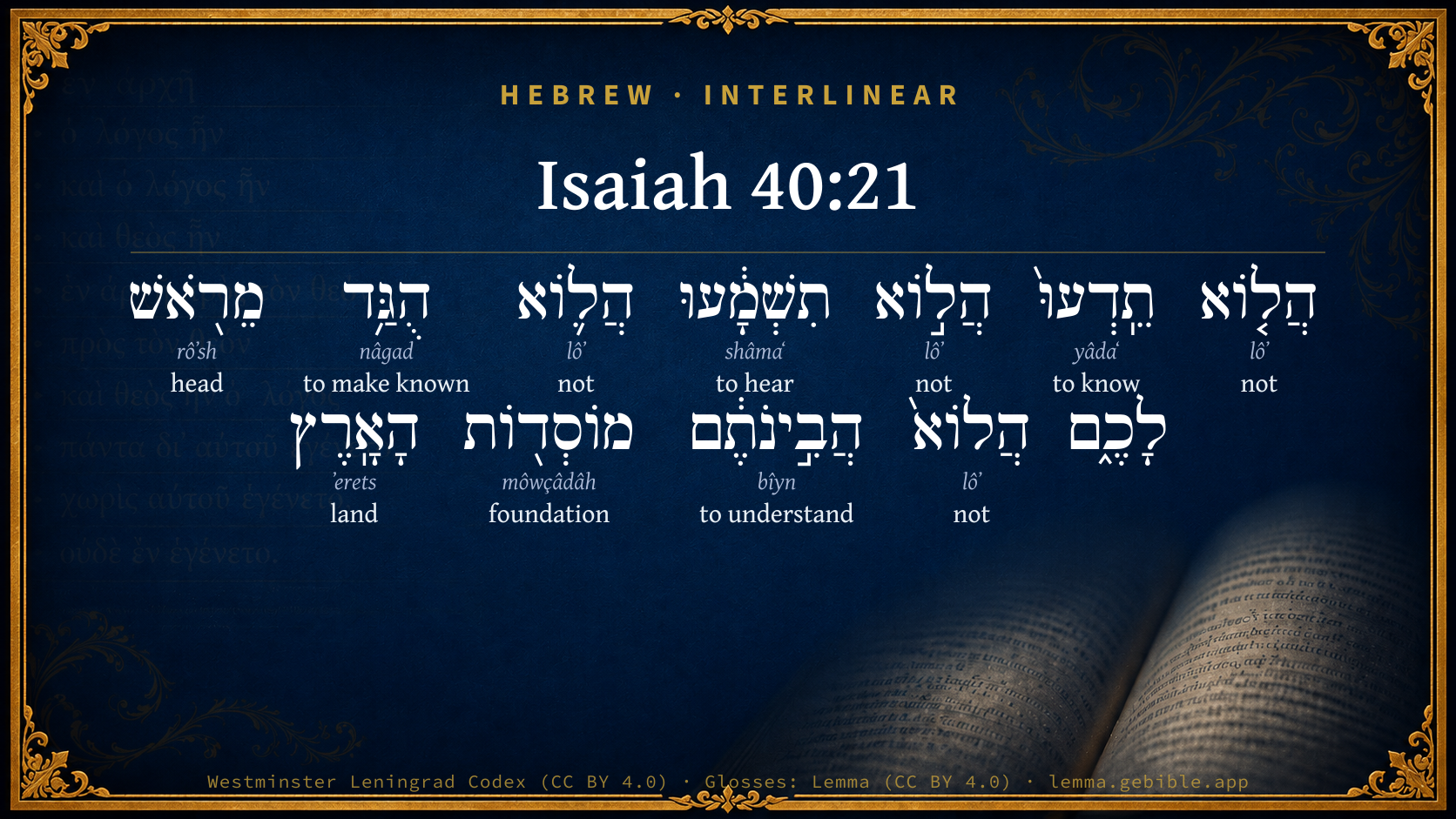
Hebrew (Westminster Leningrad Codex) Isaiah 40:21 appears in the Hebrew Old Testament. The text above is from the Westminster Leningrad Codex. Each word links to its Strong’s number, a concise gloss, and parsing drawn from the Open Scriptures Hebrew Bible morphology. Click any word for its full Brown-Driver-Briggs (BDB) entry.
Download image
Cite this verse

Isaiah 40:21 (World English Bible). Public Domain. Lemma interlinear Bible study tool, https://lemma.gebible.app/v/isaiah/40/21.

Show BibTeX & RIS
BibTeX
RIS
English Translation
Have you not known? have yet not heard? has it not been told you from the beginning? have you not understood from the foundations of the earth?
World English Bible · Public Domain
Download a study sheet

One document with this verse’s original text, its word-by-word gloss line, the meaning frame, cross-references with their text, attributed commentary, and full source and license credits — printable, and it pastes into notes with its structure intact.

This verse Autodidact and up

Study sheet (.html) Plain text (.txt)

A passage Seminary Student

Up to 50 verses in one chapter. A passage sheet keeps up to 6 commentary sources and 12 cross-references per verse, in the order this page ranks them, and says so on the sheet whenever that leaves anything out. Ask for a single verse and you get the Autodidact verse sheet above.

Everything on this page stays free to read, with no account — the sheet is a download of what is already on screen, not access to it.

Want to remove ads? Support Godless Engineer
Compare translations 3

The same verse in 3 English versions, stacked beneath the original-language interlinear above. Click any original word for its lexicon entry.

Each is an independent rendering of the whole verse — the interlinear is not word-aligned to these translations.

Highlighted words mark where these versions differ — a whole-verse word diff, not a word-by-word alignment.

  • World English Bible Public Domain
    Have you not known? have yet not heard? has it not been told you from the beginning? have you not understood from the foundations of the earth?
  • King James Version Public Domain
    Have ye not known? have ye not heard? hath it not been told you from the beginning? have ye not understood from the foundations of the earth?
  • unfoldingWord Literal Text CC BY-SA 4.0
    Do you not know? Have you not heard? Has it not been declared to you from the beginning? Have you not understood the foundations of the earth?

unfoldingWord Literal Text — © unfoldingWord, licensed CC BY-SA 4.0. Word-aligned USFM3 via Door43 (git.door43.org/unfoldingWord/en_ult).

Versions to compare (up to 4)

3 of 4 selected

Show all 18 translations

Every available English version of this verse, each an independent rendering of the whole verse.

  • World English Bible Public Domain
    Have you not known? have yet not heard? has it not been told you from the beginning? have you not understood from the foundations of the earth?
  • Berean Standard Bible Public Domain
    Do you not know? Have you not heard? Has it not been declared to you from the beginning? Have you not understood since the foundation of the earth?
  • Majority Standard Bible Public Domain
    Do you not know? Have you not heard? Has it not been declared to you from the beginning? Have you not understood since the foundation of the earth?
  • King James Version Public Domain
    Have ye not known? have ye not heard? hath it not been told you from the beginning? have ye not understood from the foundations of the earth?
  • American Standard Version (1901) Public Domain
    Have ye not known? have yet not heard? hath it not been told you from the beginning? have ye not understood from the foundations of the earth?
  • Revised Version (1885) Public Domain
    Have ye not known? have ye not heard? hath it not been told you from the beginning? have ye not understood from the foundations of the earth?
  • Geneva Bible (1599) Public Domain
    Know ye nothing? haue ye not heard it? hath it not bene tolde you from the beginning? haue ye not vnderstand it by the foundation of the earth?
  • Douay-Rheims (1899) Public Domain
    Do you not know? hath it not been heard? hath it not been told you from the beginning? have you not understood the foundations of the earth?
  • Young's Literal Translation Public Domain
    Do ye not know -- do ye not hear? Hath it not been declared from the first to you? Have ye not understood `From' the foundations of the earth?
  • Literal Standard Version CC BY-SA 4.0
    Do you not know—do you not hear? Has it not been declared from the first to you? Have you not understood || [From] the foundations of the earth?
  • Unlocked Literal Bible CC BY-SA 4.0
    Have you not known? Have you not heard? Has it not been told you from the beginning? Have you not understood from the foundations of the earth?
  • unfoldingWord Literal Text CC BY-SA 4.0
    Do you not know? Have you not heard? Has it not been declared to you from the beginning? Have you not understood the foundations of the earth?
  • Darby Bible Public Domain
    -- Do ye not know? Have ye not heard? Hath it not been told you from the beginning? Have ye not understood the foundation of the earth?
  • World Messianic Bible Public Domain
    Haven’t you known? Haven’t you heard? Haven’t you been told from the beginning? Haven’t you understood from the foundations of the earth?
  • Webster's Bible Public Domain
    Have ye not known? have ye not heard? hath it not been told you from the beginning? have ye not understood from the foundations of the earth?
  • Free Bible Version CC BY-SA 4.0
    Don't you know? Haven't you heard? Hasn't it been explained to you from the very beginning? Haven't you understood from the time the world was created?
  • Bible in Basic English Public Domain
    Have you no knowledge of it? has it not come to your ears? has not news of it been given to you from the first? has it not been clear to you from the time when the earth was placed on its base?
  • JPS Tanakh (1917) Public Domain
    Know ye not? hear ye not? Hath it not been told you from the beginning? Have ye not understood the foundations of the earth?

Literal Standard Version (2020), Covenant Press — licensed CC BY-SA 4.0. Text via the HelloAO Bible API (eBible.org). Unlocked Literal Bible (unfoldingWord) — licensed CC BY-SA 4.0. Text via the HelloAO Bible API (eBible.org). unfoldingWord Literal Text — © unfoldingWord, licensed CC BY-SA 4.0. Word-aligned USFM3 via Door43 (git.door43.org/unfoldingWord/en_ult). Free Bible Version, Dr. Jonathan Gallagher — licensed CC BY-SA 4.0. Text via the HelloAO Bible API (eBible.org).

Word by word

More ways to search: Search by grammar → Find every occurrence → Compare this word →

Practice this passage: Drill this verse → Learn its vocabulary →

מוֹסְד֖וֹת
môwçâdâh
H4146
“foundations of”
Noun, Common, Both, Plural, Construct
Part of Speech
Noun
Type
Common
Gender
Both
Number
Plural
State
Construct
Full BDB Definition

Origin: from H4144

TWOT: 875f

foundation
  1. הֲל֤וֹא lôʼ H3808 “not” Particle, Interrogative + Particle, Negative
  2. תֵֽדְעוּ֙ yâdaʻ H3045 “to know” Verb, Qal, Imperfect, 2nd Person, Masculine, Plural
  3. הֲל֣וֹא lôʼ H3808 “not” Particle, Interrogative + Particle, Negative
  4. תִשְׁמָ֔עוּ shâmaʻ H8085 “to hear” Verb, Qal, Imperfect, 2nd Person, Masculine, Plural
  5. הֲל֛וֹא lôʼ H3808 “not” Particle, Interrogative + Particle, Negative
  6. הֻגַּ֥ד nâgad H5046 “to make known” Verb, Hophal, Perfect, 3rd Person, Masculine, Singular
  7. מֵרֹ֖אשׁ rôʼsh H7218 “from · head” Preposition + Noun, Common, Masculine, Singular, Absolute
  8. הֲלוֹא֙ lôʼ H3808 “not” Particle, Interrogative + Particle, Negative
  9. הֲבִ֣ינֹתֶ֔ם bîyn H995 “to understand” Verb, Hiphil, Perfect, 2nd Person, Masculine, Plural
  10. הָאָֽרֶץ ʼerets H776 “the · land” Particle, Definite Article + Noun, Common, Both, Singular, Absolute

About this verse

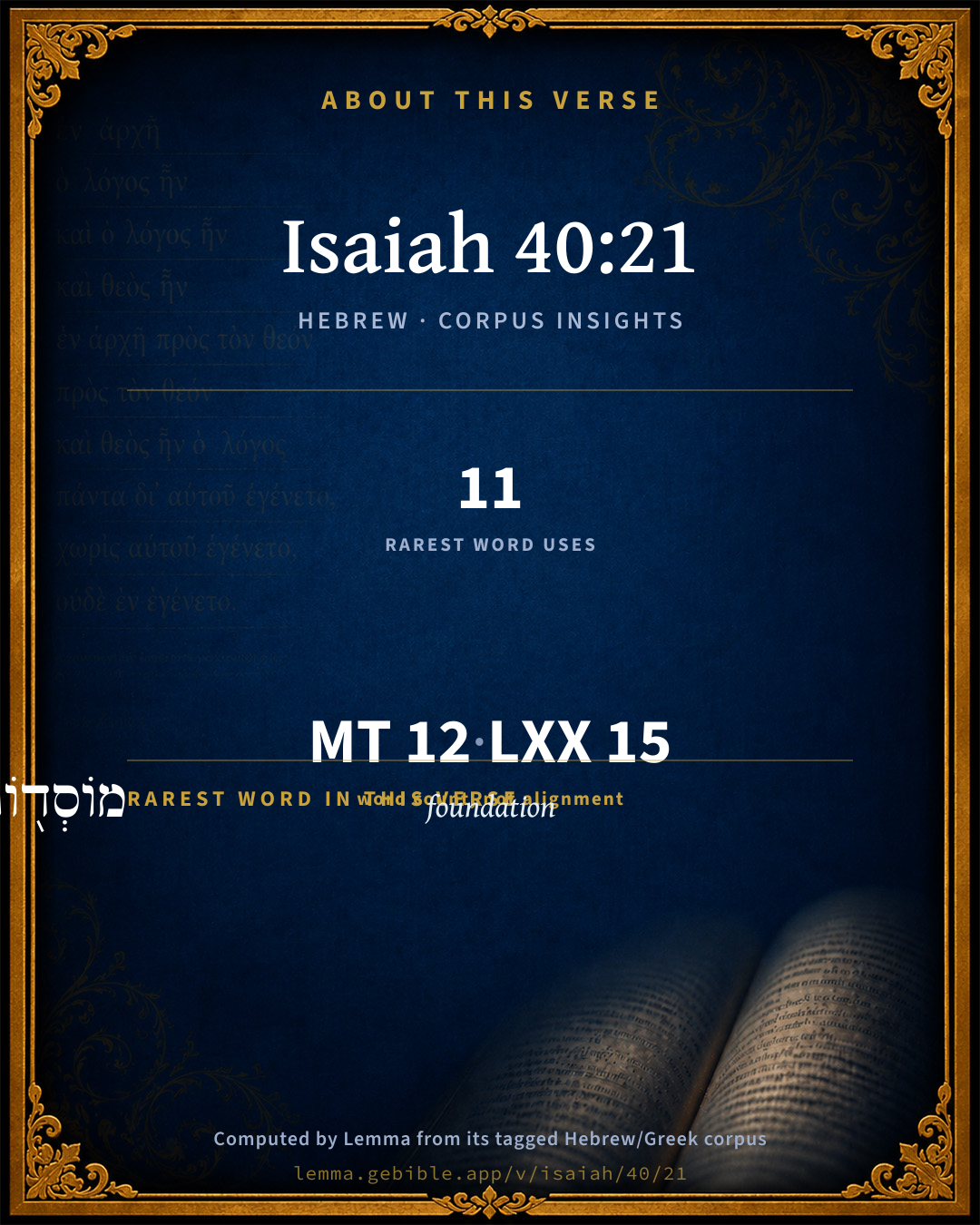
These counts appear in no published source. They are computed here, from the morphology-tagged text and Lemma’s own curated glosses. What Lemma adds →

12
words
8
distinct lemmas
Prophets
section

Notable vocabulary

The rarest word here is מוֹסְד֖וֹת foundation H4146 — appearing just 11 times in the whole Hebrew Bible.

Shared distinctive vocabulary

מוֹסְד֖וֹת foundation H4146 occurs in 11 verses of the Hebrew Bible. Also found in:

Grammatical profile

  • 4 verbs
  • 3 nouns
  • 1 preposition
  • 4 particles

Verb forms

  • תֵֽדְעוּ֙ Qal · Imperfect
  • תִשְׁמָ֔עוּ Qal · Imperfect
  • הֻגַּ֥ד Hophal · Perfect
  • הֲבִ֣ינֹתֶ֔ם Hiphil · Perfect

Repetition

A word recurs within this verse — often emphatic in Hebrew:

  • הֲל֤וֹא not H3808 ×4

Hebrew & Septuagint length

In English translation the verse runs 27 words from the Hebrew and 25 from the Septuagint (LXX English) — closely comparable.

A rough comparison of the two English renderings, which tokenize alike — not a word-level alignment.

Word counts can differ between the Hebrew and the Greek without any difference in meaning — e.g. the Hebrew direct-object marker אֵת has no separate Greek word, and Greek often adds the article ὁ.

In the original languages it is 12 Hebrew tokens and 15 Greek tokens — but the two are counted differently (Hebrew bundles its prefixes and suffixes into one token; the Greek is in lemma form), so that isn’t a like-for-like length.

Cross-references

7

Topical passages linked to Isaiah 40:21 in the Treasury of Scripture Knowledge — connected by theme and wording, ordered by reader-vote popularity; previews shown in the World English Bible.

  • Psalms 50:6 The heavens shall declare his righteousness, For God himself is judge. Selah.
  • Isaiah 46:8 Remember this, and show yourselves men; bring it again to mind, you transgressors.
  • Isaiah 48:13 Yes, my hand has laid the foundation of the earth, and my right hand has spread out the heavens: when I call to them, they stand up together.
  • Acts 14:17 Yet he didn't leave himself without witness, in that he did good and gave you rains from the sky and fruitful seasons, filling our hearts with food and gladness."
  • Psalms 115:8 Those who make them will be like them; Yes, everyone who trusts in them.
  • Romans 1:19–21 because that which is known of God is revealed in them, for God revealed it to them.
  • Romans 1:28 Even as they refused to have God in their knowledge, God gave them up to a reprobate mind, to do those things which are not fitting;

Cross-references courtesy of OpenBible.info (CC BY 4.0).

Hebrew and Greek witnesses Masoretic Hebrew ↔ Greek Septuagint

The same verse in the two great witnesses to the Old Testament, shown verse-for-verse.

These are two independent witnesses, not word-aligned to each other, and the Septuagint is shown in lemma (dictionary) form.

Hebrew Isaiah 40:21 Masoretic · Westminster Leningrad Codex

הֲל֤וֹא תֵֽדְעוּ֙ הֲל֣וֹא תִשְׁמָ֔עוּ הֲל֛וֹא הֻגַּ֥ד מֵרֹ֖אשׁ לָכֶ֑ם הֲלוֹא֙ הֲבִ֣ינֹתֶ֔ם מוֹסְד֖וֹת הָאָֽרֶץ

Have you not known? have yet not heard? has it not been told you from the beginning? have you not understood from the foundations of the earth?

World English Bible · Public Domain

Greek LXX Isaiah 40:21 Septuagint · lemma form

οὐ γιγνώσκω οὐ ἀκούω οὐ ἀναἀγγέλλω ἐκ ἀρχή σύ οὐ γιγνώσκω ὁ θεμέλιον ὁ γῆ

Will you⌃ not know? will you⌃ not hear? has it not been told you of old? Have you⌃ not known the foundations of the earth?

LXX2012 (modern English Septuagint) · Public Domain

On this verse, The Cambridge Bible for Schools and Colleges discusses the Septuagint’s reading. Read the note in Commentary ↓

Hebrew: Westminster Leningrad Codex (CC BY 4.0). Greek: Septuagint (public domain); English from LXX2012 (modern English Septuagint) (Public Domain). How the Septuagint differs from the Hebrew →

Targum (Aramaic paraphrase)

1

The Targum is the ancient Jewish Aramaic paraphrase of the Hebrew Scriptures — an interpretive translation, not the Hebrew text itself. Onkelos (literal) and Pseudo-Jonathan (expansive) render the Torah, and Jonathan the Prophets. Coverage is partial: where no permissively-licensed English translation exists for a verse, only the Aramaic is shown. This is verse-level text, not a word-by-word alignment to the Hebrew.

  1. Targum Jonathan Prophets (Joshua–Malachi)
    הֲלָא יְדַעְתּוּן הֲלָא שְׁמַעְתּוּן הֲלָא אִיתְחַוָאָה מִן אַוְלָא עוֹבַד סִדְרֵי בְרֵאשִׁית לְכוֹן הֲלָא תִּסְתַּכְּלוּן לְמִדְחַל קֳדָם מִן דִבְרָא יְסוֹדֵי אַרְעָא:

    Have ye not known? have ye not heard? hath not the work in the creation been declared unto you in its order from the beginning? Have ye not understood that ye ought to fear Him, who hath created the foundations of the earth?

    Targum Jonathan — Aramaic: “Mikraot Gedolot” (public domain). English: “Sefaria Community Translation” (CC0 1.0 (public-domain dedication)); “London "Chaldee Paraphrase," 1871” (public domain). Text via Sefaria.

Commentary

Notes on Isaiah 40:21 from classic Christian and Jewish commentators (each source and its license shown beneath its notes). The classic Christian expositions comment on the surrounding passage and are grouped to its opening verse, so a note may address several verses; the Jewish commentaries on the Tanakh (Rashi and others) are per-verse, so they appear only where the commentator wrote on this verse.

Lemma curates 59 commentaries, every one of them public domain or Creative Commons licensed, each selected and text-cleaned for this edition rather than reprinted as found. About our sources →

Trapp's Complete Commentary

John Trapp

Isa 40:21 Have ye not known? have ye not heard? hath it not been told you from the beginning? have ye not understood from the foundations of the earth?

Ver. 21. Have ye not known? have ye not heard?] Both Jews and Gentiles went against the light; the former of the word, the latter of their own consciences, in thus "changing the glory of the incorruptible God into the similitude of a corruptible creature." {Rom 1:23} Their ignorance was wilful and affected; some render this text, "Will ye not know? will ye not hear?" Idolaters are brutish and blockish; they that make them are like unto them.

John Trapp, A Commentary or Exposition upon All the Books of the Old and New Testament (1647–1656) — public domain. Text from a community e-Sword module.

The Biblical Illustrator

Joseph S. Exell

Isa_40:21

Have ye not known?

--

Isaiahs questions

His sharp questions are as hooks to draw from his hearers hearts their timid and starved convictions, that he may nourish these upon the sacramental glories of nature and of history. (Prof. G. A. Smith, D. D.)

The Biblical Illustrator, edited by Joseph S. Exell (c. 1880s–1900s) — public domain. Text from a community e-Sword module.

Joseph Benson's Commentary

Isa 40:21-24. Have ye not known — Jehovah to be the only true God, the Maker and Governor of the world, and all its inhabitants? How can ye be ignorant of so evident a truth? He addresses his speech to the idolatrous Gentiles; from the beginning — Namely, of the world, as the next clause explains it: were not these infinite perfections of God manifestly discovered to all mankind, by the creation of the world? It is he that sitteth — As a judge or governor upon his throne; upon, or rather, above, the circle of the earth — Far above this round earth, even in the highest heavens; from whence he looketh down upon the earth, where men appear to him like grasshoppers. As here we have the circle of the earth, so elsewhere we read of the circle of heaven, Job 22:14, and of the circle of the deep, or sea, Pro 8:27, because the form of the heaven, and earth, and sea, is circular. Spreadeth them out as a tent — For the benefit of the earth and of mankind, that all parts might partake of their comfortable influences. That bringeth the princes to nothing — Who can, at his pleasure, destroy all the great potentates of the world. Yea, they — The princes and judges last mentioned; shall not be planted, &c. — They shall take no root, for planting and sowing are in order to taking root. They shall not continue and flourish, as they have vainly imagined, but shall be rooted up, and perish.

Joseph Benson's Commentary on the Old and New Testaments (1811–1818) — public domain. Text from a community e-Sword module.

Tyndale Open Study Notes

Tyndale Open Resources

40:21 Idolaters fail to discern who God is or to respond wisely to him. The godly in Israel would understand and see the hand of God in the unfolding story of redemption, which includes both exile and restoration (41:20).

Tyndale Open Study Notes — © Tyndale Open Resources, licensed CC BY-SA 4.0. Text via the HelloAO Bible API.

Geneva Bible (1599)

Geneva Bible translators

Can you not learn by the visible creatures whom God hath made to observe your use, that you should not serve them nor worship them?

Have ye not the word of God, which plainly condemneth idolatry?

Geneva Bible (1599) marginal notes — public domain. Text via Bolls.life.

Jamieson, Fausset & Brown

Robert Jamieson, A. R. Fausset & David Brown

ye--who worship idols. The question emphatically implies, they had known.

from the beginning-- (Isa 41:4, Isa 41:26; Isa 48:16). God is the beginning (Rev 1:8). The tradition handed down from the very first, of the creation of all things by God at the beginning, ought to convince you of His omnipotence and of the folly of idolatry.

Jamieson, Fausset & Brown — Commentary Critical and Explanatory on the Whole Bible (1871) — public domain (CC PDM 1.0). Text via the HelloAO Bible API.

Adam Clarke's Commentary

Verse 21. Have ye not known] On this verse Kimchi has a very interesting comment, an extract of which I subjoin. "The whole world may be considered as a house built up; heaven its roof; the stars its lamps; and the fruits of the earth its table spread. The Master of the house is God, blessed for ever; and man is the steward into whose hand all the business of the house is given. If he always consider in his heart that the Master of the house is continually over him, and that he keeps his eye upon his work, and if in consequence he acts wisely, he shall find favour in the eyes of the Master of the house. But if he find wickedness in the house, then will he remove him מן פקידתו min pekidutho, 'from his stewardship.' The foolish steward does not think of this; for as his eyes do not see the Master of the house, he saith in his heart, 'I will eat and drink what I find in this house, and will take my pleasure in it; nor shall I be careful whether there be a master over this house or not.' When the Lord of the house marks this, he comes and expels him from the house speedily, and with great anger; therefore it is said, Isa 40:23, He bringeth the princes to nothing." It seems that this parable had been long in use among the Jews, as our blessed Lord alludes to it in his parable of the unjust steward. Or did the rabbin, finding it to his purpose, steal the parable from the Gospel? In both places it has great and peculiar beauties.

Have ye not understood from the foundations of the earth - "Have ye not understood it from the foundations of the earth?"] The true reading seems to be ממוסדות mimmosedoth, to answer to מראש merosh in the foregoing line. It follows a word ending with מ mem, and out of three mems concurring, it was an easy mistake to drop the middle one.

Adam Clarke's Commentary on the Bible (1810–1826) — public domain. Text from a community e-Sword/MySword module.

Ellicott's Commentary for English Readers

(21) Have ye not known? . . .—Strictly speaking, the first two verbs are potential futures: Can ye not know . . . We note that the prophet appeals to the primary intuitions of mankind, or, at least, to a primitive revelation, rather than to the commandments of the Decalogue. (Comp. Rom_1:20; Psa_19:4.)

A Bible Commentary for English Readers, edited by Charles John Ellicott (1878–1897) — public domain. Text from a community e-Sword module.

The Cambridge Bible for Schools and Colleges

gen. ed. J. J. S. Perowne

21. The next section (21–26) again commences with a series of questions driving home the force of the whole previous argument. The appeal seems to be still to mankind at large.

have ye not heard? Rather: Do ye not know? Do ye not hear? The two avenues by which the knowledge of God reaches the mind are reflexion on the facts of nature and history, and external testimony.

told you from the beginning) i.e. from the beginning of the world, by an unbroken tradition.

from the foundations] The preposition “from” might easily have been accidentally omitted in the Heb. The LXX., indeed, and other Versions take “foundations” as obj. to “understood.” The parallelism seems to require the phrase to be taken in a temporal sense (cf. Rom_1:20). but there is no other case where the word has the sense of fundatio (properly, = fundamenta).

The Cambridge Bible for Schools and Colleges (gen. ed. J. J. S. Perowne; Cambridge University Press, 1878–1918) — public domain. Text from a community e-Sword module.

John Gill's Exposition

Have ye not known? This is the speech of the prophet, directed to the idolaters, appealing to their own natural knowledge, who, from the light of nature, might know that idols were nothing, had no divinity in them: that it is God that made the earth and governs the world, and who only ought to be worshipped:

have ye not heard? by tradition from the ancients, from your forefathers, who received it from theirs, and have delivered it to you:

hath it not been told you from the beginning? from the beginning of your states and kingdoms, and even from the beginning of the world, by the wisest and best of men that have been in it, that those things are true before related, and what follow:

have ye not understood from the foundations of the earth? the being of God, the invisible things of him, his eternal power and Godhead, from the things that are made, even from his founding of the earth; as well as such knowledge and understanding has been as early as that, and might be continued from it: or,

have ye not understood the foundations of the earth (y)? what the earth is founded upon, and who laid the foundations of it; no other than that divine Being described in the next words.

(y) "nonne intelligetis fundamenta terrae?" Pagninus, Montanus; "annon intellexistis?" Vatablus.

John Gill's Exposition of the Whole Bible (1746–1763) — public domain (CC PDM 1.0). Text via the HelloAO Bible API.

Albert Barnes' Notes on the Bible

Have ye not known? - This is evidently an address to the worshippers of idols, and either designed to be addressed to the Jews themselves in the times of Manasseh, when idolatry abounded, or to all idolaters. The prophet had in the previous verses shown the manner in which the idols were made, and the folly of regarding them as objects of worship. He now turns and addresses the worshippers of these idols, as being without excuse. They might have known that these were not the true God. They had had abundant opportunity of learning his existence and of becoming acquainted with his majesty and glory. Tradition had informed them of this, and the creation of the earth demonstrated his greatness and power. The prophet, therefore, asks them whether they had not known this? Whether their conduct was the result of ignorance? And the question implies emphatically that they had known, or had abundant opportunity to know of the existence and majesty of God. This was emphatically true of the Jews, and yet they were constantly falling into idolatrous worship.

From the beginning - Hebrew, ‘From the head,’ that is, from the very commencement of the world. Has it not been communicated by tradition, from age to age, that there is one God, and that he is the Creator and upholder of all things? This was particularly the case with the Jews, who had had this knowledge from the very commencement of their history, and they were, therefore, entirely without excuse in their tendencies to idolatry.

From the foundations of the earth - Have you not learned the existence and greatness of God from the fact that the world has been made, and that it demonstrates the existence and perfection of God? The sacred writers often speak of the earth as resting on a foundation, as upheld, etc.:

For he hath founded it upon the seas,

And established it upon the floods.

(Psa 24:2; see also Pro 8:29) Perhaps here, however, the word ‘foundation’ refers rather to the time than to the manner in which the earth is made, and corresponds to the phrase ‘from the beginning;’ and the sense may be, ‘Has it not been understood ever since the earth was founded? Has not the tradition of the existence and perfections of God been unbroken and constant?’ The argument is, that the existence and greatness of God were fully known by tradition and by his works; and that it was absurd to attempt to form an image of that God who had laid the foundations of the world.

Albert Barnes' Notes on the Bible (1834–1885) — public domain. Text from a community e-Sword/MySword module.

Haydock's Catholic Bible Commentary

Beginning, by the light of nature, and (Worthington) has not Moses declared that God alone created the world? (Haydock) --- His power and goodness herein convince us that he will not deny grace. (Worthington)

George Leo Haydock (1774–1849), Haydock's Catholic Family Bible and Commentary, 1859 edition — public domain. Excludes Psalms (Douay-Rheims chapter numbering differs from Protestant) and Deuterocanonical books (Catholic canon only).

Matthew Poole's English Annotations

Have ye not known, to wit, God to be the only true God, the Maker and Governor of the world, and all its inhabitants? how can you be ignorant of so evident a truth? He addresseth his speech to the idolatrous Gentiles.

From the beginning, to wit, of the world, as the next clause explains it. Were not these infinite perfections of God manifestly discovered to all mankind by the creation of the world?

Matthew Poole's English Annotations on the Holy Bible (1683–1685) — public domain. Text from a community e-Sword/MySword module.

Whedon's Commentary on the Bible

Daniel D. Whedon

21. Such absurdities fit only for the sharpest sarcasm.

Have ye not known… heard… from the beginning? — Addressed to those still inclined, among the doubters, to idolatry, and equivalent to saying to them, “Ye know better, and why are you guilty of such consummate folly?” Of the four verbs of this verse, the first two are, in the Hebrew, future, the second two in the past tense. The former imply what is possible, the latter what is fact. Have ye not known and heard, what has always been possible to know from reason and conscience, (Rom_1:19-20; Rom_2:13,) that only the infinite God can create worlds? “From the beginning” this has been set before the eyes of all men.

Daniel D. Whedon (gen. ed.), Commentary on the Old and New Testaments (1874–1909) — public domain. Text from a community e-Sword module.

The Pulpit Commentary

Have ye not known? Hitherto the prophet has restrained himself, and confined himself to quiet sarcasm. Now he bursts out. Is there any one so insensate, so devoid of natural reason and understanding, as not to know what has been known to all from the beginning yea, from the foundations of the earth by "the light that is in them," viz. that God is something wholly different from this? that he is such a One as the prophet proceeds to describe in vers. 22-24, alike above nature and above man, Lord of heaven and earth, and absolute Disposer of the fates of all men? Hath it not been told you? If ye have not known the nature of God by the light of nature, has it not come down to you by tradition? Have not your fathers told it you? Has it not been handed on by sire to son from the very foundation of the earth? The appeal is to men generally, not especially to Israel. Have ye not understood, etc.? Some omit the preposition after "understood," and render the passage thus: "Have ye not understood the foundations of the earth?" i.e. how it was founded, or created that its creation was God"s sole act? (so the LXX, the Vulgate, Gesenius, Hitzig, Delitzsch, Knobel, Kay; but Ewald, Henderson, Weir, and Mr. Cheyne prefer the rendering of the Authorized Version).

The Pulpit Commentary (1880–1919), ed. H.D.M. Spence-Jones & Joseph S. Exell — public domain. Text from a community e-Sword module.

John Wesley's Explanatory Notes

Known - God to be the only true God, the maker and governor of the world.

John Wesley, Explanatory Notes Upon the Whole Bible (1754–1765) — public domain. Text via the GEBible commentary corpus.

Keil & Delitzsch

C. F. Keil & F. Delitzsch

Having thus depicted in a few strokes the infatuation of idolatry, the prophet addresses the following question to such of the Israelites as are looking at it with longing eye, even if they have not already been deluded by it. "Do ye not know? Do ye not hear? Is it not proclaimed to you from the beginning? Have ye not obtained an insight into the foundations of the earth?" We have here four questions chiastically arranged. The absolute being of God, which is above all created things, is something which may be either inferred per ratiocinationem, or learned per traditionem. When Israel failed to acknowledge the absolute distinctness and unequalled supremacy of Jehovah its God, it hardened itself against the knowledge which it might acquire even in a natural way (cf., Psa 19:1-14 and Rom 1:20), and shut its ears against the teaching of revelation and tradition, which had come down from the very beginning of its history. The first two questions are construed with futures, the other two with perfects; the former refer to what is possible, the latter to what is an actual fact. Have you - this is the meaning of the four questions - have you obtained no knowledge of the foundations of the earth, namely, as to the way in which they were laid?

Keil & Delitzsch — Biblical Commentary on the Old Testament (1861–1891) — public domain (CC PDM 1.0). Text via the HelloAO Bible API. (Old Testament only.)

J. A. Alexander on Isaiah

Joseph Addison Alexander

“Will you not know? will you not hear? has it not been told you from the first? have you not understood the foundations (or from the foundations) of the earth?” The tenses of the verbs in the first clause have been variously and arbitrarily explained by different interpreters. The English Version and some others exchange both the futures for preterits (have ye not known? have ye not heard?) without any satisfactory reason or authority. But the most satisfactory, because the safest and most regular construction, is the strict one given in the Septuagint (ou gnowsesthe ouk akousesthe) and revived by Lowth (will ye not know? will ye not hear?) The clause is then not a mere expression of surprise at their not knowing, but of concern or indignation at their being unwilling to know. There is no inconsistency between this explanation of the first two questions and the obvious meaning of the third; because the proof of their unwillingness to hear and know was the fact of their having been informed from the beginning. The words seem to refer simply to the testimony of external nature, and to mean that they who question the existence or supremacy of one God are without excuse, as Paul says, because the invisible things of Him from the creation of the world are clearly seen, being understood by the things that are made to wit, His eternal power and Godhead (Rom 1:20. Compare Act 14:17; Act 17:24). ‘The foundations of the earth’ are put by a natural and common figure for its being founded, (i.e., its creation).

Joseph Addison Alexander, The Prophecies of Isaiah (1846–1847; New York: Scribner, 1870–1878) — public domain. Text from a community e-Sword module.

unfoldingWord translationNotes

Door43 World Missions Community

General Information:

Isaiah continues speaking to God's people.

Have you not known? Have you not heard? Has it not been told you from the beginning? Have you not understood from the foundations of the earth?

Isaiah uses these questions to emphasize that the people should know Yahweh's greatness as the creator. AT: "You certainly know and have heard! It has been told to you from the beginning; you have understood from the foundations of the earth!" (See: Rhetorical Question and Parallelism)

Has it not been told you from the beginning?

This can be stated in active form. AT: "Have people not told you from the beginning?" (See: Active or Passive)

from the foundations of the earth

The prophet speaks of Yahweh creating the earth as if the earth were a building for which Yahweh laid the foundation. AT: "from the time that Yahweh created the earth" (See: Metaphor)

He is the one who sits above the horizon of the earth

The prophet speaks of Yahweh ruling the earth as if Yahweh were seated on a throne above the earth. (See: Metaphor)

the inhabitants are like grasshoppers before him

The prophet compares the way Yahweh considers humans to the way humans would consider grasshoppers. Just as grasshoppers are small to humans, humans are small and weak before God. (See: Simile)

He stretches out the heavens like a curtain and spreads them out as a tent to live in

These two lines share similar meanings. The prophet speaks of Yahweh creating the heavens as if he had erected a tent in which to live. AT: "He spreads out the heavens as easily as a person would stretch out a curtain or erect a tent in which to live" (See: Parallelism and Simile)

translationWords

found

earth

heaven

tent

unfoldingWord translationNotes — © Distant Shores Media and the Door43 World Missions Community, licensed CC BY-SA 4.0. Source: git.door43.org/Door43/en_tn.

Rashi

Rabbi Shlomo Yitzchaki (Rashi)

Do you not know...the foundations of the earth Who founded it, and you should have worshipped Him.

Rashi on the Tanakh — English translations: “The Judaica Press complete Tanach with Rashi, translated by A. J. Rosenberg” (CC BY 4.0); “Pentateuch with Rashi's commentary by M. Rosenbaum and A.M. Silbermann, 1929-1934” (public domain); “The Metsudah Tanach series, Lakewood, N.J” (CC BY 4.0); and “The Book of Joshua, Metsudah Publications, 1997” (CC BY 4.0). Text via Sefaria.

Ibn Ezra

Rabbi Abraham ibn Ezra

הלא תדעו Have ye not known by your own common sense, which is the most important source of knowledge;

הלא תשמעו have you not heard; have you not been informed by others;

הלא הגד מראש לכם hath it not been told you from the beginning, this is the lowest degree of knowledge.

From the beginning. From the first day of your existence; and even if you have no knowledge at all, have you not considered the foundations of the earth? etc.

Ibn Ezra on the Tanakh — English translations: “Sefaria Community Translation” (CC0 1.0 (public-domain dedication)); “Yalkut, Sifsei Chachomim Chumash, Metsudah Publications, 2009” (CC BY 4.0); and “Commentary of Ibn Ezra on Isaiah - trans. by M. Friedlander, 1873” (public domain). Text via Sefaria.

Lesson kit

Teaching starters — assembled from the data on this page, not authored interpretation. Every prompt links to the verse data it draws on. Edit before teaching.

Isaiah, in the Prophets, opens this verse with 12 words (8 distinct Hebrew lemmas). Its most distinctive word is môwçâdâh (“foundation”). A historical commentator’s framing appears above. Read the whole chapter for the surrounding context.

Discussion questions

  1. The word môwçâdâh carries the sense “foundation.” How does it shape the verse?
  2. Deuteronomy 32:22 shares the word «foundation» with this verse. How do the two illuminate each other?
  3. “not” occurs 4× in this one verse. What is the effect of the repetition?
  4. The translations on this page render this verse differently — a whole-verse word diff, not a word-by-word alignment. What might account for the different wordings?
  5. The verb «תֵֽדְעוּ֙» is Qal Imperfect. How does its form color the action?
  6. Reading how Trapp's Complete Commentary and The Biblical Illustrator read this verse, where do the two commentators agree and where do they part?

Things to notice

Reading settings

Reading text

Shown beneath each verse's original-language words.

Old Testament
Old Testament edition

Read the OT as the Masoretic Hebrew (MT) or the Greek Septuagint (LXX).

English shown for the Greek Septuagint (in the Hebrew ↔ Greek comparison).

Comparing translations? Open the Compare panel on any verse page to stack up to four side by side.