
Jeremiah 50:2

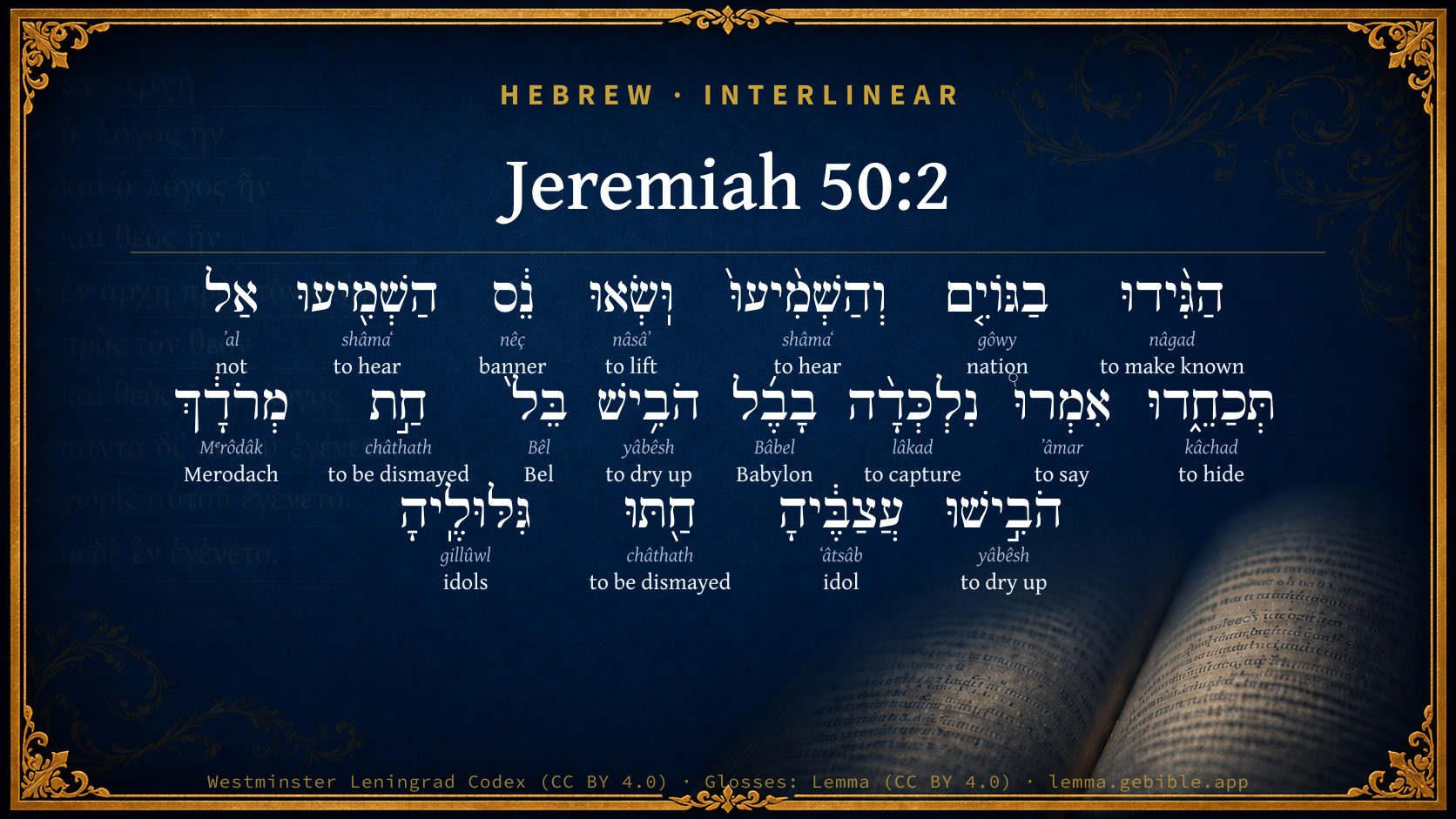
Hebrew (Westminster Leningrad Codex) Jeremiah 50:2 appears in the Hebrew Old Testament. The text above is from the Westminster Leningrad Codex. Each word links to its Strong’s number, a concise gloss, and parsing drawn from the Open Scriptures Hebrew Bible morphology. Click any word for its full Brown-Driver-Briggs (BDB) entry.
Download image
Cite this verse

Jeremiah 50:2 (World English Bible). Public Domain. Lemma interlinear Bible study tool, https://lemma.gebible.app/v/jeremiah/50/2.

Show BibTeX & RIS
BibTeX
RIS
English Translation
Declare you among the nations and publish, and set up a standard; publish, and don't conceal: say, Babylon is taken, Bel is disappointed, Merodach is dismayed; her images are disappointed, her idols are dismayed.
World English Bible · Public Domain
Highlights
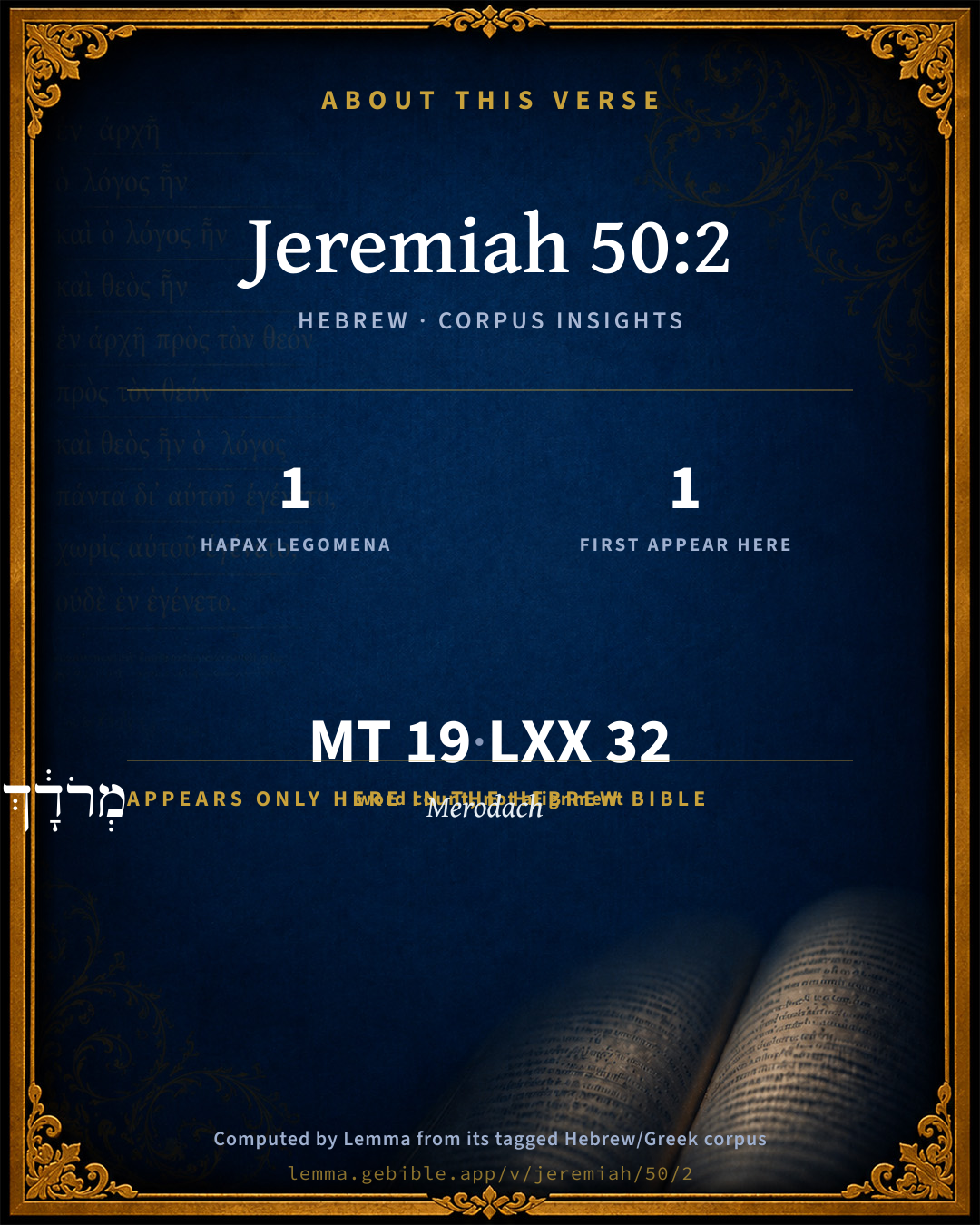
  • 1 hapax legomenon — only here in the Hebrew Bible
  • 1 first appearance in the Hebrew Bible
Full analysis ↓
Download a study sheet

One document with this verse’s original text, its word-by-word gloss line, the meaning frame, cross-references with their text, attributed commentary, and full source and license credits — printable, and it pastes into notes with its structure intact.

This verse Autodidact and up

Study sheet (.html) Plain text (.txt)

A passage Seminary Student

Up to 50 verses in one chapter. A passage sheet keeps up to 6 commentary sources and 12 cross-references per verse, in the order this page ranks them, and says so on the sheet whenever that leaves anything out. Ask for a single verse and you get the Autodidact verse sheet above.

Everything on this page stays free to read, with no account — the sheet is a download of what is already on screen, not access to it.

Want to remove ads? Support Godless Engineer
Compare translations 3

The same verse in 3 English versions, stacked beneath the original-language interlinear above. Click any original word for its lexicon entry.

Each is an independent rendering of the whole verse — the interlinear is not word-aligned to these translations.

Highlighted words mark where these versions differ — a whole-verse word diff, not a word-by-word alignment.

  • World English Bible Public Domain
    Declare you among the nations and publish, and set up a standard; publish, and don't conceal: say, Babylon is taken, Bel is disappointed, Merodach is dismayed; her images are disappointed, her idols are dismayed.
  • King James Version Public Domain
    Declare ye among the nations, and publish, and set up a standard; publish, and conceal not: say, Babylon is taken, Bel is confounded, Merodach is broken in pieces; her idols are confounded, her images are broken in pieces.
  • unfoldingWord Literal Text CC BY-SA 4.0
    “Report to the nations and cause them to listen. Lift up a signal and cause them to listen. Do not conceal it. Say, ‘Babylon is taken. Bel is made ashamed. Marduk is dismayed. Its idols are put to shame; its images are dismayed.’

unfoldingWord Literal Text — © unfoldingWord, licensed CC BY-SA 4.0. Word-aligned USFM3 via Door43 (git.door43.org/unfoldingWord/en_ult).

Versions to compare (up to 4)

3 of 4 selected

Show all 18 translations

Every available English version of this verse, each an independent rendering of the whole verse.

  • World English Bible Public Domain
    Declare you among the nations and publish, and set up a standard; publish, and don't conceal: say, Babylon is taken, Bel is disappointed, Merodach is dismayed; her images are disappointed, her idols are dismayed.
  • Berean Standard Bible Public Domain
    “Announce and declare to the nations; lift up a banner and proclaim it; hold nothing back when you say, ‘Babylon is captured; Bel is put to shame; Marduk is shattered, her images are disgraced, her idols are broken in pieces.’
  • Majority Standard Bible Public Domain
    “Announce and declare to the nations; lift up a banner and proclaim it; hold nothing back when you say, ‘Babylon is captured; Bel is put to shame; Marduk is shattered, her images are disgraced, her idols are broken in pieces.’
  • King James Version Public Domain
    Declare ye among the nations, and publish, and set up a standard; publish, and conceal not: say, Babylon is taken, Bel is confounded, Merodach is broken in pieces; her idols are confounded, her images are broken in pieces.
  • American Standard Version (1901) Public Domain
    Declare ye among the nations and publish, and set up a standard; publish, and conceal not: say, Babylon is taken, Bel is put to shame, Merodach is dismayed; her images are put to shame, her idols are dismayed.
  • Revised Version (1885) Public Domain
    Declare ye among the nations and publish, and set up a standard; publish, and conceal not: say, Babylon is taken, Bel is put to shame, Merodach is dismayed; her images are put to shame, her idols are dismayed.
  • Geneva Bible (1599) Public Domain
    Declare among the nations, and publish it, and set vp a standart, proclaime it and conceale it not: say, Babel is taken, Bel is confounded, Merodach is broken downe: her idols are confounded, and their images are burst in pieces.
  • Douay-Rheims (1899) Public Domain
    Declare ye among the nations, and publish it, lift up a standard: proclaim, and conceal it not: say: Babylon is taken, Bel is confounded, Merodach is overthrown, their graven things are confounded, their idols are overthrown.
  • Young's Literal Translation Public Domain
    `Declare ye among nations, and sound, And lift up an ensign, sound, do not hide, Say ye: Captured hath been Babylon, Put to shame hath been Bel, Broken hath been Merodach, Put to shame have been her grievous things, Broken have been her idols.
  • Literal Standard Version CC BY-SA 4.0
    “Declare among nations, and sound, || And lift up an ensign, sound, do not hide, || Say, Babylon has been captured, || Bel has been put to shame, || Merodach has been broken, || Her grievous things have been put to shame, || Her idols have been broken.
  • Unlocked Literal Bible CC BY-SA 4.0
    “Report to the nations and cause them to listen. Lift up a signal and cause them to listen. Do not conceal it. Say, 'Babylon is taken. Bel is made ashamed. Marduk is dismayed. Its idols are put to shame; its images are dismayed.'
  • unfoldingWord Literal Text CC BY-SA 4.0
    “Report to the nations and cause them to listen. Lift up a signal and cause them to listen. Do not conceal it. Say, ‘Babylon is taken. Bel is made ashamed. Marduk is dismayed. Its idols are put to shame; its images are dismayed.’
  • Darby Bible Public Domain
    Declare ye among the nations, and publish, and lift up a banner; publish, conceal not! Say, Babylon is taken, Bel is put to shame, Merodach is dismayed: her images are put to shame, her idols are dismayed.
  • World Messianic Bible Public Domain
    “Declare among the nations and publish, and set up a standard; publish, and don’t conceal; say, ‘Babylon has been taken, Bel is disappointed, Merodach is dismayed! Her images are disappointed. Her idols are dismayed.’
  • Webster's Bible Public Domain
    Declare ye among the nations, and publish, and set up a standard; publish, and conceal not: say, Babylon is taken, Bel is confounded, Merodach is broken in pieces; her idols are confounded, her images are broken in pieces.
  • Free Bible Version CC BY-SA 4.0
    Tell everyone the news! Hold up a sign and shout it out, don't hold back! Tell them, Babylon has fallen! Her god Bel is humiliated; the power of her god Marduk is broken; all Babylon's idols are humiliated and their power is broken.
  • Bible in Basic English Public Domain
    Give it out among the nations, make it public, and let the flag be lifted up; give the word and keep nothing back; say, Babylon is taken, Bel is put to shame, Merodach is broken, her images are put to shame, her gods are broken.
  • JPS Tanakh (1917) Public Domain
    Declare ye among the nations and announce, and set up a standard; announce, and conceal not; say: 'Babylon is taken, Bel is put to shame, Merodach is dismayed; her images are put to shame, her idols are dismayed.'

Literal Standard Version (2020), Covenant Press — licensed CC BY-SA 4.0. Text via the HelloAO Bible API (eBible.org). Unlocked Literal Bible (unfoldingWord) — licensed CC BY-SA 4.0. Text via the HelloAO Bible API (eBible.org). unfoldingWord Literal Text — © unfoldingWord, licensed CC BY-SA 4.0. Word-aligned USFM3 via Door43 (git.door43.org/unfoldingWord/en_ult). Free Bible Version, Dr. Jonathan Gallagher — licensed CC BY-SA 4.0. Text via the HelloAO Bible API (eBible.org).

Word by word

More ways to search: Search by grammar → Find every occurrence → Compare this word →

Practice this passage: Drill this verse → Learn its vocabulary →

מְרֹדָ֔ךְ
Mᵉrôdâk
H4781
“Merodach”
Noun, Proper
Part of Speech
Noun
Type
Proper
Full BDB Definition

Origin: of foreign derivation

TWOT: 1241

Merodach = "thy rebellion" - the chief deity of the Babylonians in the time of Nebuchadnezzar
  1. הַגִּ֨ידוּ nâgad H5046 “make known” Verb, Hiphil, Imperative, 2nd Person, Masculine, Plural
  2. בַגּוֹיִ֤ם gôwy H1471 “in/at the · nations” Preposition, Determined + Noun, Common, Masculine, Plural, Absolute
  3. וְהַשְׁמִ֨יעוּ֙ shâmaʻ H8085 “and · hear” Conjunction + Verb, Hiphil, Imperative, 2nd Person, Masculine, Plural
  4. וּֽשְׂאוּ nâsâʼ H5375 “and · lift” Conjunction + Verb, Qal, Imperative, 2nd Person, Masculine, Plural
  5. נֵ֔ס nêç H5251 “banner” Noun, Common, Masculine, Singular, Absolute
  6. הַשְׁמִ֖יעוּ shâmaʻ H8085 “hear” Verb, Hiphil, Imperative, 2nd Person, Masculine, Plural
  7. אַל ʼal H408 “not” Particle, Negative
  8. תְּכַחֵ֑דוּ kâchad H3582 “to hide” Verb, Piel, Jussive, 2nd Person, Masculine, Plural
  9. אִמְרוּ֩ ʼâmar H559 “say” Verb, Qal, Imperative, 2nd Person, Masculine, Plural
  10. נִלְכְּדָ֨ה lâkad H3920 “to capture” Verb, Niphal, Perfect, 3rd Person, Feminine, Singular
  11. בָבֶ֜ל Bâbel H894 “Babylon” Noun, Proper
  12. הֹבִ֥ישׁ yâbêsh H3001 “to dry up” Verb, Hiphil, Perfect, 3rd Person, Masculine, Singular
  13. בֵּל֙ Bêl H1078 “Bel” Noun, Proper
  14. חַ֣ת châthath H2865 “to be dismayed” Verb, Qal, Perfect, 3rd Person, Masculine, Singular
  15. הֹבִ֣ישׁוּ yâbêsh H3001 “to dry up” Verb, Hiphil, Perfect, 3rd Person, Common, Plural
  16. עֲצַבֶּ֔יהָ ʻâtsâb H6091 “idols · her” Noun, Common, Masculine, Plural, Construct + Suffix, Personal, 3rd Person, Feminine, Singular
  17. חַ֖תּוּ châthath H2865 “to be dismayed” Verb, Qal, Perfect, 3rd Person, Common, Plural
  18. גִּלּוּלֶֽיהָ gillûwl H1544 “idols · her” Noun, Common, Masculine, Plural, Construct + Suffix, Personal, 3rd Person, Feminine, Singular

About this verse

These counts appear in no published source. They are computed here, from the morphology-tagged text and Lemma’s own curated glosses. What Lemma adds →

19
words
16
distinct lemmas
Prophets
section

Notable vocabulary

1 hapax legomenon — a word that appears only here in the entire Hebrew Bible:

  • מְרֹדָ֔ךְ Merodach H4781

First appearance in Scripture

This word makes its first canonical appearance in the Hebrew Bible here:

  • מְרֹדָ֔ךְ Merodach H4781

Shared distinctive vocabulary

בֵּל֙ Bel H1078 occurs in 3 verses of the Hebrew Bible. Also found in:

Grammatical profile

  • 11 verbs
  • 7 nouns
  • 1 particle

Verb forms

  • הַגִּ֨ידוּ Hiphil · Imperative
  • וְהַשְׁמִ֨יעוּ֙ Hiphil · Imperative
  • וּֽשְׂאוּ Qal · Imperative
  • הַשְׁמִ֖יעוּ Hiphil · Imperative
  • תְּכַחֵ֑דוּ Piel · Jussive
  • אִמְרוּ֩ Qal · Imperative
  • נִלְכְּדָ֨ה Niphal · Perfect
  • הֹבִ֥ישׁ Hiphil · Perfect
  • חַ֣ת Qal · Perfect
  • הֹבִ֣ישׁוּ Hiphil · Perfect
  • חַ֖תּוּ Qal · Perfect

Repetition

Words recur within this verse — often emphatic in Hebrew:

  • וְהַשְׁמִ֨יעוּ֙ to hear H8085 ×2
  • הֹבִ֥ישׁ to dry up H3001 ×2
  • חַ֣ת to be dismayed H2865 ×2

Hebrew & Septuagint length

In the original languages it is 19 Hebrew tokens and 32 Greek tokens — but the two are counted differently (Hebrew bundles its prefixes and suffixes into one token; the Greek is in lemma form), so that isn’t a like-for-like length.

Cross-references

25

Topical passages linked to Jeremiah 50:2 in the Treasury of Scripture Knowledge — connected by theme and wording, ordered by reader-vote popularity; previews shown in the World English Bible.

  • Isaiah 46:1 Bel bows down, Nebo stoops; their idols are on the animals, and on the cattle: the things that you carried about are made a load, a burden to the weary [animal].
  • Isaiah 21:9 and, behold, here comes a troop of men, horsemen in pairs. He answered, Fallen, fallen is Babylon; and all the engraved images of her gods are broken to the ground.
  • Jeremiah 51:44 I will execute judgment on Bel in Babylon, and I will bring forth out of his mouth that which he has swallowed up; and the nations shall not flow any more to him: yes, the wall of Babylon shall fall.
  • Jeremiah 51:47 Therefore, behold, the days come, that I will execute judgment on the engraved images of Babylon; and her whole land shall be confounded; and all her slain shall fall in the midst of her.
  • Psalms 64:9 All mankind shall be afraid. They shall declare the work of God, And shall wisely ponder what he has done.
  • Psalms 96:3 Declare his glory among the nations, His marvelous works among all the peoples.
  • Isaiah 12:4 In that day you will say, "Give thanks to Yahweh! Call on his name. Declare his doings among the peoples. Proclaim that his name is exalted!
  • Isaiah 13:2 Set up an ensign on the bare mountain, lift up the voice to them, wave the hand, that they may go into the gates of the nobles.
  • Isaiah 37:19 and have cast their gods into the fire: for they were no gods, but the work of men's hands, wood and stone; therefore they have destroyed them.
  • Isaiah 39:1 At that time Merodach Baladan the son of Baladan, king of Babylon, sent letters and a present to Hezekiah; for he heard that he had been sick, and was recovered.
  • Isaiah 48:6 You have heard it; see all this; and you, will you not declare it? I have shown you new things from this time, even hidden things, which you have not known.
  • Isaiah 66:18–19 For I [know] their works and their thoughts: [the time] comes, that I will gather all nations and languages; and they shall come, and shall see my glory.
  • Jeremiah 4:16 make you mention to the nations; behold, publish against Jerusalem, [that] watchers come from a far country, and give out their voice against the cities of Judah.
  • Jeremiah 6:18 Therefore hear, you nations, and know, congregation, what is among them.
  • Jeremiah 31:10 Hear the word of Yahweh, you nations, and declare it in the isles afar off; and say, He who scattered Israel will gather him, and keep him, as shepherd does his flock.
  • Jeremiah 43:12–13 I will kindle a fire in the houses of the gods of Egypt; and he shall burn them, and carry them away captive: and he shall array himself with the land of Egypt, as a shepherd puts on his garment; and he shall go forth from there in peace.
  • Jeremiah 46:14 Declare you in Egypt, and publish in Migdol, and publish in Memphis and in Tahpanhes: say you, Stand forth, and prepare you; for the sword has devoured round about you.
  • Jeremiah 50:46 At the noise of the taking of Babylon the earth trembles, and the cry is heard among the nations.
  • Jeremiah 51:8 Babylon is suddenly fallen and destroyed: wail for her; take balm for her pain, if so be she may be healed.
  • Jeremiah 51:31 One post shall run to meet another, and one messenger to met another, to show the king of Babylon that his city is taken on every quarter:
  • Jeremiah 51:52 Therefore, behold, the days come, says Yahweh, that I will execute judgment on her engraved images; and through all her land the wounded shall groan.
  • Jeremiah 52:31 It happened in the seven and thirtieth year of the captivity of Jehoiachin king of Judah, in the twelfth month, in the five and twentieth day of the month, that Evilmerodach king of Babylon, in the [first] year of his reign, lifted up the head of Jehoiachin king of Judah, and brought him forth out of prison;
  • Zephaniah 2:11 Yahweh will be awesome to them, for he will famish all the gods of the land. Men will worship him, everyone from his place, even all the shores of the nations.
  • Revelation 14:6–8 I saw an angel flying in mid heaven, having an eternal Gospel to proclaim to those who dwell on the earth, and to every nation, tribe, language, and people.
  • Revelation 18:2 He cried with a mighty voice, saying, "Fallen, fallen is Babylon the great, and she has become a habitation of demons, a prison of every unclean spirit, and a prison of every unclean and hateful bird!

Cross-references courtesy of OpenBible.info (CC BY 4.0).

Hebrew and Greek witnesses Masoretic Hebrew ↔ Greek Septuagint

The same verse in the two great witnesses to the Old Testament, shown verse-for-verse.

These are two independent witnesses, not word-aligned to each other, and the Septuagint is shown in lemma (dictionary) form.

Hebrew Jeremiah 50:2 Masoretic · Westminster Leningrad Codex

הַגִּ֨ידוּ בַגּוֹיִ֤ם וְהַשְׁמִ֨יעוּ֙ וּֽשְׂאוּ נֵ֔ס הַשְׁמִ֖יעוּ אַל תְּכַחֵ֑דוּ אִמְרוּ֩ נִלְכְּדָ֨ה בָבֶ֜ל הֹבִ֥ישׁ בֵּל֙ חַ֣ת מְרֹדָ֔ךְ הֹבִ֣ישׁוּ עֲצַבֶּ֔יהָ חַ֖תּוּ גִּלּוּלֶֽיהָ

Declare you among the nations and publish, and set up a standard; publish, and don't conceal: say, Babylon is taken, Bel is disappointed, Merodach is dismayed; her images are disappointed, her idols are dismayed.

World English Bible · Public Domain

Greek LXX Structure differs

In the Septuagint, Jeremiah is about an eighth shorter than the Hebrew and arranges its material differently — the Oracles Against the Nations (Hebrew chapters 46–51) appear in the middle of the Greek book, after 25:13. Because the chapter and verse boundaries do not line up, a verse-for-verse comparison with the Hebrew is not shown.

A verse-for-verse comparison isn’t shown here because the chapters and verses don’t line up. Switch to the LXX edition with the MT / LXX toggle above to read the Greek directly.

On this verse, Keil & Delitzsch discusses the Septuagint’s reading. Read the note in Commentary ↓

Hebrew: Westminster Leningrad Codex (CC BY 4.0). Greek: Septuagint (public domain); English from a public-domain English Septuagint. How the Septuagint differs from the Hebrew →

Targum (Aramaic paraphrase)

1

The Targum is the ancient Jewish Aramaic paraphrase of the Hebrew Scriptures — an interpretive translation, not the Hebrew text itself. Onkelos (literal) and Pseudo-Jonathan (expansive) render the Torah, and Jonathan the Prophets. Coverage is partial: where no permissively-licensed English translation exists for a verse, only the Aramaic is shown. This is verse-level text, not a word-by-word alignment to the Hebrew.

  1. Targum Jonathan Prophets (Joshua–Malachi)
    חֲווּ בְעַמְמַיָא וּבְסַרוּ וּזְקוּפוּ אָתָא בַּסְרוּ לָא תִמְנְעוּן אֲמָרוּ אִתְכְּבִישַׁת בָּבֶל בְּהִיתוּ דְפָלְחִין לְבַל אִתְּבָרוּ דְפָלְחִין לִמְרוֹדָךְ בְּהִיתוּ צַלְמְנָהָא אִתְּבְרָא טַעֲוָתָהָא:

    (no public-domain English translation for this verse)

    Targum Jonathan — Aramaic: “Mikraot Gedolot” (public domain). English: “Sefaria Community Translation” (CC0 1.0 (public-domain dedication)); “London "Chaldee Paraphrase," 1871” (public domain). Text via Sefaria.

Commentary

Notes on Jeremiah 50:2 from classic Christian and Jewish commentators (each source and its license shown beneath its notes). The classic Christian expositions comment on the surrounding passage and are grouped to its opening verse, so a note may address several verses; the Jewish commentaries on the Tanakh (Rashi and others) are per-verse, so they appear only where the commentator wrote on this verse.

Lemma curates 59 commentaries, every one of them public domain or Creative Commons licensed, each selected and text-cleaned for this edition rather than reprinted as found. About our sources →

Trapp's Complete Commentary

John Trapp

Jer 50:2 Declare ye among the nations, and publish, and set up a standard; publish, [and] conceal not: say, Babylon is taken, Bel is confounded, Merodach is broken in pieces; her idols are confounded, her images are broken in pieces.

Ver. 2. Declare ye among the nations.] Let all take notice of the good news; there shall be a general jail delivery, sing therefore Io triumphe.

Say, Babylon is taken.] So Isa 21:9.

Bel is confounded.] This Bel was Nimrod, whose nephew Ninus set him up for a god. Merodach (a restorer of their empire, {a} whereof Nimrod had been founder) was likewise idolised. They are called "dirty deities" - foedites et stercora, a name good enough for them - and said to be confounded. See Isa 46:1. "Sorrows" also; because "their sorrows shall be multiplied that hasten after another God." {Psa 16:4}

{a} Merodach σκηπρουχος sive Sceptrifer Chaldaica appellatione.

John Trapp, A Commentary or Exposition upon All the Books of the Old and New Testament (1647–1656) — public domain. Text from a community e-Sword module.

Whedon's Commentary on the Bible

Daniel D. Whedon

THE FALL OF BABYLON AND DELIVERANCE OF ISRAEL, Jer_50:2-10.

2. Set up (rather, as the margin, lift up) a standard — As a means of spreading the good news.

Bel… Merodach — These are not two separate deities, but rather two names suggesting two aspects of one deity. “Bel” is the Aramean divinity answering to the Phenician Baal, the Phenician and Babylonian Jupiter. “Merodach” is the same, as the tutelar god of Babylon.

Daniel D. Whedon (gen. ed.), Commentary on the Old and New Testaments (1874–1909) — public domain. Text from a community e-Sword module.

Keil & Delitzsch

C. F. Keil & F. Delitzsch

The fall of Babylon, and deliverance of Israel. - Jer 50:2. "Tell it among the nations, and cause it to be heard, and lift up a standard; cause it to be heard, conceal it not: say, Babylon is taken, Bel is ashamed, Merodach is confounded; her images are ashamed, her idols are confounded. Jer 50:3. For there hath come up against her a nation out of the north; it will make her land a desolation, and there shall be not an inhabitant in it: from man to beast, [all] have fled, are gone. Jer 50:4. In those days, and at that time, saith Jahveh, the children of Israel shall come, they and the children of Judah together; they shall go, weeping as they go, and shall seek Jahveh their God. Jer 50:5. They shall ask for Zion, with their faces [turned to] the road hitherwards, [saying], Come, and let us join ourselves to Jahveh by an eternal covenant [which] shall not be forgotten. Jer 50:6. My people have been a flock of lost ones; their shepherds have misled them [on] mountains which lead astray: from mountain to hill they went; they forgot their resting-place. Jer 50:7. All who found them have devoured them; and their enemies said, We are not guilty, for they have sinned against Jahveh, the dwelling-place of justice, and the hope of their fathers, Jahveh. Jer 50:8. Flee out of the midst of Babylon, and from the land of the Chaldeans; let them go forth, and let them be like he-goats before a flock. Jer 50:9. For, behold, I will stir up, and bring up against Babylon, an assembly of great nations out of the land of the north: and they shall array themselves against her; on that side shall she be taken: his arrows [are] like [those of] a skilful hero [who] does not return empty. Jer 50:10. And [the land of the] Chaldeans shall become a spoil; all those who spoil her shall be satisfied, saith Jahveh."

In the spirit Jeremiah sees the fall of Babylon, together with its idols, as if it had actually taken place, and gives the command to proclaim among the nations this event, which brings deliverance for Israel and Judah. The joy over this is expressed in the accumulation of the words for the summons to tell the nations what has happened. On the expression, cf. Jer 4:5-6; Jer 46:14. The lifting up of a standard, i.e., of a signal-rod, served for the more rapid spreading of news; cf. Jer 4:6; Jer 6:1, Isa 13:2, etc. "Cause it to be heard" is intensified by the addition of "do not conceal it." The thing is to be proclaimed without reserve; cf. Jer 38:14. "Babylon is taken," i.e., conquered, and her idols have become ashamed, inasmuch as, from their inability to save their city, their powerlessness and nullity have come to light. Bel and Merodach are not different divinities, but merely different names for the chief deity of the Babylonians. Bel = Baal, the Jupiter of the Babylonians, was, as Bel-merodach, the tutelary god of Babylon. "The whole of the Babylonian dynasty," says Oppert, Expd. en Msopot. ii. p. 272, "places him [Merodach] at the head of the gods; and the inscription of Borsippa calls him the king of heaven and earth." עצבּים, "images of idols," and גּלּוּלים, properly "logs," an expression of contempt for idols (see on Lev 26:30), are synonymous ideas for designating the nature and character of the Babylonian gods.

Jer 50:3

Babylon is fallen by a people from the north, that has gone out against her, and makes her land a desolation. This nation is described in Jer 50:9 as a collection, union of great nations, that are enumerated especially in Jer 51:27-28. On "it [the nation] shall make her land," etc., cf. Jer 2:15; Jer 48:9; on the expression "from man to beast," cf. Jer 33:12; Jer 9:9. נדוּ is from נוּד, Jer 50:8 and Jer 49:30 = נדדוּ, from נדד, Jer 9:9.

Jer 50:4-6

Then, when Babylon shall have fallen, the children of Israel and Judah return out of their captivity, seeking Jahveh their God with tears of repentance, and marching to Zion, for the purpose of joining themselves to Him in an eternal covenant. The fall of Babylon has the deliverance of Israel as its direct result. The prophet views this in such a way, that all the steps in the fulfilment (the return from Babylon, the reunion of the tribes previously separated, their sincere return to the Lord, and the making of a new covenant that shall endure for ever), which will actually follow successively in long periods, are taken together into one view. By the statement made regarding the time, "In those days, and at that time," the fall of Babylon and the deliverance of Israel (which Jeremiah sees in the spirit as already begun) are marked out as belonging to the future. Israel and Judah come together, divided no more; cf. Jer 3:18. "Going and weeping they go," i.e., they always go further on, weeping: cf. Jer 41:6; Sa2 3:16; Ewald, 280, b. Cf. also Jer 3:21; Jer 31:9. Seeking the Lord their God, they ask for Zion, i.e., they ask after the way thither; for in Zion Jahveh has His throne. "The way hither" (i.e., to Jerusalem) "is their face," sc. directed. "Hither" points to the place of the speaker, Jerusalem. באוּ are imperatives, and words with which those who are returning encourage one another to a close following of the Lord their God. נלווּ is imperative for ילּווּ, like נקבּצוּ in Isa 43:9, Joe 3:11; cf. Ewald, 226, c. It cannot be the imperfect, because the third person gives no sense; hence Graf would change the vowels, and read נלוה. But suspicion is raised against this by the very fact that, excepting Ecc 8:15, לוה, in the sense of joining oneself to, depending on, occurs only in the Niphal. בּרית עולם is a modal accusative: "in an eternal covenant which shall not be forgotten," i.e., which we will not forget, will not break again. In fact, this is the new covenant which the Lord, according to Jer 31:31., will make in time to come with His people. But here this side of the matter is withdrawn from consideration; for the point treated of is merely what Israel, in his repentant frame and returning to God, vows he shall do.

Israel comes to this determination in consequence of the misery into which he has fallen because of his sins, Jer 50:5-7. Israel was like a flock of lost sheep which their shepherds had led astray. צאן , a flock of sheep that are going to ruin. The participle in the plural is joined with the collective noun ad sensum, to show what is imminent or is beginning to happen. The verb היה points to the subject צאן; hence the Qeri היוּ is unnecessary. The plural suffixes of the following clause refer to עמּי as a collective. The shepherds led the people of God astray on הרים שׁובבים (a local accusative; on the Kethib שׁובבים, cf. Jer 31:32; Jer 49:4; it is not to be read שׁובבים), mountains that render people faithless. These mountains were so designated because they were the seats of that idolatry which had great power of attraction for a sinful people, so that the seduction or alienation of the people from their God is ascribed to them. שׁובב is used in the sense which the verb has in Isa 47:10. The Qeri שׁובבוּם gives the less appropriate idea, "the shepherds made the sheep stray." Hitzig's translation, "they drove them along the mountain," does to suit the verb שׁובב. Moreover, the mountains in themselves do not form unsuitable pasture-ground for sheep, and הרים does not mean "a bare, desolate mountain-range." The objection to our view of הרים, that there is no very evident proof that worship on high places is referred to (Graf), is pure fancy, and the reverse only is true. For the words which follow, "they (the sheep) went from mountain to hill, and forgot their resting-place," have no meaning whatever, unless they are understood of the idolatrous dealings of Israel. The resting-place of the sheep (רבחם, the place where the flocks lie down to rest), according to Jer 50:7, is Jahveh, the hope of their fathers. Their having forgotten this resting-place is the result of their going from mountain to hill: these words undeniably point to the idolatry of the people on every high hill (Jer 2:20; Jer 3:2; Jer 17:2, etc.).

Jer 50:7

The consequence of this going astray on the part of Israel was, that every one who found them devoured them, and while doing so, cherished the thought that they were not incurring guilt, because Israel had been given up to their enemies on account of their apostasy from God; while the fact was, that every offence against Israel, as the holy people of the Lord, brought on guilt; cf. Jer 2:3. This befell Israel because they have sinned against Jahveh. נוה צדק, "the habitation (or pasture-ground) of righteousness." So, in Jer 31:23, Zion is called the mountain on which Jahveh sits enthroned in His sanctuary. As in other places Jahveh Himself is called a fortress, Psa 18:3; a sun, shield, Psa 84:12; a shade, Psa 121:5; so here He is called the One in whom is contained that righteousness which is the source of Israel's salvation. As such, He was the hope of the fathers, the God upon whom the fathers put their trust; cf. Jer 14:8; Jer 17:13; Psa 22:5. The repetition of יהוה at the end is intended to give an emphatic conclusion to the sentence.

Jer 50:8-10

To escape from this misery, Israel is to flee from Babylon; for the judgment of conquest and plunder by enemies is breaking over Babylon. The summons to flee out of Babylon is a reminiscence of Isa 38:20. The Kethib יצאוּ may be vindicated, because the direct address pretty often makes a sudden transition into the language of the third person. They are to depart from the land of the Chaldeans. No more will then be necessary than to change והיוּ into והיוּ. The simile, "like he-goats before the flock," does not mean that Israel is to press forward that he may save himself before any one else (Graf), but that Israel is to go before all, as an example and leader in the flight (Ngelsbach).

Jer 50:9-10

For the Lord arouses and leads against Babylon a crowd of nations, i.e., an army consisting of a multitude of nations. As meeעיר reminds us of Isa 13:17, so קהל גּוים גּ remind us of ממלכות גּוים נאספים in Isa 13:4. ערך ל, to make preparations against. משּׁם is not used of time (Rosenmller, Ngelsbach, etc.), for this application of the word has not been established from the actual occurrence of instances, but it has a local meaning, and refers to the "crowd of nations:" from that place where the nations that come out of the north have assembled before Babylon. In the last clause, the multitude of great nations is taken together, as if they formed one enemy: "his arrows are like the arrows of a wisely dealing (i.e., skilful) warrior."

(Note: Instead of משׂכּיל, J. H. Michaelis, in his Biblia Halens., has accepted the reading משּׁכּיל on the authority of three Erfurt codices and three old editions (a Veneta of 1618; Buxtorf's Rabbinic Bible, printed at Basle, 1720; and the London Polyglott). J. D. Michaelis, Rosenmller, Maurer, and Umbreit have decided for this reading, and point to the rendering of the Vulgate, interfectoris, and of the Targum, מתכּיל, orbans. On the other hand, the lxx and Syriac have read and rendered משׂכּיל; and this reading is not merely presented by nonnulli libri, as Maurer states, but by twelve codices of de Rossi, and all the more ancient editions of the Bible, of which de Rossi in his variae lectiones mentions forty-one. The critical witnesses are thus overwhelming for משׂכּיל; and against משּׁכּיל there lies the further consideration, that שׁכל has the meaning orbare, to render childless, only in the Piel, but in the Hiphil means abortare, to cause or have miscarriages, as is shown by רחם משּׁכּיל, Hos 9:14.)

The words לא ישׁוּב do not permit of being referred, on the strength of Sa2 1:22, to one particular arrow which does not come back empty; for the verb שׁוּב, though perhaps suitable enough for the sword, which is drawn back when it has executed the blow, is inappropriate for the arrow, which does not return. The subject to ישׁוּב is גּבּור si , the hero, who does not turn or return without having accomplished his object; cf. Isa 55:11. In Jer 50:10, כּשׂדּים is the name of the country, "Chaldeans;" hence it is construed as a feminine. The plunderers of Chaldea will be able to satisfy themselves with the rich booty of that country.

Keil & Delitzsch — Biblical Commentary on the Old Testament (1861–1891) — public domain (CC PDM 1.0). Text via the HelloAO Bible API. (Old Testament only.)

Tyndale Open Study Notes

Tyndale Open Resources

50:2 Raising a signal flag was a favored method for warning that an enemy was approaching a city (cp. Isa 13:2). • The people of Babylon would be under divine judgment because they worshiped the gods Bel (the Babylonian name for Baal) and Marduk (the Babylonian deity of wind, storm, and fertility).

Tyndale Open Study Notes — © Tyndale Open Resources, licensed CC BY-SA 4.0. Text via the HelloAO Bible API.

Geneva Bible (1599)

Geneva Bible translators

After that God had used the Babylonians’ service to punish other nations, he showeth that their turn shall come to be punished.

These were two of their chief idols.

Geneva Bible (1599) marginal notes — public domain. Text via Bolls.life.

Jamieson, Fausset & Brown

Robert Jamieson, A. R. Fausset & David Brown

Declare . . . among . . . nations--who would rejoice at the fall of Babylon their oppressor.

standard--to indicate the place of meeting to the nations where they were to hear the good news of Babylon's fall [ROSENMULLER]; or, the signal to summon the nations together against Babylon (Jer 51:12, Jer 51:27), [MAURER].

Bel--the tutelary god of Babylon; the same idol as the Phœnician Baal, that is, lord, the sun (Isa 46:1).

confounded--because unable to defend the city under their protection.

Merodach--another Babylonian idol; meaning in Syria "little lord"; from which Merodach-baladan took his name.

Jamieson, Fausset & Brown — Commentary Critical and Explanatory on the Whole Bible (1871) — public domain (CC PDM 1.0). Text via the HelloAO Bible API.

Adam Clarke's Commentary

Verse 2. Declare ye among the nations] God's determination relative to this empire.

Set up a standard] Show the people where they are to assemble.

Say, Babylon is taken] It is a thing so firmly determined, that it is as good as already done.

Bel] The tutelar deity of Babylon is confounded, because it cannot save its own city.

Merodach] Another of their idols, is broken to pieces; it was not able to save itself, much less the whole empire.

Her idols are confounded] It is a reproach to have acknowledged them.

Her images] Great and small, golden and wooden, are broken to pieces; even the form of them no longer appears.

Adam Clarke's Commentary on the Bible (1810–1826) — public domain. Text from a community e-Sword/MySword module.

John Calvin's Commentaries

He predicts the ruin of Babylon, not in simple words, for nothing seemed then more unreasonable than to announce the things which God at length proved by the effect. As Babylon was then the metropolis of the East, no one could have thought that it would ever be possessed by a foreign power. No one could have thought of the Persians, for they were far off. As to the Medes, who were nearer, they were, as we know, sunk in their own luxuries, and were deemed but half men. As then there was so much effeminacy in the Medes, and as the Persians were so far off and inclosed in their own mountains, Babylon peaceably enjoyed the empire of the whole eastern world. This, then, is the reason why the Prophet expresses at large what he might have set forth in a very few words.

Tell, he says, among the nations, publish, raise up a sign, and again, publish To what purpose is such a heap of words? even that the faithful might learn to raise up their thoughts above the world, and to look for that which was then, according to the judgment of all, incredible. This confidence shews that Jeremiah did not, in vain, foretell what he states; but he thundered as it were from heaven, knowing whence he derived this prophecy. And his proclamation was this, Babylon is taken, Bel is confounded, and Merodach is broken I know not why some think that Merodach was an idol: for as to Bel, we know that the Babylonians trusted in that god, or rather in that figment. But the Prophet mentions here evidently the name of a king well known to the Jews, in order to show that Babylon, with all its defences and its wealth, was already devoted to destruction: for we know that men look partly to some god, and partly to human or temporal means. So the Babylonians boasted that they were under the protection of Bel, and dared proudly to set up this idol in opposition to the only true God, as the unbelieving do; and then in the second place, they were inebriated with confidence in their own power: and hypocrisy ever rules in the unbelieving, so that they arrogate to themselves much more than what they ascribe to their idols. It is then the same thing as though he had said, that Babylon was taken, that Bel was confounded, and that the kingdom was broken, or broken in pieces.

The name Merodach, as I have said, was well known among the Jews, and mention is made of a father and of a son of this name, by Isaiah and in sacred history. (Isaiah 39:1; 2 Kings 20:12.) It is no wonder, then, that the Prophet should name this king, though dead, on account of the esteem in which he was held, as we have seen in the case of the kingdom of Syria, he mentioned Ben-hadad, though no one supposes that he was then alive; but as Ben-hadad distinguished himself above other kings of Syria, the Prophet introduced his name. For the same reason, in my opinion, he names Merodach here.

The sum of the whole is, that though Babylon thought itself safe and secure through the help of its idol, and also through its wealth and warlike power, and through other defences, yet its confidence would become vain and empty, for God would bring to shame its idol and destroy its king. He again returned to the idols, and not without reason; for he thus called the attention of his own nation to the only true God, and also reminded them how detestable was the idolatry which then prevailed among the Chaldeans. And it was necessary to set this doctrine before the Jews, and to impress it on them, that they might not abandon themselves to the superstitions of heathens, as it happened. But the Prophet designedly spoke of images and idols, that the Jews might know that it was the only true God who had adopted them, and that thus they might acquiesce in his power, and know that those were only vain fictions which were much made of through the whole world by the heathens and unbelieving. It now follows —

John Calvin's Commentaries (1540-1563) — public domain. Text from the Calvin Translation Society English edition (1840s-50s) via the Christian Classics Ethereal Library (ccel.org). Calvin's coverage is partial (roughly two-thirds of the Bible); uncommented books and verses are honest gaps, never fabricated. The 19th-century editor's footnotes and remarks are omitted so the notes are faithfully Calvin's own voice.

Ellicott's Commentary for English Readers

(2) Set up a standard.—Better, lift up a signal. The noun is the same as in Jer_4:6; Jer_4:21. Here, however, its use is not that of furnishing a rallying point for an army, but that of a means of rapid communication, like the succession of beacon-fires in the opening of the Agamemnon of Æschylus (Agam., 272-307). The tidings of the fall of Babylon are to be proclaimed as quickly as may be throughout the world.

Bel is confounded, Merodach is broken in pieces.—Strictly speaking these, as found in the inscriptions, were names of the same deity (see Note on Isa_46:1). The name of Bel appears in the names of the two great walls of Babylon, Imgur-Bel and Nimetti-Bel (Records of the Past, v. 125). The latter name, sometimes in the form of Marduk, appears as lord of heaven and earth, and Nebo is subordinate to him. Nebuchadnezzar’s devotion to him is indicated by the name he gave his son, Evil-merodach (Jer_52:31), and by describing himself in his inscriptions as “worshipper of Marduk” (Records of the Past, v. 113). So we have among Chaldæan names Merodach-baladan (2Ki_20:12; Isa_39:1), Kurdur-Marduk, and others. The inscriptions at Borsippa speak of him as “the great lord, the most ancient of the gods, the lord of the gates of heaven,” and so on (Rawlinson’s Herodotus, i. 627-631).

Idols . . . images.—The words had better be inverted. The former word denotes sculptured pillars, the latter blocks or columns. (See Note on Lev_26:30.)

A Bible Commentary for English Readers, edited by Charles John Ellicott (1878–1897) — public domain. Text from a community e-Sword module.

The Cambridge Bible for Schools and Colleges

gen. ed. J. J. S. Perowne

2. and set up a standard; publish] The LXX omit. Cp. for the “standard” Isa_13:2 (R.V. “ensign”) as the probable origin of the expression here. It was to be a signal either to attract attention or as a point of rendez-vous.

Bel] properly lord, apparently to be distinguished here from Merodach (Marduk), who was the tutelary divinity of Babylon. Cp. Isa_46:1, where Bel occurs coupled with Nebo, son of Merodach.

idols] lit. idol-blocks, a term of contempt very frequently found in Ezekiel (Jer_6:4, Jer_22:3, etc.). It seems to have meant primarily something rolled, hence a long sacred stone, then a stone image, lastly an idol in general.

dismayed] better, as mg. broken down.

The Cambridge Bible for Schools and Colleges (gen. ed. J. J. S. Perowne; Cambridge University Press, 1878–1918) — public domain. Text from a community e-Sword module.

John Gill's Exposition

Declare ye among the nations,.... The taking of Babylon; a piece of news, in which the nations of the world had a concern, as well as the Jews, being brought under the Babylonish yoke, from which they would now be freed; and therefore such a declaration must be very acceptable and joyful to them. Some take these words to be the words of God to the prophet; others, the words of Jeremiah to the nations; the meaning is only, that such a declaration should be made, and such things done, as follow:

and publish, and set up a standard; publish, and conceal not; cause it to be heard far and near; and, that it may be heard, set up a sign or standard, to gather the people together to hear it; for this standard was not to be set up for the enlisting of men, or gathering them together, to go up and fight against Babylon, since it was now taken; but as a token of victory, and as expressive joy, on account of it; or rather for the reason given; see Isa 13:2;

say, Babylon is taken; this is the thing to be declared, published, and not concealed; but with an audible voice to be pronounced, and rung throughout the several nations of the earth. Thus, when the everlasting Gospel is preached to every nation on earth, and Christ is set up in it as an ensign and standard to the people; it shall be everywhere published, "Babylon is fallen, is fallen", Rev 14:6;

Bel is confounded; an idol of the Babylonians, thought by some to be the same with Baal by contraction; he is by the Septuagint called Belus, the name of one of their kings; who might be idolized after his death, as was usual among the Heathen lions: he is said to be "confounded", because he must have been, could he have been sensible of the taking of Babylon, where his temple stood, and he was worshipped, since he was not able to protect it; or rather, because his worshippers were confounded, that gloried in him, and put their trust in him. So the Targum,

"they are confounded that worship Bel;''

See Gill on Isa 46:1.

Merodach is broken in pieces; another of their idols, which signifies a "pure lord"; some of their kings had this as one of their names, Isa 39:1. The Targum is,

"they are broken that worshipped Merodach;''

her idols are confounded, her images are broken to pieces; these were their lesser deities, as the other two were their greater ones; all should be destroyed along with it; as all the idols and images of the church of Rome will, when that is destroyed, Rev 9:20.

John Gill's Exposition of the Whole Bible (1746–1763) — public domain (CC PDM 1.0). Text via the HelloAO Bible API.

Albert Barnes' Notes on the Bible

Confounded ... confounded - ashamed ... ashamed.

Merodach - This deity, in the inscriptions Marduk, was the tutelary god of Babylon, and Nebuchadnezzar, who called his son Evil-Merodach, appears to have been especially devoted to his service. He was really identical with Bel, and his equivalent among the planets was Jupiter: and as such he was styled “King of heaven and earth.”

Albert Barnes' Notes on the Bible (1834–1885) — public domain. Text from a community e-Sword/MySword module.

Haydock's Catholic Bible Commentary

Declare. This is grand. Let all the captives publish these tidings. (Calmet) --- Bel, &c. Bel and Merodach were worshipped for gods by the men of Babylon. (Challoner) --- Merodach might be an ancient king deified. (Calmet) --- These greatest of their idols could neither save the people nor themselves. (Worthington)

George Leo Haydock (1774–1849), Haydock's Catholic Family Bible and Commentary, 1859 edition — public domain. Excludes Psalms (Douay-Rheims chapter numbering differs from Protestant) and Deuterocanonical books (Catholic canon only).

Matthew Poole's English Annotations

The prophet calls to men to publish it amongst other nations, and to

set up a standard, to make some signal to gather all people together to hear what he had to say from God against Babylon, which had been an instrument of great mischief unto most people that lived about them, to whom it would therefore be glad and joyful news to hear that Babylon their common enemy was ruined. That by

Bel and

Merodach are meant two principal idols of the Babylonians, most think; but what, is not so well agreed. Some think that Bel is Baal by contradiction; but they judge most probably who think it was the image of one Belus, who was formerly a king of Babylon; and they judge the like of Merodach: we find in Scripture that Merodach was some of their kings’ names, Isa 39:1; Jer 52:31. Those who desire to be further satisfied about these idols may read the English Annotations upon Isa 46:1, and our Annotations upon that verse. It was an ordinary practice amongst the heathens, when they had any princes died that had been famous in their government, to pay a divine homage to their images and statues. These idols are said to be

confounded, either because they should not be able at this pinch to help their suppliants, or because they should be destroyed together with the silly people that adored them.

Matthew Poole's English Annotations on the Holy Bible (1683–1685) — public domain. Text from a community e-Sword/MySword module.

The Pulpit Commentary

Vers. 2-10. Babylon"s fall and Israel"s deliverance.

Vers. 2, 3. The prophet, with the eye of faith, sees his revelation accomplished. Babylon (like Moab) is taken; her idols are destroyed. In his exuberant joy, he calls on the bystanders to proclaim the good news to the sympathetic nations, and to set up (or rather, lift up) a standard, (as Jer_4:6) to call the attention of those who might not be within hearing of the proclamation. The idols have been convicted of false pretensions; they are ashamed and dismayed (so we should render rather than confounded and broken in pieces) at the terrible result to their worshippers. Bel and Merodach are not different deifies, but merely different names of one of the two principal gods of the later Babylonian empire. Bel, it is true, was originally distinct from Merodach, but ultimately identified with him. Merodach was the tutelary god of Babylon, and Nebuchadnezzar seems to have been specially addicted to his worship, though, indeed, he mentions Nebo also with hardly less honour. This is the beginning of an inscription of this king"s, preserved at the India House: King of Babylon, glorious prince, worshipper of Marduk, adorer of the lofty one, glorifier of Nabu, the exalted, the possessor of intelligence" (Mr. Rodwell"s translation, "Records of the Past," 5:113). Elsewhere Nebuchadnezzar speaks of Marduk as "the god my maker," "the chief of the gods," and of himself as "his (Marduk"s) eldest son, the chosen of his heart." Her images. It is a very peculiar word (gillulim), specially frequent in Ezekiel, and also found in a chapter of Leviticus with which Ezekiel has affinities. (Lev_26:30) It evidently involves a sore disparagement of idol worship. The etymological meaning is "things rolled," which may be variously interpreted as "idol blocks" (Gesenius), or "doll images" (Ewald).

Ver. 2. The judgment of Babylon.

The position and history of Babylon give a peculiar significance to the judgment against her.

I BABYLON HAD BEEN THE GREATEST POWER OF HER TIME.

1. Earthly greatness is transitory. The supremacy of the world is an insecure position. Rivalries and hatreds inevitably spring up about it.

2. No might nor dignity can secure a people from the judgment of Heaven. The more talents are entrusted to a nation the heavier must its responsibility be. England will have to answer to God for her use of the vast resources on which she foolishly prides itself. The wealth and population of London are no defence against Divine judgments.

II BABYLON HAD BEEN THE MOST VICTORIOUS KINGDOM OF HER TIME. She had conquered in her wars with neighbouring nations. While they failed she had succeeded; fortune, frowning on them, had smiled upon her. Yet Babylon"s time came. No ground of confidence is more delusive than previous success. If success induces carelessness and self-indulgence, it is sure to prepare the way for future failure. The "fortunate man" has not the slightest reason for presuming that his good fortune will help him in the future life. If he can argue anything from it, he may conclude that, since he has had his good things in this life, the evils that fall to his share must await him in the next.

III BABYLON HAD TRIUMPHED OVER THE PEOPLE OF GOD. Some might have thought that this was a victory of her patron god over the Jehovah of the Jews. But now "Bel is confounded, Merodach is broken in pieces." For a season the evil powers of the world may triumph over the Church of Christ. But ultimately they must succumb. Persecution cannot finally crush the truth. Unbelief, proud and insolent as it may be for a while, must ultimately bow before the power of faith. For truth is great and eternal, and God is fighting on its side.

IV BABYLON HAD BEEN AN INSTRUMENT IN THE HANDS OF GOD. Jehovah speaks of Nebuchadnezzar as "my servant". (Jer_27:6) Yet he must suffer. For he was not a deliberate, willing servant. If God overrules the action of a man for good, this result is no justification of his conduct. For he is judged by his aims and motives, and not at all by the unintentional and unforeseen results of his actions. The only service of God which renders the servant acceptable in his sight is conscious, willing, obedient service. We may be used by God for other service, and then be cast off and suffer for our sinful deeds as much as if no Divine ends had been fulfilled in them. Thus the scourge is scourged.

HOMILIES BY A.F. MUIR Vers. 2-5. Israel"s deliverance.

This is described as twofold the historical circumstances and the correlative spiritual experience. Apart from its verification in the case of ancient Israel, it is true to the actual process of many an individual conversion.

I A PROVIDENTAL EVENT. The outward circumstances of life are altered. External tyrannies are brought suddenly to an end, and the children of God are set free to serve God or not as they please. In every life there are some such occurrences. The spell of evil is broken and moral freedom rendered possible. And this is often brought about impressively, with the stamp of the supernatural upon it. Especially was it so with Israel"s escape from Babylon, because of the permanent influence that event was to have on the spiritual history of mankind.

1. It was of world wide import. Babylon was the central world power, holding in iron subjection many nations. As a universal empire it is to be broken in pieces, and its sentence is not only announced, but published abroad as an evangel to the nations.

2. Of evidently Divine authorship. The clear prophecies; the moral recompense involved in its fall, and so wonderfully corresponding to its deserts, and the vast spiritual consequences accruing therefrom, make this indubitable. And equally, we may be sure, was the hand of God visible to those who were the subjects of the deliverance. (see Ps 124)

II A SPIRITUAL EXPERIENCE. This corresponds to the external circumstances and gives them their real significance and effect.

1. Sorrow for past offences. "Weeping tears of grief and shame. The marvellous grace of God has broken their hearts. Tears, too, of joy and gratitude.

2. Return to the true God. Idolatry was henceforth and forever forsaken. The sublimity and spirituality of God have taken possession of imagination and heart. Each step of the way to Palestine is a further removal from the sin which took them away. And it is not the carnal delights of the promised land which constitute its attraction. It is Zion they seek, the house of the Lord, that they may rebuild her ruins and restore her worship. This proves repentance real.

3. Renewal of the covenant. In this is repentance perfected. It is to be a new covenant more spiritual, vital, and therefore eternal. The awful years of visitation have left an undying memory; but the interposition and grace of God have written his covenant upon their heart. M.

The Pulpit Commentary (1880–1919), ed. H.D.M. Spence-Jones & Joseph S. Exell — public domain. Text from a community e-Sword module.

John Wesley's Explanatory Notes

Bel - Bel and Merodach were the two principal idols of the Babylonians.

John Wesley, Explanatory Notes Upon the Whole Bible (1754–1765) — public domain. Text via the GEBible commentary corpus.

Rashi

Rabbi Shlomo Yitzchaki (Rashi)

and raise a standard (Perche in French.) That is a signal for gathering.

Bel...Merodach The names of the Babylonian deities.

Rashi on the Tanakh — English translations: “The Judaica Press complete Tanach with Rashi, translated by A. J. Rosenberg” (CC BY 4.0); “Pentateuch with Rashi's commentary by M. Rosenbaum and A.M. Silbermann, 1929-1934” (public domain); “The Metsudah Tanach series, Lakewood, N.J” (CC BY 4.0); and “The Book of Joshua, Metsudah Publications, 1997” (CC BY 4.0). Text via Sefaria.

Lesson kit

Teaching starters — assembled from the data on this page, not authored interpretation. Every prompt links to the verse data it draws on. Edit before teaching.

Jeremiah, in the Prophets, opens this verse with 19 words (16 distinct Hebrew lemmas). Its most distinctive word is Mᵉrôdâk (“Merodach”). A historical commentator’s framing appears above. Read the whole chapter for the surrounding context.

Discussion questions

  1. How does “Merodach” (Mᵉrôdâk) shape what this verse is saying?
  2. This verse holds 1 word here found nowhere else in the Hebrew Bible. What might the rare word draw attention to?
  3. The word “Merodach” first appears here in Scripture. What is being introduced at this debut?
  4. Isaiah 46:1 shares the word «Bel» with this verse. How do the two illuminate each other?
  5. “to hear” occurs 2× in this one verse. What is the effect of the repetition?
  6. These translations render this verse differently; the difference is in the English rendering, not the original. What questions does that raise?
  7. The verb «הַגִּ֨ידוּ» is Hiphil Imperative. How does its form color the action?
  8. Reading how Trapp's Complete Commentary and Whedon's Commentary on the Bible read this verse, where do the two commentators agree and where do they part?

Things to notice

  • 1 word in this verse appears nowhere else in the Hebrew Bible.
  • 1 word makes its first canonical appearance in Scripture here.
  • This verse counts 19 Hebrew ↔ 32 Greek words.
  • These translations choose different wording for 24 words in this verse.
  • “to hear” occurs 2× in this single verse.

Reading settings

Reading text

Shown beneath each verse's original-language words.

Old Testament
Old Testament edition

Read the OT as the Masoretic Hebrew (MT) or the Greek Septuagint (LXX).

English shown for the Greek Septuagint (in the Hebrew ↔ Greek comparison).

Comparing translations? Open the Compare panel on any verse page to stack up to four side by side.