
Isaiah 7:2

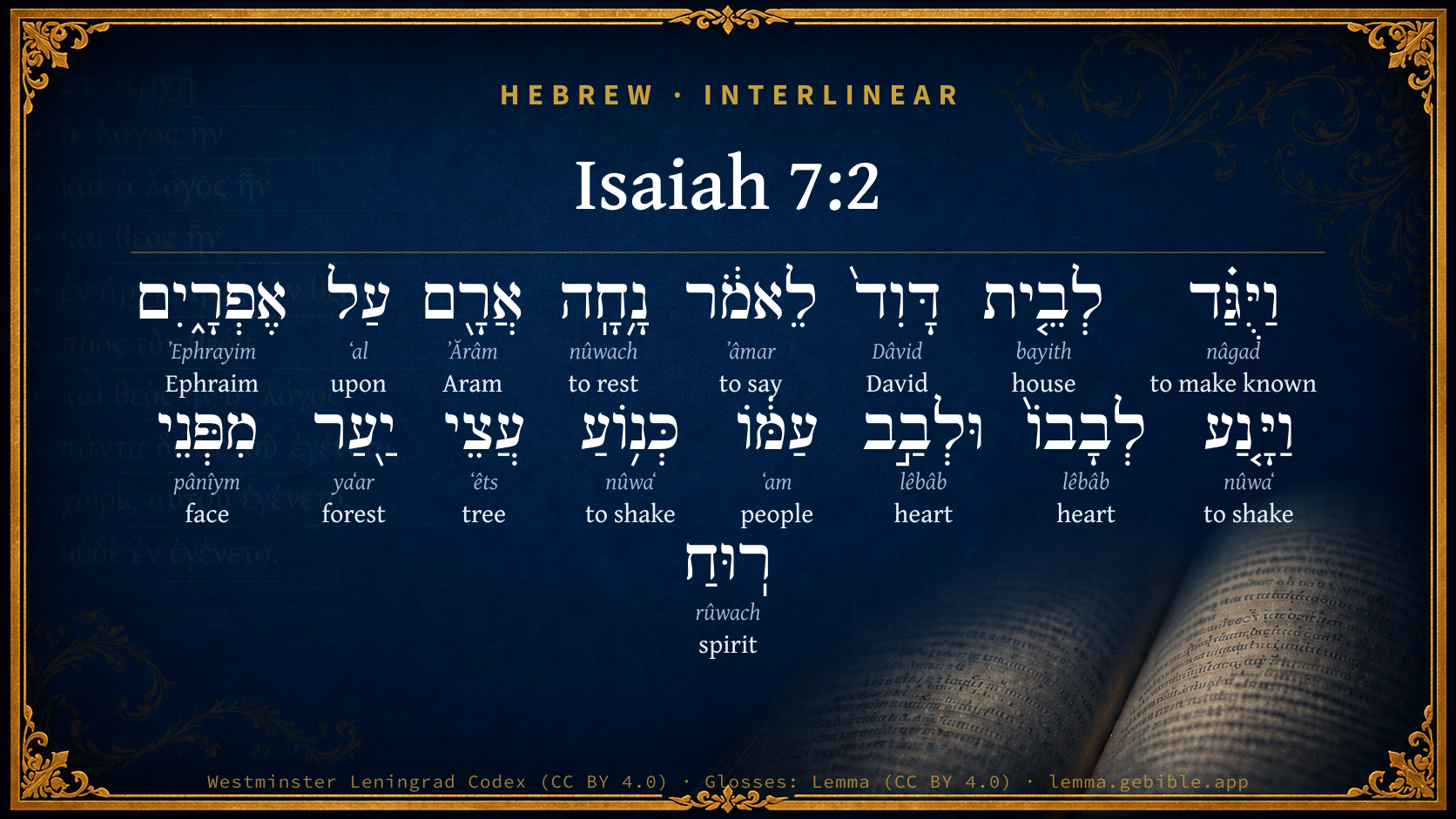
Hebrew (Westminster Leningrad Codex) Isaiah 7:2 appears in the Hebrew Old Testament. The text above is from the Westminster Leningrad Codex. Each word links to its Strong’s number, a concise gloss, and parsing drawn from the Open Scriptures Hebrew Bible morphology. Click any word for its full Brown-Driver-Briggs (BDB) entry.
Download image
Cite this verse

Isaiah 7:2 (World English Bible). Public Domain. Lemma interlinear Bible study tool, https://lemma.gebible.app/v/isaiah/7/2.

Show BibTeX & RIS
BibTeX
RIS
English Translation
It was told the house of David, saying, "Syria is allied with Ephraim." His heart trembled, and the heart of his people, as the trees of the forest tremble with the wind.
World English Bible · Public Domain
Download a study sheet

One document with this verse’s original text, its word-by-word gloss line, the meaning frame, cross-references with their text, attributed commentary, and full source and license credits — printable, and it pastes into notes with its structure intact.

This verse Autodidact and up

Study sheet (.html) Plain text (.txt)

A passage Seminary Student

Up to 50 verses in one chapter. A passage sheet keeps up to 6 commentary sources and 12 cross-references per verse, in the order this page ranks them, and says so on the sheet whenever that leaves anything out. Ask for a single verse and you get the Autodidact verse sheet above.

Everything on this page stays free to read, with no account — the sheet is a download of what is already on screen, not access to it.

Want to remove ads? Support Godless Engineer
Compare translations 3

The same verse in 3 English versions, stacked beneath the original-language interlinear above. Click any original word for its lexicon entry.

Each is an independent rendering of the whole verse — the interlinear is not word-aligned to these translations.

Highlighted words mark where these versions differ — a whole-verse word diff, not a word-by-word alignment.

  • World English Bible Public Domain
    It was told the house of David, saying, "Syria is allied with Ephraim." His heart trembled, and the heart of his people, as the trees of the forest tremble with the wind.
  • King James Version Public Domain
    And it was told the house of David, saying, Syria is confederate with Ephraim. And his heart was moved, and the heart of his people, as the trees of the wood are moved with the wind.
  • unfoldingWord Literal Text CC BY-SA 4.0
    And it was declared to the house of David, saying, “Aram has settled upon Ephraim.” And his heart shook, and the heart of his people, like the shaking of the trees of the forest from the face of the wind.

unfoldingWord Literal Text — © unfoldingWord, licensed CC BY-SA 4.0. Word-aligned USFM3 via Door43 (git.door43.org/unfoldingWord/en_ult).

Versions to compare (up to 4)

3 of 4 selected

Show all 18 translations

Every available English version of this verse, each an independent rendering of the whole verse.

  • World English Bible Public Domain
    It was told the house of David, saying, "Syria is allied with Ephraim." His heart trembled, and the heart of his people, as the trees of the forest tremble with the wind.
  • Berean Standard Bible Public Domain
    When it was reported to the house of David that Aram was in league with Ephraim, the hearts of Ahaz and his people trembled like trees in the forest shaken by the wind.
  • Majority Standard Bible Public Domain
    When it was reported to the house of David that Aram was in league with Ephraim, the hearts of Ahaz and his people trembled like trees in the forest shaken by the wind.
  • King James Version Public Domain
    And it was told the house of David, saying, Syria is confederate with Ephraim. And his heart was moved, and the heart of his people, as the trees of the wood are moved with the wind.
  • American Standard Version (1901) Public Domain
    And it was told the house of David, saying, Syria is confederate with Ephraim. And his heart trembled, and the heart of his people, as the trees of the forest tremble with the wind.
  • Revised Version (1885) Public Domain
    And it was told the house of David, saying, Syria is confederate with Ephraim. And his heart was moved, and the heart of his people, as the trees of the forest are moved with the wind.
  • Geneva Bible (1599) Public Domain
    And it was tolde the house of Dauid, saying, Aram is ioyned with Ephraim: therefore his heart was moued, and the heart of his people, as the trees of the forest are moued by the winde.
  • Douay-Rheims (1899) Public Domain
    And they told the house of David, saying: Syria hath rested upon Ephraim, and his heart was moved, and the heart of his people, as the trees of the woods are moved with the wind.
  • Young's Literal Translation Public Domain
    And it is declared to the house of David, saying, `Aram hath been led towards Ephraim,' And his heart and the heart of his people is moved, like the moving of trees of a forest by the presence of wind.
  • Literal Standard Version CC BY-SA 4.0
    And it is declared to the house of David, saying, “Aram has been led toward Ephraim,” and his heart and the heart of his people is moved, like the moving of trees of a forest by the presence of wind.
  • Unlocked Literal Bible CC BY-SA 4.0
    It was reported to the house of David that Aram was allied with Ephraim. His heart trembled, and the heart of his people, as the trees of the forest shake in the wind.
  • unfoldingWord Literal Text CC BY-SA 4.0
    And it was declared to the house of David, saying, “Aram has settled upon Ephraim.” And his heart shook, and the heart of his people, like the shaking of the trees of the forest from the face of the wind.
  • Darby Bible Public Domain
    And it was told the house of David saying, Syria is allied with Ephraim. Then his heart and the heart of his people shook, as the trees of the forest are shaken with the wind.
  • World Messianic Bible Public Domain
    David’s house was told, “Syria is allied with Ephraim.” His heart trembled, and the heart of his people, as the trees of the forest tremble with the wind.
  • Webster's Bible Public Domain
    And it was told the house of David, saying, Syria is confederate with Ephraim. And his heart was moved, and the heart of his people, as the trees of the wood are moved with the wind.
  • Free Bible Version CC BY-SA 4.0
    When the royal family of Judah was told, “Aram and Ephraim have an alliance,” Ahaz and his people were terrified and they shook like trees in the forest tossed about by the wind.
  • Bible in Basic English Public Domain
    And word came to the family of David that Aram had put up its tents in Ephraim. And the king's heart, and the hearts of his people, were moved, like the trees of the wood shaking in the wind.
  • JPS Tanakh (1917) Public Domain
    And it was told the house of David, saying: 'Aram is confederate with Ephraim.' And his heart was moved, and the heart of his people, as the trees of the forest are moved with the wind.

Literal Standard Version (2020), Covenant Press — licensed CC BY-SA 4.0. Text via the HelloAO Bible API (eBible.org). Unlocked Literal Bible (unfoldingWord) — licensed CC BY-SA 4.0. Text via the HelloAO Bible API (eBible.org). unfoldingWord Literal Text — © unfoldingWord, licensed CC BY-SA 4.0. Word-aligned USFM3 via Door43 (git.door43.org/unfoldingWord/en_ult). Free Bible Version, Dr. Jonathan Gallagher — licensed CC BY-SA 4.0. Text via the HelloAO Bible API (eBible.org).

Word by word

More ways to search: Search by grammar → Find every occurrence → Compare this word →

Practice this passage: Drill this verse → Learn its vocabulary →

וַיָּ֤נַע
nûwaʻ
H5128
“and · to shake”
Conjunction + Verb, Qal, Sequential Imperfect, 3rd Person, Masculine, Singular
Part of Speech
Conjunction + Verb
Stem
Qal
Form
Sequential Imperfect
Person
3rd Person
Gender
Masculine
Number
Singular
Full BDB Definition

Origin: a primitive root

TWOT: 1328

to quiver, totter, shake, reel, stagger, wander, move, sift, make move, wave, waver, tremble - (Qal) - to wave, quiver, vibrate, swing, stagger, tremble, be unstable - to totter, go tottering - vagabond (participle) - (Niphal) to be tossed about or around - (Hiphil) - to toss about - to shake, cause to totter - to shake, disturb - to cause to wander
  1. וַיֻּגַּ֗ד nâgad H5046 “and · to make known” Conjunction + Verb, Hophal, Sequential Imperfect, 3rd Person, Masculine, Singular
  2. לְבֵ֤ית bayith H1004 “to/for · house of” Preposition + Noun, Common, Masculine, Singular, Construct
  3. דָּוִד֙ Dâvid H1732 “David” Noun, Proper
  4. לֵאמֹ֔ר ʼâmar H559 “to say” Preposition + Verb, Qal, Infinitive Construct
  5. נָ֥חָֽה nûwach H5117 “to rest” Verb, Qal, Perfect, 3rd Person, Masculine, Singular
  6. אֲרָ֖ם ʼĂrâm H758 “Aram” Noun, Proper
  7. עַל ʻal H5921 “upon” Preposition
  8. אֶפְרָ֑יִם ʼEphrayim H669 “Ephraim” Noun, Proper
  9. לְבָבוֹ֙ lêbâb H3824 “heart · his” Noun, Common, Masculine, Singular, Construct + Suffix, Personal, 3rd Person, Masculine, Singular
  10. וּלְבַ֣ב lêbâb H3824 “and · heart of” Conjunction + Noun, Common, Masculine, Singular, Construct
  11. עַמּ֔וֹ ʻam H5971 “people · his” Noun, Common, Masculine, Singular, Construct + Suffix, Personal, 3rd Person, Masculine, Singular
  12. כְּנ֥וֹעַ nûwaʻ H5128 “like/as · to shake” Preposition + Verb, Qal, Infinitive Construct
  13. עֲצֵי ʻêts H6086 “trees of” Noun, Common, Masculine, Plural, Construct
  14. יַ֖עַר yaʻar H3293 “forest” Noun, Common, Masculine, Singular, Absolute
  15. מִפְּנֵי pânîym H6440 “from · face(s) of” Preposition + Noun, Common, Both, Plural, Construct
  16. רֽוּחַ rûwach H7307 “spirit” Noun, Common, Both, Singular, Absolute

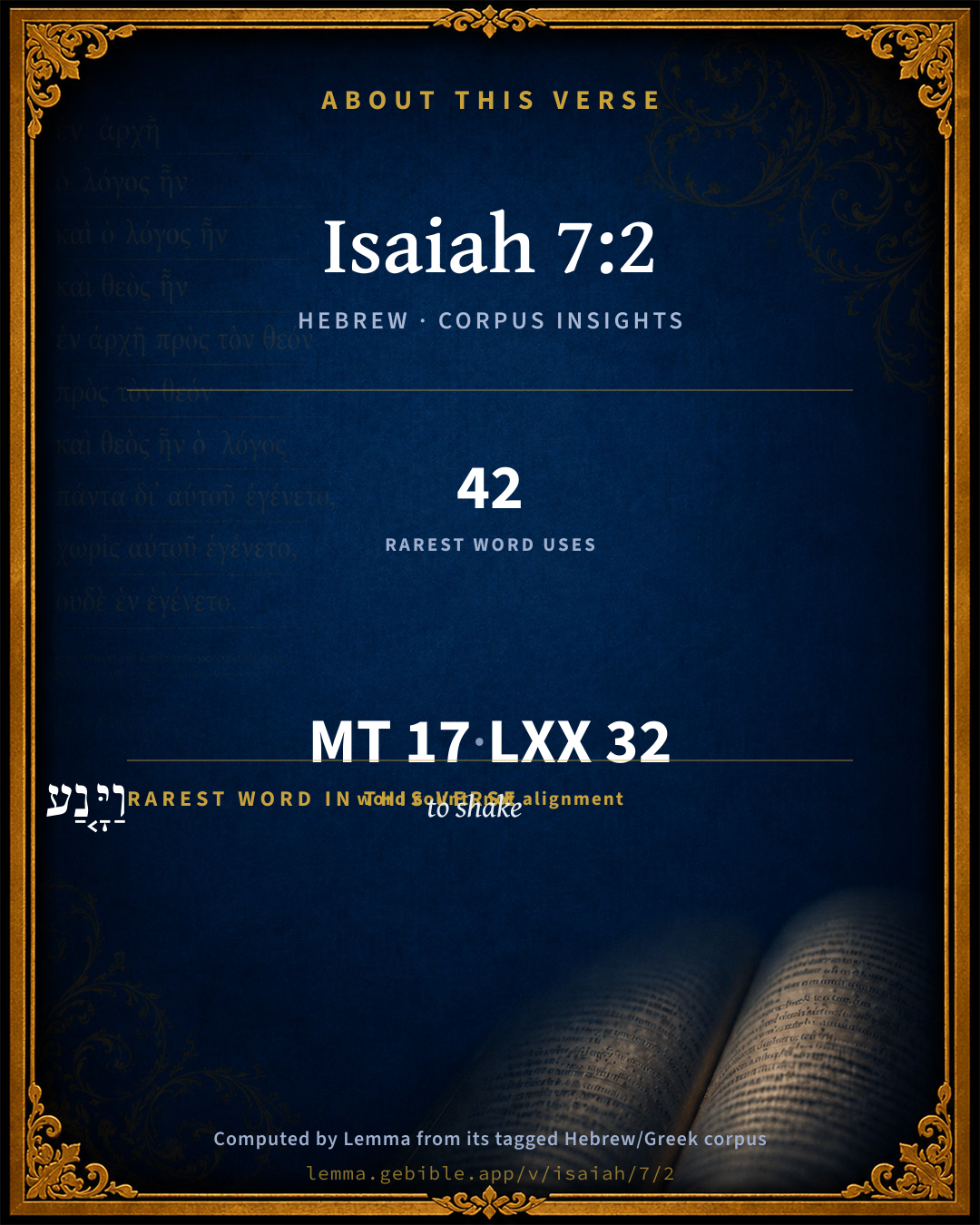
About this verse

These counts appear in no published source. They are computed here, from the morphology-tagged text and Lemma’s own curated glosses. What Lemma adds →

17
words
15
distinct lemmas
Prophets
section

Shared distinctive vocabulary

וַיָּ֤נַע to shake H5128 occurs in 36 verses of the Hebrew Bible. Also found in:

Grammatical profile

  • 5 verbs
  • 11 nouns
  • 1 preposition

Verb forms

  • וַיֻּגַּ֗ד Hophal · Sequential Imperfect
  • לֵאמֹ֔ר Qal · Infinitive Construct
  • נָ֥חָֽה Qal · Perfect
  • וַיָּ֤נַע Qal · Sequential Imperfect
  • כְּנ֥וֹעַ Qal · Infinitive Construct

Repetition

Words recur within this verse — often emphatic in Hebrew:

  • וַיָּ֤נַע to shake H5128 ×2
  • לְבָבוֹ֙ heart H3824 ×2

Hebrew & Septuagint length

In English translation the verse runs 32 words from the Hebrew and 38 from the Septuagint (LXX English) — closely comparable.

A rough comparison of the two English renderings, which tokenize alike — not a word-level alignment.

Word counts can differ between the Hebrew and the Greek without any difference in meaning — e.g. the Hebrew direct-object marker אֵת has no separate Greek word, and Greek often adds the article ὁ.

In the original languages it is 17 Hebrew tokens and 32 Greek tokens — but the two are counted differently (Hebrew bundles its prefixes and suffixes into one token; the Greek is in lemma form), so that isn’t a like-for-like length.

Cross-references

27

Topical passages linked to Isaiah 7:2 in the Treasury of Scripture Knowledge — connected by theme and wording, ordered by reader-vote popularity; previews shown in the World English Bible.

  • Isaiah 7:13 He said, "Listen now, house of David: Is it not enough for you to try the patience of men, that you will try the patience of my God also?
  • Isaiah 8:12 Don't you say, "A conspiracy!" concerning all about which this people shall say, "A conspiracy!" neither fear their fear, nor be in dread [of it].
  • Proverbs 28:1 The wicked flee when no one pursues; But the righteous are as bold as a lion.
  • Isaiah 9:9 All the people shall know, [even] Ephraim and the inhabitant of Samaria, who say in pride and in arrogance of heart,
  • Leviticus 26:36–37 "'As for those of you who are left, I will send a faintness into their hearts in the lands of their enemies: and the sound of a driven leaf will put them to flight; and they shall flee, as one flees from the sword; and they will fall when no one pursues.
  • Numbers 14:1–3 All the congregation lifted up their voice, and cried; and the people wept that night.
  • Deuteronomy 28:65–66 Among these nations shall you find no ease, and there shall be no rest for the sole of your foot: but Yahweh will give you there a trembling heart, and failing of eyes, and pining of soul;
  • 2 Samuel 7:16 Your house and your kingdom shall be made sure for ever before you: your throne shall be established forever.
  • 1 Kings 11:32 (but he shall have one tribe, for my servant David's sake and for Jerusalem's sake, the city which I have chosen out of all the tribes of Israel);
  • 1 Kings 12:16 When all Israel saw that the king didn't listen to them, the people answered the king, saying, What portion have we in David? neither have we inheritance in the son of Jesse: to your tents, Israel: now see to your own house, David. So Israel departed to their tents.
  • 1 Kings 13:2 He cried against the altar by the word of Yahweh, and said, altar, altar, thus says Yahweh: Behold, a son shall be born to the house of David, Josiah by name; and on you shall he sacrifice the priests of the high places who burn incense on you, and men's bones shall they burn on you.
  • 2 Kings 7:6–7 For the Lord had made the host of the Syrians to hear a noise of chariots, and a noise of horses, even the noise of a great host: and they said one to another, Behold, the king of Israel has hired against us the kings of the Hittites, and the kings of the Egyptians, to come on us.
  • 2 Chronicles 25:10 Then Amaziah separated them, [to wit], the army that had come to him out of Ephraim, to go home again: therefore their anger was greatly kindled against Judah, and they returned home in fierce anger.
  • 2 Chronicles 28:12 Then certain of the heads of the children of Ephraim, Azariah the son of Johanan, Berechiah the son of Meshillemoth, and Jehizkiah the son of Shallum, and Amasa the son of Hadlai, stood up against those who came from the war,
  • Psalms 11:1 In Yahweh, I take refuge. How can you say to my soul, "Flee as a bird to your mountain!"
  • Psalms 27:1–2 Yahweh is my light and my salvation. Whom shall I fear? Yahweh is the strength of my life. Of whom shall I be afraid?
  • Psalms 112:7–8 He will not be afraid of evil news. His heart is steadfast, trusting in Yahweh.
  • Isaiah 6:13 If there are yet a tenth in it, It also shall in turn be eaten up: As a terebinth, and as an oak, whose stock remains, when they are felled; So the holy seed is its stock."
  • Isaiah 7:17 Yahweh will bring on you, on your people, and on your father's house, days that have not come, from the day that Ephraim departed from Judah; even the king of Assyria.
  • Isaiah 11:13 The envy also of Ephraim shall depart, and those who vex Judah shall be cut off: Ephraim shall not envy Judah, and Judah shall not vex Ephraim.
  • Isaiah 22:22 The key of the house of David will I lay on his shoulder; and he shall open, and none shall shut; and he shall shut, and none shall open.
  • Isaiah 37:27 Therefore their inhabitants were of small power, they were dismayed and confounded; they were as the grass of the field, and as the green herb, as the grass on the housetops, and as a field [of grain] before it is grown up.
  • Isaiah 37:35 For I will defend this city to save it, for my own sake, and for my servant David's sake.
  • Jeremiah 21:12 House of David, thus says Yahweh, Execute justice in the morning, and deliver him who is robbed out of the hand of the oppressor, lest my wrath go forth like fire, and burn so that none can quench it, because of the evil of your doings.
  • Ezekiel 37:16–19 You, son of man, take one stick, and write on it, For Judah, and for the children of Israel his companions: then take another stick, and write on it, For Joseph, the stick of Ephraim, and [for] all the house of Israel his companions:
  • Hosea 12:1 Ephraim feeds on wind, And chases the east wind. He continually multiplies lies and desolation. They make a covenant with Assyria, And oil is carried into Egypt.
  • Matthew 2:3 When Herod the king heard it, he was troubled, and all Jerusalem with him.

Cross-references courtesy of OpenBible.info (CC BY 4.0).

Hebrew and Greek witnesses Masoretic Hebrew ↔ Greek Septuagint

The same verse in the two great witnesses to the Old Testament, shown verse-for-verse.

These are two independent witnesses, not word-aligned to each other, and the Septuagint is shown in lemma (dictionary) form.

Hebrew Isaiah 7:2 Masoretic · Westminster Leningrad Codex

וַיֻּגַּ֗ד לְבֵ֤ית דָּוִד֙ לֵאמֹ֔ר נָ֥חָֽה אֲרָ֖ם עַל אֶפְרָ֑יִם וַיָּ֤נַע לְבָבוֹ֙ וּלְבַ֣ב עַמּ֔וֹ כְּנ֥וֹעַ עֲצֵי יַ֖עַר מִפְּנֵי רֽוּחַ

It was told the house of David, saying, "Syria is allied with Ephraim." His heart trembled, and the heart of his people, as the trees of the forest tremble with the wind.

World English Bible · Public Domain

Greek LXX Isaiah 7:2 Septuagint · lemma form

καί ἀναἀγγέλλω εἰς ὁ οἶκος δαυίδ λέγω συνφωνέω αραμ πρός ὁ ἐφράιμ καί ἐκἵστημι ὁ ψυχή αὐτός καί ὁ ψυχή ὁ λαός αὐτός ὅς τρόπος ὅταν ἐν δρυμός ξύλον ὑπό πνεῦμα σαλεύω

And a message was brought to the house of David, saying, Aram has conspired with Ephraim. And his soul was amazed, and the soul of his people, as in a wood a tree is moved by the wind.

LXX2012 (modern English Septuagint) · Public Domain

On this verse, Ellicott's Commentary for English Readers discusses the Septuagint’s reading. Read the note in Commentary ↓

Hebrew: Westminster Leningrad Codex (CC BY 4.0). Greek: Septuagint (public domain); English from LXX2012 (modern English Septuagint) (Public Domain). How the Septuagint differs from the Hebrew →

Targum (Aramaic paraphrase)

1

The Targum is the ancient Jewish Aramaic paraphrase of the Hebrew Scriptures — an interpretive translation, not the Hebrew text itself. Onkelos (literal) and Pseudo-Jonathan (expansive) render the Torah, and Jonathan the Prophets. Coverage is partial: where no permissively-licensed English translation exists for a verse, only the Aramaic is shown. This is verse-level text, not a word-by-word alignment to the Hebrew.

  1. Targum Jonathan Prophets (Joshua–Malachi)
    וְאִתְחַוָא לְבֵית דָוִד לְמֵימָר אִתְחַבַּר מַלְכָּא דַאֲרָם עִם מַלְכָּא דְיִשְׂרָאֵל לְמֵיתֵי עֲלוֹהִי וְזָע לִבֵּיהּ וְלִבָּא דְעַמֵיהּ כְּאִשְׁתְּדָיוּת אִילָנֵי חוּרְשָׁא מִן קֳדָם רוּחָא:

    And it was told the house of David, saying, Syria is joined with the king of Israel to come upon him. And his heart and the heart of his people moved as the moving of the trees of the wood with the wind.

    Targum Jonathan — Aramaic: “Mikraot Gedolot” (public domain). English: “Sefaria Community Translation” (CC0 1.0 (public-domain dedication)); “London "Chaldee Paraphrase," 1871” (public domain). Text via Sefaria.

Commentary

Notes on Isaiah 7:2 from classic Christian and Jewish commentators (each source and its license shown beneath its notes). The classic Christian expositions comment on the surrounding passage and are grouped to its opening verse, so a note may address several verses; the Jewish commentaries on the Tanakh (Rashi and others) are per-verse, so they appear only where the commentator wrote on this verse.

Lemma curates 59 commentaries, every one of them public domain or Creative Commons licensed, each selected and text-cleaned for this edition rather than reprinted as found. About our sources →

Trapp's Complete Commentary

John Trapp

Isa 7:2 And it was told the house of David, saying, Syria is confederate with Ephraim. And his heart was moved, and the heart of his people, as the trees of the wood are moved with the wind.

Ver. 2. And it was told the house of David,] i.e., the king and chief officers of the crown and court. Ill news flieth swift, and filleth all places.

Syria is confederate with Ephraim.] Though these two were oft at a deadly feud between themselves, yet they could combine for a mischief to God’s people. So could the Herodians and Pharisees, Herod and Pilate, &c. The devil, doubtless, had a design by these two champions of his to have utterly rooted out the house of David (as he sought also afterwards to do by Herod, Caligula, and others), and so to have prevented Christ’s being "made of the seed of Abraham according to the flesh"; {Rom 1:3} but that could not be.

And his heart was moved.] Concussum est et conquassatum, Impiety triumpheth in prosperity, trembleth in adversity. Tullus Hostilius, that godless King of Rome, set up Pavor and Pallor for gods to himself. Saul and Ahithophel in distress despaired and despatched themselves; so did Demosthenes, Cato, and other heathen sages, who were without God in the world, and therefore without comfort. Sin maketh men timorous, {Lev 26:36} but righteousness bold. {Pro 28:1 Psa 27:1} The Spirit of power and of a sound mind are fitly set together. {2Ti 1:7}

John Trapp, A Commentary or Exposition upon All the Books of the Old and New Testament (1647–1656) — public domain. Text from a community e-Sword module.

Joseph Benson's Commentary

Isa 7:2. And it was told the house of David — Ahaz and his royal relations and courtiers. He calls them the house of David, to intimate that the following comfortable message was sent to Ahaz, not for his own sake, but only for the sake of his worthy progenitor David, to whom God had promised an everlasting kingdom. Syria is confederate with Ephraim — With the kingdom of the ten tribes, commonly called Ephraim, because that tribe was by far the most numerous and potent of them. And his heart was moved — Namely, the heart of Ahaz; and the heart of his people — With excessive fear, arising partly from a consciousness of their own guilt, whereby they had put themselves out of God’s protection; and partly from the consideration of the great strength and power of their enemies.

Joseph Benson's Commentary on the Old and New Testaments (1811–1818) — public domain. Text from a community e-Sword module.

Keil & Delitzsch

C. F. Keil & F. Delitzsch

It is this which is referred to in Isa 7:2 : "And it was told the house of David, Aram has settled down upon Ephraim: then his heart shook, and the heart of his people, as trees of the wood shake before the wind." The expression nuach ‛al (settled down upon) is explained in Sa2 17:12 (cf., Jdg 7:12) by the figurative simile, "as the dew falleth upon the ground:" there it denotes a hostile invasion, here the arrival of one army to the support of another. Ephraim (feminine, like the names of countries, and of the people that are regarded as included in their respective countries: see, on the other hand, Isa 3:8) is used as the name of the leading tribe of Israel, to signify the whole kingdom; here it denotes the whole military force of Israel. Following the combination mentioned above, we find that the allies now prepared for a second united expedition against Jerusalem. In the meantime, Jerusalem was in the condition described in Isa 1:7-9, viz., like a besieged city, in the midst of enemies plundering and burning on every side. Elath had fallen, as Rezin's timely return clearly showed; and in the prospect of his approaching junction with the allied army, it was quite natural, from a human point of view, that the court and people of Jerusalem should tremble like aspen leaves. וינע is a contracted fut. kal, ending with an a sound on account of the guttural, as in Rut 4:1 (Ges. 72, Anm. 4); and נוע, which is generally the form of the infin. abs. (Isa 24:20), is here, and only here, the infin. constr. instead of נוּע (cf., noach, Num 11:25; shob, Jos 2:16; mōt, Psa 38:17, etc.: vid., Ewald, 238, b).

Keil & Delitzsch — Biblical Commentary on the Old Testament (1861–1891) — public domain (CC PDM 1.0). Text via the HelloAO Bible API. (Old Testament only.)

Tyndale Open Study Notes

Tyndale Open Resources

7:2 hearts . . . trembled with fear: In contrast, Ahaz’s son King Hezekiah faced the Assyrians some thirty years later with great faith (701 BC; see 37:6-7, 14-20).

Tyndale Open Study Notes — © Tyndale Open Resources, licensed CC BY-SA 4.0. Text via the HelloAO Bible API.

Geneva Bible (1599)

Geneva Bible translators

For fear.

Meaning, the King’s house.

That is, Israel, because that tribe was the greatest, Gen. 48:19.

Geneva Bible (1599) marginal notes — public domain. Text via Bolls.life.

Jamieson, Fausset & Brown

Robert Jamieson, A. R. Fausset & David Brown

is confederate with--rather, is encamped upon the territory of Ephraim [MAURER], or better, as Rezin was encamped against Jerusalem, "is supported by" [LOWTH] Ephraim, whose land lay between Syria and Judah. The mention of "David" alludes, in sad contrast with the present, to the time when David made Syria subject to him (Sa2 8:6).

Ephraim--the ten tribes.

as . . . trees of . . . wood--a simultaneous agitation.

Jamieson, Fausset & Brown — Commentary Critical and Explanatory on the Whole Bible (1871) — public domain (CC PDM 1.0). Text via the HelloAO Bible API.

Ellicott's Commentary for English Readers

(2) Syria is confederate with Ephraim.—Literally, rests upon . . . Ephraim stands, of course, as often elsewhere, for the northern kingdom of Israel as a whole.

His heart was moved.—There was a general panic. King and people alike asked, How could they resist? Would it not be better to join the confederacy, and take their chance with it in attacking the king of Assyria? The image of the trees is generic, but suggests something like the quivering of the aspen leaves.

(2) The other interpretation sets out from an entirely different starting-point. The words of Mat_1:23 are taken as, once for all, deciding the entire meaning of the Immanuel prophecy. The prophet is supposed to have passed into a state of ecstasy in which he sees clearly, and with a full consciousness of its meaning, the history of the incarnation and the marvel of the travail-pangs of the Virgin mother. The vision of the future Christ thus presented to his mind, colours all his after-thoughts, and forms the basis of his whole work. The article emphasises the definiteness of his visions. He sees “the virgin mother” of the far-off future. And the prophet learns to connect the vision with the history of his own time. The growth of that Christ-child in the far-off future serves as a measure of time for the events that were passing, or about to pass, within the horizon of his earthly vision. Before the end of an interval not longer than that which separates youth from manhood, the Syro-Ephraiminitic confederacy should be broken up. So far, here also, we have a coherent and consistent view. It is attended, however, by some serious difficulties. A “sign,” in the language of Hebrew prophets, is that which proves to the person to whom it is offered that there is a supernatural power working with him who gives it. If a prediction, it is one which will speedily be tested by a personal experience, the very offer of which implies in the prophet the certainty of its fulfilment. He stakes, as it were, his reputation as a prophet on the issue. (Comp. Isa_37:30; Isa_38:7; Exo_4:8-14; 1Sa_12:16.) But how could the prediction of a birth in the far-off distance, divided by several centuries from Isaiah’s time, be a sign to Ahaz or his people? And what would be the meaning, we may ask again, of the words “butter and honey shall he eat,” as applied to the Christ-child? Do not the words “Before the child shall know to refuse the evil . . .” point, not to a child seen as afar in vision, but to one who was to be born and grow up among the men of that generation? Should we not have expected, if the words had implied a clear revelation of the mystery of the virgin-birth, that Isaiah himself would have dwelt upon it elsewhere, that later prophets would have named it as one of the notes of the Messiah, that it would have become a tradition of the Jewish schools of interpretation? As a matter of fact, no such allusion is found in Isaiah, nor in the prophets that follow him (see Note on Jer_31:22, for the only supposed, one cannot say even “apparent,” exception); the Jewish interpreters never include this among their notes of the Christ. It is indeed, as has been said in the New Testament portion of this Commentary, one of the strongest arguments for the historical, non-mythical character of the series of events in Matthew 1, Luke 1, 2, that they were contrary to prevailing expectation. (See Note on Mat_1:23.)

A truer way of interpretation than either of those that have been thus set forth, is, it is believed, open to us. We may remember (1) as regards St. Matthew’s interpretation of Isaiah’s prophecy, that two other predictions cited, as by the Evangelist himself, in the history of the Nativity, in Matthew 1, 2 are, as it were, detached from their position, in which they had a distinct historical meaning, and a new meaning given to them (see Notes on Mat_2:15; Mat_2:18). and that this holds good of other prophecies cited by him elsewhere (see Notes on Mat_21:5; Mat_27:9). It was not, as some have thought, that facts were invented or imagined that prophecies might appear to be fulfilled, but that the facts being given, prophecies were shown to have a meaning which was fulfilled in them, though that meaning may not have been present to the prophet’s own mind. In this case the use of the word for “virgin” in the LXX. version may have determined St. Matthew’s interpretation of the words. Here, in the history which had come to him attested by evidence which satisfied him, he found One who, in the truest and highest sense, was the “Immanuel” of Isaiah’s prophecy. We must not forget (2) the limits within which the prophets lived and moved, as they are stated in 1Pe_1:10. They “enquired and searched diligently” as to the time and manner of the fulfilment of their hopes; but their normal state (the exceptions being only enough to prove the rule) is one of enquiry and not of definite assurance. They had before them the ideal of a righteous king, a righteous sufferer, of victory over enemies and sin and death, but the “times and the seasons” were hidden from them, as they were afterwards from the apostles, and they thought of that ideal king as near, about to burst in upon the stage that was filled with the forms of Assyria, Syria, Ephraim, Judah, as the apostles appear to have thought afterwards that the advent of the Lord would come upon the stage of the world’s history that was filled with the forms of Emperors and rebellious Jews and perverse heretics and false prophets (1Th_4:15; 1Co_15:51; 2Th_2:3-4; 1Pe_4:7; 1Ti_4:1-3; 1Jn_2:18). And neither prophets nor apostles, though left to the limitations of an imperfect knowledge, were altogether wrong. Prophecy has, in Bacon’s words, its “springing and germinant accomplishments.” The natural birth of the child Immanuel was, to the prophet and his generation, a pledge and earnest of the abiding presence of God with His people. The overthrow of Assyria, and Babylon, and Jerusalem were alike forerunners of the great day of the Lord in which the ultimate and true Immanuel, the name at last fulfilled to the uttermost, shall be at once the Deliverer and the Judge.

A Bible Commentary for English Readers, edited by Charles John Ellicott (1878–1897) — public domain. Text from a community e-Sword module.

The Cambridge Bible for Schools and Colleges

gen. ed. J. J. S. Perowne

2. the house of David] (Cf. Isa_7:13; Isa_7:17) either the court (ch. Isa_22:22) or the royal family (1Sa_20:16, &c.), which must have formed a numerous and powerful caste, and must have exercised a considerable influence on the government under a weak king like Ahaz. This was probably the first time that the Davidic dynasty had been menaced by a serious danger.

Syria is confederate with Ephraim] lit. Syria has alighted upon Ephraim (R.V. marg. “resteth”). The idea seems to be that the Syrian armies already occupy the Ephraimitish territory (settling there like a swarm of locusts, v. Isaiah 19 : 2Sa_17:12) preparatory to the joint attack. The fine simile at the end of the verse is enough to prove that Isaiah himself is the narrator.

The Cambridge Bible for Schools and Colleges (gen. ed. J. J. S. Perowne; Cambridge University Press, 1878–1918) — public domain. Text from a community e-Sword module.

John Gill's Exposition

And it was told the house of David,.... Ahaz, and his family, the princes of the blood, his court and counsellors; who had intelligence of the designs and preparations of the Syrians and Israelites against them:

saying, Syria is confederate with Ephraim; the ten tribes; or the kingdom and king of Israel. Some render it, "Syria led"; that is, its army "unto Ephraim" (y); marched it into the land of Israel, and there joined the king of Israel's army; others, as the Vulgate Latin version, "Syria rests upon Ephraim" (z); depends upon, trusts in, takes heart and encouragement from Ephraim, or the ten tribes, being his ally. The Septuagint version is, "Syria hath agreed with Ephraim"; entered into a confederacy and alliance with each other; which is the sense of our version; and is confirmed by the Targum, which is,

"the king of Syria is joined with the king of Israel:''

and his heart was moved, and the heart of his people, as the trees of the wood are moved with the wind; the metaphor denotes the strength and force of the confederate armies, comparable to a strong, blustering, boisterous wind; see Isa 32:2 and the weakness of the king and people of Judah, who were like to trees shaken by the wind; and also the fear they were possessed with, partly through consciousness of guilt, and partly through distrust of divine power and Providence; and also on account of what they had suffered already from these powerful enemies, when they attacked them singly; and therefore might much more dread them, as they were combined together against them; see Ch2 28:5.

(y) "duxit exercitum", Tigurine version. (z) "Syria quievit super Ephraim", Forerius, Cocceius; "Syria acquiescit in Ephraimo", Piscator.

John Gill's Exposition of the Whole Bible (1746–1763) — public domain (CC PDM 1.0). Text via the HelloAO Bible API.

Albert Barnes' Notes on the Bible

And it was told the house of David - That is, the royal family; or the king and princes; the government. Ahaz was the descendant and successor of David.

Syria is confederate with Ephraim - Ephraim was one of the tribes of Israel, and the kingdom of Israel was often called “Ephraim,” or the kingdom of Ephraim; in the same way as the tribes of Judah and Benjamin were called the kingdom of Judah. The phrase, ‘is confederate with,’ is in Hebrew ‘resteth on;’ see the margin. The meaning is, that Syria was “supported by” Ephraim, or was allied with Ephraim. The kingdom of Israel, or Ephraim, was situated “between” Syria and Jerusalem. Of course, the latter could not be attacked without marching through the former, and without their aid. In this sense it was that Syria, or the Arameans, relied or “rested” on Ephraim. Though Syria was by far the stronger power, yet it was not strong enough to attack Jerusalem had the kingdom of Israel been opposed to it.

And his heart - The heart of the king - of Ahaz.

Was moved as the trees of the wood - This is a very beautiful and striking image. It expresses universal trembling, consternation, and alarm, as the trees are moved “together” when the wind passes violently over them. A similar expression is found in Ovid - in “Canaces,” Epist. xi. ver. 76, 77.

Ut quatitur tepido fraxina virga noto

Sic mea vibrari pallentia membra videres.

Albert Barnes' Notes on the Bible (1834–1885) — public domain. Text from a community e-Sword/MySword module.

Matthew Poole's English Annotations

The house of David; Ahaz, and his royal relations and courtiers. He calls them the house of David, to intimate that the following comfortable message was sent to Ahaz, not for his own sake, but only for the sake of his worthy progenitor, David, to whom God had promised an everlasting kingdom.

Ephraim; the kingdom of the ten tribes, commonly called Ephraim, as Isa 28:1; Hos 12:1, because that was far the most numerous and potent of’ all of them.

Was moved with excessive fear, arising partly from the conscience of their own guilt, whereby they had put themselves out of God’s protection; and partly from the consideration of the great strength and power of his enemies, who having prevailed against him severally, 2Ch 28:5,8, and having now united their threes, he, having no faith in God, nor confidence to desire or expect his help, concluded his case desperate and deplorable.

Matthew Poole's English Annotations on the Holy Bible (1683–1685) — public domain. Text from a community e-Sword/MySword module.

Whedon's Commentary on the Bible

Daniel D. Whedon

2. Told the house of David — This signal phrase refers not to the court of Ahaz, but to the blood royal, the lineage; as in modern phrase, “the house of Bourbon,” “the house of Brunswick.” So always, as 1Ki_12:19 : “Israel rebelled against the house of David unto this day;” as also 1Ki_12:16 and 1Ki_12:26, same chapter. And in Nathan’s memorable message to David, (2 Samuel 7,) the king was told that as he had purposed to build Jehovah a “house,” so Jehovah would build him “a house,” that is, a royal lineage. “Thine house and thy kingdom shall be established for ever before thee.” 2Sa_7:16. And David replies, (2Sa_7:18; 2Sa_7:25-25, and 2Sa_7:29,) “Bless the house of thy servant that it may continue before thee for ever.” And so Luk_1:27 : “To a virgin… of the house of David.” Illustrious was the pedigree of that house, as given by Luke, beginning with Adam and the fall, and reaching to the Messiah. And never yet, in Ahaz’s time, had the line of David on the throne been broken. The royal line in the northern kingdom had been changed by a succession of usurpers, of whom this Pekah was then the last one. Doubtless the royal family of David realized their high descent, and were most deeply alarmed at the thought that its sacred continuity should be broken, and a usurper, the son of Tabeal, should break the promised line.

His heart — David’s “heart,” ideally identified with David’s “house;” and so his people, no other than David’s.

Daniel D. Whedon (gen. ed.), Commentary on the Old and New Testaments (1874–1909) — public domain. Text from a community e-Sword module.

The Pulpit Commentary

It was told the house of David. Before the actual siege began, news of the alliance reached Ahaz. It is said to have been" told the house of David," because the design was to supersede the family of David by another apparently a Syrian house (see note on ver. 6). Syria is confederate with Ephraim; literally, rests upon Ephraim. Under ordinary circumstances the kingdoms of Syria and Israel were hostile the one to the other. (see 1Ki_15:20 1Ki_20:1-3 1Ki_22:3-36 2Ki_5:2 2Ki_6:8-24 2Ki_8:29 2Ki_10:32 2Ki_13:3, 2Ki_13:22, 2Ki_13:25) But occasionally, under the pressure of a great danger, the relations were changed, and a temporary league was formed. The inscriptions of Shalmaneser II show such a league to have existed in the time of Benhadad II and Ahab ("Ancient Monarchies," vol. it. pp. 103, 104). The invasion of Pul, and the threatening attitude of Tiglath-Pileser. It had now once more drown the two countries together. On the use of the word "Ephraim" to designate the kingdom of Israel, see Hosea, passim. His heart was moved; or, shook. If the two kings had each been able separately to inflict on him such loss (see the introductory paragraph), what must he not expect, now that both were about to attack him together? It is not clear whether Ahuz had as yet applied to Assyria for help or not.

The Pulpit Commentary (1880–1919), ed. H.D.M. Spence-Jones & Joseph S. Exell — public domain. Text from a community e-Sword module.

John Wesley's Explanatory Notes

David - Ahaz, and his relations. He calls them the house of David, to intimate that the following comfortable message was sent to Ahaz, not for his own sake, but for the sake of his worthy progenitor David. Ephraim - The kingdom of the ten tribes, commonly called Ephraim, because that was the most numerous of all. Moved - With fear, arising from a consciousness of their own guilt, and their enemies strength.

John Wesley, Explanatory Notes Upon the Whole Bible (1754–1765) — public domain. Text via the GEBible commentary corpus.

J. A. Alexander on Isaiah

Joseph Addison Alexander

“And it was told the house of David (the court, the royal family, of Judah) saying, Syria resteth (or is resting) upon Ephraim; and his heart (i.e., the king’s, as the chief and representative of the house of David) and the heart of his people shook, like the shaking of the trees of a wood before a wind.” This is commonly applied to the effect produced by the first news of the coalition between Rezin and Pekah or the junction of their forces. It is equally natural, and more consistent with the history, to understand the words as having reference to a later date, (i.e., either the time of the advance upon Jerusalem), or that of the retreat of the invaders, laden with the spoil of Judah, and with two hundred thousand captives. In the one case, Syria, (i.e., the Syrian army), may be said to rest upon (the army of) Ephraim, in the modern military sense, with reference to their relative position on the field of battle; in the other, Syria may be described as literally resting or reposing in the territory of Ephraim, on its homeward march, and as thereby filling Ahaz with the apprehension of a fresh attack. Although neither of these explanations may seem altogether natural, they are really as much so as any of the others which have been proposed, and in a case where we have at best a choice of difficulties, these may claim the preference as tending to harmonize the prophecy with history as given both in Kings and Chronicles. We read in 2Ki 16:7-9, that Ahaz applied to Tiglath-pileser, king of Assyria, to help him against Syria and Israel, which he did. At what precise period of the war this alliance was formed, it is not easy to determine; but there seems to be no doubt that Ahaz, at the time here mentioned, was relying upon some human aid in preference to God.

Joseph Addison Alexander, The Prophecies of Isaiah (1846–1847; New York: Scribner, 1870–1878) — public domain. Text from a community e-Sword module.

Scofield Reference Notes

C. I. Scofield

Ephraim

In the prophetic books "Ephraim" and "Israel" are the collective names of the ten tribes who, under Jeroboam, established the northern kingdom, subsequently called Samaria 1Ki 16:24 and were (B.C. 722) sent into an exile which still continues. 2Ki 17:1-6.

They are distinguished as "the outcasts of Israel" from "the dispersed of Judah." Isa 11:12. "Hidden" in the world Mat 13:44 they, with Judah, are yet to be restored to Palestine and made one nation again.; Jer 23:5-8; Eze 37:11-24.

The Scofield Reference Bible (1917 edition), notes by C. I. Scofield — public domain. Text from a community e-Sword module.

Rashi

Rabbi Shlomo Yitzchaki (Rashi)

And it was told to the House of David Since he was wicked, Scripture did not mention his name.

Aram has allied itself with Ephraim lit. has rested upon Ephraim. The king of Aram has joined the king of Israel to attack you. נָחָה is the feminine gender, since the kingdom (מַלְכוּת) joined. Posad in O. F., lay, comp. (Exodus 10:14) “And it rested (וַיַָּנַח) in all the boundary of Egypt.”

and his heart... trembled Since each one individually had already waged war with him and defeated him, as it is said (II Chron. 28:5): “And the Lord his God delivered into the hand of the king of Aram...,” and it states further (v. 6): “And Pekah son of Remaliah slew 120,000 men.” Both verses are in Chronicles.

as the trees of the forest tremble The sound of trees that do not produce fruit is heard more than that of all fruit trees [var. the sound of fruit trees], as is [found] in Gen. Rabbah (16:3).

Rashi on the Tanakh — English translations: “The Judaica Press complete Tanach with Rashi, translated by A. J. Rosenberg” (CC BY 4.0); “Pentateuch with Rashi's commentary by M. Rosenbaum and A.M. Silbermann, 1929-1934” (public domain); “The Metsudah Tanach series, Lakewood, N.J” (CC BY 4.0); and “The Book of Joshua, Metsudah Publications, 1997” (CC BY 4.0). Text via Sefaria.

Ibn Ezra

Rabbi Abraham ibn Ezra

Ephraim. The kingdom of the ten tribes is called Ephraim, because their first king Jeroboam was of that tribe (1 Kings 2:26).

עם═על With; comp. האנשים על הנשים The men with the women (Exod. 35:22)

Ibn Ezra on the Tanakh — English translations: “Sefaria Community Translation” (CC0 1.0 (public-domain dedication)); “Yalkut, Sifsei Chachomim Chumash, Metsudah Publications, 2009” (CC BY 4.0); and “Commentary of Ibn Ezra on Isaiah - trans. by M. Friedlander, 1873” (public domain). Text via Sefaria.

Lesson kit

Teaching starters — assembled from the data on this page, not authored interpretation. Every prompt links to the verse data it draws on. Edit before teaching.

Isaiah, in the Prophets, opens this verse with 17 words (15 distinct Hebrew lemmas). Its most distinctive word is nûwaʻ (“to shake”). A historical commentator’s framing appears above. Read the whole chapter for the surrounding context.

Discussion questions

  1. The word nûwaʻ carries the sense “to shake.” How does it shape the verse?
  2. Genesis 4:12 shares the word «to shake» with this verse. How do the two illuminate each other?
  3. “to shake” occurs 2× in this one verse. What is the effect of the repetition?
  4. The translations on this page render this verse differently — a whole-verse word diff, not a word-by-word alignment. What might account for the different wordings?
  5. The verb «וַיֻּגַּ֗ד» is Hophal Sequential Imperfect. How does its form color the action?
  6. Reading how Trapp's Complete Commentary and Joseph Benson's Commentary read this verse, where do the two commentators agree and where do they part?

Things to notice

Reading settings

Reading text

Shown beneath each verse's original-language words.

Old Testament
Old Testament edition

Read the OT as the Masoretic Hebrew (MT) or the Greek Septuagint (LXX).

English shown for the Greek Septuagint (in the Hebrew ↔ Greek comparison).

Comparing translations? Open the Compare panel on any verse page to stack up to four side by side.