
Psalms 40:5

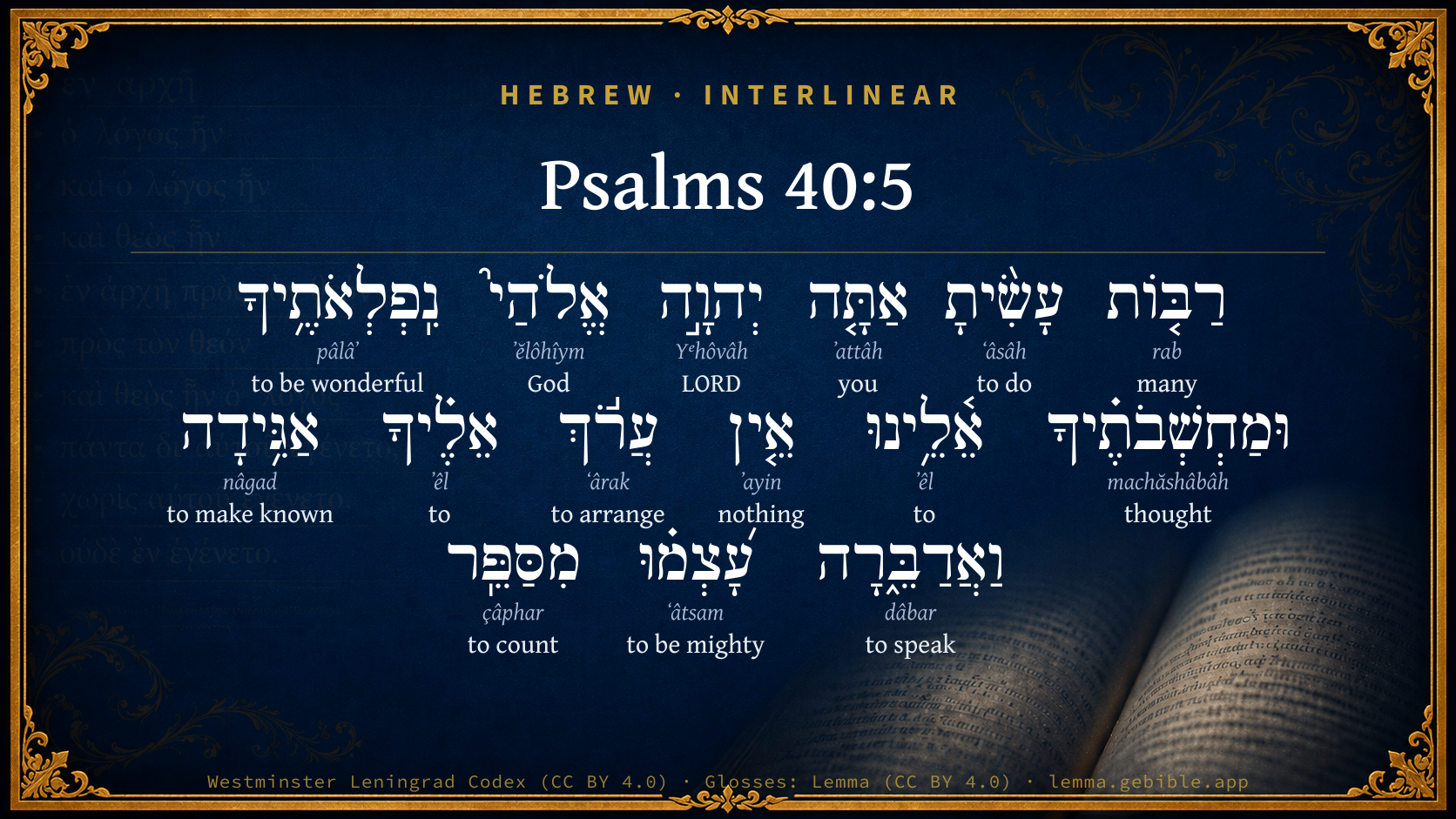
Hebrew (Westminster Leningrad Codex) Psalms 40:5 appears in the Hebrew Old Testament. The text above is from the Westminster Leningrad Codex. Each word links to its Strong’s number, a concise gloss, and parsing drawn from the Open Scriptures Hebrew Bible morphology. Click any word for its full Brown-Driver-Briggs (BDB) entry.
Download image
Cite this verse

Psalms 40:5 (World English Bible). Public Domain. Lemma interlinear Bible study tool, https://lemma.gebible.app/v/psalms/40/5.

Show BibTeX & RIS
BibTeX
RIS
English Translation
Many, Yahweh, my God, are the wonderful works which you have done, And your thoughts which are toward us. They can't be set in order to you; If I would declare and speak of them, they are more than can be numbered.
World English Bible · Public Domain
Download a study sheet

One document with this verse’s original text, its word-by-word gloss line, the meaning frame, cross-references with their text, attributed commentary, and full source and license credits — printable, and it pastes into notes with its structure intact.

This verse Autodidact and up

Study sheet (.html) Plain text (.txt)

A passage Seminary Student

Up to 50 verses in one chapter. A passage sheet keeps up to 6 commentary sources and 12 cross-references per verse, in the order this page ranks them, and says so on the sheet whenever that leaves anything out. Ask for a single verse and you get the Autodidact verse sheet above.

Everything on this page stays free to read, with no account — the sheet is a download of what is already on screen, not access to it.

Want to remove ads? Support Godless Engineer
Compare translations 3

The same verse in 3 English versions, stacked beneath the original-language interlinear above. Click any original word for its lexicon entry.

Each is an independent rendering of the whole verse — the interlinear is not word-aligned to these translations.

Highlighted words mark where these versions differ — a whole-verse word diff, not a word-by-word alignment.

  • World English Bible Public Domain
    Many, Yahweh, my God, are the wonderful works which you have done, And your thoughts which are toward us. They can't be set in order to you; If I would declare and speak of them, they are more than can be numbered.
  • King James Version Public Domain
    Many, O LORD my God, are thy wonderful works which thou hast done, and thy thoughts which are to us-ward: they cannot be reckoned up in order unto thee: if I would declare and speak of them, they are more than can be numbered.
  • unfoldingWord Literal Text CC BY-SA 4.0
    Many you have done, you, Yahweh my God, your wonderful deeds and your thoughts toward us; there is none to line up against you. Should I declare and speak, they are more than to recount.

unfoldingWord Literal Text — © unfoldingWord, licensed CC BY-SA 4.0. Word-aligned USFM3 via Door43 (git.door43.org/unfoldingWord/en_ult).

Versions to compare (up to 4)

3 of 4 selected

Show all 18 translations

Every available English version of this verse, each an independent rendering of the whole verse.

  • World English Bible Public Domain
    Many, Yahweh, my God, are the wonderful works which you have done, And your thoughts which are toward us. They can't be set in order to you; If I would declare and speak of them, they are more than can be numbered.
  • Berean Standard Bible Public Domain
    Many, O LORD my God, are the wonders You have done, and the plans You have for us—none can compare to You—if I proclaim and declare them, they are more than I can count.
  • Majority Standard Bible Public Domain
    Many, O LORD my God, are the wonders You have done, and the plans You have for us—none can compare to You—if I proclaim and declare them, they are more than I can count.
  • King James Version Public Domain
    Many, O LORD my God, are thy wonderful works which thou hast done, and thy thoughts which are to us-ward: they cannot be reckoned up in order unto thee: if I would declare and speak of them, they are more than can be numbered.
  • American Standard Version (1901) Public Domain
    Many, O Jehovah my God, are the wonderful works which thou hast done, And thy thoughts which are to us-ward; They cannot be set in order unto thee; If I would declare and speak of them, They are more than can be numbered.
  • Revised Version (1885) Public Domain
    Many, O LORD my God, are the wonderful works which thou hast done, and thy thoughts which are to us-ward: they cannot be set in order unto thee; if I would declare and speak of them, they are more than can be numbered.
  • Geneva Bible (1599) Public Domain
    O Lord my God, thou hast made thy wonderfull workes so many, that none can count in order to thee thy thoughts toward vs: I would declare, and speake of them, but they are moe then I am able to expresse.
  • Douay-Rheims (1899) Public Domain
    Blessed is the man whose trust is in the name of the Lord; and who hath not had regard to vanities, and lying follies.
  • Young's Literal Translation Public Domain
    Much hast Thou done, Jehovah my God; Thy wonders and Thy thoughts toward us, There is none to arrange unto Thee, I declare and speak: They have been more than to be numbered.
  • Literal Standard Version CC BY-SA 4.0
    You have done much, my God YHWH; Your wonders and Your thoughts toward us, || There is none to arrange to You, || I declare and speak: They have been more than to be numbered.
  • Unlocked Literal Bible CC BY-SA 4.0
    Many, Yahweh my God, are the wonderful deeds that you have done, and your thoughts which are about us cannot be numbered; if I declared and spoke of them, they would be more than could be counted.
  • unfoldingWord Literal Text CC BY-SA 4.0
    Many you have done, you, Yahweh my God, your wonderful deeds and your thoughts toward us; there is none to line up against you. Should I declare and speak, they are more than to recount.
  • Darby Bible Public Domain
    Thou, O Jehovah my God, hast multiplied thy marvellous works, and thy thoughts toward us: they cannot be reckoned up in order unto thee; would I declare and speak [them], they are more than can be numbered.
  • World Messianic Bible Public Domain
    Many, LORD, my God, are the wonderful works which you have done, and your thoughts which are toward us. They can’t be declared back to you. If I would declare and speak of them, they are more than can be counted.
  • Webster's Bible Public Domain
    \\40:4\\Blessed is that man that maketh the LORD his trust, and respecteth not the proud, nor such as turn aside to lies.
  • Free Bible Version CC BY-SA 4.0
    Lord my God, you have done so many wonderful things for us, and you have so many plans for us. No one compares to you. I want to tell all that you've done—blessings too many to count.
  • Bible in Basic English Public Domain
    O Lord my God, great are the wonders which you have done in your thought for us; it is not possible to put them out in order before you; when I would give an account of them, their number is greater than I may say.
  • JPS Tanakh (1917) Public Domain
    (40-6) Many things hast Thou done, O LORD my God, even Thy wonderful works, and Thy thoughts toward us; there is none to be compared unto Thee! If I would declare and speak of them, they are more than can be told.

Literal Standard Version (2020), Covenant Press — licensed CC BY-SA 4.0. Text via the HelloAO Bible API (eBible.org). Unlocked Literal Bible (unfoldingWord) — licensed CC BY-SA 4.0. Text via the HelloAO Bible API (eBible.org). unfoldingWord Literal Text — © unfoldingWord, licensed CC BY-SA 4.0. Word-aligned USFM3 via Door43 (git.door43.org/unfoldingWord/en_ult). Free Bible Version, Dr. Jonathan Gallagher — licensed CC BY-SA 4.0. Text via the HelloAO Bible API (eBible.org).

Word by word

More ways to search: Search by grammar → Find every occurrence → Compare this word →

Practice this passage: Drill this verse → Learn its vocabulary →

עָ֝צְמ֗וּ
ʻâtsam
H6105
“to be mighty”
Verb, Qal, Perfect, 3rd Person, Common, Plural
Part of Speech
Verb
Stem
Qal
Form
Perfect
Person
3rd Person
Gender
Common
Number
Plural
Full BDB Definition

Origin: a primitive root

TWOT: 1673 , 1674

to be vast, be numerous, be mighty - (Qal) - to be mighty - to be numerous - (Hiphil) to make strong, make mighty - to shut (the eyes), close (the eyes) - (Qal) to shut (the eyes) - (Piel) to shut tightly (the eyes)
  1. רַבּ֤וֹת rab H7227 “many” Adjective, Adjective, Feminine, Plural, Absolute
  2. עָשִׂ֨יתָ ʻâsâh H6213 “to do” Verb, Qal, Perfect, 2nd Person, Masculine, Singular
  3. אַתָּ֤ה ʼattâh H859 “you” Pronoun, Personal, 2nd Person, Masculine, Singular
  4. יְהוָ֣ה Yᵉhôvâh H3068 “LORD” Noun, Proper
  5. אֱלֹהַי֮ ʼĕlôhîym H430 “God(s) · my” Noun, Common, Masculine, Plural, Construct + Suffix, Personal, 1st Person, Common, Singular
  6. נִֽפְלְאֹתֶ֥יךָ pâlâʼ H6381 “being wonderful · you” Verb, Niphal, Participle Active, Feminine, Plural, Construct + Suffix, Personal, 2nd Person, Masculine, Singular
  7. וּמַחְשְׁבֹתֶ֗יךָ machăshâbâh H4284 “and · thoughts · your” Conjunction + Noun, Common, Feminine, Plural, Construct + Suffix, Personal, 2nd Person, Masculine, Singular
  8. אֵ֫לֵ֥ינוּ ʼêl H413 “to · us” Preposition + Suffix, Personal, 1st Person, Common, Plural
  9. אֵ֤ין ʼayin H369 “nothing” Particle, Negative
  10. עֲרֹ֬ךְ ʻârak H6186 “to arrange” Verb, Qal, Infinitive Construct
  11. אֵלֶ֗יךָ ʼêl H413 “to · you” Preposition + Suffix, Personal, 2nd Person, Masculine, Singular
  12. אַגִּ֥ידָה nâgad H5046 “to make known” Verb, Hiphil, Cohortative, 1st Person, Common, Singular
  13. וַאֲדַבֵּ֑רָה dâbar H1696 “and · to speak” Conjunction + Verb, Piel, Cohortative, 1st Person, Common, Singular
  14. מִסַּפֵּֽר çâphar H5608 “from · to count” Preposition + Verb, Piel, Infinitive Construct

About this verse

These counts appear in no published source. They are computed here, from the morphology-tagged text and Lemma’s own curated glosses. What Lemma adds →

15
words
14
distinct lemmas
Wisdom
section

Notable vocabulary

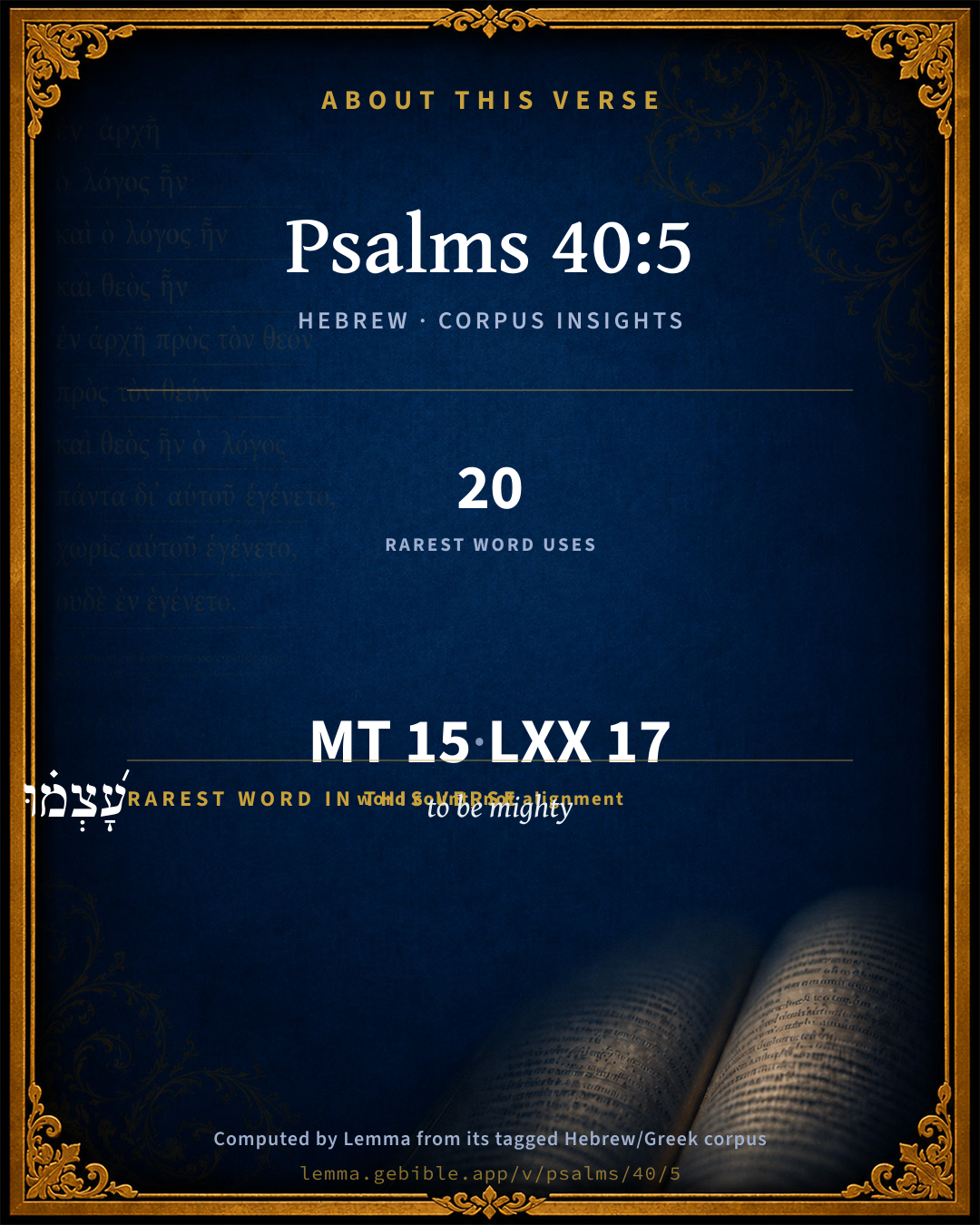
The rarest word here is עָ֝צְמ֗וּ to be mighty H6105 — appearing just 20 times in the whole Hebrew Bible.

Shared distinctive vocabulary

עָ֝צְמ֗וּ to be mighty H6105 occurs in 20 verses of the Hebrew Bible. Also found in:

Grammatical profile

  • 7 verbs
  • 3 nouns
  • 1 adjective
  • 1 pronoun
  • 2 prepositions
  • 1 particle

Verb forms

  • עָשִׂ֨יתָ Qal · Perfect
  • נִֽפְלְאֹתֶ֥יךָ Niphal · Participle Active
  • עֲרֹ֬ךְ Qal · Infinitive Construct
  • אַגִּ֥ידָה Hiphil · Cohortative
  • וַאֲדַבֵּ֑רָה Piel · Cohortative
  • עָ֝צְמ֗וּ Qal · Perfect
  • מִסַּפֵּֽר Piel · Infinitive Construct

Repetition

A word recurs within this verse — often emphatic in Hebrew:

  • אֵ֫לֵ֥ינוּ to H413 ×2

Hebrew & Septuagint length

In English translation the verse runs 42 words from the Hebrew and 32 from the Septuagint (LXX English) — closely comparable.

A rough comparison of the two English renderings, which tokenize alike — not a word-level alignment.

Word counts can differ between the Hebrew and the Greek without any difference in meaning — e.g. the Hebrew direct-object marker אֵת has no separate Greek word, and Greek often adds the article ὁ.

In the original languages it is 15 Hebrew tokens and 17 Greek tokens — but the two are counted differently (Hebrew bundles its prefixes and suffixes into one token; the Greek is in lemma form), so that isn’t a like-for-like length.

Cross-references

13

Topical passages linked to Psalms 40:5 in the Treasury of Scripture Knowledge — connected by theme and wording, ordered by reader-vote popularity; previews shown in the World English Bible.

  • Jeremiah 29:11 For I know the thoughts that I think toward you, says Yahweh, thoughts of peace, and not of evil, to give you hope in your latter end.
  • Psalms 139:17–18 How precious to me are your thoughts, God! How vast is the sum of them!
  • Exodus 15:11 Who is like you, Yahweh, among the gods? Who is like you, glorious in holiness, Fearful in praises, doing wonders?
  • Psalms 71:15 My mouth will tell about your righteousness, And of your salvation all day, Though I don't know its full measure.
  • Psalms 92:5 How great are your works, Yahweh! Your thoughts are very deep.
  • Psalms 136:4 To him who alone does great wonders; For his loving kindness endures forever:
  • Psalms 139:6 This knowledge is beyond me. It's lofty. I can't attain it.
  • Isaiah 55:8–9 For my thoughts are not your thoughts, neither are your ways my ways, says Yahweh.
  • Job 9:10 Who does great things past finding out, Yes, marvelous things without number.
  • Job 5:9 Who does great things that can't be fathomed, Marvelous things without number;
  • Job 26:14 Behold, these are but the outskirts of his ways. How small a whisper do we hear of him! But the thunder of his power who can understand?"
  • Job 37:19–20 Teach us what we shall tell him; For we can't make our case by reason of darkness.
  • Exodus 11:8 All these your servants shall come down to me, and bow down themselves to me, saying, 'Get out, and all the people who follow you; and after that I will go out.'" He went out from Pharaoh in hot anger.

Cross-references courtesy of OpenBible.info (CC BY 4.0).

Hebrew and Greek witnesses Masoretic Hebrew ↔ Greek Septuagint

The same verse in the two great witnesses to the Old Testament, shown verse-for-verse.

You’re reading Greek Psalm 39 (Hebrew Psalm 40). The Septuagint counts the superscription, so verse numbers can differ from the Hebrew — chapter-level alignment, not verse-by-verse. Numbering follows Rahlfs.

These are two independent witnesses, not word-aligned to each other, and the Septuagint is shown in lemma (dictionary) form.

Hebrew Psalms 40:5 Masoretic · Westminster Leningrad Codex

רַבּ֤וֹת עָשִׂ֨יתָ אַתָּ֤ה יְהוָ֣ה אֱלֹהַי֮ נִֽפְלְאֹתֶ֥יךָ וּמַחְשְׁבֹתֶ֗יךָ אֵ֫לֵ֥ינוּ אֵ֤ין עֲרֹ֬ךְ אֵלֶ֗יךָ אַגִּ֥ידָה וַאֲדַבֵּ֑רָה עָ֝צְמ֗וּ מִסַּפֵּֽר

Many, Yahweh, my God, are the wonderful works which you have done, And your thoughts which are toward us. They can't be set in order to you; If I would declare and speak of them, they are more than can be numbered.

World English Bible · Public Domain

Greek LXX Greek Psalm 39:5 Septuagint · lemma form

μακάριος ἀνήρ ὅς εἰμί ὁ ὄνομα κύριος ἐλπίς αὐτός καί οὐ ἐνβλέπω εἰς ματαιότης καί μανία ψευδής

O Lord my God, you have multiplied your wonderful works, and in your thoughts there is none who shall be likened to you: I declared and spoke of them: they exceeded number.

LXX2012 (modern English Septuagint) · Public Domain

On this verse, Ellicott's Commentary for English Readers discusses the Septuagint’s reading. Read the note in Commentary ↓

Hebrew: Westminster Leningrad Codex (CC BY 4.0). Greek: Septuagint (public domain); English from LXX2012 (modern English Septuagint) (Public Domain). How the Septuagint differs from the Hebrew →

Commentary

Notes on Psalms 40:5 from classic Christian and Jewish commentators (each source and its license shown beneath its notes). The classic Christian expositions comment on the surrounding passage and are grouped to its opening verse, so a note may address several verses; the Jewish commentaries on the Tanakh (Rashi and others) are per-verse, so they appear only where the commentator wrote on this verse.

Lemma curates 59 commentaries, every one of them public domain or Creative Commons licensed, each selected and text-cleaned for this edition rather than reprinted as found. About our sources →

Trapp's Complete Commentary

John Trapp

Psa 40:5 Many, O LORD my God, [are] thy wonderful works [which] thou hast done, and thy thoughts [which are] to us-ward: they cannot be reckoned up in order unto thee: [if] I would declare and speak [of them], they are more than can be numbered.

Ver. 5. Many, O Lord my God, are thy works which thou hast done] Many and great, and all for them that trust in thee; who therefore must needs be blessed, as Psa 40:4.

And thy thoughts which are to us-ward] Thoughts of peace, and not of evil, to give us an expected end, Jer 29:11.

They cannot be reckoned up in order unto thee] No, nor yet out of order; and yet we must be reckoning and relating them as we are able, to God, and men, by speaking good of his name; and at this David was old excellent, as we say.

If I should declare and speak of them] By wholesale we must do it, though we cannot so well by retail; particulars also must be instanced, as Moses doth to Jethro, Exo 18:7-8, and for that end catalogues must be kept. See one Jdg 10:11-12.

John Trapp, A Commentary or Exposition upon All the Books of the Old and New Testament (1647–1656) — public domain. Text from a community e-Sword module.

The Biblical Illustrator

Joseph S. Exell

Psa_40:5

Many, O Lord my God, are Thy wonderful works which Thou hast done, and Thy thoughts which are to us-ward: they cannot be reckoned up in order unto Thee.

Gods wonderful works and thoughts to us-ward

I. Let us recall some of the wondrous works and thoughts of God to usward during the year.

1. The first wondrous mercy is life itself, How wonderful is life! We lavish upon it our choicest and fondest expressions. With what jealous care we guard it. What are all our daily toil and efforts but a battle for life! When the last stroke seems about to fall, how, do we quiver and weep! When that stroke is suspended, what joy thrills through our frame! Life with its five mysterious senses--life, with its powers of knowing--life, with its susceptibilities of loving and aspiring--life, with its sublime sense of duty, and with its affections and hopes that soar towards God and heaven--is a treasure that makes the weakest man the possessor of boundless wealth. But life is not more sweet and precious than it is frail. At any moment the small dust of the balance may turn the scale against us. A slight pressure of the brain, a pause of the breath, and all is over. Life is a frail ship that ploughs the great ocean amidst hurricanes and lightnings, by quicksands and rocks. How wonderful is it that this frail ship should sail for twenty, forty, seventy years--that this breath should flow on--this flower bloom, not for one, but for many years!

2. We have another illustration of the wonderful works and thoughts of God to us-ward, in the means of life and the comforts of life. Life hangs on the power of God, and no means can give life one moment longer beyond Gods will; but life cannot be maintained without means, and those means of life are truly wonderful. The head of a family knows best how much work and thought must go to the getting of food and raiment and other needful things for the children. But what are his work and thought to the work and thought of the great Father of all for each of His children? Think of what is needed for each harvest; what exact adjustment of natural laws so as to suit the different stages of the plant. And these wondrous works of God are not mere works without soul in them. They are His thoughts also. We do not praise the earth, or the clouds, or the sun, but we thank God. But I would notice as the crowning example of Gods many and wonderful works and thoughts to us-ward.

3. His works and thoughts in regard to the supreme purpose and aim of life. Life and the means of life are not the end, they are only the means of a greater end. They only give us a basis. We still want a structure to be built upon them. And our Father in heaven knows that the gift of health and life and all temporal blessings Will be no blessing, but only a curse to us, unless we rear upon these the structure of right principles, and holy affections, and Christian usefulness--in a word, all the work of faith, and hope, and charity. He has destined us for these as our chief end.

II. The good effects which should follow such a review of Gods works.

1. There should be grateful acknowledgment of His mercies. Gratitude ploughs up the field which is to others only a barren waste, and plants it, and keeps it fresh and green with its tears of joy. The whole past life is the field which it ploughs up, and out of which it makes to spring all that can refresh and strengthen us.

2. The grateful review of the Divine works of mercy will inspire us likewise to be workers of good--to be good, like Him, that we may be His children--to be merciful as our Father is merciful.

3. Lastly, let the grateful review of the wondrous works of God to us-ward produce in us, not only the works of mercy, but the thoughts also of mercy, the spirit of mercy and charity. (J. Riddell.)

Two innumerable things

(with Psa_40:12):--So, then, there are two series of things which cannot be numbered. Gods mercies; mans sin. We always should begin with grateful remembrance of Gods mercy. His wondrous dealings seem to the psalmists thankful heart as numberless as the blades of grass which carpet the fields. They come pouring out continuously, like the innumerable undulations of the ether which make upon the eyeballs the single sensation of light. He thinks not only of Gods wonderful works, His realized purposes of mercy, but of His thoughts which are to us-ward, the purposes, still more wonderful, of a yet greater mercy which wait to be realized. As he thinks of all this multitude of His tender mercies, his lips break into this rapturous exclamation of my text. But there is a wonderful change in tone in the two halves of the psalm. The deliverance that seems so complete in the earlier part is but partial. The psalmist sees himself ringed about by numberless evils, as a man tied to a stake might be by a circle of fire. Innumerable evils have compassed me about. His conscience tells him that the evils are deserved; they are his iniquities transformed, which have come back to him in another shape, and have laid their hands upon him as a constable does upon a thief. Mine iniquities have taken hold upon me. They hem him in so that his vision is interrupted, the smoke from the circle of flame blinds his eyes. I cannot see. His roused conscience and his quivering heart conceive of them as more than the hairs of his head. And so courage and confidence have ebbed away from him. My heart faileth me, and there is nothing left for him but to fling himself in his misery out of himself and on to God. Draw some of the lessons from the very remarkable juxtaposition of these two innumerable things--Gods tender mercies, and mans iniquity and evil.

I. To begin with, if we keep these two things both together in our contemplations, they suggest for us very forcibly the greatest mystery in the universe, and throw a little light upon it. The difficulty of difficulties, the one insoluble problem is, given a good and perfect God, where does sorrow come from? And why is there any paid? And men have fumbled at that knot for all the years that there have been men in the world, and they have not untied it yet. Is it true that Gods mercies are innumerable? If it be, what is the meaning of all this that makes me writhe and weep? Well, when such moments come to us, do not let the black mass hide the light one from you, but copy this psalmist, and in the energy of your faith, even though it be the extremity of your pain, grasp and grip them both; and though you have to say and to wail, Innumerable evils have compassed me about, be sure that you do not let that prevent you from saying, Many, O Lord my God, are Thy wonderful works, etc. Remember, the one does not contradict the other; and let us ask ourselves if the one does not explain the other. If it be that these mercies are so innumerable as my first text says, may it not be that they go deep down beneath, and include in their number the thing that seems most opposite to them, even the sorrow that afflicts our lives? Whom the Lord loveth He chasteneth, makes a bridge across the gulf which seems to part the opposing cliffs these two sets effect, and turn the darker into a form in which the brighter reveals itself. Gods innumerable mercies include the whole sum total of my sorrows.

II. The blending of these two thoughts together heightens the impression of each. All artists, and all other people know the power of contrast. White never looks so white as when it is relieved against black; black never so intense as when it is relieved against white. Only observe that, whilst the psalmist starts from the innumerable evils that have compassed him about, he passes from these to the earlier evils which he had done. It is pains that says, Innumerable evils have compassed me about. It is conscience that says, Mine iniquities have taken hold upon me. His wrongdoing has come back to him like the boomerang that the Australian savage throws, which may strike its aim but returns to the hand that flung it. It has come back in the shape of a sorrow. And so Mine iniquities have taken hold upon me is the deepening of the earliest word of my text. Gods mercies never seem so fair, so wonderful, as when they are looked at in conjunction with mans sin. Mans sin never seems so foul and hideous as when it is looked at close against Gods mercies. You cannot estimate the conduct of one or two parties to a transaction unless you have the conduct of the other before you. You cannot understand a fathers love unless you take into account the prodigal sons sullen unthankfulness, or his unthankfulness without remembering his fathers love. So we do not see the radiant brightness of Gods lovingkindness to us until we look at it from the depth of the darkness of our own sin. The stars are seen from the bottom of the well. Mans sin has heightened Gods love to this climax and consummation of all tenderness, that He has sent us His Son. Mans darkest sin is the rejection of Christ. The clearest light makes the blackest shadow; the tenderer the love, the more criminal the apathy and selfishness which opposes it.

III. The keeping of these two thoughts together should lead us all to conscious penitence. The psalmists words are not the mere complaint of a soul in affliction, but they are also the acknowledgment of a conscience repenting. In like manner the contemplation of these two numberless series should affect us all. It is a very defective kind of religion that says, Many, O Lord my God, are Thy thoughts which are to us-ward; but has never been down on its knees with the confession, Mine iniquities have taken hold upon me. But defective as it is, it is all the religion which many people have. I would press on you all this truth, that there is no deep personal religion without a deep consciousness of personal transgression. Have you ever known what, it is so to look at Gods love that it smites you into tears of repentance when you think of the way you have requited Him? I, therefore, urge this upon you that, for the vigour of your own personal religion, you must keep these two things well together.

IV. Looking at these two numberless series together will bring into the deepest penitence a joyful confidence. There are regions of experience the very opposite of that error of which I have just been speaking. There are some of us, perhaps, who have so profound a sense of their own shortcomings and sins that the mists rising from these have blurred the sky to them and shut out the sun. Some of you, perhaps, may be saying to yourselves that you cannot get hold of Gods love because your sin seems to you to be so great, or may be saying to yourselves that it is impossible that you should ever get the victory over this evil of yours because it has laid hold upon you with so tight a grasp. If there be any inclination to doubt the infinite love of God, or the infinite possibility of cleansing from all sin, bind these two texts together, and never so look at your own evil as to lose sight of the infinite mercy of God. It is safe to say--aye! it is blessed to say Mine iniquities are more than the hairs of mine head, when we can also say, Thy thoughts to me are more than can be numbered. There are not two innumerable series, there is only one. There is a limit and a number to my sins and to yours, but Gods mercies are properly numberless. My sins may be as the sand which is by the sea-shore, innumerable, the love of God in Jesus Christ is like the great sea which rolls over the sands and buries them. My sins may rise mountains high, but:His mercies are a great deep which will cover the mountains to their very summit. (A. Maclaren, D. D.)

The marvel of Gods thoughts

Phillips Brooks thus seizes and emphasizes the message of the spring. When the spring comes, the oak-tree with its thousands upon thousands of leaves blossoms all over. The great heart of the oak-tree remembers every remotest tip of every farthest branch, and sends to each the message and the power of new life. And yet we do not think of the heart of the oak-tree as if it were burdened with such multitudinous remembrance, or as if it were any harder work for it to make a million leaves than it would be to make one. It is simply the thrill of the common life translated into these million forms. The great heart beats, and wherever the channels of a common life are standing open the rich blood flows, and out on every tip the green leaf springs. Somewhat in that way it seems to me that we may think of Gods remembrance of His million children.

The Biblical Illustrator, edited by Joseph S. Exell (c. 1880s–1900s) — public domain. Text from a community e-Sword module.

Joseph Benson's Commentary

Psa 40:5. Many are thy wonderful works — For which I and the rest of thy people, included in the plural pronoun us, have abundant cause to praise and to trust in thee, as was said Psa 40:3. And by which it will appear that he that trusteth in thee is in a most blessed and safe condition, as expressed Psa 40:4. And this verse, wherein he passes from the singular to the plural number, may seem to be interposed as a wall of partition between that which David speaks in his own person, and that which he speaks in the person of the Messiah. And thy thoughts — Thy gracious counsels or contrivances; which are to us-ward — To me and the rest of thy people; to whom David often joins himself in this book. They cannot be reckoned up, &c. — It passes our skill to order or reckon them up in order unto thee, because, indeed, they are innumerable.

Joseph Benson's Commentary on the Old and New Testaments (1811–1818) — public domain. Text from a community e-Sword module.

J. A. Alexander on Psalms

Joseph Addison Alexander

6. (Psa 40:5). Many (things) hast thou done, Jehovah, my God; thy wonders and thy thoughts to us it is not (possible) to state unto thee; I would declare and speak (them; but) they are too many to be numbered. This is not the only instance of the kind, but one of a great multitude. Many things, i.e. many uch things. My God, as well as our God, i.e. in personal covenant with me, as well as in national covenant with Israel. See above, on Psa 40:3 (2). The combination of the two divine names suggests that Jehovah was not the God of Israel only, but the Supreme God. The word translated wonders is properly a passive participle, meaning (things) made wonderful or wonderfully done, and therefore constantly used absolutely as a noun in the sense of wondrous deeds or wonderful works. See above, Psa 9:2 (1), Psa 26:7. Thoughts, purposes, and in this connection, purposes of mercy. To us, towards us, respecting us, and for our benefit. The next words may also, mean, there is no resemblance (or comparison) to thee, i.e. none to be compared with thee. See below, Psa 89:7 (6), and compare Isa 40:18, Job 28:17; Job 28:19. This use of the Hebrew word is founded on its primary sense of arranging, putting in order, with particular reference to the arrangement of the offerings and other sacred objects under the Mosaic law. Then it was used to signify the act of putting things together, side by side, and so comparing them. See above, on Psa 5:4 (3), where it is figuratively applied to the presentation of a prayer, and compare its similar use in Isaiah 4, Job 37:19; Job 32:14, in the last of which places we have the phrase to order or present words. As this is a more frequent sense than that of resembling or comparing, and in this case agrees better with the Words immediately hefore and after, it is safer to retain it. I would declare, literally I will declare, the form of the verb being that of the paragogic future, which expresses in the first person strong resolution. This is more expressive than the hypothetical proposition, "I would declare them, if I did not know it to be impossible." The idea conveyed by the original expression is that of an actual attempt and failure. As if he had said: "Yes, I will declare and tell thy wondrous works; but no, they are too many to be numbered or recounted." For the meaning of the last verb, see above, on Psa 2:7; Psa 9:2; Psa 9:15 (1, 14), Psa 19:2 (1), 22:18, 23 (17, 22), Psa 26:7.

Joseph Addison Alexander, The Psalms Translated and Explained (1850) — public domain. Text from a community e-Sword module.

Geneva Bible (1599)

Geneva Bible translators

David goeth from one kind of God’s favor to the contemplation of his providence over all, and confesseth that his counsels towards us are far above our capacities: we cannot so much as tell them in order.

Geneva Bible (1599) marginal notes — public domain. Text via Bolls.life.

Jamieson, Fausset & Brown

Robert Jamieson, A. R. Fausset & David Brown

be reckoned up in order--(compare Psa 5:3; Psa 33:14; Isa 44:7), too many to be set forth regularly. This is but one instance of many. The use of the plural accords with the union of Christ and His people. In suffering and triumph, they are one with Him.

Jamieson, Fausset & Brown — Commentary Critical and Explanatory on the Whole Bible (1871) — public domain (CC PDM 1.0). Text via the HelloAO Bible API.

Adam Clarke's Commentary

Verse 5. Many - are thy wonderful works] The psalmist seems here astonished and confounded at the counsels, loving-kindnesses, and marvellous works of the Lord, not in nature, but in grace; for it was the mercy of God towards himself that he had now particularly in view.

Adam Clarke's Commentary on the Bible (1810–1826) — public domain. Text from a community e-Sword/MySword module.

John Calvin's Commentaries

5. Many are thy wonderful works which thou hast done, O Jehovah! Interpreters are not entirely agreed as to these words; but it is generally admitted that David here contemplates with admiration the providence of God in the government of mankind. And first of all, he exclaims that the wonders of God’s works are great or many; meaning by this, that God in his inscrutable wisdom so governs human affairs, that his works, which come to be little thought of by men, from their constant familiarity with them, far surpass the comprehension of the human understanding. Thus we find, that from one particular species he ascends to the whole class; as if he had said, God has proved not only by this particular act the paternal care which he exercises towards men, but that, in general, his wonderful providence shines forth in the several parts of creation. Then he adds, that the counsels of God concerning us are so high and so hidden, that it is impossible to reckon them up in order distinctly and agreeably to their nature. Some think that the word אלינו, elenu, towards us, is employed by way of comparison, in this sense, The counsels of God are far beyond the reach of our understanding, (but David rather commends the care which God vouchsafes to take of us;) and as, in this way, the connection of the words is broken, they are constrained to render the word ערוד, aroch, which I have rendered to count in order, differently, namely, that none is equal to God, or can be compared with him. But that I may not enter upon any lengthened refutation, the intelligent reader will agree with me in considering that the true meaning is this: That God, by his incomprehensible wisdom, governs the world in such a manner that we cannot reckon up his works in their proper order, seeing our minds, through their very dulness, fail us before we can reach to so great a height. It follows, to thee, for although we should in so far reflect how wonderfully the Lord can make provision for our wants, yet this consideration is limited by the imperfection of our understanding: and hence it falls far short of the infinite glory of God. Those who give this explanation, that the counsels of God are not referred to him, because the greatest part of men imagine that every thing is subject to chance and fortune, as if David meant in passing to censure the ingratitude of those who defraud God of his praise, are no doubt mistaken as to the meaning. In stating, as David does, immediately after, that however much he might set himself to rehearse the works of God, he yet would fail ere he could declare the half of them; — in stating this he shows with sufficient plainness that the godly and devout meditation, in which the children of God are often engaged, gives them only, as it were, a slight taste of them and nothing more. We have now arrived then at the Psalmist’s meaning. Having spoken before of the deliverance which God had vouchsafed to him, he takes occasion from it to set forth the general providence of God in nourishing and sustaining men. It is also his design in this to exhort the faithful to a consideration of God’s providence, that they may not hesitate to cast all their cares upon it. Whilst some are in constant pain by reason of their own anxiety and discontent, or quake at the slightest breeze that blows, and others labor hard to fortify and preserve their life by means of earthly succours, — all this proceeds from ignorance of the doctrine, that God governs the affairs of this world according to his own good pleasure. And as the great majority of men, measuring the providence of God by their own understanding, wickedly obscure or degrade it, David, placing it on its proper footing, wisely removes this impediment. The meaning of the sentence, therefore, amounts to this, that in the works of God men should reverently admire what they cannot comprehend by their reason; and whenever the flesh moves them to contradiction or murmuring, they should raise themselves above the world. If God cease to work, he seems to be asleep, because, binding up his hands to the use of outward means, we do not consider that he works by means which are secret. We may therefore learn from this place, that although the reason of his works may be hidden or unknown to us, he is nevertheless wonderful in his counsels.

This verse is closely connected with the preceding. No man places, as he ought, entire trust in God, but he who, shutting his eyes upon external circumstances, suffers himself to be governed by him according to his good pleasure. Moreover, having spoken hitherto in the third person, David now suddenly addresses his discourse, not, however, unadvisedly, to God, that he might lead us the more effectually to this sobriety and discretion. When, however, he affirms that the works of God cannot be distinctly known by us, it is not for the purpose of deterring us from seeking the knowledge of them, or from the examination of them, but only to lay a restraint upon our rashness, which would otherwise go beyond the proper boundaries in this respect. To this end, the words to thee, or before thee, are expressly employed, by which we are admonished that however diligently a man may set himself to meditate upon the works of God, he can only attain to the extremities or borders of them. Although then so great a height be far above our reach, we must, notwithstanding, endeavor, as much as in us lies, to approach it more and more by continual advances; as we see also the hand of God stretched forth to disclose to us, so far as it is expedient, those wonders, which we are unable of ourselves to discover. There is nothing so preposterous as to affect, of one’s own accord, a gross ignorance of the providence of God, because as yet we cannot comprehend it perfectly, but only discern it in part; even as at this day we find some who employ all their endeavors to bury it in oblivion, for no other pretense than that it surpasses our understanding, as if it were unreasonable to allow to God anything more than what appears right and proper, according to our carnal reason. David acts very differently regarding it. Feeling all his senses absorbed by an inconceivable majesty and brightness, which he could not bear to look upon, he confesses frankly that these are wonderful things of which he could not comprehend the reason; but still he does not abstain wholly and everywhere from making mention of them, but, according to the measure of his capacity, sets himself devoutly to meditate upon them. From this we learn how foolish and vain a thing it is to say, by way of caution, that none should speak of the counsels or purposes of God, because they are high and incomprehensible. David, on the contrary, though he was ready to sink under the weight, ceased not to contemplate them, and abstained not from speaking of them, because he felt unequal to the task of rehearsing them, but was content, after having declared his faith on this subject, to finish his discourse in admiration.

John Calvin's Commentaries (1540-1563) — public domain. Text from the Calvin Translation Society English edition (1840s-50s) via the Christian Classics Ethereal Library (ccel.org). Calvin's coverage is partial (roughly two-thirds of the Bible); uncommented books and verses are honest gaps, never fabricated. The 19th-century editor's footnotes and remarks are omitted so the notes are faithfully Calvin's own voice.

Ellicott's Commentary for English Readers

(5) Many, O Lord.—Better,

“In numbers hast Thou made, Thou Jehovah my God,

Wonderful deeds and purposes for us.

There is nothing comparable to Thee. . . .

Would I declare, would I speak,

They are too many to number.”

For the third clause, “There is nothing comparable with Thee,” which is the rendering of the LXX., Vulg. and Syriac, comp. Isa_40:17.

A Bible Commentary for English Readers, edited by Charles John Ellicott (1878–1897) — public domain. Text from a community e-Sword module.

The Cambridge Bible for Schools and Colleges

gen. ed. J. J. S. Perowne

5. Abundantly hast Thou wrought, even Thou, O Jehovah my God,

Thy marvellous works and Thy thoughts to us-ward:

There is none to be compared unto Thee.

Multa fecisti tu Domine Deus meus mirabilia tua et cogitationes tuas pro nobis. Jerome. Thou is emphatic. Jehovah is contrasted with all such objects of reliance as those mentioned in the preceding verse. His ‘marvellous works’ (Psa_9:1 note) are the embodiment of His ‘thoughts’ or purposes of love toward His people. Cp. Psa_92:5; Isa_55:8-9; Jer_29:11. The rendering of R.V. marg., there is none to be compared unto thee, an exclamation of reverent wonder (cp. Psa_89:6; Psa_71:9), is decidedly preferable to that of the A.V., and that of R.V. text, they cannot be set in order unto thee. The P.B.V. and yet there is no man that ordereth them unto thee (cp. Isa_40:14) is improbable.

they are moe than can be numbered] Or, than I can tell of (Psa_26:7). Moe as the comparative of many is an archaism which has disappeared from modern editions of the Bible. The word for they are more may mean they are mightier. Their number and their greatness alike baffle human powers to celebrate. Cp. Joh_21:25.

The Cambridge Bible for Schools and Colleges (gen. ed. J. J. S. Perowne; Cambridge University Press, 1878–1918) — public domain. Text from a community e-Sword module.

John Gill's Exposition

Many, O Lord my God, are thy wonderful works which thou hast done,.... This is the "new song", as Aben Ezra rightly observes, which is said in Psa 40:3, to be put in the mouth of the Messiah; who sometimes speaks in the plural number, being the representative of his people, and sometimes in the singular; for it is the same person that speaks here who is continued speaking in Psa 40:6, and following; and which are applied to Christ, Heb 10:5; the "works" here said to be done, and to be "many" and "wonderful", are not the creation of the world, the dividing of the sea, and feeding the people of Israel forty years in the wilderness, as Jarchi interprets them; but the incarnation of Christ, redemption by him, the resurrection of him from the dead; regeneration and conversion, and the preservation of the saints from the evil of the world, safe to the kingdom and glory of God; all which, as they are many and various, and display the manifold wisdom and grace of God, so they are marvellous, and will be the subject of the wonder of saints to all eternity;

and thy thoughts which are to us-ward; that is, the decrees of God, as Aben Ezra truly explains them; the purposes, counsels, and intentions of God; which, though mentioned last, are before his works, and are the spring of them: these were in the mind of God from everlasting, were unknown till revealed, were thoughts of peace, and not of evil, and are unfrustrable, and ever fulfilled, and are manifold, precious, and amazing, Psa 139:17; and these were concerning all the elect of God as considered in Christ, and members of his; and therefore he says to us-ward; and all the works before mentioned were done to them, or for them, and on their account; and so Jarchi and Aben Ezra interpret the phrase, "because of us", or "for our sakes"; even the incarnation, sufferings, death, and resurrection of Christ, and the thoughts of them, were for them;

they cannot be reckoned up in order to thee; or "there is none can order them unto thee" (l); there is no power in man to do it, as Aben Ezra observes; or "there is none like unto thee", as Jarchi and the Oriental versions; see Exo 15:11; though this sense seems to break in upon the account of the wonderful works and thoughts of God, which are still designed in the following clause;

if I could declare and speak of them, they are more than can be numbered; that is, by men: from this general account of, the many and wonderful works and thoughts of God, the Messiah passes on to take notice of one particular design and work of the Lord, the redemption of his people by the sacrifice of himself.

(l) "non est qui ordinet apud te", Pagninus; "none can count them in order to thee", Ainsworth.

John Gill's Exposition of the Whole Bible (1746–1763) — public domain (CC PDM 1.0). Text via the HelloAO Bible API.

Albert Barnes' Notes on the Bible

Many, O Lord my God, are thy wonderful works which thou hast done - literally, “Many (things), O Lord my God, hast thou done; thy wonderful things and thy thoughts toward us, it is not (possible) to state unto thee.” The recollection of the particular kindness shown to the speaker, as referred to in the previous verses, suggests the recollection of the great number of wonders that God had done for his people - the acts of his kindness which it would be hopeless to attempt to recount before him. And who “could” enumerate and record all the acts of God’s benevolence toward men in the works of creation, providence, and redemption; all that he has done in the history of the Church, and for the individual members of the Church in past times; all that he has done to save his people in the days of persecution; all that has been accomplished in our own individual lives? Obviously these things are beyond all power of enumeration by man. They can be admired now only in the gross; eternity alone will be sufficient for us to look at them and to recount them in detail. The phrase “wonderful works” means here remarkable interventions; things fitted to excite astonishment; things that surpass what man could have anticipated; things that could have been done only by God.

And thy thoughts which are to us-ward - Toward us; or which pertain to us. The word “thoughts” here refers to the plans, purposes, arrangements of God designed for our welfare; the things that are the result of his thinking of our wants - of what we need - of what would do us good. See Psa 40:17.

They cannot be reckoned up in order unto thee - Margin, “None can order them unto thee.” Literally, “There is no putting them in order before thee;” that is, there is no such arranging of them, or disposing of them in order, that they can all be brought into their proper place, so as to be perceived or numbered. The Hebrew word - ערך ‛ârak - means properly, to place in a row; to put in order; to arrange; as, to put an army in battle array, or to draw it up for battle, Jdg 20:20, Jdg 20:22; to put words in order for an argument, or to arrange thoughts so as to present an argument, Job 32:14; to set a cause in order before a judge, or to lay it before him, Job 13:18. The word also means to place together with anything, or by the side of anything - that is, to make a comparison. Gesenius (Lexicon) supposes that this is the idea here, and that the proper interpretation is, “Nothing can be compared unto thee.” But the other interpretation seems best to accord with the connection, as referring to the wonderful works of God, and to his thoughts of mercy and goodness as being beyond the power of computation, or as too numerous to be brought into order and arrangement before the mind.

If I would declare and speak of them - If I should attempt to speak of them; or to recount them.

They are more than can be numbered - More than man can enumerate. They go beyond the power of language to express them. This is literally true. No language of man can describe what God has done and has purposed in fitting up this world as an abode for people, and in his mercy toward them.

Albert Barnes' Notes on the Bible (1834–1885) — public domain. Text from a community e-Sword/MySword module.

Matthew Poole's English Annotations

Thy wonderful works; for which I and the rest of thy people, included in the pronoun plural us, have abundant cause to praise thee, and to trust in thee, as was said, Psa 40:3; and by which it will appear that he that trusteth in thee is in a most blessed and safe condition, as he said, Psa 40:4. And this verse, wherein he passeth from the singular number to the plural, may seem to be interposed as a wall of partition, between that which David speaks in his own person, and that which he speaks in the person of the Messias, in the following verses.

Thy thoughts, i.e. thy gracious counsels or contrivances.

To us-ward, i.e. to me and to the rest of thy people, with whom David oft joins himself in this book. But these words may be, and are by some, joined to the following words, and the place thus rendered: It is not with us, or in our power, i.e. it passeth our skill, (and reach,) to order or to reckon them up in order unto thee, because indeed they are innumerable, and therefore cannot be digested into any order.

If I would declare; so the particle if or when is wanting, and to be supplied here, as it is Psa 39:11, and in many other places. Heb. yet I will declare and speak, to wit, some part of them; which accordingly he doth in the following verses.

They are more than can be numbered; although I am not able to express or reckon them all.

Matthew Poole's English Annotations on the Holy Bible (1683–1685) — public domain. Text from a community e-Sword/MySword module.

The Treasury of David

Charles H. Spurgeon

Ver. 5. Many, O Lord my God, are thy wonderful works which thou hast done. Creation, providence, and redemption, teem with wonders as the sea with life. Our special attention is called by this passage to the marvels which cluster around the cross and flash from it. The accomplished redemption achieves many ends, and compasses a variety of designs; the outgoings of the atonement are not to be reckoned up, the influences of the cross reach further than the beams of the sun. Wonders of grace beyond all enumeration take their rise from the cross; adoption, pardon, justification, and a long chain of godlike miracles of love proceed from it. Note that our Lord here speaks of the Lord as "my God." The man Christ Jesus claimed for himself and us a covenant relationship with Jehovah. Let our interest in our God be ever to us our peculiar treasure. And thy thoughts which are toward us. The divine thoughts march with the divine acts, for it is not according the God's wisdom to act without deliberation and counsel. All the divine thoughts are good and gracious towards his elect. God's thoughts of love are very many, very wonderful, very practical! Muse on them, dear reader; no sweeter subject ever occupied your mind. God's thoughts of you are many, let not yours be few in return. They cannot be reckoned up in order unto thee. Their sum is so great as to forbid alike analysis and numeration. Human minds fail to measure, or to arrange in order, the Lord's ways and thoughts; and it must always be so, for he hath said, "As the heavens are higher than the earth, so are my ways higher than your ways, and my thoughts than your thoughts." No maze to lose oneself in like the labyrinth of love. How sweet to be outdone, overcome and overwhelmed by the astonishing grace of the Lord our God! If I would declare and speak of them, and surely this should be the occupation of my tongue at all seasonable opportunities, they are more than can be numbered; far beyond all human arithmetic they are multiplied; thoughts from all eternity, thoughts of my fall, my restoration, my redemption, my conversion, my pardon, my upholding, my perfecting, my eternal reward; the list is too long for writing, and the value of the mercies too great for estimation. Yet, if we cannot show forth all the works of the Lord, let us not make this an excuse for silence; for our Lord, who is in this our best example, often spake of the tender thoughts of the great Father.

Ver. 5. Many, O Lord my God, are thy wonderful works which thou hast done, etc. Behold God in the magnificence and wisdom of the works which his hands have made, even this immense universe, which is full of his glory. What art and contrivance! What regularity, harmony, and proportion, are to be seen in all his productions, in the frame of our own bodies, or those that are about us! And with what beams of majestic glory do the sun, moon, and stars proclaim how august and wonderful in knowledge their Maker is! And ought not all these numberless beauties wherewith the world is stored, which the minds of inquisitive men are ready to admire, lead up our thoughts to the great Parent of all things, and inflame our amorous souls with love to him, who is infinitely brighter and fairer than them all? Cast abroad your eyes through the nations, and meditate on the mighty acts which he hath done, and the wisdom and power of his providence, which should charm all thy affections. Behold his admirable patience, with what pity he looks down on obstinate rebels; and how he is moved with compassion when he sees his creatures polluted in their blood, and bent upon their own destruction; how long he waits to be gracious; how unwillingly he appears to give up with sinners, and execute deserved vengeance on his enemies; and then with what joy he pardons, for "with him is plenteous redemption." And what can have more force than these to win thy esteem, and make a willing conquest of thy heart? so that every object about thee is an argument of love, and furnishes fuel for this sacred fire. And whether you behold God in the firmament of his power, or the sanctuary of his grace, you cannot miss to pronounce him "altogether lovely." William Dunlop.

Ver. 5. Thy thoughts which are toward us, they cannot be reckoned up in order unto thee: i.e., there is no one can digest them in order; for although that may be attempted according to the comprehension and meaning of men, yet not before thee, every attempt of that nature being infinitely beneath thy immeasurable glory. Victorinus Bythner's "Lyre of David; "translated by T. Dee: new edition, by N. L. Benmohel, 1847.

Ver. 5. Toward us. It is worthy of notice that while addressing his Father, as Jehovah and his God, our Saviour speaks of the members of the human family as his fellows. This is implied in the expression "toward us." He regarded himself as most intimately associated with the children of men. James Frame.

Ver. 5. They cannot be reckoned up in order unto thee. They are "in order" in themselves, and if they could be "reckoned up" as they are, they would be "reckoned in order." Created mind may not be able to grasp the principle of order that pervades them, but such a principle there is. And the more we study the whole series in its interrelations, the more shall we be convinced that as to time and place all the preparations for the mediatorial work of Christ, all the parts of its accomplishment, and all the divinely appointed consequences of its acceptation throughout all time into eternity, are faultlessly in order; they are precisely what and where and when they should be. James Frame.

Ver. 5. They are more than can be numbered. The pulses of Providence are quicker than those of our wrists or temples. The soul of David knew right well their multiplicity, but could not multiply them aright by any skill in arithmetic; nay, the very sum or chief heads of divine kindnesses were innumerable. His "wonderful works" and "thoughts" towards him could not be reckoned up in order by him, they were more than could be numbered. Samuel Lee (1625-1691), in The Triumph of Mercy in the Chariot of Praise.

Ver. 5. It is Christ's speech, of whom the Psalm is made, and that relating unto his Father's resolved purposes and contrivings from eternity, and those continued unto his sending Christ into the world to die for us, as Ps 40:6-7. It follows so, as although his thoughts and purposes were but one individual act at first, and never to be altered; yet they became many, through a perpetuated reiteration of them, wherein his constancy to himself is seen...My brethren, if God have been thinking thoughts of mercy from everlasting to those that are his, what a stock and treasury do these thoughts arise to, besides those that are in his nature and disposition! This is in his actual purposes and intentions, which he hath thought, and doth think over, again and again, every moment. Many, O Lord my God, are thy wonderful works which thou hast done, and thy thoughts which are toward us, saith Jesus Christ; for Psalm 40 is a Psalm of Christ, and quoted by the apostle, and applied unto Christ in Hebrews 10, How many are thy thoughts toward us! he speaks it in the name of the human naturethat is, to me and mine. If I would declare and speak of them, they are more than can be numbered. And what is the reason? Because God hath studied mercies, mercies for his children, even from everlasting. And then, "He renews his mercies every morning; "not that any mercies are new, but he actually thinketh over mercies again and again, and so he brings out of his treasury, mercies both new and old, and old are always new. What a stock, my brethren, must this needs amount unto! Thomas Goodwin.

Ver. 5.

1. There are works of God in his people and for his people. There are his works of creation, of providence, and of redemption, and also his works of grace, wrought in them by his Spirit, and around them by his providence, as well as for them by his Son.

2. These are wonderful works; wonderful in their variety, their tenderness, their adaptation to their need, their cooperation with outward means and their power.

3. They are the result of the divine thoughts respecting us. They come not by chance, not by men, but by the hand of God, and that hand is moved by his will, and that will by his thought respecting us. Every mercy, even the least, represents some kind thought in the mind of God respecting us. God thinks of each one of his people, and every moment.

4. They are innumerable. They cannot be reckoned up. Could we see all the mercies of God to us and his wonderful works wrought for us individually, they would be countless as the sands, and all these countless mercies represent countless thoughts in the mind and heart of God to each one of his people.

George Rogers.

Ver. 5. The multitude of God's thoughts, and deeds of grace; beginning in eternity, continuing for ever; and dealing with this life, heaven, hell, sin, angels, devils, and indeed all things.

Psalms 40:6*

Charles H. Spurgeon's The Treasury of David (1869–1885) — public domain. Psalms only. Text from a community e-Sword/MySword module.

Whedon's Commentary on the Bible

Daniel D. Whedon

5. Thy wonderful works—Both in nature and providence. Works are his developed thoughts, or plans; while thoughts are his devices, which are reserved for accomplishment in their time, and which we know only in their fulfilment.

To us-ward—In modern phrase, toward us. A beautiful acknowledgment of a special providence. The end of all divine dispensation in nature and in grace is for man.

They are more than can be numbered—The word “more” means strong, and hence, great, numerous. Both the magnitude and multitude of the “works” of God towards man are beyond the human power to compute.

Daniel D. Whedon (gen. ed.), Commentary on the Old and New Testaments (1874–1909) — public domain. Text from a community e-Sword module.

The Pulpit Commentary

Many, O Lord my God, are thy wonderful works which thou hast done. It is not only for his recent deliverance (ver. 2) that the psalmist owes thanks and gratitude to God. God"s mercies in the past have been countless, and have laid him under unspeakable obligations. And thy thoughts which are to us-ward. God"s thoughtfulness for man, his consideration and providential care, deserve praise and thanks equally with his wondrous acts. They cannot be reckoned up in order unto thee. They are so numerous that it is impossible to reckon them up. Many of them, moreover, are secret, and escape our notice. If I would declare and speak of them. they are more than can be numbered. Words, therefore, are insufficient; and some better return than mere words must be found.

The Pulpit Commentary (1880–1919), ed. H.D.M. Spence-Jones & Joseph S. Exell — public domain. Text from a community e-Sword module.

John Wesley's Explanatory Notes

Many - This verse seems to be interposed as a wall of partition, between that which David speaks in his own person, and that which he speaks in the person of the Messiah, in the following verses.

John Wesley, Explanatory Notes Upon the Whole Bible (1754–1765) — public domain. Text via the GEBible commentary corpus.

Keil & Delitzsch

C. F. Keil & F. Delitzsch

He esteems him happy who puts his trust (מבטחו, with a latent Dagesh, as, according to Kimchi, also in Psa 71:5; Job 31:24; Jer 17:7) in Jahve, the God who has already made Himself glorious in Israel by innumerable wonderful works. Jer 17:7 is an echo of this אשׁרי. Psa 52:9 (cf. Psa 91:9) shows how Davidic is the language. The expression is designedly not האישׁ, but הגּבר, which is better adapted to designate the man as being tempted to put trust in himself. רהבים from רהב (not from רהב) are the impetuous or violent, who in their arrogance cast down everything. שׂטי כזב, "turners aside of falsehood" (שׁוּט = שׂטה, cf. Psa 101:3), is the expression for apostates who yield to falsehood instead of to the truth: to take כּזב as accusative of the aim is forbidden by the status construct.; to take it as the genitive in the sense of the accusative of the object (like תם הלכי, Pro 2:7) is impracticable, because שׂוט (שׂטה) does not admit of a transitive sense; כזב is, therefore, genit. qualit. like און in Psa 59:6. This second strophe contains two practical applications of that which the writer himself has experienced. From this point of view, he who trusts in God appears to the poet to be supremely happy, and a distant view of God's gracious rule over His own people opens up before him. נפלאות are the thoughts of God realized, and מחשׁבות those that are being realized, as in Jer 51:29; Isa 55:8. רבּות is an accusative of the predicate: in great number, in rich abundance; אלינוּ, "for us," as e.g., in Jer 15:1 (Ew. 217, c). His doings towards Israel were from of old a fulness of wondrous deeds and plans of deliverance, which was ever realizing and revealing itself. There is not ערך אליך, a possibility of comparison with Thee, οὐκ ἔστι (Ew. 321, c) ἰσουν τί σοι - ערך as in Psa 89:7; Isa 40:18 - they are too powerful (עצם of a powerful sum, as in Psa 69:5; Psa 139:17, cf. Jer 5:6) for one to enumerate. According to Rosenmller, Stier, and Hupfeld, אין ערך אליך even affirms the same thing in other words: it is not possible to lay them forth to Thee (before Thee); but that man should "lay forth" (Symmachus ἐκθέστηαι) before God His marvellous works and His thoughts of salvation, is an unbecoming conception. The cohortative forms, which follow, אגּידה ואדבּרה ,wollof h, admit of being taken as a protasis to what follows, after the analogy of Job 19:18; Job 16:6; Job 30:26; Psa 139:8 : if I wish to declare them and speak them forth, they are too powerful (numerous) to be enumerated (Ges. 128, 1, d). The accentuation, however, renders it as a parenthetical clause: I would (as in Psa 51:18; Psa 55:13; Psa 6:10) declare them and speak them forth. He would do this, but because God, in the fulness of His wondrous works and thoughts of salvation, is absolutely without an equal, he is obliged to leave it undone - they are so powerful (numerous) that the enumeration of them falls far short of their powerful fulness. The words alioqui pronunciarem et eloquerer have the character of a parenthesis, and, as Psa 40:7 shows, this accords with the style of this Psalm.

Keil & Delitzsch — Biblical Commentary on the Old Testament (1861–1891) — public domain (CC PDM 1.0). Text via the HelloAO Bible API. (Old Testament only.)

unfoldingWord translationNotes

Door43 World Missions Community

your thoughts which are about us cannot be numbered

This can be stated in active form. AT: "no one can count all the things you think about us" (See: Active or Passive)

cannot be numbered ... more than could be counted

These phrases mean essentially the same thing. The first is stated in negative form, and the second is stated in positive form. (See: Parallelism and Litotes)

You have no delight in sacrifice or offering

This is an exaggeration to express that other things are much more important to God. AT: "Sacrifices and other offerings are not the things that delight you most" (See: Hyperbole and Generalization)

you have opened my ears

Here "ears" refers to the ability to hear. AT: "you have enabled me to hear your commands" (See: Metonymy)

you have not required burnt offerings or sin offerings

This is an exaggeration to show that these things were not the most important to God. AT: "animals burned on the altar and other offerings for our sins are not what you require most" (See: Hyperbole and Generalization)

translationWords

works

declare

sacrifice

burnt offering

sin offering

unfoldingWord translationNotes — © Distant Shores Media and the Door43 World Missions Community, licensed CC BY-SA 4.0. Source: git.door43.org/Door43/en_tn.

Rashi

Rabbi Shlomo Yitzchaki (Rashi)

the haughty Heb. רהבים, an expression of haughtiness, as (in Isa. 3:5): “they shall behave haughtily (ירהבו), the youth”; (Song 6:5) “for they have made me haughty (הרהבותי).”

and those who turn to falsehood Those who turn from the straight way to follow the falsehood of pagan deities; e tornons in Old French, and those who turn away; in modern French, et se tournant.

Rashi on the Tanakh — English translations: “The Judaica Press complete Tanach with Rashi, translated by A. J. Rosenberg” (CC BY 4.0); “Pentateuch with Rashi's commentary by M. Rosenbaum and A.M. Silbermann, 1929-1934” (public domain); “The Metsudah Tanach series, Lakewood, N.J” (CC BY 4.0); and “The Book of Joshua, Metsudah Publications, 1997” (CC BY 4.0). Text via Sefaria.

Lesson kit

Teaching starters — assembled from the data on this page, not authored interpretation. Every prompt links to the verse data it draws on. Edit before teaching.

Psalms, in the Wisdom, opens this verse with 15 words (14 distinct Hebrew lemmas). Its most distinctive word is ʻâtsam (“to be mighty”). A historical commentator’s framing appears above. Read the whole chapter for the surrounding context.

Discussion questions

  1. What does “to be mighty” (ʻâtsam) contribute to the verse as a whole?
  2. How does Genesis 26:16, which shares the word «to be mighty», read alongside this verse?
  3. What does the repetition of “to” (2× in this one verse) do in this verse?
  4. The translations on this page render this verse differently — a whole-verse word diff, not a word-by-word alignment. What might account for the different wordings?
  5. «עָשִׂ֨יתָ» is a Qal Perfect verb. How does that grammatical form shape the action described?
  6. Compare how Trapp's Complete Commentary and The Biblical Illustrator read this verse. Where do they agree or differ?

Things to notice

Reading settings

Reading text

Shown beneath each verse's original-language words.

Old Testament
Old Testament edition

Read the OT as the Masoretic Hebrew (MT) or the Greek Septuagint (LXX).

English shown for the Greek Septuagint (in the Hebrew ↔ Greek comparison).

Comparing translations? Open the Compare panel on any verse page to stack up to four side by side.