
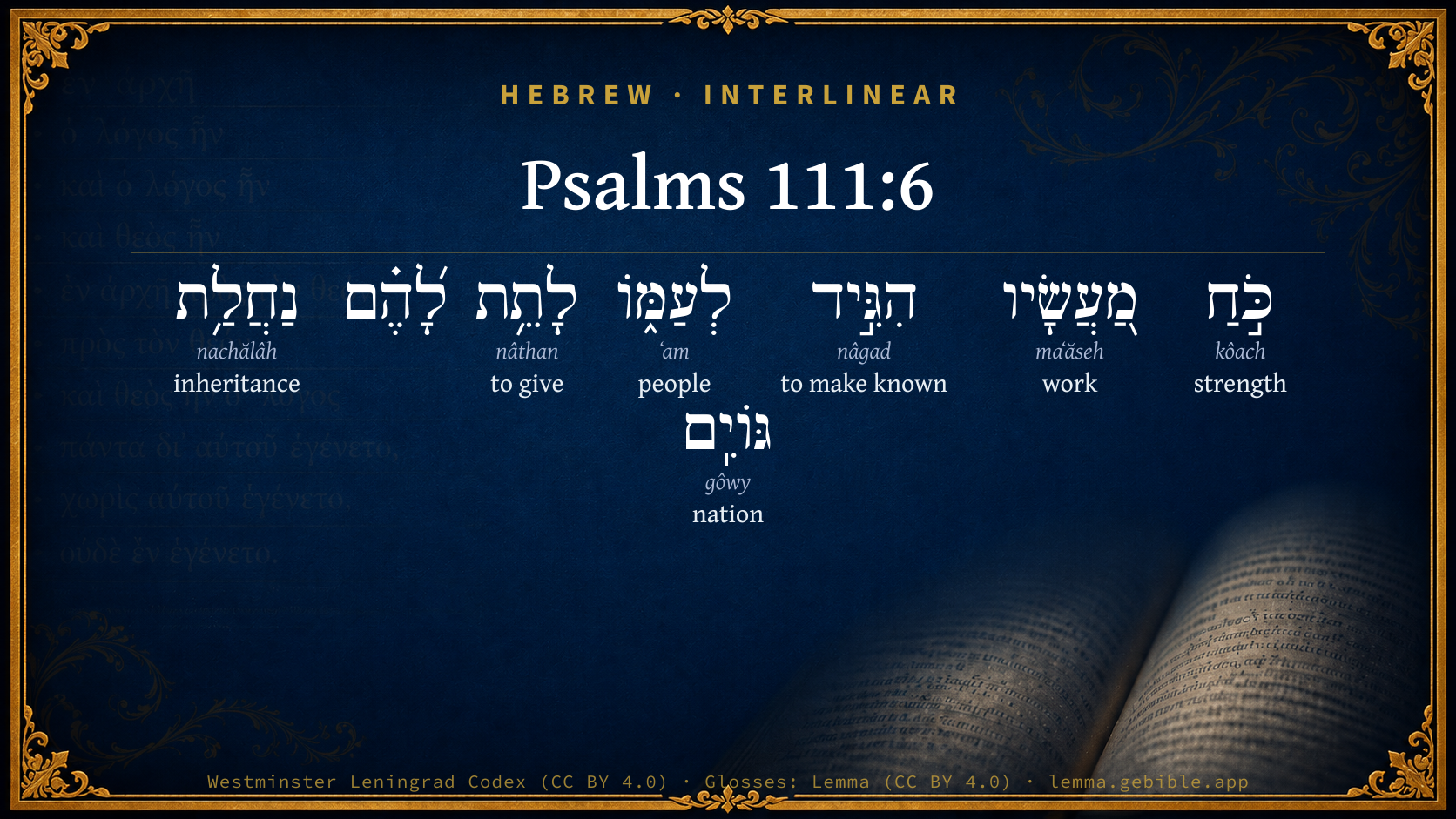
Psalms 111:6

Hebrew (Westminster Leningrad Codex) Psalms 111:6 appears in the Hebrew Old Testament. The text above is from the Westminster Leningrad Codex. Each word links to its Strong’s number, a concise gloss, and parsing drawn from the Open Scriptures Hebrew Bible morphology. Click any word for its full Brown-Driver-Briggs (BDB) entry.
Download image
Cite this verse

Psalms 111:6 (World English Bible). Public Domain. Lemma interlinear Bible study tool, https://lemma.gebible.app/v/psalms/111/6.

Show BibTeX & RIS
BibTeX
RIS
English Translation
He has shown his people the power of his works, In giving them the heritage of the nations.
World English Bible · Public Domain
Download a study sheet

One document with this verse’s original text, its word-by-word gloss line, the meaning frame, cross-references with their text, attributed commentary, and full source and license credits — printable, and it pastes into notes with its structure intact.

This verse Autodidact and up

Study sheet (.html) Plain text (.txt)

A passage Seminary Student

Up to 50 verses in one chapter. A passage sheet keeps up to 6 commentary sources and 12 cross-references per verse, in the order this page ranks them, and says so on the sheet whenever that leaves anything out. Ask for a single verse and you get the Autodidact verse sheet above.

Everything on this page stays free to read, with no account — the sheet is a download of what is already on screen, not access to it.

Want to remove ads? Support Godless Engineer
Compare translations 3

The same verse in 3 English versions, stacked beneath the original-language interlinear above. Click any original word for its lexicon entry.

Each is an independent rendering of the whole verse — the interlinear is not word-aligned to these translations.

Highlighted words mark where these versions differ — a whole-verse word diff, not a word-by-word alignment.

  • World English Bible Public Domain
    He has shown his people the power of his works, In giving them the heritage of the nations.
  • King James Version Public Domain
    He hath shewed his people the power of his works, that he may give them the heritage of the heathen.
  • unfoldingWord Literal Text CC BY-SA 4.0
    He showed the power of his works to his people, to give to them the inheritance of the nations.

unfoldingWord Literal Text — © unfoldingWord, licensed CC BY-SA 4.0. Word-aligned USFM3 via Door43 (git.door43.org/unfoldingWord/en_ult).

Versions to compare (up to 4)

3 of 4 selected

Show all 18 translations

Every available English version of this verse, each an independent rendering of the whole verse.

  • World English Bible Public Domain
    He has shown his people the power of his works, In giving them the heritage of the nations.
  • Berean Standard Bible Public Domain
    He has shown His people the power of His works by giving them the inheritance of the nations.
  • Majority Standard Bible Public Domain
    He has shown His people the power of His works by giving them the inheritance of the nations.
  • King James Version Public Domain
    He hath shewed his people the power of his works, that he may give them the heritage of the heathen.
  • American Standard Version (1901) Public Domain
    He hath showed his people the power of his works, In giving them the heritage of the nations.
  • Revised Version (1885) Public Domain
    He hath shewed his people the power of his works, in giving them the heritage of the nations.
  • Geneva Bible (1599) Public Domain
    He hath shewed to his people the power of his workes in giuing vnto them the heritage of the heathen.
  • Douay-Rheims (1899) Public Domain
    he will shew forth to his people the power of his works.
  • Young's Literal Translation Public Domain
    The power of His works He hath declared to His people, To give to them the inheritance of nations.
  • Literal Standard Version CC BY-SA 4.0
    He has declared the power of His works to His people, || To give to them the inheritance of nations.
  • Unlocked Literal Bible CC BY-SA 4.0
    He showed his powerful works to his people in giving them the inheritance of the nations.
  • unfoldingWord Literal Text CC BY-SA 4.0
    He showed the power of his works to his people, to give to them the inheritance of the nations.
  • Darby Bible Public Domain
    He hath shewn his people the power of his works, to give them the heritage of the nations.
  • World Messianic Bible Public Domain
    He has shown his people the power of his works, in giving them the heritage of the nations.
  • Webster's Bible Public Domain
    He hath shown his people the power of his works, that he may give them the heritage of the heathen.
  • Free Bible Version CC BY-SA 4.0
    He demonstrated to his people the powerful things he could do by giving them the lands of other nations.
  • Bible in Basic English Public Domain
    He has made clear to his people the power of his works, giving them the heritage of the nations.
  • JPS Tanakh (1917) Public Domain
    He hath declared to His people the power of His works, in giving them the heritage of the nations.

Literal Standard Version (2020), Covenant Press — licensed CC BY-SA 4.0. Text via the HelloAO Bible API (eBible.org). Unlocked Literal Bible (unfoldingWord) — licensed CC BY-SA 4.0. Text via the HelloAO Bible API (eBible.org). unfoldingWord Literal Text — © unfoldingWord, licensed CC BY-SA 4.0. Word-aligned USFM3 via Door43 (git.door43.org/unfoldingWord/en_ult). Free Bible Version, Dr. Jonathan Gallagher — licensed CC BY-SA 4.0. Text via the HelloAO Bible API (eBible.org).

Word by word

More ways to search: Search by grammar → Find every occurrence → Compare this word →

Practice this passage: Drill this verse → Learn its vocabulary →

כֹּ֣חַ
kôach
H3581
“strength of”
Noun, Common, Masculine, Singular, Construct
Part of Speech
Noun
Type
Common
Gender
Masculine
Number
Singular
State
Construct
Full BDB Definition

Origin: from an unused root meaning to be firm

TWOT: 973 . 1

strength, power, might - human strength - strength (of angels) - power (of God) - strength (of animals) - strength, produce, wealth (of soil) - a small reptile, probably a kind of lizard, which is unclean - perhaps an extinct animal, exact meaning is unknown
  1. מַ֭עֲשָׂיו maʻăseh H4639 “works · his” Noun, Common, Masculine, Plural, Construct + Suffix, Personal, 3rd Person, Masculine, Singular
  2. הִגִּ֣יד nâgad H5046 “to make known” Verb, Hiphil, Perfect, 3rd Person, Masculine, Singular
  3. לְעַמּ֑וֹ ʻam H5971 “to/for · people · his” Preposition + Noun, Common, Masculine, Singular, Construct + Suffix, Personal, 3rd Person, Masculine, Singular
  4. לָתֵ֥ת nâthan H5414 “to give” Preposition + Verb, Qal, Infinitive Construct
  5. נַחֲלַ֥ת nachălâh H5159 “inheritance of” Noun, Common, Feminine, Singular, Construct
  6. גּוֹיִֽם gôwy H1471 “nations” Noun, Common, Masculine, Plural, Absolute

About this verse

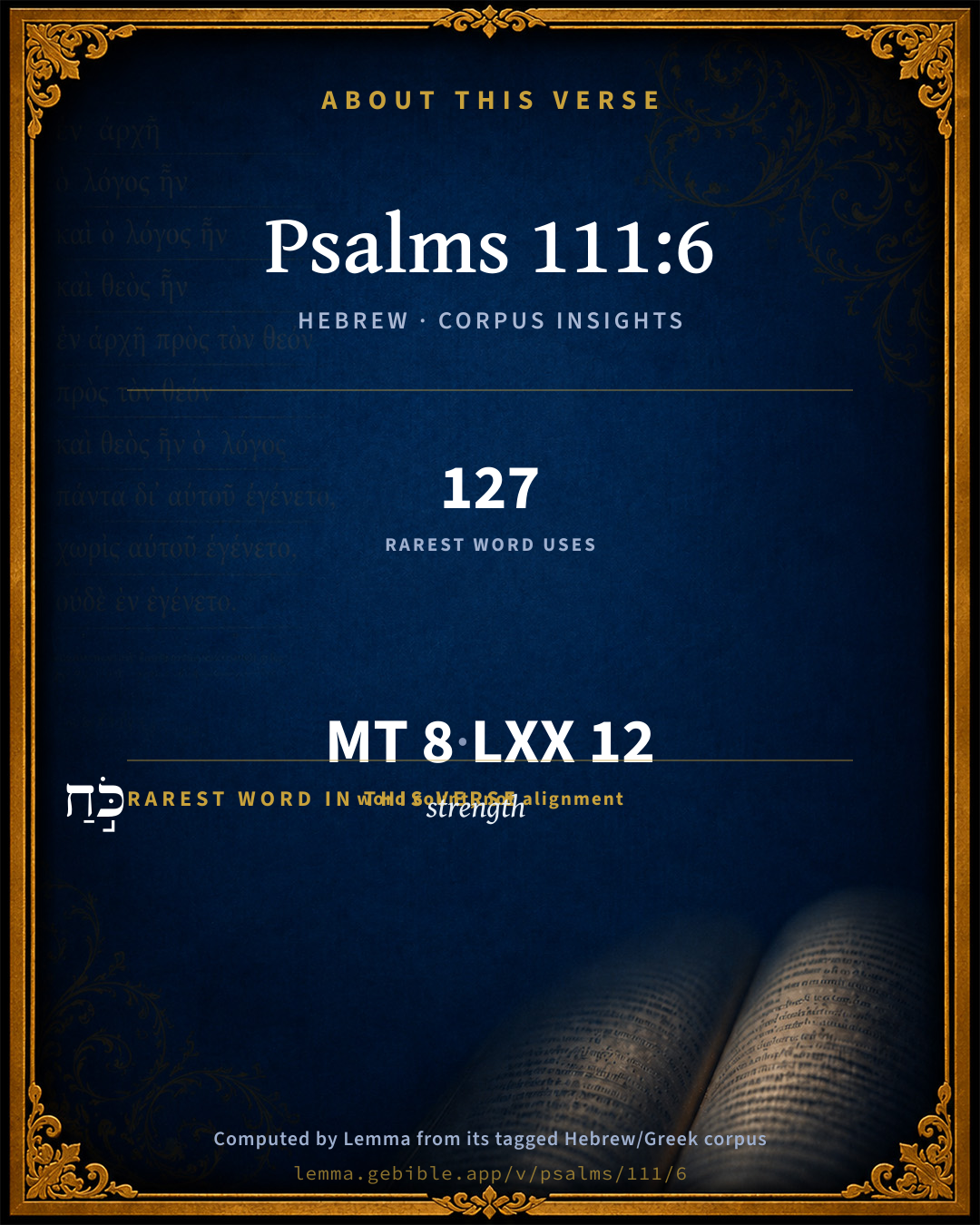
These counts appear in no published source. They are computed here, from the morphology-tagged text and Lemma’s own curated glosses. What Lemma adds →

8
words
7
distinct lemmas
Wisdom
section

Grammatical profile

  • 2 verbs
  • 5 nouns
  • 1 preposition

Verb forms

  • הִגִּ֣יד Hiphil · Perfect
  • לָתֵ֥ת Qal · Infinitive Construct

Hebrew & Septuagint length

In English translation the verse runs 18 words from the Hebrew and 19 from the Septuagint (LXX English) — closely comparable.

A rough comparison of the two English renderings, which tokenize alike — not a word-level alignment.

Word counts can differ between the Hebrew and the Greek without any difference in meaning — e.g. the Hebrew direct-object marker אֵת has no separate Greek word, and Greek often adds the article ὁ.

In the original languages it is 8 Hebrew tokens and 12 Greek tokens — but the two are counted differently (Hebrew bundles its prefixes and suffixes into one token; the Greek is in lemma form), so that isn’t a like-for-like length.

Cross-references

9

Topical passages linked to Psalms 111:6 in the Treasury of Scripture Knowledge — connected by theme and wording, ordered by reader-vote popularity; previews shown in the World English Bible.

  • Psalms 2:8 Ask of me, and I will give the nations for your inheritance, The uttermost parts of the earth for your possession.
  • Psalms 80:8 You brought a vine out of Egypt. You drove out the nations, and planted it.
  • Joshua 10:13–14 The sun stood still, and the moon stayed, Until the nation had avenged themselves of their enemies. Isn't this written in the book of Jashar? The sun stayed in the midst of the sky, and didn't hurry to go down about a whole day.
  • Psalms 44:2 You drove out the nations with your hand, But you planted them. You afflicted the peoples, But you spread them abroad.
  • Joshua 3:14–17 It happened, when the people removed from their tents, to pass over the Jordan, the priests who bore the ark of the covenant being before the people;
  • Joshua 6:20 So the people shouted, and [the priests] blew the trumpets; and it happened, when the people heard the sound of the trumpet, that the people shouted with a great shout, and the wall fell down flat, so that the people went up into the city, every man straight before him, and they took the city.
  • Psalms 78:12–72 He did marvelous things in the sight of their fathers, In the land of Egypt, in the field of Zoan.
  • Psalms 105:27–45 They performed miracles among them, And wonders in the land of Ham.
  • Deuteronomy 4:32–38 For ask now of the days that are past, which were before you, since the day that God created man on the earth, and from the one end of the sky to the other, whether there has been [any such thing] as this great thing is, or has been heard like it?

Cross-references courtesy of OpenBible.info (CC BY 4.0).

Hebrew and Greek witnesses Masoretic Hebrew ↔ Greek Septuagint

The same verse in the two great witnesses to the Old Testament, shown verse-for-verse.

You’re reading Greek Psalm 110 (Hebrew Psalm 111). The Septuagint counts the superscription, so verse numbers can differ from the Hebrew — chapter-level alignment, not verse-by-verse. Numbering follows Rahlfs.

These are two independent witnesses, not word-aligned to each other, and the Septuagint is shown in lemma (dictionary) form.

Hebrew Psalms 111:6 Masoretic · Westminster Leningrad Codex

כֹּ֣חַ מַ֭עֲשָׂיו הִגִּ֣יד לְעַמּ֑וֹ לָתֵ֥ת לָ֝הֶ֗ם נַחֲלַ֥ת גּוֹיִֽם

He has shown his people the power of his works, In giving them the heritage of the nations.

World English Bible · Public Domain

Greek LXX Greek Psalm 110:6 Septuagint · lemma form

ἰσχύς ἔργον αὐτός ἀναἀγγέλλω ὁ λαός αὐτός ὁ δίδωμι αὐτός κληρονομία ἔθνος

He has declared to his people the power of his works, to give them the inheritance of the heathen.

LXX2012 (modern English Septuagint) · Public Domain

Hebrew: Westminster Leningrad Codex (CC BY 4.0). Greek: Septuagint (public domain); English from LXX2012 (modern English Septuagint) (Public Domain). How the Septuagint differs from the Hebrew →

Commentary

Notes on Psalms 111:6 from classic Christian and Jewish commentators (each source and its license shown beneath its notes). The classic Christian expositions comment on the surrounding passage and are grouped to its opening verse, so a note may address several verses; the Jewish commentaries on the Tanakh (Rashi and others) are per-verse, so they appear only where the commentator wrote on this verse.

Lemma curates 59 commentaries, every one of them public domain or Creative Commons licensed, each selected and text-cleaned for this edition rather than reprinted as found. About our sources →

Matthew Henry's Commentary

We are here taught to give glory to God,

I. For the great things he has done for his people, for his people Israel, of old and of late: He has shown his people the power of his works (Psa 111:6), in what he has wrought for them; many a time he has given proofs of his omnipotence, and shown them what he can do, and that there is nothing too hard for him to do. Two things are specified to show the power of his works: - 1. The possession God gave to Israel in the land of Canaan, that he might give them, or in giving them, the heritage of the heathen. This he did in Joshua's time, when the seven nations were subdued, and in David's time, when the neighbouring nations were many of them brought into subjection to Israel and became tributaries to David. Herein God showed his sovereignty, in disposing of kingdoms as he pleases, and his might, in making good his disposals. If God will make the heritage of the heathen to be the heritage of Israel, who can either arraign his counsel or stay his hand? 2. The many deliverances which he wrought for his people when by their iniquities they had sold themselves into the hand of their enemies (Psa 111:9): He sent redemption unto his people, not only out of Egypt at first, but often afterwards; and these redemptions were typical of the great redemption which in the fulness of time was to be wrought out by the Lord Jesus, that redemption in Jerusalem which so many waited for.

II. For the stability both of his word and of his works, which assure us of the great things he will do for them. 1. What God has done shall never be undone. He will not undo it himself, and men and devils cannot (Psa 111:7): The works of his hand are verity and judgment (Psa 111:8), that is, they are done in truth and uprightness; all he does is consonant to the eternal rules and reasons of equity, all according to the counsel of his wisdom and the purpose of his will, all well done and therefore there is nothing to be altered or amended, but his works are firm and unchangeable. Upon the beginning of his works we may depend for the perfecting of them; work that is done properly will last, will neither go to decay nor sink under the stress that is laid upon it. 2. What God has said shall never be unsaid: All his commandments are sure, all straight and therefore all steady. His purposes, the rule of his actions, shall all have their accomplishment: Has he spoken, and will he not make it good? No doubt he will; whether he commands light or darkness, it is done as he commands. His precepts, the rule of our actions, are unquestionably just and good, and therefore unchangeable and not to be repealed; his promises and threatenings are all sure, and will be made good; nor shall the unbelief of man make either the one or the other of no effect. They are established, and therefore they stand fast for ever and ever, and the scripture cannot be broken. The wise God is never put upon new counsels, nor obliged to take new measures, either in his laws or in his providences. All is said, as all is done, in truth and uprightness, and therefore it is immutable. Men's folly and falsehood make them unstable in all their ways, but infinite wisdom and truth for ever exclude retraction and revocation: He has commanded his covenant for ever. God's covenant is commanded, for he has made it as one that has an incontestable authority to prescribe both what we must do and what we must expect, and an unquestionable ability to perform both what he has promised in the blessings of the covenant and what he has threatened in the curses of it, Psa 105:8.

III. For the setting up and establishing of religion among men. Because holy and reverend is his name, and the fear of him is the beginning of wisdom, therefore his praise endureth for ever, that is, he is to be everlastingly praised. 1. Because the discoveries of religion tend so much to his honour. Review what he has made known of himself in his word and in his works, and you will see, and say, that God is great and greatly to be feared; for his name is holy, his infinite purity and rectitude appear in all that whereby he has made himself known, and because it is holy therefore it is reverend, and to be thought of and mentioned with a holy awe. Note, What is holy is reverend; the angels have an eye to God's holiness when they cover their faces before him, and nothing is more man's honour than his sanctification. It is in his holy places that God appears most terrible, Psa 68:35; Lev 10:3. 2. Because the dictates of religion tend so much to man's happiness. We have reason to praise God that the matter is so well contrived that our reverence of him and obedience to him are as much our interest as they are our duty. (1.) Our reverence of him is so: The fear of the Lord is the beginning of wisdom. It is not only reasonable that we should fear God, because his name is reverend and his nature is holy, but it is advantageous to us. It is wisdom; it will direct us to speak and act as becomes us, in a consistency with ourselves, and for our own benefit. It is the head of wisdom, that is (as we read it), it is the beginning of wisdom. Men can never begin to be wise till they begin to fear God; all true wisdom takes its rise from true religion, and has its foundation in it. Or, as some understand it, it is the chief wisdom, and the most excellent, the first in dignity. It is the principal wisdom, and the principal of wisdom, to worship God and give honour to him as our Father and Master. Those manage well who always act under the government of his holy fear. (2.) Our obedience to him is so: A good understanding have all those that do his commandments. Where the fear of the Lord rules in the heart there will be a constant conscientious care to keep his commandments, not to talk of them, but to do them; and such have a good understanding, that is, [1.] They are well understood; their obedience is graciously accepted as a plain indication of their mind that they do indeed fear God. Compare Pro 3:4, So shalt thou find favour and good understanding. God and man will look upon those as meaning well, and approve of them, who make conscience of their duty, though they have their mistakes. What is honestly intended shall be well taken. [2.] They understand well. First, It is a sign that they do understand well. The most obedient are accepted as the most intelligent; those understand themselves and their interest best that make God's law their rule and are in every thing ruled by it. A great understanding those have that know God's commandments and can discourse learnedly of them, but a good understanding have those that do them and walk according to them. Secondly, It is the way to understand better: A good understanding are they to all that do them; the fear of the Lord and the laws of that give men a good understanding, and are able to make them wise unto salvation. If any man will do his will, he shall know more and more clearly of the doctrine of Christ, Joh 7:17. Good success have all those that do them (so the margin), according to what was promised to Joshua if he would observe to do according to the law. Jos 1:8, Then thou shalt make thy way prosperous and shalt have good success. We have reason to praise God, to praise him for ever, for putting man into such a fair way to happiness. Some apply the last words rather to the good man who fears the Lord than to the good God: His praise endures for ever. It is not of men perhaps, but it is of God (Rom 2:29), and that praise which is of God endures for ever when the praise of men is withered and gone.

Matthew Henry's Commentary on the Whole Bible (1708–1710) — public domain (CC PDM 1.0). Text via the HelloAO Bible API.

Trapp's Complete Commentary

John Trapp

Psa 111:6 He hath shewed his people the power of his works, that he may give them the heritage of the heathen.

Ver. 6. He hath showed his people, &c.] To them it is given to see, but not to others who are delivered up to a judiciary blindness. "Call unto me, and I will answer thee, and show thee great and hidden things which thou knowest not," Jer 33:3.

That he may give them, &c.] Yea, power over all nations, Rev 2:26

John Trapp, A Commentary or Exposition upon All the Books of the Old and New Testament (1647–1656) — public domain. Text from a community e-Sword module.

J. A. Alexander on Psalms

Joseph Addison Alexander

6. (Psa 111:6) The power of his works he has declared to his people, (so as) to give to them a heritage of nations. He has shewn them what powerful things he can do, by favouring them so far as to drive out nations from their seats, and make his people their successors and, as it were, their heirs. This refers to the conquest of Canaan, as the first in a long series of such dispos- sessions, including all the territories gained in war from the surrounding nations, till the death of David. The construction of to give as a gerund (by giving) is not a Hebrew idiom, and restricts the meaning of the clause unduly. See above, on Psa 78:18.

Joseph Addison Alexander, The Psalms Translated and Explained (1850) — public domain. Text from a community e-Sword module.

Tyndale Open Study Notes

Tyndale Open Resources

111:6-8 Giving Israel the lands of other nations was just and good because the Lord was executing his justice on those he dispossessed and showing grace to the Israelites. However, if the Israelites do not live faithfully and with integrity, they will also be dispossessed. The Lord’s people must reflect his character.

Tyndale Open Study Notes — © Tyndale Open Resources, licensed CC BY-SA 4.0. Text via the HelloAO Bible API.

Adam Clarke's Commentary

Verse 6. The power of his works] They have seen that these things did not arrive in the common course of nature, it was not by might nor by power, but by the Spirit of the Lord of hosts they were done. And it required a display of the power of God to give them the heritage of the heathen.

Adam Clarke's Commentary on the Bible (1810–1826) — public domain. Text from a community e-Sword/MySword module.

The Cambridge Bible for Schools and Colleges

gen. ed. J. J. S. Perowne

6. that he may give them &c.] R.V., In giving them the heritage of the nations. By dispossessing the Canaanites and giving Israel their land for its inheritance Jehovah most signally demonstrated His might (Deu_4:38 and often). That gift was the pledge of a still wider sovereignty, to be fulfilled only in a spiritual way (Psa_2:8; Isa_60:14).

The Cambridge Bible for Schools and Colleges (gen. ed. J. J. S. Perowne; Cambridge University Press, 1878–1918) — public domain. Text from a community e-Sword module.

John Gill's Exposition

He hath showed his people the power of his works,.... Or his works of power, his mighty works, in which his great power was shown; as to the people of Israel in Egypt, at the Red sea, in the wilderness, and in bringing them to and settling them in the land of Canaan; these he showed to them in fact, they saw them with their eyes; and he showed or declared them to them in prophecy, before they came to pass, as Kimchi observes, that it might not be said they came by chance. So he hath showed his works of power to his people in Gospel times, as the miracles of Christ, his resurrection from the dead, redemption by him, and the work of grace on the hearts of men in all ages.

That he may give them the heritage of the Heathen; the Lord did the above works of his power for the people of Israel, that he might put them into the possession of the land of Canaan, inherited by Heathens; that it might become their inheritance, and they might enjoy their houses, vineyards, and fields; and he wrought powerfully through the ministration of the Gospel, by his Spirit and grace, upon the hearts of men in the Gentile world; that the Christian church might possess the dominions of it, as it did in the times of Constantine and of others, and as it will more largely in the latter day; see Psa 2:8.

John Gill's Exposition of the Whole Bible (1746–1763) — public domain (CC PDM 1.0). Text via the HelloAO Bible API.

Albert Barnes' Notes on the Bible

He hath showed his people - The Jewish people. He has made this known to them. The reference here is not to his “announcing” it, or stating it, but to his acts of interposition in their behalf in which he had manifested the greatness of his power.

The power of his works - The power of his acts; the power involved in what he does. The power referred to here was that which was evinced in destroying the Egyptians, and in subduing the nations of Canaan.

That he may give them the heritage of the heathen - The nations; to wit, the nations of Palestine. The word “heritage” is often used in the large sense of possessions; and the meaning here is, that God had shown the greatness of his power by giving all that they possessed into the hands of his people.

Albert Barnes' Notes on the Bible (1834–1885) — public domain. Text from a community e-Sword/MySword module.

Matthew Poole's English Annotations

He hath showed, not only by words, but by his actions.

The power of his works; his mighty power in his works, and especially in that which here follows.

The heritage of the heathen; the land of Canaan, which had been possessed and inherited by the heathens.

Matthew Poole's English Annotations on the Holy Bible (1683–1685) — public domain. Text from a community e-Sword/MySword module.

The Treasury of David

Charles H. Spurgeon

Ver. 6. He hath shewed his people the power of his works. They have seen what he is able to do and what force he is prepared to put forth on their behalf. This power Israel saw in physical works, and we in spiritual wonders, for we behold the matchless energy of the Holy Ghost and feel it in our own souls. In times of dire distress the Lord has put forth such energy of grace that we have been astonished at his power; and this was part of his intent in bringing us into such conditions that he might reveal to us the arm of his strength. Could we ever have known it so well if we had not been in pressing need of his help? We may well turn this verse into a prayer and ask to see more and more the power of the Lord at work among us in these latter days. O Lord, let us now see how mightily thou canst work in the saving of sinners and in preserving and delivering thine own people.

That he may give them the heritage of the heathen. He put forth all his power to drive out the Canaanites and bring in his people. Even thus may it please his infinite wisdom to give to his church the heathen for her inheritance in the name of Jesus. Nothing but great power can effect this, but it will surely be accomplished in due season.

Ver. 6. He hath shewed his people, etc. The Prophet indicates the unbelief of the Jews, who murmured against God in the desert, as if he could not enable them to enter into the promised land, and possess it, because the cities were walled, and the inhabitants strong, and giants dwelt in it. He shewed, he says, i.e., he placed before their eyes, the power of His works, when he gave the lands of the heathen to be inhabited by his own people. Wolfgang Musculus.

Ver. 6. He hath shewed his people the power of his works. So he hath showed his works of power to his people in Gospel times, as the miracles of Christ, his resurrection from the dead, redemption by him, and the work of grace on the hearts of men in all ages. John Gill.

Ver. 6. He hath shewed his people, etc. To them it is given to see, but not to others who are delivered up to a judicial blindness. Call unto me, and I will answer thee, and show thee great and mighty things, which thou knowest not. Jer 33:3. John Trapp.

Ver. 6. To give them the heritage of the heathen. The heathen themselves are bequeathed to God's people, and they must take possession of this inheritance to draw them to themselves.] Richter, in Zange's Commentary.

Ver. 6. The power of God an encouragement for the evangelization of the heathen.

Psalms 111:7*

Charles H. Spurgeon's The Treasury of David (1869–1885) — public domain. Psalms only. Text from a community e-Sword/MySword module.

Whedon's Commentary on the Bible

Daniel D. Whedon

6. He hath showed his people—He has not only declared his ability to do, but has publicly manifested the power of his works by the great salvation he has actually wrought out for his people. This is God’s method in all ages. Thus “experience worketh hope through tribulation.” Rom_5:4; Psa_20:6; Psa_41:11.

Give them the heritage of the heathen—This was notably done in the times of Moses and Joshua, and in a degree scarcely less illustrious by the return of the exiles and the re-establishment of the nation by Ezra, Zerubbabel, and Nehemiah, under the decrees of Cyrus, (Ezr_1:1-4;) of Darius. (Ezra vi;) and of Artaxerxes, (Nehemiah 2.)

Daniel D. Whedon (gen. ed.), Commentary on the Old and New Testaments (1874–1909) — public domain. Text from a community e-Sword module.

The Pulpit Commentary

He hath showed his people the power of his works, that he may give them the heritage of the heathen; rather, in giving them. God manifested his power to Israel very specially by causing them to overcome the many strong Canaanitish nations, and to take their lands and labors in possession. (Psa_105:44) This was one of the greatest of his "works," or "doings."

The Pulpit Commentary (1880–1919), ed. H.D.M. Spence-Jones & Joseph S. Exell — public domain. Text from a community e-Sword module.

Rashi

Rabbi Shlomo Yitzchaki (Rashi)

The strength of His works He related to His people When He gave them the inheritance of the nations, He let them know His strength and His might. And Midrash Tanchuma (Buber, Bereishith 11): He wrote for Israel [about] the Creation to let them know that the earth is His and that it is in His power to settle in it anyone He wishes, and to move these out and settle others, so that the nations will not be able to say to Israel, “You are thieves, for you conquered the land of the seven nations.”

Rashi on the Tanakh — English translations: “The Judaica Press complete Tanach with Rashi, translated by A. J. Rosenberg” (CC BY 4.0); “Pentateuch with Rashi's commentary by M. Rosenbaum and A.M. Silbermann, 1929-1934” (public domain); “The Metsudah Tanach series, Lakewood, N.J” (CC BY 4.0); and “The Book of Joshua, Metsudah Publications, 1997” (CC BY 4.0). Text via Sefaria.

Lesson kit

Teaching starters — assembled from the data on this page, not authored interpretation. Every prompt links to the verse data it draws on. Edit before teaching.

Psalms, in the Wisdom, opens this verse with 8 words (7 distinct Hebrew lemmas). Its most distinctive word is kôach (“strength”). A historical commentator’s framing appears above. Read the whole chapter for the surrounding context.

Discussion questions

  1. How does “strength” (kôach) shape what this verse is saying?
  2. How does Psalms 2:8, which shares this passage’s theme, read alongside this verse?
  3. These translations render this verse differently. What is at stake in choosing one wording over another?
  4. «הִגִּ֣יד» is a Hiphil Perfect verb. How does that grammatical form shape the action described?
  5. Compare how Matthew Henry's Commentary and Trapp's Complete Commentary read this verse. Where do they agree or differ?

Things to notice

Reading settings

Reading text

Shown beneath each verse's original-language words.

Old Testament
Old Testament edition

Read the OT as the Masoretic Hebrew (MT) or the Greek Septuagint (LXX).

English shown for the Greek Septuagint (in the Hebrew ↔ Greek comparison).

Comparing translations? Open the Compare panel on any verse page to stack up to four side by side.