
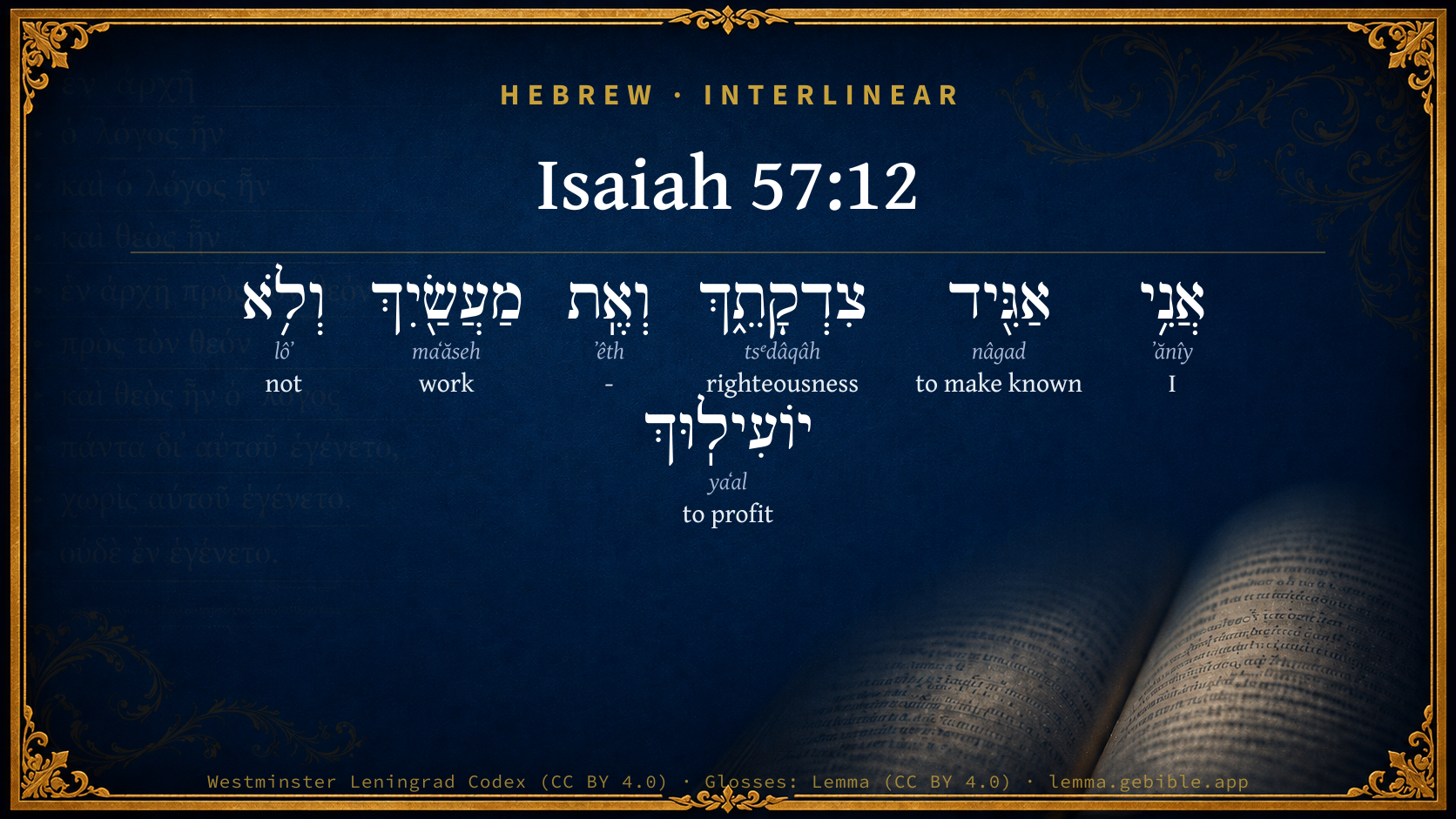
Isaiah 57:12

Hebrew (Westminster Leningrad Codex) Isaiah 57:12 appears in the Hebrew Old Testament. The text above is from the Westminster Leningrad Codex. Each word links to its Strong’s number, a concise gloss, and parsing drawn from the Open Scriptures Hebrew Bible morphology. Click any word for its full Brown-Driver-Briggs (BDB) entry.
Download image
Cite this verse

Isaiah 57:12 (World English Bible). Public Domain. Lemma interlinear Bible study tool, https://lemma.gebible.app/v/isaiah/57/12.

Show BibTeX & RIS
BibTeX
RIS
English Translation
I will declare your righteousness; and as for your works, they shall not profit you.
World English Bible · Public Domain
Download a study sheet

One document with this verse’s original text, its word-by-word gloss line, the meaning frame, cross-references with their text, attributed commentary, and full source and license credits — printable, and it pastes into notes with its structure intact.

This verse Autodidact and up

Study sheet (.html) Plain text (.txt)

A passage Seminary Student

Up to 50 verses in one chapter. A passage sheet keeps up to 6 commentary sources and 12 cross-references per verse, in the order this page ranks them, and says so on the sheet whenever that leaves anything out. Ask for a single verse and you get the Autodidact verse sheet above.

Everything on this page stays free to read, with no account — the sheet is a download of what is already on screen, not access to it.

Want to remove ads? Support Godless Engineer
Compare translations 3

The same verse in 3 English versions, stacked beneath the original-language interlinear above. Click any original word for its lexicon entry.

Each is an independent rendering of the whole verse — the interlinear is not word-aligned to these translations.

Highlighted words mark where these versions differ — a whole-verse word diff, not a word-by-word alignment.

  • World English Bible Public Domain
    I will declare your righteousness; and as for your works, they shall not profit you.
  • King James Version Public Domain
    I will declare thy righteousness, and thy works; for they shall not profit thee.
  • unfoldingWord Literal Text CC BY-SA 4.0
    I, I will declare your righteousness and your deeds, and they will not benefit you.

unfoldingWord Literal Text — © unfoldingWord, licensed CC BY-SA 4.0. Word-aligned USFM3 via Door43 (git.door43.org/unfoldingWord/en_ult).

Versions to compare (up to 4)

3 of 4 selected

Show all 18 translations

Every available English version of this verse, each an independent rendering of the whole verse.

  • World English Bible Public Domain
    I will declare your righteousness; and as for your works, they shall not profit you.
  • Berean Standard Bible Public Domain
    I will expose your righteousness and your works, and they will not profit you.
  • Majority Standard Bible Public Domain
    I will expose your righteousness and your works, and they will not profit you.
  • King James Version Public Domain
    I will declare thy righteousness, and thy works; for they shall not profit thee.
  • American Standard Version (1901) Public Domain
    I will declare thy righteousness; and as for thy works, they shall not profit thee.
  • Revised Version (1885) Public Domain
    I will declare thy righteousness; and as for thy works, they shall not profit thee.
  • Geneva Bible (1599) Public Domain
    I will declare thy righteousnes and thy workes, and they shall not profite thee.
  • Douay-Rheims (1899) Public Domain
    I will declare thy justice, and thy works shall not profit thee.
  • Young's Literal Translation Public Domain
    I declare thy righteousness, and thy works, And they do not profit thee.
  • Literal Standard Version CC BY-SA 4.0
    I declare your righteousness, and your works, || And they do not profit you.
  • Unlocked Literal Bible CC BY-SA 4.0
    I will proclaim all your righteous acts and tell all that you have done, but they will not help you.
  • unfoldingWord Literal Text CC BY-SA 4.0
    I, I will declare your righteousness and your deeds, and they will not benefit you.
  • Darby Bible Public Domain
    I will declare thy righteousness, and thy works; and they shall not profit thee.
  • World Messianic Bible Public Domain
    I will declare your righteousness; and as for your works, they will not benefit you.
  • Webster's Bible Public Domain
    I will declare thy righteousness, and thy works; for they shall not profit thee.
  • Free Bible Version CC BY-SA 4.0
    I'm going to let everyone know about how you're “so good” and the things you do—but they won't help you!
  • Bible in Basic English Public Domain
    I will make clear what your righteousness is like and your works; you will have no profit in them.
  • JPS Tanakh (1917) Public Domain
    I will declare thy righteousness; thy works also — they shall not profit thee.

Literal Standard Version (2020), Covenant Press — licensed CC BY-SA 4.0. Text via the HelloAO Bible API (eBible.org). Unlocked Literal Bible (unfoldingWord) — licensed CC BY-SA 4.0. Text via the HelloAO Bible API (eBible.org). unfoldingWord Literal Text — © unfoldingWord, licensed CC BY-SA 4.0. Word-aligned USFM3 via Door43 (git.door43.org/unfoldingWord/en_ult). Free Bible Version, Dr. Jonathan Gallagher — licensed CC BY-SA 4.0. Text via the HelloAO Bible API (eBible.org).

Word by word

More ways to search: Search by grammar → Find every occurrence → Compare this word →

Practice this passage: Drill this verse → Learn its vocabulary →

About this verse

These counts appear in no published source. They are computed here, from the morphology-tagged text and Lemma’s own curated glosses. What Lemma adds →

7
words
7
distinct lemmas
Prophets
section

Notable vocabulary

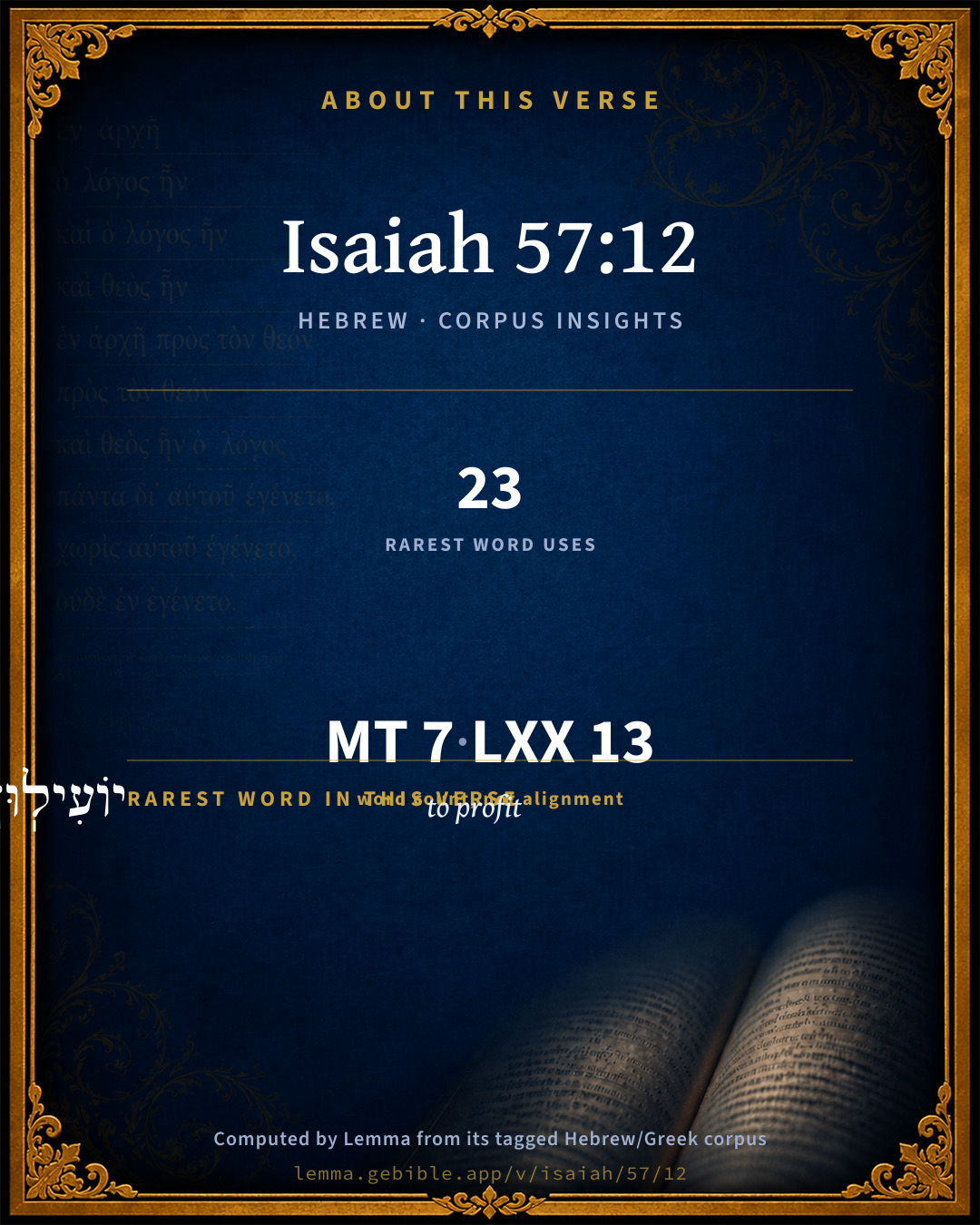
The rarest word here is יוֹעִילֽוּךְ to profit H3276 — appearing just 23 times in the whole Hebrew Bible.

Shared distinctive vocabulary

יוֹעִילֽוּךְ to profit H3276 occurs in 21 verses of the Hebrew Bible. Also found in:

Grammatical profile

  • 2 verbs
  • 2 nouns
  • 1 pronoun
  • 2 particles

Verb forms

  • אַגִּ֖יד Hiphil · Imperfect
  • יוֹעִילֽוּךְ Hiphil · Imperfect

Hebrew & Septuagint length

In English translation the verse runs 15 words from the Hebrew and 14 from the Septuagint (LXX English) — closely comparable.

A rough comparison of the two English renderings, which tokenize alike — not a word-level alignment.

Word counts can differ between the Hebrew and the Greek without any difference in meaning — e.g. the Hebrew direct-object marker אֵת has no separate Greek word, and Greek often adds the article ὁ.

In the original languages it is 7 Hebrew tokens and 13 Greek tokens — but the two are counted differently (Hebrew bundles its prefixes and suffixes into one token; the Greek is in lemma form), so that isn’t a like-for-like length.

Cross-references

12

Topical passages linked to Isaiah 57:12 in the Treasury of Scripture Knowledge — connected by theme and wording, ordered by reader-vote popularity; previews shown in the World English Bible.

  • Isaiah 1:11–15 "What are the multitude of your sacrifices to me?," says Yahweh. "I have had enough of the burnt offerings of rams, And the fat of fed animals. I don't delight in the blood of bulls, Or of lambs, Or of male goats.
  • Jeremiah 7:4–11 Don't you trust in lying words, saying, The temple of Yahweh, the temple of Yahweh, the temple of Yahweh, are these.
  • Micah 3:2–4 You who hate the good, And love the evil; Who tear off their skin, And their flesh from off their bones;
  • Matthew 23:13 "Woe to you, scribes and Pharisees, hypocrites! For you devour widows' houses, and as a pretense you make long prayers. Therefore you will receive greater condemnation.
  • Romans 3:10–20 As it is written, "There is no one righteous. No, not one.
  • Isaiah 29:15 Woe to those who hide deep their counsel from Yahweh, and whose works are in the dark, and who say, Who sees us? and who knows us?
  • Isaiah 58:2–6 Yet they seek me daily, and delight to know my ways: as a nation that did righteousness, and didn't forsake the ordinance of their God, they ask of me righteous judgments; they delight to draw near to God.
  • Isaiah 59:6–8 Their webs shall not become garments, neither shall they cover themselves with their works: their works are works of iniquity, and the act of violence is in their hands.
  • Isaiah 64:5 You meet him who rejoices and works righteousness, those who remember you in your ways: behold, you were angry, and we sinned: in them [have we been] of long time; and shall we be saved?
  • Isaiah 66:3–4 He who kills an ox is as he who kills a man; he who sacrifices a lamb, as he who breaks a dog's neck; he who offers an offering, [as he who offers] pig's blood; he who burns frankincense, as he who blesses an idol. Yes, they have chosen their own ways, and their soul delights in their abominations:
  • Matthew 23:5 But all their works they do to be seen by men. They make their phylacteries broad, enlarge the fringes of their garments,
  • Romans 10:2–3 For I testify about them that they have a zeal for God, but not according to knowledge.

Cross-references courtesy of OpenBible.info (CC BY 4.0).

Hebrew and Greek witnesses Masoretic Hebrew ↔ Greek Septuagint

The same verse in the two great witnesses to the Old Testament, shown verse-for-verse.

These are two independent witnesses, not word-aligned to each other, and the Septuagint is shown in lemma (dictionary) form.

Hebrew Isaiah 57:12 Masoretic · Westminster Leningrad Codex

אֲנִ֥י אַגִּ֖יד צִדְקָתֵ֑ךְ וְאֶֽת מַעֲשַׂ֖יִךְ וְלֹ֥א יוֹעִילֽוּךְ

I will declare your righteousness; and as for your works, they shall not profit you.

World English Bible · Public Domain

Greek LXX Isaiah 57:12 Septuagint · lemma form

καΐἐγώ ἀποἀγγέλλω ὁ δικαιοσύνη ἐγώ καί ὁ κακός σύ ὅς οὐ ὠφελέω σύ

And I will declare your righteousness, and your sins, which shall not profit you.

LXX2012 (modern English Septuagint) · Public Domain

On this verse, Adam Clarke's Commentary discusses the Septuagint’s reading. Read the note in Commentary ↓

Hebrew: Westminster Leningrad Codex (CC BY 4.0). Greek: Septuagint (public domain); English from LXX2012 (modern English Septuagint) (Public Domain). How the Septuagint differs from the Hebrew →

Targum (Aramaic paraphrase)

1

The Targum is the ancient Jewish Aramaic paraphrase of the Hebrew Scriptures — an interpretive translation, not the Hebrew text itself. Onkelos (literal) and Pseudo-Jonathan (expansive) render the Torah, and Jonathan the Prophets. Coverage is partial: where no permissively-licensed English translation exists for a verse, only the Aramaic is shown. This is verse-level text, not a word-by-word alignment to the Hebrew.

  1. Targum Jonathan Prophets (Joshua–Malachi)
    אֲנָא חֲוֵיתִי לָךְ עוֹבְדִין טְבִין דְאִינוּן זַכְוָן לִיךְ וְאַתְּ אַסְגֵית לִיךְ עוֹבָדִין בִּישִׁין דְלָא יִחֲנוּן לִיךְ:

    I have shewn thee those good works, which would have been thy righteousness; but thou hast multiplied evil works which did not profit thee.

    Targum Jonathan — Aramaic: “Mikraot Gedolot” (public domain). English: “Sefaria Community Translation” (CC0 1.0 (public-domain dedication)); “London "Chaldee Paraphrase," 1871” (public domain). Text via Sefaria.

Commentary

Notes on Isaiah 57:12 from classic Christian and Jewish commentators (each source and its license shown beneath its notes). The classic Christian expositions comment on the surrounding passage and are grouped to its opening verse, so a note may address several verses; the Jewish commentaries on the Tanakh (Rashi and others) are per-verse, so they appear only where the commentator wrote on this verse.

Lemma curates 59 commentaries, every one of them public domain or Creative Commons licensed, each selected and text-cleaned for this edition rather than reprinted as found. About our sources →

Trapp's Complete Commentary

John Trapp

Isa 57:12 I will declare thy righteousness, and thy works; for they shall not profit thee.

Ver. 12. I will declare thy righteousness,] i.e., Thine unrighteousness, by an irony; {a} or, Thy righteousness secundum dici, non secundum esse, thine hypocrisy.

For they shall not profit thee.] Nay, they shall undo thee.

{a} Antiphrasis ironica.

John Trapp, A Commentary or Exposition upon All the Books of the Old and New Testament (1647–1656) — public domain. Text from a community e-Sword module.

Whedon's Commentary on the Bible

Daniel D. Whedon

12, 13. About the whole case only words of irony can be suitable. These we have in Isa_57:12, etc.

I will declare thy righteousness — Israel’s righteousness was more than profitless — it was outrageous impiety. To idolaters the earlier words in Isa_57:13 are fearfully taunting.

When thou criest — That is, for help.

Let thy companies deliver thee — Resort to your throngs of idols. Go to your allies. Nevertheless, wind and confusion shall follow. Your protector shall be like houses or dwellings when tornadoes sweep them away. However, tornadoes are not needed.

Vanity shall take them — Lowth and Noyes translate, “A breath shall take them off.” But in Isa_57:13 the humble pious are remembered. To possess the land and to inherit God’s holy mountain, is to possess what covers the richest of blessings — generally, gospel blessings.

Daniel D. Whedon (gen. ed.), Commentary on the Old and New Testaments (1874–1909) — public domain. Text from a community e-Sword module.

Tyndale Open Study Notes

Tyndale Open Resources

57:12 The Lord did not consider the people’s so-called good deeds (literally righteousness; see 59:16) to be truly righteous.

Tyndale Open Study Notes — © Tyndale Open Resources, licensed CC BY-SA 4.0. Text via the HelloAO Bible API.

Geneva Bible (1599)

Geneva Bible translators

That is, thy naughtiness, idolatries, and impieties which the wicked call God’s service: thus he derideth their obstinacy.

Geneva Bible (1599) marginal notes — public domain. Text via Bolls.life.

Jamieson, Fausset & Brown

Robert Jamieson, A. R. Fausset & David Brown

declare--I will expose publicly thy (hypocritical) righteousness. I will show openly how vain thy works, in having recourse to idols, or foreign alliances, shall prove (Isa 57:3).

Jamieson, Fausset & Brown — Commentary Critical and Explanatory on the Whole Bible (1871) — public domain (CC PDM 1.0). Text via the HelloAO Bible API.

Adam Clarke's Commentary

Verse 12. Thy righteousness - "My righteousness"] For צדקתך tsidkathech, THY righteousness, the Syriac, Septuagint, MSS. Alex. and Pachom., and I. D. II., and Marchal. and οἱ Γ, and the Arabic, read צדקי tsidki, MY righteousness.

Adam Clarke's Commentary on the Bible (1810–1826) — public domain. Text from a community e-Sword/MySword module.

Ellicott's Commentary for English Readers

(12) I will declare thy righteousness . . .—Accepting the Hebrew text, we must look on the word as used ironically, the righteousness which is no righteousness. Comp. Isa_64:6. A slight alteration, adopted by many critics, gives “my righteousness.”

A Bible Commentary for English Readers, edited by Charles John Ellicott (1878–1897) — public domain. Text from a community e-Sword module.

The Cambridge Bible for Schools and Colleges

gen. ed. J. J. S. Perowne

12, 13. But Jehovah will no longer be silent; He will proceed to judgement (cf. again Psa_50:21).

I will declare thy righteousness] must be spoken ironically: “I will expose thy (pretended) righteousness.” This might be said of the Samaritans, who claimed to be true worshippers of Jehovah just as ancient Israel had always done (Ezr_4:2).

and thy works, &c.] Render with R.V. and as for thy works, they shall not profit thee.

The Cambridge Bible for Schools and Colleges (gen. ed. J. J. S. Perowne; Cambridge University Press, 1878–1918) — public domain. Text from a community e-Sword module.

John Gill's Exposition

I will declare thy righteousness, and thy works,.... For, notwithstanding all the idolatry, superstition, irreligion, and cruelty of the church of Rome, she makes large pretences to righteousness, by which she expects to be justified, and to merit eternal life, and even pretends to works of supererogation; but God will in due time make it clearly appear, both by the ministry of his faithful servants, which he has done in part already; and by his judgments that he will execute, that she has no righteousness; that what she calls so is no righteousness, but wickedness; and that her works she calls good works are bad ones, superstitious, idolatrous, and tyrannical:

for they shall not profit thee; secure from judgment here, or from wrath to come; nor justify before God, nor procure salvation and eternal life; but, on the contrary, shall bring deserved ruin and destruction, here and hereafter.

John Gill's Exposition of the Whole Bible (1746–1763) — public domain (CC PDM 1.0). Text via the HelloAO Bible API.

Albert Barnes' Notes on the Bible

I will declare thy righteousness - This is evidently spoken ironically. The sense is, ‘you have devoted yourselves to idols, and you have sought the aid of foreigners. I will now announce to you the true nature of the deliverance which they can bring to you.’ This is done in the following verse.

Albert Barnes' Notes on the Bible (1834–1885) — public domain. Text from a community e-Sword/MySword module.

Haydock's Catholic Bible Commentary

Justice. He speaks ironically. (Calmet) --- Self-righteousness is vicious. (Haydock)

George Leo Haydock (1774–1849), Haydock's Catholic Family Bible and Commentary, 1859 edition — public domain. Excludes Psalms (Douay-Rheims chapter numbering differs from Protestant) and Deuterocanonical books (Catholic canon only).

Matthew Poole's English Annotations

I will declare; I will no longer be silent and patient towards thee.

Thy righteousness and thy works; which may be put for the righteousness of thy works, by that known figure, of which See Poole "Isa 57:8", whereby he means their wickedness, which he calleth their

righteousness, either ironically, or because it was covered with a pretence of righteousness, and they alleged that this was a just and lawful thing, when they were distressed to seek for help from their neighbours or allies. The sense is, I will discover whether thy works be righteous, as thou pretendest they are; my punishments shall manifest the wickedness of thy actions.

They shall not profit thee; these actions shall do thee no good, but much hurt.

Matthew Poole's English Annotations on the Holy Bible (1683–1685) — public domain. Text from a community e-Sword/MySword module.

The Pulpit Commentary

I will declare thy righteousness, etc. The Syriac Version has "my righteousness," which gives a much better sense, and is adopted by Bishop Lowth, Dr. Weir, and Mr. Cheyne. God will be silent no longer. He will" declare," or show forth, "his righteousness," by visiting Judah with some righteous punishment. Then it will be seen of what value are those things in which Judah has hitherto trusted. Her works whether her "idols" are meant (Cheyne, Delitzsch), or her "deeds of iniquity" (Kay) what will they profit? She will "cry" out under the rod of chastisement cry to her false gods to save her.

Vers. 12, 13. The fate of folly and the reward of wisdom.

The Divine One whom Israel has so grievously wronged (vers. 4-9) intimates (ver. 12) that he will make known to his people the results of their apostasy from him; he will tell them "how unprofitable are their works," how suicidal is their policy; he will tell them also how great is the reward of the wise of those who abide in his service.

I THE BITTER FATE OF THE UNGODLY. Departing from God, they have no resort but that which they find in their own poor divinities, in those "heaps of idols" whose power is blown away with the first breath of adversity; they may cry to these wretched images, but they will meet with no response. This will prove the portion of the ungodly. in every age: the powers to which, in God"s absence, they have recourse will fail them utterly in their time of need; they may be numerous, they may be "companies," they may be highly esteemed, but they will certainly tail when the hour of trial arrives. Worldly wealth, a great reputation, troops of friends, high social position, varied attainments, strength of bodily constitution, any one or all of these, or other resources besides these, may be possessed, but they will ignominiously fail in the hour of supreme necessity; they will not, for they cannot, deliver a human soul in its deepest troubles, in its darkest hours; they will be as impotent as "the chaff which the wind driveth away." "Vain things for safety" are they all. The soul of man has wants which strike deeper and which rise higher than any of them can reach.

II THE BLESSED HERITAGE OF THE GODLY. "He that putteth his trust in me shall possess the land." To him may come, will come, hours of darkness, of loss, of trial; but he has a stay and a resource in God his Father, in Jesus Christ his unfailing Friend, which will make him blessed at every point of his pilgrimage, in every stage of his career. For him will be:

1. The rest of heart which comes with a consciousness of spiritual integrity.

2. Growth in all that is good and wise.

3. The happiness of heart which is found in the worship of God: "He shall inherit my holy mountain.

4. The joy of sacred service, of rendering succour, of imparting strength to the weak and comfort to the sad, of rescuing and reinstating the fallen and despairing.

5. The hope of the heavenly inheritance. C.

The Pulpit Commentary (1880–1919), ed. H.D.M. Spence-Jones & Joseph S. Exell — public domain. Text from a community e-Sword module.

Keil & Delitzsch

C. F. Keil & F. Delitzsch

But this silence would not last for ever. "I will proclaim thy righteousness; and thy works, they will not profit thee. When thou criest, let thy heaps of idols save thee: but a wind carries them all away; a breath takes them off; and whoever putteth trust in me will inherit the land, and take possession of my holy mountain." According to the context, צדקתך cannot be a synonym of ישׁוּעה f here. It is neither salvation nor the way of salvation that is intended; nor is this even included, as Stier supposes. But the simple reference is to what Israel in its blindness regarded as righteousness; whereas, if it had known itself, it would have seen that it was the most glaring opposite. This lying-righteousness of Israel would be brought to a judicial exposure by Jehovah. ואת־מעשׂיך is not a second accusative to אגּיד, for in that case we should have ומעשׂיך את־צדקתך; but it commences a second sentence, as the accents really indicate. When Jehovah begins thus to speak and act, the impotence of the false gods which His people have made for themselves will soon be exposed; and "as for thy works (i.e., thine idols, Isa 41:29, cf., Isa 1:31), they will do thee no good" (Isa 44:9-10, compare Jer 23:33; for the question מה־משׂא), here an empatic elevation of the subject, compare Isa 53:8, ואת־דורו, Ewald, 277, p. 683). This determines the meaning of קבּוּציך, which Knobel supposes to refer to the large army of the Babylonians, with which the apostates among the exiles had formed an offensive and defensive alliance. But the term is really applied to the heaps (qibbūts, collectio, not an adjective of the form limmūd) of different idols, with which Israel had furnished itself even in its captivity (compare qibbâtsâh in Mic 1:7). It was in vain for them to turn to these pantheons of theirs; a single rūăch would carry them all away, a hebhel would sweep them off, for they themselves were nothing but hebhel and rūăch (Isa 41:29). The proper punctuation here is יקּח־הבל; the first syllable of יקח, which is attached to a word with a disjunctive accent, has a so-called heavy Gaya, the second a euphonic Gaya, according to rules which are too little discussed in our grammars. When Knobel supports his explanation of קבוציך on the ground that the idols in Isa 57:13 and the worshippers of Jehovah in Isa 57:13 do not form a fitting antithesis, the simple reply is, that the contrast lies between the idols, which cannot save, and Jehovah, who not only saves those who trust in Him, but sends them prosperity according to His promises. With the promise, "Whoso trusts in me will inherit the land," this prophecy reaches the thought with which the previous prophecy (Isa 51:7-8) closed; and possibly what is here affirmed of קבּוּציך forms an intentional antithesis to the promise there, לנקבּציו עליו אקבּץ עוד: when Jehovah gathers His faithful ones from the dispersion, and gathers others to them (from among the heathen), then will the plunder which the faithless have gathered together be all scattered to the winds. And whilst the latter stand forsaken by their powerless works, the former will be established in the peaceful inheritance of the promised land. The first half of the prophecy closes here. It is full of reproach, and closes with a brief word of promise, which is merely the obverse of the threat. The second half follows an opposite course. Jehovah will redeem His people, provided it has been truly humbled by the sufferings appointed, for He has seen into what errors it has fallen since He has withdrawn His mercy from it. "But the wicked," etc. The whole closes here with words of threatening, which are the obverse of the promise. Isa 57:13 forms the transition from the first half to the second.

Keil & Delitzsch — Biblical Commentary on the Old Testament (1861–1891) — public domain (CC PDM 1.0). Text via the HelloAO Bible API. (Old Testament only.)

J. A. Alexander on Isaiah

Joseph Addison Alexander

“I will declare thy righteousness and thy works, and they shall not profit (or avail) thee.” The earlier writers make the first clause ironical; but this is unnecessary, as the simplest and most obvious construction is in all respects the most satisfactory. ‘I will declare thy righteousness’, (i.e., I will show clearly whether thou art righteous), and in order to do this I must declare thy works; and if this is done, they cannot profit thee, because instead of justifying they will condemn thee.

Joseph Addison Alexander, The Prophecies of Isaiah (1846–1847; New York: Scribner, 1870–1878) — public domain. Text from a community e-Sword module.

Rashi

Rabbi Shlomo Yitzchaki (Rashi)

I tell your righteousness Constantly, I tell you things to do, so that you will be righteous.

and your deeds that you do against My will shall not avail you at the time of your distress.

Rashi on the Tanakh — English translations: “The Judaica Press complete Tanach with Rashi, translated by A. J. Rosenberg” (CC BY 4.0); “Pentateuch with Rashi's commentary by M. Rosenbaum and A.M. Silbermann, 1929-1934” (public domain); “The Metsudah Tanach series, Lakewood, N.J” (CC BY 4.0); and “The Book of Joshua, Metsudah Publications, 1997” (CC BY 4.0). Text via Sefaria.

Ibn Ezra

Rabbi Abraham ibn Ezra

צדקתך Thy righteousness in words.

And thy works they shall not profit thee, because they are bad; thou hast trusted to others beside me.

Ibn Ezra on the Tanakh — English translations: “Sefaria Community Translation” (CC0 1.0 (public-domain dedication)); “Yalkut, Sifsei Chachomim Chumash, Metsudah Publications, 2009” (CC BY 4.0); and “Commentary of Ibn Ezra on Isaiah - trans. by M. Friedlander, 1873” (public domain). Text via Sefaria.

Lesson kit

Teaching starters — assembled from the data on this page, not authored interpretation. Every prompt links to the verse data it draws on. Edit before teaching.

Isaiah, in the Prophets, opens this verse with 7 words (7 distinct Hebrew lemmas). Its most distinctive word is yaʻal (“to profit”). A historical commentator’s framing appears above. Read the whole chapter for the surrounding context.

Discussion questions

  1. The word yaʻal carries the sense “to profit.” How does it shape the verse?
  2. 1 Samuel 12:21 shares the word «to profit» with this verse. How do the two illuminate each other?
  3. The translations on this page render this verse differently — a whole-verse word diff, not a word-by-word alignment. What might account for the different wordings?
  4. The verb «אַגִּ֖יד» is Hiphil Imperfect. How does its form color the action?
  5. Reading how Trapp's Complete Commentary and Whedon's Commentary on the Bible read this verse, where do the two commentators agree and where do they part?

Things to notice

Reading settings

Reading text

Shown beneath each verse's original-language words.

Old Testament
Old Testament edition

Read the OT as the Masoretic Hebrew (MT) or the Greek Septuagint (LXX).

English shown for the Greek Septuagint (in the Hebrew ↔ Greek comparison).

Comparing translations? Open the Compare panel on any verse page to stack up to four side by side.