Jeremiah 51:31

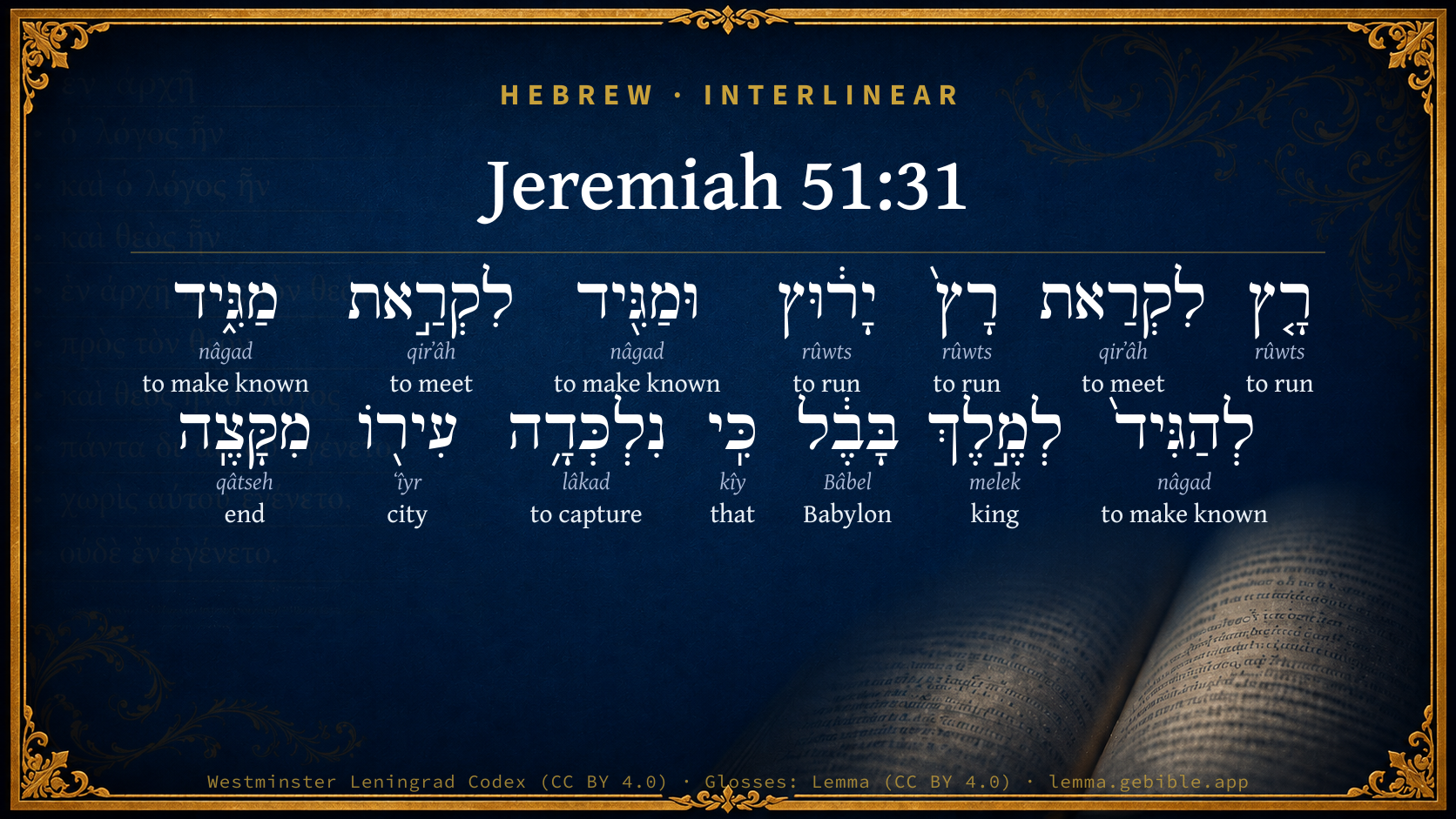
Hebrew (Westminster Leningrad Codex) Jeremiah 51:31 appears in the Hebrew Old Testament. The text above is from the Westminster Leningrad Codex. Each word links to its Strong’s number, a concise gloss, and parsing drawn from the Open Scriptures Hebrew Bible morphology. Click any word for its full Brown-Driver-Briggs (BDB) entry.
Download image
Cite this verse

Jeremiah 51:31 (World English Bible). Public Domain. Lemma interlinear Bible study tool, https://lemma.gebible.app/v/jeremiah/51/31.

Show BibTeX & RIS
BibTeX
RIS
English Translation
One post shall run to meet another, and one messenger to met another, to show the king of Babylon that his city is taken on every quarter:
World English Bible · Public Domain
Download a study sheet

One document with this verse’s original text, its word-by-word gloss line, the meaning frame, cross-references with their text, attributed commentary, and full source and license credits — printable, and it pastes into notes with its structure intact.

This verse Autodidact and up

Study sheet (.html) Plain text (.txt)

A passage Seminary Student

Up to 50 verses in one chapter. A passage sheet keeps up to 6 commentary sources and 12 cross-references per verse, in the order this page ranks them, and says so on the sheet whenever that leaves anything out. Ask for a single verse and you get the Autodidact verse sheet above.

Everything on this page stays free to read, with no account — the sheet is a download of what is already on screen, not access to it.

Want to remove ads? Support Godless Engineer
Compare translations 3

The same verse in 3 English versions, stacked beneath the original-language interlinear above. Click any original word for its lexicon entry.

Each is an independent rendering of the whole verse — the interlinear is not word-aligned to these translations.

Highlighted words mark where these versions differ — a whole-verse word diff, not a word-by-word alignment.

  • World English Bible Public Domain
    One post shall run to meet another, and one messenger to met another, to show the king of Babylon that his city is taken on every quarter:
  • King James Version Public Domain
    One post shall run to meet another, and one messenger to meet another, to shew the king of Babylon that his city is taken at one end,
  • unfoldingWord Literal Text CC BY-SA 4.0
    A messenger runs to proclaim to another messenger, and a runner tells another runner to report to the king of Babylon that his city has been taken from end to end.

unfoldingWord Literal Text — © unfoldingWord, licensed CC BY-SA 4.0. Word-aligned USFM3 via Door43 (git.door43.org/unfoldingWord/en_ult).

Versions to compare (up to 4)

3 of 4 selected

Show all 18 translations

Every available English version of this verse, each an independent rendering of the whole verse.

  • World English Bible Public Domain
    One post shall run to meet another, and one messenger to met another, to show the king of Babylon that his city is taken on every quarter:
  • Berean Standard Bible Public Domain
    One courier races to meet another, and messenger follows messenger, to announce to the king of Babylon that his city has been captured from end to end.
  • Majority Standard Bible Public Domain
    One courier races to meet another, and messenger follows messenger, to announce to the king of Babylon that his city has been captured from end to end.
  • King James Version Public Domain
    One post shall run to meet another, and one messenger to meet another, to shew the king of Babylon that his city is taken at one end,
  • American Standard Version (1901) Public Domain
    One post shall run to meet another, and one messenger to met another, to show the king of Babylon that his city is taken on every quarter:
  • Revised Version (1885) Public Domain
    One post shall run to meet another, and one messenger to meet another, to shew the king of Babylon that his city is taken on every quarter:
  • Geneva Bible (1599) Public Domain
    A post shall runne to meete the post, and a messenger to meete the messenger, to shew the King of Babel, that his citie is taken on a side thereof,
  • Douay-Rheims (1899) Public Domain
    One running post shall meet another, and messenger shall meet messenger: to tell the king of Babylon that his city is taken from one end to the other:
  • Young's Literal Translation Public Domain
    Runner to meet runner doth run, And announcer to meet announcer, To announce to the king of Babylon, For, captured hath been his city -- at the extremity.
  • Literal Standard Version CC BY-SA 4.0
    Runner runs to meet runner, || And announcer to meet announcer, || To announce to the king of Babylon, || For his city has been captured—at the extremity.
  • Unlocked Literal Bible CC BY-SA 4.0
    A messenger runs to proclaim to another messenger, and a runner tells another runner to report to the king of Babylon that his city has been taken from end to end.
  • unfoldingWord Literal Text CC BY-SA 4.0
    A messenger runs to proclaim to another messenger, and a runner tells another runner to report to the king of Babylon that his city has been taken from end to end.
  • Darby Bible Public Domain
    Courier runneth to meet courier, and messenger to meet messenger, to announce to the king of Babylon that his city is taken from end to end;
  • World Messianic Bible Public Domain
    One runner will run to meet another, and one messenger to meet another, to show the king of Babylon that his city is taken on every quarter.
  • Webster's Bible Public Domain
    One post shall run to meet another, and one messenger to meet another, to show the king of Babylon that his city is taken at one end,
  • Free Bible Version CC BY-SA 4.0
    A runner hands his message over to another to carry; one messenger follows another messenger, all of them alerting the king of Babylon to the news that his city has been completely conquered,
  • Bible in Basic English Public Domain
    One man, running, will give word to another, and one who goes with news will be handing it on to another, to give word to the king of Babylon that his town has been taken from every quarter:
  • JPS Tanakh (1917) Public Domain
    One post runneth to meet another, and one messenger to meet an other, to tell the king of Babylon that his city is taken on every quarter;

Literal Standard Version (2020), Covenant Press — licensed CC BY-SA 4.0. Text via the HelloAO Bible API (eBible.org). Unlocked Literal Bible (unfoldingWord) — licensed CC BY-SA 4.0. Text via the HelloAO Bible API (eBible.org). unfoldingWord Literal Text — © unfoldingWord, licensed CC BY-SA 4.0. Word-aligned USFM3 via Door43 (git.door43.org/unfoldingWord/en_ult). Free Bible Version, Dr. Jonathan Gallagher — licensed CC BY-SA 4.0. Text via the HelloAO Bible API (eBible.org).

Word by word

More ways to search: Search by grammar → Find every occurrence → Compare this word →

Practice this passage: Drill this verse → Learn its vocabulary →

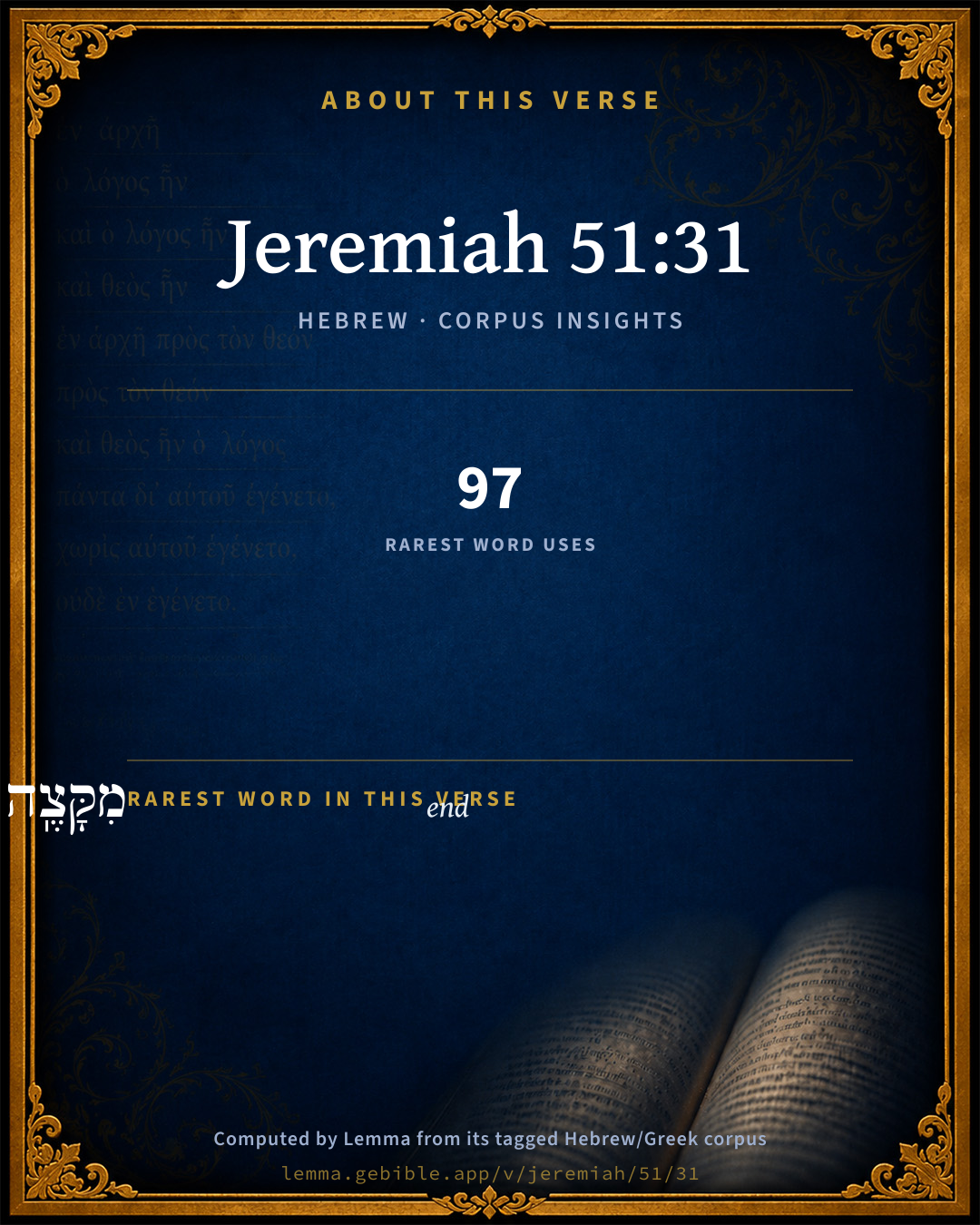
מִקָּצֶֽה
qâtseh
H7097
“from · end”
Preposition + Noun, Common, Both, Singular, Absolute
Part of Speech
Preposition + Noun
Type
Common
Gender
Both
Number
Singular
State
Absolute
Full BDB Definition

Origin: from H7096

TWOT: 2053a , 2053c

end, extremity - end, mouth, extremity - border, outskirts - the whole (condensed term for what is included within extremities) - at the end of (a certain time)
  1. רָ֤ץ rûwts H7323 “running” Verb, Qal, Participle Active, Masculine, Singular, Absolute
  2. לִקְרַאת qirʼâh H7125 “to meet” Preposition + Verb, Qal, Infinitive Construct
  3. רָץ֙ rûwts H7323 “running” Verb, Qal, Participle Active, Masculine, Singular, Absolute
  4. יָר֔וּץ rûwts H7323 “to run” Verb, Qal, Imperfect, 3rd Person, Masculine, Singular
  5. וּמַגִּ֖יד nâgad H5046 “and · making known” Conjunction + Verb, Hiphil, Participle Active, Masculine, Singular, Absolute
  6. לִקְרַ֣את qirʼâh H7125 “to meet” Preposition + Verb, Qal, Infinitive Construct
  7. מַגִּ֑יד nâgad H5046 “making known” Verb, Hiphil, Participle Active, Masculine, Singular, Absolute
  8. לְהַגִּיד֙ nâgad H5046 “to make known” Preposition + Verb, Hiphil, Infinitive Construct
  9. לְמֶ֣לֶךְ melek H4428 “to/for · king of” Preposition + Noun, Common, Masculine, Singular, Construct
  10. בָּבֶ֔ל Bâbel H894 “Babylon” Noun, Proper
  11. כִּֽי kîy H3588 “that” Conjunction
  12. נִלְכְּדָ֥ה lâkad H3920 “to capture” Verb, Niphal, Perfect, 3rd Person, Feminine, Singular
  13. עִיר֖וֹ ʻîyr H5892 “city · his” Noun, Common, Feminine, Singular, Construct + Suffix, Personal, 3rd Person, Masculine, Singular

About this verse

These counts appear in no published source. They are computed here, from the morphology-tagged text and Lemma’s own curated glosses. What Lemma adds →

14
words
9
distinct lemmas
Prophets
section

Grammatical profile

  • 9 verbs
  • 4 nouns
  • 1 conjunction

Verb forms

  • רָ֤ץ Qal · Participle Active
  • לִקְרַאת Qal · Infinitive Construct
  • רָץ֙ Qal · Participle Active
  • יָר֔וּץ Qal · Imperfect
  • וּמַגִּ֖יד Hiphil · Participle Active
  • לִקְרַ֣את Qal · Infinitive Construct
  • מַגִּ֑יד Hiphil · Participle Active
  • לְהַגִּיד֙ Hiphil · Infinitive Construct
  • נִלְכְּדָ֥ה Niphal · Perfect

Repetition

Words recur within this verse — often emphatic in Hebrew:

  • רָ֤ץ to run H7323 ×3
  • וּמַגִּ֖יד to make known H5046 ×3
  • לִקְרַאת to meet H7125 ×2

Cross-references

14

Topical passages linked to Jeremiah 51:31 in the Treasury of Scripture Knowledge — connected by theme and wording, ordered by reader-vote popularity; previews shown in the World English Bible.

  • 2 Samuel 18:19–31 Then said Ahimaaz the son of Zadok, Let me now run, and bear the king news, how that Yahweh has avenged him of his enemies.
  • 2 Chronicles 30:6 So the posts went with the letters from the king and his princes throughout all Israel and Judah, and according to the commandment of the king, saying, You children of Israel, turn again to Yahweh, the God of Abraham, Isaac, and Israel, that he may return to the remnant that have escaped of you out of the hand of the kings of Assyria.
  • 1 Samuel 4:12–18 There ran a man of Benjamin out of the army, and came to Shiloh the same day, with his clothes torn, and with earth on his head.
  • Esther 3:13–15 Letters were sent by posts into all the king's provinces, to destroy, to kill, and to cause to perish, all Jews, both young and old, little children and women, in one day, even on the thirteenth [day] of the twelfth month, which is the month Adar, and to take the spoil of them for a prey.
  • Esther 8:10 He wrote the name of king Ahasuerus, and sealed it with the king's ring, and sent letters by post on horseback, riding on swift steeds that were used in the king's service, bred of the stud:
  • Esther 8:14 So the posts who rode on swift steeds that were used in the king's service went out, being hurried and pressed on by the king's commandment; and the decree was given out in Shushan the palace.
  • Job 9:25 "Now my days are swifter than a runner. They flee away, they see no good,
  • Isaiah 21:3–9 Therefore are my loins filled with anguish; pangs have taken hold on me, as the pangs of a woman in travail: I am pained so that I can't hear; I am dismayed so that I can't see.
  • Isaiah 47:11–13 Therefore shall evil come on you; you shall not know the dawning of it: and mischief shall fall on you; you shall not be able to put it away: and desolation shall come on you suddenly, which you don't know.
  • Jeremiah 4:20 Destruction on destruction is cried; for the whole land is laid waste: suddenly are my tents destroyed, [and] my curtains in a moment.
  • Jeremiah 50:24 I have laid a snare for you, and you are also taken, Babylon, and you weren't aware: you are found, and also caught, because you have striven against Yahweh.
  • Jeremiah 50:43 The king of Babylon has heard the news of them, and his hands wax feeble: anguish has taken hold of him, [and] pangs as of a woman in travail.
  • Daniel 5:2–5 Belshazzar, while he tasted the wine, commanded to bring the golden and silver vessels which Nebuchadnezzar his father had taken out of the temple which was in Jerusalem; that the king and his lords, his wives and his concubines, might drink from it.
  • Daniel 5:30 In that night Belshazzar the Chaldean King was slain.

Cross-references courtesy of OpenBible.info (CC BY 4.0).

Hebrew and Greek witnesses Masoretic Hebrew ↔ Greek Septuagint

The same verse in the two great witnesses to the Old Testament, shown verse-for-verse.

These are two independent witnesses, not word-aligned to each other, and the Septuagint is shown in lemma (dictionary) form.

Hebrew Jeremiah 51:31 Masoretic · Westminster Leningrad Codex

רָ֤ץ לִקְרַאת רָץ֙ יָר֔וּץ וּמַגִּ֖יד לִקְרַ֣את מַגִּ֑יד לְהַגִּיד֙ לְמֶ֣לֶךְ בָּבֶ֔ל כִּֽי נִלְכְּדָ֥ה עִיר֖וֹ מִקָּצֶֽה

One post shall run to meet another, and one messenger to met another, to show the king of Babylon that his city is taken on every quarter:

World English Bible · Public Domain

Greek LXX Structure differs

In the Septuagint, Jeremiah is about an eighth shorter than the Hebrew and arranges its material differently — the Oracles Against the Nations (Hebrew chapters 46–51) appear in the middle of the Greek book, after 25:13. Because the chapter and verse boundaries do not line up, a verse-for-verse comparison with the Hebrew is not shown.

A verse-for-verse comparison isn’t shown here because the chapters and verses don’t line up. Switch to the LXX edition with the MT / LXX toggle above to read the Greek directly.

On this verse, John Gill's Exposition discusses the Septuagint’s reading. Read the note in Commentary ↓

Hebrew: Westminster Leningrad Codex (CC BY 4.0). Greek: Septuagint (public domain); English from a public-domain English Septuagint. How the Septuagint differs from the Hebrew →

Targum (Aramaic paraphrase)

1

The Targum is the ancient Jewish Aramaic paraphrase of the Hebrew Scriptures — an interpretive translation, not the Hebrew text itself. Onkelos (literal) and Pseudo-Jonathan (expansive) render the Torah, and Jonathan the Prophets. Coverage is partial: where no permissively-licensed English translation exists for a verse, only the Aramaic is shown. This is verse-level text, not a word-by-word alignment to the Hebrew.

  1. Targum Jonathan Prophets (Joshua–Malachi)
    רָהִיט לִקֳדָמוּת רָהִיט יִרְהוֹט וּמְחַוֵי לִקֳדָמוּת מִחַוֵי לְחַוָאָה לְמַלְכָּא דְבָבֶל אֲרֵי אִתְכְּבִישַׁת קַרְתֵּיהּ מִסוֹפֵיהּ:

    (no public-domain English translation for this verse)

    Targum Jonathan — Aramaic: “Mikraot Gedolot” (public domain). English: “Sefaria Community Translation” (CC0 1.0 (public-domain dedication)); “London "Chaldee Paraphrase," 1871” (public domain). Text via Sefaria.

Commentary

Notes on Jeremiah 51:31 from classic Christian and Jewish commentators (each source and its license shown beneath its notes). The classic Christian expositions comment on the surrounding passage and are grouped to its opening verse, so a note may address several verses; the Jewish commentaries on the Tanakh (Rashi and others) are per-verse, so they appear only where the commentator wrote on this verse.

Lemma curates 59 commentaries, every one of them public domain or Creative Commons licensed, each selected and text-cleaned for this edition rather than reprinted as found. About our sources →

Trapp's Complete Commentary

John Trapp

Jer 51:31 One post shall run to meet another, and one messenger to meet another, to shew the king of Babylon that his city is taken at [one] end,

Ver. 31. One post shall run to meet another.] Observe how punctually all things were foretold in the several circumstances more than fifty years before.

At one end,] sc., Where Euphrates had run, till diverted and dried up by Cyrus. See on Jer 50:38.

John Trapp, A Commentary or Exposition upon All the Books of the Old and New Testament (1647–1656) — public domain. Text from a community e-Sword module.

Tyndale Open Study Notes

Tyndale Open Resources

51:31 This king was Nabonidus; at the time, he was at Borsippa, north of Babylon. His son Belshazzar was regent in Babylon. See Dan 5:1-30.

Tyndale Open Study Notes — © Tyndale Open Resources, licensed CC BY-SA 4.0. Text via the HelloAO Bible API.

Geneva Bible (1599)

Geneva Bible translators

By turning the course of the river one side was made open and the reeds that did grow in the water were destroyed, which Cyrus did by the counsel of Gobria and Gabatha Belshazzar’s captains.

Geneva Bible (1599) marginal notes — public domain. Text via Bolls.life.

Jamieson, Fausset & Brown

Robert Jamieson, A. R. Fausset & David Brown

(See on Jer 50:24).

One post--One courier after another shall announce the capture of the city. The couriers despatched from the walls, where Cyrus enters, shall "meet" those sent by the king. Their confused running to and fro would result from the sudden panic at the entrance of Cyrus into the city, which he had so long besieged ineffectually; the Babylonians had laughed at his attempts and were feasting at the time without fear.

taken at one end--which was not known for a long time to the king and his courtiers feasting in the middle of the city; so great was its extent that, when the city was already three days in the enemy's hands, the fact was not known in some parts of the city [ARISTOTLE, Politics, 3.2].

Jamieson, Fausset & Brown — Commentary Critical and Explanatory on the Whole Bible (1871) — public domain (CC PDM 1.0). Text via the HelloAO Bible API.

Adam Clarke's Commentary

Verse 31. One post shall run to meet another] As the city was taken by surprise, in the manner already related, so now messengers, one after another, were despatched to give the king information of what was done; viz., that the city was taken at one end. Herodotus tells us that the extreme parts of the city were taken, before those of the centre knew any thing of the invasion. Herodot. lib. i. c. 191.

Adam Clarke's Commentary on the Bible (1810–1826) — public domain. Text from a community e-Sword/MySword module.

John Calvin's Commentaries

This also was fulfilled according to the testimony of heathen authors, as well as of Daniel. They do not indeed repeat these words, but according to the whole tenor of history we may easily conclude that messengers ran here and there, for the Babylonians never thought that the enemy could so suddenly penetrate into the city, for there was no entrance. We have seen how high the walls were, for there were no muskets then, and the walls could not have been beaten down. There were indeed battering-rams; but what was the breadth of the walls? even fifty feet, as already stated, so that four horses abreast could pass without coming into contact. There was then no battering-ram that could throw down walls so thick. As to the fords, the thing seemed incredible; so that they kept a feast in perfect security. In such an irruption, what our Prophet testifies here must have necessarily happened. But it is quite evident that he was the instrument of the Holy Spirit; for Cyrus was not as yet born when this prophecy was announced. We hence then know, that the holy man was guided from above, and that what he said was not produced in his own head, but was really celestial; for he could not have divined any such thing, nor was it through probable conjecture that he was able thus to speak and lead the Jews, as it were, into the very scene itself.

Nor is there a doubt but that this authority was afterwards confirmed when the fathers told their children, “So have we heard from the mouth of the Prophet what we now see with our eyes; and yet no man could have conjectured any such thing, nor have discovered it by reason or clearsightedness: hence Jeremiah must have necessarily been taught by the Spirit of God.” This, then, is the reason why God designed that the destruction of Babylon should be, as we see, so graphically described.

He then says, A runner ran to meet a runner, and then, a messenger to meet a messenger, to tell the king of Babylon that his city was taken at its extremity? Had this been said of a small city, it might have appeared ridiculous: why are these runners? one might say. But it has been sufficiently shown, that so extensive was that city, that runners, passing through many fields, might have come to the king, and convey the news that the city was taken at one of its extremities. And heathen writers cannot sufficiently eulogize the contrivance and skill of Cyrus, that, he thus took possession of so great a city; for he might have only secured one half of it, and Belshazzar might have retained the other half, and might have bravely contested with Cyrus and all his forces; and he would have no doubt overcome him, had it not been for the wonderful and unusual expedition of Cyrus. This haste, then, or expedition of Cyrus, is what the Prophet now sets forth, when he says that messengers ran to the king to tell him that the city was taken He now adds, respecting other things, what no one could have divined, —

John Calvin's Commentaries (1540-1563) — public domain. Text from the Calvin Translation Society English edition (1840s-50s) via the Christian Classics Ethereal Library (ccel.org). Calvin's coverage is partial (roughly two-thirds of the Bible); uncommented books and verses are honest gaps, never fabricated. The 19th-century editor's footnotes and remarks are omitted so the notes are faithfully Calvin's own voice.

Ellicott's Commentary for English Readers

(31) One post shall run to meet another.—The words exactly answer to the account of the capture of Babylon given in Herod. i. (see Note on Jer_51:24). The history of Belshazzar’s feast (Dan_5:1-30) must obviously have ended in a like result. No words could paint more vividly the panic of the surprised city.

A Bible Commentary for English Readers, edited by Charles John Ellicott (1878–1897) — public domain. Text from a community e-Sword module.

The Cambridge Bible for Schools and Colleges

gen. ed. J. J. S. Perowne

31. post] lit. runner. The word survives in this sense in modern English only in the expression post-haste. For the sense here cp.

“Your native town you entered like a post.”

Coriolanus, Act v sc. 5.

First denoting that which is placed (positum), it came to denote a fixed spot, e.g. a military post, or a place where horses are kept for travellers, then the person so travelling, and then any one travelling quickly. See Bible Word Book.

shall run to meet another] Bearing the tidings from opposite quarters, they shall meet at the king’s castle in the heart of the city.

on every quarter] See on Jer_50:26.

The Cambridge Bible for Schools and Colleges (gen. ed. J. J. S. Perowne; Cambridge University Press, 1878–1918) — public domain. Text from a community e-Sword module.

John Gill's Exposition

For thus saith the Lord of hosts, the God of Israel,.... "The Lord of hosts", the Lord God omnipotent, and can do all things; "the God of Israel", and therefore will plead their cause, and take vengeance on Babylon:

the daughter of Babylon is like a threshing floor; on which the nations of the earth had been threshed, or punished and destroyed; and now she was like a threshing floor, unto which should be gathered, and on which should be laid, her king, princes, and the people of the land, and be there beat and crushed to pieces. The Targum renders it the congregation of Babylon; and the Septuagint the houses of the king of Babylon; so the Arabic version:

it is time to thresh her; not the floor, but the sheaves on it: or, "it is the time to tread her" (u); as corn was trodden out by the oxen; or rather as threshing floors, being new laid with earth, were trodden, and so made hard and even, and by that means prepared for threshing against the harvest; when the corn would be ripe, cut down, and gathered in, and laid up, as follows:

yet a little while, and the time of her harvest shall come; when she would be ripe for ruin, and God would, by his instruments, put in the sickle of his wrath, and cut her down, her king, her princes, her cities, and her people; see Rev 14:15. The Targum is,

"and yet a very little while, and spoilers shall come to her.''

(u) "tempus calcandi eam", Pagninus, Calvin; "tempus calcare eam", Montanus; "eo tempore quo illa calcari solet", Piscator.

John Gill's Exposition of the Whole Bible (1746–1763) — public domain (CC PDM 1.0). Text via the HelloAO Bible API.

Albert Barnes' Notes on the Bible

The royal palace was a strong fortification in the heart of the city. The messengers thus met one another.

At one end - Rather, from all sides, entirely, completely.

Albert Barnes' Notes on the Bible (1834–1885) — public domain. Text from a community e-Sword/MySword module.

Haydock's Catholic Bible Commentary

King, feasting in his palace, (Herodotus i. 191.) or at Borsippe. (Berosus) He sent to make inquiries, (Calmet) or his subjects hastened to convey the doleful tidings, and thus met each other. (Haydock)

George Leo Haydock (1774–1849), Haydock's Catholic Family Bible and Commentary, 1859 edition — public domain. Excludes Psalms (Douay-Rheims chapter numbering differs from Protestant) and Deuterocanonical books (Catholic canon only).

Matthew Poole's English Annotations

We have had occasion one and again to recite what we have in civil historians about the taking of Babylon by Cyrus, viz., that it was taken by surprise, by the Median emperor’s unexpected diverting the river Euphrates by divers channels which he cut; as also that Babylon was a very vast city, the greatness of which might admit of posts and messengers from one end of the city to another, to acquaint the king what was done at the other end of the city in which himself was resident; and it is said that the king of Babylon, when his city, was taken, did not know of his danger until the enemy had entered the city.

Matthew Poole's English Annotations on the Holy Bible (1683–1685) — public domain. Text from a community e-Sword/MySword module.

Whedon's Commentary on the Bible

Daniel D. Whedon

31. One post shall run… and one messenger — Indicative of haste and confusion.

To show the king — Who is in his royal palace. These messengers come from all directions and meet one another in the palace with the same dreadful news.

Daniel D. Whedon (gen. ed.), Commentary on the Old and New Testaments (1874–1909) — public domain. Text from a community e-Sword module.

The Pulpit Commentary

One post shall run to meet another, etc. The wall being broken through at various points, couriers would meet each other on their way to the royal palace. This was itself a fortress in the centre of the city, on the Euphrates. The newly discovered cylinder inscription, however, shows that Nabonidus, the last King of Babylon, was not actually in the city at the time of the capture. At one end; rather, from end to end. (see on Jer_50:26)

The Pulpit Commentary (1880–1919), ed. H.D.M. Spence-Jones & Joseph S. Exell — public domain. Text from a community e-Sword module.

John Wesley's Explanatory Notes

At one end - Cyrus entered the city at one end, by the channel of the river, which he had drained, and surprized Belshazzar in the midst of his feast.

John Wesley, Explanatory Notes Upon the Whole Bible (1754–1765) — public domain. Text via the GEBible commentary corpus.

Lesson kit

Teaching starters — assembled from the data on this page, not authored interpretation. Every prompt links to the verse data it draws on. Edit before teaching.

Jeremiah, in the Prophets, opens this verse with 14 words (9 distinct Hebrew lemmas). Its most distinctive word is qâtseh (“end”). A historical commentator’s framing appears above. Read the whole chapter for the surrounding context.

Discussion questions

  1. How does “end” (qâtseh) shape what this verse is saying?
  2. How does 2 Samuel 18:19–31, which shares this passage’s theme, read alongside this verse?
  3. What does the repetition of “to run” (3× in this one verse) do in this verse?
  4. These translations render this verse differently; the difference is in the English rendering, not the original. What questions does that raise?
  5. «רָ֤ץ» is a Qal Participle Active verb. How does that grammatical form shape the action described?
  6. Compare how Trapp's Complete Commentary and Tyndale Open Study Notes read this verse. Where do they agree or differ?

Things to notice

Reading settings

Reading text

Shown beneath each verse's original-language words.

Old Testament
Old Testament edition

Read the OT as the Masoretic Hebrew (MT) or the Greek Septuagint (LXX).

English shown for the Greek Septuagint (in the Hebrew ↔ Greek comparison).

Comparing translations? Open the Compare panel on any verse page to stack up to four side by side.