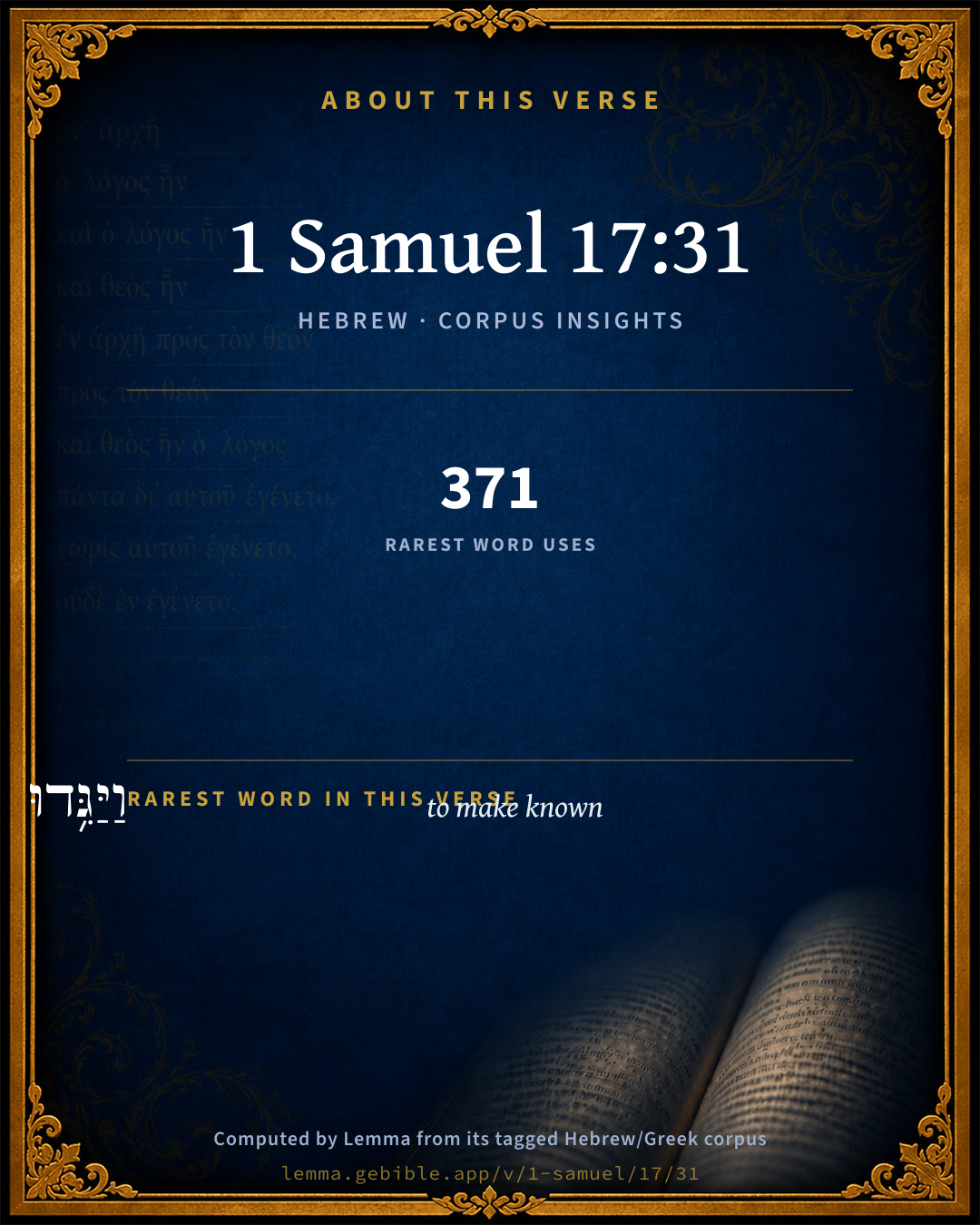
1 Samuel 17:31

Hebrew (Westminster Leningrad Codex) 1 Samuel 17:31 appears in the Hebrew Old Testament. The text above is from the Westminster Leningrad Codex. Each word links to its Strong’s number, a concise gloss, and parsing drawn from the Open Scriptures Hebrew Bible morphology. Click any word for its full Brown-Driver-Briggs (BDB) entry.
Download image
Cite this verse

1 Samuel 17:31 (World English Bible). Public Domain. Lemma interlinear Bible study tool, https://lemma.gebible.app/v/1-samuel/17/31.

Show BibTeX & RIS
BibTeX
RIS
English Translation
When the words were heard which David spoke, they rehearsed them before Saul; and he sent for him.
World English Bible · Public Domain
Download a study sheet

One document with this verse’s original text, its word-by-word gloss line, the meaning frame, cross-references with their text, attributed commentary, and full source and license credits — printable, and it pastes into notes with its structure intact.

This verse Autodidact and up

Study sheet (.html) Plain text (.txt)

A passage Seminary Student

Up to 50 verses in one chapter. A passage sheet keeps up to 6 commentary sources and 12 cross-references per verse, in the order this page ranks them, and says so on the sheet whenever that leaves anything out. Ask for a single verse and you get the Autodidact verse sheet above.

Everything on this page stays free to read, with no account — the sheet is a download of what is already on screen, not access to it.

Want to remove ads? Support Godless Engineer
Compare translations 3

The same verse in 3 English versions, stacked beneath the original-language interlinear above. Click any original word for its lexicon entry.

Each is an independent rendering of the whole verse — the interlinear is not word-aligned to these translations.

Highlighted words mark where these versions differ — a whole-verse word diff, not a word-by-word alignment.

  • World English Bible Public Domain
    When the words were heard which David spoke, they rehearsed them before Saul; and he sent for him.
  • King James Version Public Domain
    And when the words were heard which David spake, they rehearsed them before Saul: and he sent for him.
  • unfoldingWord Literal Text CC BY-SA 4.0
    And they heard the words that David spoke. And they declared to the face of Saul, and he got him.

unfoldingWord Literal Text — © unfoldingWord, licensed CC BY-SA 4.0. Word-aligned USFM3 via Door43 (git.door43.org/unfoldingWord/en_ult).

Versions to compare (up to 4)

3 of 4 selected

Show all 18 translations

Every available English version of this verse, each an independent rendering of the whole verse.

  • World English Bible Public Domain
    When the words were heard which David spoke, they rehearsed them before Saul; and he sent for him.
  • Berean Standard Bible Public Domain
    Now David’s words were overheard and reported to Saul, who called for him.
  • Majority Standard Bible Public Domain
    Now David’s words were overheard and reported to Saul, who sent for him.
  • King James Version Public Domain
    And when the words were heard which David spake, they rehearsed them before Saul: and he sent for him.
  • American Standard Version (1901) Public Domain
    And when the words were heard which David spake, they rehearsed them before Saul; and he sent for him.
  • Revised Version (1885) Public Domain
    And when the words were heard which David spake, they rehearsed them before Saul; and he sent for him.
  • Geneva Bible (1599) Public Domain
    And they that heard the wordes which Dauid spake, rehearsed them before Saul, which caused him to be brought.
  • Douay-Rheims (1899) Public Domain
    And the words which David spoke were heard, and were rehearsed before Saul.
  • Young's Literal Translation Public Domain
    And the words which David hath spoken are heard, and they declare before Saul, and he receiveth him;
  • Literal Standard Version CC BY-SA 4.0
    And the words which David has spoken are heard, and they declare [them] before Saul, and he receives him;
  • Unlocked Literal Bible CC BY-SA 4.0
    When the words that David said were heard, soldiers repeated them to Saul, and he sent for David.
  • unfoldingWord Literal Text CC BY-SA 4.0
    And they heard the words that David spoke. And they declared to the face of Saul, and he got him.
  • Darby Bible Public Domain
    And the words were heard which David spoke, and they rehearsed them before Saul; and he sent for him.
  • World Messianic Bible Public Domain
    When the words were heard which David spoke, they rehearsed them before Saul; and he sent for him.
  • Webster's Bible Public Domain
    And when the words were heard which David spoke, they rehearsed them before Saul: and he sent for him.
  • Free Bible Version CC BY-SA 4.0
    Someone overheard what David said and reported it to Saul who sent for him.
  • Bible in Basic English Public Domain
    And, hearing what David said, they gave Saul word of it: and he sent for him.
  • JPS Tanakh (1917) Public Domain
    And when the words were heard which David spoke, they rehearsed them before Saul; and he was taken to him.

Literal Standard Version (2020), Covenant Press — licensed CC BY-SA 4.0. Text via the HelloAO Bible API (eBible.org). Unlocked Literal Bible (unfoldingWord) — licensed CC BY-SA 4.0. Text via the HelloAO Bible API (eBible.org). unfoldingWord Literal Text — © unfoldingWord, licensed CC BY-SA 4.0. Word-aligned USFM3 via Door43 (git.door43.org/unfoldingWord/en_ult). Free Bible Version, Dr. Jonathan Gallagher — licensed CC BY-SA 4.0. Text via the HelloAO Bible API (eBible.org).

Word by word

More ways to search: Search by grammar → Find every occurrence → Compare this word →

Practice this passage: Drill this verse → Learn its vocabulary →

וַיַּגִּ֥דוּ
nâgad
H5046
“and · to make known”
Conjunction + Verb, Hiphil, Sequential Imperfect, 3rd Person, Masculine, Plural
Part of Speech
Conjunction + Verb
Stem
Hiphil
Form
Sequential Imperfect
Person
3rd Person
Gender
Masculine
Number
Plural
Full BDB Definition

Origin: a primitive root

TWOT: 1289

to be conspicuous, tell, make known - (Hiphil) to tell, declare - to tell, announce, report - to declare, make known, expound - to inform of - to publish, declare, proclaim - to avow, acknowledge, confess - messenger (participle) - (Hophal) to be told, be announced, be reported
  1. וַיְּשָּֽׁמְעוּ֙ shâmaʻ H8085 “and · to hear” Conjunction + Verb, Niphal, Sequential Imperfect, 3rd Person, Masculine, Plural
  2. הַדְּבָרִ֔ים dâbâr H1697 “the · words” Particle, Definite Article + Noun, Common, Masculine, Plural, Absolute
  3. אֲשֶׁ֖ר ʼăsher H834 “which” Particle, Relative
  4. דִּבֶּ֣ר dâbar H1696 “to speak” Verb, Piel, Perfect, 3rd Person, Masculine, Singular
  5. דָּוִ֑ד Dâvid H1732 “David” Noun, Proper
  6. לִפְנֵֽי pânîym H6440 “to/for · face(s) of” Preposition + Noun, Common, Both, Plural, Construct
  7. שָׁא֖וּל Shâʼûwl H7586 “Saul” Noun, Proper
  8. וַיִּקָּחֵֽהוּ lâqach H3947 “and · to take · him” Conjunction + Verb, Qal, Sequential Imperfect, 3rd Person, Masculine, Singular + Suffix, Personal, 3rd Person, Masculine, Singular

About this verse

These counts appear in no published source. They are computed here, from the morphology-tagged text and Lemma’s own curated glosses. What Lemma adds →

9
words
9
distinct lemmas
Historical
section

Grammatical profile

  • 4 verbs
  • 4 nouns
  • 1 particle

Verb forms

  • וַיְּשָּֽׁמְעוּ֙ Niphal · Sequential Imperfect
  • דִּבֶּ֣ר Piel · Perfect
  • וַיַּגִּ֥דוּ Hiphil · Sequential Imperfect
  • וַיִּקָּחֵֽהוּ Qal · Sequential Imperfect

Hebrew & Septuagint length

In English translation the verse runs 18 words from the Hebrew and 19 from the Septuagint (LXX English) — closely comparable.

A rough comparison of the two English renderings, which tokenize alike — not a word-level alignment.

Word counts can differ between the Hebrew and the Greek without any difference in meaning — e.g. the Hebrew direct-object marker אֵת has no separate Greek word, and Greek often adds the article ὁ.

Cross-references

1

Topical passages linked to 1 Samuel 17:31 in the Treasury of Scripture Knowledge — connected by theme and wording, ordered by reader-vote popularity; previews shown in the World English Bible.

  • Proverbs 22:29 Do you see a man skilled in his work? He will serve kings; He won't serve obscure men.

Cross-references courtesy of OpenBible.info (CC BY 4.0).

Hebrew and Greek witnesses Masoretic Hebrew ↔ Greek Septuagint

The same verse in the two great witnesses to the Old Testament, shown verse-for-verse.

These are two independent witnesses, not word-aligned to each other, and the Septuagint is shown in lemma (dictionary) form.

Hebrew 1 Samuel 17:31 Masoretic · Westminster Leningrad Codex

וַיְּשָּֽׁמְעוּ֙ הַדְּבָרִ֔ים אֲשֶׁ֖ר דִּבֶּ֣ר דָּוִ֑ד וַיַּגִּ֥דוּ לִפְנֵֽי שָׁא֖וּל וַיִּקָּחֵֽהוּ

When the words were heard which David spoke, they rehearsed them before Saul; and he sent for him.

World English Bible · Public Domain

Greek LXX 1 Samuel 17:31 Septuagint · lemma form

καί τρέχω δαυίδ καί ἐπιἵστημι ἐπί αὐτός καί λαμβάνω ὁ ῥομφαία αὐτός καί θανατόω αὐτός καί ἀποαἱρέω ὁ κεφαλή αὐτός καί ὁράω ὁ ἀλλόφυλος ὅτι θνήσκω ὁ δυνατός αὐτός καί φεύγω

And the Words which David spoke were heard and were reported to Saul. And he took him to himself.

LXX2012 (modern English Septuagint) · Public Domain

On this verse, John Gill's Exposition discusses the Septuagint’s reading. Read the note in Commentary ↓

Hebrew: Westminster Leningrad Codex (CC BY 4.0). Greek: Septuagint (public domain); English from LXX2012 (modern English Septuagint) (Public Domain). How the Septuagint differs from the Hebrew →

Targum (Aramaic paraphrase)

1

The Targum is the ancient Jewish Aramaic paraphrase of the Hebrew Scriptures — an interpretive translation, not the Hebrew text itself. Onkelos (literal) and Pseudo-Jonathan (expansive) render the Torah, and Jonathan the Prophets. Coverage is partial: where no permissively-licensed English translation exists for a verse, only the Aramaic is shown. This is verse-level text, not a word-by-word alignment to the Hebrew.

  1. Targum Jonathan Prophets (Joshua–Malachi)
    וְאִשְׁתְּמָעוּ פִתְגָמַיָא דְמַלֵיל דָוִד וְחַוִיאוּ קֳדָם שָׁאוּל וְדַבַּרְהִי:

    (no public-domain English translation for this verse)

    Targum Jonathan — Aramaic: “Mikraot Gedolot” (public domain). English: “Sefaria Community Translation” (CC0 1.0 (public-domain dedication)); “London "Chaldee Paraphrase," 1871” (public domain). Text via Sefaria.

Commentary

Notes on 1 Samuel 17:31 from classic Christian and Jewish commentators (each source and its license shown beneath its notes). The classic Christian expositions comment on the surrounding passage and are grouped to its opening verse, so a note may address several verses; the Jewish commentaries on the Tanakh (Rashi and others) are per-verse, so they appear only where the commentator wrote on this verse.

Lemma curates 59 commentaries, every one of them public domain or Creative Commons licensed, each selected and text-cleaned for this edition rather than reprinted as found. About our sources →

Matthew Henry's Commentary

David is at length presented to Saul for his champion (Sa1 17:31) and he bravely undertakes to fight the Philistine (Sa1 17:32): Let no man's heart fail because of him. It would have reflected too much upon the valour of his prince if he had said, Let not thy heart fail; therefore he speaks generally: Let no man's heart fail. A little shepherd, come but this morning from keeping sheep, has more courage than all the mighty men of Israel, and encourages them. Thus does God often send good words to his Israel, and do great things for them, by the weak and foolish things of the world. David only desires a commission from Saul to go and fight with the Philistine, but says nothing to him of the reward he had proposed, because that was not the thing he was ambitious of, but only the honour of serving God and his country: nor would he seem to question Saul's generosity. Two things David had to do with Saul: -

I. To get clear of the objection Saul made against his undertaking. "Alas!" says Saul, "thou hast a good heart to it, but art by no means an equal match for this Philistine. To engage with him is to throw away a life which may better be reserved for more agreeable services. Thou art but a youth, rash and inconsiderate, weak and unversed in arms: he is a man that has the head and hands of a man, a man of war, trained up and inured to it from his youth (Sa1 17:33), and how canst thou expect but that he will be too hard for thee?" David, as he had answered his brother's passion with meekness, so he answered Saul's fear with faith, and gives a reason of the hope which was in him that he should conquer the Philistine, to the satisfaction of Saul. We have reason to fear that Saul had no great acquaintance with nor regard to the word of God, and therefore David, in reasoning with him, fetched not his arguments and encouragements thence, how much soever he had an eye to it in his own mind. But he argues from experience; though he was but a youth, and never in the wars, yet perhaps he had done as much as the killing of Goliath came to, for he had had, by divine assistance, spirit enough to encounter and strength enough to subdue a lion once and another time a bear that robbed him of his lambs, Sa1 17:34-36. To these he compares this uncircumcised Philistine, looks upon him to be as much a ravenous beast as either of them, and therefore doubts not but to deal as easily with him; and hereby he gives Saul to understand that he was not so inexperienced in hazardous combats as he took him to be.

1. He tells his story like a man of spirit. He is not ashamed to own that he kept his father's sheep, which his brother had just now upbraided him with. So far is he from concealing it that from his employment as a shepherd he fetches the experience that now animated him. But he lets those about him know that he was no ordinary shepherd. Whatever our profession or calling is, be it ever so mean, we should labour to excel in it, and do the business of it in the best manner. When David kept sheep, (1.) He approved himself very careful and tender of his flock, though it was not his own, but his father's. He could not see a lamb in distress but he would venture his life to rescue it. This temper made him fit to be a king, to whom the lives of subjects should be dear and their blood precious (Psa 72:14), and fit to be a type of Christ, the good Shepherd, who gathers the lambs in his arms and carries them in his bosom (Isa 40:11), and who not only ventured, but laid down his life for his sheep. Thus too was David fit to be an example to ministers with the utmost care and diligence to watch for souls, that they be not a prey to the roaring lion. (2.) He approved himself very bold and brave in the defence of his flock. This was that which he was now concerned to give proof of, and better evidence could not be demanded than this: "Thy servant not only rescued the lambs, but, to revenge the injury, slew both the lion and the bear."

2. He applies his story like a man of faith. He owns (Sa1 17:37) it was the Lord that delivered him from the lion and the bear; to him he gives the praise of that great achievement, and thence he infers, He will deliver me out of the hand of this Philistine. "The lion and the bear were enemies only to me and my sheep, and it was in defence of my own interest that I attacked them; but this Philistine is an enemy to God and Israel, defies the armies of the living God, and it is for their honour that I attack him." Note, (1.) Our experiences ought to be improved by us as our encouragements to trust in God and venture in the way of duty. He that has delivered does and will. (2.) By the care which common Providence takes of the inferior creatures, and the protection they are under, we may be encouraged to depend upon that special Providence which surrounds the Israel of God. He that sets bounds to the waves of the sea and the rage of wild beasts can and will restrain the wrath of wicked men. Paul seems to allude to this of David (Ti2 4:17, Ti2 4:18), I was delivered out of the mouth of the lion, and therefore, I trust, the Lord shall deliver me. And perhaps David here thought of the story of Samson, and encouraged himself with it; for his slaying a lion was a happy presage of his many illustrious victories over the Philistines in single combat. Thus David took off Saul's objection against his undertaking, and gained a commission to fight the Philistine, with which Saul gave him a hearty good wish; since he would not venture himself, he prayed for him that would: Go, and the Lord be with thee, a good word, if it was not spoken customarily, and in a formal manner, as too often it is. But David has somewhat to do likewise,

II. To get clear of the armour wherewith Saul would, by all means, have him dressed up when he went upon this great action (Sa1 17:38): He armed David with his armour, not that which he wore himself, the disproportion of his stature would not admit that, but some that he kept in his armoury, little thinking that he on whom he now put his helmet and coat of mail must shortly inherit his crown and robe. David, being not yet resolved which way to attack his enemy, girded on his sword, not knowing, as yet, but he should have occasion to make use of it; but he found the armour would but encumber him, and would be rather his burden than his defence, and therefore he desires leave of Saul to put them off again: I cannot go with these, for I have not proved them, that is, "I have never been accustomed to such accoutrements as these." We may suppose Saul's armour was both very fine and very firm, but what good would it do David if it were not fit, or if he knew not how to manage himself in it? Those that aim at things above their education and usage, and covet the attire and armour of princes, forget that that is the best for us which we are fit for and accustomed to; if we had our desire, we should wish to be in our own coat again, and should say, "We cannot go with these;" we had therefore better go without them.

Matthew Henry's Commentary on the Whole Bible (1708–1710) — public domain (CC PDM 1.0). Text via the HelloAO Bible API.

Trapp's Complete Commentary

John Trapp

1Sa 17:31 And when the words were heard which David spake, they rehearsed [them] before Saul: and he sent for him.

Ver. 31. They rehearsed them before Saul.] This was according to David’s desire: and for this it was that he so busied himself in all companies, by making those inquiries: for his fingers even itched to be taking off the head of that "dead dog," which so howled against heaven.

John Trapp, A Commentary or Exposition upon All the Books of the Old and New Testament (1647–1656) — public domain. Text from a community e-Sword module.

Ellicott's Commentary for English Readers

(31) He sent for him.—No doubt much more was said by the brave shepherd boy than the compiler of the history has preserved for us in the brief account here. David felt that supernatural strength had been communicated to him by the Spirit of God, which came upon him on the day of his anointing (1Sa_16:13), and it is probable that he had openly avowed his earnest desire of meeting the dreaded foe face to face. This had been reported to Saul.

A Bible Commentary for English Readers, edited by Charles John Ellicott (1878–1897) — public domain. Text from a community e-Sword module.

John Gill's Exposition

And when the words were heard which David spake,.... To one, and to another, and these reported to other persons, and so they went from one to another through many hands:

they rehearsed them before Saul; coming to the ears of some of his courtiers and counsellors, or officers about him, they told him what such an one had said:

and he sent for him; to his tent or pavilion where he was, to talk with him on this subject. The whole of Sa1 17:11 is wanting in the Septuagint version, according to the Vatican exemplar; and these "twenty" verses are thought, by some (e), to be an interpolation; and it must be owned there are difficulties in them, and that the connection of Sa1 17:11 with the following is very clear and consistent, as also is Sa1 17:50 left out in the same version; and likewise the last four of the chapter, Sa1 17:55, and five with which the next begins, Sa1 18:1.

(e) See Dr. Kennicott's Dissert. 2. p. 418, &c.

John Gill's Exposition of the Whole Bible (1746–1763) — public domain (CC PDM 1.0). Text via the HelloAO Bible API.

The Pulpit Commentary

Vers. 31-37.

Reasonable confidence in God.

The facts are

1. David"s words being reported to Saul, he sends for him.

2. David volunteers to go forth and fight the Philistine.

3. In justification of his confidence, he refers to God"s deliverance of himfrom the lion and bear.

4. Saul bids him go, and desires for him the Lord"s presence. It wasdoubtless a relief to Saul to be informed that at least there was one in Israel who dared to accept the Philistine"s challenge. His surprise was equal to his relief, and may have lessened his hope, when he saw the stripling. The quiet confidence of David was natural and reasonable to himself, but evidently required some justification before Saul. The story Of the lion and bear was adduced, with beautiful simplicity of spirit, to indicate to Saul that the confidence cherished was amply warranted by past experience. To David"s mind the logic was unanswerable. It is by tracing the mental process by which David rested in his firm conviction that we shall see the true ground of our confidence in God, when called by his providence to enter upon undertakings of a serious nature.

I A PRIMARY TRUTH. The power of God is adequate to any human need. This general truth was the basis of David"s reasoning. It was involved in his very conception of Jehovah, and found beautiful utterance in his language of later years. The power of the Eternal was not a mere philosophic idea requisite to complete the notion of God, but a living energy permeating all things. The ascription of natural changes and events immediately to God (Ps 18) is only the expression of a faith which sees the Divine energy in and through all things. The people at Elah, on seeing Goliath, thought of his strength. The reverse effect produced in the mind of David by Goliath"s boast was the thought of the eternal power. The influence of general truths on our life is great greater than some suppose. They lie deep down in the mind, and yet are ever at command to regulate thought and feeling, and to suggest lines of conduct. Hence those in whom they are most fresh and clear are persons of wider range of view, sounder judgment, and deeper convictions. It is important to have the mend well fortified with those general truths that relate to God; and, in view of the difficulties and dangers of life, it is well to keep clear the truth that in Jehovah is "everlasting strength.

II AN EXPERIENCE. David referred to the experience he had had of the power of God in delivering him from the lion and bear while in the discharge of his life"s calling. The Almighty hand had befriended him at a time when he put forth his own energies to subdue his dangerous enemies. Without having recourse to miracle in these cases, it is enough to notice that David recognises Divine aid in the putting forth of effort, and the primary truth had been translated into the experience of life: and so become strikingly verified. A fact is an unanswerable argument. The logic strengthens. Most of us can fall back on deliverances from lions and adders. (Psa_91:13) The mental record of the past furnishes a premiss on which to build an argument of hope for the future. (2Ti_4:17, 2Ti_4:18)

III A REVEALED FACT. David could not cherish the confidence he did without welding with his primary truth and personal experience the fact that the Almighty was always the same, and that, therefore, continuity in aid might be looked for. The unchangeableness of God was an assured fact, not from philosophic speculation on the necessary nature of the Supreme, but because made clear to the mind by the Holy Spirit. (2Pe_1:21) "From everlasting to everlasting thou art God," keeping covenant forever. (Psa_89:34) Therefore the argument from past experience of his power was, so far, available for conflict with a gigantic foe. The force of this revealed fact concerning the Divine Being is great. It gives our mind a resting place amidst the incessant flux of things. It opens up to view a rock on which we can stand calm and secure in face of all changes of earth. The frailty of our life seems a blessing in association with so precious a reality. As the uniformity in the laws of nature furnish a basis of wise calculation and confidence in action, so the unchanging power of God in relation to human need is a ground of hope and confidence in pursuit of legitimate objects.

IV A PRESENT EMERGENCY. David found himself in presence of an emergency more trying than when lion and bear were confronted, for the interests were wide. He was too sensible a youth to imagine that the eternal power would be manifested because men desired it, whatever the occasion. But if aid was given formerly in real need, and now a need more pressing was felt, the argument of faith was conclusive. Moreover, the earlier occasions were private and personal; this was public, affecting the interests of Israel; and were not these the interests of him for whose advent Israel lived? The ruddy youth perhaps saw a connection between the overthrow of Goliath and the great kingdom of which he sang in Psalm 72. We have here a safe criterion of the reasonableness of confidence in God"s aid. When an emergency arises which deeply affects the honour and safety of Christ"s Church, and the diffusion of the blessings of his reign, we are warranted to cherish fullest confidence that God will help us in our endeavour, by such means as we possess, to meet the peril. Let Churches and individuals act by this rule, and they will never be disappointed. It is involved in the promise, "Lo, I am with you alway, even unto the end of the world.

V A PROVIDENCE. The previously noticed elements in the ground of David"s confidence were more influential from the fact that he did not force himself into the position, but was there by providential leading, in which he was quite passive. A man may at the last moment shrink from a dangerous work if conscious that he, by contrivance, sought it out; but when we are literally urged by circumstances into difficulties and dangers, and have a good cause in hand, then we may take the providence as an encouragement to go through. Providence led the apostles into conflict with rulers, and, hence, they dared to be confident.

VI A PLEA. David could fortify his expectation of help by the plea that his heart was honest in intent. He sought not to fight the giant for love of fighting, for securing renown, for any private end, but for love to his people Israel and the honour of Israel"s God. Purity of motive in ordinary life is no substitute for faith in Christ for acceptance with God; but it is a condition on which God grants his aid to us in our exertions. If we face gigantic evils, in themselves too great for our wisdom and strength, from an intense desire to conquer them for Christ, cherishing no vain personal ambition, then the highest confidence is justified. A power equal to our need, unchanged by time, realised in past experience, required for an emergency in which the honour of Christ is at stake, sought by one providentially led to face the difficulty, and desired not for vain reasons, but purely for the glory of God such a process of thought places confidence in God"s help on a most reasonable basis.

General lessons:

1. We should consider whether Providence has really given us arduous work to do for Christ.

2. Our wisdom is to go forth, not under the influence of the opinions ofunspiritual men, but under the full force of our own religious convictions.

3. We must not expect to know in what way the power of God will workwith us; the fact that it will is enough.

4. Success or failure in perilous enterprises for Christ depends much on thepurity of motive, and this should receive prayerful attention.

The Pulpit Commentary (1880–1919), ed. H.D.M. Spence-Jones & Joseph S. Exell — public domain. Text from a community e-Sword module.

unfoldingWord translationNotes

Door43 World Missions Community

When the words that David said were heard

This can be stated in active form. AT: "When the soldiers heard what David said" (See: Active or Passive)

Let no man's heart fail

The heart failing represents being terrified and losing confidence. AT: "Do not let anyone be terrified" or "Do not let anyone lose their confidence" (See: Metonymy)

your servant will go

David spoke of himself as "your servant" to show respect to Saul. AT: "I, your servant, will go" (See: First, Second, or Third Person)

translationWords

word

David

Saul (OT)

heart

Philistines

servant

unfoldingWord translationNotes — © Distant Shores Media and the Door43 World Missions Community, licensed CC BY-SA 4.0. Source: git.door43.org/Door43/en_tn.

Lesson kit

Teaching starters — assembled from the data on this page, not authored interpretation. Every prompt links to the verse data it draws on. Edit before teaching.

1 Samuel, in the Historical, opens this verse with 9 words (9 distinct Hebrew lemmas). Its most distinctive word is nâgad (“to make known”). A historical commentator’s framing appears above. Read the whole chapter for the surrounding context.

Discussion questions

  1. What does “to make known” (nâgad) contribute to the verse as a whole?
  2. Proverbs 22:29 shares this passage’s theme. How do the two illuminate each other?
  3. These translations render this verse differently. What is at stake in choosing one wording over another?
  4. The verb «וַיְּשָּֽׁמְעוּ֙» is Niphal Sequential Imperfect. How does its form color the action?
  5. Reading how Matthew Henry's Commentary and Trapp's Complete Commentary read this verse, where do the two commentators agree and where do they part?

Things to notice

Reading settings

Reading text

Shown beneath each verse's original-language words.

Old Testament
Old Testament edition

Read the OT as the Masoretic Hebrew (MT) or the Greek Septuagint (LXX).

English shown for the Greek Septuagint (in the Hebrew ↔ Greek comparison).

Comparing translations? Open the Compare panel on any verse page to stack up to four side by side.