
Ezekiel 40:4

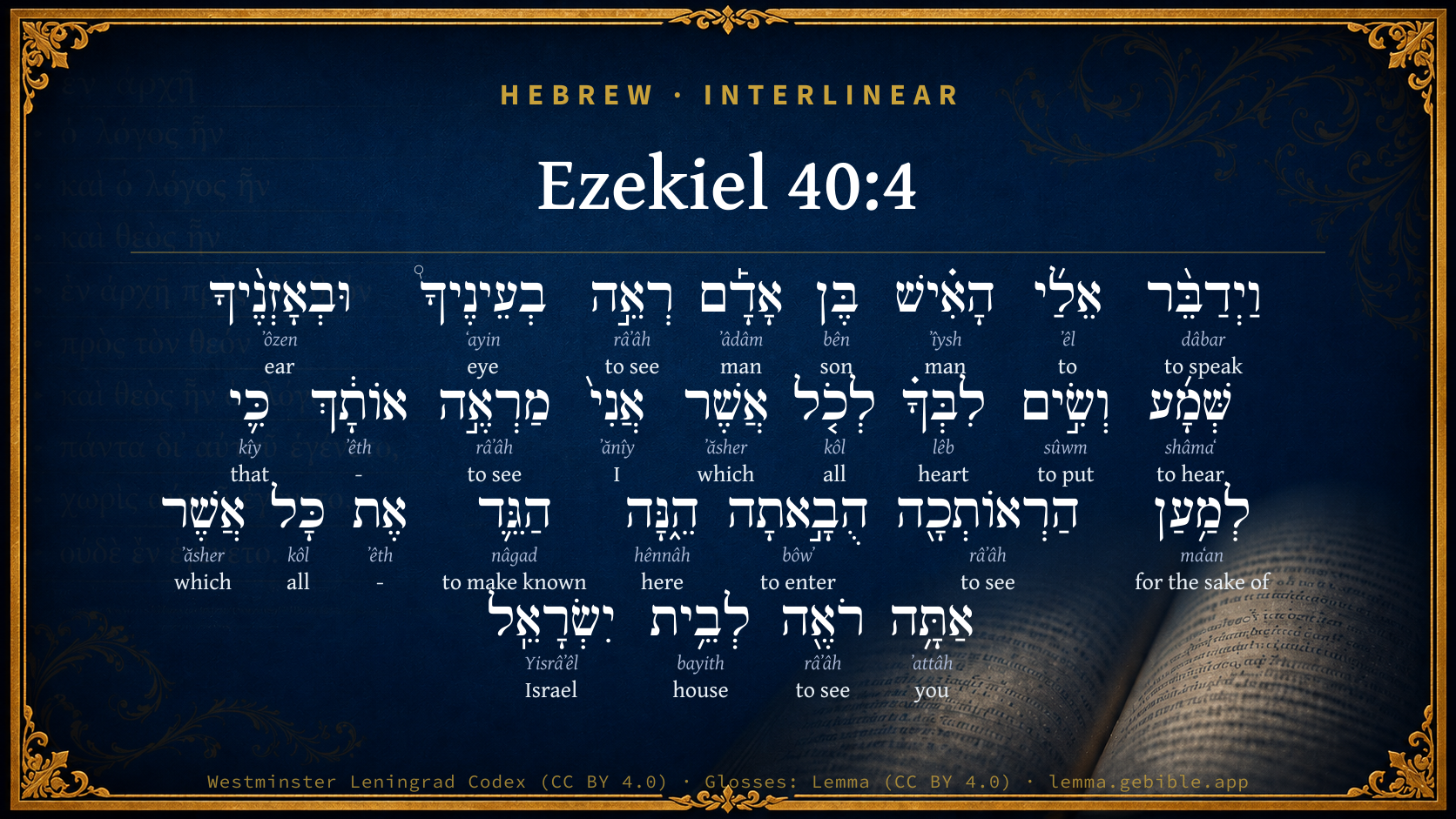
Hebrew (Westminster Leningrad Codex) Ezekiel 40:4 appears in the Hebrew Old Testament. The text above is from the Westminster Leningrad Codex. Each word links to its Strong’s number, a concise gloss, and parsing drawn from the Open Scriptures Hebrew Bible morphology. Click any word for its full Brown-Driver-Briggs (BDB) entry.
Download image
Cite this verse

Ezekiel 40:4 (World English Bible). Public Domain. Lemma interlinear Bible study tool, https://lemma.gebible.app/v/ezekiel/40/4.

Show BibTeX & RIS
BibTeX
RIS
English Translation
The man said to me, Son of man, see with your eyes, and hear with your ears, and set your heart on all that I shall show you; for, to the intent that I may show them to you, are you brought here: declare all that you see to the house of Israel.
World English Bible · Public Domain
Download a study sheet

One document with this verse’s original text, its word-by-word gloss line, the meaning frame, cross-references with their text, attributed commentary, and full source and license credits — printable, and it pastes into notes with its structure intact.

This verse Autodidact and up

Study sheet (.html) Plain text (.txt)

A passage Seminary Student

Up to 50 verses in one chapter. A passage sheet keeps up to 6 commentary sources and 12 cross-references per verse, in the order this page ranks them, and says so on the sheet whenever that leaves anything out. Ask for a single verse and you get the Autodidact verse sheet above.

Everything on this page stays free to read, with no account — the sheet is a download of what is already on screen, not access to it.

Want to remove ads? Support Godless Engineer
Compare translations 3

The same verse in 3 English versions, stacked beneath the original-language interlinear above. Click any original word for its lexicon entry.

Each is an independent rendering of the whole verse — the interlinear is not word-aligned to these translations.

Highlighted words mark where these versions differ — a whole-verse word diff, not a word-by-word alignment.

  • World English Bible Public Domain
    The man said to me, Son of man, see with your eyes, and hear with your ears, and set your heart on all that I shall show you; for, to the intent that I may show them to you, are you brought here: declare all that you see to the house of Israel.
  • King James Version Public Domain
    And the man said unto me, Son of man, behold with thine eyes, and hear with thine ears, and set thine heart upon all that I shall shew thee; for to the intent that I might shew them unto thee art thou brought hither: declare all that thou seest to the house of Israel.
  • unfoldingWord Literal Text CC BY-SA 4.0
    The man said to me, “Son of man, look with your eyes and listen with your ears, and fix your mind on all that I am revealing to you, for you were brought here so I could reveal them to you. Report everything that you will see to the house of Israel.”

unfoldingWord Literal Text — © unfoldingWord, licensed CC BY-SA 4.0. Word-aligned USFM3 via Door43 (git.door43.org/unfoldingWord/en_ult).

Versions to compare (up to 4)

3 of 4 selected

Show all 18 translations

Every available English version of this verse, each an independent rendering of the whole verse.

  • World English Bible Public Domain
    The man said to me, Son of man, see with your eyes, and hear with your ears, and set your heart on all that I shall show you; for, to the intent that I may show them to you, are you brought here: declare all that you see to the house of Israel.
  • Berean Standard Bible Public Domain
    “Son of man,” he said to me, “look with your eyes, hear with your ears, and pay attention to everything I am going to show you, for that is why you have been brought here. Report to the house of Israel everything you see.”
  • Majority Standard Bible Public Domain
    “Son of man,” he said to me, “look with your eyes, hear with your ears, and pay attention to everything I am going to show you, for that is why you have been brought here. Report to the house of Israel everything you see.”
  • King James Version Public Domain
    And the man said unto me, Son of man, behold with thine eyes, and hear with thine ears, and set thine heart upon all that I shall shew thee; for to the intent that I might shew them unto thee art thou brought hither: declare all that thou seest to the house of Israel.
  • American Standard Version (1901) Public Domain
    And the man said unto me, Son of man, behold with thine eyes, and hear with thine ears, and set thy heart upon all that I shall show thee; for, to the intent that I may show them unto thee, art thou brought hither: declare all that thou seest to the house of Israel.
  • Revised Version (1885) Public Domain
    And the man said unto me, Son of man, behold with thine eyes, and hear with thine ears, and set thine heart upon all that I shall shew thee; for to the intent that I might shew them unto thee art thou brought hither: declare all that thou seest to the house of Israel.
  • Geneva Bible (1599) Public Domain
    And the man said vnto me, Sonne of man, beholde with thine eyes, and heare with thine eares, and set thine heart vpon all that I shall shew thee: for to the intent, that they might be shewed thee, art thou brought hither: declare al that thou seest, vnto the house of Israel.
  • Douay-Rheims (1899) Public Domain
    And this man said to me: Son of man, see with thy eyes, and hear with thy ears, and set thy heart upon all that I shall shew thee: for thou art brought hither that they may be shewn to thee: declare all that thou seest, to the house of Israel.
  • Young's Literal Translation Public Domain
    and the man speaketh unto me: `Son of man, see with thine eyes, And with thine ears hear, And set thy heart to all that I am shewing thee, For, in order to shew `it' thee, Thou hast been brought in hither, Declare all that thou art seeing to the house of Israel.'
  • Literal Standard Version CC BY-SA 4.0
    and the man speaks to me: “Son of man, see with your eyes, || And hear with your ears, || And set your heart to all that I am showing you, || For in order to show [it] you, || You have been brought in here, || Declare all that you are seeing to the house of Israel.”
  • Unlocked Literal Bible CC BY-SA 4.0
    The man said to me, “Son of man, look with your eyes and listen with your ears, and fix your mind on all that I am revealing to you, for you were brought here so I could reveal them to you. Report everything that you will see to the house of Israel.”
  • unfoldingWord Literal Text CC BY-SA 4.0
    The man said to me, “Son of man, look with your eyes and listen with your ears, and fix your mind on all that I am revealing to you, for you were brought here so I could reveal them to you. Report everything that you will see to the house of Israel.”
  • Darby Bible Public Domain
    And the man said unto me, Son of man, behold with thine eyes, and hear with thine ears, and set thy heart upon all that I shall shew thee; for in order that it might be shewn unto thee art thou brought hither. Declare to the house of Israel all that thou seest.
  • World Messianic Bible Public Domain
    The man said to me, “Son of man, see with your eyes, and hear with your ears, and set your heart on all that I will show you; for you have been brought here so that I may show them to you. Declare all that you see to the house of Israel.”
  • Webster's Bible Public Domain
    And the man said to me, Son of man, behold with thy eyes, and hear with thy ears, and set thy heart upon all that I shall show thee; for, to the intent that I might show them to thee art thou brought hither: declare all that thou seest to the house of Israel.
  • Free Bible Version CC BY-SA 4.0
    “Son of man,” he told me, “watch with your eyes, listen with your ears. Concentrate on everything I'm about to show you, because that's the reason you were brought here. You are to explain to the people of Israel what you've been shown, everything you see.”
  • Bible in Basic English Public Domain
    And the man said to me, Son of man, see with your eyes and give hearing with your ears, and take to heart everything I am going to let you see; for in order that I might let you see them, you have come here: and give an account of all you see to the children of Israel.
  • JPS Tanakh (1917) Public Domain
    And the man said unto me: 'Son of man, behold with thine eyes, and hear with thine ears, and set thy heart upon all that I shall show thee, for to the intent that I might show them unto thee art thou brought thither; declare all that thou seest to the house of Israel.'

Literal Standard Version (2020), Covenant Press — licensed CC BY-SA 4.0. Text via the HelloAO Bible API (eBible.org). Unlocked Literal Bible (unfoldingWord) — licensed CC BY-SA 4.0. Text via the HelloAO Bible API (eBible.org). unfoldingWord Literal Text — © unfoldingWord, licensed CC BY-SA 4.0. Word-aligned USFM3 via Door43 (git.door43.org/unfoldingWord/en_ult). Free Bible Version, Dr. Jonathan Gallagher — licensed CC BY-SA 4.0. Text via the HelloAO Bible API (eBible.org).

Word by word

More ways to search: Search by grammar → Find every occurrence → Compare this word →

Practice this passage: Drill this verse → Learn its vocabulary →

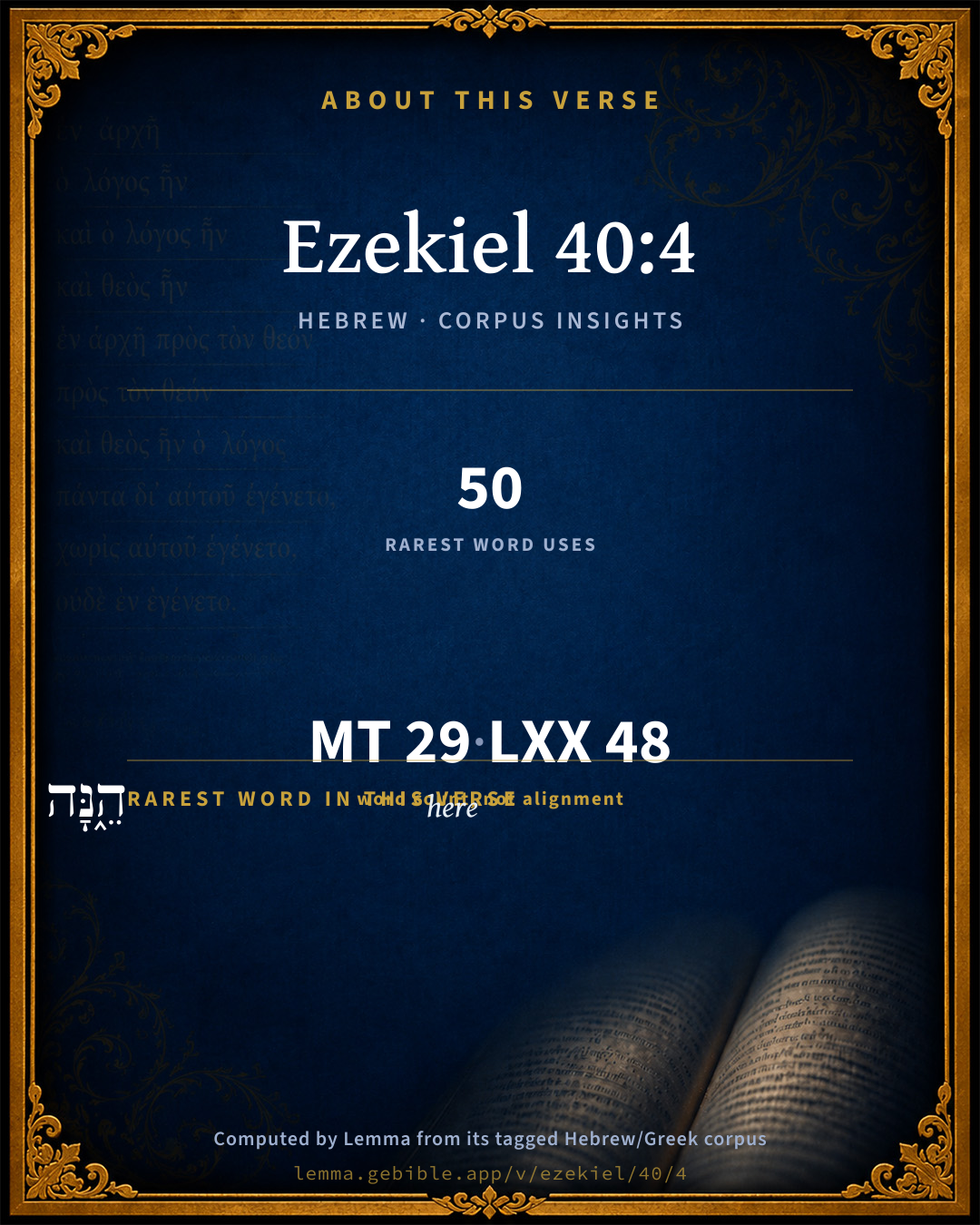
הֵ֑נָּה
hênnâh
H2008
“here”
Adverb
Part of Speech
Adverb
Full BDB Definition

Origin: from H2004

TWOT: 510b

here, there, now, hither
  1. וַיְדַבֵּ֨ר dâbar H1696 “and · to speak” Conjunction + Verb, Piel, Sequential Imperfect, 3rd Person, Masculine, Singular
  2. אֵלַ֜י ʼêl H413 “to · me” Preposition + Suffix, Personal, 1st Person, Common, Singular
  3. הָאִ֗ישׁ ʼîysh H376 “the · man” Particle, Definite Article + Noun, Common, Masculine, Singular, Absolute
  4. בֶּן bên H1121 “son of” Noun, Common, Masculine, Singular, Construct
  5. אָדָ֡ם ʼâdâm H120 “man” Noun, Common, Masculine, Singular, Absolute
  6. רְאֵ֣ה râʼâh H7200 “see” Verb, Qal, Imperative, 2nd Person, Masculine, Singular
  7. בְעֵינֶיךָ֩ ʻayin H5869 “in/at · eyes · your” Preposition + Noun, Common, Both, Dual, Construct + Suffix, Personal, 2nd Person, Masculine, Singular
  8. וּבְאָזְנֶ֨יךָ ʼôzen H241 “and · in/at · ears · your” Conjunction + Preposition + Noun, Common, Feminine, Dual, Construct + Suffix, Personal, 2nd Person, Masculine, Singular
  9. שְּׁמָ֜ע shâmaʻ H8085 “hear” Verb, Qal, Imperative, 2nd Person, Masculine, Singular
  10. וְשִׂ֣ים sûwm H7760 “and · put” Conjunction + Verb, Qal, Imperative, 2nd Person, Masculine, Singular
  11. לִבְּךָ֗ lêb H3820 “heart · your” Noun, Common, Masculine, Singular, Construct + Suffix, Personal, 2nd Person, Masculine, Singular
  12. לְכֹ֤ל kôl H3605 “to/for · all” Preposition + Noun, Common, Masculine, Singular, Absolute
  13. אֲשֶׁר ʼăsher H834 “which” Particle, Relative
  14. אֲנִי֙ ʼănîy H589 “I” Pronoun, Personal, 1st Person, Common, Singular
  15. מַרְאֶ֣ה râʼâh H7200 “seeing” Verb, Hiphil, Participle Active, Masculine, Singular, Absolute
  16. אוֹתָ֔ךְ ʼêth H853 “- · you” Particle, Direct Object + Suffix, Personal, 2nd Person, Feminine, Singular
  17. כִּ֛י kîy H3588 “that” Conjunction
  18. לְמַ֥עַן maʻan H4616 “for the sake of” Preposition
  19. הַרְאוֹתְכָ֖ה râʼâh H7200 “to see · you” Verb, Hiphil, Infinitive Construct + Suffix, Personal, 2nd Person, Masculine, Singular
  20. הֻבָ֣אתָה bôwʼ H935 “to enter” Verb, Hophal, Perfect, 2nd Person, Masculine, Singular
  21. הַגֵּ֛ד nâgad H5046 “make known” Verb, Hiphil, Imperative, 2nd Person, Masculine, Singular
  22. אֶת ʼêth H853 “-” Particle, Direct Object
  23. כָּל kôl H3605 “all of” Noun, Common, Masculine, Singular, Construct
  24. אֲשֶׁר ʼăsher H834 “which” Particle, Relative
  25. אַתָּ֥ה ʼattâh H859 “you” Pronoun, Personal, 2nd Person, Masculine, Singular
  26. רֹאֶ֖ה râʼâh H7200 “seeing” Verb, Qal, Participle Active, Masculine, Singular, Absolute
  27. לְבֵ֥ית bayith H1004 “to/for · house of” Preposition + Noun, Common, Masculine, Singular, Construct
  28. יִשְׂרָאֵֽל Yisrâʼêl H3478 “Israel” Noun, Proper

About this verse

These counts appear in no published source. They are computed here, from the morphology-tagged text and Lemma’s own curated glosses. What Lemma adds →

29
words
23
distinct lemmas
Prophets
section

Shared distinctive vocabulary

הֵ֑נָּה here H2008 occurs in 42 verses of the Hebrew Bible. Also found in:

Grammatical profile

  • 9 verbs
  • 10 nouns
  • 2 pronouns
  • 2 prepositions
  • 1 conjunction
  • 1 adverb
  • 4 particles

Verb forms

  • וַיְדַבֵּ֨ר Piel · Sequential Imperfect
  • רְאֵ֣ה Qal · Imperative
  • שְּׁמָ֜ע Qal · Imperative
  • וְשִׂ֣ים Qal · Imperative
  • מַרְאֶ֣ה Hiphil · Participle Active
  • הַרְאוֹתְכָ֖ה Hiphil · Infinitive Construct
  • הֻבָ֣אתָה Hophal · Perfect
  • הַגֵּ֛ד Hiphil · Imperative
  • רֹאֶ֖ה Qal · Participle Active

Repetition

Words recur within this verse — often emphatic in Hebrew:

  • רְאֵ֣ה to see H7200 ×4
  • לְכֹ֤ל all H3605 ×2
  • אֲשֶׁר which H834 ×2

Hebrew & Septuagint length

In English translation the verse runs 53 words from the Hebrew and 61 from the Septuagint (LXX English) — closely comparable.

A rough comparison of the two English renderings, which tokenize alike — not a word-level alignment.

Word counts can differ between the Hebrew and the Greek without any difference in meaning — e.g. the Hebrew direct-object marker אֵת has no separate Greek word, and Greek often adds the article ὁ.

In the original languages it is 29 Hebrew tokens and 48 Greek tokens — but the two are counted differently (Hebrew bundles its prefixes and suffixes into one token; the Greek is in lemma form), so that isn’t a like-for-like length.

Cross-references

12

Topical passages linked to Ezekiel 40:4 in the Treasury of Scripture Knowledge — connected by theme and wording, ordered by reader-vote popularity; previews shown in the World English Bible.

  • Ezekiel 44:5 Yahweh said to me, Son of man, mark well, and see with your eyes, and hear with your ears all that I tell you concerning all the ordinances of the house of Yahweh, and all the laws of it; and mark well the entrance of the house, with every exit of the sanctuary.
  • Jeremiah 26:2 Thus says Yahweh: Stand in the court of Yahweh's house, and speak to all the cities of Judah, which come to worship in Yahweh's house, all the words that I command you to speak to them; don't diminish a word.
  • Ezekiel 2:7–8 You shall speak my words to them, whether they will hear, or whether they will forbear; for they are most rebellious.
  • Ezekiel 43:10 You, son of man, show the house to the house of Israel, that they may be ashamed of their iniquities; and let them measure the pattern.
  • Matthew 10:27 What I tell you in the darkness, speak in the light; and what you hear whispered in the ear, proclaim on the housetops.
  • Ezekiel 2:1 He said to me, Son of man, stand on your feet, and I will speak with you.
  • Ezekiel 3:17 Son of man, I have made you a watchman to the house of Israel: therefore hear the word at my mouth, and give them warning from me.
  • Matthew 13:9 He who has ears to hear, let him hear."
  • Isaiah 21:10 You my threshing, and the grain of my floor! that which I have heard from Yahweh of hosts, the God of Israel, have I declared to you.
  • Matthew 13:51–52 Jesus said to them, "Have you understood all these things?" They answered him, "Yes, Lord."
  • Acts 20:27 for I didn't shrink from declaring to you the whole counsel of God.
  • 1 Corinthians 11:23 For I received from the Lord that which also I delivered to you, that the Lord Jesus on the night in which he was betrayed took bread.

Cross-references courtesy of OpenBible.info (CC BY 4.0).

Hebrew and Greek witnesses Masoretic Hebrew ↔ Greek Septuagint

The same verse in the two great witnesses to the Old Testament, shown verse-for-verse.

These are two independent witnesses, not word-aligned to each other, and the Septuagint is shown in lemma (dictionary) form.

Hebrew Ezekiel 40:4 Masoretic · Westminster Leningrad Codex

וַיְדַבֵּ֨ר אֵלַ֜י הָאִ֗ישׁ בֶּן אָדָ֡ם רְאֵ֣ה בְעֵינֶיךָ֩ וּבְאָזְנֶ֨יךָ שְּׁמָ֜ע וְשִׂ֣ים לִבְּךָ֗ לְכֹ֤ל אֲשֶׁר אֲנִי֙ מַרְאֶ֣ה אוֹתָ֔ךְ כִּ֛י לְמַ֥עַן הַרְאוֹתְכָ֖ה הֻבָ֣אתָה הֵ֑נָּה הַגֵּ֛ד אֶת כָּל אֲשֶׁר אַתָּ֥ה רֹאֶ֖ה לְבֵ֥ית יִשְׂרָאֵֽל

The man said to me, Son of man, see with your eyes, and hear with your ears, and set your heart on all that I shall show you; for, to the intent that I may show them to you, are you brought here: declare all that you see to the house of Israel.

World English Bible · Public Domain

Greek LXX Ezekiel 40:4 Septuagint · lemma form

καί εἶπον πρός ἐγώ ὁ ἀνήρ ὁράω υἱός ἄνθρωπος ἐν ὁ ὀφθαλμός σύ ὁράω καί ἐν ὁ οὖς σύ ἀκούω καί τάσσω εἰς ὁ καρδία σύ πᾶς ὅσος ἐγώ δεικνύω σύ διότι ἕνεκα ὁ δεικνύω σύ εἰςἔρχομαι ὧδε καί δεικνύω πᾶς ὅσος σύ ὁράω ὁ οἶκος ὁ ἰσραήλ

And the man said to me, Look with your eyes at him whom you have seen, son of man, and hear with your ears, and lay up in your heart all things that I show you; for you have come in hither that I might show you, and you shall show all things that you see to the house of Israel.

LXX2012 (modern English Septuagint) · Public Domain

Hebrew: Westminster Leningrad Codex (CC BY 4.0). Greek: Septuagint (public domain); English from LXX2012 (modern English Septuagint) (Public Domain). How the Septuagint differs from the Hebrew →

Targum (Aramaic paraphrase)

1

The Targum is the ancient Jewish Aramaic paraphrase of the Hebrew Scriptures — an interpretive translation, not the Hebrew text itself. Onkelos (literal) and Pseudo-Jonathan (expansive) render the Torah, and Jonathan the Prophets. Coverage is partial: where no permissively-licensed English translation exists for a verse, only the Aramaic is shown. This is verse-level text, not a word-by-word alignment to the Hebrew.

  1. Targum Jonathan Prophets (Joshua–Malachi)
    וּמַלֵיל עִמִי גַבְרָא בַּר אָדָם חֲזֵי בְעֵינָךְ וּבְאוּדְנָךְ שְׁמַע וְשַׁוֵי לִבָּךְ לְכָל דִי אֲנָא מַחֲזֵי יָתָךְ אֲרֵי בְּדִיל לְאַחְזָיוּתָךְ אִתּוֹתַבְתָא הַלִכָא חַוֵי יַת כָּל דְאַתְּ חָזֵי לְבֵית יִשְׂרָאֵל:

    (no public-domain English translation for this verse)

    Targum Jonathan — Aramaic: “Mikraot Gedolot” (public domain). English: “Sefaria Community Translation” (CC0 1.0 (public-domain dedication)); “London "Chaldee Paraphrase," 1871” (public domain). Text via Sefaria.

Commentary

Notes on Ezekiel 40:4 from classic Christian and Jewish commentators (each source and its license shown beneath its notes). The classic Christian expositions comment on the surrounding passage and are grouped to its opening verse, so a note may address several verses; the Jewish commentaries on the Tanakh (Rashi and others) are per-verse, so they appear only where the commentator wrote on this verse.

Lemma curates 59 commentaries, every one of them public domain or Creative Commons licensed, each selected and text-cleaned for this edition rather than reprinted as found. About our sources →

Trapp's Complete Commentary

John Trapp

Eze 40:4 And the man said unto me, Son of man, behold with thine eyes, and hear with thine ears, and set thine heart upon all that I shall shew thee; for to the intent that I might shew [them] unto thee [art] thou brought hither: declare all that thou seest to the house of Israel.

Ver. 4. Son of man.] A most kind compellation, holding forth Christ’s philanthropy or love to mankind. He calleth us "sons of men," who for our sakes became "The Son of man," that we might become the sons of God. It is observed that Ezekiel, with the Seventy, is υιος ανθρωπου, the Son of man; but Christ is υιος του ανθρωπου - that is, the Son of Adam: he was the next and only other common person.

Behold with thine eyes, and hear with thine ears, and set thine heart, &c.] We should give all possible diligence and heed to a discourse of the New Jerusalem, that city of pearl; setting to work both our outward and inward senses, and those well exercised, to discern both good and evil. {Heb 5:14}

Declare all that thou seest unto the house of Israel.] For therefore hast thou seen it. The manifestation of the Spirit is given to every man to profit with. {1Co 12:7} And as any man hath received the gift, so let him minister the same to others. {1Pe 4:10} What use is there of a candle under a bushel?

John Trapp, A Commentary or Exposition upon All the Books of the Old and New Testament (1647–1656) — public domain. Text from a community e-Sword module.

The Biblical Illustrator

Joseph S. Exell

Eze_40:4

To the intent that I might shew them unto thee.

A good intent

I. The purpose of God to stain the pride of the glory of all flesh. We may gather some instruction upon this from the 4th chapter of Daniel. The testimony that Nebuchadnezzar himself bore at the last, seems to me to be very expressive, and may be, as it were, put into the mouth of everyone that God has humbled. It is truth that we all do need humbling by the power of God. Happy man you will be if you are brought to nothing. It is one of the hardest things in the world to be nothing--to be nothing but a sinner; not a good thought, not a good word, not a good work, not a single grain or atom of goodness, but a thing of nought altogether. Now God has purposed this; He has purposed to stain the pride of the glory of all flesh; and He has purposed to do so first in mercy, and then He will do so in wrath; that is, those that He does not deal so with in their lifetime as to humble them down that they may receive His truth, He will deal with in wrath at that last great, that tremendous day. Every mans natural spirit is a spirit of ignorance, a spirit of unbelief, a spirit of enmity against God. Wherever true conviction enters, the soul is divided from the spirit of ignorance, and the soul comes into the knowledge of its own condition; the soul is divided from the spirit of unbelief, and comes into the faith of the Gospel; the soul of the man, his immortal soul, is divided from the native enmity of the spirit; for the natural spirit that is in us lusteth to envy, desireth to envy; it is the very desire of it, the very essence of it. Now when God begins His work it severs the soul from this spirit.

II. The purpose of the Lord in bringing His people to receive the truth. If the Lord has thus brought you down far enough, then I will name now the truths that you will be glad to receive. The man that is from his own experience prepared to receive that testimony certainly is not far from the kingdom of God; the man that is prepared from his heart and soul to receive that testimony in the understanding of it, in the love of it, and to abide thereby--there never was one so poor in spirit, there never was one so humbled, there never was one so led, and at the same time lost. If we are really brought down and know our nothingness, our hearts are prepared to receive the testimony in the 1st chapter of Second Timothy. The apostle knew the tendency; he knew that Timothy would get no worldly honour; he knew it would make Timothy rather what they call narrow-minded; he knew it would be offensive to many professors, but he says, Be not thou ashamed of the testimony of our Lord, nor of me, His prisoner, as I am a prisoner for that testimony. Now comes what the testimony is. Who hath saved us--that is the first thing He did. Believest thou this? Art thou brought down low enough to trace up thy salvation to this Divines this pure and heavenly source? And called us with an holy calling not according to our works--no--but according to His own purpose and grace, etc. There is a clear epitome of the Gospel itself. Doth this offend you, or doth it please you? Are you sorry such testimonies are on record? or can you set your seal to it, that unless you are saved after that Divine order you never can be saved at all? Then, if so, I may apply to you the words here, which the Lord spake to Ezekiel,--Son of man, behold with thine eyes. So I say to you,--Behold with your eyes; see after what a Divine, see after what a righteous, what a lovely, what a gracious, what a merciful, what a glorious way God hath saved thee. And hear with thine ears, and set thine heart upon all that I shall shew thee; for to the intent that I might shew them unto thee art thou brought hither. So, poor sinner, you may set your heart upon these truths, and you will never have to take it away again.

III. The special purpose of bringing Ezekiel to where he was brought, as meant in our text. Ezekiel was brought to the river of God. First, its source--it came from under the threshold, just the same as we read in the last chapter of the Revelation of a river proceeding from the throne of God and the Lamb. That river I take to represent the Gospel in the life and blessedness thereof. That is one thing, then--its source. The second is its increase--it went on increasing. And just so the Gospel, in direct contrast, as we sometimes say to this life. For soma of us are getting into the shades a Lit; and this is narrowing and that is narrowing, and the time is drawing nigh when we shall say we have no pleasure in this life. But, then, there is pleasure there--the river of Gods pleasure--and those who drink of that river, they shall still bring forth fruit in old age; they shall be fat and flourishing! Bless the Lord for this. And then mark also the power of this river. There is a lake on the southeastern side of Judea, about forty-five miles long, and from perhaps twelve to fifteen wide; that lake has nothing in it in a way of life. Nothing can live in it; it is so bituminous, so nauseous, and so deadly, that nothing can live in it. Now this river was to turn this lake into a fresh-water lake; for the river was to come down into this Dead Sea, and the waters were to be healed. You can see what that means, can you not? that the souls of men are in a state of death and bitterness. And this water of the Dead Sea, all travellers tell us, is nasty to the last degree to drink; you could hardly be put to a greater punishment than to be obliged to drink half a pint of it; you would not forget it for a twelvemonth. And just so the mind--the soul. Ah, could we see ourselves as God sees us, could we see sin as He sees it, we should indeed stand aghast; for the heart is, even beyond angelic comprehension, deceitful above all things, and desperately wicked; who can know it? Yet these waters were to heal this Dead Sea, turn it into a fresh-water lake. Just so the Gospel comes, destroys the bitterness, destroys all that is unpleasant, and turns the soul into that that is pleasant, to holiness, to righteousness, as pleasant to God as it was before unpleasant. There is another view of the river that I may just name, and that is that on its banks were trees whose leaves faded not, and that brought forth new fruit according to their months. Let these trees all of them represent Jesus Christ, and let their leaves that never fade represent His promises; and let the fruits that are perennial and immortal represent the blessings that come to us by those promises. (J. Wells.)

Declare all that thou seest to the house of Israel.--

Taught that we may teach

I. The manifestations with which certain of Gods servants are favoured.

1. The Lord Jesus Christ does draw near in a very special manner to some of His people. He will show Himself to any of you who seek Him. He will unveil the beauties of His face to every eye that is ready to behold them. There is never a heart that loves Him but He will manifest His love to that heart. But, at the same time, He does favour some of His servants who live near to Him, and who are called by Him to special service, with very remarkable manifestations of His light and glory.

2. These revelations are not incessant. I suppose that no man is always alike. John was in Patmos I know not how long; but he was in the Spirit on the Lords day on one occasion, and he specially notes it. Days of heavenly fellowship are red-letter days, to be remembered so long as memory holds her seat.

3. Yes, and it is noteworthy that the occasion of these manifestations was one of great distress. Saints have seen Jesus oftener on the bed of pain than in robust health.

4. It appears, in this case, that the manifestation to Ezekiel was made when he was put into an elevated condition. God has ways of lifting His people right up, away, away, away from mortal joy or sorrow, care or wish, into the spiritual realm. And then, when the mind has been lifted above its ordinary level, and the faculties are brought up by some divine process into a receptive state, He reveals Himself to us.

5. When He had elevated him thus it appears that He conducted him to certain places, for He says, For to the intent that I might shew them unto thee art thou brought hither. Gods children are brought in experience to unusual places, on purpose that they may get clearer sights of the love and grace and mercy of God in Christ than they could obtain elsewhere.

6. However, it is not outward circumstances that can affect the Divine purpose, there must always be a movement of the Divine Spirit. In the third verse you read, He brought me there. We never learn a truth inwardly until God brings us to it. We may hear a truth, we ought to be careful that we do not hear anything but the truth; but God must bring that truth home.

II. The responsibility of these chosen men while they are thus favoured. When the Spirit of God favours you with light, mind that you see; and, when there is a sound of grace, mind that you hear. We tell our children to learn their lessons by heart. If we put the full meaning into that expression, that is the way to learn the things of God.

1. See with thine eyes. What are the eyes for but to see with? He means this,--look, pry, search with your eyes. Looking to Christ will save you, but it is looking into Christ that gives joy, peace, holiness, heaven.

2. Hear with thine ears. Well, a man cannot use his ears for anything else, can he? Ay, but hear with your ears. Listen with all your might.

3. Set thine heart upon all that I shall shew thee. Oh, but that is the way to learn from God--by loving all that He says--feeling that, whatever God says, it is the thing you want to know.

4. The Lord bids us do this towards all that He shall shew us. Set thine heart upon all that I shall shew thee! We are to be impartial in our study of the word, and to be universal in its reception.

III. What is Gods reason for manifesting Himself to His servants? The object is this,--Declare thou all that thou seest to the house of Israel. First, see it yourself, hear it yourself, give your heart to it yourself, and then declare it to the house of Israel. Dear brother, you cannot tell who it may be to whom you are to speak, but this may be your guide: speak about what you have seen and heard to those whom it concerns. Have you been in gloom of mind, and have you been comforted? The first time you meet with a person in that condition, tell out the comfort. Have you felt a great struggle of soul, and have you found rest? Speak of your conflict to a neighbour who is passing through a like struggle. Has God delivered you in the hour of sorrow? Tell that to the next sorrowing person you meet. Ay, but still this is not all your duty. God has shown us His precious word that we may tell it to the house of Israel. Now, the house of Israel were a stiff-necked people, and when Ezekiel went to them, they cast him aside, they would not listen. Yet, he was to go and teach the word to them. We must not say, I will not speak of Christ to such a one; he would reject it. Do it as a testimony against him, even if you know he will reject it. (C. H. Spurgeon.)

The Biblical Illustrator, edited by Joseph S. Exell (c. 1880s–1900s) — public domain. Text from a community e-Sword module.

Adam Clarke's Commentary

Verse 4. Declare all that thou seest to the house of Israel] That they may know how to build the second temple, when they shall be restored from their captivity.

Adam Clarke's Commentary on the Bible (1810–1826) — public domain. Text from a community e-Sword/MySword module.

The Cambridge Bible for Schools and Colleges

gen. ed. J. J. S. Perowne

4. The man, like the Lord himself, addresses the prophet as “child of man,” cf. Eze_40:3, Eze_44:5. The prophet is commanded to see and hear and lay to heart all that is revealed to him, for he has to declare it to the house of Israel, Eze_43:10.

The Cambridge Bible for Schools and Colleges (gen. ed. J. J. S. Perowne; Cambridge University Press, 1878–1918) — public domain. Text from a community e-Sword module.

John Gill's Exposition

And the man said unto me, Son of man,.... The glorious and illustrious Person before described, who appeared in a human form, spoke to the prophet, calling him "the Son of man", a title often bestowed upon him in this prophecy; and here used to put him in mind of his original and decent, and of his meanness and unworthiness; thereby teaching him humility, which is necessary in order to receive instruction, and learn the knowledge of divine things: and also he might use this free and familiar way of speaking, both to express his philanthropy or good will to men, and to take off all terror from the mind of the prophet at his appearance; that he might more diligently attend to what he should see and hear, which he next advises him to:

behold with thine eyes, and hear with thine ears; look with both eyes, and hear with both ears; that is, look wistfully, and hear attentively; for if persons only have a glance or superficial view of anything or hear in a careless and indifferent manner, what they see and hear will make little impression upon them; nor will they retain, but soon forget it, and be incapable of relating it unto others:

and set thy heart upon all that I shall show thee; let thy mind be intent upon it; thoroughly consider it, and ponder it within thy heart; let it engross all thy thoughts and affections; so it will be imprinted upon thy mind, and be remembered by thee; for, unless a man's heart is taken with what he sees and hears, it will soon be gone from him; and besides, these were things of great moment and importance, which were about to be shown the prophet: as Moses had the pattern of the tabernacle shown him in the mount; and as David had the pattern of the temple given him by the Spirit and in writing, which were both typical of the church; and as John had a view of the New Jerusalem; so the prophet here is shown the form and order of the Gospel church in the latter day:

for to the intent that I might show them unto thee art thou brought hither; this was the design of his being brought in a visionary way out of Chaldea into the land of Israel, that he might have a view of the fabric after described; and there it was highly proper that he should diligently view it, and listen attentively to everything that was said to him about it; and the rather, as he was to relate the whole to others, as follows:

declare all that thou seest to the house of Israel; to the people of Israel then in captivity; and to the church of God in every age, to whom this prophecy should come, and by whom it should be read; that the people of God in all succeeding times might know what will be the state and condition of the church of Christ in the latter day; and how far they now come short of Gospel order and discipline; see Eze 43:10. It becomes the ministers of the word faithfully to declare what has been shown them, whether respecting doctrine or practice, even all things, and keep back nothing that may be profitable and useful.

John Gill's Exposition of the Whole Bible (1746–1763) — public domain (CC PDM 1.0). Text via the HelloAO Bible API.

Matthew Poole's English Annotations

The man: see Eze 40:3.

Said unto me; Ezekiel, called here, as in many other places, the

son of man. Behold with thine eyes; diligently view; all accurateness is required here in looking into these things presented to the eye.

Hear with thine ears; like care and attention use also in hearing what shall be spoken: these kind of phrases do bind us to greatest heedfulness.

Set thine heart upon; ponder and weigh with thyself, meditate and study on them. Though here is a supernatural revelation, yet he is required to act the utmost part of a man to know the things revealed.

All; nothing is insignificant here, therefore all must be regarded.

To the intent; this was the reason why thou wast brought hither, and why I am come to meet thee.

Declare; plainly tell them, that they may discern, and tell all, conceal nothing.

Matthew Poole's English Annotations on the Holy Bible (1683–1685) — public domain. Text from a community e-Sword/MySword module.

The Pulpit Commentary

The threefold summons addressed to the prophet (comp. Eze_44:5) intimated the importance of the communication about to be made, and reminded him of the necessity of giving it the closest attention in order to be able to impart it to the people. (comp. Eze_43:10, Eze_43:11)

The office of the prophet.

The angel who was appointed to show to Ezekiel the temple of vision, and to take its measurements in his presence, and to explain its details and its various purposes, prefaced his special mission by an exhortation in which he expressed, in a very complete and instructive manner, the vocation and functions of a true prophet.

I IN ORDER THAT THERE MAY BE PROPHECY, THERE MUST BE A REVELATION. In the case before us there was a temple to be seen, and there was an angel to exhibit and to explain it. In every case where a man has been called upon to fulfill the office of a prophet, there has been a special manifestation of the Divine mind and will. The prophet may be gifted, original, luminous; but he does not, so far as he is a prophet, utter forth his own thoughts, deal with any matter according to the light of his own reason. There must be a communication from the Being who is the Source of all good for men. Otherwise the vocation of the prophet is endued with no peculiar, Divine authority.

II IN ORDER THAT THERE MAY BE PROPHECY, THERE MUST BE THE ATTENTIVE AND OBSERVANT INTELLIGENCE. "Behold with thine eyes, and hear with thine ears." Such was the admonition of the angel to Ezekiel. A prophet must be a man gifted with powers of observation and understanding. He is not a passive medium, but an active agent. He exercises his human faculties, thinks and feels in a truly human way. Even if they had not received the prophetic commission, the seers of Israel would have been "men of light and leading," men "discerning the signs of the times." In a word, to be a prophet, one must be a man.

III IN ORDER THAT THERE MAY BE PROPHECY, THERE MUST BE A RECEPTIVE SPIRITUAL NATURE. "Set thine heart upon all that I shall show thee." Such was the further admonition addressed to the prophet. His was not a work to be discharged in a perfunctory, official, uninterested manner. Not only was it required that the intellect should be alert, the spiritual nature needed to be receptive and responsive. Intelligence is sufficient for some services; but for a spiritual ministry there is needed a spiritual susceptibility, a spiritual energy. The message of God needs to be assimilated and appropriated, to enter into the prophet"s very nature to become, so to speak, part of himself. The evidence is abundant that such was the case with Ezekiel. He felt deeply what he received anti what he had to communicate. It was to him "the burden of the Lord," by which he was oppressed as well as laden, yet which, for his country"s sake he was willing to bear.

IV IN ORDER THAT THERE MAY BE PROPHECY, THERE MUST BE THE COMMUNICATION OF THE TIDINGS, THE THREAT OR THE PROMISE, TO THOSE TO WHOM THE PROPHET IS SENT. "Declare all that thou seest to the house of Israel." There are natures which are receptive, but not communicative; deep thinkers, who are lacking in the power of the orator, the author, the artist; for whose greatness the world has little reason to be thankful. Mystic communers with heaven may see visions and hear voices, and yet may not be able to communicate their experiences to their fellow-men. Not such was the case with the Hebrew prophets. They went forth from the presence of the Lord as his heralds and authoritative agents and messengers to their countrymen. Nothing hindered them from discharging the duties of their office. They sought not men"s favor and they feared not men"s frown. Whether men would hear or forbear was not a matter for them to consider. It was theirs to relate what they had seen and heard and known of the counsels of the Eternal. T.

The Pulpit Commentary (1880–1919), ed. H.D.M. Spence-Jones & Joseph S. Exell — public domain. Text from a community e-Sword module.

Rashi

Rabbi Shlomo Yitzchaki (Rashi)

to all that I am showing you the matter of the building.

you have been brought here from Babylon.

Rashi on the Tanakh — English translations: “The Judaica Press complete Tanach with Rashi, translated by A. J. Rosenberg” (CC BY 4.0); “Pentateuch with Rashi's commentary by M. Rosenbaum and A.M. Silbermann, 1929-1934” (public domain); “The Metsudah Tanach series, Lakewood, N.J” (CC BY 4.0); and “The Book of Joshua, Metsudah Publications, 1997” (CC BY 4.0). Text via Sefaria.

Lesson kit

Teaching starters — assembled from the data on this page, not authored interpretation. Every prompt links to the verse data it draws on. Edit before teaching.

Ezekiel, in the Prophets, opens this verse with 29 words (23 distinct Hebrew lemmas). Its most distinctive word is hênnâh (“here”). A historical commentator’s framing appears above. Read the whole chapter for the surrounding context.

Discussion questions

  1. What does “here” (hênnâh) contribute to the verse as a whole?
  2. How does Genesis 15:16, which shares the word «here», read alongside this verse?
  3. What does the repetition of “to see” (4× in this one verse) do in this verse?
  4. These translations render this verse differently; the difference is in the English rendering, not the original. What questions does that raise?
  5. «וַיְדַבֵּ֨ר» is a Piel Sequential Imperfect verb. How does that grammatical form shape the action described?
  6. Compare how Trapp's Complete Commentary and The Biblical Illustrator read this verse. Where do they agree or differ?

Things to notice

Reading settings

Reading text

Shown beneath each verse's original-language words.

Old Testament
Old Testament edition

Read the OT as the Masoretic Hebrew (MT) or the Greek Septuagint (LXX).

English shown for the Greek Septuagint (in the Hebrew ↔ Greek comparison).

Comparing translations? Open the Compare panel on any verse page to stack up to four side by side.