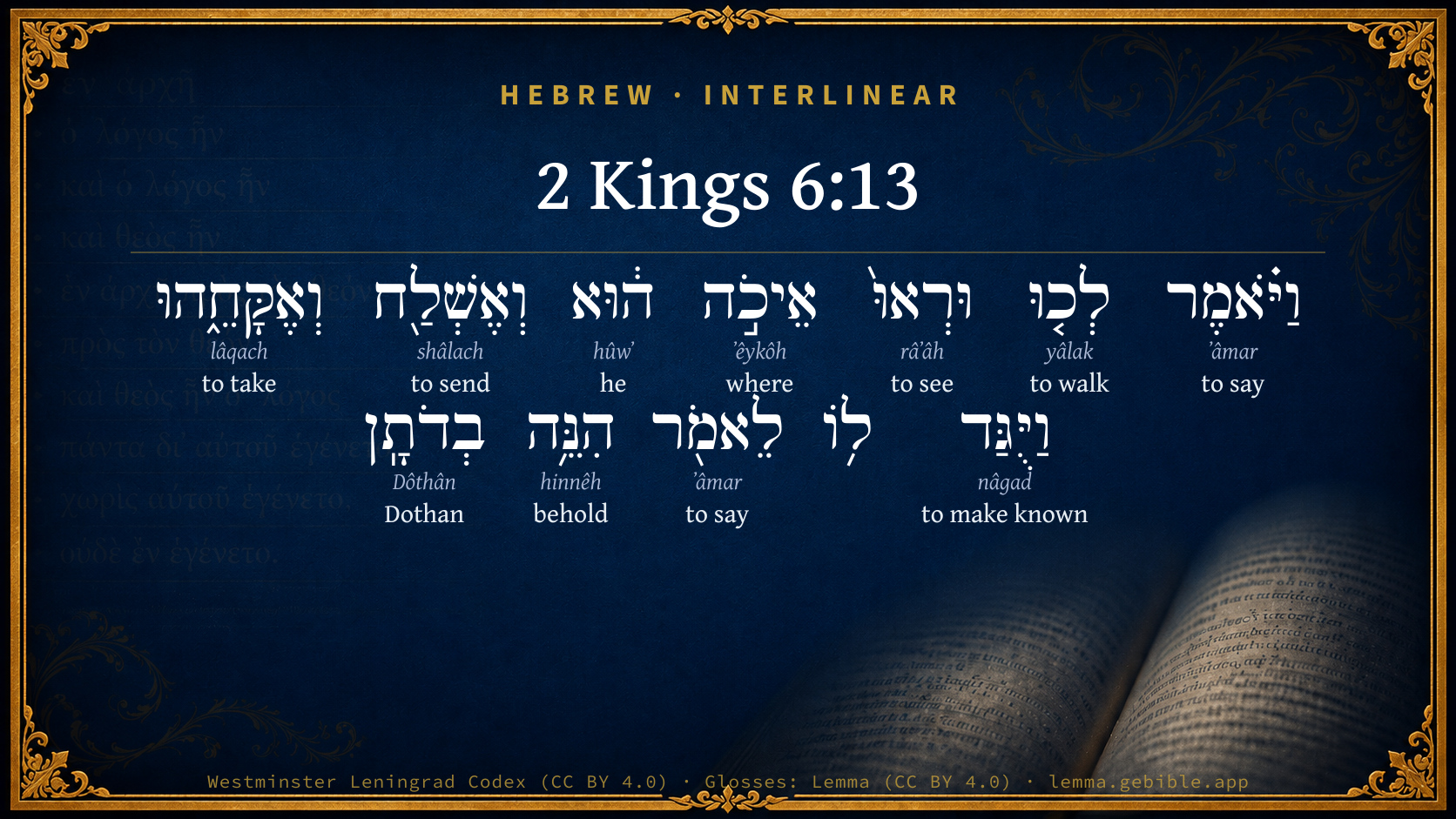
2 Kings 6:13

Hebrew (Westminster Leningrad Codex) 2 Kings 6:13 appears in the Hebrew Old Testament. The text above is from the Westminster Leningrad Codex. Each word links to its Strong’s number, a concise gloss, and parsing drawn from the Open Scriptures Hebrew Bible morphology. Click any word for its full Brown-Driver-Briggs (BDB) entry.
Download image
Cite this verse

2 Kings 6:13 (World English Bible). Public Domain. Lemma interlinear Bible study tool, https://lemma.gebible.app/v/2-kings/6/13.

Show BibTeX & RIS
BibTeX
RIS
English Translation
He said, Go and see where he is, that I may send and get him. It was told him, saying, Behold, he is in Dothan.
World English Bible · Public Domain
Highlights
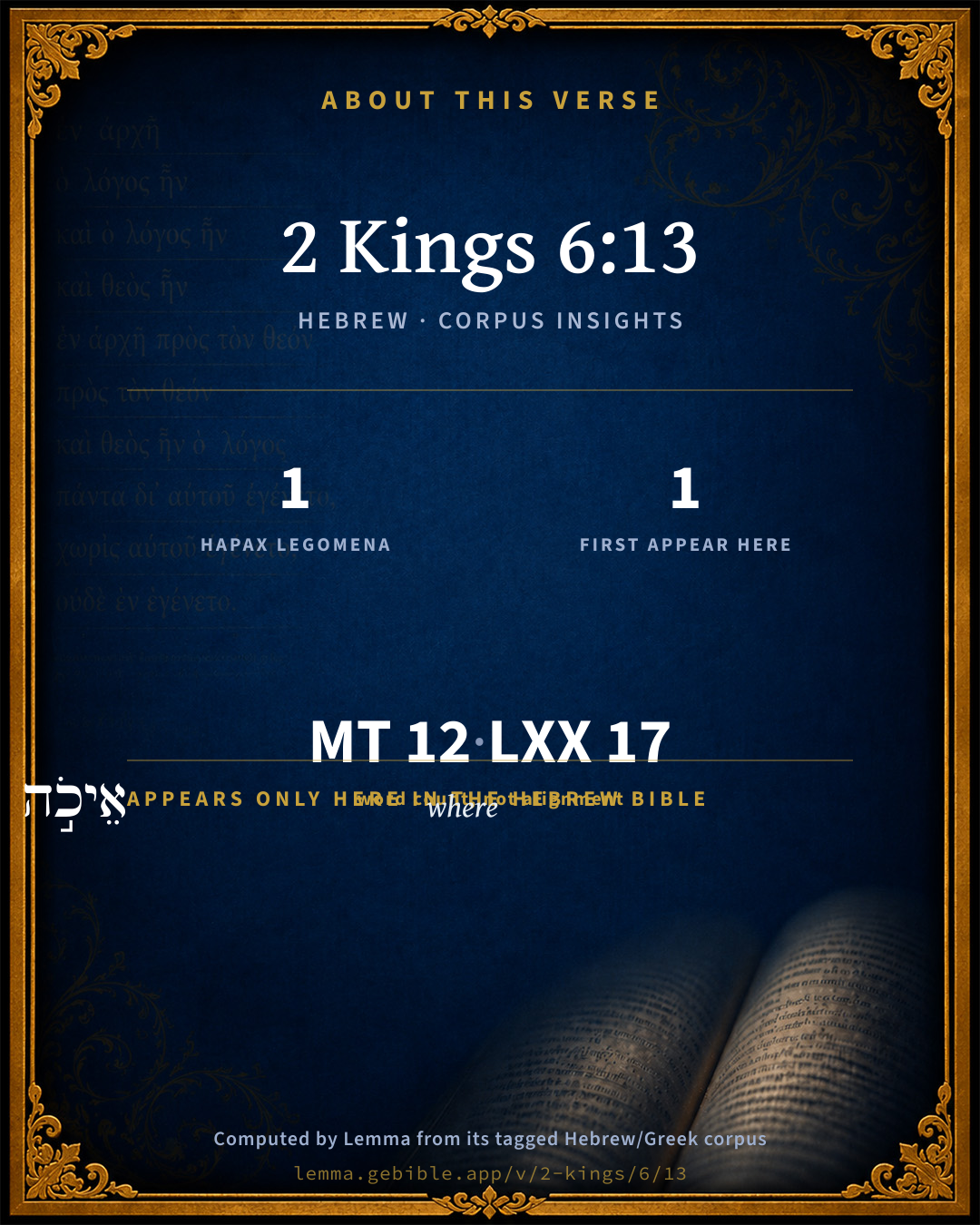
  • 1 hapax legomenon — only here in the Hebrew Bible
  • 1 first appearance in the Hebrew Bible
Full analysis ↓
Download a study sheet

One document with this verse’s original text, its word-by-word gloss line, the meaning frame, cross-references with their text, attributed commentary, and full source and license credits — printable, and it pastes into notes with its structure intact.

This verse Autodidact and up

Study sheet (.html) Plain text (.txt)

A passage Seminary Student

Up to 50 verses in one chapter. A passage sheet keeps up to 6 commentary sources and 12 cross-references per verse, in the order this page ranks them, and says so on the sheet whenever that leaves anything out. Ask for a single verse and you get the Autodidact verse sheet above.

Everything on this page stays free to read, with no account — the sheet is a download of what is already on screen, not access to it.

Want to remove ads? Support Godless Engineer
Compare translations 3

The same verse in 3 English versions, stacked beneath the original-language interlinear above. Click any original word for its lexicon entry.

Each is an independent rendering of the whole verse — the interlinear is not word-aligned to these translations.

Highlighted words mark where these versions differ — a whole-verse word diff, not a word-by-word alignment.

  • World English Bible Public Domain
    He said, Go and see where he is, that I may send and get him. It was told him, saying, Behold, he is in Dothan.
  • King James Version Public Domain
    And he said, Go and spy where he is, that I may send and fetch him. And it was told him, saying, Behold, he is in Dothan.
  • unfoldingWord Literal Text CC BY-SA 4.0
    And he said, “Go and see where he, and I will send, and I will take him.” And it was declared to him, saying, “Behold, in Dothan.”

unfoldingWord Literal Text — © unfoldingWord, licensed CC BY-SA 4.0. Word-aligned USFM3 via Door43 (git.door43.org/unfoldingWord/en_ult).

Versions to compare (up to 4)

3 of 4 selected

Show all 18 translations

Every available English version of this verse, each an independent rendering of the whole verse.

  • World English Bible Public Domain
    He said, Go and see where he is, that I may send and get him. It was told him, saying, Behold, he is in Dothan.
  • Berean Standard Bible Public Domain
    So the king said, “Go and see where he is, that I may send men to capture him.” On receiving the report, “Elisha is in Dothan,”
  • Majority Standard Bible Public Domain
    So the king said, “Go and see where he is, that I may send men to capture him.” On receiving the report, “Elisha is in Dothan,”
  • King James Version Public Domain
    And he said, Go and spy where he is, that I may send and fetch him. And it was told him, saying, Behold, he is in Dothan.
  • American Standard Version (1901) Public Domain
    And he said, Go and see where he is, that I may send and fetch him. And it was told him, saying, Behold, he is in Dothan.
  • Revised Version (1885) Public Domain
    And he said, Go and see where he is, that I may send and fetch him. And it was told him, saying, Behold, he is in Dothan.
  • Geneva Bible (1599) Public Domain
    And he said, Goe, and espie where he is, that I may sende and fetch him. And one tolde him, saying, Beholde, he is in Dothan.
  • Douay-Rheims (1899) Public Domain
    And he said to them: Go, and see where he is: that I may send, and take him. And they told him, saying: Behold he is in Dothan.
  • Young's Literal Translation Public Domain
    And he saith, `Go ye and see where he `is', and I send and take him;' and it is declared to him, saying, `Lo -- in Dothan.'
  • Literal Standard Version CC BY-SA 4.0
    And he says, “Go and see where he [is], and I send and take him”; and it is declared to him, saying, “Behold—in Dothan.”
  • Unlocked Literal Bible CC BY-SA 4.0
    The king replied, “Go and see where Elisha is so I may send men and capture him.” It was told him, “See, he is in Dothan.”
  • unfoldingWord Literal Text CC BY-SA 4.0
    And he said, “Go and see where he, and I will send, and I will take him.” And it was declared to him, saying, “Behold, in Dothan.”
  • Darby Bible Public Domain
    And he said, Go and see where he is, and I will send and fetch him. And it was told him saying, Behold, he is in Dothan.
  • World Messianic Bible Public Domain
    He said, “Go and see where he is, that I may send and get him.” He was told, “Behold, he is in Dothan.”
  • Webster's Bible Public Domain
    And he said, Go, and spy where he is, that I may send and bring him. And it was told him, saying, Behold, he is in Dothan.
  • Free Bible Version CC BY-SA 4.0
    So the king gave the order, “Go and find out where he is so I can send soldiers to capture him.” He was told, “Elisha is in Dothan.”
  • Bible in Basic English Public Domain
    Then he said, Go and see where he is, so that I may send and get him. And news came to him that he was in Dothan.
  • JPS Tanakh (1917) Public Domain
    And he said: 'Go and see where he is, that I may send and fetch him.' And it was told him, saying: 'Behold, he is in Dothan.'

Literal Standard Version (2020), Covenant Press — licensed CC BY-SA 4.0. Text via the HelloAO Bible API (eBible.org). Unlocked Literal Bible (unfoldingWord) — licensed CC BY-SA 4.0. Text via the HelloAO Bible API (eBible.org). unfoldingWord Literal Text — © unfoldingWord, licensed CC BY-SA 4.0. Word-aligned USFM3 via Door43 (git.door43.org/unfoldingWord/en_ult). Free Bible Version, Dr. Jonathan Gallagher — licensed CC BY-SA 4.0. Text via the HelloAO Bible API (eBible.org).

Word by word

More ways to search: Search by grammar → Find every occurrence → Compare this word →

Practice this passage: Drill this verse → Learn its vocabulary →

אֵיכֹ֣ה
ʼêykôh
H351
“where”
Particle, Interrogative
Part of Speech
Particle
Type
Interrogative
Full BDB Definition

Origin: probably a variation for H349 , but not as an interrogative

TWOT: 75d

where!
  1. וַיֹּ֗אמֶר ʼâmar H559 “and · to say” Conjunction + Verb, Qal, Sequential Imperfect, 3rd Person, Masculine, Singular
  2. לְכ֤וּ yâlak H3212 “walk” Verb, Qal, Imperative, 2nd Person, Masculine, Plural
  3. וּרְאוּ֙ râʼâh H7200 “and · see” Conjunction + Verb, Qal, Imperative, 2nd Person, Masculine, Plural
  4. ה֔וּא hûwʼ H1931 “he” Pronoun, Personal, 3rd Person, Masculine, Singular
  5. וְאֶשְׁלַ֖ח shâlach H7971 “and · to send” Conjunction + Verb, Qal, Imperfect, 1st Person, Common, Singular
  6. וְאֶקָּחֵ֑הוּ lâqach H3947 “and · to take · him” Conjunction + Verb, Qal, Imperfect, 1st Person, Common, Singular + Suffix, Personal, 3rd Person, Masculine, Singular
  7. וַיֻּגַּד nâgad H5046 “and · to make known” Conjunction + Verb, Hophal, Sequential Imperfect, 3rd Person, Masculine, Singular
  8. לֵאמֹ֖ר ʼâmar H559 “to say” Preposition + Verb, Qal, Infinitive Construct
  9. הִנֵּ֥ה hinnêh H2009 “behold” Particle, Demonstrative
  10. בְדֹתָֽן Dôthân H1886 “in/at · Dothan” Preposition + Noun, Proper

About this verse

These counts appear in no published source. They are computed here, from the morphology-tagged text and Lemma’s own curated glosses. What Lemma adds →

12
words
10
distinct lemmas
Historical
section

Notable vocabulary

1 hapax legomenon — a word that appears only here in the entire Hebrew Bible:

  • אֵיכֹ֣ה where H351

First appearance in Scripture

This word makes its first canonical appearance in the Hebrew Bible here:

  • אֵיכֹ֣ה where H351

Shared distinctive vocabulary

בְדֹתָֽן Dothan H1886 occurs in 2 verses of the Hebrew Bible. Also found in:

Grammatical profile

  • 7 verbs
  • 1 noun
  • 1 pronoun
  • 1 preposition
  • 2 particles

Verb forms

  • וַיֹּ֗אמֶר Qal · Sequential Imperfect
  • לְכ֤וּ Qal · Imperative
  • וּרְאוּ֙ Qal · Imperative
  • וְאֶשְׁלַ֖ח Qal · Imperfect
  • וְאֶקָּחֵ֑הוּ Qal · Imperfect
  • וַיֻּגַּד Hophal · Sequential Imperfect
  • לֵאמֹ֖ר Qal · Infinitive Construct

Repetition

A word recurs within this verse — often emphatic in Hebrew:

  • וַיֹּ֗אמֶר to say H559 ×2

Hebrew & Septuagint length

In English translation the verse runs 25 words from the Hebrew and 28 from the Septuagint (LXX English) — closely comparable.

A rough comparison of the two English renderings, which tokenize alike — not a word-level alignment.

Word counts can differ between the Hebrew and the Greek without any difference in meaning — e.g. the Hebrew direct-object marker אֵת has no separate Greek word, and Greek often adds the article ὁ.

In the original languages it is 12 Hebrew tokens and 17 Greek tokens — but the two are counted differently (Hebrew bundles its prefixes and suffixes into one token; the Greek is in lemma form), so that isn’t a like-for-like length.

Cross-references

9

Topical passages linked to 2 Kings 6:13 in the Treasury of Scripture Knowledge — connected by theme and wording, ordered by reader-vote popularity; previews shown in the World English Bible.

  • Genesis 37:17 The man said, "They have left here, for I heard them say, 'Let us go to Dothan.'" Joseph went after his brothers, and found them in Dothan.
  • John 11:47–53 The chief priests therefore and the Pharisees gathered a council, and said, "What are we doing? For this man does many signs.
  • 1 Samuel 23:22–23 Please go make yet more sure, and know and see his place where his haunt is, [and] who has seen him there; for it is told me that he deals very subtly.
  • Psalms 10:8–10 He lies in wait near the villages. From ambushes, he murders the innocent. His eyes are secretly set against the helpless.
  • Psalms 37:12–14 The wicked plots against the just, And gnashes at him with his teeth.
  • Psalms 37:32–33 The wicked watches the righteous, And seeks to kill him.
  • Jeremiah 36:26 The king commanded Jerahmeel the king's son, and Seraiah the son of Azriel, and Shelemiah the son of Abdeel, to take Baruch the scribe and Jeremiah the prophet; but Yahweh hid them.
  • Matthew 2:4–8 Gathering together all the chief priests and scribes of the people, he asked them where the Christ would be born.
  • Acts 23:12–27 When it was day, some of the Jews banded together, and bound themselves under a curse, saying that they would neither eat nor drink until they had killed Paul.

Cross-references courtesy of OpenBible.info (CC BY 4.0).

Hebrew and Greek witnesses Masoretic Hebrew ↔ Greek Septuagint

The same verse in the two great witnesses to the Old Testament, shown verse-for-verse.

These are two independent witnesses, not word-aligned to each other, and the Septuagint is shown in lemma (dictionary) form.

Hebrew 2 Kings 6:13 Masoretic · Westminster Leningrad Codex

וַיֹּ֗אמֶר לְכ֤וּ וּרְאוּ֙ אֵיכֹ֣ה ה֔וּא וְאֶשְׁלַ֖ח וְאֶקָּחֵ֑הוּ וַיֻּגַּד ל֥וֹ לֵאמֹ֖ר הִנֵּ֥ה בְדֹתָֽן

He said, Go and see where he is, that I may send and get him. It was told him, saying, Behold, he is in Dothan.

World English Bible · Public Domain

Greek LXX 2 Kings 6:13 Septuagint · lemma form

καί εἶπον δεῦτε ὁράω ποῦ οὗτος καί ἀποστέλλω λαμβάνω αὐτός καί ἀναἀγγέλλω αὐτός λέγω ἰδού ἐν δωθαϊμ

And he said, Go, see where this man is, and I will send and take him. And they sent word to him, saying, Behold, he is in Dothaim.

LXX2012 (modern English Septuagint) · Public Domain

On this verse, Ellicott's Commentary for English Readers discusses the Septuagint’s reading. Read the note in Commentary ↓

Hebrew: Westminster Leningrad Codex (CC BY 4.0). Greek: Septuagint (public domain); English from LXX2012 (modern English Septuagint) (Public Domain). How the Septuagint differs from the Hebrew →

Targum (Aramaic paraphrase)

1

The Targum is the ancient Jewish Aramaic paraphrase of the Hebrew Scriptures — an interpretive translation, not the Hebrew text itself. Onkelos (literal) and Pseudo-Jonathan (expansive) render the Torah, and Jonathan the Prophets. Coverage is partial: where no permissively-licensed English translation exists for a verse, only the Aramaic is shown. This is verse-level text, not a word-by-word alignment to the Hebrew.

  1. Targum Jonathan Prophets (Joshua–Malachi)
    וַאֲמַר אֱזִילוּ וַחֲזוֹ הֵיכָא הוּא וְאֶשְׁלַח וְאֶדְבְּרִינֵיהּ וְאִתְחַוָא לֵיהּ לְמֵימַר הָא בְדוֹתָן:

    (no public-domain English translation for this verse)

    Targum Jonathan — Aramaic: “Mikraot Gedolot” (public domain). English: “Sefaria Community Translation” (CC0 1.0 (public-domain dedication)); “London "Chaldee Paraphrase," 1871” (public domain). Text via Sefaria.

Commentary

Notes on 2 Kings 6:13 from classic Christian and Jewish commentators (each source and its license shown beneath its notes). The classic Christian expositions comment on the surrounding passage and are grouped to its opening verse, so a note may address several verses; the Jewish commentaries on the Tanakh (Rashi and others) are per-verse, so they appear only where the commentator wrote on this verse.

Lemma curates 59 commentaries, every one of them public domain or Creative Commons licensed, each selected and text-cleaned for this edition rather than reprinted as found. About our sources →

Matthew Henry's Commentary

Here is, 1. The great force which the king of Syria sent to seize Elisha. He found out where he was, at Dothan (Kg2 6:13), which was not far from Samaria; thither he sent a great host, who were to come upon him by night, and to bring him dead or alive, Kg2 6:14. Perhaps he had heard that when only one captain and his fifty men were sent to take Elijah they were baffled in the attempt, and therefore he sent an army against Elisha, as if the fire from heaven that consumed fifty men could not as easily consume 50,000. Naaman could tell him that Elisha dwelt not in any strong-hold, nor was attended with any guards, nor had any such great interest in the people that he needed to fear a tumult among them; what occasion then was there for this great force? But thus he hoped to make sure of him, especially coming upon him by surprise. Foolish man! Did he believe that Elisha had informed the king of Israel of his secret counsels or not? If not, what quarrel had he with him? If he did, could he be so weak as to imagine that Elisha would not discover the designs laid against himself, and that, having interest enough in heaven to discover them, he would not have interest enough to defeat them? Those that fight against God, his people, and prophet, know not what they do.

II. The grievous fright which the prophet's servant was in, when he perceived the city surrounded by the Syrians, and the effectual course which the prophet took to pacify him and free him from his fears. It seems, Elisha accustomed his servant to rise early, that is the way to bring something to pass, and to do the work of a day in its day. Being up, we may suppose he heard the noise of soldiers, and thereupon looked out, and was aware of an army compassing the city (Kg2 6:15), with great assurance no doubt of success, and that they should have this troublesome prophet in their hands presently. Now observe, 1. What a consternation he was in. He ran straight to Elisha, to bring him an account of it: "Alas, master!" (said he) "what shall we do? We are undone, it is to no purpose to think either of fighting or flying, but we must unavoidably fall into their hands." Had he but studied David's Psalms, which were then extant, he might have learnt not to be afraid of 10,000 of people (Psa 3:6), no, not of a host encamped against him, Psa 27:3. Had he considered that he was embarked with his master, by whom God had done great things, and whom he would not now leave to fall into the hands of the uncircumcised, and who, having saved others, would no doubt save himself, he would not have been thus at a loss. If he had only said, What shall I do? it would have been like that of the disciples: Lord, save us, we perish; but he needed not to include his master as being in distress, nor to say, What shall we do? 2. How his master quieted him, (1.) By word. What he said to him (Kg2 6:16) is spoken to all the faithful servants of God, when without are fightings and within are fears: "Fear not with that fear which has torment and amazement, for those that are with us, to protect us, are more than those that are against us, to destroy us - angels unspeakably more numerous - God infinitely more powerful." When we are magnifying the causes of our fear we ought to possess ourselves with clear, and great, and high thoughts of God and the invisible world. If God be for us, we know what follows, Rom 8:31. (2.) By vision, Kg2 6:17. [1.] It seems Elisha was much concerned for the satisfaction of his servant. Good men desire, not only to be easy themselves, but to have those about them easy. Elisha had lately parted with his old man, and this, having newly come into his service, had not the advantage of experience; his master was therefore desirous to give him other convincing evidence of that omnipotence which employed him and was therefore employed for him. Note, Those whose faith is strong ought tenderly to consider and compassionate those who are weak and of a timorous spirit, and to do what they can to strengthen their hands. [2.] He saw himself safe, and wished no more than that his servant might see what he saw, a guard of angels round about him; such as were his master's convoy to the gates of heaven were his protectors against the gates of hell - chariots of fire, and horses of fire. Fire is both dreadful and devouring; that power which was engaged for Elisha's protection could both terrify and consume the assailants. As angels are God's messengers, so they are his soldiers, his hosts (Gen 32:2), his legions, or regiments, (Mat 26:53), for the good of his people. [3.] For the satisfaction of his servant there needed no more than the opening of his eyes; that therefore he prayed for, and obtained for him: Lord, open his eyes that he may see. The eyes of his body were open, and with them he saw the danger. "Lord, open the eyes of his faith, that with them he may see the protection we are under." Note, First, The greatest kindness we can do for those that are fearful and faint-hearted is to pray for them, and so to recommend them to the mighty grace of God. Secondly, The opening of our eyes will be the silencing of our fears. In the dark we are most apt to be frightened. The clearer sight we have of the sovereignty and power of heaven the less we shall fear the calamities of this earth.

III. The shameful defeat which Elisha gave to the host of Syrians who came to seize him. They thought to make a prey of him, but he made fools of them, perfectly played with them, so far was he from fearing them or any damage by them. 1. He prayed to God to smite them with blindness, and they were all struck blind immediately, not stone-blind, nor so as to be themselves aware that they were blind, for they could see the light, but their sight was so altered that they could not know the persons and places they were before acquainted with, Kg2 6:18. They were so confounded that those among them whom they depended upon for information did not know this place to be Dothan nor this person to be Elisha, but groped at noon day as in the night (Isa 59:10; Job 12:24, Job 12:25); their memory failed them, and their distinguishing faculty. See the power of God over the minds and understanding of men, both ways; he enlightened the eyes of Elisha's friend, and darkened the eyes of his foes, that they might see indeed, but not perceive, Isa 6:9 For this twofold judgment Christ came into this world, that those who see not might see, and that those who see might be made blind (Joh 9:39), a savour of life to some, of death to others.

2. When they were thus bewildered and confounded he led them to Samaria (Kg2 6:19), promising that he would show them the man whom they sought, and he did so. He did not lie to them when he told them, This is not the way, nor is this the city where Elisha is; for he had now come out of the city; and if they would see him, they must go to another city to which he would direct them. Those that fight against God and his prophets deceive themselves, and are justly given up to delusions. 3. When he had brought them to Samaria he prayed to God so to open their eyes and restore them their memories that they might see where they were (Kg2 6:20), and behold, to their great terror, they were in the midst of Samaria, where, it is probable, there was a standing force sufficient to cut them all off, or make them prisoners of war. Satan, the god of this world, blinds men's eyes, and so deludes them into their own ruin; but, when God enlightens their eyes, they then see themselves in the midst of their enemies, captives to Satan and in danger of hell, though before they thought their condition good. The enemies of God and his church, when they fancy themselves ready to triumph, will find themselves conquered and triumphed over. 4. When he had them at his mercy he made it appear that he was influenced by a divine goodness as well as a divine power. (1.) He took care to protect them from the danger into which he had brought them, and was content to show them what he could have done; he needed not the sword of an angel to avenge his cause, the sword of the king of Israel is at his service if he please (Kg2 6:21): My father (so, respectfully does the king now speak to him, though, soon after, he swore his death), shall I smite them? And, again, as if he longed for the assault, Shall I smite them? Perhaps, he remembered how God was displeased at his father for letting go out of his hands those whom he had put it in his power to destroy, and he would not offend in like manner; yet such a reverence has he for the prophet that he will not strike a stroke without his commission. But the prophet would by no means suffer him to meddle with them; they were brought hither to be convinced and shamed, not to be killed, Kg2 6:22. Had they been his prisoners, taken captive by his sword and bow, when they asked quarter it would have been barbarous to deny, and, when he had given it to them, it would have been perfidious to do them any hurt, and against the laws of arms to kill men in cool blood. But they were not his prisoners; they were God's prisoners and the prophet's, and therefore he must do them no harm. Those that humble themselves under God's hand take the best course to secure themselves. (2.) He took care to provide for them; he ordered the king to treat them handsomely and then dismiss them fairly, which he did, Kg2 6:23. [1.] It was the king's praise that he was so obsequious to the prophet, contrary to his inclination, and, as it seemed, to his interest, Sa1 24:19. Nay, so willing was he to oblige Elisha that, whereas he was ordered openly to set bread and water before them (which are good fare for captives), he prepared great provision for them, for the credit of his court and country and of Elisha. [2.] It was the prophet's praise that he was so generous to his enemies, who, though they came to take him, could not but go away admiring him, as both the mightiest and kindest man they ever met with. The great duty of loving enemies, and doing good to those that hate us, was both commanded in the Old Testament (Pro 25:21, Pro 25:22, If thy enemy hunger, feed him, Exo 23:4, Exo 23:5) and practised, as here by Elisha. His predecessor had given a specimen of divine justice when he called for flames of fire on the heads of his persecutors to consume them, but he have a specimen of divine mercy in heaping coals of fire on the heads of his persecutors to melt them. Let not us then be overcome of evil, but overcome evil with good.

IV. The good effect this had, for the present, upon the Syrians. They came no more into the land of Israel (Kg2 6:23), namely, upon this errand, to take Elisha; they saw it was to no purpose to attempt that, nor would any of their bands be persuaded to make an assault on so great and good a man. The most glorious victory over an enemy is to turn him into a friend.

Matthew Henry's Commentary on the Whole Bible (1708–1710) — public domain (CC PDM 1.0). Text via the HelloAO Bible API.

Trapp's Complete Commentary

John Trapp

2Ki 6:13 And he said, Go and spy where he [is], that I may send and fetch him. And it was told him, saying, Behold, [he is] in Dothan.

Ver. 13. That I may send and fetch him.] This, none but a madman would have attempted. Anger is a short madness: whensoever it anteverteth reason, it is sinful.

John Trapp, A Commentary or Exposition upon All the Books of the Old and New Testament (1647–1656) — public domain. Text from a community e-Sword module.

Joseph Benson's Commentary

2Ki 6:13. Spy where he is, that I may send and fetch him — Foolish man! Did he believe that Elisha had informed the king of Israel of his secret counsels, or not? If he did not, what quarrel had he with him? If he did, could he be so weak as to imagine that the prophet would not discover the designs laid against him? and that, having interest enough in heaven to discover them, he would not have interest enough to defeat them? Those that fight against God, his people, and prophets, know not what they do. It was told him, Behold, he is in Dothan — A city in the tribe of Manasseh, not far from Shechem and Samaria: hither therefore the king of Syria sent a great host, who were to come upon him by night, and bring him alive or dead.

Joseph Benson's Commentary on the Old and New Testaments (1811–1818) — public domain. Text from a community e-Sword module.

Jamieson, Fausset & Brown

Robert Jamieson, A. R. Fausset & David Brown

Dothan--or, "Dothaim," a little north of Samaria (see on Gen 37:17).

Jamieson, Fausset & Brown — Commentary Critical and Explanatory on the Whole Bible (1871) — public domain (CC PDM 1.0). Text via the HelloAO Bible API.

Adam Clarke's Commentary

Verse 13. Behold, he is in Dothan.] This is supposed to be the same place as that mentioned in Ge 37:17. It lay about twelve miles from Samaria.

Adam Clarke's Commentary on the Bible (1810–1826) — public domain. Text from a community e-Sword/MySword module.

Ellicott's Commentary for English Readers

(13) Fetch.—Take.

Dothan.—A contracted dual (equivalent to Dothain LXX., Dothaim). It lay on a hill, twelve Roman miles north-east of Samaria, in a narrow pass (Jdt_4:5; Jdt_7:3; Jdt_8:3), on the caravan route from Gilead to Egypt (Gen_37:17). The old name survives in a Tell, covered with ruins, south-west of the modern Jenîn.

A Bible Commentary for English Readers, edited by Charles John Ellicott (1878–1897) — public domain. Text from a community e-Sword module.

The Cambridge Bible for Schools and Colleges

gen. ed. J. J. S. Perowne

13. go and spy] R.V. see. The original is the ordinary verb rendered ‘see’ in other places.

that I may send and fetch him] And thus put an end to the source of information enjoyed by the king of Israel.

Dothan] Only mentioned in the canonical books of the O.T. here and in the history of Joseph (Gen_37:17). In the book of Judith (2Ki_4:6; 2Ki_7:3; 2Ki_7:18; 2Ki_8:3) it occurs in the account of Holofernes’ campaign against Bethulia. It was not far from Shechem. It appears from this narrative that Elisha had a residence there. According to Jerome the place was twelve Roman miles north of Samaria. We can see from this history that the Syrians were able at this time to penetrate very far into the country of Israel.

The Cambridge Bible for Schools and Colleges (gen. ed. J. J. S. Perowne; Cambridge University Press, 1878–1918) — public domain. Text from a community e-Sword module.

John Gill's Exposition

Therefore sent he thither horses and chariots, and a great host,.... To terrify the inhabitants from attempting to defend the prophet, but deliver him up at once:

and they came by night; that they might come upon them unawares, and their design not be discovered, so as to have timely help from Samaria, which was not far off:

and compassed the city about; that the prophet might not make his escape out of it.

John Gill's Exposition of the Whole Bible (1746–1763) — public domain (CC PDM 1.0). Text via the HelloAO Bible API.

Albert Barnes' Notes on the Bible

Dothan - See the marginal reference note. It was at no great distance from Shechem. Its ancient name still attaches to a Tel or hill of a marked character (compare 2Ki 6:17), from the foot of which arises a copious fountain.

Albert Barnes' Notes on the Bible (1834–1885) — public domain. Text from a community e-Sword/MySword module.

Haydock's Catholic Bible Commentary

Take him. Foolish attempt! as if the prophet could not foresee his own danger. (Salien) --- Dothan or Dothain, (Genesis xxxvii. 17.) twelve miles north of Samaria. (Eusebius; Calmet) Adrichomius says, in the tribe of Zabulon. (Menochius)

George Leo Haydock (1774–1849), Haydock's Catholic Family Bible and Commentary, 1859 edition — public domain. Excludes Psalms (Douay-Rheims chapter numbering differs from Protestant) and Deuterocanonical books (Catholic canon only).

Matthew Poole's English Annotations

That I may send and fetch him; for though I cannot conceal my designs from him, yet I may possibly take him by force; his power being, I doubt not, much inferior to his knowledge.

Dothan; a city near Shechem, Gen 37:17, and not far from Samaria.

Matthew Poole's English Annotations on the Holy Bible (1683–1685) — public domain. Text from a community e-Sword/MySword module.

Whedon's Commentary on the Bible

Daniel D. Whedon

13. Go and spy where he is — How blind, to imagine that he who could tell his secret counsels could not also frustrate the movements of his spies.

Dothan — A beautiful spot on an eminence still bearing the name Tell Dothan, about twelve miles north of Samaria; the same place to which Joseph went in search of his brethren. Gen_37:17.

Daniel D. Whedon (gen. ed.), Commentary on the Old and New Testaments (1874–1909) — public domain. Text from a community e-Sword module.

The Pulpit Commentary

And hei.e. Benhadadsaid, Go and spy where he is, that I may send and fetch him; i.e. "Send out spies to learn where Elisha is at present residing, that I may dispatch a force to the place, and get him into my power." The object was scarcely "to find out, through Elisha, what the King of Israel and other princes were plotting against him in their secret counsels" (Cassel), but simply to put a stop to Elisha"s betrayal of his own plans to Jobs-ram. And it was told him, saying, Behold, he is in Dothan. The spies were sent, and brought back word that, at the time, Elisha was residing in Dothan. Dothan, the place where Joseph was sold by his brethren to the Ishmaelites, (Gen_37:17) lay evidently not very far from Shechem, (Gen_37:14) and is placed by Eusebius about twelve miles north of Samaria. In the Book of Judith (4:6; 7:3) it is mentioned among the cities bordering the southern edge of the Plain of Esdraelon. Modern travelers (Van de Velde, Robinson) have reasonably identified it with the present Dothan, a tel, or hill, of a marked character, covered with ruins, and from the foot of which arises a copious spring, to the south-west of Jenin, between that place and Jeba, a little to the left of the great road leading from Beisan (Scythopolis) to Egypt.

The Pulpit Commentary (1880–1919), ed. H.D.M. Spence-Jones & Joseph S. Exell — public domain. Text from a community e-Sword module.

Rashi

Rabbi Shlomo Yitzchaki (Rashi)

Where he is. Where he is.

Rashi on the Tanakh — English translations: “The Judaica Press complete Tanach with Rashi, translated by A. J. Rosenberg” (CC BY 4.0); “Pentateuch with Rashi's commentary by M. Rosenbaum and A.M. Silbermann, 1929-1934” (public domain); “The Metsudah Tanach series, Lakewood, N.J” (CC BY 4.0); and “The Book of Joshua, Metsudah Publications, 1997” (CC BY 4.0). Text via Sefaria.

Lesson kit

Teaching starters — assembled from the data on this page, not authored interpretation. Every prompt links to the verse data it draws on. Edit before teaching.

2 Kings, in the Historical, opens this verse with 12 words (10 distinct Hebrew lemmas). Its most distinctive word is ʼêykôh (“where”). A historical commentator’s framing appears above. Read the whole chapter for the surrounding context.

Discussion questions

  1. What does “where” (ʼêykôh) contribute to the verse as a whole?
  2. This verse holds 1 word here found nowhere else in the Hebrew Bible. What might the rare word draw attention to?
  3. The word “where” first appears here in Scripture. What is being introduced at this debut?
  4. Genesis 37:17 shares the word «Dothan» with this verse. How do the two illuminate each other?
  5. “to say” occurs 2× in this one verse. What is the effect of the repetition?
  6. These translations render this verse differently. What is at stake in choosing one wording over another?
  7. The verb «וַיֹּ֗אמֶר» is Qal Sequential Imperfect. How does its form color the action?
  8. Reading how Matthew Henry's Commentary and Trapp's Complete Commentary read this verse, where do the two commentators agree and where do they part?

Things to notice

  • 1 word in this verse appears nowhere else in the Hebrew Bible.
  • 1 word makes its first canonical appearance in Scripture here.
  • This verse counts 12 Hebrew ↔ 17 Greek words.
  • These translations choose different wording for 9 words in this verse.
  • “to say” occurs 2× in this single verse.

Reading settings

Reading text

Shown beneath each verse's original-language words.

Old Testament
Old Testament edition

Read the OT as the Masoretic Hebrew (MT) or the Greek Septuagint (LXX).

English shown for the Greek Septuagint (in the Hebrew ↔ Greek comparison).

Comparing translations? Open the Compare panel on any verse page to stack up to four side by side.