Jeremiah 38:15

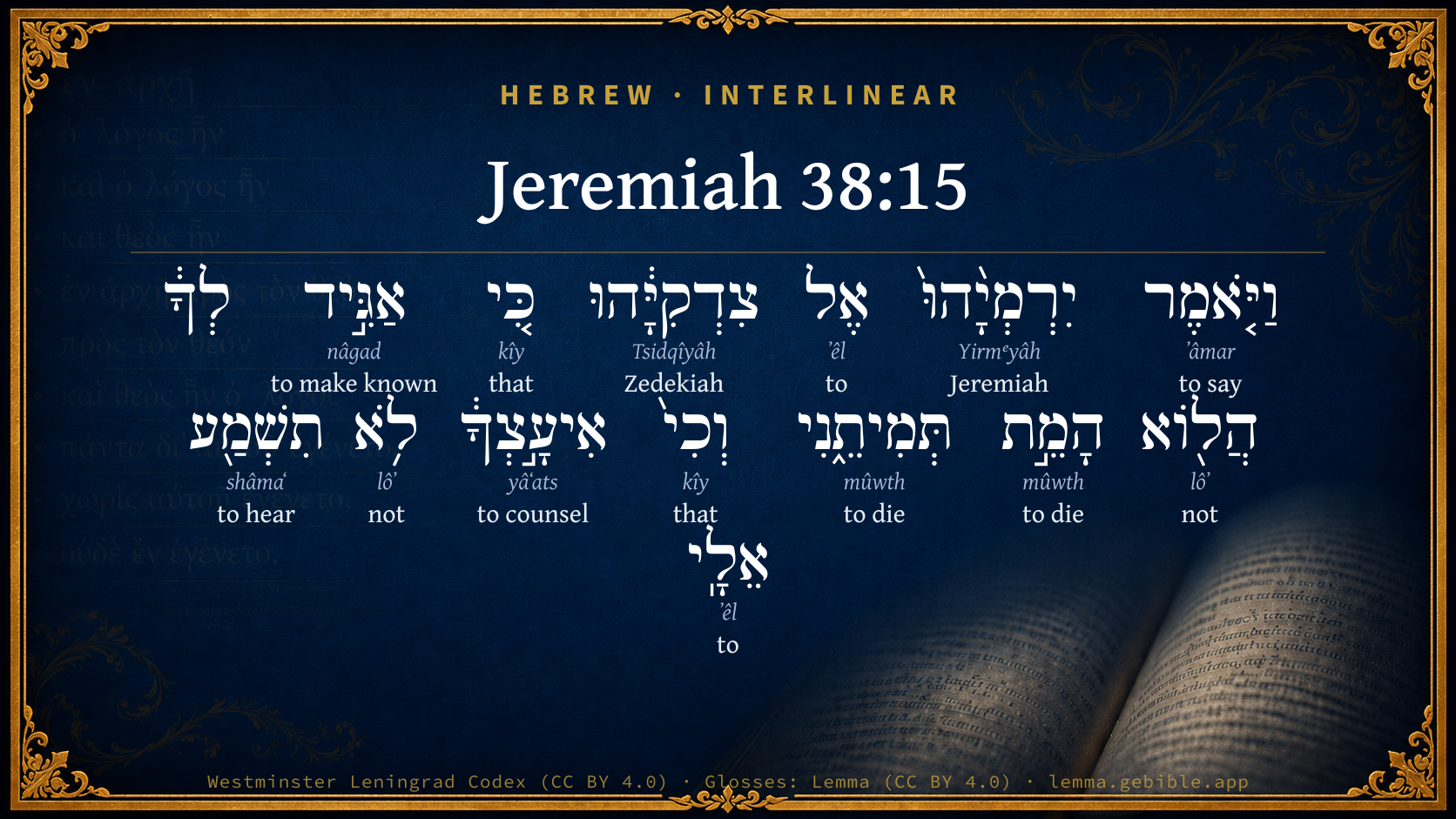
Hebrew (Westminster Leningrad Codex) Jeremiah 38:15 appears in the Hebrew Old Testament. The text above is from the Westminster Leningrad Codex. Each word links to its Strong’s number, a concise gloss, and parsing drawn from the Open Scriptures Hebrew Bible morphology. Click any word for its full Brown-Driver-Briggs (BDB) entry.
Download image
Cite this verse

Jeremiah 38:15 (World English Bible). Public Domain. Lemma interlinear Bible study tool, https://lemma.gebible.app/v/jeremiah/38/15.

Show BibTeX & RIS
BibTeX
RIS
English Translation
Then Jeremiah said to Zedekiah, If I declare it to you, will you not surely put me to death? and if I give you counsel, you will not listen to me.
World English Bible · Public Domain
Download a study sheet

One document with this verse’s original text, its word-by-word gloss line, the meaning frame, cross-references with their text, attributed commentary, and full source and license credits — printable, and it pastes into notes with its structure intact.

This verse Autodidact and up

Study sheet (.html) Plain text (.txt)

A passage Seminary Student

Up to 50 verses in one chapter. A passage sheet keeps up to 6 commentary sources and 12 cross-references per verse, in the order this page ranks them, and says so on the sheet whenever that leaves anything out. Ask for a single verse and you get the Autodidact verse sheet above.

Everything on this page stays free to read, with no account — the sheet is a download of what is already on screen, not access to it.

Want to remove ads? Support Godless Engineer
Compare translations 3

The same verse in 3 English versions, stacked beneath the original-language interlinear above. Click any original word for its lexicon entry.

Each is an independent rendering of the whole verse — the interlinear is not word-aligned to these translations.

Highlighted words mark where these versions differ — a whole-verse word diff, not a word-by-word alignment.

  • World English Bible Public Domain
    Then Jeremiah said to Zedekiah, If I declare it to you, will you not surely put me to death? and if I give you counsel, you will not listen to me.
  • King James Version Public Domain
    Then Jeremiah said unto Zedekiah, If I declare it unto thee, wilt thou not surely put me to death? and if I give thee counsel, wilt thou not hearken unto me?
  • unfoldingWord Literal Text CC BY-SA 4.0
    Jeremiah said to Zedekiah, “If I answer you, will you not certainly kill me? But if I give you advice, you will not listen to me.”

unfoldingWord Literal Text — © unfoldingWord, licensed CC BY-SA 4.0. Word-aligned USFM3 via Door43 (git.door43.org/unfoldingWord/en_ult).

Versions to compare (up to 4)

3 of 4 selected

Show all 18 translations

Every available English version of this verse, each an independent rendering of the whole verse.

  • World English Bible Public Domain
    Then Jeremiah said to Zedekiah, If I declare it to you, will you not surely put me to death? and if I give you counsel, you will not listen to me.
  • Berean Standard Bible Public Domain
    “If I tell you,” Jeremiah replied, “you will surely put me to death. And even if I give you advice, you will not listen to me.”
  • Majority Standard Bible Public Domain
    “If I tell you,” Jeremiah replied, “you will surely put me to death. And even if I give you advice, you will not listen to me.”
  • King James Version Public Domain
    Then Jeremiah said unto Zedekiah, If I declare it unto thee, wilt thou not surely put me to death? and if I give thee counsel, wilt thou not hearken unto me?
  • American Standard Version (1901) Public Domain
    Then Jeremiah said unto Zedekiah, If I declare it unto thee, wilt thou not surely put me to death? and if I give thee counsel, thou wilt not hearken unto me.
  • Revised Version (1885) Public Domain
    Then Jeremiah said unto Zedekiah, If I declare it unto thee, wilt thou not surely put me to death? and if I give thee counsel, thou wilt not hearken unto me.
  • Geneva Bible (1599) Public Domain
    Then Ieremiah sayd to Zedekiah, If I declare it vnto thee, wilt not thou slay me? and if I giue thee counsell, thou wilt not heare me.
  • Douay-Rheims (1899) Public Domain
    Then Jeremias said to Sedecias: If I shall declare it to thee, wilt thou not put me to death? and if I give thee counsel, thou wilt not hearken to me.
  • Young's Literal Translation Public Domain
    And Jeremiah saith unto Zedekiah, `When I declare to thee, dost thou not surely put me to death? and when I counsel thee, thou dost not hearken unto me.'
  • Literal Standard Version CC BY-SA 4.0
    And Jeremiah says to Zedekiah, “When I declare [it] to you, do you not surely put me to death? And when I counsel you, you do not listen to me.”
  • Unlocked Literal Bible CC BY-SA 4.0
    Jeremiah said to Zedekiah, “If I answer you, will you not certainly kill me? But if I give you advice, you will not listen to me.”
  • unfoldingWord Literal Text CC BY-SA 4.0
    Jeremiah said to Zedekiah, “If I answer you, will you not certainly kill me? But if I give you advice, you will not listen to me.”
  • Darby Bible Public Domain
    And Jeremiah said unto Zedekiah, If I declare [it] unto thee, wilt thou not certainly put me to death? and if I give thee counsel, thou wilt not hearken unto me.
  • World Messianic Bible Public Domain
    Then Jeremiah said to Zedekiah, “If I declare it to you, will you not surely put me to death? If I give you counsel, you will not listen to me.”
  • Webster's Bible Public Domain
    Then Jeremiah said to Zedekiah, If I declare it to thee, wilt thou not surely put me to death? and if I give thee counsel, wilt thou not hearken to me?
  • Free Bible Version CC BY-SA 4.0
    “If I tell you then you'll definitely have me killed,” Jeremiah replied. “Even if I were to give you advice, you wouldn't listen to me anyway.”
  • Bible in Basic English Public Domain
    Then Jeremiah said to Zedekiah, If I give you the answer to your question, will you not certainly put me to death? and if I make a suggestion to you, you will not give it a hearing.
  • JPS Tanakh (1917) Public Domain
    Then Jeremiah said unto Zedekiah: 'If I declare it unto thee, wilt thou not surely put me to death? and if I give thee counsel, thou wilt not hearken unto me.'

Literal Standard Version (2020), Covenant Press — licensed CC BY-SA 4.0. Text via the HelloAO Bible API (eBible.org). Unlocked Literal Bible (unfoldingWord) — licensed CC BY-SA 4.0. Text via the HelloAO Bible API (eBible.org). unfoldingWord Literal Text — © unfoldingWord, licensed CC BY-SA 4.0. Word-aligned USFM3 via Door43 (git.door43.org/unfoldingWord/en_ult). Free Bible Version, Dr. Jonathan Gallagher — licensed CC BY-SA 4.0. Text via the HelloAO Bible API (eBible.org).

Word by word

More ways to search: Search by grammar → Find every occurrence → Compare this word →

Practice this passage: Drill this verse → Learn its vocabulary →

צִדְקִיָּ֔הוּ
Tsidqîyâh
H6667
“Zedekiah”
Noun, Proper
Part of Speech
Noun
Type
Proper
Full BDB Definition

Origin: from H6664 and H3050

TWOT: None

Zedekiah = "Jehovah is righteous" - the last king of Judah renamed from 'Mattaniah' by Nebuchadnezzar; son of Josiah by wife Hamutal; placed on the throne by Nebuchadnezzar when he carried his nephew Jehoiakim in captivity - false prophet at the court of king Ahab of the northern kingdom of Israel - son of Maaseiah, a false prophet in Babylon - son of Hananiah, one of the princes of Judah in the time of Jeremiah - a priest who sealed the covenant with Nehemiah - son of king Jehoiakim of Judah
  1. וַיֹּ֤אמֶר ʼâmar H559 “and · to say” Conjunction + Verb, Qal, Sequential Imperfect, 3rd Person, Masculine, Singular
  2. יִרְמְיָ֨הוּ֙ Yirmᵉyâh H3414 “Jeremiah” Noun, Proper
  3. אֶל ʼêl H413 “to” Preposition
  4. כִּ֚י kîy H3588 “that” Conjunction
  5. אַגִּ֣יד nâgad H5046 “to make known” Verb, Hiphil, Imperfect, 1st Person, Common, Singular
  6. הֲל֖וֹא lôʼ H3808 “not” Particle, Interrogative + Particle, Negative
  7. הָמֵ֣ת mûwth H4191 “to die” Verb, Hiphil, Infinitive Absolute
  8. תְּמִיתֵ֑נִי mûwth H4191 “to die · me” Verb, Hiphil, Imperfect, 2nd Person, Masculine, Singular + Suffix, Personal, 1st Person, Common, Singular
  9. וְכִי֙ kîy H3588 “and · that” Conjunction + Conjunction
  10. אִיעָ֣צְךָ֔ yâʻats H3289 “to counsel · you” Verb, Qal, Imperfect, 1st Person, Common, Singular + Suffix, Personal, 2nd Person, Masculine, Singular
  11. לֹ֥א lôʼ H3808 “not” Particle, Negative
  12. תִשְׁמַ֖ע shâmaʻ H8085 “to hear” Verb, Qal, Imperfect, 2nd Person, Masculine, Singular
  13. אֵלָֽי ʼêl H413 “to · me” Preposition + Suffix, Personal, 1st Person, Common, Singular

About this verse

These counts appear in no published source. They are computed here, from the morphology-tagged text and Lemma’s own curated glosses. What Lemma adds →

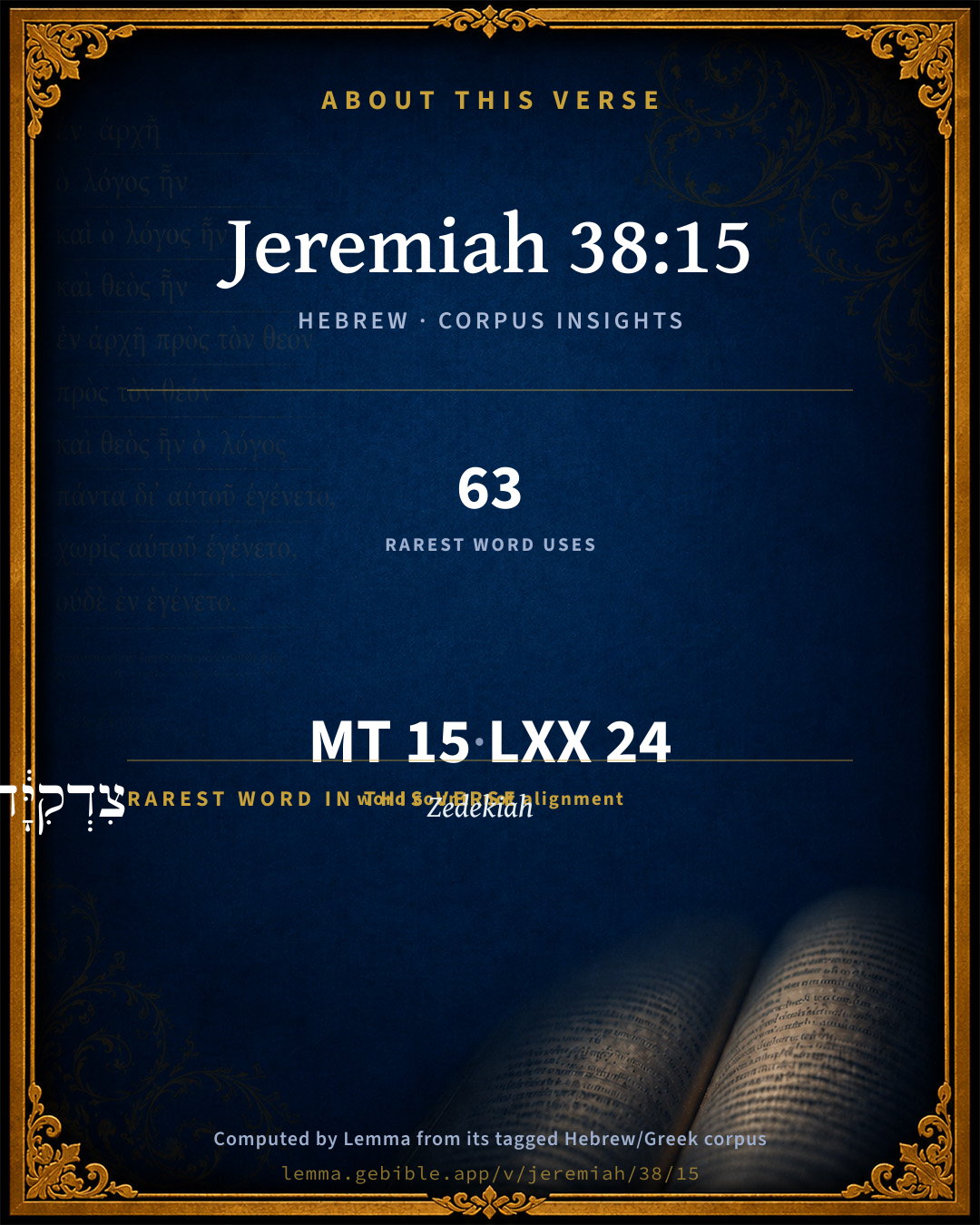
15
words
10
distinct lemmas
Prophets
section

Grammatical profile

  • 6 verbs
  • 2 nouns
  • 3 prepositions
  • 2 conjunctions
  • 2 particles

Verb forms

  • וַיֹּ֤אמֶר Qal · Sequential Imperfect
  • אַגִּ֣יד Hiphil · Imperfect
  • הָמֵ֣ת Hiphil · Infinitive Absolute
  • תְּמִיתֵ֑נִי Hiphil · Imperfect
  • אִיעָ֣צְךָ֔ Qal · Imperfect
  • תִשְׁמַ֖ע Qal · Imperfect

Repetition

Words recur within this verse — often emphatic in Hebrew:

  • הָמֵ֣ת to die H4191 ×2
  • אֶל to H413 ×2
  • כִּ֚י that H3588 ×2
  • הֲל֖וֹא not H3808 ×2

Hebrew & Septuagint length

In the original languages it is 15 Hebrew tokens and 24 Greek tokens — but the two are counted differently (Hebrew bundles its prefixes and suffixes into one token; the Greek is in lemma form), so that isn’t a like-for-like length.

Cross-references

1

Topical passages linked to Jeremiah 38:15 in the Treasury of Scripture Knowledge — connected by theme and wording, ordered by reader-vote popularity; previews shown in the World English Bible.

  • Luke 22:67–68 "If you are the Christ, tell us." But he said to them, "If I tell you, you won't believe,

Cross-references courtesy of OpenBible.info (CC BY 4.0).

Hebrew and Greek witnesses Masoretic Hebrew ↔ Greek Septuagint

The same verse in the two great witnesses to the Old Testament, shown verse-for-verse.

These are two independent witnesses, not word-aligned to each other, and the Septuagint is shown in lemma (dictionary) form.

Hebrew Jeremiah 38:15 Masoretic · Westminster Leningrad Codex

וַיֹּ֤אמֶר יִרְמְיָ֨הוּ֙ אֶל צִדְקִיָּ֔הוּ כִּ֚י אַגִּ֣יד לְךָ֔ הֲל֖וֹא הָמֵ֣ת תְּמִיתֵ֑נִי וְכִי֙ אִיעָ֣צְךָ֔ לֹ֥א תִשְׁמַ֖ע אֵלָֽי

Then Jeremiah said to Zedekiah, If I declare it to you, will you not surely put me to death? and if I give you counsel, you will not listen to me.

World English Bible · Public Domain

Greek LXX Structure differs

In the Septuagint, Jeremiah is about an eighth shorter than the Hebrew and arranges its material differently — the Oracles Against the Nations (Hebrew chapters 46–51) appear in the middle of the Greek book, after 25:13. Because the chapter and verse boundaries do not line up, a verse-for-verse comparison with the Hebrew is not shown.

A verse-for-verse comparison isn’t shown here because the chapters and verses don’t line up. Switch to the LXX edition with the MT / LXX toggle above to read the Greek directly.

On this verse, Ellicott's Commentary for English Readers discusses the Septuagint’s reading. Read the note in Commentary ↓

Hebrew: Westminster Leningrad Codex (CC BY 4.0). Greek: Septuagint (public domain); English from a public-domain English Septuagint. How the Septuagint differs from the Hebrew →

Targum (Aramaic paraphrase)

1

The Targum is the ancient Jewish Aramaic paraphrase of the Hebrew Scriptures — an interpretive translation, not the Hebrew text itself. Onkelos (literal) and Pseudo-Jonathan (expansive) render the Torah, and Jonathan the Prophets. Coverage is partial: where no permissively-licensed English translation exists for a verse, only the Aramaic is shown. This is verse-level text, not a word-by-word alignment to the Hebrew.

  1. Targum Jonathan Prophets (Joshua–Malachi)
    וַאֲמַר יִרְמְיָה לְצִדְקִיָה אֲרֵי אֱחַוֵי לָךְ הֲלָא מִקְטַל תִּקְטְלִינַנִי וַאֲרֵי אַמְלְכִינָךְ לָא תְקַבֵּיל מִנִי:

    (no public-domain English translation for this verse)

    Targum Jonathan — Aramaic: “Mikraot Gedolot” (public domain). English: “Sefaria Community Translation” (CC0 1.0 (public-domain dedication)); “London "Chaldee Paraphrase," 1871” (public domain). Text via Sefaria.

Commentary

Notes on Jeremiah 38:15 from classic Christian and Jewish commentators (each source and its license shown beneath its notes). The classic Christian expositions comment on the surrounding passage and are grouped to its opening verse, so a note may address several verses; the Jewish commentaries on the Tanakh (Rashi and others) are per-verse, so they appear only where the commentator wrote on this verse.

Lemma curates 59 commentaries, every one of them public domain or Creative Commons licensed, each selected and text-cleaned for this edition rather than reprinted as found. About our sources →

Trapp's Complete Commentary

John Trapp

Jer 38:15 Then Jeremiah said unto Zedekiah, If I declare [it] unto thee, wilt thou not surely put me to death? and if I give thee counsel, wilt thou not hearken unto me?

Ver. 15. If I declare it unto thee.] It is for the sins of a people that a hypocrite reigneth over them. {Job 34:30} Such a one was Zedekiah; and the prophet here freely reproveth him for his hypocrisy.

And if I give thee counsel, will thou not hearken?] Or, And though I advise thee, thou wilt not hearken to me. Thou art set, and hast made thy conclusion beforehand.

John Trapp, A Commentary or Exposition upon All the Books of the Old and New Testament (1647–1656) — public domain. Text from a community e-Sword module.

Joseph Benson's Commentary

Jer 38:15. Then Jeremiah said, If I declare it unto thee, wilt thou not surely put me to death? — “The prophet had so much experience of the unsteadiness of the king’s temper, of his backwardness in following good counsel, and want of courage to stand by those that durst advise him well, that he might, with good reason, resolve not to venture his life to serve a man that was in a manner incapable of being directed. And although God had showed him what would be the effect of his advice, if it were followed, (Jer 38:17,) yet it doth not appear that he had commanded him to make this known to Zedekiah.” — Lowth. And if I give thee counsel, wilt thou not hearken unto me? — Rather, wilt thou hearken unto me? Which is undoubtedly the sense intended, unless we translate the words, as some do, without an interrogation, thou wilt not hearken unto me. So Jeremiah might well conclude from the king’s former behaviour, for he had often been advised by him, but would never take his advice, and the prophet knew the same would be the case still, that the king would be overruled by a corrupt court and his own aversion to change his state as a king to the state of a prisoner.

Joseph Benson's Commentary on the Old and New Testaments (1811–1818) — public domain. Text from a community e-Sword module.

Jamieson, Fausset & Brown

Robert Jamieson, A. R. Fausset & David Brown

wilt thou not hearken unto me--Zedekiah does not answer this last query; the former one he replies to in Jer 38:16. Rather translate, "Thou wilt not hearken to me." Jeremiah judges so from the past conduct of the king. Compare Jer 38:17 with Jer 38:19.

Jamieson, Fausset & Brown — Commentary Critical and Explanatory on the Whole Bible (1871) — public domain (CC PDM 1.0). Text via the HelloAO Bible API.

John Calvin's Commentaries

THE Prophet seems here to have acted not very discreetly; for when he ought of his own accord to have announced to the king the destruction of the city, being asked he refused to answer, or at least he took care of his life, and secured himself from danger before he littered a word. And the Prophets, we know, disregarding their own life, ought to have preferred to it the commands of God, as we find was often the case with Jeremiah, who frequently at the risk of his life proclaimed prophecies calculated to rouse the hatred of all the people, and to create the greatest danger to himself. It seems, then, that he had made no good progress, since he now fails, as it were, in this hazardous act of his vocation, and dares not to expose himself to danger.

But it ought to be observed, that the Prophets had not always an express command to speak. For had God bidden Jeremiah to declare what we shall hereafter meet with, he would not have evaded the question; for he had been so trained up for a long time, that he feared not for himself so as to turn aside from the straight course of his office. That he now, then, seems to draw back, this he did because God had not as yet commanded him to explain to the king what we shall presently see. For he would have done this without benefit: and he had often admonished the king, and had seen that his counsel was despised. No wonder, then, that he was unwilling to endanger his life without any prospect of doing good. If any one brings this objection, that it is then lawful for us to do the same; to this I answer, that we are not thoughtlessly to cast pearls before swine; but until we try every means, we ought to hope for the best, and therefore to act confidently. But Jeremiah had fully performed his duty: for the king could not have pleaded mistake or ignorance, since the Prophet had so often testified that there was no other remedy for the evil but to pass over to the Chaldeans.

As then the Prophet had so often warned the king, he might now be silent, and thus excuse himself, “Thou wilt kill me, and at the same time thou wilt not believe me, or, thou wilt not obey, if I give thee counsel.” These two clauses ought to be read together; for if Jeremiah had seen that there was a prospect of doing good, he would doubtless have offered his life a sacrifice. But as he saw that his doe-trine would be useless, and that his life was in danger, he did not think it right rashly to expose his life, when he could hope for no benefit. The Prophet then did not regard only his own danger, but was also unwilling to expose heavenly truth to scorn, for it had often been already despised. He then did not answer the king’s question, because he was convinced that he would be disobedient, as he had ever been up to that very time. It follows —

John Calvin's Commentaries (1540-1563) — public domain. Text from the Calvin Translation Society English edition (1840s-50s) via the Christian Classics Ethereal Library (ccel.org). Calvin's coverage is partial (roughly two-thirds of the Bible); uncommented books and verses are honest gaps, never fabricated. The 19th-century editor's footnotes and remarks are omitted so the notes are faithfully Calvin's own voice.

Ellicott's Commentary for English Readers

(15) Wilt thou not surely put me to death?—The prophet obviously speaks as if he believed the king to have sanctioned the severe measures that had been taken against him, and having no other “word of the Lord” to speak than that which he had spoken before, fears to provoke his wrath. The latter part of the sentence is better taken with the LXX., Vulg., and Luther, “thou wilt not hearken unto me “; or the form of the question altered so as to imply that answer.

A Bible Commentary for English Readers, edited by Charles John Ellicott (1878–1897) — public domain. Text from a community e-Sword module.

The Cambridge Bible for Schools and Colleges

gen. ed. J. J. S. Perowne

15. thou wilt not hearken unto me] Cp., as illustrating Zedekiah’s weakness of character, his words in the next v. with those which he had addressed to the princes (Jer_38:5).

The Cambridge Bible for Schools and Colleges (gen. ed. J. J. S. Perowne; Cambridge University Press, 1878–1918) — public domain. Text from a community e-Sword module.

John Gill's Exposition

Then Jeremiah said unto Zedekiah,.... Here follows the prophets answer, in which he tacitly desires to be excused saying any thing upon this head, since it might be attended with danger to himself, and be of no service to the king; and therefore prudently thought fit to come into some agreement with the king, to secure himself, if he insisted upon it:

if I declare it unto thee, wilt thou not surely put me to death? this he might fear, from past experience of the king's conduct; for, though he might not slay him with his own hands, or give orders to others to do it; yet he might deliver him up to the will and mercy of his princes, as he had done before; not that the prophet was afraid to die, or was deterred through fear of death from delivering the word of the Lord, and doing his work; but he thought it proper to make use of prudent means to preserve his life; besides, he had no express order from the Lord to say anything concerning this matter at this time:

and if give thee counsel, wilt thou not hearken to me? or, "thou wilt not hearken to me" (z); so the Targum, Syriac, and Vulgate Latin versions; and therefore it was to no purpose to give him any advice; from all this the king might easily understand the prophet had nothing to say that would be agreeable to him; however, he was very desirous to know what it was, and therefore promises indemnity and security, as follows:

(z) "non audies me", V. L. Schmidt; "non audies ad me", Montanus; "non auscultabis mihi", Piscator.

John Gill's Exposition of the Whole Bible (1746–1763) — public domain (CC PDM 1.0). Text via the HelloAO Bible API.

Albert Barnes' Notes on the Bible

Wilt thou not hearken ...! - Rather, Thou wilt not hearken.

Albert Barnes' Notes on the Bible (1834–1885) — public domain. Text from a community e-Sword/MySword module.

Matthew Poole's English Annotations

Jeremiah had reason to caution with the king for his life, considering the easy answer of the king to the princes, moving for his death, Jer 38:4,5. We must imagine Jeremiah at this time under no Divine command to reveal God’s will in this case unto the king.

Wilt thou not? is here as much as thou wilt not hearken unto me. Zedekiah had often been advised by the prophet, but would never take his advice, and the prophet knew it would be the same case still, that the king would be overruled by a corrupt court, and his own aversion, to change his state, as a king, for the state of a prisoner.

Matthew Poole's English Annotations on the Holy Bible (1683–1685) — public domain. Text from a community e-Sword/MySword module.

Whedon's Commentary on the Bible

Daniel D. Whedon

15. Wilt thou not hearken — The English is wrong in giving the last sentence as a question. The true reading is, thou wilt not hearken unto me.

Daniel D. Whedon (gen. ed.), Commentary on the Old and New Testaments (1874–1909) — public domain. Text from a community e-Sword module.

The Pulpit Commentary

Wilt thou not hearken; rather, thou wilt not hearken.

The Pulpit Commentary (1880–1919), ed. H.D.M. Spence-Jones & Joseph S. Exell — public domain. Text from a community e-Sword module.

Lesson kit

Teaching starters — assembled from the data on this page, not authored interpretation. Every prompt links to the verse data it draws on. Edit before teaching.

Jeremiah, in the Prophets, opens this verse with 15 words (10 distinct Hebrew lemmas). Its most distinctive word is Tsidqîyâh (“Zedekiah”). A historical commentator’s framing appears above. Read the whole chapter for the surrounding context.

Discussion questions

  1. The word Tsidqîyâh carries the sense “Zedekiah.” How does it shape the verse?
  2. Luke 22:67–68 shares this passage’s theme. How do the two illuminate each other?
  3. “to die” occurs 2× in this one verse. What is the effect of the repetition?
  4. These translations render this verse differently. What is at stake in choosing one wording over another?
  5. The verb «וַיֹּ֤אמֶר» is Qal Sequential Imperfect. How does its form color the action?
  6. Reading how Trapp's Complete Commentary and Joseph Benson's Commentary read this verse, where do the two commentators agree and where do they part?

Things to notice

Reading settings

Reading text

Shown beneath each verse's original-language words.

Old Testament
Old Testament edition

Read the OT as the Masoretic Hebrew (MT) or the Greek Septuagint (LXX).

English shown for the Greek Septuagint (in the Hebrew ↔ Greek comparison).

Comparing translations? Open the Compare panel on any verse page to stack up to four side by side.