
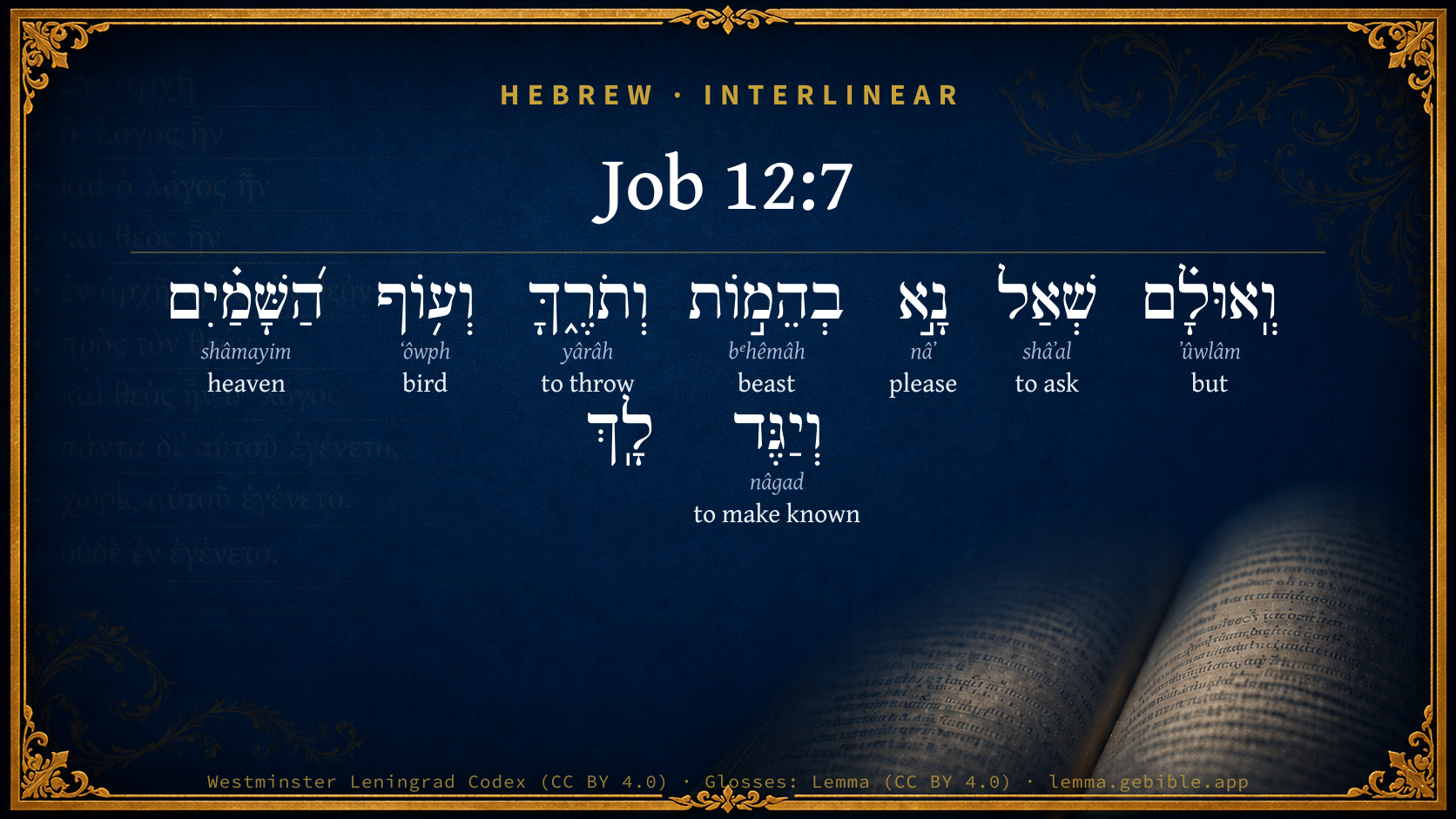
Job 12:7

Hebrew (Westminster Leningrad Codex) Job 12:7 appears in the Hebrew Old Testament. The text above is from the Westminster Leningrad Codex. Each word links to its Strong’s number, a concise gloss, and parsing drawn from the Open Scriptures Hebrew Bible morphology. Click any word for its full Brown-Driver-Briggs (BDB) entry.
Download image
Cite this verse

Job 12:7 (World English Bible). Public Domain. Lemma interlinear Bible study tool, https://lemma.gebible.app/v/job/12/7.

Show BibTeX & RIS
BibTeX
RIS
English Translation
"But ask the animals, now, and they shall teach you; The birds of the sky, and they shall tell you.
World English Bible · Public Domain
Download a study sheet

One document with this verse’s original text, its word-by-word gloss line, the meaning frame, cross-references with their text, attributed commentary, and full source and license credits — printable, and it pastes into notes with its structure intact.

This verse Autodidact and up

Study sheet (.html) Plain text (.txt)

A passage Seminary Student

Up to 50 verses in one chapter. A passage sheet keeps up to 6 commentary sources and 12 cross-references per verse, in the order this page ranks them, and says so on the sheet whenever that leaves anything out. Ask for a single verse and you get the Autodidact verse sheet above.

Everything on this page stays free to read, with no account — the sheet is a download of what is already on screen, not access to it.

Want to remove ads? Support Godless Engineer
Compare translations 3

The same verse in 3 English versions, stacked beneath the original-language interlinear above. Click any original word for its lexicon entry.

Each is an independent rendering of the whole verse — the interlinear is not word-aligned to these translations.

Highlighted words mark where these versions differ — a whole-verse word diff, not a word-by-word alignment.

  • World English Bible Public Domain
    "But ask the animals, now, and they shall teach you; The birds of the sky, and they shall tell you.
  • King James Version Public Domain
    But ask now the beasts, and they shall teach thee; and the fowls of the air, and they shall tell thee:
  • unfoldingWord Literal Text CC BY-SA 4.0
    But now ask the beasts, and one will teach you, the birds of the heavens, and one will declare to you.

unfoldingWord Literal Text — © unfoldingWord, licensed CC BY-SA 4.0. Word-aligned USFM3 via Door43 (git.door43.org/unfoldingWord/en_ult).

Versions to compare (up to 4)

3 of 4 selected

Show all 18 translations

Every available English version of this verse, each an independent rendering of the whole verse.

  • World English Bible Public Domain
    "But ask the animals, now, and they shall teach you; The birds of the sky, and they shall tell you.
  • Berean Standard Bible Public Domain
    But ask the animals, and they will instruct you; ask the birds of the air, and they will tell you.
  • Majority Standard Bible Public Domain
    But ask the animals, and they will instruct you; ask the birds of the air, and they will tell you.
  • King James Version Public Domain
    But ask now the beasts, and they shall teach thee; and the fowls of the air, and they shall tell thee:
  • American Standard Version (1901) Public Domain
    But ask now the beasts, and they shall teach thee; And the birds of the heavens, and they shall tell thee:
  • Revised Version (1885) Public Domain
    But ask now the beasts, and they shall teach thee; and the fowls of the air, and they shall tell thee:
  • Geneva Bible (1599) Public Domain
    Aske now the beasts, and they shall teach thee, and the foules of the heauen, and they shall tell thee:
  • Douay-Rheims (1899) Public Domain
    But ask now the beasts, and they shall teach thee: and the birds of the air, and they shall tell thee.
  • Young's Literal Translation Public Domain
    And yet, ask, I pray thee, `One of' the beasts, and it doth shew thee, And a fowl of the heavens, And it doth declare to thee.
  • Literal Standard Version CC BY-SA 4.0
    And yet, now ask [one of] the beasts, || And it shows you, || And a bird of the heavens, || And it declares to you.
  • Unlocked Literal Bible CC BY-SA 4.0
    But now ask the beasts, and they will teach you; ask the birds of the heavens, and they will tell you.
  • unfoldingWord Literal Text CC BY-SA 4.0
    But now ask the beasts, and one will teach you, the birds of the heavens, and one will declare to you.
  • Darby Bible Public Domain
    But ask now the beasts, and they shall teach thee; and the fowl of the heavens, and they shall tell thee;
  • World Messianic Bible Public Domain
    “But ask the animals now, and they will teach you; the birds of the sky, and they will tell you.
  • Webster's Bible Public Domain
    But ask now the beasts, and they shall teach thee; and the fowls of the air, and they shall tell thee:
  • Free Bible Version CC BY-SA 4.0
    But if you ask the animals they will teach you, the birds in the sky will tell you;
  • Bible in Basic English Public Domain
    But put now a question to the beasts, and get teaching from them; or to the birds of the heaven, and they will make it clear to you;
  • JPS Tanakh (1917) Public Domain
    But ask now the beasts, and they shall teach thee; and the fowls of the air, and they shall tell thee;

Literal Standard Version (2020), Covenant Press — licensed CC BY-SA 4.0. Text via the HelloAO Bible API (eBible.org). Unlocked Literal Bible (unfoldingWord) — licensed CC BY-SA 4.0. Text via the HelloAO Bible API (eBible.org). unfoldingWord Literal Text — © unfoldingWord, licensed CC BY-SA 4.0. Word-aligned USFM3 via Door43 (git.door43.org/unfoldingWord/en_ult). Free Bible Version, Dr. Jonathan Gallagher — licensed CC BY-SA 4.0. Text via the HelloAO Bible API (eBible.org).

Word by word

More ways to search: Search by grammar → Find every occurrence → Compare this word →

Practice this passage: Drill this verse → Learn its vocabulary →

About this verse

These counts appear in no published source. They are computed here, from the morphology-tagged text and Lemma’s own curated glosses. What Lemma adds →

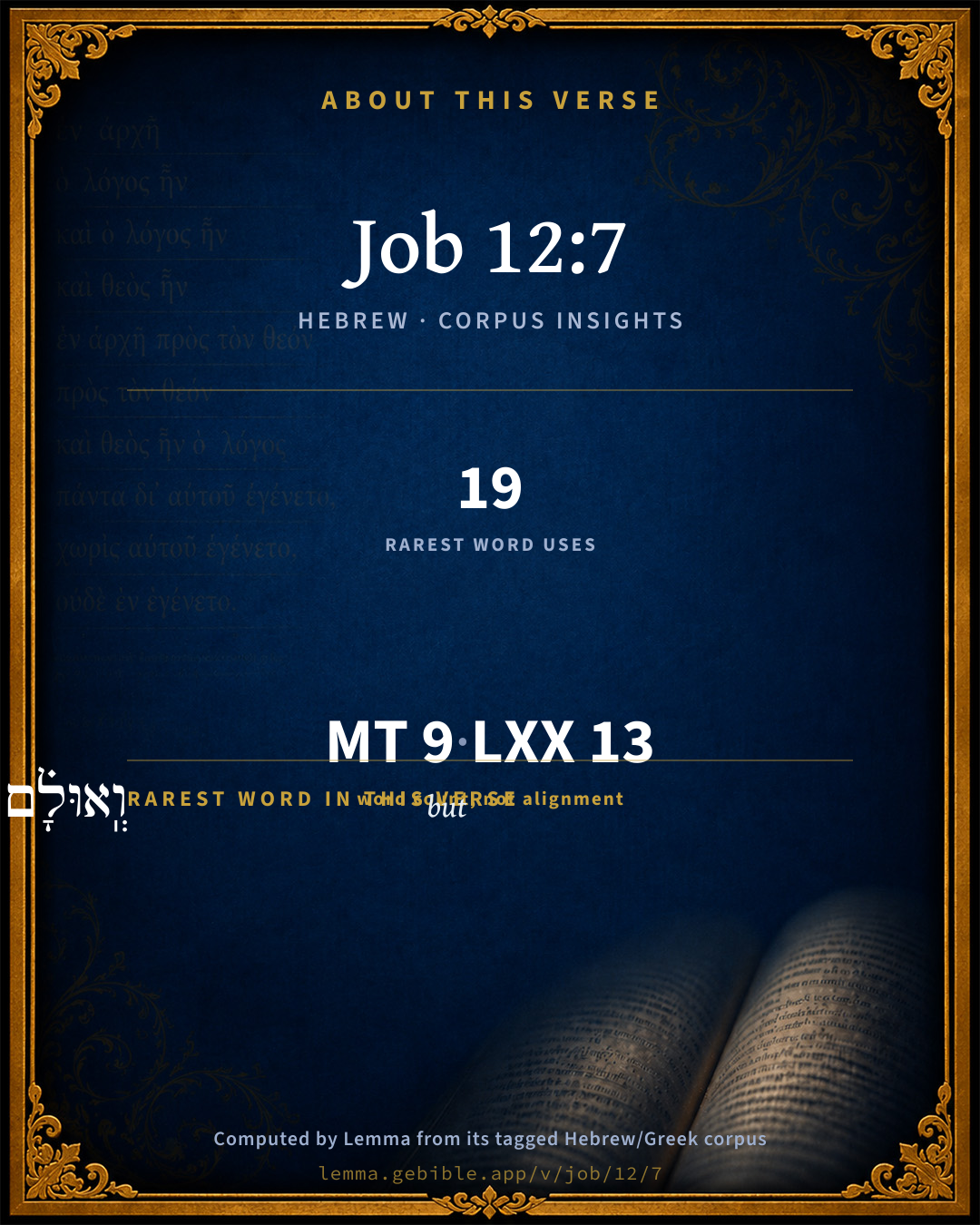
9
words
8
distinct lemmas
Wisdom
section

Notable vocabulary

The rarest word here is וְֽאוּלָ֗ם but H199 — appearing just 19 times in the whole Hebrew Bible.

Shared distinctive vocabulary

וְֽאוּלָ֗ם but H199 occurs in 19 verses of the Hebrew Bible. Also found in:

Grammatical profile

  • 3 verbs
  • 3 nouns
  • 1 preposition
  • 1 adverb
  • 1 particle

Verb forms

  • שְׁאַל Qal · Imperative
  • וְתֹרֶ֑ךָּ Hiphil · Imperfect
  • וְיַגֶּד Hiphil · Imperfect

Hebrew & Septuagint length

In English translation the verse runs 20 words from the Hebrew and 23 from the Septuagint (LXX English) — closely comparable.

A rough comparison of the two English renderings, which tokenize alike — not a word-level alignment.

Word counts can differ between the Hebrew and the Greek without any difference in meaning — e.g. the Hebrew direct-object marker אֵת has no separate Greek word, and Greek often adds the article ὁ.

In the original languages it is 9 Hebrew tokens and 13 Greek tokens — but the two are counted differently (Hebrew bundles its prefixes and suffixes into one token; the Greek is in lemma form), so that isn’t a like-for-like length.

Cross-references

4

Topical passages linked to Job 12:7 in the Treasury of Scripture Knowledge — connected by theme and wording, ordered by reader-vote popularity; previews shown in the World English Bible.

  • Isaiah 1:3 The ox knows his owner, And the donkey his master's crib; But Israel doesn't know, My people don't consider.
  • Proverbs 6:6 Go to the ant, you sluggard. Consider her ways, and be wise;
  • Jeremiah 8:7 Yes, the stork in the sky knows her appointed times; and the turtle-dove and the swallow and the crane observe the time of their coming; but my people don't know Yahweh's law.
  • Job 21:29–30 Haven't you asked wayfaring men? Don't you know their evidences,

Cross-references courtesy of OpenBible.info (CC BY 4.0).

Hebrew and Greek witnesses Masoretic Hebrew ↔ Greek Septuagint

The same verse in the two great witnesses to the Old Testament, shown verse-for-verse.

These are two independent witnesses, not word-aligned to each other, and the Septuagint is shown in lemma (dictionary) form.

Hebrew Job 12:7 Masoretic · Westminster Leningrad Codex

וְֽאוּלָ֗ם שְׁאַל נָ֣א בְהֵמ֣וֹת וְתֹרֶ֑ךָּ וְע֥וֹף הַ֝שָּׁמַ֗יִם וְיַגֶּד לָֽךְ

"But ask the animals, now, and they shall teach you; The birds of the sky, and they shall tell you.

World English Bible · Public Domain

Greek LXX Job 12:7 Septuagint · lemma form

ἀλλά δή ἐπιἐρωτάω τετράποδος ἐάν σύ εἶπον πετεινός δέ οὐρανός ἐάν σύ ἀποἀγγέλλω

But ask now the beasts, if they may speak to you; and the birds of the air, if they may declare to you.

LXX2012 (modern English Septuagint) · Public Domain

On this verse, Keil & Delitzsch discusses the Septuagint’s reading. Read the note in Commentary ↓

Hebrew: Westminster Leningrad Codex (CC BY 4.0). Greek: Septuagint (public domain); English from LXX2012 (modern English Septuagint) (Public Domain). How the Septuagint differs from the Hebrew →

Commentary

Notes on Job 12:7 from classic Christian and Jewish commentators (each source and its license shown beneath its notes). The classic Christian expositions comment on the surrounding passage and are grouped to its opening verse, so a note may address several verses; the Jewish commentaries on the Tanakh (Rashi and others) are per-verse, so they appear only where the commentator wrote on this verse.

Lemma curates 59 commentaries, every one of them public domain or Creative Commons licensed, each selected and text-cleaned for this edition rather than reprinted as found. About our sources →

Trapp's Complete Commentary

John Trapp

Job 12:7 But ask now the beasts, and they shall teach thee; and the fowls of the air, and they shall tell thee:

Ver. 7. But ask now the beasts of the earth, and they shall teach thee] Even the wildest of them that abide in the wilderness. There is not one of these, or else of the fowls of the air, but can both teach thee, and tell thee that the world is ordered by a providence, that God is powerful, wise, just, &c., and must therefore be loved and served. That he suffereth the bad to oppress the good, as the beasts do devour the little ones; as the hurtful fowls destroy the harmless; as the great fishes eat up the smaller: man, who was once the captain of God’s school, is now, for his truantcy, turned down into the lowest form, as it were, to learn his A B C’s again; yea, to learn it from the meanest creatures. See Pro 6:6 Jer 8:7 Mat 6:26; where it appeareth, that in the ant, stork, swallow, &c., God hath set before us, as in a picture, the lively resemblance of many excellent virtues, which we ought to pursue and practise. These are the right laymen’s books, the images that may truly teach people the knowledge of God, and of his will, of themselves, and of their duties; which we should the rather learn, because God hath given us wisdom beyond them, Job 37:11, and yet by sending us to them, shameth our dulness and disobedience.

John Trapp, A Commentary or Exposition upon All the Books of the Old and New Testament (1647–1656) — public domain. Text from a community e-Sword module.

The Biblical Illustrator

Joseph S. Exell

Job_12:7

But ask now the beasts, and they shall teach thee.

An appeal to the living creatures

Rosenmuller supposes that this appeal to the inferior creation should be regarded as connected with Job_12:3, and that the intermediate verses are parenthetic. Zophar had spoken with considerable parade of the wisdom of God. He professed to have exalted views of the Most High. In reply to this, Job says that the views which Zophar had expressed were the most commonplace imaginable. He need not pretend to be acquainted with the more exalted works of God, or appeal to them as if his knowledge corresponded with them. Even the lower creation--the brutes, the earth, the fishes--could teach him knowledge which he had not now. Even from their nature, properties and modes of life, higher views might be obtained than Zophar had. Others suppose the meaning is that in the distribution of happiness, God is so far from observing moral relations that even among the lower animals, the rapacious and the violent are prospered, and the gentle and innocent are the victims. Lions, wolves, and panthers are prospered--the lamb, the kid, the gazelle are the victims. The object of Job is that rewards and punishments are not distributed according to character. This is seen all over the world, and not only among men, but even in the brute creation. Everywhere the strong prey upon the weak; the fierce upon the tame; the violent upon the timid. Yet God does not come forth to destroy the lion and the hyena, or to deliver the lamb and the gazelle from their grasp. Like robbers, lions, panthers, and wolves prowl upon the earth; and the eagle and the vulture from the air pounce upon the defenceless; and the great robbers of the deep prey upon the feeble, and still are prospered. What a striking illustration of the course of events among men, and of the relative condition of the righteous and the wicked. (Albert Barnes.)

Religious lessons taught to man

1. The great lesson which the animal creation, regarded simply as the creature and subject of God, is fitted to teach us, is a lesson of the wisdom and power and constant beneficence of God. Job reminds the friends that what they had been laying down to him in so pompous a manner constituted only the mere elements of natural religion, and that a man had only to look around him and observe and ponder the phenomena of the visible universe, to be abundantly convinced that God, the maker of all things, was also the upholder of all things, and the supreme disposer of all events. Job sends us to the animal creation that we may gather from it instances of the greatness of the Creators hand, and the constancy of the Creators providence. Himself invisible, God is revealed in all the work of His hands, and it needs but the observing eye and the candid judgment to satisfy every one of His being and His perfections. God reveals Himself no less in the lapse of events than in the arrangements of creation. There is no nation, there is no household, but has in the record of its own experience abundant manifestations of His constant, and wise, and gracious superintendence of the affairs of earth. In the lesson which is thus taught to us concerning God, the animal creation bears its part. Not one of the creatures but is fearfully and wonderfully made; not one of them but is wisely and mercifully provided for. For every one of them there is a place, and to this each is adapted with transcendent skill and beneficence. Even the lower animals may be our teachers and speak to us of God.

2. The way in which the creatures spend their life, and use the powers which God has given them. In many respects they are examples to us, and by the propriety of their conduct rebuke the folly and wickedness of ours. The beasts, etc., will teach us the following things as characteristic of their manner of life.

(1) They constantly and unceasingly fulfil the end of their being.

(2) They are seen always to live according to their nature.

(3) They teach us to seek happiness according to our nature and capacity, and with a prudent foresight to avoid occasions of disaster and sorrow. Man stands rebuked by the brutes that perish. (W. Lindsay Alexander, D. D.)

Does God treat men here according to character

I. The experience of human life. The fact that Job here refers to--the prosperity of wicked men, may be regarded--

1. As one of the most common facts of human experience. All men in all lands and ages have observed it, and still observe it. It is capable of easy explanation: the conditions of worldly prosperity are such that sometimes the wicked man can attend to them in a more efficient way than the righteous. As a rule, the more greed, cunning, tact, activity, and the less conscience and modesty a man has, the more likely he is to succeed in the scramble for wealth.

2. One of the most perplexing facts in human experience. What thoughtful man in passing through life has not asked a hundred times, Wherefore do the wicked prosper? and has not felt, with Asaph, stumbling into infidelity as he saw the prosperity of the wicked?

3. One of the most predictive facts in human experience. This fact points to retribution.

II. The history of inferior life. But ask now the beasts, and they shall teach thee, etc. Solomon sends us to the ant; Agur to the coney, the locust, the spider; Isaiah to the ox and the ass; Jeremiah to the stork, the turtledove, the crane, the swallow; and the Heavenly Teacher Himself to the fowls of the air. Jobs argument is that the same lack of interference on Gods part in the free operations of men in this life, in punishing the wicked and rewarding the good, you see around you in all the lower stages of life. Look to the beasts of the field. Does the Governor of the world interfere to crush the lion, the tiger, the panther, or the wolf from devouring the feebler creation of His hands? Does He come to the rescue of the shrieking, suffering victims? Behold the fowls of the air. See the eagle, the vulture, the hawk pouncing down on the dove, the thrush, the blackbird, or the robin. Does He interfere to arrest their flight, or curb their savage instincts? Speak to the earth. See the noxious weeds choking the flowers, stealing away life from the fruit trees, does He send a blast to wither the pernicious herb? Not He. Turn to the fishes of the sea. Does He prevent the whale, the shark, and other monsters from devouring the smaller tenants of the deep? No; He allows all these creatures to develop their instincts and their propensities. It is even so with man. He allows man full scope here to work out what is in him, to get what he can.

III. The maxims of philosophic life. Doth not the ear try His words? and the mouth taste His meat? With the ancient is wisdom, and in length of days is understanding. There is something like a syllogism in this verse.

1. That the more the mind exercises itself upon moral questions, the more capable it is to pronounce a correct judgment. Just as the gourmand gets a nicer appreciation of the qualities of wines and viands as he exercises his palate, so the mind gets a clearer conception of things the more it makes them the subject of reflection.

2. That the ancients did greatly exercise their minds on these subjects, and therefore their judgment is to be taken, and it confirms Jobs conclusions. (Homilist.)

Our duty to the creatures

In order to enforce the moral and religious duty which we all owe to the inferior creatures, consider--

I. The nature of our authority over them.

1. It arises out of that capacity of reason which places us above them. And as reason is our great distinction and prerogative, it is that alone which is to influence us in the exercise of the power which it has entrusted to our hands. As these creatures are endowed with a capacity to enjoy pleasure, and as abundant provision is made for the gratification of their several senses, reason teaches us to conclude that the Creator wills their happiness, and that our nobler faculties are to be employed, not in counteracting, but in furthering His benevolent purpose. Whatever unnecessarily deprives them of any portion of their enjoyment, violates the authority of reason, and deposes the sovereign of the lower world from that throne which he converts into an engine of tyranny and oppression.

2. This, likewise, is constituted authority. Man has received the creatures by an original grant from the hands of their Maker. In virtue of this all-comprehensive endowment, the investiture of property is added to the natural authority of reason, so that we have an unquestionable right to make all the tribes of being subservient to our interest. But our authority is limited--it is the authority of men over dependents, not of demons over their victims. We are not at liberty to use the creatures as we please. Where necessity ends, inhumanity begins. The meanest reptile on earth has its inalienable rights, and it is at our peril that we immolate them on the altar of our hard-hearted selfishness. The persecuted, injured, suffering children in natures universal family are not forgotten by their beneficent Parent, nor will their wrongs remain unredressed.

II. Their claims upon our humanity and kindness. The creatures who are beneath us ought not only to be protected from ill-treatment, but they are entitled to humane and benevolent consideration, as parts of the great family specially committed to our guardianship. Many, who would shrink from the imputation of cruelty, by a constitutional indifference to the wants and sufferings of the beings around them, are really chargeable with all the wretchedness which it is in their power to prevent and alleviate. A wise and considerate humanity in its direct operation is most beneficial to universal happiness; and in its indirect influence as an example, fails not to deter many an incipient offender from the premeditated act of cruelty, while it gently diffuses its own benignant spirit through the circle in which it unostentatiously moves, protecting, saving, blessing all. And nothing tends to our felicity so much as cherished feeling of enlightened benevolence. Many reasons may be assigned why the inferior creatures ought to excite in us such a spirit.

1. They are the creatures of God.

2. They have the same origin with ourselves.

3. They are the care of Divine providence.

4. Their claims arise out of the lessons they teach.

5. They confer on us innumerable benefits of another kind. Of the general usefulness of the creatures we have the most palpable evidence every day.

6. Remember their susceptibility to pain. And we may add--

7. That these creatures owe all their natural sufferings to the fall of man; and to him therefore they have a right to look for sympathy. (J. Styles, D. D.)

The Biblical Illustrator, edited by Joseph S. Exell (c. 1880s–1900s) — public domain. Text from a community e-Sword module.

Joseph Benson's Commentary

Job 12:7. Ask now the beasts, and they shall teach thee — If thou observest the beasts, and their properties, actions, and events, from them thou mayest learn this lesson: namely, that which Zophar had uttered with so much pomp and gravity, (Job 11:7-9,) concerning God’s unsearchable wisdom, almighty power, and absolute sovereignty: thou dost not need, says Job, to go into heaven or hell to know it; but thou mayest learn it even from the brute creatures. The beasts of the earth, the fowls of the air, the fishes of the sea, all animals, and even plants, fruits, and flowers, are daily and hourly evidences to us, of the being and infinite perfections of God. The wonderful contrivance and admirable mechanism manifested in their formation, the preparation made for their wants, the exact adaptation of their organs to the particular mode of life for which they are intended; the wonderful regularity observed in their propagation: these things as plainly tell us, they are the work of God, as if they all had intelligible voices and declared it to us. Some commentators suppose that Job referred here to the greater and stronger brute creatures, preying on the lesser and weaker, as a fact illustrative of his argument respecting the power and prosperity of robbers, oppressors, and tyrants; and to the inferior animals in general, ministering to the pride, luxury, and indulgence of ungodly men; the earth and its richest produce being their property, and all nature drudging, as it were, to gratify their lusts. But the following verses seem rather to lead to the interpretation first mentioned, which certainly is the more instructive use of the words.

Joseph Benson's Commentary on the Old and New Testaments (1811–1818) — public domain. Text from a community e-Sword module.

Whedon's Commentary on the Bible

Daniel D. Whedon

b. The divine wisdom on which Zophar has descanted, the entire brute creation might have taught him. And yet Zophar does not know that He who is Lord over life and death, lets the wicked live, Job_12:7-12.

7. Ask now the beasts… and the fowls, etc. — Among the Hindus, if any one refuses instruction or will not be convinced, he is told to ask the cattle, inquire of the birds, and that they will give him wisdom. (Roberts.) Some imagine that Job appeals to the brute creation to show that the most rapacious are most secure. But others more correctly suppose that he resumes the thought with which his discourse opens (Job_12:3) — that of the power and wisdom of God. In the world’s great school (he says) anybody might learn “these.” The Scriptures frequently summon the so-called inferior creation to instruct man in things pertaining to wisdom. “Every creature hath a trumpet in his mouth to proclaim the Deity.” The world of instinct is one of mystery which man cannot fathom. It is with us, but separated from us by a great gulf which neither man nor brute can cross. As respects the interchange of thought, the brute world moves around us in an orbit of silence, but one that none the less reflects its Maker’s praise. Lord Erskine would never allow animals to be called the brute creation; he called them the mute creation. Instinct trenches upon reason at so many points, in some respects vastly surpassing it, that it does not become the monarch man to look upon his subjects with disdain. In ways we know not of, they may proclaim in the ear of the great Creator his wisdom, power, and love.

Daniel D. Whedon (gen. ed.), Commentary on the Old and New Testaments (1874–1909) — public domain. Text from a community e-Sword module.

Tyndale Open Study Notes

Tyndale Open Resources

12:7-9 A switch from you (plural in 12:2-3) to you (singular here) probably indicates that Job is directing his comments to Zophar.

12:7-8 ask the animals . . . birds . . . earth . . . fish: Job believed that the reason for his misery was obvious and that even nature would understand it (Prov 6:6). Later, God directed Job’s attention to the animal kingdom to convince Job that he did not understand (Job 38–40).

Tyndale Open Study Notes — © Tyndale Open Resources, licensed CC BY-SA 4.0. Text via the HelloAO Bible API.

Geneva Bible (1599)

Geneva Bible translators

He declareth to them that did dispute against him, that their wisdom is common to all, and such as the very brute beasts do daily teach.

Geneva Bible (1599) marginal notes — public domain. Text via Bolls.life.

Jamieson, Fausset & Brown

Robert Jamieson, A. R. Fausset & David Brown

Beasts, birds, fishes, and plants, reasons Job, teach that the violent live the most securely (Job 12:6). The vulture lives more securely than the dove, the lion than the ox, the shark than the dolphin, the rose than the thorn which tears it.

Jamieson, Fausset & Brown — Commentary Critical and Explanatory on the Whole Bible (1871) — public domain (CC PDM 1.0). Text via the HelloAO Bible API.

Adam Clarke's Commentary

Verse 7. But ask now the beasts, and they shall teach thee] Mr. Good's paraphrase here is very just: "Why tell ye me that the Almighty hath brought this calamity upon me? Every thing in nature, the beasts of the field, the fowls of the heaven, every inhabitant of earth and sea, and every thing that befalls them, are the work of his hands; and every thing feels and acknowledges him to be the universal Creator and Controller. It is the common doctrine of all nature; but to apply it as ye would apply it to me, and to assert that I am suffering from being guilty of hypocrisy, is equally impertinent. He ordains every thing in wisdom as well as in power; but why events happen as they happen, why good and evil are promiscuously scattered throughout nature or human life, ye are as ignorant of as myself."

Adam Clarke's Commentary on the Bible (1810–1826) — public domain. Text from a community e-Sword/MySword module.

The Cambridge Bible for Schools and Colleges

gen. ed. J. J. S. Perowne

7–10. Such knowledge as the friends possessed of God’s wisdom and power and their action in the world could be learned by any one who had eyes to observe the life and fate of the lower creatures. In all may be seen God’s absolute might and sway prevailing (Job_12:10).

The Cambridge Bible for Schools and Colleges (gen. ed. J. J. S. Perowne; Cambridge University Press, 1878–1918) — public domain. Text from a community e-Sword module.

John Gill's Exposition

Or speak to the earth, and it shall teach thee,.... Or ask "a sprig of the earth" (n), any shrub, or tree, or whatsoever grows out of it, and they will all unite in this doctrine, that they are raised and preserved by the power of God, and are so many instances of his wisdom, power, and goodness:

and the fishes of the sea shall declare unto thee; as mute as they are, they will proclaim this truth, that God is the mighty Maker and wise Disposer of them.

(n) "virgultum terrae", Pagninus, Schmidt; so Drusius and Michaelis.

John Gill's Exposition of the Whole Bible (1746–1763) — public domain (CC PDM 1.0). Text via the HelloAO Bible API.

Albert Barnes' Notes on the Bible

But ask now the beasts - Rosenmuller supposes that this appeal to the inferior creation should be regarded as connected with Job 12:3, and that the intermediate verses are parenthetical. Zophar had spoken with considerable parade of the wisdom of God. He had said (Job 11:7 ff) that the knowledge of God was higher than the heavens, and had professed Job 12:6 to have himself exalted views of the Most High. In reply to this, Job says that the views which Zophar had expressed, were the most commonplace imaginable. He need not pretend to be acquainted with the more exalted works of God, or appeal to them as if his knowledge corresponded with them. Even the lower creation - the brutes - the earth - the fishes - could teach him knowledge which he had not now. Even from their nature, properties, and modes of life, higher views might he obtained than Zophar had. Others suppose, that the meaning is, that in the distribution of happiness, God is so far from observing moral relations, that even among the lower animals, the rapacious and the violent are prospered, and the gentle and the innocent are the victims.

Lions, wolves, and panthers are prospered - the lamb, the kid, the gazelle, are the victims. Either of these views may suit the connection, though the latter seems to me to be the more probable interpretation. The object of Job is to show that rewards and punishments are not distributed according to character. This was so plain in his view as scarcely to admit of argument. It was seen all over the world not only among people, but even in the brute creation. Every where the strong prey upon the weak; the fierce upon the tame; the violent upon the timid. Yet God does not come forth to destroy the lion and the hyaena, or to deliver the lamb and the gazelle from their grasp. Like robbers Job 12:6, - lions, panthers, and wolves prowl upon the earth; and the eagle and the vulture from the air pounce upon the defenseless, and the great robbers of the deep prey upon the feeble, and still are prospered. What a striking illustration of the course of events among people, and of the relative condition of the righteous and the wicked. Nothing could be more pertinent to the design of Job than this appeal, and nothing was more in accordance with the whole structure of the argument in the poem, where wisdom is seen mainly to consist in the result of careful observation.

And they shall teach thee - Shall teach thee that God does not treat all according to their character. He does not give security to the gentle, the tame, and the innocent, and punish the ferocious, the blood-thirsty, and the cruel.

And the fowls - They shall give thee information of the point under discussion. Those that prey upon others - as the eagle and the vulture - are not exposed at once to the divine displeasure, and the tender and harmless are not protected. The general principle is illustrated in them, that the dealings of God are not always in exact accordance with character.

Albert Barnes' Notes on the Bible (1834–1885) — public domain. Text from a community e-Sword/MySword module.

Matthew Poole's English Annotations

They shall teach thee, to wit, objectively, i.e. if thou observest the beasts, and their properties, and actions, and events, from them thou mayst learn this lesson. What lesson? I answer, either,

1. That which was last mentioned, Job 12:5. God’s providence doth order things in the like manner among the very beasts, and fowls, and fishes; of which the most ravenous and mischievous fare the best, whilst those which are more harmless, and serviceable, and beneficial to men meet with the hardest usage. Or,

2. That which Zophar had uttered with so much pomp and gravity, Job 11:7-9, concerning God’s infinite wisdom; which, saith Job, thou needest not go into heaven or hell to know, but thou mayst learn it even from the beasts, &c.

Matthew Poole's English Annotations on the Holy Bible (1683–1685) — public domain. Text from a community e-Sword/MySword module.

The Pulpit Commentary

But ask now the beasts, and they shall teach thee. Job here begins his review of all creation, to show that God has the absolute direction of it. The order of

(1) beasts,

(2) birds,

(3) fishes, is that of dignity. (comp. Gen_9:2 Psa_8:7, Psa_8:8) Job maintains that, if appeal were made to the animal creation, and they were asked their position with respect to God, they would with one voice proclaim him their absolute Ruler and Director. And the fowls of the air, and they shall tell thee. The instincts of birds, their periodical migrations, their inherited habits, are as wonderful as anything in the Divine economy of the universe, and as much imply God"s continually directing hand.

Vers. 7-12. The wisdom and the power of God a truth universally known.

It is not the peculiar possession of those fancied wise friends. It is a truth impressed on all nature and on the experience of man.

I APPEAL TO THE LIVING CREATURES. (Vers. 7-10) The beasts, the birds of the air, the earth with all its living growths, the creatures of the sea, all bear traces of his skill, all receive from him their life and sustenance, all are subject to his omnipresent power. (comp. Psa_104:26-30)

II APPEAL TO THE EXPERIENCE OF AGE. As the palate tries and discriminates between the different dishes on the table, so does the ear try the various opinions to which it listens, and selects the best, the ripest, as its guide (ver. 11). Long life means large experience, and largo experience gives the criterion of truth and the guide of life. Yet experience is but the book of common experiences. It fails us when we have to deal with the peculiar and the exceptional, which is the present situation of Job (ver. 12).

III ELOQUENT DESCRIPTION OF THE POWER AND WISDOM OF GOD. (Vers. 13-25) Here Job rivals and surpasses his friends. With repeated blows, as of the hammer on the anvil, he impresses the truth that the might and intelligence of the Supreme are irresistible, and before him all human craft and power must be reduced to impotence. The power and the wisdom of God alternately occupy his thought, appear and reappear in a variety of images. J.

Vers. 7-10. The testimony of the creature to the Divine government.

Job again vindicates himself in presence of his accusing friends. He professes his knowledge to be as theirs, and he even points them to the lower animals to find wisdom from them. The very beasts of the earth, the fowls of the air, the fruitful field, the fishes in the deep, all tell the great truth Jehovah reigns supreme. "In his hand is the soul of every living thing, and the breath of all mankind;" all proclaim the Almighty, all speak of the Ever-living One in whom all live. This testimony is witnessed

I IN THE CONSCIOUS LIFE OF EVERY CREATURE. Even man, at the head of all, is conscious of the dependence of his life upon some power higher than himself. There is one Lord of life, Author of all life, Supporter of all. Every individual life declares "the hand of the Lord hath wrought this." In his hand alone is "the soul the life "of every living thing, and the breath of all mankind." He is the Creator and Preserver of every life.

II IN THE INFINITE VARIETY OF LIFE. What an unlimited variety do we behold! The birds of the air, the beasts of the field, the fish of the sea, abound in a wide diversity of life. All speak of the infinite Creator, in whom are the possibilities of infinite life; who, of his own infinite resources, has created and made the whole. That the species vary according to the encircling conditions of their life does not detract from their testimony to the infinite and supreme Power. For the very existence of every life speaks of that Power. How great is he whose creative skill reveals itself in this unlimited variety!

III NOT LESS TESTIMONY IS BORNE BY THE CONTINUOUS REPRODUCTION OF THE VAST VARIETIES. That age after age this power continues to bring forth, each after its own kind, is another testimony to the greatness of him "in whose hand is the soul of every living thing." The creation and preservation of the many species age after age speaks to the thoughtful mind of him who is the one Lord of all life, who by his omnipotent overruling preserves all in their order and in their continuance.

IV BUT IN THE MARVELLOUS STRUCTURE OF THEIR BODIES ANOTHER TESTIMONY IS BORNE. How delicate are the organs of the body the powers of sight, of hearing, of activity; the strength of one, the delicacy of the structure of another! How wonderful are the nerves of the body, conveying the impression from the outer world to the brain! Equally so the blood-vessels, and the hidden powers by which the bones are built up, and again the powers of nutrition gathering food from without and assimilating it to the body in all its parts. This is done without the knowledge and consent of the creature; for the creature, even man, knows not how it is done. it is above him; it speaks definitely and distinctly and loudly of God, "in whose hand is the breath of all mankind.

V YET A FURTHER TESTIMONY IS TO BE SEEN IN THE ABUNDANT PROVISION MADE FOR THE SUSTENANCE OF ALL. Notwithstanding the vastness of the realm in which creature-life is found, and the variety of the forms of life, each having its own peculiar needs, yet he "satisfieth the desire of every living thing," Food is abundant for man and beast, and of the fowls of the air it is truly said, "he feedeth them." So the Divine work is seen on every side; and from all the varieties of conscious life one testimony arises to the great truth, "The Lord reigneth." On every work the truth lies clearly impressed, "The hand of Jehovah made this. R.G.

Vers. 7-10. Lessons of nature.

I NATURE REBUKES MAN"S IGNORANCE. Job refers his friends to nature in a tone of reproach. They ought to have known what nature was proclaiming. There are two grounds for this rebuke.

1. The wealth and fulness of nature"s testimony to her Creator. Go where one may, nature is ready to speak for God. The beasts of the field, the fowls of the air, the creeping things on the ground, the fishes of the sea, all speak for the power and wisdom of their Maker. There is variety in this grand utterance of nature, yet there is unity. Many creatures, of diverse sorts, concur to bear witness to the same great truths. If we cannot understand the beasts, the birds may teach us; if the insects are an enigma, the fishes may instruct us. Though all these different voices of nature may not be sounding in our ears as once, we cannot be long out of the reach of some of them. Therefore"In contemplation of created things By stops we may ascend to God. (Milton.)

2. The greater intelligence of man. "But ask now the beasts, and they shall teach thee as though those dull brutes knew what man had missed discovering. So the lord of creation is sent to be a pupil of his humblest subjects. Of course, to be prosaically accurate, it must be said that the beasts do not understand the lessons they teach; that only man can know God, and that the testimony of nature is unconscious. Still, the higher faculty of man makes it a shame that he should not know what nature is teaching in so many ways all around him.

II NATURE REVEALS GOD"S PRESENCE.

1. By its constitution. The very variety of the creation bespeaks the mind and power of the Creator. For this variety is not confused, but orderly. There must be a sameness about the very disorder of chaos which is not seen in the cosmos. The various species of living creatures keep their several places in the scale of creation, fulfil their distinctive destinies and perform their separate functions. There is mind and purpose in the very variety of nature.

2. By its life. Nature is not a huge mosaic. If its variegated picture were motionless and changeless, we could not but admire the infinite skill with which it had been put together. The exhibition of stuffed specimens of dead animals in a natural history museum gives us abundant proof of the skill of the Creator. But the fields show us what no museum can reveal. In the great world of nature all is life and movement. Thus we have not the relics of an ancient Divine activity of God, like fossils of extinct animals, but the creatures in the very flush of life. And this life must be constantly maintained. Then by its very continuance it proclaims the presence of God. He is in nature, energizing in it every moment. In his hand is the soul of every living creature.

3. By its human connections. Man shares in the common life of nature. The hand that holds the soul of every living thing holds the breath of all mankind. "In him we live, and move, and have our being". (Act_17:28) Therefore we have not only to lock around us on the animal creation. If we do but consider our own existence, we have daily evidence of the presence of God. The testimony of creation is designed to remind us of our own dependence on God. It is especially a good corrective of the subjective notions of a visionary. Job answers Eliphaz and his awful vision most aptly by appealing to the great living voice of nature. W.F.A.

The Pulpit Commentary (1880–1919), ed. H.D.M. Spence-Jones & Joseph S. Exell — public domain. Text from a community e-Sword module.

John Wesley's Explanatory Notes

But - If thou observest the beasts, and their properties and actions, and events, from them thou mayst learn this lesson: that which Zophar had uttered with so much pomp and gravity, chap. xi, 7, 8, 9, concerning God's infinite wisdom, saith Job, thou needest not go into heaven or hell to know. but thou mayst learn it even from the beasts.

John Wesley, Explanatory Notes Upon the Whole Bible (1754–1765) — public domain. Text via the GEBible commentary corpus.

Keil & Delitzsch

C. F. Keil & F. Delitzsch

7 But ask now even the beasts - they shall teach it thee;

And the birds of heaven - they shall declare it to thee:

8 Or look thoughtfully to the ground - it shall teach it thee;

And the fish of the sea shall tell it thee.

9 Who would not recognise in all this

That the hand of Jehovah hath wrought this,

10 In whose hand is the soul of every living thing,

And the breath of all mankind?!

The meaning of the whole strophe is perverted if זאת (Job 12:9), is, with Ewald, referred to "the destiny of severe suffering and pain," and if that which precedes is accordingly referred to the testimony of creation to God as its author. Since, as a glance at what follows shows, Job further on praises God as the governor of the universe, it may be expected that the reference is here to God as the creator and preserver of the world, which seems to be the meaning of the words. Job himself expresses the purpose of this hymn of confession, Job 12:2., Job 13:1.: he will show the friends that the majesty of God, before which he ought, according to their demands, to humble himself in penitence, is not less known to him than to them; and with ואולם, verum enim vero, he passes over to this subject when he begins his third answer with the following thought: The perception in which you pride yourselves I also possess; true, I am an object of scornful contempt to you, who are as little able to understand the suffering of the godly as the prosperity of the godless, nevertheless what you know I also know: ask now, etc. Bildad had appealed to the sayings of the ancients, which have the long experience of the past in their favour, to support the justice of the divine government; Job here appeals to the absoluteness of the divine rule over creation. In form, this strophe is the counterpart of Job 8:8-10 in the speech of Bildad, and somewhat also of Job 11:7-9 in that of Zophar. The working of God, which infinitely transcends human power and knowledge, is the sermon which is continuously preached by all created things; they all proclaim the omnipotence and wisdom of the Creator.

The plural בּהמות is followed by the verb that refers to it, in the singular, in favour of which Gen 49:22 is the favourite example among old expositors (Ges. 146, 3). On the other hand, the verb might follow the collective עוף in the plural, according to Ges. 146, 1. The plural, however, is used only in Job 12:8, because there the verb precedes instead of following its subject. According to the rule Ges. 128, 2, the jussive form of the fut. follows the imperative. In the midst of this enumeration of created things, שׂיח, as a substantive, seems to signify the plants - and especially as Arab. šı̂h even now, in the neighbourhood of Job's ancient habitation, is the name of a well-known mountain-plant - under whose shade a meagre vegetation is preserved even in the hot season (vid., on Job 30:4.). But (1) שׂיח as subst. is gen. masc. Gen 2:5); (2) instead of לערץ, in order to describe a plant that is found on the ground, or one rooted in the ground, it must be על־הארץ or בארץ; (3) the mention of plants between the birds and fishes would be strange. It may therefore be taken as the imperative: speak to the earth (lxx, Targ., Vulg., and most others); or, which I prefer, since the Aramaic construction לו סח, narravit ei, does not occur elsewhere in Hebrew (although perhaps implicite, Pro 6:22, תשׂיחך = לך תשׂיח, favulabitur, or confabulabitur tibi), as a pregnant expression: think, i.e., look meditatively to the earth (Ewald), since שׂוּח (שׂיח), like הגה, combines the significations of quiet or articulate meditation on a subject. The exhortation directs attention not to the earth in itself, but to the small living things which move about on the ground, comprehended in the collective name רמשׂ, syn. שׁרץ (creeping things), in the record of creation. All these creatures, though without reason and speech, still utter a language which is heard by every intelligent man. Renan, after Ewald, translates erroneously: qui ne sait parmi tous ces tres. They do not even possess knowledge, but they offer instruction, and are a means of knowledge; בּ with ידע, like Gen 15:8; Gen 42:33, and freq. All the creatures named declare that the hand of Jehovah has made "this," whatever we see around us, τὸ βλεπόμενον, Heb 11:3. In the same manner in Isa 66:2; Jer 14:22, כּל־אלּה is used of the world around us. In the hand of God, i.e., in His power, because His workmanship, are the souls of all living things, and the spirit (that which came direct from God) of all men; every order of life, high and low, owes its origin and continuance to Him. אישׁ is the individual, and in this connection, in which נפשׁ and רוּח (= נשׁמה) are certainly not unintentionally thus separated, the individual man. Creation is the school of knowledge, and man is the learner. And this knowledge forces itself upon one's attention: quis non cognoverit? The perf. has this subjunctive force also elsewhere in interrogative clauses, e.g., Psa 11:3 (vid., on Gen 21:7). That the name of God, JEHOVAH, for once escapes the poet here, is to be explained from the phrase "the hand of Jehovah hath made this," being a somewhat proverbial expression (comp. Isa 41:20; Isa 66:2).

Job now refers to the sayings of the fathers, the authority of which, as being handed down from past generations, Bildad had maintained in his opposition to Job.

Keil & Delitzsch — Biblical Commentary on the Old Testament (1861–1891) — public domain (CC PDM 1.0). Text via the HelloAO Bible API. (Old Testament only.)

Kretzmann's Popular Commentary

Paul E. Kretzmann

God’s Government of the World

v. 7. But ask now the beasts, and they shall teach thee, every man can learn from them what Job very well knew, the majesty of God in the government of the world; and the fowls of the air, and they shall tell thee;

v. 8. or speak to the earth, addressing it for information, and it shall teach thee, and the fishes of the sea shall declare unto thee. All nature unites in declaring the greatness of God.

v. 9. Who knoweth not in all these, gaining his understanding from observing them, that the hand of the Lord hath wrought this? The entire visible universe proclaims the creation of Jehovah.

v. 10. In whose hand is the soul of every living thing, the life which He has given to all creatures, and the breath of all mankind, literally, "the spirit of all flesh of man. " All this must be acknowledged by all observers of nature.

v. 11. Doth not the ear try words, prove sayings or proverbs, testing their inner worth, and the mouth taste his meat? Even as the palate discriminates between the foods which are taken into the mouth, so the spirit of man should distinguish between matters brought to its attention.

v. 12. With the ancient is wisdom; aged men, in the course of their long life, acquire a true insight into the nature of things; and in length of days understanding; when a person has lived many years and always carefully observed things, his judgment is usually reliable. But now, by way of contrast and in bringing out a climax, Job refers to God.

v. 13. With Him is wisdom and strength, He possesses them as His personal qualities, as His essential attributes; He hath counsel and understanding, the ability to discern what is right and wrong, sound and corrupt.

v. 14. Behold, He breaketh down, in the irresistible exercise of His almighty power, and it cannot be built again, man being powerless before His might; He shutteth up a man, imprisoning him in troubles as in a cistern or dungeon, and there can be no opening, there is no escape from His power.

v. 15. Behold, He withholdeth the waters, restraining all calamity at His will, and they dry up; also He sendeth them out, releasing their devastating power, and they overturn the earth.

v. 16. With Him is strength and wisdom, true, essential knowledge; the deceived and the deceiver are His, both he who errs and he who causes others to err. God’s wisdom is far above that of all men, whether they use their knowledge for the good of their fellow-men or abuse it in leading others astray.

v. 17. He leadeth counselors away spoiled, stripped of everything they valued, especially the badges of their rank, and maketh the judges fools, depriving them of both their power and prestige.

v. 18. He looseth the bond of kings, breaking the fetters, the yoke, with which they kept their subjects in obedience, and girdeth their loins with a girdle, placing them in bonds, in turn.

v. 19. He leadeth princes, priests who were at the same time rulers, away spoiled, all their authority being taken from them, and overthroweth the mighty, those who considered themselves firmly established, mighty and influential persons.

v. 20. He removeth away the speech of the trusty, taking away the eloquence of the people’s orators and counselors, and taketh away the understanding of the aged, so that they no longer have the right judgment.

v. 21. He poureth contempt upon princes, upon the nobility of the land, and weakeneth the strength of the mighty, literally, either, "He causes the dam of the canals to sink down," or, "He lets down that which holds together the containing of great capacity"; that is, He disables the mighty for the contest by causing their undergarments to hang down loosely, a fact which hinders them in fighting.

v. 22. He discovereth deep things out of darkness and bringeth out to light the shadow of death; that is, all the dark plans and the wickedness of men which they believe hidden from the eyes of men He brings forth into the light. Cf 1Co 4:5.

v. 23. He increaseth the nations, making them great, giving them prosperity, and destroyeth them; He enlargeth the nations, spreading them abroad, increasing their territory, and straiteneth them again, causes them to be carried away into captivity and to lose all they gained.

v. 24. He taketh away the heart of the chief of the people of the earth, the understanding of those who are held together by the ties of a common origin, language, and country, and causeth them to wander in a wilderness where there is no way, in pathless wastes, following leads which are utterly foolish.

v. 25. They grope in the dark without light, and He maketh them to stagger like a drunken man. Cf Isa 19:14. The entire passage reminds one of the great hymn of Mary with its praise of the strength and mercy of God, Luk 1:46-55. Job certainly proved that he was in no wise inferior to Eliphaz in His knowledge of the wisdom and strength of Jehovah.

Paul E. Kretzmann, Popular Commentary of the Bible (1921–1924) — public domain. Text from a community e-Sword module.

unfoldingWord translationNotes

Door43 World Missions Community

But now ask ... will declare to you

These 4 statements all express the idea that the beasts, the birds, the earth, and the fish understand God better than Job's friends do. (See: Parallelism and Irony)

you

This is plural in verses 7 and 8. (See: Forms of You)

But now ask the beasts, and they will teach you

The command in the first part of the sentence functions as a hypothetical condition. AT: "But if you were to ask the beasts, they would teach you" (See: Imperatives - Other Uses and Hypothetical Situations)

ask the birds of the heavens, and they will tell you

The command in the first part of the sentence functions as a hypothetical condition. AT: if you were to ask the birds of the heavens, they would tell you" (See: Imperatives - Other Uses and Hypothetical Situations)

Or speak to the earth, and it will teach you

The command in the first part of the sentence functions as a hypothetical condition. AT: "Or if you were to speak to the earth, it would teach you" (See: Imperatives - Other Uses and Hypothetical Situations)

the fish of the sea will declare to you

The command "Ask the fish of the sea" is understood from the previous sentences. It functions as a hypothetical condition. AT: "and if you were to ask the fish of the sea, they would declare to you" (See: Ellipsis and Imperatives - Other Uses and Hypothetical Situations)

translationWords

heaven

earth

unfoldingWord translationNotes — © Distant Shores Media and the Door43 World Missions Community, licensed CC BY-SA 4.0. Source: git.door43.org/Door43/en_tn.

Lesson kit

Teaching starters — assembled from the data on this page, not authored interpretation. Every prompt links to the verse data it draws on. Edit before teaching.

Job, in the Wisdom, opens this verse with 9 words (8 distinct Hebrew lemmas). Its most distinctive word is ʼûwlâm (“but”). A historical commentator’s framing appears above. Read the whole chapter for the surrounding context.

Discussion questions

  1. The word ʼûwlâm carries the sense “but.” How does it shape the verse?
  2. How does Genesis 28:19, which shares the word «but», read alongside this verse?
  3. These translations render this verse differently; the difference is in the English rendering, not the original. What questions does that raise?
  4. «שְׁאַל» is a Qal Imperative verb. How does that grammatical form shape the action described?
  5. Compare how Trapp's Complete Commentary and The Biblical Illustrator read this verse. Where do they agree or differ?

Things to notice

Reading settings

Reading text

Shown beneath each verse's original-language words.

Old Testament
Old Testament edition

Read the OT as the Masoretic Hebrew (MT) or the Greek Septuagint (LXX).

English shown for the Greek Septuagint (in the Hebrew ↔ Greek comparison).

Comparing translations? Open the Compare panel on any verse page to stack up to four side by side.