Jeremiah 36:17

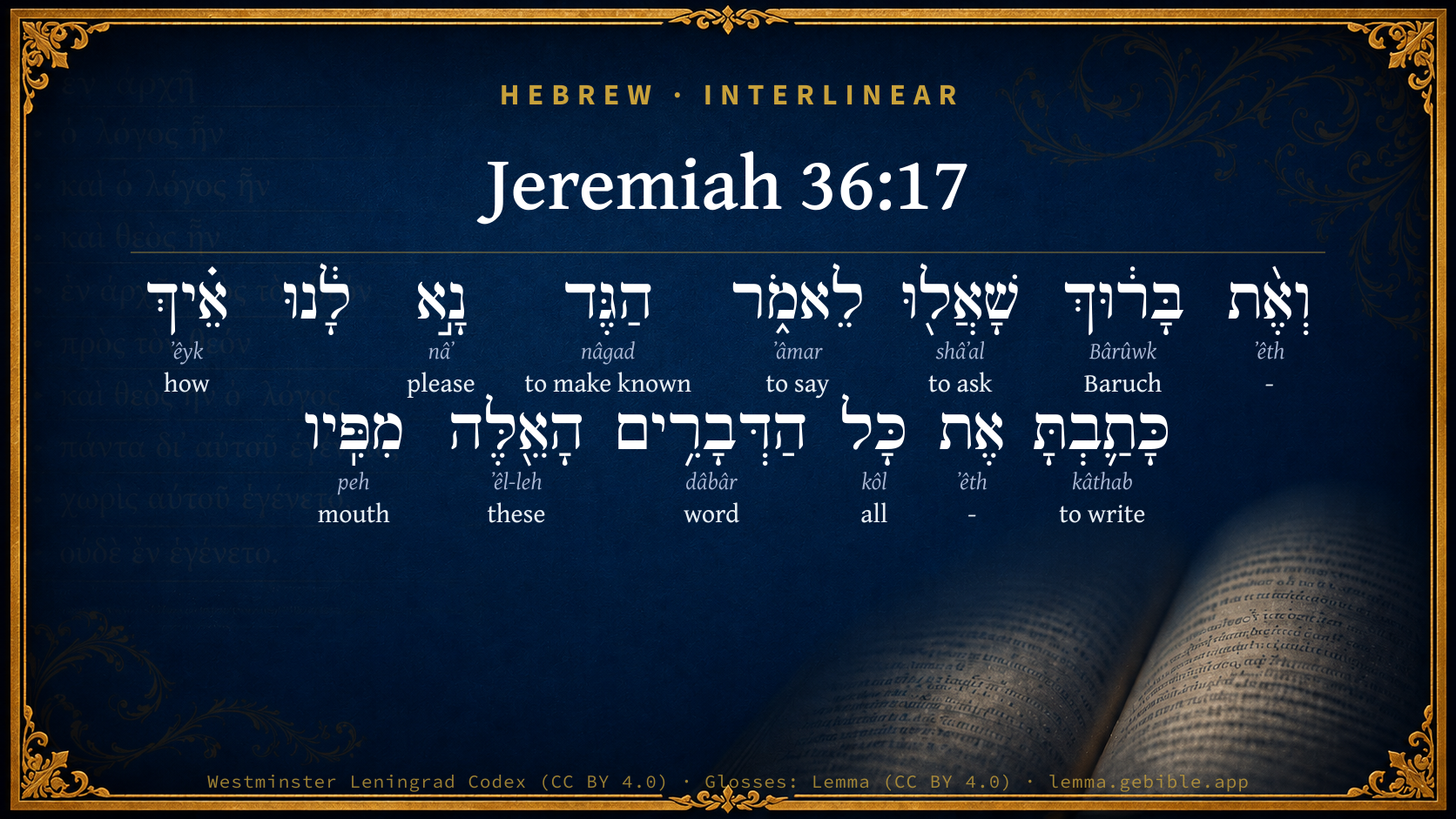
Hebrew (Westminster Leningrad Codex) Jeremiah 36:17 appears in the Hebrew Old Testament. The text above is from the Westminster Leningrad Codex. Each word links to its Strong’s number, a concise gloss, and parsing drawn from the Open Scriptures Hebrew Bible morphology. Click any word for its full Brown-Driver-Briggs (BDB) entry.
Download image
Cite this verse

Jeremiah 36:17 (World English Bible). Public Domain. Lemma interlinear Bible study tool, https://lemma.gebible.app/v/jeremiah/36/17.

Show BibTeX & RIS
BibTeX
RIS
English Translation
They asked Baruch, saying, Tell us now, How did you write all these words at his mouth?
World English Bible · Public Domain
Download a study sheet

One document with this verse’s original text, its word-by-word gloss line, the meaning frame, cross-references with their text, attributed commentary, and full source and license credits — printable, and it pastes into notes with its structure intact.

This verse Autodidact and up

Study sheet (.html) Plain text (.txt)

A passage Seminary Student

Up to 50 verses in one chapter. A passage sheet keeps up to 6 commentary sources and 12 cross-references per verse, in the order this page ranks them, and says so on the sheet whenever that leaves anything out. Ask for a single verse and you get the Autodidact verse sheet above.

Everything on this page stays free to read, with no account — the sheet is a download of what is already on screen, not access to it.

Want to remove ads? Support Godless Engineer
Compare translations 3

The same verse in 3 English versions, stacked beneath the original-language interlinear above. Click any original word for its lexicon entry.

Each is an independent rendering of the whole verse — the interlinear is not word-aligned to these translations.

Highlighted words mark where these versions differ — a whole-verse word diff, not a word-by-word alignment.

  • World English Bible Public Domain
    They asked Baruch, saying, Tell us now, How did you write all these words at his mouth?
  • King James Version Public Domain
    And they asked Baruch, saying, Tell us now, How didst thou write all these words at his mouth?
  • unfoldingWord Literal Text CC BY-SA 4.0
    Then they asked Baruch, “Tell us, how did you come to write all these words at Jeremiah’s dictation?”

unfoldingWord Literal Text — © unfoldingWord, licensed CC BY-SA 4.0. Word-aligned USFM3 via Door43 (git.door43.org/unfoldingWord/en_ult).

Versions to compare (up to 4)

3 of 4 selected

Show all 18 translations

Every available English version of this verse, each an independent rendering of the whole verse.

  • World English Bible Public Domain
    They asked Baruch, saying, Tell us now, How did you write all these words at his mouth?
  • Berean Standard Bible Public Domain
    “Tell us now,” they asked Baruch, “how did you write all these words? Was it at Jeremiah’s dictation?”
  • Majority Standard Bible Public Domain
    “Tell us now,” they asked Baruch, “how did you write all these words? Was it at Jeremiah’s dictation?”
  • King James Version Public Domain
    And they asked Baruch, saying, Tell us now, How didst thou write all these words at his mouth?
  • American Standard Version (1901) Public Domain
    And they asked Baruch, saying, Tell us now, How didst thou write all these words at his mouth?
  • Revised Version (1885) Public Domain
    And they asked Baruch, saying, tell us now, How didst thou write all these words at his mouth?
  • Geneva Bible (1599) Public Domain
    And they examined Baruch, saying, Tell vs nowe, howe diddest thou write all these wordes at his mouth?
  • Douay-Rheims (1899) Public Domain
    And they asked him, saying: Tell us how didst thou write all these words from his mouth.
  • Young's Literal Translation Public Domain
    And they asked Baruch, saying, `Declare, we pray thee, to us, how didst thou write all these words -- from his mouth?'
  • Literal Standard Version CC BY-SA 4.0
    And they asked Baruch, saying, “Please declare to us, how did you write all these words from his mouth?”
  • Unlocked Literal Bible CC BY-SA 4.0
    Then they asked Baruch, “Tell us, how did you come to write all these words at Jeremiah's dictation?”
  • unfoldingWord Literal Text CC BY-SA 4.0
    Then they asked Baruch, “Tell us, how did you come to write all these words at Jeremiah’s dictation?”
  • Darby Bible Public Domain
    And they asked Baruch, saying, Tell us now, How didst thou write all these words from his mouth?
  • World Messianic Bible Public Domain
    They asked Baruch, saying, “Tell us now, how did you write all these words at his mouth?”
  • Webster's Bible Public Domain
    And they asked Baruch, saying, Tell us now, How didst thou write all these words at his mouth?
  • Free Bible Version CC BY-SA 4.0
    Then they asked Baruch, “Now tell us, how did you come to write all this? Did Jeremiah dictate it to you?”
  • Bible in Basic English Public Domain
    And questioning Baruch, they said, Say now, how did you put all these words down in writing from his mouth?
  • JPS Tanakh (1917) Public Domain
    And they asked Baruch, saying: 'Tell us now: How didst thou write all these words at his mouth?'

Literal Standard Version (2020), Covenant Press — licensed CC BY-SA 4.0. Text via the HelloAO Bible API (eBible.org). Unlocked Literal Bible (unfoldingWord) — licensed CC BY-SA 4.0. Text via the HelloAO Bible API (eBible.org). unfoldingWord Literal Text — © unfoldingWord, licensed CC BY-SA 4.0. Word-aligned USFM3 via Door43 (git.door43.org/unfoldingWord/en_ult). Free Bible Version, Dr. Jonathan Gallagher — licensed CC BY-SA 4.0. Text via the HelloAO Bible API (eBible.org).

Word by word

More ways to search: Search by grammar → Find every occurrence → Compare this word →

Practice this passage: Drill this verse → Learn its vocabulary →

בָּר֔וּךְ
Bârûwk
H1263
“Baruch”
Noun, Proper
Part of Speech
Noun
Type
Proper
Full BDB Definition

Origin: pass. participle from H1288

TWOT: None

Baruch = "blessed" - friend, amanuensis, and faithful attendant of Jeremiah - a priest, the son of Zabbai who assisted Nehemiah in rebuilding the walls of Jerusalem - a priest, or family of priests, who signed the covenant with Nehemiah - son of Col-hozeh, a descendant of Perez or Pharez, the son of Judah
  1. וְאֶ֨ת ʼêth H853 “and · -” Conjunction + Particle, Direct Object
  2. שָׁאֲל֖וּ shâʼal H7592 “to ask” Verb, Qal, Perfect, 3rd Person, Common, Plural
  3. לֵאמֹ֑ר ʼâmar H559 “to say” Preposition + Verb, Qal, Infinitive Construct
  4. הַגֶּד nâgad H5046 “make known” Verb, Hiphil, Imperative, 2nd Person, Masculine, Singular
  5. נָ֣א nâʼ H4994 “please” Particle, Exhortation
  6. אֵ֗יךְ ʼêyk H349 “how” Particle, Interrogative
  7. כָּתַ֛בְתָּ kâthab H3789 “to write” Verb, Qal, Perfect, 2nd Person, Masculine, Singular
  8. אֶת ʼêth H853 “-” Particle, Direct Object
  9. כָּל kôl H3605 “all of” Noun, Common, Masculine, Singular, Construct
  10. הַדְּבָרִ֥ים dâbâr H1697 “the · words” Particle, Definite Article + Noun, Common, Masculine, Plural, Absolute
  11. הָאֵ֖לֶּה ʼêl-leh H428 “the · these” Particle, Definite Article + Pronoun, Demonstrative, Common, Plural
  12. מִפִּֽיו peh H6310 “from · mouth · his” Preposition + Noun, Common, Masculine, Singular, Construct + Suffix, Personal, 3rd Person, Masculine, Singular

About this verse

These counts appear in no published source. They are computed here, from the morphology-tagged text and Lemma’s own curated glosses. What Lemma adds →

14
words
12
distinct lemmas
Prophets
section

Shared distinctive vocabulary

בָּר֔וּךְ Baruch H1263 occurs in 24 verses of the Hebrew Bible. Also found in:

Grammatical profile

  • 4 verbs
  • 4 nouns
  • 1 pronoun
  • 1 preposition
  • 4 particles

Verb forms

  • שָׁאֲל֖וּ Qal · Perfect
  • לֵאמֹ֑ר Qal · Infinitive Construct
  • הַגֶּד Hiphil · Imperative
  • כָּתַ֛בְתָּ Qal · Perfect

Cross-references

3

Topical passages linked to Jeremiah 36:17 in the Treasury of Scripture Knowledge — connected by theme and wording, ordered by reader-vote popularity; previews shown in the World English Bible.

  • John 9:15 Again therefore the Pharisees also asked him how he received his sight. He said to them, "He put mud on my eyes, I washed, and I see."
  • John 9:10–11 They therefore were asking him, "How were your eyes opened?"
  • John 9:26–27 They said to him again, "What did he do to you? How did he open your eyes?"

Cross-references courtesy of OpenBible.info (CC BY 4.0).

Hebrew and Greek witnesses Masoretic Hebrew ↔ Greek Septuagint

The same verse in the two great witnesses to the Old Testament, shown verse-for-verse.

These are two independent witnesses, not word-aligned to each other, and the Septuagint is shown in lemma (dictionary) form.

Hebrew Jeremiah 36:17 Masoretic · Westminster Leningrad Codex

וְאֶ֨ת בָּר֔וּךְ שָׁאֲל֖וּ לֵאמֹ֑ר הַגֶּד נָ֣א לָ֔נוּ אֵ֗יךְ כָּתַ֛בְתָּ אֶת כָּל הַדְּבָרִ֥ים הָאֵ֖לֶּה מִפִּֽיו

They asked Baruch, saying, Tell us now, How did you write all these words at his mouth?

World English Bible · Public Domain

Greek LXX Structure differs

In the Septuagint, Jeremiah is about an eighth shorter than the Hebrew and arranges its material differently — the Oracles Against the Nations (Hebrew chapters 46–51) appear in the middle of the Greek book, after 25:13. Because the chapter and verse boundaries do not line up, a verse-for-verse comparison with the Hebrew is not shown.

A verse-for-verse comparison isn’t shown here because the chapters and verses don’t line up. Switch to the LXX edition with the MT / LXX toggle above to read the Greek directly.

On this verse, The Cambridge Bible for Schools and Colleges discusses the Septuagint’s reading. Read the note in Commentary ↓

Hebrew: Westminster Leningrad Codex (CC BY 4.0). Greek: Septuagint (public domain); English from a public-domain English Septuagint. How the Septuagint differs from the Hebrew →

Targum (Aramaic paraphrase)

1

The Targum is the ancient Jewish Aramaic paraphrase of the Hebrew Scriptures — an interpretive translation, not the Hebrew text itself. Onkelos (literal) and Pseudo-Jonathan (expansive) render the Torah, and Jonathan the Prophets. Coverage is partial: where no permissively-licensed English translation exists for a verse, only the Aramaic is shown. This is verse-level text, not a word-by-word alignment to the Hebrew.

  1. Targum Jonathan Prophets (Joshua–Malachi)
    וְיַת בָּרוּךְ שְׁאִילוּ לְמֵימָר חַוֵי כְעַן לָנָא אֵיכְדֵין כָּתַבְתָּ יַת כָּל פִּתְגָמַיָא הָאִלֵין מִפּוּמֵיהּ:

    (no public-domain English translation for this verse)

    Targum Jonathan — Aramaic: “Mikraot Gedolot” (public domain). English: “Sefaria Community Translation” (CC0 1.0 (public-domain dedication)); “London "Chaldee Paraphrase," 1871” (public domain). Text via Sefaria.

Commentary

Notes on Jeremiah 36:17 from classic Christian and Jewish commentators (each source and its license shown beneath its notes). The classic Christian expositions comment on the surrounding passage and are grouped to its opening verse, so a note may address several verses; the Jewish commentaries on the Tanakh (Rashi and others) are per-verse, so they appear only where the commentator wrote on this verse.

Lemma curates 59 commentaries, every one of them public domain or Creative Commons licensed, each selected and text-cleaned for this edition rather than reprinted as found. About our sources →

The Cambridge Bible for Schools and Colleges

gen. ed. J. J. S. Perowne

17. How didst thou write] They desired to know how far the words might be Baruch’s own, so as to be able to state to the king to what extent, if any, the prophet’s amanuensis was responsible.

at his mouth] omit with LXX, as a gloss spoiling the sense here, and introduced from Jer_36:17.

The Cambridge Bible for Schools and Colleges (gen. ed. J. J. S. Perowne; Cambridge University Press, 1878–1918) — public domain. Text from a community e-Sword module.

Trapp's Complete Commentary

John Trapp

Jer 36:17 And they asked Baruch, saying, Tell us now, How didst thou write all these words at his mouth?

Ver. 17. Tell us, How didst thou write all these words at his mouth?] Praeposteram movent interrogationem; they put an odd question, saith one, when they should rather have bethought themselves of breaking off their sins by repentance. God loves obedience and not questioners, saith Luther.

John Trapp, A Commentary or Exposition upon All the Books of the Old and New Testament (1647–1656) — public domain. Text from a community e-Sword module.

Tyndale Open Study Notes

Tyndale Open Resources

36:17-18 The officials wanted to know the source of the scroll and its messages.

Tyndale Open Study Notes — © Tyndale Open Resources, licensed CC BY-SA 4.0. Text via the HelloAO Bible API.

Jamieson, Fausset & Brown

Robert Jamieson, A. R. Fausset & David Brown

What they wished to know was, whether what Baruch had read to them was written by him from memory after hearing Jeremiah repeating his prophecies continuously, or accurately from the prophet's own dictation.

Jamieson, Fausset & Brown — Commentary Critical and Explanatory on the Whole Bible (1871) — public domain (CC PDM 1.0). Text via the HelloAO Bible API.

Adam Clarke's Commentary

Verse 17. How didst thou write all these words? - At his mouth?] So the text should be pointed. They wished to know whether he had not copied them, or whether he wrote as Jeremiah prophesied.

Adam Clarke's Commentary on the Bible (1810–1826) — public domain. Text from a community e-Sword/MySword module.

John Calvin's Commentaries

The king’s counsellors were, no doubt, so astonished when they heard that these threatenings had been written as the Prophet had dictated them, that they were agitated by different thoughts, as the unbelieving are wont to be; and not receiving as they ought to have done, the heavenly doctrine, they vacillated, and could not pursue a uniform course. Such, then, was the uncertainty that possessed the minds of the princes; for they could hardly believe that these words had been delivered by memory, but had suspicion of some trickery, as the unbelieving imagine many such things respecting God’s servants; and they seem to act thus designedly, that they may obscure God’s favor, which appears before their eyes. For this purpose, then, they are said to ask Baruch how he took the words from the mouth of Jeremiah

John Calvin's Commentaries (1540-1563) — public domain. Text from the Calvin Translation Society English edition (1840s-50s) via the Christian Classics Ethereal Library (ccel.org). Calvin's coverage is partial (roughly two-thirds of the Bible); uncommented books and verses are honest gaps, never fabricated. The 19th-century editor's footnotes and remarks are omitted so the notes are faithfully Calvin's own voice.

Ellicott's Commentary for English Readers

(17-19) Tell us now, How didst thou write . . .?—The question was clearly put as a judicial interrogatory. The princes were anxious to ascertain how far each of the parties concerned was responsible. Had Baruch exercised any discretion in writing so that the words were his, though the substance was Jeremiah’s? or had he, on his own responsibility, and without the prophet’s will, published what had been written privately? or had every syllable as it was read come from the prophet’s lips? The scribe’s answer showed that the last hypothesis answered to the facts of the case. On hearing this they, obviously with a friendly regard, advise him and the prophet to hide themselves till they should see what effect the report would have on the king’s mind. It would appear from Jer_36:19 that Jeremiah, though “shut up” and unable to go into the house of the Lord (Jer_36:5), was not actually so imprisoned as to hinder him from concealing himself. Either, therefore, we must assume that he was in a “libera custodia,” that gave him facilities for an escape, which the princes connived at, or that by “shut up” he meant only hindered by some cause or other. The latter seems the more probable hypothesis. In the concealment of the prophet we find a parallel to that of Elijah and the other prophets under Ahab (1Ki_17:3; 1Ki_18:4), of Polycarp (Mart. Polyc. c. 5), perhaps also of Luther in the Wartburg.

A Bible Commentary for English Readers, edited by Charles John Ellicott (1878–1897) — public domain. Text from a community e-Sword module.

John Gill's Exposition

And they asked Baruch,.... The following question, which may seem at first sight an odd, needless, and trifling one, as some have called it:

saying, tell us now, how didst thou write all these words at his mouth? this question does not regard the manner of writing them, whether with ink or not, for that they could see with their eyes, and yet Baruch's answer seems to have respect to this, as if he so understood them; nor barely the matter of them, as whether it was the substance of what was contained in the roll that Jeremiah dictated, and that only, leaving it to Baruch to use what words he would, or whether the express words were dictated by him; but rather it seems to have regard to the possibility of doing it: by the question it appears, that Baruch had told the princes that the prophet had dictated all these things to him, and he had taken them down in writing from his mouth; now they wanted more satisfaction about the truth of this matter. It was a difficulty with them how it was possible for Jeremiah to recollect so many different discourses and prophecies, delivered at different times, and some many years ago, and so readily dictate them to Baruch, as fast as he could write them; wherefore they desire he would tell them plainly and faithfully the truth of the matter, how it was, that so they might, if they could, affirm it with certainty to the king; since, if this was really fact which he had related, these prophecies originally, and the fresh dictating of them, must be from the Spirit of God, and would certainly have their accomplishment.

John Gill's Exposition of the Whole Bible (1746–1763) — public domain (CC PDM 1.0). Text via the HelloAO Bible API.

Albert Barnes' Notes on the Bible

The scroll might have been drawn up by Baruch from memoranda of his own without the prophet’s direct authority. The princes therefore did not ask from curiosity, but to obtain necessary information.

Albert Barnes' Notes on the Bible (1834–1885) — public domain. Text from a community e-Sword/MySword module.

Matthew Poole's English Annotations

This now seemed but a reasonable question, considering they were the substance of what he had been prophesying for so many years. The thing seemed strange to the princes, prophets being not used to study and pen their discourses, but to speak them extempore.

Matthew Poole's English Annotations on the Holy Bible (1683–1685) — public domain. Text from a community e-Sword/MySword module.

Whedon's Commentary on the Bible

Daniel D. Whedon

17. How didst thou write — Two points seem to be involved in this question, which is not one of mere curiosity, but of earnest interest: namely, authority and accuracy. As to both the answer was most conclusive.

Daniel D. Whedon (gen. ed.), Commentary on the Old and New Testaments (1874–1909) — public domain. Text from a community e-Sword module.

The Pulpit Commentary

How didst thou write all these words at his mouth! Two questions seem to be combined here didst thou write all these words?" and "Didst thou write it all at his mouth?" Baruch"s answer is good for both.

The Pulpit Commentary (1880–1919), ed. H.D.M. Spence-Jones & Joseph S. Exell — public domain. Text from a community e-Sword module.

Lesson kit

Teaching starters — assembled from the data on this page, not authored interpretation. Every prompt links to the verse data it draws on. Edit before teaching.

Jeremiah, in the Prophets, opens this verse with 14 words (12 distinct Hebrew lemmas). Its most distinctive word is Bârûwk (“Baruch”). A historical commentator’s framing appears above. Read the whole chapter for the surrounding context.

Discussion questions

  1. What does “Baruch” (Bârûwk) contribute to the verse as a whole?
  2. Nehemiah 3:20 shares the word «Baruch» with this verse. How do the two illuminate each other?
  3. These translations render this verse differently; the difference is in the English rendering, not the original. What questions does that raise?
  4. The verb «שָׁאֲל֖וּ» is Qal Perfect. How does its form color the action?
  5. Reading how The Cambridge Bible for Schools and Colleges and Trapp's Complete Commentary read this verse, where do the two commentators agree and where do they part?

Things to notice

Reading settings

Reading text

Shown beneath each verse's original-language words.

Old Testament
Old Testament edition

Read the OT as the Masoretic Hebrew (MT) or the Greek Septuagint (LXX).

English shown for the Greek Septuagint (in the Hebrew ↔ Greek comparison).

Comparing translations? Open the Compare panel on any verse page to stack up to four side by side.