Isaiah 48:6

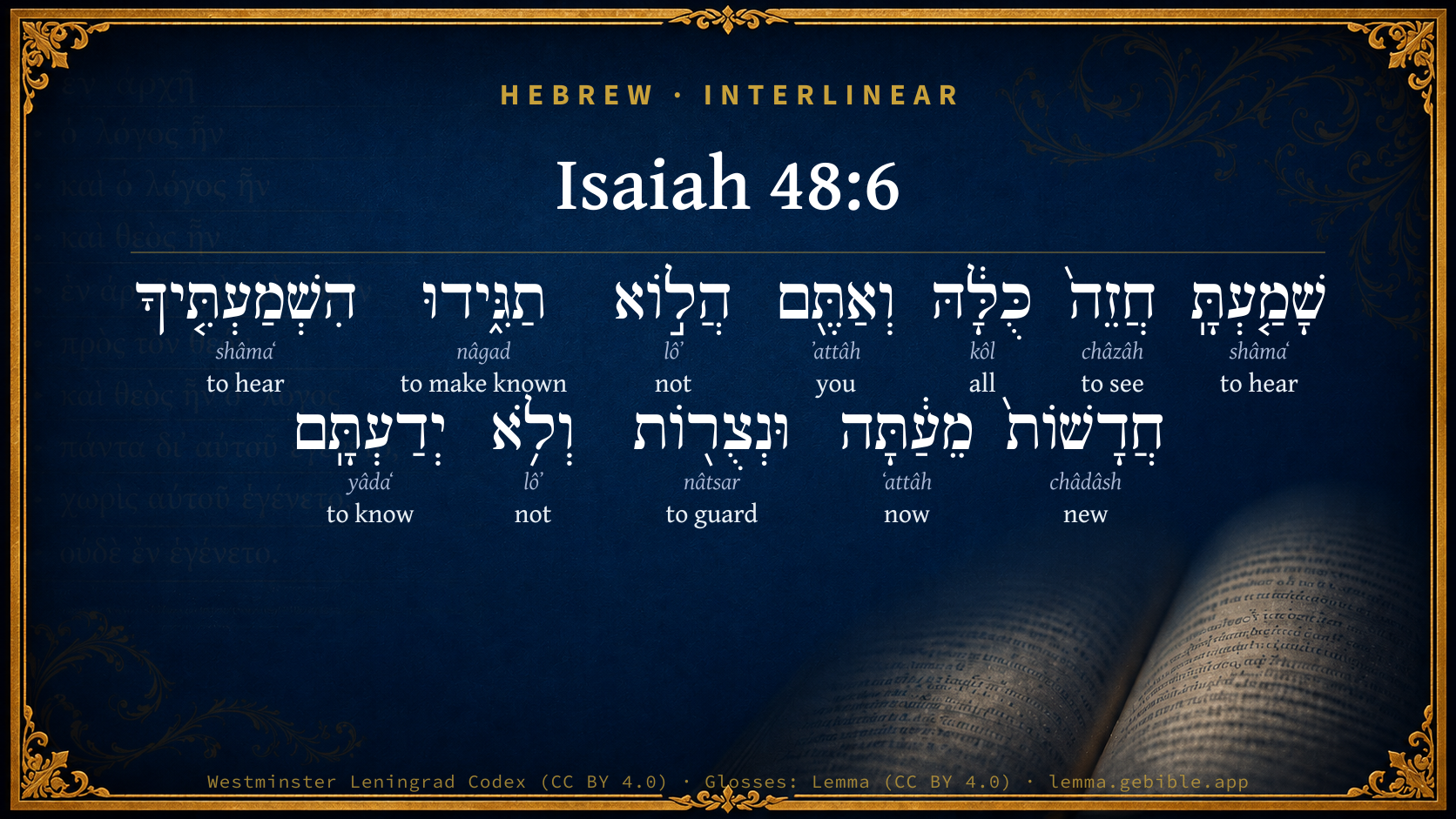
Hebrew (Westminster Leningrad Codex) Isaiah 48:6 appears in the Hebrew Old Testament. The text above is from the Westminster Leningrad Codex. Each word links to its Strong’s number, a concise gloss, and parsing drawn from the Open Scriptures Hebrew Bible morphology. Click any word for its full Brown-Driver-Briggs (BDB) entry.
Download image
Cite this verse

Isaiah 48:6 (World English Bible). Public Domain. Lemma interlinear Bible study tool, https://lemma.gebible.app/v/isaiah/48/6.

Show BibTeX & RIS
BibTeX
RIS
English Translation
You have heard it; see all this; and you, will you not declare it? I have shown you new things from this time, even hidden things, which you have not known.
World English Bible · Public Domain
Download a study sheet

One document with this verse’s original text, its word-by-word gloss line, the meaning frame, cross-references with their text, attributed commentary, and full source and license credits — printable, and it pastes into notes with its structure intact.

This verse Autodidact and up

Study sheet (.html) Plain text (.txt)

A passage Seminary Student

Up to 50 verses in one chapter. A passage sheet keeps up to 6 commentary sources and 12 cross-references per verse, in the order this page ranks them, and says so on the sheet whenever that leaves anything out. Ask for a single verse and you get the Autodidact verse sheet above.

Everything on this page stays free to read, with no account — the sheet is a download of what is already on screen, not access to it.

Want to remove ads? Support Godless Engineer
Compare translations 3

The same verse in 3 English versions, stacked beneath the original-language interlinear above. Click any original word for its lexicon entry.

Each is an independent rendering of the whole verse — the interlinear is not word-aligned to these translations.

Highlighted words mark where these versions differ — a whole-verse word diff, not a word-by-word alignment.

  • World English Bible Public Domain
    You have heard it; see all this; and you, will you not declare it? I have shown you new things from this time, even hidden things, which you have not known.
  • King James Version Public Domain
    Thou hast heard, see all this; and will not ye declare it? I have shewed thee new things from this time, even hidden things, and thou didst not know them.
  • unfoldingWord Literal Text CC BY-SA 4.0
    You have heard; regard all of it, and you, will you not declare? I have made you hear the new from now, and the hidden, and you did not know them.

unfoldingWord Literal Text — © unfoldingWord, licensed CC BY-SA 4.0. Word-aligned USFM3 via Door43 (git.door43.org/unfoldingWord/en_ult).

Versions to compare (up to 4)

3 of 4 selected

Show all 18 translations

Every available English version of this verse, each an independent rendering of the whole verse.

  • World English Bible Public Domain
    You have heard it; see all this; and you, will you not declare it? I have shown you new things from this time, even hidden things, which you have not known.
  • Berean Standard Bible Public Domain
    You have heard these things; look at them all. Will you not acknowledge them? From now on I will tell you of new things, hidden things unknown to you.
  • Majority Standard Bible Public Domain
    You have heard these things; look at them all. Will you not acknowledge them? From now on I will tell you of new things, hidden things unknown to you.
  • King James Version Public Domain
    Thou hast heard, see all this; and will not ye declare it? I have shewed thee new things from this time, even hidden things, and thou didst not know them.
  • American Standard Version (1901) Public Domain
    Thou hast heard it; behold all this; and ye, will ye not declare it? I have showed thee new things from this time, even hidden things, which thou hast not known.
  • Revised Version (1885) Public Domain
    Thou hast heard it; behold all this; and ye, will ye not declare it? I have shewed thee new things from this time, even hidden things, which thou hast not known.
  • Geneva Bible (1599) Public Domain
    Thou hast heard, behold all this, and wil not yee declare it? I haue shewed thee newe things, euen now, and hid things, which thou knewest not.
  • Douay-Rheims (1899) Public Domain
    See now all the things which thou hast heard: but have you declared them? I have shewn thee new things from that time, and things are kept which thou knowest not:
  • Young's Literal Translation Public Domain
    Thou hast heard, see the whole of it, And ye, do ye not declare? I have caused thee to hear new things from this time, And things reserved that ye knew not.
  • Literal Standard Version CC BY-SA 4.0
    You have heard, see the whole of it, || And you, do you not declare? I have caused you to hear new things from this time, || And things reserved that you did not know.
  • Unlocked Literal Bible CC BY-SA 4.0
    You heard about these things; look at all this evidence; and you, will you not admit what I said is true? From now on, I am showing you new things, hidden things that you have not known.
  • unfoldingWord Literal Text CC BY-SA 4.0
    You have heard; regard all of it, and you, will you not declare? I have made you hear the new from now, and the hidden, and you did not know them.
  • Darby Bible Public Domain
    Thou heardest, see all this; -- and ye, will not ye declare [it]? I have caused thee to hear new things from this time, and things hidden, and that thou knewest not:
  • World Messianic Bible Public Domain
    You have heard it. Now see all this. And you, won’t you declare it? “I have shown you new things from this time, even hidden things, which you have not known.
  • Webster's Bible Public Domain
    Thou hast heard, see all this; and will not ye declare it? I have showed ye new things from this time, even hidden things, and thou didst not know them.
  • Free Bible Version CC BY-SA 4.0
    You've heard all I predicted, and seen it happen. Won't you admit it? Now I'm going to tell you new things, secrets you don't know anything about.
  • Bible in Basic English Public Domain
    All this has come to your ears and you have seen it; will you not give witness to it? I am now making clear new things, even secret things, of which you had no knowledge.
  • JPS Tanakh (1917) Public Domain
    Thou hast heard, see, all this; and ye, will ye not declare it? I have announced unto thee new things from this time, even hidden things, which thou hast not known.

Literal Standard Version (2020), Covenant Press — licensed CC BY-SA 4.0. Text via the HelloAO Bible API (eBible.org). Unlocked Literal Bible (unfoldingWord) — licensed CC BY-SA 4.0. Text via the HelloAO Bible API (eBible.org). unfoldingWord Literal Text — © unfoldingWord, licensed CC BY-SA 4.0. Word-aligned USFM3 via Door43 (git.door43.org/unfoldingWord/en_ult). Free Bible Version, Dr. Jonathan Gallagher — licensed CC BY-SA 4.0. Text via the HelloAO Bible API (eBible.org).

Word by word

More ways to search: Search by grammar → Find every occurrence → Compare this word →

Practice this passage: Drill this verse → Learn its vocabulary →

חֲזֵה֙
châzâh
H2372
“see”
Verb, Qal, Imperative, 2nd Person, Masculine, Singular
Part of Speech
Verb
Stem
Qal
Form
Imperative
Person
2nd Person
Gender
Masculine
Number
Singular
Full BDB Definition

Origin: a primitive root

TWOT: 633

to see, perceive, look, behold, prophesy, provide - (Qal) - to see, behold - to see as a seer in the ecstatic state - to see, perceive - with the intelligence - to see (by experience) - to provide
  1. שָׁמַ֤עְתָּֽ shâmaʻ H8085 “to hear” Verb, Qal, Perfect, 2nd Person, Masculine, Singular
  2. כֻּלָּ֔הּ kôl H3605 “all · her” Noun, Common, Masculine, Singular, Construct + Suffix, Personal, 3rd Person, Feminine, Singular
  3. וְאַתֶּ֖ם ʼattâh H859 “and · you” Conjunction + Pronoun, Personal, 2nd Person, Masculine, Plural
  4. הֲל֣וֹא lôʼ H3808 “not” Particle, Interrogative + Particle, Negative
  5. תַגִּ֑ידוּ nâgad H5046 “to make known” Verb, Hiphil, Imperfect, 2nd Person, Masculine, Plural
  6. הִשְׁמַעְתִּ֤יךָ shâmaʻ H8085 “to hear · you” Verb, Hiphil, Perfect, 1st Person, Common, Singular + Suffix, Personal, 2nd Person, Masculine, Singular
  7. חֲדָשׁוֹת֙ châdâsh H2319 “new” Adjective, Adjective, Feminine, Plural, Absolute
  8. מֵעַ֔תָּה ʻattâh H6258 “from · now” Preposition + Adverb
  9. וּנְצֻר֖וֹת nâtsar H5341 “and · guarded” Conjunction + Verb, Qal, Participle Passive, Feminine, Plural, Absolute
  10. וְלֹ֥א lôʼ H3808 “and · not” Conjunction + Particle, Negative
  11. יְדַעְתָּֽם yâdaʻ H3045 “to know · them” Verb, Qal, Perfect, 2nd Person, Masculine, Singular + Suffix, Personal, 3rd Person, Masculine, Plural

About this verse

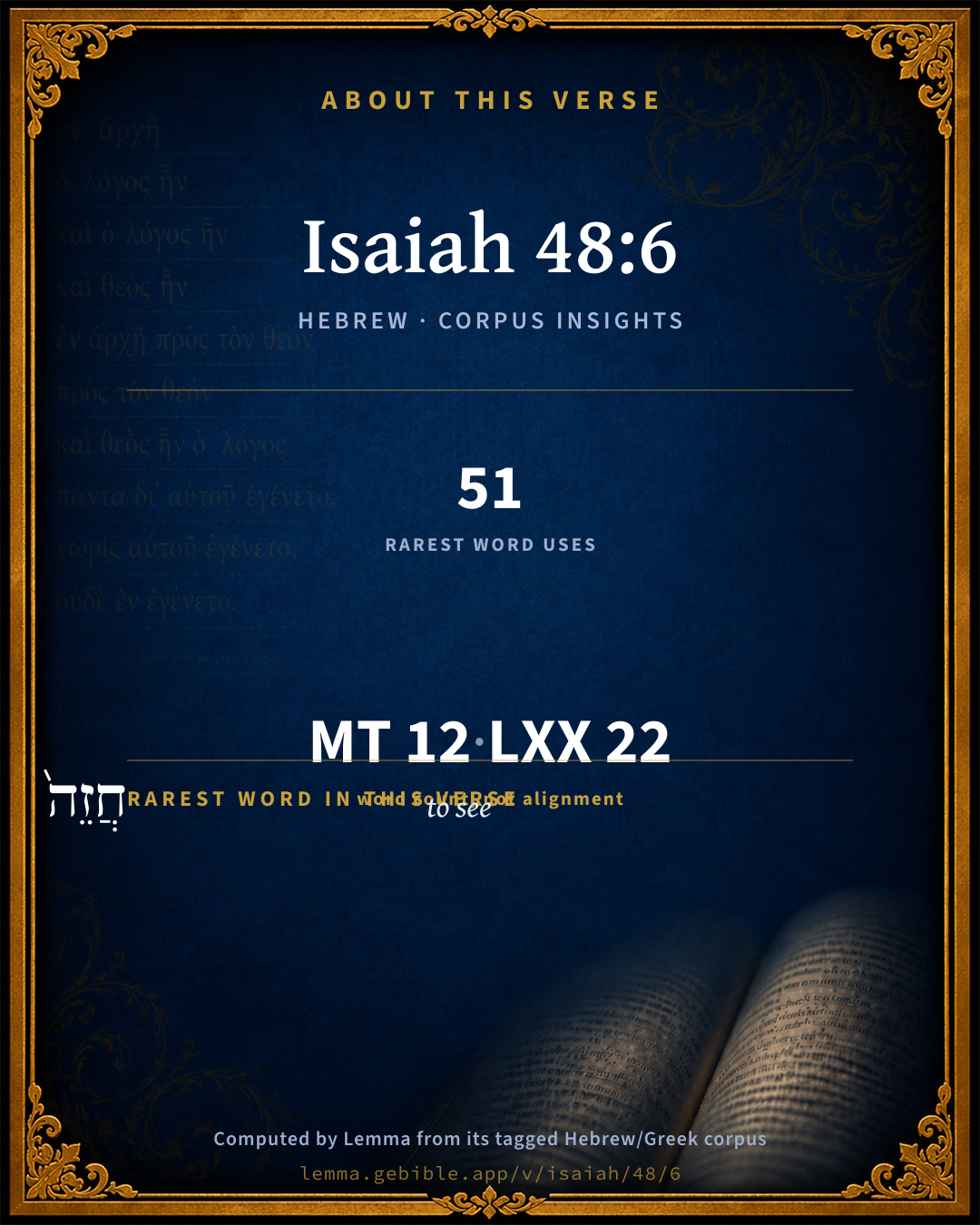
These counts appear in no published source. They are computed here, from the morphology-tagged text and Lemma’s own curated glosses. What Lemma adds →

12
words
10
distinct lemmas
Prophets
section

Shared distinctive vocabulary

חֲזֵה֙ to see H2372 occurs in 47 verses of the Hebrew Bible. Also found in:

Grammatical profile

  • 6 verbs
  • 1 noun
  • 1 adjective
  • 1 pronoun
  • 1 adverb
  • 2 particles

Verb forms

  • שָׁמַ֤עְתָּֽ Qal · Perfect
  • חֲזֵה֙ Qal · Imperative
  • תַגִּ֑ידוּ Hiphil · Imperfect
  • הִשְׁמַעְתִּ֤יךָ Hiphil · Perfect
  • וּנְצֻר֖וֹת Qal · Participle Passive
  • יְדַעְתָּֽם Qal · Perfect

Repetition

Words recur within this verse — often emphatic in Hebrew:

  • שָׁמַ֤עְתָּֽ to hear H8085 ×2
  • הֲל֣וֹא not H3808 ×2

Hebrew & Septuagint length

In English translation the verse runs 31 words from the Hebrew and 31 from the Septuagint (LXX English) — the same length.

A rough comparison of the two English renderings, which tokenize alike — not a word-level alignment.

Word counts can differ between the Hebrew and the Greek without any difference in meaning — e.g. the Hebrew direct-object marker אֵת has no separate Greek word, and Greek often adds the article ὁ.

In the original languages it is 12 Hebrew tokens and 22 Greek tokens — but the two are counted differently (Hebrew bundles its prefixes and suffixes into one token; the Greek is in lemma form), so that isn’t a like-for-like length.

Cross-references

25

Topical passages linked to Isaiah 48:6 in the Treasury of Scripture Knowledge — connected by theme and wording, ordered by reader-vote popularity; previews shown in the World English Bible.

  • Revelation 4:1 After these things I looked and saw a door opened in heaven, and the first voice that I heard, like a trumpet speaking with me, was one saying, "Come up here, and I will show you the things which must happen after this."
  • Isaiah 42:9 Behold, the former things have happened, and new things do I declare. Before they spring forth I tell you of them.
  • Romans 16:25–26
  • Isaiah 43:19 Behold, I will do a new thing; now shall it spring forth; shall you not know it? I will even make a way in the wilderness, and rivers in the desert.
  • Isaiah 43:8–10 Bring forth the blind people who have eyes, and the deaf who have ears.
  • Matthew 10:27 What I tell you in the darkness, speak in the light; and what you hear whispered in the ear, proclaim on the housetops.
  • John 15:15 No longer do I call you servants, for the servant doesn't know what his lord does. But I have called you friends, for everything that I heard from my Father, I have made known to you.
  • Psalms 40:9–10 I have proclaimed glad news of righteousness in the great assembly. Behold, I will not seal my lips, Yahweh, you know.
  • Psalms 71:15–18 My mouth will tell about your righteousness, And of your salvation all day, Though I don't know its full measure.
  • Psalms 78:3–6 Which we have heard and known, And our fathers have told us.
  • Psalms 107:43 Whoever is wise will pay attention to these things. They will consider the loving kindnesses of Yahweh.
  • Psalms 119:13 With my lips, I have declared all the ordinances of your mouth.
  • Psalms 145:4–5 One generation will commend your works to another, And will declare your mighty acts.
  • Isaiah 21:10 You my threshing, and the grain of my floor! that which I have heard from Yahweh of hosts, the God of Israel, have I declared to you.
  • Jeremiah 2:31 Generation, see the word of Yahweh. Have I been a wilderness to Israel? or a land of thick darkness? why say my people, We are broken loose; we will come no more to you?
  • Jeremiah 50:2 Declare you among the nations and publish, and set up a standard; publish, and don't conceal: say, Babylon is taken, Bel is disappointed, Merodach is dismayed; her images are disappointed, her idols are dismayed.
  • Daniel 12:8–13 I heard, but I didn't understand: then said I, my lord, what shall be the issue of these things?
  • Amos 3:6 Does the trumpet alarm sound in a city, Without the people being afraid? Does evil happen to a city, And Yahweh hasn't done it?
  • Acts 1:8 But you will receive power when the Holy Spirit has come upon you. You will be witnesses to me in Jerusalem, in all Judea and Samaria, and to the uttermost parts of the earth."
  • 1 Corinthians 2:9 But as it is written, "Things which an eye didn't see, and an ear didn't hear, Which didn't enter into the heart of man, These God has prepared for those who love him."
  • 1 Peter 1:10–12 Concerning this salvation, the prophets sought and searched diligently, who prophesied of the grace that would come to you,
  • Micah 6:9 Yahweh's voice calls to the city, And wisdom sees your name: "Listen to the rod, And he who appointed it.
  • Revelation 1:19 Write therefore the things which you have seen, and the things which are, and the things which will happen hereafter;
  • Revelation 5:1–2 I saw, in the right hand of him who sat on the throne, a book written inside and outside, sealed shut with seven seals.
  • Revelation 6:1–17 I saw that the Lamb opened one of the seven seals, and I heard one of the four living creatures saying, as with a voice of thunder, "Come and see!"

Cross-references courtesy of OpenBible.info (CC BY 4.0).

Hebrew and Greek witnesses Masoretic Hebrew ↔ Greek Septuagint

The same verse in the two great witnesses to the Old Testament, shown verse-for-verse.

These are two independent witnesses, not word-aligned to each other, and the Septuagint is shown in lemma (dictionary) form.

Hebrew Isaiah 48:6 Masoretic · Westminster Leningrad Codex

שָׁמַ֤עְתָּֽ חֲזֵה֙ כֻּלָּ֔הּ וְאַתֶּ֖ם הֲל֣וֹא תַגִּ֑ידוּ הִשְׁמַעְתִּ֤יךָ חֲדָשׁוֹת֙ מֵעַ֔תָּה וּנְצֻר֖וֹת וְלֹ֥א יְדַעְתָּֽם

You have heard it; see all this; and you, will you not declare it? I have shown you new things from this time, even hidden things, which you have not known.

World English Bible · Public Domain

Greek LXX Isaiah 48:6 Septuagint · lemma form

ἀκούω πᾶς καί σύ οὐ γιγνώσκω ἀλλά καί ἀκουστός σύ ποιέω ὁ καινός ἀπό ὁ νῦν ὅς μέλλω γίγνομαι καί οὐ εἶπον

You⌃ have heard all this, but you⌃ have not known: yet I have made known to you the new things from henceforth, which are coming to pass, and you said not,

LXX2012 (modern English Septuagint) · Public Domain

On this verse, Keil & Delitzsch discusses the Septuagint’s reading. Read the note in Commentary ↓

Hebrew: Westminster Leningrad Codex (CC BY 4.0). Greek: Septuagint (public domain); English from LXX2012 (modern English Septuagint) (Public Domain). How the Septuagint differs from the Hebrew →

Targum (Aramaic paraphrase)

1

The Targum is the ancient Jewish Aramaic paraphrase of the Hebrew Scriptures — an interpretive translation, not the Hebrew text itself. Onkelos (literal) and Pseudo-Jonathan (expansive) render the Torah, and Jonathan the Prophets. Coverage is partial: where no permissively-licensed English translation exists for a verse, only the Aramaic is shown. This is verse-level text, not a word-by-word alignment to the Hebrew.

  1. Targum Jonathan Prophets (Joshua–Malachi)
    שְׁמַעְתָּא הָא אִתְגְלִיאַת לְכָל עַמָא מַה דְאִתְגְלִיאַת לְכוֹן וְאַתּוּן הֲלָא תְחַווּן בְּסַרְתָּךְ חַדְתָּן מִכְּעַן וּנְטִירַן וְלָא יְדַעְתִּינוּן:

    Hast thou heard whether that was revealed to any people which was revealed unto thee? and as for you, will ye not declare it? I have shewed thee new things from this time, and hidden things, and thou didst not know them.

    Targum Jonathan — Aramaic: “Mikraot Gedolot” (public domain). English: “Sefaria Community Translation” (CC0 1.0 (public-domain dedication)); “London "Chaldee Paraphrase," 1871” (public domain). Text via Sefaria.

Commentary

Notes on Isaiah 48:6 from classic Christian and Jewish commentators (each source and its license shown beneath its notes). The classic Christian expositions comment on the surrounding passage and are grouped to its opening verse, so a note may address several verses; the Jewish commentaries on the Tanakh (Rashi and others) are per-verse, so they appear only where the commentator wrote on this verse.

Lemma curates 59 commentaries, every one of them public domain or Creative Commons licensed, each selected and text-cleaned for this edition rather than reprinted as found. About our sources →

Trapp's Complete Commentary

John Trapp

Isa 48:6 Thou hast heard, see all this; and will not ye declare [it]? I have shewed thee new things from this time, even hidden things, and thou didst not know them.

Ver. 6. Thou hast heard, see all this.] Here God extorteth from them a confession of the aforesaid truth, and urgeth them to attest and publish it.

John Trapp, A Commentary or Exposition upon All the Books of the Old and New Testament (1647–1656) — public domain. Text from a community e-Sword module.

The Biblical Illustrator

Joseph S. Exell

Isa_48:6

See all this

Things seen as a whole

The words See all this, have been rendered by one of the latest commentators, See it as a whole.

This rendering reproduces the prophetic argument. Isaiah had recalled a period of history which, taken as a whole, was a fulfilled word of Jehovah. That completed epoch of history from the predictions of old to the events in which it had issued was to the prophet proof of Gods control of human affairs. Any completed historic cycle, taken as a whole, becomes to us significant of God. The evidence of the Divine providence discovers itself when we view things largely, when we see life as a whole.

1. Look at your life in the large relations of it, see it as a whole. This is not the view of life which it is altogether easy for us to take. For we touch life at single points; we receive life moment by moment; and our first views of things are apt to be partial. We ought, in our moral maturity, to fit our daily doings into some large conception of our whole reason for being here in this world. We do not know how to live well, certainly we have not learned to live richly if we have not gained something of the happy art of massing things in nobler groupings; if we cannot hold the little things and daily details of life under some broad, generous conception of our life; very much as from some height we see the several parts of a landscape, not singly, but together, as one wide sunny expanse.

2. That particular thing, for example, for which it may be necessary for you to strive to-morrow in your business, or which it seems desirable to secure for your enjoyment, needs to be sought for, not as though it were the one thing only to be attained, but as a possible part of some greater good in which your life is to find its satisfaction. A man to be successful in any calling must have something of that power of concentration to which Sir Fowell Buxton once attributed his success--the power of being a whole man to one thing at a time. Nevertheless, that would be an unworthy success which should leave us entirely confined to any single thing.

3. If we desire to possess our friendships well, we must learn this art of seeing things not in their little, often vexatious details, but largely and as wholes. You must take your friend largely for what he is in his entire character, if you would keep your friend. The microscope has its uses; but it was never made for the eye of friendship.

4. Another instance for the application of this text might be found in our habits of regarding our homes. We are to possess the home, not as a good for itself alone, but in its whole social setting, in its relation to the neighbourhood, to the Church of humanity, to the kingdom of heaven, of which it is part and portion.

5. I wish now to go up with this principle to some higher lines of experience, and to observe how this entire earthly life of ours is itself life but in part, and how, if we would live truly, we must learn to see all our life, from the cradle to the grave, as itself but a part of some still larger, better whole for us. If this earthly span of our days be all, what is a human life at its best but as the rainbow which we have seen, one end of it resting upon the depths of the waters, and the other end lost in the cloud, itself as fleeting as the mist upon which for its moment of promise it becomes visible? But here lies the difficulty and the doubt. We have no experience of what lies beyond. Our hand can lay no measuring-rod upon futurity. We have only this present. It is also true, and it is the more important part of the truth, that we have this present only as an incomplete thing, we have this life only as a segment; its present brief span is the are of some curve of larger sweep than we can measure. What its future may be like, we do not know; but we know this present as in itself incomplete and requiring some future completion. If you ask me, said Savonarola, as he was ready to be borne to the stake, what shall be in general the issue of this struggle, I reply, Victory. If you ask me what shall be the issue in the particular sense, I reply, Death. It was the answer of a seer. Seen in the particular, the issue of life may be death. Seen in the general, seen as a whole, true life is not death, but victory. The Christian faith brings to a man its Gospel of the One sinless Man, who knew whence He came, and whither He went, and whose life was always to Him not an affair of the moment only, but a truth of eternity. Jesus earthly life was indeed a broken one. In one aspect of it no human life has been left so incomplete as was that life which we can follow for a few brief years of it through these gospels. The verse in the book of Acts, All the things which Jesus began both to do and to teach, suggests the incompleteness, the utter brokenness of Jesus earthly life. What work did He live to see completed? what doctrine to finish? His hands did not complete His work of mercy; they were pierced before they had wrought all their possible work of healing. His lips did not finish His teachings; He had many things to say, and He died leaving much unsaid.

Into our Lords Gethsemane may there not have entered the pathos of an unfinished life? Yet He said, I have finished the work which Thou gavest Me to do. He could not have said that had He not looked always upon His life here as part and daily portion of one Divine whole, His sacrifice as something complete in Gods eternal purpose; had He not known that His life here, and there, and always, is one life, continuous throughout, on earth and in heaven, one will of the Father--each part of it, whether of humiliation or transfiguration, of suffering or resurrection, partaking of the glory of the perfect whole. (N. Smyth, D. D.)

The Biblical Illustrator, edited by Joseph S. Exell (c. 1880s–1900s) — public domain. Text from a community e-Sword module.

Joseph Benson's Commentary

Isa 48:6-8. Thou hast heard, see all this — As thou hast heard all these things, from time to time, seriously consider them. And will not ye declare it — I call you to witness: must you not be forced to acknowledge the truth of what I say? I have showed thee new things from this time — And I have now given thee new predictions of secret things, such as till this time were wholly unknown to thee, concerning thy deliverance out of Babylon by Cyrus. They are created now — Revealed to thee by me; brought to light, as things are by creation. The idea is elegant; for what is revealed exists by the word that proceeds from the mouth of God, which is the character of creation. And not from the beginning — Hebrew, ולא מאז, not from thence, not from these ancient times when other things were revealed to thee. Even before the day — Hebrew, and, or, or before this day. This day answers to now in the first clause, and seems to be added as an exposition of it; when thou heardest them not — Hebrew, And thou didst not hear them, namely, before this time in which God hath revealed them to thee by my ministry. Lest thou shouldest say, Behold, I knew them — Either by thine own sagacity, or by the help of thine idols. Yea, thou knewest not — The same thing is repeated, because this was so illustrious a proof of the infinite power and providence of God, and so clear and full a discovery of the vanity of idols. Yea, from that time — Hebrew, from then, as in the foregoing verse; thine ear was not opened — That is, thou didst not hear; I did not reveal these things unto thee: for so this phrase of opening the ear is understood, 1Sa 9:15. For I knew that thou wouldest deal treacherously — I knew all these cautions were necessary to cure thine infidelity. And wast called — Namely, justly and truly; a transgressor from the womb — Thou wast indeed such from thy very origin as a people. The contents of this verse, therefore, are not only to be considered as a confirmation of what was said in the preceding verse, namely, that the Jews had no knowledge of these new things, (as they are called Isa 48:6,) before the revelation of them made by Isaiah; but as “containing a conviction of the inconsideration, incredulity, and prejudices of the Jewish people; who, notwithstanding the prophecies so clearly fulfilled among them, had neither duly attended to them, nor become obedient to God, which he observes was nothing strange, since, from the first time of their adoption as a people, from their deliverance out of Egypt, which was, as it were, their birth, they had been full of perfidy and transgression.” See Vitringa.

Joseph Benson's Commentary on the Old and New Testaments (1811–1818) — public domain. Text from a community e-Sword module.

The Preacher's Complete Homiletical Commentary

Joseph S. Exell (gen. ed.)

GOD’S COMMUNICATIONS TO MANKIND

Isa_48:6-8. I have showed thee new things, &c.

I. The manner of God’s communications. Prophetic, addressed to the ear, and concerning things hidden from human reason. Providential, addressed to the eye. (In dealing with Isa_48:7, show—

1. Man’s tendency to intellectual pride.

2. How this is checked by God’s method of revelation.)

II. The manner in which they are received. With inattention; without understanding; with wilful impenitence—all arising out of natural corruption.—J. Lyth, D.D.: The Homiletical Treasury, Isaiah, p. 65.

GOD’S FOREKNOWLEDGE OF MAN’S SIN

Isa_48:8. Yea, thou heardest not; yea, thou knewest not, &c.

The ancient people of God were most vexatiously stolid; and although the Lord taught them very plainly and repeatedly, line upon line, &c., yet they would not understand His will. Though taught by God-sent prophets, yet the people refused to be instructed. As in a looking-class, let us see ourselves! Let the unconverted man see his own picture! God has spoken quite as pointedly to you as ever He did to the seed of Israel. He has called you by providences, &c. Three times a yea is put into our text, as if to show God’s wonder at man’s obstinacy, and the certainty that such was the state of the heart. More painful still is it to remember, that in a certain degree the same accusation may be laid at the door of believers. Even they have not such a degree of spiritual sensibility as they should have. Alas! we may well bewail ourselves that we do not hear the voice of God as we ought. Having thus reminded you of your sin, trusting we may be led to confess it with deep humility, I have now an encouraging truth to tell you, a very simple one, that all this folly, and ignorance, and obstinacy, and rebellion on our part, was foreknown by God; and notwithstanding that foreknowledge, He yet has been pleased to deal with us in a way of mercy.

I. I ADDRESS THIS TRUTH TO THE BELIEVER.

1. A mournful fact, “I knew,” &c. That word “treacherously” is one which a man would not like to have applied to himself in the common transactions of life; he would feel it to be very galling, and if there were truth in it, very degrading; and yet I question whether it will produce the same effect upon our minds when it is applied to us in relation to unfaithfulness to God. How treacherous we have been to our own vows and promises when we were first converted! This is not all. It is not merely that we have failed in promises which were made in a period of excitement, but we have been treacherous to obligations which were altogether apart from voluntary vows on our part; we have been treacherous to the most blessed relationships which mercy could have instituted. Have you not lived as if you were your own? As soldiers, by cowardice, disobedience, and desertion, we have been treacherous to a very shameful degree. Worst of all is the fact that we have been treacherous to our Lord in a relationship where fidelity constitutes the very essence of bliss, the marriage bond which exists between our soul and Christ.

2. The Divine statement of the text, that all this was known. It was no secret that we were transgressors from the womb. As the Lord foreknew the fountain of sin, so He knew all the streams which would gush from it. There are no things unknown to God. We never have surprised the Most High; we never have brought Him to such a position that He could say, “I did not know this.” We have never gone into any sin of which it could be said concerning God, that He did not know that it would so be wrought by us.

3. Seeing that this is most certain and sure, adore the amazing grace of God. You have dealt very treacherously, and yet you were redeemed not with silver and gold, &c., and you have been adopted into the Lord’s family.

4. This truth is very important to us, because in the light of it our security is clearly manifest. God can never be obstructed by a circumstance in us which can create surprise in His mind, or throw His course out of His reckoning.

5. This truth, also, should tend very much to enhance our sense of the fulness which is treasured up in Christ Jesus. The Lord our God has provided for us in Christ for all the necessities that can occur, for He has foreknown all these necessities.

II. I APPLY THIS TRUTH TO THE UNCONVERTED.

You have discovered lately the natural vileness of your heart, &c. You have a deep regret for your long delay in seeking mercy. You are willing to acknowledge that there have been special aggravations in your case. Now, the gospel of Jesus Christ is sent to you in the state in which you now are. All these sins, delays, aggravations, and rebellions of yours, were all foreknown to God; therefore, since He has sent the Gospel to you, be not slow to accept it, since it is not possible that your sins, whatever they may be, can at all militate against the fact that, if you believe and receive the Gospel, you shall be saved. Why invent a scheme by which a rebel might be saved, if He foreknew that on account of sin that rebel never could be pardoned? Do you think God would have gone farther—gone to the vast expense of providing a Saviour, if really the Gospel were null and void? He maketh not an exception. Though a man had daubed himself a thousand times with the blackest filth that ever came from hell, yet, if he believes in Jesus, God must be true to His solemn promise (H. E. I. 2332–2337).—C. H. Spurgeon: Metropolitan Tabernacle Pulpit, No. 779.

The Preacher's Complete Homiletical Commentary (gen. ed. Joseph S. Exell; Funk & Wagnalls, c. 1892) — public domain (pre-1929). A full-Bible homiletical/sermon-outline anthology covering 65 of 66 books (2 John is absent from the source module). Text from a community e-Sword module.

Keil & Delitzsch

C. F. Keil & F. Delitzsch

But in order to determine exactly what "the former things" were, which Jehovah had foretold in order that Israel might not ascribe them to this idol or the other, we must add Isa 48:6-8 : "Thou hast heard it, look then at it all; and ye, must ye not confess it? I give thee new things to hear from this time forth, and hidden things, and what thou didst not know. It is created now, and not long ago; and thou hast not heard it before, that thou mightest not say, Behold, I knew it. Thou hast neither heard it, nor known it, nor did thine ear open itself to it long ago: for I knew thou art altogether faithless, and thou art called rebellious from the womb." The meaning of the question in Isa 48:6 is very obvious: they must acknowledge and attest, even thou against their will (Isa 43:10; Isa 44:8), that Jehovah has foretold all that is now confirmed by the evident fulfilment. Consequently the "former things" are the events experienced by the people from the very earliest times (Isa 46:9) down to the present times of Cyrus, and more especially the first half or epoch of this period itself, which expired at the time that formed the prophet's standpoint. And as the object of the prediction was to guard Israel against ascribing to its idols that which had taken place (which can only be understood of events that had occurred in favour of Israel), the "former things" must include the preparation for the redemption of Israel from the Babylonian captivity through the revolution brought to pass by Cyrus. Hence the "new things" will embrace the redemption of Israel with its attendant circumstances, and that not merely on its outward side, but on its spiritual side as well; also the glorification of the redeemed people in the midst of a world of nations converted to the God of Israel, and the creation of a new heaven and a new earth; in short, the New Testament aeon (compare עם לברית, lxx εἰς διαθήκην γένους, Isa 42:6), with the facts which contribute to its ultimate completion (f. Isa 42:9). The announcement and realization of these absolutely new and hitherto secret things (cf., Rom 16:25) take place from this time forward; Israel has not heard of them "before today" (compare מיּום, "from this day forward," Isa 43:13), that it may not lay claim to the knowledge conveyed to it by prophecy, as something drawn from itself. This thought is carried to a climax in Isa 48:8 in three correlated sentences commencing with "yea" (gam). פּתח signifies patescere here, as in Isa 60:11 (Ewald, 120, a). Jehovah had said nothing to them of this before, because it was to be feared that, with their faithlessness and tendency to idolatry, which had run through their entire history, they would only abuse it. This is strange! On the one hand, the rise of Cyrus is spoken of here as predicted from of old, because it belonged to the "former things," and as knowable through prophecy - a statement which favours the opinion that these addresses were written before the captivity; and, on the other hand, a distinction is drawn between these "former things" and certain "new things" that were intentionally not predicted before the expiration of these "former things," which certainly seems to preclude the possibility of their having been composed before the captivity; since, as Ruetschi observes, if "the older Isaiah had predicted this, he would have acted in direct opposition to Jehovah's design." But in actual fact, the dilemma in which the opponents of the authenticity of these prophecies find themselves, is comparatively worse than this. For the principal objection - namely, that a prophet before the captivity could not possibly have known or predicted anything concerning Cyrus - cannot be satisfactorily removed by attributing these prophecies to a prophet of the time of the captivity, since they expressly and repeatedly affirm that the rise of Cyrus was an event foreknown and predicted by the God of prophecy. Now, if it is Isaiah who thus takes his stand directly in the midst of the captivity, we can understand both of these: viz., the retrospective glance at previous prophecies, which issued in the rise of Cyrus that prepared the way for the redemption from Babylon, since, so far as the prophet was concerned, such prophecies as Isaiah 13-14:23; Isa 21:1-10, and also Isa 11:10-12 (Mic 4:10), are fused into one with his present predictions; and also the prospective glance at prophecies which are now first to be uttered, and events which are now fore the first time about to be accomplished; inasmuch as the revelations contained in these prophecies concerning Israel's pathway through suffering to glory, more especially so far as they grew out of the idea of the "servant of Jehovah," might really be set down as absolutely new to the prophet himself, and never heard of before. Meanwhile our exposition is not affected by the critical question; for even we most firmly maintain, that the prophet who is speaking here has his standpoint in the midst of the captivity, on the boundary line of the condition of suffering and punishment and its approaching termination.

Keil & Delitzsch — Biblical Commentary on the Old Testament (1861–1891) — public domain (CC PDM 1.0). Text via the HelloAO Bible API. (Old Testament only.)

Tyndale Open Study Notes

Tyndale Open Resources

48:6-7 Even though Israel had repeatedly failed to believe God’s past predictions, here he revealed new things that were not yet heard. Specifically, God revealed that Babylon would fall and Israel would be restored.

Tyndale Open Study Notes — © Tyndale Open Resources, licensed CC BY-SA 4.0. Text via the HelloAO Bible API.

Geneva Bible (1599)

Geneva Bible translators

Will ye not acknowledge this my benefit, and declare it unto others?

Geneva Bible (1599) marginal notes — public domain. Text via Bolls.life.

Jamieson, Fausset & Brown

Robert Jamieson, A. R. Fausset & David Brown

Thou, &c.--So "ye are my witnesses" (Isa 43:10). Thou canst testify the prediction was uttered long before the fulfilment: "see all this," namely, that the event answers to the prophecy.

declare--make the fact known as a proof that Jehovah alone is God (Isa 44:8).

new things--namely, the deliverance from Babylon by Cyrus, new in contradistinction from former predictions that had been fulfilled (Isa 42:9; Isa 43:19). Antitypically, the prophecy has in view the "new things" of the gospel treasury (Sol 7:13; Mat 13:52; Co2 5:17; Rev 21:5). From this point forward, the prophecies as to Messiah's first and second advents and the restoration of Israel, have a new circumstantial distinctness, such as did not characterize the previous ones, even of Isaiah. Babylon, in this view, answers to the mystical Babylon of Revelation.

hidden--which could not have been guessed by political sagacity (Dan 2:22, Dan 2:29; Co1 2:9-10).

Jamieson, Fausset & Brown — Commentary Critical and Explanatory on the Whole Bible (1871) — public domain (CC PDM 1.0). Text via the HelloAO Bible API.

Adam Clarke's Commentary

Verse 6. Thou hast heard, see all this - "Thou didst hear it beforehand; behold, the whole is accomplished"] For חזה chazeh, see, a MS. has הזה hazzeh, this; thou hast heard the whole of this: the Syriac has וחזית vechazith, "thou hast heard, and thou hast seen, the whole." Perhaps it should be הנה hinneh, behold. In order to express the full sense, I have rendered it somewhat paraphrastically.

Adam Clarke's Commentary on the Bible (1810–1826) — public domain. Text from a community e-Sword/MySword module.

Ellicott's Commentary for English Readers

(6) Thou hast heard . . .—The appeal is to the conscience of the exiles. They had heard the prediction. They are bidden to consider it all. Should not they declare the impression it had made on them?

I have shewed thee.—Better, I shew thee, as a present incipient act.

New things.—The “new things” are those that lie in a more distant future than the conquests of Cyrus, which are referred to as “former things.”

A Bible Commentary for English Readers, edited by Charles John Ellicott (1878–1897) — public domain. Text from a community e-Sword module.

The Cambridge Bible for Schools and Colleges

gen. ed. J. J. S. Perowne

6. see all this] see it all (sc. fulfilled).

and will not ye declare it?] Better (with the change of a consonant) and you, will ye not bear witness? (Duhm). Cf. ch. Isa_43:12.

6 b–8. Jehovah has proved His power to foretell by the fulfilment of past predictions (vv.3–6 a); now He announces new things.

I have shewed thee] Rather: I shew thee (in the act of speaking).

new things] viz. those specified in Isa_48:14,—the conquest of Babylon and all that results from it, the deliverance of Israel, the overthrow of heathenism and the manifestation of the glory of Jehovah.

hidden things] Lit. “things kept” (in reserve). and thou didst not know them] which thou hast not known (R.V.). With the exception of one letter the clause coincides with one in Jer_33:3 (“difficult things which thou knowest not”).

The Cambridge Bible for Schools and Colleges (gen. ed. J. J. S. Perowne; Cambridge University Press, 1878–1918) — public domain. Text from a community e-Sword module.

John Gill's Exposition

Thou hast heard, see all this: and will ye not declare it?.... You have heard of all these things, how they were foretold before they were; how they came to pass exactly as they were predicted; now look over these prophecies, and compare them with the events; see the exact completion of them; and when you have so done, can you be so stouthearted and impudent as to deny them, or not own and confess them?

I have showed thee new things from this time, even hidden things, and thou didst not know them; meaning the destruction of the Babylonish empire, and the deliverance of the Jews by Cyrus, prophesied just now in the preceding chapters; things not yet come to pass, newly revealed, which were hidden in the breast of God, and unknown to them until prophesied of; and which were typical of redemption by the incarnate Son of God, whose incarnation, and salvation by him, were new, unheard of, and wonderful things; and of the new state of things under the Gospel dispensation, when all things shall become new; the doctrines and ordinances of which are new; the whole Gospel is a hidden mystery, and unknown to men till revealed and made known by the Spirit of God.

John Gill's Exposition of the Whole Bible (1746–1763) — public domain (CC PDM 1.0). Text via the HelloAO Bible API.

Albert Barnes' Notes on the Bible

Thou hast heard - You are witnesses that the prediction was uttered long before it was fulfilled.

See all this - Behold how it is all fulfilled. Bear witness that the event is as it was predicted.

And will ye not declare it? - Will you not bear witness to the entire fulfillment of the prophecy? God appeals to them as qualified to testify that what he had declared had come to pass, and calls on them to make this known as a demonstration that he alone was God (see the notes at Isa 44:8).

I have showed thee new things from this time - From this time I make known a thing which has not before occurred, that you may have a similar demonstration that Yahweh is God. The ‘new thing’ here referred to, is, doubtless, the prediction of the deliverance from the captivity at Babylon - a new thing, in contradistinction from those which had been before predicted, and which were already fulfilled (see the notes at Isa 42:9; Isa 43:19).

Even hidden things - Events which are so concealed that they could not be conjectured by any political sagacity, or by any contemplation of mere natural causes. They are, as it were, laid up in dark treasurehouses (compare Isa 45:3), and they can be known only by him to whom ‘the darkness shineth as the day,’ and to whom the night and the day are both alike Psa 139:12.

Albert Barnes' Notes on the Bible (1834–1885) — public domain. Text from a community e-Sword/MySword module.

Haydock's Catholic Bible Commentary

Them. Could you have believed them? --- Knowest not. He upbraids their ignorance and indocility.

George Leo Haydock (1774–1849), Haydock's Catholic Family Bible and Commentary, 1859 edition — public domain. Excludes Psalms (Douay-Rheims chapter numbering differs from Protestant) and Deuterocanonical books (Catholic canon only).

Matthew Poole's English Annotations

Thou hast heard, see all this; as thou hast heard all these things from my mouth, from time to time, so now I advise thee to see, i.e. seriously to consider them, and to lay them to heart.

Will not ye declare it? I call you to witness; must you not be forced to acknowledge the truth of what I say? Deny it if you can. Or,

have ye not declared it unto all people, as occasion required it? Have you not boasted unto the Gentiles of this as your honour and privilege? I have showed thee new things from this time; and I have now given thee new predictions of secret things, and such as till this time were wholly unknown to thee, as it follows, concerning thy deliverance out of Babylon by Cyrus.

Matthew Poole's English Annotations on the Holy Bible (1683–1685) — public domain. Text from a community e-Sword/MySword module.

Whedon's Commentary on the Bible

Daniel D. Whedon

6, 7. Thou hast heard, etc. — The words are addressed to the Jews as if in Babylon. They have already heard enough from Jehovah. They have no need of more concerning the prediction of their deliverance through Cyrus.

See all this — In God’s eye it is all fulfilled: see you the fact likewise. That is, believe Jehovah, the same as if its accomplishment were before your eyes.

And will not ye declare it — Cause it to be known, testify to its certainty from perfect knowledge of God’s veracity? New things…

hidden things — Perhaps among them Israel’s deliverances from Babylon, and their restoration to their own land and to God’s worship; not yet accomplished, but as certain as if they were.

They are created now — Hence, they are the same as if already accomplished, and the Jews are to treat the prediction accordingly. The fulfilment is ideal but real. Babylon is to be destroyed, and Israel is to be delivered. Take these facts as made known by Jehovah, not by idol oracles or by human sagacity. No excuse for you to do otherwise. God’s veracity has often enough been proved to you. It is mockery of Jehovah to say, Behold, I knew them before.

Daniel D. Whedon (gen. ed.), Commentary on the Old and New Testaments (1874–1909) — public domain. Text from a community e-Sword module.

The Pulpit Commentary

Thou hast heard, see all this; rather, thou didst hear, (now) see it all, i.e. see all the prophecies now fulfilled, which thou heardest in days gone by. Will ye not declare it? Will ye not for very shame make known generally the accordance between the prophecies and the events, which you cannot fail to see? Will ye not become "my witnesses", (Isa_43:10) and turn away from your idols? I have showed thee; rather, I show thee; i.e. "I am about to show thee from this time new things, even hidden things, which thou knowest not things belonging to the new cycle of prophecy, not previously announced, but reserved for the present crisis (see the comment on ver. 3). On the whole, the language used seems most consonant with the view of Dr. Kay, that the "new things" are those about to be revealed in the next section of the prophecy (Isaiah 49-53), things belonging to the coming of Christ, and the "new creation" which it will be the great object of his coming to bring about.

Hidden things.

"Hidden things." The earth is full of latent forces, These are concealed. Take beat, for instance: how it hides in the secret places more stealthily than the panther! Take electricity: here it is quite close to us within us; and what a masterful power it is! how it can rend the rock and lay low the lofty palaces! These are beneficent forces, though, and do their work well, for the security, health, and comfort of man. There are hidden forces that are baneful. The latent seeds of disease lie hidden behind that pearly skin that pure and radiant complexion. And when we have to speak of sin, what a latent force that is hidden in the breast of a child! concealing itself under the cloak of outward respectability in manhood, and by its manifestations here and there like the volcano, telling us what depths of evil there are in the human heart, which only Christ and his cross can overcome. Men understand much, but they do not understand themselves.

I WE HAVE HIDDEN FORCES OF JOY IN US. In a human sense it is so. Look at those children, all eager for their own little possession, their own way; they know not now what love will do: how for that bright little maiden yonder, presently, in a few brief years, one human heart will give up time and thought, and all that earnest love can give! What a force! but hidden yet. So in marriage; that young wife cannot be informed, or instructed, or inspired by others to feel what maternal love is; but when the cry is heard, and a child is born into the world, the latent instinct leaps into life in the heart, and she knows for the first time what that slumbering force really is. So rare are in our souls hidden forces. We have latent faculties of faith in us which the Holy Ghost can call forth, whereby we walk in a new world of wonder and hope and joy in God. We have latent faculties of energy in us which, once awakened, will make us emulate the earnest of every age; and when religion sets a man to work, he finds that there is a joy in service which he was unconscious of before; he discerns that, whilst by love he serves others, he is also with each service opening up new joy-fountains in his own heart.

II WE HAVE HIDDEN FORCES OF PAIN IN US. We know not what they are, it may be, at present; but we are fearfully and wonderfully made, and we shall be a surprise unto ourselves in this respect also.

1. There is the sorrow that hides in love. We know not the measure of love save by loss! Then we know. We are tempted to think in our youth that our older friends are too pensive sometimes, too little open to the all-gladdening influences around them. Alas! we know not the bread they eat. There are forces of memory in their hearts that we cannot see.

2. There is the sorrow that hides in sin. It is so bright-presenced at first, so fascinating, so attractive; speaks in such dulcet tones; no memory at work yet; no consciousness of shame yet; no sense yet of the disturbance that sin works in God"s beautifully ordered universe. To-morrow the serpent that hides at the bottom of the cup will have stung!

3. The sorrow that hides in wrong or neglect in relation to others. While they were with us here we did not feel it so much; but now! Oh, the curtain that hides! the silence in which there is no voice! the quivering heart that puts out the untouched hand! Eternal Father, we were not what we wished, or all we wished, to them. But they are gone, and the place which knew them once shall know them no more. Death is not a tidal river; its waters never return.

III WE HAVE HIDDEN FORCES OF EVIL IN US. Power to sin! Forces which temptation may set fire to, as a spark to the tow! We see this illustrated in nature. The officer who played with his beautiful glossy pair of cub-tigers did not understand his danger till they tasted blood as they licked a little cut in his hand; and then came the surly growl, and with the officer a sword for them or death for himself. We see this in the history of the disciples. How ignorant they were of their own hearts! What latent scepticism in Thomas! what cowardice beneath Peter"s enthusiasm! what pride in those who wanted chief places in Christ"s kingdom! Ah! yes; but they recovered from their folly. But think of Judas; think of Demas; think of Hymenaeus and Philetus. We see this in the warnings of our Saviour. "Watch and pray." Yes; Mark you, Christ does not say, "Watch and pray in youth," or in manhood. " He says it to us all. He knows the potency of evil, and that there are temptable places in our nature even unto the end. For instance, "When every other passion is old, covetousness is young," says the proverb. We must be on our guard till the last hour. Then will come release and victory.

IV WE HAVE HIDDEN FORCES OF IMMORTALITY WITHIN US. Christ revealed these. He "brought life and immortality to light by the gospel." All men do not equally feel these; but there is a "power of the world to come," which more or less affects everybody. When outward life pleases, and we have vivacities of friendship, extensive and elaborate functions of duty to fulfil; when we are absorbed in the outward life; we do not always feel the great beatings of the pulses of immortality within us. But in silent meditative hours there comes over us all the consciousness alike of sin and immortality. "How abject, how august, is man!" The great conservative power of religion is the doctrine of the immortality of the soul. Let that be ignored or denied, and materialism will make very rapid strides.

1. The sense of immortality alters our estimate of the world. Makes us feel the tent-like" character of our homes. "We have here no continuing city, but we seek one to come." We knew that there remaineth a rest, and that affliction is but for a moment.

2. The sense of immortality alters our estimate of friendship. We long, even in that, to lay hold of the everlasting, to link our love with the immortal years to feel that it is of such a character as to survive in glory. Hidden the force may be, but it is real, and the strongest of all the bulwarks against atheism and materialism. When Christ speaks we feel that he spake with authority. Men trembled before a vision of themselves so searching and severe. Not only the "hidden things "of darkness, however, did he reveal; the bright diamond of the mind flashed forth its beauty in the light of his all-revealing words. "Honour all men," says St. Peter. A beautiful commandment, for the gospel has shown the hidden glory behind the veil of the meanest life. "For I have shown thee hidden things" may therefore suggest to us the reverence which we ought to entertain for the soul. Sin is not a subject for mere scorn; it is a subject for deepest sorrow. "When Jesus came near the city, he beheld it, and wept over it." Something more magnificent than the marble temple filled his vision; he wept over souls where the altar was overthrown and the love of God cast out. Let preachers, teachers, authors, workers in the field of the Lord, realize once more the Divine grandeur of their work. The sublimest creation of this universe is hidden in the heart of man: "God made man in his own image. W.M.S.

The Pulpit Commentary (1880–1919), ed. H.D.M. Spence-Jones & Joseph S. Exell — public domain. Text from a community e-Sword module.

John Wesley's Explanatory Notes

See - As thou hast heard all these things, from time to time, seriously consider them. Declare - I call you to witness: must you not be forced to acknowledge the truth of what I say? Shewed - And I have now given thee new predictions of secret things, such as 'till this time were wholly unknown to thee, concerning thy deliverance out of Babylon by Cyrus.

John Wesley, Explanatory Notes Upon the Whole Bible (1754–1765) — public domain. Text via the GEBible commentary corpus.

J. A. Alexander on Isaiah

Joseph Addison Alexander

“Thou hast heard (the prediction), see all of it (accomplished). And ye (idolaters or idols), will not ye declare,” the same word used above for the prediction of events, and therefore no doubt meaning here, ‘will not ye predict something?’ “I have made thee to hear new things.” He appeals not only to the past but to the future, and thus does what He vainly challenges them to do. There is no need of inquiring what particular predictions are referred to. All that seems to be intended is the general distinction between past and future, between earlier and later prophecies. From now, henceforth, after the present time. “And (things) kept (in reserve), and thou hast not known them,” or in our idiom, ‘which thou hast not known’.

Joseph Addison Alexander, The Prophecies of Isaiah (1846–1847; New York: Scribner, 1870–1878) — public domain. Text from a community e-Sword module.

unfoldingWord translationNotes

Door43 World Missions Community

General Information:

Yahweh continues speaking to the people of Israel.

will you not admit what I said is true?

Yahweh uses a question to scold the people of Israel for not admitting what they should know is true. AT: "you are stubborn and will not admit what I said is true." (See: Rhetorical Question)

translationWords

true

know

unfoldingWord translationNotes — © Distant Shores Media and the Door43 World Missions Community, licensed CC BY-SA 4.0. Source: git.door43.org/Door43/en_tn.

Rashi

Rabbi Shlomo Yitzchaki (Rashi)

You have heard, see all of it You have heard the first ones that I told; see that all of them have come about.

and you, will you not tell and testify for Me that nothing failed?

I let you hear new things from now Now I come back and let you hear new things that are new to you, but to Me they are revealed from time immemorial.

and hidden things and things guarded in My treasure houses, and you did not know them.

Rashi on the Tanakh — English translations: “The Judaica Press complete Tanach with Rashi, translated by A. J. Rosenberg” (CC BY 4.0); “Pentateuch with Rashi's commentary by M. Rosenbaum and A.M. Silbermann, 1929-1934” (public domain); “The Metsudah Tanach series, Lakewood, N.J” (CC BY 4.0); and “The Book of Joshua, Metsudah Publications, 1997” (CC BY 4.0). Text via Sefaria.

Ibn Ezra

Rabbi Abraham ibn Ezra

Thou hast heard, see all this. What thou hast heard, all has come.

And will not ye declare that this is the case? Behold, I have shewed thee new things from this time,

even hidden things, that are kept (בצורות═נצורות ) with the Omniscient alone.

Ibn Ezra on the Tanakh — English translations: “Sefaria Community Translation” (CC0 1.0 (public-domain dedication)); “Yalkut, Sifsei Chachomim Chumash, Metsudah Publications, 2009” (CC BY 4.0); and “Commentary of Ibn Ezra on Isaiah - trans. by M. Friedlander, 1873” (public domain). Text via Sefaria.

Lesson kit

Teaching starters — assembled from the data on this page, not authored interpretation. Every prompt links to the verse data it draws on. Edit before teaching.

Isaiah, in the Prophets, opens this verse with 12 words (10 distinct Hebrew lemmas). Its most distinctive word is châzâh (“to see”). A historical commentator’s framing appears above. Read the whole chapter for the surrounding context.

Discussion questions

  1. The word châzâh carries the sense “to see.” How does it shape the verse?
  2. How does Exodus 18:21, which shares the word «to see», read alongside this verse?
  3. What does the repetition of “to hear” (2× in this one verse) do in this verse?
  4. These translations render this verse differently. What is at stake in choosing one wording over another?
  5. «שָׁמַ֤עְתָּֽ» is a Qal Perfect verb. How does that grammatical form shape the action described?
  6. Compare how Trapp's Complete Commentary and The Biblical Illustrator read this verse. Where do they agree or differ?

Things to notice

Reading settings

Reading text

Shown beneath each verse's original-language words.

Old Testament
Old Testament edition

Read the OT as the Masoretic Hebrew (MT) or the Greek Septuagint (LXX).

English shown for the Greek Septuagint (in the Hebrew ↔ Greek comparison).

Comparing translations? Open the Compare panel on any verse page to stack up to four side by side.