1 Kings 1:20

Hebrew (Westminster Leningrad Codex) 1 Kings 1:20 appears in the Hebrew Old Testament. The text above is from the Westminster Leningrad Codex. Each word links to its Strong’s number, a concise gloss, and parsing drawn from the Open Scriptures Hebrew Bible morphology. Click any word for its full Brown-Driver-Briggs (BDB) entry.
Download image
Cite this verse

1 Kings 1:20 (World English Bible). Public Domain. Lemma interlinear Bible study tool, https://lemma.gebible.app/v/1-kings/1/20.

Show BibTeX & RIS
BibTeX
RIS
English Translation
You, my lord the king, the eyes of all Israel are on you, that you should tell them who shall sit on the throne of my lord the king after him.
World English Bible · Public Domain
Download a study sheet

One document with this verse’s original text, its word-by-word gloss line, the meaning frame, cross-references with their text, attributed commentary, and full source and license credits — printable, and it pastes into notes with its structure intact.

This verse Autodidact and up

Study sheet (.html) Plain text (.txt)

A passage Seminary Student

Up to 50 verses in one chapter. A passage sheet keeps up to 6 commentary sources and 12 cross-references per verse, in the order this page ranks them, and says so on the sheet whenever that leaves anything out. Ask for a single verse and you get the Autodidact verse sheet above.

Everything on this page stays free to read, with no account — the sheet is a download of what is already on screen, not access to it.

Want to remove ads? Support Godless Engineer
Compare translations 3

The same verse in 3 English versions, stacked beneath the original-language interlinear above. Click any original word for its lexicon entry.

Each is an independent rendering of the whole verse — the interlinear is not word-aligned to these translations.

Highlighted words mark where these versions differ — a whole-verse word diff, not a word-by-word alignment.

  • World English Bible Public Domain
    You, my lord the king, the eyes of all Israel are on you, that you should tell them who shall sit on the throne of my lord the king after him.
  • King James Version Public Domain
    And thou, my lord, O king, the eyes of all Israel are upon thee, that thou shouldest tell them who shall sit on the throne of my lord the king after him.
  • unfoldingWord Literal Text CC BY-SA 4.0
    And you, my lord the king, the eyes of all of Israel are on you, to declare to them who will sit on the throne of my lord the king after him.

unfoldingWord Literal Text — © unfoldingWord, licensed CC BY-SA 4.0. Word-aligned USFM3 via Door43 (git.door43.org/unfoldingWord/en_ult).

Versions to compare (up to 4)

3 of 4 selected

Show all 18 translations

Every available English version of this verse, each an independent rendering of the whole verse.

  • World English Bible Public Domain
    You, my lord the king, the eyes of all Israel are on you, that you should tell them who shall sit on the throne of my lord the king after him.
  • Berean Standard Bible Public Domain
    And as for you, my lord the king, the eyes of all Israel are upon you to tell them who will sit on the throne of my lord the king after him.
  • Majority Standard Bible Public Domain
    And as for you, my lord the king, the eyes of all Israel are upon you to tell them who will sit on the throne of my lord the king after him.
  • King James Version Public Domain
    And thou, my lord, O king, the eyes of all Israel are upon thee, that thou shouldest tell them who shall sit on the throne of my lord the king after him.
  • American Standard Version (1901) Public Domain
    And thou, my lord the king, the eyes of all Israel are upon thee, that thou shouldest tell them who shall sit on the throne of my lord the king after him.
  • Revised Version (1885) Public Domain
    And thou, my lord the king, the eyes of all Israel are upon thee, that thou shouldest tell them who shall sit on the throne of my lord the king after him.
  • Geneva Bible (1599) Public Domain
    And thou, my lorde, O King, knowest that the eyes of all Israel are on thee, that thou shouldest tell them, who shoulde sit on the throne of my lord the King after him.
  • Douay-Rheims (1899) Public Domain
    And now, my lord O king, the eyes of all Israel are upon thee, that thou shouldst tell them, who shall sit on thy throne, my lord the king, after thee.
  • Young's Literal Translation Public Domain
    And thou, my lord, O king, the eyes of all Israel `are' on thee, to declare to them who doth sit on the throne of my lord the king after him;
  • Literal Standard Version CC BY-SA 4.0
    And you, my lord, O king, the eyes of all Israel [are] on you, to declare to them who sit on the throne of my lord the king after him;
  • Unlocked Literal Bible CC BY-SA 4.0
    As for you, my master the king, the eyes of all Israel are on you, waiting for you to tell them who will sit on the throne after you, my master.
  • unfoldingWord Literal Text CC BY-SA 4.0
    And you, my lord the king, the eyes of all of Israel are on you, to declare to them who will sit on the throne of my lord the king after him.
  • Darby Bible Public Domain
    And thou, my lord the king, the eyes of all Israel are upon thee, that thou shouldest tell them who shall sit on the throne of my lord the king after him.
  • World Messianic Bible Public Domain
    You, my lord the king, the eyes of all Israel are on you, that you should tell them who will sit on the throne of my lord the king after him.
  • Webster's Bible Public Domain
    And thou, my lord, O king, the eyes of all Israel are upon thee, that thou shouldst tell them who shall sit on the throne of my lord the king after him.
  • Free Bible Version CC BY-SA 4.0
    Now, Your Majesty, everyone in Israel is watching to see who you're going to say will be the next king.
  • Bible in Basic English Public Domain
    And now, my lord the king, the eyes of all Israel are on you, waiting for you to say who is to take the place of my lord the king after him.
  • JPS Tanakh (1917) Public Domain
    And thou, my lord the king, the eyes of all Israel are upon thee, that thou shouldest tell them who shall sit on the throne of my lord the king after him.

Literal Standard Version (2020), Covenant Press — licensed CC BY-SA 4.0. Text via the HelloAO Bible API (eBible.org). Unlocked Literal Bible (unfoldingWord) — licensed CC BY-SA 4.0. Text via the HelloAO Bible API (eBible.org). unfoldingWord Literal Text — © unfoldingWord, licensed CC BY-SA 4.0. Word-aligned USFM3 via Door43 (git.door43.org/unfoldingWord/en_ult). Free Bible Version, Dr. Jonathan Gallagher — licensed CC BY-SA 4.0. Text via the HelloAO Bible API (eBible.org).

Word by word

More ways to search: Search by grammar → Find every occurrence → Compare this word →

Practice this passage: Drill this verse → Learn its vocabulary →

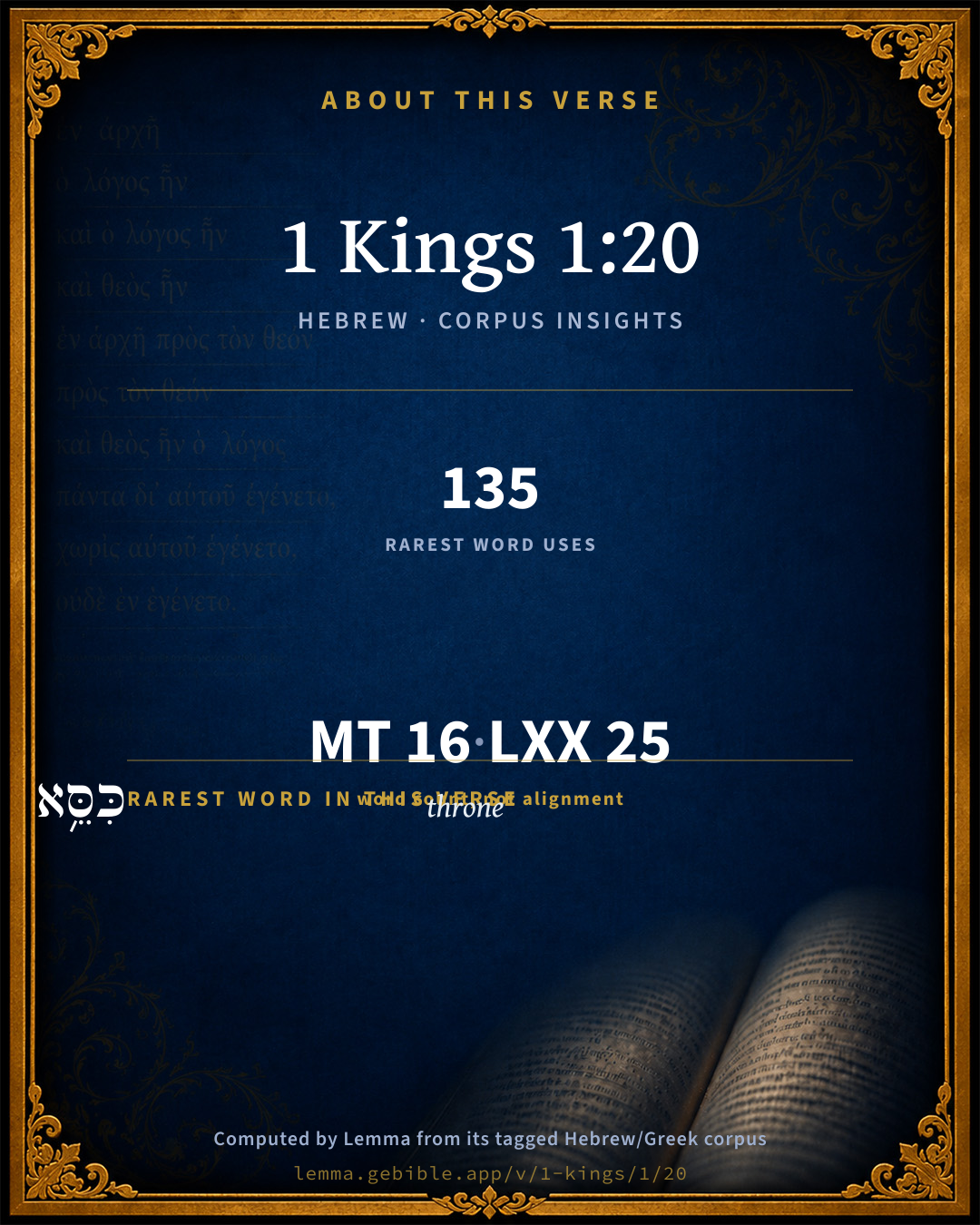
כִּסֵּ֥א
kiççêʼ
H3678
“throne of”
Noun, Common, Masculine, Singular, Construct
Part of Speech
Noun
Type
Common
Gender
Masculine
Number
Singular
State
Construct
Full BDB Definition

Origin: from H3680

TWOT: 1007

seat (of honour), throne, seat, stool - seat (of honour), throne - royal dignity, authority, power (figuratively)
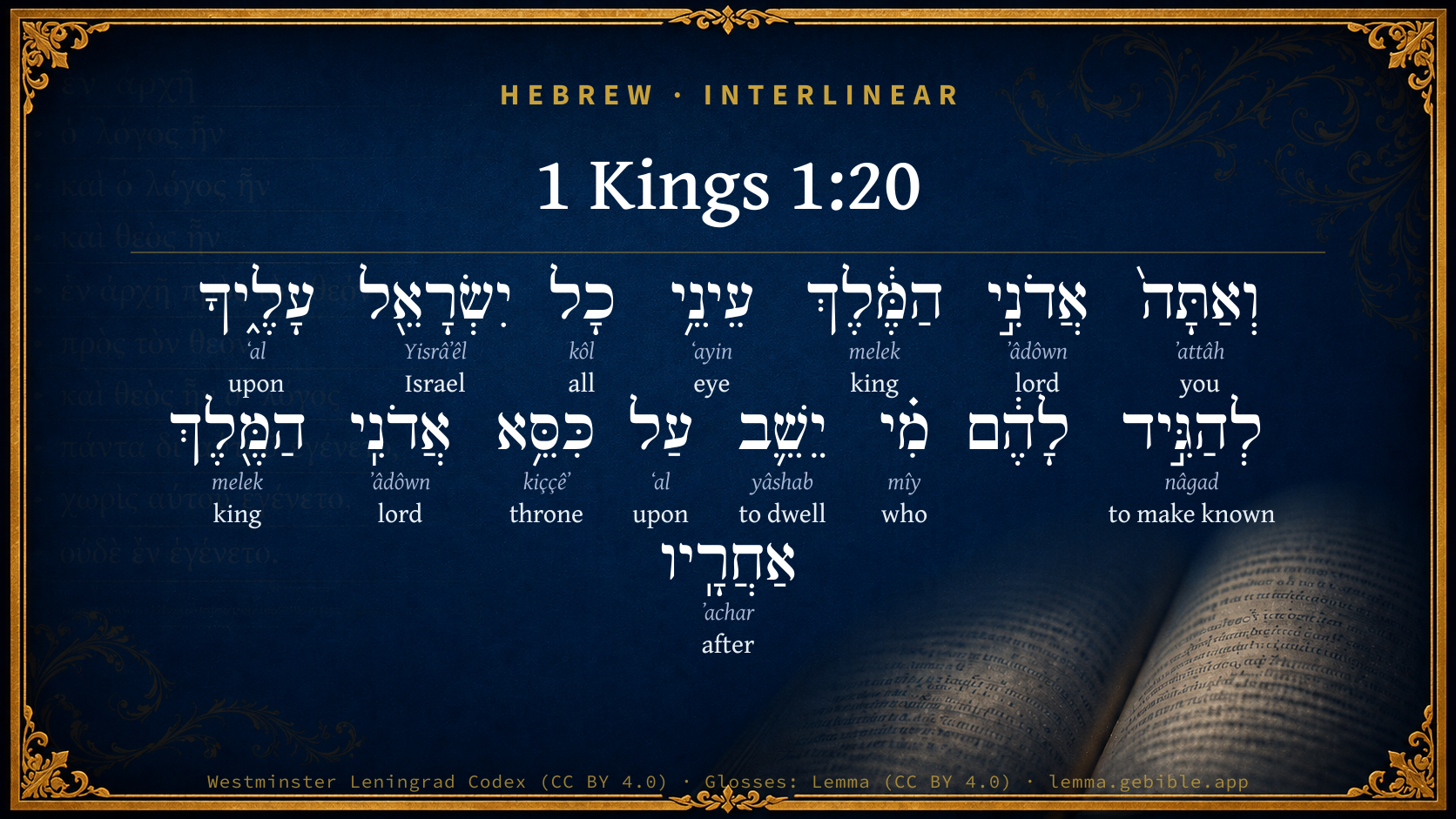
  1. וְאַתָּה֙ ʼattâh H859 “and · you” Conjunction + Pronoun, Personal, 2nd Person, Masculine, Singular
  2. אֲדֹנִ֣י ʼâdôwn H113 “lord · my” Noun, Common, Masculine, Singular, Construct + Suffix, Personal, 1st Person, Common, Singular
  3. הַמֶּ֔לֶךְ melek H4428 “the · king” Particle, Definite Article + Noun, Common, Masculine, Singular, Absolute
  4. עֵינֵ֥י ʻayin H5869 “eyes of” Noun, Common, Both, Dual, Construct
  5. כָל kôl H3605 “all of” Noun, Common, Masculine, Singular, Construct
  6. יִשְׂרָאֵ֖ל Yisrâʼêl H3478 “Israel” Noun, Proper
  7. עָלֶ֑יךָ ʻal H5921 “upon · you” Preposition + Suffix, Personal, 2nd Person, Masculine, Singular
  8. לְהַגִּ֣יד nâgad H5046 “to make known” Preposition + Verb, Hiphil, Infinitive Construct
  9. מִ֗י mîy H4310 “who” Particle, Interrogative
  10. יֵשֵׁ֛ב yâshab H3427 “to dwell” Verb, Qal, Imperfect, 3rd Person, Masculine, Singular
  11. עַל ʻal H5921 “upon” Preposition
  12. אֲדֹנִֽי ʼâdôwn H113 “lord · my” Noun, Common, Masculine, Singular, Construct + Suffix, Personal, 1st Person, Common, Singular
  13. הַמֶּ֖לֶךְ melek H4428 “the · king” Particle, Definite Article + Noun, Common, Masculine, Singular, Absolute
  14. אַחֲרָֽיו ʼachar H310 “after · him” Preposition + Suffix, Personal, 3rd Person, Masculine, Singular

About this verse

These counts appear in no published source. They are computed here, from the morphology-tagged text and Lemma’s own curated glosses. What Lemma adds →

16
words
12
distinct lemmas
Historical
section

Grammatical profile

  • 2 verbs
  • 8 nouns
  • 1 pronoun
  • 4 prepositions
  • 1 particle

Verb forms

  • לְהַגִּ֣יד Hiphil · Infinitive Construct
  • יֵשֵׁ֛ב Qal · Imperfect

Repetition

Words recur within this verse — often emphatic in Hebrew:

  • אֲדֹנִ֣י lord H113 ×2
  • הַמֶּ֔לֶךְ king H4428 ×2
  • עָלֶ֑יךָ upon H5921 ×2

Hebrew & Septuagint length

In English translation the verse runs 31 words from the Hebrew and 30 from the Septuagint (LXX English) — closely comparable.

A rough comparison of the two English renderings, which tokenize alike — not a word-level alignment.

Word counts can differ between the Hebrew and the Greek without any difference in meaning — e.g. the Hebrew direct-object marker אֵת has no separate Greek word, and Greek often adds the article ὁ.

In the original languages it is 16 Hebrew tokens and 25 Greek tokens — but the two are counted differently (Hebrew bundles its prefixes and suffixes into one token; the Greek is in lemma form), so that isn’t a like-for-like length.

Cross-references

9

Topical passages linked to 1 Kings 1:20 in the Treasury of Scripture Knowledge — connected by theme and wording, ordered by reader-vote popularity; previews shown in the World English Bible.

  • 2 Samuel 23:2 The Spirit of Yahweh spoke by me, His word was on my tongue.
  • 1 Chronicles 22:8–10 But the word of Yahweh came to me, saying, You have shed blood abundantly, and have made great wars: you shall not build a house to my name, because you have shed much blood on the earth in my sight.
  • 1 Chronicles 28:5–6 Of all my sons (for Yahweh has given me many sons), he has chosen Solomon my son to sit on the throne of the kingdom of Yahweh over Israel.
  • 1 Chronicles 28:10 Take heed now; for Yahweh has chosen you to build a house for the sanctuary: be strong, and do it.
  • 1 Chronicles 29:1 David the king said to all the assembly, Solomon my son, whom alone God has chosen, is yet young and tender, and the work is great; for the palace is not for man, but for Yahweh God.
  • 2 Chronicles 20:12 Our God, will you not judge them? for we have no might against this great company that comes against us; neither know we what to do: but out eyes are on you.
  • Psalms 25:15 My eyes are ever on Yahweh, For he will pluck my feet out of the net.
  • Psalms 123:2 Behold, as the eyes of servants look to the hand of their master, As the eyes of a maid to the hand of her mistress; So our eyes look to Yahweh, our God, Until he has mercy on us.
  • Zechariah 3:9 For, behold, the stone that I have set before Joshua; on one stone are seven eyes: behold, I will engrave the engraving of it,' says Yahweh of Hosts, 'and I will remove the iniquity of that land in one day.

Cross-references courtesy of OpenBible.info (CC BY 4.0).

Hebrew and Greek witnesses Masoretic Hebrew ↔ Greek Septuagint

The same verse in the two great witnesses to the Old Testament, shown verse-for-verse.

These are two independent witnesses, not word-aligned to each other, and the Septuagint is shown in lemma (dictionary) form.

Hebrew 1 Kings 1:20 Masoretic · Westminster Leningrad Codex

וְאַתָּה֙ אֲדֹנִ֣י הַמֶּ֔לֶךְ עֵינֵ֥י כָל יִשְׂרָאֵ֖ל עָלֶ֑יךָ לְהַגִּ֣יד לָהֶ֔ם מִ֗י יֵשֵׁ֛ב עַל כִּסֵּ֥א אֲדֹנִֽי הַמֶּ֖לֶךְ אַחֲרָֽיו

You, my lord the king, the eyes of all Israel are on you, that you should tell them who shall sit on the throne of my lord the king after him.

World English Bible · Public Domain

Greek LXX 1 Kings 1:20 Septuagint · lemma form

καί σύ κύριος ἐγώ βασιλεύς ὁ ὀφθαλμός πᾶς ἰσραήλ πρός σύ ἀποἀγγέλλω αὐτός τίς καταἵημι ἐπί ὁ θρόνος ὁ κύριος ἐγώ ὁ βασιλεύς μετά αὐτός

And you, my lord, O king, —the eyes of all Israel are upon you, to tell them who shall sit upon the throne of my lord the king after him.

LXX2012 (modern English Septuagint) · Public Domain

Hebrew: Westminster Leningrad Codex (CC BY 4.0). Greek: Septuagint (public domain); English from LXX2012 (modern English Septuagint) (Public Domain). How the Septuagint differs from the Hebrew →

Targum (Aramaic paraphrase)

1

The Targum is the ancient Jewish Aramaic paraphrase of the Hebrew Scriptures — an interpretive translation, not the Hebrew text itself. Onkelos (literal) and Pseudo-Jonathan (expansive) render the Torah, and Jonathan the Prophets. Coverage is partial: where no permissively-licensed English translation exists for a verse, only the Aramaic is shown. This is verse-level text, not a word-by-word alignment to the Hebrew.

  1. Targum Jonathan Prophets (Joshua–Malachi)
    וּכְעַן רִבּוֹנִי מַלְכָּא עֵינֵי כָל יִשְׂרָאֵל סְבִירִן עֲלָךְ לְחַוָאָה לְהוֹן מַן יִתֵּיב עַל כּוּרְסֵי מַלְכוּתָא דְרִבּוֹנִי מַלְכָּא בַּתְרוֹהִי:

    (no public-domain English translation for this verse)

    Targum Jonathan — Aramaic: “Mikraot Gedolot” (public domain). English: “Sefaria Community Translation” (CC0 1.0 (public-domain dedication)); “London "Chaldee Paraphrase," 1871” (public domain). Text via Sefaria.

Commentary

Notes on 1 Kings 1:20 from classic Christian and Jewish commentators (each source and its license shown beneath its notes). The classic Christian expositions comment on the surrounding passage and are grouped to its opening verse, so a note may address several verses; the Jewish commentaries on the Tanakh (Rashi and others) are per-verse, so they appear only where the commentator wrote on this verse.

Lemma curates 59 commentaries, every one of them public domain or Creative Commons licensed, each selected and text-cleaned for this edition rather than reprinted as found. About our sources →

Trapp's Complete Commentary

John Trapp

1Ki 1:20 And thou, my lord, O king, the eyes of all Israel [are] upon thee, that thou shouldest tell them who shall sit on the throne of my lord the king after him.

Ver. 20. That thou shouldest tell them, &c.] This some princes love not to do, - Queen Elizabeth for instance. A false Jesuit wrote, that she wished she might after her death hang a while in the air, to see what scuffling there would be for her kingdom. Os durum! fowl mouth!

John Trapp, A Commentary or Exposition upon All the Books of the Old and New Testament (1647–1656) — public domain. Text from a community e-Sword module.

Jamieson, Fausset & Brown

Robert Jamieson, A. R. Fausset & David Brown

the eyes of all Israel are upon thee, that thou shouldest tell them who shall sit on the throne--When the kings died without declaring their will, then their oldest son succeeded. But frequently they designated long before their death which of their sons should inherit the throne. The kings of Persia, as well as of other Eastern countries, have exercised the same right in modern and even recent times.

Jamieson, Fausset & Brown — Commentary Critical and Explanatory on the Whole Bible (1871) — public domain (CC PDM 1.0). Text via the HelloAO Bible API.

Adam Clarke's Commentary

Verse 20. That thou shouldest tell - who shall sit on the throne] This was a monarchy neither hereditary nor elective; the king simply named his successor. This obtained less or more, anciently, in most countries.

Adam Clarke's Commentary on the Bible (1810–1826) — public domain. Text from a community e-Sword/MySword module.

The Cambridge Bible for Schools and Colleges

gen. ed. J. J. S. Perowne

20. And thou, my lord, &c.] Here the variation is the other way, and now is read for thou. Both these changes seem to render the sentences more emphatic, especially as in this verse the queen is coming to the close of her argument and wishes to move David to take action in the matter at once.

The Cambridge Bible for Schools and Colleges (gen. ed. J. J. S. Perowne; Cambridge University Press, 1878–1918) — public domain. Text from a community e-Sword module.

John Gill's Exposition

And thou, my lord, O king,.... As for thee, or what concerns thee, or is incumbent on thee, will appear from the expectations of the people:

the eyes of all Israel are upon thee, that thou shouldest tell them who shall sit on the throne of my lord the king after him; this she said, to dissipate any fears that might possess his mind on hearing what Adonijah had done, that the people in general had assented to it, and encouraged him to it; whereas the body of the people were waiting to hear what was the will and determination of David: for they not only considered him as having a power to name a successor, as was afterwards done by Rehoboam, but as one that had the mind of God revealed to him who should be his successor, to which they should pay a regard.

John Gill's Exposition of the Whole Bible (1746–1763) — public domain (CC PDM 1.0). Text via the HelloAO Bible API.

Albert Barnes' Notes on the Bible

Tell them who shall sit on the throne - Side by side with what may be called the natural right of hereditary succession, there existed in the old world, and especially in the East, a right, if not of absolutely designating a successor, yet at any rate of choosing one among several sons. Thus, Cyrus designated Cambyses; and Darius designated Xerxes; and a still more absolute right of nomination was exercised by some of the Roman emperors.

Albert Barnes' Notes on the Bible (1834–1885) — public domain. Text from a community e-Sword/MySword module.

Haydock's Catholic Bible Commentary

Thee. Adonias boasts that all Israel was on his side, chap. ii. 15. (Calmet)

George Leo Haydock (1774–1849), Haydock's Catholic Family Bible and Commentary, 1859 edition — public domain. Excludes Psalms (Douay-Rheims chapter numbering differs from Protestant) and Deuterocanonical books (Catholic canon only).

Matthew Poole's English Annotations

The eyes of all Israel are upon thee; the generality of the people are in suspense, whether Adonijah’s practices be with thy consent or no, and wait for thy sentence, which they will readily embrace.

Who shall sit upon the throne of my lord the king; she speaks only in general, as owning my king’s prerogative to give the crown to which of his sons he pleased, if he had not restrained himself by his oath to Solomon.

After him, i.e. after thy death; whereby she taxeth Adonijah’s ambition, who usurped the crown whilst his father lived.

Matthew Poole's English Annotations on the Holy Bible (1683–1685) — public domain. Text from a community e-Sword/MySword module.

The Pulpit Commentary

And thou instead of hTaw, the Chald., Syr., and Vulg., with many MSS, read hTw "and now;" but this looks like an emendation, and "proclivi lectioni praestat ardua. " Similarly, the second "now" in ver. 18 appears as "thou" in 200 MSS. These variations are of very little consequence, but the received text, in both cases, is somewhat the more spirited my lord, O king the repetition (see vers. 18, 21, 24, 27) illustrates the profound deference and court paid to the Hebrew monarch (see on ver. 16), especially when we remember that these are the words of a wife, the eyes of all Israel are upon thee (cf. 1Ki_2:15) that thou shouldest ten them who shall sit on the throne of my lord the king after him. This shows that there was no "right of primogeniture." The kings of the East have always designated their successor amongst their sons. "Alyattes designated Croesus; Cyrus designated Cambyses, and Darius designated Xerxes" (Rawlinson). "The Shah of Persia, at the eginning of this century, had sixty sons, all brought up by their mothers, with the hope of succeeding" (Holier, quoted by Stanley). And the kings of Israel claimed and exercised a similar right. (2Ch_11:22 2Ch_21:3) And she arose at midnight rather, in the middle, i.e. , dead of the night. The sleeper could not know it was midnight, and took my son from beside me, while thine handmaid slept, and laid it in her bosom, and laid her dead child in my besom.

The Pulpit Commentary (1880–1919), ed. H.D.M. Spence-Jones & Joseph S. Exell — public domain. Text from a community e-Sword module.

unfoldingWord translationNotes

Door43 World Missions Community

General Information:

Bathsheba continues to speak to King David.

the eyes of all Israel are on you, waiting

Here "eyes" refers to the people. Here "the eyes ... are on you" is an idiom that means the people are waiting expectantly. AT: "all the people of Israel are waiting expectantly" (See: Synecdoche and Idiom)

will sit on the throne

Sitting on the throne is a metonym for being king. See how you translated similar words in 1 Kings 1:13. AT: "will be king"

when my master the king sleeps with his fathers

Bathsheba speaks to King David as if she were speaking about him to show that she respects him. AT: "when you sleep with your fathers" (See: Pronouns)

sleeps with his fathers

This is a polite way of saying "dies." (See: Euphemism)

I and my son Solomon will be regarded as criminals

This can be translated in active form. AT: "the new king will regard my son Solomon and me as criminals" (See: Active or Passive)

translationWords

Israel

asleep

ancestor

crime

unfoldingWord translationNotes — © Distant Shores Media and the Door43 World Missions Community, licensed CC BY-SA 4.0. Source: git.door43.org/Door43/en_tn.

Lesson kit

Teaching starters — assembled from the data on this page, not authored interpretation. Every prompt links to the verse data it draws on. Edit before teaching.

1 Kings, in the Historical, opens this verse with 16 words (12 distinct Hebrew lemmas). Its most distinctive word is kiççêʼ (“throne”). A historical commentator’s framing appears above. Read the whole chapter for the surrounding context.

Discussion questions

  1. What does “throne” (kiççêʼ) contribute to the verse as a whole?
  2. 2 Samuel 23:2 shares this passage’s theme. How do the two illuminate each other?
  3. “lord” occurs 2× in this one verse. What is the effect of the repetition?
  4. These translations render this verse differently. What is at stake in choosing one wording over another?
  5. The verb «לְהַגִּ֣יד» is Hiphil Infinitive Construct. How does its form color the action?
  6. Reading how Trapp's Complete Commentary and Jamieson, Fausset & Brown read this verse, where do the two commentators agree and where do they part?

Things to notice

Reading settings

Reading text

Shown beneath each verse's original-language words.

Old Testament
Old Testament edition

Read the OT as the Masoretic Hebrew (MT) or the Greek Septuagint (LXX).

English shown for the Greek Septuagint (in the Hebrew ↔ Greek comparison).

Comparing translations? Open the Compare panel on any verse page to stack up to four side by side.