Jeremiah 42:3

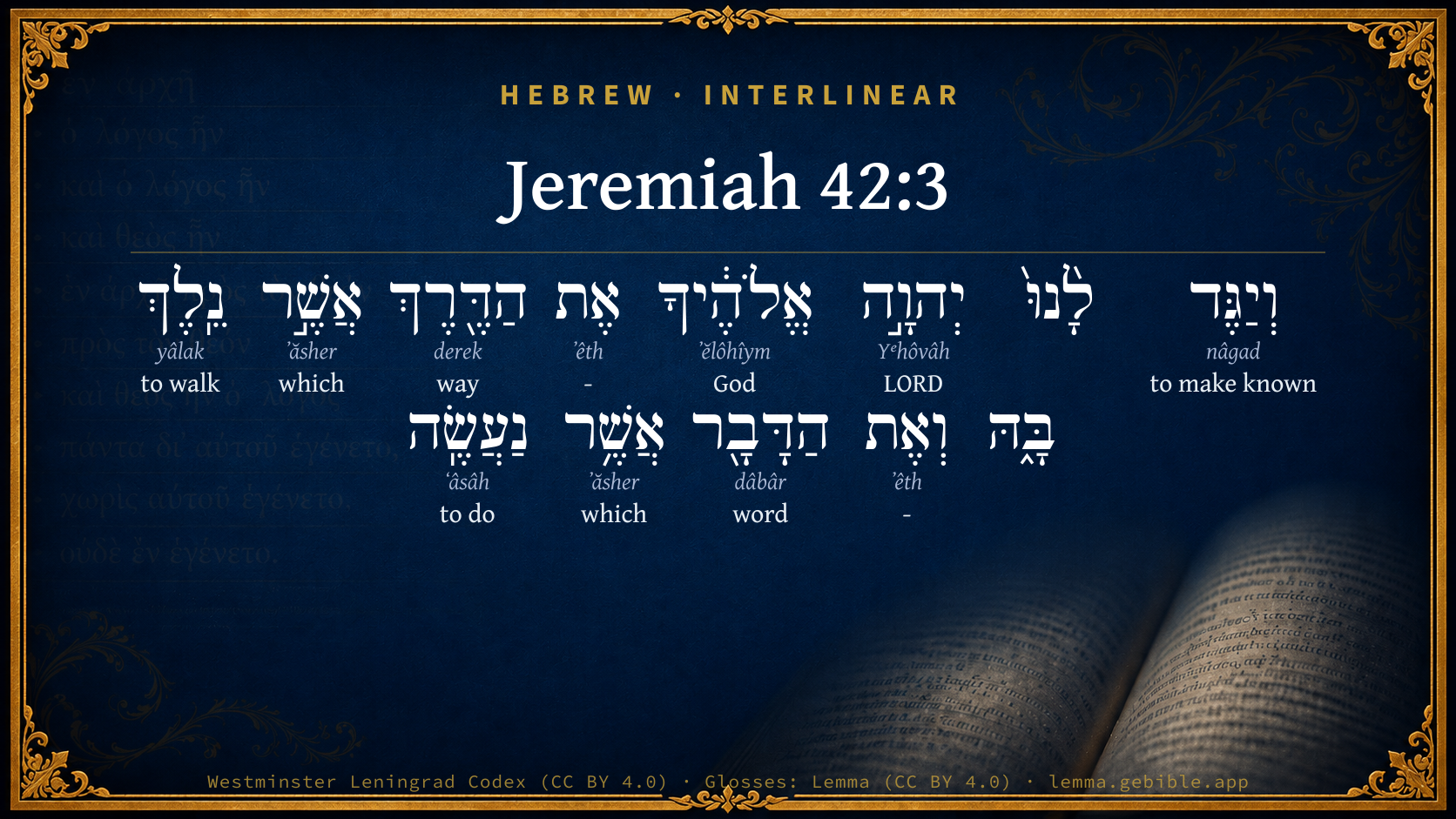
Hebrew (Westminster Leningrad Codex) Jeremiah 42:3 appears in the Hebrew Old Testament. The text above is from the Westminster Leningrad Codex. Each word links to its Strong’s number, a concise gloss, and parsing drawn from the Open Scriptures Hebrew Bible morphology. Click any word for its full Brown-Driver-Briggs (BDB) entry.
Download image
Cite this verse

Jeremiah 42:3 (World English Bible). Public Domain. Lemma interlinear Bible study tool, https://lemma.gebible.app/v/jeremiah/42/3.

Show BibTeX & RIS
BibTeX
RIS
English Translation
that Yahweh your God may show us the way in which we should walk, and the thing that we should do.
World English Bible · Public Domain
Download a study sheet

One document with this verse’s original text, its word-by-word gloss line, the meaning frame, cross-references with their text, attributed commentary, and full source and license credits — printable, and it pastes into notes with its structure intact.

This verse Autodidact and up

Study sheet (.html) Plain text (.txt)

A passage Seminary Student

Up to 50 verses in one chapter. A passage sheet keeps up to 6 commentary sources and 12 cross-references per verse, in the order this page ranks them, and says so on the sheet whenever that leaves anything out. Ask for a single verse and you get the Autodidact verse sheet above.

Everything on this page stays free to read, with no account — the sheet is a download of what is already on screen, not access to it.

Want to remove ads? Support Godless Engineer
Compare translations 3

The same verse in 3 English versions, stacked beneath the original-language interlinear above. Click any original word for its lexicon entry.

Each is an independent rendering of the whole verse — the interlinear is not word-aligned to these translations.

Highlighted words mark where these versions differ — a whole-verse word diff, not a word-by-word alignment.

  • World English Bible Public Domain
    that Yahweh your God may show us the way in which we should walk, and the thing that we should do.
  • King James Version Public Domain
    That the LORD thy God may shew us the way wherein we may walk, and the thing that we may do.
  • unfoldingWord Literal Text CC BY-SA 4.0
    Ask Yahweh your God to tell us the way we should go and what we should do.”

unfoldingWord Literal Text — © unfoldingWord, licensed CC BY-SA 4.0. Word-aligned USFM3 via Door43 (git.door43.org/unfoldingWord/en_ult).

Versions to compare (up to 4)

3 of 4 selected

Show all 18 translations

Every available English version of this verse, each an independent rendering of the whole verse.

  • World English Bible Public Domain
    that Yahweh your God may show us the way in which we should walk, and the thing that we should do.
  • Berean Standard Bible Public Domain
    Pray that the LORD your God will tell us the way we should walk and the thing we should do.”
  • Majority Standard Bible Public Domain
    Pray that the LORD your God will tell us the way we should walk and the thing we should do.”
  • King James Version Public Domain
    That the LORD thy God may shew us the way wherein we may walk, and the thing that we may do.
  • American Standard Version (1901) Public Domain
    that Jehovah thy God may show us the way wherein we should walk, and the thing that we should do.
  • Revised Version (1885) Public Domain
    that the LORD thy God may shew us the way wherein we should walk, and the thing that we should do.
  • Geneva Bible (1599) Public Domain
    That the Lord thy God may shewe vs the way wherein wee may walke, and the thing that we may doe.
  • Douay-Rheims (1899) Public Domain
    And let the Lord thy God shew us the way by which we may walk, and the thing that we must do.
  • Young's Literal Translation Public Domain
    and Jehovah thy God doth declare to us the way in which we walk, and the thing that we do.'
  • Literal Standard Version CC BY-SA 4.0
    and your God YHWH declares to us the way in which we walk, and the thing that we do.”
  • Unlocked Literal Bible CC BY-SA 4.0
    Ask Yahweh your God to tell us the way we should go and what we should do.”
  • unfoldingWord Literal Text CC BY-SA 4.0
    Ask Yahweh your God to tell us the way we should go and what we should do.”
  • Darby Bible Public Domain
    that Jehovah thy God may shew us the way wherein we should walk, and the thing that we should do.
  • World Messianic Bible Public Domain
    that the LORD your God may show us the way in which we should walk, and the things that we should do.”
  • Webster's Bible Public Domain
    That the LORD thy God may show us the way in which we may walk, and the thing that we may do.
  • Free Bible Version CC BY-SA 4.0
    Pray to the Lord your God for all of us. As you can see there are only a few of us left compared to how many there were before. In your prayer please ask the Lord your God to tell where to go and what to do.”
  • Bible in Basic English Public Domain
    That the Lord your God may make clear to us the way in which we are to go and what we are to do.
  • JPS Tanakh (1917) Public Domain
    that the LORD thy God may tell us the way wherein we should walk, and the thing that we should do.'

Literal Standard Version (2020), Covenant Press — licensed CC BY-SA 4.0. Text via the HelloAO Bible API (eBible.org). Unlocked Literal Bible (unfoldingWord) — licensed CC BY-SA 4.0. Text via the HelloAO Bible API (eBible.org). unfoldingWord Literal Text — © unfoldingWord, licensed CC BY-SA 4.0. Word-aligned USFM3 via Door43 (git.door43.org/unfoldingWord/en_ult). Free Bible Version, Dr. Jonathan Gallagher — licensed CC BY-SA 4.0. Text via the HelloAO Bible API (eBible.org).

Word by word

More ways to search: Search by grammar → Find every occurrence → Compare this word →

Practice this passage: Drill this verse → Learn its vocabulary →

וְיַגֶּד
nâgad
H5046
“and · to make known”
Conjunction + Verb, Hiphil, Jussive, 3rd Person, Masculine, Singular
Part of Speech
Conjunction + Verb
Stem
Hiphil
Form
Jussive
Person
3rd Person
Gender
Masculine
Number
Singular
Full BDB Definition

Origin: a primitive root

TWOT: 1289

to be conspicuous, tell, make known - (Hiphil) to tell, declare - to tell, announce, report - to declare, make known, expound - to inform of - to publish, declare, proclaim - to avow, acknowledge, confess - messenger (participle) - (Hophal) to be told, be announced, be reported
  1. יְהוָ֣ה Yᵉhôvâh H3068 “LORD” Noun, Proper
  2. אֱלֹהֶ֔יךָ ʼĕlôhîym H430 “God(s) · your” Noun, Common, Masculine, Plural, Construct + Suffix, Personal, 2nd Person, Masculine, Singular
  3. אֶת ʼêth H853 “-” Particle, Direct Object
  4. הַדֶּ֖רֶךְ derek H1870 “the · way” Particle, Definite Article + Noun, Common, Both, Singular, Absolute
  5. אֲשֶׁ֣ר ʼăsher H834 “which” Particle, Relative
  6. נֵֽלֶךְ yâlak H3212 “to walk” Verb, Qal, Imperfect, 1st Person, Common, Plural
  7. וְאֶת ʼêth H853 “and · -” Conjunction + Particle, Direct Object
  8. הַדָּבָ֖ר dâbâr H1697 “the · word” Particle, Definite Article + Noun, Common, Masculine, Singular, Absolute
  9. אֲשֶׁ֥ר ʼăsher H834 “which” Particle, Relative
  10. נַעֲשֶֽׂה ʻâsâh H6213 “to do” Verb, Qal, Imperfect, 1st Person, Common, Plural

About this verse

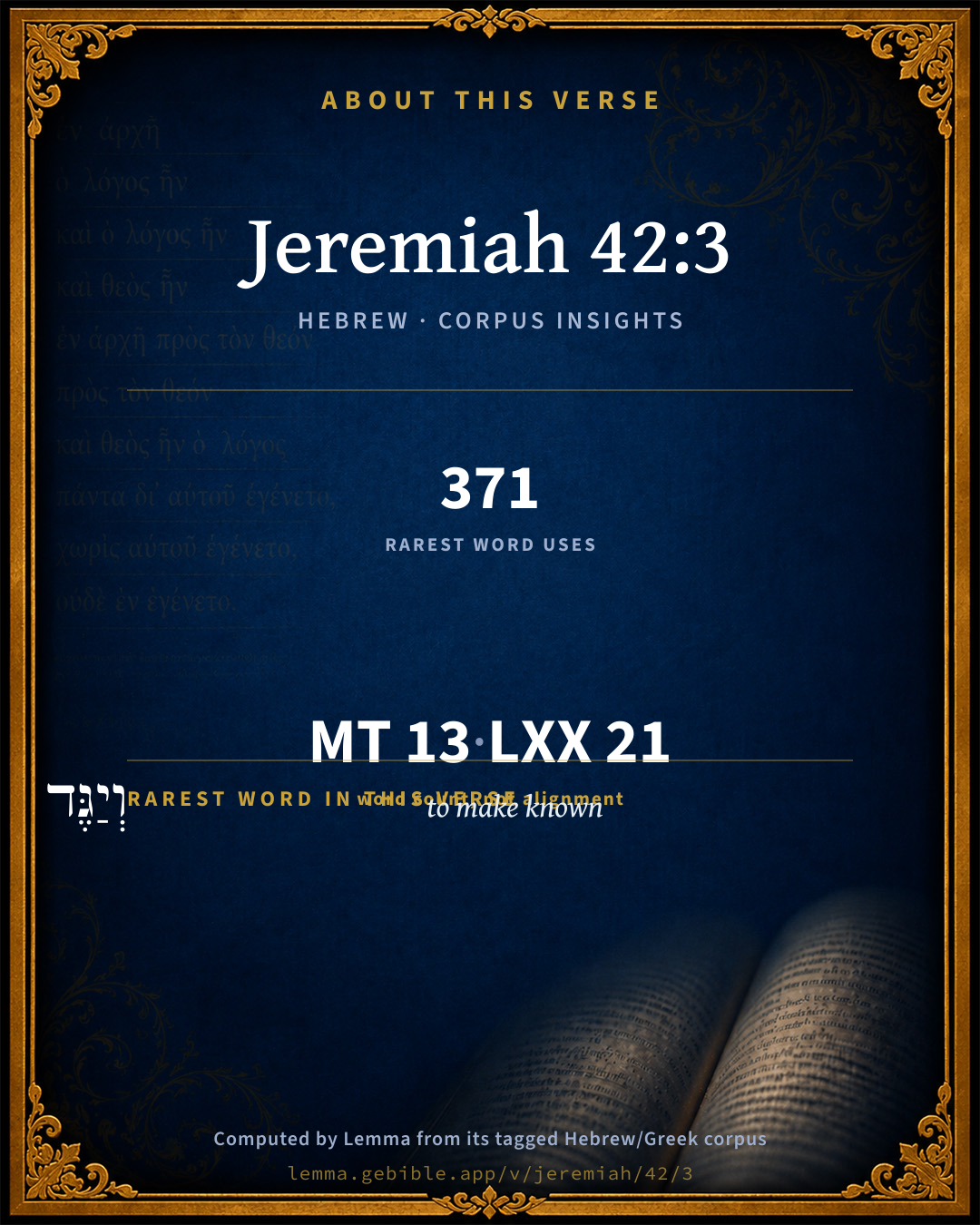
These counts appear in no published source. They are computed here, from the morphology-tagged text and Lemma’s own curated glosses. What Lemma adds →

13
words
9
distinct lemmas
Prophets
section

Grammatical profile

  • 3 verbs
  • 4 nouns
  • 2 prepositions
  • 4 particles

Verb forms

  • וְיַגֶּד Hiphil · Jussive
  • נֵֽלֶךְ Qal · Imperfect
  • נַעֲשֶֽׂה Qal · Imperfect

Repetition

A word recurs within this verse — often emphatic in Hebrew:

  • אֲשֶׁ֣ר which H834 ×2

Hebrew & Septuagint length

In the original languages it is 13 Hebrew tokens and 21 Greek tokens — but the two are counted differently (Hebrew bundles its prefixes and suffixes into one token; the Greek is in lemma form), so that isn’t a like-for-like length.

Cross-references

13

Topical passages linked to Jeremiah 42:3 in the Treasury of Scripture Knowledge — connected by theme and wording, ordered by reader-vote popularity; previews shown in the World English Bible.

  • Psalms 86:11 Teach me your way, Yahweh. I will walk in your truth. Make my heart undivided to fear your name.
  • Proverbs 3:6 In all your ways acknowledge him, And he will direct your paths.
  • Ezra 8:21 Then I proclaimed a fast there, at the river Ahava, that we might humble ourselves before our God, to seek of him a straight way for us, and for our little ones, and for all our substance.
  • Psalms 25:4–5 Show me your ways, Yahweh. Teach me your paths.
  • Jeremiah 6:16 Thus says Yahweh, Stand you in the ways and see, and ask for the old paths, where is the good way; and walk therein, and you shall find rest for your souls: but they said, We will not walk [therein].
  • Micah 4:2 Many nations will go and say, "Come, and let us go up to the mountain of Yahweh, And to the house of the God of Jacob; And he will teach us of his ways, And we will walk in his paths." For out of Zion will go forth the law, And the word of Yahweh from Jerusalem;
  • Deuteronomy 5:26 For who is there of all flesh, that has heard the voice of the living God speaking out of the midst of the fire, as we have, and lived?
  • Deuteronomy 5:29 Oh that there were such a heart in them, that they would fear me, and keep all my commandments always, that it might be well with them, and with their children forever!
  • 1 Kings 8:36 then hear in heaven, and forgive the sin of your servants, and of your people Israel, when you teach them the good way in which they should walk; and send rain on your land, which you have given to your people for an inheritance.
  • Psalms 143:8–10 Cause me to hear your loving kindness in the morning, For I trust in you. Cause me to know the way in which I should walk, For I lift up my soul to you.
  • Isaiah 2:3 Many peoples shall go and say, "Come, let's go up to the mountain of Yahweh, To the house of the God of Jacob; And he will teach us of his ways, And we will walk in his paths. For out of Zion the law shall go forth, And the word of Yahweh from Jerusalem.
  • Psalms 27:11 Teach me your way, Yahweh. Lead me in a straight path, because of my enemies.
  • Mark 12:13–14 They sent some of the Pharisees and of the Herodians to him, that they might trap him with words.

Cross-references courtesy of OpenBible.info (CC BY 4.0).

Hebrew and Greek witnesses Masoretic Hebrew ↔ Greek Septuagint

The same verse in the two great witnesses to the Old Testament, shown verse-for-verse.

These are two independent witnesses, not word-aligned to each other, and the Septuagint is shown in lemma (dictionary) form.

Hebrew Jeremiah 42:3 Masoretic · Westminster Leningrad Codex

וְיַגֶּד לָ֨נוּ֙ יְהוָ֣ה אֱלֹהֶ֔יךָ אֶת הַדֶּ֖רֶךְ אֲשֶׁ֣ר נֵֽלֶךְ בָּ֑הּ וְאֶת הַדָּבָ֖ר אֲשֶׁ֥ר נַעֲשֶֽׂה

that Yahweh your God may show us the way in which we should walk, and the thing that we should do.

World English Bible · Public Domain

Greek LXX Structure differs

In the Septuagint, Jeremiah is about an eighth shorter than the Hebrew and arranges its material differently — the Oracles Against the Nations (Hebrew chapters 46–51) appear in the middle of the Greek book, after 25:13. Because the chapter and verse boundaries do not line up, a verse-for-verse comparison with the Hebrew is not shown.

A verse-for-verse comparison isn’t shown here because the chapters and verses don’t line up. Switch to the LXX edition with the MT / LXX toggle above to read the Greek directly.

Hebrew: Westminster Leningrad Codex (CC BY 4.0). Greek: Septuagint (public domain); English from a public-domain English Septuagint. How the Septuagint differs from the Hebrew →

Targum (Aramaic paraphrase)

1

The Targum is the ancient Jewish Aramaic paraphrase of the Hebrew Scriptures — an interpretive translation, not the Hebrew text itself. Onkelos (literal) and Pseudo-Jonathan (expansive) render the Torah, and Jonathan the Prophets. Coverage is partial: where no permissively-licensed English translation exists for a verse, only the Aramaic is shown. This is verse-level text, not a word-by-word alignment to the Hebrew.

  1. Targum Jonathan Prophets (Joshua–Malachi)
    וִיחַוֵי לָנָא יְיָ אֱלָהָךְ יַת אוֹרְחָא דִנְהָךְ בָּהּ וְיַת פִּתְגָמָא דְנַעְבֵּיד:

    (no public-domain English translation for this verse)

    Targum Jonathan — Aramaic: “Mikraot Gedolot” (public domain). English: “Sefaria Community Translation” (CC0 1.0 (public-domain dedication)); “London "Chaldee Paraphrase," 1871” (public domain). Text via Sefaria.

Commentary

Notes on Jeremiah 42:3 from classic Christian and Jewish commentators (each source and its license shown beneath its notes). The classic Christian expositions comment on the surrounding passage and are grouped to its opening verse, so a note may address several verses; the Jewish commentaries on the Tanakh (Rashi and others) are per-verse, so they appear only where the commentator wrote on this verse.

Lemma curates 59 commentaries, every one of them public domain or Creative Commons licensed, each selected and text-cleaned for this edition rather than reprinted as found. About our sources →

Trapp's Complete Commentary

John Trapp

Jer 42:3 That the LORD thy God may shew us the way wherein we may walk, and the thing that we may do.

Ver. 3. That the Lord thy God may show us the way.] But they had set themselves in the way to Egypt before they came with this request to the prophet: why went they else to Goruth Chimham, the road toward Egypt? {Jer 41:17} why were they also so peremptory, when they knew God’s mind to the contrary? {Jer 43:7}

And the thing that we may do.] Good words all along; but those, we say, are light cheap: Quid vero verba quaero, facta cum videam? They were as forward to speak fair, as their ancestors were in the wilderness; but oh that there were a heart in this people, saith God, to do as they have said!

John Trapp, A Commentary or Exposition upon All the Books of the Old and New Testament (1647–1656) — public domain. Text from a community e-Sword module.

Geneva Bible (1599)

Geneva Bible translators

This declareth the nature of hypocrites, which would know of God’s word what they should do, but will not follow it, but inasmuch as it agreeth with that thing, which they have purposed to do.

Geneva Bible (1599) marginal notes — public domain. Text via Bolls.life.

Jamieson, Fausset & Brown

Robert Jamieson, A. R. Fausset & David Brown

They consulted God, like many, not so much to know what was right, as wishing Him to authorize what they had already determined on, whether agreeable to His will or not. So Ahab in consulting Micaiah (Kg1 22:13). Compare Jeremiah's answer (Jer 42:4) with Micaiah's (Kg1 22:14).

Jamieson, Fausset & Brown — Commentary Critical and Explanatory on the Whole Bible (1871) — public domain (CC PDM 1.0). Text via the HelloAO Bible API.

Adam Clarke's Commentary

Verse 3. That the Lord thy God may show us] They all thought there was no safety in Jerusalem or in Judea, and therefore determined to leave the land: but they did not know which might be the safest direction to take; for though they inclined to Egypt, yet they wished to know the mind of God on that point.

Adam Clarke's Commentary on the Bible (1810–1826) — public domain. Text from a community e-Sword/MySword module.

John Calvin's Commentaries

They came then, as it has been stated, as though they were ready to obey; and then they professed humility, because they did not wish to do anything rashly, but only to follow where God called them. Had they spoken from the heart, it would have been a rare virtue thus to-have fled in perplexities to God, and to have allowed themselves to be ruled by his word; but we shall see that it was all a pre-tence. We have then here set before us the hypocrisy of that people, so that we may learn that whenever we ask what pleases God, we should bring a pure and sincere heart, so that nothing may prevent or hinder us immediately to embrace whatever God may command us. But their hypocrisy is discovered to have been still baser, when the Prophet adds,

John Calvin's Commentaries (1540-1563) — public domain. Text from the Calvin Translation Society English edition (1840s-50s) via the Christian Classics Ethereal Library (ccel.org). Calvin's coverage is partial (roughly two-thirds of the Bible); uncommented books and verses are honest gaps, never fabricated. The 19th-century editor's footnotes and remarks are omitted so the notes are faithfully Calvin's own voice.

The Cambridge Bible for Schools and Colleges

gen. ed. J. J. S. Perowne

3. that the Lord thy God may shew us] They make up their minds to flee into Egypt, and only after they have done this, proceed to enquire God’s will. Hence we cannot acquit them of hypocrisy. Cp. Ahab in 1Ki_22:3 ff.

The Cambridge Bible for Schools and Colleges (gen. ed. J. J. S. Perowne; Cambridge University Press, 1878–1918) — public domain. Text from a community e-Sword module.

John Gill's Exposition

That the Lord thy God may show us the way wherein we may walk,.... Not the way of their duty as to religious worship, or their moral conversation, which was the way of God's commandments, and had been shown them, and they knew it; but which way they should steer their course for their safety; they had departed from Mizpah of themselves, and had taken up their dwelling at Geruthchimham, in the way to Egypt; whither they had set their faces, and where their hearts were, only they wanted the Lord's sanction for it, pretending they would be directed by him:

and the thing that we should do; the steps they should take in order to proceed; and what they should do before they left their own country, and went into another.

John Gill's Exposition of the Whole Bible (1746–1763) — public domain (CC PDM 1.0). Text via the HelloAO Bible API.

Matthew Poole's English Annotations

The thing they would have him pray to God for, was direction what they should do in this desolate state into which God had brought them. What could be more pious? a practice founded upon a Divine precept, and encouraged by a promise, Pro 3:6, Acknowledge him in all thy ways, and he shall direct thy steps. But we may well apply here what God had said to their forefathers, Deu 5:29, when they had so freely promised their obedience to the law of God, Oh that there were such an heart in them, &c.

Matthew Poole's English Annotations on the Holy Bible (1683–1685) — public domain. Text from a community e-Sword/MySword module.

The Pulpit Commentary

Divine guidance.

I THE NEED OF DIVINE GUIDANCE.

1. It arises out of our obligation to do the will of God. We are not left to carve out a career for ourselves, but to fulfil a Divine vocation. With this definite end before us, our life must fail unless we are directly making for it. A harmless life, following its own whims and fancies, is a wasted life. But only God knows his own will. Therefore we need that he shall reveal this to us, to show us, not only the path of safety, but the way he wills us to go. The most clear sighted need this guidance. As servants, we wait for our Master"s orders; as soldiers, we are to follow our Captain"s commands. Without these, how can we do the one thing needful?

2. It arises out of our own ignorance and blindness. We do not know all the circumstances which surround us; we cannot predict the exigencies of the future; the ultimate issue of our actions is beyond our reckoning; the limits of our powers are not known to us; our future requirements and capacities cannot now be gauged. Yet we must decide and act at once in relation to all these unknown quantities. Therefore only a higher wisdom and a larger knowledge can secure us from fatal blunders.

II THE METHOD OF DIVINE GUIDANCE. The Jews appealed to a prophet. We have no Jeremiah. Yet we have essentially the same means of guidance, now broken into two parts, for the higher education of our spiritual nature.

1. The revelation of God"s will and truth in Scripture. There we have God"s guidance in the words of the prophets, and in addition to that in the higher thought of the apostles of the New Testament and of Christianity. Above all, we have the great example, the speaking lessons, of the life and character of Christ, who is the "Light of the World." In all this we have larger, clearer views of God"s will and of man"s duty than were given to the Jews under the earlier dispensation.

2. The light of the Spirit of God in our mind and conscience. It may be urged that, while the instructions of the prophets for the guidance of Israel were definite and particular, the lessons which we may gather from revelation are general; and that, though the ideas of conduct thus communicated to us are higher and larger than those of the Jewish economy, they are nevertheless so abstract that we may make great mistakes in the practical application of them. This is true; and therefore, with the less particular revelation, God gives to us more light for the interpretation of it. We live under that dispensation of the Spirit wherein all Christians are, in a measure, prophets, and God"s Spirit is poured out upon all flesh. (Act_2:17) By God"s light in our souls, interpreting God"s revelation in Christ, we may know God"s will concerning our lives; and, no longer slaves to the letter of unintelligible precepts, we may carry out the broad principles of the spiritual life by a thoughtful and conscientious application of them to the details of daily life.

III THE USE OF DIVINE GUIDANCE. God reveals the way; we must walk therein. The direction may be so clear that he who reads may run, yet he must run. The sign post is not a carriage to convey the indolent traveler to his journey"s end. God reveals his will; he leaves it to our free choice and effort to obey it. He does not guide us, like the horse or mule, with bit and bridle. We are not forced to follow the revelation, but we are bound in moral obligation to do so. The main object of the revelation of truth is to guide us in practice. God enlightens our darkness that we may gird up our loins and walk in his ways.

The Pulpit Commentary (1880–1919), ed. H.D.M. Spence-Jones & Joseph S. Exell — public domain. Text from a community e-Sword module.

Lesson kit

Teaching starters — assembled from the data on this page, not authored interpretation. Every prompt links to the verse data it draws on. Edit before teaching.

Jeremiah, in the Prophets, opens this verse with 13 words (9 distinct Hebrew lemmas). Its most distinctive word is nâgad (“to make known”). A historical commentator’s framing appears above. Read the whole chapter for the surrounding context.

Discussion questions

  1. The word nâgad carries the sense “to make known.” How does it shape the verse?
  2. Psalms 86:11 shares this passage’s theme. How do the two illuminate each other?
  3. “which” occurs 2× in this one verse. What is the effect of the repetition?
  4. These translations render this verse differently; the difference is in the English rendering, not the original. What questions does that raise?
  5. The verb «וְיַגֶּד» is Hiphil Jussive. How does its form color the action?
  6. Reading how Trapp's Complete Commentary and Geneva Bible (1599) read this verse, where do the two commentators agree and where do they part?

Things to notice

Reading settings

Reading text

Shown beneath each verse's original-language words.

Old Testament
Old Testament edition

Read the OT as the Masoretic Hebrew (MT) or the Greek Septuagint (LXX).

English shown for the Greek Septuagint (in the Hebrew ↔ Greek comparison).

Comparing translations? Open the Compare panel on any verse page to stack up to four side by side.