
Jeremiah 5:20

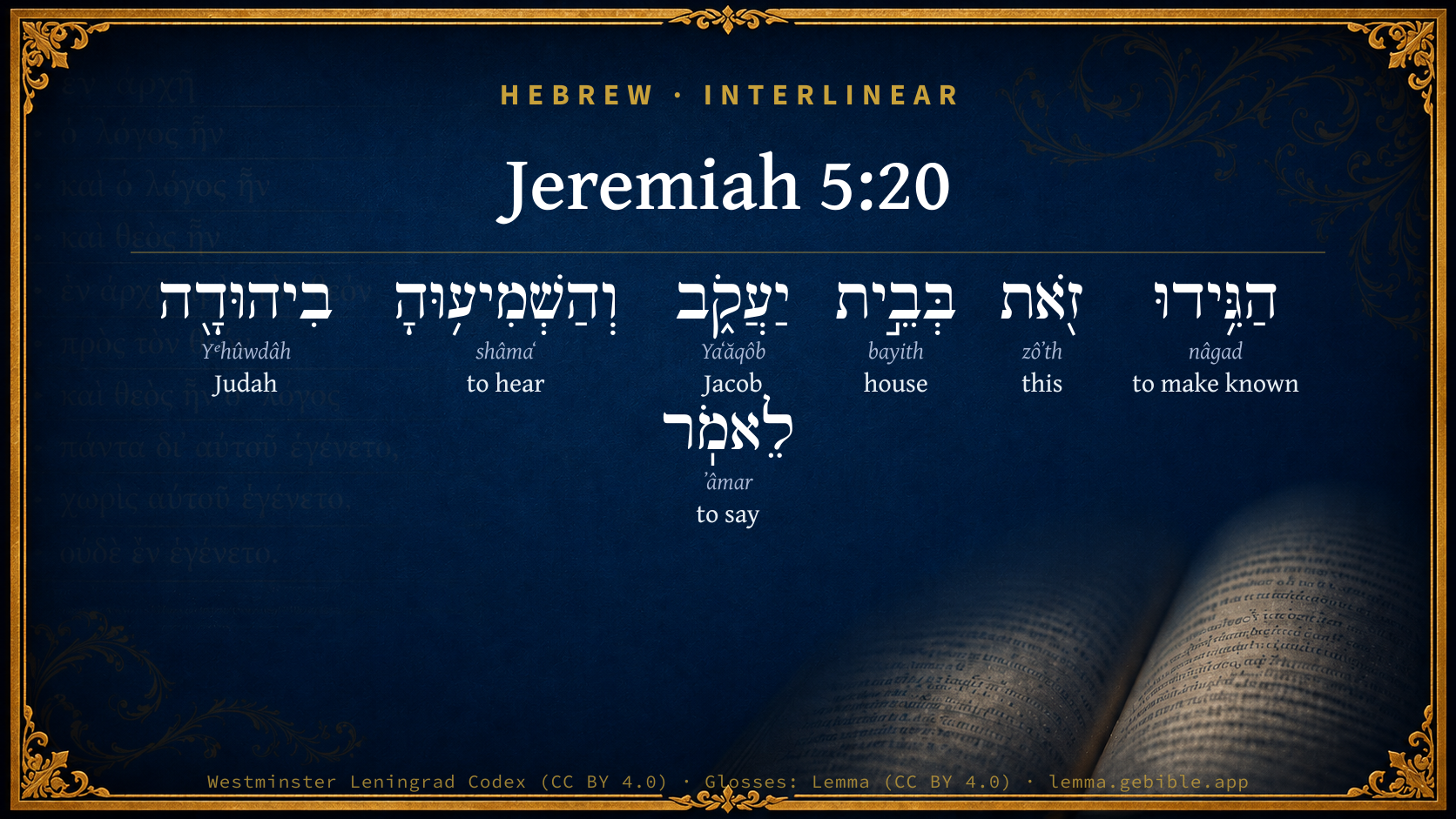
Hebrew (Westminster Leningrad Codex) Jeremiah 5:20 appears in the Hebrew Old Testament. The text above is from the Westminster Leningrad Codex. Each word links to its Strong’s number, a concise gloss, and parsing drawn from the Open Scriptures Hebrew Bible morphology. Click any word for its full Brown-Driver-Briggs (BDB) entry.
Download image
Cite this verse

Jeremiah 5:20 (World English Bible). Public Domain. Lemma interlinear Bible study tool, https://lemma.gebible.app/v/jeremiah/5/20.

Show BibTeX & RIS
BibTeX
RIS
English Translation
Declare you this in the house of Jacob, and publish it in Judah, saying,
World English Bible · Public Domain
Download a study sheet

One document with this verse’s original text, its word-by-word gloss line, the meaning frame, cross-references with their text, attributed commentary, and full source and license credits — printable, and it pastes into notes with its structure intact.

This verse Autodidact and up

Study sheet (.html) Plain text (.txt)

A passage Seminary Student

Up to 50 verses in one chapter. A passage sheet keeps up to 6 commentary sources and 12 cross-references per verse, in the order this page ranks them, and says so on the sheet whenever that leaves anything out. Ask for a single verse and you get the Autodidact verse sheet above.

Everything on this page stays free to read, with no account — the sheet is a download of what is already on screen, not access to it.

Want to remove ads? Support Godless Engineer
Compare translations 3

The same verse in 3 English versions, stacked beneath the original-language interlinear above. Click any original word for its lexicon entry.

Each is an independent rendering of the whole verse — the interlinear is not word-aligned to these translations.

Highlighted words mark where these versions differ — a whole-verse word diff, not a word-by-word alignment.

  • World English Bible Public Domain
    Declare you this in the house of Jacob, and publish it in Judah, saying,
  • King James Version Public Domain
    Declare this in the house of Jacob, and publish it in Judah, saying,
  • unfoldingWord Literal Text CC BY-SA 4.0
    Declare this to the house of Jacob and announce it in Judah, saying:

unfoldingWord Literal Text — © unfoldingWord, licensed CC BY-SA 4.0. Word-aligned USFM3 via Door43 (git.door43.org/unfoldingWord/en_ult).

Versions to compare (up to 4)

3 of 4 selected

Show all 18 translations

Every available English version of this verse, each an independent rendering of the whole verse.

  • World English Bible Public Domain
    Declare you this in the house of Jacob, and publish it in Judah, saying,
  • Berean Standard Bible Public Domain
    Declare this in the house of Jacob and proclaim it in Judah:
  • Majority Standard Bible Public Domain
    Declare this in the house of Jacob and proclaim it in Judah:
  • King James Version Public Domain
    Declare this in the house of Jacob, and publish it in Judah, saying,
  • American Standard Version (1901) Public Domain
    Declare ye this in the house of Jacob, and publish it in Judah, saying,
  • Revised Version (1885) Public Domain
    Declare ye this in the house of Jacob, and publish it in Judah, saying,
  • Geneva Bible (1599) Public Domain
    Declare this in the house of Iaakob, and publish it in Iudah, saying,
  • Douay-Rheims (1899) Public Domain
    Declare ye this to the house of Jacob, and publish it in Juda, saying:
  • Young's Literal Translation Public Domain
    Declare ye this in the house of Jacob, And sound ye it in Judah, saying,
  • Literal Standard Version CC BY-SA 4.0
    Declare this in the house of Jacob, || And sound it in Judah, saying,
  • Unlocked Literal Bible CC BY-SA 4.0
    Report this to the house of Jacob and let it be heard in Judah. Say,
  • unfoldingWord Literal Text CC BY-SA 4.0
    Declare this to the house of Jacob and announce it in Judah, saying:
  • Darby Bible Public Domain
    Declare this in the house of Jacob, and publish it in Judah, saying,
  • World Messianic Bible Public Domain
    “Declare this in the house of Jacob, and publish it in Judah, saying,
  • Webster's Bible Public Domain
    Declare this in the house of Jacob, and publish it in Judah, saying,
  • Free Bible Version CC BY-SA 4.0
    Announce this to the people of Jacob and Judah:
  • Bible in Basic English Public Domain
    Say this openly in Jacob and give it out in Judah, saying,
  • JPS Tanakh (1917) Public Domain
    Declare ye this in the house of Jacob, and announce it in Judah, saying:

Literal Standard Version (2020), Covenant Press — licensed CC BY-SA 4.0. Text via the HelloAO Bible API (eBible.org). Unlocked Literal Bible (unfoldingWord) — licensed CC BY-SA 4.0. Text via the HelloAO Bible API (eBible.org). unfoldingWord Literal Text — © unfoldingWord, licensed CC BY-SA 4.0. Word-aligned USFM3 via Door43 (git.door43.org/unfoldingWord/en_ult). Free Bible Version, Dr. Jonathan Gallagher — licensed CC BY-SA 4.0. Text via the HelloAO Bible API (eBible.org).

Word by word

More ways to search: Search by grammar → Find every occurrence → Compare this word →

Practice this passage: Drill this verse → Learn its vocabulary →

About this verse

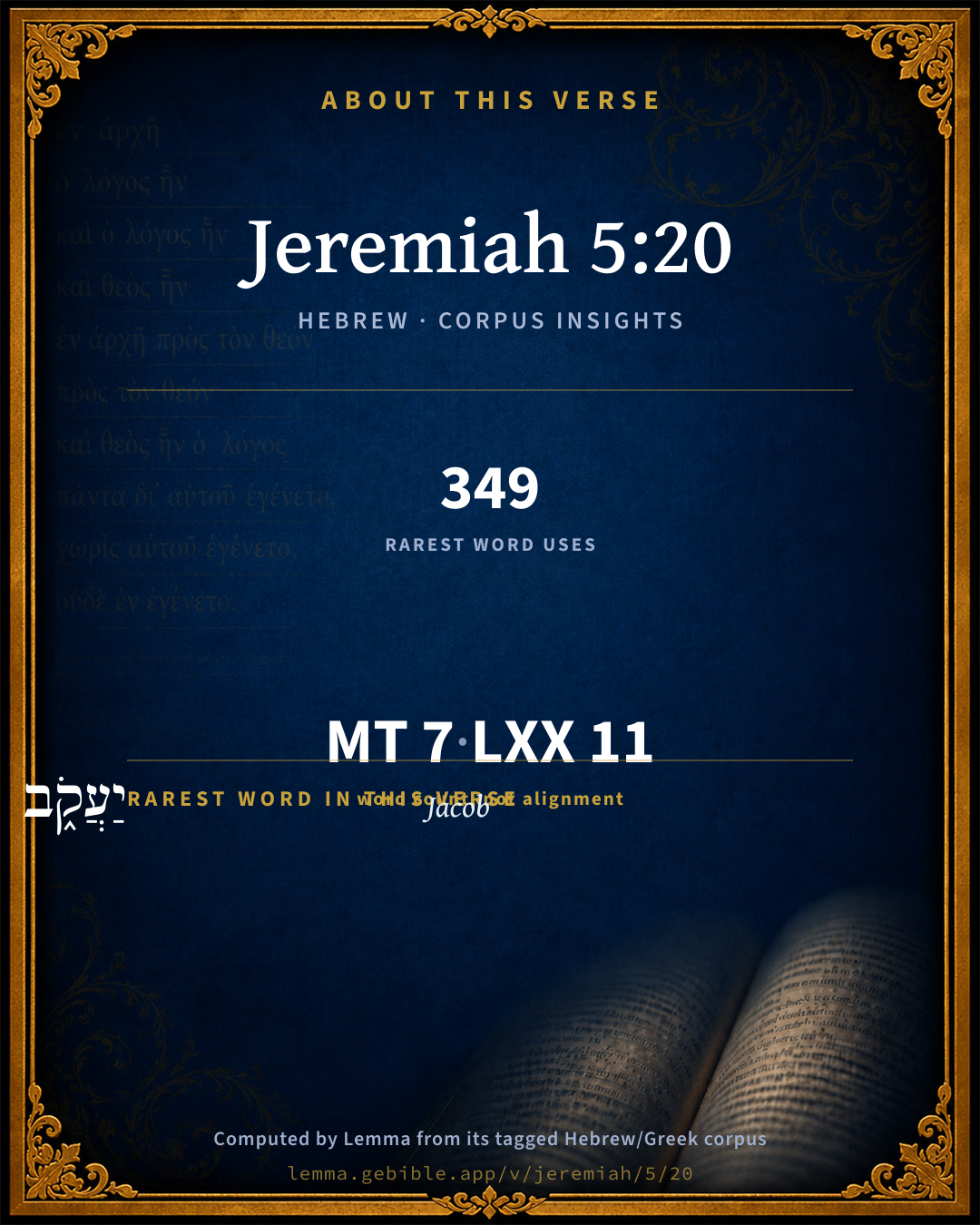
These counts appear in no published source. They are computed here, from the morphology-tagged text and Lemma’s own curated glosses. What Lemma adds →

7
words
7
distinct lemmas
Prophets
section

Grammatical profile

  • 3 verbs
  • 3 nouns
  • 1 pronoun

Verb forms

  • הַגִּ֥ידוּ Hiphil · Imperative
  • וְהַשְׁמִיע֥וּהָ Hiphil · Imperative
  • לֵאמֹֽר Qal · Infinitive Construct

Hebrew & Septuagint length

In the original languages it is 7 Hebrew tokens and 11 Greek tokens — but the two are counted differently (Hebrew bundles its prefixes and suffixes into one token; the Greek is in lemma form), so that isn’t a like-for-like length.

Hebrew and Greek witnesses Masoretic Hebrew ↔ Greek Septuagint

The same verse in the two great witnesses to the Old Testament, shown verse-for-verse.

These are two independent witnesses, not word-aligned to each other, and the Septuagint is shown in lemma (dictionary) form.

Hebrew Jeremiah 5:20 Masoretic · Westminster Leningrad Codex

הַגִּ֥ידוּ זֹ֖את בְּבֵ֣ית יַעֲקֹ֑ב וְהַשְׁמִיע֥וּהָ בִיהוּדָ֖ה לֵאמֹֽר

Declare you this in the house of Jacob, and publish it in Judah, saying,

World English Bible · Public Domain

Greek LXX Structure differs

In the Septuagint, Jeremiah is about an eighth shorter than the Hebrew and arranges its material differently — the Oracles Against the Nations (Hebrew chapters 46–51) appear in the middle of the Greek book, after 25:13. Because the chapter and verse boundaries do not line up, a verse-for-verse comparison with the Hebrew is not shown.

A verse-for-verse comparison isn’t shown here because the chapters and verses don’t line up. Switch to the LXX edition with the MT / LXX toggle above to read the Greek directly.

Hebrew: Westminster Leningrad Codex (CC BY 4.0). Greek: Septuagint (public domain); English from a public-domain English Septuagint. How the Septuagint differs from the Hebrew →

Targum (Aramaic paraphrase)

1

The Targum is the ancient Jewish Aramaic paraphrase of the Hebrew Scriptures — an interpretive translation, not the Hebrew text itself. Onkelos (literal) and Pseudo-Jonathan (expansive) render the Torah, and Jonathan the Prophets. Coverage is partial: where no permissively-licensed English translation exists for a verse, only the Aramaic is shown. This is verse-level text, not a word-by-word alignment to the Hebrew.

  1. Targum Jonathan Prophets (Joshua–Malachi)
    חֲווֹ דָא בְּבֵית יַעֲקֹב וּבַשְׂרוּהָ בִדְבֵית יְהוּדָה לְמֵימָר:

    (no public-domain English translation for this verse)

    Targum Jonathan — Aramaic: “Mikraot Gedolot” (public domain). English: “Sefaria Community Translation” (CC0 1.0 (public-domain dedication)); “London "Chaldee Paraphrase," 1871” (public domain). Text via Sefaria.

Commentary

Notes on Jeremiah 5:20 from classic Christian and Jewish commentators (each source and its license shown beneath its notes). The classic Christian expositions comment on the surrounding passage and are grouped to its opening verse, so a note may address several verses; the Jewish commentaries on the Tanakh (Rashi and others) are per-verse, so they appear only where the commentator wrote on this verse.

Lemma curates 59 commentaries, every one of them public domain or Creative Commons licensed, each selected and text-cleaned for this edition rather than reprinted as found. About our sources →

The Cambridge Bible for Schools and Colleges

gen. ed. J. J. S. Perowne

20–22. These vv. are in whole or in part rejected as a later addition by Stade, Du., Co., Gi., because (i) “declare” and “publish” are in the plural, which is unusual (but see Jer_4:16); (ii) the illustration of Jehovah’s greatness by the phenomena of nature belongs to the later period, cp. Job_38:8-11 (but see Amo_4:13; Amo_5:8; Amo_9:6); (iii) they resemble the suspicious passages Jer_31:35 ff., Jer_32:17 ff.; (iv) there is a needless embellishment of style. These reasons, however, seem insufficient to warrant the rejection of the whole. Moreover (unless we accept Du.’s view, see note on Jer_5:18), to omit them, and thus join Jer_5:23 immediately to Jer_5:19, involves injury to the sequence of thought. This is obviated by the retention of the first part of Jer_5:21, and of Jer_5:22 to “my presence.” So Co. Jer_5:20 is in any case probably an addition, as there is no parallel in Jeremiah for this kind of introduction to an utterance.

20–29. See summary at beginning of section.

The Cambridge Bible for Schools and Colleges (gen. ed. J. J. S. Perowne; Cambridge University Press, 1878–1918) — public domain. Text from a community e-Sword module.

Trapp's Complete Commentary

John Trapp

Jer 5:20 Declare this in the house of Jacob, and publish it in Judah, saying,

Ver. 20. Declare this in the house of Jacob, &c.] Cease not to ring it in their ears, whether they will hear, or whether they will forbear; for it is a rebellious people, and of the number of those who wink willingly, that they may not see when some unsavoury potion is ministered to them, {a} as Justin Martyr expresseth it.

{a} καταπινοντες το πακρον.

John Trapp, A Commentary or Exposition upon All the Books of the Old and New Testament (1647–1656) — public domain. Text from a community e-Sword module.

The Biblical Illustrator

Joseph S. Exell

Jer_5:20-25

O foolish people, and without understanding.

Gods judgment of self-will

The text is part of a message which was to be declared in the house of Jacob, and published in Israel. It shows that three results were produced by self-assertion against the rule of God; will the same cause produce the same effect? Let us see the results of self-will as shown in the text, and compare them with the testimony of our own experience.

I. Self-will in relation to the Divine government destroys the natural capacities and faculties of man. Foolish people, without understanding, etc. How different this description to the original portraiture of man! Foolish, blind, deaf--such is man when he has turned his back upon God, and taken life into his own hands. It would seem as if all the faculties of our nature were dependent for continuance upon their religious use; moral paralysis is equivalent to intellectual stagnation; not to pray is to die. Is it not much the same as if a flower should be shut out from the light and dew? The soul is, so to speak, withdrawn from the source of its being--cut off from the fountain of life, and allowed to exhaust its little resources, to languish in loneliness, and to die of hunger. If, then, we leave God, how soon does our poverty come as an armed man, and our want as one that travaileth? We shall most clearly see how the natural faculties of man are impaired, and indeed destroyed, by irreligion, by considering that the same truth holds good in the ordinary business of life,--separation from God means folly, blindness, and general incapacity, even in earthly things. Take the case of our daily bread, and see how the doctrine is sustained. Let any man set aside Gods plan of obtaining daffy bread, and call upon his own genius to supply it; let the earth remain uncultivated; let the seed remain unsown: can it be doubted that the insane man would soon be taught by famine what he would not learn from reason or infer from revelation? There is no violence in transferring the argument from the body to the soul: on the contrary, such transference would seem to be a logical necessity; for if God is essential to the inferior, is He not essential to the superior? If man cannot do the less, how can he do the greater? A man who would not eat bread because he could not make his own will dominant through every detail of the process of germination would be pitied or despised; yet men who cannot by their own will or power make one grain of corn for the support of the body are often found resenting Gods offers of enlightenment and guidance of the soul! What wonder that God should call upon the heavens to be astonished and the earth to be horribly afraid? And what wonder, repelled and dishonoured as He is, that He should say: Behold, the days come, saith the Lord God, that I will send a famine in the land, etc. Think of God sending a famine upon the soul,--of minds pining and dying because Divine messages have been withdrawn! We know what the effect would be if God were to withhold the dew, or to trouble the air with a plague, or to avert the beams of the sun: the garden would be a desert, the fruitful field a sandy plain, the wind a bearer of death, summer a stormy night, and life itself a cruel variation of death,--so penetrating, so boundless is the influence of God in nature. Is it conceivable that the withdrawment of Gods influence would be less disastrous upon the spirit of man? Out of God there is no true being; the spasm, the convulsion, which is mistaken for existence is an impious sarcasm upon life.

II. Self-will in relation to the Divine government plunges the soul into irreverence. The fear spoken of (Jer_5:22) may be taken as expressive of homage, veneration, and, in fact, everything that enters into a complete idea of worship. The destruction of veneration may be regarded as the final triumph of self-will. There is a very simple philosophy of spiritual retrogression. It turns upon mans self-magnifying power, and his consequent ambition for self-government. He says: If there be a God, He is at all events unseen; I am the highest power that comes within the cognisance of my own senses; other beings, such as demons and angels, have been spoken of; but they are fictions of genius, dreams of ill-regulated minds; I am king, I am god. This is the natural creed of Sight, and it has many virtual subscribers. Now, it is to the senses themselves that God addresses the appeal of the text. He would appoint the ocean as umpire in the great controversy. Look, He says in effect, at the sea: it is bounded by the sand; its great fury cannot prevail against the limit which I have appointed: can you enlarge the decree which determinates the movement of the deep? Can you beat back the waves, or silence the roar of the billows? Stand by the seashore, then, and learn that there is a will higher than your own, a power which could crush your puny arm; listen, and let your soul hear a voice mightier than mans; incline your ear, and let the spirit hear the going of God upon the quiet or troubled waves; reflect, wonder, bow down, and worship.

III. Self-will dissociates the gifts of nature from the Giver (Jer_5:24). Revolted man will accept the rain because he cannot live without it, but the Giver will not be so much as named; the corn will be gathered, but those who bear the sheaves will have no harvest hymn for God. How rapid, tumultuous, fatal is the course of moral revolt! The purpose of God was evidently to have His Name identified with the common mercies of life, that our very bread and water might remind us constantly of His gentle and liberal care. He was not to be confided to purely spiritual contemplation, to be the subject of the souls dream when lost in high reverie, or to be thought of as a Being far off, enclosed within the circle of the planets, or throned in the unapproachable palaces of an undiscovered universe: He desires to be seen spreading our table in the wilderness, causing the earth to bring forth and bud for our benefit, turning our weary feel towards the water springs, and nourishing us in the time of weakness. Men may eat unblessed bread, and be bodily the stronger for it, but it is a sore and lasting reproach to the soul. The course of moral revolt ends in this, ends in the deposition of God and in the worship of self. Man ploughs, sows, reaps, and considers all the influences which cooperate in the production of results as mere features of inanimate nature existing and working apart altogether from intelligent or moral will. The universe becomes a stupendous machine; they who get good crops have used the machine skilfully, and they whose fields are fruitless have misunderstood or misapplied the machine. The universe was designed to be the temple, the very coveting, of God; but the worship of self has wrought a bad transfiguration upon it, and now the thief, the unclean beast, and the lying prophet prevail on every hand. The demoralisation of man may have a mischievous effect upon nature itself. We sometimes speak of a bad harvest: what if behind it there has been a bad life? When the heart is right towards God, God will not withhold His blessing from the earth: Let the people praise thee, O God; let all the people praise Thee: then shall the earth yield her increase. Physical blessing will follow spiritual worship; no good thing will be withheld from them that walk uprightly. In the light of these statements we have a double view of the unity of the moral and material systems of government. One view is from the human side: when man sins, commits a trespass in the spiritual region, he finds the result of his sin in the physical department; the reflection of his spiritual misrule is seen in dried fountains and fruitless fields, in devastating storms and fatal plagues; the universe takes up arms in defence of law. Another view is from the Divine side. God shows favour upon the earth for reasons derived from the spiritual character of the people, and demonstrates the superiority of the soul over the body by making its condition the measure of His material benefactions. How terrific, how hopeless, then, is the condition of the sinner! (J. Parker, D. D.)

Indifference

I. What God has done to produce pious consideration.

1. He has given powers of mind adapted to it. Eyes--to see, discern, read, etc. Ears--to hearken, messengers of truth. Understanding--to know, weigh, reflect, etc.

2. He has given us the means to answer to these powers. His Word, His servants, His providence, etc.

3. He has given us His Holy Spirit--to strive, convince, etc.

II. The indifference men often exhibit.

1. The indifference of some is total, without any concern. Live stocks and stones.

2. Others are considerate only of the externals of religion.

3. The consideration of some is only to the intellectual parts of the truth. A mental study; philosophical attention; such as they give to literature.

4. The consideration of others is occasional. Under very arousing discourses, providences, sickness, bereavements, etc.

III. The consequences of this indifference.

1. It is extremely foolish. Moral insanity.

2. Detrimental to the soul. Makes it blind, deaf; robs it of spiritual food and enjoyment; degrades it.

3. Specially offensive to God. Rebellion. Gratitude.

4. Must end in the souls ruin. No moral fitness without devout consideration.

Application--

1. Examine and test yourselves.

2. Seek the quickening influences of the Divine Spirit.

3. Be resolved and wise now, lest you perish. (J. Burns, D. D.)

Fear ye not Me? saith the Lord.--

Solemn reasons for fearing the Lord

I. Argument from Gods government of the sea.

1. Suited to impress man with an idea of--

(1) Infinite power.

(2) Consummate wisdom.

(3) Special goodness.

Two fold--

(a) Negatively, in checking the threatening invasion of the sea;

(b) Affirmatively, in giving rain, etc.

2. Mans revolting tendencies.

(1) God has prescribed the bounds of mans actions and thoughts by befitting laws. As the sea has bounds, so there are limits to every finite being.

(2) To overstep these limits is rebellion against the Great Lawgiver.

(3) Man has revolted, differing in this from the sea.

(4) Man can do what the sea cannot.

(a) Man has a heart, the sea has not; a will power.

(b) This power in man has been prostituted to evil.

II. Argument from Gods bestowment of the harvest.

1. Until the Gospel was communicated to the world, attentive observance of the dispensation of providence was the principal means whereby Gods Spirit drew the Gentiles to Himself, and led them to piety and obedience.

(1) It was the religion of nature (Act_14:15-17; Rom_1:19-20).

(2) From Gods works alone, His being, power, mercy, may be fully and satisfactorily proved, without the advantages of revelation.

2. Although we enjoy the full light of the glorious Gospel, we can never too closely keep in mind the fact that all things we see and enjoy are ordained by God.

(1) We have less need than the heathen to learn about God from His outward and visible works.

(2) Yet we are beholden to His providence for all essential natural blessings.

(3) Nothing in nature could reach maturity but for the fatherly care of God.

3. From the natural events around us we may--

(1) Learn diligence in our spiritual concerns, that the Word of Life may ripen in our hearts.

(2) Pray that the heavenly Sower will not pass us by in barrenness.

(3) When observing the tender blade, reflect on the weakness of our advance in piety, and entreat Him who tempers all the elements to work all things together for our good.

(4) When the harvest hour is nigh, let us think how short our time is, and pray that we may not be found blasted or unfruitful. (Bp. Heber.)

Persuasives to the fear of God

I. He complains of the shameful stupidity of this people.

1. Their understandings were darkened. Possessing intellectual faculties and capacities, they did not employ and improve them.

2. Their wills were stubborn: not submit to rules of Divine law.

II. He ascribes this to the want of the fear of God.

1. If you keep up awe of God you will be observant of what He says.

2. Because we neglect to stir up our wills to holy awe of God we are so apt to rebel.

III. He suggests some things proper to possess us with a holy fear of God.

1. We must fear the Lord and His greatness. He keeps and manages the sea.

(1) By this we see His universal sovereignty; therefore to be had in reverence.

(2) This shows how easily He could drown the world again by withdrawing His decree; therefore we lie continually at His mercy, and should fear to make Him our enemy.

(3) Even the unruly waves obey Him neither revolt not rebel; why, then, should our hearts?

2. We must fear the Lord, and His goodness.

(1) Because He is always doing us good.

(2) Because these blessings are consequent upon His promise.

(3) Because we have such a necessary dependence upon Him. (M. Henry, D. D.)

Which have placed the sand for the bound of the sea.--

Adoration of God in nature

1. The more blessings they enjoyed, the more thankful they should have been.

2. Having rejected God spiritually, He yet continued to manifest Himself to them in nature.

3. Gratitude to God for the fruits of the seasons is a common ground on which to argue effectually even with the darkest heathen.

4. The heathen are denied excuse for their ignorance and idolatry, because of the marks of Gods love and power in the world around them.

5. Yet the heathen, in outward forms at least, surpassed Jews and Christians.

6. There was, then, great sin on the part of Israel when, even as natural men, they ignored the mercies of Gods ordinary providence, and were not softened and converted by His unmerited goodness.

7. A bounteous season ought to awaken love and thankfulness to God.

8. God is exceedingly jealous of the honour due unto His name.

9. The eye is blind to God in natural wonders, and the ear deaf amid His works, because the heart has not embraced Him in the Gospel of His Son. (J. Garbett, M. A.)

Gods government of the sea and mans revolting tendencies

1. God is the Author and Governor of the sea.

2. God binds the sea within certain limits by law.

3. Gods laws are permanent till He wills a change by a perpetual decree.

4. God is ever prevent in His laws and contrivances.

5. Gods presence in the laws of the sea, as well as in every other law, should have a restraining and reverencing influence upon men.

I. Gods government of the sea. Suited to impress man with an idea of--

1. Infinite power.

2. Consummate wisdom.

3. Special goodness.

II. Mans revolting tendencies.

1. God has prescribed the bounds of mans actions and thoughts by befitting laws. Love to God and man.

2. To overstep these limits is rebellion against the great Lawgiver. When thoughts are unholy and imagination irreverent, the soul has overstepped its proper limits, and is in rebellion against its Creator.

3. Man has overstepped his proper limits, and therefore rebelled. They are revolted and gone. Differing in this from the sea.

4. Man can do what the sea can not, namely, overstep his proper limits and transgress the laws of his being.

(1) Man has a heart. The sea has not. Man has a will power--a power to act to a great extent as he likes.

(2) This power in man has been prostituted to evil. Man, morally, has lost his equilibrium, his heart has become rebellious; and heart rebellion is the source of all rebellions--of hand and head rebellions. Conclusion--

1. God must govern heart and will by heart and will influences.

2. It is easier for God to rule suns and systems and oceans than one man, because he has a heart, and a rebellious one.

3. Man, as a rebel, contrasts unfavourably with the material creation--the earth and sea, etc. God notices this with a painful emotion. Fear ye not Me, etc. (Homilist.)

The sand barrier

Take a handful of sand up; and how easily it filters through the fingers. This slippery sand is part of Gods wall against the sea. By agglomeration it is strong. The restraining of the waters has made the earth habitable. Every coastline, however indented, flat, or rocky, has been traced by that Hand which gave to the sea its decree.

I. There are natural laws which are, like the boundaries of the sea, not to be passed. We all know what would be the result if the force of gravitation did not hold us in our place on the earths surface, or if we determined to ignore the law by leaping from a precipice. There are also laws of health which restrain us. We can easily damage our physical frame by neglect. Pains we must then endure, compelling to obedience.

II. In society we have limits, bounds and restraints which are of greatest value. The opinions of our fellows are restraints. Laws are the bounds within which the moral would secure the immoral. The good man fears them not, because he has no wish to break them. He values them, because they protect him from the lawless.

III. There are in knowledge certain limits and bounds which are of great value. Those who think deeply are the most conscious of this. Let us be thankful for such bounds. Let us remember what ennui and pride would follow if we could know all. Further, where would be the need for faith--that noblest act of the soul? Let us be humble. What is all we know, compared with what God has to reveal to us? Let us seek to become more fitted to pass beyond the limitations of the present, and to appreciate more the widening of our sphere of knowledge in the future world.

IV. As the sea has its bounds, so has life its limits. Decay and death must come sooner or later. Hearts can beat only a determined number of times, even as a watch, when once wound up, can go only a certain time. Every tick brings it nearer to the last beat. When the spring runs down, another beat cannot be got out of it. What are mans years to immortality? (Job_14:5). There is wisdom in this decree. If men were to live beyond a certain point they would be hindrances; and if there were no death, men would be altogether forgetful of God their Judge.

V. We may apply the text to the trials to which man is subjected. God sets bounds to them. He will not allow us to be crushed or swamped. He knows what we can bear, and how much is good for us. Murmur not. Trust in Him. He can deliver, check, remove the restraints, hindrances, and trials, and even bring blessing out of them. (Homiletic Magazine.)

God the ruler of the waves

God rules the waves, not Britannia. (John Newton.)

Sea and soil; Divine providence

By the mouth of His prophet, Jeremiah, God upbraids His people for their impiety; but it is worthy of notice that He reproaches them not for their forgetfulness of His miraculous deliverances, but for their heedlessness of His regular kindness to them. It is not that they are neglecting Him who saved them from the wrath of the Egyptians by the marvels of the Red Sea passage; it is that they are failing to honour Him who has always been keeping the sea in its bed.

I. Gods constant kindness to us.

1. In keeping in check the destructive forces upon the earth (verse 22). The sea at rest, kept within its bounds, is an object of surpassing beauty; its surface is the great highway of the nations. But when it breaks its bounds, it causes terrible destruction. As with the sea, so with the air. The pure air we breathe is life itself; the soft breeze is refreshment and invigoration; the wind aids us in our industries and carries our ships across the water. But the cyclone, the hurricane, is danger, destruction, death. The occasional storm reminds us of the continuance from week to week of that balance in the atmospheric forces which the wisdom and the power of God sustain, and which makes possible and practicable our pleasant lives. This also holds with the interior of the earth. Beneath a thin crust of rock are stored and hidden great central fires. What if they were loosened! The earthquake and the volcano are the reminders that there are forces beneath our feet and of which we have no control whatever; but a mightier hand than ours has shut them in, and keeps us in safety and in peace.

2. In putting into exercise productive powers (verse 24). God has been fulfilling His promise, and neither seedtime nor harvest has failed from the earth. There have come droughts and storms: our trust and our patience have been tried; our intellectual resources have been developed, and our character has been disciplined thereby; adverse material conditions have been strengthening and quickening our manhood; the culture of the field has been the culture of the race; the method of Gods giving has greatly enhanced the value of His gift. Divine wisdom has accompanied Divine bounty at every step.

II. Our human response. Too often it has been--

1. That which is our reproach. Men have taken everything from the God of their life, and they, have--

(1) Denied His existence; or

(2) Questioned His interest in His childrens well-being; or

(3) Practically disregarded the operation of His hand, and rendered Him no thanks; or

(4) Contented themselves with bare formalities from which all genuine feeling has been left out. But prophet and psalmist and apostle invite us to a response--

2. Which is becoming and acceptable.

(1) Reverence. Fear ye not Me? Have we no adoration for this Lord of all power and wisdom, who keeps the sea in its place and who covers the barren soil with a golden harvest?

(2) Gratitude. Shall we not bless the Lord, who filleth our mouth with good things?

(3) Service. He who gives us the bread which nourishes our body has placed us under a far greater obligation in that He has given us the Bread of Life. Eating of the one, we live a lower life for a few more years; but partaking of the other, we live the larger and higher life for evermore (Joh_6:58). (C. Clarkson, B. A.)

Gods barriers against mans sin

The majesty of God, as displayed in creation and providence, ought to stir up our hearts in adoring wonder and melt them down in willing obedience to His commands. The almighty power of Jehovah, so clearly manifest in the works of His hands, should constrain us, His creatures, to fear His name and prostrate ourselves in humble reverence before His throne. The contemplation of the marvellous works which He doth upon the great and wide sea, where He tosseth the waves to and fro, and yet keepeth them in their ordained courses, should draw forth our devoutest emotions, and I could almost say, inspire us with homage. Have these great things of God, these wondrous works of His, no lesson to teach us? Do they not while declaring His glory reveal our duty? Our poets, both the sacred and the uninspired, have feigned consciousness to those inanimate agents that they might the more truthfully represent their honourable service. But if because we are intelligent beings, we withhold our allegiance from our rightful Sovereign, then our privileges are a curse, and our glory is a shame. We might learn, even without the written oracles of Scripture, that we ought to obey God, if our foolish hearts were not so darkened; thus unbelief of the Almighty Creator is a crime of the first magnitude. If it were a petty sovereign against whom ye rebelled, it might be pardonable; if He were a man like yourselves, ye might expect that your faults would easily find forgiveness; but since He is the God who reigns alone where clouds and darkness are round about Him, the God to whom all nature is obedient, and whose high behests are obeyed both in heaven and in hell, it becomes a crime, the terrible character of which words cannot portray, that you should ever sin against a God so marvellously great. The greatness of God enhances the greatness of our sin. I believe this is one lesson which the prophet intended to teach us by the text. But while it is a lesson, I do not think it is the lesson of the text. There is something else which we are to learn from it. God here contrasts the obedience of the strong, the mighty, the untamed sea, with the rebellious character of His own people. The doctrine of the text seems to be this--that without supernatural means God can make all creatures obedient save man; but man is so disobedient in his heart, that only some supernatural agency can make him obedient to God, while the simple agency of sand can restrain the sea, without any stupendous effort of Divine power more than He ordinarily puts out in nature: He cannot thus make man obedient to His will. Now, look back into history, and see if it has not been so. What has been a greater problem, if we may so speak concerning the Divine mind, than that of restraining men from sin? How many restraints God has put upon man! But what of this fact?--you say--we know it is true; verified in your own ease. Come, now, I want to ask of you, whether it cannot be said of you truly, The sea is bound by sand; but I am one of those people who are bent on revolting from God, neither can any of His restraints keep me from sin. Let us review the various restraints which God has put upon His people to keep them from sins which, nevertheless, are altogether ineffectual, without the accompanying power of grace.

1. Then, remember there is a restraint of gratitude which, to the lowly regenerated heart, must necessarily form a very strong motive to obedience. I ask thee, O saint, viewing thy sins as sins against love and mercy, against covenant promises, covenant oaths, covenant engagements, ay, and covenant fulfillments, is not thy sin a desperate thing, and art not thou thyself a rebellious and revolting being, seeing that thou canst not be restrained by such a barrier of adamant as thy soul acknowledges? Next notice, that the saint has not only this barrier against sin, but many others.

2. He has the whole of Gods Word given him by way of warning; its pages he is accustomed to read; he reads there, that if he break the statutes and keep not the commandments of the Lord, his Father will visit his transgressions with a rod, and his iniquity with stripes. And yet, O Christian, against all warning and against all precept, thou darest to sin. Oh! art thou not a rebellious creature, and mayest thou not humble thyself at the thought of the greatness of thine iniquity?

3. Again, the saint sins against his own experience. When he looks back upon his past life he finds that sin has always been a loss to him; he has never found any profit, but has always lost by it. Will you put the poisoned goblet to your lips again? Yes, you will; but because you do so in the teeth of your experience, it ought to make you weep, that you should be such desperate rebels against such a loving God, who has put not merely a barrier of sand, but a barrier of tried steel to keep in your lusts, and yet they will break forth; verily, ye are a rebellious and revolting people.

4. Then again, God guards all His children with providence, in order to keep them from sin. Ah! strange things happen to some of us. It was only a providence which on some solemn occasion, to which you never look back without regret, saved you from sin which would have been a scab on your character. Bless God for that! But remember, notwithstanding the girdlings of His providence, how many times you have offended; and let the frequency of your sin remind you that you must indeed be a rebellious creature.

5. Yet, once more let me remind you, that the ordinances of Gods house are all intended to be checks to sin. Bow down your heads with shame while ye consider your ways, and then lift up your hearts, Christians, in adoring love, that He has kept you when your feet were making haste to hell, where you would have gone, but for His preserving grace. Will you not pray, that God should not cast you away, nor take His Holy Spirit from you, though you are a rebellious creature, and though you have revolted against Him?

II. Apply it to sinners. Come, then, sinner; in the first place, I bid thee consider thy guilt. The mighty ocean is kept in obedience by God, and restrained within its channel by simple sand; and thou, a pitiful worm, the creature of a day, the ephemera of an hour, thou art a rebel against God. The sea obeys Him; thou dost not. Consider how many restraints God has put on thee: He has not checked thy lusts with sand but with beetling cliffs; and yet thou hast burst through every bound in the violence of thy transgressions. Perhaps He has checked thy soul by the remembrance of thy guilt. Thou hast felt thyself a despiser of God; or if not a despiser, thou art a mere hearer, and hast no part nor lot in this matter. Dost thou not remember thy sins in the face of thy mothers counsels and thy fathers strong admonitions? Thou knowest the threatenings of God; it is no new tale to thee, when I warn thee that sinners must be condemned. Consider, then, how great is thy guilt; thou hast sinned against light and knowledge; thou art not the Hottentot sinner, who sins in darkness; thou hast not sinned ignorantly, thou hast done it when thou knewest better. Some of you have had other things. Dont you remember, some little time ago, when sickness was rife, you were stretched on your bed? Methinks I see you; you turned your face to the wall, and you cried, O God, if Thou wilt save my life, I will give myself to Thee! Perhaps it was an accident; thou didst fear that death was very near; the terrors of death laid hold of thee, and thou didst cry, O God, let me but reach home in safety, and my bended knees and my tears pouring in torrents, shall prove that I am sincere in the vow I make! But didst thou perform that vow? Nay, thou hast sinned against God; thy broken vows have gone before thee to judgment. (C. H. Spurgeon.)

The Biblical Illustrator, edited by Joseph S. Exell (c. 1880s–1900s) — public domain. Text from a community e-Sword module.

Tyndale Open Study Notes

Tyndale Open Resources

5:20-21 to Israel: Literally to the house of Jacob. The names “Jacob” and “Israel” are often interchanged throughout the Old Testament, referring sometimes to the individual patriarch and sometimes to the nation. • To be foolish is to engage in rash and immoral behavior that ignores consequences. • senseless: Literally no heart. When “heart” is used in a negative sense, it means that a person or group does not desire to do moral acts and so disdains the intelligent behavior that is pleasing to God. • The people’s ears and eyes functioned (see study note on 6:10), but they stubbornly shut out the true meaning of what they heard and saw (Isa 6:9; Ezek 12:2; Mark 8:18).

Tyndale Open Study Notes — © Tyndale Open Resources, licensed CC BY-SA 4.0. Text via the HelloAO Bible API.

Matthew Henry's Commentary

The prophet, having reproved them for sin and threatened the judgments of God against them, is here sent to them again upon another errand, which he must publish in Judah; the purport of it is to persuade them to fear God, which would be an effectual principle of their reformation, as the want of that fear had been at the bottom of their apostasy.

I. He complains of the shameful stupidity of this people, and their bent to backslide from God, speaking as if he knew not what course to take with them. For,

1. Their understandings were darkened and unapt to admit the rays of the divine light: They are a foolish people and without understanding; they apprehend not the mind of God, though ever so plainly declared to them by the written word, by his prophets, and by his providence (Jer 5:21): They have eyes, but they see not, ears, but they hear not, like the idols which they made and worshipped, Psa 115:5, Psa 115:6, Psa 115:8. One would have thought that they took notice of things, but really they did not; they had intellectual faculties and capacities, but they did not employ and improve them as they ought. Herein they disappointed the expectations of all their neighbours, who, observing what excellent means of knowledge they had, concluded, Surely they are a wise and an understanding people (Deu 4:6), and yet really they are a foolish people and without understanding. Note, We cannot judge of men by the advantages and opportunities they enjoy: there are those that sit in darkness in a land of light, that live in sin even in a holy land, that are bad in the best places. 2. Their wills were stubborn and unapt to submit to the rules of the divine law (Jer 5:23): This people has a revolting and a rebellious heart; and no wonder when they were foolish and without understanding, Psa 82:5. Nay, it is the corrupt bias of the will that bribes and besots the understanding: none so blind as those that will not see. The character of this people is the true character of all people by nature, till the grace of God has wrought a change. We are foolish, slow of understanding, and apt to mistake and forget; yet that is not the worst. We have a revolting and a rebellious heart, a carnal mind, that is enmity against God, and is not in subjection to his law, not only revolting from him by a rooted aversion to that which is good, but rebellious against him by a strong inclination to that which is evil. Observe, The revolting heart is a rebellious one: those that withdraw from their allegiance to God do not stop there, but by siding in with sin and Satan take up arms against him. They have revolted and gone. The revolting heart will produce a revolting life. They are gone, and they will go (so it may be read); now nothing will be restrained from them, Gen 11:6.

II. He ascribed this to the want of the fear of God. When he observes them to be without understanding he asks, "Fear you not me, saith the Lord, and will you not tremble at my presence? Jer 5:22. If you would but keep up an awe of God, you would be more observant of what he says to you: and, did you but understand your own interest better, you would be more under the commanding rule of God's fear." When he observes that they have revolted and gone he adds this, as the root and cause of their apostasy (Jer 5:24), Neither say they in their hearts, Let us now fear the Lord our God. Therefore so many bad thoughts come into their mind, and hurry them to that which is evil, because they will not admit and entertain good thoughts, and particularly not this good thought, Let us now fear the Lord our God. It is true it is God's work to put his fear into our hearts; but it is our work to stir up ourselves to fear him, and to fasten upon those considerations which are proper to affect us with a holy awe of him; and it is because we do not do this that our hearts are so destitute of his fear as they are, and so apt to revolt and rebel.

III. He suggests some of those things which are proper to possess us with a holy fear of God.

1. We must fear the Lord and his greatness, Jer 5:22. Upon this account he demands our fear: Shall we not tremble at his presence, and not be afraid of affronting him, or trifling with him, who in the kingdom of nature and providence gives such incontestable proofs of his almighty power and sovereign dominion? Here is one instance given of very many that might be given: he keeps the sea within compass. Though the tides flow with a mighty strength twice every day, and if they should flow on awhile would drown the world, though in a storm the billows rise high and dash to the shore with incredible force and fury, yet they are under check, they return, they retire, and no harm is done. This is the Lord's doing, and, if it were not common, it would be marvellous in our eyes. He has placed the sand for the bound of the sea, not only for a meer-stone, to mark out how far it may come and where it must stop, but as a mound, or fence, to put a stop to it. A wall of sand shall be as effectual as a wall of brass to check the flowing waves, when God is pleased to make it so; nay, that is chosen rather, to teach us that a soft answer, like the soft sand, turns away wrath, and quiets a foaming rage, when grievous words, like hard rocks, do but exasperate, and make the waters cast forth so much the more mire and dirt. This bound is placed by a perpetual decree, by an ordinance of antiquity (so some read it), and then it sends us as far back as to the creation of the world, when God divided between the sea and dry land, and fixed marches between them, Gen 1:9, Gen 1:10 (which is elegantly described, Psa 104:6, etc., and Job 38:8, etc.), or to the period of Noah's flood, when God promised that he would never drown the world again, Gen 9:11. An ordinance of perpetuity - so our translation takes it. It is a perpetual decree; it has had its effect all along to this day and shall still continue till day and night come to an end. This perpetual decree the waters of the sea cannot pass over nor break through. Though the waves thereof toss themselves, as the troubled sea does when it cannot rest, yet can they not prevail; though they roar and rage as if they were vexed at the check given them, yet can they not pass over. Now this is a good reason why we should fear God; for, (1.) By this we see that he is a God of almighty power and universal sovereignty, and therefore to be feared and had in reverence. (2.) This shows us how easily he could drown the world again and how much we continually lie at his mercy, and therefore we should be afraid of making him our enemy. (3.) Even the unruly waves of the sea observe his decree and retreat at his check, and shall not we then? Why are our hearts revolting and rebellious, when the sea neither revolts nor rebels?

2. We must fear the Lord and his goodness, Hos 3:5. The instances of this, as of the former, are fetched from God's common providence, Jer 5:24. We must fear the Lord our God, that is, we must worship him, and give him glory, and be always in care to keep ourselves in his love, because he is continually doing us good: he gives us both the former and the latter rain, the former a little after seed-time, the latter a little before harvest, and both in their season; and by this means he reserves to us the appointed weeks of harvest. Harvest is reckoned by weeks, because in a few weeks enough is gathered to serve for sustenance the year round. The weeks of the harvest are appointed us by the promise of God, that seed-time and harvest shall not fail. And in performance of that promise they are reserved to us by the divine providence, otherwise we should come short of them. In harvest mercies therefore God is to be acknowledged, his power, and goodness, and faithfulness, for they all come from him. And it is good reason why we should fear him, that we may keep ourselves in his love, because we have such a necessary dependence upon him. The fruitful seasons were witnesses for God, even to the heathen world, sufficient to leave them inexcusable in their contempt of him (Act 14:17); and yet the Jews, who had the written word to explain their testimony by, were not wrought upon to fear the Lord, though it appears how much it is our interest to do so.

Matthew Henry's Commentary on the Whole Bible (1708–1710) — public domain (CC PDM 1.0). Text via the HelloAO Bible API.

John Calvin's Commentaries

The Prophet confirms what he had said, lest the Jews should think that they were only terrified by words, and not dread the consequences. Hence he says, Declare this The Prophet, no doubt, alludes to a custom which prevailed; for wars were usually proclaimed by heralds. Enemies did not immediately march forth, but they proclaimed war that the cause might appear just. Hence God here declares, that he had spoken in earnest by the mouth of Jeremiah, as though war had been in the usual manner proclaimed, and armed enemies were already nigh at hand.

John Calvin's Commentaries (1540-1563) — public domain. Text from the Calvin Translation Society English edition (1840s-50s) via the Christian Classics Ethereal Library (ccel.org). Calvin's coverage is partial (roughly two-thirds of the Bible); uncommented books and verses are honest gaps, never fabricated. The 19th-century editor's footnotes and remarks are omitted so the notes are faithfully Calvin's own voice.

Ellicott's Commentary for English Readers

(20) Declare—publish.—The words indicate, as in Jer_4:5; Jer_4:16, the beginning of a fresh section of the prophecy, though no definitely new topic is introduced. The command is given by Jehovah, not to the prophet only, but to his disciples.

A Bible Commentary for English Readers, edited by Charles John Ellicott (1878–1897) — public domain. Text from a community e-Sword module.

John Gill's Exposition

Declare this in the house of Jacob,.... That a mighty nation should come and destroy them, and they should be servants in a strange land; or rather the words seem to be an order to declare war against the Jews, and even in their own land; and do not seem to be addressed to the prophet, but to others, seeing the words are in the plural number; see Jer 4:5,

and publish it in Judah: the house of Jacob and Judah are the same, namely, the two tribes of Benjamin and Judah; for, as for the ten tribes, as observed on Jer 5:15, they had been carried captive before this time:

saying: as follows:

John Gill's Exposition of the Whole Bible (1746–1763) — public domain (CC PDM 1.0). Text via the HelloAO Bible API.

Albert Barnes' Notes on the Bible

Against the God

(1) of Creation Jer 5:22, and

(2) of Providence Jer 5:24,

They sin, not merely by apostasy, but by a general immorality extending to all classes Jer 5:25-28. It is in this immorality that their idolatry has its root.

Jer 5:22

The sea is the symbol of restless and indomitable energy, chafing against all resistance, and dashing to pieces the works whereby man endeavors to restrain its fury. Yet God has imposed upon it laws which it must obey, and keeps it in its appointed place, not by barriers of iron but by a belt of sand. Modern science has shown that the resisting power of sand is enormous. A wave which would shatter rocks fails powerless upon sand.

Can they not prevail - The opposite of “thou couldest” Jer 3:5. The sea, the mightiest of God’s works, cannot prevail, cannot break God’s laws, because He has not endowed it with free-will. Man, physically impotent, can prevail, because, being made in God’s image, he is free.

Jer 5:23

The heart, or will of the Jews was first “revolting,” literally a will that “drew back” from God, because it disliked His service; and secondly it was “rebellious,” a will that actively resisted Him. Compare Deu 21:18, Deu 21:20.

Jer 5:24

As God’s Providence addresses itself chiefly to the thoughtful, Jeremiah says in their heart. By the intelligent study of God’s dealings men perceive that they are not merely acts of power but also of love.

The appointed weeks - literally, He guardeth, maintaineth, for us the weeks which are the statutes or settled laws “of the harvest.” These were the seven weeks from the Passover to Pentecost, and were as important for the ingathering of the crops as the rainy seasons for their nourishment.

Jer 5:25

It was not that the rains did not fall, or that the harvest weeks were less bright; the good was there, but the wickedness of the community blocked up the channels, through which it shou d have reached the people. The lawlessness and injustice of the times kept the mass of the people in poverty.

Jer 5:26

Rather, he spieth about like the crouching down of fowlers; they have set the fatal snare; “they catch men.”

Trap - literally, “The destroyer;” it was probably a gin, which strangled the birds caught in it.

Jer 5:27

Deceit - The wealth gained by deceit and fraud.

Jer 5:28

Fatness is admired in the East as a sign of wealth.

They shine - This word is used of the sleekness of the skin, soft and smooth as ivory.

They overpass the deeds of the wicked - literally, “They have overpassed words of wickedness,” i. e., they go to excess in wickedness.

Yet they prosper - Or, that they (the orphans) may prosper, enjoy their rights.

Jer 5:30

Rather, A terrible “and horrible thing” has happened “in the land.”

Jer 5:31

Bear rule by their means - Rather, “The priests” rule at their hands, i. e., govern according to their false prophecies, guidance, and directions.

My people love to have it so - False teaching lightens the yoke of God’s Law, and removes His fear from the conscience: and with this, man is ready to be content.

Albert Barnes' Notes on the Bible (1834–1885) — public domain. Text from a community e-Sword/MySword module.

Matthew Poole's English Annotations

See of this Jer 4:5. By

Judah and

Jacob we are to understand the two tribes only, as Jer 5:11, which see.

Matthew Poole's English Annotations on the Holy Bible (1683–1685) — public domain. Text from a community e-Sword/MySword module.

John Wesley's Explanatory Notes

Judah - By Judah and Jacob we are to understand the two tribes only.

John Wesley, Explanatory Notes Upon the Whole Bible (1754–1765) — public domain. Text via the GEBible commentary corpus.

unfoldingWord translationNotes

Door43 World Missions Community

Connecting Statement:

Yahweh continues to speak to the people of Israel.

Report this

"Tell this"

the house of Jacob

The word "house" is a metonym for the family that lives in the house. In this case it refers to Jacob's descendants. Translate "house of Jacob" as in Jeremiah 2:4. AT: "descendants of Jacob" (See: Metonymy)

let it be heard in Judah

This can be expressed in active from. AT: "Let those in Judah hear it" or "announce it in Judah" (See: Active or Passive)

who have no understanding

"who do not understand" or "who understand nothing"

you cannot see

Here "cannot see" is a metonym for not understanding. AT: "you do not understand" (See: Metonymy)

you cannot hear

Here "cannot hear" represents not understanding. "AT: "you do not understand" (See: Metonymy)

this is Yahweh's declaration

Yahweh speaks of himself by name to express the certainty of what he is declaring. See how you translated this in Jeremiah 1:8. AT: "this is what Yahweh has declared" or "this is what I, Yahweh, have declared" (See: First, Second, or Third Person)

Do you not fear me ... face?

Yahweh uses this question to emphasize that the people are extremely foolish because they do not fear Yahweh. AT: "It is foolish that you do not fear me ... face!" (See: Rhetorical Question)

or tremble before my face

The trembling would be because of fear, and being "before my face" represents being aware of who God is. AT: "or shake with fear because of me" (See: Assumed Knowledge and Implicit Information and Metonymy)

I have placed a border of sand against the sea

"I placed the sand as the border for the sea"

an ongoing decree that it does not violate

God speaks of the ocean not going past the border of sand as if the border were a law, and as if the ocean were a person who obeys the law. AT: "an everlasting limit that it cannot cross" (See: Metaphor)

rises and falls

"moves back and forth"

it does not violate it

"the ocean does not violate my decree." God speaks of ocean not going past the border of sand as if the border were a law, and as if the ocean were a person who obeys the law. AT: "it does not succeed in going past the border" (See: Metaphor)

translationWords

report

house

Jacob

Judah

fool

fear

tremble

face

decree

unfoldingWord translationNotes — © Distant Shores Media and the Door43 World Missions Community, licensed CC BY-SA 4.0. Source: git.door43.org/Door43/en_tn.

Lesson kit

Teaching starters — assembled from the data on this page, not authored interpretation. Every prompt links to the verse data it draws on. Edit before teaching.

Jeremiah, in the Prophets, opens this verse with 7 words (7 distinct Hebrew lemmas). Its most distinctive word is Yaʻăqôb (“Jacob”). A historical commentator’s framing appears above. Read the whole chapter for the surrounding context.

Discussion questions

  1. The word Yaʻăqôb carries the sense “Jacob.” How does it shape the verse?
  2. These translations render this verse differently. What is at stake in choosing one wording over another?
  3. The verb «הַגִּ֥ידוּ» is Hiphil Imperative. How does its form color the action?
  4. Reading how The Cambridge Bible for Schools and Colleges and Trapp's Complete Commentary read this verse, where do the two commentators agree and where do they part?

Things to notice

Reading settings

Reading text

Shown beneath each verse's original-language words.

Old Testament
Old Testament edition

Read the OT as the Masoretic Hebrew (MT) or the Greek Septuagint (LXX).

English shown for the Greek Septuagint (in the Hebrew ↔ Greek comparison).

Comparing translations? Open the Compare panel on any verse page to stack up to four side by side.