Exodus 4:28

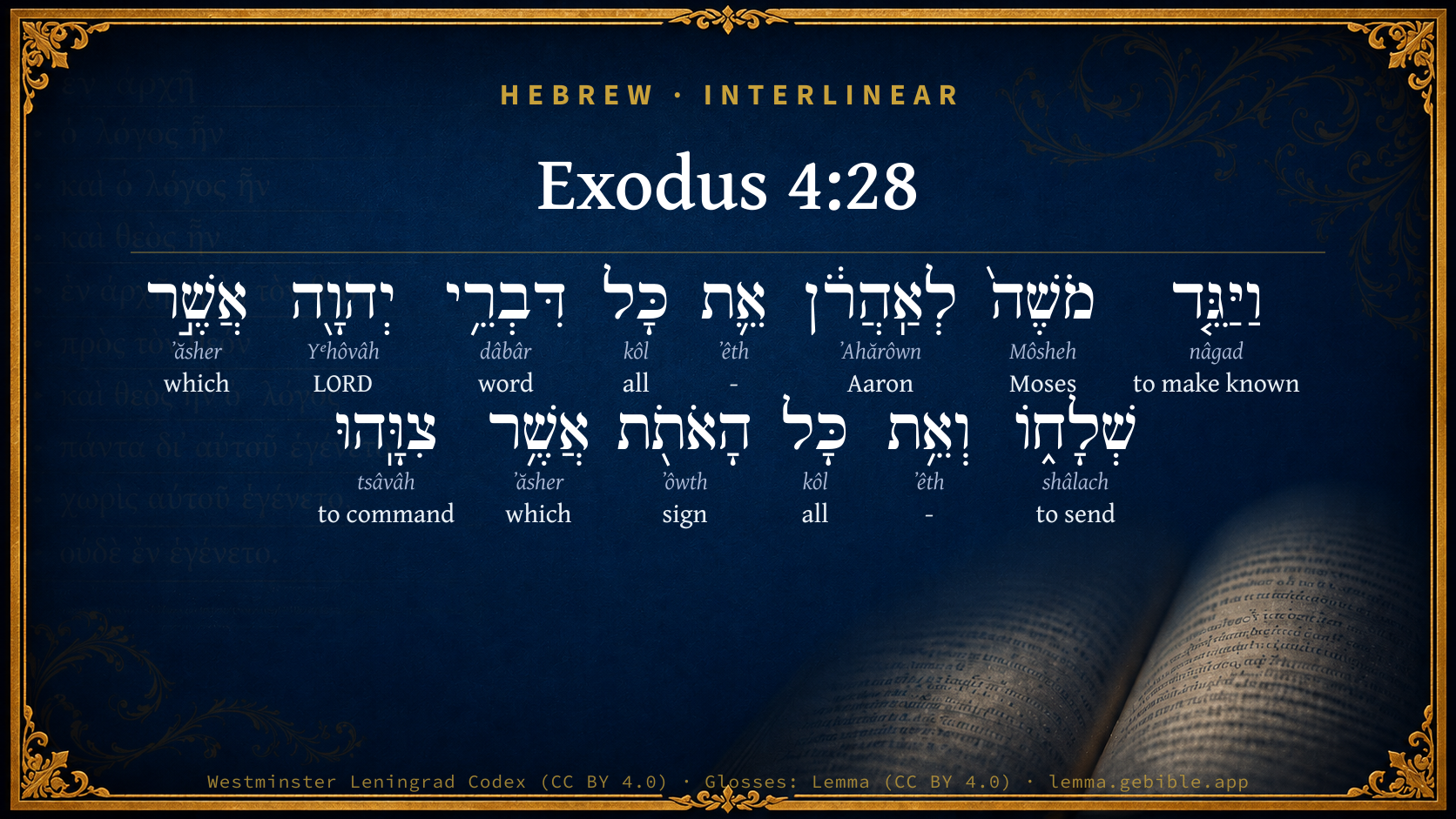
Hebrew (Westminster Leningrad Codex) Exodus 4:28 appears in the Hebrew Old Testament. The text above is from the Westminster Leningrad Codex. Each word links to its Strong’s number, a concise gloss, and parsing drawn from the Open Scriptures Hebrew Bible morphology. Click any word for its full Brown-Driver-Briggs (BDB) entry.
Download image
Cite this verse

Exodus 4:28 (World English Bible). Public Domain. Lemma interlinear Bible study tool, https://lemma.gebible.app/v/exodus/4/28.

Show BibTeX & RIS
BibTeX
RIS
English Translation
Moses told Aaron all the words of Yahweh with which he had sent him, and all the signs with which he had charged him.
World English Bible · Public Domain
Download a study sheet

One document with this verse’s original text, its word-by-word gloss line, the meaning frame, cross-references with their text, attributed commentary, and full source and license credits — printable, and it pastes into notes with its structure intact.

This verse Autodidact and up

Study sheet (.html) Plain text (.txt)

A passage Seminary Student

Up to 50 verses in one chapter. A passage sheet keeps up to 6 commentary sources and 12 cross-references per verse, in the order this page ranks them, and says so on the sheet whenever that leaves anything out. Ask for a single verse and you get the Autodidact verse sheet above.

Everything on this page stays free to read, with no account — the sheet is a download of what is already on screen, not access to it.

Want to remove ads? Support Godless Engineer
Compare translations 3

The same verse in 3 English versions, stacked beneath the original-language interlinear above. Click any original word for its lexicon entry.

Each is an independent rendering of the whole verse — the interlinear is not word-aligned to these translations.

Highlighted words mark where these versions differ — a whole-verse word diff, not a word-by-word alignment.

  • World English Bible Public Domain
    Moses told Aaron all the words of Yahweh with which he had sent him, and all the signs with which he had charged him.
  • King James Version Public Domain
    And Moses told Aaron all the words of the LORD who had sent him, and all the signs which he had commanded him.
  • unfoldingWord Literal Text CC BY-SA 4.0
    And Moses told Aaron all the words of Yahweh that he had sent him and all the signs that he commanded him.

unfoldingWord Literal Text — © unfoldingWord, licensed CC BY-SA 4.0. Word-aligned USFM3 via Door43 (git.door43.org/unfoldingWord/en_ult).

Versions to compare (up to 4)

3 of 4 selected

Show all 18 translations

Every available English version of this verse, each an independent rendering of the whole verse.

  • World English Bible Public Domain
    Moses told Aaron all the words of Yahweh with which he had sent him, and all the signs with which he had charged him.
  • Berean Standard Bible Public Domain
    And Moses told Aaron everything the LORD had sent him to say, and all the signs He had commanded him to perform.
  • Majority Standard Bible Public Domain
    And Moses told Aaron everything the LORD had sent him to say, and all the signs He had commanded him to perform.
  • King James Version Public Domain
    And Moses told Aaron all the words of the LORD who had sent him, and all the signs which he had commanded him.
  • American Standard Version (1901) Public Domain
    And Moses told Aaron all the words of Jehovah wherewith he had sent him, and all the signs wherewith he had charged him.
  • Revised Version (1885) Public Domain
    And Moses told Aaron all the words of the LORD wherewith he had sent him, and all the signs wherewith he had charged him.
  • Geneva Bible (1599) Public Domain
    Then Moses tolde Aaron all the wordes of the Lord, who had sent him, and all the signes wherewith he had charged him.
  • Douay-Rheims (1899) Public Domain
    And Moses told Aaron all the words of the Lord, by which he had sent him, and the signs that he had commanded.
  • Young's Literal Translation Public Domain
    and Moses declareth to Aaron all the words of Jehovah with which He hath sent him, and all the signs with which He hath charged him.
  • Literal Standard Version CC BY-SA 4.0
    and Moses declares to Aaron all the words of YHWH with which He has sent him, and all the signs with which He has charged him.
  • Unlocked Literal Bible CC BY-SA 4.0
    Moses told Aaron all the words of Yahweh that he had sent him to say and about all the signs of Yahweh's power that he had commanded him to do.
  • unfoldingWord Literal Text CC BY-SA 4.0
    And Moses told Aaron all the words of Yahweh that he had sent him and all the signs that he commanded him.
  • Darby Bible Public Domain
    And Moses told Aaron all the words of Jehovah who had sent him, and all the signs that he had commanded him.
  • World Messianic Bible Public Domain
    Moses told Aaron all the LORD’s words with which he had sent him, and all the signs with which he had instructed him.
  • Webster's Bible Public Domain
    And Moses told Aaron all the words of the LORD who had sent him, and all the signs which he had commanded him.
  • Free Bible Version CC BY-SA 4.0
    Then Moses explained to Aaron everything the Lord had sent him to say and all the miracles he had ordered him to do.
  • Bible in Basic English Public Domain
    And Moses gave Aaron an account of all the words of the Lord which he had sent him to say, and of all the signs which he had given him orders to do.
  • JPS Tanakh (1917) Public Domain
    And Moses told Aaron all the words of the LORD wherewith He had sent him, and all the signs wherewith He had charged him.

Literal Standard Version (2020), Covenant Press — licensed CC BY-SA 4.0. Text via the HelloAO Bible API (eBible.org). Unlocked Literal Bible (unfoldingWord) — licensed CC BY-SA 4.0. Text via the HelloAO Bible API (eBible.org). unfoldingWord Literal Text — © unfoldingWord, licensed CC BY-SA 4.0. Word-aligned USFM3 via Door43 (git.door43.org/unfoldingWord/en_ult). Free Bible Version, Dr. Jonathan Gallagher — licensed CC BY-SA 4.0. Text via the HelloAO Bible API (eBible.org).

Word by word

More ways to search: Search by grammar → Find every occurrence → Compare this word →

Practice this passage: Drill this verse → Learn its vocabulary →

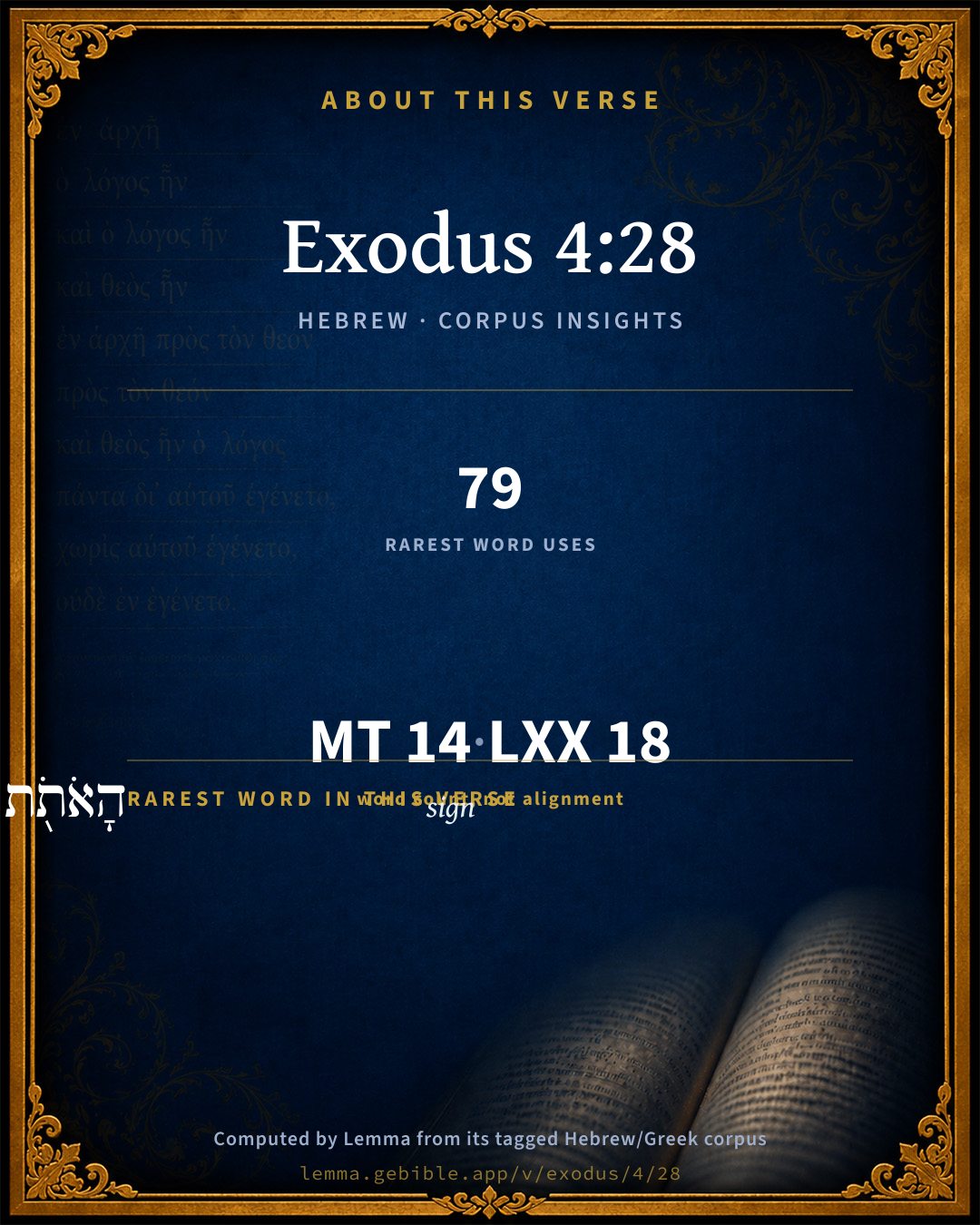
הָאֹתֹ֖ת
ʼôwth
H226
“the · signs”
Particle, Definite Article + Noun, Common, Both, Plural, Absolute
Part of Speech
Particle + Noun
Type
Common
Gender
Both
Number
Plural
State
Absolute
Full BDB Definition

Origin: probably from H225 (in the sense of appearing)

TWOT: 41a

sign, signal - a distinguishing mark - banner - remembrance - miraculous sign - omen - warning - token, ensign, standard, miracle, proof
  1. וַיַּגֵּ֤ד nâgad H5046 “and · to make known” Conjunction + Verb, Hiphil, Sequential Imperfect, 3rd Person, Masculine, Singular
  2. מֹשֶׁה֙ Môsheh H4872 “Moses” Noun, Proper
  3. לְאַֽהֲרֹ֔ן ʼAhărôwn H175 “to/for · Aaron” Preposition + Noun, Proper
  4. אֵ֛ת ʼêth H853 “-” Particle, Direct Object
  5. כָּל kôl H3605 “all of” Noun, Common, Masculine, Singular, Construct
  6. דִּבְרֵ֥י dâbâr H1697 “words of” Noun, Common, Masculine, Plural, Construct
  7. יְהוָ֖ה Yᵉhôvâh H3068 “LORD” Noun, Proper
  8. אֲשֶׁ֣ר ʼăsher H834 “which” Particle, Relative
  9. שְׁלָח֑וֹ shâlach H7971 “to send · him” Verb, Qal, Perfect, 3rd Person, Masculine, Singular + Suffix, Personal, 3rd Person, Masculine, Singular
  10. וְאֵ֥ת ʼêth H853 “and · -” Conjunction + Particle, Direct Object
  11. כָּל kôl H3605 “all of” Noun, Common, Masculine, Singular, Construct
  12. אֲשֶׁ֥ר ʼăsher H834 “which” Particle, Relative
  13. צִוָּֽהוּ tsâvâh H6680 “to command · him” Verb, Piel, Perfect, 3rd Person, Masculine, Singular + Suffix, Personal, 3rd Person, Masculine, Singular

About this verse

These counts appear in no published source. They are computed here, from the morphology-tagged text and Lemma’s own curated glosses. What Lemma adds →

14
words
11
distinct lemmas
Pentateuch
section

Grammatical profile

  • 3 verbs
  • 7 nouns
  • 4 particles

Verb forms

  • וַיַּגֵּ֤ד Hiphil · Sequential Imperfect
  • שְׁלָח֑וֹ Qal · Perfect
  • צִוָּֽהוּ Piel · Perfect

Repetition

Words recur within this verse — often emphatic in Hebrew:

  • כָּל all H3605 ×2
  • אֲשֶׁ֣ר which H834 ×2

Hebrew & Septuagint length

In English translation the verse runs 24 words from the Hebrew and 22 from the Septuagint (LXX English) — closely comparable.

A rough comparison of the two English renderings, which tokenize alike — not a word-level alignment.

Word counts can differ between the Hebrew and the Greek without any difference in meaning — e.g. the Hebrew direct-object marker אֵת has no separate Greek word, and Greek often adds the article ὁ.

In the original languages it is 14 Hebrew tokens and 18 Greek tokens — but the two are counted differently (Hebrew bundles its prefixes and suffixes into one token; the Greek is in lemma form), so that isn’t a like-for-like length.

Cross-references

4

Topical passages linked to Exodus 4:28 in the Treasury of Scripture Knowledge — connected by theme and wording, ordered by reader-vote popularity; previews shown in the World English Bible.

  • Exodus 4:8–9 "It will happen, if they will neither believe you nor listen to the voice of the first sign, that they will believe the voice of the latter sign.
  • Exodus 4:15–16 You shall speak to him, and put the words in his mouth. I will be with your mouth, and with his mouth, and will teach you what you shall do.
  • Jonah 3:2 "Arise, go to Nineveh, that great city, and preach to it the message that I give you."
  • Matthew 21:29 He answered, 'I will not,' but afterward he changed his mind, and went.

Cross-references courtesy of OpenBible.info (CC BY 4.0).

Hebrew and Greek witnesses Masoretic Hebrew ↔ Greek Septuagint

The same verse in the two great witnesses to the Old Testament, shown verse-for-verse.

These are two independent witnesses, not word-aligned to each other, and the Septuagint is shown in lemma (dictionary) form.

Hebrew Exodus 4:28 Masoretic · Westminster Leningrad Codex

וַיַּגֵּ֤ד מֹשֶׁה֙ לְאַֽהֲרֹ֔ן אֵ֛ת כָּל דִּבְרֵ֥י יְהוָ֖ה אֲשֶׁ֣ר שְׁלָח֑וֹ וְאֵ֥ת כָּל הָאֹתֹ֖ת אֲשֶׁ֥ר צִוָּֽהוּ

Moses told Aaron all the words of Yahweh with which he had sent him, and all the signs with which he had charged him.

World English Bible · Public Domain

Greek LXX Exodus 4:28 Septuagint · lemma form

καί ἀναἀγγέλλω μωυσῆς ὁ ααρων πᾶς ὁ λόγος κύριος ὅς ἀποστέλλω καί πᾶς ὁ σημεῖον ὅς ἐντέλλομαι αὐτός

And Moses reported to Aaron all the words of the Lord, which he sent, and all the things which he charged him.

LXX2012 (modern English Septuagint) · Public Domain

On this verse, Ellicott's Commentary for English Readers discusses the Septuagint’s reading. Read the note in Commentary ↓

Hebrew: Westminster Leningrad Codex (CC BY 4.0). Greek: Septuagint (public domain); English from LXX2012 (modern English Septuagint) (Public Domain). How the Septuagint differs from the Hebrew →

Targum (Aramaic paraphrase)

2

The Targum is the ancient Jewish Aramaic paraphrase of the Hebrew Scriptures — an interpretive translation, not the Hebrew text itself. Onkelos (literal) and Pseudo-Jonathan (expansive) render the Torah, and Jonathan the Prophets. Coverage is partial: where no permissively-licensed English translation exists for a verse, only the Aramaic is shown. This is verse-level text, not a word-by-word alignment to the Hebrew.

  1. Targum Onkelos Torah (Genesis–Deuteronomy)
    וְחַוִי משֶׁה לְאַהֲרֹן יָת כָּל פִּתְגָמַיָא דַיְיָ דִי שַׁלְחֵהּ וְיָת כָּל אָתַיָא דִי פַקְדֵהּ:

    (no public-domain English translation for this verse)

    Targum Onkelos — Aramaic: “Onkelos Genesis” (public domain); “Onkelos Exodus” (public domain); “Onkelos Leviticus” (public domain); “Onkelos Numbers” (public domain); “Onkelos Deuteronomy” (public domain). English: “Sefaria Community Translation” (CC0 1.0 (public-domain dedication)); “J.W. Etheridge. The Targums of Onkelos and Jonathan Ben Uzziel on the Pentateuch. London: Longmans, Green, 1862” (public domain). Text via Sefaria.

  2. Targum Pseudo-Jonathan Torah (Genesis–Deuteronomy)
    וּתְנֵי משֶׁה לְאַהֲרן יַת פִּתְגָמָא הָאִלֵין דְשַׁלְחֵיהּ וְיַת כָּל אָתַיָא דְפַקְדֵיהּ לְמֶעֱבַד

    And Mosheh delivered to Aharon all these words with which he had sent him, and all the signs that he had instructed him to work.

    Targum Pseudo-Jonathan — Aramaic: “Targum Jonathan on Genesis” (public domain); “Targum Jonathan on Exodus” (public domain); “Targum Jonathan on Leviticus” (public domain); “Targum Jonathan on Numbers” (public domain); “Targum Jonathan on Deuteronomy” (public domain). English: “The Targum of Jonathan ben Uzziel, trans. J. W. Etheridge, London, 1862” (public domain). Text via Sefaria.

Commentary

Notes on Exodus 4:28 from classic Christian and Jewish commentators (each source and its license shown beneath its notes). The classic Christian expositions comment on the surrounding passage and are grouped to its opening verse, so a note may address several verses; the Jewish commentaries on the Tanakh (Rashi and others) are per-verse, so they appear only where the commentator wrote on this verse.

Lemma curates 59 commentaries, every one of them public domain or Creative Commons licensed, each selected and text-cleaned for this edition rather than reprinted as found. About our sources →

Trapp's Complete Commentary

John Trapp

Exo 4:28 And Moses told Aaron all the words of the LORD who had sent him, and all the signs which he had commanded him.

Ver. 28. And Moses told Aaron.] So clouds, when full, pour down, and the spouts run, and the eaves shed, and the presses overflow. Aromatical trees sweat out their precious oils: and as ambergris is nothing so sweet in itself as when compounded with other things; so good men are great gainers by communicating with each other.

John Trapp, A Commentary or Exposition upon All the Books of the Old and New Testament (1647–1656) — public domain. Text from a community e-Sword module.

Ellicott's Commentary for English Readers

(28) Who had sent him.—Rather, “which he had laid upon him,” τοὺς λόγους κυρίου, οὓς ἀπέστειλεν, LXX.

All the signs, i.e., the three miracles of Exo_4:3-9.

A Bible Commentary for English Readers, edited by Charles John Ellicott (1878–1897) — public domain. Text from a community e-Sword module.

The Cambridge Bible for Schools and Colleges

gen. ed. J. J. S. Perowne

28. words … signs] the commission and promises of Exo_3:10-15; and the ‘signs’ of Exo_4:17. There does not seem to be any reference to the part which Aaron is to play as Moses’ spokesman (Exo_4:15-16 J).

The Cambridge Bible for Schools and Colleges (gen. ed. J. J. S. Perowne; Cambridge University Press, 1878–1918) — public domain. Text from a community e-Sword module.

John Gill's Exposition

And Moses and Aaron went,.... Set forward for Egypt: and being come thither:

gathered together all the elders of the children of Israel; the heads of tribes and families, as many as they could conveniently get together in one place; probably in the metropolis of the kingdom, where Pharaoh's palace was, since we quickly hear of their going in to him.

John Gill's Exposition of the Whole Bible (1746–1763) — public domain (CC PDM 1.0). Text via the HelloAO Bible API.

The Pulpit Commentary

Moses told Aaron all the words of the Lord. Perfect confidence between the two brothers was absolutely necessary for the success of their enterprise; and Moses wisely, at their very first interview, made Aaron acquainted with the entire series of Divine revelations that had been made to him, keeping nothing back, but communicating to him "all the words of the Lord." Who had sent him. Rather, "which he had laid upon him." (So the LXX, the Vulgate, Knobel, Kalisch, and others.) All the signs. Compare verses 3-9 and verse 23.

Full confidence necessary between fellow-workers.

Moses told Aaron "all the words of the Lord made "a clean breast" to him, kept back none of the counsel of God, so far as he had been made acquainted with it. A kind, a loving, and a prudent course. Half-confidences are valueless; they irritate rather than satisfy. If known to be half-confidences, they offend; if mistaken for full ones, they mislead and conduct to disaster. Those who are to be fellow-workers in any undertaking more especially any great one should have entire confidence each in each, and be wholly unreserved one towards the other. There is good sense and good advice in the motto, "Trust me not at all or all in all."

The Pulpit Commentary (1880–1919), ed. H.D.M. Spence-Jones & Joseph S. Exell — public domain. Text from a community e-Sword module.

John Wesley's Explanatory Notes

Moses told Aaron all - Those that are fellow-servants to God in the same work, should use a mutual freedom, and endeavour, rightly and fully to understand one another.

John Wesley, Explanatory Notes Upon the Whole Bible (1754–1765) — public domain. Text via the GEBible commentary corpus.

Ramban (Nachmanides)

Rabbi Moshe ben Nachman (Ramban / Nachmanides)

AND MOSES TOLD AARON ALL THE WORDS OF THE ETERNAL WHEREWITH HE HATH SENT HIM. This means that he told all the words which were spoken between him and the Holy One, blessed be He, and all the objections he had raised against undertaking the mission, and that he was sent against his own will. This is the intent of the word kol (‘all’ the words of the Eternal). In Midrash Chazit [we find it stated]: “And the Rabbis say that Moses revealed to Aaron the Tetragrammaton [which had been revealed to him].” The intent of their explanation is that Moses told Aaron the Divine Names mentioned above by which He sent him, and the Name that is derived [from them], and the explanation that is inherent in them.

Ramban (Nachmanides) on the Tanakh — English translation: “Commentary on the Torah by Ramban (Nachmanides). Translated and annotated by Charles B. Chavel. New York, Shilo Pub. House, 1971-1976” (CC BY 4.0). Text via Sefaria.

Lesson kit

Teaching starters — assembled from the data on this page, not authored interpretation. Every prompt links to the verse data it draws on. Edit before teaching.

Exodus, in the Pentateuch, opens this verse with 14 words (11 distinct Hebrew lemmas). Its most distinctive word is ʼôwth (“sign”). A historical commentator’s framing appears above. Read the whole chapter for the surrounding context.

Discussion questions

  1. The word ʼôwth carries the sense “sign.” How does it shape the verse?
  2. Exodus 4:8–9 shares this passage’s theme. How do the two illuminate each other?
  3. “all” occurs 2× in this one verse. What is the effect of the repetition?
  4. These translations render this verse differently; the difference is in the English rendering, not the original. What questions does that raise?
  5. The verb «וַיַּגֵּ֤ד» is Hiphil Sequential Imperfect. How does its form color the action?
  6. Reading how Trapp's Complete Commentary and Ellicott's Commentary for English Readers read this verse, where do the two commentators agree and where do they part?

Things to notice

Reading settings

Reading text

Shown beneath each verse's original-language words.

Old Testament
Old Testament edition

Read the OT as the Masoretic Hebrew (MT) or the Greek Septuagint (LXX).

English shown for the Greek Septuagint (in the Hebrew ↔ Greek comparison).

Comparing translations? Open the Compare panel on any verse page to stack up to four side by side.