
Job 36:33

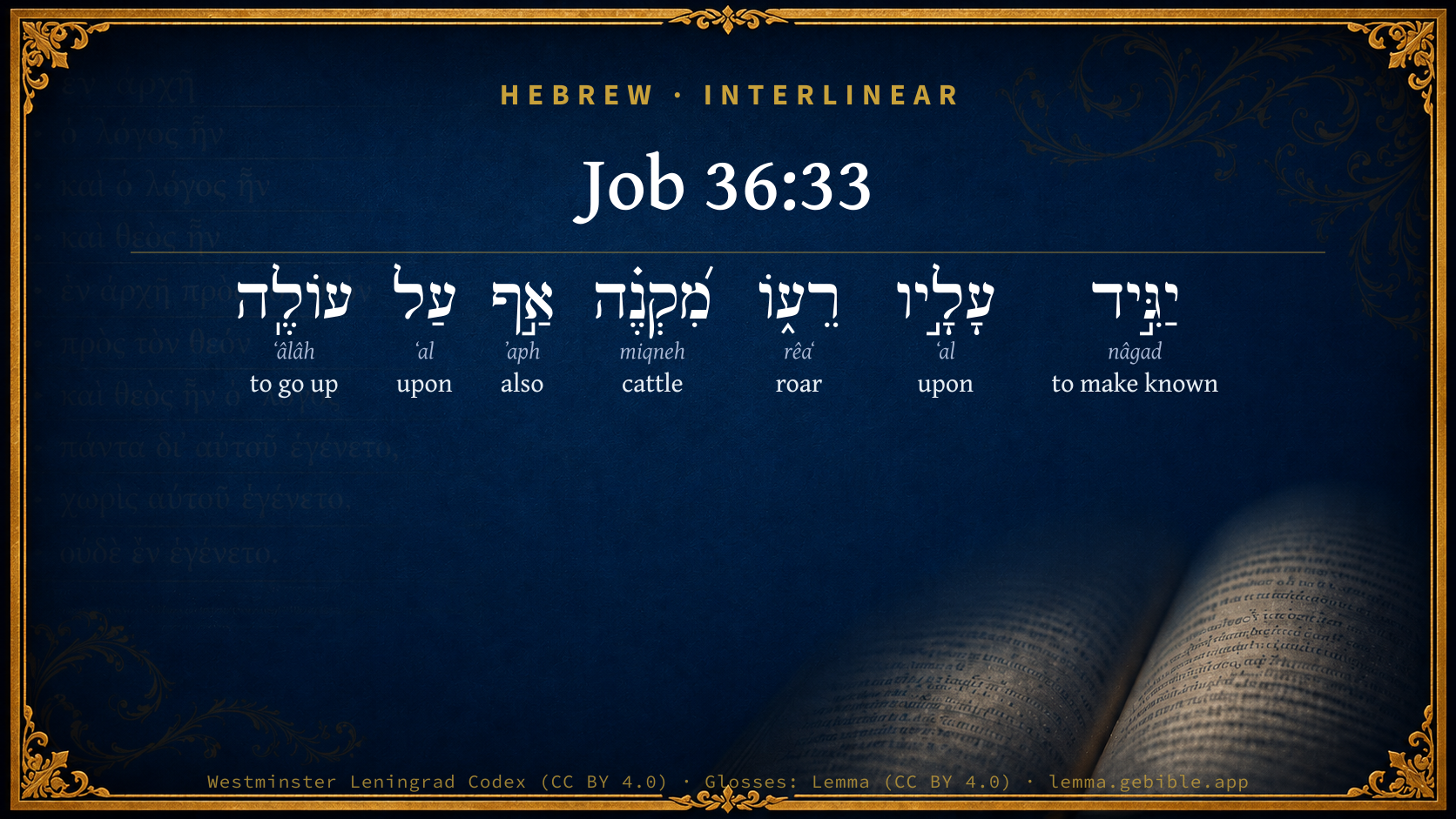
Hebrew (Westminster Leningrad Codex) Job 36:33 appears in the Hebrew Old Testament. The text above is from the Westminster Leningrad Codex. Each word links to its Strong’s number, a concise gloss, and parsing drawn from the Open Scriptures Hebrew Bible morphology. Click any word for its full Brown-Driver-Briggs (BDB) entry.
Download image
Cite this verse

Job 36:33 (World English Bible). Public Domain. Lemma interlinear Bible study tool, https://lemma.gebible.app/v/job/36/33.

Show BibTeX & RIS
BibTeX
RIS
English Translation
The noise of it tells about him, And the cattle also concerning the storm that comes up.
World English Bible · Public Domain
Download a study sheet

One document with this verse’s original text, its word-by-word gloss line, the meaning frame, cross-references with their text, attributed commentary, and full source and license credits — printable, and it pastes into notes with its structure intact.

This verse Autodidact and up

Study sheet (.html) Plain text (.txt)

A passage Seminary Student

Up to 50 verses in one chapter. A passage sheet keeps up to 6 commentary sources and 12 cross-references per verse, in the order this page ranks them, and says so on the sheet whenever that leaves anything out. Ask for a single verse and you get the Autodidact verse sheet above.

Everything on this page stays free to read, with no account — the sheet is a download of what is already on screen, not access to it.

Want to remove ads? Support Godless Engineer
Compare translations 3

The same verse in 3 English versions, stacked beneath the original-language interlinear above. Click any original word for its lexicon entry.

Each is an independent rendering of the whole verse — the interlinear is not word-aligned to these translations.

Highlighted words mark where these versions differ — a whole-verse word diff, not a word-by-word alignment.

  • World English Bible Public Domain
    The noise of it tells about him, And the cattle also concerning the storm that comes up.
  • King James Version Public Domain
    The noise thereof sheweth concerning it, the cattle also concerning the vapour.
  • unfoldingWord Literal Text CC BY-SA 4.0
    He declares his shout about it; the cattle also about the thing arising.

unfoldingWord Literal Text — © unfoldingWord, licensed CC BY-SA 4.0. Word-aligned USFM3 via Door43 (git.door43.org/unfoldingWord/en_ult).

Versions to compare (up to 4)

3 of 4 selected

Show all 18 translations

Every available English version of this verse, each an independent rendering of the whole verse.

  • World English Bible Public Domain
    The noise of it tells about him, And the cattle also concerning the storm that comes up.
  • Berean Standard Bible Public Domain
    The thunder declares His presence; even the cattle regard the rising storm.
  • Majority Standard Bible Public Domain
    The thunder declares His presence; even the cattle regard the rising storm.
  • King James Version Public Domain
    The noise thereof sheweth concerning it, the cattle also concerning the vapour.
  • American Standard Version (1901) Public Domain
    The noise thereof telleth concerning him, The cattle also concerning `the storm' that cometh up.
  • Revised Version (1885) Public Domain
    The noise thereof telleth concerning him, the cattle also concerning the storm that cometh up.
  • Geneva Bible (1599) Public Domain
    His companion sheweth him thereof, and there is anger in rising vp.
  • Douay-Rheims (1899) Public Domain
    He sheweth his friend concerning it, that it is his possession, and that he may come up to it.
  • Young's Literal Translation Public Domain
    He sheweth by it `to' his friend substance, Anger against perversity.
  • Literal Standard Version CC BY-SA 4.0
    His shout shows it, || The livestock also, the rising [storm].”
  • Unlocked Literal Bible CC BY-SA 4.0
    Its thunder warns of the storm, the cattle can also hear it is coming.
  • unfoldingWord Literal Text CC BY-SA 4.0
    He declares his shout about it; the cattle also about the thing arising.
  • Darby Bible Public Domain
    His thundering declareth concerning him; the cattle even, concerning its coming.
  • World Messianic Bible Public Domain
    Its noise tells about him, and the livestock also, concerning the storm that comes up.
  • Webster's Bible Public Domain
    The noise of it showeth concerning it, the cattle also concerning the vapor.
  • Free Bible Version CC BY-SA 4.0
    Thunder declares his presence—even cattle know when a storm is coming.”
  • Bible in Basic English Public Domain
    The thunder makes clear his passion, and the storm gives news of his wrath.
  • JPS Tanakh (1917) Public Domain
    The noise thereof telleth concerning it, the cattle also concerning the storm that cometh up.

Literal Standard Version (2020), Covenant Press — licensed CC BY-SA 4.0. Text via the HelloAO Bible API (eBible.org). Unlocked Literal Bible (unfoldingWord) — licensed CC BY-SA 4.0. Text via the HelloAO Bible API (eBible.org). unfoldingWord Literal Text — © unfoldingWord, licensed CC BY-SA 4.0. Word-aligned USFM3 via Door43 (git.door43.org/unfoldingWord/en_ult). Free Bible Version, Dr. Jonathan Gallagher — licensed CC BY-SA 4.0. Text via the HelloAO Bible API (eBible.org).

Word by word

More ways to search: Search by grammar → Find every occurrence → Compare this word →

Practice this passage: Drill this verse → Learn its vocabulary →

About this verse

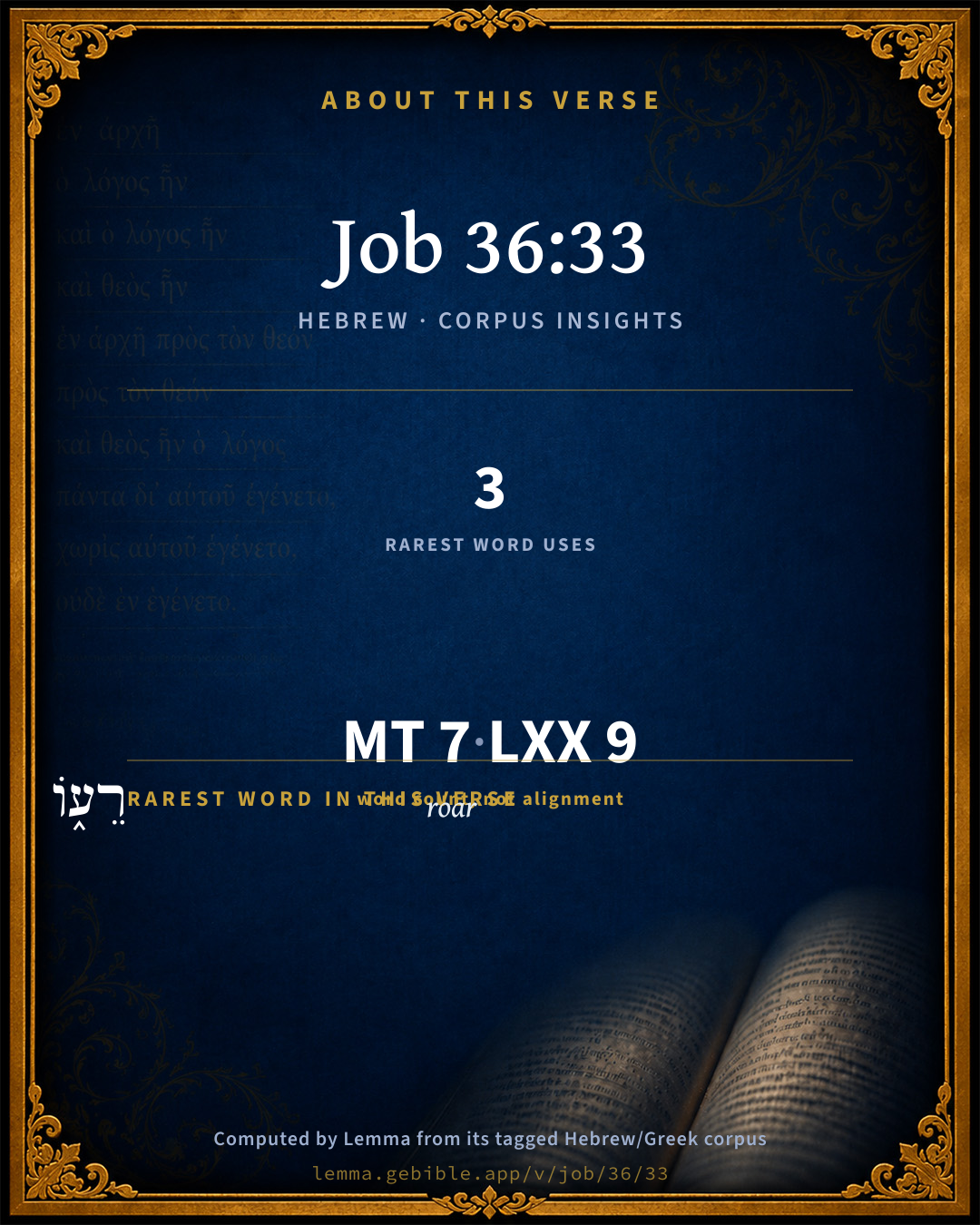
These counts appear in no published source. They are computed here, from the morphology-tagged text and Lemma’s own curated glosses. What Lemma adds →

7
words
6
distinct lemmas
Wisdom
section

Notable vocabulary

The rarest word here is רֵע֑וֹ roar H7452 — appearing just 3 times in the whole Hebrew Bible.

Shared distinctive vocabulary

רֵע֑וֹ roar H7452 occurs in 3 verses of the Hebrew Bible. Also found in:

Grammatical profile

  • 2 verbs
  • 2 nouns
  • 2 prepositions
  • 1 particle

Verb forms

  • יַגִּ֣יד Hiphil · Imperfect
  • עוֹלֶֽה Qal · Participle Active

Repetition

A word recurs within this verse — often emphatic in Hebrew:

  • עָלָ֣יו upon H5921 ×2

Hebrew & Septuagint length

In English translation the verse runs 17 words from the Hebrew and 17 from the Septuagint (LXX English) — the same length.

A rough comparison of the two English renderings, which tokenize alike — not a word-level alignment.

Word counts can differ between the Hebrew and the Greek without any difference in meaning — e.g. the Hebrew direct-object marker אֵת has no separate Greek word, and Greek often adds the article ὁ.

In the original languages it is 7 Hebrew tokens and 9 Greek tokens — but the two are counted differently (Hebrew bundles its prefixes and suffixes into one token; the Greek is in lemma form), so that isn’t a like-for-like length.

Cross-references

7

Topical passages linked to Job 36:33 in the Treasury of Scripture Knowledge — connected by theme and wording, ordered by reader-vote popularity; previews shown in the World English Bible.

  • 2 Samuel 22:14 Yahweh thundered from heaven, The Most High uttered his voice.
  • Job 36:29 Yes, can any understand the spreading of the clouds, And the thunderings of his pavilion?
  • Job 37:2 Hear, oh, hear the noise of his voice, The sound that goes out of his mouth.
  • 1 Kings 18:41–45 Elijah said to Ahab, Get you up, eat and drink; for there is the sound of abundance of rain.
  • Jeremiah 14:4–6 Because of the ground which is cracked, because no rain has been in the land, the plowmen are disappointed, they cover their heads.
  • Joel 2:22 Don't be afraid, you animals of the field; For the pastures of the wilderness spring up, For the tree bears its fruit. The fig tree and the vine yield their strength.
  • Joel 1:18 How the animals groan! The herds of cattle are perplexed, because they have no pasture. Yes, the flocks of sheep are made desolate.

Cross-references courtesy of OpenBible.info (CC BY 4.0).

Hebrew and Greek witnesses Masoretic Hebrew ↔ Greek Septuagint

The same verse in the two great witnesses to the Old Testament, shown verse-for-verse.

These are two independent witnesses, not word-aligned to each other, and the Septuagint is shown in lemma (dictionary) form.

Hebrew Job 36:33 Masoretic · Westminster Leningrad Codex

יַגִּ֣יד עָלָ֣יו רֵע֑וֹ מִ֝קְנֶ֗ה אַ֣ף עַל עוֹלֶֽה

The noise of it tells about him, And the cattle also concerning the storm that comes up.

World English Bible · Public Domain

Greek LXX Job 36:33 Septuagint · lemma form

ἀναἀγγέλλω περί αὐτός φίλος αὐτός κτῆσις καί περί ἀδικία

The Lord will declare concerning this to his friend: but there is a portion also for unrighteousness.

LXX2012 (modern English Septuagint) · Public Domain

Hebrew: Westminster Leningrad Codex (CC BY 4.0). Greek: Septuagint (public domain); English from LXX2012 (modern English Septuagint) (Public Domain). How the Septuagint differs from the Hebrew →

Commentary

Notes on Job 36:33 from classic Christian and Jewish commentators (each source and its license shown beneath its notes). The classic Christian expositions comment on the surrounding passage and are grouped to its opening verse, so a note may address several verses; the Jewish commentaries on the Tanakh (Rashi and others) are per-verse, so they appear only where the commentator wrote on this verse.

Lemma curates 59 commentaries, every one of them public domain or Creative Commons licensed, each selected and text-cleaned for this edition rather than reprinted as found. About our sources →

Trapp's Complete Commentary

John Trapp

Job 36:33 The noise thereof sheweth concerning it, the cattle also concerning the vapour.

Ver. 33. The noise thereof sheweth concerning it] The hurrying noise made in the air before a shower of rain foreshoweth it to be at hand.

The cattle also concerning the vapour] Heb. concerning that which goeth up. Hogs, sheep, oxen, &c., have a better scence of smell than men; and can perceive the vapours going up to cause rain before men can see or feel them. Hence shepherds and herdsmen gather prognostics of rain, and are so weather wise, as we call it. Aben-Ezra noteth, that sheep lying on the right side foresignify foul weather, Ad dextram cubantes oves pluviam portendunt (Merlin). See Virgil, Georg. l. i., and Pliny Nat. Hist. l. xviii. c. 35. Some render this verse (than which there is not a harder in all the book, saith Mercer), thus, Declaring toward him (who intercedeth) his good will toward the cattle, and also toward the increase of the earth.

John Trapp, A Commentary or Exposition upon All the Books of the Old and New Testament (1647–1656) — public domain. Text from a community e-Sword module.

Geneva Bible (1599)

Geneva Bible translators

The cold vapor showeth him: that is, the cloud of the hot exhalation, which being taken in the cold cloud mounteth up toward the place where the fire is, and so anger is engendered: that is, noise, and thunderclaps.

Geneva Bible (1599) marginal notes — public domain. Text via Bolls.life.

Jamieson, Fausset & Brown

Robert Jamieson, A. R. Fausset & David Brown

noise--rather, He revealeth it (literally, "announceth concerning it") to His friend (antithesis to adversary, Job 36:32, so the Hebrew is translated, Job 2:11); also to cattle and plants (literally, "that which shooteth up"; Gen 40:10; Gen 41:22). As the genial effect of "water" in the growth of food, is mentioned, Job 36:31, so here that of "light" in cherishing cattle and plants [UMBREIT]. If English Version, "noise" be retained, translate, "His noise (thunder) announces concerning Him (His coming in the tempest), the cattle (to announce) concerning Him when He is in the act of rising up" (in the storm). Some animals give various intimations that they are sensible of the approach of a storm [VIRGIL, Georgics, I.373, &c.].

Next: Job Chapter 37

Jamieson, Fausset & Brown — Commentary Critical and Explanatory on the Whole Bible (1871) — public domain (CC PDM 1.0). Text via the HelloAO Bible API.

Adam Clarke's Commentary

Verse 33. The noise thereof showeth concerning it, the cattle also concerning the vapour.] I think this translation very unhappy. I shall give each hemistich in the original: -

יגיד עליו רעו

Yaggid alaiv reo

מקנה אף על עולה

Mikneh aph al oleh.

I think this may be translated without any violence to any word in the text: -

Its loud noise (or his thunder) shall proclaim

concerning him;

A magazine of wrath against iniquity.

This is literal, and gives, in my opinion, a proper meaning of the passage, and one in strict connection with the context. And it is worthy of remark that every wicked man trembles at the noise of thunder and the flash of lightning, and considers this a treasury of Divine wrath, emphatically called among us the artillery of the skies; and whenever the noise is heard, it is considered the voice of God. Thus the thunder declares concerning him. The next chapter, which is a continuation of the subject here, confirms and illustrates this meaning. For יגיד yaggid, Houbigant reads יניד yanid; and for מקנה mikneh, מקנאת mikkinath; and translates thus: "He agitates with himself his thunder, from the indignation of his wrath against iniquity."

Adam Clarke's Commentary on the Bible (1810–1826) — public domain. Text from a community e-Sword/MySword module.

Ellicott's Commentary for English Readers

(33) The noise thereof sheweth concerning it.—This verse is extremely difficult, and the sense very uncertain. We may translate the first clause, “The noise thereof (i.e., the crash of the thunder) declareth concerning Him:” it is His voice, and speaks of Him; but the last clause is almost unintelligible. The words as they stand mean, or may mean, cattle even concerning a goer up; but what this means who shall say? Possibly, the thunder-crash telleth the cattle even concerning Him who goeth up: i.e., even the cattle show, by their terror, that the thunder speaketh to them of God, who goeth up on high. (See Psa_29:9; Psa_68:4; Psa_68:18; Psa_47:5.) Some render the last clause, “The cattle also concerning Him as He riseth up;” or, “The cattle also concerning the rising storm.” There can be no doubt but that the general meaning is that all nature participateth in the terror caused by the thunder, which is regarded as the audible voice of God; but what the exact expression of this general thought may be it is very hard to say.

There should he no break between this chapter and the next.

A Bible Commentary for English Readers, edited by Charles John Ellicott (1878–1897) — public domain. Text from a community e-Sword module.

The Cambridge Bible for Schools and Colleges

gen. ed. J. J. S. Perowne

33. the cattle also] The A. V. makes “cattle” subject—they also tell of God; in which case the reference would be to their presentiments of a coming storm. The context, however, describes a storm actually present, and it is more natural to repeat the words “it telleth” from the first clause and render, (it telleth) unto the cattle; for the reference throughout appears to be to the impression produced on all creatures by God’s mighty thunderings and how these reveal His majesty—even the cattle hearing with terror His awful voice; just as in ch. Job_37:1 Elihu describes the effect produced on himself.

concerning the vapour] Rather as above, concerning Him that cometh up, i. e. approaches or advances in the thunder cloud.

The above rendering assumes that the present Heb. text is correct. Others by alterations in the pointing elicit various senses.

The Cambridge Bible for Schools and Colleges (gen. ed. J. J. S. Perowne; Cambridge University Press, 1878–1918) — public domain. Text from a community e-Sword module.

John Gill's Exposition

The noise thereof showeth concerning it,.... The rain, that it is coming; it is a presage and prognostic of it, namely, the noise of the clouds in the air, the sound of abundance of rain there; or the noise of the winds, which is often a forerunner of it: or the noise of thunder when rain frequently follows, Jer 10:13;

the cattle also concerning the vapour; that is, the cattle likewise show signs of rain, being sensible of the vapours which rise up out of the earth, and are drawn up into the air and form clouds there; these, through their sharp sight, discern the vapours rising out of the earth insensible by men; or by their quick smell (p) or taste discern them, these leaving some tincture upon the grass they are feeding on; and which occasion some motions and gestures in them by which husbandmen, and those that are accustomed to them, know that the rain is at hand: and there are various things observable in brutes, fowls, and cattle, and other creatures, which are signs of approaching rain; as the cawing of crows, the croaking of frogs, the flying about of cranes and swallows, the motion of ants, the retire of cattle to places of shelter, and the like; Aben Ezra observes that sheep lying on their right side portends rain; the above things with others are most beautifully expressed by Virgil (q) and which with many others are collected together by Pliny (r); and though there are various interpretations given of this passage, this seems to be the most agreeable, and which suits with our version; unless the following, which I only propose, should be more eligible, "he", that is, God, "by it", the rain, "declares his good will" to men, likewise to "the cattle, and also towards what rises up" out of the earth, the herbs and plants; all which receive much benefit by the clouds and rain.

(p) Vid. Democrit. Fragment. & Rendtorf. Not. in ib. apud Fabritii Bibliothec. Gr. l. 4. c. 29. p. 338, 362. (q) "Aut illum surgentem vallibus imis", c. Georgic, l. 1. v. 374, &c. Bacon's Nat. Hist. cent. 9. p. 208. (r) Nat. Hist. l. 18. c. 35. Vid. Democrit. Fragm. ut supra, p. 335, 358, 362, 366.

Next: Job Chapter 37

John Gill's Exposition of the Whole Bible (1746–1763) — public domain (CC PDM 1.0). Text via the HelloAO Bible API.

Albert Barnes' Notes on the Bible

The noise thereof showeth concerning it - The word “noise” here has been inserted by our translators as a version of the Hebrew word (רעו rê‛ô), and if the translators attached any idea to the language which they have used, it seems to have been that the noise attending the lightning, that is, the thunder, furnished an illustration of the power and majesty of God. But it is not possible to educe this idea from the original, and perhaps it is not possible to determine the sense of the passage. Herder renders it, “He pointeth out to them the wicked.” Prof. Lee, “By it he announceth his will.” Umbreit, “He makes known to it his friend;” that is, he points out his friend to the light, so that it may serve for the happiness of that friend. Noyes, “He uttereth to him his voice; to the herds and the plants.” Rosenmuller,” He announces what he has decreed against people, and the flocks which the earth has produced.”

Many other expositions have been proposed, and there is no reasonable ground of hope that an interpretation will be arrived at which will be free from all difficulty. The principal difficulty in this part of the verse arises from the word רעו rê‛ô, rendered in our version, “The noise thereof.” This may be from רוע rûa‛, and may mean a noise, or outcry, and so it is rendered here by Gesenius, “He makes known to him his thunder, that is, to man, or to his enemies.” Or the word may mean “his friend,” as the word רע rêa‛ is often used; Job 2:11; Job 19:21; Pro 27:17; Son 5:16; Hos 3:1. Or it may denote “will, thought, desire;” Psa 139:2, Psa 139:17. A choice must be made between these different meanings according to the view entertained of the scope of the passage. To me it seems that the word ““friend”” will better suit the connection than anyone of the other interpretations proposed. According to this, the idea is, that God points out “his friends” to the lightning which he holds in his hand, and bids it spare them. He has entire control of it, and can direct it where he pleases, and instead of sending it forth to work indiscriminate destruction, he carefully designates those on whom he wishes it to strike, but bids it spare his friends.

The cattle also concerning the vapour - Margin, “that which goeth up.” What idea the translators attached to this phrase it is impossible now to know, and the probability is, that being conscious of utter inability to give any meaning to the passage, they endeavored to translate the “words” of the original as literally as possible. Coverdale evidently felt the same perplexity, for he renders it, “The rising up thereof showeth he to his friends and to the cattle.” Indeed almost every translator and expositor has had the same difficulty, and each one has proposed a version of his own. Aa examination of the “words” employed is the only hope of arriving at any satisfactory view of the passage. The word rendered “cattle” (מקנה miqneh), means properly:

(1) expectation, hope, confidence; Eze 28:26; Ezr 10:2;

(2) a gathering together, a collection, as

(a) of waters, Gen 1:10; Exo 7:19,

(b) a gathering together, a collection, or company of people, horses, etc. - a caravan. So it may possibly mean in 1Ki 10:28, where interpreters have greatly differed.

The word “cattle,” therefore, by no means expresses its usual signification. That would be better expressed by “gathering, collecting,” or “assembling.” The word rendered also (אף 'aph), denotes:

(1) also, even, more, besides, etc., and

(2) “the nose,” and then “anger” - from the effect of anger in producing hard breathing, Pro 22:24; Deu 32:22; Deu 29:20.

Here it may be rendered, without impropriety, “anger,” and then the phrase will mean, “the collecting, or gathering together of anger.” The word rendered “vapour” (עולה ‛ovelâh - if from עלה ‛âlâh), means that which “ascends,” and would then mean anything that ascends - as smoke, vapor; or as Rosenmuller supposes, what “ascends” or “grows” from the ground - that is, plants and vegetables, And so Umbreit, “das Gewachs” - “plants of any kind.” Note. But with a slight variation in the pointing עולה ‛ovelâh - instead of עולה ‛oleh), the word means “evil, wickedness, iniquity” - from our word “evil;” Job 24:20; Job 6:29; Job 11:14; Job 13:7; and it may, without impropriety, be regarded as having this signification here, as the points have no authority. The meaning of the whole phrase then will be, “the gathering, or collecting of his wrath is upon evil, that is, upon the wicked;” and the sense is, that while, on the one hand, God, who holds the lightning in his hands, points out to it his friends, so that they are spared; on the other hand the gathering together, or the condensation, of his wrath is upon the evil. That is, the lightnings - so vivid, so mighty, and apparently so wholly beyond law or control, are under his direction, and he makes them the means of executing his pleasure. His friends are spared; and the condensation of his wrath is on his foes. This exposition of the passage accords with the general scope of the remarks of Elihu, and this view of the manner in which God controls even the lightning, was one that was adapted to fill the mind with exalted conceptions of the majesty and power of the Most High.

Albert Barnes' Notes on the Bible (1834–1885) — public domain. Text from a community e-Sword/MySword module.

Haydock's Catholic Bible Commentary

To it. The tabernacle of God is designed for his friends. Hebrew is very obscure. "Thunder announces the rain, and the very animals know it;" (Virgil describes their signs, Geor. i.) or "His thunder announces from above the clouds his wrath to men." (Calmet) --- "The noise thereof sheweth concerning it, the cattle also concerning the vapour."

George Leo Haydock (1774–1849), Haydock's Catholic Family Bible and Commentary, 1859 edition — public domain. Excludes Psalms (Douay-Rheims chapter numbering differs from Protestant) and Deuterocanonical books (Catholic canon only).

Matthew Poole's English Annotations

The noise thereof, to wit. of or within the black or thick cloud, spoken of Job 36:32. Or, his, i.e. God’s, noise, to wit, the thunder, which is called God’s voice, Psa 29:4,5.

Showeth concerning it, to wit, the rain, which is the principal subject of these verses, of which he speaketh expressly Job 36:27,28; and of its companions, the clouds, and thunder and lightning, in all the following verses. The sense is, The thunder gives notice of the approaching rain. And as the thunder, so also the cattle, showeth (which verb is, understood out of the foregoing clause, after the manner) concerning the vapour, i.e. concerning the coming of the rain; but he puts vapour for the rain, because divers cattle are very sagacious in this matter, and do not only perceive the rain when it is ready to fall, but foresee it at some distance by the vapours, which are drawn up by the sun in great abundance, and by divers motions and actions, give men timely notice of it, as hath been observed not only by husbandmen, but also by learned authors.

Matthew Poole's English Annotations on the Holy Bible (1683–1685) — public domain. Text from a community e-Sword/MySword module.

Whedon's Commentary on the Bible

Daniel D. Whedon

33. The noise thereof… the vapour — This is one of the most difficult passages in the Bible, on account of the ambiguity of every important word. Of the discordant readings, that of Ewald is now generally accepted: — “His thunder announces Him; the cattle even, that he is approaching;” literally, on the march. Some see in the allusion to cattle the instinctive apprehension which the brute manifests at the approach of a storm, as both Virgil and Pliny had observed, (Georg., 1:374; Nat. Hist., 18:87, 88.) The reading of Dillmann, Hitzig, etc., who for the most part follow Symmachus, is not so well sustained, to wit: “His alarm-cry announces concerning him, making wrath to rage against iniquity;” essential to which is a change in the pointing of על עולה to על עולה, “against iniquity.” The former of these Hebraic words — the accepted pointing of our text — we would prefer, and read as above “concerning Him who is coming upward,” that is, that “He is approaching.” Conant renders the second clause of the verse, — “to the herds, even of Him who is on high; making מקנה(which others, as above, render “wrath”) the object rather than the subject of the verb. In explanation of these comments, the reader may here be reminded that the vowel points form no part of the original Hebrew text, but were first introduced about the seventh century of the Christian era, and since the completion of the Talmud. For lengthened comment on the verse, the reader is referred to either Schultens, Dillmann or Conant.

Daniel D. Whedon (gen. ed.), Commentary on the Old and New Testaments (1874–1909) — public domain. Text from a community e-Sword module.

The Pulpit Commentary

The noise thereof showeth concerning it; or, concerning him. The loud crash proclaims the fierceness of God"s anger. The cattle also concerning the vapour; rather, it sheweth the cattle also concerning him that goeth up; i.e. the very cattle also feel that God is in the storm, rides upon it, and "goeth up". (comp. Psa_47:5) The rendering of the Revised Version, "(it showeth) the cattle also concerning the storm that cometh up," is very weak, and unworthy of such an orator as Elihu.

The Pulpit Commentary (1880–1919), ed. H.D.M. Spence-Jones & Joseph S. Exell — public domain. Text from a community e-Sword module.

John Wesley's Explanatory Notes

The noise - The thunder gives notice of the approaching rain. Also - And as the thunder, so also the cattle sheweth, concerning the vapor, concerning the coming of the rain, by a strange instinct, seeking for shelter, when a change of weather is near.

John Wesley, Explanatory Notes Upon the Whole Bible (1754–1765) — public domain. Text via the GEBible commentary corpus.

Rashi

Rabbi Shlomo Yitzchaki (Rashi)

Their beloved one preaches to them He preaches to them to search their deeds for themselves and to return to Him.

the acquisition This is the acquisition whereby the rain is acquired.

it also ascends on high Heb. על. It also [ascends] higher and higher [in this manner], like (Hosea 7: 16), “They will return, but not to the Most High (על)” or (II Sam. 23:1), “raised on high (על).” [See Comm. Dig. to Hosea 7:16.] Our Sages, however, interpret it (Taanith 8a) as the acquisition of anger and wrath upon one who becomes haughty [after his prayers have been answered], but the vowelization, viz. that מִקְנֶה is vowelized with a “pattah” [meaning a “seggol”], does not substantiate [the theory] that it is connected to אַף, for were it connected to אַף, it would be vowelized with a “kamatz” [meaning a “tzeireh”], and it would not be punctuated by a cantillation sign that denotes a pause, viz. a revi’i.

Rashi on the Tanakh — English translations: “The Judaica Press complete Tanach with Rashi, translated by A. J. Rosenberg” (CC BY 4.0); “Pentateuch with Rashi's commentary by M. Rosenbaum and A.M. Silbermann, 1929-1934” (public domain); “The Metsudah Tanach series, Lakewood, N.J” (CC BY 4.0); and “The Book of Joshua, Metsudah Publications, 1997” (CC BY 4.0). Text via Sefaria.

Lesson kit

Teaching starters — assembled from the data on this page, not authored interpretation. Every prompt links to the verse data it draws on. Edit before teaching.

Job, in the Wisdom, opens this verse with 7 words (6 distinct Hebrew lemmas). Its most distinctive word is rêaʻ (“roar”). A historical commentator’s framing appears above. Read the whole chapter for the surrounding context.

Discussion questions

  1. How does “roar” (rêaʻ) shape what this verse is saying?
  2. Exodus 32:17 shares the word «roar» with this verse. How do the two illuminate each other?
  3. “upon” occurs 2× in this one verse. What is the effect of the repetition?
  4. The translations on this page render this verse differently — a whole-verse word diff, not a word-by-word alignment. What might account for the different wordings?
  5. The verb «יַגִּ֣יד» is Hiphil Imperfect. How does its form color the action?
  6. Reading how Trapp's Complete Commentary and Geneva Bible (1599) read this verse, where do the two commentators agree and where do they part?

Things to notice

Reading settings

Reading text

Shown beneath each verse's original-language words.

Old Testament
Old Testament edition

Read the OT as the Masoretic Hebrew (MT) or the Greek Septuagint (LXX).

English shown for the Greek Septuagint (in the Hebrew ↔ Greek comparison).

Comparing translations? Open the Compare panel on any verse page to stack up to four side by side.