
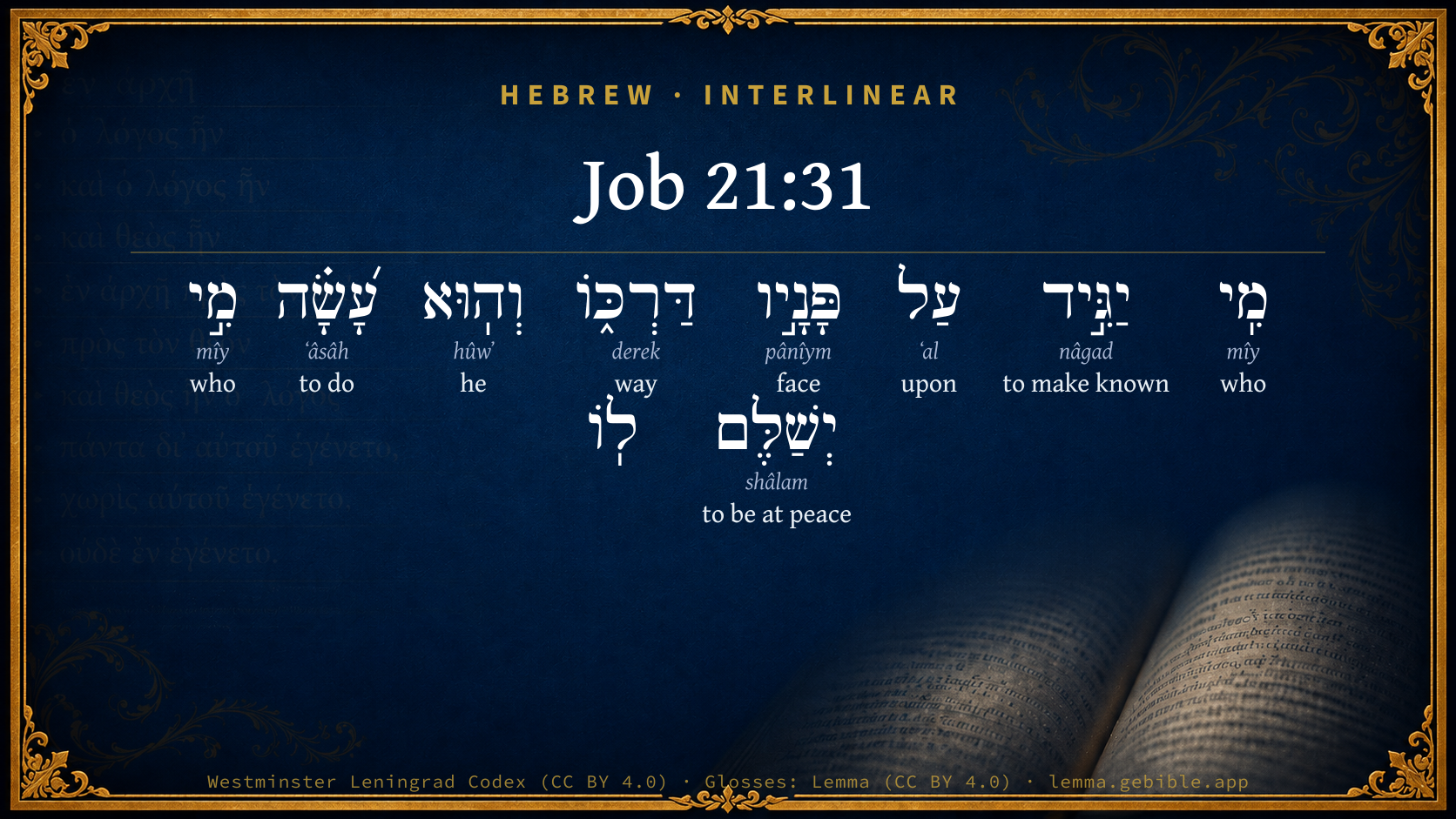
Job 21:31

Hebrew (Westminster Leningrad Codex) Job 21:31 appears in the Hebrew Old Testament. The text above is from the Westminster Leningrad Codex. Each word links to its Strong’s number, a concise gloss, and parsing drawn from the Open Scriptures Hebrew Bible morphology. Click any word for its full Brown-Driver-Briggs (BDB) entry.
Download image
Cite this verse

Job 21:31 (World English Bible). Public Domain. Lemma interlinear Bible study tool, https://lemma.gebible.app/v/job/21/31.

Show BibTeX & RIS
BibTeX
RIS
English Translation
Who shall declare his way to his face? Who shall repay him what he has done?
World English Bible · Public Domain
Download a study sheet

One document with this verse’s original text, its word-by-word gloss line, the meaning frame, cross-references with their text, attributed commentary, and full source and license credits — printable, and it pastes into notes with its structure intact.

This verse Autodidact and up

Study sheet (.html) Plain text (.txt)

A passage Seminary Student

Up to 50 verses in one chapter. A passage sheet keeps up to 6 commentary sources and 12 cross-references per verse, in the order this page ranks them, and says so on the sheet whenever that leaves anything out. Ask for a single verse and you get the Autodidact verse sheet above.

Everything on this page stays free to read, with no account — the sheet is a download of what is already on screen, not access to it.

Want to remove ads? Support Godless Engineer
Compare translations 3

The same verse in 3 English versions, stacked beneath the original-language interlinear above. Click any original word for its lexicon entry.

Each is an independent rendering of the whole verse — the interlinear is not word-aligned to these translations.

Highlighted words mark where these versions differ — a whole-verse word diff, not a word-by-word alignment.

  • World English Bible Public Domain
    Who shall declare his way to his face? Who shall repay him what he has done?
  • King James Version Public Domain
    Who shall declare his way to his face? and who shall repay him what he hath done?
  • unfoldingWord Literal Text CC BY-SA 4.0
    Who will denounce his way to his face? And what he has done, who will repay to him?

unfoldingWord Literal Text — © unfoldingWord, licensed CC BY-SA 4.0. Word-aligned USFM3 via Door43 (git.door43.org/unfoldingWord/en_ult).

Versions to compare (up to 4)

3 of 4 selected

Show all 18 translations

Every available English version of this verse, each an independent rendering of the whole verse.

  • World English Bible Public Domain
    Who shall declare his way to his face? Who shall repay him what he has done?
  • Berean Standard Bible Public Domain
    Who denounces his behavior to his face? Who repays him for what he has done?
  • Majority Standard Bible Public Domain
    Who denounces his behavior to his face? Who repays him for what he has done?
  • King James Version Public Domain
    Who shall declare his way to his face? and who shall repay him what he hath done?
  • American Standard Version (1901) Public Domain
    Who shall declare his way to his face? And who shall repay him what he hath done?
  • Revised Version (1885) Public Domain
    Who shall declare his way to his face? and who shall repay him what he hath done?
  • Geneva Bible (1599) Public Domain
    Who shall declare his way to his face? and who shall reward him for that he hath done?
  • Douay-Rheims (1899) Public Domain
    Who shall reprove his way to his face? and who shall repay him what he hath done?
  • Young's Literal Translation Public Domain
    Who doth declare to his face his way? And `for' that which he hath done, Who doth give recompence to him?
  • Literal Standard Version CC BY-SA 4.0
    Who declares his way to his face? And [for] that which he has done, || Who gives repayment to him?
  • Unlocked Literal Bible CC BY-SA 4.0
    Who will condemn the wicked man's way to his face? Who will repay him for what he has done?
  • unfoldingWord Literal Text CC BY-SA 4.0
    Who will denounce his way to his face? And what he has done, who will repay to him?
  • Darby Bible Public Domain
    Who shall declare his way to his face? and who shall repay him what he hath done?
  • World Messianic Bible Public Domain
    Who will declare his way to his face? Who will repay him what he has done?
  • Webster's Bible Public Domain
    Who shall declare his way to his face? and who shall repay him what he hath done?
  • Free Bible Version CC BY-SA 4.0
    Who confronts them with their actions? Who pays them back for what they have done?
  • Bible in Basic English Public Domain
    Who will make his way clear to his face? and if he has done a thing, who gives him punishment for it?
  • JPS Tanakh (1917) Public Domain
    But who shall declare his way to his face? And who shall repay him what he hath done?

Literal Standard Version (2020), Covenant Press — licensed CC BY-SA 4.0. Text via the HelloAO Bible API (eBible.org). Unlocked Literal Bible (unfoldingWord) — licensed CC BY-SA 4.0. Text via the HelloAO Bible API (eBible.org). unfoldingWord Literal Text — © unfoldingWord, licensed CC BY-SA 4.0. Word-aligned USFM3 via Door43 (git.door43.org/unfoldingWord/en_ult). Free Bible Version, Dr. Jonathan Gallagher — licensed CC BY-SA 4.0. Text via the HelloAO Bible API (eBible.org).

Word by word

More ways to search: Search by grammar → Find every occurrence → Compare this word →

Practice this passage: Drill this verse → Learn its vocabulary →

יְשַׁלֶּם
shâlam
H7999
“to be at peace”
Verb, Piel, Imperfect, 3rd Person, Masculine, Singular
Part of Speech
Verb
Stem
Piel
Form
Imperfect
Person
3rd Person
Gender
Masculine
Number
Singular
Full BDB Definition

Origin: a primitive root

TWOT: 2401c

to be in a covenant of peace, be at peace - (Qal) - to be at peace - peaceful one (participle) - (Pual) one in covenant of peace (participle) - (Hiphil) - to make peace with - to cause to be at peace - (Hophal) to live in peace - to be complete, be sound - (Qal) - to be complete, be finished, be ended - to be sound, be uninjured - (Piel) - to complete, finish - to make safe - to make whole or good, restore, make compensation - to make good, pay - to requite, recompense, reward - (Pual) - to be performed - to be repaid, be requited - (Hiphil) - to complete, perform - to make an end of
  1. מִֽי mîy H4310 “who” Particle, Interrogative
  2. יַגִּ֣יד nâgad H5046 “to make known” Verb, Hiphil, Imperfect, 3rd Person, Masculine, Singular
  3. עַל ʻal H5921 “upon” Preposition
  4. פָּנָ֣יו pânîym H6440 “face(s) · his” Noun, Common, Both, Plural, Construct + Suffix, Personal, 3rd Person, Masculine, Singular
  5. דַּרְכּ֑וֹ derek H1870 “way · his” Noun, Common, Both, Singular, Construct + Suffix, Personal, 3rd Person, Masculine, Singular
  6. וְהֽוּא hûwʼ H1931 “and · he” Conjunction + Pronoun, Personal, 3rd Person, Masculine, Singular
  7. עָ֝שָׂ֗ה ʻâsâh H6213 “to do” Verb, Qal, Perfect, 3rd Person, Masculine, Singular
  8. מִ֣י mîy H4310 “who” Particle, Interrogative

About this verse

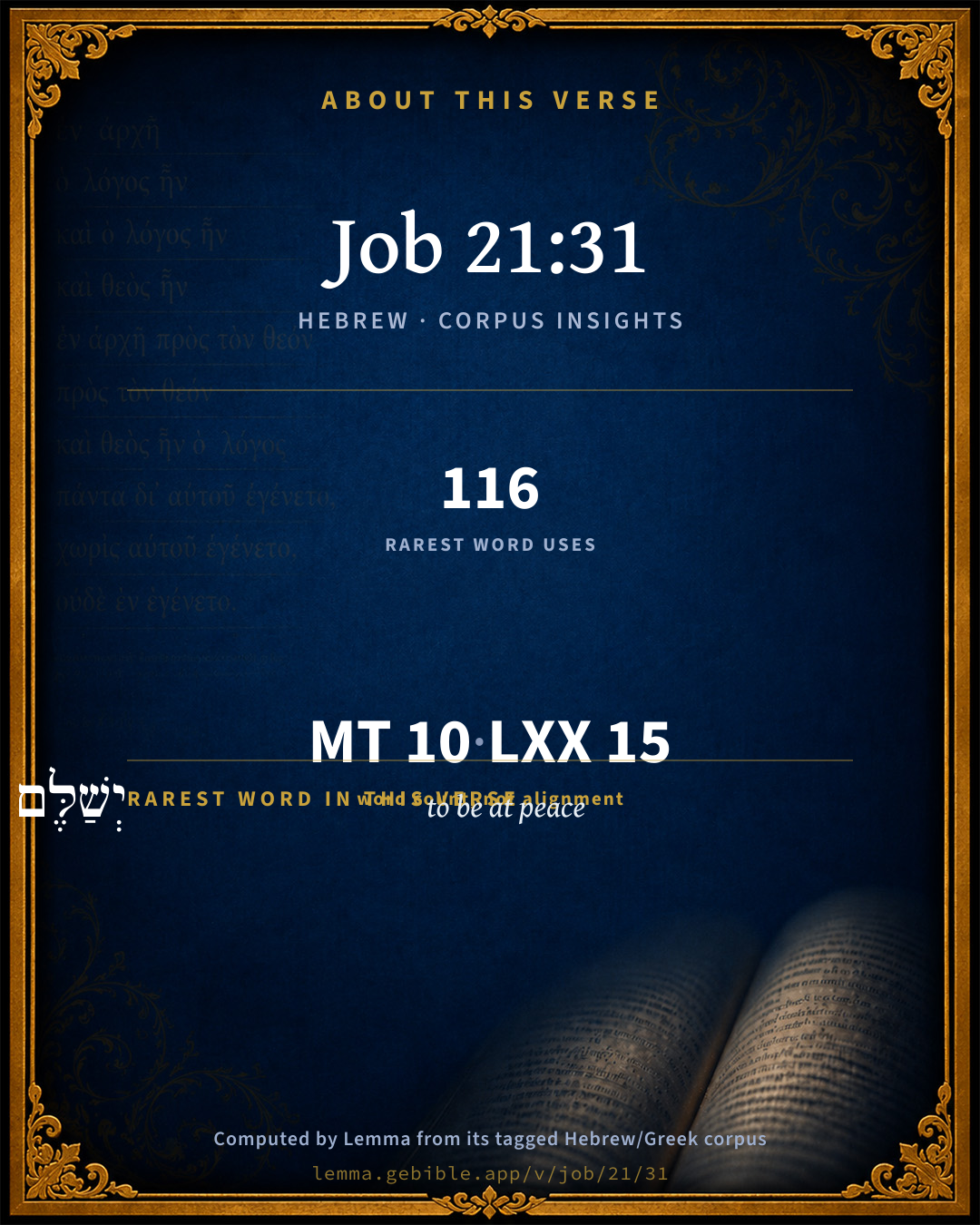
These counts appear in no published source. They are computed here, from the morphology-tagged text and Lemma’s own curated glosses. What Lemma adds →

10
words
8
distinct lemmas
Wisdom
section

Grammatical profile

  • 3 verbs
  • 2 nouns
  • 1 pronoun
  • 2 prepositions
  • 2 particles

Verb forms

  • יַגִּ֣יד Hiphil · Imperfect
  • עָ֝שָׂ֗ה Qal · Perfect
  • יְשַׁלֶּם Piel · Imperfect

Repetition

A word recurs within this verse — often emphatic in Hebrew:

Hebrew & Septuagint length

In English translation the verse runs 16 words from the Hebrew and 18 from the Septuagint (LXX English) — closely comparable.

A rough comparison of the two English renderings, which tokenize alike — not a word-level alignment.

Word counts can differ between the Hebrew and the Greek without any difference in meaning — e.g. the Hebrew direct-object marker אֵת has no separate Greek word, and Greek often adds the article ὁ.

In the original languages it is 10 Hebrew tokens and 15 Greek tokens — but the two are counted differently (Hebrew bundles its prefixes and suffixes into one token; the Greek is in lemma form), so that isn’t a like-for-like length.

Cross-references

13

Topical passages linked to Job 21:31 in the Treasury of Scripture Knowledge — connected by theme and wording, ordered by reader-vote popularity; previews shown in the World English Bible.

  • Deuteronomy 7:10 and repays those who hate him to their face, to destroy them: he will not be slack to him who hates him, he will repay him to his face.
  • Galatians 2:11 But when Peter came to Antioch, I resisted him to the face, because he stood condemned.
  • Romans 12:19 Don't seek revenge yourselves, beloved, but give place to God's wrath. For it is written, "Vengeance belongs to me; I will repay, says the Lord."
  • 2 Samuel 12:7–12 Nathan said to David, "You are the man. This is what Yahweh, the God of Israel, says: 'I anointed you king over Israel, and I delivered you out of the hand of Saul.
  • 1 Kings 21:19–24 You shall speak to him, saying, Thus says Yahweh, Have you killed and also taken possession? You shall speak to him, saying, Thus says Yahweh, In the place where dogs licked the blood of Naboth shall dogs lick your blood, even yours.
  • Job 21:19 You say, 'God lays up his iniquity for his children.' Let him recompense it to himself, that he may know it.
  • Job 41:11 Who has first given to me, that I should repay him? Everything under the heavens is mine.
  • Psalms 50:21 You have done these things, and I kept silent. You thought that the "I AM" was just like you. I will rebuke you, and accuse you in front of your eyes.
  • Isaiah 59:13 transgressing and denying Yahweh, and turning away from following our God, speaking oppression and revolt, conceiving and uttering from the heart words of falsehood.
  • Jeremiah 2:33–35 How trimmest you your way to seek love! therefore even the wicked women have you taught your ways.
  • Mark 6:18 For John said to Herod, "It is not lawful for you to have your brother's wife."
  • Acts 24:25 As he reasoned about righteousness, self-control, and the judgment to come, Felix was terrified, and answered, "Go your way for this time, and when it is convenient for me, I will summon you."
  • James 2:13 For judgment is without mercy to him who has shown no mercy. Mercy triumphs over judgment.

Cross-references courtesy of OpenBible.info (CC BY 4.0).

Hebrew and Greek witnesses Masoretic Hebrew ↔ Greek Septuagint

The same verse in the two great witnesses to the Old Testament, shown verse-for-verse.

These are two independent witnesses, not word-aligned to each other, and the Septuagint is shown in lemma (dictionary) form.

Hebrew Job 21:31 Masoretic · Westminster Leningrad Codex

מִֽי יַגִּ֣יד עַל פָּנָ֣יו דַּרְכּ֑וֹ וְהֽוּא עָ֝שָׂ֗ה מִ֣י יְשַׁלֶּם לֽוֹ

Who shall declare his way to his face? Who shall repay him what he has done?

World English Bible · Public Domain

Greek LXX Job 21:31 Septuagint · lemma form

τίς ἀποἀγγέλλω ἐπί πρόσωπον αὐτός ὁ ὁδός αὐτός καί αὐτός ποιέω τίς ἀντι ἀποδίδωμι αὐτός

Who will tell him his way to his face, whereas he has done it? who shall recompense him?

LXX2012 (modern English Septuagint) · Public Domain

Hebrew: Westminster Leningrad Codex (CC BY 4.0). Greek: Septuagint (public domain); English from LXX2012 (modern English Septuagint) (Public Domain). How the Septuagint differs from the Hebrew →

Commentary

Notes on Job 21:31 from classic Christian and Jewish commentators (each source and its license shown beneath its notes). The classic Christian expositions comment on the surrounding passage and are grouped to its opening verse, so a note may address several verses; the Jewish commentaries on the Tanakh (Rashi and others) are per-verse, so they appear only where the commentator wrote on this verse.

Lemma curates 59 commentaries, every one of them public domain or Creative Commons licensed, each selected and text-cleaned for this edition rather than reprinted as found. About our sources →

Trapp's Complete Commentary

John Trapp

Job 21:31 Who shall declare his way to his face? and who shall repay him [what] he hath done?

Ver. 31. Who shall declare his way to his face? &c.] Who shall be so bold as to deal plainly with this rich wretch, and tell him his own? Divitibus ideo deest amicus, quia nihil deest. Great men have many flatterers, and not a few mutterers against them, but very few that will faithfully show them their sin, and forewarn them of their danger, lest they meet with the same hard measure that the hares in the fable did, who, taking upon them to reprove the lion, were torn in pieces by him for the same. Truth breedeth hatred; and although she be a good mistress, yet they that follow her too close at the heels may hap to have their teeth struck out. But truth, downright truth, must be spoken, however it be taken. Elias dealt roundly and impartially with wicked Ahab, Jeremiah with Josiah’s sons and successors, the Baptist with Herod, Christ with the elders and Pharisees, that noble General Trajan with Valens, the Arian emperor, telling him, That by his persecuting the orthodox he had lost the day, abandoning the victory, and sending it away to the enemy.

And who shall repay him what he hath done?] q.d. Men dare not, for who will take a lion by the beard or a bear by the tooth? God will not punish him here, therefore he must needs escape unpunished, This is by Gregory fitly referred to Antichrist, who may not be admonished, and will not be punished; but thinks to bear out his most malapert misdemeanour, because it is - facinus maioris abollae, the fact of a great one.

John Trapp, A Commentary or Exposition upon All the Books of the Old and New Testament (1647–1656) — public domain. Text from a community e-Sword module.

Joseph Benson's Commentary

Job 21:31. Who shall declare his way? — That is, his wicked course and actions, and whither they lead him; to his face — That is, plainly, and while he lives, as the same phrase is used Deu 7:10. His power and splendour are so great that scarcely any man dare reprove him for his sin, or show him his danger. And who shall repay him what he hath done? — No man can bring him to an account or punishment. Job is here pursuing the same way of reasoning which he did before, and showing that the wicked mighty man is so far from being always punished in this world, that he often does what he pleases without any to control him, or so much as open their lips against him. And that such a one shall at last go down to the grave in peace, and be buried with great pomp.

Joseph Benson's Commentary on the Old and New Testaments (1811–1818) — public domain. Text from a community e-Sword module.

Whedon's Commentary on the Bible

Daniel D. Whedon

Strophe b — The doom of the wicked is sure, notwithstanding that in his life he was above accountability to man, and in his death honoured with a grand funereal cortege, and with undying fame among men, Job_21:31-34.

31. His way to his face — No one dares to declare to the face of the powerful wicked the way (of destruction, איד) they pursue. Nor does any one dare confront them with their evil deeds. Yet though above all responsibility to man, they are not above responsibility to God.

Daniel D. Whedon (gen. ed.), Commentary on the Old and New Testaments (1874–1909) — public domain. Text from a community e-Sword module.

Geneva Bible (1599)

Geneva Bible translators

Though men do flatter him, and none dare reprove him in this world, yet death is a token that he will bring him to an account.

Geneva Bible (1599) marginal notes — public domain. Text via Bolls.life.

Jamieson, Fausset & Brown

Robert Jamieson, A. R. Fausset & David Brown

That is, who dares to charge him openly with his bad ways? namely, in this present life. He shall, I grant (Job 21:30), be "repaid" hereafter.

Jamieson, Fausset & Brown — Commentary Critical and Explanatory on the Whole Bible (1871) — public domain (CC PDM 1.0). Text via the HelloAO Bible API.

Adam Clarke's Commentary

Verse 31. Who shall declare his way to his face?] But while the wicked is in power, who shall dare to tell him to his face what his true character is? or, who shall dare to repay him the evil he has done? As such a person cannot have his punishment in this life, he must have it in another; and for this the day of wrath - the day of judgment, is prepared.

Adam Clarke's Commentary on the Bible (1810–1826) — public domain. Text from a community e-Sword/MySword module.

The Cambridge Bible for Schools and Colleges

gen. ed. J. J. S. Perowne

31. The person spoken of in this verse seems most naturally the wicked man. It is doubtful however whether the testimony of the travellers is here still carried on, or whether the present words are not those of Job himself. The history of the evil man is proceeded with: his power makes him irresponsible and extorts the homage of men, who do him honour in death (Job_21:32). Others suppose the verse to be spoken of God, in which case the words are almost parenthetical, the history of the sinner being resumed in Job_21:32. If said of God the verse refers to the inscrutable dealings of His omnipotent power (Job_21:30), dealings against which the moral sense of mankind reclaims indeed, but of what avail are the reclamations of the moral sense against omnipotence? cf. ch. Job_9:12, Job_23:13. The language, however, seems less appropriate if spoken of God.

The Cambridge Bible for Schools and Colleges (gen. ed. J. J. S. Perowne; Cambridge University Press, 1878–1918) — public domain. Text from a community e-Sword module.

John Gill's Exposition

Yet shall he be brought to the grave,.... Or "and", "or yea he shall be brought", &c. (a); for the meaning is not, that though he is great in life he shall be brought low enough at death; for Job is still describing the grand figure wicked men make, even at death, as well as in life; for he is not only brought to the grave, as all men are, it being the house appointed for all living, and every man's long home; but the wicked rich man is brought thither in great funeral pomp, in great state, as the rich sinner was buried, Ecc 8:10; or "to the graves" (b), the place where many graves are, the place of the sepulchres of his ancestors; and in the chiefest and choicest of them he is interred, and has an honourable burial; not cast into a ditch, or buried with the burial of an ass, as Jehoiakim was, being cast forth beyond the gates of the city, Jer 22:19; and shall remain in the tomb; quiet and undisturbed, when it has been the lot of others to have their bones taken out of their grave, and spread before the sun, see Jer 8:1; and even some good men, who have had their graves dug up, their bones taken out and burnt, and their ashes scattered about, as was the case of that eminent man, John Wickliff, here in England. The word for "tomb" signifies an "heap" (c), and is sometimes used for an heap of the fruits of the earth; which has led some to think of the place of this man's interment being in the midst of a corn field; but the reason why a grave or tomb is so called is, because a grave, through a body or bodies being laid in it, rises up higher than the common ground; and if it has a tomb erected over it, that is no other than an heap of stones artificially put together; or it may be so called from the heaps of bodies one upon another in a grave, or vault, over which the tomb is, or where every part of the body is gathered and heaped (d); from this sense of the word some have given this interpretation of the passage, that the wicked man shall be brought to his grave, and abide there, after he has heaped up a great deal of wealth and riches in this world; which, though a truth, seems not to be intended here, any more than others taken from the different signification of the word translated "remain". It is observed by some to signify to "hasten" (e), from whence the almond tree, which hastens to put forth its bloom, has its name, Jer 1:10; and so give this as the sense, that such a man, being of full age, is ripe for death, and, comes to his grave, or heap, like a shock of corn in its season. Others observe, that it signifies to "watch"; and so in the margin of our Bibles the clause is put, "he shall watch in the heap" (f), which is differently interpreted; by some, that he early and carefully provides himself a tomb, as Absalom in his lifetime set up a sepulchral pillar for himself, Sa2 18:18; and Shebna the scribe, and Joseph of Arimathea, hewed themselves sepulchres out of the rock, Isa 22:15; and others think the allusion is either to statues upon tombs, as are still in use in our days, where they are placed as if they were watching over the tombs; or to bodies embalmed, according to the custom of the eastern countries, especially the Egyptians, which were set up erect in their vaults, and seemed as if they were alive, and there set to watch the places they were in, rather than as if buried there; or, according to others, "he shall be watched", or "the keeper shall watch at", or "over the tomb" (g), that the body is not disturbed or taken away; but the sense our version gives is best, and most agrees with the context, and the scope of it, and with what follows.

(a) "et ipse", Pagninus, Montanus, &c. (b) "ad sepulchra", V. L. Montamus, Vatablus, Drusius, Beza, Mercerus, Michaelis, Schultens; "in sepulchra", Junius & Tremellius, Piscator. (c) "super acervo", Montanus, Codurcus; so Bolducius, Mercerus. (d) Vid. David de Pomis Lexic. fol. 14. 3. (e) "festinabit", Pagninus; so some in Vatablus, and Ben Melech. (f) "Vigilabit", V. L. Tigurine version, Montanus; "vigilat", Michaelis, Schultens; "erit tanquam vigil", Bolducius. (g) "Vigilabitur", Beza; "vigilatur", Cocceius; so Calovius.

John Gill's Exposition of the Whole Bible (1746–1763) — public domain (CC PDM 1.0). Text via the HelloAO Bible API.

Albert Barnes' Notes on the Bible

Who shall declare his way to his face? - That is, the face of the wicked. Who shall dare to rise up and openly charge him with his guilt? The idea is, that none would dare to do it, and that, therefore, the wicked man was not punished according to his character here, and was reserved to a day of future wrath.

And who shall repay him what he hath done? - The meaning is, that many wicked people lived without being punished for their sins. No one was able to recompense them for the evil which they had done, and consequently they lived in security and prosperity. Such were the tyrants and conquerors, who had made the world desolate.

Albert Barnes' Notes on the Bible (1834–1885) — public domain. Text from a community e-Sword/MySword module.

Haydock's Catholic Bible Commentary

Done. Man is afraid, and God defers to take cognizance. (Calmet)

George Leo Haydock (1774–1849), Haydock's Catholic Family Bible and Commentary, 1859 edition — public domain. Excludes Psalms (Douay-Rheims chapter numbering differs from Protestant) and Deuterocanonical books (Catholic canon only).

Matthew Poole's English Annotations

His way, i.e. his wicked course and actions, and whither they lead him. His power and splendour is so great, that scarce any man dare reprove him for his sin, or show him his danger.

To his face, i.e. plainly, and whilst he lives, as the same phrase is used, Deu 7:10.

Who shall repay him what he hath done? no man can bring him to an account or punishment.

Matthew Poole's English Annotations on the Holy Bible (1683–1685) — public domain. Text from a community e-Sword/MySword module.

The Pulpit Commentary

Who shall declare his way to his face? rather, Who shall denounce? i.e. Who will be bold enough to tell the rich and powerful man that he is wicked? that his "way," or course of life, is altogether wrong? And who shall repay him what he hath done? Still less will any one be found who will take upon him to attack such a one, to prosecute him in courts or otherwise bring him to condign punishment. Thus, being castigated neither by God nor man, he enjoys complete impunity.

The Pulpit Commentary (1880–1919), ed. H.D.M. Spence-Jones & Joseph S. Exell — public domain. Text from a community e-Sword module.

John Wesley's Explanatory Notes

Declare - His power and splendour are so great, that scarce any man dare reprove him.

John Wesley, Explanatory Notes Upon the Whole Bible (1754–1765) — public domain. Text via the GEBible commentary corpus.

unfoldingWord translationNotes

Door43 World Missions Community

Connecting Statement:

Job continues speaking to his friends.

Who will condemn the wicked man's way to his face?

Job uses this question to contradict his friends' belief that the wicked are always judged. AT: "No one condemns the wicked man to his face." (See: Rhetorical Question)

to his face

This means no one will go directly to the wicked person and condemn him personally. (See: Idiom)

Who will repay him for what he has done?

Job uses this question to contradict his friends' belief that the wicked are always judged. AT: "No one repays him for the bad things that he has done." (See: Rhetorical Question)

he will be borne

This can be stated in active form. AT: "people will carry him" (See: Active or Passive)

The clods of the valley will be sweet to him

Job imagines that the dead person will even enjoy the dirt that is put on him. This means the wicked person will even have a good death and a nice burial after a fulfilling life. "Clods" refer to the earth that covers the grave. AT: "He will enjoy being covered with the dirt of the valley" or "He will enjoy being buried in the dirt of the valley" (See: Synecdoche)

all people will follow after him, as there were innumerable people before him

Job emphasizes that a large crowd of people will be in the funeral procession of this imaginary wicked man to honor him. AT: "a huge number of people go to the grave site; some go in front of the procession and some come behind" (See: Hypothetical Situations)

translationWords

condemn

face

grave

people group

unfoldingWord translationNotes — © Distant Shores Media and the Door43 World Missions Community, licensed CC BY-SA 4.0. Source: git.door43.org/Door43/en_tn.

Rashi

Rabbi Shlomo Yitzchaki (Rashi)

Who will tell His way to His face Who is the great king who will tell His way to His face and will not fear Him? How exalted He is! That is the Holy One, blessed be He, Who did.

and who will requite Him Who will requite Him with the recompense for His wickedness?

Rashi on the Tanakh — English translations: “The Judaica Press complete Tanach with Rashi, translated by A. J. Rosenberg” (CC BY 4.0); “Pentateuch with Rashi's commentary by M. Rosenbaum and A.M. Silbermann, 1929-1934” (public domain); “The Metsudah Tanach series, Lakewood, N.J” (CC BY 4.0); and “The Book of Joshua, Metsudah Publications, 1997” (CC BY 4.0). Text via Sefaria.

Lesson kit

Teaching starters — assembled from the data on this page, not authored interpretation. Every prompt links to the verse data it draws on. Edit before teaching.

Job, in the Wisdom, opens this verse with 10 words (8 distinct Hebrew lemmas). Its most distinctive word is shâlam (“to be at peace”). A historical commentator’s framing appears above. Read the whole chapter for the surrounding context.

Discussion questions

  1. What does “to be at peace” (shâlam) contribute to the verse as a whole?
  2. Deuteronomy 7:10 shares this passage’s theme. How do the two illuminate each other?
  3. “who” occurs 2× in this one verse. What is the effect of the repetition?
  4. These translations render this verse differently. What is at stake in choosing one wording over another?
  5. The verb «יַגִּ֣יד» is Hiphil Imperfect. How does its form color the action?
  6. Reading how Trapp's Complete Commentary and Joseph Benson's Commentary read this verse, where do the two commentators agree and where do they part?

Things to notice

Reading settings

Reading text

Shown beneath each verse's original-language words.

Old Testament
Old Testament edition

Read the OT as the Masoretic Hebrew (MT) or the Greek Septuagint (LXX).

English shown for the Greek Septuagint (in the Hebrew ↔ Greek comparison).

Comparing translations? Open the Compare panel on any verse page to stack up to four side by side.