
Jonah 1:8

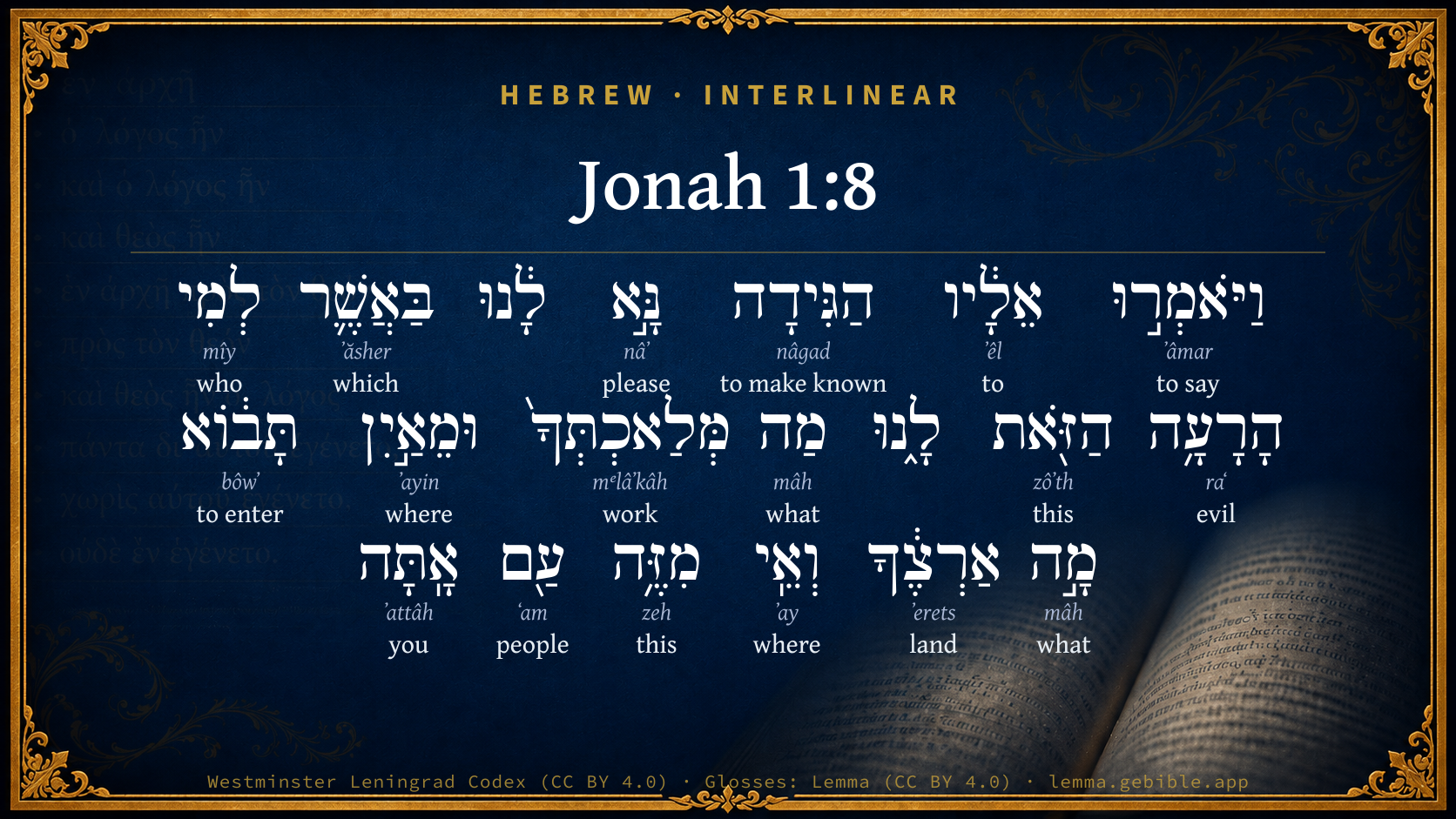
Hebrew (Westminster Leningrad Codex) Jonah 1:8 appears in the Hebrew Old Testament. The text above is from the Westminster Leningrad Codex. Each word links to its Strong’s number, a concise gloss, and parsing drawn from the Open Scriptures Hebrew Bible morphology. Click any word for its full Brown-Driver-Briggs (BDB) entry.
Download image
Cite this verse

Jonah 1:8 (World English Bible). Public Domain. Lemma interlinear Bible study tool, https://lemma.gebible.app/v/jonah/1/8.

Show BibTeX & RIS
BibTeX
RIS
English Translation
Then they asked him, "Tell us, please, for whose cause this evil is on us. What is your occupation? Where do you come from? What is your country? Of what people are you?"
World English Bible · Public Domain
Download a study sheet

One document with this verse’s original text, its word-by-word gloss line, the meaning frame, cross-references with their text, attributed commentary, and full source and license credits — printable, and it pastes into notes with its structure intact.

This verse Autodidact and up

Study sheet (.html) Plain text (.txt)

A passage Seminary Student

Up to 50 verses in one chapter. A passage sheet keeps up to 6 commentary sources and 12 cross-references per verse, in the order this page ranks them, and says so on the sheet whenever that leaves anything out. Ask for a single verse and you get the Autodidact verse sheet above.

Everything on this page stays free to read, with no account — the sheet is a download of what is already on screen, not access to it.

Want to remove ads? Support Godless Engineer
Compare translations 3

The same verse in 3 English versions, stacked beneath the original-language interlinear above. Click any original word for its lexicon entry.

Each is an independent rendering of the whole verse — the interlinear is not word-aligned to these translations.

Highlighted words mark where these versions differ — a whole-verse word diff, not a word-by-word alignment.

  • World English Bible Public Domain
    Then they asked him, "Tell us, please, for whose cause this evil is on us. What is your occupation? Where do you come from? What is your country? Of what people are you?"
  • King James Version Public Domain
    Then said they unto him, Tell us, we pray thee, for whose cause this evil is upon us; What is thine occupation? and whence comest thou? what is thy country? and of what people art thou?
  • unfoldingWord Literal Text CC BY-SA 4.0
    Then they said to him, “Please tell us on whose account this evil is happening to us. What is your occupation, and where do you come from? What is your country, and from which people are you?”

unfoldingWord Literal Text — © unfoldingWord, licensed CC BY-SA 4.0. Word-aligned USFM3 via Door43 (git.door43.org/unfoldingWord/en_ult).

Versions to compare (up to 4)

3 of 4 selected

Show all 18 translations

Every available English version of this verse, each an independent rendering of the whole verse.

  • World English Bible Public Domain
    Then they asked him, "Tell us, please, for whose cause this evil is on us. What is your occupation? Where do you come from? What is your country? Of what people are you?"
  • Berean Standard Bible Public Domain
    “Tell us now,” they demanded, “who is to blame for this calamity that is upon us? What is your occupation, and where have you come from? What is your country, and who are your people?”
  • Majority Standard Bible Public Domain
    “Tell us now,” they demanded, “who is to blame for this calamity that is upon us? What is your occupation, and where have you come from? What is your country, and who are your people?”
  • King James Version Public Domain
    Then said they unto him, Tell us, we pray thee, for whose cause this evil is upon us; What is thine occupation? and whence comest thou? what is thy country? and of what people art thou?
  • American Standard Version (1901) Public Domain
    Then said they unto him, Tell us, we pray thee, for whose cause this evil is upon us; what is thine occupation? and whence comest thou? what is thy country? and of what people art thou?
  • Revised Version (1885) Public Domain
    Then said they unto him, Tell us, we pray thee, for whose cause this evil is upon us; what is thine occupation? and whence comest thou? what is thy country? and of what people art thou?
  • Geneva Bible (1599) Public Domain
    Then said they vnto him, Tell vs for whose cause this euill is vpon vs? what is thine occupation? and whence commest thou? which is thy countrey? and of what people art thou?
  • Douay-Rheims (1899) Public Domain
    And they said to him: Tell us for what cause this evil is upon us, what is thy business? of what country art thou? and whither goest thou? or of what people art thou?
  • Young's Literal Translation Public Domain
    And they say unto him, `Declare to us, we pray thee, on what account this evil `is' on us? what `is' thine occupation, and whence comest thou? what `is' thy country, seeing thou art not of this people?'
  • Literal Standard Version CC BY-SA 4.0
    And they say to him, “Now declare to us, on whose account [is] this evil on us? What [is] your occupation, and where do you come from? What [is] your country, seeing you are not of this people?”
  • Unlocked Literal Bible CC BY-SA 4.0
    Then they said to Jonah, “Please tell us who is the cause of this evil that is happening to us. What is your occupation, and where did you come from? What is your country, and from which people are you?”
  • unfoldingWord Literal Text CC BY-SA 4.0
    Then they said to him, “Please tell us on whose account this evil is happening to us. What is your occupation, and where do you come from? What is your country, and from which people are you?”
  • Darby Bible Public Domain
    And they said unto him, Tell us, we pray thee, for whose cause this evil is upon us: what is thine occupation? and whence comest thou? what is thy country? and of what people art thou?
  • World Messianic Bible Public Domain
    Then they asked him, “Tell us, please, for whose cause this evil is on us. What is your occupation? Where do you come from? What is your country? Of what people are you?”
  • Webster's Bible Public Domain
    Then said they to him, Tell us, we pray thee, for whose cause this evil is upon us; What is thy occupation? and whence comest thou? what is thy country? and of what people art thou?
  • Free Bible Version CC BY-SA 4.0
    So they asked him, “Tell us who is responsible for this trouble that we're in. What do you do for a living? Where are you from? What is your country? What is your nationality?”
  • Bible in Basic English Public Domain
    Then they said to him, Now make clear to us what is your work, and where you come from? what is your country, and who are your people?
  • JPS Tanakh (1917) Public Domain
    Then said they unto him: 'Tell us, we pray thee, for whose cause this evil is upon us: what is thine occupation? and whence comest thou? what is thy country? and of what people art thou?'

Literal Standard Version (2020), Covenant Press — licensed CC BY-SA 4.0. Text via the HelloAO Bible API (eBible.org). Unlocked Literal Bible (unfoldingWord) — licensed CC BY-SA 4.0. Text via the HelloAO Bible API (eBible.org). unfoldingWord Literal Text — © unfoldingWord, licensed CC BY-SA 4.0. Word-aligned USFM3 via Door43 (git.door43.org/unfoldingWord/en_ult). Free Bible Version, Dr. Jonathan Gallagher — licensed CC BY-SA 4.0. Text via the HelloAO Bible API (eBible.org).

Word by word

More ways to search: Search by grammar → Find every occurrence → Compare this word →

Practice this passage: Drill this verse → Learn its vocabulary →

וּמֵאַ֣יִן
ʼayin
H370
“and · from · where”
Conjunction + Preposition + Particle, Interrogative
Part of Speech
Conjunction + Preposition + Particle
Type
Interrogative
Full BDB Definition

Origin: probably identical with H369 in the sense of query (compare H336 )

TWOT: 75f

where?, whence?
  1. וַיֹּאמְר֣וּ ʼâmar H559 “and · to say” Conjunction + Verb, Qal, Sequential Imperfect, 3rd Person, Masculine, Plural
  2. אֵלָ֔יו ʼêl H413 “to · him” Preposition + Suffix, Personal, 3rd Person, Masculine, Singular
  3. הַגִּידָה nâgad H5046 “make known” Verb, Hiphil, Imperative, 2nd Person, Masculine, Singular + Suffix, h
  4. נָּ֣א nâʼ H4994 “please” Particle, Interjection
  5. בַּאֲשֶׁ֛ר ʼăsher H834 “in/at · which” Preposition + Particle, Relative
  6. לְמִי mîy H4310 “to/for · who” Preposition + Particle, Interrogative
  7. הָרָעָ֥ה raʻ H7451 “the · evil” Particle, Definite Article + Noun, Common, Feminine, Singular, Absolute
  8. הַזֹּ֖את zôʼth H2063 “the · this” Particle, Definite Article + Pronoun, Demonstrative, Feminine, Singular
  9. מַה mâh H4100 “what” Particle, Interrogative
  10. מְּלַאכְתְּךָ֙ mᵉlâʼkâh H4399 “work · your” Noun, Common, Feminine, Singular, Construct + Suffix, Personal, 2nd Person, Masculine, Singular
  11. תָּב֔וֹא bôwʼ H935 “to enter” Verb, Qal, Imperfect, 2nd Person, Masculine, Singular
  12. מָ֣ה mâh H4100 “what” Particle, Interrogative
  13. אַרְצֶ֔ךָ ʼerets H776 “land · your” Noun, Common, Both, Singular, Construct + Suffix, Personal, 2nd Person, Masculine, Singular
  14. וְאֵֽי ʼay H335 “and · where” Conjunction + Particle, Interrogative
  15. מִזֶּ֥ה zeh H2088 “from · this” Preposition + Pronoun, Demonstrative, Masculine, Singular
  16. עַ֖ם ʻam H5971 “people” Noun, Common, Masculine, Singular, Absolute
  17. אָֽתָּה ʼattâh H859 “you” Pronoun, Personal, 2nd Person, Masculine, Singular

About this verse

These counts appear in no published source. They are computed here, from the morphology-tagged text and Lemma’s own curated glosses. What Lemma adds →

20
words
17
distinct lemmas
Prophets
section

Notable vocabulary

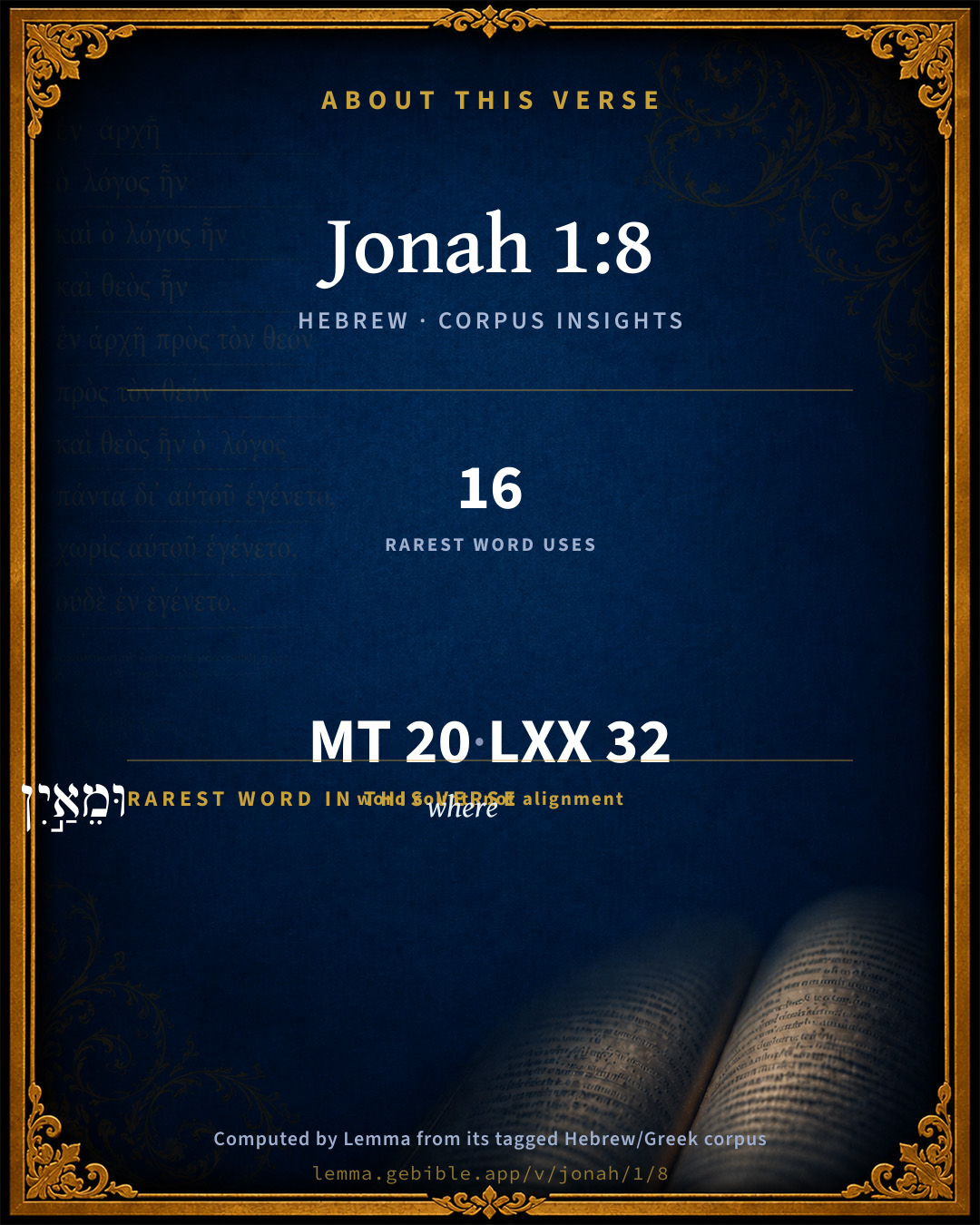
The rarest word here is וּמֵאַ֣יִן where H370 — appearing just 16 times in the whole Hebrew Bible.

Shared distinctive vocabulary

וּמֵאַ֣יִן where H370 occurs in 16 verses of the Hebrew Bible. Also found in:

Grammatical profile

  • 3 verbs
  • 4 nouns
  • 3 pronouns
  • 3 prepositions
  • 7 particles

Verb forms

  • וַיֹּאמְר֣וּ Qal · Sequential Imperfect
  • הַגִּידָה Hiphil · Imperative
  • תָּב֔וֹא Qal · Imperfect

Repetition

A word recurs within this verse — often emphatic in Hebrew:

Hebrew & Septuagint length

In English translation the verse runs 33 words from the Hebrew and 24 from the Septuagint (LXX English) — closely comparable.

A rough comparison of the two English renderings, which tokenize alike — not a word-level alignment.

Word counts can differ between the Hebrew and the Greek without any difference in meaning — e.g. the Hebrew direct-object marker אֵת has no separate Greek word, and Greek often adds the article ὁ.

In the original languages it is 20 Hebrew tokens and 32 Greek tokens — but the two are counted differently (Hebrew bundles its prefixes and suffixes into one token; the Greek is in lemma form), so that isn’t a like-for-like length.

Cross-references

5

Topical passages linked to Jonah 1:8 in the Treasury of Scripture Knowledge — connected by theme and wording, ordered by reader-vote popularity; previews shown in the World English Bible.

  • Genesis 47:3 Pharaoh said to his brothers, "What is your occupation?" They said to Pharaoh, "Your servants are shepherds, both we, and our fathers."
  • 1 Samuel 30:13 David said to him, To whom belong you? and whence are you? He said, I am a young man of Egypt, servant to an Amalekite; and my master left me, because three days ago I fell sick.
  • Joshua 7:19 Joshua said to Achan, My son, please give glory to Yahweh, the God of Israel, and make confession to him; and tell me now what you have done; don't hide it from me.
  • James 5:16 Confess your offenses to one another, and pray one for another, that you may be healed. The effective, earnest prayer of a righteous man is powerfully effective.
  • 1 Samuel 14:43 Then Saul said to Jonathan, Tell me what you have done. Jonathan told him, and said, I did certainly taste a little honey with the end of the rod that was in my hand; and, behold, I must die.

Cross-references courtesy of OpenBible.info (CC BY 4.0).

Hebrew and Greek witnesses Masoretic Hebrew ↔ Greek Septuagint

The same verse in the two great witnesses to the Old Testament, shown verse-for-verse.

These are two independent witnesses, not word-aligned to each other, and the Septuagint is shown in lemma (dictionary) form.

Hebrew Jonah 1:8 Masoretic · Westminster Leningrad Codex

וַיֹּאמְר֣וּ אֵלָ֔יו הַגִּידָה נָּ֣א לָ֔נוּ בַּאֲשֶׁ֛ר לְמִי הָרָעָ֥ה הַזֹּ֖את לָ֑נוּ מַה מְּלַאכְתְּךָ֙ וּמֵאַ֣יִן תָּב֔וֹא מָ֣ה אַרְצֶ֔ךָ וְאֵֽי מִזֶּ֥ה עַ֖ם אָֽתָּה

Then they asked him, "Tell us, please, for whose cause this evil is on us. What is your occupation? Where do you come from? What is your country? Of what people are you?"

World English Bible · Public Domain

Greek LXX Jonah 1:8 Septuagint · lemma form

καί εἶπον πρός αὐτός ἀποἀγγέλλω ἐγώ τίς ἕνεκεν ὁ κακία οὗτος εἰμί ἐν ἐγώ τίς σύ ὁ ἐργασία εἰμί καί πόθεν ἔρχομαι καί ἐκ ποῖος χώρα καί ἐκ ποῖος λαός εἰμί σύ

And they said to him, Tell us what is your occupation, and whence come you, and of what country and what people are you?

LXX2012 (modern English Septuagint) · Public Domain

On this verse, Whedon's Commentary on the Bible discusses the Septuagint’s reading. Read the note in Commentary ↓

Hebrew: Westminster Leningrad Codex (CC BY 4.0). Greek: Septuagint (public domain); English from LXX2012 (modern English Septuagint) (Public Domain). How the Septuagint differs from the Hebrew →

Targum (Aramaic paraphrase)

1

The Targum is the ancient Jewish Aramaic paraphrase of the Hebrew Scriptures — an interpretive translation, not the Hebrew text itself. Onkelos (literal) and Pseudo-Jonathan (expansive) render the Torah, and Jonathan the Prophets. Coverage is partial: where no permissively-licensed English translation exists for a verse, only the Aramaic is shown. This is verse-level text, not a word-by-word alignment to the Hebrew.

  1. Targum Jonathan Prophets (Joshua–Malachi)
    וַאֲמַרוּ לֵיהּ חַוֵי כְעַן לָנָא בְּדִיל מָה בִישְׁתָּא הָדָא לָנָא מָה עֲבִידְתָּךְ וּמְנָן אַתְּ אָתֵי אֵי דָא הִיא מְדִינְתָךְ וְאֵי מִדֵין עַמָא אַתְּ:

    And they said to him, “Tell us, now, you on whose account this evil is ours. What is your labor? And where do you come from? Which is your country, and of which people are you?”

    Targum Jonathan — Aramaic: “Mikraot Gedolot” (public domain). English: “Sefaria Community Translation” (CC0 1.0 (public-domain dedication)); “London "Chaldee Paraphrase," 1871” (public domain). Text via Sefaria.

Commentary

Notes on Jonah 1:8 from classic Christian and Jewish commentators (each source and its license shown beneath its notes). The classic Christian expositions comment on the surrounding passage and are grouped to its opening verse, so a note may address several verses; the Jewish commentaries on the Tanakh (Rashi and others) are per-verse, so they appear only where the commentator wrote on this verse.

Lemma curates 59 commentaries, every one of them public domain or Creative Commons licensed, each selected and text-cleaned for this edition rather than reprinted as found. About our sources →

Trapp's Complete Commentary

John Trapp

Jon 1:8 Then said they unto him, Tell us, we pray thee, for whose cause this evil [is] upon us; What [is] thine occupation? and whence comest thou? what [is] thy country? and of what people [art] thou?

Ver. 8. Tell us, we pray thee, for whose cause, &c.] He confessed not till urged and necessitated. Sin gags people, and prompts them to hide their faults, as Adam; or at least to mince, extenuate, shift them upon other persons and things, as Eve. Sin and shifting came into the world together; and Satan, that old manslayer, knowing that there is no way to purge the soul but upwards, holds the lips close, that the heart may not disburden itself: God, by this means, is often put to his proof, and must bring the malefactor to trial; who, refusing ordinary trial, must therefore be pressed, Jer 2:35.

What is thine occupation?] For that thou hast one we take it for granted. At Athens every man was, once a year, at least, to give account to the judges by what art or trade he maintained himself. By Mahomet’s law the Grand Signior himself must use some manual trade; Solyman the Magnificent made arrowheads; Mahomet the Great horn rings for archers, &c. That which the mariners here inquire after is, whether Jonah’s occupation be honest and lawful? whether he "laboured the thing that was good," Eph 4:28. For if any man overreach or oppress his brother in any matter, by the use of any ill arts, he shall be sure to find that "the Lord is the avenger of all such," 1Th 4:6; though haply they lie out of the walk of human justice, or come not under man’s cognizance.

And whence comest thou?] Art thou not of an accursed country? and is not thy people a people of God’s wrath, as England was in the time of the sweating sickness, pursuing the English wherever they came; which made them like tyrants, both feared and avoided by all nations? How the Jews are to this day hated and shunned as an execrable people is known to all.

What is thy country? and of what people art thou?] Notanda brevitas, saith Jerome here, note the brevity of these questions, nothing short of those in Virgil so much admired (Aen. viii. 112).

-- “ iuvenes quae causa subegit

Ignotas tentare vias? qua tenditis? inquit,

Quod genus? unde domo? pacemne hue fertis, an arma? ”

Note also here, how these Pagans proceed not to execution till they have fully inquired into the matter, This was far better than that ugly custom of some people in Europe, mentioned by Aeneas Sylvius: that if any one among them be suspected of theft or the like crime he is presently taken and hanged. Then three days after they examine the business; and if the party be found guilty they suffer his body there to hang till it rot down; or, if otherwise, they bury him in the churchyard, and keep a funeral feast at the public charge.

John Trapp, A Commentary or Exposition upon All the Books of the Old and New Testament (1647–1656) — public domain. Text from a community e-Sword module.

The Biblical Illustrator

Joseph S. Exell

Jon_1:8

What is thine occupation?

What is thine occupation?

In secular life God intends every man to have an occupation. So too in the Christian life. The world of sin inquires of the Church, What is thine occupation? A religion that cannot give a valid reason for existence will and ought to die. Gods calls to duty are all Special calls. So are His calls to us. What is our response? The Church has been sent into this world on a special errand, with a special message; but many of her members are fleeing from duty; many are asleep over a volcano of human hate; are tossed skyward and hellward by the tumultuous waves of social unrest, every lift of the wave bearing them further from duty and Divine destiny. The Church should be a nursery--not a nursery for adults, but for babes. Men and women in the Church should be nursing fathers and nursing mothers. Then what is your occupation?(F. A. Swart.)

The Biblical Illustrator, edited by Joseph S. Exell (c. 1880s–1900s) — public domain. Text from a community e-Sword module.

The Preacher's Complete Homiletical Commentary

Joseph S. Exell (gen. ed.)

CRITICAL NOTES.]

Jon_1:8. Tell] How urgent and earnest this examination! Fit questions for our own hearts!

Jon_1:9. Hebrew] A name by which an Israelite was known to foreigners (Gen_40:15; Exo_3:18). The God] Heathens had distinct gods for heaven, earth, and sea.

Jon_1:10. Afraid] They had heard of, now they felt the power of Jehovah.

HOMILETICS

URGENT QUESTIONS.—Jon_1:8

Most admirable is the dealing of these heathens with the prophet of God. They are in great danger, but press not his ruin; do not condemn him without opportunity to clear himself. They inquire concerning him—(a) mildly, (b) minutely, (c) briefly, and (d) urgently. Their patience was greater than many Christians would have displayed in similar circumstances.

I. Apply the questions to Jonah. “These questions must have gone home to Jonah’s conscience. What is thy business? The office of a prophet which he had left. Whence comest thou? From standing before God as his minister. What thy country? Of what people art thou? The people of God whom he had quitted for heathen; not to win them to God, as he commanded; but not knowing what they did to abet him in his flight” [Pusey].

II. Apply the questions to ourselves. Pause amid the excitements, hurry, and concerns of life, and ask what is our present business—the work of God, or the service of Satan? What our country—the world, or the kingdom of Christ? Are we content with earth, or do we seek “a better country”? Of what people? Of the people of God, or those living without God? Some live in holiness and others in sin; some by faith and others by sense. Whom dost thou join now, for they are thine, and with them thou shalt have thy portion? And whence comest thou? Trace thy origin from God as a holy being, from thy parents as born in sin. If saved, thou comest out of darkness into light, from the power of Satan unto God. But whither goest thou? What is your aim, and what will be the end of your life?

CONFESSION OF FAITH AND OF GUILT.—Jon_1:9-10

I. Jonah confesses his faith. A confession as unreserved as his guilt was aggravating.

1. He was a Hebrew. A name designating Abraham’s descendants, and indicating great privileges and advantages. One of the peculiar people. We have been adopted into Israel’s position. To us belong the oracles of God. Our sins are more dishonouring to God than those of Pagans.

2. He was a servant of God. “I fear Jehovah.” He distinctly avows his religion besides his nationality. He thus confirms the light and condemns the practice of the sailors; candidly confesses his own guilt, and puts to shame many professors, who hide their light and disown their Master. He feared; though his conduct belied his profession, yet he reverently feared and worshipped Jehovah.

(1) His God was the Creator of heaven and earth. He exalts him above the local deities of heaven, sea, and land; directs the mariners’ thoughts from their own lying vanities to the living and true God. His God did not partition the universe into provinces, but governed all things and could help them in the storm.

(2) His God was Jehovah. The great and significant name by which God (according to his own use of it) revealed Himself as the covenant-making and covenant-keeping God of a chosen people. One God and only One, Maker and Ruler of the universe; Guide and Saviour of men. Thus he invites all to come and put their trust under the shadow of his wing (Exo_6:2-8; Psa_68:4; Rom_3:1-2).

II. Jonah confesses his guilt. What a change in the prophet.

1. He makes a bold confession. He shrank from distant danger at first, now lays himself open to reproach, contempt, and death.

2. He makes a full confession. He has no reserve, but severely condemns himself in the presence of the crew. “It is easy to keep the flag up when it is nailed to the mast; but to hoist it in the face of the enemy after we have been sailing with him, yard-arm and yard-arm, under false colours, is hard—so hard that many surrender—are long led captive by Satan at his will, and delivered only through severe affliction or deep disgrace.”

3. He made a difficult confession. He had neglected his duty and hid his religion; he had refused to help the crew and told them that he was in conflict with Jehovah; that his conduct was wicked, not a revolt against the arbitrary rule of a local divinity, but against his Maker and theirs, and had involved them in contest with his infinite power and truth. This was hard, but he did it, and proved the sincerity of his penitence and the reality of God’s gracious work in his heart. “Happy is he that hath the God of Jacob for his help, whose hope is in the Lord his God: which made heaven and earth, the sea, and all that therein is: which keepeth truth for ever.”

AGGRAVATIONS OF THE GUILT OF BACKSLIDING.—Jon_1:9-10

Are you a true worshipper and servant of God? Are you like Jonah overtaken by Divine displeasure in a course of disobedience? And are you at last humbled to own your guilt? Then you will acknowledge these three things in the exceeding sinfulness of your sin—the three elements which appear in the guilt of Jonah and expressly owned by himself.

1. Against what God is in himself. Jonah owns that he has sinned; against “Jehovah, the God of heaven, which hath made the sea and the dry land.”

2. Against what God has been to him. Jonah confesses that he has sinned; “I am an Hebrew:” a member of the people whose God Jehovah is, for whom Jehovah hath done great things; to whom he hath given “the adoption, and the glory, and the covenants, and the law, and the service of God, and the promises, whose are the fathers,” &c.

3. Against what he himself has been to God. Jonah owns that he had sinned: “I fear Jehovah;” I am one of his servants; I have been enrolled among the true Israel—a true child of the covenant—a messenger of it also, standing in the counsel and in the secret of the Most High; for “the secret of the Lord is with them that fear him.” By all these three considerations Jonah ought to have been restrained from sinning and retained in his loyalty to God. The glory of God—the God of heaven, of the sea, and of the dry land—ought to have restrained him. The graciousness of God towards himself ought to have restrained him. And the grace of God in himself ought to have restrained him. And when, in the face of all these three considerations, his disobedience breaks forth and carries him impetuously away, do they not all go to aggravate the guilt which he contracts [Hugh Martin]?

HOMILETIC HINTS AND OUTLINES

Jon_1:8. Public insight into private life [Exell].

Jon_1:10. Feared. By receiving Jonah, they had opposed God, whose power and supremacy they now perceived. Notice that God glorifies himself above idols, and often constrains men to render homage,—that the more men see of God’s judgments for sin, the more they should fear him; that “such fear is the beginning of conversion, when men turn from dwelling on the distresses which surround them to God who sent them.”

Why hast thou done this?

1. Words of amazement. The worshipper of Jehovah thinking to escape by flight! Convinced sinners often marvel at the inconsistencies of professed believers.

2. Words of humanity. They expostulate instead of punishing him.

3. Words of rebuke. None injure us so much as those who bring us under the wrath of God. Let us not add the blood of others to the guilt of our own sin.

The question for the backslider. “Why hast thou done this?” Did you not like the work God gave you to do? Did not religion answer your expectations? After trial, have you found that the world is better than Christ? Let all take the warning against disobedience, and learn that happiness consists only in walking with God and obeying his commands. “If his anger be kindled, yea, but a little, blessed are all they that put their trust in him.”

ILLUSTRATIONS TO CHAPTER 1

Jon_1:8. How natural the questions!

“Say, strangers, for what cause

Explore your ways unknown? or whither tends

Your voyage here? Whence come you? From what race

Derived? And bring you hither peace or war?” [Trapp’s Virgil.]

The Preacher's Complete Homiletical Commentary (gen. ed. Joseph S. Exell; Funk & Wagnalls, c. 1892) — public domain (pre-1929). A full-Bible homiletical/sermon-outline anthology covering 65 of 66 books (2 John is absent from the source module). Text from a community e-Sword module.

Jamieson, Fausset & Brown

Robert Jamieson, A. R. Fausset & David Brown

The guilty individual being discovered is interrogated so as to make full confession with his own mouth. So in Achan's case ().

Jamieson, Fausset & Brown — Commentary Critical and Explanatory on the Whole Bible (1871) — public domain (CC PDM 1.0). Text via the HelloAO Bible API.

Adam Clarke's Commentary

Verse 8. Tell us - for whose cause] A very gentle method of bringing the charge home to himself, and the several questions here asked gave the utmost latitude to make the best of his own case.

Adam Clarke's Commentary on the Bible (1810–1826) — public domain. Text from a community e-Sword/MySword module.

John Calvin's Commentaries

After the lot fell on Jonah, they doubted not but that he was the guilty person, any more than if he had been a hundred times proved to be so: for why did they cast lots, except that they were persuaded that all doubt could thus be removed, and that what was hid could thus be brought to the light? As then this persuasion was fixed in their minds, that the truth was elicited, and was in a manner drawn out of darkness by the lot, they now inquire of Jonah what he had done: for they took this as allowed, that they had to endure the tempest on his account, and also, that he, by some detestable crime, had merited such a vengeance at Gods hand. We hence see that they cast lots, because they fully believed that they could not otherwise find out the crime on account of which they suffered, and also, that lots were directed by the hidden purpose of God: for how could a certain judgment be found by lot, except God directed it according to his own purpose, and overruled what seemed to be especially fortuitous? These principles then were held as certain in a manner by men who were heathens, — that God can draw out the truth, and bring it to the light, — and also, that he presides over lots, however fortuitous they may be thought to be.

This was the reason why they now asked what Jonah had done. Tell us, then, why has this evil happened to us, what is thy work? etc. By work here I do not mean what is wrong, but a kind of life, or, as they say, a manner of living. They then asked how Jonah had hitherto employed himself, and what sort of life he followed. For it afterwards follows, Tell us, whence comest thou, what is thy country, and from what people art thou? They made inquiries, no doubt, on each particular in due order; but Jonah here briefly records the questions.

John Calvin's Commentaries (1540-1563) — public domain. Text from the Calvin Translation Society English edition (1840s-50s) via the Christian Classics Ethereal Library (ccel.org). Calvin's coverage is partial (roughly two-thirds of the Bible); uncommented books and verses are honest gaps, never fabricated. The 19th-century editor's footnotes and remarks are omitted so the notes are faithfully Calvin's own voice.

Ellicott's Commentary for English Readers

(8) For whose cause . . .—The Hebrew idiom is peculiar, on account of which to whom; but in this verse, when addressed by the sailors to the prophet, it is expressed in a more elegant form than when used to each other in the preceding verse, one among many touches marking the artistic perfection of this narrative. It is true some MSS. omit this repetition of the question, and it is therefore by some commentators treated as a gloss. But the repetition is quite natural. The sailors seeing the lot fall on one whose appearance was so little suspicious, are anxious to have it confirmed by his confession. Not less natural is the rapid and excited leap from question to question. (Comp. Virg. Æn. 8:112, 113.)

A Bible Commentary for English Readers, edited by Charles John Ellicott (1878–1897) — public domain. Text from a community e-Sword module.

The Cambridge Bible for Schools and Colleges

gen. ed. J. J. S. Perowne

8. for whose cause] The lot has detected Jonah, but they will not condemn him unheard. They will give him an opportunity of clearing himself, or like Achan (Jos_7:19), of making confession with his own lips. The judicial fairness and calmness of these heathen men, their abstinence from anger and reproach for the wrong done them, their sense of the sanctity of human life, their fear of punishing the innocent, are very strikingly brought out in the whole of this exciting scene.

“Even in their supreme danger the mariners were anxious not only to avoid all violence, but all haste. While the fury of the waves and the tempest constantly increased, and every instant was precious to those who prized their lives, they patiently instituted an investigation with almost judicial calmness. Though fully trusting to the reality of the decision by lot, they were resolved neither to execute the judgment without the offender’s confession, nor to execute it in an arbitrary manner.” Kalisch, who quotes the words of Philo: “One might see in the scene a terrible tribunal: for the ship was the court of justice, the judges were the sailors, the executioners were the winds, the prisoner at the bar was the prophet, the house of correction and prison of safe keeping was the whale, and the accuser was the angry sea.”

What is thine occupation, &c.] This crowding together of questions in their excitement is very true to nature. It has been compared with the well-known passage in Virgil, Æn. VIII. 112–114.

The Cambridge Bible for Schools and Colleges (gen. ed. J. J. S. Perowne; Cambridge University Press, 1878–1918) — public domain. Text from a community e-Sword module.

John Gill's Exposition

Then they said unto him, tell us, we pray thee,.... They did not fall upon him at once in an outrageous manner, and throw him overboard; as it might be thought such men would have done, considering what they had suffered and lost by means of him; but they use him with great respect, tenderness, and lenity: and entreat him to tell them

for whose cause this evil was upon them: or rather, as the Targum,

"for what this evil is upon us;''

and so Noldius (f) renders the words; for their inquiry was not about the person for whose cause it was; that was determined by the lot; but on what account it was; what sin it was he had been guilty of, which was the cause of it; for they supposed some great sin must be committed, that had brought down the vengeance of God in such a manner:

what is thine occupation? trade or business? this question they put, to know whether he had any, or was an idle man; or rather, whether it was an honest and lawful employment; whether it was by fraud or violence, by thieving and stealing, he got his livelihood; or by conjuring, and using the magic art: or else the inquiry was about his present business, what he was going about; what he was to do at Tarshish when he came there; whether he was not upon some ill design, and sent on an unlawful errand, and going to do some ill thing, for which vengeance pursued him, and stopped him:

and whence comest thou? what is thy country? and of what people art thou? which questions seem to relate to the same thing, what nation he was of; and put by different persons, who were eager to learn what countryman he was, that they might know who was the God he worshipped, and guess at the crime he had been guilty of.

(f) Concordant. Part. Ebr. p. 182. No. 828.

Next: Jonah Chapter 2

John Gill's Exposition of the Whole Bible (1746–1763) — public domain (CC PDM 1.0). Text via the HelloAO Bible API.

Albert Barnes' Notes on the Bible

Tell us, for whose cause - Literally “for what to whom.” It may be that they thought that Jonah had been guilty toward some other. The lot had pointed him out. The mariners, still fearing to do wrong, ask him thronged questions, to know why the anger of God followed him; “what” hast thou done “to whom?” “what thine occupation?” i. e., either his ordinary occupation, whether it was displeasing to God? or this particular business in which he was engaged, and for which he had come on board. Questions so thronged have been admired in human poetry, Jerome says. For it is true to nature. They think that some one of them will draw forth the answer which they wish. It may be that they thought that his country, or people, or parents, were under the displeasure of God. But perhaps, more naturally, they wished to “know all about him,” as people say. These questions must have gone home to Jonah’s conscience. “What is thy business?” The office of prophet which he had left. “Whence comest thou?” From standing before God, as His minister. “What thy country? of what people art thou?” The people of God, whom he had quitted for pagan; not to win them to God, as He commanded; but, not knowing what they did, to abet him in his flight.

What is thine occupation? - They should ask themselves, who have Jonah’s office to speak in the name of God, and preach repentance . “What should be thy business, who hast consecrated thyself wholly to God, whom God has loaded with daily benefits? who approachest to Him as to a Friend? “What is thy business?” To live for God, to despise the things of earth, to behold the things of heaven,” to lead others heavenward.

Jonah answers simply the central point to which all these questions tended:

Albert Barnes' Notes on the Bible (1834–1885) — public domain. Text from a community e-Sword/MySword module.

Matthew Poole's English Annotations

Then said they unto him; when the lot pointed out Jonah, these mariners all are satisfied that he was the man, that heaven had determined that grand inquiry, and accordingly they treat with him.

Tell us, we pray thee; they try what fair means will do with him, and desire to have the account from his own mouth; so Joshua dealt with Achan, Jos 7; satisfied in the person, next they do, with commendable justice and calmness, inquire into the thing.

For whose cause this evil is upon us: what hast thou done, for which God is so angry with thee, and with us for thy sake? sure thou canst not but know what it is, and now frankly tell us what is thine occupation, what course of life hast thou lived, or what employment dost thou now profess to follow, that we may guess by that whether thou art one of flagitious or of honest life.

Whence comest thou? ere he give answer to this, probably another asketh whence he cometh, what company he had kept; by this they conjecture at the man.

What is thy country? another starts a third inquiry, what country or nation he is of; to those ports persons of different nations flocked; possibly they hoped some or other in the ship might be his countrymen, and so fittest to examine him. Of what people art thou? this seems to be the same question repeated, or else an inquiry where he dwelt. These are the heads of the questions asked him.

Matthew Poole's English Annotations on the Holy Bible (1683–1685) — public domain. Text from a community e-Sword/MySword module.

Whedon's Commentary on the Bible

Daniel D. Whedon

8. The case seemed clear against Jonah. The sailors, however, do not condemn him unheard; they give him an opportunity to clear himself, if possible.

For whose cause this evil is upon us — As in Jon_1:7. After the decision by lot there could remain no question in the minds of the sailors as to the cause of the calamity. The only ground for putting the question to Jonah could be a desire to secure a confession from him. It should be noted, however, that LXX., B and several Hebrew manuscripts omit this question, and it may not be original.

The four questions which follow, and which are flung at the prophet in rapid succession, deal with his occupation, his home, and his nationality.

Occupation — His occupation might possibly be offensive to the god of the tempest.

Whence — City or town. The prophet’s home or people might be under a divine curse. The mystery could be cleared only by his answers. 9. Only the answer to the fourth question is stated; but Jon_1:10 indicates that his reply was even more complete than they had requested; and it is quite possible that Jonah made a full confession. It seems that the rapid succession of startling events brought him to his senses, for throughout the rest of the chapter his bearing is pictured as dignified and manly; but it is a little too much to see in this change of attitude an evidence of conversion (compare especially chapter iv).

Hebrew — The name used by the descendants of Abraham when speaking of themselves to foreigners (Gen_40:15; Exo_2:7; Exo_3:18, etc.).

I fear Jehovah — Not, I am afraid of, but, I am a worshiper of. He thus boldly acknowledges himself to be a servant of Jehovah; but there is no intention, as some have supposed, of claiming special piety or feigning innocence.

God of heaven — A title of Jehovah indicating his supreme majesty; found chiefly in postexilic writings (Ezr_1:2; Neh_1:4; Dan_2:18, etc.).

Made the sea and the dry land — He is the creator. What folly to attempt to escape from the presence of such a God (Jon_1:3).

Daniel D. Whedon (gen. ed.), Commentary on the Old and New Testaments (1874–1909) — public domain. Text from a community e-Sword module.

The Pulpit Commentary

The mariners having, as they supposed, discovered the culprit, proceed calmly to investigate his guilt; amid the roaring of the tempest and the peril that surrounded them, they give him every opportunity of clearing himself or confessing his crime. For whose cause. Some manuscripts of the Hebrew and the Greek omit this clause as unnecessary; but, as Keil remarks, it is not superfluous, the sailors thereby wishing to induce Jonah to confess his guilt with his own mouth. In their excitement they crowd question upon question, asking him about his business, his journey, his country, his parentage. Jerome notes the pregnant brevity of these inquiries, and compares Virgil, "AEneid," 8:112, etc. "Juvenes, quae causa subegit Ignotas tentare vias? quo tenditis? inquit. Qui genus? unde domo? pacemne huc fertis an arma?" "Warriors, what cause constrained you thus to tempt A path untrodden? Whither are ye bound? What is your race? Where dwell ye? Peace or war, Come ye to bring? (Comp. Hom., "Od.," 1:170.)

What is thine occupation? His occupation, they thought, might have been one to excite the wrath of the gods; or his country and family might have been exposed to the hatred of Heaven; hence the succeeding questions.

The Pulpit Commentary (1880–1919), ed. H.D.M. Spence-Jones & Joseph S. Exell — public domain. Text from a community e-Sword module.

John Wesley's Explanatory Notes

Tell us - What hast thou done, for which God is so angry with thee, and with us for thy sake?

John Wesley, Explanatory Notes Upon the Whole Bible (1754–1765) — public domain. Text via the GEBible commentary corpus.

unfoldingWord translationNotes

Door43 World Missions Community

Then they said to Jonah

"Then the men who were working on the ship said to Jonah"

Please tell us who is the cause of this evil that is happening to us.

"Who caused this bad thing that is happening to us?"

fear Yahweh

The word "fear" refers Jonah having a deep respecting God.

What is this that you have done?

The men on the ship used this rhetorical question to show how angry they were at Jonah. AT: "You have done a terrible thing." (See: Rhetorical Question)

he was running away from the presence of Yahweh

Here Yahweh is represented by his presence. Jonah was seeking to escape Yahweh as if Yahweh was present only in the land of Israel. AT: "Jonah was running away from Yahweh" (See: Metonymy)

because he had told them.

What he told them can be stated clearly. AT: "because he had said to them, 'I am trying to get away from Yahweh.'" (See: Assumed Knowledge and Implicit Information)

translationWords

evil

Hebrew

fear

Yahweh

God

heaven

unfoldingWord translationNotes — © Distant Shores Media and the Door43 World Missions Community, licensed CC BY-SA 4.0. Source: git.door43.org/Door43/en_tn.

Rashi

Rabbi Shlomo Yitzchaki (Rashi)

“Tell us now, because of whom—Against whom have you sinned, that this evil should befall us because of it

What is your work—Perhaps you were negligent in your work.

and whence do you come? Perhaps a decree has been issued upon the people of that place even if you are not there.

and from what people are you?”—Perhaps your people have sinned.

Rashi on the Tanakh — English translations: “The Judaica Press complete Tanach with Rashi, translated by A. J. Rosenberg” (CC BY 4.0); “Pentateuch with Rashi's commentary by M. Rosenbaum and A.M. Silbermann, 1929-1934” (public domain); “The Metsudah Tanach series, Lakewood, N.J” (CC BY 4.0); and “The Book of Joshua, Metsudah Publications, 1997” (CC BY 4.0). Text via Sefaria.

Lesson kit

Teaching starters — assembled from the data on this page, not authored interpretation. Every prompt links to the verse data it draws on. Edit before teaching.

Jonah, in the Prophets, opens this verse with 20 words (17 distinct Hebrew lemmas). Its most distinctive word is ʼayin (“where”). A historical commentator’s framing appears above. Read the whole chapter for the surrounding context.

Discussion questions

  1. The word ʼayin carries the sense “where.” How does it shape the verse?
  2. How does Genesis 29:4, which shares the word «where», read alongside this verse?
  3. What does the repetition of “what” (2× in this one verse) do in this verse?
  4. These translations render this verse differently. What is at stake in choosing one wording over another?
  5. «וַיֹּאמְר֣וּ» is a Qal Sequential Imperfect verb. How does that grammatical form shape the action described?
  6. Compare how Trapp's Complete Commentary and The Biblical Illustrator read this verse. Where do they agree or differ?

Things to notice

Reading settings

Reading text

Shown beneath each verse's original-language words.

Old Testament
Old Testament edition

Read the OT as the Masoretic Hebrew (MT) or the Greek Septuagint (LXX).

English shown for the Greek Septuagint (in the Hebrew ↔ Greek comparison).

Comparing translations? Open the Compare panel on any verse page to stack up to four side by side.