
Psalms 9:11

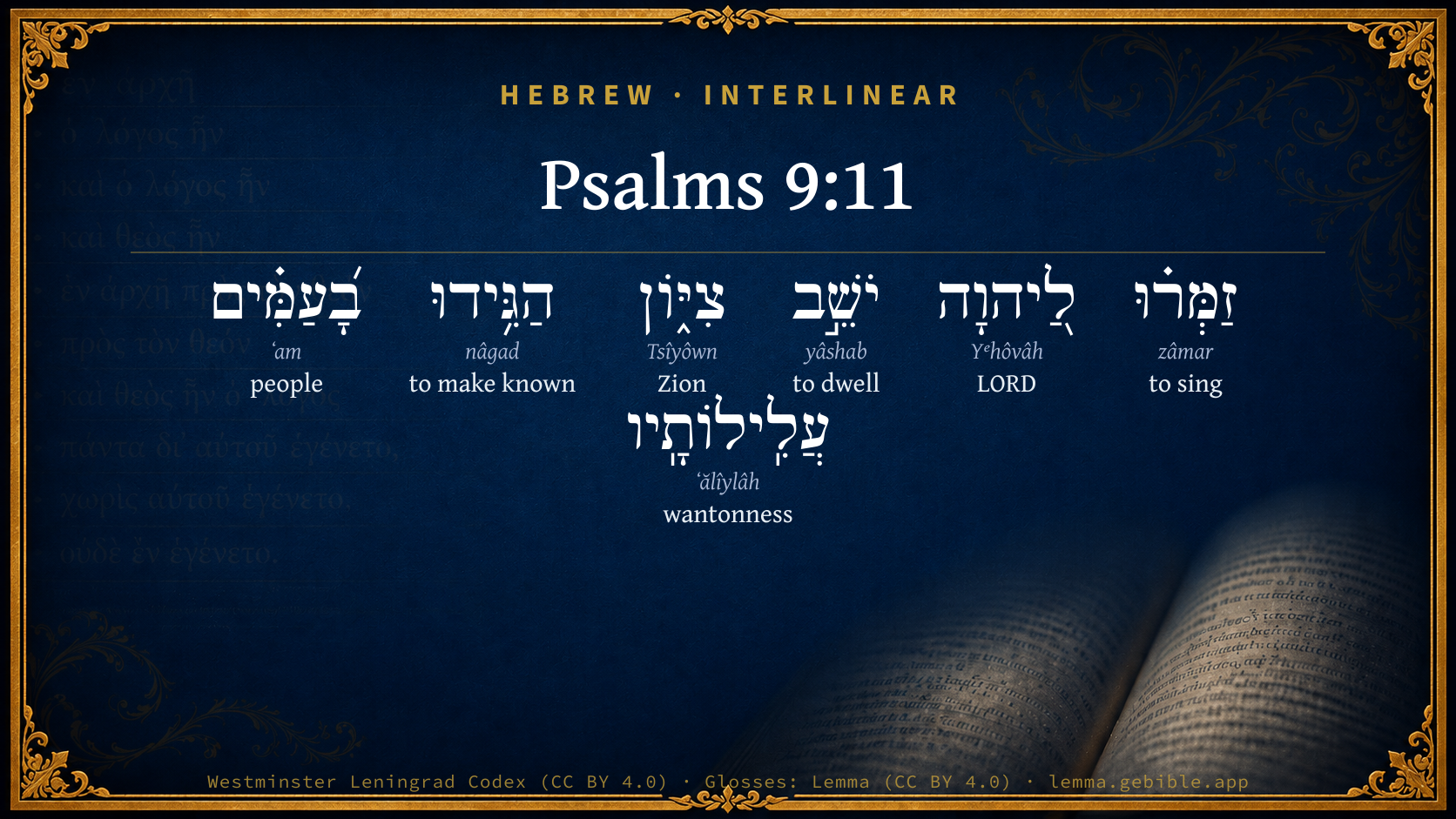
Hebrew (Westminster Leningrad Codex) Psalms 9:11 appears in the Hebrew Old Testament. The text above is from the Westminster Leningrad Codex. Each word links to its Strong’s number, a concise gloss, and parsing drawn from the Open Scriptures Hebrew Bible morphology. Click any word for its full Brown-Driver-Briggs (BDB) entry.
Download image
Cite this verse

Psalms 9:11 (World English Bible). Public Domain. Lemma interlinear Bible study tool, https://lemma.gebible.app/v/psalms/9/11.

Show BibTeX & RIS
BibTeX
RIS
English Translation
Sing praises to Yahweh, who dwells in Zion, And declare among the people what he has done.
World English Bible · Public Domain
Download a study sheet

One document with this verse’s original text, its word-by-word gloss line, the meaning frame, cross-references with their text, attributed commentary, and full source and license credits — printable, and it pastes into notes with its structure intact.

This verse Autodidact and up

Study sheet (.html) Plain text (.txt)

A passage Seminary Student

Up to 50 verses in one chapter. A passage sheet keeps up to 6 commentary sources and 12 cross-references per verse, in the order this page ranks them, and says so on the sheet whenever that leaves anything out. Ask for a single verse and you get the Autodidact verse sheet above.

Everything on this page stays free to read, with no account — the sheet is a download of what is already on screen, not access to it.

Want to remove ads? Support Godless Engineer
Compare translations 3

The same verse in 3 English versions, stacked beneath the original-language interlinear above. Click any original word for its lexicon entry.

Each is an independent rendering of the whole verse — the interlinear is not word-aligned to these translations.

Highlighted words mark where these versions differ — a whole-verse word diff, not a word-by-word alignment.

  • World English Bible Public Domain
    Sing praises to Yahweh, who dwells in Zion, And declare among the people what he has done.
  • King James Version Public Domain
    Sing praises to the LORD, which dwelleth in Zion: declare among the people his doings.
  • unfoldingWord Literal Text CC BY-SA 4.0
    Sing praises to Yahweh, the sitter Zion! Declare his deeds among the peoples

unfoldingWord Literal Text — © unfoldingWord, licensed CC BY-SA 4.0. Word-aligned USFM3 via Door43 (git.door43.org/unfoldingWord/en_ult).

Versions to compare (up to 4)

3 of 4 selected

Show all 18 translations

Every available English version of this verse, each an independent rendering of the whole verse.

  • World English Bible Public Domain
    Sing praises to Yahweh, who dwells in Zion, And declare among the people what he has done.
  • Berean Standard Bible Public Domain
    Sing praises to the LORD, who dwells in Zion; proclaim His deeds among the nations.
  • Majority Standard Bible Public Domain
    Sing praises to the LORD, who dwells in Zion; proclaim His deeds among the nations.
  • King James Version Public Domain
    Sing praises to the LORD, which dwelleth in Zion: declare among the people his doings.
  • American Standard Version (1901) Public Domain
    Sing praises to Jehovah, who dwelleth in Zion: Declare among the people his doings.
  • Revised Version (1885) Public Domain
    Sing praises to the LORD, which dwelleth in Zion: declare among the people his doings.
  • Geneva Bible (1599) Public Domain
    Sing praises to the Lord, which dwelleth in Zion: shewe the people his workes.
  • Douay-Rheims (1899) Public Domain
    And let them trust in thee who know thy name: for thou hast not forsaken them that seek thee, O Lord.
  • Young's Literal Translation Public Domain
    Sing ye praise to Jehovah, inhabiting Zion, Declare ye among the peoples His acts,
  • Literal Standard Version CC BY-SA 4.0
    Sing praise to YHWH, inhabiting Zion, || Declare His acts among the peoples,
  • Unlocked Literal Bible CC BY-SA 4.0
    Sing praises to Yahweh, who rules in Zion; tell the nations what he has done.
  • unfoldingWord Literal Text CC BY-SA 4.0
    Sing praises to Yahweh, the sitter Zion! Declare his deeds among the peoples
  • Darby Bible Public Domain
    Sing psalms to Jehovah who dwelleth in Zion; tell among the peoples his doings.
  • World Messianic Bible Public Domain
    Sing praises to the LORD, who dwells in Zion, and declare among the people what he has done.
  • Webster's Bible Public Domain
    \\9:10\\And they that know thy name will put their trust in thee: for thou, LORD, hast not forsaken them that seek thee.
  • Free Bible Version CC BY-SA 4.0
    Sing praises to the Lord who reigns in Zion! Tell the nations what he has done!
  • Bible in Basic English Public Domain
    Make songs of praise to the Lord, whose house is in Zion: make his doings clear to the people.
  • JPS Tanakh (1917) Public Domain
    (9-12) Sing praises to the LORD, who dwelleth in Zion; declare among the peoples His doings.

Literal Standard Version (2020), Covenant Press — licensed CC BY-SA 4.0. Text via the HelloAO Bible API (eBible.org). Unlocked Literal Bible (unfoldingWord) — licensed CC BY-SA 4.0. Text via the HelloAO Bible API (eBible.org). unfoldingWord Literal Text — © unfoldingWord, licensed CC BY-SA 4.0. Word-aligned USFM3 via Door43 (git.door43.org/unfoldingWord/en_ult). Free Bible Version, Dr. Jonathan Gallagher — licensed CC BY-SA 4.0. Text via the HelloAO Bible API (eBible.org).

Word by word

More ways to search: Search by grammar → Find every occurrence → Compare this word →

Practice this passage: Drill this verse → Learn its vocabulary →

About this verse

These counts appear in no published source. They are computed here, from the morphology-tagged text and Lemma’s own curated glosses. What Lemma adds →

7
words
7
distinct lemmas
Wisdom
section

Notable vocabulary

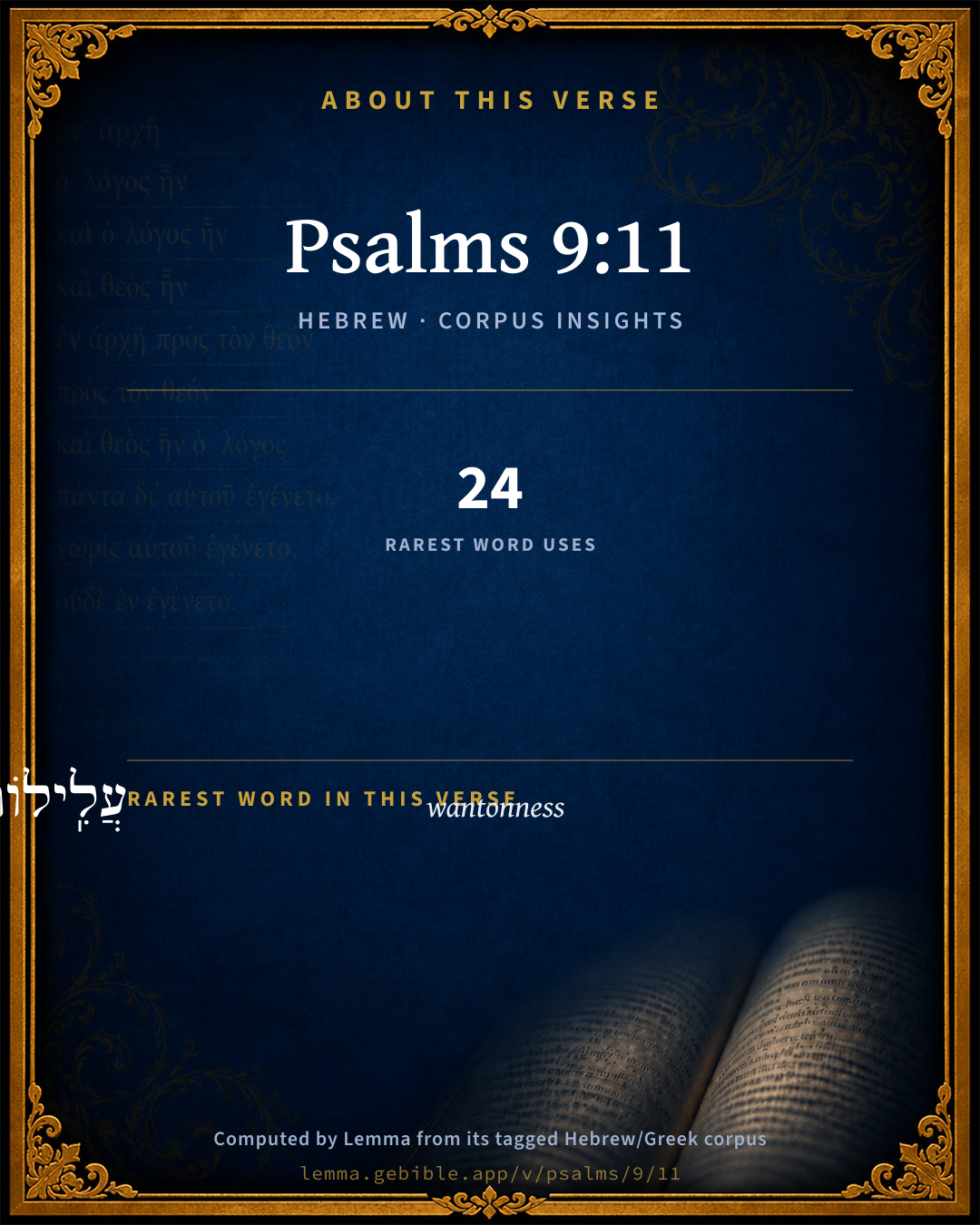
The rarest word here is עֲלִֽילוֹתָֽיו wantonness H5949 — appearing just 24 times in the whole Hebrew Bible.

Shared distinctive vocabulary

עֲלִֽילוֹתָֽיו wantonness H5949 occurs in 24 verses of the Hebrew Bible. Also found in:

Grammatical profile

  • 3 verbs
  • 4 nouns

Verb forms

  • זַמְּר֗וּ Piel · Imperative
  • יֹשֵׁ֣ב Qal · Participle Active
  • הַגִּ֥ידוּ Hiphil · Imperative

Hebrew & Septuagint length

In English translation the verse runs 17 words from the Hebrew and 15 from the Septuagint (LXX English) — closely comparable.

A rough comparison of the two English renderings, which tokenize alike — not a word-level alignment.

Word counts can differ between the Hebrew and the Greek without any difference in meaning — e.g. the Hebrew direct-object marker אֵת has no separate Greek word, and Greek often adds the article ὁ.

Cross-references

17

Topical passages linked to Psalms 9:11 in the Treasury of Scripture Knowledge — connected by theme and wording, ordered by reader-vote popularity; previews shown in the World English Bible.

  • Psalms 107:22 Let them offer the sacrifices of thanksgiving, And declare his works with singing.
  • Psalms 96:1–2 Sing to Yahweh a new song! Sing to Yahweh, all the earth.
  • Psalms 148:1–5 Praise Yah! Praise Yahweh from the heavens! Praise him in the heights!
  • Psalms 66:2 Sing to the glory of his name! Offer glory and praise!
  • Psalms 105:1–2 Give thanks to Yahweh! Call on his name! Make his doings known among the peoples.
  • Isaiah 12:4–6 In that day you will say, "Give thanks to Yahweh! Call on his name. Declare his doings among the peoples. Proclaim that his name is exalted!
  • Psalms 96:10 Say among the nations, "Yahweh reigns." The world is also established. It can't be moved. He will judge the peoples with equity.
  • Psalms 118:17 I will not die, but live, And declare Yah's works.
  • Psalms 66:5 Come, and see God's deeds-- Awesome work on behalf of the children of men.
  • Psalms 33:1–3 Rejoice in Yahweh, you righteous! Praise is fitting for the upright.
  • Psalms 76:2 His tent is also in Salem; His dwelling place in Zion.
  • Revelation 14:1 I saw, and behold, the Lamb standing on Mount Zion, and with him a number, one hundred forty-four thousand, having his name, and the name of his Father, written on their foreheads.
  • Psalms 78:68 But chose the tribe of Judah, Mount Zion which he loved.
  • Isaiah 14:32 What then shall one answer the messengers of the nation? That Yahweh has founded Zion, and in her shall the afflicted of his people take refuge.
  • John 17:26 I made known to them your name, and will make it known; that the love with which you loved me may be in them, and I in them."
  • Psalms 47:6–7 Sing praise to God, sing praises. Sing praises to our King, sing praises.

Cross-references courtesy of OpenBible.info (CC BY 4.0).

Hebrew and Greek witnesses Masoretic Hebrew ↔ Greek Septuagint

The same verse in the two great witnesses to the Old Testament, shown verse-for-verse.

You’re reading Greek Psalm 9 (Hebrew Psalm 9). The Septuagint counts the superscription, so verse numbers can differ from the Hebrew — chapter-level alignment, not verse-by-verse. Numbering follows Rahlfs.

These are two independent witnesses, not word-aligned to each other, and the Septuagint is shown in lemma (dictionary) form.

Hebrew Psalms 9:11 Masoretic · Westminster Leningrad Codex

זַמְּר֗וּ לַ֭יהוָה יֹשֵׁ֣ב צִיּ֑וֹן הַגִּ֥ידוּ בָ֝עַמִּ֗ים עֲלִֽילוֹתָֽיו

Sing praises to Yahweh, who dwells in Zion, And declare among the people what he has done.

World English Bible · Public Domain

Greek LXX Greek Psalm 9:11 Septuagint · lemma form

καί ἐλπίζω ἐπί σύ ὁ γιγνώσκω ὁ ὄνομα σύ ὅτι οὐ ἐν καταλείπω ὁ ἐκζητέω σύ κύριος

Sing praises to the Lord, who dwells in Sion: declare his dealings among the nations.

LXX2012 (modern English Septuagint) · Public Domain

Hebrew: Westminster Leningrad Codex (CC BY 4.0). Greek: Septuagint (public domain); English from LXX2012 (modern English Septuagint) (Public Domain). How the Septuagint differs from the Hebrew →

Commentary

Notes on Psalms 9:11 from classic Christian and Jewish commentators (each source and its license shown beneath its notes). The classic Christian expositions comment on the surrounding passage and are grouped to its opening verse, so a note may address several verses; the Jewish commentaries on the Tanakh (Rashi and others) are per-verse, so they appear only where the commentator wrote on this verse.

Lemma curates 59 commentaries, every one of them public domain or Creative Commons licensed, each selected and text-cleaned for this edition rather than reprinted as found. About our sources →

Matthew Henry's Commentary

In these verses,

I. David, having praised God himself, calls upon and invites others to praise him likewise, Psa 9:11. Those who believe God is greatly to be praised not only desire to do that work better themselves, but desire that others also may join with them in it and would gladly be instrumental to bring them to it: Sing praises to the Lord who dwelleth in Zion. As the special residence of his glory is in heaven, so the special residence of his grace is in his church, of which Zion was a type. There he meets his people with his promises and graces, and there he expects they should meet him with their praises and services. In all our praises we should have an eye to God as dwelling in Zion, in a special manner present in the assemblies of his people, as their protector and patron. He resolved himself to show forth God's marvellous works (Psa 9:1), and here he calls upon others to declare among the people his doings. He commands his own subjects to do it, for the honour of God, of their country, and of their holy religion; he courts his neighbours to do it, to sing praises, not, as hitherto, to their false gods, but to Jehovah who dwelleth in Zion, to the God of Israel, and to own among the heathen that the Lord has done great things for his people Israel, Psa 126:3, Psa 126:4. Let them particularly take notice of the justice of God in avenging the blood of his people Israel on the Philistines and their other wicked neighbours, who had, in making war upon them, used them barbarously and given them no quarter, Psa 9:12. When God comes to make inquisition for blood by his judgments on earth, before he comes to do it by the judgment of the great day, he remembers them, remembers every drop of the innocent blood which they have shed, and will return it sevenfold upon the head of the blood-thirsty; he will give them blood to drink, for they are worthy. This assurance he might well build upon that word (Deu 32:43), He will avenge the blood of his servants. Note, There is a day coming when God will make inquisition for blood, when he will discover what has been shed secretly, and avenge what has been shed unjustly; see Isa 26:21; Jer 51:35. In that day it will appear how precious the blood of God's people is to him (Psa 72:14), when it must all be accounted for. It will then appear that he has not forgotten the cry of the humble, neither the cry of their blood nor the cry of their prayers, but that both are sealed up among his treasures.

II. David, having praised God for former mercies and deliverances, earnestly prays that God would still appear for him; for he sees not all things put under him.

1. He prays, (1.) That God would be compassionate to him (Psa 9:13): "Have mercy upon me, who, having misery only, and no merit, to speak for me, must depend upon mercy for relief." (2.) That he would be concerned for him. He is not particular in his request, lest he should seem to prescribe to God; but submits himself to the wisdom and will of God in this modest request, "Lord, consider my trouble, and do for me as thou thinkest fit."

2. He pleads, (1.) The malice of his enemies, the trouble which he suffered from those that hated him, and hatred is a cruel passion. (2.) The experience he had had of divine succours and the expectation he now had of the continuance of them, as the necessity of his case required: "O thou that liftest me up, that canst do it, that hast done it, that wilt do it, whose prerogative it is to lift up thy people from the gates of death!" We are never brought so low, so near to death, but God can raise us up. If he has saved us from spiritual and eternal death, we may thence take encouragement to hope that in all our distresses he will be a very present help to us. (3.) His sincere purpose to praise God when his victories should be completed (Psa 9:14): "Lord, save me, not that I may have the comfort and credit of the deliverance, but that thou mayest have the glory, that I may show forth all thy praise, and that publicly, in the gates of the daughter of Zion;" there God was said to dwell (Psa 9:11) and there David would attend him, with joy in God's salvation, typical of the great salvation which was to be wrought out by the Son of David.

III. David by faith foresees and foretels the certain ruin of all wicked people, both in this world and in that to come.

1. In this world, Psa 9:15, Psa 9:16. God executes judgment upon them when the measure of their iniquities is full, and does it, (1.) So as to put shame upon them and make their fall inglorious; for they sink into the pit which they themselves digged (Psa 7:15), they are taken in the net which they themselves laid for the ensnaring of God's people, and they are snared in the work of their own hands. In all the struggles David had with the Philistines they were the aggressors, Sa2 5:17, Sa2 5:22. And other nations were subdued by those ward in which they embroiled themselves. The overruling providence of God frequently so orders it that persecutors and oppressors are brought to ruin by those very projects which they intended to be destructive to the people of God. Drunkards kill themselves; prodigals beggar themselves; the contentious bring mischief upon themselves. Thus men's sins may be read in their punishment, and it becomes visible to all that the destruction of sinners is not only meritoriously, but efficiently, of themselves, which will fill them with the utmost confusion. (2.) So as to get honour to himself: The Lord is known, that is, he makes himself known, by these judgments which he executes. It is known that there is a God who judges in the earth, that he is a righteous God, and one that hates sin and will punish it. In these judgments the wrath of God is revealed from heaven against all ungodliness and unrighteousness of men. The psalmist therefore adds here a note extraordinary, commanding special regard, Higgaion; it is a thing to be carefully observed and meditated upon. What we see of present judgments, and what we believe of the judgment to come, ought to be the subject of our frequent and serious meditations.

2. In the other world (Psa 9:17): The wicked shall be turned into hell, as captives into the prison-house, even all the nations that forget God. Note, (1.) Forgetfulness of God is the cause of all the wickedness of the wicked. (2.) There are nations of those that forget God, multitudes that live without God in the world, many great and many mighty nations, that never regard him nor desire the knowledge of his ways. (3.) Hell will, at last, be the portion of such, a state of everlasting misery and torment - Sheol, a pit of destruction, in which they and all their comforts will be for ever lost and buried. Though there be nations of them, yet they shall be turned into hell, like sheep into the slaughter-house (Psa 49:14), and their being so numerous will not be any security or ease to them, nor any loss to God or the least impeachment of his goodness.

IV. David encourages the people of God to wait for his salvation, though it should be long deferred, Psa 9:18. The needy may think themselves, and others may think them, forgotten for a while, and their expectation of help from God may seem to have perished and to have been for ever frustrated. But he that believes does not make haste; the vision is for an appointed time, and at the end it shall speak. We may build upon it as undoubtedly true that God's people, God's elect, shall not always be forgotten, nor shall they be disappointed of their hopes from the promise. God will not only remember them, at last, but will make it to appear that he never did forget them; it is impossible he should, though a woman may forget her sucking child.

V. He concludes with prayer that God would humble the pride, break the power, and blast the projects, of all the wicked enemies of his church: "Arise, O Lord! (Psa 9:19), stir up thy self, exert thy power, take thy seat, and deal with all these proud and daring enemies of thy name, and cause, and people." 1. "Lord, restrain them, and set bounds to their malice: Let not man prevail; consult thy own honour, and let not weak and mortal men prevail against the kingdom and interest of the almighty and immortal God. Shall mortal man be too hard for God, too strong for his Maker?" 2. "Lord, reckon with them: Let the heathen be judges in thy sight, that is, let them be plainly called to an account for all the dishonour done to thee and the mischief done to thy people." Impenitent sinners will be punished in God's sight; and, when their day of grace is over, the bowels even of infinite mercy will not relent towards them, Rev 14:10. 3. "Lord, frighten them: Put them in fear, O Lord! (Psa 9:20), strike a terror upon them, make them afraid with thy judgments." God knows how to make the strongest and stoutest of men to tremble and to flee when none pursues, and thereby he makes them know and own that they are but men; they are but weak men, unable to stand before the holy God - sinful men, the guilt of whose consciences make them subject to alarms. Note, It is a very desirable thing, much for the glory of God and the peace and welfare of the universe, that men should know and consider themselves to be but men, depending creatures, mutable, mortal, and accountable.

In singing this psalm we must give to God the glory of his justice in pleading his people's cause against his and their enemies, and encourage ourselves to wait for the year of the redeemed and the year of recompences for the controversy of Zion, even the final destruction of all anti-christian powers and factions, to which many of the ancients apply this psalm.

Matthew Henry's Commentary on the Whole Bible (1708–1710) — public domain (CC PDM 1.0). Text via the HelloAO Bible API.

Trapp's Complete Commentary

John Trapp

Psa 9:11 Sing praises to the LORD, which dwelleth in Zion: declare among the people his doings.

Ver. 11. Sing praises to the Lord, &c.] This is the guise of godly people, to provoke others to praise God, as being unsatisfiable in their desires of doing him that service, and as deeming that others see him as they do totum totum desiderabilem, worthy to be praised, Psa 18:3, highly to be admired, Psa 9:1 of this psalm.

John Trapp, A Commentary or Exposition upon All the Books of the Old and New Testament (1647–1656) — public domain. Text from a community e-Sword module.

Joseph Benson's Commentary

Psa 9:11. Sing praises to the Lord — Those who believe God is greatly to be praised not only desire to do that work better themselves, but desire that others also may join with them in it, and would gladly be instrumental to bring them to it. Which dwelleth in Zion — As the special residence of his glory is in heaven, so the special residence of his grace is in his church, of which Zion was a type: there he meets his people with his promises and graces, and there he expects they should meet him with their praises and services. Declare among the people his doings — Not only among the Israelites, but to the heathen nations, that they may also be brought to the knowledge and worship of the true God.

Joseph Benson's Commentary on the Old and New Testaments (1811–1818) — public domain. Text from a community e-Sword module.

J. A. Alexander on Psalms

Joseph Addison Alexander

12. (Psa 9:11). Sing, make music, give praise by song or music, to Jehovah, as the God of Israel, inhabiting Zion, i. e. the sanctuary there established. Or the words may mean sitting, as a king, enthroned, (in) Zion, which agrees well with the use of the same verbs in Psa 9:5; Psa 9:8 (4, 7) above, although the other version is favoured by the obvious allusion to the symbolical import of the sanctuary under the Mosaic law, as teaching the great doctrine of God's dwelling among men. See above, on Psa 3:5 (4), Psa 9:8 (7). Zion is here represented as the centre of a circle reaching far beyond the house of Israel, and indeed co-extensive with the earth. Tell, declare, make known, in, among, the nations, his exploits, his noble deeds, the wonders mentioned in Psa 9:2 (1). We have here, in his inspired formula of worship, a clear proof that the ancient church believed and understood the great truth, that the law was to go forth from Zion, and the word of the Lord from Jerusalem, Isa 2:3, Mic 4:2.

Joseph Addison Alexander, The Psalms Translated and Explained (1850) — public domain. Text from a community e-Sword module.

Tyndale Open Study Notes

Tyndale Open Resources

9:11-12 Recognition that the Lord’s judgment falls on some of the wicked (9:3-6) and that God promises to judge all evil (9:7-10) motivates praise. The psalmist calls on the godly community to join him.

9:11 The psalm writers often connect the idea that God reigns (or sits, or is enthroned) with a place, such as heaven (2:4; see 47:9), Jerusalem, “between the cherubim” (80:1; 99:1), “on high” (113:5), or “at my right hand” (110:1). Since the Lord rules the world, all people must know of his unforgettable deeds of salvation (see 9:1; 64:9; 66:16; 105:1).

Tyndale Open Study Notes — © Tyndale Open Resources, licensed CC BY-SA 4.0. Text via the HelloAO Bible API.

Jamieson, Fausset & Brown

Robert Jamieson, A. R. Fausset & David Brown

(Compare Psa 2:6; Psa 3:4).

Jamieson, Fausset & Brown — Commentary Critical and Explanatory on the Whole Bible (1871) — public domain (CC PDM 1.0). Text via the HelloAO Bible API.

Adam Clarke's Commentary

Verse 11. Declare among the people his doings.] It is the duty of all those who have received the salvation of God, to recommend him and his salvation to the whole circle of their acquaintance, Christians, so called, when they meet, seldom speak about God! Why is this? Because they have nothing to say.

Adam Clarke's Commentary on the Bible (1810–1826) — public domain. Text from a community e-Sword/MySword module.

John Calvin's Commentaries

11. Sing unto Jehovah. David, not contented with giving thanks individually, and on his own account, exhorts the faithful to unite with him, praising God, and to do this not only because it is their duty to stir up one another to this religious exercise, but because the deliverances of which he treats were worthy of being publicly and solemnly celebrated; and this is expressed more clearly in the second clause, where he commands them to be published among the nations. The meaning is, that they are not published or celebrated as they deserve, unless the whole world is filled with the renown of them. To proclaim God’s doings among the nations was indeed, as it were, to sing to the deaf; but by this manner of speaking, David intended to show that the territory of Judea was too narrow to contain the infinite greatness of Jehovah’s praises. He gives God this title, He who dwelleth in Sion, to distinguish him from all the false gods of the Gentiles. There is in the phrase a tacit comparison between the God who made his covenant with Abraham and Israel, and all the gods who, in every other part of the world except Judea, were worshipped according to the blinded and depraved fancies of men. It is not enough for persons to honor and reverence some deity indiscriminately or at random; they must distinctly yield to the only living and true God the worship which belongs to him, and which he commands. Moreover, as God had particularly chosen Sion as the place where his name might be called upon, David very properly assigns it to him as his peculiar dwelling-place, not that it is lawful to attempt to shut up, in any particular place, Him whom “the heaven of heavens cannot contain,” (1 Kings 8:1.) but because, as we shall afterwards see, (Psalm 132:12) he had promised to make it his rest for ever. David did not, according to his own fancy, assign God a dwelling-place there; but he understood, by a revelation from heaven, that such was the pleasure of God himself, as Moses had often predicted, (Deuteronomy 12:1.) This goes far to prove what I have said before, that this psalm was not composed upon the occasion of David’s victory over Goliath; for it was only towards the close of David’s reign that the ark of the covenant was removed to Sion according to the commandment of God. The conjecture of some that David spake by the Spirit of prophecy of the residence of the ark on Sion, as a future event, appears to me to be unnatural and forced. Farther, we see that the holy fathers, when they resorted to Sion to offer sacrifices to God, did not act merely according to the suggestion of their own minds; but what they did proceeded from faith in the word of God, and was done in obedience to his command; and they were, therefore, approved of by him for their religious service. Whence it follows, that there is no ground whatever to make use of their example as an argument or excuse for the religious observances which superstitious men have, by their own fancy, invented for themselves. Besides, it was not enough for the faithful, in those days, to depend upon the word of God, and to engage in those ceremonial services which he required, unless, aided by external symbols, they elevated their minds above these, and yielded to God spiritual worship. God, indeed, gave real tokens of his presence in that visible sanctuary, but not for the purpose of binding the senses and thoughts of his people to earthly elements; he wished rather that these external symbols should serve as ladders, by which the faithful might ascend even to heaven. The design of God from the commencement in the appointment of the sacraments, and all the outward exercises of religion, was to consult the infirmity and weak capacity of his people. Accordingly, even at the present day, the true and proper use of them is, to assist us in seeking God spiritually in his heavenly glory, and not to occupy our minds with the things of this world, or keep them fixed in the vanities of the flesh, a subject which we shall afterwards have a more suitable opportunity of discussing more fully. And as the Lord, in ancient times, when he called himself, He who dwelleth in Sion, intended to give his people full and solid ground of trust, tranquillity, and joy; so even now, after the law has come out of Sion, and the covenant of grace has flowed to us from that fountain, let us know and be fully persuaded, that wherever the faithful, who worship him purely and in due form, according to the appointment of his word, are assembled together to engage in the solemn acts of religious worship, he is graciously present, and presides in the midst of them.

John Calvin's Commentaries (1540-1563) — public domain. Text from the Calvin Translation Society English edition (1840s-50s) via the Christian Classics Ethereal Library (ccel.org). Calvin's coverage is partial (roughly two-thirds of the Bible); uncommented books and verses are honest gaps, never fabricated. The 19th-century editor's footnotes and remarks are omitted so the notes are faithfully Calvin's own voice.

The Cambridge Bible for Schools and Colleges

gen. ed. J. J. S. Perowne

11. which dwelleth in Zion] Or, (cp. Psa_9:7) sitteth enthroned. Zion became the special abode of Jehovah from the time when the Ark, the symbol of His Presence, was placed there (Psa_76:2; Psa_132:13 f.). The cherubim which overshadowed the ark were the throne of His glory (Psa_80:1; Psa_99:1). It was the earthly counterpart of heaven (Psa_2:4): from thence He manifested Himself for the help of His people (Psa_3:4; Psa_20:2).

the people] Rather, the peoples, as R.V. marg. Not Israel, but the nations around, are meant. Jehovah’s doings (Psa_77:12; Psa_78:11; Psa_103:7), i.e. His mighty works on behalf of His people, are to be proclaimed among them. The first step towards their conversion is that they should know the evidences of His power and love. Cp. Psa_18:49; Psa_57:9; Psa_96:3; Psa_105:1; Isa_12:4.

11, 12. Stanza of Zayin. A call to praise.

The Cambridge Bible for Schools and Colleges (gen. ed. J. J. S. Perowne; Cambridge University Press, 1878–1918) — public domain. Text from a community e-Sword module.

John Gill's Exposition

When he maketh inquisition for blood,.... The Arabic version renders it, "he remembers him that seeks their blood"; that is, the wicked man, that lies in wait for innocent blood, and whose feet are swift to shed it; the man of sin, who is bloodthirsty; who drinks up the blood of the saints like water, and has been made drunk with the blood of the martyrs of Jesus, him will God remember, and take vengeance on, in his own time: but rather this is to be understood of God himself, seeking for the blood of his saints: he knows where it is, though ever so privily shed, as he did Abel's; yet, to show his strict care and accurate notice of it, he is represented as searching for it, and finding it out by secret search, Jer 2:34. And it is the same phrase with "requiring" blood, and expresses a demand of satisfaction for it; and declares the vengeance that God will take on account of it: he requires the blood of every man at the hand of him by whom it is shed, Gen 9:5; especially the blood of the righteous, Mat 23:35; particularly the blood of the martyrs of Jesus, shed by the Romish antichrist; he will make inquisition for that, and will find in Babylon the blood of the prophets and saints, and of all that are slain on earth; and will avenge the blood of his servants at her hand, and give her blood to drink, Rev 18:24;

he remembereth them; either the "righteous", as the Targum paraphrases it, whose blood has been shed; or else the wicked, who shed their blood: God will remember them and their sins; which, for some time, may seem not to have been taken notice of by him, and will pour out his wrath, and inflict just punishment on them; see Rev 16:19;

he forgetteth not the cry of the humble: the "Cetib", or writing of the text, is "afflicted"; the "Keri", or marginal reading, is "humble"; so the Masorah and Targum read: both may be taken into the sense: afflicted persons are generally humble, afflictions make them humble; God's people are an afflicted people; afflicted with sin, with Satan, with the world, with antichrist and his followers: and they are an humble people; grace makes them humble, and a sense of their sin and unworthiness keeps them so: and this is a proper character of the followers of Jesus. These in their distress cry to the Lord, as the Israelites did in Egypt under their bondage and, pressures: yea, their blood cries after death, as Abel's did, and as the blood of the martyrs of Christ does, whose souls under the altar cry for vengeance, Rev 6:9; and God is not unmindful of their cry; however he may seem to be, he takes notice of it, and wilt in his own time avenge his elect, which cry unto him day and night.

John Gill's Exposition of the Whole Bible (1746–1763) — public domain (CC PDM 1.0). Text via the HelloAO Bible API.

Albert Barnes' Notes on the Bible

Sing praises to the Lord - As the result of these views of his character, and at the remembrance of his doings. The heart of the psalmist is full of exultation and joy at the remembrance of the divine interposition, and he naturally breaks out into these strong expressions, calling on others to rejoice also.

Which dwelleth in Zion - On the word Zion, see the notes at Psa 2:6. Compare Psa 3:4; Psa 5:7. As Zion was the place where at this time the tabernacle was set up, and the worship of God was celebrated, it is spoken of as his dwelling-place.

Declare among the people his doings - Make general and wide proclamation of what he has done; that is, make him known abroad, in his true character, that others may be brought also to put their trust in him, and to Praise him.

Albert Barnes' Notes on the Bible (1834–1885) — public domain. Text from a community e-Sword/MySword module.

Matthew Poole's English Annotations

Which dwelleth in Zion; whose special and gracious presence is there; for there was the ark at this time.

Among the people, i.e. to the heathen nations, that they also may be brought to the knowledge and worship of the true God.

Matthew Poole's English Annotations on the Holy Bible (1683–1685) — public domain. Text from a community e-Sword/MySword module.

The Treasury of David

Charles H. Spurgeon

Ver. 11. Being full of gratitude himself, our inspired author is eager to excite others to join the strain, and praise God in the same manner as he himself vowed to do in the first and second verses. The heavenly spirit of praise is gloriously contagious, and he that hath it is never content unless he can excite all who surround him to unite in his sweet employ. Singing and preaching, as means of glorifying God, are here joined together, and it is remarkable that, connected with all revivals of gospel ministry, there has been a sudden outburst of the spirit of song. Luther's Psalms and Hymns were in all men's mouths, and in the modern revival under Wesley and Whitefield, the strains of Charles Wesley, Cennick, Berridge, Toplady, Hart, Newton, and many others, were the outgrowth of restored piety. The singing of the birds of praise fitly accompanies the return of the gracious spring of divine visitation through the proclamation of the truth. Sing on brethren, and preach on, and these shall both be a token that the Lord still dwelleth in Zion. It will be well for us when coming up to Zion, to remember that the Lord dwells among his saints, and is to be had in peculiar reverence of all those that are about him.

None.

Ver. 11.

1. Zion, what is it?

2. Her glorious inhabitant, what doth he?

3. The twofold occupation of her sons "sing praises, " "declare among the people his doings."

4. Arguments from the first part of the subject to encourage us in the double duty.

Charles H. Spurgeon's The Treasury of David (1869–1885) — public domain. Psalms only. Text from a community e-Sword/MySword module.

Whedon's Commentary on the Bible

Daniel D. Whedon

11, 12. Sing praises to the Lord—We have here a call for public thanksgiving by all the people in their religious assemblies.

Which dwelleth in Zion—Zion was now the center of worship for the nation, (see Psa_9:14,) which fixes the date of this psalm as being not earlier than the Syrian wars.

Declare among the people—Peoples, here plural, עמים, (ammim,) cannot, as it commonly does, refer to Gentile nations, but to the whole Israelitish family, the covenant tribes.

Inquisition for blood— Searches for the detection and punishment of those who shed innocent blood. See Gen_9:5; Eze_33:6.

He remembereth them— That is, those who “trust” and “seek him.” Psa_9:10.

Daniel D. Whedon (gen. ed.), Commentary on the Old and New Testaments (1874–1909) — public domain. Text from a community e-Sword module.

The Pulpit Commentary

Sing praises to the Lord. Having praised God himself (vers. 1, 2), and declared the grounds upon which his praises rest (vers. 3-10), David now calls upon all faithful Israelites to join him in his song of thanksgiving. "Sing praises unto the Lord," he says, which dwelleth in Zion. Who is enthroned, i.e. , on the mercy-seat between the cherubim in the tabernacle, now set up upon Mount Zion. (2Sa_6:1-17) The date of the psalm is thus to some extent limited, since it must have been composed subsequently to the transfer of the ark to Jerusalem. Declare among the people his doings. In the original "among the peoples" ( i.e. not the people of Israel only, but all the surrounding nations. David is possessed with the conviction that the revelation of God made to Israel is not to be confined to them, but through them to be communicated to "all the ends of the earth to the heathen at large, to all nations. (comp. Psa_18:49 Psa_66:4 Psa_72:11, Psa_72:19, etc.)

The Pulpit Commentary (1880–1919), ed. H.D.M. Spence-Jones & Joseph S. Exell — public domain. Text from a community e-Sword module.

John Wesley's Explanatory Notes

Zion - Whose special and gracious presence is there. People - To the heathen nations.

John Wesley, Explanatory Notes Upon the Whole Bible (1754–1765) — public domain. Text via the GEBible commentary corpus.

Keil & Delitzsch

C. F. Keil & F. Delitzsch

(Heb.: 9:12-13) Thus then the z-strophe summons to the praise of this God who has done, and will still do, such things. The summons contains a moral claim, and therefore applies to all, and to each one individually. Jahve, who is to be praised everywhere and by every one, is called ישׁב ציּון, which does not mean: He who sits enthroned in Zion, but He who inhabiteth Zion, Ges. 138, 1. Such is the name by which He is called since the time when His earthly throne, the ark, was fixed on the castle hill of Jerusalem, Psa 76:3. It is the epithet applied to Him during the period of the typical kingship of promise. That Jahve's salvation shall be proclaimed from Zion to all the world, even outside Israel, for their salvation, is, as we see here and elsewhere, an idea which throbs with life even in the Davidic Psalms; later prophecy beholds its realisation in its wider connections with the history of the future. That which shall be proclaimed to the nations is called עלילותיו, a designation which the magnalia Dei have obtained in the Psalms and the prophets since the time of Hannah's song, Sa1 2:3 (from עלל, root על, to come over or upon anything, to influence a person or a thing, as it were, from above, to subject them to one's energy, to act upon them).

With כּי, quod, in Psa 9:13, the subject of the proclamation of salvation is unfolded as to its substance. The praett. state that which is really past; for that which God has done is the assumption that forms the basis of the discourse in praise of God on account of His mighty acts. They consist in avenging and rescuing His persecuted church-persecuted even to martyrdom. The אותם, standing by way of emphasis before its verb, refers to those who are mentioned afterwards (cf. Psa 9:20): the Chethb calls them עניּים, the Keri ענוים. Both words alternate elsewhere also, the Ker at one time placing the latter, at another the former, in the place of the one that stands in the text. They are both referable to ענה to bend (to bring low, Isa 25:5). The neuter signification of the verb ענה = ענו, Arab.. ‛nâ, fut o., underlies the noun ענו (cf. שׁלו), for which in Num 12:3 there is a Ker עניו with an incorrect Jod (like שׁליו Job 21:23). This is manifest from the substantive ענוה, which does not signify affliction, but passiveness, i.e., humility and gentleness; and the noun עני is passive, and therefore does not, like ענו, signify one who is lowly-minded, in a state of ענוה, but one who is bowed down by afflictions, עני. But because the twin virtues denoted by ענוה are acquired in the school of affliction, there comes to be connected with עני - but only secondarily - the notion of that moral and spiritual condition which is aimed at by dispensations of affliction, and is joined with a suffering life, rather than with one of worldly happiness and prosperity, - a condition which, as Num 12:3 shows, is properly described by ענו (ταπεινός and πραΰ́ς). It shall be proclaimed beyond Israel, even among the nations, that the Avenger of blood, דּמים דּרשׁ, thinks of them (His דּרשׁים), and has been as earnest in His concern for them as they in theirs for Him. דּמים always signifies human blood that is shed by violence and unnaturally; the plur. is the plural of the product discussed by Dietrich, Abhandl. S. 40. דּרשׁ to demand back from any one that which he has destroyed, and therefore to demand a reckoning, indemnification, satisfaction for it, Gen 9:5, then absolutely to punish, Ch2 24:22.

Keil & Delitzsch — Biblical Commentary on the Old Testament (1861–1891) — public domain (CC PDM 1.0). Text via the HelloAO Bible API. (Old Testament only.)

unfoldingWord translationNotes

Door43 World Missions Community

who rules in Zion

"who lives in Jerusalem"

tell the nations

Here "the nations" represents the people of the nations. (See: Metonymy)

For the God who avenges bloodshed remembers

What he remembers can be stated clearly. AT: "For the God who avenges bloodshed remembers those who were killed" or "For God remembers those who were killed and he punishes the killers" (See: Assumed Knowledge and Implicit Information)

he does not forget the cry

"He does not ignore the cry"

translationWords

praise

Zion

avenge

bloodshed

unfoldingWord translationNotes — © Distant Shores Media and the Door43 World Missions Community, licensed CC BY-SA 4.0. Source: git.door43.org/Door43/en_tn.

Radak

Rabbi David Kimhi (Radak)

And they will trust in Thee: – It is right that they should trust in Thee – viz.

those that know Thy Name – as Israel to-day – for they have seen

That Thou, Lord, didst not forsake them that seek Thee: – but that Thou wast with them in the time of their trouble.

Radak on the Tanakh — English translations: “Sefaria Community Translation” (CC0 1.0 (public-domain dedication)); “Eliyahu Munk, HaChut Hameshulash” (CC BY 4.0); “Rabbi Mike Feuer, Jerusalem Anthology” (CC BY 4.0); and “R. David Kimhi on the first book of Psalms, Translated by R.G. Finch, London, 1919” (public domain). Text via Sefaria.

Lesson kit

Teaching starters — assembled from the data on this page, not authored interpretation. Every prompt links to the verse data it draws on. Edit before teaching.

Psalms, in the Wisdom, opens this verse with 7 words (7 distinct Hebrew lemmas). Its most distinctive word is ʻălîylâh (“wantonness”). A historical commentator’s framing appears above. Read the whole chapter for the surrounding context.

Discussion questions

  1. How does “wantonness” (ʻălîylâh) shape what this verse is saying?
  2. How does Deuteronomy 22:14, which shares the word «wantonness», read alongside this verse?
  3. These translations render this verse differently; the difference is in the English rendering, not the original. What questions does that raise?
  4. «זַמְּר֗וּ» is a Piel Imperative verb. How does that grammatical form shape the action described?
  5. Compare how Matthew Henry's Commentary and Trapp's Complete Commentary read this verse. Where do they agree or differ?

Things to notice

Reading settings

Reading text

Shown beneath each verse's original-language words.

Old Testament
Old Testament edition

Read the OT as the Masoretic Hebrew (MT) or the Greek Septuagint (LXX).

English shown for the Greek Septuagint (in the Hebrew ↔ Greek comparison).

Comparing translations? Open the Compare panel on any verse page to stack up to four side by side.