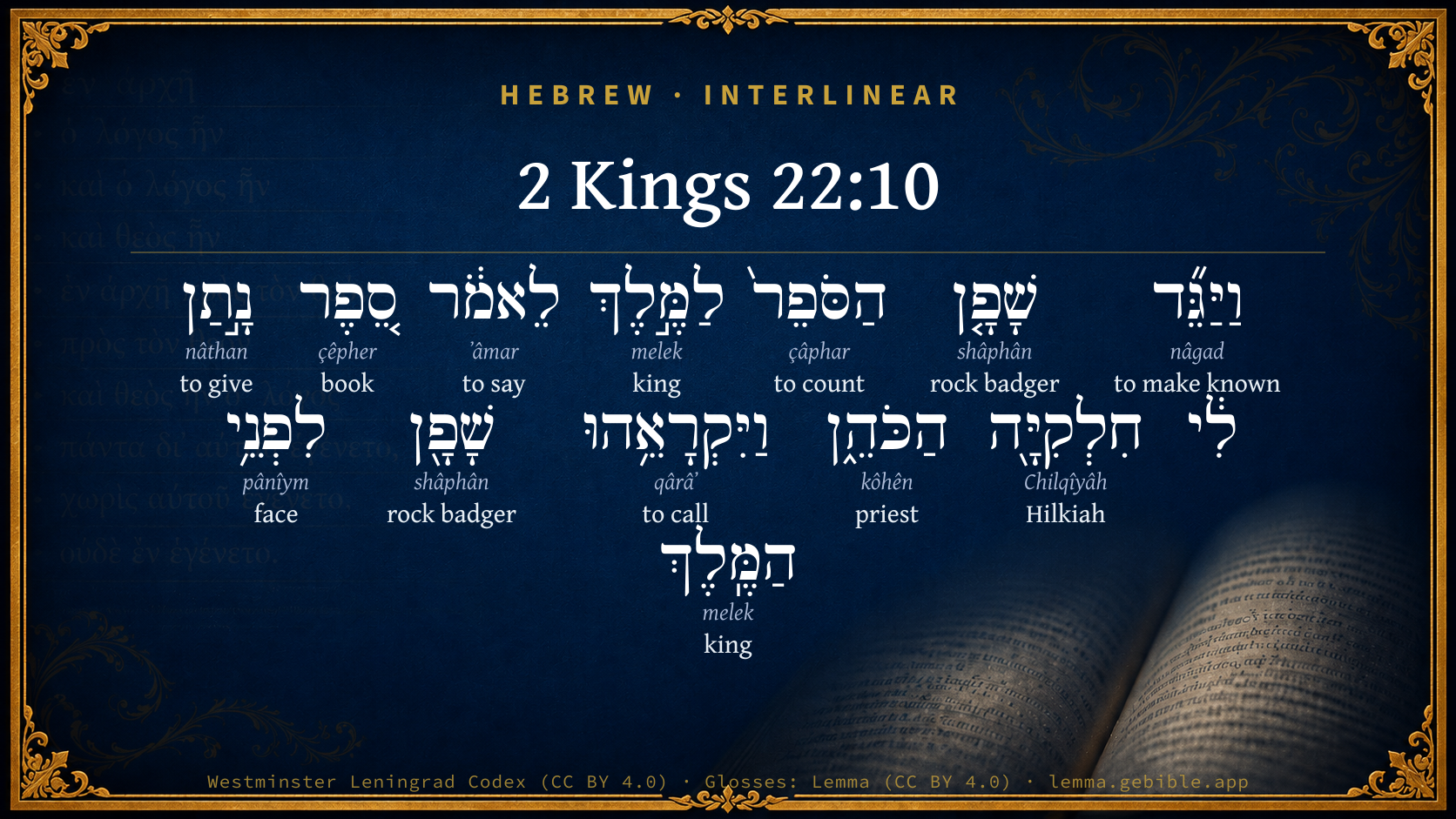
2 Kings 22:10

Hebrew (Westminster Leningrad Codex) 2 Kings 22:10 appears in the Hebrew Old Testament. The text above is from the Westminster Leningrad Codex. Each word links to its Strong’s number, a concise gloss, and parsing drawn from the Open Scriptures Hebrew Bible morphology. Click any word for its full Brown-Driver-Briggs (BDB) entry.
Download image
Cite this verse

2 Kings 22:10 (World English Bible). Public Domain. Lemma interlinear Bible study tool, https://lemma.gebible.app/v/2-kings/22/10.

Show BibTeX & RIS
BibTeX
RIS
English Translation
Shaphan the scribe told the king, saying, Hilkiah the priest has delivered me a book. Shaphan read it before the king.
World English Bible · Public Domain
Download a study sheet

One document with this verse’s original text, its word-by-word gloss line, the meaning frame, cross-references with their text, attributed commentary, and full source and license credits — printable, and it pastes into notes with its structure intact.

This verse Autodidact and up

Study sheet (.html) Plain text (.txt)

A passage Seminary Student

Up to 50 verses in one chapter. A passage sheet keeps up to 6 commentary sources and 12 cross-references per verse, in the order this page ranks them, and says so on the sheet whenever that leaves anything out. Ask for a single verse and you get the Autodidact verse sheet above.

Everything on this page stays free to read, with no account — the sheet is a download of what is already on screen, not access to it.

Want to remove ads? Support Godless Engineer
Compare translations 3

The same verse in 3 English versions, stacked beneath the original-language interlinear above. Click any original word for its lexicon entry.

Each is an independent rendering of the whole verse — the interlinear is not word-aligned to these translations.

Highlighted words mark where these versions differ — a whole-verse word diff, not a word-by-word alignment.

  • World English Bible Public Domain
    Shaphan the scribe told the king, saying, Hilkiah the priest has delivered me a book. Shaphan read it before the king.
  • King James Version Public Domain
    And Shaphan the scribe showed the king, saying, Hilkiah the priest hath delivered me a book. And Shaphan read it before the king.
  • unfoldingWord Literal Text CC BY-SA 4.0
    And Shaphan the scribe declared to the king, saying, “Hilkiah the priest has given a scroll to me.” And Shaphan read it to the face of the king.

unfoldingWord Literal Text — © unfoldingWord, licensed CC BY-SA 4.0. Word-aligned USFM3 via Door43 (git.door43.org/unfoldingWord/en_ult).

Versions to compare (up to 4)

3 of 4 selected

Show all 18 translations

Every available English version of this verse, each an independent rendering of the whole verse.

  • World English Bible Public Domain
    Shaphan the scribe told the king, saying, Hilkiah the priest has delivered me a book. Shaphan read it before the king.
  • Berean Standard Bible Public Domain
    Moreover, Shaphan the scribe told the king, “Hilkiah the priest has given me a book.” And Shaphan read it in the presence of the king.
  • Majority Standard Bible Public Domain
    Moreover, Shaphan the scribe told the king, “Hilkiah the priest has given me a book.” And Shaphan read it in the presence of the king.
  • King James Version Public Domain
    And Shaphan the scribe showed the king, saying, Hilkiah the priest hath delivered me a book. And Shaphan read it before the king.
  • American Standard Version (1901) Public Domain
    And Shaphan the scribe told the king, saying, Hilkiah the priest hath delivered me a book. And Shaphan read it before the king.
  • Revised Version (1885) Public Domain
    And Shaphan the scribe told the king, saying, Hilkiah the priest hath delivered me a book. And Shaphan read it before the king.
  • Geneva Bible (1599) Public Domain
    Also Shaphan the chanceller shewed the King saying, Hilkiah the Priest hath deliuered me a booke. And Shaphan read it before the King.
  • Douay-Rheims (1899) Public Domain
    And Saphan the scribe told the king, saying: Helcias the priest hath delivered to me a book. And when Saphan had read it before the king,
  • Young's Literal Translation Public Domain
    And Shaphan the scribe declareth to the king, saying, `A book hath Hilkiah the priest given to me;' and Shaphan readeth it before the king.
  • Literal Standard Version CC BY-SA 4.0
    And Shaphan the scribe declares to the king, saying, “Hilkiah the priest has given a scroll to me”; and Shaphan reads it before the king.
  • Unlocked Literal Bible CC BY-SA 4.0
    Then Shaphan the scribe said to the king, “Hilkiah the priest has given me a book.” Then Shaphan read it to the king.
  • unfoldingWord Literal Text CC BY-SA 4.0
    And Shaphan the scribe declared to the king, saying, “Hilkiah the priest has given a scroll to me.” And Shaphan read it to the face of the king.
  • Darby Bible Public Domain
    And Shaphan the scribe informed the king saying, Hilkijah the priest has given me a book. And Shaphan read it before the king.
  • World Messianic Bible Public Domain
    Shaphan the scribe told the king, saying, “Hilkiah the priest has delivered a book to me.” Then Shaphan read it before the king.
  • Webster's Bible Public Domain
    And Shaphan the scribe showed the king, saying, Hilkiah the priest hath delivered me a book. And Shaphan read it before the king.
  • Free Bible Version CC BY-SA 4.0
    Then Shaphan the scribe told the king, “Hilkiah the priest has given me a book.” Shaphan read it to the king.
  • Bible in Basic English Public Domain
    Then Shaphan the scribe said to the king, Hilkiah the priest has given me a book; and he was reading it before the king.
  • JPS Tanakh (1917) Public Domain
    And Shaphan the scribe told the king, saying: 'Hilkiah the priest hath delivered me a book.' And Shaphan read it before the king.

Literal Standard Version (2020), Covenant Press — licensed CC BY-SA 4.0. Text via the HelloAO Bible API (eBible.org). Unlocked Literal Bible (unfoldingWord) — licensed CC BY-SA 4.0. Text via the HelloAO Bible API (eBible.org). unfoldingWord Literal Text — © unfoldingWord, licensed CC BY-SA 4.0. Word-aligned USFM3 via Door43 (git.door43.org/unfoldingWord/en_ult). Free Bible Version, Dr. Jonathan Gallagher — licensed CC BY-SA 4.0. Text via the HelloAO Bible API (eBible.org).

Word by word

More ways to search: Search by grammar → Find every occurrence → Compare this word →

Practice this passage: Drill this verse → Learn its vocabulary →

שָׁפָ֤ן
shâphân
H8227
“rock badger”
Noun, Proper
Part of Speech
Noun
Type
Proper
Full BDB Definition

Origin: from H8226

TWOT: 2446a

rock badger, coney, the hyrax (noun masculine) - secretary or scribe of king Josiah of Judah (noun proper masculine) - father of Ahikam in the time of king Josiah of Judah (noun proper masculine) - improbably the same as 2 - father of Elasah in the time of the prophet Jeremiah (noun proper masculine) - perhaps the same as 3 - a scribe and father of Gemariah (noun proper masculine) - perhaps the same as 2 - father of Jaazaniah in the time of Ezekiel (noun proper masculine) - perhaps the same as 2
  1. וַיַּגֵּ֞ד nâgad H5046 “and · to make known” Conjunction + Verb, Hiphil, Sequential Imperfect, 3rd Person, Masculine, Singular
  2. הַסֹּפֵר֙ çâphar H5608 “the · scribe” Particle, Definite Article + Noun, Common, Masculine, Singular, Absolute
  3. לַמֶּ֣לֶךְ melek H4428 “to/for the · king” Preposition, Determined + Noun, Common, Masculine, Singular, Absolute
  4. לֵאמֹ֔ר ʼâmar H559 “to say” Preposition + Verb, Qal, Infinitive Construct
  5. סֵ֚פֶר çêpher H5612 “book” Noun, Common, Masculine, Singular, Absolute
  6. נָ֣תַן nâthan H5414 “to give” Verb, Qal, Perfect, 3rd Person, Masculine, Singular
  7. חִלְקִיָּ֖ה Chilqîyâh H2518 “Hilkiah” Noun, Proper
  8. הַכֹּהֵ֑ן kôhên H3548 “the · priest” Particle, Definite Article + Noun, Common, Masculine, Singular, Absolute
  9. וַיִּקְרָאֵ֥הוּ qârâʼ H7121 “and · to call · him” Conjunction + Verb, Qal, Sequential Imperfect, 3rd Person, Masculine, Singular + Suffix, Personal, 3rd Person, Masculine, Singular
  10. שָׁפָ֖ן shâphân H8227 “rock badger” Noun, Proper
  11. לִפְנֵ֥י pânîym H6440 “to/for · face(s) of” Preposition + Noun, Common, Both, Plural, Construct
  12. הַמֶּֽלֶךְ melek H4428 “the · king” Particle, Definite Article + Noun, Common, Masculine, Singular, Absolute

About this verse

These counts appear in no published source. They are computed here, from the morphology-tagged text and Lemma’s own curated glosses. What Lemma adds →

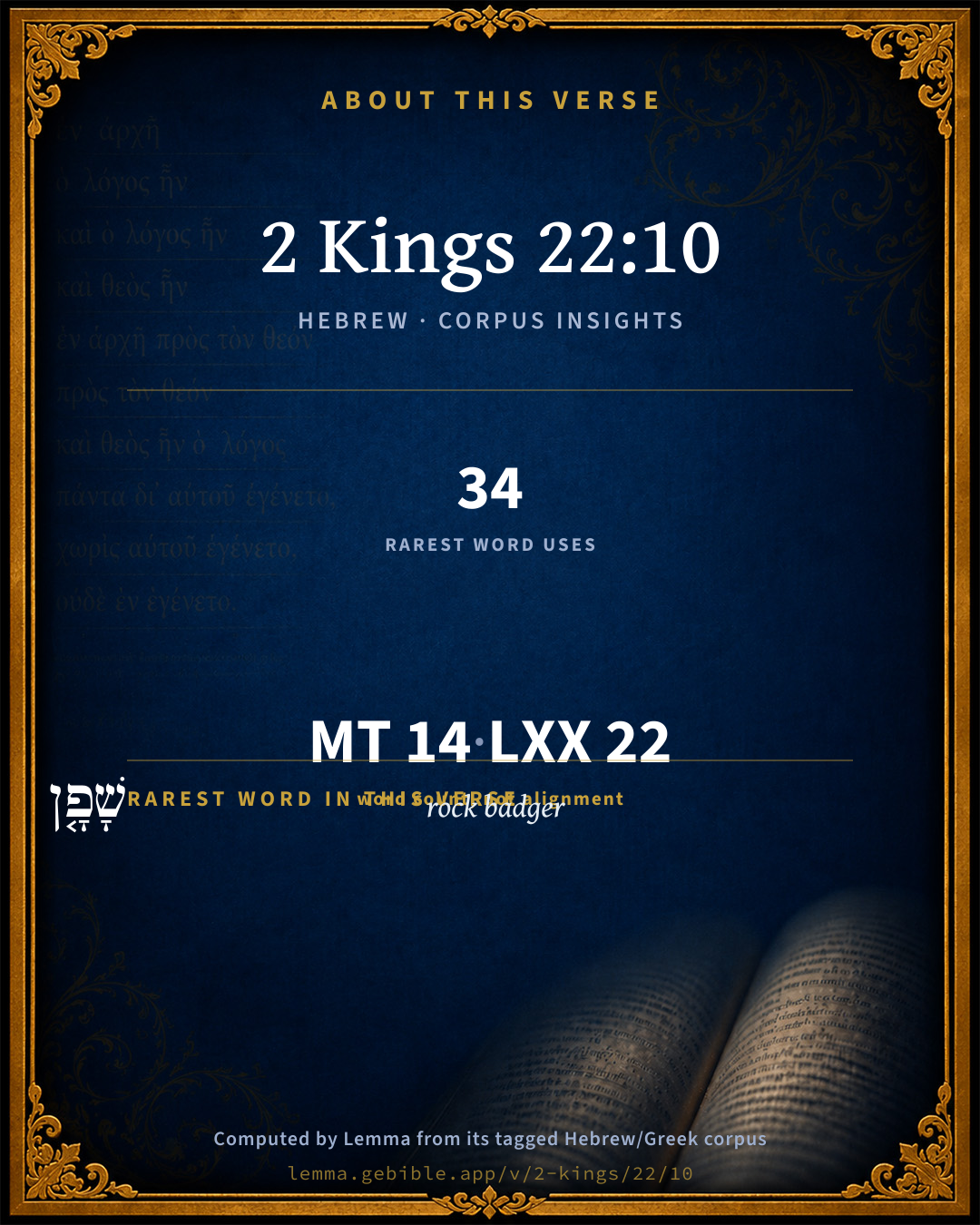
14
words
11
distinct lemmas
Historical
section

Shared distinctive vocabulary

שָׁפָ֤ן rock badger H8227 occurs in 28 verses of the Hebrew Bible. Also found in:

Grammatical profile

  • 4 verbs
  • 9 nouns
  • 1 preposition

Verb forms

  • וַיַּגֵּ֞ד Hiphil · Sequential Imperfect
  • לֵאמֹ֔ר Qal · Infinitive Construct
  • נָ֣תַן Qal · Perfect
  • וַיִּקְרָאֵ֥הוּ Qal · Sequential Imperfect

Repetition

Words recur within this verse — often emphatic in Hebrew:

  • שָׁפָ֤ן rock badger H8227 ×2
  • לַמֶּ֣לֶךְ king H4428 ×2

Hebrew & Septuagint length

In English translation the verse runs 21 words from the Hebrew and 24 from the Septuagint (LXX English) — closely comparable.

A rough comparison of the two English renderings, which tokenize alike — not a word-level alignment.

Word counts can differ between the Hebrew and the Greek without any difference in meaning — e.g. the Hebrew direct-object marker אֵת has no separate Greek word, and Greek often adds the article ὁ.

In the original languages it is 14 Hebrew tokens and 22 Greek tokens — but the two are counted differently (Hebrew bundles its prefixes and suffixes into one token; the Greek is in lemma form), so that isn’t a like-for-like length.

Cross-references

12

Topical passages linked to 2 Kings 22:10 in the Treasury of Scripture Knowledge — connected by theme and wording, ordered by reader-vote popularity; previews shown in the World English Bible.

  • Jeremiah 36:21 So the king sent Jehudi to get the scroll; and he took it out of the chamber of Elishama the scribe. Jehudi read it in the ears of the king, and in the ears of all the princes who stood beside the king.
  • Deuteronomy 17:18–20 It shall be, when he sits on the throne of his kingdom, that he shall write him a copy of this law in a book, out of [that which is] before the priests the Levites:
  • Deuteronomy 31:9–13 Moses wrote this law, and delivered it to the priests the sons of Levi, who bore the ark of the covenant of Yahweh, and to all the elders of Israel.
  • 2 Chronicles 34:18 Shaphan the scribe told the king, saying, Hilkiah the priest has delivered me a book. Shaphan read therein before the king.
  • Nehemiah 8:1–7 All the people gathered themselves together as one man into the broad place that was before the water gate; and they spoke to Ezra the scribe to bring the book of the law of Moses, which Yahweh had commanded to Israel.
  • Nehemiah 8:14–15 They found written in the law, how that Yahweh had commanded by Moses, that the children of Israel should dwell in booths in the feast of the seventh month;
  • Nehemiah 8:18 Also day by day, from the first day to the last day, he read in the book of the law of God. They kept the feast seven days; and on the eighth day was a solemn assembly, according to the ordinance.
  • Nehemiah 13:1 On that day they read in the book of Moses in the audience of the people; and therein was found written, that an Ammonite and a Moabite should not enter into the assembly of God forever,
  • Jeremiah 13:18 Say you to the king and to the queen-mother, Humble yourselves, sit down; for your headdresses are come down, even the crown of your glory.
  • Jeremiah 22:1–2 Thus said Yahweh: Go down to the house of the king of Judah, and speak there this word,
  • Jeremiah 36:6 therefore go you, and read in the scroll, which you have written from my mouth, the words of Yahweh in the ears of the people in Yahweh's house on the fast-day; and also you shall read them in the ears of all Judah who come out of their cities.
  • Jeremiah 36:15 They said to him, Sit down now, and read it in our ears. So Baruch read it in their ears.

Cross-references courtesy of OpenBible.info (CC BY 4.0).

Hebrew and Greek witnesses Masoretic Hebrew ↔ Greek Septuagint

The same verse in the two great witnesses to the Old Testament, shown verse-for-verse.

These are two independent witnesses, not word-aligned to each other, and the Septuagint is shown in lemma (dictionary) form.

Hebrew 2 Kings 22:10 Masoretic · Westminster Leningrad Codex

וַיַּגֵּ֞ד שָׁפָ֤ן הַסֹּפֵר֙ לַמֶּ֣לֶךְ לֵאמֹ֔ר סֵ֚פֶר נָ֣תַן לִ֔י חִלְקִיָּ֖ה הַכֹּהֵ֑ן וַיִּקְרָאֵ֥הוּ שָׁפָ֖ן לִפְנֵ֥י הַמֶּֽלֶךְ

Shaphan the scribe told the king, saying, Hilkiah the priest has delivered me a book. Shaphan read it before the king.

World English Bible · Public Domain

Greek LXX 2 Kings 22:10 Septuagint · lemma form

καί εἶπον σαφφαν ὁ γραμματεύς πρός ὁ βασιλεύς λέγω βιβλίον δίδωμι ἐγώ χελκιας ὁ ἱερεύς καί ἀναγιγνώσκω αὐτός σαφφαν ἐνώπιον ὁ βασιλεύς

And Sapphan the scribe spoke to the king, saying, Chelcias the priest has given me a book. And Sapphan read it before the king.

LXX2012 (modern English Septuagint) · Public Domain

Hebrew: Westminster Leningrad Codex (CC BY 4.0). Greek: Septuagint (public domain); English from LXX2012 (modern English Septuagint) (Public Domain). How the Septuagint differs from the Hebrew →

Targum (Aramaic paraphrase)

1

The Targum is the ancient Jewish Aramaic paraphrase of the Hebrew Scriptures — an interpretive translation, not the Hebrew text itself. Onkelos (literal) and Pseudo-Jonathan (expansive) render the Torah, and Jonathan the Prophets. Coverage is partial: where no permissively-licensed English translation exists for a verse, only the Aramaic is shown. This is verse-level text, not a word-by-word alignment to the Hebrew.

  1. Targum Jonathan Prophets (Joshua–Malachi)
    וְחַוִי שָׁפָן סַפְרָא לְמַלְכָּא לְמֵימָר סַפְרָא יְהִיב לִי חִלְקִיָה כַּהֲנָא וּקְרָהִי שָׁפָן קֳדָם מַלְכָּא:

    (no public-domain English translation for this verse)

    Targum Jonathan — Aramaic: “Mikraot Gedolot” (public domain). English: “Sefaria Community Translation” (CC0 1.0 (public-domain dedication)); “London "Chaldee Paraphrase," 1871” (public domain). Text via Sefaria.

Commentary

Notes on 2 Kings 22:10 from classic Christian and Jewish commentators (each source and its license shown beneath its notes). The classic Christian expositions comment on the surrounding passage and are grouped to its opening verse, so a note may address several verses; the Jewish commentaries on the Tanakh (Rashi and others) are per-verse, so they appear only where the commentator wrote on this verse.

Lemma curates 59 commentaries, every one of them public domain or Creative Commons licensed, each selected and text-cleaned for this edition rather than reprinted as found. About our sources →

Trapp's Complete Commentary

John Trapp

2Ki 22:10 And Shaphan the scribe shewed the king, saying, Hilkiah the priest hath delivered me a book. And Shaphan read it before the king.

Ver. 10. And Shaphan read it before the king.] Who well showed how he was affected toward it, and wrought upon by it, (1.) Lectione libri; ( 2.) Laceratione vestium; ( 3.) Legatione ad Prophetissam.

John Trapp, A Commentary or Exposition upon All the Books of the Old and New Testament (1647–1656) — public domain. Text from a community e-Sword module.

Joseph Benson's Commentary

2Ki 22:10-11. And Shaphan read it before the king — That is, some part of it, for it cannot be supposed that he read all of it, especially at one time. When the king heard the words of the book — The dreadful comminations contained in it against them for the sins still reigning among them; he rent his clothes — Being very deeply affected with a sense of the greatness of their guilt, and an apprehension that dreadful judgments hung over them, and were ready to fall upon them. It appears from this, that whether this was the only authentic copy of the law in existence or not, yet the things contained in it were new, both to the king himself, and also to the high- priest. And if even they were strangers to them, how much more may we reasonably suppose the people in general were. It is true, every king was commanded to write a copy of the law with his own hand, (Deu 17:18,) and the law was to be publicly read every seventh year. But, it is probable, these customs had been intermitted for a long time, and that the body of the people had no other way of coming to the knowledge of God’s laws, but by word of mouth from one to another; a method which must have been attended with great imperfection and uncertainty. And accordingly we find, that even in the times of pious kings, and public reformation, the people, notwithstanding, continued in the practice of many things directly contrary to the law of Moses, such as sacrificing and burning incense on high places. And they seem to have done these things as if they did not know that they were forbidden. And certainly it must have been very difficult for them, had they been ever so desirous of it, to obtain a knowledge of all the things required of them in the law. It was no marvel that the people were so corrupt, when the book of the law was such a scarce thing, and its contents so little known among them. Where that vision is not, the people perish. From hence we may take occasion to reflect with gratitude on the great privileges we possess, in that we live in times when the art of printing has made it comparatively easy, in most Christian countries, at least in our own, for every one to have a copy of the divine law in his hands, to be his constant director, to be consulted on all occasions, and to be the matter of his meditation at all times. An advantage this of inestimable value, if it be made a right use of.

Joseph Benson's Commentary on the Old and New Testaments (1811–1818) — public domain. Text from a community e-Sword module.

Ellicott's Commentary for English Readers

(10) Read it before the king.—Keil suggests such passages as Deuteronomy 28 and Leviticus 26. If it were meant that Shaphan read the whole of the book, as Thenius alleges, we should expect “all the words of the book” in 2Ki_22:11.

A Bible Commentary for English Readers, edited by Charles John Ellicott (1878–1897) — public domain. Text from a community e-Sword module.

The Cambridge Bible for Schools and Colleges

gen. ed. J. J. S. Perowne

10. Shaphan … shewed [R.V. told] the king] The R.V. has taken the rendering in Chronicles where the Hebrew is the same. ‘Shewed’ is open to a wrong sense.

Hilkiah … hath delivered me a book] Though Shaphan is represented as speaking of a book, there can be no question that he knew what the book was. ‘The book of the Law’ had a well-defined meaning for him. How far the king understood what such a book contained is questionable. The sacrifices and other religious observances in which he had taken part he of course understood. It is manifest that there was in this book something more than he had known before, from his alarm when he heard it read.

And Shaphan read it] i.e. Portions of it. The Hebrew in 2 Chronicles expresses this, and says ‘he read in it’.

The Cambridge Bible for Schools and Colleges (gen. ed. J. J. S. Perowne; Cambridge University Press, 1878–1918) — public domain. Text from a community e-Sword module.

John Gill's Exposition

And Shaphan showed the king,.... Further related to him what follows:

saying, Hilkiah the high priest hath delivered me a book; but did not say what book it was:

and Shaphan read it before the king; part of it; and it is thought by Kimchi and Ben Gersom that he particularly read the reproofs and threatenings in the book of Deuteronomy; they suppose that Hilkiah read those to Shaphan, and directed him to read them to the king, that he might take into consideration a further reformation.

John Gill's Exposition of the Whole Bible (1746–1763) — public domain (CC PDM 1.0). Text via the HelloAO Bible API.

Whedon's Commentary on the Bible

Daniel D. Whedon

10. The priest hath delivered me a book — Shaphan had already read the book (2Ki_22:8) sufficiently, doubtless, to satisfy himself of its character and value, but he did not tell the king that it was the law of Moses; he spoke of it as a book, an ancient manuscript, worthy of attention, and then read it before the king. From this last expression we are not to understand that Shaphan read at that one time all the pentateuch to the king. Chronicles says, he read in it; that is, portions of it. From the impression the reading made upon the king, and from the language of the prophetess in 2Ki_22:16, (comp. 2Ch_34:23,) it is commonly supposed that the scribe opened upon the latter portion of the book of Deuteronomy, especially chaps. 28-31. And this would be very natural if the book were in the form of a scroll, and the scribe unrolled the last part first.

Daniel D. Whedon (gen. ed.), Commentary on the Old and New Testaments (1874–1909) — public domain. Text from a community e-Sword module.

The Pulpit Commentary

And Shaphan the scribe showed the king, saying, Hilkiah the priest hath delivered me a book. Shaphan does not venture to-characterize the book, as Hilkiah has done. He is not officially learned in the Law. And he has only read a few passages of it. To him, therefore, it is only "a book," the authorship and value of which he leaves it to others to determine. And Shaphan read it before the king. It is most natural to understand hero, as in ver. 8, that Shaphan read portions of the book. Where the author intends to say that the whole book was read, he expresses himself differently. (see 2Ki_23:2, "The king read in their ears all the words of the book of the covenant

The Pulpit Commentary (1880–1919), ed. H.D.M. Spence-Jones & Joseph S. Exell — public domain. Text from a community e-Sword module.

Kretzmann's Popular Commentary

Paul E. Kretzmann

The Book of the Law Read before the King, and the Results

v. 10. And Shaphan, the scribe, showed the king, he made a report to him, saying, Hilkiah, the priest, hath delivered me a book. And Shaphan read it before the king, not the entire roll at this time, but certain passages.

v. 11. And it came to pass, when the king had heard the words of the Book of the Law, the original, as usual, making a much deeper impression upon the hearer than the copies which were often neglected, that he rent his clothes, his entire soul being stirred by the impressive ordinances and filled with sorrow as he realized his shortcomings.

v. 12. And the king commanded Hilkiah, the priest, and Ahikam, the son of Shaphan, and Achbor, the son of Michaiah, and Shaphan, the scribe, and Asahiah, a servant of the king’s, one of his officers, saying,

v. 13. Go ye, enquire of the Lord for me and for the people and for all Judah, the entire nation, concerning the words of this book that is found; for great is the wrath of the Lord that is kindled against us, as he could see from such passages as Leviticus 26 and Deuteronomy 28, because our fathers have not hearkened unto the words of this book, to do according unto all that which is written concerning us. The inquiry thus chiefly had the purpose of finding out whether there were still hope for grace, whether the threatened punishments might still be averted.

v. 14. So Hilkiah, the priest, and Ahikam, and Achbor, and Shaphan, and Asahiah went unto Huldah, the prophetess, who at that time was the only one in the city possessing the gift of prophecy, the wife of Shallum, the son of Tikvali, the son of Harhas, keeper of the wardrobe, either of the priestly vestments in the Temple or of the royal garments for state occasions; (now she dwelt in Jerusalem in the college, in the second district of the lower city, which was afterward included within the walls;) and they communed with her.

v. 15. And she said unto them, Thus saith the Lord God of Israel, Tell the man that sent you to me, the first part of the message being of a general nature,

v. 16. Thus saith the Lord, Behold, I will bring evil upon this place, Jerusalem as the capital of the nation, and upon the inhabitants thereof, even all the words of the book which the king of Judah hath read, the curses upon disobedience would surely be fulfilled,

v. 17. because they have forsaken Me, and have burned incense unto other gods, indulged in gross and shameless idolatry, that they might provoke Me to anger with all the works of their hands, with the idol statues which they had made. Therefore My wrath shall be kindled against this place and shall not be quenched, the punishment was sure to come.

v. 18. But to the king of Judah which sent you to enquire of the Lord, thus shall ye say to him, in a special message concerning his rule alone, Thus saith the Lord God of Israel, As touching the words which thou hast heard,

v. 19. because thine heart was tender, not hardened in obstinacy and sin as that of some of his predecessors, and thou hast humbled thyself before the Lord, appealing to Him in repentance and humility, when thou heardest what I spake against this place and against the Inhabitants thereof, that they should become a desolation and a curse, and hast rent thy clothes, and wept before me, in terror, dismay, and repentance, I also have heard thee, saith the Lord, namely, his appeal for mercy.

v. 20. Behold, therefore, I will gather thee unto thy fathers, and thou shalt be gathered into thy grave in peace, without seeing the desolation of Jerusalem, although he himself was killed in battle, 2Ki 23:29; and thine eyes shall not see all the evil which I will bring upon this place, he would not witness its destruction with all its attendant horrors. And they brought the king word again, they reported to him what they had heard from the prophetess. Those who truly humble themselves under the Word of God will escape the judgment which will strike the disobedient and willful malefactors.

Paul E. Kretzmann, Popular Commentary of the Bible (1921–1924) — public domain. Text from a community e-Sword module.

Lesson kit

Teaching starters — assembled from the data on this page, not authored interpretation. Every prompt links to the verse data it draws on. Edit before teaching.

2 Kings, in the Historical, opens this verse with 14 words (11 distinct Hebrew lemmas). Its most distinctive word is shâphân (“rock badger”). A historical commentator’s framing appears above. Read the whole chapter for the surrounding context.

Discussion questions

  1. How does “rock badger” (shâphân) shape what this verse is saying?
  2. How does Leviticus 11:5, which shares the word «rock badger», read alongside this verse?
  3. What does the repetition of “rock badger” (2× in this one verse) do in this verse?
  4. The translations on this page render this verse differently — a whole-verse word diff, not a word-by-word alignment. What might account for the different wordings?
  5. «וַיַּגֵּ֞ד» is a Hiphil Sequential Imperfect verb. How does that grammatical form shape the action described?
  6. Compare how Trapp's Complete Commentary and Joseph Benson's Commentary read this verse. Where do they agree or differ?

Things to notice

Reading settings

Reading text

Shown beneath each verse's original-language words.

Old Testament
Old Testament edition

Read the OT as the Masoretic Hebrew (MT) or the Greek Septuagint (LXX).

English shown for the Greek Septuagint (in the Hebrew ↔ Greek comparison).

Comparing translations? Open the Compare panel on any verse page to stack up to four side by side.