
Psalms 147:19

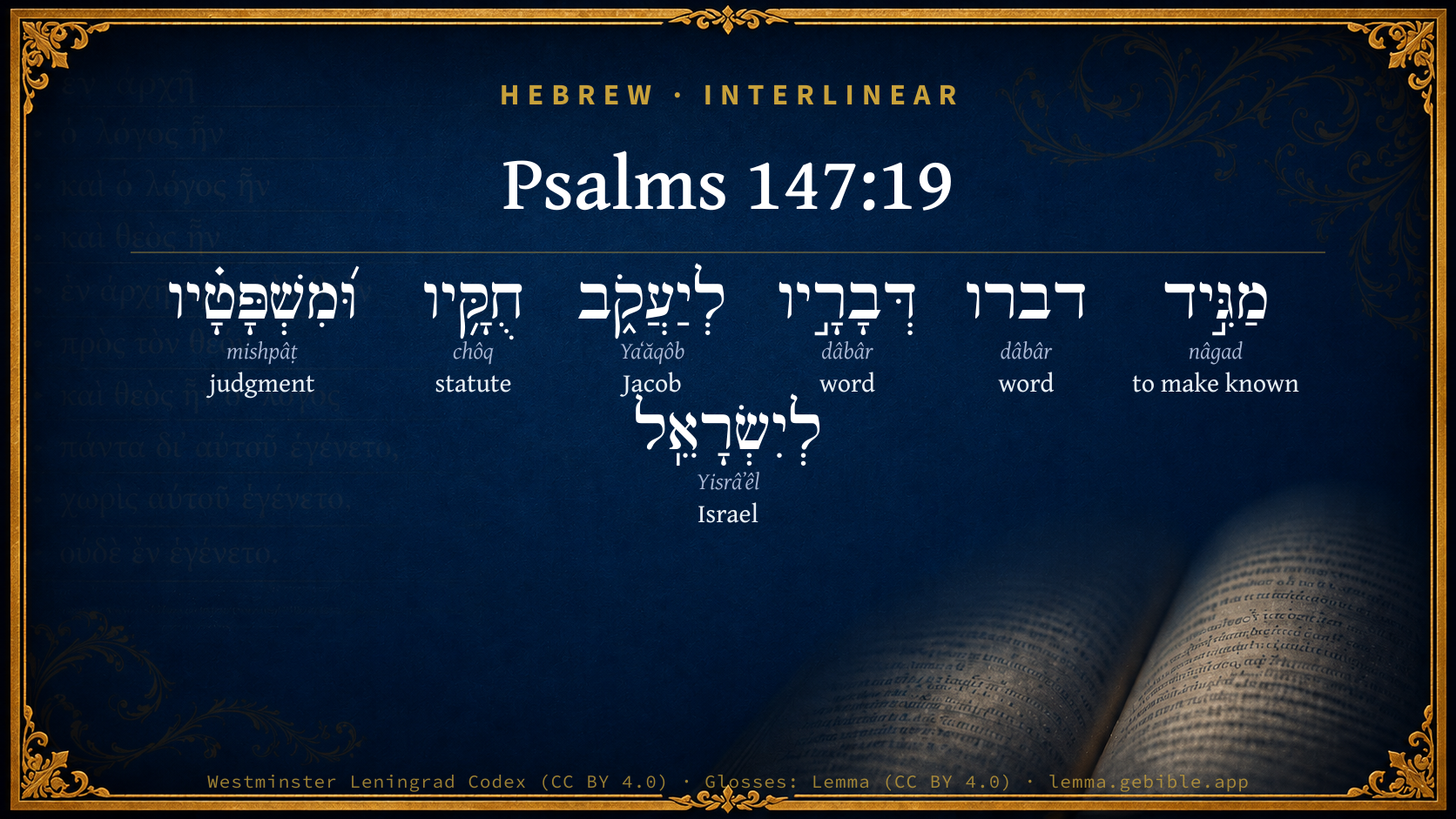
Hebrew (Westminster Leningrad Codex) Psalms 147:19 appears in the Hebrew Old Testament. The text above is from the Westminster Leningrad Codex. Each word links to its Strong’s number, a concise gloss, and parsing drawn from the Open Scriptures Hebrew Bible morphology. Click any word for its full Brown-Driver-Briggs (BDB) entry.
Download image
Cite this verse

Psalms 147:19 (World English Bible). Public Domain. Lemma interlinear Bible study tool, https://lemma.gebible.app/v/psalms/147/19.

Show BibTeX & RIS
BibTeX
RIS
English Translation
He shows his word to Jacob; His statutes and his ordinances to Israel.
World English Bible · Public Domain
Download a study sheet

One document with this verse’s original text, its word-by-word gloss line, the meaning frame, cross-references with their text, attributed commentary, and full source and license credits — printable, and it pastes into notes with its structure intact.

This verse Autodidact and up

Study sheet (.html) Plain text (.txt)

A passage Seminary Student

Up to 50 verses in one chapter. A passage sheet keeps up to 6 commentary sources and 12 cross-references per verse, in the order this page ranks them, and says so on the sheet whenever that leaves anything out. Ask for a single verse and you get the Autodidact verse sheet above.

Everything on this page stays free to read, with no account — the sheet is a download of what is already on screen, not access to it.

Want to remove ads? Support Godless Engineer
Compare translations 3

The same verse in 3 English versions, stacked beneath the original-language interlinear above. Click any original word for its lexicon entry.

Each is an independent rendering of the whole verse — the interlinear is not word-aligned to these translations.

Highlighted words mark where these versions differ — a whole-verse word diff, not a word-by-word alignment.

  • World English Bible Public Domain
    He shows his word to Jacob; His statutes and his ordinances to Israel.
  • King James Version Public Domain
    He sheweth his word unto Jacob, his statutes and his judgments unto Israel.
  • unfoldingWord Literal Text CC BY-SA 4.0
    He declared his word to Jacob, his statutes and his judgments to Israel.

unfoldingWord Literal Text — © unfoldingWord, licensed CC BY-SA 4.0. Word-aligned USFM3 via Door43 (git.door43.org/unfoldingWord/en_ult).

Versions to compare (up to 4)

3 of 4 selected

Show all 17 translations

Every available English version of this verse, each an independent rendering of the whole verse.

  • World English Bible Public Domain
    He shows his word to Jacob; His statutes and his ordinances to Israel.
  • Berean Standard Bible Public Domain
    He declares His word to Jacob, His statutes and judgments to Israel.
  • Majority Standard Bible Public Domain
    He declares His word to Jacob, His statutes and judgments to Israel.
  • King James Version Public Domain
    He sheweth his word unto Jacob, his statutes and his judgments unto Israel.
  • American Standard Version (1901) Public Domain
    He showeth his word unto Jacob, His statutes and his ordinances unto Israel.
  • Revised Version (1885) Public Domain
    He sheweth his word unto Jacob, his statutes and his judgments unto Israel.
  • Geneva Bible (1599) Public Domain
    He sheweth his word vnto Iaakob, his statutes and his iudgements vnto Israel.
  • Young's Literal Translation Public Domain
    Declaring His words to Jacob, His statutes and His judgments to Israel.
  • Literal Standard Version CC BY-SA 4.0
    Declaring His words to Jacob, || His statutes and His judgments to Israel.
  • Unlocked Literal Bible CC BY-SA 4.0
    He proclaimed his word to Jacob, his statutes and his righteous decrees to Israel.
  • unfoldingWord Literal Text CC BY-SA 4.0
    He declared his word to Jacob, his statutes and his judgments to Israel.
  • Darby Bible Public Domain
    He sheweth his word unto Jacob, his statutes and his judgments unto Israel.
  • World Messianic Bible Public Domain
    He shows his word to Jacob, his statutes and his ordinances to Israel.
  • Webster's Bible Public Domain
    He showeth his word to Jacob, his statutes and his judgments to Israel.
  • Free Bible Version CC BY-SA 4.0
    He proclaims his word to Jacob; his rules and laws to Israel.
  • Bible in Basic English Public Domain
    He makes his word clear to Jacob, teaching Israel his laws and his decisions.
  • JPS Tanakh (1917) Public Domain
    He declareth His word unto Jacob, His statutes and His ordinances unto Israel.

Literal Standard Version (2020), Covenant Press — licensed CC BY-SA 4.0. Text via the HelloAO Bible API (eBible.org). Unlocked Literal Bible (unfoldingWord) — licensed CC BY-SA 4.0. Text via the HelloAO Bible API (eBible.org). unfoldingWord Literal Text — © unfoldingWord, licensed CC BY-SA 4.0. Word-aligned USFM3 via Door43 (git.door43.org/unfoldingWord/en_ult). Free Bible Version, Dr. Jonathan Gallagher — licensed CC BY-SA 4.0. Text via the HelloAO Bible API (eBible.org).

Word by word

More ways to search: Search by grammar → Find every occurrence → Compare this word →

Practice this passage: Drill this verse → Learn its vocabulary →

חֻקָּ֥יו
chôq
H2706
“statutes · his”
Noun, Common, Masculine, Plural, Construct + Suffix, Personal, 3rd Person, Masculine, Singular
Part of Speech
Noun
Type
Common
Gender
Masculine
Number
Plural
State
Construct
Full BDB Definition

Origin: from H2710

TWOT: 728a

statute, ordinance, limit, something prescribed, due - prescribed task - prescribed portion - action prescribed (for oneself), resolve - prescribed due - prescribed limit, boundary - enactment, decree, ordinance - specific decree - law in general - enactments, statutes - conditions - enactments - decrees - civil enactments prescribed by God
  1. מַגִּ֣יד nâgad H5046 “making known” Verb, Hiphil, Participle Active, Masculine, Singular, Absolute
  2. דברו dâbâr H1697 “word · his” Noun, Common, Masculine, Singular, Construct + Suffix, Personal, 3rd Person, Masculine, Singular
  3. דְּבָרָ֣יו dâbâr H1697 “words · his” Noun, Common, Masculine, Plural, Construct + Suffix, Personal, 3rd Person, Masculine, Singular
  4. לְיַעֲקֹ֑ב Yaʻăqôb H3290 “to/for · Jacob” Preposition + Noun, Proper
  5. וּ֝מִשְׁפָּטָ֗יו mishpâṭ H4941 “and · judgments · his” Conjunction + Noun, Common, Masculine, Plural, Construct + Suffix, Personal, 3rd Person, Masculine, Singular
  6. לְיִשְׂרָאֵֽל Yisrâʼêl H3478 “to/for · Israel” Preposition + Noun, Proper

About this verse

These counts appear in no published source. They are computed here, from the morphology-tagged text and Lemma’s own curated glosses. What Lemma adds →

7
words
6
distinct lemmas
Wisdom
section

Grammatical profile

  • 1 verb
  • 6 nouns

Verb forms

  • מַגִּ֣יד Hiphil · Participle Active

Repetition

A word recurs within this verse — often emphatic in Hebrew:

  • דברו word H1697 ×2

Cross-references

17

Topical passages linked to Psalms 147:19 in the Treasury of Scripture Knowledge — connected by theme and wording, ordered by reader-vote popularity; previews shown in the World English Bible.

  • Malachi 4:4 "Remember the law of Moses my servant, which I commanded to him in Horeb for all Israel, even statutes and ordinances.
  • Psalms 78:5 For he established a testimony in Jacob, And appointed a law in Israel, Which he commanded our fathers, That they should make them known to their children;
  • Deuteronomy 33:2–4 He said, Yahweh came from Sinai, Rose from Seir to them; He shined forth from Mount Paran, He came from the ten thousands of holy ones: At his right hand was a fiery law for them.
  • Deuteronomy 4:45 these are the testimonies, and the statutes, and the ordinances, which Moses spoke to the children of Israel, when they came forth out of Egypt,
  • Deuteronomy 5:22 These words Yahweh spoke to all your assembly on the mountain out of the midst of the fire, of the cloud, and of the thick darkness, with a great voice: and he added no more. He wrote them on two tables of stone, and gave them to me.
  • Deuteronomy 5:31 But as for you, stand you here by me, and I will speak to you all the commandment, and the statutes, and the ordinances, which you shall teach them, that they may do them in the land which I give them to possess it.
  • Romans 3:2 Much in every way! Because first of all, they were entrusted with the oracles of God.
  • Romans 9:4 who are Israelites; whose is the adoption, the glory, the covenants, the giving of the law, the service, and the promises;
  • Exodus 20:1–21 God spoke all these words, saying,
  • Deuteronomy 4:1 Now, Israel, listen to the statutes and to the ordinances, which I teach you, to do them; that you may live, and go in and possess the land which Yahweh, the God of your fathers, gives you.
  • Psalms 76:1 In Judah, God is known. His name is great in Israel.
  • Psalms 103:7 He made known his ways to Moses, His deeds to the children of Israel.
  • Exodus 21:1–23 "Now these are the ordinances which you shall set before them.
  • Deuteronomy 4:8 What great nation is there, that has statutes and ordinances so righteous as all this law, which I set before you this day?
  • Deuteronomy 4:12–13 Yahweh spoke to you out of the midst of the fire: you heard the voice of words, but you saw no form; only [you heard] a voice.
  • Deuteronomy 6:1 Now this is the commandment, the statutes, and the ordinances, which Yahweh your God commanded to teach you, that you might do them in the land where you go over to possess it;
  • 2 Timothy 3:15–17 From infancy, you have known the sacred writings which are able to make you wise for salvation through faith, which is in Christ Jesus.

Cross-references courtesy of OpenBible.info (CC BY 4.0).

Hebrew and Greek witnesses Masoretic Hebrew ↔ Greek Septuagint

The same verse in the two great witnesses to the Old Testament, shown verse-for-verse.

You’re reading Greek Psalm 146 (Hebrew Psalm 147). The Septuagint counts the superscription, so verse numbers can differ from the Hebrew — chapter-level alignment, not verse-by-verse. Numbering follows Rahlfs.

These are two independent witnesses, not word-aligned to each other, and the Septuagint is shown in lemma (dictionary) form.

Hebrew Psalms 147:19 Masoretic · Westminster Leningrad Codex

מַגִּ֣יד דברו דְּבָרָ֣יו לְיַעֲקֹ֑ב חֻקָּ֥יו וּ֝מִשְׁפָּטָ֗יו לְיִשְׂרָאֵֽל

He shows his word to Jacob; His statutes and his ordinances to Israel.

World English Bible · Public Domain

Hebrew: Westminster Leningrad Codex (CC BY 4.0). Greek: Septuagint (public domain); English from a public-domain English Septuagint. How the Septuagint differs from the Hebrew →

Commentary

Notes on Psalms 147:19 from classic Christian and Jewish commentators (each source and its license shown beneath its notes). The classic Christian expositions comment on the surrounding passage and are grouped to its opening verse, so a note may address several verses; the Jewish commentaries on the Tanakh (Rashi and others) are per-verse, so they appear only where the commentator wrote on this verse.

Lemma curates 59 commentaries, every one of them public domain or Creative Commons licensed, each selected and text-cleaned for this edition rather than reprinted as found. About our sources →

Trapp's Complete Commentary

John Trapp

Psa 147:19 He sheweth his word unto Jacob, his statutes and his judgments unto Israel.

Ver. 19. He showeth his word unto Jacob] The Jews were God’s library keepers; and unto them (as a special favour) were committed those lively and life giving oracles, Rom 3:2; there is a "chiefly" set upon it; like as Luk 12:48, to know the Master’s will is the great talent of all other; there is a "much" in that.

His statutes and his judyments unto Israel] Even right judgments, true laws, good statutes and commandments, Neh 9:13 Rom 9:4-5. Prosper’s conceit was that Judaei were so called because they received ius Dei, the law of God.

John Trapp, A Commentary or Exposition upon All the Books of the Old and New Testament (1647–1656) — public domain. Text from a community e-Sword module.

The Biblical Illustrator

Joseph S. Exell

Psa_147:19-20

His statutes and His judgments unto Israel.

The Law of Moses

That Law which God delivered to His own people, and for which just returns of praise are here made to Him, shall be the subject of our present inquiries, particularly the end and design of it, and its perfections, and also some defects in it which the Christian revelation hath enabled us to discover.

1. From the Scriptures we learn that God chose the children of Israel, as He had promised to Abraham, to be His peculiar people; that He miraculously rescued them from slavery; that He gave them the quiet possession of a fruitful country; that He wrought many wonders for their preservation; that He delivered precepts to them, the observance of which necessarily separated them from other people; that He raised up a succession of prophets to instruct them or correct them; that He ruled over them Himself in a singular manner. After He had preserved them a distinct people for more than fourteen hundred years, He sent His Son to them, who was born amongst them, and came to make a new and a better covenant, to which both they and all other nations should be invited, and to teach a more pure and spiritual religion. This Messias was obscurely represented in their religious ceremonies, and promised in the Law and the prophets; and as the time of His coming approached, the predictions concerning Him were more full and clear. If We consider the Law as intended to instruct the Jews in moral truths, and to keep up the worship of God in the world, we may observe that these ends were sufficiently secured. From the Law and the prophets the Jews might learn that God did not so much delight in ceremonial observances, as in piety, justice, and charity; from many expressions in them they might suppose and hope that a quiet possession of the land of Canaan was not the only reward of well-doing, but that God reserved for these who loved Him a better recompense in a better world. In those books they might find descriptions of Gods goodness and mercy proper to raise their trust in Him, and to encourage them to amendment and repentance, gracious promises of pardon, and a promise of future blessings, of which the Messias should be the author and dispenser; which may be said to belong rather to the Gospel than to the Law, and to be founded upon all that Christ did and suffered for mankind. And as good laws naturally tend to make good subjects, and a good religion to make good men, so the lives and behaviour of some worthies recorded in Scripture are witnesses to the excellence of the religion which they had received, and by which they were guided. They were remarkable for piety to God, and for a disinterested love of their country, they preferred their duty to all worldly advantages, and endured with patience cruel persecutions, even to death, for the sake of a good conscience. Another end of the Law was to preserve the people of Israel distinct and separated from all nations. Many precepts were appointed for this very purpose: I am the Lord your God, who hath separated you from other people: ye shall therefore put difference between beasts clean and unclean. That having a diet peculiar to themselves, they might be restrained from eating with the Gentiles, and so from learning their idolatrous and vicious customs. Another end of the Law was to set up a form of government differing from all others, in which God Himself should be the King, and rule over the people in a most remarkable and wonderful manner. Another end for which we may suppose the Law to have been given was that it might be in some measure a light to enlighten the Gentiles, to spread the knowledge of one God, and so to preserve it that it might not be quite obliterated by idolatry.

2. I shall now make some remarks on the defects and imperfections of the Law. Though that part of the Law which was ceremonial served for good and wise purposes, yet, considered in itself, and compared with the Gospel, it was a weak and imperfect institution, fitted only for children in knowledge, and also a burthensome and severe ordinance, as the apostles testify. St. Paul hath represented the state of the Jews as a state of infants and slaves. He says that whilst they continued under the Law they were children, and that their rites and ceremonies were rudiments adapted to the low capacities of children, and designed to train them up and prepare them for the Gospel; he says also that they were slaves, that they had received the spirit of bondage to fear, because they were obliged to the performance of external services which in themselves had no goodness, and compelled to the observance of them chiefly by servile motives, by the fear of punishment. The Law was defective, also, in that it was not a general revelation of Gods will to mankind, nor indeed of its own nature fitted for universal use. It seems confined to the people to whom it was delivered, in its promises, in its threats, in its rewards and punishments, in several duties and conditions which it required, in the ceremonies, sacrifices, feasts, and customs which it appointed. It admitted proselytes indeed; but it could not have been the religion of any other nation; and the number of the proselytes, though considerable enough sometimes, when compared with the number of the Israelites, or Jews, yet when compared with the Gentile world, was so small, that the psalmist might well say in the text, God hath not so dealt with any nation, neither have the heathen knowledge of his laws. From the defects of the Law it seems reasonable to suppose that it was not designed to continue always. Therefore God, by the prophets, added from time to time new revelations to the Law, removing some of its obscurity, and allaying some of its severity, and also promised greater discoveries to be made in His appointed time. Thus was the Law a preceptor to the Jews, as the apostle speaks, to bring them to Christ; a dispensation appointed, in condescension to the weakness of that people, to train them up and fit them by degrees for the reception of the Gospel.

3. I shall now proceed to vindicate the Law of Moses and the Jewish religion from some objections which have been raised against them, both in ancient and in modern times. First, sacrifices were disliked by some learned and respectable philosophers; and for this and other reasons Judaism appeared to them an injudicious and a superstitious religion. We must therefore observe that sacrifices were not appointed as the most excellent way of serving God, or even as a practice good in itself, but partly in condescension to the weakness of a stubborn people, partly by way of fine and punishment for their transgressions, partly as emblematic ceremonies showing the heinous and dangerous nature of sin which deserved death, and partly as a figurative representation of the atonement to be made by the Lamb of God who should take away the sins of the world. Secondly, God never commanded sacrifice as a thing of its own nature right and fit, but only as useful or necessary by way of consequence. It was usually a rite by which men renewed a covenant with God, and it supposed some transgression, so that if men had never sinned it would have had no place. When God accepted it, He approved it only as it was a testimony of contrition, a humble acknowledgment of unworthiness, a desire to honour Him with a present, and to be received again into favour and alliance with Him. Another objection to the Jewish religion is taken from the bloody wars which the Israelites waged with some nations, and with some cities, by Divine command, and in which they were directed to give no quarter to their enemies, but to put them all to the sword. But it is strange that any one who believes in God should think this to be an insuperable objection, a difficulty not to be removed, and a full confutation of the Jewish religion, because such sort of reasoning will overset natural as much as revealed religion. It will prove, if it proves anything, that God cannot suffer diseases and calamities to destroy so many of His creatures every day; for diseases and calamities are in some sense of His appointment, and arise from the constitution and the nature of the things which He hath created. Another objection to the Old Testament is that Moses and the Prophets had not just notions of the Divine perfections, and ascribe to God things unworthy of Him. Thus, for example, they represent God as punishing the children for the faults of the parents, as being the author of evil, and as obnoxious to human infirmities, and to the passions of grief, anger, and jealousy. As to Gods visiting the iniquities of the fathers upon the children--First, this threatening being annexed to the commandment against idolatry, is not properly personal, but rather national. Secondly, God still reserved to Himself a power, by a particular providence, to show favour to particular persons who should distinguish themselves by their good behaviour, and carefully avoid the vices and iniquities of their forefathers. Thirdly, when the nation was degenerated, and was punished for it, and the righteous and the wicked were involved in the same public calamities, God was able to make a compensation to the least guilty and the more innocent, partly in this world, and fully in another world. As to the objection that they represent God as the Author of evil--by this way of speaking they never meant to remove the guilt of wicked actions from men and to lay it upon God; they only intended to acknowledge the superintending providence of God, and to declare that no event took place without His knowledge and permission. In this sense they held that He created both good and evil, and that there were not two Gods, two Principles, or First Causes, but only one Author of all, of all those powers and qualities which the righteous employ to good purposes, and of which sinners make a bad use. As to those passages of Scripture in which God is clothed with human infirmities, and subject to human passions, these things are spoken in condescension to our capacities, and arise from the imperfection of human language, and the necessity of representing things spiritual in a way suitable to our conceptions. Another and a common objection to the Old Testament is taken from the behaviour of those illustrious persons who are represented as holy men and servants of God, and some of whose actions are not condemned in Scripture, and yet are not justifiable. First, we must remember that the doctrines of morality in those ancient times were not so perfect as those of the Gospel; and, therefore, proper allowances must be made upon that account. Secondly, the history of the Old Testament is often vary short and concise; and as we know not all the circumstances, we should rather incline to judge too favour-ably than too severely of the actions of good men which are of an ambiguous nature, and to admit of any candid apology which may be suggested for them; at least, we should suspend our judgment in such eases, and not decide too hastily. (J. Jortin, D. D.)

.

Psa_148:1-14

The Biblical Illustrator, edited by Joseph S. Exell (c. 1880s–1900s) — public domain. Text from a community e-Sword module.

Joseph Benson's Commentary

Psa 147:19-20. He showeth his word unto Jacob — “That word, the effects of which, upon the spiritual system, are similar to those experienced by nature in the vernal season: that word was showed unto Jacob, and became the property of Israel, while Israel continued to be the church of God. It hath since been made over, with all its types realized, and its prophecies accomplished in Jesus, to the Christian Church.” He hath not dealt so with any nation — But for many ages left all others to their native darkness and blindness, and to those dim discoveries of God, and of themselves, and of God’s will concerning them, which they had from the light of nature. Divine revelation is that peculiar blessing, “which distinguishes the church of God from the rest of the world, and for which her children are bound at all times to praise the Lord.”

Joseph Benson's Commentary on the Old and New Testaments (1811–1818) — public domain. Text from a community e-Sword module.

J. A. Alexander on Psalms

Joseph Addison Alexander

19. (Psa 147:19) Declaring his word to Jacob, his statutes and his judgments to Israel. The God of Nature is the God of Revelation. He who thus controls the elements and seasons is the God of Israel, and will work spiritual changes corresponding to these natural phenomena, for the benefit of the people whom he has entrusted with the revelation of his will.

Joseph Addison Alexander, The Psalms Translated and Explained (1850) — public domain. Text from a community e-Sword module.

Tyndale Open Study Notes

Tyndale Open Resources

147:19-20 words . . . decrees . . . regulations: The Lord gave powerful words to Israel so that they might obey him (105:45).

Tyndale Open Study Notes — © Tyndale Open Resources, licensed CC BY-SA 4.0. Text via the HelloAO Bible API.

Geneva Bible (1599)

Geneva Bible translators

As before he called God’s secret working in all his creatures his word: so he meaneth here by his word the doctrine of life everlasting, which he hath left to his Church as a most precious treasure.

Geneva Bible (1599) marginal notes — public domain. Text via Bolls.life.

Jamieson, Fausset & Brown

Robert Jamieson, A. R. Fausset & David Brown

This mighty ruler and benefactor of heaven and earth is such especially to His chosen people, to whom alone (Deu 4:32-34) He has made known His will, while others have been left in darkness. Therefore unite in the great hallelujah.

Next: Psalms Chapter 148

Jamieson, Fausset & Brown — Commentary Critical and Explanatory on the Whole Bible (1871) — public domain (CC PDM 1.0). Text via the HelloAO Bible API.

Adam Clarke's Commentary

Verse 19. He showeth his word unto Jacob] To no nation of the world beside had God given a revelation of his will.

Adam Clarke's Commentary on the Bible (1810–1826) — public domain. Text from a community e-Sword/MySword module.

John Calvin's Commentaries

19. He announces his words to Jacob, etc. Here it is another word that is spoken of than what was formerly mentioned; for God speaks in a different way to the insensate works of his hands, which he silently subordinates to his will by secret laws impressed upon them, than he does to men who are endued with understanding, for these he teaches with articulate language, that they may obey him intelligently and with consent. Although the blessings formerly mentioned are not to be depreciated, they fall far short of this, that he has condescended to be the teacher of his chosen people, by communicating to them that religious doctrine which is a treasure of everlasting salvation. How little would it avail the Church that it were filled with the perishing enjoyments of time, and protected from hostile violence, did not its hope extend beyond this world. This, accordingly, is the grand proof of his love, that he has set before us in his word the light of eternal life. On this account it is appropriately mentioned here as the crowning part of true solid happiness. And let us learn from this, that we should not only receive the doctrine of God with reverential and holy obedience, but embrace it with affection, for we can conceive of nothing more delightful and desirable than that God should undertake our salvation, and give testimony of this by stretching out his hand to bring us to himself. For this is the design with which the doctrine has been given to us, that amidst the thick darkness of this world, and the devious errors into which Satan misleads the children of men, the great Father of us all may by it cast a foregoing light upon our path before gathering us to the inheritance of heaven. We are to notice, that the part which was sustained by Moses and the Prophets according to divine appointment is here ascribed to God himself, for we only put due honor upon the doctrine of religion, and estimate it at its proper worth when we rise to the consideration of God, who, in using the instrumentality of men, still claims to be considered our chief and only teacher. Thus its due majesty is assigned to the word from the person of its author. Again, he enhances the mercy shown by stating a comparison, intimating that this had not been done for other nations For if it be asked why God preferred one people to others, this pre-eminence will certainly lead us to gratuitous election as its source, since we will find that the children of Israel did not differ from others in any excellency attaching to themselves, but because God passed by others and condescended to adopt them into his favor.

John Calvin's Commentaries (1540-1563) — public domain. Text from the Calvin Translation Society English edition (1840s-50s) via the Christian Classics Ethereal Library (ccel.org). Calvin's coverage is partial (roughly two-thirds of the Bible); uncommented books and verses are honest gaps, never fabricated. The 19th-century editor's footnotes and remarks are omitted so the notes are faithfully Calvin's own voice.

Ellicott's Commentary for English Readers

(19) Jacob . . . Israel.—As in the other two pieces into which the psalm divides (Psa_147:6-11), the thought passes from the grandeur of God revealed in nature to the divine protection and favour accorded to Israel.

A Bible Commentary for English Readers, edited by Charles John Ellicott (1878–1897) — public domain. Text from a community e-Sword module.

The Cambridge Bible for Schools and Colleges

gen. ed. J. J. S. Perowne

19, 20. Cp. Deu_4:7-8. The Lord, whose word all Nature obeys, has given Israel His word in the law; a privilege which distinguishes it from every other nation.

judgments] Or, ordinances.

The Cambridge Bible for Schools and Colleges (gen. ed. J. J. S. Perowne; Cambridge University Press, 1878–1918) — public domain. Text from a community e-Sword module.

John Gill's Exposition

He showeth his word unto Jacob,.... From the things of nature and providence, the psalmist passes to the blessings of grace and goodness; for which the Lord is to be praised, particularly for his word and ordinances. The Targum interprets this of the words of the law; and indeed the law, or decalogue, was given only to the Israelites, the posterity of Jacob; as also the ceremonial and judicial laws; and even the whole Scripture, the oracles of God, were committed to them in a very peculiar manner: all which distinguished them from the Gentiles, and gave them the preference to them; see Deu 4:6, Rom 3:1. But the Gospel part of the word is also included; the word of grace, peace, reconciliation, righteousness, eternal life, and salvation, which was first published to the Jews: it was "shown" unto them, for it cannot be known by any without a revelation; the Gospel, and the things of it, are hidden things to natural men, and could never have been discerned by any, had they not been shown by the Lord; as they are externally in the ministration of the word, and internally and effectually by the Spirit of God; who is the Spirit of wisdom and revelation in the knowledge of divine things;

his statutes and his judgments unto Israel; the ordinances of divine worship under the former dispensation, which were peculiar to literal Israel; and those of the Gospel dispensation, which belong to the spiritual Israel, Jews and Gentiles; and which are shown and directed to in the word, to be observed by them; and both the Gospel and the ordinances of it are instances of divine favour, for which the Lord is to be praised.

John Gill's Exposition of the Whole Bible (1746–1763) — public domain (CC PDM 1.0). Text via the HelloAO Bible API.

Albert Barnes' Notes on the Bible

He showeth his word unto Jacob - Margin, words. His commands; his promises; his laws. The things which were before adverted to, pertain to the world in general. All people see his works; all enjoy the benefits of his arrangements in the seasons - in the changes which occur upon the earth; but he has especially favored his own people by giving them his laws - his revealed will. This distinguishes them above all other nations of the earth, and gives them special occasion for gratitude.

His statutes and his judgments unto Israel - His laws; his written word. The word judgments here refers to the law of God as being that which he judges or determines to be right.

Albert Barnes' Notes on the Bible (1834–1885) — public domain. Text from a community e-Sword/MySword module.

Matthew Poole's English Annotations

He showeth his word; he fully declared his mind and will by revelation and in his word.

Unto Jacob; to the children of Jacob or Israel, and to them alone, as it follows.

Matthew Poole's English Annotations on the Holy Bible (1683–1685) — public domain. Text from a community e-Sword/MySword module.

The Treasury of David

Charles H. Spurgeon

Ver. 19. He sheweth his word unto Jacob, his statutes and his judgments unto Israel. He who is the Creator is also the Revealer. We are to praise the Lord above all things for his manifesting himself to us as he does not unto the world. Whatever part of his mind he discloses to us, whether it be a word of instruction, a statute of direction, or a judgment of government, we are bound to bless the Lord for it. He who causes summer to come in the place of winter has also removed the coldness and death from our hearts by the power of his word, and this is abundant cause for singing unto his name. As Jacob's seed of old were made to know the Lord, even so are we ill these latter days; wherefore, let his name be magnified among us. By that knowledge Jacob is ennobled into Israel, and therefore let him who is made a prevailing prince in prayer be also a chief musician in praise. The elect people were bound to sing hallelujahs to their own God. Why were they so specially favoured if they did not, above all others, tell forth the glory of their God?

Ver. 19. Here we see God in compassion bending down, in order to communicate to the deeply fallen son of man something of a blessed secret, of which, without his special enlightenment, the eye would never have seen anything, nor the ear ever have heard. J.J. Van Oosterzee, on "The Image of Christ."

Ver. 19-20. If the publication of the law by the ministry of angels to the Israelites were such a privilege that it is reckoned their peculiar treasureHe hath shewed his statutes unto Israel; he hath not dealt so with any nation what is the revelation of the gospel by the Son of God himself? For although the law is obscured and defaced since the fall, yet there are some ingrafted notions of it in human nature; but there is not the least suspicion of the gospel. The law discovers our misery, but the gospel alone shows the way to be delivered from it. If an advantage so great and so precious doth not touch our hearts; and, in possessing it with joy, if we are not sensible of the engagements the Father of mercies hath laid upon us; we shall be the most ungrateful wretches in the world. William Bates.

Ver. 19-20. That some should have more means of knowing the Creator, others less, it is all from the mercy and will of God. His church hath a privilege and an advantage above other nations in the world; the Jews had this favour above the heathens, and Christians above the Jews; and no other reason can be assigned but his eternal love. Thomas Manton.

Ver. 19.

1. God's people.

2. God's Word.

3. God's revelation to the soul.

4. God's praise for this special revelation.

Psalms 147:20*

Charles H. Spurgeon's The Treasury of David (1869–1885) — public domain. Psalms only. Text from a community e-Sword/MySword module.

Whedon's Commentary on the Bible

Daniel D. Whedon

19. His statutes… judgments—The special blessing of Israel. God’s “statutes and judgments” had produced the Daniels, Esthers, and Mordecais of the captivity, and kept heart and hope from sinking down.

Other nations had sad confusion of moral ideas. The chief advantage of the Jews was, that to them were committed the oracles of God, the light and truth that now go forth to the ends of the earth.

Daniel D. Whedon (gen. ed.), Commentary on the Old and New Testaments (1874–1909) — public domain. Text from a community e-Sword module.

The Pulpit Commentary

He showeth his word unto Jacob, his statutes and his judgments unto Israel. Beyond and above all the physical blessings which God bestows on man are the gifts of spiritual enlightenment dud direction. These also Israel may count on receiving from him, who has already given them a written revelation dud judgments while he also enlightens and directs them from time to time by his prophets.

The Pulpit Commentary (1880–1919), ed. H.D.M. Spence-Jones & Joseph S. Exell — public domain. Text from a community e-Sword module.

unfoldingWord translationNotes

Door43 World Missions Community

He proclaimed his word to Jacob, his statutes and his righteous decrees to Israel

These two lines mean the same thing and emphasize that Yahweh gave his law only to Israel. (See: Parallelism)

his statutes and his righteous decrees to Israel

The verbal phrase can be supplied from the previous line. AT: "He proclaimed his statutes and his righteous decrees to Israel" (See: Ellipsis)

his statutes and his righteous decrees

The words "statutes" and "righteous decrees," along with "word" in the previous line, all refer to the law of Moses. If your language does not have different words for these terms, you may combine the two lines into one, using either "Jacob" or "Israel" for the people who received them. (See: Doublet)

they do not know them

The other nations do not know Yahweh's decrees.

translationWords

preach

word of God

Jacob

statute

righteous

decree

Israel

nation

know

unfoldingWord translationNotes — © Distant Shores Media and the Door43 World Missions Community, licensed CC BY-SA 4.0. Source: git.door43.org/Door43/en_tn.

Lesson kit

Teaching starters — assembled from the data on this page, not authored interpretation. Every prompt links to the verse data it draws on. Edit before teaching.

Psalms, in the Wisdom, opens this verse with 7 words (6 distinct Hebrew lemmas). Its most distinctive word is chôq (“statute”). A historical commentator’s framing appears above. Read the whole chapter for the surrounding context.

Discussion questions

  1. What does “statute” (chôq) contribute to the verse as a whole?
  2. Malachi 4:4 shares this passage’s theme. How do the two illuminate each other?
  3. “word” occurs 2× in this one verse. What is the effect of the repetition?
  4. These translations render this verse differently. What is at stake in choosing one wording over another?
  5. The verb «מַגִּ֣יד» is Hiphil Participle Active. How does its form color the action?
  6. Reading how Trapp's Complete Commentary and The Biblical Illustrator read this verse, where do the two commentators agree and where do they part?

Things to notice

Reading settings

Reading text

Shown beneath each verse's original-language words.

Old Testament
Old Testament edition

Read the OT as the Masoretic Hebrew (MT) or the Greek Septuagint (LXX).

English shown for the Greek Septuagint (in the Hebrew ↔ Greek comparison).

Comparing translations? Open the Compare panel on any verse page to stack up to four side by side.