
Isaiah 41:26

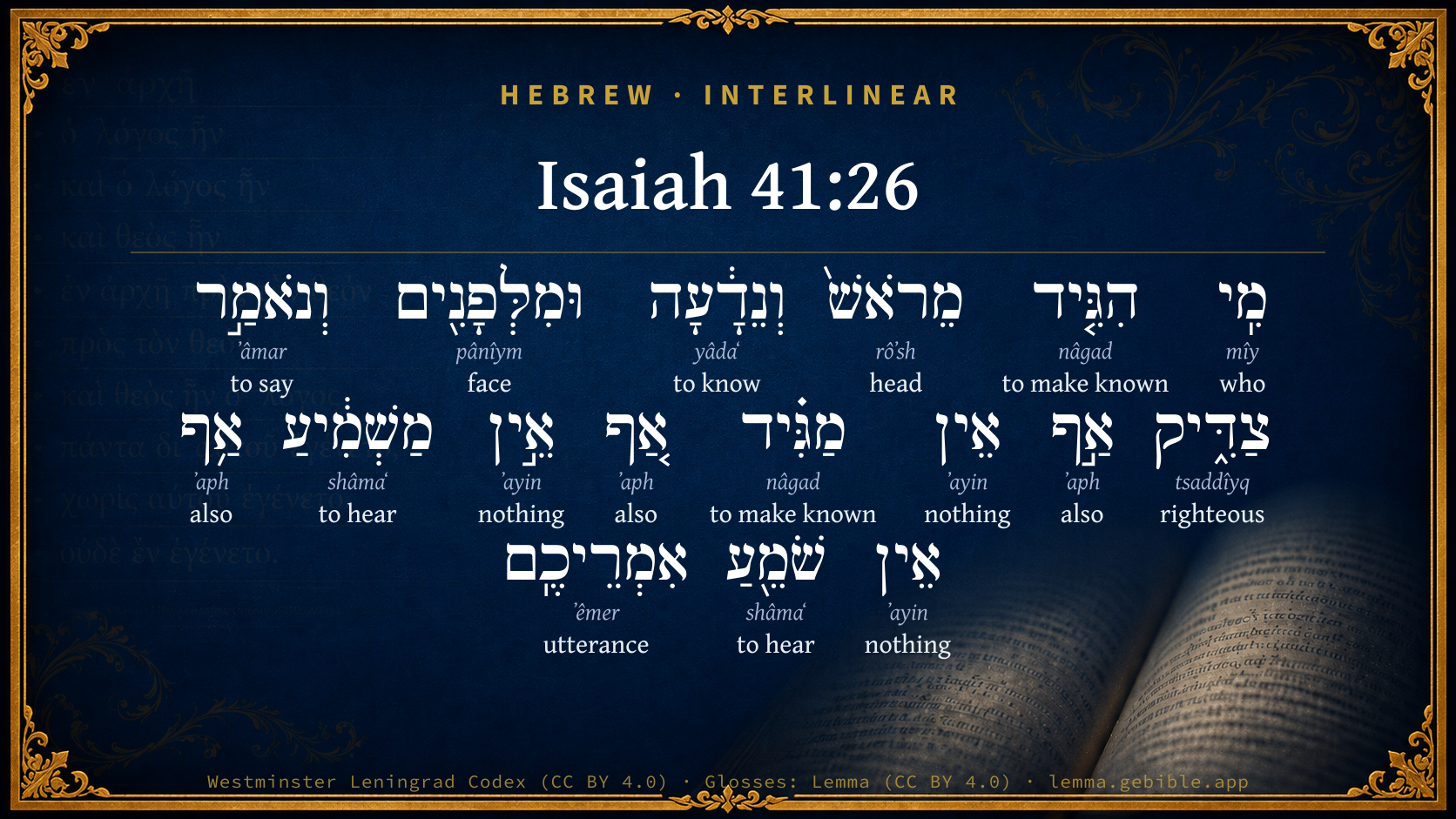
Hebrew (Westminster Leningrad Codex) Isaiah 41:26 appears in the Hebrew Old Testament. The text above is from the Westminster Leningrad Codex. Each word links to its Strong’s number, a concise gloss, and parsing drawn from the Open Scriptures Hebrew Bible morphology. Click any word for its full Brown-Driver-Briggs (BDB) entry.
Download image
Cite this verse

Isaiah 41:26 (World English Bible). Public Domain. Lemma interlinear Bible study tool, https://lemma.gebible.app/v/isaiah/41/26.

Show BibTeX & RIS
BibTeX
RIS
English Translation
Who has declared it from the beginning, that we may know? and before, that we may say, [He is] right? yes, there is none who declares, yes, there is none who shows, yes, there is none who hears your words.
World English Bible · Public Domain
Download a study sheet

One document with this verse’s original text, its word-by-word gloss line, the meaning frame, cross-references with their text, attributed commentary, and full source and license credits — printable, and it pastes into notes with its structure intact.

This verse Autodidact and up

Study sheet (.html) Plain text (.txt)

A passage Seminary Student

Up to 50 verses in one chapter. A passage sheet keeps up to 6 commentary sources and 12 cross-references per verse, in the order this page ranks them, and says so on the sheet whenever that leaves anything out. Ask for a single verse and you get the Autodidact verse sheet above.

Everything on this page stays free to read, with no account — the sheet is a download of what is already on screen, not access to it.

Want to remove ads? Support Godless Engineer
Compare translations 3

The same verse in 3 English versions, stacked beneath the original-language interlinear above. Click any original word for its lexicon entry.

Each is an independent rendering of the whole verse — the interlinear is not word-aligned to these translations.

Highlighted words mark where these versions differ — a whole-verse word diff, not a word-by-word alignment.

  • World English Bible Public Domain
    Who has declared it from the beginning, that we may know? and before, that we may say, [He is] right? yes, there is none who declares, yes, there is none who shows, yes, there is none who hears your words.
  • King James Version Public Domain
    Who hath declared from the beginning, that we may know? and beforetime, that we may say, He is righteous? yea, there is none that sheweth, yea, there is none that declareth, yea, there is none that heareth your words.
  • unfoldingWord Literal Text CC BY-SA 4.0
    Who has declared from the beginning, that we might know? And from before, that we might say, ‘Right’? Indeed, none is declaring. Indeed, none is making hear. Indeed, none is hearing your words.

unfoldingWord Literal Text — © unfoldingWord, licensed CC BY-SA 4.0. Word-aligned USFM3 via Door43 (git.door43.org/unfoldingWord/en_ult).

Versions to compare (up to 4)

3 of 4 selected

Show all 18 translations

Every available English version of this verse, each an independent rendering of the whole verse.

  • World English Bible Public Domain
    Who has declared it from the beginning, that we may know? and before, that we may say, [He is] right? yes, there is none who declares, yes, there is none who shows, yes, there is none who hears your words.
  • Berean Standard Bible Public Domain
    Who has declared this from the beginning, so that we may know, and from times past, so that we may say: ‘He was right’? No one announced it, no one foretold it, no one heard your words.
  • Majority Standard Bible Public Domain
    Who has declared this from the beginning, so that we may know, and from times past, so that we may say: ‘He was right’? No one announced it, no one foretold it, no one heard your words.
  • King James Version Public Domain
    Who hath declared from the beginning, that we may know? and beforetime, that we may say, He is righteous? yea, there is none that sheweth, yea, there is none that declareth, yea, there is none that heareth your words.
  • American Standard Version (1901) Public Domain
    Who hath declared it from the beginning, that we may know? and beforetime, that we may say, `He is' right? yea, there is none that declareth, yea, there is none that showeth, yea, there is none that heareth your words.
  • Revised Version (1885) Public Domain
    Who hath declared it from the beginning, that we may know? and beforetime, that we may say, He is righteous? yea, there is none that declareth, yea, there is none that sheweth, yea, there is none that heareth your words.
  • Geneva Bible (1599) Public Domain
    Who hath declared from the beginning, that we may knowe? or before time, that we may say, He is righteous? Surely there is none that sheweth: surely there is none that declareth: surely there is none that heareth your wordes.
  • Douay-Rheims (1899) Public Domain
    Who bath declared from the beginning, that we may know: and from time of old, that we may say: Thou art just. There is none that sheweth, nor that foretelleth, nor that heareth your words.
  • Young's Literal Translation Public Domain
    Who hath declared from the first, and we know? And beforetime, and we say, `Righteous?' yea, there is none declaring, Yea, there is none proclaiming, Yea, there is none hearing your sayings.
  • Literal Standard Version CC BY-SA 4.0
    Who has declared from the first, and we know? And formerly, and we say, “Righteous?” Indeed, there is none declaring, || Indeed, there is none proclaiming, || Indeed, there is none hearing your sayings.
  • Unlocked Literal Bible CC BY-SA 4.0
    Who announced this from the beginning, that we might know? Before this time, that we may say, “He is right”? Indeed none of them decreed it, yes, none heard you say anything.
  • unfoldingWord Literal Text CC BY-SA 4.0
    Who has declared from the beginning, that we might know? And from before, that we might say, ‘Right’? Indeed, none is declaring. Indeed, none is making hear. Indeed, none is hearing your words.
  • Darby Bible Public Domain
    Who hath declared [it] from the beginning, that we may know? and beforetime, that we may say, [It is] right? Indeed, there is none that declareth; no, none that sheweth; no, none that heareth your words.
  • World Messianic Bible Public Domain
    Who has declared it from the beginning, that we may know? and before, that we may say, ‘He is right’? Surely, there is no one who declares. Surely, there is no one who shows. Surely, there is no one who hears your words.
  • Webster's Bible Public Domain
    Who hath declared from the beginning, that we may know? and before time, that we may say, He is righteous? verily, there is none that showeth, verily, there is none that declareth, verily, there is none that heareth your words.
  • Free Bible Version CC BY-SA 4.0
    Who announced this beforehand so that we could know about it? Who let us know in the past, so that now we could say: ‘He was right’? None of you announced it, none of you predicted it, and nobody heard you say a word!
  • Bible in Basic English Public Domain
    Who has given knowledge of it from the first, so that we may be certain of it? and from the start, so that we may say, His word is true? There is no one who gives news, or says anything, or who gives ear to your words.
  • JPS Tanakh (1917) Public Domain
    Who hath declared from the beginning, that we may know? and beforetime, that we may say that he is right? Yea, there is none that declareth, yea, there is none that announceth, yea, there is none that heareth your utterances.

Literal Standard Version (2020), Covenant Press — licensed CC BY-SA 4.0. Text via the HelloAO Bible API (eBible.org). Unlocked Literal Bible (unfoldingWord) — licensed CC BY-SA 4.0. Text via the HelloAO Bible API (eBible.org). unfoldingWord Literal Text — © unfoldingWord, licensed CC BY-SA 4.0. Word-aligned USFM3 via Door43 (git.door43.org/unfoldingWord/en_ult). Free Bible Version, Dr. Jonathan Gallagher — licensed CC BY-SA 4.0. Text via the HelloAO Bible API (eBible.org).

Word by word

More ways to search: Search by grammar → Find every occurrence → Compare this word →

Practice this passage: Drill this verse → Learn its vocabulary →

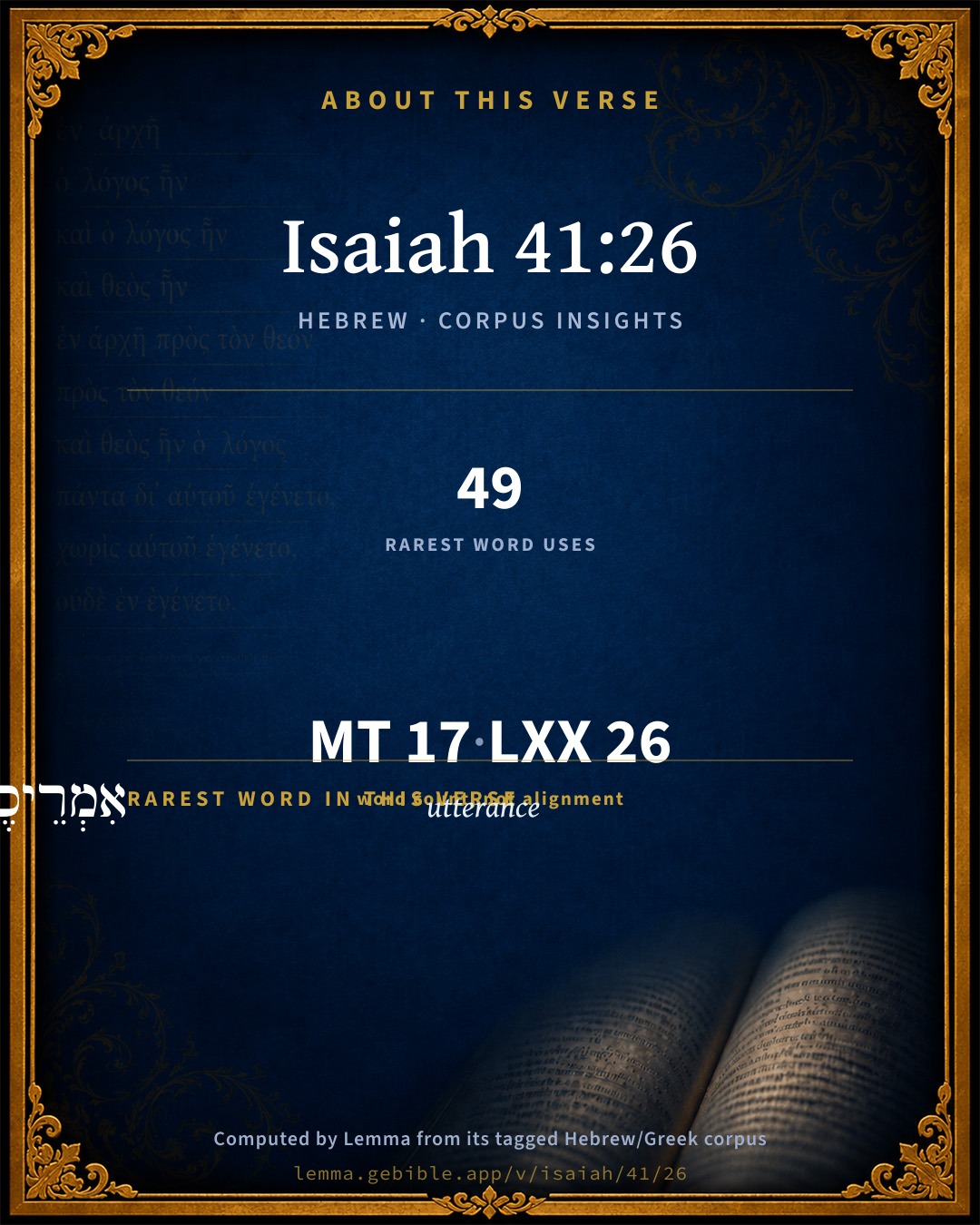
אִמְרֵיכֶֽם
ʼêmer
H561
“utterances · your”
Noun, Common, Masculine, Plural, Construct + Suffix, Personal, 2nd Person, Masculine, Plural
Part of Speech
Noun
Type
Common
Gender
Masculine
Number
Plural
State
Construct
Full BDB Definition

Origin: from H559

TWOT: 118a

utterance, speech, word, saying, promise, command
  1. מִֽי mîy H4310 “who” Particle, Interrogative
  2. הִגִּ֤יד nâgad H5046 “to make known” Verb, Hiphil, Perfect, 3rd Person, Masculine, Singular
  3. מֵרֹאשׁ֙ rôʼsh H7218 “from · head” Preposition + Noun, Common, Masculine, Singular, Absolute
  4. וְנֵדָ֔עָה yâdaʻ H3045 “and · to know” Conjunction + Verb, Qal, Cohortative, 1st Person, Common, Plural
  5. וּמִלְּפָנִ֖ים pânîym H6440 “and · from · to/for · face(s)” Conjunction + Preposition + Preposition + Noun, Common, Both, Plural, Absolute
  6. וְנֹאמַ֣ר ʼâmar H559 “and · to say” Conjunction + Verb, Qal, Imperfect, 1st Person, Common, Plural
  7. צַדִּ֑יק tsaddîyq H6662 “righteous” Adjective, Adjective, Masculine, Singular, Absolute
  8. אַ֣ף ʼaph H637 “also” Particle, Accusative
  9. אֵין ʼayin H369 “nothing” Particle, Negative
  10. מַגִּ֗יד nâgad H5046 “making known” Verb, Hiphil, Participle Active, Masculine, Singular, Absolute
  11. אַ֚ף ʼaph H637 “also” Particle, Accusative
  12. אֵ֣ין ʼayin H369 “nothing” Particle, Negative
  13. מַשְׁמִ֔יעַ shâmaʻ H8085 “hearing” Verb, Hiphil, Participle Active, Masculine, Singular, Absolute
  14. אַ֥ף ʼaph H637 “also” Particle, Accusative
  15. אֵין ʼayin H369 “nothing” Particle, Negative
  16. שֹׁמֵ֖עַ shâmaʻ H8085 “hearing” Verb, Qal, Participle Active, Masculine, Singular, Absolute

About this verse

These counts appear in no published source. They are computed here, from the morphology-tagged text and Lemma’s own curated glosses. What Lemma adds →

17
words
11
distinct lemmas
Prophets
section

Shared distinctive vocabulary

אִמְרֵיכֶֽם utterance H561 occurs in 47 verses of the Hebrew Bible. Also found in:

Grammatical profile

  • 6 verbs
  • 3 nouns
  • 1 adjective
  • 7 particles

Verb forms

  • הִגִּ֤יד Hiphil · Perfect
  • וְנֵדָ֔עָה Qal · Cohortative
  • וְנֹאמַ֣ר Qal · Imperfect
  • מַגִּ֗יד Hiphil · Participle Active
  • מַשְׁמִ֔יעַ Hiphil · Participle Active
  • שֹׁמֵ֖עַ Qal · Participle Active

Repetition

Words recur within this verse — often emphatic in Hebrew:

  • אַ֣ף also H637 ×3
  • אֵין nothing H369 ×3
  • הִגִּ֤יד to make known H5046 ×2
  • מַשְׁמִ֔יעַ to hear H8085 ×2

Hebrew & Septuagint length

In English translation the verse runs 40 words from the Hebrew and 38 from the Septuagint (LXX English) — closely comparable.

A rough comparison of the two English renderings, which tokenize alike — not a word-level alignment.

Word counts can differ between the Hebrew and the Greek without any difference in meaning — e.g. the Hebrew direct-object marker אֵת has no separate Greek word, and Greek often adds the article ὁ.

In the original languages it is 17 Hebrew tokens and 26 Greek tokens — but the two are counted differently (Hebrew bundles its prefixes and suffixes into one token; the Greek is in lemma form), so that isn’t a like-for-like length.

Cross-references

5

Topical passages linked to Isaiah 41:26 in the Treasury of Scripture Knowledge — connected by theme and wording, ordered by reader-vote popularity; previews shown in the World English Bible.

  • Isaiah 41:22 Let them bring forth, and declare to us what shall happen: declare you the former things, what they are, that we may consider them, and know the latter end of them; or show us things to come.
  • Isaiah 44:7 Who, as I, shall call, and shall declare it, and set it in order for me, since I established the ancient people? and the things that are coming, and that shall happen, let them declare.
  • Isaiah 45:21 Declare you, and bring [it] forth; yes, let them take counsel together: who has shown this from ancient time? who has declared it of old? Haven't I, Yahweh? and there is no God else besides me, a just God and a Savior; there is no one besides me.
  • Isaiah 43:9 Let all the nations be gathered together, and let the peoples be assembled: who among them can declare this, and show us former things? let them bring their witnesses, that they may be justified; or let them hear, and say, It is truth.
  • Habakkuk 2:18–20 "What value does the engraved image have, that its maker has engraved it; the molten image, even the teacher of lies, that he who fashions its form trusts in it, to make mute idols?

Cross-references courtesy of OpenBible.info (CC BY 4.0).

Hebrew and Greek witnesses Masoretic Hebrew ↔ Greek Septuagint

The same verse in the two great witnesses to the Old Testament, shown verse-for-verse.

These are two independent witnesses, not word-aligned to each other, and the Septuagint is shown in lemma (dictionary) form.

Hebrew Isaiah 41:26 Masoretic · Westminster Leningrad Codex

מִֽי הִגִּ֤יד מֵרֹאשׁ֙ וְנֵדָ֔עָה וּמִלְּפָנִ֖ים וְנֹאמַ֣ר צַדִּ֑יק אַ֣ף אֵין מַגִּ֗יד אַ֚ף אֵ֣ין מַשְׁמִ֔יעַ אַ֥ף אֵין שֹׁמֵ֖עַ אִמְרֵיכֶֽם

Who has declared it from the beginning, that we may know? and before, that we may say, [He is] right? yes, there is none who declares, yes, there is none who shows, yes, there is none who hears your words.

World English Bible · Public Domain

Greek LXX Isaiah 41:26 Septuagint · lemma form

τίς γάρ ἀναἀγγέλλω ὁ ἐκ ἀρχή ἵνα γιγνώσκω καί ὁ ἔμπροσθεν καί εἶπον ὅτι ἀληθής εἰμί οὐ εἰμί ὁ προλέγω οὐδέ ὁ ἀκούω σύ ὁ λόγος

For who will declare the things from the beginning, that we may know also the former things, and we will say that they are true? there is no one that speaks beforehand, nor anyone that hears your words.

LXX2012 (modern English Septuagint) · Public Domain

Hebrew: Westminster Leningrad Codex (CC BY 4.0). Greek: Septuagint (public domain); English from LXX2012 (modern English Septuagint) (Public Domain). How the Septuagint differs from the Hebrew →

Targum (Aramaic paraphrase)

1

The Targum is the ancient Jewish Aramaic paraphrase of the Hebrew Scriptures — an interpretive translation, not the Hebrew text itself. Onkelos (literal) and Pseudo-Jonathan (expansive) render the Torah, and Jonathan the Prophets. Coverage is partial: where no permissively-licensed English translation exists for a verse, only the Aramaic is shown. This is verse-level text, not a word-by-word alignment to the Hebrew.

  1. Targum Jonathan Prophets (Joshua–Malachi)
    מַן חַוֵי מִן אַוְלָא וְנֵדַע וּמִלְקָדְמִין וְנֵימַר קְשׁוֹט אַף לֵית דִי מְחַוֵי אַף לֵית דִמְבַסֵר אַף לֵית דְשָׁמַע לְמִילֵיכוֹן:

    Who hath declared this from the beginning that we should know it? and beforetime, that we may say, It is true? Yea, there was none that foretold it; yea, none that declared it; yea, none that heard your words.

    Targum Jonathan — Aramaic: “Mikraot Gedolot” (public domain). English: “Sefaria Community Translation” (CC0 1.0 (public-domain dedication)); “London "Chaldee Paraphrase," 1871” (public domain). Text via Sefaria.

Commentary

Notes on Isaiah 41:26 from classic Christian and Jewish commentators (each source and its license shown beneath its notes). The classic Christian expositions comment on the surrounding passage and are grouped to its opening verse, so a note may address several verses; the Jewish commentaries on the Tanakh (Rashi and others) are per-verse, so they appear only where the commentator wrote on this verse.

Lemma curates 59 commentaries, every one of them public domain or Creative Commons licensed, each selected and text-cleaned for this edition rather than reprinted as found. About our sources →

Trapp's Complete Commentary

John Trapp

Isa 41:26 Who hath declared from the beginning, that we may know? and beforetime, that we may say, [He is] righteous? yea, [there is] none that sheweth, yea, [there is] none that declareth, yea, [there is] none that heareth your words.

Ver. 26. Who hath declared?] Who, besides myself, ever did or could predict such a thing? If any other hath done it, we will do him right, called him a god.

John Trapp, A Commentary or Exposition upon All the Books of the Old and New Testament (1647–1656) — public domain. Text from a community e-Sword module.

Joseph Benson's Commentary

Isa 41:26. Who hath declared from the beginning — Which of your idols could foretel such things as these from the beginning of the world unto this day? And beforetime — Before the things come to pass. That we may say, He is righteous — His cause is good; he is a God indeed. Yea, there is none that showeth — Hebrew, surely, there is none of your gods that hath done or can do this, and therefore their claim to divinity is false and foolish. There is none that heareth your words — Because you are dumb and cannot speak.

Joseph Benson's Commentary on the Old and New Testaments (1811–1818) — public domain. Text from a community e-Sword module.

Keil & Delitzsch

C. F. Keil & F. Delitzsch

As Isa 41:25 points back to the first charge against the heathen and their gods (Isa 41:2-7), so Isa 41:26-28 point back to the second. Not only did Jehovah manifest Himself as the Universal Ruler in the waking up of Cyrus, but as the Omniscient Ruler also. "Who hath made it known from the beginning, we will acknowledge it, and from former time, we will say He is in the right?! Yea, there was none that made known; yea, none that caused to hear; yea, none that heard your words. As the first I saith to Zion, Behold, behold, there it is: and I bestow evangelists upon Jerusalem. And I looked, and there was no man; and of these there was no one answering whom I would ask, and who would give me an answer." If any one of the heathen deities had foretold this appearance of Cyrus so long before as at the very commencement of that course of history which had thus reached its goal, Jehovah with His people, being thus taught by experience, would admit and acknowledge their divinity. מראשׁ is used in the same sense as in Isa 48:16 : and also in Isa 41:4 and Isa 40:21, where it refers according to the context in each case, to the beginning of the particular line of history. צדּיק signifies either "he is right," i.e., in the right (compare the Arabic siddik, genuine), or in a neuter sense, "it is right" (= true), i.e., the claim to divine honours is really founded upon divine performances. But there was not one who had proclaimed it, or who gave a single sound of himself; no one had heard anything of the kind from them. אין receives a retrospective character from the connection; and bearing this in mind, the participles may be also resolved into imperfects. The repeated אף, passing beyond what is set down as possible, declares the reality of the very opposite. What Jehovah thus proves the idols to want, He can lay claim to for Himself. In Isa 41:27 we need not assume that there is any hyperbaton, as Louis de Dieu, Rosenmller, and others have done: "I first will give to Zion and Jerusalem one bringing glad tidings: behold, behold them." After what has gone before in Isa 41:26 we may easily supply אמרתּי, "I said," in Isa 41:27 (compare Isa 8:19; Isa 14:16; Isa 27:2), not אמר, for the whole comparison drawn by Jehovah between Himself and the idols is retrospective, and looks back from the fulfilment in progress to the prophecies relating to it. The only reply that we can look for to the question in Isa 41:26 is not, "I on the contrary do it," but "I did it." At the same time, the rendering is a correct one: "Behold, behold them" (illa; for the neuter use of the masculine, compare Isa 48:3; Isa 38:16; Isa 45:8). "As the first," Jehovah replies (i.e., without any one anticipating me), "Have I spoken to Zion: behold, behold, there it is," pointing with the finger of prophecy to the coming salvation, which is here regarded as present; "and I gave to Jerusalem messengers of joy;" i.e., long ago, before what is now approaching could be known by any one, I foretold to my church, through the medium of prophets, the glad tidings of the deliverance from Babylon. If the author of chapters 40-66 were a prophet of the captivity, his reference here would be to such prophecies as Isa 11:11 (where Shinar is mentioned as a land of dispersion), and more especially still Mic 4:10, "There in Babylon wilt thou be delivered, there will Jehovah redeem thee out of the hand of thine enemies;" but if Isaiah were the author, he is looking back from the ideal standpoint of the time of the captivity, and of Cyrus more especially, to his own prophecies before the captivity (such as Isaiah 13:1-14:23, and Isa 21:1-10), just as Ezekiel, when prophesying of Gog and Magog, looks back in Isa 38:17 fro the ideal standpoint of this remote future, more especially to his own prophecies in relation to it. In that case the mebhassēr, or evangelist, more especially referred to is the prophet himself (Grotius and Stier), namely, as being the foreteller of those prophets to whom the commission in Isa 40:1, "Comfort ye, comfort ye," is addressed, and who are greeted in Isa 52:7-8 as the bearers of the joyful news of the existing fulfilment of the deliverance that has appeared, and therefore as the mebhassēr or evangelist of the future מבשׂרים. In any case, it follows from Isa 41:26, Isa 41:27 that the overthrow of Babylon and the redemption of Israel had long before been proclaimed by Jehovah through His prophets; and if our exposition is correct so far, the futures in Isa 41:28 are to be taken as imperfects: And I looked round (וארא, a voluntative in the hypothetical protasis, Ges. 128, 2), and there was no one (who announced anything of the kind); and of these (the idols) there was no adviser (with regard to the future, Num 24:14), and none whom I could ask, and who answered me (the questioner). Consequently, just as the raising up of Cyrus proclaimed the sole omnipotence of Jehovah, so did the fact that the deliverance of Zion-Jerusalem, for which the raising up of Cyrus prepared the way, had been predicted by Him long before, proclaim His sole omniscience.

Keil & Delitzsch — Biblical Commentary on the Old Testament (1861–1891) — public domain (CC PDM 1.0). Text via the HelloAO Bible API. (Old Testament only.)

Tyndale Open Study Notes

Tyndale Open Resources

41:26 Idols and false gods could not predict the future.

Tyndale Open Study Notes — © Tyndale Open Resources, licensed CC BY-SA 4.0. Text via the HelloAO Bible API.

Geneva Bible (1599)

Geneva Bible translators

Meaning, that none of the Gentile gods can work any of these things.

Geneva Bible (1599) marginal notes — public domain. Text via Bolls.life.

Jamieson, Fausset & Brown

Robert Jamieson, A. R. Fausset & David Brown

Who--of the idolatrous soothsayers? When this prophecy shall be fulfilled, all shall see that God foretold as to Cyrus, which none of the soothsayers have.

beforetime--before the event occurred.

He is righteous--rather, "It is true"; it was a true prophecy, as the event shows. "He is righteous," in English Version, must be interpreted, The fulfilment of the idol's words proves that he is faithful.

showeth, &c.--rather, "there was none (of the soothsayers) that showed . . . declared--no one has heard your words" foretelling the event.

Jamieson, Fausset & Brown — Commentary Critical and Explanatory on the Whole Bible (1871) — public domain (CC PDM 1.0). Text via the HelloAO Bible API.

Adam Clarke's Commentary

Verse 26. Your word] אמרתיכם imrntheychem; but, instead of this, one of my most ancient MSS. has דבריכם dibreychem. The meaning is nearly the same: but in this reading this MS. is singular.

Adam Clarke's Commentary on the Bible (1810–1826) — public domain. Text from a community e-Sword/MySword module.

Ellicott's Commentary for English Readers

(26) Who hath declared . . .—The words paint once more the startling suddenness of the conquests of the Persian king. He was to come as a comet or a meteor. None of all the oracles in Assyria or Babylon, or in the far coasts to which the Phœnicians sent their ships of Tarshish, had anticipated this.

A Bible Commentary for English Readers, edited by Charles John Ellicott (1878–1897) — public domain. Text from a community e-Sword module.

The Cambridge Bible for Schools and Colleges

gen. ed. J. J. S. Perowne

26. He is righteous] He is in the right (cf. Exo_9:27); or, simply, Right! (cf. ch. Isa_43:9), although the adj. is always used of persons, except in Deu_4:8 (of the divine ordinances).

The Cambridge Bible for Schools and Colleges (gen. ed. J. J. S. Perowne; Cambridge University Press, 1878–1918) — public domain. Text from a community e-Sword module.

John Gill's Exposition

Who hath declared from the beginning, that we may know?.... Who of the idols, or of their priests, that have declared things future before they came to pass, or ever predicted such an event as this before mentioned; which, if understood of Cyrus, was an hundred and fifty years before it came to pass; and if of Constantine, near a thousand years:

and before time, that we may say, he is righteous? that is, who hath declared things before the time of the accomplishment of them, and they have come to pass, as they have been declared? by which it may be known that they are gods, or the priests of such that are so, by their having prescience of future events, or the spirit of prophecy; and so it may be said of them, that they are just in their pretensions, and have a rightful claim to deity, or are true prophets; so the Targum,

"that we may say it is true''

yea, there is none that showeth, yea, there is none that declareth; that shows and declares things to come, or such as the true God shows and declares:

yea, there is none that heareth your words; none of your worshippers that ever heard you speak a word, who, when they have prayed to you, could never have an answer; and therefore you have no just claim to deity; or ever heard any of your prophets say such a thing should come to pass, and it did.

John Gill's Exposition of the Whole Bible (1746–1763) — public domain (CC PDM 1.0). Text via the HelloAO Bible API.

Albert Barnes' Notes on the Bible

Who hath declared from the beginning - The meaning of this passage is, ‘there is no one among the soothsayers, and the worshippers of idols, who has predicted the birth, the character, and the conquests of Cyrus. There is among the pagan no recorded prediction on the subject, as there is among the Jews, that when he shall have come, it may be said that a prediction is accomplished.’

And before-time - Formerly; before the event occurred.

That we may say - That it may be said; that there may be evidence, or reason for the affirmation.

He is righteous - The words ‘he is’ are not in the Hebrew ·The original is simply ‘righteous’ (צדיק tsaddı̂yq), just, that is, it is just, or true; the prediction is fulfilled. It does not refer to the character of God, but to the certainty of the fulfillment of the prediction.

There is none that showeth - There is no one among the worshippers of false gods, the soothsayers and necromancers, that has predicted these events.

None that heareth your words - There is no one that has heard such a prediction among you.

Albert Barnes' Notes on the Bible (1834–1885) — public domain. Text from a community e-Sword/MySword module.

Haydock's Catholic Bible Commentary

Just, or "the just one," (Haydock) that we may recognise Cyrus at once. --- Your words. He addresses the idols. You cannot dive into futurity. (Calmet)

George Leo Haydock (1774–1849), Haydock's Catholic Family Bible and Commentary, 1859 edition — public domain. Excludes Psalms (Douay-Rheims chapter numbering differs from Protestant) and Deuterocanonical books (Catholic canon only).

Matthew Poole's English Annotations

Who hath declared from the beginning? which of all your idols did or could foretell such things as this from the beginning of the world unto this day? They never yet did nor can foretell any such things, further than I think fit to reveal it to them.

Beforetime; either in time past, or before the things come to pass.

That we may say, that we may be convinced and forced to acknowledge,

He is righteous; his cause now pleaded is just and good; he. is a God indeed as he pretends to be, he claims his Divinity by a good title.

Yea, there is none; Heb. surely there is none of your gods that hath done or can do this, and therefore their claim to the Deity is false and foolish.

There is none that heareth your words; none of your worshippers ever heard any such thing, either from you or of you; nor indeed doth any man hear your words, because you are dumb, and cannot speak.

Matthew Poole's English Annotations on the Holy Bible (1683–1685) — public domain. Text from a community e-Sword/MySword module.

Whedon's Commentary on the Bible

Daniel D. Whedon

26. Who hath declared from the beginning — The questioned resumed as respects idols. Which of them ever gave a prediction at all? Which of them could even affirm as I, Jehovah, have affirmed of Cyrus?

He is righteous — A better translation, at least of the thought, is that of Cowles: “Who has declared [any thing] from the beginning, that we may know [it,] and from before the event, and we will say, Right. [It is true.] Verily there has been no such revealer, no such publisher; not one who has heard your words — that is, real predictions.”

Daniel D. Whedon (gen. ed.), Commentary on the Old and New Testaments (1874–1909) — public domain. Text from a community e-Sword module.

The Pulpit Commentary

Who hath declared from the beginning? Which of the idol-gods has announced the coming of a conqueror? If any, we on Jehovah"s side are quite willing to acknowledge it, and to say, He is righteous; or rather, he is right. But, in fact, there is none of them that showeth, none that declareth no one has heard of any such announcement as delivered by any of them.

The Pulpit Commentary (1880–1919), ed. H.D.M. Spence-Jones & Joseph S. Exell — public domain. Text from a community e-Sword module.

John Wesley's Explanatory Notes

Who - Which of your idols could foretel such things as these from the beginning of the world unto this day? Before-time - Before the things come to pass. Righteous - His cause is good: he is a God indeed. Heareth - Because you are dumb and cannot speak.

John Wesley, Explanatory Notes Upon the Whole Bible (1754–1765) — public domain. Text via the GEBible commentary corpus.

J. A. Alexander on Isaiah

Joseph Addison Alexander

“Who declared from the beginning? (Say) and we will know; and beforehand, and we will say, Right (or True). Nay, there was none that told; nay, there was none that uttered; nay, there was none that heard your words.” The meaning of the whole verse is that the events in question had been foretold by Jehovah and no other.

Joseph Addison Alexander, The Prophecies of Isaiah (1846–1847; New York: Scribner, 1870–1878) — public domain. Text from a community e-Sword module.

Rashi

Rabbi Shlomo Yitzchaki (Rashi)

Who of the prophets of Baal told, like me, a thing destined to come, and who told it from before, that when it comes we will say that he is just, that his prophecy is just?

Not one told But there is none among you who will foretell the future and that it will come true.

not one hears your statements Who will testify when the future comes, that so and so the prophet of the Baal prophesied this from before.

Rashi on the Tanakh — English translations: “The Judaica Press complete Tanach with Rashi, translated by A. J. Rosenberg” (CC BY 4.0); “Pentateuch with Rashi's commentary by M. Rosenbaum and A.M. Silbermann, 1929-1934” (public domain); “The Metsudah Tanach series, Lakewood, N.J” (CC BY 4.0); and “The Book of Joshua, Metsudah Publications, 1997” (CC BY 4.0). Text via Sefaria.

Ibn Ezra

Rabbi Abraham ibn Ezra

צדיק He is righteous. His words are true; it is the opposite of כזב false.

Behold, there is none that showeth, none that heareth the words of the idols; for they have mouths but speak not (Ps. 115:5)

Ibn Ezra on the Tanakh — English translations: “Sefaria Community Translation” (CC0 1.0 (public-domain dedication)); “Yalkut, Sifsei Chachomim Chumash, Metsudah Publications, 2009” (CC BY 4.0); and “Commentary of Ibn Ezra on Isaiah - trans. by M. Friedlander, 1873” (public domain). Text via Sefaria.

Lesson kit

Teaching starters — assembled from the data on this page, not authored interpretation. Every prompt links to the verse data it draws on. Edit before teaching.

Isaiah, in the Prophets, opens this verse with 17 words (11 distinct Hebrew lemmas). Its most distinctive word is ʼêmer (“utterance”). A historical commentator’s framing appears above. Read the whole chapter for the surrounding context.

Discussion questions

  1. The word ʼêmer carries the sense “utterance.” How does it shape the verse?
  2. Genesis 49:21 shares the word «utterance» with this verse. How do the two illuminate each other?
  3. “also” occurs 3× in this one verse. What is the effect of the repetition?
  4. The translations on this page render this verse differently — a whole-verse word diff, not a word-by-word alignment. What might account for the different wordings?
  5. The verb «הִגִּ֤יד» is Hiphil Perfect. How does its form color the action?
  6. Reading how Trapp's Complete Commentary and Joseph Benson's Commentary read this verse, where do the two commentators agree and where do they part?

Things to notice

Reading settings

Reading text

Shown beneath each verse's original-language words.

Old Testament
Old Testament edition

Read the OT as the Masoretic Hebrew (MT) or the Greek Septuagint (LXX).

English shown for the Greek Septuagint (in the Hebrew ↔ Greek comparison).

Comparing translations? Open the Compare panel on any verse page to stack up to four side by side.