
Jonah 1:10

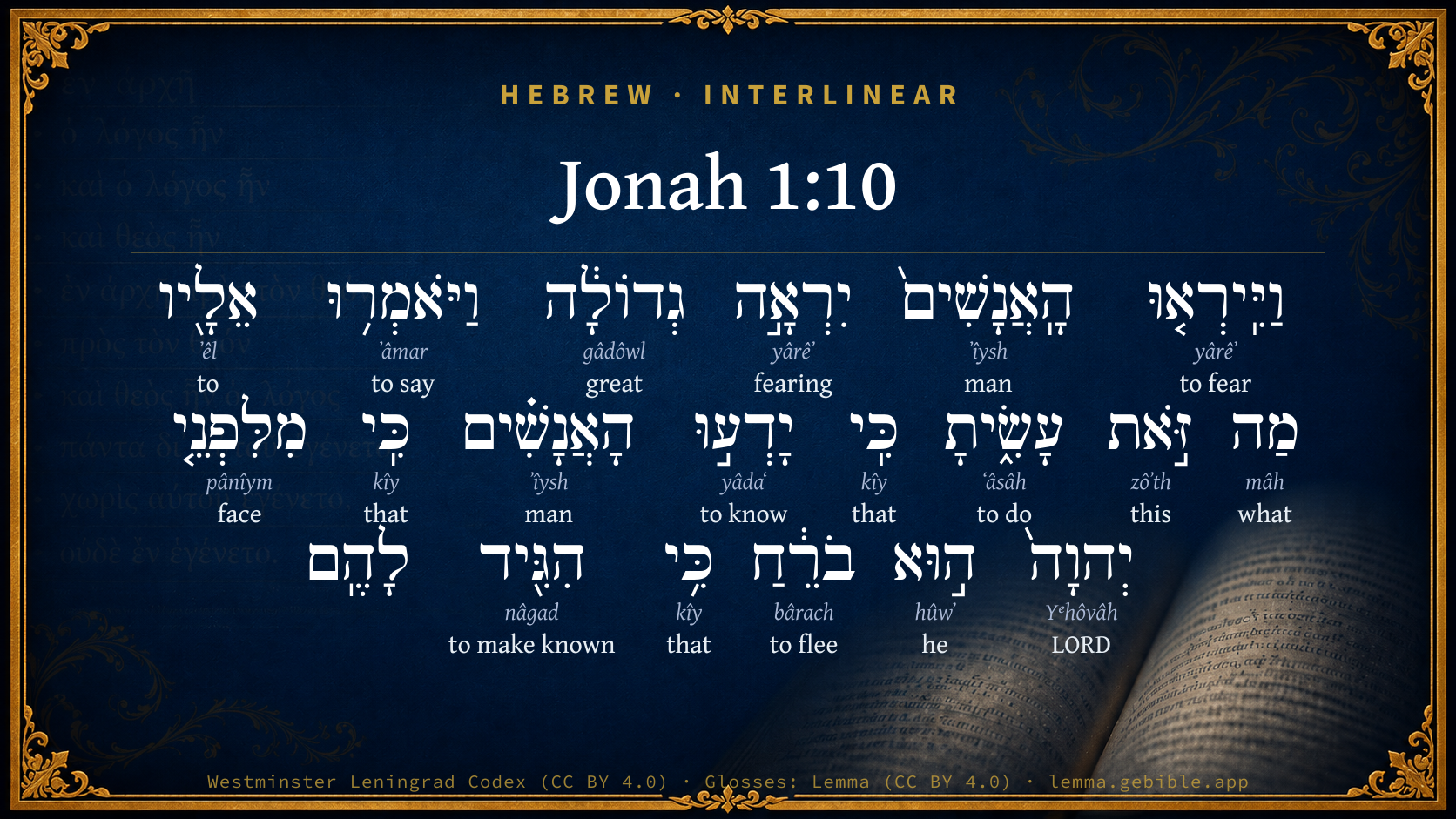
Hebrew (Westminster Leningrad Codex) Jonah 1:10 appears in the Hebrew Old Testament. The text above is from the Westminster Leningrad Codex. Each word links to its Strong’s number, a concise gloss, and parsing drawn from the Open Scriptures Hebrew Bible morphology. Click any word for its full Brown-Driver-Briggs (BDB) entry.
Download image
Cite this verse

Jonah 1:10 (World English Bible). Public Domain. Lemma interlinear Bible study tool, https://lemma.gebible.app/v/jonah/1/10.

Show BibTeX & RIS
BibTeX
RIS
English Translation
Then were the men exceedingly afraid, and said to him, "What is this that you have done?" For the men knew that he was fleeing from the presence of Yahweh, because he had told them.
World English Bible · Public Domain
Download a study sheet

One document with this verse’s original text, its word-by-word gloss line, the meaning frame, cross-references with their text, attributed commentary, and full source and license credits — printable, and it pastes into notes with its structure intact.

This verse Autodidact and up

Study sheet (.html) Plain text (.txt)

A passage Seminary Student

Up to 50 verses in one chapter. A passage sheet keeps up to 6 commentary sources and 12 cross-references per verse, in the order this page ranks them, and says so on the sheet whenever that leaves anything out. Ask for a single verse and you get the Autodidact verse sheet above.

Everything on this page stays free to read, with no account — the sheet is a download of what is already on screen, not access to it.

Want to remove ads? Support Godless Engineer
Compare translations 3

The same verse in 3 English versions, stacked beneath the original-language interlinear above. Click any original word for its lexicon entry.

Each is an independent rendering of the whole verse — the interlinear is not word-aligned to these translations.

Highlighted words mark where these versions differ — a whole-verse word diff, not a word-by-word alignment.

  • World English Bible Public Domain
    Then were the men exceedingly afraid, and said to him, "What is this that you have done?" For the men knew that he was fleeing from the presence of Yahweh, because he had told them.
  • King James Version Public Domain
    Then were the men exceedingly afraid, and said unto him. Why hast thou done this? For the men knew that he fled from the presence of the LORD, because he had told them.
  • unfoldingWord Literal Text CC BY-SA 4.0
    Then the men feared a great fear, and they said to him, “What is this that you have done?” For the men knew that he was running away from before the face of Yahweh, because he had told them.

unfoldingWord Literal Text — © unfoldingWord, licensed CC BY-SA 4.0. Word-aligned USFM3 via Door43 (git.door43.org/unfoldingWord/en_ult).

Versions to compare (up to 4)

3 of 4 selected

Show all 18 translations

Every available English version of this verse, each an independent rendering of the whole verse.

  • World English Bible Public Domain
    Then were the men exceedingly afraid, and said to him, "What is this that you have done?" For the men knew that he was fleeing from the presence of Yahweh, because he had told them.
  • Berean Standard Bible Public Domain
    Then the men were even more afraid and said to him, “What have you done?” The men knew that he was fleeing from the presence of the LORD, because he had told them.
  • Majority Standard Bible Public Domain
    Then the men were even more afraid and said to him, “What have you done?” The men knew that he was fleeing from the presence of the LORD, because he had told them.
  • King James Version Public Domain
    Then were the men exceedingly afraid, and said unto him. Why hast thou done this? For the men knew that he fled from the presence of the LORD, because he had told them.
  • American Standard Version (1901) Public Domain
    Then were the men exceedingly afraid, and said unto him, What is this that thou hast done? For the men knew that he was fleeing from the presence of Jehovah, because he had told them.
  • Revised Version (1885) Public Domain
    Then were the men exceedingly afraid, and said unto him, What is this that thou hast done? For the men knew that he fled from the presence of the LORD, because he had told them.
  • Geneva Bible (1599) Public Domain
    Then were the men exceedingly afrayde, and said vnto him, Why hast thou done this? (for the men knewe, that he fled from the presence of the Lord, because he had tolde them)
  • Douay-Rheims (1899) Public Domain
    And the men were greatly afraid, and they said to him: Why hast thou done this? (for the men knew that he fled from the face of the Lord: because he had told them.)
  • Young's Literal Translation Public Domain
    And the men fear a great fear, and say unto him, `What `is' this thou hast done!' for the men have known that from the face of Jehovah he is fleeing, for he hath told them.
  • Literal Standard Version CC BY-SA 4.0
    And the men fear a great fear, and say to him, “What [is] this you have done!” For the men have known that he is fleeing from the face of YHWH, for he has told them.
  • Unlocked Literal Bible CC BY-SA 4.0
    Then the men were even more afraid and said to Jonah, “What is this that you have done?” For the men knew that he was running away from the presence of Yahweh, because he had told them.
  • unfoldingWord Literal Text CC BY-SA 4.0
    Then the men feared a great fear, and they said to him, “What is this that you have done?” For the men knew that he was running away from before the face of Yahweh, because he had told them.
  • Darby Bible Public Domain
    Then were the men exceedingly afraid, and said unto him, What is this thou hast done? For the men knew that he fled from the presence of Jehovah: for he had told them.
  • World Messianic Bible Public Domain
    Then the men were exceedingly afraid, and said to him, “What have you done?” For the men knew that he was fleeing from the presence of the LORD, because he had told them.
  • Webster's Bible Public Domain
    Then were the men exceedingly afraid, and said to him, Why hast thou done this? For the men knew that he fled from the presence of the LORD, because he had told them.
  • Free Bible Version CC BY-SA 4.0
    The sailors became even more terrified and said to Jonah, “What have you done?” because Jonah had explained to them that he was running away from the Lord.
  • Bible in Basic English Public Domain
    And the men were in great fear, and they said to him, What is this you have done? For the men had knowledge of his flight from the Lord because he had not kept it from them.
  • JPS Tanakh (1917) Public Domain
    Then were the men exceedingly afraid, and said unto him: 'What is this that thou hast done?' For the men knew that he fled from the presence of the LORD, because he had told them.

Literal Standard Version (2020), Covenant Press — licensed CC BY-SA 4.0. Text via the HelloAO Bible API (eBible.org). Unlocked Literal Bible (unfoldingWord) — licensed CC BY-SA 4.0. Text via the HelloAO Bible API (eBible.org). unfoldingWord Literal Text — © unfoldingWord, licensed CC BY-SA 4.0. Word-aligned USFM3 via Door43 (git.door43.org/unfoldingWord/en_ult). Free Bible Version, Dr. Jonathan Gallagher — licensed CC BY-SA 4.0. Text via the HelloAO Bible API (eBible.org).

Word by word

More ways to search: Search by grammar → Find every occurrence → Compare this word →

Practice this passage: Drill this verse → Learn its vocabulary →

יִרְאָ֣ה
yârêʼ
H3373
“fearing”
Noun, Common, Feminine, Singular, Absolute
Part of Speech
Noun
Type
Common
Gender
Feminine
Number
Singular
State
Absolute
Full BDB Definition

Origin: from H3372

TWOT: 907a

fearing, reverent, afraid
  1. וַיִּֽירְא֤וּ yârêʼ H3372 “and · to fear” Conjunction + Verb, Qal, Sequential Imperfect, 3rd Person, Masculine, Plural
  2. הָֽאֲנָשִׁים֙ ʼîysh H376 “the · men” Particle, Definite Article + Noun, Common, Masculine, Plural, Absolute
  3. גְדוֹלָ֔ה gâdôwl H1419 “great” Adjective, Adjective, Feminine, Singular, Absolute
  4. וַיֹּאמְר֥וּ ʼâmar H559 “and · to say” Conjunction + Verb, Qal, Sequential Imperfect, 3rd Person, Masculine, Plural
  5. אֵלָ֖יו ʼêl H413 “to · him” Preposition + Suffix, Personal, 3rd Person, Masculine, Singular
  6. מַה mâh H4100 “what” Particle, Interrogative
  7. זֹּ֣את zôʼth H2063 “this” Pronoun, Demonstrative, Feminine, Singular
  8. עָשִׂ֑יתָ ʻâsâh H6213 “to do” Verb, Qal, Perfect, 2nd Person, Masculine, Singular
  9. כִּֽי kîy H3588 “that” Conjunction
  10. יָדְע֣וּ yâdaʻ H3045 “to know” Verb, Qal, Perfect, 3rd Person, Common, Plural
  11. הָאֲנָשִׁ֗ים ʼîysh H376 “the · men” Particle, Definite Article + Noun, Common, Masculine, Plural, Absolute
  12. כִּֽי kîy H3588 “that” Conjunction
  13. מִלִּפְנֵ֤י pânîym H6440 “from · to/for · face(s) of” Preposition + Preposition + Noun, Common, Both, Plural, Construct
  14. יְהוָה֙ Yᵉhôvâh H3068 “LORD” Noun, Proper
  15. ה֣וּא hûwʼ H1931 “he” Pronoun, Personal, 3rd Person, Masculine, Singular
  16. בֹרֵ֔חַ bârach H1272 “fleeing” Verb, Qal, Participle Active, Masculine, Singular, Absolute
  17. כִּ֥י kîy H3588 “that” Conjunction
  18. הִגִּ֖יד nâgad H5046 “to make known” Verb, Hiphil, Perfect, 3rd Person, Masculine, Singular

About this verse

These counts appear in no published source. They are computed here, from the morphology-tagged text and Lemma’s own curated glosses. What Lemma adds →

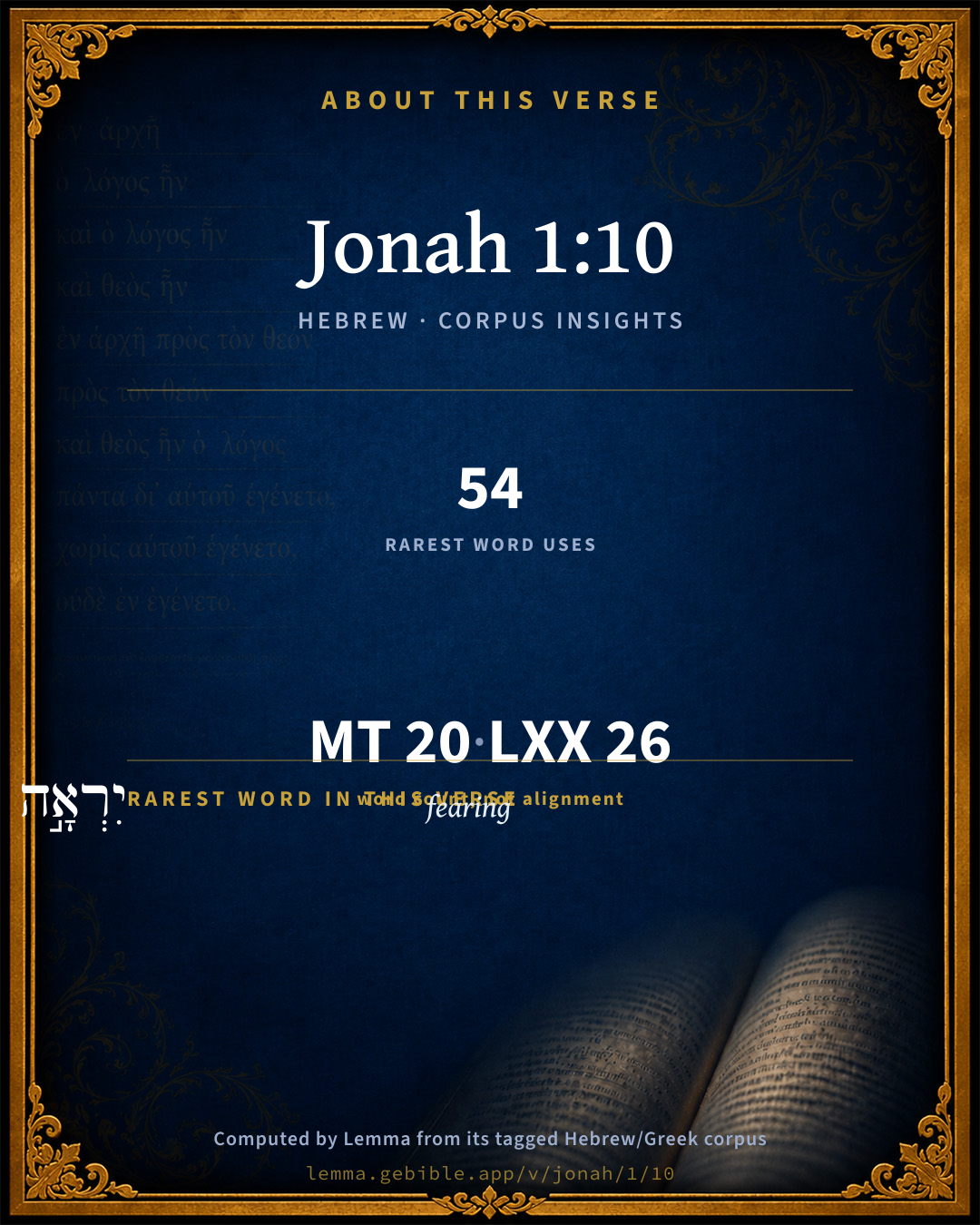
20
words
16
distinct lemmas
Prophets
section

Shared distinctive vocabulary

יִרְאָ֣ה fearing H3373 occurs in 54 verses of the Hebrew Bible. Also found in:

Grammatical profile

  • 6 verbs
  • 5 nouns
  • 1 adjective
  • 2 pronouns
  • 2 prepositions
  • 3 conjunctions
  • 1 particle

Verb forms

  • וַיִּֽירְא֤וּ Qal · Sequential Imperfect
  • וַיֹּאמְר֥וּ Qal · Sequential Imperfect
  • עָשִׂ֑יתָ Qal · Perfect
  • יָדְע֣וּ Qal · Perfect
  • בֹרֵ֔חַ Qal · Participle Active
  • הִגִּ֖יד Hiphil · Perfect

Repetition

Words recur within this verse — often emphatic in Hebrew:

  • הָֽאֲנָשִׁים֙ man H376 ×2
  • כִּֽי that H3588 ×3

Hebrew & Septuagint length

In English translation the verse runs 35 words from the Hebrew and 35 from the Septuagint (LXX English) — the same length.

A rough comparison of the two English renderings, which tokenize alike — not a word-level alignment.

Word counts can differ between the Hebrew and the Greek without any difference in meaning — e.g. the Hebrew direct-object marker אֵת has no separate Greek word, and Greek often adds the article ὁ.

In the original languages it is 20 Hebrew tokens and 26 Greek tokens — but the two are counted differently (Hebrew bundles its prefixes and suffixes into one token; the Greek is in lemma form), so that isn’t a like-for-like length.

Cross-references

6

Topical passages linked to Jonah 1:10 in the Treasury of Scripture Knowledge — connected by theme and wording, ordered by reader-vote popularity; previews shown in the World English Bible.

  • Jonah 1:3 But Jonah rose up to flee to Tarshish from the presence of Yahweh. He went down to Joppa, and found a ship going to Tarshish; so he paid its fare, and went down into it, to go with them to Tarshish from the presence of Yahweh.
  • Job 27:22 For it hurls at him, and does not spare, As he flees away from his hand.
  • Joshua 7:25 Joshua said, Why have you troubled us? Yahweh shall trouble you this day. All Israel stoned him with stones; and they burned them with fire, and stoned them with stones.
  • 2 Samuel 24:3 Joab said to the king, Now Yahweh your God add to the people, however many they may be, one hundred times; and may the eyes of my lord the king see it: but why does my lord the king delight in this thing?
  • Daniel 5:6–9 Then the king's face was changed in him, and his thoughts troubled him; and the joints of his loins were loosened, and his knees struck one against another.
  • John 19:8 When therefore Pilate heard this saying, he was more afraid.

Cross-references courtesy of OpenBible.info (CC BY 4.0).

Hebrew and Greek witnesses Masoretic Hebrew ↔ Greek Septuagint

The same verse in the two great witnesses to the Old Testament, shown verse-for-verse.

These are two independent witnesses, not word-aligned to each other, and the Septuagint is shown in lemma (dictionary) form.

Hebrew Jonah 1:10 Masoretic · Westminster Leningrad Codex

וַיִּֽירְא֤וּ הָֽאֲנָשִׁים֙ יִרְאָ֣ה גְדוֹלָ֔ה וַיֹּאמְר֥וּ אֵלָ֖יו מַה זֹּ֣את עָשִׂ֑יתָ כִּֽי יָדְע֣וּ הָאֲנָשִׁ֗ים כִּֽי מִלִּפְנֵ֤י יְהוָה֙ ה֣וּא בֹרֵ֔חַ כִּ֥י הִגִּ֖יד לָהֶֽם

Then were the men exceedingly afraid, and said to him, "What is this that you have done?" For the men knew that he was fleeing from the presence of Yahweh, because he had told them.

World English Bible · Public Domain

Greek LXX Jonah 1:10 Septuagint · lemma form

καί φοβέω ὁ ἀνήρ φόβος μέγας καί εἶπον πρός αὐτός τίς οὗτος ποιέω διότι γιγνώσκω ὁ ἀνήρ ὅτι ἐκ πρόσωπον κύριος εἰμί φεύγω ὅτι ἀποἀγγέλλω αὐτός

Then the men feared exceedingly, and said to him, What is this that you have done? for the men knew that he was fleeing from the face of the Lord, because he had told them.

LXX2012 (modern English Septuagint) · Public Domain

Hebrew: Westminster Leningrad Codex (CC BY 4.0). Greek: Septuagint (public domain); English from LXX2012 (modern English Septuagint) (Public Domain). How the Septuagint differs from the Hebrew →

Targum (Aramaic paraphrase)

1

The Targum is the ancient Jewish Aramaic paraphrase of the Hebrew Scriptures — an interpretive translation, not the Hebrew text itself. Onkelos (literal) and Pseudo-Jonathan (expansive) render the Torah, and Jonathan the Prophets. Coverage is partial: where no permissively-licensed English translation exists for a verse, only the Aramaic is shown. This is verse-level text, not a word-by-word alignment to the Hebrew.

  1. Targum Jonathan Prophets (Joshua–Malachi)
    וּדְחִילוּ גַבְרַיָא דְחִילָא רַבָּא וַאֲמָרוּ לֵיהּ מַה דָא עַבַדְתָּא אֲרֵי יְדָעוּ גוּבְרַיָא אֲרֵי מִן קֳדָם יְיָ הוּא עָרֵיק אֲרֵי חַוֵי לְהוֹן:

    And the men were afraid with a great fear, and said to him, “What did you do!?” because the men know that from before the LORD he had fled, since he told them.

    Targum Jonathan — Aramaic: “Mikraot Gedolot” (public domain). English: “Sefaria Community Translation” (CC0 1.0 (public-domain dedication)); “London "Chaldee Paraphrase," 1871” (public domain). Text via Sefaria.

Commentary

Notes on Jonah 1:10 from classic Christian and Jewish commentators (each source and its license shown beneath its notes). The classic Christian expositions comment on the surrounding passage and are grouped to its opening verse, so a note may address several verses; the Jewish commentaries on the Tanakh (Rashi and others) are per-verse, so they appear only where the commentator wrote on this verse.

Lemma curates 59 commentaries, every one of them public domain or Creative Commons licensed, each selected and text-cleaned for this edition rather than reprinted as found. About our sources →

Trapp's Complete Commentary

John Trapp

Jon 1:10 Then were the men exceedingly afraid, and said unto him, Why hast thou done this? For the men knew that he fled from the presence of the LORD, because he had told them.

Ver. 10. Then were the men exceedingly afraid] Heb. with great fear; when once they had heard the business, and weighed the particulars, of his message to Nineveh, of his miscarriage, and of his present misery, together with the danger that themselves were in for his sake; how much more for their own, as being conscious to themselves of far more and greater sins than Jonah had to answer for. This put the mariners into a great fright; and as all fear hath torment, they could not be at quiet till they had further questioned him, saying:

Why hast thou done this?] Lo, he that would not be subject to God’s command is now liable to the censures, conviction, and condemnation of rude barbarous men; which, being humbled in the sense of his sin, he doth patiently endure without grudging. Daneus’s note here is, that concerning themselves and their own sins against God these good fellows speak nothing, whatever they think; but demand of the prophet, why hast thou done this? as if he were the only misdoer.

Because he had told them] As willing now to give glory to God and take shame to himself: this is the property of a true penitentiary. See Psa 51:1 title (where David stands to do penance in a white sheet, as it were), and Augustin’s Confessions. Hypocrites deal with their souls as some do with their bodies; when their beauty is decayed they desire to hide it from themselves by false glasses and from others by painting: so do they their sins from themselves by false glosses and from others by excuses. But as the prisoner on the rack tells all; and as things written with the juice of lemons when held to the fire are made legible; so when God brings men into straits, when he roasteth them in the fire of his wrath, then, if ever, they will confess against themselves, and so give glory to God, Jos 7:19, by putting themselves into the hand of justice, in hope of mercy.

John Trapp, A Commentary or Exposition upon All the Books of the Old and New Testament (1647–1656) — public domain. Text from a community e-Sword module.

Whedon's Commentary on the Bible

Daniel D. Whedon

10. The words of Jonah recorded in Jon_1:9 would be sufficient to create fear and restlessness; but if the closing words of Jon_1:10 are original, Jonah made known his attempt to flee from this God of heaven and earth. No wonder they were “sore afraid”; for the attempt to escape from the supreme God is the climax of crime and the height of folly.

Why hast thou done this? — R.V., “What is this that thou hast done?” Not a question of inquiry, but an exclamation of astonishment and indignation at his crime and folly.

The men knew that he fled — While the presence of Jonah in the boat and the storm viewed in the light of the confession in Jon_1:9 might have been sufficient to lead the sailors to suppose that they had before them a fugitive from the presence of Jehovah, there seems insufficient reason for questioning the originality of the closing words of Jon_1:10, which state that the prophet informed the men of his attempt. 11.

What shall we do — Though terror struck, the sailors are ready to deal with Jonah, who alone was responsible for their plight, in all fairness. Something must be done, but they are willing to receive any suggestion as to the proper course to pursue.

Unto us — Literally, from upon us, that is, so that it may cease from rushing upon us like an enemy (Jon_1:5).

The sea wrought, and was tempestuous — R.V., “the sea grew more and more tempestuous”; literally, was (is) going on and was (is) being tempestuous. A peculiar Hebrew idiom, which is rightly reproduced in R.V. (compare Gen_8:3; 1Sa_2:26; 2Sa_3:1). The words may be interpreted as the utterance of the sailors, giving the reason for their anxious appeal to him; it is high time that something should be done, since the raging of the sea is constantly increasing.

Daniel D. Whedon (gen. ed.), Commentary on the Old and New Testaments (1874–1909) — public domain. Text from a community e-Sword module.

Jamieson, Fausset & Brown

Robert Jamieson, A. R. Fausset & David Brown

"The men were exceedingly afraid," when made aware of the wrath of so powerful a God at the flight of Jonah.

Why hast thou done this?--If professors of religion do wrong, they will hear of it from those who make no such profession.

Jamieson, Fausset & Brown — Commentary Critical and Explanatory on the Whole Bible (1871) — public domain (CC PDM 1.0). Text via the HelloAO Bible API.

John Calvin's Commentaries

It then follows, that the men feared with great fear, and said, Why hast thou done this? for they knew that he had fled from the presence of Jehovah, for he had told them. And this is not unimportant — that the sailors feared with great fear: for Jonah means that they were not only moved by what he said, but also terrified, so that they gave to the true God his glory. We indeed know that superstitious men almost trifle with their own idols. They often entertain, it is true, strange fears, but afterwards they flatter themselves, and in a manner cajole their own hearts, so that they can pleasantly and sweetly smile at their own fancies. But Jonah, by saying here that they feared with great fear, means that they were so smitten, that they really perceived that the God of Israel was a righteous judge, and that he was not such as other nations fancied him to be, but that he was capable of affording dreadful examples whenever he intended to execute his vengeance. We hence see what Jonah means, when he speaks of great fear. At the same time, two things ought to be noticed, — that they feared, because it was easy for them to conclude from the Prophet’s words, that the God of Israel was the only creator of heaven and earth, — and then, that it was a great fear, which, as I have said, must be considered as serious dread, since the fear which the unbelieving have soon vanishes.

But with regard to the reproof which the sailors and other passengers gave to Jonah, the Lord returned to him this as a reward which he had deserved. He had fled from the presence of God; he had thus, as we have said taken away from God his supreme power: for what becomes of God’s authority when any one of us rejects his commands and flees away from his presence? Since Jonah then sought to shun God, he was now placed before men. There were present heathens, and even barbarians, who rebuked him for his sin, who were his censors and judges. And the same thing we see happening often. For they who do not willingly obey God and his word, afterwards abandon themselves to many flagrant sins, and their baseness becomes evident to all. As, then, they cannot bear God to be their Master and Teacher, they are constrained to bear innumerable censors; for they are branded by the reproaches of the vulgar, they are pointed at every where by the finger, at length they are conducted to the gallows, and the executioner becomes their chief teacher. The case was similar, as we see, with Jonah: the pilot had before reproved his torpor, when he said, Do thou also call on thy God; what meanest thou, O sleeper? thou liest down here like a log of wood, and yet thou sees us perplexed and in extreme danger. As, then, the pilot first so sharply inveighed against Jonah, and then all reproved him with one mouth, we certainly find that he was made subject to the condemnation of all, because he tried to deprive God of his supreme power. If at any time the same thing should happen to us, if God should subject us to the reproaches of men when we seek to avoid his judgment, let us not wonder. But as Jonah here calmly answers, and raises no clamor, and shows no bitterness, so let every one of us, in the true spirit of meekness, acknowledge our own sins; when charged with them, were even children our condemners, or were even the most contemptible of the people to rise up against us, let us patiently bear all this; and let us know that these kinds of censors befall us through the providence of God. It now follows —

John Calvin's Commentaries (1540-1563) — public domain. Text from the Calvin Translation Society English edition (1840s-50s) via the Christian Classics Ethereal Library (ccel.org). Calvin's coverage is partial (roughly two-thirds of the Bible); uncommented books and verses are honest gaps, never fabricated. The 19th-century editor's footnotes and remarks are omitted so the notes are faithfully Calvin's own voice.

Ellicott's Commentary for English Readers

(10) Why hast.—Rather, What is this that thou hast done? The question expresses horror, not curiosity.

For the men knew that.—Jonah’s answer in Jon_1:9 is evidently intended only as an abbreviation of what he actually replied.

A Bible Commentary for English Readers, edited by Charles John Ellicott (1878–1897) — public domain. Text from a community e-Sword module.

The Cambridge Bible for Schools and Colleges

gen. ed. J. J. S. Perowne

10. Why hast thou done this?] Rather, What is this that thou hast done? A question not of enquiry, but of amazement and reproach. Comp. Gen_4:10.

The Cambridge Bible for Schools and Colleges (gen. ed. J. J. S. Perowne; Cambridge University Press, 1878–1918) — public domain. Text from a community e-Sword module.

John Gill's Exposition

Then were the men exceedingly afraid,.... When they found he was a Hebrew, and that it was the God of the Hebrews that was angry; of whom they had heard much, and what great and wonderful things had been done by him, and now had an experience of his power and providence, and that it was for fleeing from his presence that all this was; and therefore, since they had been guilty of greater sins than this, as they might imagine, what would be done to them? and particularly it might fill them with dread and terror, when they heard of the destruction of Nineveh, the prophet was sent to denounce; of which no doubt he had told them, and they might from hence conclude it would certainly be:

and said unto him, why hast thou done this? they wonder he should act such a foolish part as to flee from such a God he had described to them, who was Lord of heaven, earth, and sea; and therefore could meet with him, and seize him, be he where he would; and they reprove him for it, and the rather as it had involved them in so much distress and danger:

for the men knew that he had fled from the presence of the Lord,

because he had told them; not when he first entered into the ship, but now, though not before mentioned; for no doubt Jonah told the whole story at length, though the whole is not recorded; how that he was sent by the Lord with a message to Nineveh, to denounce destruction to it; and that he refused to go, and fled from his face; and this was the true reason of the storm.

John Gill's Exposition of the Whole Bible (1746–1763) — public domain (CC PDM 1.0). Text via the HelloAO Bible API.

Albert Barnes' Notes on the Bible

Then were the men exceedingly afraid - Before, they had feared the tempest and the loss of their lives. Now they feared God. They feared, not the creature but the Creator. They knew that what they had feared was the doing of His Almightiness. They felt how awesome a thing it was to be in His Hands. Such fear is the beginning of conversion, when people turn from dwelling on the distresses which surround them, to God who sent them.

Why hast thou done this? - They are words of amazement and wonder. Why hast thou not obeyed so great a God, and how thoughtest thou to escape the hand of the Creator ? “What is the mystery of thy flight? Why did one, who feared God and had revelations from God, flee, sooner than go to fulfill them? Why did the worshiper of the One true God depart from his God?” “A servant flee from his Lord, a son from his father, man from his God!” The inconsistency of believers is the marvel of the young Christian, the repulsion of those without, the hardening of the unbeliever. If people really believed in eternity, how could they be thus immersed in things of time? If they believed in hell, how could they so hurry there? If they believed that God died for them, how could they so requite Him? Faith without love, knowledge without obedience, conscious dependence and rebellion, to be favored by God yet to despise His favor, are the strangest marvels of this mysterious world.

All nature seems to cry out to and against the unfaithful Christian, “why hast thou done this?” And what a why it is! A scoffer has recently said so truthfully : “Avowed scepticism cannot do a tenth part of the injury to practical faith, that the constant spectacle of the huge mass of worldly unreal belief does.” It is nothing strange, that the world or unsanctified intellect should reject the Gospel. It is a thing of course, unless it be converted. But, to know, to believe, and to DISOBEY! To disobey God, in the name of God. To propose to halve the living Gospel, as the woman who had killed her child 1Ki 3:26, and to think that the poor quivering remnants would be the living Gospel anymore! As though the will of God might, like those lower forms of His animal creation, be divided endlessly, and, keep what fragments we will, it would still be a living whole, a vessel of His Spirit! Such unrealities and inconsistencies would be a sore trial of faith, had not Jesus, who (cf. Joh 2:25), “knew what is in man,” forewarned us that it should be so. The scandals against the Gospel, so contrary to all human opinion, are only all the more a testimony to the divine knowledge of the Redeemer.

Albert Barnes' Notes on the Bible (1834–1885) — public domain. Text from a community e-Sword/MySword module.

Matthew Poole's English Annotations

Then; when Jonah had declared his God, whose power and wrath these mariners saw and heard in the tempest, and what sin of his was now punished, and how they had taken him into their ship, knowing that he did runaway from this mighty God.

The men were exceedingly afraid; their fear was doubled, every thing now represents horror to them, their own danger, Nineveh’s approaching dismal ruin, which they believe by what they see, satisfied that he who so tremendously punished the refusal to deliver the message, was able and certainly would execute the sentence which he commanded should be delivered.

Why hast thou done this? now they ask a reason for that of which no reason can be given: it was most unreasonable that Jonah had done, and we find no answer to this interrogatory, though the foregoing questions were answered. Others think it is a reproof of him for so doing; I rather think it mixed of both. It was a real reproof to himself while he more particularly explains the great sinfulness Of this prank of his; and it is an inquiry made for satisfaction to them, who no doubt thought of Jonah’s God as they did of their own, that it was no hard matter to be done, nor any great sin if done, to run from their presence. These likely were their thoughts of the thing when he first told them; but the dreadful storm that Jonah’s God sent after this fugitive servant of his makes them more curious to know what great sin it was, and so Jonah explaining the whole, confesseth his sin, humbleth himself, and takes the reproof to himself, and informeth them aright. The men; the master of the ship, and the mariners.

Knew that he fled from the presence of the Lord: in these words it is probable he told them; now though they knew this was the thing, yet they apprehended not what was in it, but did judge of this by their own gods, and their presence.

He had told them, when they inquired the cause of his travels, as it is very like they would do, ere they took his fare.

Matthew Poole's English Annotations on the Holy Bible (1683–1685) — public domain. Text from a community e-Sword/MySword module.

The Pulpit Commentary

Exceedingly afraid. They understand now the greatness of Jehovah and the terrible risk incurred by one who offends him. There was a widespread acknowledgment of the power of Jehovah among the heathen. (Exo_15:15 Jos_5:1 1Sa_4:7; and comp. RAPC Jdt 5:21) Why hast thou done this? better, What is this that thou hast done?. (Gen_3:13) This is not a question of inquiry, for he had already told them that he had fled from the presence of the Lord; but rather an exclamation of horror and amazement at his folly and sin. That one who worshipped the Almighty Creator should disobey his command seemed to them outrageous and inexcusably criminal. The prophet does not spare himself in giving the history of the transaction. To be thus rebuked by heathen sailors must have added to the poignancy of his remorse. The presence of the Lord (see note on ver. 3).

The Pulpit Commentary (1880–1919), ed. H.D.M. Spence-Jones & Joseph S. Exell — public domain. Text from a community e-Sword module.

Rashi

Rabbi Shlomo Yitzchaki (Rashi)

“What is this that you have done?”—Why have you done this, to flee from before such a Ruler?

Rashi on the Tanakh — English translations: “The Judaica Press complete Tanach with Rashi, translated by A. J. Rosenberg” (CC BY 4.0); “Pentateuch with Rashi's commentary by M. Rosenbaum and A.M. Silbermann, 1929-1934” (public domain); “The Metsudah Tanach series, Lakewood, N.J” (CC BY 4.0); and “The Book of Joshua, Metsudah Publications, 1997” (CC BY 4.0). Text via Sefaria.

Lesson kit

Teaching starters — assembled from the data on this page, not authored interpretation. Every prompt links to the verse data it draws on. Edit before teaching.

Jonah, in the Prophets, opens this verse with 20 words (16 distinct Hebrew lemmas). Its most distinctive word is yârêʼ (“fearing”). A historical commentator’s framing appears above. Read the whole chapter for the surrounding context.

Discussion questions

  1. How does “fearing” (yârêʼ) shape what this verse is saying?
  2. Genesis 22:12 shares the word «fearing» with this verse. How do the two illuminate each other?
  3. “man” occurs 2× in this one verse. What is the effect of the repetition?
  4. The translations on this page render this verse differently — a whole-verse word diff, not a word-by-word alignment. What might account for the different wordings?
  5. The verb «וַיִּֽירְא֤וּ» is Qal Sequential Imperfect. How does its form color the action?
  6. Reading how Trapp's Complete Commentary and Whedon's Commentary on the Bible read this verse, where do the two commentators agree and where do they part?

Things to notice

Reading settings

Reading text

Shown beneath each verse's original-language words.

Old Testament
Old Testament edition

Read the OT as the Masoretic Hebrew (MT) or the Greek Septuagint (LXX).

English shown for the Greek Septuagint (in the Hebrew ↔ Greek comparison).

Comparing translations? Open the Compare panel on any verse page to stack up to four side by side.