Jeremiah 48:20

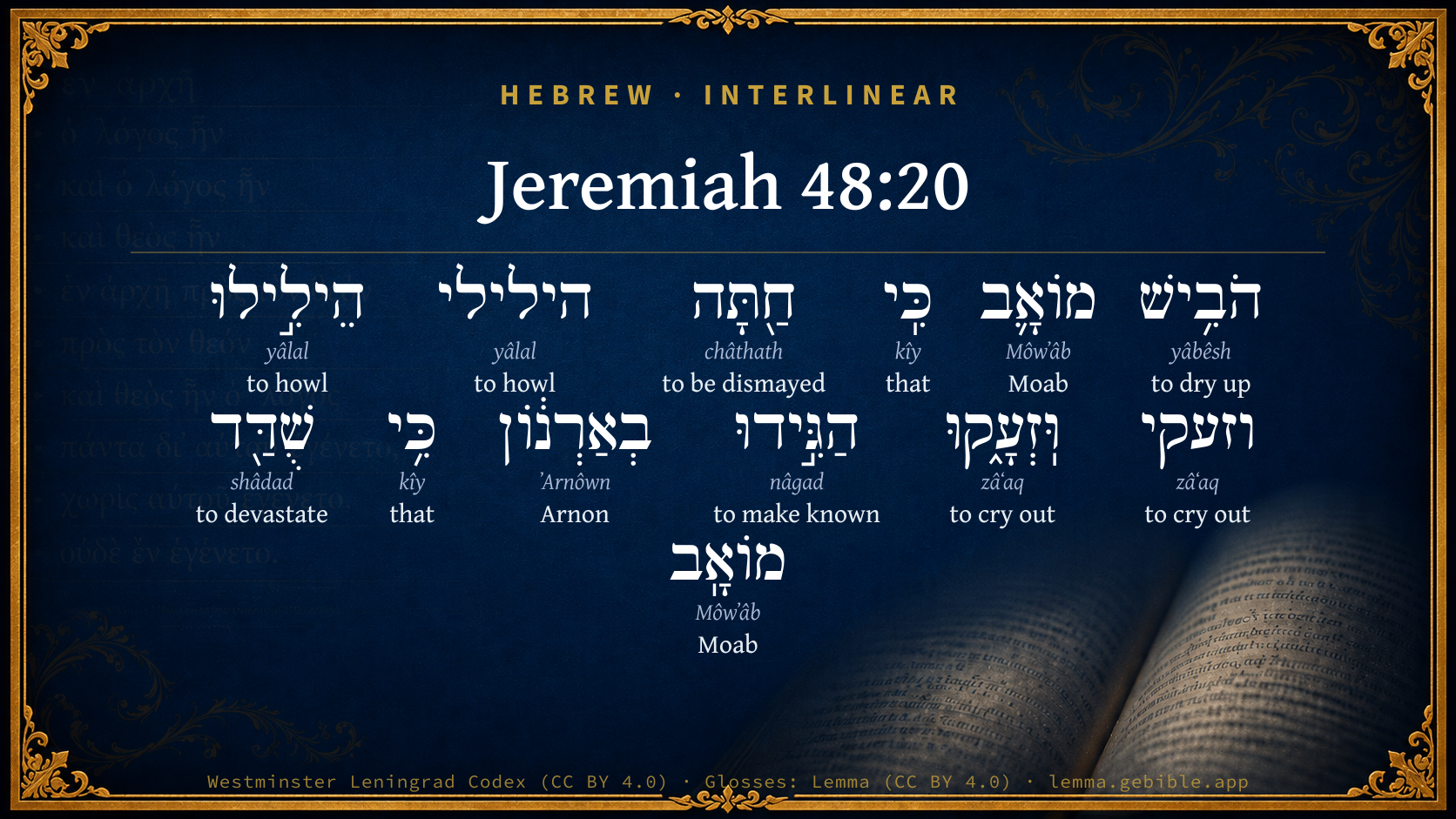
Hebrew (Westminster Leningrad Codex) Jeremiah 48:20 appears in the Hebrew Old Testament. The text above is from the Westminster Leningrad Codex. Each word links to its Strong’s number, a concise gloss, and parsing drawn from the Open Scriptures Hebrew Bible morphology. Click any word for its full Brown-Driver-Briggs (BDB) entry.
Download image
Cite this verse

Jeremiah 48:20 (World English Bible). Public Domain. Lemma interlinear Bible study tool, https://lemma.gebible.app/v/jeremiah/48/20.

Show BibTeX & RIS
BibTeX
RIS
English Translation
Moab is disappointed; for it is broken down: wail and cry; tell you it by the Arnon, that Moab is laid waste.
World English Bible · Public Domain
Download a study sheet

One document with this verse’s original text, its word-by-word gloss line, the meaning frame, cross-references with their text, attributed commentary, and full source and license credits — printable, and it pastes into notes with its structure intact.

This verse Autodidact and up

Study sheet (.html) Plain text (.txt)

A passage Seminary Student

Up to 50 verses in one chapter. A passage sheet keeps up to 6 commentary sources and 12 cross-references per verse, in the order this page ranks them, and says so on the sheet whenever that leaves anything out. Ask for a single verse and you get the Autodidact verse sheet above.

Everything on this page stays free to read, with no account — the sheet is a download of what is already on screen, not access to it.

Want to remove ads? Support Godless Engineer
Compare translations 3

The same verse in 3 English versions, stacked beneath the original-language interlinear above. Click any original word for its lexicon entry.

Each is an independent rendering of the whole verse — the interlinear is not word-aligned to these translations.

Highlighted words mark where these versions differ — a whole-verse word diff, not a word-by-word alignment.

  • World English Bible Public Domain
    Moab is disappointed; for it is broken down: wail and cry; tell you it by the Arnon, that Moab is laid waste.
  • King James Version Public Domain
    Moab is confounded; for it is broken down: howl and cry; tell ye it in Arnon, that Moab is spoiled,
  • unfoldingWord Literal Text CC BY-SA 4.0
    Moab has been shamed, for it has been shattered. Howl and lament; shout for help. Tell it to people by the Arnon River that Moab has been devastated.

unfoldingWord Literal Text — © unfoldingWord, licensed CC BY-SA 4.0. Word-aligned USFM3 via Door43 (git.door43.org/unfoldingWord/en_ult).

Versions to compare (up to 4)

3 of 4 selected

Show all 18 translations

Every available English version of this verse, each an independent rendering of the whole verse.

  • World English Bible Public Domain
    Moab is disappointed; for it is broken down: wail and cry; tell you it by the Arnon, that Moab is laid waste.
  • Berean Standard Bible Public Domain
    Moab is put to shame, for it has been shattered. Wail and cry out! Declare by the Arnon that Moab is destroyed.
  • Majority Standard Bible Public Domain
    Moab is put to shame, for it has been shattered. Wail and cry out! Declare by the Arnon that Moab is destroyed.
  • King James Version Public Domain
    Moab is confounded; for it is broken down: howl and cry; tell ye it in Arnon, that Moab is spoiled,
  • American Standard Version (1901) Public Domain
    Moab is put to shame; for it is broken down: wail and cry; tell ye it by the Arnon, that Moab is laid waste.
  • Revised Version (1885) Public Domain
    Moab is put to shame; for it is broken down: howl and cry; tell ye it in Arnon, that Moab is laid waste.
  • Geneva Bible (1599) Public Domain
    Moab is cofouded: for it is destroied: howle, and cry, tell ye it in Arnon, that Moab is made waste,
  • Douay-Rheims (1899) Public Domain
    Moab is confounded, because he is overthrown: howl ye, and cry, tell ye it in Amen, that Moab is wasted.
  • Young's Literal Translation Public Domain
    Put to shame hath been Moab, For it hath been broken down, Howl and cry, declare ye in Arnon, For spoiled is Moab,
  • Literal Standard Version CC BY-SA 4.0
    Moab has been put to shame, || For it has been broken down, || Howl and cry, declare in Arnon, || For Moab is spoiled,
  • Unlocked Literal Bible CC BY-SA 4.0
    Moab has been shamed, for it has been shattered. Howl and lament; shout for help. Tell it to people by the Arnon River that Moab has been devastated.
  • unfoldingWord Literal Text CC BY-SA 4.0
    Moab has been shamed, for it has been shattered. Howl and lament; shout for help. Tell it to people by the Arnon River that Moab has been devastated.
  • Darby Bible Public Domain
    Moab is put to shame; for he is broken down: howl and cry; tell it in Arnon, that Moab is laid waste.
  • World Messianic Bible Public Domain
    Moab is disappointed; for it is broken down. Wail and cry! Tell it by the Arnon, that Moab is laid waste.
  • Webster's Bible Public Domain
    Moab is confounded; for it is broken down: howl and cry; tell ye it in Arnon, that Moab is laid waste.
  • Free Bible Version CC BY-SA 4.0
    Moab has been humiliated because it has been defeated. Weep and wail! Shout out beside the River Arnon that Moab has been destroyed!
  • Bible in Basic English Public Domain
    Moab has been put to shame, she is broken: make loud sounds of grief, crying out for help; give the news in Arnon, that Moab has been made waste.
  • JPS Tanakh (1917) Public Domain
    Moab is put to shame, for it is dismayed; wail and cry; tell ye it in Arnon, that Moab is spoiled.

Literal Standard Version (2020), Covenant Press — licensed CC BY-SA 4.0. Text via the HelloAO Bible API (eBible.org). Unlocked Literal Bible (unfoldingWord) — licensed CC BY-SA 4.0. Text via the HelloAO Bible API (eBible.org). unfoldingWord Literal Text — © unfoldingWord, licensed CC BY-SA 4.0. Word-aligned USFM3 via Door43 (git.door43.org/unfoldingWord/en_ult). Free Bible Version, Dr. Jonathan Gallagher — licensed CC BY-SA 4.0. Text via the HelloAO Bible API (eBible.org).

Word by word

More ways to search: Search by grammar → Find every occurrence → Compare this word →

Practice this passage: Drill this verse → Learn its vocabulary →

בְאַרְנ֔וֹן
ʼArnôwn
H769
“in/at · Arnon”
Preposition + Noun, Proper
Part of Speech
Preposition + Noun
Type
Proper
Full BDB Definition

Origin: from H7442

TWOT: None

Arnon = "rushing stream" - a river and surrounding valley in south Palestine, forms the border between Moab and the Amorites
  1. הֹבִ֥ישׁ yâbêsh H3001 “to dry up” Verb, Hiphil, Perfect, 3rd Person, Masculine, Singular
  2. מוֹאָ֛ב Môwʼâb H4124 “Moab” Noun, Proper
  3. כִּֽי kîy H3588 “that” Conjunction
  4. חַ֖תָּה châthath H2865 “to be dismayed” Verb, Qal, Perfect, 3rd Person, Feminine, Singular
  5. הילילי yâlal H3213 “howl” Verb, Hiphil, Imperative, 2nd Person, Feminine, Singular
  6. הֵילִ֣ילוּ yâlal H3213 “howl” Verb, Hiphil, Imperative, 2nd Person, Masculine, Plural
  7. וזעקי zâʻaq H2199 “and · cry out” Conjunction + Verb, Qal, Imperative, 2nd Person, Feminine, Singular
  8. וּֽזְעָ֑קוּ zâʻaq H2199 “and · cry out” Conjunction + Verb, Qal, Imperative, 2nd Person, Masculine, Plural
  9. הַגִּ֣ידוּ nâgad H5046 “make known” Verb, Hiphil, Imperative, 2nd Person, Masculine, Plural
  10. כִּ֥י kîy H3588 “that” Conjunction
  11. שֻׁדַּ֖ד shâdad H7703 “to devastate” Verb, Pual, Perfect, 3rd Person, Masculine, Singular
  12. מוֹאָֽב Môwʼâb H4124 “Moab” Noun, Proper

About this verse

These counts appear in no published source. They are computed here, from the morphology-tagged text and Lemma’s own curated glosses. What Lemma adds →

13
words
9
distinct lemmas
Prophets
section

Notable vocabulary

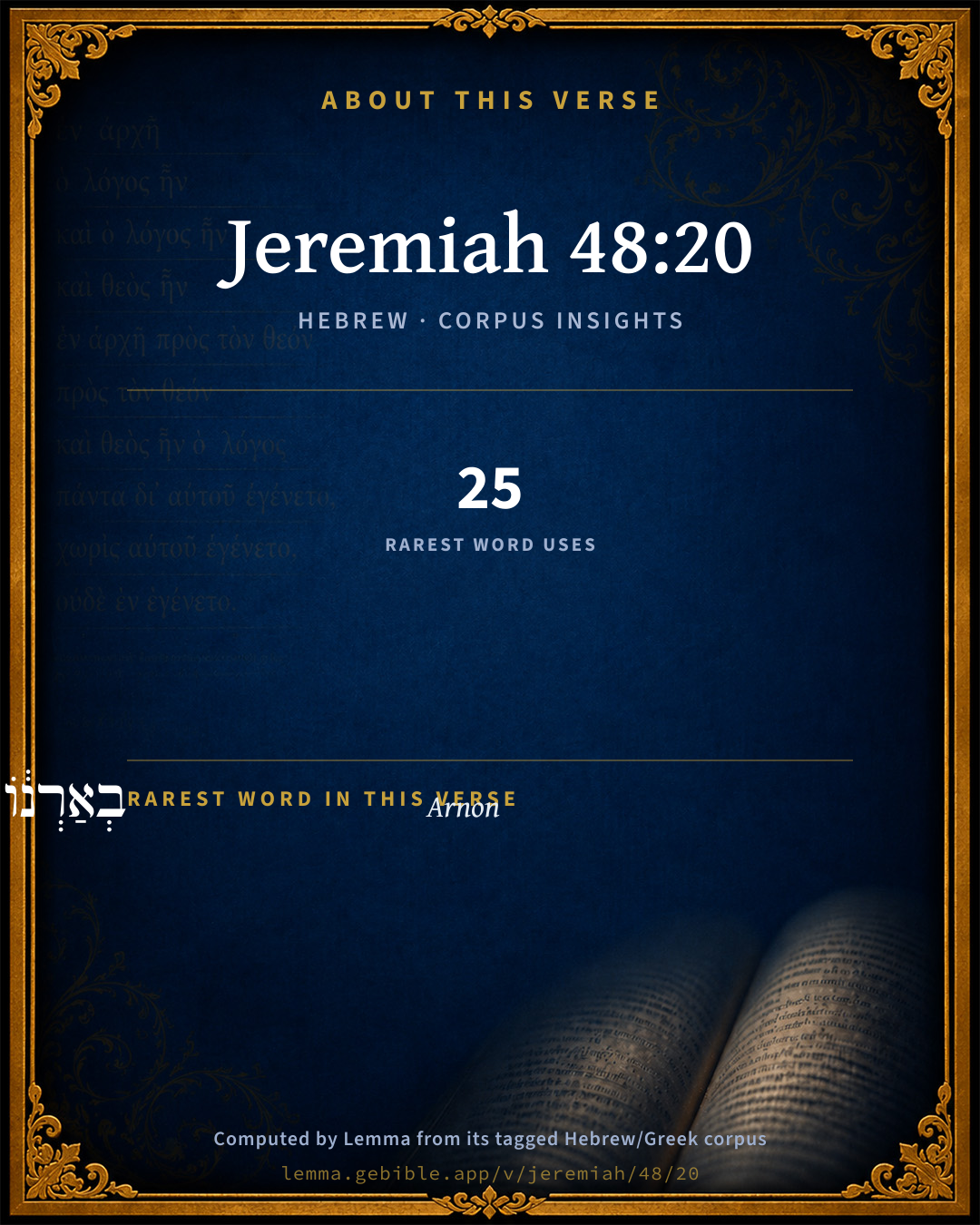
The rarest word here is בְאַרְנ֔וֹן Arnon H769 — appearing just 25 times in the whole Hebrew Bible.

Shared distinctive vocabulary

בְאַרְנ֔וֹן Arnon H769 occurs in 23 verses of the Hebrew Bible. Also found in:

Grammatical profile

  • 8 verbs
  • 3 nouns
  • 2 conjunctions

Verb forms

  • הֹבִ֥ישׁ Hiphil · Perfect
  • חַ֖תָּה Qal · Perfect
  • הילילי Hiphil · Imperative
  • הֵילִ֣ילוּ Hiphil · Imperative
  • וזעקי Qal · Imperative
  • וּֽזְעָ֑קוּ Qal · Imperative
  • הַגִּ֣ידוּ Hiphil · Imperative
  • שֻׁדַּ֖ד Pual · Perfect

Repetition

Words recur within this verse — often emphatic in Hebrew:

  • מוֹאָ֛ב Moab H4124 ×2
  • הילילי to howl H3213 ×2
  • וזעקי to cry out H2199 ×2
  • כִּֽי that H3588 ×2

Cross-references

10

Topical passages linked to Jeremiah 48:20 in the Treasury of Scripture Knowledge — connected by theme and wording, ordered by reader-vote popularity; previews shown in the World English Bible.

  • Isaiah 16:2 For it shall be that, as wandering birds, as a scattered nest, so shall the daughters of Moab be at the fords of the Arnon.
  • Numbers 21:13–14 From there they traveled, and encamped on the other side of the Arnon, which is in the wilderness, that comes out of the border of the Amorites: for the Arnon is the border of Moab, between Moab and the Amorites.
  • Numbers 21:26–28 For Heshbon was the city of Sihon the king of the Amorites, who had fought against the former king of Moab, and taken all his land out of his hand, even to the Arnon.
  • Deuteronomy 2:36 From Aroer, which is on the edge of the valley of the Arnon, and [from] the city that is in the valley, even to Gilead, there was not a city too high for us; Yahweh our God delivered up all before us:
  • Joshua 13:9 from Aroer, that is on the edge of the valley of the Arnon, and the city that is in the middle of the valley, and all the plain of Medeba to Dibon;
  • Judges 11:18 Then they went through the wilderness, and went around the land of Edom, and the land of Moab, and came by the east side of the land of Moab, and they encamped on the other side of the Arnon; but they didn't come within the border of Moab, for the Arnon was the border of Moab.
  • Isaiah 15:1–5 The burden of Moab. For in a night Ar of Moab is laid waste, [and] brought to nothing; for in a night Kir of Moab is laid waste, [and] brought to nothing.
  • Isaiah 15:8 For the cry is gone round about the borders of Moab; the wailing of it to Eglaim, and the wailing of it to Beer-elim.
  • Isaiah 16:7–11 Therefore shall Moab wail for Moab, everyone shall wail: for the raisin-cakes of Kir Hareseth shall you mourn, utterly stricken.
  • Jeremiah 48:1–5 Of Moab. Thus says Yahweh of Hosts, the God of Israel: Woe to Nebo! for it is laid waste; Kiriathaim is disappointed, it is taken; Misgab is put to shame and broken down.

Cross-references courtesy of OpenBible.info (CC BY 4.0).

Hebrew and Greek witnesses Masoretic Hebrew ↔ Greek Septuagint

The same verse in the two great witnesses to the Old Testament, shown verse-for-verse.

These are two independent witnesses, not word-aligned to each other, and the Septuagint is shown in lemma (dictionary) form.

Hebrew Jeremiah 48:20 Masoretic · Westminster Leningrad Codex

הֹבִ֥ישׁ מוֹאָ֛ב כִּֽי חַ֖תָּה הילילי הֵילִ֣ילוּ וזעקי וּֽזְעָ֑קוּ הַגִּ֣ידוּ בְאַרְנ֔וֹן כִּ֥י שֻׁדַּ֖ד מוֹאָֽב

Moab is disappointed; for it is broken down: wail and cry; tell you it by the Arnon, that Moab is laid waste.

World English Bible · Public Domain

Greek LXX Structure differs

In the Septuagint, Jeremiah is about an eighth shorter than the Hebrew and arranges its material differently — the Oracles Against the Nations (Hebrew chapters 46–51) appear in the middle of the Greek book, after 25:13. Because the chapter and verse boundaries do not line up, a verse-for-verse comparison with the Hebrew is not shown.

A verse-for-verse comparison isn’t shown here because the chapters and verses don’t line up. Switch to the LXX edition with the MT / LXX toggle above to read the Greek directly.

Hebrew: Westminster Leningrad Codex (CC BY 4.0). Greek: Septuagint (public domain); English from a public-domain English Septuagint. How the Septuagint differs from the Hebrew →

Targum (Aramaic paraphrase)

1

The Targum is the ancient Jewish Aramaic paraphrase of the Hebrew Scriptures — an interpretive translation, not the Hebrew text itself. Onkelos (literal) and Pseudo-Jonathan (expansive) render the Torah, and Jonathan the Prophets. Coverage is partial: where no permissively-licensed English translation exists for a verse, only the Aramaic is shown. This is verse-level text, not a word-by-word alignment to the Hebrew.

  1. Targum Jonathan Prophets (Joshua–Malachi)
    בְּהִיתוּ מוֹאֲבָאֵי אֲרֵי אִתְּבָרוּ אַיְלִילוּ וּצְוָחוּ חֲווּ בְאַרְנוֹן אֲרֵי אִתְבְּזִיזוּ מוֹאֲבָאֵי:

    (no public-domain English translation for this verse)

    Targum Jonathan — Aramaic: “Mikraot Gedolot” (public domain). English: “Sefaria Community Translation” (CC0 1.0 (public-domain dedication)); “London "Chaldee Paraphrase," 1871” (public domain). Text via Sefaria.

Commentary

Notes on Jeremiah 48:20 from classic Christian and Jewish commentators (each source and its license shown beneath its notes). The classic Christian expositions comment on the surrounding passage and are grouped to its opening verse, so a note may address several verses; the Jewish commentaries on the Tanakh (Rashi and others) are per-verse, so they appear only where the commentator wrote on this verse.

Lemma curates 59 commentaries, every one of them public domain or Creative Commons licensed, each selected and text-cleaned for this edition rather than reprinted as found. About our sources →

The Cambridge Bible for Schools and Colleges

gen. ed. J. J. S. Perowne

20. broken down] See on Jer_48:1.

in Arnon] rather, by the Arnon, i.e. on its banks.

20–24. The metrical arrangement begun in Jer_48:17 ends in the middle of Jer_48:20. From “tell ye it” onwards to the end of Jer_48:24 is in all probability a later addition. Of the places not already mentioned in the ch. the position of some is quite unknown.

20–28. See introd. summary to the ch.

The Cambridge Bible for Schools and Colleges (gen. ed. J. J. S. Perowne; Cambridge University Press, 1878–1918) — public domain. Text from a community e-Sword module.

Trapp's Complete Commentary

John Trapp

Jer 48:20 Moab is confounded; for it is broken down: howl and cry; tell ye it in Arnon, that Moab is spoiled,

Ver. 20. Moab is confounded.] See on Jer 48:15.

Tell it in Arnon.] In the cities standing upon that river.

John Trapp, A Commentary or Exposition upon All the Books of the Old and New Testament (1647–1656) — public domain. Text from a community e-Sword module.

Tyndale Open Study Notes

Tyndale Open Resources

48:20 When the news spread that Moab lay in ruins, disgraced and destroyed, panic would rapidly increase in the Arnon Valley.

Tyndale Open Study Notes — © Tyndale Open Resources, licensed CC BY-SA 4.0. Text via the HelloAO Bible API.

Geneva Bible (1599)

Geneva Bible translators

Thus they that flee, shall answer.

Geneva Bible (1599) marginal notes — public domain. Text via Bolls.life.

Jamieson, Fausset & Brown

Robert Jamieson, A. R. Fausset & David Brown

Answer of the fleeing Moabites to the Ammonite inquirers (Jer 48:19; Isa 16:2). He enumerates the Moabite cities at length, as it seemed so incredible that all should be so utterly ruined. Many of them were assigned to the Levites, while Israel stood.

in Arnon--the north boundary between Moab and Ammon (Jer 48:19; Num 21:13).

Jamieson, Fausset & Brown — Commentary Critical and Explanatory on the Whole Bible (1871) — public domain (CC PDM 1.0). Text via the HelloAO Bible API.

Adam Clarke's Commentary

Verse 20. Tell ye it in Arnon] Apprize the inhabitants there that the territories of Moab are invaded, and the country about to be destroyed, that they may provide for their own safety.

Adam Clarke's Commentary on the Bible (1810–1826) — public domain. Text from a community e-Sword/MySword module.

John Calvin's Commentaries

We have stated why the Prophet describes so fully the ruin of the Moabites, and dwells so long on a subject in no way obscure; it was not indeed enough merely to teach and to show what was useful to be known, but it was also necessary to add goads, that the Jews might attend to these prophecies; nay, it was necessary to drive as it were with a hammer into their minds what would have been otherwise incredible; for they deemed it a fable that the Moabites could thus be broken, laid waste, and reduced to nothing. The Prophet then would have labored in vain, or spoken ineffectually, had he described in simple and plain words what we here read. But he added vehemence to his words, as though he would drive in his words with a hammer and fasten them in the minds of the people.

He then says, that Moab was ashamed, because he was smitten And then he turns again to address their neighbors, Howl, cry, and declare in Aroer: but the Prophet ironically exhorted others to howl and cry; for, as we have said, it was not his purpose to show that they deserved pity who had been the most cruel enemies to God’s Church, but to show that God’s vengeance would be so dreadful as to call forth cryings and howlings through the whole neighborhood. And then he adds, Declare it in Aroer; and afterwards he names many cities; as though he had said, that no corner of the land would be free from fear and anxiety, because the enemies, after having made an inroad into one part, would turn to another, so as to make no end of ravaging, until they had destroyed the whole country and all the people. Of these cities and of their situation there is no need of saying much, for it would be a useless labor. For in the last place, the Prophet sufficiently shews that what he had in view was what I have stated; for he says, on all the cities of Moab, remote as well as near: he intimates that no part of the land would be exempted from destruction; for the enemies having begun to attack it, would not cease until they had gone through every part, and desolation had spread everywhere, as though the whole country had been burnt with fire. It follows, —

John Calvin's Commentaries (1540-1563) — public domain. Text from the Calvin Translation Society English edition (1840s-50s) via the Christian Classics Ethereal Library (ccel.org). Calvin's coverage is partial (roughly two-thirds of the Bible); uncommented books and verses are honest gaps, never fabricated. The 19th-century editor's footnotes and remarks are omitted so the notes are faithfully Calvin's own voice.

Ellicott's Commentary for English Readers

(20) Tell ye it in Arnon.—The name, which means a rushing stream, belonged to the chief river of Moab, now the Mugab, which rises in the Arabian mountains and flows into the Dead Sea. It appears in the war-song quoted, in Num_21:14, from the “Book of the Wars of the Lord,” and the “high places” on either side its course were crowned with the castles of the lords of Moab (Num_21:28). The verse contains the answer to the question that precedes it—“This is what has come to pass, Moab is confounded and spoiled.” For the “plain country” see Note on Jer_48:8.

(20) Make ye him drunken . . .—The image is suggested by the wine-cup of Jehovah’s fury in Jer_25:15, and was familiar in the symbolic language of the prophets (Isa_51:17; Job_21:20; Eze_23:32; Rev_14:10). The words that follow paint the image in its strongest colours. As men looked with scorn on the drunkard wallowing in his shame, so should they look on Moab, that had been so boastful in its pride, when it was brought low.

A Bible Commentary for English Readers, edited by Charles John Ellicott (1878–1897) — public domain. Text from a community e-Sword module.

John Gill's Exposition

And judgment is come upon the plain country,.... Of Moab, which was for the most part such, especially that which lay near Arnon; the judgment of God's vengeance, punishment for sin, by the hand of the Chaldeans. The Targum is,

"they that execute vengeance are come:''

upon Holon; a city of Moab; of which see Jos 15:51; it had its name perhaps from the sandy ground on which it stood. Grotius takes it to be the Alabana of Ptolemy:

and upon Jahazah: the same with Jahaz; see Gill on Isa 15:4; reckoned by Grotius to be the Jadu of Ptolemy; see Jos 13:18;

and upon Mephaath; of which see Jos 13:18; said by Grotius to be the Maipha of Ptolemy.

John Gill's Exposition of the Whole Bible (1746–1763) — public domain (CC PDM 1.0). Text via the HelloAO Bible API.

Albert Barnes' Notes on the Bible

Or, “Moab is ashamed, because she (Dibon) is broken” by her fortifications being battered down.

Albert Barnes' Notes on the Bible (1834–1885) — public domain. Text from a community e-Sword/MySword module.

Haydock's Catholic Bible Commentary

Arnon, on which river Aroer stood.

George Leo Haydock (1774–1849), Haydock's Catholic Family Bible and Commentary, 1859 edition — public domain. Excludes Psalms (Douay-Rheims chapter numbering differs from Protestant) and Deuterocanonical books (Catholic canon only).

Matthew Poole's English Annotations

Arnon was the name of a river, Num 21:14; Deu 2:36; Jos 12:1. It was the border of Moab, whither Balak went to meet Balaam, Num 22:36; probably the adjacent country or city might take its name from the river.

Matthew Poole's English Annotations on the Holy Bible (1683–1685) — public domain. Text from a community e-Sword/MySword module.

The Pulpit Commentary

The answer of the fugitives begins in the latter part of this verse, and, continues to ver. 24. Confounded ought, as usual, to be brought to shame. The address, howl and cry, which is in the feminine, refers to Moab, which has just before been spoken of in the feminine ("It is broken down," or rather, "she is dismayed," refers to Moab, not to Dibon). In Arnon; i.e. in the region of the Amen; better, beside Arnon. (comp. Jer_13:5, "by Euphrates

The Pulpit Commentary (1880–1919), ed. H.D.M. Spence-Jones & Joseph S. Exell — public domain. Text from a community e-Sword module.

John Wesley's Explanatory Notes

Arnon - Arnon was the name of a river; it was the border of Moab: probably the adjacent country or city might take its name from the river.

John Wesley, Explanatory Notes Upon the Whole Bible (1754–1765) — public domain. Text via the GEBible commentary corpus.

Lesson kit

Teaching starters — assembled from the data on this page, not authored interpretation. Every prompt links to the verse data it draws on. Edit before teaching.

Jeremiah, in the Prophets, opens this verse with 13 words (9 distinct Hebrew lemmas). Its most distinctive word is ʼArnôwn (“Arnon”). A historical commentator’s framing appears above. Read the whole chapter for the surrounding context.

Discussion questions

  1. How does “Arnon” (ʼArnôwn) shape what this verse is saying?
  2. How does Numbers 21:13, which shares the word «Arnon», read alongside this verse?
  3. What does the repetition of “Moab” (2× in this one verse) do in this verse?
  4. The translations on this page render this verse differently — a whole-verse word diff, not a word-by-word alignment. What might account for the different wordings?
  5. «הֹבִ֥ישׁ» is a Hiphil Perfect verb. How does that grammatical form shape the action described?
  6. Compare how The Cambridge Bible for Schools and Colleges and Trapp's Complete Commentary read this verse. Where do they agree or differ?

Things to notice

Reading settings

Reading text

Shown beneath each verse's original-language words.

Old Testament
Old Testament edition

Read the OT as the Masoretic Hebrew (MT) or the Greek Septuagint (LXX).

English shown for the Greek Septuagint (in the Hebrew ↔ Greek comparison).

Comparing translations? Open the Compare panel on any verse page to stack up to four side by side.