Ezekiel 23:36

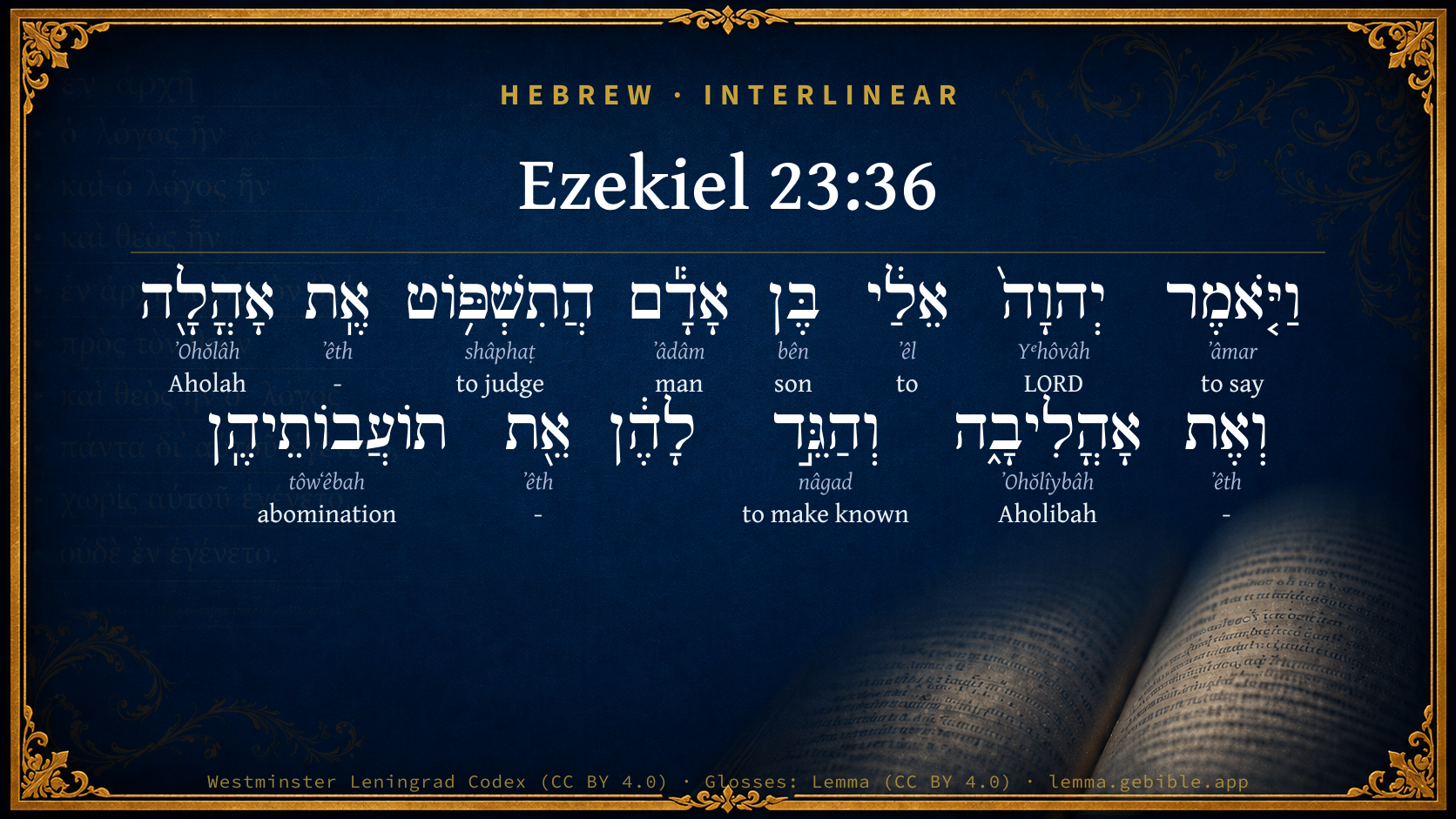
Hebrew (Westminster Leningrad Codex) Ezekiel 23:36 appears in the Hebrew Old Testament. The text above is from the Westminster Leningrad Codex. Each word links to its Strong’s number, a concise gloss, and parsing drawn from the Open Scriptures Hebrew Bible morphology. Click any word for its full Brown-Driver-Briggs (BDB) entry.
Download image
Cite this verse

Ezekiel 23:36 (World English Bible). Public Domain. Lemma interlinear Bible study tool, https://lemma.gebible.app/v/ezekiel/23/36.

Show BibTeX & RIS
BibTeX
RIS
English Translation
Yahweh said moreover to me: Son of man, will you judge Oholah and Oholibah? then declare to them their abominations.
World English Bible · Public Domain
Download a study sheet

One document with this verse’s original text, its word-by-word gloss line, the meaning frame, cross-references with their text, attributed commentary, and full source and license credits — printable, and it pastes into notes with its structure intact.

This verse Autodidact and up

Study sheet (.html) Plain text (.txt)

A passage Seminary Student

Up to 50 verses in one chapter. A passage sheet keeps up to 6 commentary sources and 12 cross-references per verse, in the order this page ranks them, and says so on the sheet whenever that leaves anything out. Ask for a single verse and you get the Autodidact verse sheet above.

Everything on this page stays free to read, with no account — the sheet is a download of what is already on screen, not access to it.

Want to remove ads? Support Godless Engineer
Compare translations 3

The same verse in 3 English versions, stacked beneath the original-language interlinear above. Click any original word for its lexicon entry.

Each is an independent rendering of the whole verse — the interlinear is not word-aligned to these translations.

Highlighted words mark where these versions differ — a whole-verse word diff, not a word-by-word alignment.

  • World English Bible Public Domain
    Yahweh said moreover to me: Son of man, will you judge Oholah and Oholibah? then declare to them their abominations.
  • King James Version Public Domain
    The LORD said moreover unto me; Son of man, wilt thou judge Aholah and Aholibah? yea, declare unto them their abominations;
  • unfoldingWord Literal Text CC BY-SA 4.0
    Yahweh said to me, “Son of man, will you judge Oholah and Oholibah? So present to them their disgusting actions,

unfoldingWord Literal Text — © unfoldingWord, licensed CC BY-SA 4.0. Word-aligned USFM3 via Door43 (git.door43.org/unfoldingWord/en_ult).

Versions to compare (up to 4)

3 of 4 selected

Show all 18 translations

Every available English version of this verse, each an independent rendering of the whole verse.

  • World English Bible Public Domain
    Yahweh said moreover to me: Son of man, will you judge Oholah and Oholibah? then declare to them their abominations.
  • Berean Standard Bible Public Domain
    Then the LORD said to me: “Son of man, will you pass judgment against Oholah and Oholibah? Then declare to them their abominations.
  • Majority Standard Bible Public Domain
    Then the LORD said to me: “Son of man, will you pass judgment against Oholah and Oholibah? Then declare to them their abominations.
  • King James Version Public Domain
    The LORD said moreover unto me; Son of man, wilt thou judge Aholah and Aholibah? yea, declare unto them their abominations;
  • American Standard Version (1901) Public Domain
    Jehovah said moreover unto me: Son of man, wilt thou judge Oholah and Oholibah? then declare unto them their abominations.
  • Revised Version (1885) Public Domain
    The LORD said moreover unto me: Son of man, wilt thou judge Oholah and Oholibah? then declare unto them their abominations.
  • Geneva Bible (1599) Public Domain
    The Lord sayd moreouer vnto me, Sonne of man, wilt thou iudge Aholah and Aholibah? and wilt thou declare to them their abominations?
  • Douay-Rheims (1899) Public Domain
    And the Lord spoke to me, saying: Son of man, dost thou judge Oolla, and Ooliba, and dost thou declare to them their wicked deeds?
  • Young's Literal Translation Public Domain
    And Jehovah saith unto me, `Son of man, Dost thou judge Aholah and Aholibah? Declare then to them their abominations.
  • Literal Standard Version CC BY-SA 4.0
    And YHWH says to me, “Son of man, || Do you judge Aholah and Aholibah? Then declare their abominations to them.
  • Unlocked Literal Bible CC BY-SA 4.0
    Yahweh said to me, “Son of man, will you judge Oholah and Oholibah? So present to them their disgusting actions,
  • unfoldingWord Literal Text CC BY-SA 4.0
    Yahweh said to me, “Son of man, will you judge Oholah and Oholibah? So present to them their disgusting actions,
  • Darby Bible Public Domain
    And Jehovah said unto me, Son of man, wilt thou judge Oholah and Oholibah? yea, declare unto them their abominations.
  • World Messianic Bible Public Domain
    The LORD said moreover to me: “Son of man, will you judge Oholah and Oholibah? Then declare to them their abominations.
  • Webster's Bible Public Domain
    The LORD said moreover to me; Son of man, wilt thou judge Aholah and Aholibah? yes, declare to them their abominations;
  • Free Bible Version CC BY-SA 4.0
    Then the Lord said to me: “Son of man, are you going to condemn Oholah and Oholibah? Expose the disgusting things they've done!
  • Bible in Basic English Public Domain
    Then the Lord said to me: Son of man, will you be the judge of Oholibah? then make clear to her the disgusting things she has done.
  • JPS Tanakh (1917) Public Domain
    The LORD said moreover unto me: 'Son of man, wilt thou judge Oholah and Oholibah? then declare unto them their abominations.

Literal Standard Version (2020), Covenant Press — licensed CC BY-SA 4.0. Text via the HelloAO Bible API (eBible.org). Unlocked Literal Bible (unfoldingWord) — licensed CC BY-SA 4.0. Text via the HelloAO Bible API (eBible.org). unfoldingWord Literal Text — © unfoldingWord, licensed CC BY-SA 4.0. Word-aligned USFM3 via Door43 (git.door43.org/unfoldingWord/en_ult). Free Bible Version, Dr. Jonathan Gallagher — licensed CC BY-SA 4.0. Text via the HelloAO Bible API (eBible.org).

Word by word

More ways to search: Search by grammar → Find every occurrence → Compare this word →

Practice this passage: Drill this verse → Learn its vocabulary →

אָהֳלָ֖ה
ʼOhŏlâh
H170
“Aholah”
Noun, Proper
Part of Speech
Noun
Type
Proper
Full BDB Definition

Origin: in form a f of H168 , but in fact for 'Oholahh o-hol-aw'

TWOT: 32b

Aholah = "her own tent" - Samaria as an adulteress with Assyria (metaphorically)
  1. וַיֹּ֤אמֶר ʼâmar H559 “and · to say” Conjunction + Verb, Qal, Sequential Imperfect, 3rd Person, Masculine, Singular
  2. יְהוָה֙ Yᵉhôvâh H3068 “LORD” Noun, Proper
  3. אֵלַ֔י ʼêl H413 “to · me” Preposition + Suffix, Personal, 1st Person, Common, Singular
  4. בֶּן bên H1121 “son of” Noun, Common, Masculine, Singular, Construct
  5. אָדָ֕ם ʼâdâm H120 “man” Noun, Common, Masculine, Singular, Absolute
  6. הֲתִשְׁפּ֥וֹט shâphaṭ H8199 “to judge” Particle, Interrogative + Verb, Qal, Imperfect, 2nd Person, Masculine, Singular
  7. אֶֽת ʼêth H853 “-” Particle, Direct Object
  8. וְאֶת ʼêth H853 “and · -” Conjunction + Particle, Direct Object
  9. אָהֳלִיבָ֑ה ʼOhŏlîybâh H172 “Aholibah” Noun, Proper
  10. וְהַגֵּ֣ד nâgad H5046 “and · make known” Conjunction + Verb, Hiphil, Imperative, 2nd Person, Masculine, Singular
  11. אֵ֖ת ʼêth H853 “-” Particle, Direct Object
  12. תוֹעֲבוֹתֵיהֶֽן tôwʻêbah H8441 “abominations · their” Noun, Common, Feminine, Plural, Construct + Suffix, Personal, 3rd Person, Feminine, Plural

About this verse

These counts appear in no published source. They are computed here, from the morphology-tagged text and Lemma’s own curated glosses. What Lemma adds →

14
words
11
distinct lemmas
Prophets
section

Notable vocabulary

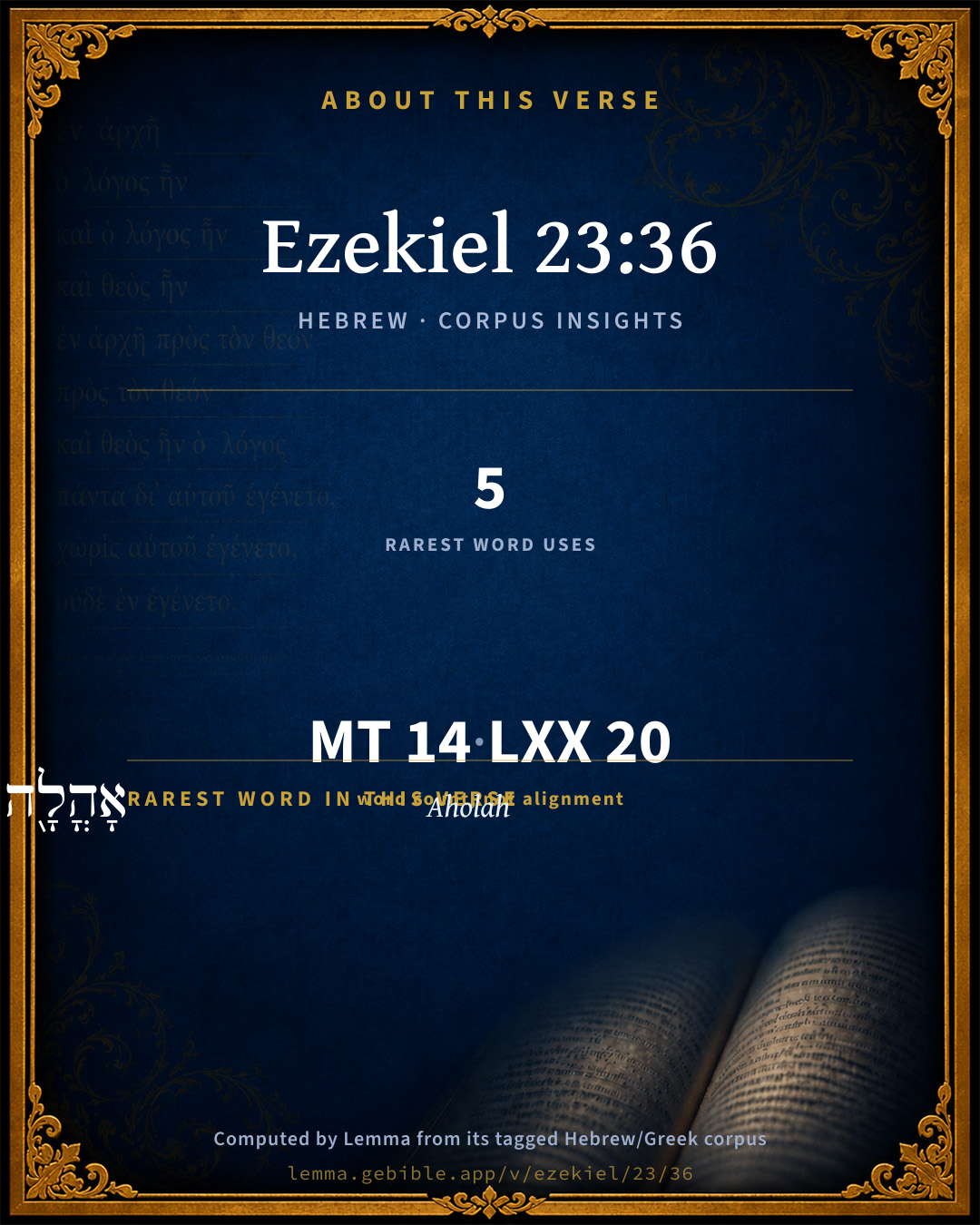
The rarest word here is אָהֳלָ֖ה Aholah H170 — appearing just 5 times in the whole Hebrew Bible.

Shared distinctive vocabulary

אָהֳלָ֖ה Aholah H170 occurs in 4 verses of the Hebrew Bible. Also found in:

Grammatical profile

  • 3 verbs
  • 6 nouns
  • 2 prepositions
  • 3 particles

Verb forms

  • וַיֹּ֤אמֶר Qal · Sequential Imperfect
  • הֲתִשְׁפּ֥וֹט Qal · Imperfect
  • וְהַגֵּ֣ד Hiphil · Imperative

Hebrew & Septuagint length

In English translation the verse runs 20 words from the Hebrew and 22 from the Septuagint (LXX English) — closely comparable.

A rough comparison of the two English renderings, which tokenize alike — not a word-level alignment.

Word counts can differ between the Hebrew and the Greek without any difference in meaning — e.g. the Hebrew direct-object marker אֵת has no separate Greek word, and Greek often adds the article ὁ.

In the original languages it is 14 Hebrew tokens and 20 Greek tokens — but the two are counted differently (Hebrew bundles its prefixes and suffixes into one token; the Greek is in lemma form), so that isn’t a like-for-like length.

Cross-references

13

Topical passages linked to Ezekiel 23:36 in the Treasury of Scripture Knowledge — connected by theme and wording, ordered by reader-vote popularity; previews shown in the World English Bible.

  • Ezekiel 22:2 You, son of man, will you judge, will you judge the bloody city? then cause her to know all her abominations.
  • Isaiah 58:1 Cry aloud, don't spare, lift up your voice like a trumpet, and declare to my people their disobedience, and to the house of Jacob their sins.
  • Ezekiel 16:2 Son of man, cause Jerusalem to know her abominations;
  • Ezekiel 20:4 Will you judge them, son of man, will you judge them? Cause them to know the abominations of their fathers;
  • Jeremiah 1:10 behold, I have this day set you over the nations and over the kingdoms, to pluck up and to break down and to destroy and to overthrow, to build and to plant.
  • Jeremiah 11:14 Therefore don't you pray for this people, neither lift up cry nor prayer for them; for I will not hear them in the time that they cry to me because of their trouble.
  • Jeremiah 14:11 Yahweh said to me, Don't pray for this people for [their] good.
  • Hosea 2:2 Contend with your mother! Contend, for she is not my wife, Neither am I her husband; And let her put away her prostitution from her face, And her adulteries from between her breasts;
  • Micah 3:8–11 But as for me, I am full of power by the Spirit of Yahweh, And of judgment, and of might, To declare to Jacob his disobedience, And to Israel his sin.
  • Matthew 23:13–35 "Woe to you, scribes and Pharisees, hypocrites! For you devour widows' houses, and as a pretense you make long prayers. Therefore you will receive greater condemnation.
  • Luke 11:39–52 The Lord said to him, "Now you Pharisees cleanse the outside of the cup and of the platter, but your inward part is full of extortion and wickedness.
  • Acts 7:51–53 "You stiff-necked and uncircumcised in heart and ears, you always resist the Holy Spirit! As your fathers did, so you do.
  • 1 Corinthians 6:2–3 Don't you know that the saints will judge the world? And if the world is judged by you, are you unworthy to judge the smallest matters?

Cross-references courtesy of OpenBible.info (CC BY 4.0).

Hebrew and Greek witnesses Masoretic Hebrew ↔ Greek Septuagint

The same verse in the two great witnesses to the Old Testament, shown verse-for-verse.

These are two independent witnesses, not word-aligned to each other, and the Septuagint is shown in lemma (dictionary) form.

Hebrew Ezekiel 23:36 Masoretic · Westminster Leningrad Codex

וַיֹּ֤אמֶר יְהוָה֙ אֵלַ֔י בֶּן אָדָ֕ם הֲתִשְׁפּ֥וֹט אֶֽת אָהֳלָ֖ה וְאֶת אָהֳלִיבָ֑ה וְהַגֵּ֣ד לָהֶ֔ן אֵ֖ת תוֹעֲבוֹתֵיהֶֽן

Yahweh said moreover to me: Son of man, will you judge Oholah and Oholibah? then declare to them their abominations.

World English Bible · Public Domain

Greek LXX Ezekiel 23:36 Septuagint · lemma form

καί εἶπον κύριος πρός ἐγώ υἱός ἄνθρωπος οὐ κρίνω ὁ οολα καί ὁ οολιβα καί ἀποἀγγέλλω αὐτός ὁ ἀνομία αὐτός

And the Lord said to me, Son of man, will you not judge Oola and Ooliba? and declare to them their iniquities?

LXX2012 (modern English Septuagint) · Public Domain

On this verse, Keil & Delitzsch discusses the Septuagint’s reading. Read the note in Commentary ↓

Hebrew: Westminster Leningrad Codex (CC BY 4.0). Greek: Septuagint (public domain); English from LXX2012 (modern English Septuagint) (Public Domain). How the Septuagint differs from the Hebrew →

Targum (Aramaic paraphrase)

1

The Targum is the ancient Jewish Aramaic paraphrase of the Hebrew Scriptures — an interpretive translation, not the Hebrew text itself. Onkelos (literal) and Pseudo-Jonathan (expansive) render the Torah, and Jonathan the Prophets. Coverage is partial: where no permissively-licensed English translation exists for a verse, only the Aramaic is shown. This is verse-level text, not a word-by-word alignment to the Hebrew.

  1. Targum Jonathan Prophets (Joshua–Malachi)
    וַאֲמַר יְיָ לִי בַּר אָדָם הֲתוֹכַח יַת אָהֳלָה וְיַת אָהֳלִיבָה וְחַוֵי לְהֶן יַת תּוֹעֶבָתְהָן:

    (no public-domain English translation for this verse)

    Targum Jonathan — Aramaic: “Mikraot Gedolot” (public domain). English: “Sefaria Community Translation” (CC0 1.0 (public-domain dedication)); “London "Chaldee Paraphrase," 1871” (public domain). Text via Sefaria.

Commentary

Notes on Ezekiel 23:36 from classic Christian and Jewish commentators (each source and its license shown beneath its notes). The classic Christian expositions comment on the surrounding passage and are grouped to its opening verse, so a note may address several verses; the Jewish commentaries on the Tanakh (Rashi and others) are per-verse, so they appear only where the commentator wrote on this verse.

Lemma curates 59 commentaries, every one of them public domain or Creative Commons licensed, each selected and text-cleaned for this edition rather than reprinted as found. About our sources →

The Cambridge Bible for Schools and Colleges

gen. ed. J. J. S. Perowne

36. yea, declare] then declare.

36–49. New exposure of the immoralities of Oholah and Oholibah (Eze_23:36-44), and threat of their punishment (Eze_23:45-49)

The passage is not a continuation of Eze_23:1-35, but an independent description, parallel to these verses.

(1) Eze_23:36-37. The adulteries, that is, idolatries, and bloodshed of which the two women are guilty.

(2) vv, 38, 39. Their profaning the house of Jehovah, and breaking; his Sabbaths—the former particularly in their entering his house fresh from the sacrifice of their children.

(3) Eze_23:40-44. Their alliances with idolatrous nations and receiving their gods, under the figure of a harlot receiving and entertaining men.

(4) Eze_23:45-49. Their punishment with the death of an adulteress at the hands of righteous men.—The text in some passages is extremely difficult.

The Cambridge Bible for Schools and Colleges (gen. ed. J. J. S. Perowne; Cambridge University Press, 1878–1918) — public domain. Text from a community e-Sword module.

Trapp's Complete Commentary

John Trapp

Eze 23:36 The LORD said moreover unto me; Son of man, wilt thou judge Aholah and Aholibah? yea, declare unto them their abominations;

Ver. 36. Wilt thou judge?] See Eze 20:4; Eze 22:2.

John Trapp, A Commentary or Exposition upon All the Books of the Old and New Testament (1647–1656) — public domain. Text from a community e-Sword module.

Joseph Benson's Commentary

Eze 23:36-39. Wilt thou judge Aholah and Aholibah — That is, Samaria and Jerusalem? The meaning is, Wilt thou not judge, or, Wilt thou not condemn them? That they have committed adultery, and blood is, &c. — That they have been guilty of the heinous sins of murder and adultery; and have also caused their sons, &c. — Have caused their children, who of right belonged to me, and who ought to have been bred up to be my worshippers, to be burned in the fire, by way of sacrifice in honour to false gods. They have defiled my sanctuary in the same day — They have also come directly from these idolatrous and abominable rites and sacrifices into my temple, as though they could worship me acceptably when they were thus horribly polluted. And have profaned my sabbaths — Have spent the sabbaths, which I appointed to be observed to my honour alone, in the service and to the honour of idols. Or, they profaned them by coming into God’s courts to observe them, immediately after they had defiled themselves by their idolatrous and horrid ceremonies. For when they had slain their children to their idols — To my great dishonour, and the reproach of the human nature; then they came into my sanctuary — With their hands imbrued, and their clothes stained with their children’s blood, to present themselves before me; expecting acceptance with me notwithstanding their villanies, as if I either did not know their wickedness, or did not hate it. And lo, thus have they done in the midst of my house — In the inward part of my temple. Some expound the words, of their setting up idols in the very temple, and worshipping them there.

Joseph Benson's Commentary on the Old and New Testaments (1811–1818) — public domain. Text from a community e-Sword module.

The Preacher's Complete Homiletical Commentary

Joseph S. Exell (gen. ed.)

(Eze_23:36-49)

EXEGETICAL NOTES.—Judah and Samaria are considered as joined together in their sin and punishment.

Eze_23:37. “They have committed adultery, and blood is in their hands.” “The actual subject matter of these verses is closely connected with Eze_23:16, more especially in the designation of the sins as adultery and bloodshed (compare Eze_23:37 and Eze_23:45 with Eze_16:38). They committed adultery with the idols, thus placing the idols on a par with Jehovah as the husband of Israel (compare Jer_3:8; Jer_2:27. For the Moloch-worship compare Eze_16:20-21, and Eze_20:31”).—Keil.

Eze_23:39. “Then they came the same day into My sanctuary to profane it.” “So callous and daring were the Jews in their idolatry that on the very day on which they had burned their children to Moloch in the valley of Gehenna, they hypocritically presented themselves as worshippers in the temple of Jehovah. Compare Jer_7:9-10.” (Henderson). The profanation consisted, not simply in idol-worship considered by itself, but in worshipping the true God in connection with their idols. Thus they placed Jehovah on a par with Moloch.

Eze_23:40. “Ye have sent for men to come from far.” The Heb. verb being in the imperfect tense shows that the action was continuous. Not that they merely sent once and again, but that they were wont to do so. “For whom thou didst wash thyself, paintedst thy eyes, and deckedst thyself with ornaments.” “They spread fine paint of a black colour on the eyelids so as to produce a black margin, and thus make the white of the eye look more beautiful and seducing. It is a custom still practised by Oriental females. Jerusalem is represented as so doing to entice her lovers. She left nothing untried by which this might be effected” (Henderson). “The eyelashes and eyebrows were stained with a powder, so as to make the glance of the eye more brilliant.”—Lange.

Eze_23:41. “Satest upon a stately bed, and a table prepared before it.’ “She seated herself upon a cushion (not lay down upon a bed), and in front of this there was a table, spread with different kinds of food, upon which she placed incense and oil.”—(Keil.) “The board or table is furnished with meats and drinks. Eating and drinking play an important part in adultery, either in the usual or in the spiritual sense.”—(Hengstenberg). “Where-upon thou hast set Mine incense and Mine oil.” The force of this charge lies in the fact that she devoted the offerings which belonged to Jehovah to the gratification of her lovers. “Religious ceremonies are not here spoken of. We find ourselves in the region of political idolatry, which in the latest times of the people, from the days of Ahaz and Hezekiah, far outweighed that of religion. The corresponding reality consists in the rich gifts by which Judah endeavoured to purchase the favour of the heathen sovereigns (Isa_30:6).”—(Hengstenberg.) Some understand this passage as describing the lascivious worship of the Babylonish Mylitta. The wanton Israel is described as preparing herself for one of the high festivals of this goddess, and as abandoning herself to strangers like the young women of Babylon.

Eze_23:42. “A voice of a multitude being at ease was with her.” They are at ease, in careless, undisturbed prosperity. “Sabeans from the Wilderness.” “Instead of receiving the warnings given them by the prophets, and humbling themselves on account of their idolatries, the inhabitants of Jerusalem indulged in rioting and drunkenness—bringing even the vulgar Arabs from the desert to keep them company.”—(Henderson.) The phrase “from the desert,” cannot indicate the home of these men, but simply the place from which they came to Judah, namely, from the desert of Syria and Arabia, which separated Palestine from Babylon. These peoples decorated the arms of the harlots with clasps, and their heads with splendid wreaths (crowns). The thought is simply that Samaria and Judah had attained to wealth and earthly glory through their intercourse with these nations; the very gifts with which, according to Eze_16:11, &c., Jehovah Himself had adorned His people.”—(Keil)

Eze_23:43. “Old in adulteries.” Lit. who was debilitated for adultery. “The Heb. word does not indicate the means by which the strength has been exhausted, but is an accusation of direction or reference, debilitated with regard to adultery, so as no longer to be capable of practising it.”—(Keil.) “Will they now commit whoredoms with her?” “Disgusting as was her character as an old adulteress, Jerusalem found those who encouraged her in her wickedness. Taken in connection with the next verse, the two sisters are again presented to view, though Aholibah is specially singled out, being the more guilty of the two.”—(Henderson.)

Eze_23:45. “The righteous men.” Men who had the right on their side. Such were the Chaldeans, who were the instruments of God’s righteous anger. “The Chaldeans are righteous according to their mission as ministers of the Divine vengeance. The heathen tyrant also, in Isa_49:24, is designated as righteous.”—(Hengstenberg.) “A moral comparison between the Chaldeans and the Jews is not intended, nor are prophets and righteous men among the people themselves to be imagined.”—(Lange.)

Eze_23:46. “I will bring up a company upon them.” “Here the prophet is first addressed. What shall happen is, as it were, wrought by him, as the power which gave the prophecy produces also the fulfilment; in the prophecy also, ideally considered, the fulfilment is already present. The community denotes usually the congregation of Israel. As this has failed to do its duty, reacting against the crime, as once happened in the war against Benjamin (Judges 20), so stands here the community of the heathen, which God summons to execute His vengeance.”—(Hengstenberg.)

Eze_23:48.“All women.” All the nations, to whom Israel would serve as a warning and deterring example.

Eze_23:49. “They shall recompense your lewdness upon you.” “The punishment is announced to both the women, Israel and Judah, as still in the future, although Aholah (Samaria) had been overtaken by the judgment a considerable time before. The explanation of this is to be found in the allegory itself, in which both kingdoms are represented as being sisters of one mother; and it may also be defended on the ground that the approaching destruction of Jérusalem and the kingdom of Judah affected the remnants of the kingdom of the ten tribes, which were still to be found in Palestine; whilst, on the other hand, the judgment was not restricted to the destruction of the two kingdoms, but also embraced the latter judgments which fell upon the entire nation.”—(Keil).,

HOMILETICS

ANOTHER SUMMARY OF THE SINS AND PUNISHMENT OF JUDAH AND SAMARIA

I. Their Sins.

1. Idolatry. “With their idols have they committed adultery” (Eze_23:37). Jehovah was to Israel as a husband. To serve other gods was to forsake and forfeit His favour and protection. It was a fearful crime, such as adultery would be in the judgment of all nations.

2. Cruelty. “Blood is in their hands.” They offered their children to the cruelties of Moloch worship. Idolatry leads to perverted and unnatural views of human duty and of the requirements of religion. Hence the cruelty of its rites.

3. Impurity. She sought to make herself attractive to her lovers, using every art to pander to her lust (Eze_23:41-42). Israel made herself attractive to the surrounding nations, “For whom thou didst wash thyself, paintedst thy eyes, and deckedst thyself with ornaments.” They washed themselves before men, but were unclean before God—the way of hypocrites. Israel sought for occasions of sin. “Ye have sent for men” (Eze_23:40). They tried to excite a jaded appetite (Eze_23:43). They were old and worn out in the service of sin, but tried hard to awaken the impulses of it, to stir up the embers of a smouldering fire. Even in Christian lands, how many serve such impure and cruel gods and even use infamous arts to plunge into the lowest depths of iniquity! “He who serves Venus and Bacchus offers to them also his children.”—(Lange). And how many, also, become more shameless as they grow old in sin!

4. Profanity. They profaned the Sabbath and the sanctury (Eze_23:38). They employed in the service of idolatry the “incense” and “oil,” God’s own property, which He had reserved for sacred uses (Exo_30:23-33). More than this, they dared to combine the service of Jehovah with that of idols, thus adding to their sins the boldest and most wicked hypocracy. After they had indulged in the most cruel rites of idolatry, they came “in the same day” into God’s sanctuary to defile it. “To run from the harlot-house to God’s house, from murder to the place of prayer, from sin to sinning, is not pleasing to God.”—Lange.

II. Their punishment.

1. It would be felt to be just even by the heathen nation who inflicted it. “And the righteous men, they shall judge them.” (Eze_23:45). The Chaldeans had right on their side. They were the righteous instruments of God to execute His vengeance. Even heathen nations looked upon perjury and breach of covenant as fearful crimes. (Eze_17:15-16).

2. It would be a severe, and yet a most fitting punishment. (Eze_23:46-47). The Judgment hour had come, and God’s army was ready. “They shall stone them with stones,”—the punishment of those who commit adultery and shed blood (Joh_8:5).

3. It would be effectual. The punishment would completely cure the evil (Eze_23:48). It would be a warning example to all (Eze_23:48). It would bring them to the true knowledge of God (Eze_23:49). The whole of this chapter illustrates the words of St. Paul, that “the Law entered that the offence might abound” (Rom_5:20). It would seem as if the presence of God’s holy Law served to stir up the proud will of the chosen people to more desperate self-assertion. They sought those sinful alliances with the powers of the world, which seemed to have all the more attraction because they were forbidden. “Ye adulterers and adulteresses, know ye not that the friendship of the world is enmity with God? whosoever therefore will be a friend of the world is the enemy of God.” (Jas_4:4).

(Eze_23:36-44.)

1. Sinners make little or no conscience of horrible sins, or holy duties; they pass from one to the other immediately. When they had slain their children to their idols, that same day they came into the Sanctuary. From shedding of blood and sacrificing to idols, they step into the temple and worship of God. Had not their consciences been seared, they would have accused them and told them that they were unclean, not fit to meddle with holy things. But they go boldly and impudently into God’s presence. So Jeremiah tells us, they did steal, murder, commit adultery, swear falsely, burn incense to Baal, walk after other gods, and then come presently and stand before Him in His house, and say: “We are delivered.” (Jer_7:9-10.) They passed from wicked practices to holy duties, making no conscience of the one or the other.

2. The Lord takes notice how men draw near to Him in the duties of His worship. They thrust themselves into the temple worship and into the presence of God, as if they had been innocent and as acceptable to God as any. Men may deceive others and themselves, but they cannot deceive the Lord. He sees their spirits, and whether they come unprepared in the guilt of former or present sins.

3. Profaning of holy things is wronging God. “This have they done unto Me. Lo, thus have they done in the midst of Mine house.” God had instituted their worship, and had stamped holiness upon them; and therefore the defiling and profaning of them He counted the defiling and profaning of His name and of Himself. Three ways, especially, are holy things defiled, profaned:

(1.) When men come in their sins, without purging themselves. (St. James, Jas_4:8.) If men draw near to God without cleansing their hands, and purifying their hearts, God will not draw near them. He will not touch unclean things.

(2.) When we mingle aught of us therewith. Additions of human things are pollutions of divine things. When they brought aught into the Temple which God appointed not, then was God’s worship defiled. When Nadab and Abihu put strange fire into the censers, they defiled God’s worship and provoked Him to their destruction (Leviticus 10); and when they set their threshold with God’s threshold, they defiled His name and worship (Eze_43:7-8).

3. When holy things are handled irreverently. The Bethshemites in a rude manner peeped into the ark and profaned it, which caused the Lord to smite them with sudden death (1Sa_6:19). Solomon gives counsel that men should keep their feet when they go into the house of God (Ecc_5:1). For if they look not well to their affections, they will play the fool, and profane those holy things, and procure a curse instead of a blessing.

4. Sinners will show great activity in drawing others to themselves and their wicked ways. These harlots sent to Assyria, to Egypt, and to others to come unto them. They trimmed and decked themselves, they spared not for any cost whereby they might please and satisfy them. Thus did the harlot (Proverbs 7). She perfumes her bed, trims up herself, goes forth, and diligently seeks, finds, and brings in the prey. Some compass sea and land to make proselytes. Shall wicked ones and wickedness be active, expensive to draw and ruin others, and shall not godly ones and godliness be as active and expensive to win and save sinners?

5. Those who are given to corporeal or spiritual uncleanness are seldom, recovered, but go on and grow old in those sins. These women had many reproofs and threatenings, but none prevailed (Eze_23:44). Such sins are bewitching, and hold men captive. “None that go unto her return again” (Pro_2:19).

6. The Lord takes notice of sinners, as to the beginning, progress, and continuance of their sin. He observed when Aholah began her whoredoms, when the calves were set up at Dan and Bethel, how she grew up and grew old in adulteries. God’s eye goes along with sinners, from the beginning to the end.

7. God’s judgments are teaching things. He brought these judgments upon the two harlots, that all women might be taught thereby. Gideon by thorns and briars taught the men of Succoth (Jdg_8:16). There is no judgment of God upon any city, nation, or people, but it speaks and teaches: “Hear ye the rod” (Mic_6:9); it hath a voice, a teaching voice.

1. It teaches all who are guilty of the same sins, and not visited with the same judgments to admire the goodness and long suffering of God towards them.

2. It teaches those who are guilty of such sins to repent and turn to the Lord, lest the Lord, being now in the way of judgment, should break out also upon them, and make them examples of His justice.

3. It teaches others to fear and to flee from such practices, as being such destructive judgments. When Samaria and Jerusalem shall be destroyed for their confidence in the arm of flesh, will not every other city learn what is the reward of wickedness, and fear to do the like?

8. God’s ways with sinners in judging them righteously brings them to acknowledge the equity of His dealing with them. When the just punishment of your lewdness and idolatry shall be upon you, “ye shall know that I am the Lord,” who observed all your ways, who waited long for your repentance, who have dealt justly with you in all the evils I have brought upon you; you cannot but justify Me, and condemn yourselves.—(Greenhill.)

The Preacher's Complete Homiletical Commentary (gen. ed. Joseph S. Exell; Funk & Wagnalls, c. 1892) — public domain (pre-1929). A full-Bible homiletical/sermon-outline anthology covering 65 of 66 books (2 John is absent from the source module). Text from a community e-Sword module.

Keil & Delitzsch

C. F. Keil & F. Delitzsch

Another Summary of the Sins and Punishment of the Two Women

Eze 23:36. And Jehovah said to me, Son of man, wilt thou judge Oholah and Oholibah, then show them their abominations; Eze 23:37. For they have committed adultery, and blood is in their hands; and they have committed adultery with their idols; and their sons also whom they bare to me they have caused to pass through to them to be devoured. Eze 23:38. Yea more, they have done this to me; they have defiled my sanctuary the same day, and have desecrated my Sabbaths. Eze 23:39. When they slaughtered their sons to their idols, they came into my sanctuary the same day to desecrate it; and, behold, they have acted thus in the midst of my house. Eze 23:40. Yea, they have even sent to men coming from afar; to them was a message sent, and, behold, they came, for whom thou didst bathe thyself, paint thine eyes, and put on ornaments, Eze 23:41. And didst seat thyself upon a splendid cushion, and a table was spread before them, thou didst lay thereon my incense and my oil. Eze 23:42. And the loud noise became still thereat, and to the men out of the multitude there were brought topers out of the desert, and they put armlets upon their hands, and glorious crowns upon their heads. Eze 23:43. Then I said to her who was debilitated for adultery, Now will her whoredom itself go whoring, Eze 23:44. And they will go in to her as they go in to a shore; so did they go in to Oholah and Oholibah, the lewd women. Eze 23:45. But righteous men, these shall judge them according to the judgment of adulteresses and according to the judgment of murderesses; for they are adulteresses, and there is blood in their hands. Eze 23:46. For thus saith the Lord Jehovah, I will bring up against them an assembly, and deliver them up for maltreating and for booty. Eze 23:47. And the assembly shall stone them, and cut them in pieces with their swords; their sons and their daughters shall they kill, and burn their houses with fire. Eze 23:48. Thus will I eradicate lewdness from the land, that all women may take warning and not practise lewdness like you. Eze 23:49. And they shall bring your lewdness upon you, and ye shall bear the sins of your idols, and shall learn that I am the Lord Jehovah. - The introductory words 'התשׁפּוט point back not only to Eze 22:2, but also to Eze 20:4, and show that this section is really a summary of the contents of the whole group (Eze 20:23). The actual subject-matter of these verses is closely connected with Eze 23:16, more especially in the designation of the sins as adultery and bloodshed (compare Eze 23:37 and Eze 23:45 with Eze 16:38). נאף, to commit adultery with the idols, whereby the idols are placed on a par with Jehovah as the husband of Israel (compare Jer 3:8 and Jer 2:27). For the Moloch-worship in Eze 23:37, compare Eze 16:20-21, and Eze 20:31. The desecration of the sanctuary (Eze 23:38) is more minutely defined in Eze 23:39. בּיּום ההוּא in Eze 23:38, which has so offended the lxx and Hitzig that it is omitted by the former, while the latter proposes to strike it out as a gloss, is added for the purpose of designating the profanation of the sanctuary as contemporaneous with the Moloch-worship of Eze 23:37, as is evident from Eze 23:39. For the fact itself, compare Kg2 21:4-5, Kg2 21:7. The desecration of the Sabbaths, as in Eze 20:13, Eze 20:16. For Eze 23:39, compare Eze 16:21. The words are not to be understood as signifying that they sacrificed children to Moloch in the temple, but simply that immediately after they had sacrificed children to Moloch, they went into the temple of Jehovah, that there they might worship Jehovah also, and thus placed Jehovah upon a par with Moloch. This was a profanation (חלּל) of His sanctuary.

In Eze 23:40-44 the allusion is not to actual idolatry, but to the ungodly alliance into which Judah had entered with Chaldea. Judah sent ambassadors to Chaldea, and for the purpose of receiving the Chaldeans, adorned herself as a woman would do for the reception of her paramours. She seated herself upon a splendid divan, and in front of this there was a table spread, upon which stood the incense and the oil that she ought to have offered to Jehovah. This is the explanation which Kliefoth has correctly given of Eze 23:40 and Eze 23:41. The emphatic ואף כּי in Eze 23:40 is sufficient to show that the reference is to a new crime deserving of punishment. This cannot be idolatry, because the worship of Moloch has already been mentioned in Eze 23:38 and Eze 23:39 as the worst of all the idolatrous abominations. Moreover, sending for (or to) men who come from afar does not apply to idolatry in the literal sense of the word; for men to whom the harlot sent messengers to invite them to come to her could not be idols for which she sent to a distant land. The allusion is rather to Assyrians or Chaldeans, and, according to Eze 23:42, it is the former who are referred to here (compare Isa 39:3). There is no force in Hitzig's objection, namely, that the one woman sent to these, and that their being sent for and coming have already been disposed of in Eze 23:16. For the singulars in the last clause of Eze 23:40 show that even here only one woman is said to have sent for the men. Again, תּשׁלחנה might even be the third person singular, as this form does sometimes take the termination נה (vid., Ewald, 191c, and Ges. 47, Anm. 3). At the same time, there is nothing in the fact that the sending to Chaldea has already been mentioned in Eze 23:16 to preclude another allusion to the same circumstance from a different point of view. The woman adorned herself that she might secure the favour of the men for whom she had sent. כּהל is the Arabic khl, to paint the eyes with stibium (kohol). For the fact itself, see the remarks on Kg2 9:30. She then seated herself upon a cushion (not lay down upon a bed; for ישׁב does not mean to lie down), and in front of this there was a table, spread with different kinds of food, upon which she placed incense and oil. The suffix to עליה refers to שׁלחן, and is to be taken as a neuter, which suits the table as a thing, whilst שׁלחן generally takes the termination ות in the plural. In Eze 23:41, Ewald and Hvernick detect a description of the lectisternia of the licentious worship of the Babylonian Mylitta. But neither the sitting (ישׁב) upon a cushion (divan), nor the position taken by the woman behind the table, harmonizes with this. As Hitzig has correctly observed, "if she has taken her seat upon a cushion, and has a table spread before her, she evidently intends to dine, and that with the men for whom she has adorned herself. The oil is meant for anointing at meal-time (Amo 6:6; Pro 21:17; cf. Psa 23:5), and the incense for burning." "My incense and my oil" are the incense and oil given to her by God, which she ought to have devoted to His service, but had squandered upon herself and her foreign friends (cf. Eze 16:18; Hos 2:10). The oil, as the produce of the land of Palestine, was the gift of Jehovah; and although incense was not a production of Palestine, yet as the money with which Judah purchased it, or the goods bartered for it, were the fists of God, Jehovah could also call it His incense.

Eze 23:42 is very obscure. Such renderings of the first clause as et vox multitudinis exultantis in ea (Vulg)., and "the voice of a careless multitude within her" (Hvernick), can hardly be sustained. In every other passage in which קול occurs, it does not signify the voice of a multitude, but a loud tumult; compare Isa 13:4; Isa 33:3; Dan 10:6, and Sa1 4:14, where קול ההמון is used as synonymous with קול. Even in cases where המון is used for a multitude, it denotes a noisy, boisterous, tumultuous crowd. Consequently שׁלו cannot be taken as an adjective connected with המון, because a quiet tumult is a contradiction, and שׁלו does not mean either exultans or recklessly breaking loose (Hvernick), but simply living in quiet, peaceful and contented. שׁלו must therefore be the predicate to קול המון; the sound of the tumult or the loud noise was (or became) quiet, still. בהּ, thereat (neuter, like בהּ, thereby, Gen 24:14). The words which follow, 'ואל אנשׁים וגו, are not to be taken with the preceding clause, as the connection would yield no sense. They belong to what follows. אנשׁים מרב אדם .swollof tah can only be the men who came from afar (Eze 23:40). In addition to these, there were brought, i.e., induced to come, topers from the desert. The Chetib סובאים is no doubt a participle of סבא, drinkers, topers; and the Hophal מוּבאים is chosen instead of the Kal בּאים, for the sake of the paronomasia, with סובאים. The former, therefore, can only be the Assyrians (בּני אשּׁוּר, Eze 23:5 and Eze 23:7), the latter (the topers) the Chaldeans (בּני בבל( sn, Eze 23:15). The epithet drinkers is a very appropriate one for the sons of Babylon; as Curtius (Eze 23:1) describes the Babylonians as maxime in vinum et quae ebrietatem sequuntur effusi. The phrase "from the desert" cannot indicate the home of these men, although ממּדבּר corresponds to ממּרחק in Eze 23:40, but simply the place from which they came to Judah, namely, from the desert of Syria and Arabia, which separated Palestine from Babylon. These peoples decorated the arms of the harlots with clasps, and their heads with splendid wreaths (crowns). The plural suffixes indicate that the words apply to both women, and this is confirmed by the fact that they are both named in Eze 23:44. The subject to ויּתּנוּ is not merely the סובאים, but also the אנשׁים ממּרחק eht osla in Eze 23:40. The thought is simply that Samaria and Judah had attained to wealth and earthly glory through their intercourse with these nations; the very gifts with which, according to Eze 16:11., Jehovah Himself had adorned His people. The meaning of the verse, therefore, when taken in its connection, appears to be the following: - When the Assyrians began to form alliances with Israel, quiet was the immediate result. The Chaldeans were afterwards added to these, so that through their adulterous intercourse with both these nations Israel and Judah acquired both wealth and glory. The sentence which God pronounced upon this conduct was, that Judah had sunk so deeply into adultery that it would be impossible for it ever to desist from the sin.

This is the way in which we understand Eze 23:43, connecting לבּלה with ואמר: "I said concerning her who was debilitated with whoredom." בּלה, feminine of בּלה fo enini, used up, worn out; see, for example, Jos 9:4-5, where it is applied to clothes; here it is transferred to persons decayed, debilitated, in which sense the verb occurs in Gen 18:12. נאפּים, which is co-ordinated with בּלה, does not indicate the means by which the strength has been exhausted, but is an accusative of direction or reference, debilitated with regard to adultery, so as no longer to be capable of practising it.

(Note: The proposal of Ewald to take לבּלה נאפּים as an independent clause, "adultery to the devil," cannot be defended by the usage of the language; and that of Hitzig, "the withered hag practises adultery," is an unnatural invention, inasmuch as ל, if taken as nota dativi, would give this meaning: the hag has (possesses) adultery as her property - and there is nothing to indicate that it should be taken as a question.)

In the next clause עתּ , תּזנוּתיה is the subject to יזנה, and the Chetib is correct, the Keri being erroneous, and the result of false exposition. If תזנותיה were the object to יזנה, so that the woman would be the subject, we should have the feminine תּזנה. But if, on the other hand, תזנותיה is the subject, there is no necessity for this, whether we regard the word as a plural, from תּזנוּתים, or take it as a singular, as Ewald (259a) has done, inasmuch as in either case it is still an abstract, which might easily be preceded by the verb in the masculine form. והיא gives greater force, not only to the suffix, but also the noun - and that even she (her whoredom). The sin of whoredom is personified, or regarded as רוּח זנוּנים (Hos 4:12), as a propensity to whoredom, which continues in all its force after the capacity of the woman herself is gone. - Eze 23:44 contains the result of the foregoing description of the adulterous conduct of the two women, and this is followed in Eze 23:45. by an account of the attitude assumed by God, and the punishment of the sinful women. ויּבוא, with an indefinite subject, they (man, one) went to her. אליה, the one woman, Oholibah. It is only in the apodosis that what has to be said is extended to both women. This is the only interpretation of Eze 23:44 which does justice both to the verb ויּבוא (imperfect with Vav consec. as the historical tense) and the perfect בּאוּ. The plural אשּׁת does not occur anywhere else. Hitzig would therefore alter it into the singular, as "unheard of," and confine the attribute to Oholibah, who is the only one mentioned in the first clause of the verse, and also in Eze 23:43, Eze 23:40, and Eze 23:41. The judgment upon the two sisters is to be executed by righteous men (Eze 23:45). The Chaldeans are not designated as righteous in contrast to the Israelites, but as the instruments of the punitive righteousness of God in this particular instance, executing just judgment upon the sinners for adultery and bloodshed (vid., Eze 16:38). The infinitives העלה and נתון in Eze 23:46 stand for the third person future. For other points, compare the commentary on Eze 16:40 and Eze 16:41. The formula נתן לזעוה is derived from Deu 28:25, and has been explained in the exposition of that passage. וּברא is the inf. abs. Piel. For the meaning of the word, see the comm. on Eze 21:24. From this judgment all women, i.e., all nations, are to take warning to desist from idolatry. נוּסּרוּ is a mixed form, compounded of the Niphal and Hithpael, for התוסּרוּ, like נכּפּר in Deu 21:8 (see the comm. in loc.). - For Eze 23:49, vid., Eze 16:58. - The punishment is announced to both the women, Israel and Judah, as still in the future, although Oholah (Samaria) had been overtaken by the judgment a considerable time before. The explanation of this is to be found in the allegory itself, in which both kingdoms are represented as being sisters of one mother; and it may also be defended on the ground that the approaching destruction of Jerusalem and the kingdom of Judah affected the remnants of the kingdom of the ten tribes, which were still to be found in Palestine; whilst, on the other hand, the judgment was not restricted to the destruction of the two kingdoms, but also embraced the later judgments which fell upon the entire nation.

Keil & Delitzsch — Biblical Commentary on the Old Testament (1861–1891) — public domain (CC PDM 1.0). Text via the HelloAO Bible API. (Old Testament only.)

Tyndale Open Study Notes

Tyndale Open Resources

23:36-43 The prophet again adopted the role of prosecuting attorney, whose task was to confront Jerusalem with her sins (described in detail in ch 22). Far from being holy cities, Jerusalem and Samaria had become worn-out prostitutes whose only attractiveness was in their availability.

Tyndale Open Study Notes — © Tyndale Open Resources, licensed CC BY-SA 4.0. Text via the HelloAO Bible API.

Jamieson, Fausset & Brown

Robert Jamieson, A. R. Fausset & David Brown

A summing up of the sins of the two sisters, especially those of Judah.

wilt thou judge--Wilt thou (not) judge (see on Eze 20:4)?

Jamieson, Fausset & Brown — Commentary Critical and Explanatory on the Whole Bible (1871) — public domain (CC PDM 1.0). Text via the HelloAO Bible API.

Ellicott's Commentary for English Readers

(36) Wilt thou judge?—Rather, judge thou, as in Eze_20:4; Eze_22:2.

A Bible Commentary for English Readers, edited by Charles John Ellicott (1878–1897) — public domain. Text from a community e-Sword module.

John Gill's Exposition

The Lord said moreover unto me, son of man, wilt thou judge Aholah and Aholibah?.... Plead the cause of Israel and Judah? say any thing in their defence, and in excuse of them? or intercede and pray for them, that threatened judgments may not come upon them? no, do nothing of this kind; if thou wilt do anything, do as follows:

yea, declare unto them their abominations; their abominable sins, their murders, adulteries, and idolatries; set them in a true light before them, in all their aggravated circumstances; that, if it can be, they may be brought to a true sight and sense of them, to repent of them, be ashamed of them, loath them, confess them, and forsake them.

John Gill's Exposition of the Whole Bible (1746–1763) — public domain (CC PDM 1.0). Text via the HelloAO Bible API.

Haydock's Catholic Bible Commentary

Deeds. He is thus admonished to condemn them; (chap. xx. 4.) as times and places tended to aggravate their crimes, ver. 39. (Worthington)

George Leo Haydock (1774–1849), Haydock's Catholic Family Bible and Commentary, 1859 edition — public domain. Excludes Psalms (Douay-Rheims chapter numbering differs from Protestant) and Deuterocanonical books (Catholic canon only).

Matthew Poole's English Annotations

Wilt thou judge, excuse or plead for such adultresses. so Eze 22:2.

Declare unto them plainly, fully tell them, what they have been, and what they must expect for all their abominations.

Matthew Poole's English Annotations on the Holy Bible (1683–1685) — public domain. Text from a community e-Sword/MySword module.

Whedon's Commentary on the Bible

Daniel D. Whedon

36. Here begins a new description of the wickedness of the two sisters who have committed adultery by idol worship (Eze_23:37); whose hands are stained with the blood of their own children (Eze_23:37); who are sabbath breakers and profane (Eze_23:38), yet, notwithstanding all this, hope for beauty and happiness (Eze_23:41).

Wilt thou judge — See Eze_20:4.

Daniel D. Whedon (gen. ed.), Commentary on the Old and New Testaments (1874–1909) — public domain. Text from a community e-Sword module.

The Pulpit Commentary

As often, Ezekiel emphasizes by reiteration, begins yet a fresh discourse with the same words, wilt thou judge, as in Eze_20:4 and 22:2, and enters on another summary of the sins of the two harlot sisters, in which Moloch-worship (Ver. 37) and sabbath-breaking (Ver. 38) were conspicuous elements. The nature of the guilt is emphasized (Vers. 38, 39) by the fact that the idolatrous ritual was performed on the very day in which the people sacrificed in the temple; that it found a local habitation even there. (comp. Eze_8:17 2Ki 21; Jer_32:34)

Ver. 36 (last clause). Abominations declared.

I ABOMINATIONS MAY BE HIDDEN.

1. They may be committed in secret. Then they are unknown to every one but the guilty persons and their accomplices.

2. Their corrupt character may not be admitted. Then they may be done in open daylight without shame or rebuke. Not only the outside public, but even the guilty persons themselves, may not perceive the full evil of what they are doing.

3. They may be forgotten. People do not wish to call to mind a disagreeable past. As the years glide by it slides further and further into the dim land of forgetfulness. By dint of reiterated self-flattery the guilty persons almost persuade themselves that they did not do the evil things of those old bad years, or that somehow they have left their former selves behind them in that evil past; or they put the thought of it quite out of their minds.

II ABOMINATIONS CANNOT BE HIDDEN FOREVER. God does not forget them. The recording angel has written them in his awful book with ink that never fades. The subtle poison of them lingers in the souls of the guilty. "Whatsoever a man soweth, that shall he also reap." Some seeds take long to germinate. But the seeds of evil deeds have a fatal vitality, though they be slow to make an appearance. We cannot escape the consequences of our misdeeds by forgetting them.

III IT IS BEST THAT ABOMINATIONS SHOULD BE REVEALED TO THE GUILTY ON EARTH. It is no piece of idle vengeance that tortures Israel with a revelation of its abominations.

1. It is well for the guilty to know them. There is no chance of repentance until the heinousness of sin is acknowledged. But that this may be the case, the abominations must first be revealed to the sinner. There may be little good in proclaiming his guilt aloud to the world. What is needed is that it should be brought well home to his own conscience.

2. It is well that they should be known now. If men wait for the certain revelation of final judgment, the abominations will be declared in trumpet-tones of denunciation, and burned into the soul in memories of fire. It is infinitely better to become conscious of them first, that the awakening knowledge of guilt may perchance lead to contrition and repentance.

IV GOD DECLARES THEIR ABOMINATIONS TO SINNERS. He is too merciful to permit his children to perish without warning. The Bible contains awful revelations of human sin. If we take it as a lamp, and turn its light on our own lives and into our own hearts, it will reveal many an abomination of wickedness hitherto calmly ignored. The prophets of Israel were required to reveal man"s sin quite as much as to make known the thoughts and will of God. John the Baptist came to prepare for Christ by declaring to men the abominations of their ways. Christ himself makes men feel their sin by his own holy presence. So Peter feared to be near him. (Luk_5:8) A vision of Christ throws a wholesome light on the hideous condition of an impenitent soul. This is to lead to repentance and salvation through Christ. Then the abominations may be blotted out. (1Jn_1:7)

The Pulpit Commentary (1880–1919), ed. H.D.M. Spence-Jones & Joseph S. Exell — public domain. Text from a community e-Sword module.

unfoldingWord translationNotes

Door43 World Missions Community

Son of man, will you judge Oholah and Oholibah?

Yahweh uses this rhetorical question as a command for Ezekiel. This question can be written as a statement. The cities of Jerusalem and Samaria are represented by Oholah and Oholibah. AT: "Son of man, you will judge Oholah and Oholibah!" or "Son of man, judge the people of those two cities represented by Oholah and Oholibah." (See: Rhetorical Question and Metaphor)

Son of man

"Son of a human being" or "Son of humanity." God calls Ezekiel this to emphasize that Ezekiel is only a human being. God is eternal and powerful, but humans are not. See how you translated this in Ezekiel 2:1.

there is blood on their hands

This is an idiom. AT: "they have murdered people" (See: Idiom)

translationWords

Son of Man

adultery

blood

false god

son

unfoldingWord translationNotes — © Distant Shores Media and the Door43 World Missions Community, licensed CC BY-SA 4.0. Source: git.door43.org/Door43/en_tn.

Rashi

Rabbi Shlomo Yitzchaki (Rashi)

will you judge [Heb. הֲתִשׁפֹט,] an expression of debate.

Rashi on the Tanakh — English translations: “The Judaica Press complete Tanach with Rashi, translated by A. J. Rosenberg” (CC BY 4.0); “Pentateuch with Rashi's commentary by M. Rosenbaum and A.M. Silbermann, 1929-1934” (public domain); “The Metsudah Tanach series, Lakewood, N.J” (CC BY 4.0); and “The Book of Joshua, Metsudah Publications, 1997” (CC BY 4.0). Text via Sefaria.

Lesson kit

Teaching starters — assembled from the data on this page, not authored interpretation. Every prompt links to the verse data it draws on. Edit before teaching.

Ezekiel, in the Prophets, opens this verse with 14 words (11 distinct Hebrew lemmas). Its most distinctive word is ʼOhŏlâh (“Aholah”). A historical commentator’s framing appears above. Read the whole chapter for the surrounding context.

Discussion questions

  1. What does “Aholah” (ʼOhŏlâh) contribute to the verse as a whole?
  2. How does Ezekiel 23:4, which shares the word «Aholah», read alongside this verse?
  3. The translations on this page render this verse differently — a whole-verse word diff, not a word-by-word alignment. What might account for the different wordings?
  4. «וַיֹּ֤אמֶר» is a Qal Sequential Imperfect verb. How does that grammatical form shape the action described?
  5. Compare how The Cambridge Bible for Schools and Colleges and Trapp's Complete Commentary read this verse. Where do they agree or differ?

Things to notice

Reading settings

Reading text

Shown beneath each verse's original-language words.

Old Testament
Old Testament edition

Read the OT as the Masoretic Hebrew (MT) or the Greek Septuagint (LXX).

English shown for the Greek Septuagint (in the Hebrew ↔ Greek comparison).

Comparing translations? Open the Compare panel on any verse page to stack up to four side by side.