Isaiah 48:3

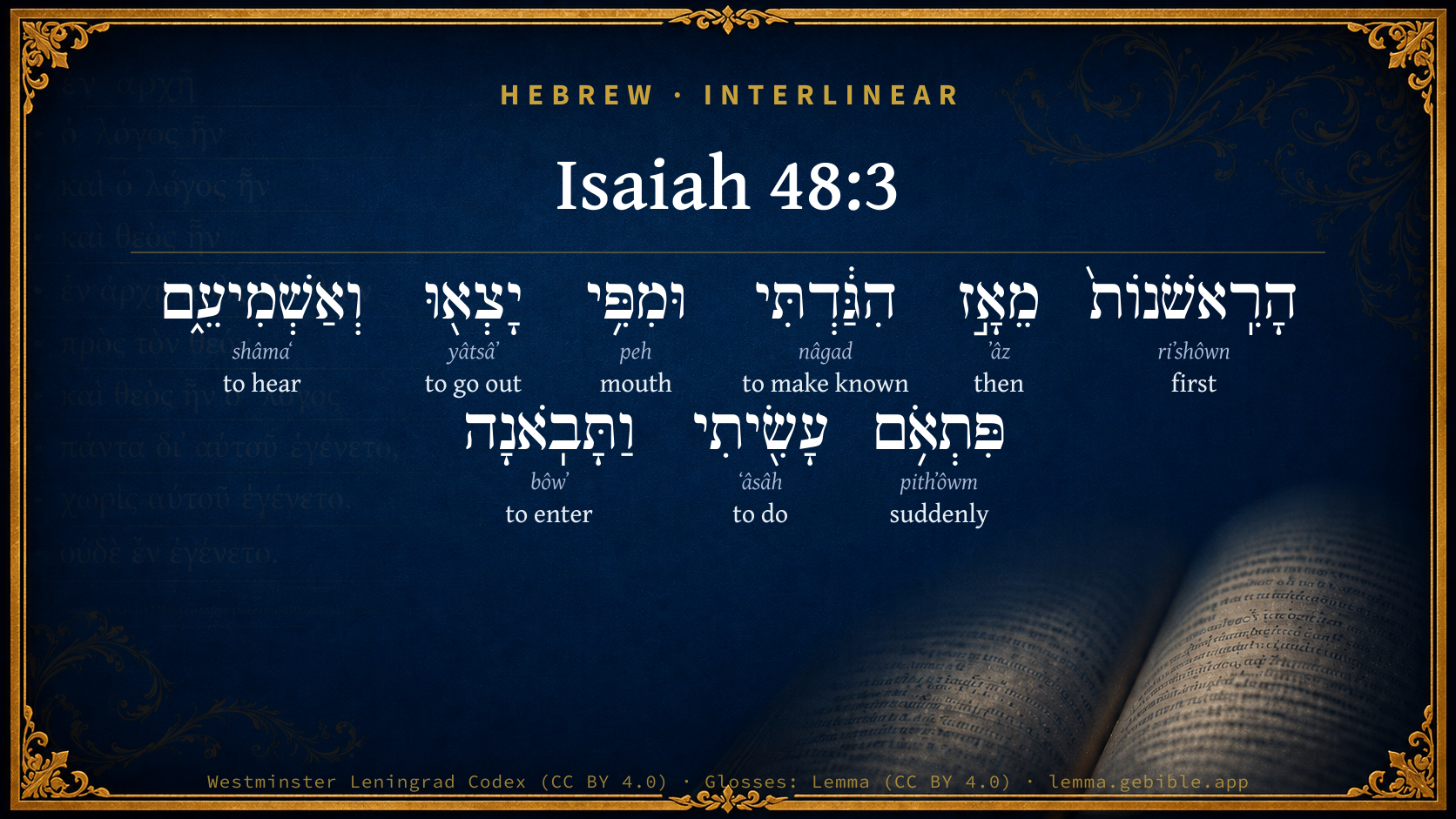
Hebrew (Westminster Leningrad Codex) Isaiah 48:3 appears in the Hebrew Old Testament. The text above is from the Westminster Leningrad Codex. Each word links to its Strong’s number, a concise gloss, and parsing drawn from the Open Scriptures Hebrew Bible morphology. Click any word for its full Brown-Driver-Briggs (BDB) entry.
Download image
Cite this verse

Isaiah 48:3 (World English Bible). Public Domain. Lemma interlinear Bible study tool, https://lemma.gebible.app/v/isaiah/48/3.

Show BibTeX & RIS
BibTeX
RIS
English Translation
I have declared the former things from of old; yes, they went forth out of my mouth, and I shown them: suddenly I did them, and they happened.
World English Bible · Public Domain
Download a study sheet

One document with this verse’s original text, its word-by-word gloss line, the meaning frame, cross-references with their text, attributed commentary, and full source and license credits — printable, and it pastes into notes with its structure intact.

This verse Autodidact and up

Study sheet (.html) Plain text (.txt)

A passage Seminary Student

Up to 50 verses in one chapter. A passage sheet keeps up to 6 commentary sources and 12 cross-references per verse, in the order this page ranks them, and says so on the sheet whenever that leaves anything out. Ask for a single verse and you get the Autodidact verse sheet above.

Everything on this page stays free to read, with no account — the sheet is a download of what is already on screen, not access to it.

Want to remove ads? Support Godless Engineer
Compare translations 3

The same verse in 3 English versions, stacked beneath the original-language interlinear above. Click any original word for its lexicon entry.

Each is an independent rendering of the whole verse — the interlinear is not word-aligned to these translations.

Highlighted words mark where these versions differ — a whole-verse word diff, not a word-by-word alignment.

  • World English Bible Public Domain
    I have declared the former things from of old; yes, they went forth out of my mouth, and I shown them: suddenly I did them, and they happened.
  • King James Version Public Domain
    I have declared the former things from the beginning; and they went forth out of my mouth, and I shewed them; I did them suddenly, and they came to pass.
  • unfoldingWord Literal Text CC BY-SA 4.0
    The former, I declared from then, and they went out from my mouth, and I made hear them; suddenly I did, and they came.

unfoldingWord Literal Text — © unfoldingWord, licensed CC BY-SA 4.0. Word-aligned USFM3 via Door43 (git.door43.org/unfoldingWord/en_ult).

Versions to compare (up to 4)

3 of 4 selected

Show all 18 translations

Every available English version of this verse, each an independent rendering of the whole verse.

  • World English Bible Public Domain
    I have declared the former things from of old; yes, they went forth out of my mouth, and I shown them: suddenly I did them, and they happened.
  • Berean Standard Bible Public Domain
    I foretold the former things long ago; they came out of My mouth and I proclaimed them. Suddenly I acted, and they came to pass.
  • Majority Standard Bible Public Domain
    I foretold the former things long ago; they came out of My mouth and I proclaimed them. Suddenly I acted, and they came to pass.
  • King James Version Public Domain
    I have declared the former things from the beginning; and they went forth out of my mouth, and I shewed them; I did them suddenly, and they came to pass.
  • American Standard Version (1901) Public Domain
    I have declared the former things from of old; yea, they went forth out of my mouth, and I showed them: suddenly I did them, and they came to pass.
  • Revised Version (1885) Public Domain
    I have declared the former things from of old; yea, they went forth out of my mouth, and I shewed them: suddenly I did them, and they came to pass.
  • Geneva Bible (1599) Public Domain
    I haue declared ye former things of old, and they went out of my mouth, and I shewed them: I did them suddenly, and they came to passe.
  • Douay-Rheims (1899) Public Domain
    The former things of old I have declared, and they went forth out of my mouth, and I have made them to be heard: I did them suddenly and they came to pass.
  • Young's Literal Translation Public Domain
    The former things from that time I declared, And from my mouth they have gone forth, And I proclaim them, Suddenly I have done, and it cometh.
  • Literal Standard Version CC BY-SA 4.0
    I declared the former things from that time, || And they have gone forth from My mouth, || And I proclaim them, || Suddenly I have done, and it comes.
  • Unlocked Literal Bible CC BY-SA 4.0
    “I have declared the things from long ago; they came out from my mouth, and I made them known; then suddenly I did them, and they came to pass.
  • unfoldingWord Literal Text CC BY-SA 4.0
    The former, I declared from then, and they went out from my mouth, and I made hear them; suddenly I did, and they came.
  • Darby Bible Public Domain
    I have declared the former things long ago; and they went forth out of my mouth, and I caused them to be heard: I wrought suddenly, and they came to pass.
  • World Messianic Bible Public Domain
    I have declared the former things from of old. Yes, they went out of my mouth, and I revealed them. I did them suddenly, and they happened.
  • Webster's Bible Public Domain
    I have declared the former things from the beginning; and they went forth from my mouth, and I showed them; I did them suddenly, and they came to pass.
  • Free Bible Version CC BY-SA 4.0
    I predicted long ago what was going to happen—I said it and let people know. Then suddenly I decided to act, and it all came true.
  • Bible in Basic English Public Domain
    I gave word in the past of the things which came about; they came from my mouth, and I made them clear: suddenly I did them, and they came about.
  • JPS Tanakh (1917) Public Domain
    I have declared the former things from of old; yea, they went forth out of My mouth, and I announced them; suddenly I did them, and they came to pass.

Literal Standard Version (2020), Covenant Press — licensed CC BY-SA 4.0. Text via the HelloAO Bible API (eBible.org). Unlocked Literal Bible (unfoldingWord) — licensed CC BY-SA 4.0. Text via the HelloAO Bible API (eBible.org). unfoldingWord Literal Text — © unfoldingWord, licensed CC BY-SA 4.0. Word-aligned USFM3 via Door43 (git.door43.org/unfoldingWord/en_ult). Free Bible Version, Dr. Jonathan Gallagher — licensed CC BY-SA 4.0. Text via the HelloAO Bible API (eBible.org).

Word by word

More ways to search: Search by grammar → Find every occurrence → Compare this word →

Practice this passage: Drill this verse → Learn its vocabulary →

About this verse

These counts appear in no published source. They are computed here, from the morphology-tagged text and Lemma’s own curated glosses. What Lemma adds →

9
words
9
distinct lemmas
Prophets
section

Notable vocabulary

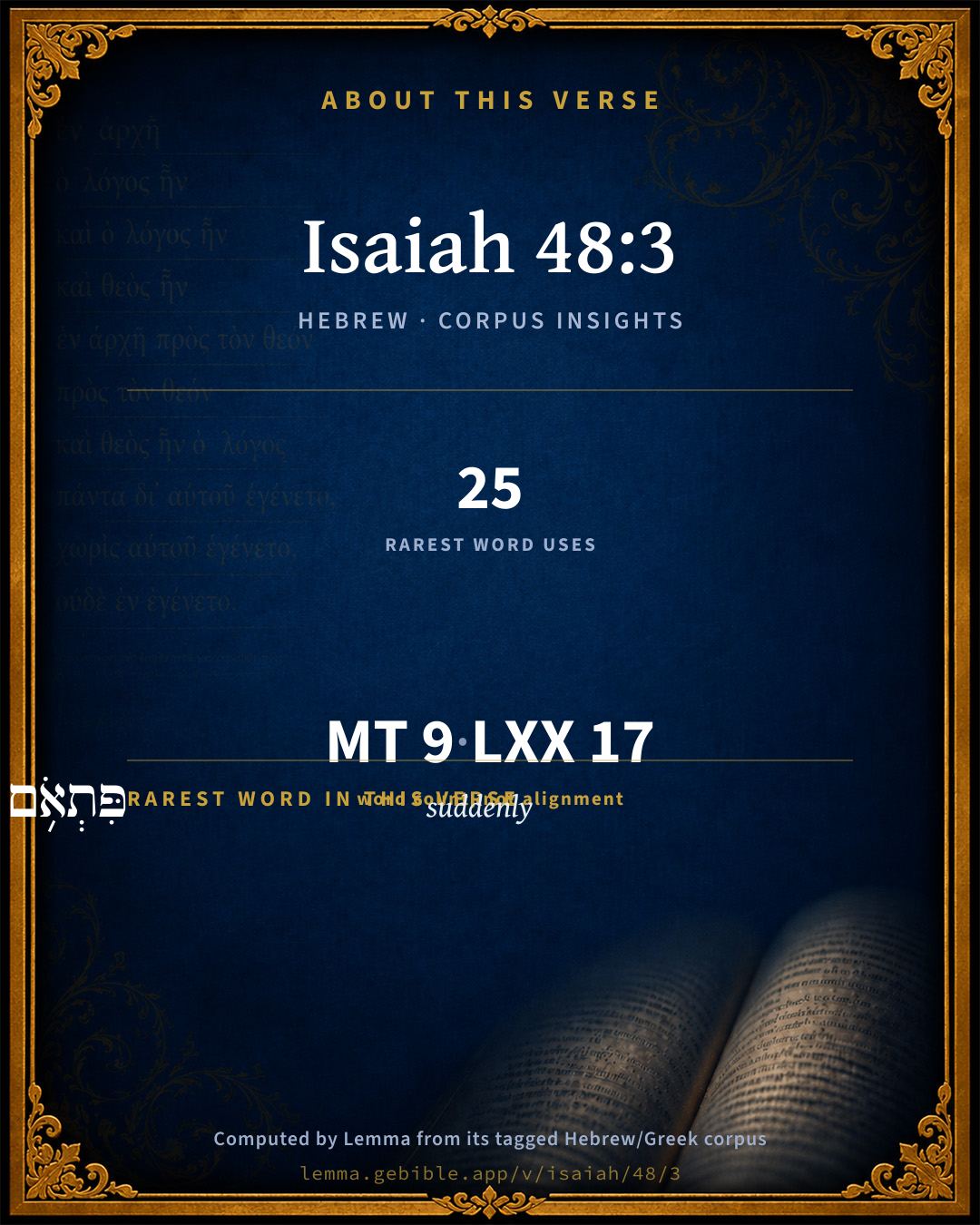
The rarest word here is פִּתְאֹ֥ם suddenly H6597 — appearing just 25 times in the whole Hebrew Bible.

Shared distinctive vocabulary

פִּתְאֹ֥ם suddenly H6597 occurs in 25 verses of the Hebrew Bible. Also found in:

Grammatical profile

  • 5 verbs
  • 1 noun
  • 1 adjective
  • 2 adverbs

Verb forms

  • הִגַּ֔דְתִּי Hiphil · Perfect
  • יָצְא֖וּ Qal · Perfect
  • וְאַשְׁמִיעֵ֑ם Hiphil · Imperfect
  • עָשִׂ֖יתִי Qal · Perfect
  • וַתָּבֹֽאנָה Qal · Sequential Imperfect

Hebrew & Septuagint length

In English translation the verse runs 28 words from the Hebrew and 23 from the Septuagint (LXX English) — closely comparable.

A rough comparison of the two English renderings, which tokenize alike — not a word-level alignment.

Word counts can differ between the Hebrew and the Greek without any difference in meaning — e.g. the Hebrew direct-object marker אֵת has no separate Greek word, and Greek often adds the article ὁ.

In the original languages it is 9 Hebrew tokens and 17 Greek tokens — but the two are counted differently (Hebrew bundles its prefixes and suffixes into one token; the Greek is in lemma form), so that isn’t a like-for-like length.

Cross-references

13

Topical passages linked to Isaiah 48:3 in the Treasury of Scripture Knowledge — connected by theme and wording, ordered by reader-vote popularity; previews shown in the World English Bible.

  • Isaiah 42:9 Behold, the former things have happened, and new things do I declare. Before they spring forth I tell you of them.
  • Joshua 21:45 There failed not anything of any good thing which Yahweh had spoken to the house of Israel; all came to pass.
  • Isaiah 41:22 Let them bring forth, and declare to us what shall happen: declare you the former things, what they are, that we may consider them, and know the latter end of them; or show us things to come.
  • Isaiah 44:7–8 Who, as I, shall call, and shall declare it, and set it in order for me, since I established the ancient people? and the things that are coming, and that shall happen, let them declare.
  • Isaiah 45:21 Declare you, and bring [it] forth; yes, let them take counsel together: who has shown this from ancient time? who has declared it of old? Haven't I, Yahweh? and there is no God else besides me, a just God and a Savior; there is no one besides me.
  • Isaiah 43:9 Let all the nations be gathered together, and let the peoples be assembled: who among them can declare this, and show us former things? let them bring their witnesses, that they may be justified; or let them hear, and say, It is truth.
  • Isaiah 46:9–10 Remember the former things of old: for I am God, and there is none else; [I am] God, and there is none like me;
  • Joshua 23:14–15 Behold, this day I am going the way of all the earth: and you know in all your hearts and in all your souls, that not one thing has failed of all the good things which Yahweh your God spoke concerning you; all are happen to you, not one thing has failed of it.
  • Isaiah 37:7 Behold, I will put a spirit in him, and he shall hear news, and shall return to his own land; and I will cause him to fall by the sword in his own land.
  • Isaiah 10:33–34 Behold, the Lord, Yahweh of Hosts, will lop the boughs with terror: and the high of stature shall be hewn down, and the lofty shall be brought low.
  • Isaiah 37:29 Because of your raging against me, and because your arrogance is come up into my ears, therefore will I put my hook in your nose, and my bridle in your lips, and I will turn you back by the way by which you came.
  • Isaiah 10:12–19 Therefore it shall happen that, when the Lord has performed his whole work on Mount Zion and on Jerusalem, I will punish the fruit of the stout heart of the king of Assyria, and the glory of his high looks.
  • Isaiah 37:36–38 The angel of Yahweh went forth, and struck in the camp of the Assyrians one hundred and eighty-five thousand; and when men arose early in the morning, behold, these were all dead bodies.

Cross-references courtesy of OpenBible.info (CC BY 4.0).

Hebrew and Greek witnesses Masoretic Hebrew ↔ Greek Septuagint

The same verse in the two great witnesses to the Old Testament, shown verse-for-verse.

These are two independent witnesses, not word-aligned to each other, and the Septuagint is shown in lemma (dictionary) form.

Hebrew Isaiah 48:3 Masoretic · Westminster Leningrad Codex

הָרִֽאשֹׁנוֹת֙ מֵאָ֣ז הִגַּ֔דְתִּי וּמִפִּ֥י יָצְא֖וּ וְאַשְׁמִיעֵ֑ם פִּתְאֹ֥ם עָשִׂ֖יתִי וַתָּבֹֽאנָה

I have declared the former things from of old; yes, they went forth out of my mouth, and I shown them: suddenly I did them, and they happened.

World English Bible · Public Domain

Greek LXX Isaiah 48:3 Septuagint · lemma form

ὁ πρότερος ἔτι ἀναἀγγέλλω καί ἐκ ὁ στόμα ἐγώ ἐκἔρχομαι καί ἀκουστός γίγνομαι ἐξάπινα ποιέω καί ἐπιἔρχομαι

and they that have proceeded out of my mouth, and it became well known; I wrought suddenly, and the events came to pass.

LXX2012 (modern English Septuagint) · Public Domain

Hebrew: Westminster Leningrad Codex (CC BY 4.0). Greek: Septuagint (public domain); English from LXX2012 (modern English Septuagint) (Public Domain). How the Septuagint differs from the Hebrew →

Targum (Aramaic paraphrase)

1

The Targum is the ancient Jewish Aramaic paraphrase of the Hebrew Scriptures — an interpretive translation, not the Hebrew text itself. Onkelos (literal) and Pseudo-Jonathan (expansive) render the Torah, and Jonathan the Prophets. Coverage is partial: where no permissively-licensed English translation exists for a verse, only the Aramaic is shown. This is verse-level text, not a word-by-word alignment to the Hebrew.

  1. Targum Jonathan Prophets (Joshua–Malachi)
    קַדְמֵיתָא מִבְּכֵן חַוֵתִי וּמִמֵימְרִי נְפַקָא וּמְסַרְתִּינוּן בִּתְכֵיף עֲבַדְתִּינוּן וַאֲתָאָה:

    I have declared the former things from the beginning; and they have gone forth from my WORD, and I announced them; suddenly I will do them, and they shall come to pass.

    Targum Jonathan — Aramaic: “Mikraot Gedolot” (public domain). English: “Sefaria Community Translation” (CC0 1.0 (public-domain dedication)); “London "Chaldee Paraphrase," 1871” (public domain). Text via Sefaria.

Commentary

Notes on Isaiah 48:3 from classic Christian and Jewish commentators (each source and its license shown beneath its notes). The classic Christian expositions comment on the surrounding passage and are grouped to its opening verse, so a note may address several verses; the Jewish commentaries on the Tanakh (Rashi and others) are per-verse, so they appear only where the commentator wrote on this verse.

Lemma curates 59 commentaries, every one of them public domain or Creative Commons licensed, each selected and text-cleaned for this edition rather than reprinted as found. About our sources →

Trapp's Complete Commentary

John Trapp

Isa 48:3 I have declared the former things from the beginning; and they went forth out of my mouth, and I shewed them; I did [them] suddenly, and they came to pass.

Ver. 3. I have declared the former things.] This God had said oft before; but being now to conclude this comfortable sermon, he repeats here the heads of what had been spoken in the seven foregoing chapters.

John Trapp, A Commentary or Exposition upon All the Books of the Old and New Testament (1647–1656) — public domain. Text from a community e-Sword module.

The Biblical Illustrator

Joseph S. Exell

Isa_48:3

I have declared the former things from the beginning

The probability and use of inspired predictions

I.

It is quite plain that ANY BEING THAT IS DISTINGUISHED ABOVE OTHERS MUST BE EXALTED EITHER BY KNOWLEDGE OR BY POWER, OR BY BOTH. If, then, God is to make Himself known to His creatures, it must be by some displays of this kind--by power, doing those things which they cannot do; or by intellect, making known those things which they cannot know. There is one advantage in these displays of God by means of knowledge, telling things that we could not know otherwise--that it addresses our judgment. Miracles seem to astound us; they may be supposed to throw us out of our calm self-possession, and to bewilder us by their wonders; but prophecies coolly address our judgment, without disturbing our passions, and enable us to exercise our reason in reflection upon these discoveries of the great superior Mind. Though we cannot tell exactly what preference we are to give to one or the other, some minds being most struck with the displays of power in miracles, others most with the displays of knowledge in predictions, yet we can easily see that these may concur and aid each other. Is it not probable that God will make Himself known to man? But is it not equally probable that if He tells us about a futurity and eternity, He will take some method of convincing us that what He thus tells us is true and will surely come to pass?

II. THE USES OF INSPIRED PREDICTIONS. These are various; many of them we have yet to discover.

1. A most important use of the inspired predictions of Scripture is, that you should study the Book that contains them.

2. You should watch His providence, that you may see how it fulfils His Word. He that eyes providences shall never want providences to eye.

3. You should learn from hence to admire and adore the omniscience and faithfulness and truth of God.

4. Expect all that God has predicted both for time and eternity. (J. Bennett, D. D.)

The Biblical Illustrator, edited by Joseph S. Exell (c. 1880s–1900s) — public domain. Text from a community e-Sword module.

Joseph Benson's Commentary

Isa 48:3-5. I have declared — That is, predicted; the former things — Those things which are already come to pass. These, opposed to new things, (Isa 48:6,) seem to intend the events foretold by Isaiah in the former part of this book, relating to the two confederate kings of Syria and Israel, (chap. 7.,) and to Sennacherib, (chap. 10,) as the new things, and things to come, (Isa 41:22,) respect the Babylonian captivity, and their return from thence, as figures of gospel times. They went forth out of my mouth, and I did them suddenly — What my mouth foretold my hand effected, even when there was no likelihood of such events taking place, whereby I gave you full proof of my Godhead. Because I knew that thou art obstinate — Therefore I gave thee the more and clearer demonstrations of my nature and providence, because I knew thou wast an unbelieving and perverse nation, that would not easily nor willingly be convinced. And thy neck an iron sinew — Which would not bow down to receive my yoke. It is a metaphor taken from untamed and stubborn oxen. The sense is, I considered that thou wast unteachable and incorrigible. And thy brow brass — That thou wast impudent and insolent. Before it came to pass I showed it thee, lest, &c. — I foretold these things, that it might be evident that they were the effects of my counsel, and not of thine idols. “God ordained a succession of prophets to foretel the most remarkable events which should happen to the Jews, on purpose to prevent their ascribing them to their idols, which their infidelity and obstinacy might have prompted them to do.” — Lowth.

Joseph Benson's Commentary on the Old and New Testaments (1811–1818) — public domain. Text from a community e-Sword module.

Whedon's Commentary on the Bible

Daniel D. Whedon

3-5. I have declared — Or, have announced.

Former things — Former events, before they came to pass; or, as some suppose, “and they have come to pass” Isa_42:9; Isa_44:7-8.

Suddenly — They came to pass so unexpectedly that the prophecy could not have been fulfilled through human means; at least, human sagacity could not have foretold them. The argument runs thus: Through my prophet I announced in former times a certain prediction — for example, the destruction of the Assyrian army — and it suddenly took place. Isa_37:36. Human sagacity could not have foretold that event, nor could human means have brought it about. Not long past I predicted, not an ideal fact — namely, the raising up of a deliverer, Cyrus, for my people at Babylon — it shall prove an actual fact. Other instances of prediction and fulfilment could be given. No idol system is equal to this. The facts of the past cannot be disputed. Because I knew, etc. — I made former predictions and fulfilled them, because I knew that thou art obstinate, unbelieving, not easily convinced, with neck stiff as if made of sinews of iron.

Thy brow brass — As hard and insensible to spiritual influence as brass. The fifth verse recapitulates, in order to confirm, the argument of Isa_48:3.

Daniel D. Whedon (gen. ed.), Commentary on the Old and New Testaments (1874–1909) — public domain. Text from a community e-Sword module.

Lange's Commentary on the Holy Scriptures

2. THE FORMER THINGS AS FOUNDATIONS OF THE NEW

Isa_48:3-11

3          I have declared the former things 1 from the beginning;

And they went forth out of my mouth, and I 2 shewed them;

I did them suddenly, and they came to pass.

4     Because I knew that thou art 3 obstinate,

And thy neck is an iron sinew,

And thy brow brass;

5     I have even from the beginning declared it to thee;

Before it came to pass I 4shewed it thee:

Lest thou shouldest say, Mine idol hath done them,

And my graven image, and my molten image, hath commanded them.

6     Thou hast heard, see all this;

And will not ye declare it?

I have cshewed thee new things from this time,

Even hidden things, and thou didst not know them.

7     They are created now, and not afrom the beginning;

Even before the day 5when thou heardest them not;

Lest thou shouldest say, Behold, I knew them.

8     Yea, thou heardest not; yea, thou knewest not;

Yea, afrom that time 6that thine ear was not opened:

For I knew that thou wouldest deal very treacherously,

And wast called a transgressor from the womb.

9     For my name’s sake will I defer mine anger,

And for my praise will I refrain for thee,

That I cut thee not off.

10     Behold, I have refined thee, but not 7with silver;

I have chosen thee in the furnace of affliction.

11     For mine own sake, even for mine own sake, will I do it:

For how should my name be polluted?

And I will not give my glory unto another.

TEXTUAL AND GRAMMATICAL

See List for the recurrence of the words: Isa_48:3. ראשׁנות—מֵאָז. Isa_48:5. פֶסֶל. Isa_48:9. חָטַם. Isa_48:10.צָרַף.

Isa_48:1. מֵאָז is properly=“from that time hitherto.” But מִן stands here, according to Hebrew usage, as designation of the term, a quo. We may therefore boldly translate מאז by “then, at that time,” as a reference to time long past.

Isa_48:7. לִמְנֵי יוֹם is = ante hunc diem, comp. Isa_43:13. וְ before לֹא is demonstrative.

Isa_48:8. פִתְּחָה is causative Piel=“to make an opening,” i.e., to open one’s-self to the report, to hear the report, comp. for the causative use Isa_60:11; Psa_116:6.—The expression קרא לך as in Isa_58:12; Isa_61:3; Isa_62:2.

Isa_48:9. האריך אף only Pro_19:11; comp. Job_6:11 and the expression in the Pentateuch אֶרֶךְ אַפַיִם Exo_34:6; Num_14:18, etc.—למען Is to be supplied before תהלתי, Isa_44:28; Isa_46:5.—חָטַם, Arab, chatama, Aram. חֲטַם, coercere, חָטָם frenum, nose-ring.—לָךְ dat. Commodi; Isa_40:10.

Isa_48:10. It is plain that the בְּ can neither be ב pretii, nor that of accompaniment. It is (Hitzig, Delitzsch) the ב essentiae = in qualitate argenti, in the quality of silver, i.e., as silver. The only peculiarity here is the placing of the בְּ with the object (comp. Eze_20:41; Psa_78:55, Del.).—בָּחַר properly means “to choose.” But as to choose presupposes a testing and confirmation, so in the Aram. בְּחַר stands directly for בָּחַן (Syr. bochuro = בָּחוֹן explorator). In Latin, too, probare means not only to hold something to be good, but also to investigate whether it is good. So also here בחר is used in the sense of בָּהַן (comp. Job_34:4).

EXEGETICAL AND CRITICAL

1. I have declared——commanded them. Isa_48:3-5. These three verses express the thought, that from ancient times on, and before He gave this new prophecy that culminates in the name of Cyrus, the Lord had by prophecy and fulfilment proved Himself to be the true God. This is the seventh time the Prophet presents this argument. By ראשׁנות, therefore, I understand priora, ante facta. The Prophet, as it were, divides history into two parts: the old and the new. The new begins with the first prophetic announcements of events relative to Cyrus. The matter is important to the Lord hence he divides הנדתי, “I have announced,” into two natural component parts: 1) the prophecy went out of His mouth, 2) it entered into Israel’s ear. Thus the fact of the prophecy is proved. And also the fulfilment. For suddenly (פתאם is wont to stand for the initiation of the fulfilment, because the inward connection is hid from the eyes of men, comp. Isa_29:5; Isa_47:11) the Lord performed what was announced and the thing prophesied came about (comp. Isa_44:7; Isa_47:9). This course was necessary from the very first. It had always an eminently practical object. Because I know, says the Lord, that thou art hard, i.e., stiff-necked, hard to convince and that thy neck is an iron sinew (נִיד, nervus, tendo, spring, resort), therefore hard to bend, and thy brow brass, thus impenetrable, obstinate,—for this reason I announced to the at that time, long ago, so that thou mightest not say my idol (עֹצֶב, general word, deus ficticius in general, Psa_139:24) did it, my graven image and my molten image (נסך, Isa_41:29) commanded it here (made it come, Isa_45:11). Therefore the Lord here declares that in the past even, thus in what has been indicated as the first period of history, by reason of Israel’s hardness of heart, and its being unimpressible by purely inward, spiritual proofs, and because of its desire for arguments that may be seized outwardly, He had found Himself obliged to establish His claim to be the only true God, by prophesying the future, and bringing to pass what was prophesied. In this the Prophet says nothing new. He only repeats what he has before set forth in various places (Isa_41:4; Isa_41:21 sqq., Isa_41:26; Isa_43:9 sqq.; Isa_44:7 sqq.; Isa_46:9 sq.).

2. Thou hast heard——from the womb. Isa_48:6-8. With these words, too, the Prophet repeats essentially only something said before, viz., what he had announced in reference to the new period of salvation to be inaugurated by Cyrus. The words שׁמעת to תנידו, Isa_48:6, form the transition. שׁמעת manifestly refers to אשׁמיעם, Isa_48:3, and השׁמעתיך, Isa_48:5. It must be established that not only did the Lord bring those old prophecies to a hearing, but that they were actually heard. And כֻּלָּהּ would express that all relating to that, therefore the fulfilment also, has been heard. The emphatic חֲזֵה (comp. Isa_33:20; Isa_30:10) would warn Israel not to treat the matter lightly. Only let it look narrowly, and it must confess that all in the previous period of history relative to prophecy and fulfilment was fully known. Will they not on their part feel impelled to declare and proclaim aloud what they have undoubtedly heard? In the entire section, Isa_48:3-11, the Prophet steadily addresses Israel in the second pers. masc. sing. Suddenly in the single clause, ואתם הלא תנידו, he passes to the second pers. masc. plur. The reason for this seems to me to be, that he has in mind here, no longer the ideal total Israel, but the concrete persons of his contemporaries and immediate hearers or first readers.

This appears to me to be one of the passages where the Prophet, who else lives wholly in the Exile, cannot help casting a glance at the actual present. If we might assume that chapters 40–66 were to remain a sealed-up prophecy until the time of the Exile, then we would be warranted in saying that the words and will ye not declare it applied only to the exiles. But the numerous citations from chapters 40–66, that occur in prophets after Isaiah but before the Exile, show that our prophecy even before the Exile must have been publici juris. Hence I can only see in these words an exhortation that Isaiah gives to his actual contemporaries, viz., to confess openly that the history of Israel hitherto is a proof that Jehovah can prophesy and fulfil. [“And ye (idolaters or idols), will not ye declare, the same word used above for the prediction of events, and therefore no doubt meaning here, will not ye predict something? This is Hitzig’s explanation of the words. In favor of this view is its taking הִנִּיד in the sense which it has in the preceding verse, and also the analogy of Isa_41:22-23, where the very same challenge is given in nearly the same form; to which may be added the sudden change to the plural form, and the emphatic introduction of the pronoun, implying a new object of address, and not a mere enallage, because he immediately resumes the address to the people in the singular” J. A. Alex.]. As Israel itself must confess that it has learned to know its God as a prophesier and fulfiller, the Lord bases on that the further demand that they believe also the present new prophecy, and infer from it the proper consequences. Manifestly the חֲדָשׁוֹת, new things, are the prophecy relating to Cyrus and the period of salvation initiated by him. The Prophet refers to Isa_42:9 sqq.; Isa_43:19 sqq.; Isa_44:24 sqq.; Isa_45:1 sqq., Isa_45:11 sqq., Isa_45:19 sqq.; Isa_46:11. He particularly emphasizes that this prophecy as such is also quite a new thing. Had Israel obtained report of those future events in any other way, natural or supernatural, then, of course, their proclamation by the Prophet would have been met by the reply: “Nothing new, we know it already.” That would have been ruinous for the reputation of Jehovah and His prophet. But there is no mention of that. The prophecy relates to hidden things (Isa_1:8; Isa_49:6; Isa_65:4), to things that have just been created. The expression, are created (comp. Isa_41:20; Isa_43:7; Isa_45:8) is to be judged of by the measure of what is divinely real. The word of prophecy has changed the divine decree from being a λόγος ἐνδιάθετος to being a λόγος προφορικός. The divine idea is thereby, as it were, born into the world. Even though it only exists as a mere word, still a word so uttered is a creative word. If God has spoken it, it also comes to pass. So far what God has spoken, announced, prophesied, is as good as created. It is real even if for the time being it is only a divine decree (comp. under Doctr. and Eth. on Isa_48:7). But its reality rests only on this act of the divine will, and the knowledge of it only on the revelation of it by means of the prophet of Jehovah. No one in the world would have thought of it, and no one in the world would have received intelligence of the divine thought without the revelation through the Prophet. God thinks it, God says it, God does it. It is only and altogether a fruit of God, and hence a proof that God is, and what He is. God revealed it to Israel, and He did it with the intention of curing Israel of its deep-rooted tendency to faithlessness (comp. Jer_3:7; Jer_3:10), from its native tendency to apostacy.

3. For my name’s sake——unto another, Isa_48:9-11. These verses are related to what precedes as giving a reason. The new things (Isa_48:6), previously concealed, but now entered on existence as to principle by the word of prophecy, involve salvation and deliverance for Israel on the assumption that Israel will let itself be cured of its deep-rooted tendency to apostacy. For this continued rebelliousness it had properly merited extinction. But the Lord desires not the death of the sinner, but that he should repent and live. For the sake of His own honor, also, He desires not the death of the sinner. For the rejection of Israel after its election would even compromise the Lord Himself. It would make Him appear as one who would, but could not. Hence the Lord will make His anger long, i.e. He will postpone the destructive blow that His anger properly demands (see Text. and Gram.). In fact He postponed it until the rejection of His Son (Mat_21:39 sqq.). Therefore, for His name’s sake He will defer His anger, and for the sake of His honor He will restrain it, for Israel’s advantage (see Text. and Gram.), so that it will not be destroyed. He will only purify, refine Israel, yet not as silver; but He will confirm it in the furnace of affliction. The Prophet makes a difference between the refining furnace and the furnace of affliction. The difference cannot relate to the effect, since that is the same in both. For I do not think that the Prophet assumes an unfavorable result in the smelting process, viz. that dross will come of it. According to the context the honor of God demands that Israel be purified and saved. But the smelting furnace is for the silver no misfortune, no disgrace; it is the natural and necessary means for restoring the silver. Properly Israel ought not to need this smelting process. So far the furnace of affliction is for Israel a punishment and disgrace, which the smelting furnace is not for silver.—Finally the Prophet repeats the thought with emphasis, that the preservation of Israel was in the proper interest of Jehovah. Did He forsake Israel, He would then surrender them to the idols, and thereby permit the honor belonging to Him alone to be given to them. The words: and I will not give my honor to another, Isa_48:11 b, in which manifestly the thought of Isa_48:9-11 culminates, is a literal repetition of Isa_42:8. By this, the Prophet intimates that in these words, too (Isa_48:9-11), he only repeats what he had said before. Delitzsch very fittingly at Isa_48:11 refers to Eze_36:19-23.

Footnotes:

[1]from then.

[2]caused them to be heard.

[3]Heb. hard.

[4]caused them to hear.

[5]and.

[6]omit that.

[7]Or, for silver.

Lange's Commentary on the Holy Scriptures (Critical, Doctrinal, and Homiletical), ed. John Peter Lange, English translation edited by Philip Schaff (1864–1880) — public domain. Text from a community e-Sword module.

Tyndale Open Study Notes

Tyndale Open Resources

48:3 The Lord had forewarned Israel of what was going to happen in the Exile.

Tyndale Open Study Notes — © Tyndale Open Resources, licensed CC BY-SA 4.0. Text via the HelloAO Bible API.

Geneva Bible (1599)

Geneva Bible translators

He showeth that they could not accuse him in anything, forasmuch as he had performed whatsoever he had promised.

Geneva Bible (1599) marginal notes — public domain. Text via Bolls.life.

Jamieson, Fausset & Brown

Robert Jamieson, A. R. Fausset & David Brown

former--things which have happened in time past to Israel (Isa 42:9; Isa 44:7-8; Isa 45:21; Isa 46:10).

suddenly--They came to pass so unexpectedly that the prophecy could not have resulted from mere human sagacity.

Jamieson, Fausset & Brown — Commentary Critical and Explanatory on the Whole Bible (1871) — public domain (CC PDM 1.0). Text via the HelloAO Bible API.

Ellicott's Commentary for English Readers

(3) I have declared . . .—Once more, for the seventh time, the prophet presses the fact of the Divine foreknowledge, not, as before, against the “no-faith” of the heathen, but against the “little faith” of Judah.

A Bible Commentary for English Readers, edited by Charles John Ellicott (1878–1897) — public domain. Text from a community e-Sword module.

The Cambridge Bible for Schools and Colleges

gen. ed. J. J. S. Perowne

3. For from the beginning, render beforehand, or (as R.V.) “from of old.”

they (the predictions) went forth out of my mouth … I did them] brought the events to pass; the rî’shônôth including both the predictions and their historical fulfilments (see on ch. Isa_41:22).

The Cambridge Bible for Schools and Colleges (gen. ed. J. J. S. Perowne; Cambridge University Press, 1878–1918) — public domain. Text from a community e-Sword module.

John Gill's Exposition

I have declared the former things from the beginning,.... From the time of their first ancestors, from the time of Abraham their father, to whom was declared what should befall his posterity; that they should sojourn in Egypt, be afflicted there, and come out from thence with great substance; that they be brought into the land of Canaan, and the inhabitants of it being driven out before them, Gen 15:13.

And they went forth out of my mouth, and I showed them; they were told to Abraham by word of mouth; they were shown to him in prophecy:

I did them suddenly, and they came to pass; for very quickly these things began to take place, even in Abraham's time; for his seed being a stranger in a land not theirs, and afflicted near four hundred years, must be reckoned from the birth of Isaac; and all which exactly came to pass as was foretold; not one thing which the Lord had spoken of failed; all was punctually fulfilled, Jos 21:45.

John Gill's Exposition of the Whole Bible (1746–1763) — public domain (CC PDM 1.0). Text via the HelloAO Bible API.

Albert Barnes' Notes on the Bible

I have declared the former things - That is, in former times I have predicted future events by the prophets, which have come to pass as they were foretold. Though the fulfillment might have appeared to be long delayed, yet it came to pass at the very time, showing it to be an exact fulfillment of the prophecy. The design of thus referring to the former predictions is, to remind them of their proneness to disregard his declarations, and to recall to their attention the fact that all that he said would be certainly accomplished. As a people, they had been prone to disbelieve his word. He saw that the same thing would take place in Babylon, and that there also they would disbelieve his prophecies about raising up Cyrus, and restoring them to their own land. He therefore endeavors to anticipate this, by reminding them of their former unbelief, and of the fact that all that he had foretold in former times had come to pass.

From the beginning - In regard to this, and the meaning of the phrase, ‘the former things, see the notes at Isa 41:22; Isa 43:9. The phrase. ‘former things,’ refers to the things which precede others; the series, or order of events.

I did them suddenly - They came to pass at an unexpected time; when you were not looking for them, and when perhaps you were doubting whether they would occur, or were calling in question the divine veracity. The idea is, that God in like manner would, certainly, and suddenly, accomplish his predictions about Babylon, and their release from their captivity.

Albert Barnes' Notes on the Bible (1834–1885) — public domain. Text from a community e-Sword/MySword module.

Haydock's Catholic Bible Commentary

Suddenly, when there was no human appearance of the event, as when I foretold the exploits of Cyrus and the ruin of Babylon so long before.

George Leo Haydock (1774–1849), Haydock's Catholic Family Bible and Commentary, 1859 edition — public domain. Excludes Psalms (Douay-Rheims chapter numbering differs from Protestant) and Deuterocanonical books (Catholic canon only).

Matthew Poole's English Annotations

I have declared the former things from the beginning; those things which have formerly come to pass, which I punctually foretold from time to time before they came to pass; whereby I gave you full proof of my Godhead.

They came to pass; what my mouth foretold my hand effected.

Matthew Poole's English Annotations on the Holy Bible (1683–1685) — public domain. Text from a community e-Sword/MySword module.

The Pulpit Commentary

I have declared the former things from the beginning. (Isa_41:26 Isa_43:9, 10 44:7, 8, etc.) "Former things" are here contrasted with the "new things" of ver. 6. Two cycles of prophecy seem to be intended one of comparatively ancient date, the other quite fresh both equally showing forth the power of God and his infinite superiority to the idols. It is difficult to determine what the two cycles of prophecy are. Delitzsch suggests that "the former things are the events experienced by the people from the very earliest times down to the times of Cyrus," while "the new things embrace the redemption of Israel from Babylon, the glorification of the people in the midst of a world of nations converted to the God of Israel, and the creation of a new heaven and a new earth." Dr. Kay thinks that the "former things" are those mentioned in the prophecies concerning Babylon generally, the "new things those about to be announced in Isaiah 49-56. I did them suddenly; rather, sud denly I wrought.

The Pulpit Commentary (1880–1919), ed. H.D.M. Spence-Jones & Joseph S. Exell — public domain. Text from a community e-Sword module.

Keil & Delitzsch

C. F. Keil & F. Delitzsch

After this summons, and description of those who are summoned, the address of Jehovah begins. "The first I have long ago proclaimed, and it has gone forth out of my mouth, and I caused it to be heard. I carried it out suddenly, and it came to pass. Because I knew that thou art hard, and thy neck an iron clasp, and thy brow of brass; I proclaimed it to thee long ago; before it came to pass, I caused thee to hear it, that thou mightest not say, My idol has done it, and my graven image and molten image commanded it." The word הראשׁנות in itself signifies simply priora; and then, according to the context, it signifies prius facta (Isa 46:9), or prius praedicta (Isa 43:9), or prius eventura (Isa 41:22; Isa 42:9). In the present passage it refers to earlier occurrences, which Jehovah had foretold, and, when the time fixed for their accomplishment arrived, which He had immediately brought to pass. With a retrospective glance at this, we find plural masc. suffixes (cf., Isa 41:27) used interchangeably with plural fem. (cf., Isa 48:7 and Isa 38:16); the prophet more frequently uses the sing. fem. in this neuter sense (Isa 41:20; Isa 42:23, etc.), and also, though very rarely, the sing. masc. (Isa 45:8). On gı̄d, a band, a sinew, but here a clasp (cf., Arab. kaid, a fetter), see Psychology, p. 233. Nechūshâh is a poetical equivalent for nechōsheth, as in Isa 45:2. The heathen cravings of Israel, which reached into the captivity, are here presupposed. Hengstenberg is mistaken in his supposition, that the prophet's standpoint is always anterior to the captivity when he speaks in condemnation of idolatry. We cannot draw any conclusion from the character of the community that returned, with regard to that of the people of the captivity generally. The great mass even of Judah, and still more of Israel, remained behind, and became absorbed into the heathen, to whom they became more and more assimilated. And does not Ezekiel expressly state in Eze 20:30., that the golah by the Chaboras defiled themselves with the same abominations of idolatry as their fathers, and that the prevailing disposition was to combine the worship of Jehovah with heathenism, or else to exchange the former altogether for the latter? And we know that it was just the same with the exiles in Egypt, among whom the life and labours of Jeremiah terminated. Wherever the prophet speaks of פשׁעים and רשׁעים, these names invariably include a tendency or falling away to Babylonian idolatry, to which he describes the exiles as having been addicted, both in Isa 66:17 and elsewhere.

Keil & Delitzsch — Biblical Commentary on the Old Testament (1861–1891) — public domain (CC PDM 1.0). Text via the HelloAO Bible API. (Old Testament only.)

J. A. Alexander on Isaiah

Joseph Addison Alexander

“The first (or former things) since then I have declared.” That is, ‘I prophesied of old the events, which have already taken place’. For the sense of the particular expressions, see above on Isa 45:21; Isa 46:10. There is no abrupt transition here, as some interpreters assume. This verse asserts God’s prescience, not absolutely as in other cases, but for the purpose of explaining why He had so carefully predicted certain future events. It can be fully understood, therefore, only in connection with what goes before and follows. “And out of my mouth they went forth.” Some regard this as a proof that former things means former prophecies and not events; but even the latter might be figuratively said to have gone out of His mouth, as having been predicted by Him. “And I cause them to be heard,” a synonymous expression. “Suddenly I do (them) and they come to pass.” All this is introductory to what follows respecting the design of prophecy. The sense is not simply, ‘I foretell things to come’, but ‘I foretell things to come for a particular purpose’, which is now to be explained.

Joseph Addison Alexander, The Prophecies of Isaiah (1846–1847; New York: Scribner, 1870–1878) — public domain. Text from a community e-Sword module.

unfoldingWord translationNotes

Door43 World Missions Community

General Information:

Yahweh continues speaking to the people of Israel.

they came out from my mouth

"Mouth" refers to someone speaking. AT: "I spoke these things" (See: Synecdoche)

your neck muscles tight as iron, and your forehead like bronze

Yahweh compares the tightness of their neck muscles and the hardness of their foreheads to the hardness of iron and bronze. Here, to have a tight neck or a hard forehead is a metaphor that means the people are stubborn. AT: "it is as if your necks were iron and your heads were bronze" (See: Simile and Metaphor)

I declared these things to you beforehand; before they happened I informed you

This is saying the same thing twice for emphasis. (See: Parallelism)

translationWords

declare

know

bronze

false god

image

ordain

unfoldingWord translationNotes — © Distant Shores Media and the Door43 World Missions Community, licensed CC BY-SA 4.0. Source: git.door43.org/Door43/en_tn.

Rashi

Rabbi Shlomo Yitzchaki (Rashi)

The first things that passed, [viz.] the redemption from Egypt and Hezekiah’s salvation from the hand of Sennacherib.

I told from then When they had not yet come about, and suddenly I did it.

and they came to pass as I told before through My prophets.

Rashi on the Tanakh — English translations: “The Judaica Press complete Tanach with Rashi, translated by A. J. Rosenberg” (CC BY 4.0); “Pentateuch with Rashi's commentary by M. Rosenbaum and A.M. Silbermann, 1929-1934” (public domain); “The Metsudah Tanach series, Lakewood, N.J” (CC BY 4.0); and “The Book of Joshua, Metsudah Publications, 1997” (CC BY 4.0). Text via Sefaria.

Ibn Ezra

Rabbi Abraham ibn Ezra

I have declared, etc. God will say to the unbelievers, Have I not often foretold you coming events before they happened (ראשנות)? The past tense is therefore used: and they came to pass.

Ibn Ezra on the Tanakh — English translations: “Sefaria Community Translation” (CC0 1.0 (public-domain dedication)); “Yalkut, Sifsei Chachomim Chumash, Metsudah Publications, 2009” (CC BY 4.0); and “Commentary of Ibn Ezra on Isaiah - trans. by M. Friedlander, 1873” (public domain). Text via Sefaria.

Lesson kit

Teaching starters — assembled from the data on this page, not authored interpretation. Every prompt links to the verse data it draws on. Edit before teaching.

Isaiah, in the Prophets, opens this verse with 9 words (9 distinct Hebrew lemmas). Its most distinctive word is pithʼôwm (“suddenly”). A historical commentator’s framing appears above. Read the whole chapter for the surrounding context.

Discussion questions

  1. What does “suddenly” (pithʼôwm) contribute to the verse as a whole?
  2. Numbers 6:9 shares the word «suddenly» with this verse. How do the two illuminate each other?
  3. These translations render this verse differently. What is at stake in choosing one wording over another?
  4. The verb «הִגַּ֔דְתִּי» is Hiphil Perfect. How does its form color the action?
  5. Reading how Trapp's Complete Commentary and The Biblical Illustrator read this verse, where do the two commentators agree and where do they part?

Things to notice

Reading settings

Reading text

Shown beneath each verse's original-language words.

Old Testament
Old Testament edition

Read the OT as the Masoretic Hebrew (MT) or the Greek Septuagint (LXX).

English shown for the Greek Septuagint (in the Hebrew ↔ Greek comparison).

Comparing translations? Open the Compare panel on any verse page to stack up to four side by side.