
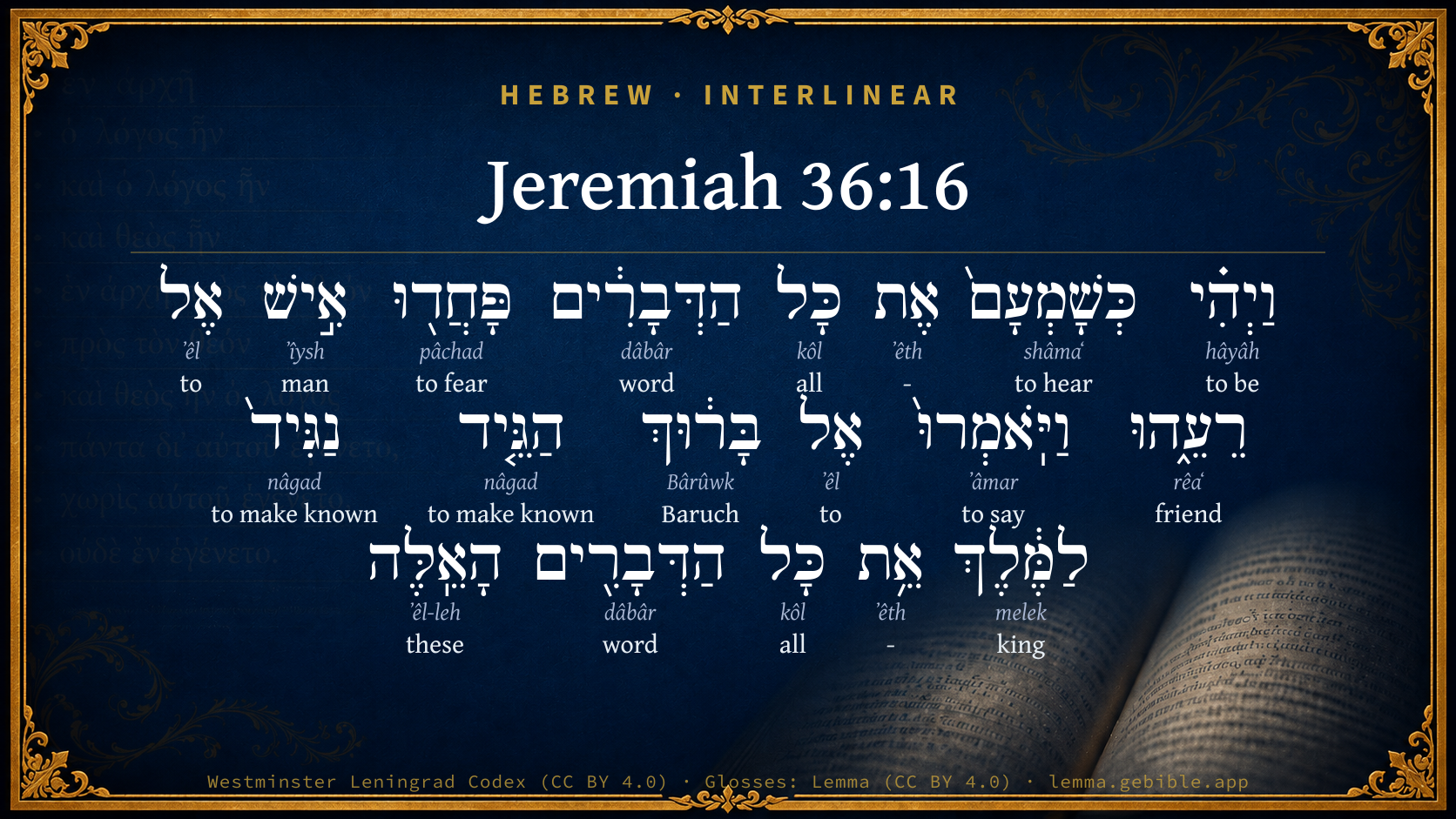
Jeremiah 36:16

Hebrew (Westminster Leningrad Codex) Jeremiah 36:16 appears in the Hebrew Old Testament. The text above is from the Westminster Leningrad Codex. Each word links to its Strong’s number, a concise gloss, and parsing drawn from the Open Scriptures Hebrew Bible morphology. Click any word for its full Brown-Driver-Briggs (BDB) entry.
Download image
Cite this verse

Jeremiah 36:16 (World English Bible). Public Domain. Lemma interlinear Bible study tool, https://lemma.gebible.app/v/jeremiah/36/16.

Show BibTeX & RIS
BibTeX
RIS
English Translation
Now it happened, when they had heard all the words, they turned in fear one toward another, and said to Baruch, We will surely tell the king of all these words.
World English Bible · Public Domain
Download a study sheet

One document with this verse’s original text, its word-by-word gloss line, the meaning frame, cross-references with their text, attributed commentary, and full source and license credits — printable, and it pastes into notes with its structure intact.

This verse Autodidact and up

Study sheet (.html) Plain text (.txt)

A passage Seminary Student

Up to 50 verses in one chapter. A passage sheet keeps up to 6 commentary sources and 12 cross-references per verse, in the order this page ranks them, and says so on the sheet whenever that leaves anything out. Ask for a single verse and you get the Autodidact verse sheet above.

Everything on this page stays free to read, with no account — the sheet is a download of what is already on screen, not access to it.

Want to remove ads? Support Godless Engineer
Compare translations 3

The same verse in 3 English versions, stacked beneath the original-language interlinear above. Click any original word for its lexicon entry.

Each is an independent rendering of the whole verse — the interlinear is not word-aligned to these translations.

Highlighted words mark where these versions differ — a whole-verse word diff, not a word-by-word alignment.

  • World English Bible Public Domain
    Now it happened, when they had heard all the words, they turned in fear one toward another, and said to Baruch, We will surely tell the king of all these words.
  • King James Version Public Domain
    Now it came to pass, when they had heard all the words, they were afraid both one and other, and said unto Baruch, We will surely tell the king of all these words.
  • unfoldingWord Literal Text CC BY-SA 4.0
    It happened that when they heard all these words, each man turned in fear to the one next to him and said to Baruch, “We must certainly report all of these words to the king.”

unfoldingWord Literal Text — © unfoldingWord, licensed CC BY-SA 4.0. Word-aligned USFM3 via Door43 (git.door43.org/unfoldingWord/en_ult).

Versions to compare (up to 4)

3 of 4 selected

Show all 18 translations

Every available English version of this verse, each an independent rendering of the whole verse.

  • World English Bible Public Domain
    Now it happened, when they had heard all the words, they turned in fear one toward another, and said to Baruch, We will surely tell the king of all these words.
  • Berean Standard Bible Public Domain
    When they had heard all these words, they turned to one another in fear and said to Baruch, “Surely we must report all these words to the king.”
  • Majority Standard Bible Public Domain
    When they had heard all these words, they turned to one another in fear and said to Baruch, “Surely we must report all these words to the king.”
  • King James Version Public Domain
    Now it came to pass, when they had heard all the words, they were afraid both one and other, and said unto Baruch, We will surely tell the king of all these words.
  • American Standard Version (1901) Public Domain
    Now it came to pass, when they had heard all the words, they turned in fear one toward another, and said unto Baruch, We will surely tell the king of all these words.
  • Revised Version (1885) Public Domain
    Now it came to pass, when they had heard all the words, they turned in fear one toward another, and said unto Baruch, We will surely tell the king of all these words.
  • Geneva Bible (1599) Public Domain
    Now when they had heard all the wordes, they were afraid both one and other, and said vnto Baruch, We will certifie the King of all these wordes.
  • Douay-Rheims (1899) Public Domain
    And when they had heard all the words, they looked upon one another with astonishment, and they said to Baruch: We must tell the king all these words.
  • Young's Literal Translation Public Domain
    and it cometh to pass, when they hear all the words, they have been afraid one at another, and say unto Baruch, `We do surely declare to the king all these words.'
  • Literal Standard Version CC BY-SA 4.0
    and it comes to pass, when they hear all the words, they have been afraid—one to another—and say to Baruch, “We surely declare all these words to the king.”
  • Unlocked Literal Bible CC BY-SA 4.0
    It happened that when they heard all these words, each man turned in fear to the one next to him and said to Baruch, “We must certainly report all of these words to the king.”
  • unfoldingWord Literal Text CC BY-SA 4.0
    It happened that when they heard all these words, each man turned in fear to the one next to him and said to Baruch, “We must certainly report all of these words to the king.”
  • Darby Bible Public Domain
    And it came to pass, when they heard all the words, they turned in fear one toward another, and said unto Baruch, We will certainly report to the king all these words.
  • World Messianic Bible Public Domain
    Now when they had heard all the words, they turned in fear one toward another, and said to Baruch, “We will surely tell the king of all these words.”
  • Webster's Bible Public Domain
    Now it came to pass when they had heard all the words, they were afraid both one and another, and said to Baruch, We will surely tell the king of all these words.
  • Free Bible Version CC BY-SA 4.0
    After they'd heard everything, they were frightened and looked at each other. They said to Baruch, “We've got to tell the king about all this.”
  • Bible in Basic English Public Domain
    Now it came about that, after hearing all the words, they said to one another in fear, We will certainly give the king an account of all these words.
  • JPS Tanakh (1917) Public Domain
    Now it came to pass, when they had heard all the words, they turned in fear one toward another, and said unto Baruch: 'We will surely tell the king of all these words.'

Literal Standard Version (2020), Covenant Press — licensed CC BY-SA 4.0. Text via the HelloAO Bible API (eBible.org). Unlocked Literal Bible (unfoldingWord) — licensed CC BY-SA 4.0. Text via the HelloAO Bible API (eBible.org). unfoldingWord Literal Text — © unfoldingWord, licensed CC BY-SA 4.0. Word-aligned USFM3 via Door43 (git.door43.org/unfoldingWord/en_ult). Free Bible Version, Dr. Jonathan Gallagher — licensed CC BY-SA 4.0. Text via the HelloAO Bible API (eBible.org).

Word by word

More ways to search: Search by grammar → Find every occurrence → Compare this word →

Practice this passage: Drill this verse → Learn its vocabulary →

פָּחֲד֖וּ
pâchad
H6342
“to fear”
Verb, Qal, Perfect, 3rd Person, Common, Plural
Part of Speech
Verb
Stem
Qal
Form
Perfect
Person
3rd Person
Gender
Common
Number
Plural
Full BDB Definition

Origin: a primitive root

TWOT: 1756

to fear, tremble, revere, dread, be in awe or dread - (Qal) - to be in dread - to be in awe - (Piel) to be in great dread - (Hiphil) to cause to dread
  1. וַיְהִ֗י hâyâh H1961 “and · to be” Conjunction + Verb, Qal, Sequential Imperfect, 3rd Person, Masculine, Singular
  2. כְּשָׁמְעָם֙ shâmaʻ H8085 “like/as · to hear · them” Preposition + Verb, Qal, Infinitive Construct + Suffix, Personal, 3rd Person, Masculine, Plural
  3. אֶת ʼêth H853 “-” Particle, Direct Object
  4. כָּל kôl H3605 “all of” Noun, Common, Masculine, Singular, Construct
  5. הַדְּבָרִ֔ים dâbâr H1697 “the · words” Particle, Definite Article + Noun, Common, Masculine, Plural, Absolute
  6. אִ֣ישׁ ʼîysh H376 “man” Noun, Common, Masculine, Singular, Absolute
  7. אֶל ʼêl H413 “to” Preposition
  8. רֵעֵ֑הוּ rêaʻ H7453 “friend · his” Noun, Common, Masculine, Singular, Construct + Suffix, Personal, 3rd Person, Masculine, Singular
  9. וַיֹּֽאמְרוּ֙ ʼâmar H559 “and · to say” Conjunction + Verb, Qal, Sequential Imperfect, 3rd Person, Masculine, Plural
  10. אֶל ʼêl H413 “to” Preposition
  11. בָּר֔וּךְ Bârûwk H1263 “Baruch” Noun, Proper
  12. הַגֵּ֤יד nâgad H5046 “to make known” Verb, Hiphil, Infinitive Absolute
  13. נַגִּיד֙ nâgad H5046 “to make known” Verb, Hiphil, Imperfect, 1st Person, Common, Plural
  14. לַמֶּ֔לֶךְ melek H4428 “to/for the · king” Preposition, Determined + Noun, Common, Masculine, Singular, Absolute
  15. אֵ֥ת ʼêth H853 “-” Particle, Direct Object
  16. כָּל kôl H3605 “all of” Noun, Common, Masculine, Singular, Construct
  17. הַדְּבָרִ֖ים dâbâr H1697 “the · words” Particle, Definite Article + Noun, Common, Masculine, Plural, Absolute
  18. הָאֵֽלֶּה ʼêl-leh H428 “the · these” Particle, Definite Article + Pronoun, Demonstrative, Common, Plural

About this verse

These counts appear in no published source. They are computed here, from the morphology-tagged text and Lemma’s own curated glosses. What Lemma adds →

19
words
14
distinct lemmas
Prophets
section

Notable vocabulary

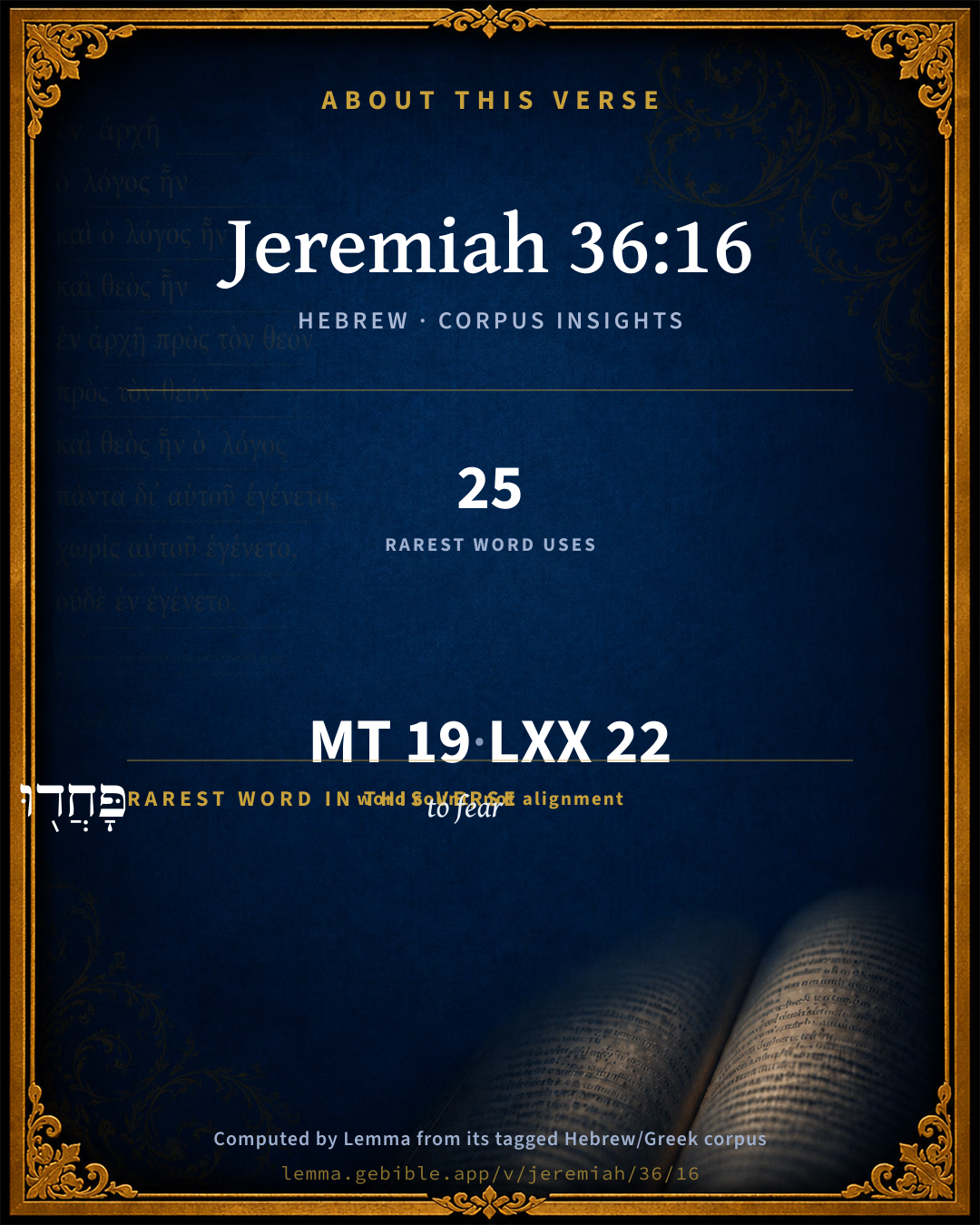
The rarest word here is פָּחֲד֖וּ to fear H6342 — appearing just 25 times in the whole Hebrew Bible.

Shared distinctive vocabulary

פָּחֲד֖וּ to fear H6342 occurs in 25 verses of the Hebrew Bible. Also found in:

Grammatical profile

  • 6 verbs
  • 8 nouns
  • 1 pronoun
  • 2 prepositions
  • 2 particles

Verb forms

  • וַיְהִ֗י Qal · Sequential Imperfect
  • כְּשָׁמְעָם֙ Qal · Infinitive Construct
  • פָּחֲד֖וּ Qal · Perfect
  • וַיֹּֽאמְרוּ֙ Qal · Sequential Imperfect
  • הַגֵּ֤יד Hiphil · Infinitive Absolute
  • נַגִּיד֙ Hiphil · Imperfect

Repetition

Words recur within this verse — often emphatic in Hebrew:

  • כָּל all H3605 ×2
  • הַדְּבָרִ֔ים word H1697 ×2
  • הַגֵּ֤יד to make known H5046 ×2
  • אֶל to H413 ×2

Hebrew & Septuagint length

In the original languages it is 19 Hebrew tokens and 22 Greek tokens — but the two are counted differently (Hebrew bundles its prefixes and suffixes into one token; the Greek is in lemma form), so that isn’t a like-for-like length.

Cross-references

5

Topical passages linked to Jeremiah 36:16 in the Treasury of Scripture Knowledge — connected by theme and wording, ordered by reader-vote popularity; previews shown in the World English Bible.

  • Jeremiah 13:18 Say you to the king and to the queen-mother, Humble yourselves, sit down; for your headdresses are come down, even the crown of your glory.
  • Jeremiah 36:24 They were not afraid, nor tore their garments, neither the king, nor any of his servants who heard all these words.
  • Amos 7:10–11 Then Amaziah the priest of Beth El sent to Jeroboam king of Israel, saying, "Amos has conspired against you in the midst of the house of Israel. The land is not able to bear all his words.
  • Jeremiah 38:1–4 Shephatiah the son of Mattan, and Gedaliah the son of Pashhur, and Jucal the son of Shelemiah, and Pashhur the son of Malchijah, heard the words that Jeremiah spoke to all the people, saying,
  • Acts 24:25–26 As he reasoned about righteousness, self-control, and the judgment to come, Felix was terrified, and answered, "Go your way for this time, and when it is convenient for me, I will summon you."

Cross-references courtesy of OpenBible.info (CC BY 4.0).

Hebrew and Greek witnesses Masoretic Hebrew ↔ Greek Septuagint

The same verse in the two great witnesses to the Old Testament, shown verse-for-verse.

These are two independent witnesses, not word-aligned to each other, and the Septuagint is shown in lemma (dictionary) form.

Hebrew Jeremiah 36:16 Masoretic · Westminster Leningrad Codex

וַיְהִ֗י כְּשָׁמְעָם֙ אֶת כָּל הַדְּבָרִ֔ים פָּחֲד֖וּ אִ֣ישׁ אֶל רֵעֵ֑הוּ וַיֹּֽאמְרוּ֙ אֶל בָּר֔וּךְ הַגֵּ֤יד נַגִּיד֙ לַמֶּ֔לֶךְ אֵ֥ת כָּל הַדְּבָרִ֖ים הָאֵֽלֶּה

Now it happened, when they had heard all the words, they turned in fear one toward another, and said to Baruch, We will surely tell the king of all these words.

World English Bible · Public Domain

Greek LXX Structure differs

In the Septuagint, Jeremiah is about an eighth shorter than the Hebrew and arranges its material differently — the Oracles Against the Nations (Hebrew chapters 46–51) appear in the middle of the Greek book, after 25:13. Because the chapter and verse boundaries do not line up, a verse-for-verse comparison with the Hebrew is not shown.

A verse-for-verse comparison isn’t shown here because the chapters and verses don’t line up. Switch to the LXX edition with the MT / LXX toggle above to read the Greek directly.

On this verse, The Cambridge Bible for Schools and Colleges discusses the Septuagint’s reading. Read the note in Commentary ↓

Hebrew: Westminster Leningrad Codex (CC BY 4.0). Greek: Septuagint (public domain); English from a public-domain English Septuagint. How the Septuagint differs from the Hebrew →

Targum (Aramaic paraphrase)

1

The Targum is the ancient Jewish Aramaic paraphrase of the Hebrew Scriptures — an interpretive translation, not the Hebrew text itself. Onkelos (literal) and Pseudo-Jonathan (expansive) render the Torah, and Jonathan the Prophets. Coverage is partial: where no permissively-licensed English translation exists for a verse, only the Aramaic is shown. This is verse-level text, not a word-by-word alignment to the Hebrew.

  1. Targum Jonathan Prophets (Joshua–Malachi)
    וַהֲוָה כְּמִשְׁמַעְהוֹן יַת כָּל פִּתְגָמַיָא תְּוָהוּ גְבַר לְחַבְרֵיהּ וַאֲמַרוּ לְבָרוּךְ חַוָאָה נְחַוֵי לְמַלְכָּא יַת כָּל פִּתְגָמַיָא הָאִלֵין:

    (no public-domain English translation for this verse)

    Targum Jonathan — Aramaic: “Mikraot Gedolot” (public domain). English: “Sefaria Community Translation” (CC0 1.0 (public-domain dedication)); “London "Chaldee Paraphrase," 1871” (public domain). Text via Sefaria.

Commentary

Notes on Jeremiah 36:16 from classic Christian and Jewish commentators (each source and its license shown beneath its notes). The classic Christian expositions comment on the surrounding passage and are grouped to its opening verse, so a note may address several verses; the Jewish commentaries on the Tanakh (Rashi and others) are per-verse, so they appear only where the commentator wrote on this verse.

Lemma curates 59 commentaries, every one of them public domain or Creative Commons licensed, each selected and text-cleaned for this edition rather than reprinted as found. About our sources →

Trapp's Complete Commentary

John Trapp

Jer 36:16 Now it came to pass, when they had heard all the words, they were afraid both one and other, and said unto Baruch, We will surely tell the king of all these words.

Ver. 16. They were afraid, both one and other,] {a} Expavescunt et sese mutuo respiciunt; they were afraid, and looked one upon another, being much distracted at this new and unexpected occurrence; neither wist they at first what to do, being affected after a sort, and smitten with the weightiness of the business.

We will surely tell the king.] They durst do no otherwise; for if these things should have come to the king’s ear, and they not first tell him, they might come into the danger of his displeasure.

{a} Alter alterum intuentes vel alloquentes. - Piscat.

John Trapp, A Commentary or Exposition upon All the Books of the Old and New Testament (1647–1656) — public domain. Text from a community e-Sword module.

Joseph Benson's Commentary

Jer 36:16-19. When they heard all the words — It is hardly to be imagined that all these counsellors would sit still till they had heard all the prophecies read which Jeremiah had uttered for the last twenty-two years; but all signifies many, or, the substance of all his prophecies. They were afraid both one and other — That is, they were all of them afraid. The judgments denounced were so terrible as to make the ears of them that heard them tingle. Jeremiah had now been above twenty years a prophet to this people, and doubtless had been in great esteem for eighteen years of that time, while Josiah was alive, and they could not but observe that his prophecies had been often accomplished. They were, therefore, it seems, afraid that they should see these fulfilled also. And they asked Baruch, saying, Tell us now, How didst thou write all these words? — This seemed a reasonable question, considering they were the substance of what he had been prophesying for so many years. The matter seemed strange to the princes, the prophets not being used to study and write their discourses, but to preach them extempore. Baruch answered, He pronounced all these words, and I wrote them, &c. — This could not but add to the princes’ fear that these prophecies would be accomplished, for they must needs conceive that, without a special influence of God, it would have been a thing impossible that Jeremiah should have called to mind all that he had spoken at sundry times for so many years. Then said the princes unto Baruch, Go hide thee, thou and Jeremiah — They thought it their duty to acquaint the king with the matter, and yet were unwilling that Jeremiah and Baruch should feel the effects of his displeasure.

Joseph Benson's Commentary on the Old and New Testaments (1811–1818) — public domain. Text from a community e-Sword module.

Geneva Bible (1599)

Geneva Bible translators

The godly were afraid, seeing God so offended, and the wicked were astonied for the horror of the punishment.

Geneva Bible (1599) marginal notes — public domain. Text via Bolls.life.

Jamieson, Fausset & Brown

Robert Jamieson, A. R. Fausset & David Brown

afraid, both one and other--Hebrew, "fear-stricken," they turned to one another (compare Gen 42:28). This showed, on their part, hesitancy, and some degree of fear of God, but not enough to make them willing to sacrifice the favor of an earthly king. We will surely tell the king--not the language of threatening but implying that the matter is of such moment that the king ought to be made acquainted with it, so as to seek some remedy against the divine anger.

Jamieson, Fausset & Brown — Commentary Critical and Explanatory on the Whole Bible (1871) — public domain (CC PDM 1.0). Text via the HelloAO Bible API.

John Calvin's Commentaries

We see that there was some regard for religion in the princes, for they submitted to hear, and respectfully received the Prophet’s servant. Had Jeremiah himself come, he would, no doubt, have been received as God’s Prophet, as such honor was given to his servant, that the princes ordered him to be seated, which was certainly a favor. It hence appears that they were not profane despisers of God. Then follows another thing, — that they were moved with fear Then as to the king’s counsellors, we see that they were in such a state of mind, that they readily listened to, and dreaded the threatenings of God. But it was a fear that no doubt soon vanished; and what he says, that they feared each as to his neighbor, was a sign of a change; for he who fears as he ought, thinks of himself, and examines himself before God; but when the mind wavers, eyery one looks to another. It was then a sign of repentance not real and genuine, so to fear as to look to one another, for they ought, each of them, to look to God, that they might from an inward consciousness acknowledge their sins, and thus flee to the true remedy.

It follows, that they said, Declaring we shall declare to the king, etc. We hence learn, that their fear was such, that they did not yet wish to offend the king. They then referred the matter to him, being anxious to gratify him. This is the religion of the court, even so to fear God as not to lose favor, but on the contrary, so to perform one’s duty, as not to be liable to the charge of not being sufficiently attentive and devoted to the king’s interest. In short, the Prophet thus represents to us, as in a glass, the religion of the king’s counsellors, and shews to us at the same time that their minds were corrupted by ambition, and that ambition so prevailed, that they paid more regard to a mortal king than to the only true King of heaven.

John Calvin's Commentaries (1540-1563) — public domain. Text from the Calvin Translation Society English edition (1840s-50s) via the Christian Classics Ethereal Library (ccel.org). Calvin's coverage is partial (roughly two-thirds of the Bible); uncommented books and verses are honest gaps, never fabricated. The 19th-century editor's footnotes and remarks are omitted so the notes are faithfully Calvin's own voice.

Ellicott's Commentary for English Readers

(16) They were afraid both one and other . . .—The words indicate a conflict of feelings. They were alarmed for themselves and their country as they heard, with at least a partial faith, the woes that were threatened as impending. They were alarmed also for the safety of the prophet and the scribe who had the boldness to utter those woes. They have no hostile purpose in communicating what they had heard to the king, but the matter had come to their official knowledge, and they had no alternative but to report it (Lev_5:1; Pro_29:24).

A Bible Commentary for English Readers, edited by Charles John Ellicott (1878–1897) — public domain. Text from a community e-Sword module.

The Cambridge Bible for Schools and Colleges

gen. ed. J. J. S. Perowne

16. they turned in fear one toward another] lit. they trembled every one to his neighbour, i.e. they looked at each other and trembled.

unto Baruch] omit with LXX.

The Cambridge Bible for Schools and Colleges (gen. ed. J. J. S. Perowne; Cambridge University Press, 1878–1918) — public domain. Text from a community e-Sword module.

John Gill's Exposition

Now it came to pass, when they had heard all the words,.... In the roll or book read by Baruch; they heard them read patiently, which was what the king afterwards would not do:

they were afraid both one and another; both good and bad; for there were some of both sorts among them: or, "a man to his friend" (r); they looked at one another, and knew not what to say to each other, as men amazed and astonished; they trembled at what they heard, the threatenings were so terrible, and the calamity threatened so great; and they consulted together what they should do with this roll, or what course they should take to avert the threatened vengeance, and particularly whether they should acquaint the king with it or not; and which they thought the safest and most prudent part to do:

and said unto Baruch, we will surely tell the king of all these words; this they said, not to terrify Baruch, or out of any ill will to him; but partly for their own security, lest they should incur the king's displeasure, should he come to the knowledge of it any other way; and chiefly hoping it might have some effect upon him, to cause a reformation; though of this they were dubious, and rather feared it would exasperate him; and therefore desired that Baruch and Jeremiah would hide themselves, Jer 36:19; this was the sense of some of them, of those that were good men among them, and wished things were otherwise than they were.

(r) "vir ad socium suum", Montanus; "ad proximum suum", Vatablus; "ad amicum suum", Pagninus; "erga socium suum", Schmidt.

John Gill's Exposition of the Whole Bible (1746–1763) — public domain (CC PDM 1.0). Text via the HelloAO Bible API.

Albert Barnes' Notes on the Bible

They were afraid both one and other - literally, “they trembled each to his neighbor,” i. e., they showed their alarm by their looks and gestures one to another. They felt that what he had so consistently prophesied for a period of 23 years would in all probability be fulfilled.

We will surely tell - Rather, We must tell the king. It was their official duty.

Albert Barnes' Notes on the Bible (1834–1885) — public domain. Text from a community e-Sword/MySword module.

Matthew Poole's English Annotations

It is hardly to be imagined that all these counsellors should sit still till they had heard all Jeremiah’s prophecies for twenty-two years read, but all signifies many, or the sense and substance of all the prophecies. They were all of them afraid: Jeremiah had now been above twenty years a prophet to this people, and doubtless in great esteem for eighteen years of it, while Josiah was alive, and one whose prophecies they could not but observe had been oft accomplished; therefore they could not but be afraid that they should see these words also fulfilled, and took themselves bound in duty to acquaint the king with them. Some, if not all, of these probably had been great men in Josiah’s time, which was but four or five years before, and from him sucked in some good and religious principles, which begat some awe of God in them.

Matthew Poole's English Annotations on the Holy Bible (1683–1685) — public domain. Text from a community e-Sword/MySword module.

Whedon's Commentary on the Bible

Daniel D. Whedon

16. They were afraid — Literally, they trembled each to his fellow. They showed the alarm with which these words filled their minds. This was due, not to the novelty of the predictions, as with many of them they must have been acquainted, but to the solemnity of the occasion, the gravity of the subject-matter, the earnestness of the scribe himself, and the cumulative force of the predictions.

We will surely tell — Rather, we must tell. These matters, so important, we may not hide from the king.

Daniel D. Whedon (gen. ed.), Commentary on the Old and New Testaments (1874–1909) — public domain. Text from a community e-Sword module.

The Pulpit Commentary

They were afraid both one and other; rather, they turned shudderingly one to another. Such an announcement as Jeremiah"s at such a serious crisis startled them by its boldness. We may infer that the prophet had for some time, by Divine command, kept his sombre anticipations in the background. We will surely tell the king; rather, we have to tell the king. Friendly feeling would have prompted them to hush up the affair, (see Jer_27:20, Jer_27:21) but duty forbade.

Vers. 16-18. The mystery of inspiration.

I THE NATURAL DESIRE TO SOLVE IT.

1. This has its root in mere curiosity. A desire to know for the sake of knowing laudable enough in itself, but in danger of passing into irreverence and idle speculation. Religious movements and supernatural phenomena have excited this wonder in all ages. Religion interests many as a problem, where it is refused attention or respect as a law.

2. This is increased by the attraction of the forbidden and unlawful. An anticipation of the "profane and vain babblings, and oppositions of science the knowledge falsely so called," against which Timothy is warned. (1Ti_6:20; cf. Col_2:8, Col_2:18, Col_2:19) The sin of Simon Magus was analogous.

3. It is also increased by the natural mind"s intolerance of mystery. There are multitudes who would willingly inquire how a miracle may be wrought, who have no desire to learn why. It is humiliating to our natural pride to realize that there are so many things in the universe we cannot explain. The authority which the supernatural lends to the doctrines and revelations of religion is resented.

II HOW IT IS SATISFIED.

1. The direction of their questioning. They asked concerning the mechanical process the manner, etc., of the prophet, apparently unconscious that the real problem lay behind all that. "Did the prophet stammer whilst the inspiration was upon him? Was his manner wild or strange?" Now, we know that the manner of the person receiving Divine inspiration may be perfectly indistinguishable from that of those who are under ordinary human conditions. But they fell into the error of supposing that, when that was determined, the solution of the problem would be advanced.

2. Where it ended. There is no further curiosity; they remain at arm"s length from the kernel of the whole question. The moral conditions of it are of no concern to them. Theirs is the radical carelessness with respect to religion as such which characterizes the carnal mind. Their inquiries ended just where they ought to have begun; just as those of many nowadays lingerers or loiterers in the perch, who never enter into the temple. Conscience could answer much that curiosity leaves untouched. The deep necessity of God communion for every man and nation to which it witnesses, is what the whole process of revelation presupposes. God will not leave man alone. His supernatural workings continually witness to his presence and authority. And man cannot do without God and his Word. M.

The Pulpit Commentary (1880–1919), ed. H.D.M. Spence-Jones & Joseph S. Exell — public domain. Text from a community e-Sword module.

unfoldingWord translationNotes

Door43 World Missions Community

It happened that

This phrase is used here to mark an important event in the story. If your language has a way for doing this, you could consider using it here.

when they heard

The word "they" refers to the officials.

all these words

the words that Baruch read aloud from the scroll

how did you come to write

"how did you write"

at Jeremiah's dictation

See how you translated this in Jeremiah 36:4.

dictated

Jeremiah spoke out loud so that Baruch could write down his words.

wrote them in ink

"used ink to write them"

ink

a dark liquid that is used for writing

Jeremiah, too

You may need to make this a complete sentence. AT: "Jeremiah should hide himself, too" (See: Ellipsis)

where you are

The word "you" refers to Baruch and Jeremiah and so is plural. (See: Forms of You)

translationWords

word

fear

Baruch

report

king

Jeremiah

scroll

know

unfoldingWord translationNotes — © Distant Shores Media and the Door43 World Missions Community, licensed CC BY-SA 4.0. Source: git.door43.org/Door43/en_tn.

Rashi

Rabbi Shlomo Yitzchaki (Rashi)

“We will surely tell the king” Perhaps he will hear.

Rashi on the Tanakh — English translations: “The Judaica Press complete Tanach with Rashi, translated by A. J. Rosenberg” (CC BY 4.0); “Pentateuch with Rashi's commentary by M. Rosenbaum and A.M. Silbermann, 1929-1934” (public domain); “The Metsudah Tanach series, Lakewood, N.J” (CC BY 4.0); and “The Book of Joshua, Metsudah Publications, 1997” (CC BY 4.0). Text via Sefaria.

Lesson kit

Teaching starters — assembled from the data on this page, not authored interpretation. Every prompt links to the verse data it draws on. Edit before teaching.

Jeremiah, in the Prophets, opens this verse with 19 words (14 distinct Hebrew lemmas). Its most distinctive word is pâchad (“to fear”). A historical commentator’s framing appears above. Read the whole chapter for the surrounding context.

Discussion questions

  1. What does “to fear” (pâchad) contribute to the verse as a whole?
  2. How does Deuteronomy 28:66, which shares the word «to fear», read alongside this verse?
  3. What does the repetition of “all” (2× in this one verse) do in this verse?
  4. These translations render this verse differently. What is at stake in choosing one wording over another?
  5. «וַיְהִ֗י» is a Qal Sequential Imperfect verb. How does that grammatical form shape the action described?
  6. Compare how Trapp's Complete Commentary and Joseph Benson's Commentary read this verse. Where do they agree or differ?

Things to notice

Reading settings

Reading text

Shown beneath each verse's original-language words.

Old Testament
Old Testament edition

Read the OT as the Masoretic Hebrew (MT) or the Greek Septuagint (LXX).

English shown for the Greek Septuagint (in the Hebrew ↔ Greek comparison).

Comparing translations? Open the Compare panel on any verse page to stack up to four side by side.