
Isaiah 66:19

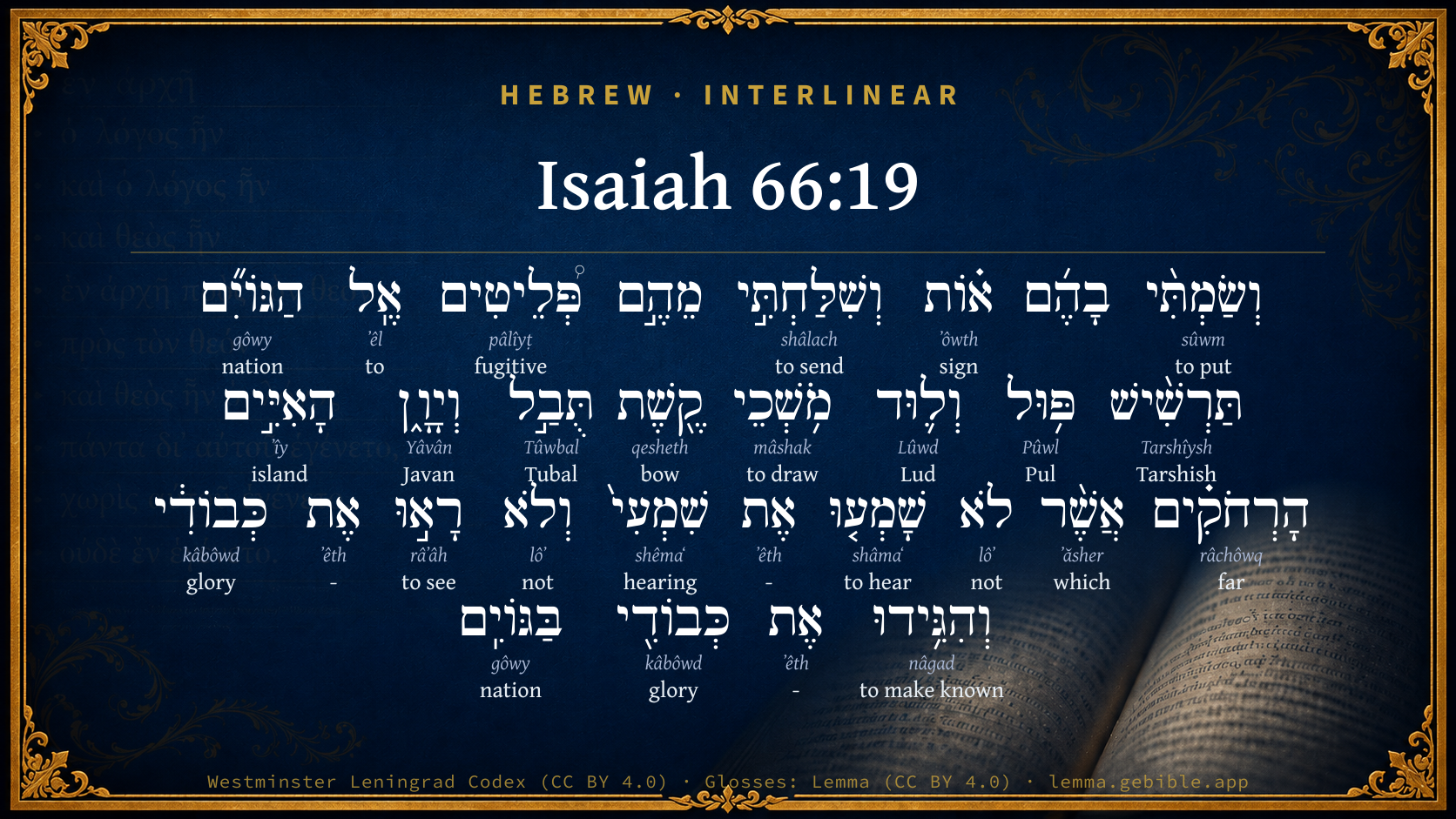
Hebrew (Westminster Leningrad Codex) Isaiah 66:19 appears in the Hebrew Old Testament. The text above is from the Westminster Leningrad Codex. Each word links to its Strong’s number, a concise gloss, and parsing drawn from the Open Scriptures Hebrew Bible morphology. Click any word for its full Brown-Driver-Briggs (BDB) entry.
Download image
Cite this verse

Isaiah 66:19 (World English Bible). Public Domain. Lemma interlinear Bible study tool, https://lemma.gebible.app/v/isaiah/66/19.

Show BibTeX & RIS
BibTeX
RIS
English Translation
I will set a sign among them, and I will send such as escape of them to the nations, to Tarshish, Pul, and Lud, who draw the bow, to Tubal and Javan, to the isles afar off, who have not heard my fame, neither have seen my glory; and they shall declare my glory among the nations.
World English Bible · Public Domain
Download a study sheet

One document with this verse’s original text, its word-by-word gloss line, the meaning frame, cross-references with their text, attributed commentary, and full source and license credits — printable, and it pastes into notes with its structure intact.

This verse Autodidact and up

Study sheet (.html) Plain text (.txt)

A passage Seminary Student

Up to 50 verses in one chapter. A passage sheet keeps up to 6 commentary sources and 12 cross-references per verse, in the order this page ranks them, and says so on the sheet whenever that leaves anything out. Ask for a single verse and you get the Autodidact verse sheet above.

Everything on this page stays free to read, with no account — the sheet is a download of what is already on screen, not access to it.

Want to remove ads? Support Godless Engineer
Compare translations 3

The same verse in 3 English versions, stacked beneath the original-language interlinear above. Click any original word for its lexicon entry.

Each is an independent rendering of the whole verse — the interlinear is not word-aligned to these translations.

Highlighted words mark where these versions differ — a whole-verse word diff, not a word-by-word alignment.

  • World English Bible Public Domain
    I will set a sign among them, and I will send such as escape of them to the nations, to Tarshish, Pul, and Lud, who draw the bow, to Tubal and Javan, to the isles afar off, who have not heard my fame, neither have seen my glory; and they shall declare my glory among the nations.
  • King James Version Public Domain
    And I will set a sign among them, and I will send those that escape of them unto the nations, to Tarshish, Pul, and Lud, that draw the bow, to Tubal, and Javan, to the isles afar off, that have not heard my fame, neither have seen my glory; and they shall declare my glory among the Gentiles.
  • unfoldingWord Literal Text CC BY-SA 4.0
    And I will set a sign among them, and I will send fugitives from them to the nations—Tarshish, Pul, and Lud, drawers of the bow, Tubal and Javan, the distant coastlands—that have not heard my report and have not seen my glory, and they will declare my glory among the nations.

unfoldingWord Literal Text — © unfoldingWord, licensed CC BY-SA 4.0. Word-aligned USFM3 via Door43 (git.door43.org/unfoldingWord/en_ult).

Versions to compare (up to 4)

3 of 4 selected

Show all 18 translations

Every available English version of this verse, each an independent rendering of the whole verse.

  • World English Bible Public Domain
    I will set a sign among them, and I will send such as escape of them to the nations, to Tarshish, Pul, and Lud, who draw the bow, to Tubal and Javan, to the isles afar off, who have not heard my fame, neither have seen my glory; and they shall declare my glory among the nations.
  • Berean Standard Bible Public Domain
    I will establish a sign among them, and I will send survivors from among them to the nations—to Tarshish, Put, and the archers of Lud; to Tubal, Javan, and the islands far away who have not heard of My fame or seen My glory. So they will proclaim My glory among the nations.
  • Majority Standard Bible Public Domain
    I will establish a sign among them, and I will send survivors from among them to the nations—to Tarshish, Put, and the archers of Lud; to Tubal, Javan, and the islands far away who have not heard of My fame or seen My glory. So they will proclaim My glory among the nations.
  • King James Version Public Domain
    And I will set a sign among them, and I will send those that escape of them unto the nations, to Tarshish, Pul, and Lud, that draw the bow, to Tubal, and Javan, to the isles afar off, that have not heard my fame, neither have seen my glory; and they shall declare my glory among the Gentiles.
  • American Standard Version (1901) Public Domain
    And I will set a sign among them, and I will send such as escape of them unto the nations, to Tarshish, Pul, and Lud, that draw the bow, to Tubal and Javan, to the isles afar off, that have not heard my fame, neither have seen my glory; and they shall declare my glory among the nations.
  • Revised Version (1885) Public Domain
    And I will set a sign among them, and I will send such as escape of them unto the nations, to Tarshish, Pul and Lud, that draw the bow, to Tubal and Javan, to the isles afar off, that have not heard my fame, neither have seen my glory; and they shall declare my glory among the nations.
  • Geneva Bible (1599) Public Domain
    And I will set a signe among them, and will send those that escape of them, vnto the nations of Tarshish, Pul, and Lud, and to them that drawe the bowe, to Tubal and Tauan, yles afarre off, that haue not heard my fame, neither haue seene my glorie, and they shall declare my glorie among the Gentiles.
  • Douay-Rheims (1899) Public Domain
    And I will set a sign among them, and I will send of them that shall be saved, to the Gentiles into the sea, into Africa, and Lydia them that draw the bow: into Italy, and Greece, to the islands afar off, to them that have not heard of me, and have not seen my glory. And they shall declare my glory to the Gentiles:
  • Young's Literal Translation Public Domain
    And I have set among them a sign, And have sent out of them those escaping unto the nations, (Tarshish, Pul, and Lud, drawing bow, Tubal and Javan, the isles that are far off,) Who have not heard My fame, nor seen Mine honour, And they have declared Mine honour among nations.
  • Literal Standard Version CC BY-SA 4.0
    And I have set a sign among them, || And have sent out of them those escaping to the nations || (Tarshish, Pul, and Lud, drawing bow, Tubal and Javan, the islands that are far off), || Who have not heard My fame, nor seen My glory, || And they have declared My glory among nations.
  • Unlocked Literal Bible CC BY-SA 4.0
    I will set a mighty sign among them. Then I will send survivors from them to the nations: To Tarshish, Put, and Lud, archers who draw their bows, to Tubal, Javan, and to the distant coastlands where they have not heard about me nor seen my glory. They will proclaim my glory among the nations.
  • unfoldingWord Literal Text CC BY-SA 4.0
    And I will set a sign among them, and I will send fugitives from them to the nations—Tarshish, Pul, and Lud, drawers of the bow, Tubal and Javan, the distant coastlands—that have not heard my report and have not seen my glory, and they will declare my glory among the nations.
  • Darby Bible Public Domain
    And I will set a sign among them, and I will send those that escape of them unto the nations, to Tarshish, Pul, and Lud, that draw the bow; to Tubal and Javan, to the isles afar off, that have not heard my fame, neither have seen my glory: and they shall declare my glory among the nations.
  • World Messianic Bible Public Domain
    “I will set a sign among them, and I will send those who escape of them to the nations, to Tarshish, Pul, and Lud, who draw the bow, to Tubal and Javan, to far-away islands, who have not heard my fame, nor have seen my glory; and they shall declare my glory among the nations.
  • Webster's Bible Public Domain
    And I will set a sign among them, and I will send those that escape of them to the nations, to Tarshish, Pul, and Lud, that draw the bow, to Tubal, and Javan, to the isles afar off, that have not heard my fame, neither have seen my glory; and they shall declare my glory among the Gentiles.
  • Free Bible Version CC BY-SA 4.0
    I will give them a sign, and I will send some who survive to the nations. They will go to Tarshish, to the Libyans and Lydians (who are famous as archers), to Tubal and Greece, and to the distant lands that haven't heard about me or seen my glory. They will announce my glory among the nations.
  • Bible in Basic English Public Domain
    And I will put a sign among them, and I will send those who are still living to the nations, to Tarshish, Put, and Lud, Meshech and Rosh, Tubal and Javan, to the sea-lands far away, who have not had word of me, or seen my glory; and they will give the knowledge of my glory to the nations.
  • JPS Tanakh (1917) Public Domain
    And I will work a sign among them, and I will send such as escape of them unto the nations, to Tarshish, Pul and Lud, that draw the bow, to Tubal and Javan, to the isles afar off, that have not heard My fame, neither have seen My glory; and they shall declare My glory among the nations.

Literal Standard Version (2020), Covenant Press — licensed CC BY-SA 4.0. Text via the HelloAO Bible API (eBible.org). Unlocked Literal Bible (unfoldingWord) — licensed CC BY-SA 4.0. Text via the HelloAO Bible API (eBible.org). unfoldingWord Literal Text — © unfoldingWord, licensed CC BY-SA 4.0. Word-aligned USFM3 via Door43 (git.door43.org/unfoldingWord/en_ult). Free Bible Version, Dr. Jonathan Gallagher — licensed CC BY-SA 4.0. Text via the HelloAO Bible API (eBible.org).

Word by word

More ways to search: Search by grammar → Find every occurrence → Compare this word →

Practice this passage: Drill this verse → Learn its vocabulary →

פּ֥וּל
Pûwl
H6322
“Pul”
Noun, Proper
Part of Speech
Noun
Type
Proper
Full BDB Definition

Origin: of foreign origin

TWOT: None

Pul = "distinguishing" - the Babylonian name for Tiglath-pileser III, king of Assyria
  1. וְשַׂמְתִּ֨י sûwm H7760 “and · to put” Conjunction + Verb, Qal, Sequential Perfect, 1st Person, Common, Singular
  2. א֗וֹת ʼôwth H226 “sign” Noun, Common, Both, Singular, Absolute
  3. וְשִׁלַּחְתִּ֣י shâlach H7971 “and · to send” Conjunction + Verb, Piel, Sequential Perfect, 1st Person, Common, Singular
  4. פְּ֠לֵיטִים pâlîyṭ H6412 “fugitives” Noun, Common, Masculine, Plural, Absolute
  5. אֶֽל ʼêl H413 “to” Preposition
  6. הַגּוֹיִ֞ם gôwy H1471 “the · nations” Particle, Definite Article + Noun, Common, Masculine, Plural, Absolute
  7. תַּרְשִׁ֨ישׁ Tarshîysh H8659 “Tarshish” Noun, Proper
  8. וְל֛וּד Lûwd H3865 “and · Lud” Conjunction + Noun, Proper
  9. מֹ֥שְׁכֵי mâshak H4900 “drawing” Verb, Qal, Participle Active, Masculine, Plural, Construct
  10. קֶ֖שֶׁת qesheth H7198 “bow” Noun, Common, Feminine, Singular, Absolute
  11. תֻּבַ֣ל Tûwbal H8422 “Tubal” Noun, Proper
  12. וְיָוָ֑ן Yâvân H3120 “and · Javan” Conjunction + Noun, Proper
  13. הָאִיִּ֣ים ʼîy H339 “the · islands” Particle, Definite Article + Noun, Common, Masculine, Plural, Absolute
  14. הָרְחֹקִ֗ים râchôwq H7350 “the · far” Particle, Definite Article + Adjective, Adjective, Masculine, Plural, Absolute
  15. אֲשֶׁ֨ר ʼăsher H834 “which” Particle, Relative
  16. לֹא lôʼ H3808 “not” Particle, Negative
  17. שָׁמְע֤וּ shâmaʻ H8085 “to hear” Verb, Qal, Perfect, 3rd Person, Common, Plural
  18. אֶת ʼêth H853 “-” Particle, Direct Object
  19. שִׁמְעִי֙ shêmaʻ H8088 “hearing · my” Noun, Common, Masculine, Singular, Construct + Suffix, Personal, 1st Person, Common, Singular
  20. וְלֹא lôʼ H3808 “and · not” Conjunction + Particle, Negative
  21. רָא֣וּ râʼâh H7200 “to see” Verb, Qal, Perfect, 3rd Person, Common, Plural
  22. אֶת ʼêth H853 “-” Particle, Direct Object
  23. כְּבוֹדִ֔י kâbôwd H3519 “glory · my” Noun, Common, Both, Singular, Construct + Suffix, Personal, 1st Person, Common, Singular
  24. וְהִגִּ֥ידוּ nâgad H5046 “and · to make known” Conjunction + Verb, Hiphil, Sequential Perfect, 3rd Person, Common, Plural
  25. אֶת ʼêth H853 “-” Particle, Direct Object
  26. כְּבוֹדִ֖י kâbôwd H3519 “glory · my” Noun, Common, Both, Singular, Construct + Suffix, Personal, 1st Person, Common, Singular
  27. בַּגּוֹיִֽם gôwy H1471 “in/at the · nations” Preposition, Determined + Noun, Common, Masculine, Plural, Absolute

About this verse

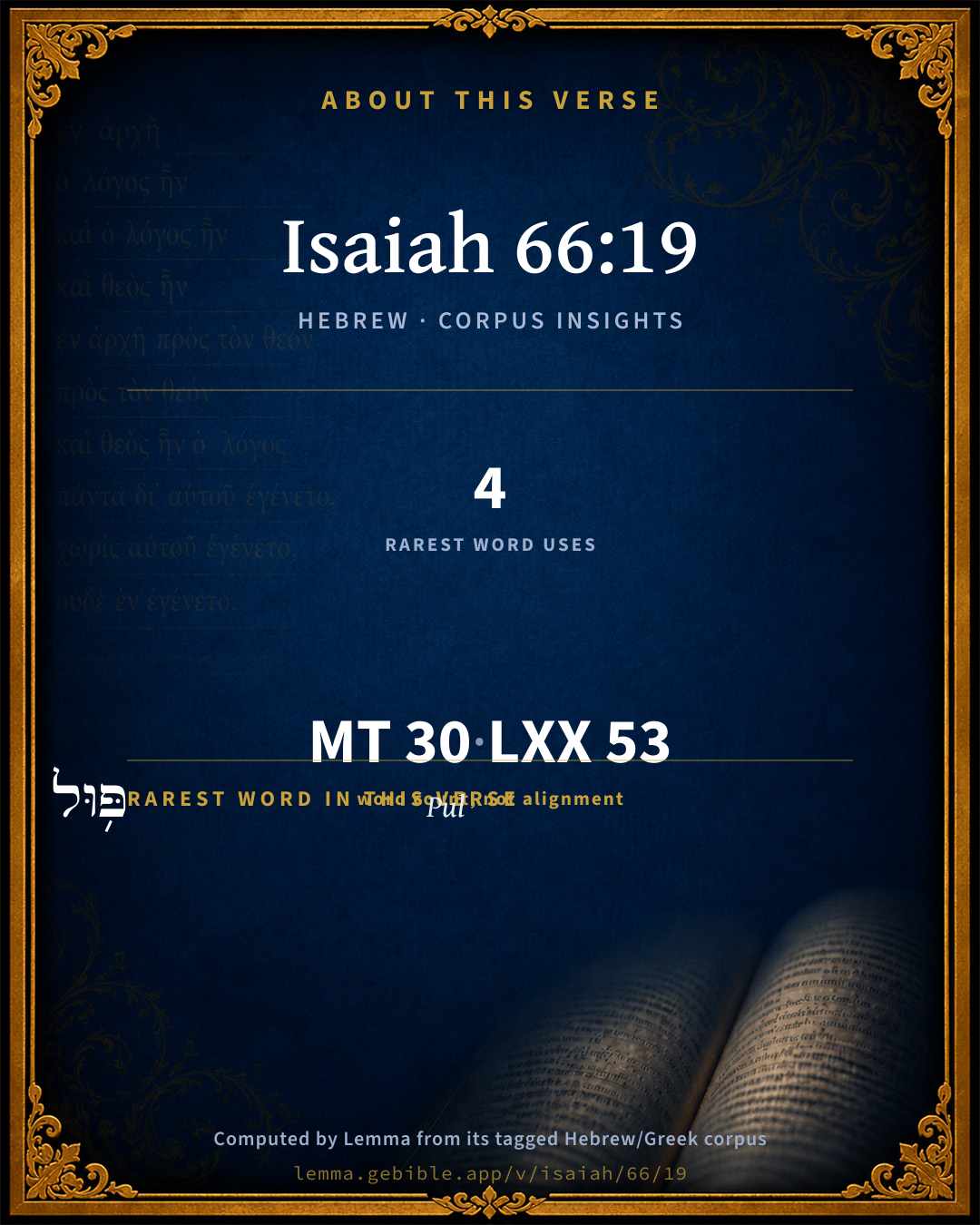
These counts appear in no published source. They are computed here, from the morphology-tagged text and Lemma’s own curated glosses. What Lemma adds →

30
words
23
distinct lemmas
Prophets
section

Notable vocabulary

The rarest word here is פּ֥וּל Pul H6322 — appearing just 4 times in the whole Hebrew Bible.

Shared distinctive vocabulary

פּ֥וּל Pul H6322 occurs in 3 verses of the Hebrew Bible. Also found in:

Grammatical profile

  • 6 verbs
  • 14 nouns
  • 1 adjective
  • 3 prepositions
  • 6 particles

Verb forms

  • וְשַׂמְתִּ֨י Qal · Sequential Perfect
  • וְשִׁלַּחְתִּ֣י Piel · Sequential Perfect
  • מֹ֥שְׁכֵי Qal · Participle Active
  • שָׁמְע֤וּ Qal · Perfect
  • רָא֣וּ Qal · Perfect
  • וְהִגִּ֥ידוּ Hiphil · Sequential Perfect

Repetition

Words recur within this verse — often emphatic in Hebrew:

  • הַגּוֹיִ֞ם nation H1471 ×2
  • כְּבוֹדִ֔י glory H3519 ×2
  • לֹא not H3808 ×2

Hebrew & Septuagint length

In English translation the verse runs 57 words from the Hebrew and 63 from the Septuagint (LXX English) — closely comparable.

A rough comparison of the two English renderings, which tokenize alike — not a word-level alignment.

Word counts can differ between the Hebrew and the Greek without any difference in meaning — e.g. the Hebrew direct-object marker אֵת has no separate Greek word, and Greek often adds the article ὁ.

In the original languages it is 30 Hebrew tokens and 53 Greek tokens — but the two are counted differently (Hebrew bundles its prefixes and suffixes into one token; the Greek is in lemma form), so that isn’t a like-for-like length.

Cross-references

38

Topical passages linked to Isaiah 66:19 in the Treasury of Scripture Knowledge — connected by theme and wording, ordered by reader-vote popularity; previews shown in the World English Bible.

  • Isaiah 52:15 so shall he sprinkle many nations; kings shall shut their mouths at him: for that which had not been told them shall they see; and that which they had not heard shall they understand.
  • Romans 15:21 But, as it is written, "They will see, to whom no news of him came. They who haven't heard will understand."
  • Isaiah 55:5 Behold, you shall call a nation that you don't know; and a nation that didn't know you shall run to you, because of Yahweh your God, and for the Holy One of Israel; for he has glorified you.
  • Ezekiel 27:10 Persia and Lud and Put were in your army, your men of war: they hanged the shield and helmet in you; they set forth your comeliness.
  • Isaiah 60:9 Surely the isles shall wait for me, and the ships of Tarshish first, to bring your sons from far, their silver and their gold with them, for the name of Yahweh your God, and for the Holy One of Israel, because he has glorified you.
  • 1 Chronicles 16:24 Declare his glory among the nations, His marvelous works among all the peoples.
  • Isaiah 62:10 Go through, go through the gates; prepare you the way of the people; cast up, cast up the highway; gather out the stones; lift up an ensign for the peoples.
  • Isaiah 65:1 I am inquired of by those who didn't ask; I am found by those who didn't seek me: I said, See me, see me, to a nation that was not called by my name.
  • Genesis 10:2 The sons of Japheth: Gomer, Magog, Madai, Javan, Tubal, Meshech, and Tiras.
  • Isaiah 11:10–11 It shall happen in that day, that the root of Jesse, who stands for an ensign of the peoples, to him shall the nations seek; and his resting-place shall be glorious.
  • Isaiah 18:3 All you inhabitants of the world, and you dwellers on the earth, when an ensign is lifted up on the mountains, look; and when the trumpet is blown, listen.
  • Isaiah 29:24 They also who err in spirit shall come to understanding, and those who murmur shall receive instruction.
  • Isaiah 42:4 He will not fail nor be discouraged, until he have set justice in the earth; and the isles shall wait for his law.
  • Ezekiel 27:13 Javan, Tubal, and Meshech, they were your traffickers; they traded the persons of men and vessels of brass for your merchandise.
  • Ezekiel 30:5 Ethiopia, and Put, and Lud, and all the mixed people, and Cub, and the children of the land that is in league, shall fall with them by the sword.
  • Matthew 7:11–12 If you then, being evil, know how to give good gifts to your children, how much more will your Father who is in heaven give good things to those who ask him!
  • Matthew 28:19 Therefore go, and make disciples of all nations, baptizing them in the name of the Father and of the Son and of the Holy Spirit,
  • Mark 16:15 He said to them, "Go into all the world, and preach the Gospel to the whole creation.
  • Luke 2:34 and Simeon blessed them, and said to Mary, his mother, "Behold, this child is set for the falling and the rising of many in Israel, and for a sign which is spoken against.
  • Romans 11:1–6 I ask then, Did God reject his people? May it never be! For I also am an Israelite, a descendant of Abraham, of the tribe of Benjamin.
  • Ephesians 3:8 To me, the very least of all saints, was this grace given, to preach to the Gentiles the unsearchable riches of Christ,
  • Genesis 10:4 The sons of Javan: Elishah, Tarshish, Kittim, and Dodanim.
  • Genesis 10:13 Mizraim became the father of Ludim, Anamim, Lehabim, Naphtuhim,
  • 1 Chronicles 1:7 The sons of Javan: Elishah, and Tarshish, Kittim, and Rodanim.
  • 1 Chronicles 1:11 Mizraim became the father of Ludim, and Anamim, and Lehabim, and Naphtuhim,
  • Psalms 72:10 The kings of Tarshish and of the isles will bring tribute. The kings of Sheba and Seba shall offer gifts.
  • Isaiah 2:16 For all the ships of Tarshish, And for all pleasant imagery.
  • Isaiah 18:7 In that time shall a present be brought to Yahweh of Hosts [from] a people tall and smooth, even from a people awesome from their beginning onward, a nation that measures out and treads down, whose land the rivers divide, to the place of the name of Yahweh of Hosts, Mount Zion.
  • Isaiah 24:15–16 Therefore glorify Yahweh in the east, even the name of Yahweh, the God of Israel, in the isles of the sea!
  • Isaiah 43:6 I will tell the north, Give up; and to the south, Don't keep back; bring my sons from far, and my daughters from the end of the earth;
  • Isaiah 49:1 Listen, isles, to me; and listen, you peoples, from far: Yahweh has called me from the womb; from the bowels of my mother has he made mention of my name:
  • Isaiah 49:12 Behold, these shall come from far; and, behold, these from the north and from the west; and these from the land of Sinim.
  • Isaiah 49:22 Thus says the Lord Yahweh, Behold, I will lift up my hand to the nations, and set up my ensign to the peoples; and they shall bring your sons in their bosom, and your daughters shall be carried on their shoulders.
  • Isaiah 51:5 My righteousness is near, my salvation is gone forth, and my arms shall judge the peoples; the isles shall wait for me, and on my arm shall they trust.
  • Ezekiel 38:2–3 Son of man, set your face toward Gog, of the land of Magog, the prince of Rosh, Meshech, and Tubal, and prophesy against him,
  • Ezekiel 39:1 You, son of man, prophesy against Gog, and say, Thus says the Lord Yahweh: Behold, I am against you, Gog, prince of Rosh, Meshech, and Tubal:
  • Zephaniah 2:11 Yahweh will be awesome to them, for he will famish all the gods of the land. Men will worship him, everyone from his place, even all the shores of the nations.
  • Malachi 1:11 For from the rising of the sun even to the going down of the same, my name is great among the nations, and in every place incense will be offered to my name, and a pure offering: for my name is great among the nations," says Yahweh of Hosts.

Cross-references courtesy of OpenBible.info (CC BY 4.0).

Hebrew and Greek witnesses Masoretic Hebrew ↔ Greek Septuagint

The same verse in the two great witnesses to the Old Testament, shown verse-for-verse.

These are two independent witnesses, not word-aligned to each other, and the Septuagint is shown in lemma (dictionary) form.

Hebrew Isaiah 66:19 Masoretic · Westminster Leningrad Codex

וְשַׂמְתִּ֨י בָהֶ֜ם א֗וֹת וְשִׁלַּחְתִּ֣י מֵהֶ֣ם פְּ֠לֵיטִים אֶֽל הַגּוֹיִ֞ם תַּרְשִׁ֨ישׁ פּ֥וּל וְל֛וּד מֹ֥שְׁכֵי קֶ֖שֶׁת תֻּבַ֣ל וְיָוָ֑ן הָאִיִּ֣ים הָרְחֹקִ֗ים אֲשֶׁ֨ר לֹא שָׁמְע֤וּ אֶת שִׁמְעִי֙ וְלֹא רָא֣וּ אֶת כְּבוֹדִ֔י וְהִגִּ֥ידוּ אֶת כְּבוֹדִ֖י בַּגּוֹיִֽם

I will set a sign among them, and I will send such as escape of them to the nations, to Tarshish, Pul, and Lud, who draw the bow, to Tubal and Javan, to the isles afar off, who have not heard my fame, neither have seen my glory; and they shall declare my glory among the nations.

World English Bible · Public Domain

Greek LXX Isaiah 66:19 Septuagint · lemma form

καί καταλείπω ἐπί αὐτός σημεῖα καί ἐκ ἀποστέλλω ἐκ αὐτός σώζω εἰς ὁ ἔθνος εἰς θαρσις καί φουδ καί λουδ καί μοσοχ καί θοβελ καί εἰς ὁ ἑλλάς καί εἰς ὁ νήσος ὁ πόρρω ὅς οὐ ἀκούω ἐγώ ὁ ὄνομα οὐδέ ὁράω ὁ δόξα ἐγώ καί ἀναἀγγέλλω ἐγώ ὁ δόξα ἐν ὁ ἔθνος

And I will leave a sign upon them, and I will send forth them that have escaped of them to the nations, to Tharsis, and Phud, and Lud, and Mosoch, and to Thobel, and to Greece, and to the isles afar off, to those who have not heard my name, nor seen my glory; and they shall declare my glory among the Gentiles.

LXX2012 (modern English Septuagint) · Public Domain

On this verse, Trapp's Complete Commentary discusses the Septuagint’s reading. Read the note in Commentary ↓

Hebrew: Westminster Leningrad Codex (CC BY 4.0). Greek: Septuagint (public domain); English from LXX2012 (modern English Septuagint) (Public Domain). How the Septuagint differs from the Hebrew →

Targum (Aramaic paraphrase)

1

The Targum is the ancient Jewish Aramaic paraphrase of the Hebrew Scriptures — an interpretive translation, not the Hebrew text itself. Onkelos (literal) and Pseudo-Jonathan (expansive) render the Torah, and Jonathan the Prophets. Coverage is partial: where no permissively-licensed English translation exists for a verse, only the Aramaic is shown. This is verse-level text, not a word-by-word alignment to the Hebrew.

  1. Targum Jonathan Prophets (Joshua–Malachi)
    וַאֲשַׁוֵי בְהוֹן אָתָא וַאֲשַׁלַח מִנְהוֹן מְשֵׁיזְבִין לְבֵינֵי עַמְמַיָא לִמְדִינַת יַמָא פּוּלָאֵי וְלוּדָאֵי דְנַגְדִין וּמָחָן בְּקַשְׁתָּא לִמְדִינַת תּוּבַל וְיָוָן נַגְוָתָא רְחִיקָן דְלָא שְׁמָעוּ יַת שְׁמַע גְבוּרְתִי וְלָא חֲזוֹ יַת יְקָרִי וְיַחְווּן יַת יְקָרִי בְּעַמְמֵיָא:

    And I will set a sign among them, and I will send those that escape of them among the nations to the province of the sea, Pul and Lud, that draw the bow, and smite with it, to the province of Tubal, and Javan, the isles that are afar off, that have not heard the fame of my might, neither have seen my glory; but they shall declare my glory among the nations.

    Targum Jonathan — Aramaic: “Mikraot Gedolot” (public domain). English: “Sefaria Community Translation” (CC0 1.0 (public-domain dedication)); “London "Chaldee Paraphrase," 1871” (public domain). Text via Sefaria.

Commentary

Notes on Isaiah 66:19 from classic Christian and Jewish commentators (each source and its license shown beneath its notes). The classic Christian expositions comment on the surrounding passage and are grouped to its opening verse, so a note may address several verses; the Jewish commentaries on the Tanakh (Rashi and others) are per-verse, so they appear only where the commentator wrote on this verse.

Lemma curates 59 commentaries, every one of them public domain or Creative Commons licensed, each selected and text-cleaned for this edition rather than reprinted as found. About our sources →

Trapp's Complete Commentary

John Trapp

Isa 66:19 And I will set a sign among them, and I will send those that escape of them unto the nations, [to] Tarshish, Pul, and Lud, that draw the bow, [to] Tubal, and Javan, [to] the isles afar off, that have not heard my fame, neither have seen my glory; and they shall declare my glory among the Gentiles.

Ver. 19. And I will set a sign among them.] This sign may very well be that visible pouring out of the gifts of the Holy Ghost on the day of Pentecost, under the symbol of wind and fire, {Act 2:2-4} {a} together with the signs and wonders whereby the apostle’s doctrine was confirmed. Others make this sign to be the profession of the Christian faith. Some also, the doctrine of the gospel, and especially the sacraments.

And I will send those that escape of them,] i.e., The apostles and their fellow helpers, such as were Barnabas, Silas, Luke, &c.

To Tarshish, Pul.] To all parts of the world, east, west, north, and south.

That draw the bow.] The Mosches or Muscovites, say the Septuagint; the Turks, saith one of the Rabbis. {See Trapp on "Rev 9:15"} {See Trapp on "Rev 9:16"} {See Trapp on "Rev 9:17"}

{a} Scultet.

John Trapp, A Commentary or Exposition upon All the Books of the Old and New Testament (1647–1656) — public domain. Text from a community e-Sword module.

The Biblical Illustrator

Joseph S. Exell

Isa_66:19

And I will set a sign among them

Missions

I.

THE MANNER IN WHICH THE NATIONS WERE TO BE GATHERED INTO THE CHURCH OF GOD.

II. THE INSTRUMENTS TO RE EMPLOYED IN EFFECTING THIS GREAT WORK. (R. Macculloch.)

Tarshish . . . Javan

That is, to far Spain, and the distances of Africa, towards the Black Sea, and to Greece, a full round of the compass. (Prof. G. A. Smith, D. D.)

The isles afar off

Coastlands (Isa_40:15). This distinctionbetween the nearer nations who have experienced something of the greatness of Jehovah through contact with His people Israel, and the remoter nations who have not heard His name, orginates with the prophet Ezekiel (Eze_38:1). But while the distinction is common to the two prophets, the development of the idea is strikingly different. In Ezekiel Gogs Ignorance of Jehovah tempts him to an act of sacrilege on the land of Israel which is avenged by the annihilation of him and his host. The spirit of this passage is more evangelical. Jehovah sends missionaries from the nearer nations to those who have not heard His fame nor seen His glory; and the report carries conviction to their minds, so that they restore the Israelites exiled amongst them, as an offering to the Lord. (Prof. J. Skinner, D. D.)

And they shall declare My glory among the Gentiles

Missionary responsibility

I. THE STATE OF THE HEATHEN WHO KNOW NOT GOD.

1. Their present state. They know nothing of the God of love. The weary and heavy-laden among them never heard Christs Come unto Me. The sorrowful among them never heard His Blessed are they that mourn. They know nothing of the Paraclete, the Comforter, the Strengthener, although their need as urgent aa ours, of comfort and of strength. They do not know what prayer is. They do but send up deprecations to demons. They, as we, are bereaved of dear ones; but the grand music of those words, I am the Resurrection and the Life,- never hushed the discords of their wailing, nor lifted the darkness of their silent despair.

2. Their future. All is to them wrapt in gloom impenetrable.

II. OUR RESPONSIBILITY. Imagine the plague once more devastating our cities. Suppose you knew of an infallible remedy. Then suppose utter indifference on your part in imparting it. What a monster you would be! No one really loves the Lord Jesus who is not zealous to make others love Him. If you do love Him, and are anxious to make others love Him, what are you doing for the spread of His kingdom?

III. WHAT CAN WE DO? We can pray for the full coming of Christs kingdom, for the sending more labourers into the harvest. We can provoke others to pray. We can try to realize this truth, that our Lord makes the evangelization of the world to depend, in we know not what degree, upon faithful, earnest prayer. (J. R. Vernon, M. A.)

The Biblical Illustrator, edited by Joseph S. Exell (c. 1880s–1900s) — public domain. Text from a community e-Sword module.

Tyndale Open Study Notes

Tyndale Open Resources

66:19 The sign is the proclamation of God’s glory among the nations (66:20). God will establish a righteous and faithful new people consisting of godly Gentiles together with faithful Israelites (Rev 15:3-4; see also Acts 2).

Tyndale Open Study Notes — © Tyndale Open Resources, licensed CC BY-SA 4.0. Text via the HelloAO Bible API.

Geneva Bible (1599)

Geneva Bible translators

Signifying the Parthians.

Italy.

Greece.

Meaning, the Apostles, Disciples, and others, which he did first choose of the Jews to preach unto the Gentiles.

To wit, Lydia, or Asia minor.

I will make these that I chose, that they perish not with the rest of the infidels: whereby he alludeth to the marking of the posts of his people, whom he preserved, Exod. 12:7.

I will scatter the rest of the Jews, which escaped destruction, into divers nations.

That is, Cilicia.

Meaning Africa.

Geneva Bible (1599) marginal notes — public domain. Text via Bolls.life.

Jamieson, Fausset & Brown

Robert Jamieson, A. R. Fausset & David Brown

sign--a banner on a high place, to indicate the place of meeting for the dispersed Jewish exiles, preparatory to their return to their land (Isa 5:26; Isa 11:12; Isa 62:10).

those that escape of them--the Gentile survivors spared by God (see on Isa 66:18; Zac 14:16). Isa 2:2-3; Mic 5:7; and Zac 14:16-19 represent it, not that the Jews go as missionaries to the Gentiles, but that the Gentiles come up to Jerusalem to learn the Lord's ways there.

Tarshish--Tartessus in Spain, in the west.

Pul--east and north of Africa: probably the same as Philoe, an island in the Nile, called by the Egyptians Pilak, that is, the border country, being between Egypt and Ethiopia [BOCHART].

Lud--the Libyans of Africa (Gen 10:13), Ludim being son of Mizraim (Egypt): an Ethiopian people famous as bowmen (Jer 46:9): employed as mercenaries by Tyre and Egypt (Eze 27:10; Eze 30:5).

Tubal--Tibarenians, in Asia Minor, south of the Caucasus, between the Black Sea and Araxes. Or, the Iberians [JOSEPHUS]. Italy [JEROME].

Javan--the Greeks; called Ionians, including all the descendants of Javan, both in Greece and in Asia Minor (Gen 10:2-4).

my glory . . . Gentiles-- (Mal 1:11).

Jamieson, Fausset & Brown — Commentary Critical and Explanatory on the Whole Bible (1871) — public domain (CC PDM 1.0). Text via the HelloAO Bible API.

Adam Clarke's Commentary

Verse 19. That draw the bow] I much suspect that the words משכי קשת moshechey kesheth, who draw the bow, are a corruption of the word משך meshek, Moschi, the name of a nation situated between the Euxine and Caspian seas; and properly joined with תבל tubal, the Tibareni. See Bochart, Phaleg. iii. 12. The Septuagint have μοσοχ, without any thing of the drawers of the bow: the word being once taken for a participle, the bow was added to make sense of it קשת kesheth, the bow, is omitted in a MS. and by the Septuagint.

That have not heard my fame - "Who never heard my name"] For שמעי shimi, my fame, I read, with the Septuagint and Syriac, שמי shemi, my name.

Adam Clarke's Commentary on the Bible (1810–1826) — public domain. Text from a community e-Sword/MySword module.

Ellicott's Commentary for English Readers

(19) I will set a sign among them . . .—The “sign” may be one of supernatural terror in the work of judgment, or, as the context makes more probable, of supernatural deliverance. The thought of a “remnant” to be saved is still characteristically dominant, and that “remnant” is to act as heralds of Jehovah to the far-distant nations who had not been sharers in any open antagonism to Israel, and who were, therefore, not involved in the great judgment. Of these the prophet names Tarshish, either definitely for Spain, or vaguely for the far west.

Pul is not found elsewhere as the name of a nation, and stands probably for “Phut,” as in the LXX., found in common with “Lud” in Eze_27:10; Eze_30:5, and standing for an African people (Phint, or Phet) on the east coast of Northern Africa.

Lud, joined with “Pul” here, in Eze_27:10 with Phut, and with Ethiopia and Libya in Eze_37:5, stands, in the judgment of most scholars, not for the Lydians of Asia Minor, but for an African nation, the Ludim of Gen_10:13 and Jer_46:9, where they are named, as here, as famous for their skill as archers. On the other hand, Mr. Sayce (Cheyne, 2:287) identifies “Pul” with the Apuli of Italy and “Lud,” with the Lydian soldiers, by whose help Psammitichus made himself independent of Assyria.

Tubal (comp. Eze_27:13; Eze_38:2-3; Eze_39:1) points to the shores of the Black Sea and tribes of Scythian extraction.

Javan (Ionia), Gen_10:2, is here used widely for any Greek settlements, and points probably to those on the Black Sea, which, together with Tubal and Meshech, carried on an active slave-trade with Tyre (Eze_27:3). It completes the list of nations named as representing the far-off lands that had not before heard of the God of Israel, but were now to know Him through the preaching of the remnant.

A Bible Commentary for English Readers, edited by Charles John Ellicott (1878–1897) — public domain. Text from a community e-Sword module.

The Cambridge Bible for Schools and Colleges

gen. ed. J. J. S. Perowne

19. I will set a sign among them] i.e. perform a miracle (ch. Isa_7:11) that shall convince them of Jehovah’s divinity.

I will send … them] I will send from them escaped ones, survivors (cf. Isa_45:20) of the judgement depicted in Isa_66:16. The purpose is to spread the tidings of Jehovah’s glory.

to Tarshish … Javan] All these names are taken from the book of Ezekiel; see Isa_27:10; Isa_27:12 f., Isa_38:1, Isa_39:1. So Duhm, who thinks the whole line is a gloss. Tarshish = Tartessus; see on ch. Isa_2:16. A name Pul occurs nowhere else, and it is doubtless here a clerical error for Put (so LXX. Φούδ). Phut and Lud are mentioned together in Jer_46:9; Eze_27:10; Eze_30:5; and in Gen_10:6; Gen_10:13 both peoples are connected genealogically with Mizraim (Egypt). Probably therefore two African nations are denoted.

that draw the bow] The bow is mentioned as the weapon of the Lydians (Lud) in Jer_46:9. The LXX. reads Μόσοχ (Meshech). This is attractive, because of the resemblance to môshìkê (drawing), and because Meshech and Tubal are nearly always associated (Gen_10:2; Eze_27:13; Eze_32:26, &c.). They are the Moschi and Tibareni of classical writers, the Muski and Tabal of the Assyrian monuments, tribes lying south and south-east of the Black Sea (Schrader, Cun. Inscr. pp. 82, 84). If the reading of the LXX. be adopted it will be necessary to find an equivalent for qésheth (bow); and Duhm suggests Rosh from Eze_38:1; Eze_39:1 (see Davidson’s Note).

Javan (= Ἰάϝων) the Ionians, is the Hebrew name for the Greek race.

the isles (coastlands, ch. Isa_40:15) afar off, that have not heard my fame &c.] This distinction between the nearer nations who have experienced something of the greatness of Jehovah, through contact with His people Israel, and the remoter nations who have not heard His name, originates with the prophet Ezekiel. It underlies the conception of the invasion of Gog’s host and its destruction as described in ch. 38 f. Gog is the leader and representative of the outlying nations of the earth, and the demonstration of Jehovah’s power against them falls at a time subsequent to the peaceful settlement of Israel in its own land, and long after judgement has been executed on the neighbouring states which had been in contact with Israel throughout its history (see Davidson, Camb. Bible, Ezekiel, pp. 273 ff.). But while the distinction is common to the two prophets, the development of the idea is strikingly different. In Ezekiel Gog’s ignorance of Jehovah tempts him to an act of sacrilege on the land of Israel, which is avenged by the annihilation of him and his host. The spirit of this passage is more evangelical. Jehovah sends missionaries from the nearer nations to those who have not heard His fame nor seen His glory; and the report carries conviction to their minds, so that they restore the Israelites exiled amongst them, as an offering to the Lord.

The Cambridge Bible for Schools and Colleges (gen. ed. J. J. S. Perowne; Cambridge University Press, 1878–1918) — public domain. Text from a community e-Sword module.

John Gill's Exposition

And I will set a sign among them,.... Either a miraculous sign, something wonderful, as the word is often used, Exo 4:8, not the effusion of the Spirit on the day of Pentecost, in the presence of men of all nations; or the miracles wrought in the Gentile world by the apostles, in confirmation of the Gospel; but rather the wonderful conversion of the Jews, Isa 66:8, or those wonders, the time of the end of which is inquired, Dan 12:6 or else some distinguishing sign or mark is meant; such an one as was set on Cain, and on those that sighed and mourned for the sins of Jerusalem, Eze 9:4, and may intend the seal or mark of Christ's Father's name, in the foreheads of his people, to distinguish and preserve them from being hurt with others, Rev 7:3, or, best of all, a sign or ensign to gather persons together; which, though not the usual word for an ensign, is sometimes so used, as in Psa 74:4, and so may intend Christ, who is a sign that has been spoken against, Luk 2:34 and is set up in the ministration of the Gospel, to gather souls unto him, Isa 10:10, and which, as it was attended with great success in the first times of the Gospel, will also in the latter day, Isa 2:2,

and I will send those that escape of them; meaning, not the apostles and first preachers of the word, that escaped the perverseness and frowardness of the Jewish nation, their rage and persecution, and the wrath that came upon them to the uttermost; but those that shall escape at the defeat of the Turks, and at the ruin of mystical Babylon, and at the fall of the tenth part of the city, Rev 11:13 and who also, in a spiritual sense, will escape the pollutions of the world, through the grace of God, and knowledge of Christ; the vengeance of divine justice; the curses of the law, and wrath to come; hell and eternal damnation, by fleeing to Christ; these, some of them, will be made preachers of the Gospel; as who so fit as those to warn sinners of their danger, to show men the way of salvation, and publish the good tidings of the Gospel, and will be sent of God with a commission from him "unto the nations"; in order to gather them to Christ and his church, and behold his glory: particularly to "Tarshish", a word sometimes used for the sea; and the Vulgate Latin version renders it "the nations in the sea"; or, as the Targum, the province of the sea, the maritime provinces, those that lie nearest the sea; the Persian and Arabian seas; or Tartessus in Spain; and may be put for the whole country:

Pul, and Lud, that draw the bow; which some take to be the same with Put and Lud, or Lybia and Lydia, which go together, Jer 46:9 both countries in Africa, famous for archery; and the Vulgate Latin version renders it Africa and Lydia; though Bochart, and after him Vitringa, take Pul to be the same with Philas, an island upon the Nile, above Syene, between Ethiopia and Egypt, of which Diodorus Siculus (m) and Strabo (n) make mention; or Elephantine, the same with Phil, near the other. Kimchi interprets those that draw the bow of the Turks:

to Tubal and Javan; which the same version renders Italy and Greece:

and the isles afar off; even as far as the West Indies: what places and countries are exactly and precisely meant cannot be determined; only, in general, that into various parts of the world, east, west, north, and south, even the most distant, the Gospel and Gospel ministers shall be sent:

even to those that have not heard my fame; or, "my report" (o); the Gospel, which is a good and true report of Christ; this the nations, covered with gross darkness, the Pagan ones, have not so much as heard of, but now shall, through these men being sent unto them:

neither have seen my glory; in the glass of the Gospel, that having never been set before them; and so have never seen the glory of Christ, as the only begotten of the Father; his comeliness and beauty, the fulness of grace in him, nor any of the excellencies of him, either of his person or offices:

and they shall declare my glory among the Gentiles; this, those that are escaped, or the preachers sent to the nations, shall do; they shall declare publicly, plainly, and clearly, that Christ is the brightness of the divine Glory; shall declare the glory of his deity; of his rich grace and love to sinners, in suffering and dying for them; of his salvation, how great, complete, suitable, and glorious it is; with all the glorious truths of the Gospel, peace, pardon, righteousness, and eternal life, by Christ.

(m) Bibliothec I. 1. p. 23. (n) Geograph, l. 17. p. 552, 562. (o) "meum auditum", Pagninus, Montanus; "the report of me", Gataker.

John Gill's Exposition of the Whole Bible (1746–1763) — public domain (CC PDM 1.0). Text via the HelloAO Bible API.

Albert Barnes' Notes on the Bible

And I will set a sign among them - (See the notes at Isa 11:12; Isa 18:3). On the meaning of the word ‘sign’ (אות 'ôth), see the notes at Isa 7:11. What is its meaning here is to be determined by the connection. That would seem to me to require some such interpretation as this: That when God should come Isa 66:17-18 to take vengeance on his foes, and to manifest his glory, he would establish some mark or memorial; would erect some standard, or give some signal, by which his true friends would escape, and that he would send them to distant nations to proclaim his truth and gather together those who had not seen his glory. What that sign should be, he does not here say. Whether a standard, a secret communication, or some intimation beforehand, by which they should know the approaching danger and make their escape, is not declared. It is by no means easy to determine with certainty on this passage; and it certainly becomes no one to speak dogmatically or very confidently.

But it seems to me that the whole passage may have been intended, by the Holy Spirit, to refer to the propagation of the gospel by the apostles. The heavy judgments referred to may have been the impending calamities over Jerusalem. The glory of God referred to, may have been the signal manifestation of his perfections at that period in the approaching destruction of the city, and in the wonders that attended the coming of the Messiah. The gathering of the nations Isa 66:18 may possibly refer to the collecting together of numerous people from all parts of the earth about that time; that is, either the assembled people at the time of the Saviour’s death Act 2:8, Act 2:11, or the gathering of the armies of the Romans - a commingled multitude from all nations - to inflict punishment on the Jewish nation, and to behold the manifestation of the divine justice in the destruction of the guilty Jewish capital.

The ‘sign’ here referred to, may denote the intimations which the Redeemer gave to his disciples to discern these approaching calamities, and to secure their safety by flight when they should be about to appear Mat 24:15-18. By these warnings and previous intimations they were to be preserved. The sign was ‘among them,’ that is, in the very midst of the nation; and the object of the intimation was, to secure their safety, and the speedy propagation of the true religion among all nations. Deeply sensible that there is great danger of erring here, and that the above view may be viewed as mere conjecture, I cannot, however, help regarding it as the true exposition. If there is error in it, it may be pardoned, for it will probably be felt by most readers of these notes that there has not been a too frequent reference in the interpretation proposed to the times of the Christian dispensation.

And I will send those that escape of them - According to the interpretation suggested above, this refers to the portion of the Jewish nation that should escape from the tokens of the divine displeasure; that is, to the apostles and the early disciples of the Redeemer. The great mass of the nation would be abandoned and devoted to destruction. But a remnant would be saved (compare Isa 1:9; Isa 11:11, Isa 11:16). Of that remnant, God would send a portion to make his name known to those who had not heard it, and they would lead distant nations to the knowledge of his truth. The whole passage is so accurately descriptive of what occurred in the times when the gospel was first preached to the pagan world, that there can be little danger of error in referring it to those times. Compare Vitringa on the passage for a more full view of the reasons of this interpretation. The names of the places which follow are designed to specify the principal places where the message would be sent, and stand here as representatives of the whole pagan world.

To Tarshish - (See the notes at Isa 2:16; Isa 23:1; Isa 60:19). Tarshish was one of the most distant seaports known to the Hebrews; and whether it be regarded as situated in Spain, or in the East Indies, or south of Abyssinia (see the notes above) it equally denotes a distant place, and the passage means that the message would be borne to the most remote regions.

Pul - This is supposed to denote some region in Africa. Jerome renders it, ‘Africa.’ The Septuagint, Φοὺδ Foud - ‘Phud.’ Bochart, Phaleg. iv. 26, supposes that it means Philae, a large island in the Nile, between Egypt and Ethiopia; called by the Egyptians Pilak, i e., the border, or far country (see Champollion, l’Egypte, i. 158). There are still on that island remains of some very noble and extensive temples built by the ancient Egyptians.

And Lud - Jerome renders this, ‘Lydia.’ The Septuagint ‘Lud.’ There was a Lydia in Asia Minor - the kingdom of the celebrated Croesus; but it is generally supposed that this place was in Africa. Ludim was a son of Mizraim Gen 10:13, and the name Ludim, or Lybians, referring to a people, several times occurs in the Bible Jer 46:9; Eze 27:10; Eze 30:5. These African Lybians are commonly mentioned in connection with Pul, Ethiopia, and Phut. Bochart supposes that Abyssinia is intended, but it is by no means certain that this is the place referred to. Josephus affirms that the descendants of Ludim are long since extinct, having been destroyed in the Ethiopian wars. It is clear that some part of Egypt is intended, says Calmer, but it is not easy to show exactly where they dwelt.

That draw the bow - (קשׁת משׁכי moshekēy qeshet). The Septuagint here renders the Hebrew phrase simply by Μοσὸχ Mosoch,’ understanding it of a place. Lowth supposes that the Hebrew phrase is a corruption of the word Moschi, the name of a nation situated between the Euxine and the Caspian seas. But there is no authority for supposing, as he does, that the word ‘bow’ has been interpolated. The Chaldee renders it, ‘Drawing and smiting with the bow.’ The idea is, that the nations here referred to were distinguished for the use of thw bow. The bow was in common use in wars; and it is by no means improbable that at that time they had acquired special fame in the use of this weapon.

To Tubal - Tubal was the fifth son of Japhet, and is here joined with Javan because they were among the settlers of Europe. The names before mentioned together relate to Africa, and the sense there is, that the message should be sent to Africa; here the idea is, that it should be sent to Europe. Tubal is commonly united with Meshech, and it is supposed that they populated countries bordering on each other. Bochart labors to prove that by Meshech and Tubal are intended the Muscovites and the Tibarenians. The Tibarenians of the Greeks were the people inhabiting the country south of the Caucasus, between the Black Sea and the Araxes. Josephus says, that ‘Tubal obtained the Thobelians (Θωβήλους Thōbēlous) who are reckoned among the Iberians.’ Jerome renders it, ‘Italy.’ It is not possible to determine with certainty the country that is referred to, though some part of Europe is doubtless intended.

And Javan - Jerome renders this, ‘Greece.’ So the Septuagint, Εἰς τήν Ἑλλάδα Eis tēn Hellada - ‘To Greece.’ Javan was the fourth son of Japhet, and was the father of the Ionians and the Greeks Gen 10:2-4. The word ‘Ionia,’ Greek Ἰων Iōn, Ἰωνία Iōnia, is evidently derived from the word rendered here ‘Javan’ (יון yâvân), and in the Scriptures the word comprehends all the countries inhabited by the descendants of Javan, as well in Greece as in Asia Minor. Ionia properly was the beautiful province on the western part of Asia Minor - a country much celebrated in the Greek classics for its fertility and the salubrity of its climate - but the word used here includes all of Greece. Thus Daniel Dan 11:2, speaking of Xerxes, says, ‘He shall stir up all against the realm of Javan.’ Alexander the Great is descried by the same prophet as ‘king of Javan’ Dan 8:21; Dan 10:20. The Hindus call the Greeks Yavanas - the ancient Hebrew appellation. It is needless to say, on the supposition that this refers to the propagation of the gospel by the apostles, that it was fulfilled. They went to Greece and to Asia Minor in the very commencement of their labors, and seme of the earliest and most flourishing churches were founded in the lands that were settled by the descendants of Javan.

To the isles afar off - (See the notes at Isa 41:1).

That have not heard my fame - Hebrew, ‘Who have not heard my report,’ that is, who were ignorant of the true God.

Neither have seen my glory - The glory which he had manifested to the Hebrews in giving his law, and in the various exhibitions of his character and perfections among them.

Albert Barnes' Notes on the Bible (1834–1885) — public domain. Text from a community e-Sword/MySword module.

Haydock's Catholic Bible Commentary

Sign; the cross, which Christ left to enlighten us, (Ezechiel ix.; St. Jerome; Worthington) or the gospel, with the power of working miracles. Some Jews shall be saved, and shall preach to others, as God’s servants. --- Sea. Hebrew, "Tharsis, to Phul in Thebais, Lud, (Ethiopians.; Bochart) who were expert archers." Septuagint, "Mosoch." --- Italy. Hebrew, "Thubal;" denoting Italy, Spain, Iberia, &c. --- Greece. Hebrew, "Javan;" who peopled Ionia and the Archipelago. Islands, near Asia, (Calmet) and all distant places. (Parkhurst, p. 4.) (Haydock) --- Men of all nations shall be converted, and brought by angels to the Church. (St. Jerome) (Worthington)

George Leo Haydock (1774–1849), Haydock's Catholic Family Bible and Commentary, 1859 edition — public domain. Excludes Psalms (Douay-Rheims chapter numbering differs from Protestant) and Deuterocanonical books (Catholic canon only).

Matthew Poole's English Annotations

It is on all hands agreed that this verse is a prophecy of the conversion of the Gentiles.

I will set a sign: by sign here some understand an ensign, as the word signifies, Psa 74:4, which is a military sign to gather people together; by this may be understood Christ, Luk 2:34. See Isa 11:10. Or, as others, the ministry of the word attended with miracles (often called signs); these were set up among the Jews first, then among the Gentiles. Others (but less probably) understand by sign a mark of distinction, like that mentioned Eze 9:4; so as, saith he, some shall escape and not be destroyed; and for those that shall escape, I will send them to Tarshish, Pul, Lud, Tubal, Javan, to Europe, Asia, and Africa, to all the quarters of the world, (see the Latin Synopsis, and the English Annotations, large discourses of these particular places,) to all nations that had never before heard of God or his true worship.

And they shall declare my glory among the Gentiles; and they shall every where preach the gospel, and set up my gospel ordinances and institutions. This was eminently made good upon the apostles leaving the Jews, and turning to the Gentiles, Act 13:46, and more fully after the destruction of Jerusalem, when the believers among the Jews, as well as the apostles, went about publishing the gospel to all people, which was the declaring of the Lord’s glory.

Matthew Poole's English Annotations on the Holy Bible (1683–1685) — public domain. Text from a community e-Sword/MySword module.

Whedon's Commentary on the Bible

Daniel D. Whedon

19. The achievements just named, no doubt, are the conversion of so large a part of the Gentiles.

I will set a sign — Not an “ensign,” (chap. Isa_11:12,) a rallying flag around which Gentiles are bidden to throng. It is one of the words used for miracle, the miracle of most extensive Gentile conversions, opened from the time of the great pentecostal occasion. Acts 2.

Will send those that escape of them — Dispersed Jews and proselytes converted to Christ at the great feast of the pentecost, return as missionaries in every direction to their respective homes, which are here enumerated, but not exhaustively. Tarshish, (western end of the Mediterranean;) Pul, and Lud, (in Africa, Jer_46:9;) Tubal, (in Northern Asia, Eze_27:13; Eze_32:26; Eze_38:2-3; Eze_39:1;) Javan, (in Greece; and Ionian isles and maritime coasts, etc.) This includes the missionary results, not of the pentecostal occasion alone, but of the apostolic labours as well.

Escape of them — These converted ones of Israel are of those on whom the fiery judgments of Jehovah were not to fall, as upon the apostate Jews. The prophet, in these verses, writes of events in the manner of foreshortened prediction; that is, of events as occurring quite in his own times, or somewhat later, but which, in point of fact, extend into the far future. They reach, evidently, the apostolic age, and no doubt they qualifiedly cover ages beyond, during which missionary work shall be in demand for the conversion of the entire world — the scope of time required by St. Paul in Romans 10, 11.

Daniel D. Whedon (gen. ed.), Commentary on the Old and New Testaments (1874–1909) — public domain. Text from a community e-Sword module.

The Pulpit Commentary

Vers. 19-24. THE FINAL CONDITION OF THE CHURCH OF THE REDEEMED ON EARTH. When the enemies of God have been consumed, there shall go out from the Church missionaries, who shall convert the distant Gentiles, and unite them, and the Jews who dwell among them, into a single body of worshippers, which shall inhabit the new Jerusalem on equal terms, and join continually in a common worship of Jehovah. The awful destruction of the wicked, and their eternal sufferings, shall at the same time be held in remembrance.

I will set a sign among them. Dr. Kay suggests that the "sign" is the resurrection of our Lord, or possibly a miraculous manifestation of Christ which is to precede his coming in judgment. Mr. Cheyne, less venturesome, finds in the prophet"s words merely a suggestion of "some mysterious event, which he leaves his awestruck readers to imagine." Those that escape of them. Not, surely, those of God"s enemies that survive the slaughter, but "the remnant" of Jews, that are not among God"s enemies, and so "escape." These shall be sent (as missionaries) to the distant nations; not literally to those enumerated, but to such as at the end of the world occupy a position which the nations mentioned occupied on Isaiah"s horizon. Of these nations, Tarshish (Tartessus) was at the furthest limit westward, Pul and Lud, or rather Phut and Lud, at the furthest limit southward, Tubal and Javan at the furthest limit northward, Pul, which occurs nowhere else in Scripture as a geographic name, is almost certainly a wrong reading for Phut, which occurs in Gen_10:6, and also three times (Jer_46:9 Eze_27:10 Eze_30:5) in connection with Lud. Phut designates an African nation, probably the Nubians, whom the Egyptians called Pet, and who were noted as bowmen. Wetstein"s conjecture of "Pun" (Punici, "Phoenicians "), commended by Mr. Cheyne, is quite unsupported and highly improbable. Lud. It is tempting to connect "Lud" with the Lydians, who were certainly known as Lndi" to the Assyrians of the time of Asshur-bani-pal (B.C. 669-626). But the other scriptural notices of "Lud", (Jer_46:9 Eze_27:10 Eze_30:5) which uniformly connect it with Phut, point rather to an African people. See also Gen_10:13, where the Ludim are a subdivision of the Egyptians. That draw the bow. (Jer_46:9) To Tubal, and Javan. Tubal stands, no doubt, for the Tibareni, a people of the Asiatic highland west of the Upper Euphrates, called Tuplai or Tabali by the Assyrians. They would occupy Isaiah"s northern and north-western horizon, in company with Javan, or the Ionians (Iabonev ), who were among the chief people of Asia Minor. Javan, Tubal, and Mesheeh (Moscoi , Muskai) are joined in Gen_10:2 and Eze_27:13. The isles afar off; i.e. the shores and islands of the Mediterranean.

Vers. 19-23. A vision of the future.

From these verses, which present us with a glowing vision of future triumph and blessedness, we learn

I THAT GOD MAY CALL US TO UNWELCOME BUT EXCELLENT SERVICE. The Jews could not have anticipated, nor would they have desired, such a disposition of themselves, and such a use of their powers as is indicated in the nineteenth verse. It was strange to their thought, alien to their sympathy. Yet it was a most admirable service, with which they might well be contented. Thus God often blesses us now with opportunities we do not court, hut which prove to be excellent and admirable indeed. Possibly he may deal with us in a way very similar to that before us. As the persecution of the early disciples resulted in their going everywhere, away from home and friends, preaching the gospel, (Act_8:8) so some providential ordering which is unpleasant at the time, removing us from scenes that are inviting or from persons that are dear to us, may place us in conditions of great usefulness and blessing.

II THAT GOD INVITES US ALL TO A NOBLE VICTORY. There had been bitter hatred and bloody strife between Jew and Gentile; each had sought to triumph over the other on the battle-field; each longed to have his feet on the other"s neck. The peaceful picture of the text (ver. 20) supplies a beautiful and blessed substitute. One is to bring the other, in friendly and honourable conveyance, and to present him in holy sacrifice to God. Not to wreak vengeance; not to obtain civil supremacy; but to bring to God"s house and to introduce to his service, is to gain the true victory over our brother.

III THAT GOD IS EFFECTING A WONDROUS AND LASTING RENOVATION. He is creating new heavens and a new earth which will endure. (ver. 22 and Isa_65:17) He will make all things new. This kingdom of sin and folly which has so long prevailed shall disappear, and in its place shall be seen a kingdom of "righteousness, peace, and joy;" a far greater change, more wonderful, more difficult of accomplishment, more to be desired, than the displacement of the material elements and the substitution of others in their place. This new kingdom is one which will be essentially Divine.

1. It will be of God. He "will make it.

2. It will be characterized by reverence for him, and one of its main features will be regular and universal worship (ver. 23).

3. It will be durable as the strongest of his handiworks. It "shall remain.

IV THAT GOD WILL RECEIVE THOSE FURTHEST AWAY TO NEAREST INTERCOURSE WITH HIMSELF. Of the Gentiles themselves God would take "for priests and for Levites" (ver. 21). This was a startling promise, and never was literally fulfilled. But it finds a glorious fulfilment in the kingdom of Christ. Now we (Gentiles) who were afar off are brought nigh. We worship and serve in the sanctuary; we sit down at "the table of the Lord;" we have freest and fullest access to God; every harrier in the way of perfect intercourse has disappeared; we are admitted to the royal presence, and "stand before the King;" nay, we ourselves are "kings and priests unto God." That which once seemed hopelessly impossible has become a constant privilege under Jesus Christ. C.

The Pulpit Commentary (1880–1919), ed. H.D.M. Spence-Jones & Joseph S. Exell — public domain. Text from a community e-Sword module.

John Wesley's Explanatory Notes

A sign - By this may be understood Christ, Luke ii, 34, or the ministry of the word attended with miracles, these were set up among the Jews first, then among the Gentiles. Afar off - To all the quarters of the world. They shall - This was eminently made good after the destruction of Jerusalem, when the believers among the Jews, as well as the apostles went about publishing the gospel to all people, which was declaring the Lord's glory.

John Wesley, Explanatory Notes Upon the Whole Bible (1754–1765) — public domain. Text via the GEBible commentary corpus.

Keil & Delitzsch

C. F. Keil & F. Delitzsch

But a remnant escapes; and this remnant is employed by Jehovah to promote the conversion of the Gentile world and the restoration of Israel. "And I set a sign upon them, and send away those that have escaped from them to the Gentiles to Tarshiish, Phl, and Ld, to the stretchers of the bow, Tbal and Javan - the distant islands that have not heard my fame and have not seen my glory, and they will proclaim my glory among the Gentiles. And they will bring your brethren out of all heathen nations, a sacrifice for Jehovah, upon horses and upon chariots, and upon litters and upon mules and upon dromedaries, to my holy mountain, to Jerusalem, saith Jehovah, as the children of Israel bring the meat-offering in a clear vessel to the house of Jehovah." The majority of commentators understand vesamtı̄ bâhem 'ōth (and I set a sign upon them) as signifying, according to Exo 10:2, that Jehovah will perform such a miraculous sign upon the assembled nations as He formerly performed upon Egypt (Hofmann), and one which will outweigh the ten Egyptian 'ōthōth and complete the destruction commenced by them. Hitzig supposes the 'ōth to refer directly to the horrible wonder connected with the battle, in which Jehovah fights against them with fire and sword (compare the parallels so far as the substance is concerned in Joe 3:14-16, Zep 3:8, Eze 38:18., Zac 14:12.). But since, according to the foregoing threat, the expression "they shall see my glory" signifies that they will be brought to experience the judicial revelation of the glory of Jehovah, if vesamtı̄ bâhem 'ōth (and I set a sign upon them) were to be understood in this judicial sense, it would be more appropriate for it to precede than to follow. Moreover, this vesamtı̄ bâhem 'ōth would be a very colourless description of what takes place in connection with the assembled army of nations. It is like a frame without a picture; and consequently Ewald and Umbreit are right in maintaining that what follows directly after is to be taken as the picture for this framework. The 'ōth (or sign) consists in the unexpected and, with this universal slaughter, the surprising fact, that a remnant is still spared, and survives this judicial revelation of glory. This marvellous rescue of individuals out of the mass is made subservient in the midst of judgment to the divine plan of salvation. those who have escaped are to bring to the far distant heathen world the tidings of Jehovah, the God who has been manifested in judgment and grace, tidings founded upon their own experience. It is evident from this, that notwithstanding the expression "all nations and tongues," the nations that crowd together against Jerusalem and are overthrown in the attempt, are not to be understood as embracing all nations without exception, since the prophet is able to mention the names of many nations which were beyond the circle of these great events, and had been hitherto quite unaffected by the positive historical revelation, which was concentrated in Israel. By Tarshish Knobel understand the nation of the Tyrsenes, Tuscans, or Etruscans; but there is far greater propriety in looking for Tarshish, as the opposite point to 'Ophir, in the extreme west, where the name of the Spanish colony Tartessus resembles it in sound. In the middle ages Tunis was combined with this. Instead of ולוּד פּוּל we should probably read with the lxx ולוּד פּוּט, as in Eze 27:10; Eze 30:5. Stier decides in favour of this, whilst Hitzig and Ewald regard פול as another form of פוט. The epithet קשׁת משׁכי (drawers of the bow) is admirably adapted to the inhabitants of Pūt, since this people of the early Egyptian Phet (Phaiat) is represented ideographically upon the monuments by nine bows. According to Josephus, Ant. i. 6, 2, a river of Mauritania was called Phout, and the adjoining country Phoute; and this is confirmed by other testimonies. As Lud is by no means to be understood as referring to the Lydians of Asia Minor here, if only because they could not well be included among the nations of the farthest historico-geographical horizon in a book which traces prophetically the victorious career of Cyrus, but signifies rather the undoubtedly African tribe, the לוד which Ezekiel mentions in Isa 30:5 among the nations under Egyptian rule, and in Isa 27:10 among the auxiliaries of the Tyrians, and which Jeremiah notices in Jer 46:9 along with Put as armed with bows; Put and Lud form a fitting pair in this relation also, whereas Pul is never met with again. The Targum renders it by פּוּלאי, i.e., (according to Bochart) inhabitants of Φιλαί, a Nile island of Upper Egypt, which Strabo (xvii. 1, 49) calls "a common abode of Ethiopians and Egyptians" (see Parthey's work, De Philis insula); and this is at any rate better than Knobel's supposition, that either Apulia (which was certainly called Pul by the Jews of the middle ages) or Lower Italy is intended here. Tubal stands for the Tibarenes on the south-east coast of the Black Sea, the neighbours of the Moschi (משׁך), with whom they are frequently associated by Ezekiel (Eze 27:13; Eze 38:2-3; Eze 39:1); according to Josephus (Ant. i. 6, 1), the (Caucasian) Iberians. Javan is a name given to the Greeks, from the aboriginal tribe of the Bawones. The eye is now directed towards the west: the "isles afar off" are the islands standing out of the great western sea (the Mediterranean), and the coastlands that project into it. To all these nations, which have hitherto known nothing of the God of revelation, either through the hearing of the word or through their own experience, Jehovah sends those who have escaped; and they make known His glory there, that glory the judicial manifestation of which they have just seen for themselves.

The prophet is speaking here of the ultimate completion of the conversion of the Gentiles; for elsewhere this appeared to him as the work of the Servant of Jehovah, for which Cyrus the oppressor of the nations prepared the soil. His standpoint here resembles that of the apostle in Rom 11:25, who describes the conversion of the heathen world and the rescue of all Israel as facts belonging to the future; although at the time when he wrote this, the evangelization of the heathen foretold by our prophet in Isa 42:1. was already progressing most rapidly. A direct judicial act of God Himself will ultimately determine the entrance of the Pleroma of the Gentiles into the kingdom of God, and this entrance of the fulness of the Gentiles will then lead to the recovery of the diaspora of Israel, since the heathen, when won by the testimony borne to Jehovah by those who have been saved, "bring your brethren out of all nations." On the means employed to carry this into effect, including kirkârōth, a species of camels (female camels), which derives its name from its rapid swaying motion, see the Lexicons.

(Note: The lxx render it σκιαδίων, i.e., probably palanquins. Jerome observes on this, quae nos dormitoria interpretari possumus vel basternas. (On this word, with which the name of the Bastarnians as ̔Αμαξόβιοι is connected, see Hahnel's Bedeutung der Bastarner fr das german. Alterthum, 1865, p. 34.))

The words are addressed, as in Isa 66:5, to the exiles of Babylonia. The prophet presupposes that his countrymen are dispersed among all nations to the farthest extremity of the geographical horizon. In fact, the commerce of the Israelites, which had extended as far as India and Spain ever since the time of Solomon, the sale of Jewish prisoners as slaves to Phoenicians, Edomites, and Greeks in the time of king Joram (Oba 1:20; Joe 3:6; Amo 1:6), the Assyrian captivities, the free emigrations - for example, of those who stayed behind in the land after the destruction of Jerusalem and then went down to Egypt - had already scattered the Israelites over the whole of the known world (see at Isa 49:12). Umbreit is of opinion that the prophet calls all the nations who had turned to Jehovah "brethren of Israel," and represents them as marching in the most motley grouping to the holy city. In that case those who were brought upon horses, chariots, etc., would be proselytes; but who would bring them? This explanation is opposed not only to numerous parallels in Isaiah, such as Isa 60:4, but also to the abridgment of the passage in Zep 3:10 : "From the other side of the rivers of Ethiopia (taken from Isa 18:1-7) will they offer my worshippers, the daughters of my dispersed ones, to me for a holy offering." It is the diaspora of Israel to which the significant name "my worshippers, the daughters of my dispersed ones," is there applied. The figure hinted at in minchâtı̄ (my holy offering) is given more elaborately here in the book of Isaiah, viz., "as the children of Israel are accustomed (fut. as in Isa 6:2) to offer the meat-offering" (i.e., that which was to be placed upon the altar as such, viz., wheaten flour, incense, oil, the grains of the first-fruits of wheat, etc.) "in a pure vessel to the house of Jehovah," not in the house of Jehovah, for the point of comparison is not the presentation in the temple, but the bringing to the temple. The minchah is the diaspora of Israel, and the heathen who have become vessels of honour correspond to the clean vessels.

Keil & Delitzsch — Biblical Commentary on the Old Testament (1861–1891) — public domain (CC PDM 1.0). Text via the HelloAO Bible API. (Old Testament only.)

J. A. Alexander on Isaiah

Joseph Addison Alexander

“And I will place in them (or among them) a sign, and I will send of them survivors (or escaped ones) to the nations, Tarshish, Pul, and Lud, drawers of the bow, Tabal and Javan, the distant isles, which have not heard my fame and have not seen my glory, and they shall declare my glory among the nations.” Most modern writers agree in determining the sense of the first phrase from that which it evidently has in Exo 10:1-2, where God is twice said to have placed His signs among the Egyptians, with evident allusion to the plagues as miraculous evidences of His power. Explained by this analogy, the clause before us would appear to mean, ‘I will work a miracle among them or before them’. The escaped, as in Isa 4:3, are the survivors of the judgments previously mentioned. These are sent to the nations, of whom some are then particularly mentioned. For the sense of Tarshish, see above, on Isa 60:9. Its use here may be regarded as decisive of the question whether it denotes the sea, since Tarshish is added to the general term nations precisely as the other names are added afterwards. The incongruity of this translation of the word is exhibited without disguise in the Vulgate, ad gentes, in mare, in Africam, etc., so that the sea stands first in a catalogue of nations. Pul is identified by Bochart with an island in the Nile on the frontier of Ethiopia and Egypt. Others regard it as an orthographical variation or an error of the text for Put or Phut, which is elsewhere joined with Lud (Jer 46:9; Eze 27:10), and repeatedly written in the Septuagint Phoud (Gen 10:6; 1Ch 1:8), the same form which that version here employs. All agree that the name belongs to Africa, like that which follows, Lud, the Ludim of Gen 10:13 and Jer 46:9, elsewhere represented as warriors (Eze 27:10; Eze 30:5). Javan is the Hebrew name for Greece (Gen 10:2; Dan 8:21; Zec 9:13), perhaps identical with Ion or Ionia. The same name essentially exists in Sanscrit. The nations specified are obviously given as a sample. This is rendered still more certain by the addition of the general expression, ‘the remote coasts or islands’; for the sense of which see above, on Isa 41:1. The suggestion is not without plausibility that some of the obscure names here used were selected for the express purpose of conveying the idea of remote and unknown regions. The restriction of the promise to the very places mentioned would be like the proceeding of a critic who should argue hereafter from the mention of Greenland, India, Africa, and Ceylon, in Heber’s Missionary Hymn, that the zeal of English Protestants extended only to those portions of the heathen world. As this interpretation of the hymn would be forbidden, not only by the general analogy of figurative language and of lyric composition, but by the express use of such universal phrases as "from pole to pole" in the very same connection, so in this case it is plain that the essential meaning of the whole enumeration is that expressed in the following clause: ‘who have not heard my fame and have not seen my glory’. As to the meaning of the whole verse, or the nature of the event which it predicts, interpreters differ in exact accordance with their several hypotheses. The only way in which these seeming contradictions can be reconciled is by assuming what is in itself most natural and perfectly agreeable to usage, namely, that v. 19 does not describe the progress of events beyond the time referred to in v. 18, but explains in what way the assemblage there described is to be brought about. ‘I will gather all nations.’ By what means? ‘I will send those who escape my judgments to invite them.’ Both verses being then collateral and equally dependent on v. 17, the pronoun ‘them’ refers to the persons there described, viz. the apostate Jews, whose excision is the subject of this prophecy. The whole may then be paraphrased as follows: ‘Such being their character, I will cast them off and gather the nations to take their place; for which end I will send forth the survivors of the nation, the elect for whose sake these days shall be shortened when all besides them perish, to declare my glory in the regions where my name has never yet been heard.’ Thus understood, the passage is exactly descriptive of the preaching of the gospel at the beginning of the new dispensation. All the first preachers were escaped Jews, plucked as brands from the burning, saved from that perverse generation (Act 2:40). The sign will then denote the whole miraculous display of divine power, in bringing the old dispensation to a close and introducing the new, including the destruction of the unbelieving Jews on the one hand, and on the other all those signs and wonders and divers miracles and gifts of the Holy Ghost (Heb 2:4) which Paul calls the signs of an apostle (2Co 12:12), and which Christ Himself had promised should follow them that believed (Mar 16:17). ‘All these were signs placed among them,’ (i.e., among the Jews, to the greater condemnation of the unbelievers, and to the salvation of such as should be saved). That there will not be hereafter an analogous display of divine power in the further execution of this promise, cannot be proved, and need not be affirmed; but if there never should be, it will still have had a glorious fulfillment in a series of events compared with which the restoration of the Jewish people to the land of Canaan is of little moment.

Joseph Addison Alexander, The Prophecies of Isaiah (1846–1847; New York: Scribner, 1870–1878) — public domain. Text from a community e-Sword module.

Rashi

Rabbi Shlomo Yitzchaki (Rashi)

And I will place a sign upon them etc. Refugees will survive the war, and I will allow them to remain in order to go to report to the distant islands My glory that they saw in the war, and also upon those refugees I will place one of the signs with which their colleagues were punished, in order to let the distant ones know that with this plague, those who gathered about Jerusalem were smitten.

Rashi on the Tanakh — English translations: “The Judaica Press complete Tanach with Rashi, translated by A. J. Rosenberg” (CC BY 4.0); “Pentateuch with Rashi's commentary by M. Rosenbaum and A.M. Silbermann, 1929-1934” (public domain); “The Metsudah Tanach series, Lakewood, N.J” (CC BY 4.0); and “The Book of Joshua, Metsudah Publications, 1997” (CC BY 4.0). Text via Sefaria.

Ibn Ezra

Rabbi Abraham ibn Ezra

אות A sign of reproach, as e.g., the loss of one eye; it will be some new thing, the like of which has never appeared before.

Those that escape. The greater part will die, as is stated distinctly. Comp. Ez. 38:21, 22; 39:11 sqq.; and Zec. 14:12, 13

Ibn Ezra on the Tanakh — English translations: “Sefaria Community Translation” (CC0 1.0 (public-domain dedication)); “Yalkut, Sifsei Chachomim Chumash, Metsudah Publications, 2009” (CC BY 4.0); and “Commentary of Ibn Ezra on Isaiah - trans. by M. Friedlander, 1873” (public domain). Text via Sefaria.

Lesson kit

Teaching starters — assembled from the data on this page, not authored interpretation. Every prompt links to the verse data it draws on. Edit before teaching.

Isaiah, in the Prophets, opens this verse with 30 words (23 distinct Hebrew lemmas). Its most distinctive word is Pûwl (“Pul”). A historical commentator’s framing appears above. Read the whole chapter for the surrounding context.

Discussion questions

  1. How does “Pul” (Pûwl) shape what this verse is saying?
  2. How does 2 Kings 15:19, which shares the word «Pul», read alongside this verse?
  3. What does the repetition of “nation” (2× in this one verse) do in this verse?
  4. The translations on this page render this verse differently — a whole-verse word diff, not a word-by-word alignment. What might account for the different wordings?
  5. «וְשַׂמְתִּ֨י» is a Qal Sequential Perfect verb. How does that grammatical form shape the action described?
  6. Compare how Trapp's Complete Commentary and The Biblical Illustrator read this verse. Where do they agree or differ?

Things to notice

Reading settings

Reading text

Shown beneath each verse's original-language words.

Old Testament
Old Testament edition

Read the OT as the Masoretic Hebrew (MT) or the Greek Septuagint (LXX).

English shown for the Greek Septuagint (in the Hebrew ↔ Greek comparison).

Comparing translations? Open the Compare panel on any verse page to stack up to four side by side.