
Isaiah 3:9

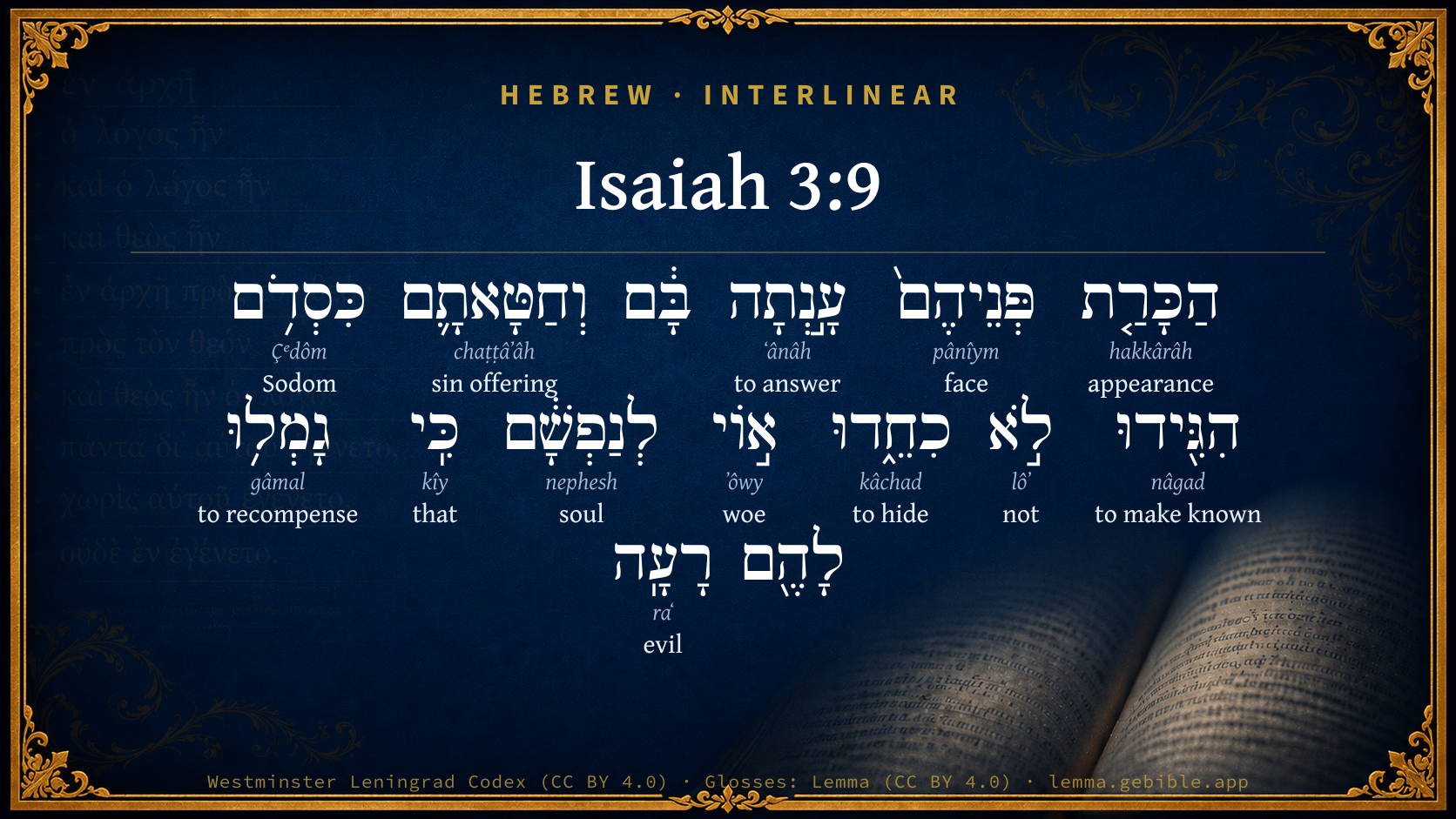
Hebrew (Westminster Leningrad Codex) Isaiah 3:9 appears in the Hebrew Old Testament. The text above is from the Westminster Leningrad Codex. Each word links to its Strong’s number, a concise gloss, and parsing drawn from the Open Scriptures Hebrew Bible morphology. Click any word for its full Brown-Driver-Briggs (BDB) entry.
Download image
Cite this verse

Isaiah 3:9 (World English Bible). Public Domain. Lemma interlinear Bible study tool, https://lemma.gebible.app/v/isaiah/3/9.

Show BibTeX & RIS
BibTeX
RIS
English Translation
The look of their faces testify against them. They parade their sin like Sodom. They don't hide it. Woe to their soul! For they have brought disaster upon themselves.
World English Bible · Public Domain
Highlights
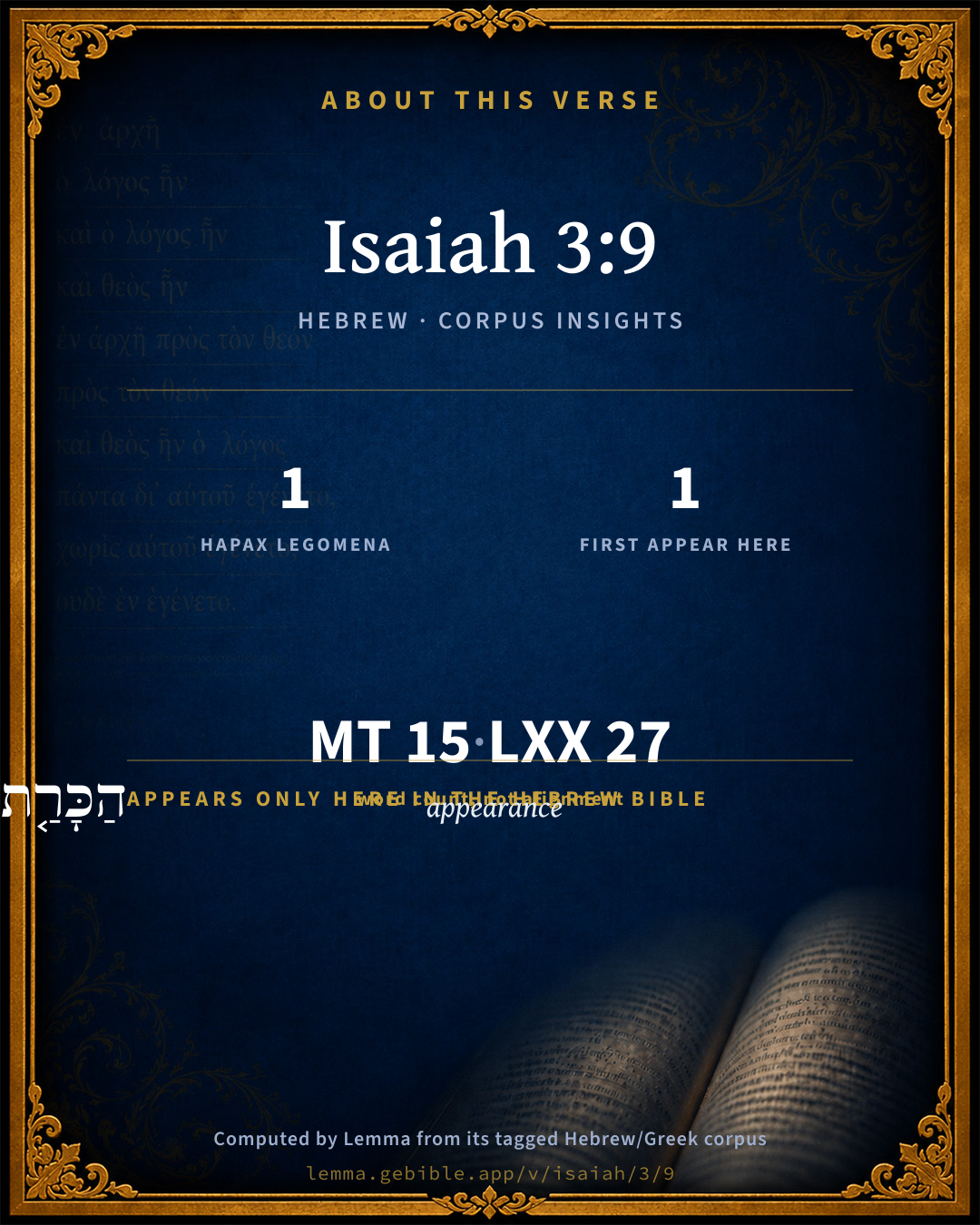
  • 1 hapax legomenon — only here in the Hebrew Bible
  • 1 first appearance in the Hebrew Bible
Full analysis ↓
Download a study sheet

One document with this verse’s original text, its word-by-word gloss line, the meaning frame, cross-references with their text, attributed commentary, and full source and license credits — printable, and it pastes into notes with its structure intact.

This verse Autodidact and up

Study sheet (.html) Plain text (.txt)

A passage Seminary Student

Up to 50 verses in one chapter. A passage sheet keeps up to 6 commentary sources and 12 cross-references per verse, in the order this page ranks them, and says so on the sheet whenever that leaves anything out. Ask for a single verse and you get the Autodidact verse sheet above.

Everything on this page stays free to read, with no account — the sheet is a download of what is already on screen, not access to it.

Want to remove ads? Support Godless Engineer
Compare translations 3

The same verse in 3 English versions, stacked beneath the original-language interlinear above. Click any original word for its lexicon entry.

Each is an independent rendering of the whole verse — the interlinear is not word-aligned to these translations.

Highlighted words mark where these versions differ — a whole-verse word diff, not a word-by-word alignment.

  • World English Bible Public Domain
    The look of their faces testify against them. They parade their sin like Sodom. They don't hide it. Woe to their soul! For they have brought disaster upon themselves.
  • King James Version Public Domain
    The shew of their countenance doth witness against them; and they declare their sin as Sodom, they hide it not. Woe unto their soul! for they have rewarded evil unto themselves.
  • unfoldingWord Literal Text CC BY-SA 4.0
    The appearance of their faces witnesses against them, and they declare their sin, like Sodom; they do not hide. Woe to their soul, for they have recompensed harm to themselves.

unfoldingWord Literal Text — © unfoldingWord, licensed CC BY-SA 4.0. Word-aligned USFM3 via Door43 (git.door43.org/unfoldingWord/en_ult).

Versions to compare (up to 4)

3 of 4 selected

Show all 18 translations

Every available English version of this verse, each an independent rendering of the whole verse.

  • World English Bible Public Domain
    The look of their faces testify against them. They parade their sin like Sodom. They don't hide it. Woe to their soul! For they have brought disaster upon themselves.
  • Berean Standard Bible Public Domain
    The expression on their faces testifies against them, and like Sodom they flaunt their sin; they do not conceal it. Woe to them, for they have brought disaster upon themselves.
  • Majority Standard Bible Public Domain
    The expression on their faces testifies against them, and like Sodom they flaunt their sin; they do not conceal it. Woe to them, for they have brought disaster upon themselves.
  • King James Version Public Domain
    The shew of their countenance doth witness against them; and they declare their sin as Sodom, they hide it not. Woe unto their soul! for they have rewarded evil unto themselves.
  • American Standard Version (1901) Public Domain
    The show of their countenance doth witness against them; and they declare their sin as Sodom, they hide it not. Woe unto their soul! for they have done evil unto themselves.
  • Revised Version (1885) Public Domain
    The shew of their countenance doth witness against them; and they declare their sin as Sodom, they hide it not. Woe unto their soul! for they have rewarded evil unto themselves.
  • Geneva Bible (1599) Public Domain
    The triall of their countenance testifieth against them, yea, they declare their sinnes as Sodom, they hide them not. Wo be vnto their soules: for they haue rewarded euil vnto themselues.
  • Douay-Rheims (1899) Public Domain
    The shew of their countenance hath answered them: and they have proclaimed abroad their sin as Sodom, and they have not hid it: woe to their souls, for evils are rendered to them.
  • Young's Literal Translation Public Domain
    The appearance of their faces witnessed against them, And their sin, as Sodom, they declared, They have not hidden! Wo to their soul, For they have done to themselves evil.
  • Literal Standard Version CC BY-SA 4.0
    The appearance of their faces witnessed against them, || And their sin, as Sodom, they declared, || They have not hidden! Woe to their soul, || For they have done evil to themselves.
  • Unlocked Literal Bible CC BY-SA 4.0
    The look on their faces witnesses against them; and they tell of their sin like Sodom; they do not hide it. Woe to them! For they have completed a catastrophe for themselves.
  • unfoldingWord Literal Text CC BY-SA 4.0
    The appearance of their faces witnesses against them, and they declare their sin, like Sodom; they do not hide. Woe to their soul, for they have recompensed harm to themselves.
  • Darby Bible Public Domain
    The look of their face doth witness against them, and they declare their sin as Sodom: they hide it not. Woe unto their soul! for they have brought evil upon themselves.
  • World Messianic Bible Public Domain
    The look of their faces testify against them. They parade their sin like Sodom. They don’t hide it. Woe to their soul! For they have brought disaster upon themselves.
  • Webster's Bible Public Domain
    The show of their countenance doth witness against them; and they declare their sin as Sodom, they hide it not. Woe to their soul! for they have rewarded evil to themselves.
  • Free Bible Version CC BY-SA 4.0
    The look on their faces proves what they've done, proclaiming their sin just like Sodom—they don't even bother to try and hide it! Tragedy is coming to them! They have brought disaster down upon themselves.
  • Bible in Basic English Public Domain
    Their respect for a man's position is a witness against them; and their sin is open to the view of all; like that of Sodom, it is not covered. A curse on their soul! for the measure of their sin is full.
  • JPS Tanakh (1917) Public Domain
    The show of their countenance doth witness against them; and they declare their sin as Sodom, they hide it not. Woe unto their soul! for they have wrought evil unto themselves.

Literal Standard Version (2020), Covenant Press — licensed CC BY-SA 4.0. Text via the HelloAO Bible API (eBible.org). Unlocked Literal Bible (unfoldingWord) — licensed CC BY-SA 4.0. Text via the HelloAO Bible API (eBible.org). unfoldingWord Literal Text — © unfoldingWord, licensed CC BY-SA 4.0. Word-aligned USFM3 via Door43 (git.door43.org/unfoldingWord/en_ult). Free Bible Version, Dr. Jonathan Gallagher — licensed CC BY-SA 4.0. Text via the HelloAO Bible API (eBible.org).

Word by word

More ways to search: Search by grammar → Find every occurrence → Compare this word →

Practice this passage: Drill this verse → Learn its vocabulary →

הַכָּרַ֤ת
hakkârâh
H1971
“appearance of”
Noun, Common, Feminine, Singular, Construct
Part of Speech
Noun
Type
Common
Gender
Feminine
Number
Singular
State
Construct
Full BDB Definition

Origin: from H5234

TWOT: 1368e

the look, appearance, expression
  1. פְּנֵיהֶם֙ pânîym H6440 “face(s) · their” Noun, Common, Both, Plural, Construct + Suffix, Personal, 3rd Person, Masculine, Plural
  2. עָ֣נְתָה ʻânâh H6030 “to answer” Verb, Qal, Perfect, 3rd Person, Feminine, Singular
  3. וְחַטָּאתָ֛ם chaṭṭâʼâh H2403 “and · sin offering · their” Conjunction + Noun, Common, Feminine, Singular, Construct + Suffix, Personal, 3rd Person, Masculine, Plural
  4. כִּסְדֹ֥ם Çᵉdôm H5467 “like/as · Sodom” Preposition + Noun, Proper
  5. הִגִּ֖ידוּ nâgad H5046 “to make known” Verb, Hiphil, Perfect, 3rd Person, Common, Plural
  6. לֹ֣א lôʼ H3808 “not” Particle, Negative
  7. כִחֵ֑דוּ kâchad H3582 “to hide” Verb, Piel, Perfect, 3rd Person, Common, Plural
  8. א֣וֹי ʼôwy H188 “woe” Particle, Interjection
  9. לְנַפְשָׁ֔ם nephesh H5315 “to/for · soul · their” Preposition + Noun, Common, Both, Singular, Construct + Suffix, Personal, 3rd Person, Masculine, Plural
  10. כִּֽי kîy H3588 “that” Conjunction
  11. גָמְל֥וּ gâmal H1580 “to recompense” Verb, Qal, Perfect, 3rd Person, Common, Plural
  12. רָעָֽה raʻ H7451 “evil” Noun, Common, Feminine, Singular, Absolute

About this verse

These counts appear in no published source. They are computed here, from the morphology-tagged text and Lemma’s own curated glosses. What Lemma adds →

15
words
13
distinct lemmas
Prophets
section

Notable vocabulary

1 hapax legomenon — a word that appears only here in the entire Hebrew Bible:

  • הַכָּרַ֤ת appearance H1971

First appearance in Scripture

This word makes its first canonical appearance in the Hebrew Bible here:

  • הַכָּרַ֤ת appearance H1971

Shared distinctive vocabulary

א֣וֹי woe H188 occurs in 23 verses of the Hebrew Bible. Also found in:

Grammatical profile

  • 4 verbs
  • 6 nouns
  • 2 prepositions
  • 1 conjunction
  • 2 particles

Verb forms

  • עָ֣נְתָה Qal · Perfect
  • הִגִּ֖ידוּ Hiphil · Perfect
  • כִחֵ֑דוּ Piel · Perfect
  • גָמְל֥וּ Qal · Perfect

Hebrew & Septuagint length

In English translation the verse runs 29 words from the Hebrew and 29 from the Septuagint (LXX English) — the same length.

A rough comparison of the two English renderings, which tokenize alike — not a word-level alignment.

Word counts can differ between the Hebrew and the Greek without any difference in meaning — e.g. the Hebrew direct-object marker אֵת has no separate Greek word, and Greek often adds the article ὁ.

In the original languages it is 15 Hebrew tokens and 27 Greek tokens — but the two are counted differently (Hebrew bundles its prefixes and suffixes into one token; the Greek is in lemma form), so that isn’t a like-for-like length.

Cross-references

18

Topical passages linked to Isaiah 3:9 in the Treasury of Scripture Knowledge — connected by theme and wording, ordered by reader-vote popularity; previews shown in the World English Bible.

  • Genesis 13:13 Now the men of Sodom were exceedingly wicked and sinners against Yahweh.
  • Genesis 18:20–21 Yahweh said, "Because the cry of Sodom and Gomorrah is great, and because their sin is very grievous,
  • Genesis 19:5–9 They called to Lot, and said to him, "Where are the men who came in to you this night? Bring them out to us, that we may have sex with them."
  • 1 Samuel 15:32 Then said Samuel, Bring you here to me Agag the king of the Amalekites. Agag came to him cheerfully. Agag said, Surely the bitterness of death is past.
  • 2 Kings 9:30 When Jehu was come to Jezreel, Jezebel heard of it; and she painted her eyes, and attired her head, and looked out at the window.
  • Psalms 10:4 The wicked, in the pride of his face, Has no room in his thoughts for God.
  • Psalms 73:6–7 Therefore pride is like a chain around their neck. Violence covers them like a garment.
  • Proverbs 8:36 But he who sins against me wrongs his own soul. All those who hate me love death."
  • Proverbs 30:13 There is a generation, oh how lofty are their eyes! Their eyelids are lifted up.
  • Isaiah 3:16 Moreover Yahweh said, "Because the daughters of Zion are haughty, And walk with outstretched necks and flirting eyes, Walking to trip as they go, Jingling ornaments on their feet;
  • Jeremiah 3:3 Therefore the showers have been withheld, and there has been no latter rain; yet you have a prostitute's forehead, you refused to be ashamed.
  • Jeremiah 6:15 Were they ashamed when they had committed abomination? nay, they were not at all ashamed, neither could they blush: therefore they shall fall among those who fall; at the time that I visit them they shall be cast down, says Yahweh.
  • Jeremiah 44:16–17 As for the word that you have spoken to us in the name of Yahweh, we will not listen to you.
  • Lamentations 5:16 The crown is fallen from our head: Woe to us! for we have sinned.
  • Ezekiel 23:16 As soon as she saw them she doted on them, and sent messengers to them into Chaldea.
  • Romans 6:23 For the wages of sin is death, but the free gift of God is eternal life in Christ Jesus our Lord.
  • Daniel 7:20 and concerning the ten horns that were on its head, and the other [horn] which came up, and before which three fell, even that horn that had eyes, and a mouth that spoke great things, whose look was more stout than its fellows.
  • Hosea 13:9 You are destroyed, Israel, because you are against me, Against your help.

Cross-references courtesy of OpenBible.info (CC BY 4.0).

Hebrew and Greek witnesses Masoretic Hebrew ↔ Greek Septuagint

The same verse in the two great witnesses to the Old Testament, shown verse-for-verse.

These are two independent witnesses, not word-aligned to each other, and the Septuagint is shown in lemma (dictionary) form.

Hebrew Isaiah 3:9 Masoretic · Westminster Leningrad Codex

הַכָּרַ֤ת פְּנֵיהֶם֙ עָ֣נְתָה בָּ֔ם וְחַטָּאתָ֛ם כִּסְדֹ֥ם הִגִּ֖ידוּ לֹ֣א כִחֵ֑דוּ א֣וֹי לְנַפְשָׁ֔ם כִּֽי גָמְל֥וּ לָהֶ֖ם רָעָֽה

The look of their faces testify against them. They parade their sin like Sodom. They don't hide it. Woe to their soul! For they have brought disaster upon themselves.

World English Bible · Public Domain

Greek LXX Isaiah 3:9 Septuagint · lemma form

καί ὁ αἰσχύνη ὁ πρόσωπον αὐτός ἀντιἵστημι αὐτός ὁ δέ ἁμαρτία αὐτός ὡς σοδομων ἀναἀγγέλλω καί ἐνφανίζω οὐαί ὁ ψυχή αὐτός διότι βουλεύω βουλή πονηρός κατά ἑαυτοῦ

Therefore now their glory has been brought low, and the shame of their countenance has withstood them, and they have proclaimed their sin as Sodom, and made it manifest.

LXX2012 (modern English Septuagint) · Public Domain

On this verse, Trapp's Complete Commentary discusses the Septuagint’s reading. Read the note in Commentary ↓

Hebrew: Westminster Leningrad Codex (CC BY 4.0). Greek: Septuagint (public domain); English from LXX2012 (modern English Septuagint) (Public Domain). How the Septuagint differs from the Hebrew →

Targum (Aramaic paraphrase)

1

The Targum is the ancient Jewish Aramaic paraphrase of the Hebrew Scriptures — an interpretive translation, not the Hebrew text itself. Onkelos (literal) and Pseudo-Jonathan (expansive) render the Torah, and Jonathan the Prophets. Coverage is partial: where no permissively-licensed English translation exists for a verse, only the Aramaic is shown. This is verse-level text, not a word-by-word alignment to the Hebrew.

  1. Targum Jonathan Prophets (Joshua–Malachi)
    אִשְׁתְּמוֹדָעוּת אַפֵּיהוֹן בְּדִינָא אַסְהֵיד בְּהוֹן וַחֲטָאֵיהוֹן כִּסְדוֹמָאֵי קָבְלִין וְלָא מָנְעִין וַי לְנַפְשֵׁיהוֹן אֲרֵי גְרַמוּ דְתֵיתֵי לְהוֹן בִּישָׁא:

    The shew of their faces in judgment bears testimony against them, and they declare their sins as the Sodomites, and they restrain not. Woe unto them! for they have caused that evil should come upon them.

    Targum Jonathan — Aramaic: “Mikraot Gedolot” (public domain). English: “Sefaria Community Translation” (CC0 1.0 (public-domain dedication)); “London "Chaldee Paraphrase," 1871” (public domain). Text via Sefaria.

Commentary

Notes on Isaiah 3:9 from classic Christian and Jewish commentators (each source and its license shown beneath its notes). The classic Christian expositions comment on the surrounding passage and are grouped to its opening verse, so a note may address several verses; the Jewish commentaries on the Tanakh (Rashi and others) are per-verse, so they appear only where the commentator wrote on this verse.

Lemma curates 59 commentaries, every one of them public domain or Creative Commons licensed, each selected and text-cleaned for this edition rather than reprinted as found. About our sources →

Matthew Henry's Commentary

Here God proceeds in his controversy with his people. Observe,

I. The ground of his controversy. It was for sin that God contended with them; if they vex themselves, let them look a little further and they will see that they must thank themselves: Woe unto their souls! For they have rewarded evil unto themselves. Alas for their souls! (so it may be read, in a way of lamentation), for they have procured evil to themselves, Isa 3:9. Note, The condition of sinners is woeful and very deplorable. Note, also, It is the soul that is damaged and endangered by sin. Sinners may prosper in their outward estates, and yet at the same time there may be a woe to their souls. Note, further, Whatever evils befals sinners it is of their own procuring, Jer 2:19. That which is here charged upon then is, 1. That the shame which should have restrained them from their sins was quite thrown off and they had grown impudent, Isa 3:9. This hardens men against repentance, and ripens them for ruin, as much as anything: The show of their countenance doth witness against them that their minds are vain, and lewd, and malicious; their eyes declare plainly that they cannot cease from sin, Pe2 2:14. One may look them in the face and guess at the desperate wickedness that there is in their hearts: They declare their sin as Sodom, so impetuous, so imperious, are their lusts, and so impatient of the least check, and so perfectly are all the remaining sparks of virtue extinguished in them. The Sodomites declared their sin, not only by the exceeding greatness of it (Gen 13:13), so that it cried to heaven (Gen 18:20), but by their shameless owning of that which was most shameful (Gen 19:5); and thus Judah and Jerusalem did: they were so far from hiding it that they gloried in it, in the bold attempts they made upon virtue, and the victory they gained over their own convictions. They had a whore's forehead (Jer 3:3) and could not blush, Jer 6:15. Note, Those that have grown impudent in sin are ripe for ruin. Those that are past shame (we say) are past grace, and then past hope. 2. That their guides, who should direct them in the right way, put them out of the way (Isa 3:12): "Those who lead thee (the princes, priests, and prophets) mislead thee; they cause thee to err." Either they preached to them that which was false and corrupt, or, if they preached that which was true and good, they contradicted it by their practices, and the people would soon follow a bad example than a good exhortation. Thus they destroyed the ways of their paths, pulling down with one hand what they built up with the other. Que te beatificant - Those that call thee blessed cause thee to err; so some read it. Their priests applauded them, as if nothing were amiss among them, cried Peace, peace, to them, as if they were in no danger; and thus they caused them to go on in their errors. 3. That their judges, who should have patronized and protected the oppressed, were themselves the greatest oppressors, Isa 3:14, Isa 3:15. The elders of the people, and the princes, who had learning and could not but know better things, who had great estates and were not under the temptation of necessity to encroach upon those about them, and who were men of honour and should have scorned to do a base thing, yet they have eaten up the vineyard. God's vineyard, which they were appointed to be the dressers and keepers of, they burnt (so the word signifies); they did as ill by it as its worst enemies could do, Psa 80:16. Or the vineyards of the poor they wrested out of their possession, as Jezebel did Naboth's, or devoured the fruits of them, fed their lusts with that which should have been the necessary food of indigent families; the spoil of the poor was hoarded up in their houses; when God came to search for stolen goods there he found it, and it was a witness against them. It was to be had, and they might have made restitution, but would not. God reasons with these great men (Isa 3:15): "What mean you, that you beat my people into pieces? What cause have you for it? What good does it do you?" Or, "What hurt have they done you? Do you think you had power given you for such a purpose as this?" Note, There is nothing more unaccountable, and yet nothing which must more certainly be accounted for, than the injuries and abuses that are done to God's people by their persecutors and oppressors. "You grind the faces of the poor; you put them to as much pain and terror as if they were ground in a mill, and as certainly reduce them to dust by one act of oppression after another." Or, "Their faces are bruised and crushed with the blows you have given them; you have not only ruined their estates, but have given them personal abuses." Our Lord Jesus was smitten on the face, Mat 26:67.

II. The management of this controversy. 1. God himself is the prosecutor (Isa 3:13): The Lord stands up to plead, or he sets himself to debate the matter, and he stands to judge the people, to judge for those that were oppressed and abused; and he will enter into judgment with the princes, Isa 3:14. Note, The greatest of men cannot exempt or secure themselves from the scrutiny and sentence of God's judgment, nor demur to the jurisdiction of the court of heaven. 2. The indictment is proved by the notorious evidence of the fact: "Look upon the oppressors, and the show of their countenance witnesses against them (Isa 3:9); look upon the oppressed, and you see how their faces are battered and abused," Isa 3:15. 3. The controversy is already begun in the change of the ministry. To punish those that had abused their power to bad purposes God sets those over them that had not sense to use their power to any good purposes: Children are their oppressors, and women rule over them (Isa 3:12), men that have as weak judgments and strong passions as women and children: this was their sin, that their rulers were such, and it became a judgment upon them.

III. The distinction that shall be made between particular persons, in the prosecution of this controversy (Isa 3:10, Isa 3:11): Say to the righteous, It shall be well with thee. Woe to the wicked; it shall be ill with him. He had said (Isa 3:9), they have rewarded evil to themselves, in proof of which he here shows that God will render to every man according to his works. Had they been righteous, it would have been well with them; but, if it be ill with them, it is because they are wicked and will be so. Thus God stated the matter to Cain, to convince him that he had no reason to be angry, Gen 4:7. Or it may be taken thus: God is threatening national judgments, which will ruin the public interests. Now, 1. Some good people might fear that they should be involved in that ruin, and therefore God bids the prophets comfort them against those fears: "Whatever becomes of the unrighteous nation, let the righteous man know that he shall not be lost in the crowd of sinners; the Judge of all the earth will not slay the righteous with the wicked (Gen 18:25); no, assure him, in God's name, that it shall be well with him. The property of the trouble shall be altered to him, and he shall be hidden in the day of the Lord's anger. He shall have divine supports and comforts, which shall abound as afflictions abound, and so it shall be well with him." When the whole stay of bread is taken away, yet in the day of famine the righteous shall be satisfied; they shall eat the fruit of their doings - they shall have the testimony of their consciences for them that they kept themselves pure from the common iniquity, and therefore the common calamity is not the same thing to them that it is to others; they brought no fuel to the flame, and therefore are not themselves fuel for it. 2. Some wicked people might hope that they should escape that ruin, and therefore God bids the prophets shake their vain hopes: "Woe to the wicked; it shall be ill with him, Isa 3:11. To him the judgments shall have sting, and there shall be wormwood and gall in the affliction and misery." There is a woe to wicked people, and, though they may think to shelter themselves from public judgments, yet it shall be ill with them; it will grow worse and worse with them if they repent not, and the worst of all will be at last; for the reward of their hands shall be given them, in the day when every man shall receive according to the things done in the body.

Matthew Henry's Commentary on the Whole Bible (1708–1710) — public domain (CC PDM 1.0). Text via the HelloAO Bible API.

Trapp's Complete Commentary

John Trapp

Isa 3:9 The shew of their countenance doth witness against them; and they declare their sin as Sodom, they hide [it] not. Woe unto their soul! for they have rewarded evil unto themselves.

Ver. 9. The show of their countenance doth witness against them,] q.d., You may see by their very looks what lewd lowlies they are. Their cruelty, pride, envy, hypocrisy, mulieorsity sitteth and showeth itself apparently in their faces and foreheads. Wisdom maketh the face to shine, saith Solomon; et ipse aspectus viri boni delectat. Good men look lovely, saith Seneca, as did that angel of God, John Bradford, quoth Dr Taylor, martyr; not so Cain, when discontented at God, and displeased at his brother; {Gen 4:6} he scowled and looked like a dog under a door, as we say. The thoughts are oft known by the countenance; and the heart is printed upon the face. Damascen calleth the eyes the exact images of the imaginations? {a} And the Italians have a proverb, that a man with his words close and his countenance loose, may travel undiscovered what he is, or goes about, all the world over. The word here used for "show" or "trial," doth in Hithpael signify to make a man’s self unknown.

And they declare their sin, as Sodom.] They tell it out. {as Jdg 14:16} And as the shameless Sodomites said to Lot, Bring them out to us that we may know them. {Gen 19:5} See the like impudence in Lamech; {Gen 4:23-24} in Lot’s two daughters. {Gen 19:36-37} This impudent naming of their incestuous brats, as begotten by their own father, showeth that they declared their sin, as Sodom, where they had lived and learned it.

They hide it not.] So Eze 24:7. Her blood is in the midst of her; she set it upon the top of a rock, as it were a-sunning; she poured it not upon the ground, to cover it with dust. See Jer 2:25.

Woe to their soul.] To their very soul. All wickedness hath a woe hanging at the heels of it, but especially that which is grown impudent, a noon day devil. The Septuagint here have it thus: Woe to their soul, for that they have taken evil counsel; saying, Let us bind the just One, for that he is not for our purpose or profit. Wherein they do insinuate the mystery of Christ’s passion, saith Oecolampadius, and do manifestly tax their own nation. Epiphanius {b} testifieth of the Jews at Tiberias, after the last destruction of Jerusalem, that it was usual with them, when any of their dear friends or kindred were at the point of death, to whisper these words secretly into their ears, Crede in Iesum Nazarenum crucifixum, Believe in Jesus of Nazareth, whom our chieftains crucified, for he it is who shall come to judge thee at the last day. Now if this be true, how great is the obstinace and impudence of that perverse people, who still sin against such strong convictions!

{a} Tον υποδρα ιδων. - Hom. αγαλματα της ψυχης ακριβη.

{b} Epiphan. apud Lonicer. in Theat. Histor. p. 96.

John Trapp, A Commentary or Exposition upon All the Books of the Old and New Testament (1647–1656) — public domain. Text from a community e-Sword module.

The Biblical Illustrator

Joseph S. Exell

Isa_3:9

The shew of their countenance doth witness against them

Character revealed in the countenance

What is meant is the insolent look which their sinfulness is stamping upon their faces, without the self-condemnation which in others takes the form of dread to commit sin.

(F. Delitzsch.)

Woe unto their soul!

1. The condition of sinners is woeful and very deplorable.

2. It is the soul that is damaged and endangered by sin. Sinners may prosper in their outward estates, and yet there may be a woe to their souls.

3. Whatever evil befalls sinners, it is of their own procuring (Jer_2:19). (M. Henry.)

The Biblical Illustrator, edited by Joseph S. Exell (c. 1880s–1900s) — public domain. Text from a community e-Sword module.

Joseph Benson's Commentary

Isa 3:9. The show of their countenance — Their pride, wantonness, and impiety, manifestly show themselves in their very looks and whole behaviour, and will be swift witnesses against them, both before God and men. They declare their sin as Sodom — They commit it publicly, casting off all fear of God, and reverence to men; and they glory in it. They hide it not — As men do, who have any remains of modesty or ingenuity. They have rewarded evil to themselves — That is, procured a fit recompense for their wickedness, even utter ruin; or, they have done evil, &c. They cannot blame God, but themselves: their destruction is wholly from themselves. The word הכרה, rendered show, in the first clause of the verse, not occurring elsewhere in the Bible, is of rather uncertain signification. Bishop Lowth renders it, steadfastness; and Dr. Waterland, impudence. The former translates the whole verse thus: “The steadfastness of their countenance witnesseth against them: for their sin, like Sodom, they publish, they hide it not: wo to their souls! for upon themselves have they brought down evil.”

Joseph Benson's Commentary on the Old and New Testaments (1811–1818) — public domain. Text from a community e-Sword module.

The Preacher's Complete Homiletical Commentary

Joseph S. Exell (gen. ed.)

SHAMELESS SINNERS

Isa_3:9. They declare their sin as Sodom, they hide it not.

Extremes are generally detestable: equatorial heat, arctic cold; the speaker whom we must strain to hear, the orator who roars, &c. So in morals: foolhardy rashness, cowardice; prodigality, penuriousness; hypocrites, and such shameless sinners as are spoken of here. Such persons are even more detestable than hypocrites; these at least pay this homage to virtue, that they array themselves in her outer garments. Desperate and vain is the endeavour to cloak iniquity, yet even this is better than the effrontery which leads some to flaunt it in open day. How surprising is such effrontery! When we consider what sin is—a thing horribly degrading to man as well as insufferably offensive to God—we should have expected beforehand that men would have been as anxious to hide their vices, as they are to conceal any loathsome disease with which they may be afflicted. But it is not so. There are tens of thousands of sinners as devoid of shame as were those who dwelt in Sodom; nay, they glory in their shame. Consider—

I. THE CAUSES OF SHAMELESSNESS IN SIN.

1. Ignorance. There are many so uninstructed in moral and spiritual things; they have grown up surrounded by such evil examples, that they have no consciousness of the foulness of their vices, any more than a peasant has of the ungracefulness of his manners. This cause operates among the lower classes to an extent scarcely conceivable by the cultured and refined.

2. Habit. Many an open and shameless sinner, at the outset of his career, when he was first betrayed into transgression, was ashamed almost to walk through the street, and imagined that every one whom he met had heard of, and despised him for, his offence. But the offence was repeated; it became a habit; and in proportion as it has done so, has the offender’s sense of shame died out of him. He thinks as little of it as a soldier does of his uniform, which when it was first put on caused him to think that all eyes were fixed upon him.

3. A desire to silence conscience. The effrontery is often assumed, just as the rustic traveller when near a churchyard whistles, not because he is courageous, but to keep his courage up. Conscience reproaches and warns, and the sinner seeks to silence it by greater desperation in wickedness.

4. A seared conscience. In the course just named the sinner too often succeeds. Conscience, defied and outraged, desists from her useless efforts, and gives herself over to an insensible lethargy; there will come an hour of terrible awakening; but meanwhile she is blind, deaf, dumb, and the sinner perpetrates the most abominable iniquities without a blush [544]

5. Infidelity. The sinner has succeeded at last in persuading himself that what he wishes were true is true, and that there is no God, and, consequently, no day of judgment and no hell. As soon as men have cast off fear of God, it is easy for them to cast off fear of man. The ordinary fruit of infidelity is vice. What but prudence is left to restrain the infidel from partaking in the pleasures of sin? And how weak prudence is in any real contest with passion!

[544] Blind and ignorant consciences speak peace, or hold their peace, because they have not skill enough to find fault; they swallow many a fly, and digest all well enough. While the scales were upon Paul’s eyes, he was alive and quiet; he thought concupiscence, the sin and breeder of all sin, to be no sin. Such consciences discern sin as we do stars in a dark night,—see only the great ones of the first magnitude, whereas a bright even discovers millions; or as we see a few motes in the dark houses, which sunlight shows to be infinite. Such think good meaning will serve the turn, that all religions will save, or a “Lord, have mercy on us,” at the last gasp. The law which nature has engraven, they tread out with sins, as men do the engravings of tombs they walk on with foul shoes: they dare not look in the glass of God’s law, which makes sin abound, lest the foulness of their souls should affright them. A number of such Scottish souls there be, whose consciences, if God opens, as He did the eyes of the prophet’s servant, they shall see armies and legions of sins and devils in them.—Ward, 1577–1639.

II. THE CONSEQUENCES OF SHAMELESSNESS IN SIN.

This is declared by the prophet to be woe—woe of peculiar intensity and awfulnes. “Woe unto their soul!” &c. They stand in peril of the severest chastisements of the Divine justice—

1. Because shamelessness in sin is an aggravation of sin. It is felt to be so in the home, in the nation. Disloyalty is an evil thing, but to break forth into open rebellion, and to take the field against the monarch, is worse.

2. Because shamelessness in sin adds to the contagiousness of sin. One reason why sin is so hateful in the sight of God is because it renders every sinner a moral pestilence. Corrupt, he corrupts others (Ecc_9:18). But of shameless sinners this is especially true.

1. They lead many to imitate them in their wickedness. In every community these shameless sinners are ringleaders in vice and recruiting-sergeants for the devil.

2. They confirm many in wickedness. Many are “halting between two opinions,” and these shameless offenders, by their example, and often by their persuasions, supply that which is needed to bring these irresolute ones to a decision for a life of iniquity. Thus they are soul-murderers as well as soul-suicides. Justice, therefore, demands that their punishment shall be especially severe. Their doom will probably be as manifest as their guilt.

APPLICATION.

1. Let those who have been thus shameless in sin humble themselves before Almighty God. Even for them to-day there is mercy (Isa_55:7; Isa_1:18). Let no sinner be deterred from seeking mercy by the greatness of his sins (Ezr_9:6, with Psa_108:4, and Rom_5:20). Yet let no sinner presume further to transgress because God is so merciful. There is an awful warning in the gracious invitation (Isa_55:6).

2. As ignorance is one main cause of shamelessness in sin, let Sunday-school teachers recognise the importance of the task in which they are engaged. Though they may not be able to point to individual conversions as the result of their efforts, they are not labouring in vain; by them the moral sense of the community is being raised. Evil as are our days, the testimony is conclusive that the former days were not better, but worse.

3. As habit is another main cause of shamelessness in sin, let the young be anxiously on their guard against the formation of evil habits. But habits grow from acts. A single action is consequently more important than it seems. There are certain actions which have in themselves a special decisiveness of influence. When a young man has once entered a bar parlour, he has entered upon the high way to drunkenness; he may not reach it, but he is on the high way to it. Another most decisive step towards shamelessness in sin is taken when a young person who has been trained under Christian influence joins a Sunday excursion. It is by this gate that millions have entered that path of open transgression, along which they have hastened to perdition.

4. Let the people of God be very careful to leave shameless sinners without excuse. It is by the inconsistencies of professing Christians that such persons endeavour to shield themselves from censure and to silence their consciences. Hence Eph_5:15; Col_4:5; 1Th_5:22.

The Preacher's Complete Homiletical Commentary (gen. ed. Joseph S. Exell; Funk & Wagnalls, c. 1892) — public domain (pre-1929). A full-Bible homiletical/sermon-outline anthology covering 65 of 66 books (2 John is absent from the source module). Text from a community e-Sword module.

Tyndale Open Study Notes

Tyndale Open Resources

3:9 The very look on their faces: At this time people boldly displayed their rebellion against God.

Tyndale Open Study Notes — © Tyndale Open Resources, licensed CC BY-SA 4.0. Text via the HelloAO Bible API.

Geneva Bible (1599)

Geneva Bible translators

When God shall examine their deeds whereupon they now set an impudent face, he shall find the mark of their impiety in their forehead.

Geneva Bible (1599) marginal notes — public domain. Text via Bolls.life.

Jamieson, Fausset & Brown

Robert Jamieson, A. R. Fausset & David Brown

show--The Hebrew means, "that which may be known by their countenances" [GESENIUS and WEISS]. But MAURER translates, "Their respect for person"; so Syriac and Chaldee. But the parallel word "declare" favors the other view. KIMCHI, from the Arabic, translates "their hardness" (Job 19:3, Margin), or impudence of countenance (Jer 3:3). They have lost not only the substance of virtue, but its color.

witness--literally, "corresponds" to them; their look answers to their inner character (Hos 5:5).

declare-- (Jde 1:13). "Foaming out their own shame"; so far from making it a secret, "glorying" in it (Phi 3:19).

unto themselves--Compare "in themselves" (Pro 1:31; Pro 8:36; Jer 2:19; Rom 1:27).

Jamieson, Fausset & Brown — Commentary Critical and Explanatory on the Whole Bible (1871) — public domain (CC PDM 1.0). Text via the HelloAO Bible API.

Adam Clarke's Commentary

Verse 9. The show of their countenance] Bishop Lowth has it the steadfastness of their countenance-they appear to be bent on iniquity, their eyes tell the wickedness of their hearts. The eye is the index of the mind. Envy, hatred, malice, malevolence, concupiscence, and murder, when in the heart, look most intelligently out at the eye. They tell the innocent to be on their guard; and serve the same purpose as the sonorous rings in the tail of the rattlesnake-they announce the presence of the destroyer.

They declare their sin as Sodom] Impure propensities are particularly legible in the eyes: whoever has beheld the face of a debauchee or a prostitute knows this; of these it may be said, they wish to appear what they really are. They glory in their iniquity. This is the highest pitch of ungodliness.

They have rewarded evil unto themselves.] Every man's sin is against his own soul. Evil awaiteth sinners-and he that offends his God injures himself.

Adam Clarke's Commentary on the Bible (1810–1826) — public domain. Text from a community e-Sword/MySword module.

Ellicott's Commentary for English Readers

(9) They declare their sin as Sodom.—The comparison is, it should be remembered, of probably an earlier date than that in Isa_1:10. In the reign of Ahaz (perhaps the prophet, editing in his old age, thought also of that of Manasseh) there was not even the homage which vice pays to virtue by feigning a virtue which it has not. Men fell into an utter shamelessness, like that of the cities of the plain (Gen_19:5), generally in the luxury and profligacy of their lives (Eze_16:49), perhaps also with a more definite and horrible resemblance (1Ki_14:24; 1Ki_15:12; 2Ki_23:7).

Woe unto their soul!—In the midst of the confusions of the times the prophet is bidden to proclaim that the law of a righteous retribution would be seen working even there.

A Bible Commentary for English Readers, edited by Charles John Ellicott (1878–1897) — public domain. Text from a community e-Sword module.

The Cambridge Bible for Schools and Colleges

gen. ed. J. J. S. Perowne

9. The shew of their countenance] The safest translation is that of R.V. marg., their respecting of persons, i.e. their partiality in judgment. The familiar phrase “respect persons” (see Deu_1:17, &c.) appears here in the nominal form, the usual infinitive being replaced by a verbal noun. It is not an objection to this view that such a charge only applies to a particular class. The prophet deals with the nation throughout as a political unity, and he knows that the whole people must suffer for the sins of the rulers.

they declare … hide it not] or, they declare their sin, like Sodom, undisguisedly. On the construction see Davidson, Synt. § 41, R. 3.

Woe unto their soul …] or, Woe to themselves for they have done themselves evil. The injustice they have done to others witnesses against them and recoils on their own heads.

The Cambridge Bible for Schools and Colleges (gen. ed. J. J. S. Perowne; Cambridge University Press, 1878–1918) — public domain. Text from a community e-Sword module.

John Gill's Exposition

The shew of their countenance doth witness against them,.... The word translated "shew" is only used in this place. Some derive it from "to know", in the conjugations Piel and Hiphil; and render it, "the knowledge of their countenance" (f); that is, that which may be known by their countenances; the countenance oftentimes shows what is in the heart, the cruel disposition of the mind, the pride and vanity of it, the uncleanness and lasciviousness that is in it; to this our version agrees, and which is confirmed by the Chaldee paraphrase,

"the knowledge of their countenance in judgment doth testify against them;''

as they appear there, so it may be judged of them; their guilt flies in their face, and fills them with shame and confusion; and so the Septuagint and Arabic versions render it, "the shame of their face"; but others derive it from which has the signification of hardness in the Arabic language, and as it is thought by some to have in Job 19:3 and render it, "the hardness of their countenance"; so R. Joseph Kimchi, and others (g), meaning their impudence (h); not only their words and actions, but their impudent looks, show what they are; which agrees with what follows:

and they declare their sin as Sodom, and

hide it not; commit it openly, without fear or shame; glory in it, and boast of it, as the Jews did in their crucifixion of Christ, and their evil treatment of him:

woe to their soul, for they have rewarded evil unto themselves; they have brought upon themselves, soul and body, the just recompence of reward; they have been the cause of their own ruin, and have wronged their own souls.

(f) "cognitio vultus eorum", Munster, Vatablus, V. L. (g) "Obfermatio", Janius & Tremellius; "durities", Piscator. (h) So Schindler renders the Arabic word, "hacar", impudence. Vid. Castel. Lexic. col. 846.

John Gill's Exposition of the Whole Bible (1746–1763) — public domain (CC PDM 1.0). Text via the HelloAO Bible API.

Albert Barnes' Notes on the Bible

The show of their countenance - The word rendered “the show” is probably derived from a word signifying “to know,” or “to recognize,” and here denotes “impudence” or “pride.” Septuagint, ‘The shame of their face.’

Doth witness against them - “Answers” to them; or “responds” to them (ענתה ‛ânetâh). There is a correspondence between the feeling of the heart and the looks, an “answering” of the countenance to the purposes of the soul that shows their true character, and betrays their plans. The prophet refers here to the great law in physiology that the emotions of the heart will be usually “expressed” in the countenance; and that by the marks of pride, vanity, and malice there depicted, we may judge of the heart; or as it is expressed in our translation, that the expression of the face will “witness” against a wicked man.

They declare ... - By their deeds. Their crimes are open and bold. There is no attempt at concealment.

As Sodom - see Gen 19:5; compare the note at Isa 1:10.

Wo unto their soul - They shall bring woe upon themselves; they deserve punishment. This is an expression denoting the highest abhorrence of their crimes.

They have rewarded evil ... - They have brought the punishment upon themselves by their own sins.

Albert Barnes' Notes on the Bible (1834–1885) — public domain. Text from a community e-Sword/MySword module.

Haydock's Catholic Bible Commentary

Shew, (agnitio.) "Knowledge." (Worthington) --- Impudence, &c. (Calmet) --- Hacurath (Haydock) occurs no where else. (Calmet) --- From their countenance we may judge that they are proud, &c. (Menochius)

George Leo Haydock (1774–1849), Haydock's Catholic Family Bible and Commentary, 1859 edition — public domain. Excludes Psalms (Douay-Rheims chapter numbering differs from Protestant) and Deuterocanonical books (Catholic canon only).

Matthew Poole's English Annotations

The show of their countenance doth witness against them; their pride, and wantonness, and impiety manifestly shows itself in their very looks and carriages, and will be swift witness against them both before God and men.

They declare their sin; they act it publicly, casting off all fear of God, and reverence to men, and they glory in it.

They hide it not, as men do who have any remainders of modesty or ingenuity.

They have rewarded, i.e. procured a fit recompence for their wickedness, even utter ruin. Or, they have done; for this word is oft so used, without any signification of a recompence, as Psa 7:4. They cannot blame me, but themselves; their destruction is wholly from themselves. Compare Hos 13:9.

Matthew Poole's English Annotations on the Holy Bible (1683–1685) — public domain. Text from a community e-Sword/MySword module.

Whedon's Commentary on the Bible

Daniel D. Whedon

9. Show of… countenance — Its bold, staring effrontery declares, testifies, against them; reveals their own true character exactly. Thoughts only of evil are mirrored in their countenances, and are as clearly open to every one’s view as were the open sins of Sodom. The meaning is not that their looks betray them, but that they attempt no concealment, they hide it not.

Woe unto their soul — This expresses the highest abhorrence of their acts.

Rewarded evil unto themselves — Reaped punishment as the only proper retribution.

Daniel D. Whedon (gen. ed.), Commentary on the Old and New Testaments (1874–1909) — public domain. Text from a community e-Sword module.

The Pulpit Commentary

The show of their countenance doth witness against them. This is not in itself a sin, but it is a sign of frequent and habitual sin. Vice, long indulged in, stamps its mark upon the countenance, giving men what is called "a bad expression a guilty and hardened look. It does not require a skilled physiognomist to detect at a glance the habitual criminal or sensualist. They declare their sin as Sodom. Not only does their countenance betray them, but, like the Sodomites, (Gen_19:5, Gen_19:9) they boldly and impudently declare their wicked purposes beforehand, and make no attempt at concealment. Hypocrisy has been said to be the homage that vice pays to virtue. Where there is none, where vice has ceased to shroud or veil itself, a very advanced stage of wickedness has been reached. They have rewarded evil unto themselves. They have "received in themselves the recompense of their error which was meet". (Rom_1:27) Their sins have at once marred their countenance and injured their moral nature.

Vers. 9-11. The law of retributive justice not mechanical, but moral.

The doctrine of future rewards and punishments is sometimes preached in a way that is, if not offensive, at any rate unsatisfactory. God is made to deal with men as not even judicious parents would deal with their children viz, for so much obedience, so much bestowal of pleasure or indulgence; for so much disobedience, an equal award of pain and punishment. But this is certainly not the doctrine of Holy Scripture. Scripture represents the reward of well-doing as "eternal life," and this "eternal life" is the vigorous energy of all that is good in the man himself, sustained and strengthened by the Spirit of Christ in the soul, and accompanied by happy feelings of love and trust and thankfulness. "Eternal life" begins in this world, and is only carried out to perfection in the next. It is, in the main, a state of feeling-consciousness of being at one with God, consciousness of communion with him. It admits, no doubt, of exaltation from without, as here by the special shedding of Divine influences upon the soul, and hereafter by the transcendent blessing of the beatific vision; but it is principally in the man himself. It is a condition of mind, not a set of external circumstances. And so with ill-doing and its consequence, "eternal death." Men make their own misery by their deeds. They "receive within themselves the recompense of their errors." They mar their moral nature; they refuse to hold communion with God; and then, thrown back upon themselves, and having nothing within them pleasing to contemplate or to be conscious of, they find themselves wretched they have created their own hell.

HOMILIES BY W.M. STATHAM Ver. 9. The revealings of the face.

"The show of their countenance doth witness against them." We are "fearfully and wonderfully made." Just as the countenance reveals the state of our physical health, so do thought and character manifest themselves in the face. All our nature, with its complexity of being, has yet a subtle and mysterious oneness, and the tone of the mind and the inclination of the heart are made manifest, not alone in speech, but in look and gesture and manner. In the simple language of the holy Book, there is a show of the countenance.

I MEN CANNOT PREVENT SELF-REVEALING. As the New Testament says, "They that be otherwise cannot be hid." There is no concealment in nature. The hidden seed springs up even in the cleft of a rock. There is always some damaging witness waiting for an evil man. As the snow reveals the footsteps of the beast of prey, as the wind of the desert drifts the sand from the body that is buried in it, so sin will surely be found out. A bad man"s face is a tell-tale of levity and scorn and shame. If God is not in the heart, the light of his presence will not be in the countenance.

II MEN CANNOT LONG ACT A PART. Nature is against insincerity. You cannot forge her handwriting. You cannot make your artificial rock so that it shall remain unknown beside hers. No. And it is so with voice and face. Hypocrisy drops unconsciously its mask. The same words are spoken differently by sincere and insincere men. We read of hollow laughter. So there is hollow exhortation which does not exercise inspiration over our hearts. So men cannot twist their countenances into false witnessing. There is a blatant iniquity about the wicked which cannot be concealed by long effort. "They declare their sin as Sodom, they hide it not.

III MEN CANNOT AVERT PUNISHMENT. "Woe unto their soul! for they have rewarded evil unto themselves." They create their own inquisition-chamber. Memory is their misery. No theories of unaccountability can live. Excuses there are none. The conscience tears them to pieces like a spider"s web. Life is personal and accountable. We all feel that. "Say ye to the righteous, it shall be well with him: for they shall eat the fruit of their doings. Woe unto the wicked! it shall be ill with him: for the reward of his hands shall be given him." Reward, then, is not always blessing; it is harvest of golden sheaves or gathered tares, according to our planting. Verily a light from within fills the countenance even of godly men. The prayer is fulfilled. "Cause thy face to shine upon us." "Who is the Health of my countenance, and my God W.M.S.

Vers. 9-11. The path of sin and the rest of righteousness.

I THAT SIN CANNOT BE CONCEALED. "The show of their countenance doth witness against them" (ver. 9). Whether Isaiah"s words point to the unconscious revelation of sin is uncertain, but they clearly suggest the fact. The evil that is in men"s hearts is shown in their countenance, whether they wish to conceal it or whether they take a shameful pride in it. The thoughts that flit through the mind, the passions that burn within the soul, the sins that defile the inward man, are written, line by line, on the visage, and "may be known and read of all men." Are there not those whom we have to look upon in the inter, course of life "whose eyes are full of adultery," or whose cheeks are stained with intoxication, or whose features are drawn together with cruelty; those who, instead of "bearing in their body the marks of the Lord Jesus, "carry with them the signs of Satan"s service? It is a fact which may well make the guilty wince and hesitate before they continue, that, by the operation of God"s righteous laws, the sin which at the beginning they would fain hide in the depths of their own soul, will at length be written on the tablet of the body, and "the show of their countenance will witness against them.

II THAT SIN, IN ITS LATER STAGES, SCORNS TO BE SCREENED FROM VIEW. "They declare their sin...they hide it not" (ver. 9). In the further stages of iniquity there is no attempt, for there is no desire, to hide the wrong thing from view. Shame gradually declines until it passes away, and in its place there grows up a horrible pride in sin. Men come to gloat over that from which they ought to shrink with utmost sense of humiliation; they "glory in their shame". (Php_3:19) This is eminently true of acts of rapacity and fraud; it also applies to sins of direct ungodliness and of self-indulgence.

III THAT SIN IS ALWAYS WORKING TOWARDS RUIN. "Woe unto their soul; they have rewarded evil unto themselves" (ver. 9). "Woe unto the wicked," etc. (ver. 11). Sin sometimes prospers long; the "sinner may do evil a hundred times, and his days be prolonged, yet surely we know... that it shall not be well with the wicked". (Ecc_8:12, Ecc_8:13) Nor is it well when the end comes. (see Psa_73:1-20)

1. Sin tends to temporal ill-being, to penury, to sickness, to early death.

2. Sin tends to isolation, to the withdrawal of confidence and affection on the part of the good and worthy, to dishonor, and even degradation.

3. Sin must inevitably lead to spiritual deterioration and, if it be persisted in, to spiritual death. "The wages of sin is death.

4. Sin finally conducts to condemnation and exile from the home of God. Alas! for the soul that is impenitent, that seeks not Divine mercy, that does not return on its way to the living God and to his righteousness. There is a world of meaning in that one small word which constitutes here such a significant sentence "ill.

IV THAT RIGHTEOUSNESS MAY REST SECURE IN HOPE. (Ver. 10.) It may seem ill to the righteous; "weeping may endure for a night." He may find himself inclined to sigh, "All these things are against me". (Gen_42:36) But "unto the upright there ariseth light in the darkness." The converse of all that applies to the ungodly is true of the godly. Righteousness

(1) tends to prosperity here;

(2) begets trust and love;

(3) results in moral excellency the good man finds that honesty, purity, truthfulness, sobriety, kindness, etc., issue in spiritual increase, in a harvest of inward good, and he "eats the fruit of his doings;

(4) conducts at last to the heavenly land, where he who does the will of God "is recompensed at the resurrection of the just. C.

The Pulpit Commentary (1880–1919), ed. H.D.M. Spence-Jones & Joseph S. Exell — public domain. Text from a community e-Sword module.

John Wesley's Explanatory Notes

The shew - Their pride, and wantonness, and impiety m manifestly shews itself in their very looks. They declare - They act it publickly, casting off all fear of God and reverence to men. Rewarded - Procured a fit recompense for their wickedness, even utter ruin.

John Wesley, Explanatory Notes Upon the Whole Bible (1754–1765) — public domain. Text via the GEBible commentary corpus.

Keil & Delitzsch

C. F. Keil & F. Delitzsch

But Israel, instead of walking in the consciousness of being a constant and favourite object of these majestic, earnestly admonishing eyes, was diligently engaged in bidding them defiance both in word and deed, not even hiding its sin from fear of them, but exposing them to view in the most shameless manner. - "The look of their faces testifies against them, and their sin they make known like Sodom, without concealing it: woe to their soul! for they do themselves harm." In any case, the prophet refers to the impudence with which their enmity against God was shamelessly stamped upon their faces, without even the self-condemnation which leads in other cases to a diligent concealment of the sin. But we cannot follow Luzzatto and Jos. Kimchi, who take haccârath as used directly for azzuth (impudence), inasmuch as the Arabic hakara (hakir‛a), to which Kimchi appeals, signifies to be astonished and to stare (see at Job 19:3). And in this case there would be nothing strange in the substantive form, which would be a piel formation like בּלּהה חטּאה. But it may be a hiphil formation (Ewald, 156, a); and this is incomparably the more probable of the two, as hiccir panim is a very common phrase. It signifies to look earnestly, keenly, or inquiringly in the face of a person, to fix the eye upon him; and, when used of a judge, to take the part of a person, by favouring him unjustly (Deu 1:17; Deu 16:19). But this latter idea, viz., "their acceptance of the person, or partiality" (according to Pro 24:23; Pro 28:21), is inadmissible here, for the simple reason that the passage refers to the whole nation, and not particularly to the judges. "The look of their faces" (haccârath p'nēhem) is to be understood in an objective sense, viz., the appearance (τὸ εἶδος, Luk 9:29), like the agnitio of Jerome, id quo se agnoscendum dat vultus eorum. This was probably the expression commonly employed in Hebrew for what we designate by a very inappropriate foreign word, viz., physiognomy, i.e., the expression of the face which reveals the state of the mind. This expression of their countenance testified against them (anah b', as in Isa 59:12), for it was the disturbed and distorted image of their sin, which not only could not be hidden, but did not even wish to be; in a word, of their azzuth (Ecc 8:1). And it did not even rest with this open though silent display: they spoken openly of their sin (higgid in its simplest meaning, palam facere, from nâgad, nagâda, to be open, evident) without making any secret of it, like the Sodomites, who publicly proclaimed their fleshly lusts (Gen 19). Jerusalem was spiritually Sodom, as the prophet called it in Isa 1:10. By such barefaced sinning they did themselves harm (gâmal, lit., to finish, then to carry out, to show practically).

(Note: It may now be accepted as an established fact, that the verb gâmal is connected with the Arabic 'gamala, to collect together, 'gamula, to be perfect, kamala, kamula id., and gâmar, to finish (see Hupfeld on Psa 7:5, and Frst, Heb. Lex.).)

Keil & Delitzsch — Biblical Commentary on the Old Testament (1861–1891) — public domain (CC PDM 1.0). Text via the HelloAO Bible API. (Old Testament only.)

J. A. Alexander on Isaiah

Joseph Addison Alexander

As they make no secret of their depravity, and as sin and suffering are inseparably connected, they must bear the blame of their own destruction. “The expression of their countenances testifies against them, and their sin, like Sodom, they hide it not. Woe unto their soul, for they have done evil to themselves. “The context seems to show that the Prophet has reference to general character and not to a specific sin, while the parallel expressions in this verse make it almost certain that the phrase relates to the expression of the countenance. The sense is not that their looks betray them, but that they make no effort at concealment, as appears from the reference to Sodom. The expression of the same idea first in a positive and then in a negative form is not uncommon in Scripture, and is a natural if not an English idiom. Madame d’Arblay, in her memoirs of Dr. Burney, speaks of Omiah, the Tahitian brought home by Capt. Cook, as "uttering first affirmatively and then negatively all the little sentences that he attempted to pronounce."

Joseph Addison Alexander, The Prophecies of Isaiah (1846–1847; New York: Scribner, 1870–1878) — public domain. Text from a community e-Sword module.

Rashi

Rabbi Shlomo Yitzchaki (Rashi)

The recognition of their faces The sin that they recognize faces [i.e., show favoritism] in judgment testified against them before Me. Another version is: The recognition of their faces—They are recognizable by the boldness of their faces.

like Sodom they told, they did not deny They committed [sins] publicly.

Rashi on the Tanakh — English translations: “The Judaica Press complete Tanach with Rashi, translated by A. J. Rosenberg” (CC BY 4.0); “Pentateuch with Rashi's commentary by M. Rosenbaum and A.M. Silbermann, 1929-1934” (public domain); “The Metsudah Tanach series, Lakewood, N.J” (CC BY 4.0); and “The Book of Joshua, Metsudah Publications, 1997” (CC BY 4.0). Text via Sefaria.

Ibn Ezra

Rabbi Abraham ibn Ezra

הכרת. According to some, the cutting off, derived from כרת to cut off, but more correctly, the knowing of; comp. הכירהו they knew him (Gen. 42:8); the Dagesh in כ indicates the omission of the radical נ which appears in ינכר He is known (Prov. 26:24). He who is able to judge of the constitution of the whole body from the face will find in it the declaration and confession of the truth; no further evidence is wanted.

And they tell their sin like Sodom. They do not even conceal their sins; for he who does conceal them feels at least ashamed of what he has done.

Ibn Ezra on the Tanakh — English translations: “Sefaria Community Translation” (CC0 1.0 (public-domain dedication)); “Yalkut, Sifsei Chachomim Chumash, Metsudah Publications, 2009” (CC BY 4.0); and “Commentary of Ibn Ezra on Isaiah - trans. by M. Friedlander, 1873” (public domain). Text via Sefaria.

Lesson kit

Teaching starters — assembled from the data on this page, not authored interpretation. Every prompt links to the verse data it draws on. Edit before teaching.

Isaiah, in the Prophets, opens this verse with 15 words (13 distinct Hebrew lemmas). Its most distinctive word is hakkârâh (“appearance”). A historical commentator’s framing appears above. Read the whole chapter for the surrounding context.

Discussion questions

  1. What does “appearance” (hakkârâh) contribute to the verse as a whole?
  2. 1 word here appears nowhere else in the Hebrew Bible. Why might the author reach for such rare wording?
  3. This is the first place “appearance” appears in Scripture (first appears here). What does its debut here establish?
  4. How does Numbers 21:29, which shares the word «woe», read alongside this verse?
  5. The translations on this page render this verse differently — a whole-verse word diff, not a word-by-word alignment. What might account for the different wordings?
  6. «עָ֣נְתָה» is a Qal Perfect verb. How does that grammatical form shape the action described?
  7. Compare how Matthew Henry's Commentary and Trapp's Complete Commentary read this verse. Where do they agree or differ?

Things to notice

Reading settings

Reading text

Shown beneath each verse's original-language words.

Old Testament
Old Testament edition

Read the OT as the Masoretic Hebrew (MT) or the Greek Septuagint (LXX).

English shown for the Greek Septuagint (in the Hebrew ↔ Greek comparison).

Comparing translations? Open the Compare panel on any verse page to stack up to four side by side.