
Isaiah 44:8

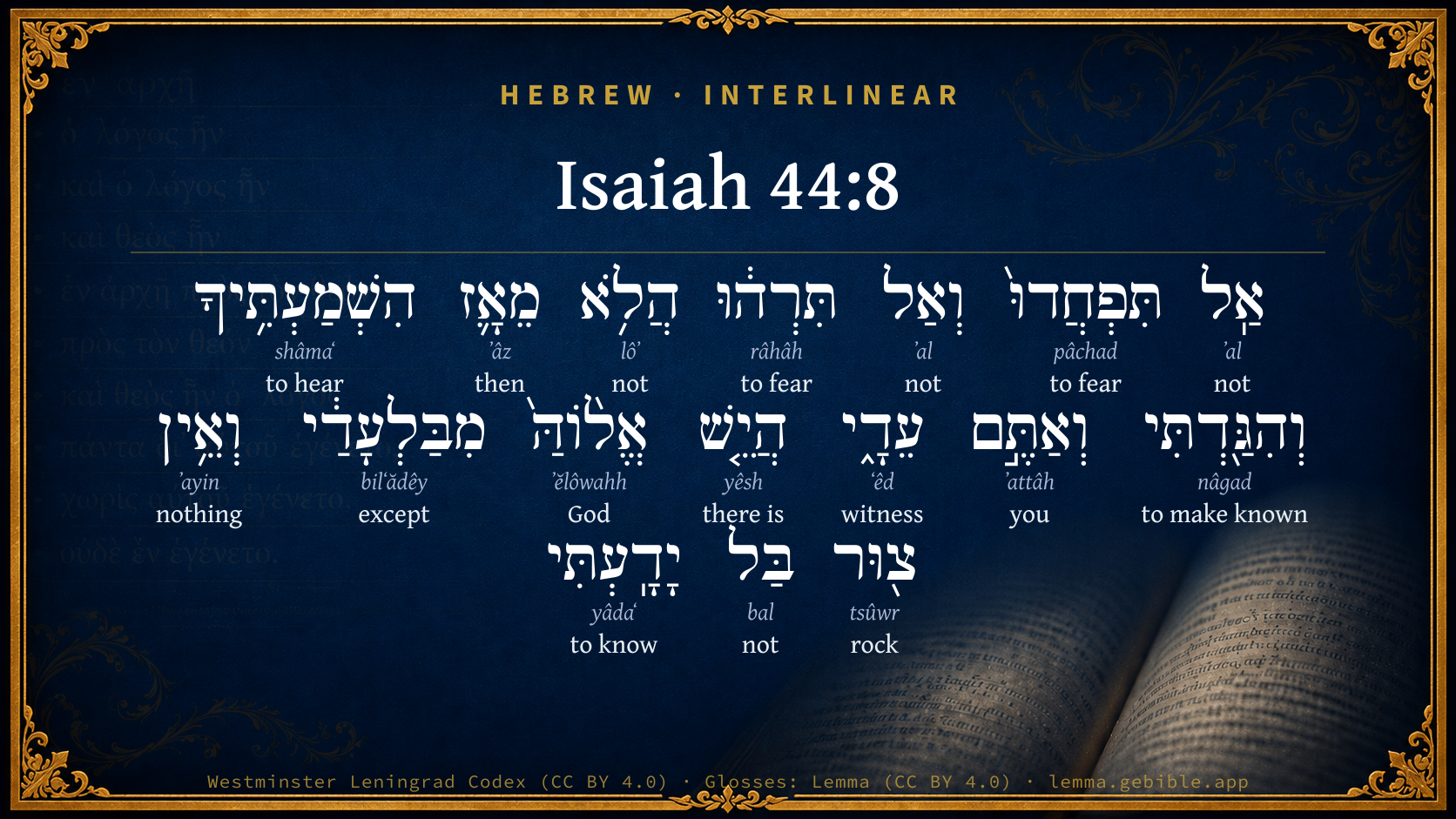
Hebrew (Westminster Leningrad Codex) Isaiah 44:8 appears in the Hebrew Old Testament. The text above is from the Westminster Leningrad Codex. Each word links to its Strong’s number, a concise gloss, and parsing drawn from the Open Scriptures Hebrew Bible morphology. Click any word for its full Brown-Driver-Briggs (BDB) entry.
Download image
Cite this verse

Isaiah 44:8 (World English Bible). Public Domain. Lemma interlinear Bible study tool, https://lemma.gebible.app/v/isaiah/44/8.

Show BibTeX & RIS
BibTeX
RIS
English Translation
Don't fear, neither be afraid: haven't I declared to you of old, and shown it? You are my witnesses. Is there a God besides me? Indeed, there is not. I don't know any Rock.
World English Bible · Public Domain
Highlights
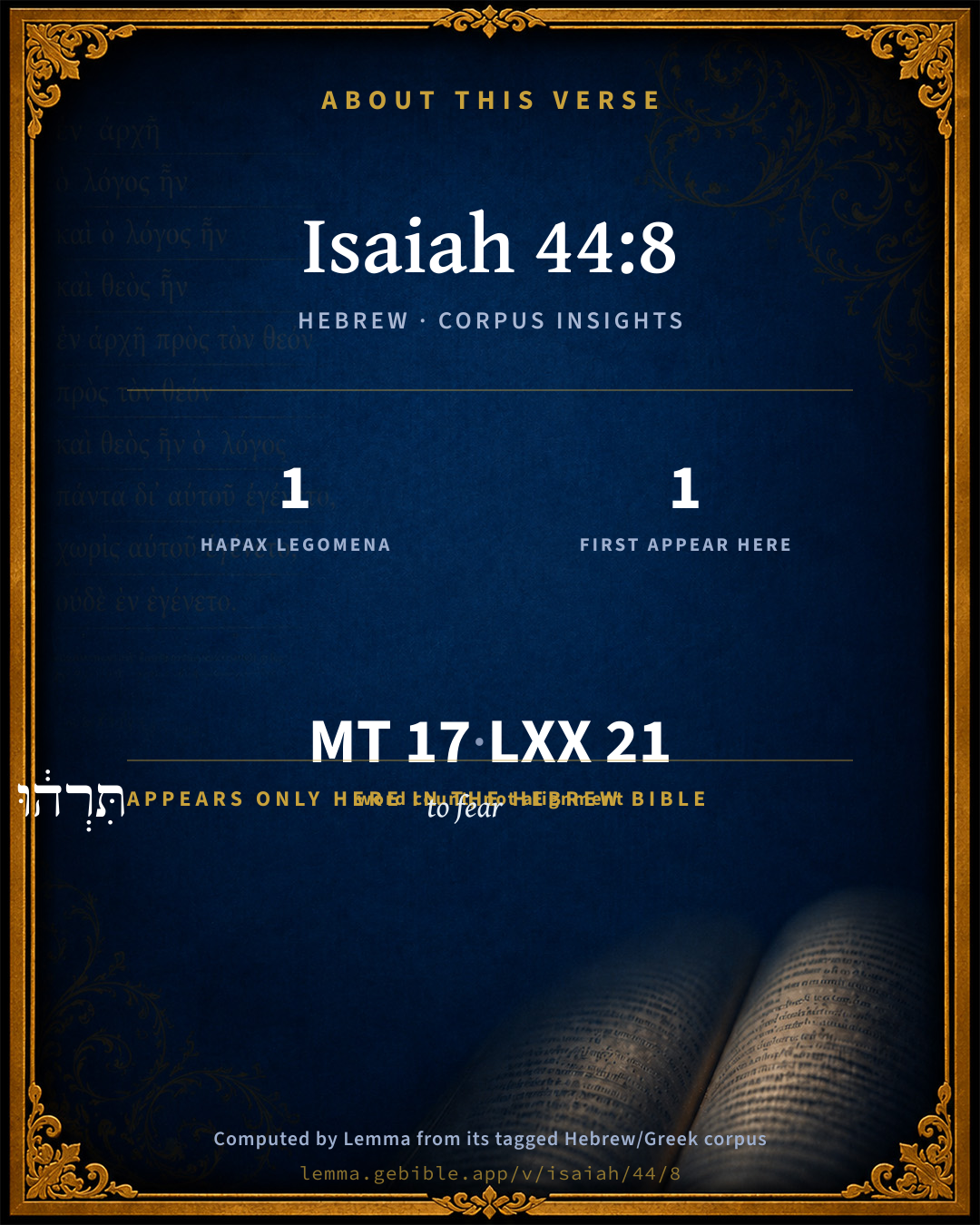
  • 1 hapax legomenon — only here in the Hebrew Bible
  • 1 first appearance in the Hebrew Bible
Full analysis ↓
Download a study sheet

One document with this verse’s original text, its word-by-word gloss line, the meaning frame, cross-references with their text, attributed commentary, and full source and license credits — printable, and it pastes into notes with its structure intact.

This verse Autodidact and up

Study sheet (.html) Plain text (.txt)

A passage Seminary Student

Up to 50 verses in one chapter. A passage sheet keeps up to 6 commentary sources and 12 cross-references per verse, in the order this page ranks them, and says so on the sheet whenever that leaves anything out. Ask for a single verse and you get the Autodidact verse sheet above.

Everything on this page stays free to read, with no account — the sheet is a download of what is already on screen, not access to it.

Want to remove ads? Support Godless Engineer
Compare translations 3

The same verse in 3 English versions, stacked beneath the original-language interlinear above. Click any original word for its lexicon entry.

Each is an independent rendering of the whole verse — the interlinear is not word-aligned to these translations.

Highlighted words mark where these versions differ — a whole-verse word diff, not a word-by-word alignment.

  • World English Bible Public Domain
    Don't fear, neither be afraid: haven't I declared to you of old, and shown it? You are my witnesses. Is there a God besides me? Indeed, there is not. I don't know any Rock.
  • King James Version Public Domain
    Fear ye not, neither be afraid: have not I told thee from that time, and have declared it? ye are even my witnesses. Is there a God beside me? yea, there is no God; I know not any.
  • unfoldingWord Literal Text CC BY-SA 4.0
    May you not fear, and may you not be afraid. Did I not made you hear from then and declare? And you my witnesses. Is there a God except me? For there is no rock, I know none.” q1

unfoldingWord Literal Text — © unfoldingWord, licensed CC BY-SA 4.0. Word-aligned USFM3 via Door43 (git.door43.org/unfoldingWord/en_ult).

Versions to compare (up to 4)

3 of 4 selected

Show all 18 translations

Every available English version of this verse, each an independent rendering of the whole verse.

  • World English Bible Public Domain
    Don't fear, neither be afraid: haven't I declared to you of old, and shown it? You are my witnesses. Is there a God besides me? Indeed, there is not. I don't know any Rock.
  • Berean Standard Bible Public Domain
    Do not tremble or fear. Have I not told you and declared it long ago? You are My witnesses! Is there any God but Me? There is no other Rock; I know not one.”
  • Majority Standard Bible Public Domain
    Do not tremble or fear. Have I not told you and declared it long ago? You are My witnesses! Is there any God but Me? There is no other Rock; I know not one.”
  • King James Version Public Domain
    Fear ye not, neither be afraid: have not I told thee from that time, and have declared it? ye are even my witnesses. Is there a God beside me? yea, there is no God; I know not any.
  • American Standard Version (1901) Public Domain
    Fear ye not, neither be afraid: have I not declared unto thee of old, and showed it? and ye are my witnesses. Is there a God besides me? yea, there is no Rock; I know not any.
  • Revised Version (1885) Public Domain
    Fear ye not, neither be afraid: have I not declared unto thee of old, and shewed it? and ye are my witnesses. Is there a God beside me? yea, there is no Rock; I know not any.
  • Geneva Bible (1599) Public Domain
    Feare ye not, neither be afraide: haue not I tolde thee of olde, and haue declared it? you are euen my witnesses, whether there be a God beside me, and that there is no God that I knowe not.
  • Douay-Rheims (1899) Public Domain
    Fear ye not, neither be ye troubled, from that time I have made thee to hear, and have declared: you are my witnesses. Is there a God besides me, a maker, whom I have not known?
  • Young's Literal Translation Public Domain
    Fear not, nor be afraid, Have I not from that time caused thee to hear, and declared? And ye `are' My witnesses, Is there a God besides Me? yea, there is none, A Rock I have not known.
  • Literal Standard Version CC BY-SA 4.0
    Do not fear, nor be afraid, || Have I not caused you to hear from that time, and declared? And you [are] My witnesses, || Is there a God besides Me? Indeed, there is none, || I have not known another Rock.”
  • Unlocked Literal Bible CC BY-SA 4.0
    Do not fear or be afraid. Have I not declared to you long ago, and announced it? You are my witnesses: Is there any God besides me? There is no other Rock; I know of none.”
  • unfoldingWord Literal Text CC BY-SA 4.0
    May you not fear, and may you not be afraid. Did I not made you hear from then and declare? And you my witnesses. Is there a God except me? For there is no rock, I know none.” q1
  • Darby Bible Public Domain
    Fear not, neither be afraid. Have I not caused thee to hear from that time, and have declared it? and ye are my witnesses. Is there a +God beside me? yea, there is no Rock: I know not any.
  • World Messianic Bible Public Domain
    Don’t fear, neither be afraid. Haven’t I declared it to you long ago, and shown it? You are my witnesses. Is there a God besides me? Indeed, there is not. I don’t know any other Rock.”
  • Webster's Bible Public Domain
    Fear ye not, neither be afraid: have not I told thee from that time, and have declared it? ye are even my witnesses. Is there a God besides me? verily there is no God; I know not any.
  • Free Bible Version CC BY-SA 4.0
    Don't tremble, don't be afraid! Didn't I tell you long ago what I was going to do? Didn't I explain it? You are my witnesses. Is there any God besides me? There is no other Rock—I don't know any!
  • Bible in Basic English Public Domain
    Have no fear, be strong in heart; have I not made it clear to you in the past, and let you see it? and you are my witnesses. Is there any God but me, or a Rock of whom I have no knowledge?
  • JPS Tanakh (1917) Public Domain
    Fear ye not, neither be afraid; have I not announced unto thee of old, and declared it? And ye are My witnesses. Is there a God beside Me? Yea, there is no Rock; I know not any.

Literal Standard Version (2020), Covenant Press — licensed CC BY-SA 4.0. Text via the HelloAO Bible API (eBible.org). Unlocked Literal Bible (unfoldingWord) — licensed CC BY-SA 4.0. Text via the HelloAO Bible API (eBible.org). unfoldingWord Literal Text — © unfoldingWord, licensed CC BY-SA 4.0. Word-aligned USFM3 via Door43 (git.door43.org/unfoldingWord/en_ult). Free Bible Version, Dr. Jonathan Gallagher — licensed CC BY-SA 4.0. Text via the HelloAO Bible API (eBible.org).

Word by word

More ways to search: Search by grammar → Find every occurrence → Compare this word →

Practice this passage: Drill this verse → Learn its vocabulary →

תִּרְה֔וּ
râhâh
H7297
“to fear”
Verb, Qal, Jussive, 2nd Person, Masculine, Plural
Part of Speech
Verb
Stem
Qal
Form
Jussive
Person
2nd Person
Gender
Masculine
Number
Plural
Full BDB Definition

Origin: a primitive root

TWOT: 2126

(Qal) to fear - meaning dubious
  1. אַֽל ʼal H408 “not” Particle, Negative
  2. תִּפְחֲדוּ֙ pâchad H6342 “to fear” Verb, Qal, Jussive, 2nd Person, Masculine, Plural
  3. וְאַל ʼal H408 “and · not” Conjunction + Particle, Negative
  4. הֲלֹ֥א lôʼ H3808 “not” Particle, Interrogative + Particle, Negative
  5. מֵאָ֛ז ʼâz H227 “from · then” Preposition + Adverb
  6. הִשְׁמַעְתִּ֥יךָ shâmaʻ H8085 “to hear · you” Verb, Hiphil, Perfect, 1st Person, Common, Singular + Suffix, Personal, 2nd Person, Masculine, Singular
  7. וְהִגַּ֖דְתִּי nâgad H5046 “and · to make known” Conjunction + Verb, Hiphil, Perfect, 1st Person, Common, Singular
  8. וְאַתֶּ֣ם ʼattâh H859 “and · you” Conjunction + Pronoun, Personal, 2nd Person, Masculine, Plural
  9. עֵדָ֑י ʻêd H5707 “witnesses · my” Noun, Common, Masculine, Plural, Construct + Suffix, Personal, 1st Person, Common, Singular
  10. הֲיֵ֤שׁ yêsh H3426 “there is” Particle, Interrogative + Particle, Demonstrative
  11. אֱל֨וֹהַּ֙ ʼĕlôwahh H433 “God” Noun, Common, Masculine, Singular, Absolute
  12. מִבַּלְעָדַ֔י bilʻădêy H1107 “from · except · me” Preposition + Preposition + Suffix, Personal, 1st Person, Common, Singular
  13. וְאֵ֥ין ʼayin H369 “and · nothing” Conjunction + Particle, Negative
  14. צ֖וּר tsûwr H6697 “rock” Noun, Common, Masculine, Singular, Absolute
  15. בַּל bal H1077 “not” Particle, Negative
  16. יָדָֽעְתִּי yâdaʻ H3045 “to know” Verb, Qal, Perfect, 1st Person, Common, Singular

About this verse

These counts appear in no published source. They are computed here, from the morphology-tagged text and Lemma’s own curated glosses. What Lemma adds →

17
words
16
distinct lemmas
Prophets
section

Notable vocabulary

1 hapax legomenon — a word that appears only here in the entire Hebrew Bible:

  • תִּרְה֔וּ to fear H7297

First appearance in Scripture

This word makes its first canonical appearance in the Hebrew Bible here:

  • תִּרְה֔וּ to fear H7297

Shared distinctive vocabulary

מִבַּלְעָדַ֔י except H1107 occurs in 16 verses of the Hebrew Bible. Also found in:

Grammatical profile

  • 5 verbs
  • 3 nouns
  • 1 pronoun
  • 1 preposition
  • 1 adverb
  • 6 particles

Verb forms

  • תִּפְחֲדוּ֙ Qal · Jussive
  • תִּרְה֔וּ Qal · Jussive
  • הִשְׁמַעְתִּ֥יךָ Hiphil · Perfect
  • וְהִגַּ֖דְתִּי Hiphil · Perfect
  • יָדָֽעְתִּי Qal · Perfect

Repetition

A word recurs within this verse — often emphatic in Hebrew:

  • אַֽל not H408 ×2

Hebrew & Septuagint length

In English translation the verse runs 34 words from the Hebrew and 29 from the Septuagint (LXX English) — closely comparable.

A rough comparison of the two English renderings, which tokenize alike — not a word-level alignment.

Word counts can differ between the Hebrew and the Greek without any difference in meaning — e.g. the Hebrew direct-object marker אֵת has no separate Greek word, and Greek often adds the article ὁ.

In the original languages it is 17 Hebrew tokens and 21 Greek tokens — but the two are counted differently (Hebrew bundles its prefixes and suffixes into one token; the Greek is in lemma form), so that isn’t a like-for-like length.

Cross-references

46

Topical passages linked to Isaiah 44:8 in the Treasury of Scripture Knowledge — connected by theme and wording, ordered by reader-vote popularity; previews shown in the World English Bible.

  • Isaiah 43:10 You are my witnesses, says Yahweh, and my servant whom I have chosen; that you may know and believe me, and understand that I am he: before me there was no God formed, neither shall there be after me.
  • 1 Samuel 2:2 There is none holy as Yahweh; For there is none besides you, Neither is there any rock like our God.
  • Deuteronomy 4:35 To you it was shown, that you might know that Yahweh he is God; there is none else besides him.
  • Deuteronomy 4:39 Know therefore this day, and lay it to your heart, that Yahweh he is God in heaven above and on the earth beneath; there is none else.
  • John 10:30 I and the Father are one."
  • Deuteronomy 32:39 See now that I, even I, am he, There is no god with me: I kill, and I make alive; I wound, and I heal; There is none who can deliver out of my hand.
  • 2 Samuel 22:32 For who is God, save Yahweh? Who is a rock, save our God?
  • Psalms 18:31 For who is God, except Yahweh? Who is a rock, besides our God,
  • Isaiah 44:6 Thus says Yahweh, the King of Israel, and his Redeemer, Yahweh of Hosts: I am the first, and I am the last; and besides me there is no God.
  • Joel 2:27 You will know that I am in the midst of Israel, And that I am Yahweh, your God, and there is no one else; And my people will never again be disappointed.
  • John 1:1 In the beginning was the Word, and the Word was with God, and the Word was God.
  • Isaiah 45:5–6 I am Yahweh, and there is none else; besides me there is no God. I will gird you, though you have not known me;
  • Isaiah 46:9 Remember the former things of old: for I am God, and there is none else; [I am] God, and there is none like me;
  • Isaiah 44:2 Thus says Yahweh who made you, and formed you from the womb, who will help you: Don't be afraid, Jacob my servant; and you, Jeshurun, whom I have chosen.
  • Genesis 15:13–21 He said to Abram, "Know for sure that your seed will live as foreigners in a land that is not theirs, and will serve them. They will afflict them four hundred years.
  • Jeremiah 30:10–11 Therefore don't you be afraid, O Jacob my servant, says Yahweh; neither be dismayed, Israel: for, behold, I will save you from afar, and your seed from the land of their captivity; and Jacob shall return, and shall be quiet and at ease, and none shall make him afraid.
  • Daniel 2:28 but there is a God in heaven who reveals secrets, and he has made known to the king Nebuchadnezzar what shall be in the latter days. Your dream, and the visions of your head on your bed, are these:
  • Daniel 4:25 that you shall be driven from men, and your dwelling shall be with the animals of the field, and you shall be made to eat grass as oxen, and shall be wet with the dew of the sky, and seven times shall pass over you; until you know that the Most High rules in the kingdom of men, and gives it to whoever he will.
  • Daniel 5:23–30 but have lifted up yourself against the Lord of heaven; and they have brought the vessels of his house before you, and you and your lords, your wives and your concubines, have drunk wine from them; and you have praised the gods of silver and gold, of brass, iron, wood, and stone, which don't see, nor hear, nor know; and the God in whose hand your breath is, and whose are all your ways, you have not glorified.
  • Daniel 6:22 My God has sent his angel, and has shut the lions' mouths, and they have not hurt me; because as before him innocence was found in me; and also before you, O king, have I done no hurt.
  • Acts 17:23–31 For as I passed along, and observed the objects of your worship, I found also an altar with this inscription: 'TO AN UNKNOWN GOD.' What therefore you worship in ignorance, this I announce to you.
  • Genesis 28:13–15 Behold, Yahweh stood above it, and said, "I am Yahweh, the God of Abraham your father, and the God of Isaac. The land whereon you lie, to you will I give it, and to your seed.
  • Genesis 46:3 He said, "I am God, the God of your father. Don't be afraid to go down into Egypt; for there I will make of you a great nation.
  • Genesis 48:19 His father refused, and said, "I know, my son, I know. He also will become a people, and he also will be great. However, his younger brother will be greater than he, and his seed will become a multitude of nations."
  • Genesis 49:1–28 Jacob called to his sons, and said: "Gather yourselves together, that I may tell you that which will happen to you in the days to come.
  • Leviticus 26:1–46 "'You shall make for yourselves no idols, neither shall you raise up an engraved image or a pillar, neither shall you place any figured stone in your land, to bow down to it: for I am Yahweh your God.
  • Deuteronomy 4:25–31 When you shall father children, and children's children, and you shall have been long in the land, and shall corrupt yourselves, and make an engraved image in the form of anything, and shall do that which is evil in the sight of Yahweh your God, to provoke him to anger;
  • Deuteronomy 28:1–68 It shall happen, if you shall listen diligently to the voice of Yahweh your God, to observe to do all his commandments which I command you this day, who Yahweh your God will set you on high above all the nations of the earth:
  • Deuteronomy 32:4 The Rock, his work is perfect; For all his ways are justice: A God of faithfulness and without iniquity, Just and right is he.
  • Deuteronomy 32:31 For their rock is not as our Rock, Even our enemies themselves being judges.
  • Ezra 1:2 Thus says Cyrus king of Persia, All the kingdoms of the earth has Yahweh, the God of heaven, given me; and he has charged me to build him a house in Jerusalem, which is in Judah.
  • Ezra 8:22 For I was ashamed to ask of the king a band of soldiers and horsemen to help us against the enemy in the way, because we had spoken to the king, saying, The hand of our God is on all those who seek him, for good; but his power and his wrath is against all those who forsake him.
  • Proverbs 3:25–26 Don't be afraid of sudden fear, Neither of the desolation of the wicked, when it comes:
  • Isaiah 30:29 You shall have a song as in the night when a holy feast is kept; and gladness of heart, as when one goes with a pipe to come to the mountain of Yahweh, to the Rock of Israel.
  • Isaiah 41:10–14 Don't you be afraid, for I am with you; don't be dismayed, for I am your God; I will strengthen you; yes, I will help you; yes, I will uphold you with the right hand of my righteousness.
  • Isaiah 42:9 Behold, the former things have happened, and new things do I declare. Before they spring forth I tell you of them.
  • Isaiah 43:12 I have declared, and I have saved, and I have shown; and there was no strange [god] among you: therefore you are my witnesses, says Yahweh, and I am God.
  • Isaiah 48:5 therefore I have declared it to you from of old; before it came to pass I shown it you; lest you should say, My idol has done them, and my engraved image, and my molten image, has commanded them.
  • Jeremiah 10:7 Who should not fear you, King of the nations? for to you does it appertain; because among all the wise men of the nations, and in all their royal estate, there is none like you.
  • Daniel 2:47 The king answered to Daniel, and said, Of a truth your God is the God of gods, and the Lord of kings, and a revealer of secrets, seeing you have been able to reveal this secret.
  • Daniel 3:16–28 Shadrach, Meshach, and Abednego answered the king, Nebuchadnezzar, we have no need to answer you in this matter.
  • John 6:10 Jesus said, "Have the people sit down." Now there was much grass in that place. So the men sat down, in number about five thousand.
  • Acts 1:8 But you will receive power when the Holy Spirit has come upon you. You will be witnesses to me in Jerusalem, in all Judea and Samaria, and to the uttermost parts of the earth."
  • Acts 14:15 "Men, why are you doing these things? We also are men of like passions with you, and bring you good news, that you should turn from these vain things to the living God, who made the sky and the earth and the sea, and all that is in them;
  • Hebrews 12:1 Therefore let us also, seeing we are surrounded by so great a cloud of witnesses, lay aside every weight and the sin which so easily entangles us, and let us run with patience the race that is set before us,
  • 1 John 1:2 (and the life was revealed, and we have seen, and testify, and declare to you the life, the eternal life, which was with the Father, and was revealed to us);

Cross-references courtesy of OpenBible.info (CC BY 4.0).

Hebrew and Greek witnesses Masoretic Hebrew ↔ Greek Septuagint

The same verse in the two great witnesses to the Old Testament, shown verse-for-verse.

These are two independent witnesses, not word-aligned to each other, and the Septuagint is shown in lemma (dictionary) form.

Hebrew Isaiah 44:8 Masoretic · Westminster Leningrad Codex

אַֽל תִּפְחֲדוּ֙ וְאַל תִּרְה֔וּ הֲלֹ֥א מֵאָ֛ז הִשְׁמַעְתִּ֥יךָ וְהִגַּ֖דְתִּי וְאַתֶּ֣ם עֵדָ֑י הֲיֵ֤שׁ אֱל֨וֹהַּ֙ מִבַּלְעָדַ֔י וְאֵ֥ין צ֖וּר בַּל יָדָֽעְתִּי

Don't fear, neither be afraid: haven't I declared to you of old, and shown it? You are my witnesses. Is there a God besides me? Indeed, there is not. I don't know any Rock.

World English Bible · Public Domain

Greek LXX Isaiah 44:8 Septuagint · lemma form

μή παρακαλύπτω οὐ ἀπό ἀρχή ἐνωτίζομαι καί ἀποἀγγέλλω σύ μάρτυς σύ εἰμί εἰ εἰμί θεός πλήν ἐγώ καί οὐ εἰμί τότε

Hide not yourselves, nor go astray: have you⌃ not heard from the beginning, and have not I told you? you⌃ are witnesses if there is a God beside me.

LXX2012 (modern English Septuagint) · Public Domain

On this verse, Albert Barnes' Notes on the Bible discusses the Septuagint’s reading. Read the note in Commentary ↓

Hebrew: Westminster Leningrad Codex (CC BY 4.0). Greek: Septuagint (public domain); English from LXX2012 (modern English Septuagint) (Public Domain). How the Septuagint differs from the Hebrew →

Targum (Aramaic paraphrase)

1

The Targum is the ancient Jewish Aramaic paraphrase of the Hebrew Scriptures — an interpretive translation, not the Hebrew text itself. Onkelos (literal) and Pseudo-Jonathan (expansive) render the Torah, and Jonathan the Prophets. Coverage is partial: where no permissively-licensed English translation exists for a verse, only the Aramaic is shown. This is verse-level text, not a word-by-word alignment to the Hebrew.

  1. Targum Jonathan Prophets (Joshua–Malachi)
    לָא תִדַחֲלוּן וְלָא תִתַּבְּרוּן הֲלָא מִבְּכֵן בְסַרְתָּךְ וְחַוֵיתִי וְאַתּוּן סָהֲדִין קֳדָמַי הֲאִית אֱלָהָא בַּר מִנִי וְלֵית דְתַקִיף אֱלָהֵן דְמִן קֳדָמַי מִתְיְהַב לֵיהּ תְּקוֹף:

    Fear ye not, neither be afraid: have not I told thee from that time, and have declared it? ye also are my witnesses, that there is no God beside me, and there is none strong, except he to whom strength is given from me.

    Targum Jonathan — Aramaic: “Mikraot Gedolot” (public domain). English: “Sefaria Community Translation” (CC0 1.0 (public-domain dedication)); “London "Chaldee Paraphrase," 1871” (public domain). Text via Sefaria.

Commentary

Notes on Isaiah 44:8 from classic Christian and Jewish commentators (each source and its license shown beneath its notes). The classic Christian expositions comment on the surrounding passage and are grouped to its opening verse, so a note may address several verses; the Jewish commentaries on the Tanakh (Rashi and others) are per-verse, so they appear only where the commentator wrote on this verse.

Lemma curates 59 commentaries, every one of them public domain or Creative Commons licensed, each selected and text-cleaned for this edition rather than reprinted as found. About our sources →

Trapp's Complete Commentary

John Trapp

Isa 44:8 Fear ye not, neither be afraid: have not I told thee from that time, and have declared [it]? ye [are] even my witnesses. Is there a God beside me? yea, [there is] no God; I know not [any].

Ver. 8. Have I not told thee from that time?] Ever since I made thee mine ancient people, well affected to old truths, and distasting novel opinions.

Is there a God besides me?] Vehementi spiritu hoc quaerit, et gravitate magna respondet, There is no God, no other God: I know not any. This was spoken by the prophet, say some, in the days of Ahaz, that notorious idolater.

John Trapp, A Commentary or Exposition upon All the Books of the Old and New Testament (1647–1656) — public domain. Text from a community e-Sword module.

The Biblical Illustrator

Joseph S. Exell

Isa_44:8

Fear ye not

Christian courage

Boldness for God, and boldness in dealing with God, should form part of the Christian character; and the Word of God encourages this Christian boldness.

We are repeatedly exhorted to fear not, to be of good courage.

I. WHY ARE WE TO EXPECT THAT THE PEOPLE OF GOD WOULD BE LIKELY TO FEAR?

1. They have always been a persecuted people.

2. Many a man, before he is decided for God, finds out that, if he makes up his mind to enter into the service of the Lord, his worldly interest is nearly sure to suffer.

3. Others, again, know their personal interest for their worldly circumstances. They know, for instance, their birth, their wealth, their talent. Then perhaps they are called of God to think seriously about their eternal state; and the result is, that they feel in their own minds, If I forsake all this outward display of means, and show that I do not value it as I have hitherto done, my influence amongst others will very greatly suffer.

4. There is many a man, if he would serve the Lord, must make a sacrifice of many of his personal and worldly comforts.

5. Then, take the case of doctrines. There are many who imbibe from their earliest days the idea that religion is gloomy, that God is an object of terror, that death must be misery; they live in no thought of the Lords coming again in joy and happiness, and heaven itself, with its delights and its pleasures, is never really considered. Now, all these things frequently produce fear in our minds.

II. THE REASON WHY WE SHOULD NOT FEAR. The reason is, that the Lord thus argues with us: Have not I told thee from that time, and have declared it? That is, God challenges man to deny this fact, that He knows the end from the beginning, and has proved that He knows it by foretelling the end from the beginning. This is the manner in which God argues in other passages. (Isa_42:9). God knows the end; God foresees the means, and foreseeing the means He exercises control over those means--everything that happens therefore, great or small, is under the control of God, who orders all things after the counsel of His own will, and consequently we have nothing to fear, because we are in His hands who doeth all things well. This is the manner in which we find the argument used in Isa_51:12.

III. Having thus stated the Christians duty as well as his privilege--not to fear; and having seen what the reason is, that God has foretold all things, and therefore decreed and settled all things from the beginning, HE THEN CHALLENGES HIS PEOPLE in these words--Ye are even My witnesses, and therefore urges upon them, by the strongest possible personal appeal, to bear testimony to the fact that the Lord He is God, and our God too, for ever and for ever. (M. Villiers, M. A.)

The Biblical Illustrator, edited by Joseph S. Exell (c. 1880s–1900s) — public domain. Text from a community e-Sword module.

The Preacher's Complete Homiletical Commentary

Joseph S. Exell (gen. ed.)

CHRISTIAN COURAGE

Isa_44:8. Fear not, neither be afraid, &c.

Boldness for God, and boldness in dealing with God, should form part of the Christian character; and the Word of God, from the beginning to the end, encourages this Christian boldness. We are repeatedly exhorted to “fear not,” to “be of good courage.”

I. WHY GOD’S PEOPLE ARE LIKELY TO FEAR.

1. Because they are few in number and “peculiar.” Many are called, but few are chosen. “Fear not, little flock,” &c.

2. The result of this is that they have always been a persecuted people (Gen_5:29; Isa_41:10-11).

3. Because they are called to live not by sight, but by faith, and therefore to make present sacrifices (Mat_19:2-30; Php_3:4-7).

II. WHY THEY SHOULD NOT FEAR. Because the Lord thus argues with, us: “Have not I,” &c. God challenges man to deny this fact, that He knows the end from the beginning, and has proved that He knows it by foretelling the end from the beginning. [1414] This is the manner in which God argues in other passages (Isa_42:9; Deu_28:47-49; Mat_26:31). So, again, the Lord has foretold to us everything that is required for our deliverance in the advent and work of Christ (Isa_9:6; Zec_13:7; Dan_9:26; Isa_53:5). These prophecies have been fulfilled to the very letter. Hence, God knows the end; foresees the means, and exercises control over those means. Everything that happens, great or small, is under the control of God, and therefore we have nothing to fear, because we are in His hands who “doeth all things well.” In this manner we find the argument used (Isa_51:12).

[1414] See also Isa_44:7 : “And who, as I, shall call,” &c. Foreknowledge is the exclusive prerogative of God; it is exemplified in the prophetic history of His people; it extends to things remote as well as near; it supplies a strong argument for unwavering confidence.—Lyth.

III. THE PERSONAL APPEAL WHICH THE LORD MAKES TO HIS PEOPLE. “Ye are even my witnesses,” thus urging upon them, by the strongest possible personal appeal, to bear testimony to the fact that He is their God for ever and ever. He would have all His people speak of His faithfulness (Isa_43:10-13). The duty from which many shrink, from a want of simple courage. Many ways in which we may be witnesses.

1. By a consistent life. Should be a “living epistle.”

2. By speaking for the cause of truth and holiness.

3. By zeal for the salvation of souls.

Are you amongst the real witnesses for God?—M. Villiers, M.A.: The Pulpit, vol. lxix. pp. 129–134).

The Preacher's Complete Homiletical Commentary (gen. ed. Joseph S. Exell; Funk & Wagnalls, c. 1892) — public domain (pre-1929). A full-Bible homiletical/sermon-outline anthology covering 65 of 66 books (2 John is absent from the source module). Text from a community e-Sword module.

Geneva Bible (1599)

Geneva Bible translators

Read Isa. 43:10.

Geneva Bible (1599) marginal notes — public domain. Text via Bolls.life.

Jamieson, Fausset & Brown

Robert Jamieson, A. R. Fausset & David Brown

be afraid--literally, "be astounded," or "distracted with fear."

from that time--namely, from the time that "I appointed the ancient people" (Isa 44:7). From the time of Abraham's call, his family were the depositories of the predictions of the Redeemer, whereas the promise of Cyrus was not heard of till Isaiah's time; therefore, the event to the prediction and accomplishment of which God appeals in proof of His sole Godhead, is the redemption of man by a descendant of Abraham, in whose person "the ancient people" was first formally "appointed." The deliverance of the Jews, by Cyrus, is mentioned afterwards only as an earnest of that greater mercy [HORSLEY].

no God--Hebrew, tsur, "rock" (Deu 32:4); that is, a stronghold to take refuge in, and a solid foundation to build on.

Jamieson, Fausset & Brown — Commentary Critical and Explanatory on the Whole Bible (1871) — public domain (CC PDM 1.0). Text via the HelloAO Bible API.

Adam Clarke's Commentary

Verse 8. Fear ye not] תרהו tirehu never occurs. Perhaps it should be תיראו tireu, fear ye. Two MSS. read תהרו tirehu, and one of mine taharu.

Adam Clarke's Commentary on the Bible (1810–1826) — public domain. Text from a community e-Sword/MySword module.

Ellicott's Commentary for English Readers

(8) Yea, there is no God . . .—Literally, no Rock. That word, as expressing eternal strength, being used, as in Deu_32:4; 2Sa_22:3; 2Sa_23:3, as a Divine name.

A Bible Commentary for English Readers, edited by Charles John Ellicott (1878–1897) — public domain. Text from a community e-Sword module.

The Cambridge Bible for Schools and Colleges

gen. ed. J. J. S. Perowne

8. Fear ye not] in the coming convulsions; the ground of confidence is that Jehovah has proved His control over these events by foretelling them. The verb for be afraid does not occur elsewhere.

from that time] Rather beforehand, or, from of old; as ch. Isa_45:21, Isa_48:3; Isa_48:5; Isa_48:7.

and ye are my witnesses (R.V.)] Cf. ch. Isa_43:10; Isa_43:12.

no God] no Rock, as R.V. Cf. Deu_32:4, etc.

The Cambridge Bible for Schools and Colleges (gen. ed. J. J. S. Perowne; Cambridge University Press, 1878–1918) — public domain. Text from a community e-Sword module.

John Gill's Exposition

Fear ye not, neither be afraid,.... Of the accomplishment of prophecies and promises, and of professing the true God, and of adhering to Jesus Christ, the only Redeemer and Saviour; or of the gods of the Heathens, and of persecuting tyrants, and what they can do against you, and in favour of their idolatrous religion:

have not I told thee from that time, and have declared it? what should come to pass, before it did, even everything that has since the appointment of the ancient people; and particularly what troubles and persecutions the apostles, ministers of the word, the first Christians should meet with among the Heathens, for professing and propagating the Gospel, and what success they should meet with, which came to pass accordingly:

ye are even my witnesses; as especially the apostles were, who had it from Christ's own mouth, that they should be hated and persecuted for the sake of the Gospel, and should be successful wherever they came; as they also were his witnesses in Jerusalem, and Judea, and Samaria, and unto the uttermost parts of the earth, of his person, doctrine, miracles, death, resurrection, and ascension to heaven, Act 1:8,

is there a God besides me? that is a true God; for there were many fictitious and false deities, but none omniscient and omnipotent, that could foretell future events, and accomplish them as he did; there is no god but the one God, Father, Son, and Spirit; for this an appeal is made to the witnesses:

yea, there is no God, I know not any; or, there is "no rock" (a); or, is there any? a word used for God, Deu 32:4, there is no rock to build upon for salvation, no rock for shelter and safety, but Christ the rock of ages, on which the church is built, and the gates of hell cannot prevail against it, Mat 16:18, and if God, who is omniscient, knows none else, there can be no other.

(a) "nulls rupes", Junius & Tremellius, Piscator; "non est petra", Montanus, Cocceius; "estne rupes?" Vitringa.

John Gill's Exposition of the Whole Bible (1746–1763) — public domain (CC PDM 1.0). Text via the HelloAO Bible API.

Albert Barnes' Notes on the Bible

Fear ye not, neither be afraid - (see the notes at Isa 41:10). The word rendered here ‘be afraid,’ occurs nowhere else in the Bible. There can be no doubt, however, in regard to its meaning. The Septuagint renders it, Μηδέ πλανᾶσθε Mēde planasthe - ‘Neither be deceived.’ All the other ancient versions express the sense to fear, to be afraid (Gesenius’ Lexicon on the word ירה yârahh).

Have not I told thee from that time - Have I not fully declared from the very commencement of your history as a people, in the main what shall occur?

Ye are even my witnesses - (See the notes at Isa 43:12).

Is there a God besides me? - This is a strong mode of affirming that there is no God besides Yahweh (see the note at Isa 44:6).

Yea, there is no God - Margin, ‘Rock’ (צור tsûr). The word rock is often applied to God (see the note at Isa 30:29; compare Deu 32:4, Deu 32:30-31; Psa 19:14; Psa 31:2-3; Psa 42:9; et soepe al. The idea is taken from the fact that a lofty rock or fastness was inaccessible by an enemy, and that those who fled there were safe.

Albert Barnes' Notes on the Bible (1834–1885) — public domain. Text from a community e-Sword/MySword module.

Haydock's Catholic Bible Commentary

Witnesses. The history of the true religion is its best proof, chap. xliii. 9, 10. --- Known. Ruled, consequently no other can be truly God. (Calmet) --- Idolaters are foolish, trusting in those who cannot announce future events. (Worthington)

George Leo Haydock (1774–1849), Haydock's Catholic Family Bible and Commentary, 1859 edition — public domain. Excludes Psalms (Douay-Rheims chapter numbering differs from Protestant) and Deuterocanonical books (Catholic canon only).

Matthew Poole's English Annotations

Have not I told thee? thee, O Israel, whom he bids not to fear. The sense is, I call you Israelites to bear me witness, whether I have not, from time to time, acquainted you with things to come, such as your sojourning in a strange land for four hundred years, and your deliverance and happiness after that time, Gen 15:13,14, and many things of the like nature?

From that time; from the time when I appointed the ancient people, as I now said, Isa 44:7. These were pregnant instances of God’s prediction of things to come, not only from the beginning of the Jewish commonwealth, but even from the first ages of the world, as unto Enoch, Jude 14, and unto Noah, Ge 6 13, to say nothing of what other authors relate concerning Adam and Seth.

Have declared it; have published it to the world in my sacred records.

My witnesses, both of my predictions, and of the exact agreeableness of events to them.

Is there a God besides me? judge by this character whether I be not the only true God.

Yea, there is no God; I know not any; if any of you be wiser than I am, I am willing to be informed. It is a sarcastical speech. But this clause may be, and is by others, taken interrogatively, do not I know it? Is it not a certain and undeniable truth, that there is no other God?

Matthew Poole's English Annotations on the Holy Bible (1683–1685) — public domain. Text from a community e-Sword/MySword module.

The Pulpit Commentary

Fear ye not. (comp. Isa_41:10, 13 43:5; ver. 2) Israel need not fear that they will be forgotten or forsaken. God has told them from that time, or, from the beginning, (Isa_48:3, Isa_48:7) and declared to them, what he is about to do viz, destroy Babylon, and give them deliverance. He will assuredly do as he has said. Ye are even my witnesses. (comp. Isa_43:10, Isa_43:12) There is no God; literally, there is no Rock; i.e. no sure ground of trust or confidence. (comp. Isa_17:10 Isa_26:4 Isa_30:29; and see the comment on Isa_17:10)

God"s witness to his own rights.

"There is no God; I know not any." A most striking exclamation. God becomes a witness to his own claims, and the last, the supreme, witness. The thought here so grandly and sublimely expressed is one which occurs also in the sacred book of the Buddhists. In the address of Gotama "Bhagavat," are the following sentences: "Even I was even at first, not any other thing, that which exists, unperceived, supreme; afterwards I am that which is, and he who must remain am I" The exclamation sets us upon thinking what witnesses we have to the Divine rights. When all are carefully reviewed, it must be felt that, as all beings and all creation are really dependent on one great Being, the supreme witness must be that Being"s witness to himself. Our sphere is strictly limited to the human and the earthly, and, so far as our experience goes, there may be some other God away in other spheres which we cannot reach. No man can prove that there is no other God beside Jehovah. But Jehovah fills all spheres: he, and he alone, can tell us whether, in any sphere, there is any rival deity. In a truly sublime way, the prophet presents him as looking with an all-searching eye into every corner of unbounded space, and then turning to us and saying, "There is no God beside me; I know not any." The passage stands in close relation with the supposed claims of idol-gods; and we should carefully note that the idol-figures are first of all representations of qualities, or powers, which are supposed to exist, though unseen, and are usually personified or thought of as living beings. Only in the degraded stage are idol-figures treated as if they themselves were gods. In this connection two points may be illustrated, and practical lessons from each may be enforced.

I GOD ABSORBS IN HIMSELF ALL THE IDEAS WHICH IDOLATRY SEEKS TO EMBODY. Poetically conceived, the figures of Baal or Jupiter are only representations of certain powers of life, warmth, rule, wisdom, etc., which are living, unseen beings. Our God says there are no such beings. Every one of these powers is in himself. He is Zeus, and Baal, and Venus, and Diana, and Moloch, so far as any of these represent necessary powers belonging to Deity. We must not divide him into many beings; he is only One. So far as idols are mere creations of men, there is nothing existing that corresponds to them. So far as they represent real powers, these powers all meet in the One God our God!

II GOD DEMANDS ALL THE WORSHIP WHICH IDOLATRY DISTRIBUTES OVER MANY GODS. True worship is both word and work, profession and service. Men who divide God into gods have their favourite deity. God cannot be divided. And the law for every creature made in his image is, "Thou shalt love the Lord thy God with all thy heart, and all thy mind, and all thy soul, and all thy strength. R.T.

The Pulpit Commentary (1880–1919), ed. H.D.M. Spence-Jones & Joseph S. Exell — public domain. Text from a community e-Sword module.

John Wesley's Explanatory Notes

Ye - Thee, O Israel, whom he bids not to fear. Told thee - Even from the first ages of the world. Declared - Have published it to the world in my sacred records. Witnesses - Both of my predictions, and of the exact agreeableness of events to them.

John Wesley, Explanatory Notes Upon the Whole Bible (1754–1765) — public domain. Text via the GEBible commentary corpus.

Keil & Delitzsch

C. F. Keil & F. Delitzsch

Of course, none of the heathen gods could in any way answer to the challenge. So much the more confident might Israel be, seeing that it had quite another God. "Despair ye not, neither tremble: have not I told thee long ago, and made known, and ye are my witnesses: is there a God beside me? And nowhere a rock; I know of none." The Jewish lexicographers derive תּרהוּ (with the first syllable closed) from רהה (רה); whereas modern lexicographers prefer some of them to read תּרהוּ, tı̄rehū, from ירהּ (Ges., Knobel), and others תּיראוּ (Ewald). But the possibility of there being a verb רהה, to tremble or fear, cannot for a moment be doubted when we think of such words as ירא, ירע, compare also Arab. r'h (applied to water moving to and fro). It was not of the heathen deities that they were directed not to be afraid, as in Jer 10:5, but rather the great catastrophe coming upon the nations, of which Cyrus was the instrument. In the midst of this, when one nation after another would be overthrown, and its tutelar gods would prove to be worthless, Israel would have nothing to fear, since its God, who was no dumb idol, had foretold all this, and that indeed long ago (מאז, cf., מראשׁ, Isa 41:26), as they themselves must bear witness. Prophecies before the captivity had foretold the conquest of Babylon by Medes and Elamites, and the deliverance of Israel from the Babylonian bondage; and even these prophecies themselves were like a spirit's voice from the far distant past, consoling the people of the captivity beforehand, and serving to support their faith. On the ground of such well-known self-manifestations, Jehovah could well ask, "Is there a God beside me?" - a virtual denial in the form of an interrogation, to which the categorical denial, "There is no rock (i.e., no ground of trust, Isa 26:4; Isa 17:10), I know of none (beside me)," is attached.

Keil & Delitzsch — Biblical Commentary on the Old Testament (1861–1891) — public domain (CC PDM 1.0). Text via the HelloAO Bible API. (Old Testament only.)

J. A. Alexander on Isaiah

Joseph Addison Alexander

“Quake not and fear not; have I not since then let thee hear and told (thee), and are ye not my witnesses? Is there a God without me? And there is no rock, know not (any).” The alternation of the singular and plural form in reference to Israel, is peculiarly appropriate to an ideal or collective person, and in strict agreement with the usage of the Pentateuch, especially with that of Deuteronomy, in which the same apparent confusion of numbers is not a mere occasional phenomenon, but one of perpetual occurrence. Since then may refer to the event mentioned in the preceding verse, viz. the constitution of the "ancient people.” And ye are my witnesses is usually construed as an independent clause; but a possible construction is to include it in the question as above. Here, as in many other cases, God is called a Rock, as being the refuge of his people, and the firm foundation of their hopes.

Joseph Addison Alexander, The Prophecies of Isaiah (1846–1847; New York: Scribner, 1870–1878) — public domain. Text from a community e-Sword module.

unfoldingWord translationNotes

Door43 World Missions Community

General Information:

Yahweh continues speaking to the people of Israel.

Do not fear or be afraid

Yahweh uses two similar expressions in order to strengthen his encouragement. AT: "Do not be afraid" (See: Doublet)

Have I not declared to you long ago, and announced it?

Yahweh uses this question to emphasize that he is the one who predicted the events that have now happened. This can be translated as a statement. The word "announced" means basically the same thing as "declared." AT: "I declared these things to you long ago." (See: Rhetorical Question and Doublet)

Is there any God besides me?

Yahweh uses a question again to emphasize that there is no other God. This rhetorical question can be translated as a statement. AT: "There is no God besides me." (See: Rhetorical Question)

There is no other Rock

Yahweh speaks of himself as if he were a large rock under which people can find shelter. This means he has the power to protect his people. (See: Metaphor)

translationWords

fear

declare

testimony

unfoldingWord translationNotes — © Distant Shores Media and the Door43 World Missions Community, licensed CC BY-SA 4.0. Source: git.door43.org/Door43/en_tn.

Rashi

Rabbi Shlomo Yitzchaki (Rashi)

and be not dismayed Heb. תִּרְהוּ. There is no similar word, and its interpretation according to its context is like תֵּחַתּוּ, be not dismayed from making My name known among the heathens (nations [K’li Paz and mss.]).

let you hear from Mount Sinai, and I told you there that there is no God besides Me.

and you are My witnesses that I opened for you seven heavens and showed you that there is no other, and you are My witnesses to this thing that there is no God besides Me.

and there is no rock I did not know Jonathan renders: And there is no strong one unless he is given strength by Me.

I did not know Heb. יָדַעְתִּי. An expression similar to (Exodus 33:17) “And I knew you by name (וָאֵדָעֲךָ)”; (Deut. 2:7) “He knew (יָדַע) your going”; (Hosea 13:5) “I knew you (יְדַעְתִּיךָ) in the desert.”

Rashi on the Tanakh — English translations: “The Judaica Press complete Tanach with Rashi, translated by A. J. Rosenberg” (CC BY 4.0); “Pentateuch with Rashi's commentary by M. Rosenbaum and A.M. Silbermann, 1929-1934” (public domain); “The Metsudah Tanach series, Lakewood, N.J” (CC BY 4.0); and “The Book of Joshua, Metsudah Publications, 1997” (CC BY 4.0). Text via Sefaria.

Ibn Ezra

Rabbi Abraham ibn Ezra

אל תרהו Be ye not afraid, תרהו is hap. leg; those that identify it with תראו are wrong, on account of the absence of the radical י —

Be not afraid, when those calamities befall Babylon.

Have I not told thee of it long ago? Ye are even my witnesses, and you will see whether there is a God beside me; There is no God בל ירעתי whom I know not to be vain and powerless. According to some, whom I chastised not; comp. ויודע and he chastised (Jud. 8:16). I think that the prophet speaks here of the host of heaven.

Ibn Ezra on the Tanakh — English translations: “Sefaria Community Translation” (CC0 1.0 (public-domain dedication)); “Yalkut, Sifsei Chachomim Chumash, Metsudah Publications, 2009” (CC BY 4.0); and “Commentary of Ibn Ezra on Isaiah - trans. by M. Friedlander, 1873” (public domain). Text via Sefaria.

Lesson kit

Teaching starters — assembled from the data on this page, not authored interpretation. Every prompt links to the verse data it draws on. Edit before teaching.

Isaiah, in the Prophets, opens this verse with 17 words (16 distinct Hebrew lemmas). Its most distinctive word is râhâh (“to fear”). A historical commentator’s framing appears above. Read the whole chapter for the surrounding context.

Discussion questions

  1. The word râhâh carries the sense “to fear.” How does it shape the verse?
  2. 1 word here appears nowhere else in the Hebrew Bible. Why might the author reach for such rare wording?
  3. This is the first place “to fear” appears in Scripture (first appears here). What does its debut here establish?
  4. How does Genesis 14:24, which shares the word «except», read alongside this verse?
  5. What does the repetition of “not” (2× in this one verse) do in this verse?
  6. The translations on this page render this verse differently — a whole-verse word diff, not a word-by-word alignment. What might account for the different wordings?
  7. «תִּפְחֲדוּ֙» is a Qal Jussive verb. How does that grammatical form shape the action described?
  8. Compare how Trapp's Complete Commentary and The Biblical Illustrator read this verse. Where do they agree or differ?

Things to notice

  • 1 word in this verse appears nowhere else in the Hebrew Bible.
  • 1 word makes its first canonical appearance in Scripture here.
  • This verse counts 17 Hebrew ↔ 21 Greek words.
  • These translations choose different wording for 25 words in this verse.
  • “not” occurs 2× in this single verse.

Reading settings

Reading text

Shown beneath each verse's original-language words.

Old Testament
Old Testament edition

Read the OT as the Masoretic Hebrew (MT) or the Greek Septuagint (LXX).

English shown for the Greek Septuagint (in the Hebrew ↔ Greek comparison).

Comparing translations? Open the Compare panel on any verse page to stack up to four side by side.