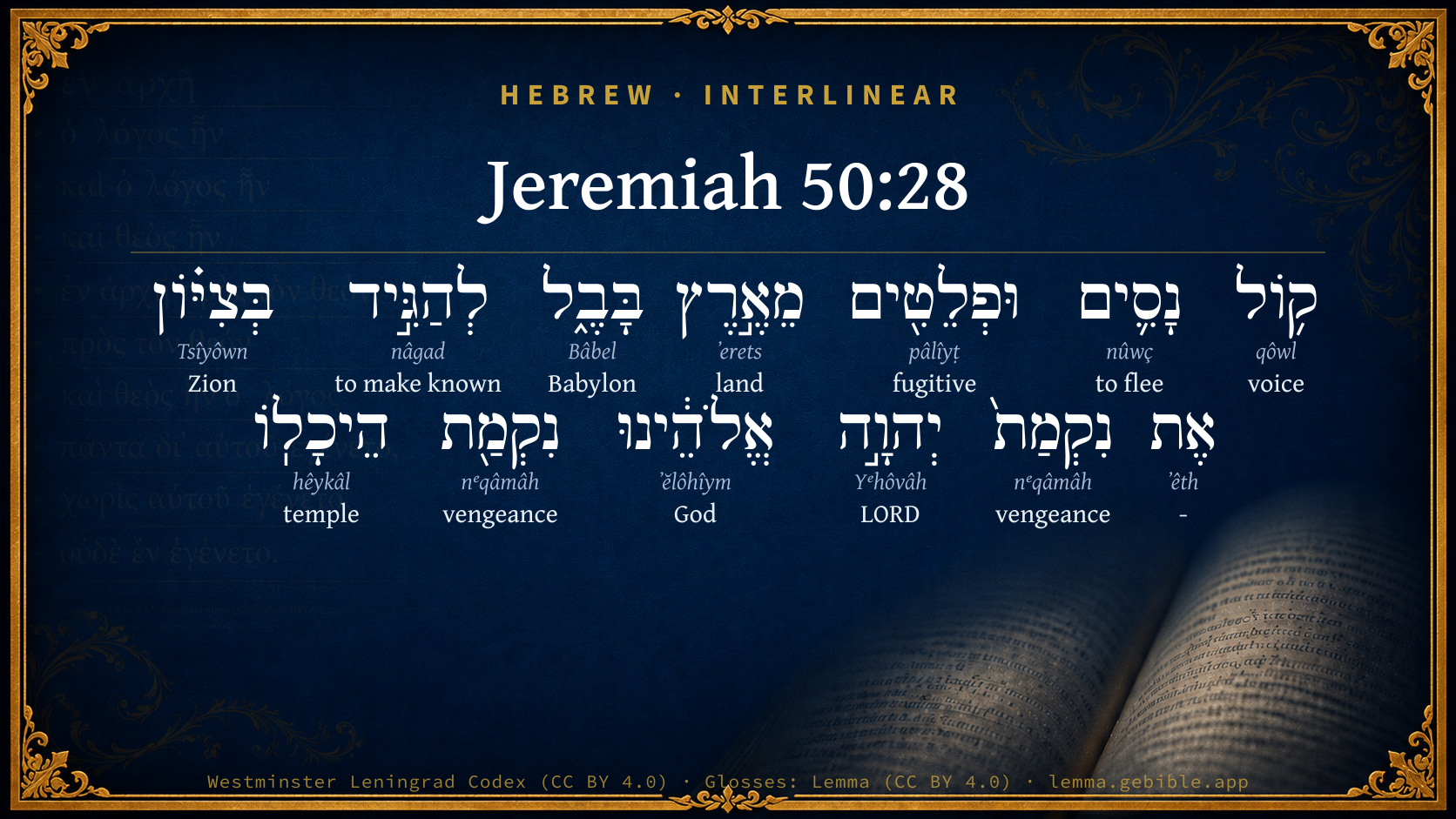
Jeremiah 50:28

Hebrew (Westminster Leningrad Codex) Jeremiah 50:28 appears in the Hebrew Old Testament. The text above is from the Westminster Leningrad Codex. Each word links to its Strong’s number, a concise gloss, and parsing drawn from the Open Scriptures Hebrew Bible morphology. Click any word for its full Brown-Driver-Briggs (BDB) entry.
Download image
Cite this verse

Jeremiah 50:28 (World English Bible). Public Domain. Lemma interlinear Bible study tool, https://lemma.gebible.app/v/jeremiah/50/28.

Show BibTeX & RIS
BibTeX
RIS
English Translation
The voice of those who flee and escape out of the land of Babylon, to declare in Zion the vengeance of Yahweh our God, the vengeance of his temple.
World English Bible · Public Domain
Download a study sheet

One document with this verse’s original text, its word-by-word gloss line, the meaning frame, cross-references with their text, attributed commentary, and full source and license credits — printable, and it pastes into notes with its structure intact.

This verse Autodidact and up

Study sheet (.html) Plain text (.txt)

A passage Seminary Student

Up to 50 verses in one chapter. A passage sheet keeps up to 6 commentary sources and 12 cross-references per verse, in the order this page ranks them, and says so on the sheet whenever that leaves anything out. Ask for a single verse and you get the Autodidact verse sheet above.

Everything on this page stays free to read, with no account — the sheet is a download of what is already on screen, not access to it.

Want to remove ads? Support Godless Engineer
Compare translations 3

The same verse in 3 English versions, stacked beneath the original-language interlinear above. Click any original word for its lexicon entry.

Each is an independent rendering of the whole verse — the interlinear is not word-aligned to these translations.

Highlighted words mark where these versions differ — a whole-verse word diff, not a word-by-word alignment.

  • World English Bible Public Domain
    The voice of those who flee and escape out of the land of Babylon, to declare in Zion the vengeance of Yahweh our God, the vengeance of his temple.
  • King James Version Public Domain
    The voice of them that flee and escape out of the land of Babylon, to declare in Zion the vengeance of the LORD our God, the vengeance of his temple.
  • unfoldingWord Literal Text CC BY-SA 4.0
    There is the sound of those fleeing, of those who are survivors, from the land of Babylon. These will report the vengeance of Yahweh our God for Zion, and vengeance for his temple.”

unfoldingWord Literal Text — © unfoldingWord, licensed CC BY-SA 4.0. Word-aligned USFM3 via Door43 (git.door43.org/unfoldingWord/en_ult).

Versions to compare (up to 4)

3 of 4 selected

Show all 18 translations

Every available English version of this verse, each an independent rendering of the whole verse.

  • World English Bible Public Domain
    The voice of those who flee and escape out of the land of Babylon, to declare in Zion the vengeance of Yahweh our God, the vengeance of his temple.
  • Berean Standard Bible Public Domain
    Listen to the fugitives and refugees from the land of Babylon, declaring in Zion the vengeance of the LORD our God, the vengeance for His temple.
  • Majority Standard Bible Public Domain
    Listen to the fugitives and refugees from the land of Babylon, declaring in Zion the vengeance of the LORD our God, the vengeance for His temple.
  • King James Version Public Domain
    The voice of them that flee and escape out of the land of Babylon, to declare in Zion the vengeance of the LORD our God, the vengeance of his temple.
  • American Standard Version (1901) Public Domain
    The voice of them that flee and escape out of the land of Babylon, to declare in Zion the vengeance of Jehovah our God, the vengeance of his temple.
  • Revised Version (1885) Public Domain
    The voice of them that flee and escape out of the land of Babylon, to declare in Zion the vengeance of the LORD our God, the vengeance of his temple.
  • Geneva Bible (1599) Public Domain
    The voyce of them that flee, and escape out of the lande of Babel to declare in Zion the vengeance of the Lord our God, and the vengeance of his Temple.
  • Douay-Rheims (1899) Public Domain
    The voice of them that flee, and of them that have escaped out of the land of Babylon: to declare in Sion the revenge of the Lord our God, the revenge of his temple.
  • Young's Literal Translation Public Domain
    A voice of fugitives and escaped ones `Is' from the land of Babylon, To declare in Zion the vengeance of Jehovah our God, The vengeance of His temple.
  • Literal Standard Version CC BY-SA 4.0
    A voice of fugitives and escaped ones || [Is] from the land of Babylon, || To declare in Zion the vengeance of our God YHWH, || The vengeance of His temple.
  • Unlocked Literal Bible CC BY-SA 4.0
    There is the sound of those fleeing, of those who are survivors, from the land of Babylon. These will report the vengeance of Yahweh our God for Zion, and vengeance for his temple.”
  • unfoldingWord Literal Text CC BY-SA 4.0
    There is the sound of those fleeing, of those who are survivors, from the land of Babylon. These will report the vengeance of Yahweh our God for Zion, and vengeance for his temple.”
  • Darby Bible Public Domain
    The voice of them that flee and escape out of the land of Babylon, to declare in Zion the vengeance of Jehovah our God, the vengeance of his temple.
  • World Messianic Bible Public Domain
    Listen to those who flee and escape out of the land of Babylon, to declare in Zion the vengeance of the LORD our God, the vengeance of his temple.
  • Webster's Bible Public Domain
    The voice of them that flee and escape from the land of Babylon, to declare in Zion the vengeance of the LORD our God, the vengeance of his temple.
  • Free Bible Version CC BY-SA 4.0
    (Listen to the refugees and survivors who have returned from Babylonia, announcing in Zion, “The Lord our God is paying them back for what happened to his Temple.”)
  • Bible in Basic English Public Domain
    The voice of those who are in flight, who have got away safe from the land of Babylon, to give news in Zion of punishment from the Lord our God, even payment for his Temple.
  • JPS Tanakh (1917) Public Domain
    Hark! they flee and escape out of the land of Babylon, to declare in Zion the vengeance of the LORD our God, the vengeance of His temple.

Literal Standard Version (2020), Covenant Press — licensed CC BY-SA 4.0. Text via the HelloAO Bible API (eBible.org). Unlocked Literal Bible (unfoldingWord) — licensed CC BY-SA 4.0. Text via the HelloAO Bible API (eBible.org). unfoldingWord Literal Text — © unfoldingWord, licensed CC BY-SA 4.0. Word-aligned USFM3 via Door43 (git.door43.org/unfoldingWord/en_ult). Free Bible Version, Dr. Jonathan Gallagher — licensed CC BY-SA 4.0. Text via the HelloAO Bible API (eBible.org).

Word by word

More ways to search: Search by grammar → Find every occurrence → Compare this word →

Practice this passage: Drill this verse → Learn its vocabulary →

וּפְלֵטִ֖ים
pâlîyṭ
H6412
“and · fugitives”
Conjunction + Noun, Common, Masculine, Plural, Absolute
Part of Speech
Conjunction + Noun
Type
Common
Gender
Masculine
Number
Plural
State
Absolute
Full BDB Definition

Origin: from H6403

TWOT: 1774b , 1774c

refugee, fugitive, escaped one
  1. ק֥וֹל qôwl H6963 “voice of” Noun, Common, Masculine, Singular, Construct
  2. נָסִ֛ים nûwç H5127 “fleeing” Verb, Qal, Participle Active, Masculine, Plural, Absolute
  3. מֵאֶ֣רֶץ ʼerets H776 “from · land of” Preposition + Noun, Common, Both, Singular, Construct
  4. בָּבֶ֑ל Bâbel H894 “Babylon” Noun, Proper
  5. לְהַגִּ֣יד nâgad H5046 “to make known” Preposition + Verb, Hiphil, Infinitive Construct
  6. בְּצִיּ֗וֹן Tsîyôwn H6726 “in/at · Zion” Preposition + Noun, Proper
  7. אֶת ʼêth H853 “-” Particle, Direct Object
  8. נִקְמַת֙ nᵉqâmâh H5360 “vengeance of” Noun, Common, Feminine, Singular, Construct
  9. יְהוָ֣ה Yᵉhôvâh H3068 “LORD” Noun, Proper
  10. אֱלֹהֵ֔ינוּ ʼĕlôhîym H430 “God(s) · our” Noun, Common, Masculine, Plural, Construct + Suffix, Personal, 1st Person, Common, Plural
  11. נִקְמַ֖ת nᵉqâmâh H5360 “vengeance of” Noun, Common, Feminine, Singular, Construct
  12. הֵיכָלֽוֹ hêykâl H1964 “temple · his” Noun, Common, Masculine, Singular, Construct + Suffix, Personal, 3rd Person, Masculine, Singular

About this verse

These counts appear in no published source. They are computed here, from the morphology-tagged text and Lemma’s own curated glosses. What Lemma adds →

13
words
12
distinct lemmas
Prophets
section

Notable vocabulary

The rarest word here is וּפְלֵטִ֖ים fugitive H6412 — appearing just 24 times in the whole Hebrew Bible.

Shared distinctive vocabulary

וּפְלֵטִ֖ים fugitive H6412 occurs in 23 verses of the Hebrew Bible. Also found in:

Grammatical profile

  • 2 verbs
  • 10 nouns
  • 1 particle

Verb forms

  • נָסִ֛ים Qal · Participle Active
  • לְהַגִּ֣יד Hiphil · Infinitive Construct

Repetition

A word recurs within this verse — often emphatic in Hebrew:

  • נִקְמַת֙ vengeance H5360 ×2

Cross-references

10

Topical passages linked to Jeremiah 50:28 in the Treasury of Scripture Knowledge — connected by theme and wording, ordered by reader-vote popularity; previews shown in the World English Bible.

  • Isaiah 48:20 Go you forth from Babylon, flee you from the Chaldeans; with a voice of singing declare you, tell this, utter it even to the end of the earth: say you, Yahweh has redeemed his servant Jacob.
  • Jeremiah 50:15 Shout against her round about: she has submitted herself; her bulwarks are fallen, her walls are thrown down; for it is the vengeance of Yahweh: take vengeance on her; as she has done, do to her.
  • Lamentations 1:10 The adversary has spread out his hand on all her pleasant things: For she has seen that the nations are entered into her sanctuary, Concerning whom you did command that they should not enter into your assembly.
  • Psalms 149:6–9 May the high praises of God be in their mouths, And a two-edged sword in their hand;
  • Jeremiah 51:10–11 Yahweh has brought forth our righteousness: come, and let us declare in Zion the work of Yahweh our God.
  • Lamentations 2:6–7 He has violently taken away his tent, as if it were of a garden; he has destroyed his place of assembly: Yahweh has caused solemn assembly and Sabbath to be forgotten in Zion, Has despised in the indignation of his anger the king and the priest.
  • Daniel 5:23 but have lifted up yourself against the Lord of heaven; and they have brought the vessels of his house before you, and you and your lords, your wives and your concubines, have drunk wine from them; and you have praised the gods of silver and gold, of brass, iron, wood, and stone, which don't see, nor hear, nor know; and the God in whose hand your breath is, and whose are all your ways, you have not glorified.
  • Jeremiah 51:50–51 You who have escaped the sword, go you, don't stand still; remember Yahweh from afar, and let Jerusalem come into your mind.
  • Daniel 5:3–5 Then they brought the golden vessels that were taken out of the temple of the house of God which was at Jerusalem; and the king and his lords, his wives and his concubines, drank from them.
  • Zechariah 12:2–3 "Behold, I will make Jerusalem a cup of reeling to all the surrounding peoples, and on Judah also will it be in the siege against Jerusalem.

Cross-references courtesy of OpenBible.info (CC BY 4.0).

Hebrew and Greek witnesses Masoretic Hebrew ↔ Greek Septuagint

The same verse in the two great witnesses to the Old Testament, shown verse-for-verse.

These are two independent witnesses, not word-aligned to each other, and the Septuagint is shown in lemma (dictionary) form.

Hebrew Jeremiah 50:28 Masoretic · Westminster Leningrad Codex

ק֥וֹל נָסִ֛ים וּפְלֵטִ֖ים מֵאֶ֣רֶץ בָּבֶ֑ל לְהַגִּ֣יד בְּצִיּ֗וֹן אֶת נִקְמַת֙ יְהוָ֣ה אֱלֹהֵ֔ינוּ נִקְמַ֖ת הֵיכָלֽוֹ

The voice of those who flee and escape out of the land of Babylon, to declare in Zion the vengeance of Yahweh our God, the vengeance of his temple.

World English Bible · Public Domain

Greek LXX Structure differs

In the Septuagint, Jeremiah is about an eighth shorter than the Hebrew and arranges its material differently — the Oracles Against the Nations (Hebrew chapters 46–51) appear in the middle of the Greek book, after 25:13. Because the chapter and verse boundaries do not line up, a verse-for-verse comparison with the Hebrew is not shown.

A verse-for-verse comparison isn’t shown here because the chapters and verses don’t line up. Switch to the LXX edition with the MT / LXX toggle above to read the Greek directly.

Hebrew: Westminster Leningrad Codex (CC BY 4.0). Greek: Septuagint (public domain); English from a public-domain English Septuagint. How the Septuagint differs from the Hebrew →

Targum (Aramaic paraphrase)

1

The Targum is the ancient Jewish Aramaic paraphrase of the Hebrew Scriptures — an interpretive translation, not the Hebrew text itself. Onkelos (literal) and Pseudo-Jonathan (expansive) render the Torah, and Jonathan the Prophets. Coverage is partial: where no permissively-licensed English translation exists for a verse, only the Aramaic is shown. This is verse-level text, not a word-by-word alignment to the Hebrew.

  1. Targum Jonathan Prophets (Joshua–Malachi)
    קַל דְעָרְקִין וּמִשְׁתֵּיזְבִין מֵאַרְעָא דְבָבֶל לְחַוָאָה בְצִיוֹן יַת פּוּרְעֲנוּתָא דַייָ אֱלָהָנָא פּוּרְעֲנּוּת הֵיכָלֵיהּ:

    (no public-domain English translation for this verse)

    Targum Jonathan — Aramaic: “Mikraot Gedolot” (public domain). English: “Sefaria Community Translation” (CC0 1.0 (public-domain dedication)); “London "Chaldee Paraphrase," 1871” (public domain). Text via Sefaria.

Commentary

Notes on Jeremiah 50:28 from classic Christian and Jewish commentators (each source and its license shown beneath its notes). The classic Christian expositions comment on the surrounding passage and are grouped to its opening verse, so a note may address several verses; the Jewish commentaries on the Tanakh (Rashi and others) are per-verse, so they appear only where the commentator wrote on this verse.

Lemma curates 59 commentaries, every one of them public domain or Creative Commons licensed, each selected and text-cleaned for this edition rather than reprinted as found. About our sources →

Trapp's Complete Commentary

John Trapp

Jer 50:28 The voice of them that flee and escape out of the land of Babylon, to declare in Zion the vengeance of the LORD our God, the vengeance of his temple.

Ver. 28. The vengeance of his temple.] Spoiled and burnt by the Chaldeans, those wasters, as their name also signifieth. Woe, then, to such as destroy God’s living temples!

John Trapp, A Commentary or Exposition upon All the Books of the Old and New Testament (1647–1656) — public domain. Text from a community e-Sword module.

Tyndale Open Study Notes

Tyndale Open Resources

50:28 The exiles returning to Jerusalem would be able to encourage those left behind that the enemy had been punished as God had promised and that his promised restoration of Israel was beginning.

Tyndale Open Study Notes — © Tyndale Open Resources, licensed CC BY-SA 4.0. Text via the HelloAO Bible API.

Geneva Bible (1599)

Geneva Bible translators

Of the Jews which should be delivered by Cyrus.

Geneva Bible (1599) marginal notes — public domain. Text via Bolls.life.

Jamieson, Fausset & Brown

Robert Jamieson, A. R. Fausset & David Brown

declare in Zion . . . temple--Some Jews "fleeing" from Babylon at its fall shall tell in Judea how God avenged the cause of Zion and her temple that had been profaned (Jer 52:13; Dan 1:2; Dan 5:2).

Jamieson, Fausset & Brown — Commentary Critical and Explanatory on the Whole Bible (1871) — public domain (CC PDM 1.0). Text via the HelloAO Bible API.

Adam Clarke's Commentary

Verse 28. Declare in Zion the vengeance of the Lord] Zion was desolated by Babylon; tell Zion that God hath desolated the desolator.

The vengeance of his temple.] Which Nebuchadnezzar had pillaged, profaned, and demolished, transporting its sacred vessels to Babylon, and putting them in the temple of his god Bel.

Adam Clarke's Commentary on the Bible (1810–1826) — public domain. Text from a community e-Sword/MySword module.

John Calvin's Commentaries

The Prophet again shows, that God in punishing Babylon, would give a sure proof of his favor towards his Church. For this prophecy would have been uninteresting to the faithful, did they not know that God would be an enemy to that great monarchy, because he had undertaken the care of their safety. Then the Prophet often calls the attention of the faithful to this fact, that God’s vengeance on the Babylonians would be to them a sure proof of God’s favor, through which he had once embraced them, and which he would continue to show to them to the end.

This, then, was the design of the Prophet, when he said, The voice officers and of those who escape from the land of Babylon, etc.; as though he had said, “Babylon is on many accounts worthy of destruction, but God in destroying it will have a regard to his own people, and will effectually show that he is the Father of the people whom he has adopted.” Jeremiah afterwards exhorts the faithful to show their gratitude. There are here, then, two things; the first is, that when God destroyed Babylon, the people would hence with certainty perceive how dear they were to God; and secondly, from this truth flows an exhortation, that the faithful were not to be mute at such a singular benefit of God, but were to proclaim their deliverance. Hence he says, The voice of fleers and of those who escape from the land of Babylon, to announce in Sion, etc. By saying in Sion, he shows for what end God intended to gather his people, even that he might again be worshipped as formerly-in his own Temple.

He adds, to announce in Sion the vengeance of our God The vengeance of God is to be taken here in an active sense, signifying the vengeance which God would execute. The vengeance of the Temple, which immediately follows, is to be taken passively, as meaning the vengeance by which God would avenge the indignity offered to the Temple. God then takes vengeance, and God’s Temple is defended from contempt and reproach.

We now then see the meaning of this passage. The Prophet first teaches us, that God would have a regard to his people in so rigidly punishing Babylon; and secondly, he adds an exhortation, lest the faithful should be unthankful to God, but acknowledge that God, for the sake of their deliverance had undertaken war against that monarchy; and lastly, he shows the end, even that the people who had been scattered, as it is said in Psalm 147:2,

“God is he who gathers the dispersed of Israel,”

might again be collected together. As, then, the Jews were as a mutilated body among the Chaldeans, the Prophet shows that that monarchy would be dispersed, in order that the faithful might again be gathered, and that all might worship God together in the Temple, or on mount Sion. It follows, —

John Calvin's Commentaries (1540-1563) — public domain. Text from the Calvin Translation Society English edition (1840s-50s) via the Christian Classics Ethereal Library (ccel.org). Calvin's coverage is partial (roughly two-thirds of the Bible); uncommented books and verses are honest gaps, never fabricated. The 19th-century editor's footnotes and remarks are omitted so the notes are faithfully Calvin's own voice.

Ellicott's Commentary for English Readers

(28) The voice of them that flee . . .—The abruptness of the opening words, as if the prophet heard the cry of the escaping exiles, would be perhaps best represented by Hark, the voice . . . The words that follow define the cry as coming chiefly from the captive Jews, who see in the destruction of Babylon the vengeance of Jehovah for the destruction of His Temple.

A Bible Commentary for English Readers, edited by Charles John Ellicott (1878–1897) — public domain. Text from a community e-Sword module.

The Cambridge Bible for Schools and Colleges

gen. ed. J. J. S. Perowne

28. them that flee] the liberated Jews.

the vengeance of his temple] the requital for having burned it in their final capture of Jerusalem. Cp. Jer_51:11.

The Cambridge Bible for Schools and Colleges (gen. ed. J. J. S. Perowne; Cambridge University Press, 1878–1918) — public domain. Text from a community e-Sword module.

John Gill's Exposition

The voice of them that flee and escape out the land of Babylon,.... The Jews that were captives in Babylon, upon the taking of it, took that opportunity to flee out Of it, and make their escape to their own land, which some of them might do before the proclamation of Cyrus; whose voice declaring to their brethren in Judea what God had done to Babylon, and rejoicing at it, was as if it was heard by the prophet in vision, or under a spirit of prophecy; this also is true of them who will be called out of mystical Babylon, and escape from thence, just before its destruction, Rev 18:4;

to declare in Zion the vengeance of the Lord our God, the vengeance of his temple; the vengeance which God took on the Chaldeans for their ill usage of his people, and for plundering and burning his temple; this the Jews, when they came to their own land, declared to their brethren there with joy and pleasure; and a like joy will be expressed when God shall avenge his people on antichrist, for his blasphemy against him, his name, his tabernacle, and them that dwell in it, Rev 13:6.

John Gill's Exposition of the Whole Bible (1746–1763) — public domain (CC PDM 1.0). Text via the HelloAO Bible API.

Albert Barnes' Notes on the Bible

The voice of them ... - i. e., There is a sound of fugitives escaping from Babylonia. The Jews saw in the fall of Babylon Yahweh’s vengeance for His temple.

Albert Barnes' Notes on the Bible (1834–1885) — public domain. Text from a community e-Sword/MySword module.

Haydock's Catholic Bible Commentary

Voice. I hear the captives proclaiming this at their return.

George Leo Haydock (1774–1849), Haydock's Catholic Family Bible and Commentary, 1859 edition — public domain. Excludes Psalms (Douay-Rheims chapter numbering differs from Protestant) and Deuterocanonical books (Catholic canon only).

Matthew Poole's English Annotations

The prophet here brings in the poor Jews that had been captives in Babylon going back upon Cyrus’s proclamation of liberty towards Zion, there joyfully to declare the revenge which their God had taken for them, and for his holy

temple, which the Chaldeans had burnt and destroyed.

Matthew Poole's English Annotations on the Holy Bible (1683–1685) — public domain. Text from a community e-Sword/MySword module.

Whedon's Commentary on the Bible

Daniel D. Whedon

28. From Babylon the scene changes to Jerusalem, where we hear the voice of the fugitives who bring to Zion the tidings of God’s fearful judgments on Babylon.

Daniel D. Whedon (gen. ed.), Commentary on the Old and New Testaments (1874–1909) — public domain. Text from a community e-Sword module.

The Pulpit Commentary

The voice of them that flee, etc.; rather, Hark! those that flee, etc. A confused murmur indicates the approach of the fugitives with their great tidings. The vengeance of his temple; i.e. the punishment due to Babylon for burning the temple; comp. next verse, also ver. 15, "The vengeance of the Lord," and Jer_51:11.

The Pulpit Commentary (1880–1919), ed. H.D.M. Spence-Jones & Joseph S. Exell — public domain. Text from a community e-Sword module.

John Wesley's Explanatory Notes

The vengeance - The revenge which God had taken for his holy temple, which the Chaldeans had destroyed.

John Wesley, Explanatory Notes Upon the Whole Bible (1754–1765) — public domain. Text via the GEBible commentary corpus.

Lesson kit

Teaching starters — assembled from the data on this page, not authored interpretation. Every prompt links to the verse data it draws on. Edit before teaching.

Jeremiah, in the Prophets, opens this verse with 13 words (12 distinct Hebrew lemmas). Its most distinctive word is pâlîyṭ (“fugitive”). A historical commentator’s framing appears above. Read the whole chapter for the surrounding context.

Discussion questions

  1. How does “fugitive” (pâlîyṭ) shape what this verse is saying?
  2. Genesis 14:13 shares the word «fugitive» with this verse. How do the two illuminate each other?
  3. “vengeance” occurs 2× in this one verse. What is the effect of the repetition?
  4. These translations render this verse differently; the difference is in the English rendering, not the original. What questions does that raise?
  5. The verb «נָסִ֛ים» is Qal Participle Active. How does its form color the action?
  6. Reading how Trapp's Complete Commentary and Tyndale Open Study Notes read this verse, where do the two commentators agree and where do they part?

Things to notice

Reading settings

Reading text

Shown beneath each verse's original-language words.

Old Testament
Old Testament edition

Read the OT as the Masoretic Hebrew (MT) or the Greek Septuagint (LXX).

English shown for the Greek Septuagint (in the Hebrew ↔ Greek comparison).

Comparing translations? Open the Compare panel on any verse page to stack up to four side by side.