
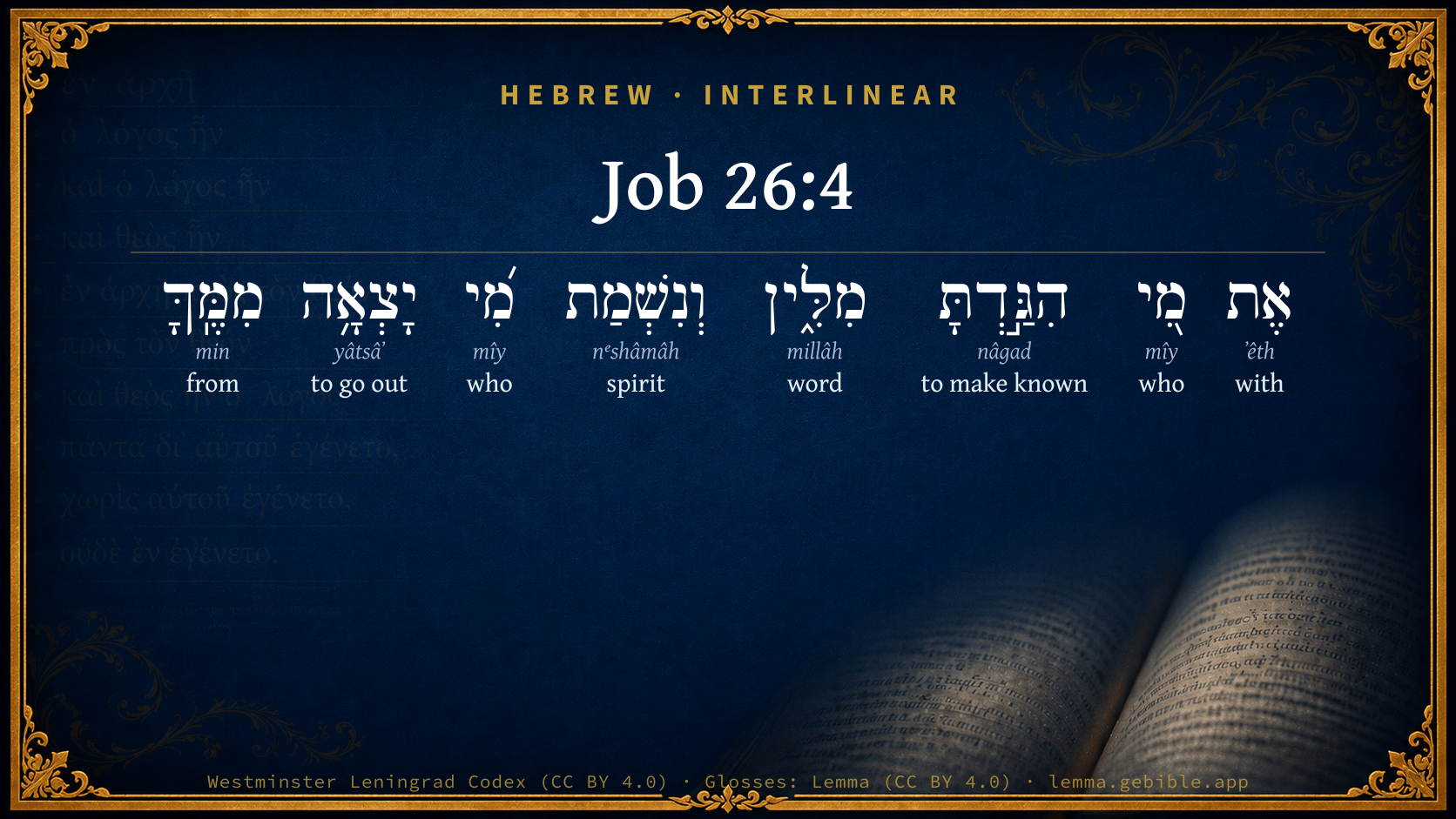
Job 26:4

Hebrew (Westminster Leningrad Codex) Job 26:4 appears in the Hebrew Old Testament. The text above is from the Westminster Leningrad Codex. Each word links to its Strong’s number, a concise gloss, and parsing drawn from the Open Scriptures Hebrew Bible morphology. Click any word for its full Brown-Driver-Briggs (BDB) entry.
Download image
Cite this verse

Job 26:4 (World English Bible). Public Domain. Lemma interlinear Bible study tool, https://lemma.gebible.app/v/job/26/4.

Show BibTeX & RIS
BibTeX
RIS
English Translation
To whom have you uttered words? Whose spirit came forth from you?
World English Bible · Public Domain
Download a study sheet

One document with this verse’s original text, its word-by-word gloss line, the meaning frame, cross-references with their text, attributed commentary, and full source and license credits — printable, and it pastes into notes with its structure intact.

This verse Autodidact and up

Study sheet (.html) Plain text (.txt)

A passage Seminary Student

Up to 50 verses in one chapter. A passage sheet keeps up to 6 commentary sources and 12 cross-references per verse, in the order this page ranks them, and says so on the sheet whenever that leaves anything out. Ask for a single verse and you get the Autodidact verse sheet above.

Everything on this page stays free to read, with no account — the sheet is a download of what is already on screen, not access to it.

Want to remove ads? Support Godless Engineer
Compare translations 3

The same verse in 3 English versions, stacked beneath the original-language interlinear above. Click any original word for its lexicon entry.

Each is an independent rendering of the whole verse — the interlinear is not word-aligned to these translations.

Highlighted words mark where these versions differ — a whole-verse word diff, not a word-by-word alignment.

  • World English Bible Public Domain
    To whom have you uttered words? Whose spirit came forth from you?
  • King James Version Public Domain
    To whom hast thou uttered words? and whose spirit came from thee?
  • unfoldingWord Literal Text CC BY-SA 4.0
    With whom did you declare words? And the breath of whom came out from you?

unfoldingWord Literal Text — © unfoldingWord, licensed CC BY-SA 4.0. Word-aligned USFM3 via Door43 (git.door43.org/unfoldingWord/en_ult).

Versions to compare (up to 4)

3 of 4 selected

Show all 18 translations

Every available English version of this verse, each an independent rendering of the whole verse.

  • World English Bible Public Domain
    To whom have you uttered words? Whose spirit came forth from you?
  • Berean Standard Bible Public Domain
    To whom have you uttered these words? And whose spirit spoke through you?
  • Majority Standard Bible Public Domain
    To whom have you uttered these words? And whose spirit spoke through you?
  • King James Version Public Domain
    To whom hast thou uttered words? and whose spirit came from thee?
  • American Standard Version (1901) Public Domain
    To whom hast thou uttered words? And whose spirit came forth from thee?
  • Revised Version (1885) Public Domain
    To whom hast thou uttered words? and whose spirit came forth from thee?
  • Geneva Bible (1599) Public Domain
    To whom doest thou declare these words? or whose spirit commeth out of thee?
  • Douay-Rheims (1899) Public Domain
    Whom hast thou desired to teach? was it not him that made life?
  • Young's Literal Translation Public Domain
    With whom hast thou declared words? And whose breath came forth from thee?
  • Literal Standard Version CC BY-SA 4.0
    With whom have you declared words? And whose breath came forth from you?
  • Unlocked Literal Bible CC BY-SA 4.0
    With whose help have you spoken these words? Whose spirit was it that came out from you?
  • unfoldingWord Literal Text CC BY-SA 4.0
    With whom did you declare words? And the breath of whom came out from you?
  • Darby Bible Public Domain
    For whom hast thou uttered words? and whose spirit came from thee?
  • World Messianic Bible Public Domain
    To whom have you uttered words? Whose spirit came out of you?
  • Webster's Bible Public Domain
    To whom hast thou uttered words? and whose spirit came from thee?
  • Free Bible Version CC BY-SA 4.0
    Who helped you speak these words? Who inspired you to say such things?
  • Bible in Basic English Public Domain
    To whom have your words been said? and whose spirit came out from you?
  • JPS Tanakh (1917) Public Domain
    With whose help hast thou uttered words? And whose spirit came forth from thee?

Literal Standard Version (2020), Covenant Press — licensed CC BY-SA 4.0. Text via the HelloAO Bible API (eBible.org). Unlocked Literal Bible (unfoldingWord) — licensed CC BY-SA 4.0. Text via the HelloAO Bible API (eBible.org). unfoldingWord Literal Text — © unfoldingWord, licensed CC BY-SA 4.0. Word-aligned USFM3 via Door43 (git.door43.org/unfoldingWord/en_ult). Free Bible Version, Dr. Jonathan Gallagher — licensed CC BY-SA 4.0. Text via the HelloAO Bible API (eBible.org).

Word by word

More ways to search: Search by grammar → Find every occurrence → Compare this word →

Practice this passage: Drill this verse → Learn its vocabulary →

About this verse

These counts appear in no published source. They are computed here, from the morphology-tagged text and Lemma’s own curated glosses. What Lemma adds →

8
words
7
distinct lemmas
Wisdom
section

Notable vocabulary

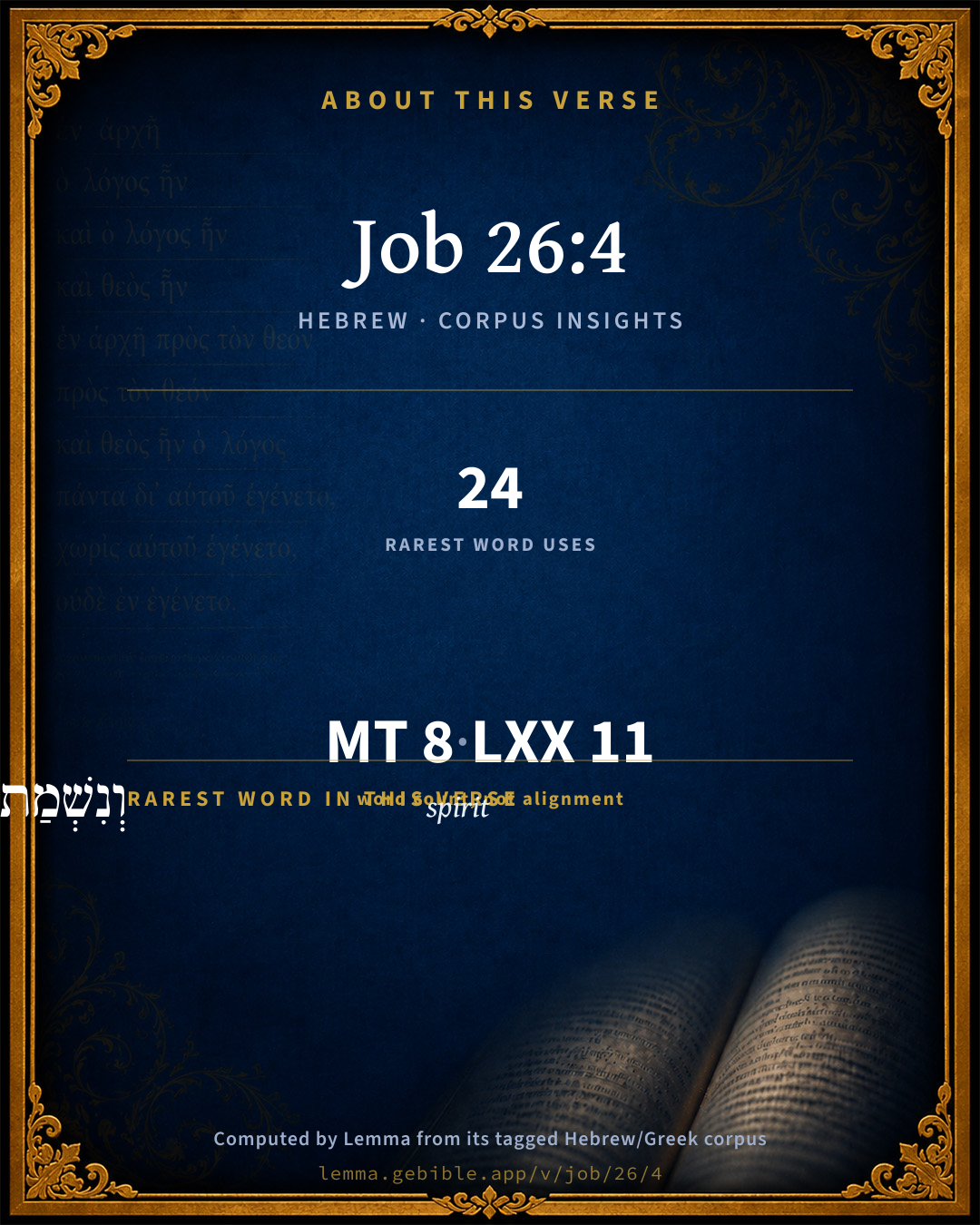
The rarest word here is וְנִשְׁמַת spirit H5397 — appearing just 24 times in the whole Hebrew Bible.

Shared distinctive vocabulary

וְנִשְׁמַת spirit H5397 occurs in 24 verses of the Hebrew Bible. Also found in:

Grammatical profile

  • 2 verbs
  • 2 nouns
  • 2 prepositions
  • 2 particles

Verb forms

  • הִגַּ֣דְתָּ Hiphil · Perfect
  • יָצְאָ֥ה Qal · Perfect

Repetition

A word recurs within this verse — often emphatic in Hebrew:

Hebrew & Septuagint length

In English translation the verse runs 12 words from the Hebrew and 17 from the Septuagint (LXX English) — the Septuagint runs noticeably longer here. See the side-by-side →

A rough comparison of the two English renderings, which tokenize alike — not a word-level alignment.

Word counts can differ between the Hebrew and the Greek without any difference in meaning — e.g. the Hebrew direct-object marker אֵת has no separate Greek word, and Greek often adds the article ὁ.

In the original languages it is 8 Hebrew tokens and 11 Greek tokens — but the two are counted differently (Hebrew bundles its prefixes and suffixes into one token; the Greek is in lemma form), so that isn’t a like-for-like length.

Cross-references

7

Topical passages linked to Job 26:4 in the Treasury of Scripture Knowledge — connected by theme and wording, ordered by reader-vote popularity; previews shown in the World English Bible.

  • 1 Kings 22:23–24 Now therefore, behold, Yahweh has put a lying spirit in the mouth of all these your prophets; and Yahweh has spoken evil concerning you.
  • Job 20:3 I have heard the reproof which puts me to shame; The spirit of my understanding answers me.
  • Job 32:18 For I am full of words. The spirit within me constrains me.
  • Ecclesiastes 12:7 And the dust returns to the earth as it was, And the spirit returns to God who gave it.
  • 1 Corinthians 12:3 Therefore I make known to you that no man speaking by God's Spirit says, "Jesus is accursed." No one can say, "Jesus is Lord," but by the Holy Spirit.
  • 1 John 4:1–3 Beloved, don't believe every spirit, but test the spirits, whether they are of God, because many false prophets have gone out into the world.
  • Revelation 16:13–14 I saw coming out of the mouth of the dragon, and out of the mouth of the beast, and out of the mouth of the false prophet, three unclean spirits, something like frogs;

Cross-references courtesy of OpenBible.info (CC BY 4.0).

Hebrew and Greek witnesses Masoretic Hebrew ↔ Greek Septuagint

The same verse in the two great witnesses to the Old Testament, shown verse-for-verse.

Here the Septuagint runs noticeably longer than the Hebrew — LXX2012 (modern English Septuagint) 17 words vs World English Bible 12. A rough length comparison of the two English translations, not a word-level alignment — read both below.

These are two independent witnesses, not word-aligned to each other, and the Septuagint is shown in lemma (dictionary) form.

Hebrew Job 26:4 Masoretic · Westminster Leningrad Codex

אֶת מִ֭י הִגַּ֣דְתָּ מִלִּ֑ין וְנִשְׁמַת מִ֝י יָצְאָ֥ה מִמֶּֽךָּ

To whom have you uttered words? Whose spirit came forth from you?

World English Bible · Public Domain

Greek LXX Job 26:4 Septuagint · lemma form

τίς ἀναἀγγέλλω ῥῆμα πνοή δέ τίς εἰμί ὁ ἐκἔρχομαι ἐκ σύ

To whom have you uttered words? and whose breath is it that has come forth from you?

LXX2012 (modern English Septuagint) · Public Domain

On this verse, Haydock's Catholic Bible Commentary discusses the Septuagint’s reading. Read the note in Commentary ↓

Hebrew: Westminster Leningrad Codex (CC BY 4.0). Greek: Septuagint (public domain); English from LXX2012 (modern English Septuagint) (Public Domain). How the Septuagint differs from the Hebrew →

Commentary

Notes on Job 26:4 from classic Christian and Jewish commentators (each source and its license shown beneath its notes). The classic Christian expositions comment on the surrounding passage and are grouped to its opening verse, so a note may address several verses; the Jewish commentaries on the Tanakh (Rashi and others) are per-verse, so they appear only where the commentator wrote on this verse.

Lemma curates 59 commentaries, every one of them public domain or Creative Commons licensed, each selected and text-cleaned for this edition rather than reprinted as found. About our sources →

Trapp's Complete Commentary

John Trapp

Job 26:4 To whom hast thou uttered words? and whose spirit came from thee?

Ver. 4. To whom hast thou uttered words?] And, as thou thinkest, words weighty, and worthy of all acceptation, when in truth there is no such matters; bubbles of words they are, and big swollen fancies, sed cui bono? What tack is there in them? and to what good purpose are they? Melancthon makes mention of a certain good man, who reading Aristotle’s discourse concerning the rainbow, conceited thereupon many strange speculations, and wrote to a friend that he had far outdone Aristotle in that matter (Manl. loc. com. 536). But coming afterwards to the university, and disputing there upon that subject, he was found to be utterly out in those fancies of his, which indeed were no better than a sublime dotage.

And whose spirit came from thee?] Or, came out of thee? Was it by God’s Spirit that thou spakest, or thine own rather? For "there is a spirit in man, but the inspiration of the Almighty giveth them understanding," Job 32:8. Job would not have Bildad think and term his discourses to be divine inspirations, or such admirable pieces, rare sayings, being but vulgar and ordinary businesses (Scult. Ann. p. 238). Muncer, the arch Anabaptist, wrote a book against Luther, wherein he boasteth much of the spirit, and of prophetical light, accusing Luther for unspiritual, and one that savoured nothing but carnal things. The Antinomians use to call upon their hearers to mark; it may be they shall hear that which they have not heard before, whenas the thing they deliver after so promising a preface, is either false, or what is taught ordinarily by others. Some read the words thus, Whose spirit admired thee? for the spirit goeth as it were out of itself after those things it admireth. The Hebrews expound it thus, Whose spirit hast thou quickened, or confirmed, by these thy words? Who is the wiser or the better for them? Quam animam per haec fecisti? What soul hast thou gained to God by thy doctrine? confer Gen 12:5, the souls which they had made, that is, brought to the true fear and service of God.

John Trapp, A Commentary or Exposition upon All the Books of the Old and New Testament (1647–1656) — public domain. Text from a community e-Sword module.

Joseph Benson's Commentary

Job 26:4. To whom hast thou uttered words — For whose instruction hast thou uttered these things? For mine? Dost thou think I do not know that which the meanest persons are not unacquainted with; that God is incomparably greater and better than his creatures? Whose spirit came from thee — Who inspired thee with this profound discourse of thine?

Joseph Benson's Commentary on the Old and New Testaments (1811–1818) — public domain. Text from a community e-Sword module.

Tyndale Open Study Notes

Tyndale Open Resources

26:4 Eliphaz (4:15), Zophar (20:3), and Elihu (32:18; 33:4) all claimed to be prompted by the proper spirit (see Jer 29:8-9; 1 Cor 12:10; 1 Jn 4:1).

Tyndale Open Study Notes — © Tyndale Open Resources, licensed CC BY-SA 4.0. Text via the HelloAO Bible API.

Geneva Bible (1599)

Geneva Bible translators

That is, moveth thee to speak this?

Geneva Bible (1599) marginal notes — public domain. Text via Bolls.life.

Jamieson, Fausset & Brown

Robert Jamieson, A. R. Fausset & David Brown

For whose instruction were thy words meant? If for me I know the subject (God's omnipotence) better than my instructor; Job 26:5-14 is a sample of Job's knowledge of it.

whose spirit--not that of God (Job 32:8); nay, rather, the borrowed sentiment of Eliphaz (Job 4:17-19; Job 15:14-16).

Jamieson, Fausset & Brown — Commentary Critical and Explanatory on the Whole Bible (1871) — public domain (CC PDM 1.0). Text via the HelloAO Bible API.

Adam Clarke's Commentary

Verse 4. Whose spirit came from thee?] Mr. Good renders the verse thus: From whom hast thou pillaged speeches? And whose spirit hath issued forth from thee? The retort is peculiarly severe; and refers immediately to the proverbial sayings which in several of the preceding answers have been adduced against the irritated sufferer; for which see Job 8:11-19; Job 15:20-35, some of which he has already complained of, as in Job 12:3, and following. I concur most fully therefore with Dr. Stock in regarding the remainder of this chapter as a sample, ironically exhibited by Job, of the harangues on the power and greatness of God which he supposes his friends to have taken out of the mouths of other men, to deck their speeches with borrowed lustre. Only, in descanting on the same subject, he shows how much he himself can go beyond them in eloquence and sublimity.

Job intimates that, whatever spirit they had, it was not the Spirit of God, because in their answers falsehood was found.

Adam Clarke's Commentary on the Bible (1810–1826) — public domain. Text from a community e-Sword/MySword module.

Ellicott's Commentary for English Readers

(4) To whom.—That is, “Is it not to one who had said the same thing himself? Was it not my own breath, my own teaching, that came forth from you?” He then proceeds to show that it is not only the starry heavens that declare the glory of God, but the under world likewise, and the universe generally.

A Bible Commentary for English Readers, edited by Charles John Ellicott (1878–1897) — public domain. Text from a community e-Sword module.

The Cambridge Bible for Schools and Colleges

gen. ed. J. J. S. Perowne

4. to whom hast thou uttered words?] Job refers to himself and asks, Who is it that thou hast spoken such things to? The same feeling of conscious superiority to his friends and disdain of the instructions they were giving him reappears here, which came out already in ch. Job_12:4. It is the same feeling as was expressed by the magnates of Jerusalem in reference to the continual harping of Isaiah: “Whom will he teach knowledge, and whom will he make to understand doctrine? them that are weaned from the milk and drawn from the breast?” Has he children before him that he gives precept upon precept, line upon line, &c.? Isa_28:9.

and whose spirit came from thee?] Or, came forth from thee. Job asks, Under what lofty inspiration hast thou spoken? Is it, indeed, the very spirit of God that has found expression through thy mouth? The words carry a sarcastic reference to the poverty of Bildad’s speech, possibly also to the oracular air with which it was uttered.

The Cambridge Bible for Schools and Colleges (gen. ed. J. J. S. Perowne; Cambridge University Press, 1878–1918) — public domain. Text from a community e-Sword module.

John Gill's Exposition

To whom hast thou uttered words?.... That others know not; dost thou think thou art talking to an ignorant man? be it known to thee, that he knows as much, and can say as much of the Divine Being, of his glories, and of his wondrous ways and works, as thyself, or more: or dost thou consider the circumstances he is in thou art speaking to? one under great affliction and distress, to whom it must be unsuitable to talk of the greatness and majesty of God, of his power and strength, of his purity, holiness, and strict justice; it would have been more proper and pertinent to have discoursed concerning his loving kindness, grace, and mercy, his pity and compassion towards his afflicted people, his readiness to forgive their sins, and overlook their failings; and concerning the promised Redeemer, his righteousness and sacrifice, and of the many instances of divine goodness to the sons of men, and in such like circumstances, by raising them up again, and restoring them to their former happiness. Some things of this nature would have been more pertinent and suitable, and would have been doing both a wise and friendly part:

and whose spirit came from thee? Not the spirit of God; dost thou think thyself inspired by God? or that what thou hast said is by the inspiration of his Spirit? or that thou speakest like such who are moved by the Holy Ghost? nor indeed was it his own spirit, or the words and things uttered were not of himself, or flowed not from his own knowledge and understanding: of things, but what he had borrowed from Eliphaz; for he had delivered very little more than what Eliphaz had said, Job 4:17; or else the sense is, whose spirit has been restored, revived, refreshed, and comforted by what thou hast said? The word of God has such efficacy as to restore the soul, to revive it when drooping, and as it were swooning away and dying, see Psa 19:7; and the words of some good men are spirit and life, the savour of life unto life, and are as life from the dead, very refreshing and comforting; but no such effect followed on what Bildad had said. Mr. Broughton renders the words, "whose soul admired thee?" thou mayest admire thyself, and thy friends may admire thee, at least thou mayest think they do, having said in thine own opinion admirable things; but who else does? for my own part I do not; and, if saying great and glorious things of God are to any purpose in the controversy between us, I am capable of speaking greater and better things than what have been delivered; and, for instance, let the following be attended to.

John Gill's Exposition of the Whole Bible (1746–1763) — public domain (CC PDM 1.0). Text via the HelloAO Bible API.

Albert Barnes' Notes on the Bible

To whom hast thou uttered words? - Jerome renders this, Quem docere voluisti? “Whom do you wish to teach?” The sense is, “Do you attempt to teach me in such a manner, on such a subject? Do you take it that I am so ignorant of the perfections of God, that such remarks about him would convey any real instruction?”

And whose spirit came from thee? - That is, by whose spirit didst thou speak? What claims hast thou to inspiration, or to the uttering of sentiments beyond what man himself could originate? The meaning is, that there was nothing remarkable in what he had said that would show that he had been indebted for it either to God or to the wise and good on earth.

Albert Barnes' Notes on the Bible (1834–1885) — public domain. Text from a community e-Sword/MySword module.

Haydock's Catholic Bible Commentary

Life. Septuagint also seem to understand this of God. (Calmet) --- Job does not blame his friends for undertaking to approve the ways of Providence, but for condemning himself (St. Chrysostom) rashly, (Haydock) and, with an air of haughtiness, endeavouring to restrain him from pleading his cause before the divine tribunal. (Menochius) --- Hebrew, "Whose spirit came from thee?" (Protestants) (Haydock) Did I receive my life, or do I seek advice from thee? (Calmet) --- God stood in no need of Baldad’s wisdom (Worthington) no more than Job. (Haydock)

George Leo Haydock (1774–1849), Haydock's Catholic Family Bible and Commentary, 1859 edition — public domain. Excludes Psalms (Douay-Rheims chapter numbering differs from Protestant) and Deuterocanonical books (Catholic canon only).

Matthew Poole's English Annotations

For whose instruction hast thou uttered these things? For mine? Dost thou think me to be so ignorant, that I do not know that which the meanest persons are not unacquainted with, to wit, that God is incomparably greater and better than his creatures?

Whose spirit came from thee? so the sense is, Whom hast thou revived or comforted by this discourse? Not me surely. The spirit or breath of a man is in a manner suppressed and intercepted in deep sorrows and consternations, such as Job’s were; and when he is cheered or refreshed, it finds vent and breathes out freely, as it did before. But I do not remember that ever this phrase is used in this sense; but, on the contrary, the giving or restoring of life is expressed by the coming in, and not by the going out, of spirit or breath, as appears from Gen 2:7; Eze 37:5,6,10. The words therefore are and may be otherwise understood; either thus, Whose spirit or inspiration (as this word signifies, Job 32:8)

came from thee? Who inspired thee with this profound discourse of thine? Was it by Divine inspiration, as thou wouldst have us to believe? or was it not a rash suggestion of thy own vain and foolish mind? Or thus, Whose spirit went out (to wit, of his body, by an ecstasy of admiration) for thee, by reason of thy discourse? I may be thought partial in my censure of it, but thou mayst perceive none of our friends here present admire it, except thyself. Or, To or for whom (the particle eth being here understood out of the former branch, as is usual among the Hebrews) did breath go out from thee, i.e. didst thou speak? For whose good, or to what end, didst thou speak this? God needed it not; I receive no edification or benefit by it.

Matthew Poole's English Annotations on the Holy Bible (1683–1685) — public domain. Text from a community e-Sword/MySword module.

Whedon's Commentary on the Bible

Daniel D. Whedon

4. Whose spirit — By whose inspiration hast thou spoken? He insinuates that Bildad has borrowed his few meagre thoughts, for instance, from Eliphaz, Job_4:17-21; Job_15:14-16.

Daniel D. Whedon (gen. ed.), Commentary on the Old and New Testaments (1874–1909) — public domain. Text from a community e-Sword module.

The Pulpit Commentary

To whom hast thou uttered words? Whom didst thou intend to address? Surely not me, since thy words touch none of my arguments. And whose spirit came from thee? Who prompted thy speech? Was it Eliphaz? (comp. Job_4:17-19)

The Pulpit Commentary (1880–1919), ed. H.D.M. Spence-Jones & Joseph S. Exell — public domain. Text from a community e-Sword module.

John Wesley's Explanatory Notes

To whom - For whose instruction hast thou uttered these things? For mine? Dost thou think I do not know, that which the meanest persons are not unacquainted with; that God is incomparably greater and better than his creatures? Whose spirit - Who inspired thee with this profound discourse of thine?

John Wesley, Explanatory Notes Upon the Whole Bible (1754–1765) — public domain. Text via the GEBible commentary corpus.

Rashi

Rabbi Shlomo Yitzchaki (Rashi)

Job’s Replyand whose breath emerged from you? Who put into you this breath that emerged from your mouth? Who does not know this?

Rashi on the Tanakh — English translations: “The Judaica Press complete Tanach with Rashi, translated by A. J. Rosenberg” (CC BY 4.0); “Pentateuch with Rashi's commentary by M. Rosenbaum and A.M. Silbermann, 1929-1934” (public domain); “The Metsudah Tanach series, Lakewood, N.J” (CC BY 4.0); and “The Book of Joshua, Metsudah Publications, 1997” (CC BY 4.0). Text via Sefaria.

Lesson kit

Teaching starters — assembled from the data on this page, not authored interpretation. Every prompt links to the verse data it draws on. Edit before teaching.

Job, in the Wisdom, opens this verse with 8 words (7 distinct Hebrew lemmas). Its most distinctive word is nᵉshâmâh (“spirit”). The Greek Septuagint runs longer here. A historical commentator’s framing appears above. Read the whole chapter for the surrounding context.

Discussion questions

  1. How does “spirit” (nᵉshâmâh) shape what this verse is saying?
  2. How does Genesis 2:7, which shares the word «spirit», read alongside this verse?
  3. What does the repetition of “who” (2× in this one verse) do in this verse?
  4. The Septuagint runs longer here than the Hebrew. What might account for the difference?
  5. These translations render this verse differently; the difference is in the English rendering, not the original. What questions does that raise?
  6. «הִגַּ֣דְתָּ» is a Hiphil Perfect verb. How does that grammatical form shape the action described?
  7. Compare how Trapp's Complete Commentary and Joseph Benson's Commentary read this verse. Where do they agree or differ?

Things to notice

Reading settings

Reading text

Shown beneath each verse's original-language words.

Old Testament
Old Testament edition

Read the OT as the Masoretic Hebrew (MT) or the Greek Septuagint (LXX).

English shown for the Greek Septuagint (in the Hebrew ↔ Greek comparison).

Comparing translations? Open the Compare panel on any verse page to stack up to four side by side.