
Jeremiah 38:27

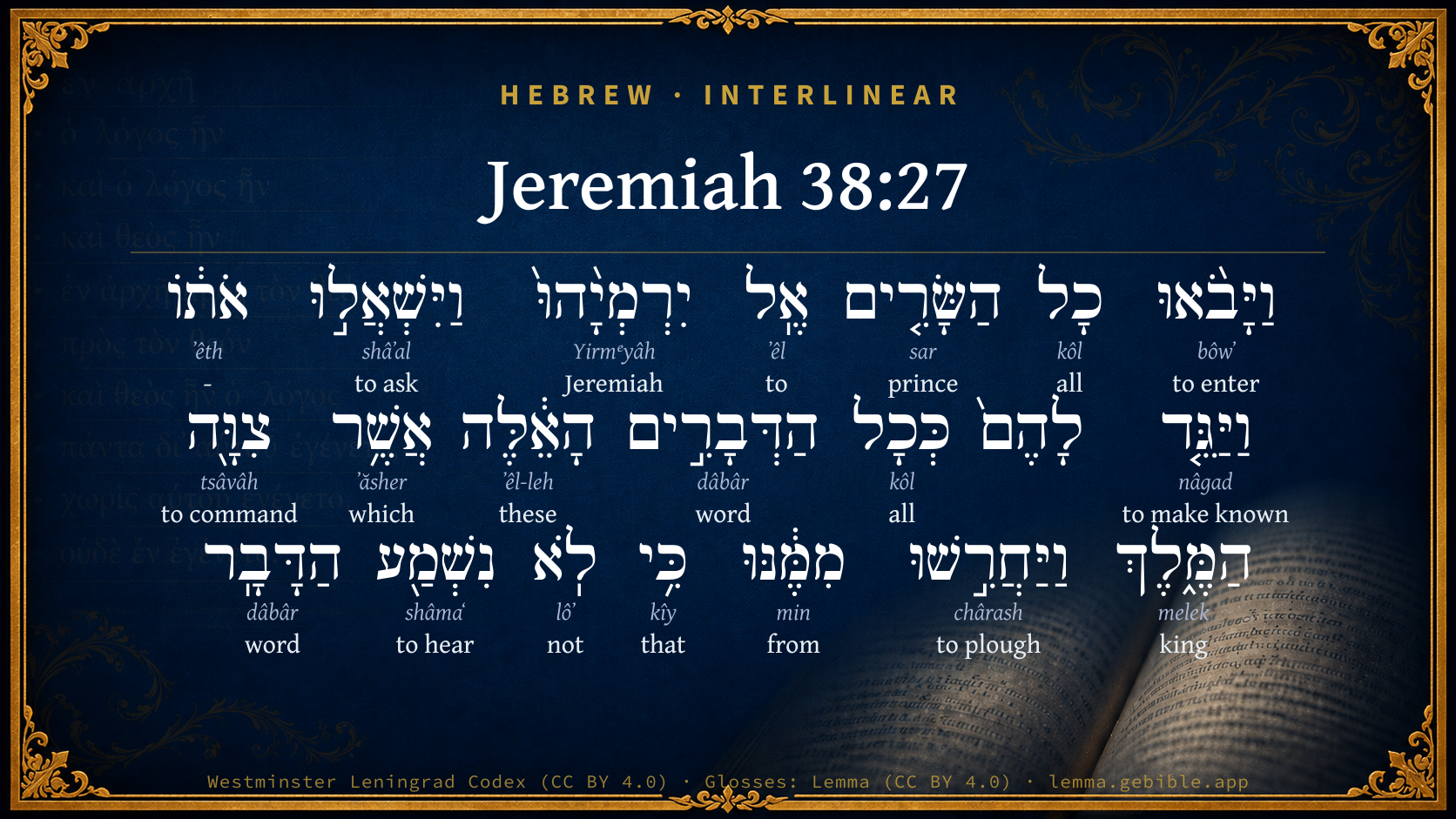
Hebrew (Westminster Leningrad Codex) Jeremiah 38:27 appears in the Hebrew Old Testament. The text above is from the Westminster Leningrad Codex. Each word links to its Strong’s number, a concise gloss, and parsing drawn from the Open Scriptures Hebrew Bible morphology. Click any word for its full Brown-Driver-Briggs (BDB) entry.
Download image
Cite this verse

Jeremiah 38:27 (World English Bible). Public Domain. Lemma interlinear Bible study tool, https://lemma.gebible.app/v/jeremiah/38/27.

Show BibTeX & RIS
BibTeX
RIS
English Translation
Then came all the princes to Jeremiah, and asked him; and he told them according to all these words that the king had commanded. So they left off speaking with him; for the matter was not perceived.
World English Bible · Public Domain
Download a study sheet

One document with this verse’s original text, its word-by-word gloss line, the meaning frame, cross-references with their text, attributed commentary, and full source and license credits — printable, and it pastes into notes with its structure intact.

This verse Autodidact and up

Study sheet (.html) Plain text (.txt)

A passage Seminary Student

Up to 50 verses in one chapter. A passage sheet keeps up to 6 commentary sources and 12 cross-references per verse, in the order this page ranks them, and says so on the sheet whenever that leaves anything out. Ask for a single verse and you get the Autodidact verse sheet above.

Everything on this page stays free to read, with no account — the sheet is a download of what is already on screen, not access to it.

Want to remove ads? Support Godless Engineer
Compare translations 3

The same verse in 3 English versions, stacked beneath the original-language interlinear above. Click any original word for its lexicon entry.

Each is an independent rendering of the whole verse — the interlinear is not word-aligned to these translations.

Highlighted words mark where these versions differ — a whole-verse word diff, not a word-by-word alignment.

  • World English Bible Public Domain
    Then came all the princes to Jeremiah, and asked him; and he told them according to all these words that the king had commanded. So they left off speaking with him; for the matter was not perceived.
  • King James Version Public Domain
    Then came all the princes unto Jeremiah, and asked him: and he told them according to all these words that the king had commanded. So they left off speaking with him; for the matter was not perceived.
  • unfoldingWord Literal Text CC BY-SA 4.0
    Then all the officials came to Jeremiah and questioned him, so he answered them as the king had instructed him. So they stopped talking with him, because they had not heard the conversation between Jeremiah and the king.

unfoldingWord Literal Text — © unfoldingWord, licensed CC BY-SA 4.0. Word-aligned USFM3 via Door43 (git.door43.org/unfoldingWord/en_ult).

Versions to compare (up to 4)

3 of 4 selected

Show all 18 translations

Every available English version of this verse, each an independent rendering of the whole verse.

  • World English Bible Public Domain
    Then came all the princes to Jeremiah, and asked him; and he told them according to all these words that the king had commanded. So they left off speaking with him; for the matter was not perceived.
  • Berean Standard Bible Public Domain
    When all the officials came to Jeremiah and questioned him, he relayed to them the exact words the king had commanded him to say. So they said no more to him, for no one had overheard the conversation.
  • Majority Standard Bible Public Domain
    When all the officials came to Jeremiah and questioned him, he relayed to them the exact words the king had commanded him to say. So they said no more to him, for no one had overheard the conversation.
  • King James Version Public Domain
    Then came all the princes unto Jeremiah, and asked him: and he told them according to all these words that the king had commanded. So they left off speaking with him; for the matter was not perceived.
  • American Standard Version (1901) Public Domain
    Then came all the princes unto Jeremiah, and asked him; and he told them according to all these words that the king had commanded. So they left off speaking with him; for the matter was not perceived.
  • Revised Version (1885) Public Domain
    Then came all the princes unto Jeremiah, and asked him: and he told them according to all these words that the king had commanded. So they left off speaking with him; for the matter was not perceived.
  • Geneva Bible (1599) Public Domain
    Then came all the princes vnto Ieremiah and asked him. And he tolde them according to all these wordes that the King had commanded: so they left off speaking with him, for the matter was not perceiued.
  • Douay-Rheims (1899) Public Domain
    So all the princes came to Jeremias, and asked him: and he spoke to them according to all the words that the king had commanded him: and they left him: for nothing had been heard.
  • Young's Literal Translation Public Domain
    And all the heads come in unto Jeremiah, and ask him, and he declareth to them according to all these words that the king commanded, and they keep silent from him, for the matter was not heard;
  • Literal Standard Version CC BY-SA 4.0
    And all the heads come to Jeremiah, and ask him, and he declares to them according to all these words that the king commanded, and they keep silent from him, for the matter was not heard;
  • Unlocked Literal Bible CC BY-SA 4.0
    Then all the officials came to Jeremiah and questioned him, so he answered them as the king had instructed him. So they stopped talking with him, because they had not heard the conversation between Jeremiah and the king.
  • unfoldingWord Literal Text CC BY-SA 4.0
    Then all the officials came to Jeremiah and questioned him, so he answered them as the king had instructed him. So they stopped talking with him, because they had not heard the conversation between Jeremiah and the king.
  • Darby Bible Public Domain
    -- And all the princes came to Jeremiah, and asked him; and he told them according to all these words that the king had commanded. And they withdrew quietly from him; for the matter was not reported.
  • World Messianic Bible Public Domain
    Then all the princes came to Jeremiah, and asked him; and he told them according to all these words that the king had commanded. So they stopped speaking with him, for the matter was not perceived.
  • Webster's Bible Public Domain
    Then came all the princes to Jeremiah, and asked him: and he told them according to all these words that the king had commanded. So they left off speaking with him; for the matter was not perceived.
  • Free Bible Version CC BY-SA 4.0
    When all the officers came to Jeremiah wanting to know, he repeated to them exactly what the king had told him to say. So they didn't ask him anything more because no one had heard what had been said.
  • Bible in Basic English Public Domain
    Then all the rulers came to Jeremiah, questioning him: and he gave them an answer in the words the king had given him orders to say. So they said nothing more to him; for the thing was not made public.
  • JPS Tanakh (1917) Public Domain
    Then came all the princes unto Jeremiah, and asked him; and he told them according to all these words that the king had commanded. So they left off speaking with him; for the matter was not reported.

Literal Standard Version (2020), Covenant Press — licensed CC BY-SA 4.0. Text via the HelloAO Bible API (eBible.org). Unlocked Literal Bible (unfoldingWord) — licensed CC BY-SA 4.0. Text via the HelloAO Bible API (eBible.org). unfoldingWord Literal Text — © unfoldingWord, licensed CC BY-SA 4.0. Word-aligned USFM3 via Door43 (git.door43.org/unfoldingWord/en_ult). Free Bible Version, Dr. Jonathan Gallagher — licensed CC BY-SA 4.0. Text via the HelloAO Bible API (eBible.org).

Word by word

More ways to search: Search by grammar → Find every occurrence → Compare this word →

Practice this passage: Drill this verse → Learn its vocabulary →

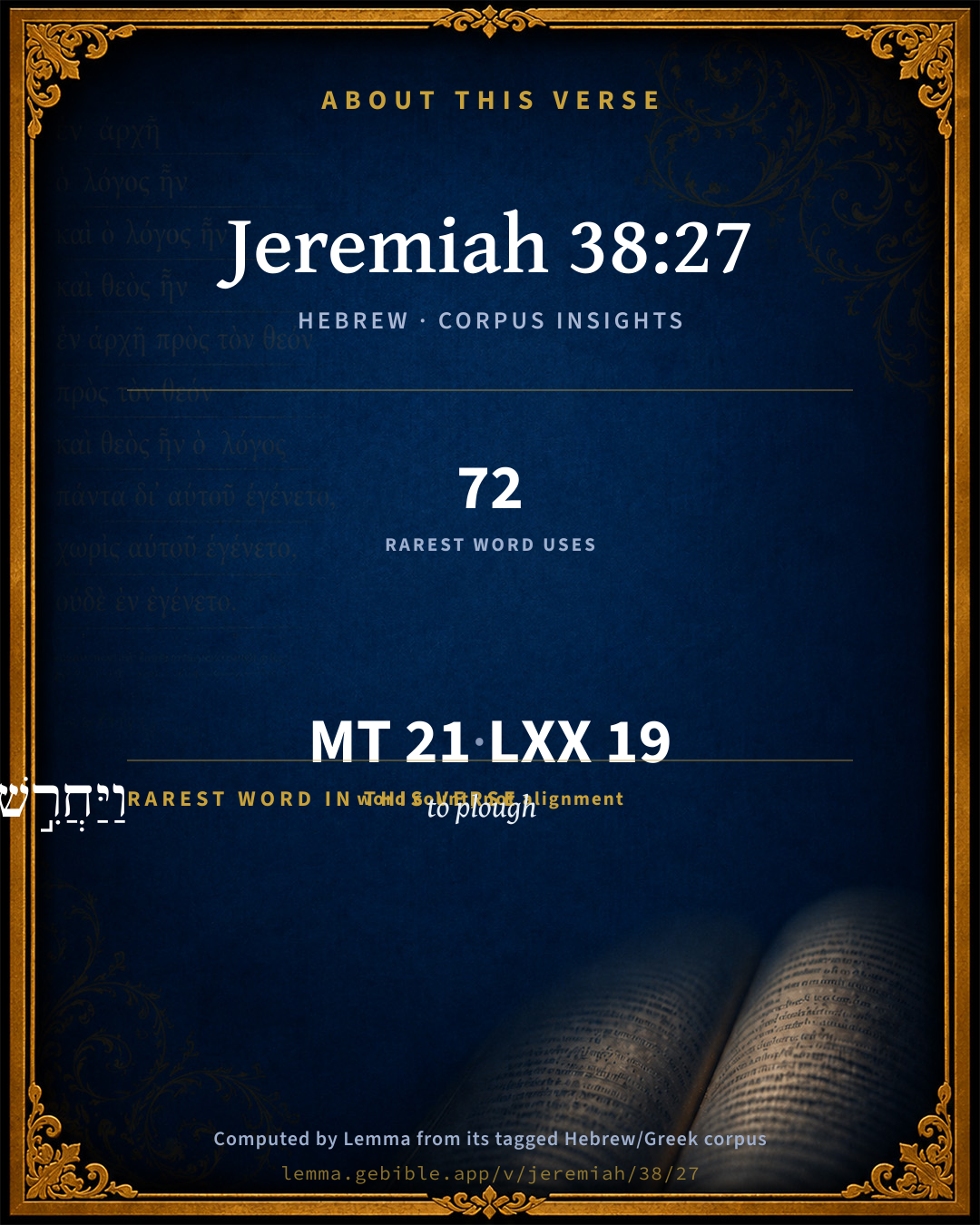
וַיַּחֲרִ֣שׁוּ
chârash
H2790
“and · to plough”
Conjunction + Verb, Hiphil, Sequential Imperfect, 3rd Person, Masculine, Plural
Part of Speech
Conjunction + Verb
Stem
Hiphil
Form
Sequential Imperfect
Person
3rd Person
Gender
Masculine
Number
Plural
Full BDB Definition

Origin: a primitive root

TWOT: 760 , 761

to cut in, plough, engrave, devise - (Qal) - to cut in, engrave - to plough - to devise - (Niphal) to be ploughed - (Hiphil) to plot evil - to be silent, be dumb, be speechless, be deaf - (Qal) - to be silent - to be deaf - (Hiphil) - to be silent, keep quiet - to make silent - to be deaf, show deafness - (Hithpael) to remain silent
  1. וַיָּבֹ֨אוּ bôwʼ H935 “and · to enter” Conjunction + Verb, Qal, Sequential Imperfect, 3rd Person, Masculine, Plural
  2. כָל kôl H3605 “all of” Noun, Common, Masculine, Singular, Construct
  3. הַשָּׂרִ֤ים sar H8269 “the · princes” Particle, Definite Article + Noun, Common, Masculine, Plural, Absolute
  4. אֶֽל ʼêl H413 “to” Preposition
  5. יִרְמְיָ֨הוּ֙ Yirmᵉyâh H3414 “Jeremiah” Noun, Proper
  6. וַיִּשְׁאֲל֣וּ shâʼal H7592 “and · to ask” Conjunction + Verb, Qal, Sequential Imperfect, 3rd Person, Masculine, Plural
  7. אֹת֔וֹ ʼêth H853 “- · him” Particle, Direct Object + Suffix, Personal, 3rd Person, Masculine, Singular
  8. וַיַּגֵּ֤ד nâgad H5046 “and · to make known” Conjunction + Verb, Hiphil, Sequential Imperfect, 3rd Person, Masculine, Singular
  9. כְּכָל kôl H3605 “like/as · all of” Preposition + Noun, Common, Masculine, Singular, Construct
  10. הַדְּבָרִ֣ים dâbâr H1697 “the · words” Particle, Definite Article + Noun, Common, Masculine, Plural, Absolute
  11. הָאֵ֔לֶּה ʼêl-leh H428 “the · these” Particle, Definite Article + Pronoun, Demonstrative, Common, Plural
  12. אֲשֶׁ֥ר ʼăsher H834 “which” Particle, Relative
  13. צִוָּ֖ה tsâvâh H6680 “to command” Verb, Piel, Perfect, 3rd Person, Masculine, Singular
  14. הַמֶּ֑לֶךְ melek H4428 “the · king” Particle, Definite Article + Noun, Common, Masculine, Singular, Absolute
  15. מִמֶּ֔נּוּ min H4480 “from · us” Preposition + Suffix, Personal, 1st Person, Common, Plural
  16. כִּ֥י kîy H3588 “that” Conjunction
  17. לֹֽא lôʼ H3808 “not” Particle, Negative
  18. נִשְׁמַ֖ע shâmaʻ H8085 “to hear” Verb, Niphal, Perfect, 3rd Person, Masculine, Singular
  19. הַדָּבָֽר dâbâr H1697 “the · word” Particle, Definite Article + Noun, Common, Masculine, Singular, Absolute

About this verse

These counts appear in no published source. They are computed here, from the morphology-tagged text and Lemma’s own curated glosses. What Lemma adds →

21
words
18
distinct lemmas
Prophets
section

Grammatical profile

  • 6 verbs
  • 7 nouns
  • 1 pronoun
  • 3 prepositions
  • 1 conjunction
  • 3 particles

Verb forms

  • וַיָּבֹ֨אוּ Qal · Sequential Imperfect
  • וַיִּשְׁאֲל֣וּ Qal · Sequential Imperfect
  • וַיַּגֵּ֤ד Hiphil · Sequential Imperfect
  • צִוָּ֖ה Piel · Perfect
  • וַיַּחֲרִ֣שׁוּ Hiphil · Sequential Imperfect
  • נִשְׁמַ֖ע Niphal · Perfect

Repetition

Words recur within this verse — often emphatic in Hebrew:

  • כָל all H3605 ×2
  • הַדְּבָרִ֣ים word H1697 ×2

Hebrew & Septuagint length

In the original languages it is 21 Hebrew tokens and 19 Greek tokens — but the two are counted differently (Hebrew bundles its prefixes and suffixes into one token; the Greek is in lemma form), so that isn’t a like-for-like length.

Cross-references

4

Topical passages linked to Jeremiah 38:27 in the Treasury of Scripture Knowledge — connected by theme and wording, ordered by reader-vote popularity; previews shown in the World English Bible.

  • 1 Samuel 10:15–16 Saul's uncle said, Tell me, Please, what Samuel said to you.
  • 1 Samuel 16:2–5 Samuel said, How can I go? if Saul hear it, he will kill me. Yahweh said, Take a heifer with you, and say, I am come to sacrifice to Yahweh.
  • 2 Kings 6:19 Elisha said to them, This is not the way, neither is this the city: follow me, and I will bring you to the man whom you seek. He led them to Samaria.
  • Acts 23:6 But when Paul perceived that the one part were Sadducees and the other Pharisees, he cried out in the council, "Men and brothers, I am a Pharisee, a son of Pharisees. Concerning the hope and resurrection of the dead I am being judged!"

Cross-references courtesy of OpenBible.info (CC BY 4.0).

Hebrew and Greek witnesses Masoretic Hebrew ↔ Greek Septuagint

The same verse in the two great witnesses to the Old Testament, shown verse-for-verse.

These are two independent witnesses, not word-aligned to each other, and the Septuagint is shown in lemma (dictionary) form.

Hebrew Jeremiah 38:27 Masoretic · Westminster Leningrad Codex

וַיָּבֹ֨אוּ כָל הַשָּׂרִ֤ים אֶֽל יִרְמְיָ֨הוּ֙ וַיִּשְׁאֲל֣וּ אֹת֔וֹ וַיַּגֵּ֤ד לָהֶם֙ כְּכָל הַדְּבָרִ֣ים הָאֵ֔לֶּה אֲשֶׁ֥ר צִוָּ֖ה הַמֶּ֑לֶךְ וַיַּחֲרִ֣שׁוּ מִמֶּ֔נּוּ כִּ֥י לֹֽא נִשְׁמַ֖ע הַדָּבָֽר

Then came all the princes to Jeremiah, and asked him; and he told them according to all these words that the king had commanded. So they left off speaking with him; for the matter was not perceived.

World English Bible · Public Domain

Greek LXX Structure differs

In the Septuagint, Jeremiah is about an eighth shorter than the Hebrew and arranges its material differently — the Oracles Against the Nations (Hebrew chapters 46–51) appear in the middle of the Greek book, after 25:13. Because the chapter and verse boundaries do not line up, a verse-for-verse comparison with the Hebrew is not shown.

A verse-for-verse comparison isn’t shown here because the chapters and verses don’t line up. Switch to the LXX edition with the MT / LXX toggle above to read the Greek directly.

Hebrew: Westminster Leningrad Codex (CC BY 4.0). Greek: Septuagint (public domain); English from a public-domain English Septuagint. How the Septuagint differs from the Hebrew →

Targum (Aramaic paraphrase)

1

The Targum is the ancient Jewish Aramaic paraphrase of the Hebrew Scriptures — an interpretive translation, not the Hebrew text itself. Onkelos (literal) and Pseudo-Jonathan (expansive) render the Torah, and Jonathan the Prophets. Coverage is partial: where no permissively-licensed English translation exists for a verse, only the Aramaic is shown. This is verse-level text, not a word-by-word alignment to the Hebrew.

  1. Targum Jonathan Prophets (Joshua–Malachi)
    וַאֲתוּ כָּל רַבְרְבַיָא לְוַת יִרְמְיָה וּשְׁאִילוּ יָתֵיהּ וְחַוֵי לְהוֹן כְּכָל פִתְגָמַיָא הָאִלֵין דְפַקֵיד מַלְכָּא וּשְׁתִיקוּ מִנֵיהּ אֲרֵי לָא יִשְׁתְּמַע פִּתְגָמָא:

    (no public-domain English translation for this verse)

    Targum Jonathan — Aramaic: “Mikraot Gedolot” (public domain). English: “Sefaria Community Translation” (CC0 1.0 (public-domain dedication)); “London "Chaldee Paraphrase," 1871” (public domain). Text via Sefaria.

Commentary

Notes on Jeremiah 38:27 from classic Christian and Jewish commentators (each source and its license shown beneath its notes). The classic Christian expositions comment on the surrounding passage and are grouped to its opening verse, so a note may address several verses; the Jewish commentaries on the Tanakh (Rashi and others) are per-verse, so they appear only where the commentator wrote on this verse.

Lemma curates 59 commentaries, every one of them public domain or Creative Commons licensed, each selected and text-cleaned for this edition rather than reprinted as found. About our sources →

Trapp's Complete Commentary

John Trapp

Jer 38:27 Then came all the princes unto Jeremiah, and asked him: and he told them according to all these words that the king had commanded. So they left off speaking with him; for the matter was not perceived.

Ver. 27. So they left off speaking with him.] Indigni utique qui ultra monerentur. The princes were far worse than the king, {a} who yet himself was one of the best. They therefore were slain by the Babylonian princes, when the king’s life was preserved, though with the loss of his eyes, which yet might be a means to open the eyes of his mind.

{a} In una impietate solum stabiles.

John Trapp, A Commentary or Exposition upon All the Books of the Old and New Testament (1647–1656) — public domain. Text from a community e-Sword module.

Adam Clarke's Commentary

Verse 27. The matter was not perceived.] They did not question him farther; and the king's commandment to remove him from the house of Jonathan being well known, they took for granted that they had all the information that they sought. And he was most certainly not obliged to relate any thing that might embroil this weak king with his factious but powerful princes, or affect his own life. He related simply what was necessary, and no more.

Adam Clarke's Commentary on the Bible (1810–1826) — public domain. Text from a community e-Sword/MySword module.

John Calvin's Commentaries

Here, indeed, the Prophet confesses that he did as the king had commanded him; but he does not commend what he had done. There is no doubt but that on the one hand he placed before his eyes the timidity of the king, who, being forgetful of plain dealing, slavishly feared his own counselors; and that., on the other hand, he manifested that he was not sufficiently discreet, for when the princes came, even if he wished not to deceive them, he yet concealed the main thing, and said that he went to the king to pray for his own life, which was not true. Though then what he said was in part true, that he prayed not. to be sent back to prison, yet he could not by this evasion be wholly exempted from blame.

In short, we see that even God’s servants have sometimes spoken evasively, when oppressed with extreme fear; and thus we are reminded to seek of God magnanimity of mind and resolute firmness; for he alone can strengthen and sustain us when we are terrified by any fear of danger.

He says, that he did as the king had commanded him; but he ought rather to have hearkened to God’s word, in which simplicity is enjoined. It is also said, that the princes were silent, that is, departed in silence; for no one had been a witness to the conference, and the matter had not spread farther; for the king was silent through fear, and the Prophet also had not made known the secret interview. Hence it was that the princes departed, and thought that the matter was as represented. In short, Jeremiah intimates that they were deceived by this pretext. It follows at last, —

John Calvin's Commentaries (1540-1563) — public domain. Text from the Calvin Translation Society English edition (1840s-50s) via the Christian Classics Ethereal Library (ccel.org). Calvin's coverage is partial (roughly two-thirds of the Bible); uncommented books and verses are honest gaps, never fabricated. The 19th-century editor's footnotes and remarks are omitted so the notes are faithfully Calvin's own voice.

The Cambridge Bible for Schools and Colleges

gen. ed. J. J. S. Perowne

27. perceived] mg. reported, i.e. the princes were given no further particulars as to the conversation.

The Cambridge Bible for Schools and Colleges (gen. ed. J. J. S. Perowne; Cambridge University Press, 1878–1918) — public domain. Text from a community e-Sword module.

John Gill's Exposition

Then came all the princes to Jeremiah, and asked him,.... After he had parted with the king, and was come back to the court of the prison; as soon as the princes had been informed of the interview between the king and the prophet, which soon came to their ears, they came in a body to him, to the court of the prison, where he was, and asked him of what passed between him and the king:

and he told them according to all those words that the king had commanded; what he told them, no doubt, was truth; though he did not tell them all the truth; which he was not obliged to do, having no command from God, and being forbid by the king:

so they left off speaking with him; or, "were silent from him" (e); went away silent, not being able to disprove what he had said, or object unto it, and finding they could get nothing more out of him:

for the matter was not perceived; or, "was not heard" (f); though there were persons that saw the king and the prophet together, yet nobody heard anything that passed between them; and therefore Jeremiah could not be confronted in what he had said, or be charged with concealing anything.

(e) "et tacuerunt ab eo", Pagninus, Montanus; "siluerunt", Calvin. (f) "quia non auditum est verbum", Pagninus, Montanus, Schmidt.

John Gill's Exposition of the Whole Bible (1746–1763) — public domain (CC PDM 1.0). Text via the HelloAO Bible API.

Matthew Poole's English Annotations

As the king suspected, so it came to pass; the king’s private discourse with the prophet took wind, and all the princes then at court came and inquired of Jeremiah what was the substance of his discourse. Jeremiah answered them according as the king had directed. A man is not bound in all cases to speak the whole truth, much less to those who have nothing to do to inquire of us, which these princes had not. By this means the princes never knew the matter of this discourse.

Matthew Poole's English Annotations on the Holy Bible (1683–1685) — public domain. Text from a community e-Sword/MySword module.

The Pulpit Commentary

He told them according to all these words. A controversy has arisen as to whether Jeremiah was justified in concealing the truth. But is a man bound to confess the truth to a murderer?

A question of casuistry.

A deservedly esteemed commentator observes on this conduct of Jeremiah, "Though we must be so harmless as doves as never to tell a wilful lie, yet we must be so wise as serpents as not needlessly to expose ourselves to danger by telling all we know." But many are not satisfied with this defence, and they hesitate not to apply the terms "equivocation," "subterfuge," and other like censures to the prophet"s reply to the princes. Note, therefore

I WHAT IS URGED AGAINST SUCH CONDUCT. One says, "The plain meaning of such words is that Jeremiah hoodwinked them. He did not lie to them, certainly; but he did not tell the truth, and left them with a false impression. It comes very near to deception; it was evasive, and certainly was not an honest act. It seems an oblique lie. And this view of the case is supported on grounds such as these:

1. Had he not been afraid, he would have told the whole truth; but fear does not justify falsehood, though it often occasions it.

2. What must the king have thought of a prophet of God so complaisant as this?

3. What would the princes say of his vaunted righteousness when they learnt how he had dealt with them?

4. Our Saviour and his apostles never did the like.

5. It had all the effect of a lie, since it left a false impression on the minds of those to whom he spoke.

6. The very fact that it needs laboured argument to justify it against our instinctive condemnation of it shows that it does not belong to the noble family of truth, etc. But audi alteram partem. Therefore note

II WHAT MAY BE URGED IN DEFENCE.

1. In reference to the foregoing arguments. The first assumes that there was no motive but fear. The second and third are assumptions also. The fourth is, to say the least, doubtful. (Joh_7:8, 9 Act_20:20-26) Concerning the fifth, it is not true that all the effect of a lie, nor its worst effect, is that stated. And as to the sixth, it may be said that instinctive condemnations may be unjust as well as just.

2. Other replies to the charge against the prophet are:

(1) He spoke no untruth.

(2) Expediency, if not unlawful, is obligatory.

(3) It has been ever recognized as lawful, under certain circumstances, to mislead an enemy; of Rahab"s conduct (Jos_2:1) and its commendation. (Heb_11:31 Jam_2:25) The commonly supposed case of a murderer asking you which way your friend has gone, in order that he may overtake and murder him; in such case, not only might you mislead, but would you not be bound to do so?

3. There are sacred principles on which such suppression of the truth as Jeremiah"s is justified.

(1) The right to truth may be forfeited, as the right to liberty and life may be forfeited, by wrong doing. In the vast majority of cases men have a right to the truth, but in all the cases cited above they had no such right.

(2) Truth is not an end in itself, but only a means to an end, which is the honour of God and the well being of man; and there are occasions, doubtless very rare, when the end can only be secured by the sacrifice of the ordinary means. Therefore let all who presume to condemn great saints of God as guilty of lying, because they had no mere superstitious idolatry of veracity, as some have, hesitate before they bring such charge. Who are we to sit in judgment on such? But, on the other hand, let none pervert these reasonings, as the Jesuits did and many yet do, into a justification for lying and departing from the truth whenever it may be found convenient. It needs a healthy conscience to decide when these reasonings are applicable a conscience enlightened by God"s Spirit and animated by his love, and then such a one, and only such a one, may be left to do as he wills in cases like those we have considered. C.

The Pulpit Commentary (1880–1919), ed. H.D.M. Spence-Jones & Joseph S. Exell — public domain. Text from a community e-Sword module.

Keil & Delitzsch

C. F. Keil & F. Delitzsch

What the king had supposed actually occurred, and Jeremiah gave the princes, who asked about the conversation, the reply that the king had prepared for him. יחרשׁוּ ממּנּוּ .mih rof deraperp, they went away in silence from him, and left him in peace; cf. Sa1 7:8. כּי לא נשׁמע , for the matter, the real subject of the conversation did not become known. So Jeremiah remained in the court of the prison till the day of the capture of Jerusalem. - The last sentence of Jer 38:28 belongs to the following chapter, and forms the introductory sentence of the passage whose conclusion follows in Jer 39:3.

Keil & Delitzsch — Biblical Commentary on the Old Testament (1861–1891) — public domain (CC PDM 1.0). Text via the HelloAO Bible API. (Old Testament only.)

unfoldingWord translationNotes

Door43 World Missions Community

the conversation between Jeremiah and the king

The abstract noun "conversation" can be translated as a verb. AT: "what Jeremiah and the king said to each other" (See: Abstract Nouns)

the courtyard of the guard

This was an open area attached to the king's palace that was surrounded by buildings and in which they kept prisoners. See how you translated this in Jeremiah 32:2.

until the day Jerusalem was captured

This can be translated in active form. AT: "until the day that the Babylonian army captured Jerusalem" (See: Active or Passive)

translationWords

court

Jerusalem

unfoldingWord translationNotes — © Distant Shores Media and the Door43 World Missions Community, licensed CC BY-SA 4.0. Source: git.door43.org/Door43/en_tn.

Lesson kit

Teaching starters — assembled from the data on this page, not authored interpretation. Every prompt links to the verse data it draws on. Edit before teaching.

Jeremiah, in the Prophets, opens this verse with 21 words (18 distinct Hebrew lemmas). Its most distinctive word is chârash (“to plough”). A historical commentator’s framing appears above. Read the whole chapter for the surrounding context.

Discussion questions

  1. How does “to plough” (chârash) shape what this verse is saying?
  2. How does 1 Samuel 10:15–16, which shares this passage’s theme, read alongside this verse?
  3. What does the repetition of “all” (2× in this one verse) do in this verse?
  4. These translations render this verse differently; the difference is in the English rendering, not the original. What questions does that raise?
  5. «וַיָּבֹ֨אוּ» is a Qal Sequential Imperfect verb. How does that grammatical form shape the action described?
  6. Compare how Trapp's Complete Commentary and Adam Clarke's Commentary read this verse. Where do they agree or differ?

Things to notice

Reading settings

Reading text

Shown beneath each verse's original-language words.

Old Testament
Old Testament edition

Read the OT as the Masoretic Hebrew (MT) or the Greek Septuagint (LXX).

English shown for the Greek Septuagint (in the Hebrew ↔ Greek comparison).

Comparing translations? Open the Compare panel on any verse page to stack up to four side by side.