Genesis 45:26

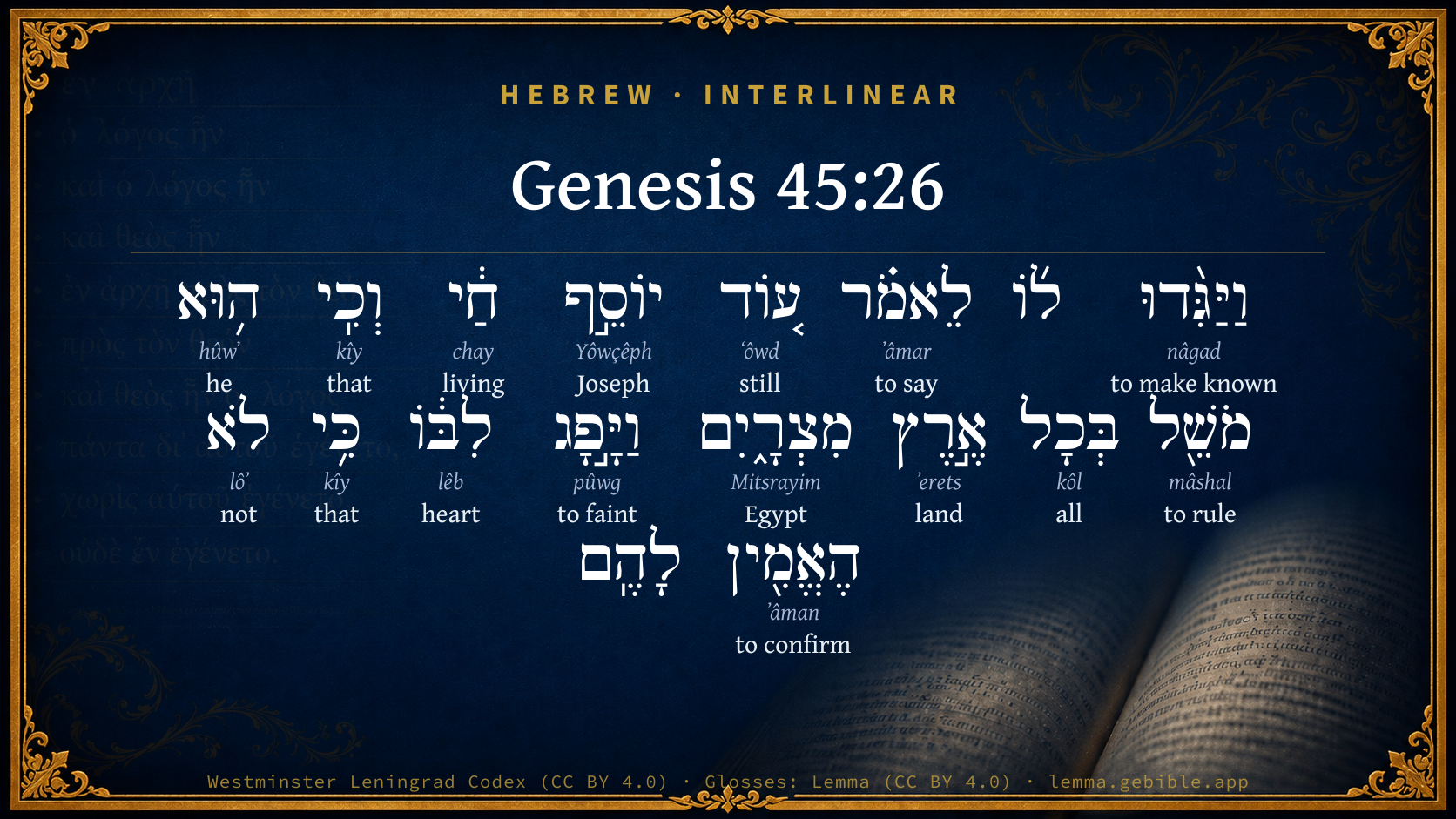
Hebrew (Westminster Leningrad Codex) Genesis 45:26 appears in the Hebrew Old Testament. The text above is from the Westminster Leningrad Codex. Each word links to its Strong’s number, a concise gloss, and parsing drawn from the Open Scriptures Hebrew Bible morphology. Click any word for its full Brown-Driver-Briggs (BDB) entry.
Download image
Cite this verse

Genesis 45:26 (World English Bible). Public Domain. Lemma interlinear Bible study tool, https://lemma.gebible.app/v/genesis/45/26.

Show BibTeX & RIS
BibTeX
RIS
English Translation
They told him, saying, "Joseph is still alive, and he is ruler over all the land of Egypt." His heart fainted, for he didn't believe them.
World English Bible · Public Domain
Highlights
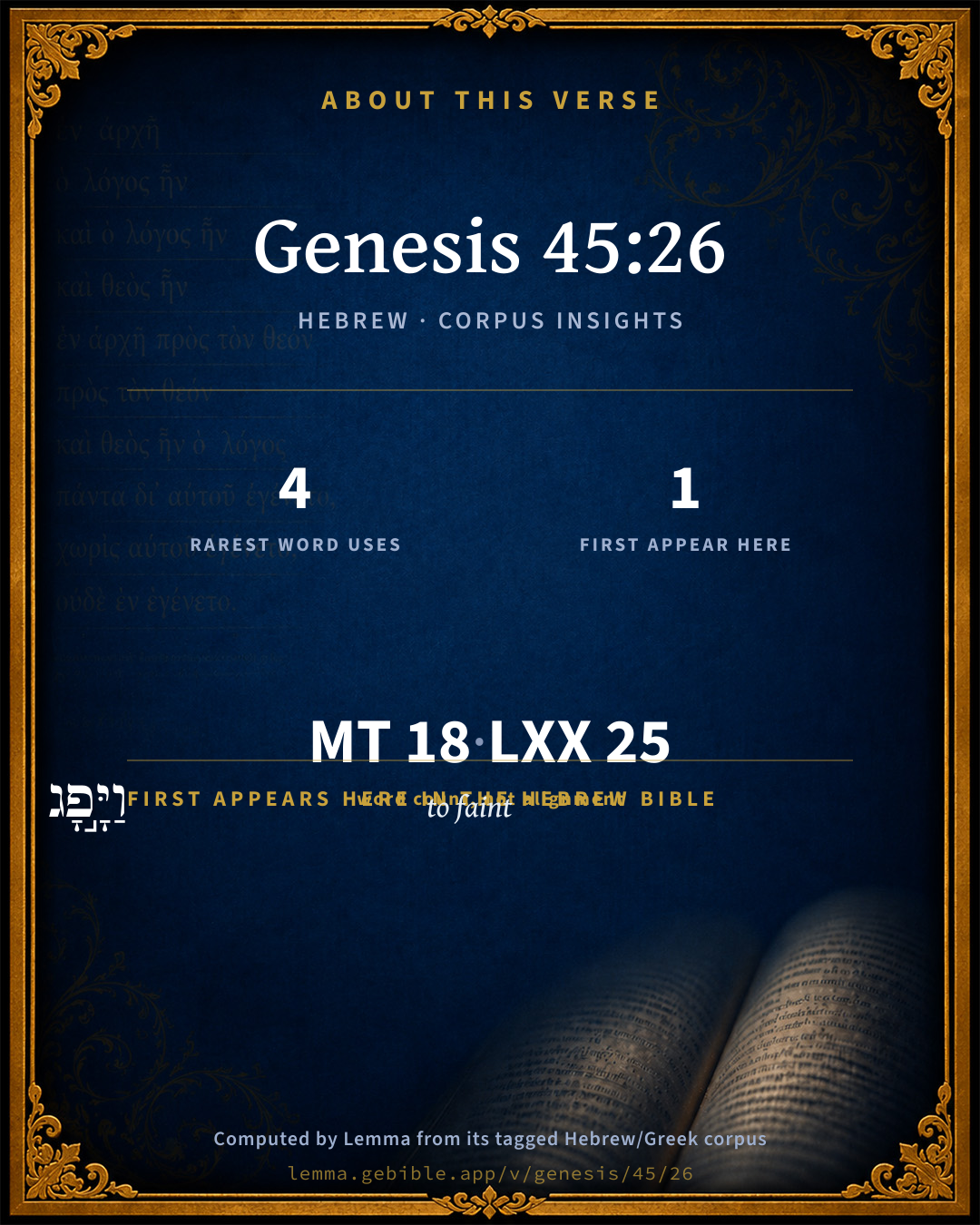
  • 1 first appearance in the Hebrew Bible
Full analysis ↓
Download a study sheet

One document with this verse’s original text, its word-by-word gloss line, the meaning frame, cross-references with their text, attributed commentary, and full source and license credits — printable, and it pastes into notes with its structure intact.

This verse Autodidact and up

Study sheet (.html) Plain text (.txt)

A passage Seminary Student

Up to 50 verses in one chapter. A passage sheet keeps up to 6 commentary sources and 12 cross-references per verse, in the order this page ranks them, and says so on the sheet whenever that leaves anything out. Ask for a single verse and you get the Autodidact verse sheet above.

Everything on this page stays free to read, with no account — the sheet is a download of what is already on screen, not access to it.

Want to remove ads? Support Godless Engineer
Compare translations 3

The same verse in 3 English versions, stacked beneath the original-language interlinear above. Click any original word for its lexicon entry.

Each is an independent rendering of the whole verse — the interlinear is not word-aligned to these translations.

Highlighted words mark where these versions differ — a whole-verse word diff, not a word-by-word alignment.

  • World English Bible Public Domain
    They told him, saying, "Joseph is still alive, and he is ruler over all the land of Egypt." His heart fainted, for he didn't believe them.
  • King James Version Public Domain
    And told him, saying, Joseph is yet alive, and he is governor over all the land of Egypt. And Jacob's heart fainted, for he believed them not.
  • unfoldingWord Literal Text CC BY-SA 4.0
    And they reported to him, saying, “Joseph still alive! And in fact, he the ruler over all the land of Egypt!” But his heart went numb because he did not believe them.

unfoldingWord Literal Text — © unfoldingWord, licensed CC BY-SA 4.0. Word-aligned USFM3 via Door43 (git.door43.org/unfoldingWord/en_ult).

Versions to compare (up to 4)

3 of 4 selected

Show all 18 translations

Every available English version of this verse, each an independent rendering of the whole verse.

  • World English Bible Public Domain
    They told him, saying, "Joseph is still alive, and he is ruler over all the land of Egypt." His heart fainted, for he didn't believe them.
  • Berean Standard Bible Public Domain
    “Joseph is still alive,” they said, “and he is ruler over all the land of Egypt!” But Jacob was stunned, for he did not believe them.
  • Majority Standard Bible Public Domain
    “Joseph is still alive,” they said, “and he is ruler over all the land of Egypt!” But Jacob was stunned, for he did not believe them.
  • King James Version Public Domain
    And told him, saying, Joseph is yet alive, and he is governor over all the land of Egypt. And Jacob's heart fainted, for he believed them not.
  • American Standard Version (1901) Public Domain
    And they told him, saying, Joseph is yet alive, and he is ruler over all the land of Egypt. And his heart fainted, for he believed them not.
  • Revised Version (1885) Public Domain
    And they told him, saying, Joseph is yet alive, and he is ruler over all the land of Egypt. And his heart fainted, for he believed them not.
  • Geneva Bible (1599) Public Domain
    And tolde him, saying, Ioseph is yet aliue, and he also is gouernour ouer all the lande of Egypt, and Iaakobs heart failed: for he beleeued them not.
  • Douay-Rheims (1899) Public Domain
    And they told him, saying: Joseph thy son is living: and he is ruler in all the land of Egypt. Which when Jacob heard, he awaked as it were out of a deep sleep, yet did not believe them.
  • Young's Literal Translation Public Domain
    and they declare to him, saying, `Joseph `is' yet alive,' and that he `is' ruler over all the land of Egypt; and his heart ceaseth, for he hath not given credence to them.
  • Literal Standard Version CC BY-SA 4.0
    and they declare to him, saying, “Joseph [is] yet alive,” and that he [is] ruler over all the land of Egypt; and his heart ceases, for he has not given credence to them.
  • Unlocked Literal Bible CC BY-SA 4.0
    They told him saying “Joseph is still alive, and he is ruler over all the land of Egypt.” His heart was astonished, for he could not believe what they told him.
  • unfoldingWord Literal Text CC BY-SA 4.0
    And they reported to him, saying, “Joseph still alive! And in fact, he the ruler over all the land of Egypt!” But his heart went numb because he did not believe them.
  • Darby Bible Public Domain
    And they told him, saying, Joseph is still alive, and he is governor over all the land of Egypt. And his heart fainted, for he did not believe them.
  • World Messianic Bible Public Domain
    They told him, saying, “Joseph is still alive, and he is ruler over all the land of Egypt.” His heart fainted, for he didn’t believe them.
  • Webster's Bible Public Domain
    And told him, saying, Joseph is yet alive, and he is governor over all the land of Egypt. And Jacob's heart fainted, for he believed them not.
  • Free Bible Version CC BY-SA 4.0
    “Joseph's still alive!” they told him. “It's true, and he's the ruler of the whole country of Egypt!” Jacob was stunned at the news—he just couldn't believe it!
  • Bible in Basic English Public Domain
    And they said to him, Joseph is living, and is ruler over all the land of Egypt. And at this word Jacob was quite overcome, for he had no faith in it.
  • JPS Tanakh (1917) Public Domain
    And they told him, saying: 'Joseph is yet alive, and he is ruler over all the land of Egypt.' And his heart fainted, for he believed them not.

Literal Standard Version (2020), Covenant Press — licensed CC BY-SA 4.0. Text via the HelloAO Bible API (eBible.org). Unlocked Literal Bible (unfoldingWord) — licensed CC BY-SA 4.0. Text via the HelloAO Bible API (eBible.org). unfoldingWord Literal Text — © unfoldingWord, licensed CC BY-SA 4.0. Word-aligned USFM3 via Door43 (git.door43.org/unfoldingWord/en_ult). Free Bible Version, Dr. Jonathan Gallagher — licensed CC BY-SA 4.0. Text via the HelloAO Bible API (eBible.org).

Word by word

More ways to search: Search by grammar → Find every occurrence → Compare this word →

Practice this passage: Drill this verse → Learn its vocabulary →

וַיָּ֣פָג
pûwg
H6313
“and · to faint”
Conjunction + Verb, Qal, Sequential Imperfect, 3rd Person, Masculine, Singular
Part of Speech
Conjunction + Verb
Stem
Qal
Form
Sequential Imperfect
Person
3rd Person
Gender
Masculine
Number
Singular
Full BDB Definition

Origin: a primitive root

TWOT: 1740

to grow numb, be feeble, be benumbed - (Qal) to be feeble - (Niphal) to be benumbed
  1. וַיַּגִּ֨דוּ nâgad H5046 “and · to make known” Conjunction + Verb, Hiphil, Sequential Imperfect, 3rd Person, Masculine, Plural
  2. לֵאמֹ֗ר ʼâmar H559 “to say” Preposition + Verb, Qal, Infinitive Construct
  3. ע֚וֹד ʻôwd H5750 “still” Adverb
  4. יוֹסֵ֣ף Yôwçêph H3130 “Joseph” Noun, Proper
  5. חַ֔י chay H2416 “living” Adjective, Adjective, Masculine, Singular, Absolute
  6. וְכִֽי kîy H3588 “and · that” Conjunction + Conjunction
  7. ה֥וּא hûwʼ H1931 “he” Pronoun, Personal, 3rd Person, Masculine, Singular
  8. מֹשֵׁ֖ל mâshal H4910 “ruling” Verb, Qal, Participle Active, Masculine, Singular, Absolute
  9. בְּכָל kôl H3605 “in/at · all of” Preposition + Noun, Common, Masculine, Singular, Construct
  10. אֶ֣רֶץ ʼerets H776 “land of” Noun, Common, Both, Singular, Construct
  11. מִצְרָ֑יִם Mitsrayim H4714 “Egypt” Noun, Proper
  12. לִבּ֔וֹ lêb H3820 “heart · his” Noun, Common, Masculine, Singular, Construct + Suffix, Personal, 3rd Person, Masculine, Singular
  13. כִּ֥י kîy H3588 “that” Conjunction
  14. לֹא lôʼ H3808 “not” Particle, Negative
  15. הֶאֱמִ֖ין ʼâman H539 “to confirm” Verb, Hiphil, Perfect, 3rd Person, Masculine, Singular

About this verse

These counts appear in no published source. They are computed here, from the morphology-tagged text and Lemma’s own curated glosses. What Lemma adds →

18
words
15
distinct lemmas
Pentateuch
section

Notable vocabulary

The rarest word here is וַיָּ֣פָג to faint H6313 — appearing just 4 times in the whole Hebrew Bible.

First appearance in Scripture

This word makes its first canonical appearance in the Hebrew Bible here:

  • וַיָּ֣פָג to faint H6313

Shared distinctive vocabulary

וַיָּ֣פָג to faint H6313 occurs in 4 verses of the Hebrew Bible. Also found in:

Grammatical profile

  • 5 verbs
  • 5 nouns
  • 1 adjective
  • 1 pronoun
  • 2 prepositions
  • 2 conjunctions
  • 1 adverb
  • 1 particle

Verb forms

  • וַיַּגִּ֨דוּ Hiphil · Sequential Imperfect
  • לֵאמֹ֗ר Qal · Infinitive Construct
  • מֹשֵׁ֖ל Qal · Participle Active
  • וַיָּ֣פָג Qal · Sequential Imperfect
  • הֶאֱמִ֖ין Hiphil · Perfect

Repetition

A word recurs within this verse — often emphatic in Hebrew:

  • וְכִֽי that H3588 ×2

Hebrew & Septuagint length

In English translation the verse runs 26 words from the Hebrew and 31 from the Septuagint (LXX English) — closely comparable.

A rough comparison of the two English renderings, which tokenize alike — not a word-level alignment.

Word counts can differ between the Hebrew and the Greek without any difference in meaning — e.g. the Hebrew direct-object marker אֵת has no separate Greek word, and Greek often adds the article ὁ.

In the original languages it is 18 Hebrew tokens and 25 Greek tokens — but the two are counted differently (Hebrew bundles its prefixes and suffixes into one token; the Greek is in lemma form), so that isn’t a like-for-like length.

Cross-references

13

Topical passages linked to Genesis 45:26 in the Treasury of Scripture Knowledge — connected by theme and wording, ordered by reader-vote popularity; previews shown in the World English Bible.

  • Genesis 44:28 and the one went out from me, and I said, "Surely he is torn in pieces;" and I haven't seen him since.
  • Genesis 37:35 All his sons and all his daughters rose up to comfort him; but he refused to be comforted. He said, "For I will go down to Sheol to my son mourning." His father wept for him.
  • Genesis 42:36 Jacob, their father, said to them, "You have bereaved me of my children! Joseph is no more, Simeon is no more, and you want to take Benjamin away. All these things are against me."
  • Genesis 42:38 He said, "My son shall not go down with you; for his brother is dead, and he only is left. If harm happens to him by the way in which you go, then you will bring down my gray hairs with sorrow to Sheol."
  • Genesis 45:8–9 So now it wasn't you who sent me here, but God, and he has made me a father to Pharaoh, lord of all his house, and ruler over all the land of Egypt.
  • Job 9:16 If I had called, and he had answered me, Yet would I not believe that he listened to my voice.
  • Job 29:24 I smiled on them when they had no confidence. They didn't reject the light of my face.
  • Psalms 105:21 He made him lord of his house, And ruler of all of his possessions;
  • Psalms 126:1 When Yahweh brought back those who returned to Zion, We were like those who dream.
  • Jonah 2:7 "When my soul fainted within me, I remembered Yahweh. My prayer came in to you, into your holy temple.
  • Luke 24:11 These words seemed to them to be nonsense, and they didn't believe them.
  • Luke 24:34 saying, "The Lord is risen indeed, and has appeared to Simon!"
  • Luke 24:41 While they still didn't believe for joy, and wondered, he said to them, "Do you have anything here to eat?"

Cross-references courtesy of OpenBible.info (CC BY 4.0).

Hebrew and Greek witnesses Masoretic Hebrew ↔ Greek Septuagint

The same verse in the two great witnesses to the Old Testament, shown verse-for-verse.

These are two independent witnesses, not word-aligned to each other, and the Septuagint is shown in lemma (dictionary) form.

Hebrew Genesis 45:26 Masoretic · Westminster Leningrad Codex

וַיַּגִּ֨דוּ ל֜וֹ לֵאמֹ֗ר ע֚וֹד יוֹסֵ֣ף חַ֔י וְכִֽי ה֥וּא מֹשֵׁ֖ל בְּכָל אֶ֣רֶץ מִצְרָ֑יִם וַיָּ֣פָג לִבּ֔וֹ כִּ֥י לֹא הֶאֱמִ֖ין לָהֶֽם

They told him, saying, "Joseph is still alive, and he is ruler over all the land of Egypt." His heart fainted, for he didn't believe them.

World English Bible · Public Domain

Greek LXX Genesis 45:26 Septuagint · lemma form

καί ἀναἀγγέλλω αὐτός λέγω ὅτι ὁ υἱός σύ ιωσηφ ζάω καί αὐτός ἄρχω πᾶς γῆ αἴγυπτος καί ἐκἵστημι ὁ διάνοια ἰακώβ οὐ γάρ πιστεύω αὐτός

And they reported to him, saying, Your son Joseph is living, and he is ruler over all the land of Egypt; and Jacob was amazed, for he did not believe them.

LXX2012 (modern English Septuagint) · Public Domain

On this verse, Haydock's Catholic Bible Commentary discusses the Septuagint’s reading. Read the note in Commentary ↓

Hebrew: Westminster Leningrad Codex (CC BY 4.0). Greek: Septuagint (public domain); English from LXX2012 (modern English Septuagint) (Public Domain). How the Septuagint differs from the Hebrew →

Targum (Aramaic paraphrase)

2

The Targum is the ancient Jewish Aramaic paraphrase of the Hebrew Scriptures — an interpretive translation, not the Hebrew text itself. Onkelos (literal) and Pseudo-Jonathan (expansive) render the Torah, and Jonathan the Prophets. Coverage is partial: where no permissively-licensed English translation exists for a verse, only the Aramaic is shown. This is verse-level text, not a word-by-word alignment to the Hebrew.

  1. Targum Onkelos Torah (Genesis–Deuteronomy)
    וְחַוִּיאוּ לֵהּ לְמֵימַר עַד כְּעַן יוֹסֵף קַיָּם וַאֲרֵי הוּא שַׁלִּיט בְּכָל אַרְעָא דְמִצְרָיִם וַהֲווֹ מִלַּיָּא פָּיְגָן עַל לִבֵּהּ אֲרֵי לָא הֵימִין לְהוֹן

    (no public-domain English translation for this verse)

    Targum Onkelos — Aramaic: “Onkelos Genesis” (public domain); “Onkelos Exodus” (public domain); “Onkelos Leviticus” (public domain); “Onkelos Numbers” (public domain); “Onkelos Deuteronomy” (public domain). English: “Sefaria Community Translation” (CC0 1.0 (public-domain dedication)); “J.W. Etheridge. The Targums of Onkelos and Jonathan Ben Uzziel on the Pentateuch. London: Longmans, Green, 1862” (public domain). Text via Sefaria.

  2. Targum Pseudo-Jonathan Torah (Genesis–Deuteronomy)
    וְתַנִיאוּ לֵיהּ לְמֵימָר עַד כְּדוֹן יוֹסֵף קַיֵים וַאֲרוּם הוּא שַׁלִיט בְּכָל אַרְעָא דְמִצְרַיִם וּפְלֵיג לִבֵּיהּ אֲרוּם לָא הֵימִין לְהוֹם

    And they declared to him, saying, Joseph is yet alive, and is ruler over all the land of Mizraim. But his heart was divided, because he did not believe them.

    Targum Pseudo-Jonathan — Aramaic: “Targum Jonathan on Genesis” (public domain); “Targum Jonathan on Exodus” (public domain); “Targum Jonathan on Leviticus” (public domain); “Targum Jonathan on Numbers” (public domain); “Targum Jonathan on Deuteronomy” (public domain). English: “The Targum of Jonathan ben Uzziel, trans. J. W. Etheridge, London, 1862” (public domain). Text via Sefaria.

Commentary

Notes on Genesis 45:26 from classic Christian and Jewish commentators (each source and its license shown beneath its notes). The classic Christian expositions comment on the surrounding passage and are grouped to its opening verse, so a note may address several verses; the Jewish commentaries on the Tanakh (Rashi and others) are per-verse, so they appear only where the commentator wrote on this verse.

Lemma curates 59 commentaries, every one of them public domain or Creative Commons licensed, each selected and text-cleaned for this edition rather than reprinted as found. About our sources →

Trapp's Complete Commentary

John Trapp

Gen 45:26 And told him, saying, Joseph [is] yet alive, and he [is] governor over all the land of Egypt. And Jacob’s heart fainted, for he believed them not.

Ver. 26. Joseph is yet alive.] This was the most joyful news that ever Jacob heard, and the sincerest pleasure that ever he had; which therefore God reserves for his age. How did his good heart, after he had recollected himself, dance Levaltoes in his bosom, to hear of Joseph’s honour, but especially of his life! What shall ours do, when we see Christ in his kingdom!

Jacob’s heart fainted, for he believed them not.] They had told him a tale before; and he that once hath cracked his credit is hardly, after, believed. Besides, he thought the news was too good to be true. Tarda solet magnis rebus inesse fides. The joy of heaven is so great, that we must "enter into it"; it cannot enter into us. "Enter into the joy of thy Lord." {Mat 25:21}

John Trapp, A Commentary or Exposition upon All the Books of the Old and New Testament (1647–1656) — public domain. Text from a community e-Sword module.

Joseph Benson's Commentary

Gen 45:26. They told him — Probably without any preamble; Joseph is yet alive — The very mention of Joseph’s name revived his sorrow, so that his heart fainted, and it was a good while before he came to himself. He was in such care and fear about the rest of them, that at this time it would have been joy enough to him to hear that Simeon was released, and Benjamin come safe home; for he had been ready to despair concerning them both; but to hear that Joseph was alive was too good news to be true; he faints, for he believes it not.

Joseph Benson's Commentary on the Old and New Testaments (1811–1818) — public domain. Text from a community e-Sword module.

Tyndale Open Study Notes

Tyndale Open Resources

45:26-28 As might be expected, Jacob was stunned when he heard that his son Joseph was still alive and ruling all the land of Egypt. As he heard the details of their story and saw all that Joseph had sent him, he was convinced that it was true. He immediately prepared to move to Egypt and reunite with his son Joseph, whom he had not seen for twenty-two years.

Tyndale Open Study Notes — © Tyndale Open Resources, licensed CC BY-SA 4.0. Text via the HelloAO Bible API.

Geneva Bible (1599)

Geneva Bible translators

As one between hope and fear.

Geneva Bible (1599) marginal notes — public domain. Text via Bolls.life.

Adam Clarke's Commentary

Verse 26. Jacob's heart fainted] Probably the good news so overpowered him as to cast him into a swoon. He believed them not-he thought it was too good news to be true; and though it occasioned his swooning, yet on his recovery he could not fully credit it. See a similar case, Lu 24:41.

Adam Clarke's Commentary on the Bible (1810–1826) — public domain. Text from a community e-Sword/MySword module.

John Calvin's Commentaries

26. And Jacob’s heart fainted. We know that some persons have fainted with sudden and unexpected joy. Therefore, certain interpreters suppose that the heart of Jacob was, in a sense, suffocated, as if seized by a kind of ecstatic stupor. But Moses assigns a different cause; namely, that not having confidence in his sons, he was agitated between hope and fear. And we know, that they who are held in suspense, by hearing some incredible message, are struck with torpor, as if they were lifeless. It was not, therefore, a simple affection of joy, but a certain mingled perturbation which shook the mind of Jacob. Therefore, Moses shortly after says, that his spirit revived; when he, having returned to himself, and being composed in mind, believed that which he had heard to be true. And he shows that his love towards Joseph had not languished through length of time, inasmuch as he set no value upon his own life, except so far as it would permit him to enjoy a sight of Joseph. He had before assigned to himself continual sorrow, even to the grave; but now he declares that he shall have a joyful death.

John Calvin's Commentaries (1540-1563) — public domain. Text from the Calvin Translation Society English edition (1840s-50s) via the Christian Classics Ethereal Library (ccel.org). Calvin's coverage is partial (roughly two-thirds of the Bible); uncommented books and verses are honest gaps, never fabricated. The 19th-century editor's footnotes and remarks are omitted so the notes are faithfully Calvin's own voice.

Ellicott's Commentary for English Readers

(26) Jacob’s heart fainted.—Heb., grew cold. This was not the effect of incredulity or suspicion, but of surprise. Jacob, crushed by the loss of the child who had taken the place of his beloved Rachel in his heart, had nothing left to interest him except Benjamin. When, therefore, the news come that Joseph still lives, his mind cannot open itself to receive the joyful tidings, and their first effect is to chill him with a renewed sense of his loss. It is only when he sees the wagons, and other clear proofs of the fact, that life returns to his benumbed faculties, and he becomes capable of joy.

A Bible Commentary for English Readers, edited by Charles John Ellicott (1878–1897) — public domain. Text from a community e-Sword module.

The Cambridge Bible for Schools and Colleges

gen. ed. J. J. S. Perowne

26. his heart fainted] Lit. “became numb or cold”; as we should say, “his heart stood still’ at the news. It was too good to be true.

The Cambridge Bible for Schools and Colleges (gen. ed. J. J. S. Perowne; Cambridge University Press, 1878–1918) — public domain. Text from a community e-Sword module.

John Gill's Exposition

And told him,.... What had happened to them in Egypt:

saying, Joseph is yet alive; who was thought by him and them to have been dead long ago:

and he is governor over all the land of Egypt; deputy governor, and had such power and authority that nothing was done without his order; the executive power or administration of government was put into his hands, and all the officers of the kingdom were under him, he was next to Pharaoh:

and Jacob's heart fainted, for he believed them not; it was too great and too good news to be true; though it was desirable, it was unexpected; it amazed him, he knew not what to think, or say or believe about it; there was such a conflict of the passions in him, that he could not compose himself, or reason with himself about it; and what might serve the more to hinder his belief of it was, that this report of theirs was contrary to what they themselves had before related of his death; and very likely upon the mention of the thing he fell into a swoon, and was not himself for a while; and when he came a little to himself, they went on with their account, as follows.

John Gill's Exposition of the Whole Bible (1746–1763) — public domain (CC PDM 1.0). Text via the HelloAO Bible API.

Haydock's Catholic Bible Commentary

He awaked, &c. His heart was overpowered between hope and distrust. He seemed to himself to be dreaming. Septuagint, "in an ecstacy." Such a sudden transition has oftentimes caused death. (Haydock)

George Leo Haydock (1774–1849), Haydock's Catholic Family Bible and Commentary, 1859 edition — public domain. Excludes Psalms (Douay-Rheims chapter numbering differs from Protestant) and Deuterocanonical books (Catholic canon only).

Matthew Poole's English Annotations

Jacob’s heart fainted, or, was weakened, or failed, he fell into a swoon, as it is ordinary, because of the greatness and suddenness of the news, and the conflict of contrary and violent passions, raised hereby; grief at the remembrance of his former loss, and excessive joy for Joseph’s recovery and felicity; hope that this might be true, and fear lest it should be but a fiction of theirs: any one of these passions are able to cause a fainting of the spirits, but much more when all meet together, especially in an aged person.

He believed them not; partly because of the greatness, and strangeness, and desirableness of the thing; compare Psa 126:1; and partly because they were by this very relation convicted of one lie about Joseph, in saying that he was dead, and therefore might easily be thought guilty of another.

Matthew Poole's English Annotations on the Holy Bible (1683–1685) — public domain. Text from a community e-Sword/MySword module.

Whedon's Commentary on the Bible

Daniel D. Whedon

26. Jacob’s heart fainted — Gesenius (Lex., on פוג) renders: “But his heart was cold, did not warm with joy, was not moved.” The news was too great and surprising for the aged patriarch to believe. Pressing grief, and mistrust and suspicion of his sons also, helped to beget this chill of unbelief in Jacob’s heart.

Daniel D. Whedon (gen. ed.), Commentary on the Old and New Testaments (1874–1909) — public domain. Text from a community e-Sword module.

John Wesley's Explanatory Notes

We have here the good news brought to Jacob. When, without any preamble, his sons came in crying Joseph is yet alive. The very mention of Joseph's name revived his sorrow, so that his heart fainted. It was a good while before he came to himself. He was in such care and fear about the rest of them, that at this time it would have been joy enough to him to hear that Simeon is released, and Benjamin is come safe home; for he had been ready to despair concerning both these; but to bear that Joseph is alive, is too good news to be true; he faints, for he believes it not.

John Wesley, Explanatory Notes Upon the Whole Bible (1754–1765) — public domain. Text via the GEBible commentary corpus.

Rashi

Rabbi Shlomo Yitzchaki (Rashi)

וכי הוא משל — the word וכי is used here in the sense of אשר “that”: AND THAT HE WAS RULER.

ויפג לבו AND JACOB’S HEART CONTINUED COLD — his heart passed away (נחלף) and ceased to believe — his heart took no notice of their words. The word ויפג has the same meaning as (Beitzah 14a) “all spices let their taste pass away (מפיגין)” (i.e. lose their taste) in Mishnaic Hebrew. Similar is (Lamentations 3:49) “without (הפגות) intermission”. The words (Jeremiah 48:11) “and his scent is not changed (נמר)” is rendered in the Targum by “and his scent has not את כל דברי יוסף.

Rashi on the Tanakh — English translations: “The Judaica Press complete Tanach with Rashi, translated by A. J. Rosenberg” (CC BY 4.0); “Pentateuch with Rashi's commentary by M. Rosenbaum and A.M. Silbermann, 1929-1934” (public domain); “The Metsudah Tanach series, Lakewood, N.J” (CC BY 4.0); and “The Book of Joshua, Metsudah Publications, 1997” (CC BY 4.0). Text via Sefaria.

Ramban (Nachmanides)

Rabbi Moshe ben Nachman (Ramban / Nachmanides)

‘VAYAPHAG’ HIS HEART. His heart passed away and ceased to believe; his heart took no notice of their words. The word vayaphag has the same meaning as the Mishnaic expression: “The fragrance of all spices m’phigin (escape).” Similar is the verse, Without any ‘haphugoth’ (intermission). The verse, And his scent is not ‘namar,’ is rendered in the Targum: “and his scent is not pag (passing away).” This is the language of Rashi. But it is not correct, for phugah is an expression of cessation and abolition, just as: give thyself no ‘phugath’ (respite). So also, Mine eye is poured out, and ceaseth not, without any ‘haphugoth,’ meaning “mine eye pours out tears steadily without cessation or intermission.” And so likewise, “m’phigin (their fragrance)” means that the spices scatter the fragrance and it is voided. So also, Therefore the law is ‘taphug,’ that is, voided and ceased. In this verse also, ‘vayaphag’ his heart [thus means that the beat of] his heart was suspended and his breathing ceased, for the movement of the heart ceased and he was as dead. This condition is known when joy suddenly comes upon one, and it is mentioned in the books of medicines that old or feeble persons cannot withstand the shock, for many of them faint when joy comes to them very suddenly. The heart widens and opens suddenly, and its natural heat goes out and scatters throughout the outer parts of the body, and the heart thus ceases to function because of its coolness. Thus the patriarch fell as dead. Scripture says, for he believed them not, in order to relate that he remained in that condition a great part of the day, and he lay so without movement because he did not believe them.Concerning such fainting it is known that people shout to the fainting person and accustom him to that joyful event gradually until he accepts it with a tranquil spirit. And this is the meaning of the verse, And they told him all the words of Joseph, which he had said unto them, and when he saw the wagons [which Joseph had sent to carry him, the spirit of Jacob their father revived], for they shouted into his ears the words of Joseph and brought the wagons before him. Then did his spirit return to him, and his breathing began and he was revived. It is this which Scripture says, And the spirit of Jacob their father revived. Now Onkelos translated: “The Divine Presence, [which had departed from him when he was in mourning], again rested upon him.” Onkelos added this because the thing is true, and he expounded this interpretation from the word ruach (spirit), since Scripture does not say, “and Jacob their father revived,” [but rather, and the spirit of Jacob their father revived]. He thus explained the verse here as being analogous to these verses: The spirit of the Eternal G-d is upon me; And now the Eternal G-d hath sent me and His spirit;, 48:16. A man in whom is spirit.

Ramban (Nachmanides) on the Tanakh — English translation: “Commentary on the Torah by Ramban (Nachmanides). Translated and annotated by Charles B. Chavel. New York, Shilo Pub. House, 1971-1976” (CC BY 4.0). Text via Sefaria.

Radak

Rabbi David Kimhi (Radak)

וכי הוא, and in addition to this he is מושל, the first word עוד in our verse performs a dual function, also applying to the portion relating to Joseph being a ruler.

ויפג לבו, it became weak. The very mention of Joseph provoked such a reaction from Yaakov.

כי לא האמין להם, he did not believe them as he could not fathom why they would make such a statement. Presumably, the brothers rushed in with the information, not having shown Yaakov any supporting evidence yet, such as the ten donkeys’ loads of food, the carriages etc. Once when the brothers elaborated and showed Yaakov what they had brought with them from Egypt, especially the carriages, he did believe them.

Radak on the Tanakh — English translations: “Sefaria Community Translation” (CC0 1.0 (public-domain dedication)); “Eliyahu Munk, HaChut Hameshulash” (CC BY 4.0); “Rabbi Mike Feuer, Jerusalem Anthology” (CC BY 4.0); and “R. David Kimhi on the first book of Psalms, Translated by R.G. Finch, London, 1919” (public domain). Text via Sefaria.

Lesson kit

Teaching starters — assembled from the data on this page, not authored interpretation. Every prompt links to the verse data it draws on. Edit before teaching.

Genesis, in the Pentateuch, opens this verse with 18 words (15 distinct Hebrew lemmas). Its most distinctive word is pûwg (“to faint”). A historical commentator’s framing appears above. Read the whole chapter for the surrounding context.

Discussion questions

  1. The word pûwg carries the sense “to faint.” How does it shape the verse?
  2. This is the first place “to faint” appears in Scripture (first appears here). What does its debut here establish?
  3. How does Psalms 38:8, which shares the word «to faint», read alongside this verse?
  4. What does the repetition of “that” (2× in this one verse) do in this verse?
  5. These translations render this verse differently. What is at stake in choosing one wording over another?
  6. «וַיַּגִּ֨דוּ» is a Hiphil Sequential Imperfect verb. How does that grammatical form shape the action described?
  7. Compare how Trapp's Complete Commentary and Joseph Benson's Commentary read this verse. Where do they agree or differ?

Things to notice

Reading settings

Reading text

Shown beneath each verse's original-language words.

Old Testament
Old Testament edition

Read the OT as the Masoretic Hebrew (MT) or the Greek Septuagint (LXX).

English shown for the Greek Septuagint (in the Hebrew ↔ Greek comparison).

Comparing translations? Open the Compare panel on any verse page to stack up to four side by side.