Esther 2:22

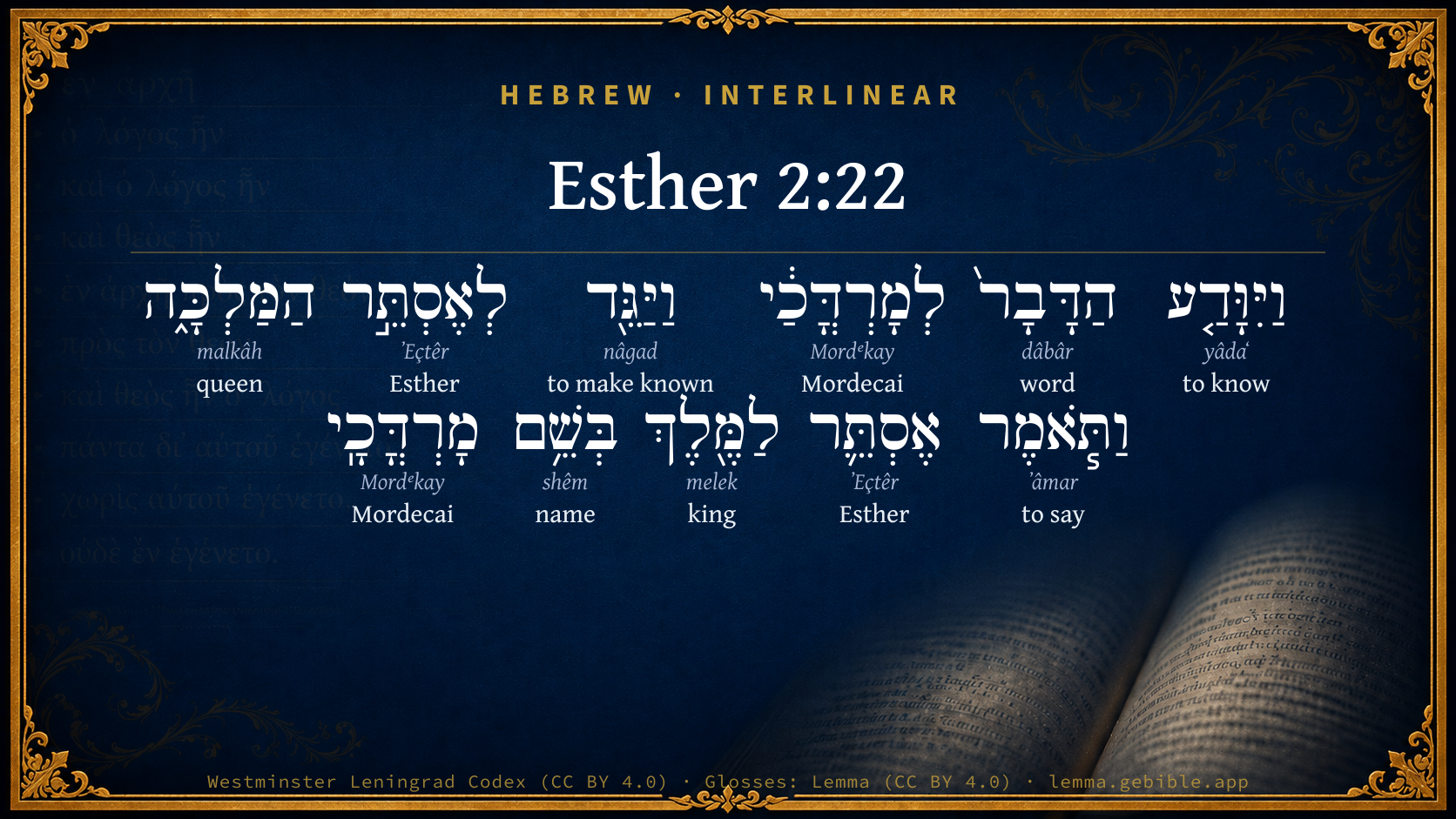
Hebrew (Westminster Leningrad Codex) Esther 2:22 appears in the Hebrew Old Testament. The text above is from the Westminster Leningrad Codex. Each word links to its Strong’s number, a concise gloss, and parsing drawn from the Open Scriptures Hebrew Bible morphology. Click any word for its full Brown-Driver-Briggs (BDB) entry.
Download image
Cite this verse

Esther 2:22 (World English Bible). Public Domain. Lemma interlinear Bible study tool, https://lemma.gebible.app/v/esther/2/22.

Show BibTeX & RIS
BibTeX
RIS
English Translation
The thing became known to Mordecai, who shown it to Esther the queen; and Esther told the king [of it] in Mordecai's name.
World English Bible · Public Domain
Download a study sheet

One document with this verse’s original text, its word-by-word gloss line, the meaning frame, cross-references with their text, attributed commentary, and full source and license credits — printable, and it pastes into notes with its structure intact.

This verse Autodidact and up

Study sheet (.html) Plain text (.txt)

A passage Seminary Student

Up to 50 verses in one chapter. A passage sheet keeps up to 6 commentary sources and 12 cross-references per verse, in the order this page ranks them, and says so on the sheet whenever that leaves anything out. Ask for a single verse and you get the Autodidact verse sheet above.

Everything on this page stays free to read, with no account — the sheet is a download of what is already on screen, not access to it.

Want to remove ads? Support Godless Engineer
Compare translations 3

The same verse in 3 English versions, stacked beneath the original-language interlinear above. Click any original word for its lexicon entry.

Each is an independent rendering of the whole verse — the interlinear is not word-aligned to these translations.

Highlighted words mark where these versions differ — a whole-verse word diff, not a word-by-word alignment.

  • World English Bible Public Domain
    The thing became known to Mordecai, who shown it to Esther the queen; and Esther told the king [of it] in Mordecai's name.
  • King James Version Public Domain
    And the thing was known to Mordecai, who told it unto Esther the queen; and Esther certified the king thereof in Mordecai's name.
  • unfoldingWord Literal Text CC BY-SA 4.0
    And the matter was made known to Mordecai, and he declared it to Esther the queen. And Esther spoke to the king in the name of Mordecai.

unfoldingWord Literal Text — © unfoldingWord, licensed CC BY-SA 4.0. Word-aligned USFM3 via Door43 (git.door43.org/unfoldingWord/en_ult).

Versions to compare (up to 4)

3 of 4 selected

Show all 18 translations

Every available English version of this verse, each an independent rendering of the whole verse.

  • World English Bible Public Domain
    The thing became known to Mordecai, who shown it to Esther the queen; and Esther told the king [of it] in Mordecai's name.
  • Berean Standard Bible Public Domain
    When Mordecai learned of the plot, he reported it to Queen Esther, and she informed the king on Mordecai’s behalf.
  • Majority Standard Bible Public Domain
    When Mordecai learned of the plot, he reported it to Queen Esther, and she informed the king on Mordecai’s behalf.
  • King James Version Public Domain
    And the thing was known to Mordecai, who told it unto Esther the queen; and Esther certified the king thereof in Mordecai's name.
  • American Standard Version (1901) Public Domain
    And the thing became known to Mordecai, who showed it unto Esther the queen; and Esther told the king `thereof' in Mordecai's name.
  • Revised Version (1885) Public Domain
    And the thing was known to Mordecai, who shewed it unto Esther the queen; and Esther told the king thereof in Mordecai’s name.
  • Geneva Bible (1599) Public Domain
    And the thing was knowen to Mordecai, and he tolde it vnto Queene Ester, and Ester certified the King thereof in Mordecais name: and when inquisition was made, it was found so: therefore they were both hanged on a tree: and it was written in the booke of the Chronicles before the King.
  • Douay-Rheims (1899) Public Domain
    And Mardochai had notice of it, and immediately he told it to queen Esther: and she to the king in Mardochai's name, who had reported the thing unto her.
  • Young's Literal Translation Public Domain
    and the thing is known to Mordecai, and he declareth `it' to Esther the queen, and Esther speaketh to the king in the name of Mordecai,
  • Literal Standard Version CC BY-SA 4.0
    and the thing is known to Mordecai, and he declares [it] to Esther the queen, and Esther speaks to the king in the name of Mordecai,
  • Unlocked Literal Bible CC BY-SA 4.0
    When the matter was revealed to Mordecai, he told Queen Esther, and Esther spoke to the king in the name of Mordecai.
  • unfoldingWord Literal Text CC BY-SA 4.0
    And the matter was made known to Mordecai, and he declared it to Esther the queen. And Esther spoke to the king in the name of Mordecai.
  • Darby Bible Public Domain
    And the thing became known to Mordecai, and he related it to Esther the queen, and Esther told it to the king in Mordecai's name.
  • World Messianic Bible Public Domain
    This thing became known to Mordecai, who informed Esther the queen; and Esther informed the king in Mordecai’s name.
  • Webster's Bible Public Domain
    And the thing was known to Mordecai, who told it to Esther the queen; and Esther certified the king of it in Mordecai's name.
  • Free Bible Version CC BY-SA 4.0
    Mordecai found out about the plot and reported it to Queen Esther. Esther in turn told the king on Mordecai's behalf.
  • Bible in Basic English Public Domain
    And Mordecai, having knowledge of their purpose, sent word of it to Esther the queen; and Esther gave the news to the king in Mordecai's name.
  • JPS Tanakh (1917) Public Domain
    And the thing became known to Mordecai, who told it unto Esther the queen; and Esther told the king thereof in Mordecai's name.

Literal Standard Version (2020), Covenant Press — licensed CC BY-SA 4.0. Text via the HelloAO Bible API (eBible.org). Unlocked Literal Bible (unfoldingWord) — licensed CC BY-SA 4.0. Text via the HelloAO Bible API (eBible.org). unfoldingWord Literal Text — © unfoldingWord, licensed CC BY-SA 4.0. Word-aligned USFM3 via Door43 (git.door43.org/unfoldingWord/en_ult). Free Bible Version, Dr. Jonathan Gallagher — licensed CC BY-SA 4.0. Text via the HelloAO Bible API (eBible.org).

Word by word

More ways to search: Search by grammar → Find every occurrence → Compare this word →

Practice this passage: Drill this verse → Learn its vocabulary →

הַמַּלְכָּ֑ה
malkâh
H4436
“the · queen”
Particle, Definite Article + Noun, Common, Feminine, Singular, Absolute
Part of Speech
Particle + Noun
Type
Common
Gender
Feminine
Number
Singular
State
Absolute
Full BDB Definition

Origin: from H4428

TWOT: 1199b

queen
  1. וַיִּוָּדַ֤ע yâdaʻ H3045 “and · to know” Conjunction + Verb, Niphal, Sequential Imperfect, 3rd Person, Masculine, Singular
  2. הַדָּבָר֙ dâbâr H1697 “the · word” Particle, Definite Article + Noun, Common, Masculine, Singular, Absolute
  3. לְמָרְדֳּכַ֔י Mordᵉkay H4782 “to/for · Mordecai” Preposition + Noun, Proper
  4. וַיַּגֵּ֖ד nâgad H5046 “and · to make known” Conjunction + Verb, Hiphil, Sequential Imperfect, 3rd Person, Masculine, Singular
  5. לְאֶסְתֵּ֣ר ʼEçtêr H635 “to/for · Esther” Preposition + Noun, Proper
  6. וַתֹּ֧אמֶר ʼâmar H559 “and · to say” Conjunction + Verb, Qal, Sequential Imperfect, 3rd Person, Feminine, Singular
  7. אֶסְתֵּ֛ר ʼEçtêr H635 “Esther” Noun, Proper
  8. לַמֶּ֖לֶךְ melek H4428 “to/for the · king” Preposition, Determined + Noun, Common, Masculine, Singular, Absolute
  9. בְּשֵׁ֥ם shêm H8034 “in/at · name of” Preposition + Noun, Common, Masculine, Singular, Construct
  10. מָרְדֳּכָֽי Mordᵉkay H4782 “Mordecai” Noun, Proper

About this verse

These counts appear in no published source. They are computed here, from the morphology-tagged text and Lemma’s own curated glosses. What Lemma adds →

11
words
9
distinct lemmas
Historical
section

Shared distinctive vocabulary

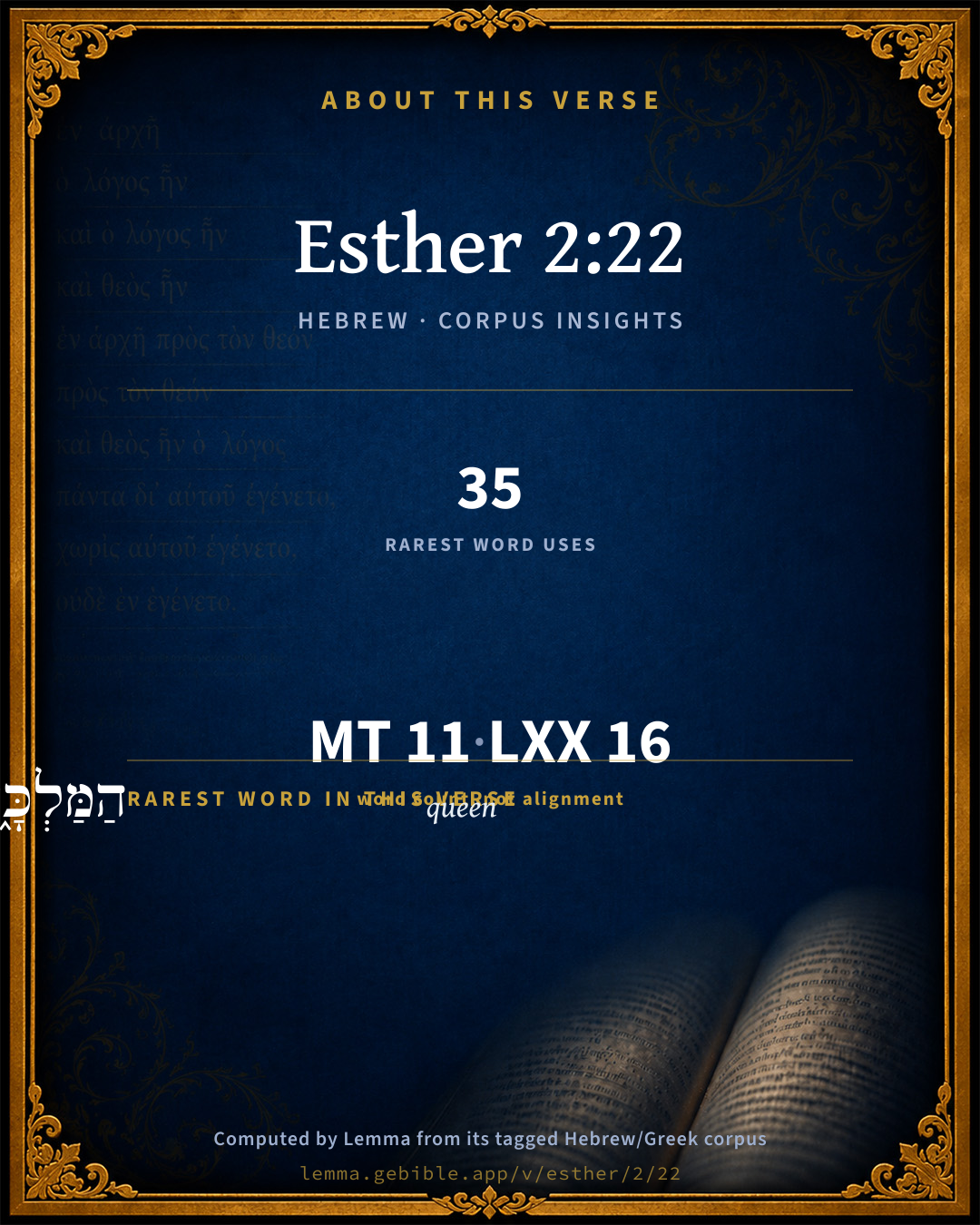
הַמַּלְכָּ֑ה queen H4436 occurs in 34 verses of the Hebrew Bible. Also found in:

Grammatical profile

  • 3 verbs
  • 8 nouns

Verb forms

  • וַיִּוָּדַ֤ע Niphal · Sequential Imperfect
  • וַיַּגֵּ֖ד Hiphil · Sequential Imperfect
  • וַתֹּ֧אמֶר Qal · Sequential Imperfect

Repetition

Words recur within this verse — often emphatic in Hebrew:

  • לְמָרְדֳּכַ֔י Mordecai H4782 ×2
  • לְאֶסְתֵּ֣ר Esther H635 ×2

Hebrew & Septuagint length

In English translation the verse runs 23 words from the Hebrew and 25 from the Septuagint (LXX English) — closely comparable.

A rough comparison of the two English renderings, which tokenize alike — not a word-level alignment.

Word counts can differ between the Hebrew and the Greek without any difference in meaning — e.g. the Hebrew direct-object marker אֵת has no separate Greek word, and Greek often adds the article ὁ.

In the original languages it is 11 Hebrew tokens and 16 Greek tokens — but the two are counted differently (Hebrew bundles its prefixes and suffixes into one token; the Greek is in lemma form), so that isn’t a like-for-like length.

Cross-references

5

Topical passages linked to Esther 2:22 in the Treasury of Scripture Knowledge — connected by theme and wording, ordered by reader-vote popularity; previews shown in the World English Bible.

  • Esther 6:1–2 On that night the king couldn't sleep; and he commanded to bring the book of records of the chronicles, and they were read before the king.
  • Ecclesiastes 10:20 Don't curse the king, no, not in your thoughts; And don't curse the rich in your bedchamber: For a bird of the sky may carry your voice, And that which has wings may tell the matter.
  • Acts 23:12–22 When it was day, some of the Jews banded together, and bound themselves under a curse, saying that they would neither eat nor drink until they had killed Paul.
  • Romans 11:33 Oh the depth of the riches both of the wisdom and the knowledge of God! How unsearchable are his judgments, and his ways past tracing out!
  • Philippians 2:4 each of you not just looking to his own things, but each of you also to the things of others.

Cross-references courtesy of OpenBible.info (CC BY 4.0).

Hebrew and Greek witnesses Masoretic Hebrew ↔ Greek Septuagint

The same verse in the two great witnesses to the Old Testament, shown verse-for-verse.

These are two independent witnesses, not word-aligned to each other, and the Septuagint is shown in lemma (dictionary) form.

Hebrew Esther 2:22 Masoretic · Westminster Leningrad Codex

וַיִּוָּדַ֤ע הַדָּבָר֙ לְמָרְדֳּכַ֔י וַיַּגֵּ֖ד לְאֶסְתֵּ֣ר הַמַּלְכָּ֑ה וַתֹּ֧אמֶר אֶסְתֵּ֛ר לַמֶּ֖לֶךְ בְּשֵׁ֥ם מָרְדֳּכָֽי

The thing became known to Mordecai, who shown it to Esther the queen; and Esther told the king [of it] in Mordecai's name.

World English Bible · Public Domain

Greek LXX Esther 2:22 Septuagint · lemma form

καί δηλόω μαρδοχαῖος ὁ λόγος καί σημαίνω εσθηρ καί αὐτός ἐνφανίζω ὁ βασιλεύς ὁ ὁ ἐπιβουλή

And the matter was revealed to Mardochaeus, and he made it known to Esther, and she declared to the king the matter of the conspiracy.

LXX2012 (modern English Septuagint) · Public Domain

Hebrew: Westminster Leningrad Codex (CC BY 4.0). Greek: Septuagint (public domain); English from LXX2012 (modern English Septuagint) (Public Domain). How the Septuagint differs from the Hebrew →

Commentary

Notes on Esther 2:22 from classic Christian and Jewish commentators (each source and its license shown beneath its notes). The classic Christian expositions comment on the surrounding passage and are grouped to its opening verse, so a note may address several verses; the Jewish commentaries on the Tanakh (Rashi and others) are per-verse, so they appear only where the commentator wrote on this verse.

Lemma curates 59 commentaries, every one of them public domain or Creative Commons licensed, each selected and text-cleaned for this edition rather than reprinted as found. About our sources →

Trapp's Complete Commentary

John Trapp

Est 2:22 And the thing was known to Mordecai, who told [it] unto Esther the queen; and Esther certified the king [thereof] in Mordecai’s name.

Ver. 22. And the thing was known to Mordecai] How he came to know it is uncertain. Josephus saith that it was revealed to him by one Barnabazus, a Jew, who was servant to one of the conspirators. R. Solomon saith that the eunuchs talked of the plot before Mordecai in the language of Tarsus, supposing that he had not understood them; and so it came forth. Others conceive that they solicited him, being one of the keepers of the king’s door, also to join with them. Howsoever it was that he got inkling and intelligence of their bloody purpose, God was in it, and good men are of his privy council; "The secret of the Lord is with them that fear him," Psa 25:14. Their apprehensions of things are deep, and their observations right, their knowledge rare to bolt out mischiefs, their experience leads them oft to guess shrewdly at men’s purposes by their looks and gestures. "I, wisdom, dwell with prudence" (or subtilty), "and find out knowledge of witty inventions," Pro 8:12.

Who told it unto Esther the queen] Haply, as holding himself a mean man, unworthy and unfit to speak to the king. Or, as fearing lest he should not be believed, or should be outfaced by the traitor, or, as conceiving that it would be better taken from Esther, whom the king so dearly loved; and might prove a good means to win her further into his favour. Yea, Mordecai himself, saith an interpreter, might safely have also a further reach herein, namely, to try the sincere affection of Esther towards him, whether she would make this an occasion to his good and preferment, or rather take the glory thereof unto herself.

And Esther certified the king thereof in Mordecai’s name] She doth not conceal the treason, or further it, as some ambitious Semiramis would have done, or adulterous Livia. For although she was wont to boast that she ruled her husband Augustus by obeying him, yet Pliny and Tacitus tell us that she was overly familiar with Eudemus, her physician. And whereas Augustus’s last words to her were, O Livia, remember our marriage; and, Adieu. She did so, and, it is thought, had a hand in setting him going. And the like is reported of Clytemnestra, Olympias, Queen Isabel, wife to our Edward II. But holy Esther was none such; she, as a loyal and faithful wife, revealed to the king the danger he was in, and so saved his life. So did Michal, David’s wife, though she had no great goodness in her. The like is reported of Cleopatra, daughter to Antiochus the Great, who gave her in marriage to Ptolemaeus Epiphanes, thinking by her to destroy him, but he was deceived, according to Dan 11:17. Valerius Maximus and Fulgosius speak much in the commendation of Thuria, Sulpitia, Chilonia, Antonia, Egnatia, &c., for loving and faithful wives. Valerius Maximus Christianus also, for like cause, celebrateth Irene, wife to Philip, the emperor; and Mary, wife to Sigismund, king of Bohemia and Hungary, &c.

Verum haec (Esther) tantum alias inter caput extulit omnes,

Quantum lenta solent inter viburna cupressi.

John Trapp, A Commentary or Exposition upon All the Books of the Old and New Testament (1647–1656) — public domain. Text from a community e-Sword module.

Tyndale Open Study Notes

Tyndale Open Resources

2:22 gave the information to Queen Esther: The quickest, safest way for the information to get to the king was through the queen. • Although Esther could have promoted herself by taking credit for this information, she gave Mordecai credit for the report, an important point later in the story (6:1-3).

Tyndale Open Study Notes — © Tyndale Open Resources, licensed CC BY-SA 4.0. Text via the HelloAO Bible API.

Geneva Bible (1599)

Geneva Bible translators

In the Chronicles of the Medes and Persians, as Esther 10:2.

Geneva Bible (1599) marginal notes — public domain. Text via Bolls.life.

Adam Clarke's Commentary

Verse 22. Was known to Mordecai] Josephus says that a Jew, named Barnabasus, overheard the plot, told it to Mordecai, Mordecai to Esther, and Esther to the king, in Mordecai's name; and he was registered as the discoverer.

Adam Clarke's Commentary on the Bible (1810–1826) — public domain. Text from a community e-Sword/MySword module.

Ellicott's Commentary for English Readers

(22) And Esther certified the king thereof.—Doubtless by this means an increased influence was gained over the capricious mind of the king, an influence which before long served Esther in good stead.

A Bible Commentary for English Readers, edited by Charles John Ellicott (1878–1897) — public domain. Text from a community e-Sword module.

The Cambridge Bible for Schools and Colleges

gen. ed. J. J. S. Perowne

22. And the thing was known to Mordecai] The Targum states that Mordecai was indebted for his discovery to extraordinary linguistic powers, as understanding no fewer than seventy languages! Josephus (Ant. xi. 6. 4) less extravagantly attributes it to information obtained from a Jewish slave of the conspirators named Barnabazus.

told] simpler than ‘certified’ of A.V. and more in consonance with the original.

in Mordecai’s name] but without mentioning his relationship.

The Cambridge Bible for Schools and Colleges (gen. ed. J. J. S. Perowne; Cambridge University Press, 1878–1918) — public domain. Text from a community e-Sword module.

John Gill's Exposition

And the thing was known to Mordecai,.... But by what means does not appear; the Jewish writers say (c), these two men were Tarsians, and spoke in the Tarsian language, which they thought Mordecai did not understand; but he, being skilled in languages, overheard them, and understood what they said; but, according to Josephus (d), it was discovered to him by Barnabazus, a servant of one of the chamberlains; the latter Targum says, it was showed unto him by the Holy Ghost:

who told it unto Esther, and Esther certified the king thereof in Mordecai's name; whose name she mentioned, partly as a voucher of the truth of what she reported, and partly to ingratiate Mordecai to the king, that he might be still yet more promoted in due time.

(c) T. Bab. Megillah, fol. 13. 2. Targum prius & Jarchi in loc. (d) Antiqu. l. 11. c. 6. sect. 4.

John Gill's Exposition of the Whole Bible (1746–1763) — public domain (CC PDM 1.0). Text via the HelloAO Bible API.

Haydock's Catholic Bible Commentary

Notice of it, from Barnabaz, a Jew in the service of one of them. (Josephus, [Antiquities?] xi. 6.) --- He might also hear some suspicious words. (R. Calom.) (Worthington)

George Leo Haydock (1774–1849), Haydock's Catholic Family Bible and Commentary, 1859 edition — public domain. Excludes Psalms (Douay-Rheims chapter numbering differs from Protestant) and Deuterocanonical books (Catholic canon only).

The Pulpit Commentary

And the thing was known unto Mordecai. Josephus says that a certain Pharnabazus, a slave of one of the conspirators, betrayed them to Mordecai ("Ant. Jud:," 14:6, One of the Targums on Esther attributes his discovery of the plot to his knowledge of languages. But it is probable that these are mere guesses. And Esther certified the king thereof. The original is simpler, "And Esther told it to the king." In Mordecai"s name. Mordecai"s name thus came first before the king. Esther mentioned him as her informant, but did not say that he was related to her. (comp. Est_8:1)

The Pulpit Commentary (1880–1919), ed. H.D.M. Spence-Jones & Joseph S. Exell — public domain. Text from a community e-Sword module.

unfoldingWord translationNotes

Door43 World Missions Community

When the matter was revealed to Mordecai

This can be stated in active form. AT: "When Mordecai learned about what they were planning" (See: Active or Passive)

in the name of Mordecai

This is an idiom. AT: "on behalf of Mordecai" (See: Idiom)

The report was investigated and confirmed, and both the men were hanged

This can be stated in active form. AT: "The king investigated and confirmed the report, and ordered his servants to hang both men" (See: Active or Passive)

a gallows

This was a structure used for killing people by tying one end of a rope around the top of the structure and the other end of the rope around their necks and hanging them from it. AT: "a frame for hanging people" (See: Translate Unknowns)

This account was written

This can be stated in active form. AT: "They recorded this account" (See: Active or Passive)

translationWords

reveal

Mordecai

Esther

king

unfoldingWord translationNotes — © Distant Shores Media and the Door43 World Missions Community, licensed CC BY-SA 4.0. Source: git.door43.org/Door43/en_tn.

Rashi

Rabbi Shlomo Yitzchaki (Rashi)

And the matter became known to Mordecai For they were discussing their affairs before him in the Tarsean language, and they did not know that Mordecai was familiar with seventy languages, for he was one of those who sat in the Chamber of Hewn Stone.

Rashi on the Tanakh — English translations: “The Judaica Press complete Tanach with Rashi, translated by A. J. Rosenberg” (CC BY 4.0); “Pentateuch with Rashi's commentary by M. Rosenbaum and A.M. Silbermann, 1929-1934” (public domain); “The Metsudah Tanach series, Lakewood, N.J” (CC BY 4.0); and “The Book of Joshua, Metsudah Publications, 1997” (CC BY 4.0). Text via Sefaria.

Lesson kit

Teaching starters — assembled from the data on this page, not authored interpretation. Every prompt links to the verse data it draws on. Edit before teaching.

Esther, in the Historical, opens this verse with 11 words (9 distinct Hebrew lemmas). Its most distinctive word is malkâh (“queen”). A historical commentator’s framing appears above. Read the whole chapter for the surrounding context.

Discussion questions

  1. The word malkâh carries the sense “queen.” How does it shape the verse?
  2. How does 1 Kings 10:1, which shares the word «queen», read alongside this verse?
  3. What does the repetition of “Mordecai” (2× in this one verse) do in this verse?
  4. These translations render this verse differently. What is at stake in choosing one wording over another?
  5. «וַיִּוָּדַ֤ע» is a Niphal Sequential Imperfect verb. How does that grammatical form shape the action described?
  6. Compare how Trapp's Complete Commentary and Tyndale Open Study Notes read this verse. Where do they agree or differ?

Things to notice

Reading settings

Reading text

Shown beneath each verse's original-language words.

Old Testament
Old Testament edition

Read the OT as the Masoretic Hebrew (MT) or the Greek Septuagint (LXX).

English shown for the Greek Septuagint (in the Hebrew ↔ Greek comparison).

Comparing translations? Open the Compare panel on any verse page to stack up to four side by side.