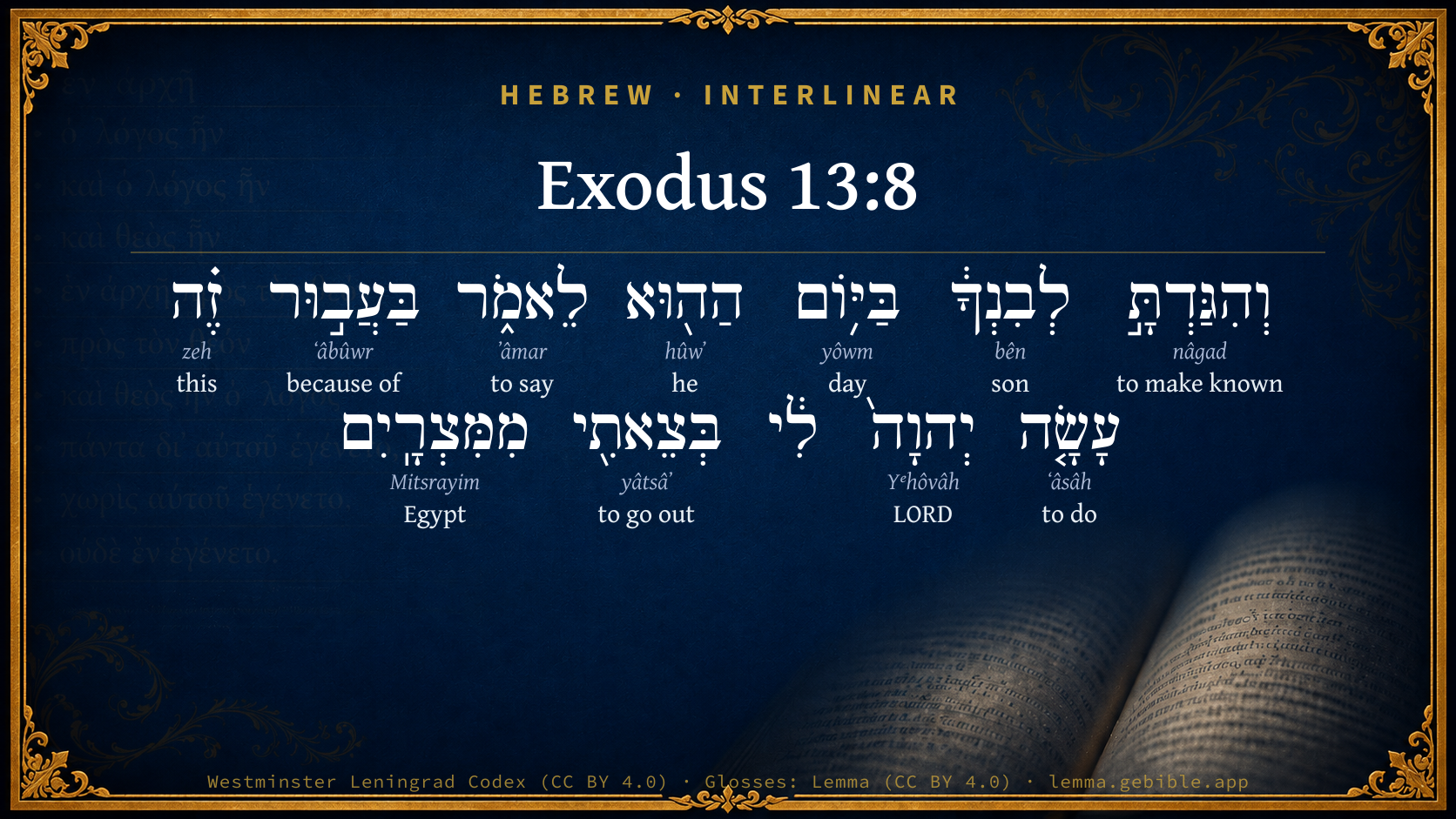
Exodus 13:8

Hebrew (Westminster Leningrad Codex) Exodus 13:8 appears in the Hebrew Old Testament. The text above is from the Westminster Leningrad Codex. Each word links to its Strong’s number, a concise gloss, and parsing drawn from the Open Scriptures Hebrew Bible morphology. Click any word for its full Brown-Driver-Briggs (BDB) entry.
Download image
Cite this verse

Exodus 13:8 (World English Bible). Public Domain. Lemma interlinear Bible study tool, https://lemma.gebible.app/v/exodus/13/8.

Show BibTeX & RIS
BibTeX
RIS
English Translation
You shall tell your son in that day, saying, 'It is because of that which Yahweh did for me when I came forth out of Egypt.'
World English Bible · Public Domain
Download a study sheet

One document with this verse’s original text, its word-by-word gloss line, the meaning frame, cross-references with their text, attributed commentary, and full source and license credits — printable, and it pastes into notes with its structure intact.

This verse Autodidact and up

Study sheet (.html) Plain text (.txt)

A passage Seminary Student

Up to 50 verses in one chapter. A passage sheet keeps up to 6 commentary sources and 12 cross-references per verse, in the order this page ranks them, and says so on the sheet whenever that leaves anything out. Ask for a single verse and you get the Autodidact verse sheet above.

Everything on this page stays free to read, with no account — the sheet is a download of what is already on screen, not access to it.

Want to remove ads? Support Godless Engineer
Compare translations 3

The same verse in 3 English versions, stacked beneath the original-language interlinear above. Click any original word for its lexicon entry.

Each is an independent rendering of the whole verse — the interlinear is not word-aligned to these translations.

Highlighted words mark where these versions differ — a whole-verse word diff, not a word-by-word alignment.

  • World English Bible Public Domain
    You shall tell your son in that day, saying, 'It is because of that which Yahweh did for me when I came forth out of Egypt.'
  • King James Version Public Domain
    And thou shalt show thy son in that day, saying, This is done because of that which the LORD did unto me when I came forth out of Egypt.
  • unfoldingWord Literal Text CC BY-SA 4.0
    And you shall tell your son on that day, saying, ‘This is because of what Yahweh did for me when I came out from Egypt.’

unfoldingWord Literal Text — © unfoldingWord, licensed CC BY-SA 4.0. Word-aligned USFM3 via Door43 (git.door43.org/unfoldingWord/en_ult).

Versions to compare (up to 4)

3 of 4 selected

Show all 18 translations

Every available English version of this verse, each an independent rendering of the whole verse.

  • World English Bible Public Domain
    You shall tell your son in that day, saying, 'It is because of that which Yahweh did for me when I came forth out of Egypt.'
  • Berean Standard Bible Public Domain
    And on that day you are to explain to your son, ‘This is because of what the LORD did for me when I came out of Egypt.’
  • Majority Standard Bible Public Domain
    And on that day you are to explain to your son, ‘This is because of what the LORD did for me when I came out of Egypt.’
  • King James Version Public Domain
    And thou shalt show thy son in that day, saying, This is done because of that which the LORD did unto me when I came forth out of Egypt.
  • American Standard Version (1901) Public Domain
    And thou shalt tell thy son in that day, saying, It is because of that which Jehovah did for me when I came forth out of Egypt.
  • Revised Version (1885) Public Domain
    And thou shalt tell thy son in that day, saying, It is because of that which the LORD did for me when I came forth out of Egypt.
  • Geneva Bible (1599) Public Domain
    And thou shalt shew thy sonne in that day, saying, This is done, because of that which the Lord did vnto me, when I came out of Egypt.
  • Douay-Rheims (1899) Public Domain
    And thou shalt tell thy son in that day, saying: This is what the Lord did to me when I came forth out of Egypt.
  • Young's Literal Translation Public Domain
    `And thou hast declared to thy son in that day, saying, ``It is' because of what Jehovah did to me, in my going out from Egypt,
  • Literal Standard Version CC BY-SA 4.0
    And you have declared to your son in that day, saying, [It is] because of what YHWH did to me, in my going out from Egypt,
  • Unlocked Literal Bible CC BY-SA 4.0
    On that day you are to say to your children, 'This is because of what Yahweh did for me when I came out of Egypt.'
  • unfoldingWord Literal Text CC BY-SA 4.0
    And you shall tell your son on that day, saying, ‘This is because of what Yahweh did for me when I came out from Egypt.’
  • Darby Bible Public Domain
    And thou shalt inform thy son in that day, saying, It is because of what Jehovah did to me when I came out of Egypt.
  • World Messianic Bible Public Domain
    You shall tell your son in that day, saying, ‘It is because of that which the LORD did for me when I came out of Egypt.’
  • Webster's Bible Public Domain
    And thou shalt show thy son in that day, saying, This is done because of that which the LORD did to me when I came forth out of Egypt.
  • Free Bible Version CC BY-SA 4.0
    On that day tell your children, ‘This is because of what the Lord did for me when I left Egypt.’
  • Bible in Basic English Public Domain
    And you will say to your son in that day, It is because of what the Lord did for me when I came out of Egypt.
  • JPS Tanakh (1917) Public Domain
    And thou shalt tell thy son in that day, saying: It is because of that which the LORD did for me when I came forth out of Egypt.

Literal Standard Version (2020), Covenant Press — licensed CC BY-SA 4.0. Text via the HelloAO Bible API (eBible.org). Unlocked Literal Bible (unfoldingWord) — licensed CC BY-SA 4.0. Text via the HelloAO Bible API (eBible.org). unfoldingWord Literal Text — © unfoldingWord, licensed CC BY-SA 4.0. Word-aligned USFM3 via Door43 (git.door43.org/unfoldingWord/en_ult). Free Bible Version, Dr. Jonathan Gallagher — licensed CC BY-SA 4.0. Text via the HelloAO Bible API (eBible.org).

Word by word

More ways to search: Search by grammar → Find every occurrence → Compare this word →

Practice this passage: Drill this verse → Learn its vocabulary →

בַּעֲב֣וּר
ʻâbûwr
H5668
“in/at · because of of”
Preposition + Noun, Common, Masculine, Singular, Construct
Part of Speech
Preposition + Noun
Type
Common
Gender
Masculine
Number
Singular
State
Construct
Full BDB Definition

Origin: pass part of H5674

TWOT: 1556g

for the sake of, on account of, because of, in order to (preposition) - in order that (conjunction)
  1. וְהִגַּדְתָּ֣ nâgad H5046 “and · to make known” Conjunction + Verb, Hiphil, Sequential Perfect, 2nd Person, Masculine, Singular
  2. לְבִנְךָ֔ bên H1121 “to/for · son · your” Preposition + Noun, Common, Masculine, Singular, Construct + Suffix, Personal, 2nd Person, Masculine, Singular
  3. בַּיּ֥וֹם yôwm H3117 “in/at the · day” Preposition, Determined + Noun, Common, Masculine, Singular, Absolute
  4. הַה֖וּא hûwʼ H1931 “the · he” Particle, Definite Article + Pronoun, Personal, 3rd Person, Masculine, Singular
  5. לֵאמֹ֑ר ʼâmar H559 “to say” Preposition + Verb, Qal, Infinitive Construct
  6. זֶ֗ה zeh H2088 “this” Pronoun, Demonstrative, Masculine, Singular
  7. עָשָׂ֤ה ʻâsâh H6213 “to do” Verb, Qal, Perfect, 3rd Person, Masculine, Singular
  8. יְהוָה֙ Yᵉhôvâh H3068 “LORD” Noun, Proper
  9. בְּצֵאתִ֖י yâtsâʼ H3318 “in/at · to go out · me” Preposition + Verb, Qal, Infinitive Construct + Suffix, Personal, 1st Person, Common, Singular
  10. מִמִּצְרָֽיִם Mitsrayim H4714 “from · Egypt” Preposition + Noun, Proper

About this verse

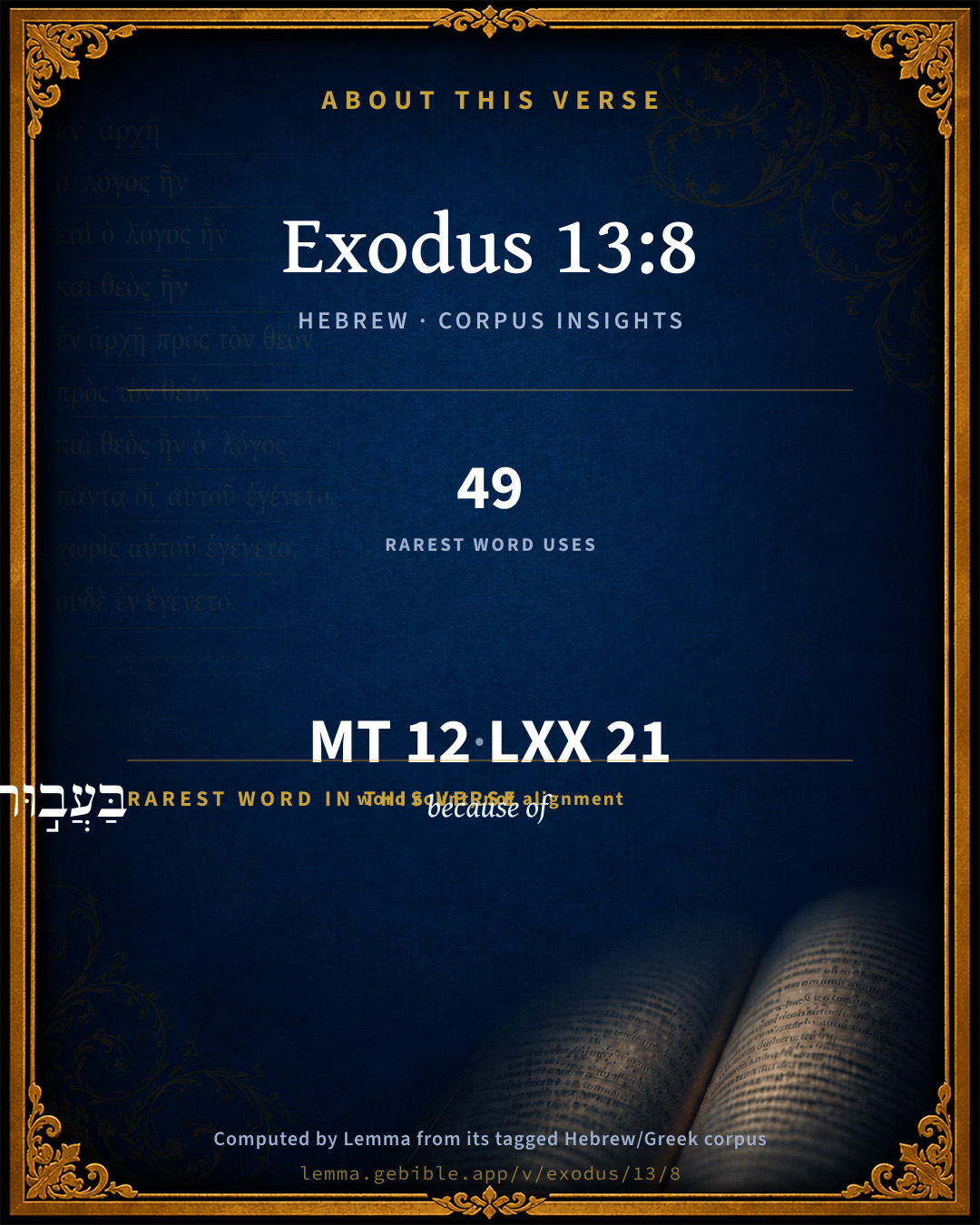
These counts appear in no published source. They are computed here, from the morphology-tagged text and Lemma’s own curated glosses. What Lemma adds →

12
words
11
distinct lemmas
Pentateuch
section

Shared distinctive vocabulary

בַּעֲב֣וּר because of H5668 occurs in 47 verses of the Hebrew Bible. Also found in:

Grammatical profile

  • 4 verbs
  • 5 nouns
  • 2 pronouns
  • 1 preposition

Verb forms

  • וְהִגַּדְתָּ֣ Hiphil · Sequential Perfect
  • לֵאמֹ֑ר Qal · Infinitive Construct
  • עָשָׂ֤ה Qal · Perfect
  • בְּצֵאתִ֖י Qal · Infinitive Construct

Hebrew & Septuagint length

In English translation the verse runs 26 words from the Hebrew and 24 from the Septuagint (LXX English) — closely comparable.

A rough comparison of the two English renderings, which tokenize alike — not a word-level alignment.

Word counts can differ between the Hebrew and the Greek without any difference in meaning — e.g. the Hebrew direct-object marker אֵת has no separate Greek word, and Greek often adds the article ὁ.

In the original languages it is 12 Hebrew tokens and 21 Greek tokens — but the two are counted differently (Hebrew bundles its prefixes and suffixes into one token; the Greek is in lemma form), so that isn’t a like-for-like length.

Cross-references

8

Topical passages linked to Exodus 13:8 in the Treasury of Scripture Knowledge — connected by theme and wording, ordered by reader-vote popularity; previews shown in the World English Bible.

  • Exodus 13:14 It shall be, when your son asks you in time to come, saying, 'What is this?' that you shall tell him, 'By strength of hand Yahweh brought us out from Egypt, from the house of bondage;
  • Exodus 12:26–27 It will happen, when your children ask you, 'What do you mean by this service?'
  • Psalms 44:1 We have heard with our ears, God; Our fathers have told us, What work you did in their days, In the days of old.
  • Exodus 10:2 and that you may tell in the hearing of your son, and of your son's son, what things I have done to Egypt, and my signs which I have done among them; that you may know that I am Yahweh."
  • Psalms 78:3–8 Which we have heard and known, And our fathers have told us.
  • Isaiah 38:19 The living, the living, he shall praise you, as I do this day: The father to the children shall make known your truth.
  • Deuteronomy 4:9–10 Only take heed to yourself, and keep your soul diligently, lest you forget the things which your eyes saw, and lest they depart from your heart all the days of your life; but make them known to your children and your children's children;
  • Ephesians 6:4 You fathers, don't provoke your children to wrath, but nurture them in the discipline and instruction of the Lord.

Cross-references courtesy of OpenBible.info (CC BY 4.0).

Hebrew and Greek witnesses Masoretic Hebrew ↔ Greek Septuagint

The same verse in the two great witnesses to the Old Testament, shown verse-for-verse.

These are two independent witnesses, not word-aligned to each other, and the Septuagint is shown in lemma (dictionary) form.

Hebrew Exodus 13:8 Masoretic · Westminster Leningrad Codex

וְהִגַּדְתָּ֣ לְבִנְךָ֔ בַּיּ֥וֹם הַה֖וּא לֵאמֹ֑ר בַּעֲב֣וּר זֶ֗ה עָשָׂ֤ה יְהוָה֙ לִ֔י בְּצֵאתִ֖י מִמִּצְרָֽיִם

You shall tell your son in that day, saying, 'It is because of that which Yahweh did for me when I came forth out of Egypt.'

World English Bible · Public Domain

Greek LXX Exodus 13:8 Septuagint · lemma form

καί ἀναἀγγέλλω ὁ υἱός σύ ἐν ὁ ἡμέρα ἐκεῖνος λέγω διά οὗτος ποιέω κύριος ὁ θεός ἐγώ ὡς ἐκπορεύομαι ἐκ αἴγυπτος

And you shall tell your son in that day, saying, Therefore the Lord dealt thus with me, as I was going out of Egypt.

LXX2012 (modern English Septuagint) · Public Domain

Hebrew: Westminster Leningrad Codex (CC BY 4.0). Greek: Septuagint (public domain); English from LXX2012 (modern English Septuagint) (Public Domain). How the Septuagint differs from the Hebrew →

Targum (Aramaic paraphrase)

2

The Targum is the ancient Jewish Aramaic paraphrase of the Hebrew Scriptures — an interpretive translation, not the Hebrew text itself. Onkelos (literal) and Pseudo-Jonathan (expansive) render the Torah, and Jonathan the Prophets. Coverage is partial: where no permissively-licensed English translation exists for a verse, only the Aramaic is shown. This is verse-level text, not a word-by-word alignment to the Hebrew.

  1. Targum Onkelos Torah (Genesis–Deuteronomy)
    וּתְחַוֵי לִבְנָךְ בְּיוֹמָא הַהוּא לְמֵימָר בְּדִיל דֵין עֲבַד יְיָ לִי בְּמִפְּקִי מִמִצְרָיִם:

    (no public-domain English translation for this verse)

    Targum Onkelos — Aramaic: “Onkelos Genesis” (public domain); “Onkelos Exodus” (public domain); “Onkelos Leviticus” (public domain); “Onkelos Numbers” (public domain); “Onkelos Deuteronomy” (public domain). English: “Sefaria Community Translation” (CC0 1.0 (public-domain dedication)); “J.W. Etheridge. The Targums of Onkelos and Jonathan Ben Uzziel on the Pentateuch. London: Longmans, Green, 1862” (public domain). Text via Sefaria.

  2. Targum Pseudo-Jonathan Torah (Genesis–Deuteronomy)
    וְתִתְנֵי לִבְרָךְ בְּיוֹמָא הַהוּא לְמֵימָר מִן בִּגְלַל מִצְוָותָא דָא עֲבַד מֵימְרָא דַיְיָ לִי נִיסִין וּפְרִישִׁין בְּמִפְקֵי מִמִּצְרָיִם

    And thou shalt instruct thy son on that day, saying, This precept is on account of what the Word of the Lord did for me in miracles and wonders, in bringing me forth from Mizraim.

    Targum Pseudo-Jonathan — Aramaic: “Targum Jonathan on Genesis” (public domain); “Targum Jonathan on Exodus” (public domain); “Targum Jonathan on Leviticus” (public domain); “Targum Jonathan on Numbers” (public domain); “Targum Jonathan on Deuteronomy” (public domain). English: “The Targum of Jonathan ben Uzziel, trans. J. W. Etheridge, London, 1862” (public domain). Text via Sefaria.

Commentary

Notes on Exodus 13:8 from classic Christian and Jewish commentators (each source and its license shown beneath its notes). The classic Christian expositions comment on the surrounding passage and are grouped to its opening verse, so a note may address several verses; the Jewish commentaries on the Tanakh (Rashi and others) are per-verse, so they appear only where the commentator wrote on this verse.

Lemma curates 59 commentaries, every one of them public domain or Creative Commons licensed, each selected and text-cleaned for this edition rather than reprinted as found. About our sources →

Trapp's Complete Commentary

John Trapp

Exo 13:8 And thou shalt shew thy son in that day, saying, [This is done] because of that [which] the LORD did unto me when I came forth out of Egypt.

Ver. 8. And thou shalt show.] {See Trapp on "Exo 12:26"}

John Trapp, A Commentary or Exposition upon All the Books of the Old and New Testament (1647–1656) — public domain. Text from a community e-Sword module.

The Biblical Illustrator

Joseph S. Exell

Exo_13:8-10

Show thy son in that day.

Lessons

1. The instruction of children is a duty upon parents.

2. God commands continuance of ordinances for instruction of posterity.

3. The reason of Gods ordinances must be understood by parents and children (Exo_13:8).

4. Sacramental signs, and memorials of God, He is pleased to give His Church.

5. God would have these signal memorials at hand and before the eyes of His.

6. The Passover was a true sacramental sign and seal of Gods covenant.

7. By sacraments rightly used Gods covenant is confirmed on hearts and in profession.

8. Gods mighty gracious redemption is a just cause of such memorials (Exo_13:9).

9. Gods sacraments are His statutes and positive laws.

10. It is God s prerogative, to make anniversary memorials of His mercies (Exo_13:10). (G. Hughes, B. D.)

Truth embodied

As the soul is clothed in flesh, and only thus is able to perform its functions in this earth, where it is sent to live; as the thought must find a word before it can pass from mind to mind; so every great truth seeks some body, some outward form, in which to exhibit its powers. It appears in the world, and men lay hold of it, and represent it to themselves, in histories, in forms of words, in sacramental symbols; and these things, which in their proper nature are but illustrations, stiffen into essential fact, and become part of the reality. (J. A. Froude.)

Importance of commemorative days and ordinances

The following sentence is attributed to Voltaire:--I despair of destroying Christianity in any country, so long as millions of human beings meet on Sunday to worship God. Many things have been fathered on Voltaire of which he never heard, but if he really said or wrote this he uttered an unusually sensible thing. It is curious that sceptical writers have regarded so little the testimony of Christian rites to the facts with which they are indissolubly connected. How did the Lords Supper and the Lords Day come to be established institutions? Rites and observances do not establish and perpetuate themselves. The origin of these two Christian institutions can only be explained by their connection with the events they commemorate. If the written records of the apostolic age could be blotted from the memory of man, the Lords Supper would still bear testimony to Christs death for mans salvation, as the Lords Day would eloquently witness to His resurrection from the dead.

The Biblical Illustrator, edited by Joseph S. Exell (c. 1880s–1900s) — public domain. Text from a community e-Sword module.

Joseph Benson's Commentary

Exo 13:8. Thou shalt show thy son — When you shall be come into the land of Canaan, you shall instruct your children in the meaning of your killing the lamb, and abstaining from leaven, that so you and they may be excited to gratitude to God for his goodness. This was evidently the design of the institution.

Joseph Benson's Commentary on the Old and New Testaments (1811–1818) — public domain. Text from a community e-Sword module.

Geneva Bible (1599)

Geneva Bible translators

When thou dost celebrate the feast of unleavened bread.

Geneva Bible (1599) marginal notes — public domain. Text via Bolls.life.

Jamieson, Fausset & Brown

Robert Jamieson, A. R. Fausset & David Brown

thou shalt show thy son in that day, saying--The establishment of this and the other sacred festivals presented the best opportunities of instructing the young in a knowledge of His gracious doings to their ancestors in Egypt.

Jamieson, Fausset & Brown — Commentary Critical and Explanatory on the Whole Bible (1871) — public domain (CC PDM 1.0). Text via the HelloAO Bible API.

The Cambridge Bible for Schools and Colleges

gen. ed. J. J. S. Perowne

8. The children to be instructed (cf. on Exo_12:26) on the meaning of the festival: it is to remind Israel in perpetuity of the duties which it owes to Jehovah, in gratitude for its deliverance out of Egypt.

The Cambridge Bible for Schools and Colleges (gen. ed. J. J. S. Perowne; Cambridge University Press, 1878–1918) — public domain. Text from a community e-Sword module.

John Gill's Exposition

And thou shall show thy son in that day,.... On the first of the days of the feast of unleavened bread, the reason of eating it; and this is to be shown not to a son or single child only, but by parents to all their children, sons and daughters, and even unasked, as Maimonides (b) interprets it; and so Jarchi's note is, to a son that knows not how to ask or what to ask about; see Gill on Exo 12:26, Exo 12:27,

saying, this is done because of that which the Lord did unto me, when I came forth out of Egypt: that is, this unleavened bread is eaten because of the quick and speedy deliverance of Israel out of Egypt, so that they had not time to leaven their dough.

(b) Hilchot Chametz Umetzah, c. 7. sect. 2, 3.

John Gill's Exposition of the Whole Bible (1746–1763) — public domain (CC PDM 1.0). Text via the HelloAO Bible API.

The Pulpit Commentary

And thou shalt shew thy son. Repeated from Exo_12:26, Exo_12:27.

The Pulpit Commentary (1880–1919), ed. H.D.M. Spence-Jones & Joseph S. Exell — public domain. Text from a community e-Sword module.

unfoldingWord translationNotes

Door43 World Missions Community

On that day you are to say to your children, 'This is because of what Yahweh did for me when I came out of Egypt.'

The quotation can be stated as an indirect quote. AT: "On that day you are to tell your children that this is because of what Yahweh did for you when you came out of Egypt" (See: Direct and Indirect Quotations)

This will be a reminder for you on your hand, and a reminder on your forehead

These are two different types of physical reminders so people will not forget something important. (See: Parallelism)

a reminder for you on your hand

Moses speaks of celebrating the festival as if it were tying an object around their hands to remind them of what Yahweh had done. AT: "like something you tie around your hand as a reminder" (See: Metaphor)

a reminder on your forehead

Moses speaks of celebrating the festival as if it were tying an object around their foreheads to remind them of what Yahweh had done. AT: "like something you tie around your head as a reminder" (See: Metaphor)

so the law of Yahweh may be in your mouth

The words "in your mouth" here refers to the words that they speak. AT: "so you may always be speaking of the law of Yahweh" (See: Metonymy)

strong hand

The word "hand" here represents God's actions or works. See how you translated this in Exodus 6:1. AT: "the power I show in my works" (See: Metonymy)

translationWords

children

Yahweh

Egypt

sign

law

appoint

unfoldingWord translationNotes — © Distant Shores Media and the Door43 World Missions Community, licensed CC BY-SA 4.0. Source: git.door43.org/Door43/en_tn.

Rashi

Rabbi Shlomo Yitzchaki (Rashi)

בעבור זה FOR THE SAKE OF THIS — for the sake that I should carry out His commands, such as this Passover offering, this unleavened bread and this bitter herb (cf. Mekhilta).

עשה ה' לי GOD DID FOR ME — Here is an indication of the reply to be given to the wicked son: that one should say to him, “God did for me” — and one should not say “what God did לנו, for us” — thus implying “not for thee”, for if thou hadst been there (in Egypt) thou wouldst not have been regarded as worthy of being redeemed (Mekhilta).

Rashi on the Tanakh — English translations: “The Judaica Press complete Tanach with Rashi, translated by A. J. Rosenberg” (CC BY 4.0); “Pentateuch with Rashi's commentary by M. Rosenbaum and A.M. Silbermann, 1929-1934” (public domain); “The Metsudah Tanach series, Lakewood, N.J” (CC BY 4.0); and “The Book of Joshua, Metsudah Publications, 1997” (CC BY 4.0). Text via Sefaria.

Ramban (Nachmanides)

Rabbi Moshe ben Nachman (Ramban / Nachmanides)

IT IS BECAUSE OF THAT THE ETERNAL DID FOR ME. This is equivalent to saying, “It is because of that which the Eternal did for me when I came forth out of Egypt.” A similar case is the verse: And thou shalt show them the way they are to go in, [which means “wherein they are to go”]. There are many such cases. The father is thus stating [to his son]: “It is because of that which G-d did for me when I came forth out of Egypt that I observe this service.” It is similar to that which is stated further on: Therefore I sacrifice to the Eternal all that openeth the womb. The intent of the word zeh (that) [in the verse, It is because of ‘that’], is: “tell him ‘that’ which you yourself see, i.e., what G-d did for you when you came forth out of Egypt.” And our Rabbis have explained that the word zeh (that) alludes to the unleavened bread and bitter herbs that are laid before him.It is possible that the purport of the verse, And thou shalt tell thy son… It is ‘ba’avur’ (because) of that the Eternal did for me when I came forth out of Egypt, is equivalent to the verse’s saying “such and such did G-d do unto me.” The word ba’avur also serves to indicate something within a subject itself, [and it does not only convey the idea: “because” of some other subject]. This is as the case in the verse, ‘ba’avur’ the child that was alive thou didst fast and weep, [which means “while” the child was alive], and not “because”. [David did not fast and weep “because” the child was alive; he fasted and wept “while” the child was alive so that it should get well.]Rabbi Abraham ibn Ezra said that the purport of the verse is: “Because of that which I do and worship Him by eating the Passover-offering and the unleavened bread, the Eternal did for me wonders until He brought me forth out of Egypt.” But it is not correct. I will yet explain this verse.

Ramban (Nachmanides) on the Tanakh — English translation: “Commentary on the Torah by Ramban (Nachmanides). Translated and annotated by Charles B. Chavel. New York, Shilo Pub. House, 1971-1976” (CC BY 4.0). Text via Sefaria.

Ibn Ezra

Rabbi Abraham ibn Ezra

Because of this Hashem did this for me. This should be understood: “For the sake of this service—i.e. the eating of the matzoh and the refraining from leaven bread, which were the first commandments that B’nei Yisrael received—Hashem performed for us miracles and took us out of Egypt.” In other words, Hashem only took B’nei Yisrael out of Egypt in order that they should serve Him, in keeping with the verse, “When you bring the people out of Egypt—you will serve Elohim on this mountain” (Shemos 3:12).

Ibn Ezra on the Tanakh — English translations: “Sefaria Community Translation” (CC0 1.0 (public-domain dedication)); “Yalkut, Sifsei Chachomim Chumash, Metsudah Publications, 2009” (CC BY 4.0); and “Commentary of Ibn Ezra on Isaiah - trans. by M. Friedlander, 1873” (public domain). Text via Sefaria.

Lesson kit

Teaching starters — assembled from the data on this page, not authored interpretation. Every prompt links to the verse data it draws on. Edit before teaching.

Exodus, in the Pentateuch, opens this verse with 12 words (11 distinct Hebrew lemmas). Its most distinctive word is ʻâbûwr (“because of”). A historical commentator’s framing appears above. Read the whole chapter for the surrounding context.

Discussion questions

  1. What does “because of” (ʻâbûwr) contribute to the verse as a whole?
  2. Genesis 3:17 shares the word «because of» with this verse. How do the two illuminate each other?
  3. These translations render this verse differently; the difference is in the English rendering, not the original. What questions does that raise?
  4. The verb «וְהִגַּדְתָּ֣» is Hiphil Sequential Perfect. How does its form color the action?
  5. Reading how Trapp's Complete Commentary and The Biblical Illustrator read this verse, where do the two commentators agree and where do they part?

Things to notice

Reading settings

Reading text

Shown beneath each verse's original-language words.

Old Testament
Old Testament edition

Read the OT as the Masoretic Hebrew (MT) or the Greek Septuagint (LXX).

English shown for the Greek Septuagint (in the Hebrew ↔ Greek comparison).

Comparing translations? Open the Compare panel on any verse page to stack up to four side by side.