
Judges 14:16

Hebrew (Westminster Leningrad Codex) Judges 14:16 appears in the Hebrew Old Testament. The text above is from the Westminster Leningrad Codex. Each word links to its Strong’s number, a concise gloss, and parsing drawn from the Open Scriptures Hebrew Bible morphology. Click any word for its full Brown-Driver-Briggs (BDB) entry.
Download image
Cite this verse

Judges 14:16 (World English Bible). Public Domain. Lemma interlinear Bible study tool, https://lemma.gebible.app/v/judges/14/16.

Show BibTeX & RIS
BibTeX
RIS
English Translation
Samson's wife wept before him, and said, You do but hate me, and don't love me: you have put forth a riddle to the children of my people, and haven't told it me. He said to her, Behold, I haven't told it my father nor my mother, and shall I tell you?
World English Bible · Public Domain
Download a study sheet

One document with this verse’s original text, its word-by-word gloss line, the meaning frame, cross-references with their text, attributed commentary, and full source and license credits — printable, and it pastes into notes with its structure intact.

This verse Autodidact and up

Study sheet (.html) Plain text (.txt)

A passage Seminary Student

Up to 50 verses in one chapter. A passage sheet keeps up to 6 commentary sources and 12 cross-references per verse, in the order this page ranks them, and says so on the sheet whenever that leaves anything out. Ask for a single verse and you get the Autodidact verse sheet above.

Everything on this page stays free to read, with no account — the sheet is a download of what is already on screen, not access to it.

Want to remove ads? Support Godless Engineer
Compare translations 3

The same verse in 3 English versions, stacked beneath the original-language interlinear above. Click any original word for its lexicon entry.

Each is an independent rendering of the whole verse — the interlinear is not word-aligned to these translations.

Highlighted words mark where these versions differ — a whole-verse word diff, not a word-by-word alignment.

  • World English Bible Public Domain
    Samson's wife wept before him, and said, You do but hate me, and don't love me: you have put forth a riddle to the children of my people, and haven't told it me. He said to her, Behold, I haven't told it my father nor my mother, and shall I tell you?
  • King James Version Public Domain
    And Samson's wife wept before him, and said, Thou dost but hate me, and lovest me not: thou hast put forth a riddle unto the children of my people, and hast not told it me. And he said unto her, Behold, I have not told it my father nor my mother, and shall I tell it thee?
  • unfoldingWord Literal Text CC BY-SA 4.0
    And the wife of Samson wept on him, and she said, “You only hate me, and you do not love me! You have put a riddle to the sons of my people, but you have not declared to me.” And he said to her, “Behold, to my father and to my mother I have not declared, so will I tell to you?”

unfoldingWord Literal Text — © unfoldingWord, licensed CC BY-SA 4.0. Word-aligned USFM3 via Door43 (git.door43.org/unfoldingWord/en_ult).

Versions to compare (up to 4)

3 of 4 selected

Show all 18 translations

Every available English version of this verse, each an independent rendering of the whole verse.

  • World English Bible Public Domain
    Samson's wife wept before him, and said, You do but hate me, and don't love me: you have put forth a riddle to the children of my people, and haven't told it me. He said to her, Behold, I haven't told it my father nor my mother, and shall I tell you?
  • Berean Standard Bible Public Domain
    Then Samson’s wife came to him, weeping, and said, “You hate me! You do not really love me! You have posed to my people a riddle, but have not explained it to me.” “Look,” he said, “I have not even explained it to my father or mother, so why should I explain it to you?”
  • Majority Standard Bible Public Domain
    Then Samson’s wife came to him, weeping, and said, “You hate me! You do not really love me! You have posed to my people a riddle, but have not explained it to me.” “Look,” he said, “I have not even explained it to my father or mother, so why should I explain it to you?”
  • King James Version Public Domain
    And Samson's wife wept before him, and said, Thou dost but hate me, and lovest me not: thou hast put forth a riddle unto the children of my people, and hast not told it me. And he said unto her, Behold, I have not told it my father nor my mother, and shall I tell it thee?
  • American Standard Version (1901) Public Domain
    And Samson's wife wept before him, and said, Thou dost but hate me, and lovest me not: thou hast put forth a riddle unto the children of my people, and hast not told it me. And he said unto her, Behold, I have not told it my father nor my mother, and shall I tell thee?
  • Revised Version (1885) Public Domain
    And Samson’s wife wept before him, and said, Thou dost but hate me, and lovest me not: thou hast put forth a riddle unto the children of my people, and hast not told it me. And he said unto her, Behold, I have not told it my father nor my mother, and shall I tell it thee?
  • Geneva Bible (1599) Public Domain
    And Samsons wife wept before him, and said, Surely thou hatest mee and louest mee not: for thou hast put forth a riddle vnto the children of my people, and hast not told it mee. And hee sayd vnto her, Beholde, I haue not told it my father, nor my mother, and shall I tell it thee?
  • Douay-Rheims (1899) Public Domain
    So she wept before Samson and complained, saying: Thou hatest me, and dost not love me: therefore thou wilt not expound to me the riddle which thou hast proposed to the sons of my people. But he answered: I would not tell it to my father and mother, and how can I tell it to thee?
  • Young's Literal Translation Public Domain
    And Samson's wife weepeth for it, and saith, `Thou hast only hated me, and hast not loved me; the riddle thou hast put forth to the sons of my people -- and to me thou hast not declared it;' and he saith to her, `Lo, to my father and to my mother I have not declared `it' -- and to thee I declare `it'!'
  • Literal Standard Version CC BY-SA 4.0
    And Samson’s wife weeps for it and says, “You have only hated me, and have not loved me; you have put forth the riddle to the sons of my people, but have not declared it to me”; and he says to her, “Behold, I have not declared [it] to my father and to my mother—and I declare [it] to you?”
  • Unlocked Literal Bible CC BY-SA 4.0
    Samson's wife started to weep in front of him; she said, “All you do is hate me! You do not love me. You have told a riddle to some of my people, but you have not told me the answer.” Samson said to her, “Look here, if I have not told my father or my mother, should I tell you?”
  • unfoldingWord Literal Text CC BY-SA 4.0
    And the wife of Samson wept on him, and she said, “You only hate me, and you do not love me! You have put a riddle to the sons of my people, but you have not declared to me.” And he said to her, “Behold, to my father and to my mother I have not declared, so will I tell to you?”
  • Darby Bible Public Domain
    And Samson's wife wept before him, and said, "You only hate me, you do not love me; you have put a riddle to my countrymen, and you have not told me what it is." And he said to her, "Behold, I have not told my father nor my mother, and shall I tell you?"
  • World Messianic Bible Public Domain
    Samson’s wife wept before him, and said, “You just hate me, and don’t love me. You’ve told a riddle to the children of my people, and haven’t told it to me.” He said to her, “Behold, I haven’t told my father or my mother, so why should I tell you?”
  • Webster's Bible Public Domain
    And Samson's wife wept before him, and said, Thou dost but hate me, and lovest me not: thou hast proposed a riddle to the children of my people, and hast not told it to me. And he said to her, Behold, I have not told it to my father nor to my mother, and shall I tell it to thee?
  • Free Bible Version CC BY-SA 4.0
    So Samson's wife went crying to him, saying, “You really do hate me, don't you! You don't love me at all! You have posed a riddle to my people, but haven't even explained it to me.” “So?” he replied. “I haven't even explained it to my father or mother! Why should I explain it to you?”
  • Bible in Basic English Public Domain
    Then Samson's wife, weeping over him, said, Truly you have no love for me but only hate; you have put a hard question to the children of my people and have not given me the answer. And he said to her, See, I have not given the answer even to my father or my mother; am I to give it to you?
  • JPS Tanakh (1917) Public Domain
    And Samson's wife wept before him, and said: 'Thou dost but hate me, and lovest me not; thou hast put forth a riddle unto the children of my people, and wilt thou not tell it me?' And he said unto her: 'Behold, I have not told it my father nor my mother, and shall I tell thee?'

Literal Standard Version (2020), Covenant Press — licensed CC BY-SA 4.0. Text via the HelloAO Bible API (eBible.org). Unlocked Literal Bible (unfoldingWord) — licensed CC BY-SA 4.0. Text via the HelloAO Bible API (eBible.org). unfoldingWord Literal Text — © unfoldingWord, licensed CC BY-SA 4.0. Word-aligned USFM3 via Door43 (git.door43.org/unfoldingWord/en_ult). Free Bible Version, Dr. Jonathan Gallagher — licensed CC BY-SA 4.0. Text via the HelloAO Bible API (eBible.org).

Word by word

More ways to search: Search by grammar → Find every occurrence → Compare this word →

Practice this passage: Drill this verse → Learn its vocabulary →

חַ֨דְתָּ֙
chûwd
H2330
“to propose a riddle”
Verb, Qal, Perfect, 2nd Person, Masculine, Singular
Part of Speech
Verb
Stem
Qal
Form
Perfect
Person
2nd Person
Gender
Masculine
Number
Singular
Full BDB Definition

Origin: a primitive root

TWOT: 616

(Qal) to propose a riddle, propound a riddle
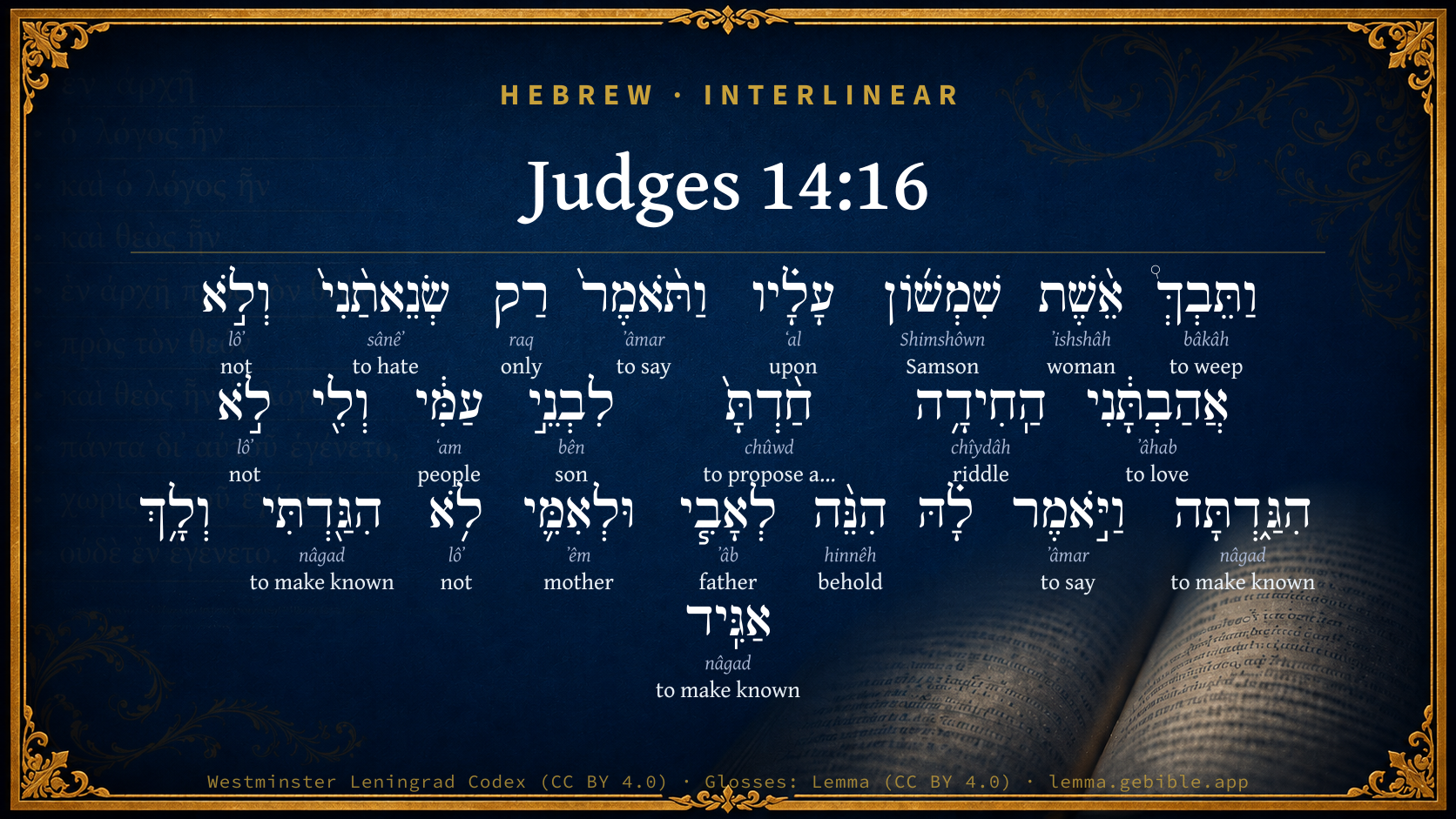
  1. וַתֵּבְךְּ֩ bâkâh H1058 “and · to weep” Conjunction + Verb, Qal, Sequential Imperfect, 3rd Person, Feminine, Singular
  2. אֵ֨שֶׁת ʼishshâh H802 “woman of” Noun, Common, Feminine, Singular, Construct
  3. שִׁמְשׁ֜וֹן Shimshôwn H8123 “Samson” Noun, Proper
  4. עָלָ֗יו ʻal H5921 “upon · him” Preposition + Suffix, Personal, 3rd Person, Masculine, Singular
  5. וַתֹּ֨אמֶר֙ ʼâmar H559 “and · to say” Conjunction + Verb, Qal, Sequential Imperfect, 3rd Person, Feminine, Singular
  6. רַק raq H7535 “only” Particle, Accusative
  7. שְׂנֵאתַ֨נִי֙ sânêʼ H8130 “to hate · me” Verb, Qal, Perfect, 2nd Person, Masculine, Singular + Suffix, Personal, 1st Person, Common, Singular
  8. וְלֹ֣א lôʼ H3808 “and · not” Conjunction + Particle, Negative
  9. אֲהַבְתָּ֔נִי ʼâhab H157 “to love · me” Verb, Qal, Perfect, 2nd Person, Masculine, Singular + Suffix, Personal, 1st Person, Common, Singular
  10. הַֽחִידָ֥ה chîydâh H2420 “the · riddle” Particle, Definite Article + Noun, Common, Feminine, Singular, Absolute
  11. לִבְנֵ֣י bên H1121 “to/for · sons of” Preposition + Noun, Common, Masculine, Plural, Construct
  12. עַמִּ֔י ʻam H5971 “people · my” Noun, Common, Masculine, Singular, Construct + Suffix, Personal, 1st Person, Common, Singular
  13. לֹ֣א lôʼ H3808 “not” Particle, Negative
  14. הִגַּ֑דְתָּה nâgad H5046 “to make known” Verb, Hiphil, Perfect, 2nd Person, Masculine, Singular
  15. וַיֹּ֣אמֶר ʼâmar H559 “and · to say” Conjunction + Verb, Qal, Sequential Imperfect, 3rd Person, Masculine, Singular
  16. הִנֵּ֨ה hinnêh H2009 “behold” Particle, Demonstrative
  17. לְאָבִ֧י ʼâb H1 “to/for · father · my” Preposition + Noun, Common, Masculine, Singular, Construct + Suffix, Personal, 1st Person, Common, Singular
  18. וּלְאִמִּ֛י ʼêm H517 “and · to/for · mother · my” Conjunction + Preposition + Noun, Common, Feminine, Singular, Construct + Suffix, Personal, 1st Person, Common, Singular
  19. לֹ֥א lôʼ H3808 “not” Particle, Negative
  20. הִגַּ֖דְתִּי nâgad H5046 “to make known” Verb, Hiphil, Perfect, 1st Person, Common, Singular
  21. אַגִּֽיד nâgad H5046 “to make known” Verb, Hiphil, Imperfect, 1st Person, Common, Singular

About this verse

These counts appear in no published source. They are computed here, from the morphology-tagged text and Lemma’s own curated glosses. What Lemma adds →

25
words
17
distinct lemmas
Historical
section

Notable vocabulary

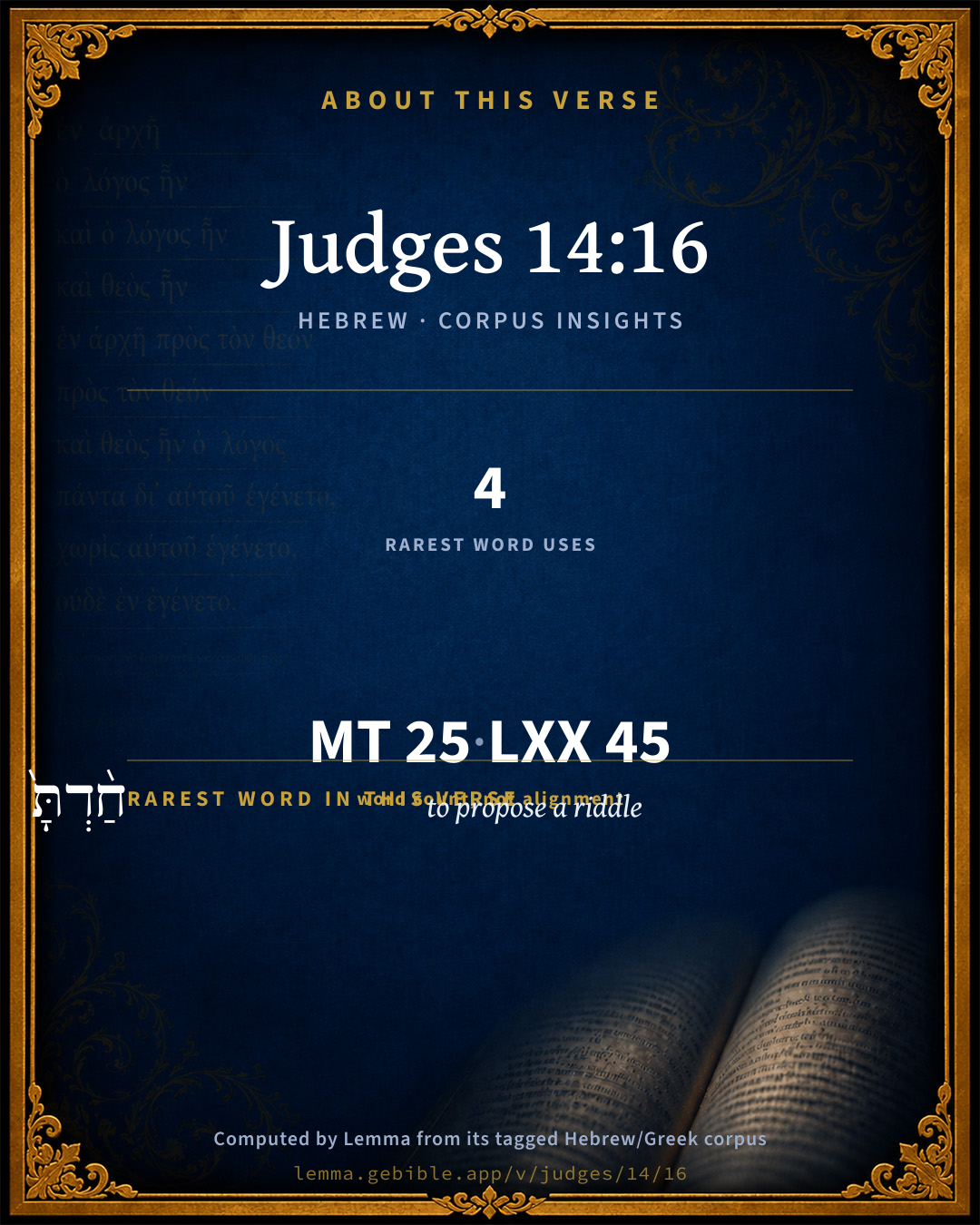
The rarest word here is חַ֨דְתָּ֙ to propose a riddle H2330 — appearing just 4 times in the whole Hebrew Bible.

Shared distinctive vocabulary

חַ֨דְתָּ֙ to propose a riddle H2330 occurs in 4 verses of the Hebrew Bible. Also found in:

Grammatical profile

  • 9 verbs
  • 7 nouns
  • 4 prepositions
  • 5 particles

Verb forms

  • וַתֵּבְךְּ֩ Qal · Sequential Imperfect
  • וַתֹּ֨אמֶר֙ Qal · Sequential Imperfect
  • שְׂנֵאתַ֨נִי֙ Qal · Perfect
  • אֲהַבְתָּ֔נִי Qal · Perfect
  • חַ֨דְתָּ֙ Qal · Perfect
  • הִגַּ֑דְתָּה Hiphil · Perfect
  • וַיֹּ֣אמֶר Qal · Sequential Imperfect
  • הִגַּ֖דְתִּי Hiphil · Perfect
  • אַגִּֽיד Hiphil · Imperfect

Repetition

Words recur within this verse — often emphatic in Hebrew:

  • הִגַּ֑דְתָּה to make known H5046 ×3
  • וַתֹּ֨אמֶר֙ to say H559 ×2
  • וְלֹ֣א not H3808 ×3

Hebrew & Septuagint length

In English translation the verse runs 52 words from the Hebrew and 58 from the Septuagint (LXX English) — closely comparable.

A rough comparison of the two English renderings, which tokenize alike — not a word-level alignment.

Word counts can differ between the Hebrew and the Greek without any difference in meaning — e.g. the Hebrew direct-object marker אֵת has no separate Greek word, and Greek often adds the article ὁ.

In the original languages it is 25 Hebrew tokens and 45 Greek tokens — but the two are counted differently (Hebrew bundles its prefixes and suffixes into one token; the Greek is in lemma form), so that isn’t a like-for-like length.

Cross-references

2

Topical passages linked to Judges 14:16 in the Treasury of Scripture Knowledge — connected by theme and wording, ordered by reader-vote popularity; previews shown in the World English Bible.

  • Judges 16:15 She said to him, How can you say, I love you, when your heart is not with me? you have mocked me these three times, and have not told me in which your great strength lies.
  • Genesis 2:24 Therefore a man will leave his father and his mother, and will join with his wife, and they will be one flesh.

Cross-references courtesy of OpenBible.info (CC BY 4.0).

Hebrew and Greek witnesses Masoretic Hebrew ↔ Greek Septuagint

The same verse in the two great witnesses to the Old Testament, shown verse-for-verse.

These are two independent witnesses, not word-aligned to each other, and the Septuagint is shown in lemma (dictionary) form.

Hebrew Judges 14:16 Masoretic · Westminster Leningrad Codex

וַתֵּבְךְּ֩ אֵ֨שֶׁת שִׁמְשׁ֜וֹן עָלָ֗יו וַתֹּ֨אמֶר֙ רַק שְׂנֵאתַ֨נִי֙ וְלֹ֣א אֲהַבְתָּ֔נִי הַֽחִידָ֥ה חַ֨דְתָּ֙ לִבְנֵ֣י עַמִּ֔י וְלִ֖י לֹ֣א הִגַּ֑דְתָּה וַיֹּ֣אמֶר לָ֗הּ הִנֵּ֨ה לְאָבִ֧י וּלְאִמִּ֛י לֹ֥א הִגַּ֖דְתִּי וְלָ֥ךְ אַגִּֽיד

Samson's wife wept before him, and said, You do but hate me, and don't love me: you have put forth a riddle to the children of my people, and haven't told it me. He said to her, Behold, I haven't told it my father nor my mother, and shall I tell you?

World English Bible · Public Domain

Greek LXX Judges 14:16 Septuagint · lemma form

καί κλαίω ὁ γυνή σαμψων πρός αὐτός καί εἶπον πλήν μισέω ἐγώ καί οὐ ἀγαπάω ἐγώ ὅτι ὁ πρόβλημα ὅς προβάλλω ὁ υἱός ὁ λαός ἐγώ οὐ ἀποἀγγέλλω ἐγώ καί εἶπον αὐτός σαμψων εἰ ὁ πατήρ ἐγώ καί ὁ μήτηρ ἐγώ οὐ ἀποἀγγέλλω σύ ἀποἀγγέλλω

And Sampson's wife wept before him, and said, You do but hate me, and love me not; for the riddle which you have propounded to the children of my people you have not told me: and Sampson said to her, If I have not told it to my father and my mother, shall I tell it to you?

LXX2012 (modern English Septuagint) · Public Domain

Hebrew: Westminster Leningrad Codex (CC BY 4.0). Greek: Septuagint (public domain); English from LXX2012 (modern English Septuagint) (Public Domain). How the Septuagint differs from the Hebrew →

Targum (Aramaic paraphrase)

1

The Targum is the ancient Jewish Aramaic paraphrase of the Hebrew Scriptures — an interpretive translation, not the Hebrew text itself. Onkelos (literal) and Pseudo-Jonathan (expansive) render the Torah, and Jonathan the Prophets. Coverage is partial: where no permissively-licensed English translation exists for a verse, only the Aramaic is shown. This is verse-level text, not a word-by-word alignment to the Hebrew.

  1. Targum Jonathan Prophets (Joshua–Malachi)
    וּבְכַת אִתַּת שִׁמְשׁוֹן עֲלוֹהִי וַאֲמַרַת לְחוֹד שְׂנֵאתַנִי וְלָא רְחַמְתָּנִי חוּדְתָּא חַדְתָּא לִבְנֵי עַמִי וְלִי לָא חֲוֵיתָא וַאֲמַר לָהּ הָא לְאַבָּא וּלְאִמָא לָא חֲוֵיתִי וְלִיךְ אֵכְדֵין אֲחַוֵי:

    (no public-domain English translation for this verse)

    Targum Jonathan — Aramaic: “Mikraot Gedolot” (public domain). English: “Sefaria Community Translation” (CC0 1.0 (public-domain dedication)); “London "Chaldee Paraphrase," 1871” (public domain). Text via Sefaria.

Commentary

Notes on Judges 14:16 from classic Christian and Jewish commentators (each source and its license shown beneath its notes). The classic Christian expositions comment on the surrounding passage and are grouped to its opening verse, so a note may address several verses; the Jewish commentaries on the Tanakh (Rashi and others) are per-verse, so they appear only where the commentator wrote on this verse.

Lemma curates 59 commentaries, every one of them public domain or Creative Commons licensed, each selected and text-cleaned for this edition rather than reprinted as found. About our sources →

Trapp's Complete Commentary

John Trapp

Jdg 14:16 And Samson’s wife wept before him, and said, Thou dost but hate me, and lovest me not: thou hast put forth a riddle unto the children of my people, and hast not told [it] me. And he said unto her, Behold, I have not told [it] my father nor my mother, and shall I tell [it] thee?

Ver. 16. And Samson’s wife wept before him.] Tears are women’s weapons or engines, and many of them

“ Ut flerent oculos erudiere suos. ” - Ovid, Amor., lib. ii.

Apollodorus in Athenaeus telleth of the harlot Phryne, that from her feigned tears she was surnamed κλαυσιγελως, laugh-cry; because she could easily do either.

John Trapp, A Commentary or Exposition upon All the Books of the Old and New Testament (1647–1656) — public domain. Text from a community e-Sword module.

Geneva Bible (1599)

Geneva Bible translators

Unto them which are of my nation.

Geneva Bible (1599) marginal notes — public domain. Text via Bolls.life.

Ellicott's Commentary for English Readers

(16) Wept before him.—Samson’s riddle had the effect of making the whole wedding-feast of this ill-starred marriage one of the most embittered and least joyous that ever fell to a bridegroom’s lot. This was a just punishment for his lawless fancies, though God overruled them to His own ends. A weeping, teazing, fretting bride and sullen guests might have served as a warning that Philistine marriages were not good for the sons of Israel.

A Bible Commentary for English Readers, edited by Charles John Ellicott (1878–1897) — public domain. Text from a community e-Sword module.

The Cambridge Bible for Schools and Colleges

gen. ed. J. J. S. Perowne

16. before him] upon him and Jdg_14:17, i.e. on his neck; the same idiom in Gen_45:15. For the woman’s wile cf. Jdg_16:15.

The Cambridge Bible for Schools and Colleges (gen. ed. J. J. S. Perowne; Cambridge University Press, 1878–1918) — public domain. Text from a community e-Sword module.

John Gill's Exposition

And Samson's wife wept before him,.... When she came to him to get out of him the explanation of the riddle, thinking that her tears would move him to it:

and said, thou dost but hate me, and lovest me not: another artifice she used, well knowing he could not bear to have his affection called in question, which was now very strong, as is usual with newly married persons:

thou hast put forth a riddle unto the children of my people; her countrymen, fellow citizens, and neighbour, and could not but be dear to her, and respected by her; so that what affected and afflicted them must have some influence upon her:

and hast not told me; that is, the explanation of it, otherwise it is likely she had heard the riddle itself told:

and he said unto her behold, l have not told it my father nor my mother, and shall I tell it thee? his parents he was greatly indebted to, for whom he had the highest reverence and esteem, whose fidelity and taciturnity he had sufficient knowledge of, and yet he had not thought fit to impart it to them; how therefore could she expect to be trusted with such a secret, with whom he had not been long acquainted, not long enough to know whether she could keep it or not?

John Gill's Exposition of the Whole Bible (1746–1763) — public domain (CC PDM 1.0). Text via the HelloAO Bible API.

Matthew Poole's English Annotations

Though I have had much more experience of their fidelity and taciturnity than of thine.

Matthew Poole's English Annotations on the Holy Bible (1683–1685) — public domain. Text from a community e-Sword/MySword module.

Whedon's Commentary on the Bible

Daniel D. Whedon

16. I have not told it my father nor my mother — A thing kept secret from one’s parents is, with the Orientals, a thing not to be told in other ears, or, at least, very rarely. “The greatest proof of confidence,” says Roberts, “is to say, I have told you what I have not revealed to my father. In proof of the great affection one has for another, it is said, He has told things to him that he would not have related to his parents. ‘My friend, do tell me the secret.’ ‘Tell you? Yes, when I have told my parents.’”

Daniel D. Whedon (gen. ed.), Commentary on the Old and New Testaments (1874–1909) — public domain. Text from a community e-Sword module.

The Pulpit Commentary

And Samson"s wife, etc. This statement does not follow ver. 15, but is a parallel narrative to that beginning in ver. 14, And they could not in three days," etc., down to the end of ver. 15, bringing the story down to the same point of time, viz., the seventh day. One stream of the narrative tells us what the young men did when Samson had propounded his riddle; the other tells us what Samson"s wife did. From the very first, no doubt, she had wished to be in the secret, not perhaps from treacherous motives, but from curiosity, and the natural desire to be in her husband"s confidence, and she pressed her request with cajolery and petulance. The young men at the same time had tried to find out the riddle by fair means. But on the seventh day they threatened to burn her and her father unless she found out the riddle for them, and under the terror of this threat she extracted the secret from Samson and divulged it to the Philistine young men. The only difficulty is to explain why a gap of four days occurs in the account between vers. 14 and 15. The most likely thing is, that after three days" vain attempt to find out the riddle, they began to tamper with Samson"s wife, offering her money, as the Philistine lords did to Delilah, (Jud_1:16:5) though the narrative does not mention it; but that on the seventh day, becoming desperate, and thinking that the woman was not doing her best, they resorted to the dreadful threat of burning her.

The Pulpit Commentary (1880–1919), ed. H.D.M. Spence-Jones & Joseph S. Exell — public domain. Text from a community e-Sword module.

unfoldingWord translationNotes

Door43 World Missions Community

All you do is hate me! You do not love me

Samson's wife basically said the same thing twice for emphasis. AT: "You do not really love me at all" (See: Parallelism)

riddle

a game in which the players must discover the answer to a difficult question

Look here

This is used to get someones attention. Here "look" means to "listen." AT: "Listen to me" or "Pay attention to what I am about to say"

if I have not told my father or my mother, should I tell you?

Samson was rebuking her for demanding that he tell her the answer. This question can be written as a statement. AT: "I have not even told my father or mother. I will not tell you." or "you should not demand that I tell you, since I have not even told my parents, and they are closer to me than you are." (See: Rhetorical Question and Assumed Knowledge and Implicit Information)

during the seven days that their feast lasted

Possible meanings are 1) "during the seven days of their feast" or 2) "during the rest of the seven days of their feast."

the seventh day

"day 7" (See: Ordinal Numbers)

she pressured him very much

Here the word "pressured" means "urged." AT: "she kept urging him to tell her" (See: Idiom)

translationWords

Samson

love

people group

feast

unfoldingWord translationNotes — © Distant Shores Media and the Door43 World Missions Community, licensed CC BY-SA 4.0. Source: git.door43.org/Door43/en_tn.

Lesson kit

Teaching starters — assembled from the data on this page, not authored interpretation. Every prompt links to the verse data it draws on. Edit before teaching.

Judges, in the Historical, opens this verse with 25 words (17 distinct Hebrew lemmas). Its most distinctive word is chûwd (“to propose a riddle”). A historical commentator’s framing appears above. Read the whole chapter for the surrounding context.

Discussion questions

  1. How does “to propose a riddle” (chûwd) shape what this verse is saying?
  2. Judges 14:12 shares the word «to propose a riddle» with this verse. How do the two illuminate each other?
  3. “to make known” occurs 3× in this one verse. What is the effect of the repetition?
  4. The translations on this page render this verse differently — a whole-verse word diff, not a word-by-word alignment. What might account for the different wordings?
  5. The verb «וַתֵּבְךְּ֩» is Qal Sequential Imperfect. How does its form color the action?
  6. Reading how Trapp's Complete Commentary and Geneva Bible (1599) read this verse, where do the two commentators agree and where do they part?

Things to notice

Reading settings

Reading text

Shown beneath each verse's original-language words.

Old Testament
Old Testament edition

Read the OT as the Masoretic Hebrew (MT) or the Greek Septuagint (LXX).

English shown for the Greek Septuagint (in the Hebrew ↔ Greek comparison).

Comparing translations? Open the Compare panel on any verse page to stack up to four side by side.