
Jeremiah 42:4

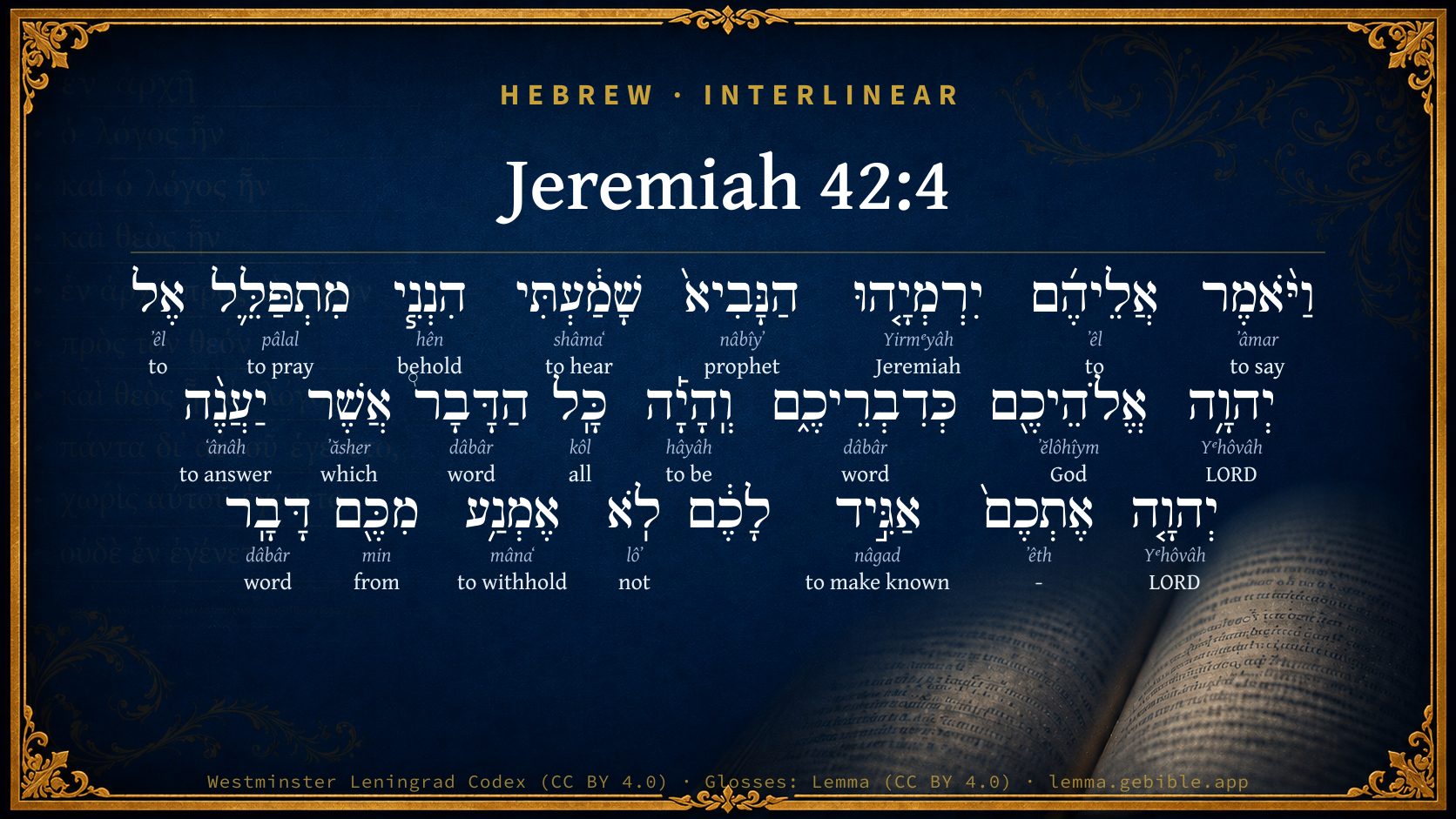
Hebrew (Westminster Leningrad Codex) Jeremiah 42:4 appears in the Hebrew Old Testament. The text above is from the Westminster Leningrad Codex. Each word links to its Strong’s number, a concise gloss, and parsing drawn from the Open Scriptures Hebrew Bible morphology. Click any word for its full Brown-Driver-Briggs (BDB) entry.
Download image
Cite this verse

Jeremiah 42:4 (World English Bible). Public Domain. Lemma interlinear Bible study tool, https://lemma.gebible.app/v/jeremiah/42/4.

Show BibTeX & RIS
BibTeX
RIS
English Translation
Then Jeremiah the prophet said to them, I have heard you; behold, I will pray to Yahweh your God according to your words; and it shall happen that whatever thing Yahweh shall answer you, I will declare it to you; I will keep nothing back from you.
World English Bible · Public Domain
Download a study sheet

One document with this verse’s original text, its word-by-word gloss line, the meaning frame, cross-references with their text, attributed commentary, and full source and license credits — printable, and it pastes into notes with its structure intact.

This verse Autodidact and up

Study sheet (.html) Plain text (.txt)

A passage Seminary Student

Up to 50 verses in one chapter. A passage sheet keeps up to 6 commentary sources and 12 cross-references per verse, in the order this page ranks them, and says so on the sheet whenever that leaves anything out. Ask for a single verse and you get the Autodidact verse sheet above.

Everything on this page stays free to read, with no account — the sheet is a download of what is already on screen, not access to it.

Want to remove ads? Support Godless Engineer
Compare translations 3

The same verse in 3 English versions, stacked beneath the original-language interlinear above. Click any original word for its lexicon entry.

Each is an independent rendering of the whole verse — the interlinear is not word-aligned to these translations.

Highlighted words mark where these versions differ — a whole-verse word diff, not a word-by-word alignment.

  • World English Bible Public Domain
    Then Jeremiah the prophet said to them, I have heard you; behold, I will pray to Yahweh your God according to your words; and it shall happen that whatever thing Yahweh shall answer you, I will declare it to you; I will keep nothing back from you.
  • King James Version Public Domain
    Then Jeremiah the prophet said unto them, I have heard you; behold, I will pray unto the LORD your God according to your words; and it shall come to pass, that whatsoever thing the LORD shall answer you, I will declare it unto you; I will keep nothing back from you.
  • unfoldingWord Literal Text CC BY-SA 4.0
    So Jeremiah the prophet said to them, “I have heard you. Look, I will pray to Yahweh your God as you have requested. Whatever Yahweh answers, I will tell you. I will keep nothing back from you.”

unfoldingWord Literal Text — © unfoldingWord, licensed CC BY-SA 4.0. Word-aligned USFM3 via Door43 (git.door43.org/unfoldingWord/en_ult).

Versions to compare (up to 4)

3 of 4 selected

Show all 18 translations

Every available English version of this verse, each an independent rendering of the whole verse.

  • World English Bible Public Domain
    Then Jeremiah the prophet said to them, I have heard you; behold, I will pray to Yahweh your God according to your words; and it shall happen that whatever thing Yahweh shall answer you, I will declare it to you; I will keep nothing back from you.
  • Berean Standard Bible Public Domain
    “I have heard you,” replied Jeremiah the prophet. “I will surely pray to the LORD your God as you request, and I will tell you everything that the LORD answers; I will not withhold a word from you.”
  • Majority Standard Bible Public Domain
    “I have heard you,” replied Jeremiah the prophet. “I will surely pray to the LORD your God as you request, and I will tell you everything that the LORD answers. I will not withhold a word from you.”
  • King James Version Public Domain
    Then Jeremiah the prophet said unto them, I have heard you; behold, I will pray unto the LORD your God according to your words; and it shall come to pass, that whatsoever thing the LORD shall answer you, I will declare it unto you; I will keep nothing back from you.
  • American Standard Version (1901) Public Domain
    Then Jeremiah the prophet said unto them, I have heard you; behold, I will pray unto Jehovah your God according to your words; and it shall come to pass that whatsoever thing Jehovah shall answer you, I will declare it unto you; I will keep nothing back from you.
  • Revised Version (1885) Public Domain
    Then Jeremiah the prophet said unto them, I have heard you; behold, I will pray unto the LORD your God according to your words; and it shall come to pass that whatsoever thing the LORD shall answer you, I will declare it unto you; I will keep nothing back from you.
  • Geneva Bible (1599) Public Domain
    Then Ieremiah the Prophet said vnto them, I haue heard you: behold, I will pray vnto ye Lord your God according to your wordes, and whatsoeuer thing the Lord shall answere you, I will declare it vnto you: I will keepe nothing backe from you.
  • Douay-Rheims (1899) Public Domain
    And Jeremias the prophet said to them: I have heard you: behold I will pray to the Lord your God according to your words: and whatsoever thing he shall answer me, I will declare it to you: and I will hide nothing from you.
  • Young's Literal Translation Public Domain
    And Jeremiah the prophet saith unto them, `I have heard: lo, I am praying unto Jehovah your God according to your words, and it hath come to pass, the whole word that Jehovah answereth you, I declare to you -- I do not withhold from you a word.'
  • Literal Standard Version CC BY-SA 4.0
    And Jeremiah the prophet says to them, “I have heard: behold, I am praying to your God YHWH according to your words, and it has come to pass, the whole word that YHWH answers you, I declare to you—I do not withhold a word from you.”
  • Unlocked Literal Bible CC BY-SA 4.0
    So Jeremiah the prophet said to them, “I have heard you. Look, I will pray to Yahweh your God as you have requested. Whatever Yahweh answers, I will tell you. I will keep nothing back from you.”
  • unfoldingWord Literal Text CC BY-SA 4.0
    So Jeremiah the prophet said to them, “I have heard you. Look, I will pray to Yahweh your God as you have requested. Whatever Yahweh answers, I will tell you. I will keep nothing back from you.”
  • Darby Bible Public Domain
    And Jeremiah the prophet said unto them, I have heard; behold, I will pray unto Jehovah your God according to your words; and it shall come to pass [that] whatsoever thing Jehovah shall answer you, I will declare it unto you: I will keep nothing back from you.
  • World Messianic Bible Public Domain
    Then Jeremiah the prophet said to them, “I have heard you. Behold, I will pray to the LORD your God according to your words; and it will happen that whatever thing the LORD answers you, I will declare it to you. I will keep nothing back from you.”
  • Webster's Bible Public Domain
    Then Jeremiah the prophet said to them, I have heard you; behold, I will pray to the LORD your God according to your words; and it shall come to pass, that whatever thing the LORD shall answer you, I will declare it to you; I will keep nothing back from you.
  • Free Bible Version CC BY-SA 4.0
    “I'll do as you ask,” Jeremiah replied. “I will definitely pray to the Lord your God as you've requested, and I'll tell you everything he says. I won't keep anything back from you.”
  • Bible in Basic English Public Domain
    Then Jeremiah the prophet said to them, I have given ear to you; see, I will make prayer to the Lord your God, as you have said; and it will be that, whatever the Lord may say in answer to you, I will give you word of it, keeping nothing back.
  • JPS Tanakh (1917) Public Domain
    Then Jeremiah the prophet said unto them: 'I have heard you; behold, I will pray unto the LORD your God according to your words; and it shall come to pass, that whatsoever thing the LORD shall answer you, I will declare it unto you; I will keep nothing back from you.'

Literal Standard Version (2020), Covenant Press — licensed CC BY-SA 4.0. Text via the HelloAO Bible API (eBible.org). Unlocked Literal Bible (unfoldingWord) — licensed CC BY-SA 4.0. Text via the HelloAO Bible API (eBible.org). unfoldingWord Literal Text — © unfoldingWord, licensed CC BY-SA 4.0. Word-aligned USFM3 via Door43 (git.door43.org/unfoldingWord/en_ult). Free Bible Version, Dr. Jonathan Gallagher — licensed CC BY-SA 4.0. Text via the HelloAO Bible API (eBible.org).

Word by word

More ways to search: Search by grammar → Find every occurrence → Compare this word →

Practice this passage: Drill this verse → Learn its vocabulary →

אֶמְנַ֥ע
mânaʻ
H4513
“to withhold”
Verb, Qal, Imperfect, 1st Person, Common, Singular
Part of Speech
Verb
Stem
Qal
Form
Imperfect
Person
1st Person
Gender
Common
Number
Singular
Full BDB Definition

Origin: a primitive root

TWOT: 1216

to withhold, hold back, keep back, refrain, deny, keep restrain, hinder - (Qal) to withhold - (Niphal) to be withheld
  1. וַיֹּ֨אמֶר ʼâmar H559 “and · to say” Conjunction + Verb, Qal, Sequential Imperfect, 3rd Person, Masculine, Singular
  2. אֲלֵיהֶ֜ם ʼêl H413 “to · them” Preposition + Suffix, Personal, 3rd Person, Masculine, Plural
  3. יִרְמְיָ֤הוּ Yirmᵉyâh H3414 “Jeremiah” Noun, Proper
  4. הַנָּבִיא֙ nâbîyʼ H5030 “the · prophet” Particle, Definite Article + Noun, Common, Masculine, Singular, Absolute
  5. שָׁמַ֔עְתִּי shâmaʻ H8085 “to hear” Verb, Qal, Perfect, 1st Person, Common, Singular
  6. הִנְנִ֧י hên H2005 “behold · me” Particle, Demonstrative + Suffix, Personal, 1st Person, Common, Singular
  7. מִתְפַּלֵּ֛ל pâlal H6419 “praying” Verb, Hithpael, Participle Active, Masculine, Singular, Absolute
  8. אֶל ʼêl H413 “to” Preposition
  9. יְהוָ֥ה Yᵉhôvâh H3068 “LORD” Noun, Proper
  10. אֱלֹהֵיכֶ֖ם ʼĕlôhîym H430 “God(s) · your” Noun, Common, Masculine, Plural, Construct + Suffix, Personal, 2nd Person, Masculine, Plural
  11. כְּדִבְרֵיכֶ֑ם dâbâr H1697 “like/as · words · your” Preposition + Noun, Common, Masculine, Plural, Construct + Suffix, Personal, 2nd Person, Masculine, Plural
  12. וְֽהָיָ֡ה hâyâh H1961 “and · to be” Conjunction + Verb, Qal, Sequential Perfect, 3rd Person, Masculine, Singular
  13. כָּֽל kôl H3605 “all of” Noun, Common, Masculine, Singular, Construct
  14. הַדָּבָר֩ dâbâr H1697 “the · word” Particle, Definite Article + Noun, Common, Masculine, Singular, Absolute
  15. אֲשֶׁר ʼăsher H834 “which” Particle, Relative
  16. יַעֲנֶ֨ה ʻânâh H6030 “to answer” Verb, Qal, Imperfect, 3rd Person, Masculine, Singular
  17. יְהוָ֤ה Yᵉhôvâh H3068 “LORD” Noun, Proper
  18. אֶתְכֶם֙ ʼêth H853 “- · you” Particle, Direct Object + Suffix, Personal, 2nd Person, Masculine, Plural
  19. אַגִּ֣יד nâgad H5046 “to make known” Verb, Hiphil, Imperfect, 1st Person, Common, Singular
  20. לֹֽא lôʼ H3808 “not” Particle, Negative
  21. מִכֶּ֖ם min H4480 “from · you” Preposition + Suffix, Personal, 2nd Person, Masculine, Plural
  22. דָּבָֽר dâbâr H1697 “word” Noun, Common, Masculine, Singular, Absolute

About this verse

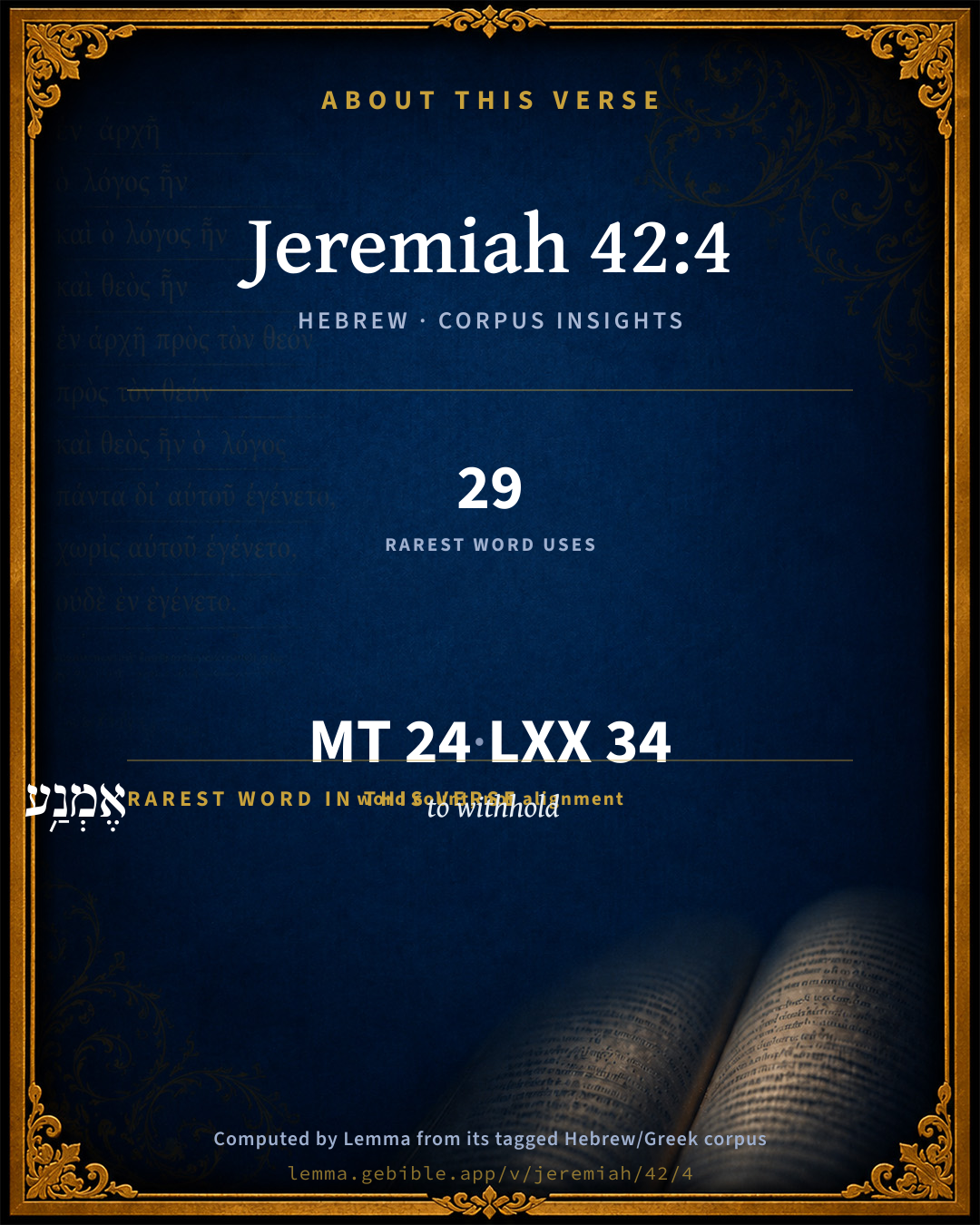
These counts appear in no published source. They are computed here, from the morphology-tagged text and Lemma’s own curated glosses. What Lemma adds →

24
words
19
distinct lemmas
Prophets
section

Shared distinctive vocabulary

אֶמְנַ֥ע to withhold H4513 occurs in 29 verses of the Hebrew Bible. Also found in:

Grammatical profile

  • 7 verbs
  • 9 nouns
  • 4 prepositions
  • 4 particles

Verb forms

  • וַיֹּ֨אמֶר Qal · Sequential Imperfect
  • שָׁמַ֔עְתִּי Qal · Perfect
  • מִתְפַּלֵּ֛ל Hithpael · Participle Active
  • וְֽהָיָ֡ה Qal · Sequential Perfect
  • יַעֲנֶ֨ה Qal · Imperfect
  • אַגִּ֣יד Hiphil · Imperfect
  • אֶמְנַ֥ע Qal · Imperfect

Repetition

Words recur within this verse — often emphatic in Hebrew:

  • כְּדִבְרֵיכֶ֑ם word H1697 ×3
  • יְהוָ֥ה LORD H3068 ×2
  • אֲלֵיהֶ֜ם to H413 ×2

Hebrew & Septuagint length

In the original languages it is 24 Hebrew tokens and 34 Greek tokens — but the two are counted differently (Hebrew bundles its prefixes and suffixes into one token; the Greek is in lemma form), so that isn’t a like-for-like length.

Cross-references

11

Topical passages linked to Jeremiah 42:4 in the Treasury of Scripture Knowledge — connected by theme and wording, ordered by reader-vote popularity; previews shown in the World English Bible.

  • Exodus 8:29 Moses said, "Behold, I go out from you, and I will pray to Yahweh that the swarms of flies may depart from Pharaoh, from his servants, and from his people, tomorrow; only don't let Pharaoh deal deceitfully any more in not letting the people go to sacrifice to Yahweh."
  • 1 Samuel 3:17–18 He said, "What is the thing that [Yahweh] has spoken to you? Please don't hide it from me. God do so to you, and more also, if you hide anything from me of all the things that he spoke to you."
  • 1 Samuel 12:23 Moreover as for me, far be it from me that I should sin against Yahweh in ceasing to pray for you: but I will instruct you in the good and the right way.
  • Psalms 40:10 I have not hidden your righteousness within my heart. I have declared your faithfulness and your salvation. I have not concealed your loving kindness and your truth from the great assembly.
  • Jeremiah 23:28 The prophet who has a dream, let him tell a dream; and he who has my word, let him speak my word faithfully. What is the straw to the wheat? says Yahweh.
  • Acts 20:20 how I didn't shrink from declaring to you anything that was profitable, teaching you publicly and from house to house,
  • Acts 20:27 for I didn't shrink from declaring to you the whole counsel of God.
  • 1 Kings 22:14–16 Micaiah said, As Yahweh lives, what Yahweh says to me, that will I speak.
  • 2 Chronicles 18:13–15 Micaiah said, As Yahweh lives, what my God says, that will I speak.
  • Ezekiel 2:7 You shall speak my words to them, whether they will hear, or whether they will forbear; for they are most rebellious.
  • Romans 10:1 Brothers, my heart's desire and my prayer to God is for Israel, that they may be saved.

Cross-references courtesy of OpenBible.info (CC BY 4.0).

Hebrew and Greek witnesses Masoretic Hebrew ↔ Greek Septuagint

The same verse in the two great witnesses to the Old Testament, shown verse-for-verse.

These are two independent witnesses, not word-aligned to each other, and the Septuagint is shown in lemma (dictionary) form.

Hebrew Jeremiah 42:4 Masoretic · Westminster Leningrad Codex

וַיֹּ֨אמֶר אֲלֵיהֶ֜ם יִרְמְיָ֤הוּ הַנָּבִיא֙ שָׁמַ֔עְתִּי הִנְנִ֧י מִתְפַּלֵּ֛ל אֶל יְהוָ֥ה אֱלֹהֵיכֶ֖ם כְּדִבְרֵיכֶ֑ם וְֽהָיָ֡ה כָּֽל הַדָּבָר֩ אֲשֶׁר יַעֲנֶ֨ה יְהוָ֤ה אֶתְכֶם֙ אַגִּ֣יד לָכֶ֔ם לֹֽא אֶמְנַ֥ע מִכֶּ֖ם דָּבָֽר

Then Jeremiah the prophet said to them, I have heard you; behold, I will pray to Yahweh your God according to your words; and it shall happen that whatever thing Yahweh shall answer you, I will declare it to you; I will keep nothing back from you.

World English Bible · Public Domain

Greek LXX Structure differs

In the Septuagint, Jeremiah is about an eighth shorter than the Hebrew and arranges its material differently — the Oracles Against the Nations (Hebrew chapters 46–51) appear in the middle of the Greek book, after 25:13. Because the chapter and verse boundaries do not line up, a verse-for-verse comparison with the Hebrew is not shown.

A verse-for-verse comparison isn’t shown here because the chapters and verses don’t line up. Switch to the LXX edition with the MT / LXX toggle above to read the Greek directly.

Hebrew: Westminster Leningrad Codex (CC BY 4.0). Greek: Septuagint (public domain); English from a public-domain English Septuagint. How the Septuagint differs from the Hebrew →

Targum (Aramaic paraphrase)

1

The Targum is the ancient Jewish Aramaic paraphrase of the Hebrew Scriptures — an interpretive translation, not the Hebrew text itself. Onkelos (literal) and Pseudo-Jonathan (expansive) render the Torah, and Jonathan the Prophets. Coverage is partial: where no permissively-licensed English translation exists for a verse, only the Aramaic is shown. This is verse-level text, not a word-by-word alignment to the Hebrew.

  1. Targum Jonathan Prophets (Joshua–Malachi)
    וַאֲמַר לְהוֹן יִרְמְיָה נְבִיָא שַׁמֵעֵית הָא אֲנָא מְצַלֵי קֳדָם יְיָ אֱלָהָכוֹן כְּפִתְגְמֵכוֹן וִיהֵי כָּל פִּתְגָם דִיתִב יְיָ יַתְכוֹן אֲחַוֵי לְכוֹן לָא אֶמְנַע מִנְכוֹן פִּתְגָם:

    (no public-domain English translation for this verse)

    Targum Jonathan — Aramaic: “Mikraot Gedolot” (public domain). English: “Sefaria Community Translation” (CC0 1.0 (public-domain dedication)); “London "Chaldee Paraphrase," 1871” (public domain). Text via Sefaria.

Commentary

Notes on Jeremiah 42:4 from classic Christian and Jewish commentators (each source and its license shown beneath its notes). The classic Christian expositions comment on the surrounding passage and are grouped to its opening verse, so a note may address several verses; the Jewish commentaries on the Tanakh (Rashi and others) are per-verse, so they appear only where the commentator wrote on this verse.

Lemma curates 59 commentaries, every one of them public domain or Creative Commons licensed, each selected and text-cleaned for this edition rather than reprinted as found. About our sources →

Trapp's Complete Commentary

John Trapp

Jer 42:4 Then Jeremiah the prophet said unto them, I have heard [you]; behold, I will pray unto the LORD your God according to your words; and it shall come to pass, [that] whatsoever thing the LORD shall answer you, I will declare [it] unto you; I will keep nothing back from you.

Ver. 4. I have heard you; behold, I will pray.] The wisdom from above is persuasible, easy to be entreated, {Jas 3:18} and good men are ready to every good work. {Tit 3:1} Jeremiah hoped they might speak their whole hearts, and promiseth to do his best for them, both by praying and prophesying.

Whatsoever thing the Lord shall answer you, I will declare.] Sic veteres nihil ex se vel potuerunt, vel protulerunt. The prophets spake as they were inspired by the Spirit of truth. Christ spake nothing but what was consonant to the Holy Scriptures. The apostles delivered to the churches what they had received of the Lord. {1Co 11:23} Polycarp told the churches that he delivered nothing to them but what he had received of the apostles. {a}

{a} Irenaeus, lib. iii.; Eccles. Hist., lib. iv. cap. 14.

John Trapp, A Commentary or Exposition upon All the Books of the Old and New Testament (1647–1656) — public domain. Text from a community e-Sword module.

Joseph Benson's Commentary

Jer 42:4-6. Then Jeremiah said, I have heard you, &c. — That is, I will do for you what you desire. I will pray unto the Lord your God — They called the Lord Jeremiah’s God: here Jeremiah calls him their God, both to remind them of God’s relation to them, and of their duty toward him. And whatsoever thing the Lord shall answer, I will declare — I will be faithful in giving you an account of what God shall reveal to me to be his will concerning you. Then they said, The Lord be a true and faithful witness, &c. — The words of this and the following verse imply a perfect oath, the form of which lies in appealing to God as a witness of the sincerity of the hearts of those that swear, for a security to those to whom the oath is given: which also includes a secret challenging of God to take vengeance upon those that give that security, if they should not act according to their promise. The thing these men promise is, that they would perfectly obey God’s will, whether agreeable or disagreeable to them. And they further declare they were convinced that their prosperity and happiness entirely depended upon their complying with God’s will, adding, That it may be well with us, &c.

Joseph Benson's Commentary on the Old and New Testaments (1811–1818) — public domain. Text from a community e-Sword module.

Tyndale Open Study Notes

Tyndale Open Resources

42:4 The first phrase, All right (literally I heard), indicates that Jeremiah questioned the sincerity of the Judean group led by Johanan. Still, the prophet agreed to pray for divine guidance and to give them the full content of the Lord’s answer.

Tyndale Open Study Notes — © Tyndale Open Resources, licensed CC BY-SA 4.0. Text via the HelloAO Bible API.

Jamieson, Fausset & Brown

Robert Jamieson, A. R. Fausset & David Brown

I have heard--that is, I accede to your request.

your God--Being His by adoption, ye are not your own, and are bound to whatever He wills (Exo 19:5-6; Co1 6:19-20).

answer you--that is, through me.

keep nothing back-- (Sa1 3:18; Act 20:20).

Jamieson, Fausset & Brown — Commentary Critical and Explanatory on the Whole Bible (1871) — public domain (CC PDM 1.0). Text via the HelloAO Bible API.

John Calvin's Commentaries

In order to prepare them to obey, he testified that he would be a faithful messenger of God; for there is no doubt but that the Prophet, as we shall see, regarded them with suspicion. That he might therefore have them teachable and obedient to the answer expected from God, he said beforehand, that he would honestly and faithfully perform his office as a Prophet.

I have heard, he says; here he shews how ready he was to attend, and how he neglected nothing conducive to their well being. I have heard, he says, Behold, I will pray according to your words There is no doubt but that he thus intimated that he wished well to them; and it might have rendered them more attentive to the oracle to know that the Prophet was influenced by love. Nor is there a doubt but that the Prophet testified his love towards them, that his doctrine might afterwards have more weight with them.

By saying, Whatever your God will answer, he did not mean that the oracle would be revealed to all, for the words could not be otherwise explained than through the Prophet, who would openly make known to the whole people what he heard from God’s mouth. But he says, that the answer would be given to them, because God would give the answer which was to be communicated to all, as it is said that God spoke to Moses, and also to all the people, for the doctrine was intended for all. Moses did not receive the law, nor its interpretation, in his own private character, but in order that the people might know what was right. So Jeremiah did here; the answer he received from God he made known as belonging in common to all the people.

But in calling God their God, he did not mean to flatter them or to praise their piety, but to exhort them to surrender and devote themselves wholly to God, as though he had said, that they had to do with God, who had bound them to himself when he adopted them as his peculiar people, and then favored them with so many blessings. Since then God had made himself known to them, they could not reject his counsel with impunity, for there was no pretext of ignorance. We hence see what weight there is in this, your God; for Jeremiah reminded them that they could not with impunity trifle with God, for they were not their own, but had been chosen to be God’s people, and on this condition, to be wholly subject to his authority. Then the sum of the whole is this, that the Prophet would faithfully convey to the Jews the answer God would give them; and he said this that his doctrine might have a greater authority among them. It now follows, —

John Calvin's Commentaries (1540-1563) — public domain. Text from the Calvin Translation Society English edition (1840s-50s) via the Christian Classics Ethereal Library (ccel.org). Calvin's coverage is partial (roughly two-thirds of the Bible); uncommented books and verses are honest gaps, never fabricated. The 19th-century editor's footnotes and remarks are omitted so the notes are faithfully Calvin's own voice.

John Gill's Exposition

Then Jeremiah the prophet said unto them, I have heard you,.... He took notice of what they said to him, and found himself disposed to comply with their request, and readily granted it:

behold, I will pray unto the Lord your God, according to your words; be an intercessor for them; use his interest with his God, and their God; and, on account of relation, might expect to be heard; whom he would humbly entreat to direct what they should do, as they desired:

and it shall come to pass, that whatsoever thing the Lord shall answer you, I will declare it unto you; I will keep nothing back from you; but faithfully make known the whole mind and will of God, just as it is delivered, be it in what way soever: and though it is not expressed, he might suggest that he had some doubt on his mind whether they would obey it or not; and that he expected they would be open and free in declaring themselves on that point; since he had so readily complied with their request, and was determined to act the faithful part to them; hence the following reply:

John Gill's Exposition of the Whole Bible (1746–1763) — public domain (CC PDM 1.0). Text via the HelloAO Bible API.

Matthew Poole's English Annotations

I have heard you; that is, I will do for you according as you desire. And I will be faithful in giving you an account of what God shall reveal to me to be his will on your behalf. They called God Jeremiah’s God, here Jeremiah calls him their God, both to mind them of God’s relation to them, and their duty towards him.

Matthew Poole's English Annotations on the Holy Bible (1683–1685) — public domain. Text from a community e-Sword/MySword module.

Whedon's Commentary on the Bible

Daniel D. Whedon

4. I have heard you — I agree to your request.

The Lord your God — As he was their God they had a right to prefer to him their requests.

Daniel D. Whedon (gen. ed.), Commentary on the Old and New Testaments (1874–1909) — public domain. Text from a community e-Sword module.

unfoldingWord translationNotes

Door43 World Missions Community

Look

"Pay attention to what I am about to tell you"

I will keep nothing back from you

The phrase "keep nothing back from you" is an idiom that means to tell someone everything. This can be stated in positive form. AT: "I will tell you everything the Lord tells me" (See: Idiom and Active or Passive)

May Yahweh be

This is a way of beginning an oath. AT: "We ask Yahweh to be" or "Yahweh will be"

true and faithful

Here these words share similar meanings. They describe Yahweh as a witness whom no one will be able to contradict. AT: "trustworthy" (See: Doublet)

Whether it is good or if it is bad

The people mention both extremes to emphasize that they will obey no matter what Yahweh's answer is. AT: "Whatever he answers" (See: Merism)

the voice of Yahweh our God

Here "voice" represents what Yahweh says. AT: "what Yahweh our God says" or "we will obey Yahweh our God" (See: Metonymy)

translationWords

true

faithful

testimony

good

obey

voice

send

unfoldingWord translationNotes — © Distant Shores Media and the Door43 World Missions Community, licensed CC BY-SA 4.0. Source: git.door43.org/Door43/en_tn.

Lesson kit

Teaching starters — assembled from the data on this page, not authored interpretation. Every prompt links to the verse data it draws on. Edit before teaching.

Jeremiah, in the Prophets, opens this verse with 24 words (19 distinct Hebrew lemmas). Its most distinctive word is mânaʻ (“to withhold”). A historical commentator’s framing appears above. Read the whole chapter for the surrounding context.

Discussion questions

  1. What does “to withhold” (mânaʻ) contribute to the verse as a whole?
  2. How does Genesis 30:2, which shares the word «to withhold», read alongside this verse?
  3. What does the repetition of “word” (3× in this one verse) do in this verse?
  4. These translations render this verse differently; the difference is in the English rendering, not the original. What questions does that raise?
  5. «וַיֹּ֨אמֶר» is a Qal Sequential Imperfect verb. How does that grammatical form shape the action described?
  6. Compare how Trapp's Complete Commentary and Joseph Benson's Commentary read this verse. Where do they agree or differ?

Things to notice

Reading settings

Reading text

Shown beneath each verse's original-language words.

Old Testament
Old Testament edition

Read the OT as the Masoretic Hebrew (MT) or the Greek Septuagint (LXX).

English shown for the Greek Septuagint (in the Hebrew ↔ Greek comparison).

Comparing translations? Open the Compare panel on any verse page to stack up to four side by side.