
Esther 4:7

Hebrew (Westminster Leningrad Codex) Esther 4:7 appears in the Hebrew Old Testament. The text above is from the Westminster Leningrad Codex. Each word links to its Strong’s number, a concise gloss, and parsing drawn from the Open Scriptures Hebrew Bible morphology. Click any word for its full Brown-Driver-Briggs (BDB) entry.
Download image
Cite this verse

Esther 4:7 (World English Bible). Public Domain. Lemma interlinear Bible study tool, https://lemma.gebible.app/v/esther/4/7.

Show BibTeX & RIS
BibTeX
RIS
English Translation
Mordecai told him of all that had happened to him, and the exact sum of the money that Haman had promised to pay to the king's treasuries for the Jews, to destroy them.
World English Bible · Public Domain
Highlights
  • 1 first appearance in the Hebrew Bible
Full analysis ↓
Download a study sheet

One document with this verse’s original text, its word-by-word gloss line, the meaning frame, cross-references with their text, attributed commentary, and full source and license credits — printable, and it pastes into notes with its structure intact.

This verse Autodidact and up

Study sheet (.html) Plain text (.txt)

A passage Seminary Student

Up to 50 verses in one chapter. A passage sheet keeps up to 6 commentary sources and 12 cross-references per verse, in the order this page ranks them, and says so on the sheet whenever that leaves anything out. Ask for a single verse and you get the Autodidact verse sheet above.

Everything on this page stays free to read, with no account — the sheet is a download of what is already on screen, not access to it.

Want to remove ads? Support Godless Engineer
Compare translations 3

The same verse in 3 English versions, stacked beneath the original-language interlinear above. Click any original word for its lexicon entry.

Each is an independent rendering of the whole verse — the interlinear is not word-aligned to these translations.

Highlighted words mark where these versions differ — a whole-verse word diff, not a word-by-word alignment.

  • World English Bible Public Domain
    Mordecai told him of all that had happened to him, and the exact sum of the money that Haman had promised to pay to the king's treasuries for the Jews, to destroy them.
  • King James Version Public Domain
    And Mordecai told him of all that had happened unto him, and of the sum of the money that Haman had promised to pay to the king's treasuries for the Jews, to destroy them.
  • unfoldingWord Literal Text CC BY-SA 4.0
    And Mordecai reported to him all that had happened to him, and the exact amount of silver that Haman had said to weigh out into the treasuries of the king against the Jews to destroy them.

unfoldingWord Literal Text — © unfoldingWord, licensed CC BY-SA 4.0. Word-aligned USFM3 via Door43 (git.door43.org/unfoldingWord/en_ult).

Versions to compare (up to 4)

3 of 4 selected

Show all 18 translations

Every available English version of this verse, each an independent rendering of the whole verse.

  • World English Bible Public Domain
    Mordecai told him of all that had happened to him, and the exact sum of the money that Haman had promised to pay to the king's treasuries for the Jews, to destroy them.
  • Berean Standard Bible Public Domain
    and Mordecai told him all that had happened to him, including the exact amount of money that Haman had promised to pay into the royal treasury in order to destroy the Jews.
  • Majority Standard Bible Public Domain
    and Mordecai told him all that had happened to him, including the exact amount of money that Haman had promised to pay into the royal treasury in order to destroy the Jews.
  • King James Version Public Domain
    And Mordecai told him of all that had happened unto him, and of the sum of the money that Haman had promised to pay to the king's treasuries for the Jews, to destroy them.
  • American Standard Version (1901) Public Domain
    And Mordecai told him of all that had happened unto him, and the exact sum of the money that Haman had promised to pay to the king's treasuries for the Jews, to destroy them.
  • Revised Version (1885) Public Domain
    And Mordecai told him of all that had happened unto him, and the exact sum of the money that Haman had promised to pay to the king’s treasuries for the Jews, to destroy them.
  • Geneva Bible (1599) Public Domain
    And Mordecai tolde him of all that which had come vnto him, and of the summe of the siluer that Haman had promised to pay vnto the Kings treasures, because of the Iewes, for to destroy them.
  • Douay-Rheims (1899) Public Domain
    And Mardochai told him all that had happened, how Aman had promised to pay money into the king's treasures, to have the Jews destroyed.
  • Young's Literal Translation Public Domain
    and Mordecai declareth to him all that hath met him, and the explanation of the money that Haman said to weigh to the treasuries of the king for the Jews, to destroy them,
  • Literal Standard Version CC BY-SA 4.0
    and Mordecai declares to him all that has met him, and the explanation of the money that Haman said to weigh to the treasuries of the king for the Jews, to destroy them,
  • Unlocked Literal Bible CC BY-SA 4.0
    Mordecai reported to him all that had happened to him, and the total amount of the silver that Haman had promised to weigh out and put into the king's treasuries in order to put the Jews to death.
  • unfoldingWord Literal Text CC BY-SA 4.0
    And Mordecai reported to him all that had happened to him, and the exact amount of silver that Haman had said to weigh out into the treasuries of the king against the Jews to destroy them.
  • Darby Bible Public Domain
    And Mordecai told him of all that had happened to him, and of the sum of money that Haman had promised to pay to the king's treasuries for the Jews, to destroy them.
  • World Messianic Bible Public Domain
    Mordecai told him of all that had happened to him, and the exact sum of the money that Haman had promised to pay to the king’s treasuries for the destruction of the Jews.
  • Webster's Bible Public Domain
    And Mordecai told him all that had happened to him, and of the sum of the money that Haman had promised to pay to the king's treasuries for the Jews, to destroy them.
  • Free Bible Version CC BY-SA 4.0
    Mordecai explained to him everything that had happened to him, including the exact amount of money that Haman had promised to pay the royal treasury for the destruction of the Jews.
  • Bible in Basic English Public Domain
    And Mordecai gave him an account of what had taken place, and of the amount of money which Haman had said he would put into the king's store for the destruction of the Jews.
  • JPS Tanakh (1917) Public Domain
    And Mordecai told him of all that had happened unto him, and the exact sum of the money that Haman had promised to pay to the king's treasuries for the Jews, to destroy them.

Literal Standard Version (2020), Covenant Press — licensed CC BY-SA 4.0. Text via the HelloAO Bible API (eBible.org). Unlocked Literal Bible (unfoldingWord) — licensed CC BY-SA 4.0. Text via the HelloAO Bible API (eBible.org). unfoldingWord Literal Text — © unfoldingWord, licensed CC BY-SA 4.0. Word-aligned USFM3 via Door43 (git.door43.org/unfoldingWord/en_ult). Free Bible Version, Dr. Jonathan Gallagher — licensed CC BY-SA 4.0. Text via the HelloAO Bible API (eBible.org).

Word by word

More ways to search: Search by grammar → Find every occurrence → Compare this word →

Practice this passage: Drill this verse → Learn its vocabulary →

פָּרָשַׁ֣ת
pârâshâh
H6575
“declaration of”
Noun, Common, Feminine, Singular, Construct
Part of Speech
Noun
Type
Common
Gender
Feminine
Number
Singular
State
Construct
Full BDB Definition

Origin: from H6567

TWOT: 1833a

exact statement, declaration
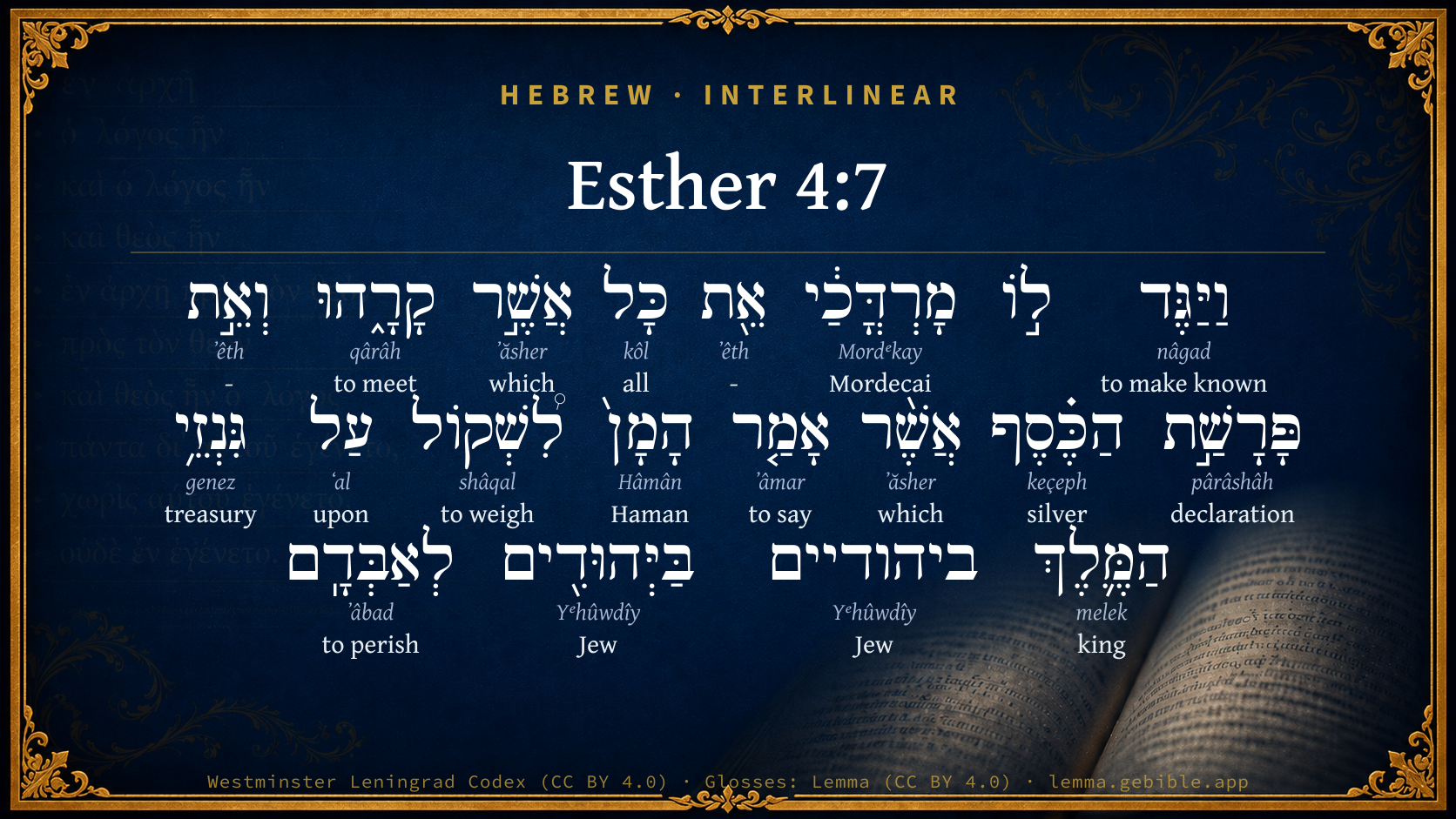
  1. וַיַּגֶּד nâgad H5046 “and · to make known” Conjunction + Verb, Hiphil, Sequential Imperfect, 3rd Person, Masculine, Singular
  2. מָרְדֳּכַ֔י Mordᵉkay H4782 “Mordecai” Noun, Proper
  3. אֵ֖ת ʼêth H853 “-” Particle, Direct Object
  4. כָּל kôl H3605 “all” Noun, Common, Masculine, Singular, Absolute
  5. אֲשֶׁ֣ר ʼăsher H834 “which” Particle, Relative
  6. קָרָ֑הוּ qârâh H7136 “to meet · him” Verb, Qal, Perfect, 3rd Person, Masculine, Singular + Suffix, Personal, 3rd Person, Masculine, Singular
  7. וְאֵ֣ת ʼêth H853 “and · -” Conjunction + Particle, Direct Object
  8. הַכֶּ֗סֶף keçeph H3701 “the · silver” Particle, Definite Article + Noun, Common, Masculine, Singular, Absolute
  9. אֲשֶׁ֨ר ʼăsher H834 “which” Particle, Relative
  10. אָמַ֤ר ʼâmar H559 “to say” Verb, Qal, Perfect, 3rd Person, Masculine, Singular
  11. הָמָן֙ Hâmân H2001 “Haman” Noun, Proper
  12. לִ֠שְׁקוֹל shâqal H8254 “to weigh” Preposition + Verb, Qal, Infinitive Construct
  13. עַל ʻal H5921 “upon” Preposition
  14. גִּנְזֵ֥י genez H1595 “treasuries of” Noun, Common, Masculine, Plural, Construct
  15. הַמֶּ֛לֶךְ melek H4428 “the · king” Particle, Definite Article + Noun, Common, Masculine, Singular, Absolute
  16. ביהודיים Yᵉhûwdîy H3064 “in/at the · Jews” Preposition, Determined + Noun, Gentilic, Masculine, Plural, Absolute
  17. בַּיְּהוּדִ֖ים Yᵉhûwdîy H3064 “in/at the · Jews” Preposition, Determined + Noun, Gentilic, Masculine, Plural, Absolute
  18. לְאַבְּדָֽם ʼâbad H6 “to perish · them” Preposition + Verb, Piel, Infinitive Construct + Suffix, Personal, 3rd Person, Masculine, Plural

About this verse

These counts appear in no published source. They are computed here, from the morphology-tagged text and Lemma’s own curated glosses. What Lemma adds →

20
words
16
distinct lemmas
Historical
section

Notable vocabulary

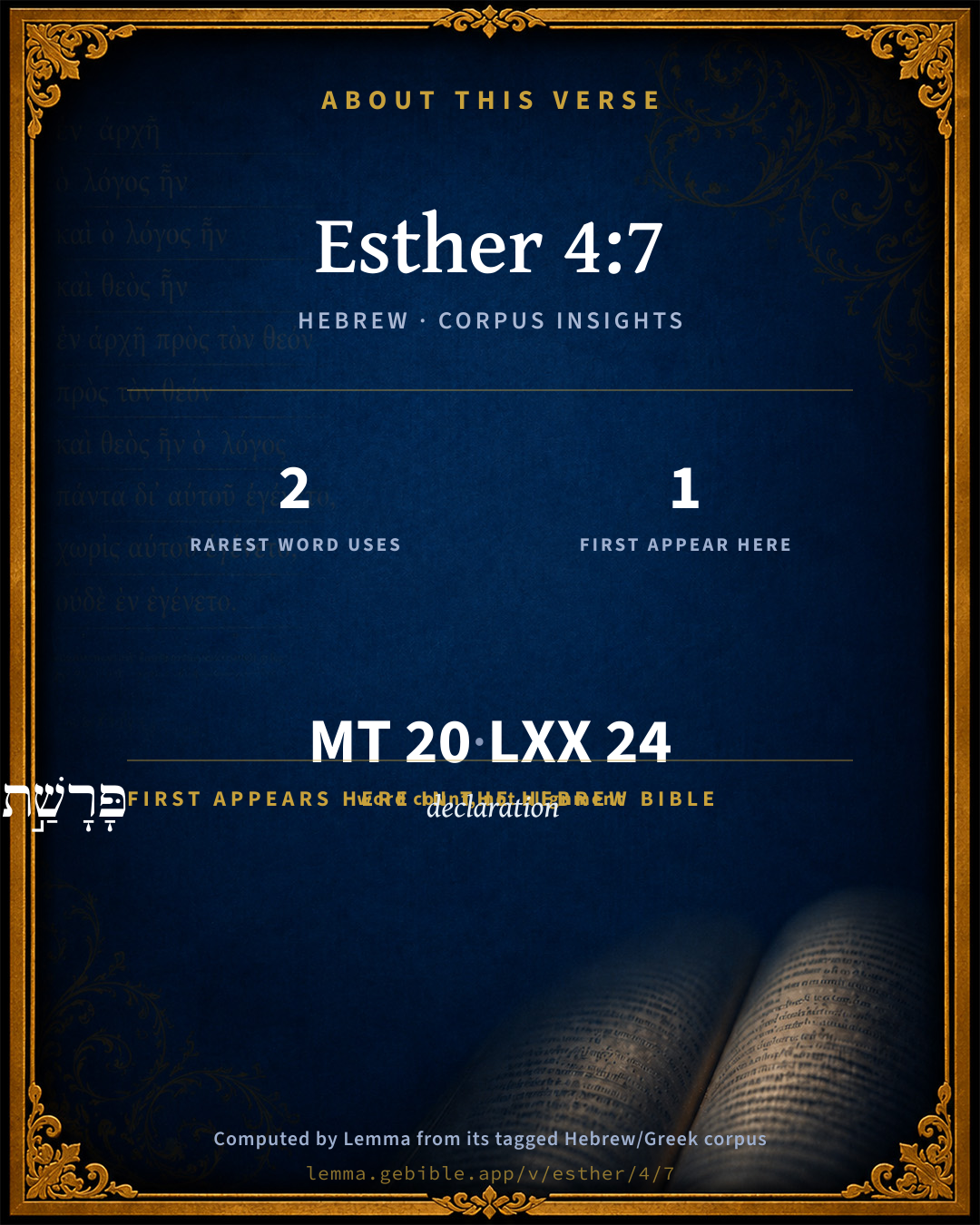
The rarest word here is פָּרָשַׁ֣ת declaration H6575 — appearing just 2 times in the whole Hebrew Bible.

First appearance in Scripture

This word makes its first canonical appearance in the Hebrew Bible here:

  • פָּרָשַׁ֣ת declaration H6575

Shared distinctive vocabulary

פָּרָשַׁ֣ת declaration H6575 occurs in 2 verses of the Hebrew Bible. Also found in:

Grammatical profile

  • 5 verbs
  • 9 nouns
  • 2 prepositions
  • 4 particles

Verb forms

  • וַיַּגֶּד Hiphil · Sequential Imperfect
  • קָרָ֑הוּ Qal · Perfect
  • אָמַ֤ר Qal · Perfect
  • לִ֠שְׁקוֹל Qal · Infinitive Construct
  • לְאַבְּדָֽם Piel · Infinitive Construct

Repetition

Words recur within this verse — often emphatic in Hebrew:

  • ביהודיים Jew H3064 ×2
  • אֲשֶׁ֣ר which H834 ×2

Hebrew & Septuagint length

In English translation the verse runs 33 words from the Hebrew and 32 from the Septuagint (LXX English) — closely comparable.

A rough comparison of the two English renderings, which tokenize alike — not a word-level alignment.

Word counts can differ between the Hebrew and the Greek without any difference in meaning — e.g. the Hebrew direct-object marker אֵת has no separate Greek word, and Greek often adds the article ὁ.

In the original languages it is 20 Hebrew tokens and 24 Greek tokens — but the two are counted differently (Hebrew bundles its prefixes and suffixes into one token; the Greek is in lemma form), so that isn’t a like-for-like length.

Cross-references

1

Topical passages linked to Esther 4:7 in the Treasury of Scripture Knowledge — connected by theme and wording, ordered by reader-vote popularity; previews shown in the World English Bible.

  • Esther 3:2–15 All the king's servants, who were in the king's gate, bowed down, and did reverence to Haman; for the king had so commanded concerning him. But Mordecai didn't bow down, nor did him reverence.

Cross-references courtesy of OpenBible.info (CC BY 4.0).

Hebrew and Greek witnesses Masoretic Hebrew ↔ Greek Septuagint

The same verse in the two great witnesses to the Old Testament, shown verse-for-verse.

These are two independent witnesses, not word-aligned to each other, and the Septuagint is shown in lemma (dictionary) form.

Hebrew Esther 4:7 Masoretic · Westminster Leningrad Codex

וַיַּגֶּד ל֣וֹ מָרְדֳּכַ֔י אֵ֖ת כָּל אֲשֶׁ֣ר קָרָ֑הוּ וְאֵ֣ת פָּרָשַׁ֣ת הַכֶּ֗סֶף אֲשֶׁ֨ר אָמַ֤ר הָמָן֙ לִ֠שְׁקוֹל עַל גִּנְזֵ֥י הַמֶּ֛לֶךְ ביהודיים בַּיְּהוּדִ֖ים לְאַבְּדָֽם

Mordecai told him of all that had happened to him, and the exact sum of the money that Haman had promised to pay to the king's treasuries for the Jews, to destroy them.

World English Bible · Public Domain

Greek LXX Esther 4:7 Septuagint · lemma form

ὁ δέ μαρδοχαῖος ὑποδεικνύω αὐτός ὁ γίγνομαι καί ὁ ἐπαγγελία ὅς ἐπιἀγγέλλω αμαν ὁ βασιλεύς εἰς ὁ γάζα τάλαντον μύριοι ἵνα ἀποὀλλύω ὁ ἰουδαῖος

And Mardochaeus showed him what was done, and the promise which Aman had made the king of ten thousand talents to be paid into the treasury, that he might destroy the Jews.

LXX2012 (modern English Septuagint) · Public Domain

On this verse, Haydock's Catholic Bible Commentary discusses the Septuagint’s reading. Read the note in Commentary ↓

Hebrew: Westminster Leningrad Codex (CC BY 4.0). Greek: Septuagint (public domain); English from LXX2012 (modern English Septuagint) (Public Domain). How the Septuagint differs from the Hebrew →

Commentary

Notes on Esther 4:7 from classic Christian and Jewish commentators (each source and its license shown beneath its notes). The classic Christian expositions comment on the surrounding passage and are grouped to its opening verse, so a note may address several verses; the Jewish commentaries on the Tanakh (Rashi and others) are per-verse, so they appear only where the commentator wrote on this verse.

Lemma curates 59 commentaries, every one of them public domain or Creative Commons licensed, each selected and text-cleaned for this edition rather than reprinted as found. About our sources →

Trapp's Complete Commentary

John Trapp

Est 4:7 And Mordecai told him of all that had happened unto him, and of the sum of the money that Haman had promised to pay to the king’s treasuries for the Jews, to destroy them.

Ver. 7. And Mordecai told him all that had happened unto him] Not by fate or blind fortune, κατα συγκυριαν (and yet time and chance happeneth to all, Ecc 9:11, and it was by chance to the wounded man, that the priest and the Levite came down that way, Luk 10:31), but by the providence of God, which hath a hand in ordering the most casual and fortuitous events, to the execution of his righteous counsels; neither is there ever a providence but we shall once see a wonder or a mercy wrapt up in it.

And of the sum of money] See Est 3:9. Money is the monarch of this present world. Money is to many dearer than their heart blood, yet, to gratify their lusts, they lavish silver out of the bag, and care not to purchase revenge or sensual delights with misery, beggary, discredit, damnation.

John Trapp, A Commentary or Exposition upon All the Books of the Old and New Testament (1647–1656) — public domain. Text from a community e-Sword module.

Joseph Benson's Commentary

Est 4:7-8. And of the sum of money, &c. — Namely, the ten thousand talents he had offered to procure the king’s consent to their destruction. And to charge her, &c. — Not only in his own name, to whom she had manifested singular respect, but also in the name of the great God.

Joseph Benson's Commentary on the Old and New Testaments (1811–1818) — public domain. Text from a community e-Sword module.

Geneva Bible (1599)

Geneva Bible translators

Hebrew, declaration.

Geneva Bible (1599) marginal notes — public domain. Text via Bolls.life.

The Cambridge Bible for Schools and Colleges

gen. ed. J. J. S. Perowne

7. the exact sum] The A.V. less closely the sum. The Heb. word is derived from a root meaning to distinguish, explain. It occurs again in Est_10:2 (‘the full account of the greatness of Mordecai’).

that Haman had promised to pay] See on Est_3:11.

for the Jews] as the price of the destruction of the Jews.

The Cambridge Bible for Schools and Colleges (gen. ed. J. J. S. Perowne; Cambridge University Press, 1878–1918) — public domain. Text from a community e-Sword module.

John Gill's Exposition

And Mordecai told him of all that had happened unto him,.... How that, for refusing to reverence Haman, he was incensed against him, and against all the Jews for his sake; and had vowed revenge on them, and had formed a scheme for the ruin of them:

and of the sum of money that Haman had promised to pay to the king's treasuries for the Jews, to destroy them the 10,000 talents of silver he proposed to pay into the king's exchequer in lieu of the Jews' tribute; which Mordecai observes, to show how bent he was upon the destruction of the Jews, and cared not what it cost him to gain his point; and perhaps Mordecai as yet might not know that the king had remitted it.

John Gill's Exposition of the Whole Bible (1746–1763) — public domain (CC PDM 1.0). Text via the HelloAO Bible API.

Haydock's Catholic Bible Commentary

Money. Hebrew, "the sum of money." Septuagint, "then thousand talents."

George Leo Haydock (1774–1849), Haydock's Catholic Family Bible and Commentary, 1859 edition — public domain. Excludes Psalms (Douay-Rheims chapter numbering differs from Protestant) and Deuterocanonical books (Catholic canon only).

Whedon's Commentary on the Bible

Daniel D. Whedon

7. The sum of the money — Rather, a statement of the silver. The word here rendered sum is פרשׁת, and occurs again only at chap. Est_10:2, where it is rendered declaration. It means a distinct or accurate statement. Mordecai told Hatach what had befallen him, and gave him also a statement of the silver Haman had promised to bring into the king’s treasury.

Daniel D. Whedon (gen. ed.), Commentary on the Old and New Testaments (1874–1909) — public domain. Text from a community e-Sword module.

The Pulpit Commentary

The sum of money. Mordecai evidently considered that the money was an important item in the transaction, and had mainly influenced Ahasuerus. This would not have been the case if Ahasuerus had at once given it back. (see the comment on Est_3:9)

The Pulpit Commentary (1880–1919), ed. H.D.M. Spence-Jones & Joseph S. Exell — public domain. Text from a community e-Sword module.

Rashi

Rabbi Shlomo Yitzchaki (Rashi)

the full account of the silver the explanation of the silver.

Rashi on the Tanakh — English translations: “The Judaica Press complete Tanach with Rashi, translated by A. J. Rosenberg” (CC BY 4.0); “Pentateuch with Rashi's commentary by M. Rosenbaum and A.M. Silbermann, 1929-1934” (public domain); “The Metsudah Tanach series, Lakewood, N.J” (CC BY 4.0); and “The Book of Joshua, Metsudah Publications, 1997” (CC BY 4.0). Text via Sefaria.

Lesson kit

Teaching starters — assembled from the data on this page, not authored interpretation. Every prompt links to the verse data it draws on. Edit before teaching.

Esther, in the Historical, opens this verse with 20 words (16 distinct Hebrew lemmas). Its most distinctive word is pârâshâh (“declaration”). A historical commentator’s framing appears above. Read the whole chapter for the surrounding context.

Discussion questions

  1. What does “declaration” (pârâshâh) contribute to the verse as a whole?
  2. The word “declaration” first appears here in Scripture. What is being introduced at this debut?
  3. Esther 10:2 shares the word «declaration» with this verse. How do the two illuminate each other?
  4. “Jew” occurs 2× in this one verse. What is the effect of the repetition?
  5. The translations on this page render this verse differently — a whole-verse word diff, not a word-by-word alignment. What might account for the different wordings?
  6. The verb «וַיַּגֶּד» is Hiphil Sequential Imperfect. How does its form color the action?
  7. Reading how Trapp's Complete Commentary and Joseph Benson's Commentary read this verse, where do the two commentators agree and where do they part?

Things to notice

Reading settings

Reading text

Shown beneath each verse's original-language words.

Old Testament
Old Testament edition

Read the OT as the Masoretic Hebrew (MT) or the Greek Septuagint (LXX).

English shown for the Greek Septuagint (in the Hebrew ↔ Greek comparison).

Comparing translations? Open the Compare panel on any verse page to stack up to four side by side.