
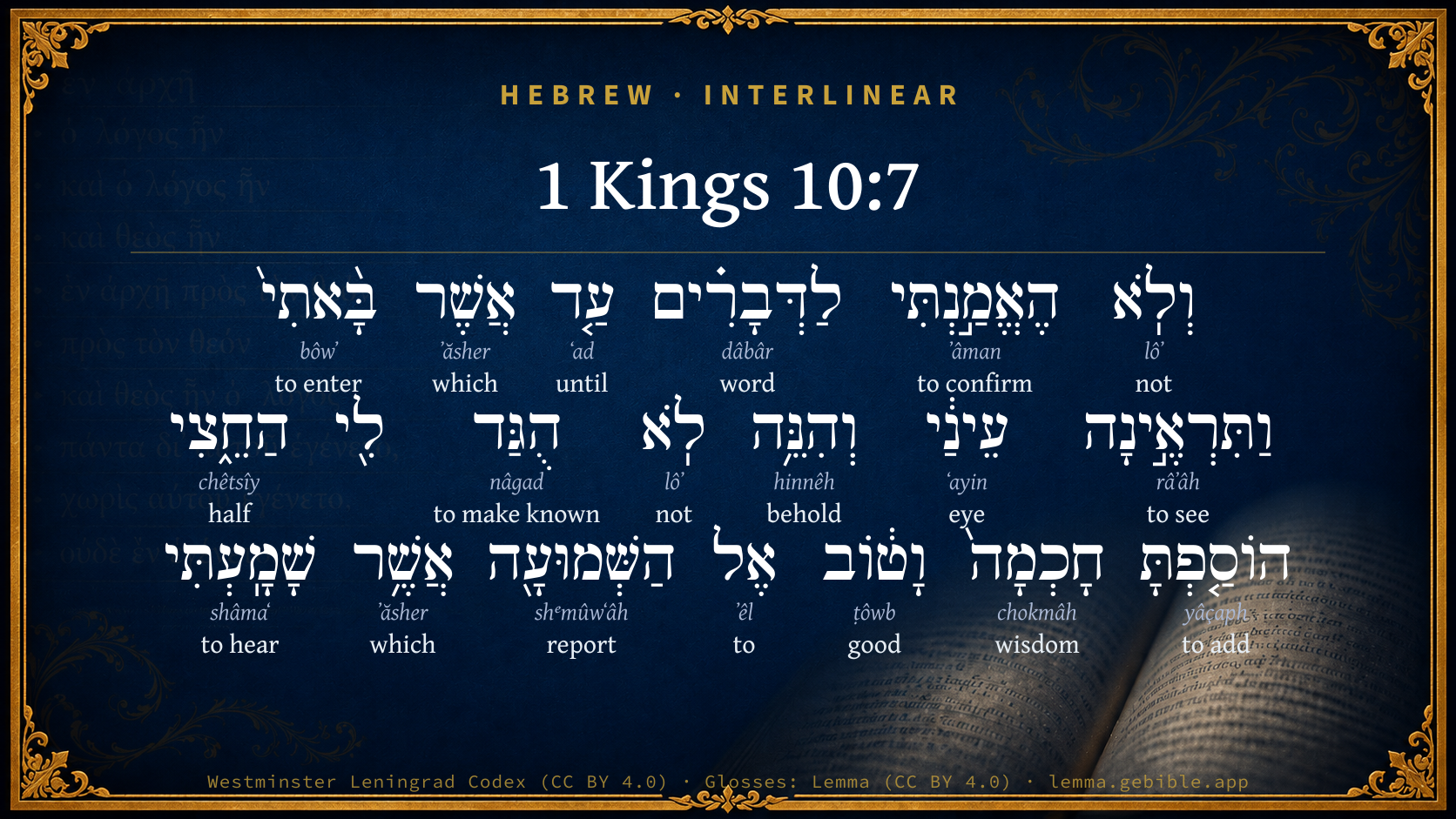
1 Kings 10:7

Hebrew (Westminster Leningrad Codex) 1 Kings 10:7 appears in the Hebrew Old Testament. The text above is from the Westminster Leningrad Codex. Each word links to its Strong’s number, a concise gloss, and parsing drawn from the Open Scriptures Hebrew Bible morphology. Click any word for its full Brown-Driver-Briggs (BDB) entry.
Download image
Cite this verse

1 Kings 10:7 (World English Bible). Public Domain. Lemma interlinear Bible study tool, https://lemma.gebible.app/v/1-kings/10/7.

Show BibTeX & RIS
BibTeX
RIS
English Translation
However I didn't believe the words, until I came, and my eyes had seen it: and, behold, the half was not told me; your wisdom and prosperity exceed the fame which I heard.
World English Bible · Public Domain
Download a study sheet

One document with this verse’s original text, its word-by-word gloss line, the meaning frame, cross-references with their text, attributed commentary, and full source and license credits — printable, and it pastes into notes with its structure intact.

This verse Autodidact and up

Study sheet (.html) Plain text (.txt)

A passage Seminary Student

Up to 50 verses in one chapter. A passage sheet keeps up to 6 commentary sources and 12 cross-references per verse, in the order this page ranks them, and says so on the sheet whenever that leaves anything out. Ask for a single verse and you get the Autodidact verse sheet above.

Everything on this page stays free to read, with no account — the sheet is a download of what is already on screen, not access to it.

Want to remove ads? Support Godless Engineer
Compare translations 3

The same verse in 3 English versions, stacked beneath the original-language interlinear above. Click any original word for its lexicon entry.

Each is an independent rendering of the whole verse — the interlinear is not word-aligned to these translations.

Highlighted words mark where these versions differ — a whole-verse word diff, not a word-by-word alignment.

  • World English Bible Public Domain
    However I didn't believe the words, until I came, and my eyes had seen it: and, behold, the half was not told me; your wisdom and prosperity exceed the fame which I heard.
  • King James Version Public Domain
    Howbeit I believed not the words, until I came, and mine eyes had seen it: and, behold, the half was not told me: thy wisdom and prosperity exceedeth the fame which I heard.
  • unfoldingWord Literal Text CC BY-SA 4.0
    But I did not believe the words until when I came and my eyes saw, and behold, the half had not been declared to me! You have added wisdom and goodness to the report that I heard.

unfoldingWord Literal Text — © unfoldingWord, licensed CC BY-SA 4.0. Word-aligned USFM3 via Door43 (git.door43.org/unfoldingWord/en_ult).

Versions to compare (up to 4)

3 of 4 selected

Show all 18 translations

Every available English version of this verse, each an independent rendering of the whole verse.

  • World English Bible Public Domain
    However I didn't believe the words, until I came, and my eyes had seen it: and, behold, the half was not told me; your wisdom and prosperity exceed the fame which I heard.
  • Berean Standard Bible Public Domain
    But I did not believe these things until I came and saw with my own eyes. Indeed, not even half was told to me. Your wisdom and prosperity have far exceeded the report I heard.
  • Majority Standard Bible Public Domain
    But I did not believe these things until I came and saw with my own eyes. Indeed, not even half was told to me. Your wisdom and prosperity have far exceeded the report I heard.
  • King James Version Public Domain
    Howbeit I believed not the words, until I came, and mine eyes had seen it: and, behold, the half was not told me: thy wisdom and prosperity exceedeth the fame which I heard.
  • American Standard Version (1901) Public Domain
    Howbeit I believed not the words, until I came, and mine eyes had seen it: and, behold, the half was not told me; thy wisdom and prosperity exceed the fame which I heard.
  • Revised Version (1885) Public Domain
    Howbeit I believed not the words, until I came, and mine eyes had seen it: and, behold, the half was not told me: thy wisdom and prosperity exceedeth the fame which I heard.
  • Geneva Bible (1599) Public Domain
    Howebeit I beleeued not this report till I came, and had seene it with mine eyes: but lo, ye one halfe was not tolde mee: for thou hast more wisedome and prosperitie, then I haue heard by report.
  • Douay-Rheims (1899) Public Domain
    Concerning thy words, and concerning thy wisdom. And I did not believe them that told me, till I came myself, and saw with my own eyes, and have found that the half hath not been told me: thy wisdom and thy works, exceed the fame which I heard.
  • Young's Literal Translation Public Domain
    and I gave no credence to the words till that I have come, and my eyes see, and lo, it was not declared to me -- the half; thou hast added wisdom and goodness unto the report that I heard.
  • Literal Standard Version CC BY-SA 4.0
    and I gave no credence to the words until I have come, and my eyes see, and behold, not [even] half was declared to me; you have added wisdom and goodness to the report that I heard.
  • Unlocked Literal Bible CC BY-SA 4.0
    I did not believe what I heard until I came here, and now my eyes have seen it. Not half was told me about your wisdom and wealth! You have exceeded the fame that I heard about.
  • unfoldingWord Literal Text CC BY-SA 4.0
    But I did not believe the words until when I came and my eyes saw, and behold, the half had not been declared to me! You have added wisdom and goodness to the report that I heard.
  • Darby Bible Public Domain
    but I gave no credit to the words, until I came and mine eyes had seen; and behold, the half was not told me: in wisdom and prosperity thou exceedest the report that I heard.
  • World Messianic Bible Public Domain
    However, I didn’t believe the words until I came and my eyes had seen it. Behold, not even half was told me! Your wisdom and prosperity exceed the fame which I heard.
  • Webster's Bible Public Domain
    Howbeit, I believed not the words, until I came, and my eyes had seen it: and behold, the half was not told me: thy wisdom and prosperity exceed the fame which I heard.
  • Free Bible Version CC BY-SA 4.0
    But I didn't believe what they told me until I came and saw with my own eyes. In fact, I wasn't told the half of it—the extent of your wisdom far exceeds what I heard!
  • Bible in Basic English Public Domain
    But I had no faith in what was said about you, till I came and saw for myself; and now I see that it was not half the story; your wisdom and your wealth are much greater than they said.
  • JPS Tanakh (1917) Public Domain
    Howbeit I believed not the words, until I came, and mine eyes had seen it; and, behold, the half was not told me; thou hast wisdom and prosperity exceeding the fame which I heard.

Literal Standard Version (2020), Covenant Press — licensed CC BY-SA 4.0. Text via the HelloAO Bible API (eBible.org). Unlocked Literal Bible (unfoldingWord) — licensed CC BY-SA 4.0. Text via the HelloAO Bible API (eBible.org). unfoldingWord Literal Text — © unfoldingWord, licensed CC BY-SA 4.0. Word-aligned USFM3 via Door43 (git.door43.org/unfoldingWord/en_ult). Free Bible Version, Dr. Jonathan Gallagher — licensed CC BY-SA 4.0. Text via the HelloAO Bible API (eBible.org).

Word by word

More ways to search: Search by grammar → Find every occurrence → Compare this word →

Practice this passage: Drill this verse → Learn its vocabulary →

הַשְּׁמוּעָ֖ה
shᵉmûwʻâh
H8052
“the · report”
Particle, Definite Article + Noun, Common, Feminine, Singular, Absolute
Part of Speech
Particle + Noun
Type
Common
Gender
Feminine
Number
Singular
State
Absolute
Full BDB Definition

Origin: pass part of H8074

TWOT: 2412d

report, news, rumour - report, news, tidings - mention
  1. וְלֹֽא lôʼ H3808 “and · not” Conjunction + Particle, Negative
  2. הֶאֱמַ֣נְתִּי ʼâman H539 “to confirm” Verb, Hiphil, Perfect, 1st Person, Common, Singular
  3. לַדְּבָרִ֗ים dâbâr H1697 “to/for the · words” Preposition, Determined + Noun, Common, Masculine, Plural, Absolute
  4. עַ֤ד ʻad H5704 “until” Preposition
  5. אֲשֶׁר ʼăsher H834 “which” Particle, Relative
  6. בָּ֨אתִי֙ bôwʼ H935 “to enter” Verb, Qal, Perfect, 1st Person, Common, Singular
  7. וַתִּרְאֶ֣ינָה râʼâh H7200 “and · to see” Conjunction + Verb, Qal, Sequential Imperfect, 3rd Person, Feminine, Plural
  8. עֵינַ֔י ʻayin H5869 “eyes · my” Noun, Common, Both, Dual, Construct + Suffix, Personal, 1st Person, Common, Singular
  9. וְהִנֵּ֥ה hinnêh H2009 “and · behold” Conjunction + Particle, Demonstrative
  10. לֹֽא lôʼ H3808 “not” Particle, Negative
  11. הֻגַּד nâgad H5046 “to make known” Verb, Hophal, Perfect, 3rd Person, Masculine, Singular
  12. הַחֵ֑צִי chêtsîy H2677 “the · half” Particle, Definite Article + Noun, Common, Masculine, Singular, Absolute
  13. הוֹסַ֤פְתָּ yâçaph H3254 “to add” Verb, Hiphil, Perfect, 2nd Person, Masculine, Singular
  14. חָכְמָה֙ chokmâh H2451 “wisdom” Noun, Common, Feminine, Singular, Absolute
  15. וָט֔וֹב ṭôwb H2896 “and · good” Conjunction + Adjective, Adjective, Masculine, Singular, Absolute
  16. אֶל ʼêl H413 “to” Preposition
  17. אֲשֶׁ֥ר ʼăsher H834 “which” Particle, Relative
  18. שָׁמָֽעְתִּי shâmaʻ H8085 “to hear” Verb, Qal, Perfect, 1st Person, Common, Singular

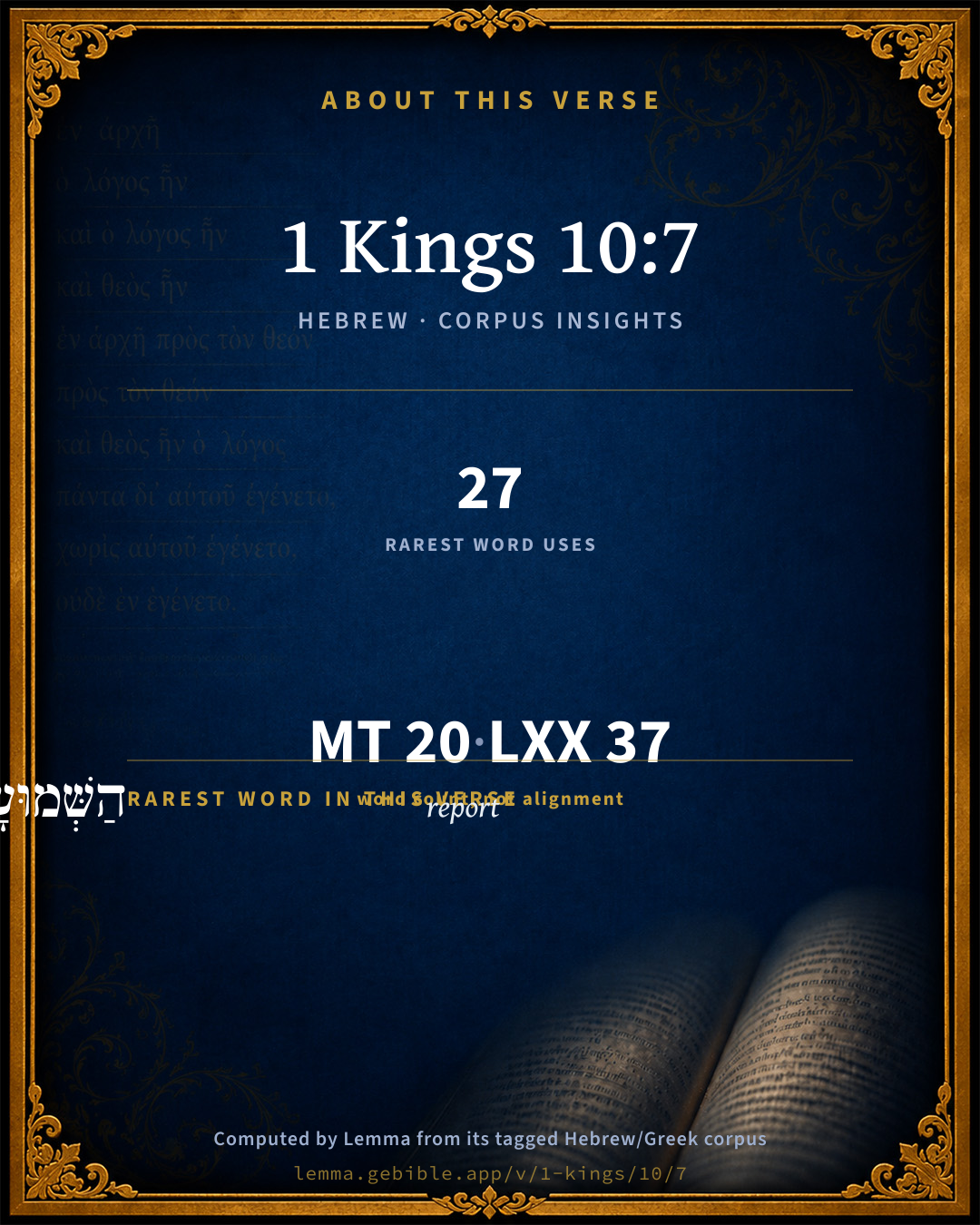
About this verse

These counts appear in no published source. They are computed here, from the morphology-tagged text and Lemma’s own curated glosses. What Lemma adds →

20
words
17
distinct lemmas
Historical
section

Shared distinctive vocabulary

הַשְּׁמוּעָ֖ה report H8052 occurs in 24 verses of the Hebrew Bible. Also found in:

Grammatical profile

  • 6 verbs
  • 5 nouns
  • 1 adjective
  • 3 prepositions
  • 5 particles

Verb forms

  • הֶאֱמַ֣נְתִּי Hiphil · Perfect
  • בָּ֨אתִי֙ Qal · Perfect
  • וַתִּרְאֶ֣ינָה Qal · Sequential Imperfect
  • הֻגַּד Hophal · Perfect
  • הוֹסַ֤פְתָּ Hiphil · Perfect
  • שָׁמָֽעְתִּי Qal · Perfect

Repetition

Words recur within this verse — often emphatic in Hebrew:

  • וְלֹֽא not H3808 ×2
  • אֲשֶׁר which H834 ×2

Hebrew & Septuagint length

In English translation the verse runs 33 words from the Hebrew and 42 from the Septuagint (LXX English) — closely comparable.

A rough comparison of the two English renderings, which tokenize alike — not a word-level alignment.

Word counts can differ between the Hebrew and the Greek without any difference in meaning — e.g. the Hebrew direct-object marker אֵת has no separate Greek word, and Greek often adds the article ὁ.

In the original languages it is 20 Hebrew tokens and 37 Greek tokens — but the two are counted differently (Hebrew bundles its prefixes and suffixes into one token; the Greek is in lemma form), so that isn’t a like-for-like length.

Cross-references

6

Topical passages linked to 1 Kings 10:7 in the Treasury of Scripture Knowledge — connected by theme and wording, ordered by reader-vote popularity; previews shown in the World English Bible.

  • John 20:25–29 The other disciples therefore said to him, "We have seen the Lord!" But he said to them, "Unless I see in his hands the print of the nails, and put my hand into his side, I will not believe."
  • 1 Corinthians 2:9 But as it is written, "Things which an eye didn't see, and an ear didn't hear, Which didn't enter into the heart of man, These God has prepared for those who love him."
  • 1 John 3:2 Beloved, now we are children of God, and it is not yet revealed what we will be. But we know that, when he is revealed, we will be like him; for we will see him just as he is.
  • Isaiah 64:4 For from of old men have not heard, nor perceived by the ear, neither has the eye seen a God besides you, who works for him who waits for him.
  • Zechariah 9:17 For how great is his goodness, And how great is his beauty! Grain will make the young men flourish, And new wine the virgins.
  • Mark 16:11 When they heard that he was alive, and had been seen by her, they disbelieved.

Cross-references courtesy of OpenBible.info (CC BY 4.0).

Hebrew and Greek witnesses Masoretic Hebrew ↔ Greek Septuagint

The same verse in the two great witnesses to the Old Testament, shown verse-for-verse.

These are two independent witnesses, not word-aligned to each other, and the Septuagint is shown in lemma (dictionary) form.

Hebrew 1 Kings 10:7 Masoretic · Westminster Leningrad Codex

וְלֹֽא הֶאֱמַ֣נְתִּי לַדְּבָרִ֗ים עַ֤ד אֲשֶׁר בָּ֨אתִי֙ וַתִּרְאֶ֣ינָה עֵינַ֔י וְהִנֵּ֥ה לֹֽא הֻגַּד לִ֖י הַחֵ֑צִי הוֹסַ֤פְתָּ חָכְמָה֙ וָט֔וֹב אֶל הַשְּׁמוּעָ֖ה אֲשֶׁ֥ר שָׁמָֽעְתִּי

However I didn't believe the words, until I came, and my eyes had seen it: and, behold, the half was not told me; your wisdom and prosperity exceed the fame which I heard.

World English Bible · Public Domain

Greek LXX 1 Kings 10:7 Septuagint · lemma form

καί οὐ πιστεύω ὁ λαλέω ἐγώ ἕως ὅστις παραγίγνομαι καί ὁράω ὁ ὀφθαλμός ἐγώ καί ἰδού οὐ εἰμί ὁ ἥμισυς καθώς ἀποἀγγέλλω ἐγώ προςτίθημι ἀγαθός πρός αὐτός ἐπί πᾶς ὁ ἀκοή ὅς ἀκούω ἐν ὁ γῆ ἐγώ

But I believed not them that told me, until I came and my eyes saw: and, behold, the words as they reported to me are not the half: you have exceeded in goodness all the report which I heard in my land.

LXX2012 (modern English Septuagint) · Public Domain

Hebrew: Westminster Leningrad Codex (CC BY 4.0). Greek: Septuagint (public domain); English from LXX2012 (modern English Septuagint) (Public Domain). How the Septuagint differs from the Hebrew →

Targum (Aramaic paraphrase)

1

The Targum is the ancient Jewish Aramaic paraphrase of the Hebrew Scriptures — an interpretive translation, not the Hebrew text itself. Onkelos (literal) and Pseudo-Jonathan (expansive) render the Torah, and Jonathan the Prophets. Coverage is partial: where no permissively-licensed English translation exists for a verse, only the Aramaic is shown. This is verse-level text, not a word-by-word alignment to the Hebrew.

  1. Targum Jonathan Prophets (Joshua–Malachi)
    וְלָא הֵימָנִית לְפִתְגָמַיָא עַד דַאֲתֵיתִי וַחֲזָאָה עֵינַי וְהָא לָא אִתְחַוָא לִי פַּלְגוּ מַה דַחֲזֵיתִי אוֹסַפְתָּא חוּכְמְתָא וְטַבְתָא עַל שְׁמוּעֲתָא דִי שְׁמָעִית:

    (no public-domain English translation for this verse)

    Targum Jonathan — Aramaic: “Mikraot Gedolot” (public domain). English: “Sefaria Community Translation” (CC0 1.0 (public-domain dedication)); “London "Chaldee Paraphrase," 1871” (public domain). Text via Sefaria.

Commentary

Notes on 1 Kings 10:7 from classic Christian and Jewish commentators (each source and its license shown beneath its notes). The classic Christian expositions comment on the surrounding passage and are grouped to its opening verse, so a note may address several verses; the Jewish commentaries on the Tanakh (Rashi and others) are per-verse, so they appear only where the commentator wrote on this verse.

Lemma curates 59 commentaries, every one of them public domain or Creative Commons licensed, each selected and text-cleaned for this edition rather than reprinted as found. About our sources →

The Biblical Illustrator

Joseph S. Exell

1Ki_10:7

Howbeit I believed not the words until I came.

Seeing and believing

This Queen of Sheba would not rest content with secondhand knowledge. Her example is worth following. Never rest content with secondhand knowledge. The great crisis is past, and the Christian life begins in its full beauty and strength when hearing gives place to seeing and the glory of the living Christ becomes a present fact and the governing factor in the daily life. There is something lacking m your experience unless you can say, Mine eyes have seen. It is the eternal distinction between the world and the Church, the children of the age and the children of eternity. Have you thus seen the Son? Has the glory of Jesus been so revealed to you as to capture your heart and deprive sin and the world of their power to allure you? Or is your knowledge of Jesus Christ still secondhand, unconvincing, unsatisfying, ineffectual? We take this Queen of Sheba then as a model seeker after truth, one of those sincere and genuine souls of whom Jesus said, Every one that is of the truth heareth My voice.

I. She was true to the needs of her own heart. As a great queen, she might easily have become engrossed in State affairs or in the pleasures of court life. But she would not allow even the din of an empire to drown the voice of her own heart. Spiritual suicide is seriously urged in some quarters as the ideal of true religion. People are urged to forget all about their own souls, and care or pretend to care for other people only. This Queen of Sheba put everything else aside until her inner life had been put right. For though a queen she was not satisfied. Questions kept coming before her which she dared not set aside and could not answer.

II. This Queen of Sheba proved her sincerity by making a personal inquiry. No man can put anothers questions, for no man can read anothers heart. You can never be saved by proxy. The hunger of your heart will never be met until you make personal application to Jesus Christ. And you must take trouble over it. Those who never put themselves to any trouble seldom get their questions answered. Of course you can hear the gospel without travelling 1500 miles. But with many there is a barrier between them and Jesus Christ more difficult to overcome than 1500 miles of space. It is the barrier of nearly 1900 years. The Bible seems such ancient history. It deals with a state of society so different to ours. It is an Eastern book wearing an Eastern dress, and its teaching is full of reference to Jewish customs and ideas. The education which can perfectly understand Tennyson or Browning is often utterly at a loss in reading the New Testament. Those who would find Christ in the Bible must take real pains to master the history of Genesis and Exodus and the types of Leviticus, or they will never understand either the Gospels or the Epistles. You might as well expect to understand the differential calculus by the light of Nature as think to understand the Bible without giving years to patient systematic study of it. When the word of God was rare and precious, men studied it and meditated upon it night and day. Now that the Bible is in everybodys hands men think they know it because they can quote a few odd verses, though they have taken no pains to master its deep teaching. They will not take the trouble to make a personal inquiry. Certainly the Queen of Sheba will rise and condemn all such.

III. This queen was genuinely true in her private interview with Solomon. She communed with him of all that was in her heart. She had not meant to do this. Her questions had been carefully prepared, all couched in general terms and in the third person. How can one explain this? How can one answer this? How should one act under these circumstances? But when she came to Solomon it was no longer How can one? but How can I? She felt at once that her disguise was penetrated. Solomon read her heart and drew out with perfect tact all her personal longing and unrest. Do be true in your dealings with God. Never attempt to wear a mask in Gods presence. As soon as you really draw near to God you find out that you are personally involved. You are the guilty culprit needing propitiation and forgiveness, you are the sick and helpless one needing the Good Physicians touch. You can never have a satisfactory interview with God until you take your right place.

IV. The Queen of Sheba was true in the confession she made of her former unbelief. She was a sincere, candid, and whole-hearted seeker, but she was an unbeliever when she came to Jerusalem. Such unbelief is most wholesome. It is the unbelief of those who are staggered at the greatness of the gospel message. Have you ever been thus staggered? Has it come home to you as the greatest wonder in the world that God should love sinners? Have you ever when listening to the joyful tidings of a Saviour able to.save to the uttermost, of a God willing to forgive and forget all your sins, of a throne of grace to which all needy souls may flee for succour, said in your heart, It is too good to be true, I cannot believe it? Solomon was not vexed when the Queen of Sheba said, I believed not the words. It is the blind unbelief that sees no glory in redeeming love that deserves rebuke, not the weak faith that is so dazzled by it that it can hardly believe it to be true. (F. S. Webster, M. A.)

Truth seeking

I. That rumour as to truth should lead us to inquire as to its reality. How many are content with the mere rumour or report of what has transpired. It does not do to be content with hearsay; there must be some endeavour to learn the truth for ourselves. Listening must result in action. When we have heard, we must seek personal acquaintance with the facts.

II. That the realities relating to truth will prove greater than the rumours.

1. If our pursuits arise out of our curiosity, until it becomes an anxiety to gather knowledge, we shall never fail to acquire more than we sought. The retailing of impressions is never the same as the possession of experience--the one is infinitely richer than the other can indicate.

2. Nothing that may be told us about Jesus Christ can equal what we shall know when we have been to Him for ourselves. The eye of the soul must behold His glory before His greatness and His beauty can be appreciated and understood. Thus nothing that can be written about Him ever seems to equal what the soul, when given up to Him, has experienced of His love.

3. There are some things which in their recital seem to transcend belief. If the account of them has stimulated inquiry, then any latent scepticism with which the facts may have been treated is beneficial--we are making the right use of doubt when we are looking out for the truth. Personal experience is the best criterion of truth. (U. R. Gardner.)

The visit of the queen

I. Learn first from this subject what a beautiful thing it is when social position and wealth surrender themselves to God. If there are those here who have been favoured of fortune, or, as I might better put it, favoured of God, surrender all you have, and all you expect to be, to the Lord, who blessed this Queen of Sheba. Certainly you are not ashamed to be found in this queens company. I am glad that Christ has had His imperial friends in all ages. Elizabeth Christina, Queen of Prussia; Marie Feoderovna, Queen of Russia; Marie, Empress of France; Helena, the imperial mother of Constantine; Arcadia, from her great fortunes, building public baths at Constantinople, and toiling for the elevation of the masses; Queen Clotilda leading her husband and three thousand of his armed warriors to Christian baptism; Elizabeth of Burgundy giving her jewelled glove to a beggar, and scattering great fortunes among the distressed; Prince Albert singing Rock of Ages in Windsor Castle; and Queen Victoria incognito reading the Scriptures to a dying pauper. Again--

II. What is earnestness in the search of truth. Do you know where Sheba was? It was in Abyssinia, or some say in the southern part of Arabia Felix. In either case it was a great way off from Jerusalem. To get from there to Jerusalem she had to cross a country infested with bandits, and go across blistering deserts. When I see that caravan dust-covered, weary, and exhausted, trudging on across the desert and among the bandits, until it reaches Jerusalem, I say, There is an earnest seeker after the truth. But you want the truth to come to you; you do not want to go to it. There are people who fold their arms and say, I am ready to become a Christian at any time; if I am to be saved, I shall be saved; and if I am to be lost, I shall be lost. A man who says that, and keeps on saying it, will be lost. Jerusalem will never come to you; you must go to Jerusalem. The religion of the Lord Jesus Christ will not come to you; you must go and get religion. Bring out the camels; put on all the sweet spices, all the treasures of the hearts affection; start for the throne. Goad on the camels! Jerusalem will never come to you; you must go to Jerusalem. Take the kingdom of heaven by violence. Urge on the camels. Again--

III. Religion is a surprise to anybody that gets it. This story of the new religion in Jerusalem, and of the glory of King Solomon, who was a type of Christ--that story rolls on and rolls on, and is told by every traveller coming back from Jerusalem. Religion is always a surprise to any one that gets it. The story of grace--an old story. Apostles preached it with rattle of chain; martyrs declared it with arm of fire; death-beds have affirmed it with visions of glory, and ministers of religion have sounded it through the lanes, and the highways, and the chapels, and the cathedrals. It has been cut into stone with chisel, and spread on the canvas with pencil; and it has been recited in the doxology of great congregations. And yet when a man first comes to look upon the palace of Gods mercy, and to see the royalty of Christ, and the wealth of His banquet, and the luxuriance of His attendants, and the loveliness of His face, and the joy of His service, he exclaims with prayers, with tears, with songs, with triumph, The half--the half was not told me! (T. De Witt Talmage, D. D.)

The reality beyond the report

A brief enumeration and invoice of some of the departments of Christian truth and life.

1. First among these riches of grace should be named the life-giving, everlasting book which we call the Bible. As to its certainty, completeness, and power not half has been told.

2. Not half has been told by poet, artist, or preacher concerning the wisdom, power, and love of God in the created universe. Gods world as well as His Word should be studied. Nature is Christian and preaches to us.

3. Not a tithe has been told of the glory of the words, works, and life of Christ.

4. The most sanguine saint has scarcely dreamed of the power of the gospel to save, yea, even to the uttermost. Modern Miracles, such as Leila Thompson writes of, should become common occurrences.

5. Not half has been told of the blessedness and possibilities of Christian experience;--exceeding abundantly above all that we ask or think (Eph_3:20).

6. How faint our conception of the golden opportunities of Christian activity and usefulness.

7. And who can delineate, who can tabulate the attractions of heaven? That is the true home of the soul, the ideal society and kingdom without fault, the Church without spot or blemish. The exclusion of all evil, the inclusion of all that is pure, true and good. (P. Ross Parish.)

Exceeding all thought

The love of God passeth knowledge; man cannot grasp it. When Columbus landed in America, he did not know that he had discovered a vast continent. He knew nothing about its vast rivers, its great lakes and valleys. What did he know about the wealth of minerals hidden in its mountains? So it will take us all our days to discover the love of God; its depths we know nothing about. We shall need all eternity to fathom it.

Realisers alone can appreciate

The queens words and gifts suggest wide truths. Her experience that the reality transcended all report and expectation is repeated in every, heart that faithfully clings to Jesus and brings its questions and doubts to Him. He must be loved ere that to you He will seem worthy of your love. Just as, after all the speech of poets from the beginning of the world, he sweetness of love has not been told, and every heart that is blessed by it feels that it is more than all words can declare; so, after all that saints and evangelists have said of Christ, each soul which enters into faithful fellowship with Him finds that the half was not told it. No painter can put the melting glories of sunset on his canvas. No description can give one who has not heard it a true impression of the majesty and pathos of Beethovens thunderous music. Nothing but tasting for ourselves can tell us how good the Lord is. Even here Jesus gives to eat of the hidden manna, and the secrets of His love are only known by the loving heart. No man who rejects Him knows rightly Him whom he rejects. (A. Maclaren, D. D.)

The Biblical Illustrator, edited by Joseph S. Exell (c. 1880s–1900s) — public domain. Text from a community e-Sword module.

Joseph Benson's Commentary

1Ki 10:7-8. I believed not the words — Which were told me concerning thee: they seemed incredible, and above the perfection of human nature. Thy wisdom and prosperity — Hebrew, ושׂוב, vatob, and goodness, may be intended to signify either happiness or virtue. Exceeded the fame which I heard — This was remarkable, for people commonly find things to fall far short of their expectations. Happy are thy men — Thy subjects, especially those that are about thy person, and minister unto thee; who have an opportunity every day of hearing thy wise sayings and discourses. With much more reason may we say this of Christ’s servants: Blessed are they that dwell in thy house; they will be always praising thee.

Joseph Benson's Commentary on the Old and New Testaments (1811–1818) — public domain. Text from a community e-Sword module.

The Cambridge Bible for Schools and Colleges

gen. ed. J. J. S. Perowne

7. thy wisdom and prosperity exceedeth the fame] This is a good idiomatic representation of the Hebrew, which is literally ‘thou hast added wisdom and goodness to the fame &c.’ The ‘goodness’ here spoken of includes all material prosperity. Cf. Job_2:10, where the same word stands in the original, ‘Shall we receive good (i.e. such prosperity as Job had previously enjoyed) at the hand of God and shall we not receive evil?’ See also Psa_104:28.

The Cambridge Bible for Schools and Colleges (gen. ed. J. J. S. Perowne; Cambridge University Press, 1878–1918) — public domain. Text from a community e-Sword module.

John Gill's Exposition

Howbeit I believed not the words, until I came, and mine eyes had seen it,.... That is, she did not believe the whole of what was related to her; somewhat of it she credited, and supposed there was something grand and extraordinary in it, or she would never have taken such a journey; but she did not believe that all could be true; she thought things were too much magnified:

and, behold, the half was not told me; of what she now saw and heard:

thy wisdom and prosperity exceedeth the fame which I heard; the inward endowments of his mind, and the outward magnificence of his court, exceeded the relation of them to her; they were beyond expression, they were so great that reporters could not hyperbolize upon them, nor even come up to them in their account of them, and in which yet men are apt to exceed.

John Gill's Exposition of the Whole Bible (1746–1763) — public domain (CC PDM 1.0). Text via the HelloAO Bible API.

Matthew Poole's English Annotations

I believed not the words which the reporters used concerning him; or, the things reported; they seemed incredible, and above the perfection of human nature.

Prosperity; or, happiness; or, virtue; Heb. goodness.

Matthew Poole's English Annotations on the Holy Bible (1683–1685) — public domain. Text from a community e-Sword/MySword module.

Lesson kit

Teaching starters — assembled from the data on this page, not authored interpretation. Every prompt links to the verse data it draws on. Edit before teaching.

1 Kings, in the Historical, opens this verse with 20 words (17 distinct Hebrew lemmas). Its most distinctive word is shᵉmûwʻâh (“report”). A historical commentator’s framing appears above. Read the whole chapter for the surrounding context.

Discussion questions

  1. What does “report” (shᵉmûwʻâh) contribute to the verse as a whole?
  2. How does 1 Samuel 2:24, which shares the word «report», read alongside this verse?
  3. What does the repetition of “not” (2× in this one verse) do in this verse?
  4. These translations render this verse differently; the difference is in the English rendering, not the original. What questions does that raise?
  5. «הֶאֱמַ֣נְתִּי» is a Hiphil Perfect verb. How does that grammatical form shape the action described?
  6. Compare how The Biblical Illustrator and Joseph Benson's Commentary read this verse. Where do they agree or differ?

Things to notice

Reading settings

Reading text

Shown beneath each verse's original-language words.

Old Testament
Old Testament edition

Read the OT as the Masoretic Hebrew (MT) or the Greek Septuagint (LXX).

English shown for the Greek Septuagint (in the Hebrew ↔ Greek comparison).

Comparing translations? Open the Compare panel on any verse page to stack up to four side by side.