
Psalms 92:15

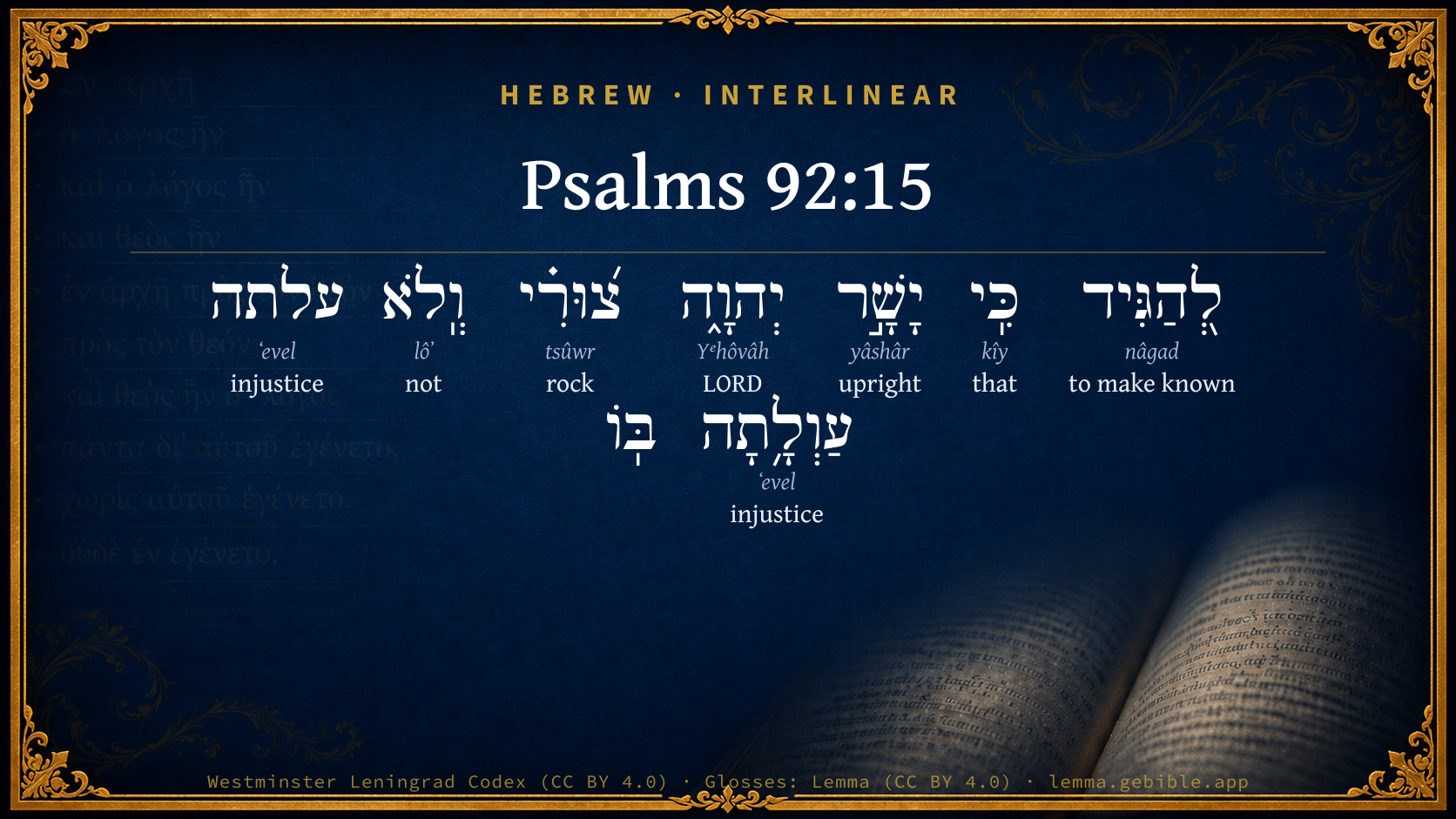
Hebrew (Westminster Leningrad Codex) Psalms 92:15 appears in the Hebrew Old Testament. The text above is from the Westminster Leningrad Codex. Each word links to its Strong’s number, a concise gloss, and parsing drawn from the Open Scriptures Hebrew Bible morphology. Click any word for its full Brown-Driver-Briggs (BDB) entry.
Download image
Cite this verse

Psalms 92:15 (World English Bible). Public Domain. Lemma interlinear Bible study tool, https://lemma.gebible.app/v/psalms/92/15.

Show BibTeX & RIS
BibTeX
RIS
English Translation
To show that Yahweh is upright. He is my rock, And there is no unrighteousness in him.
World English Bible · Public Domain
Download a study sheet

One document with this verse’s original text, its word-by-word gloss line, the meaning frame, cross-references with their text, attributed commentary, and full source and license credits — printable, and it pastes into notes with its structure intact.

This verse Autodidact and up

Study sheet (.html) Plain text (.txt)

A passage Seminary Student

Up to 50 verses in one chapter. A passage sheet keeps up to 6 commentary sources and 12 cross-references per verse, in the order this page ranks them, and says so on the sheet whenever that leaves anything out. Ask for a single verse and you get the Autodidact verse sheet above.

Everything on this page stays free to read, with no account — the sheet is a download of what is already on screen, not access to it.

Want to remove ads? Support Godless Engineer
Compare translations 3

The same verse in 3 English versions, stacked beneath the original-language interlinear above. Click any original word for its lexicon entry.

Each is an independent rendering of the whole verse — the interlinear is not word-aligned to these translations.

Highlighted words mark where these versions differ — a whole-verse word diff, not a word-by-word alignment.

  • World English Bible Public Domain
    To show that Yahweh is upright. He is my rock, And there is no unrighteousness in him.
  • King James Version Public Domain
    To shew that the LORD is upright: he is my rock, and there is no unrighteousness in him.
  • unfoldingWord Literal Text CC BY-SA 4.0
    to proclaim that Yahweh is just, my rock, and no unrighteousness in him.

unfoldingWord Literal Text — © unfoldingWord, licensed CC BY-SA 4.0. Word-aligned USFM3 via Door43 (git.door43.org/unfoldingWord/en_ult).

Versions to compare (up to 4)

3 of 4 selected

Show all 18 translations

Every available English version of this verse, each an independent rendering of the whole verse.

  • World English Bible Public Domain
    To show that Yahweh is upright. He is my rock, And there is no unrighteousness in him.
  • Berean Standard Bible Public Domain
    to proclaim, “The LORD is upright; He is my Rock, and in Him there is no unrighteousness.”
  • Majority Standard Bible Public Domain
    to proclaim, “The LORD is upright; He is my Rock, and in Him there is no unrighteousness.”
  • King James Version Public Domain
    To shew that the LORD is upright: he is my rock, and there is no unrighteousness in him.
  • American Standard Version (1901) Public Domain
    To show that Jehovah is upright; He is my rock, and there is no unrighteousness in him.
  • Revised Version (1885) Public Domain
    To shew that the LORD is upright; he is my rock, and there is no unrighteousness in him.
  • Geneva Bible (1599) Public Domain
    To declare that the Lord my rocke is righteous, and that none iniquitie is in him.
  • Douay-Rheims (1899) Public Domain
    They shall still increase in a fruitful old age: and shall be well treated,
  • Young's Literal Translation Public Domain
    To declare that upright `is' Jehovah my rock, And there is no perverseness in Him!
  • Literal Standard Version CC BY-SA 4.0
    To declare that YHWH my Rock [is] upright, || And there is no perverseness in Him!
  • Unlocked Literal Bible CC BY-SA 4.0
    to proclaim that Yahweh is just. He is my rock, and there is no unrighteousness in him.
  • unfoldingWord Literal Text CC BY-SA 4.0
    to proclaim that Yahweh is just, my rock, and no unrighteousness in him.
  • Darby Bible Public Domain
    To shew that Jehovah is upright: [he is] my rock, and there is no unrighteousness in him.
  • World Messianic Bible Public Domain
    to show that the LORD is upright. He is my rock, and there is no unrighteousness in him.
  • Webster's Bible Public Domain
    \\92:14\\They shall still bring forth fruit in old age; they shall be fat and flourishing;
  • Free Bible Version CC BY-SA 4.0
    They will declare, “The Lord does what is right! He is my rock! There is no wrong in him!”
  • Bible in Basic English Public Domain
    For a sign that the Lord is upright; he is my Rock, there is no deceit in him.
  • JPS Tanakh (1917) Public Domain
    (92-16) To declare that the LORD is upright, my Rock, in whom there is no unrighteousness.

Literal Standard Version (2020), Covenant Press — licensed CC BY-SA 4.0. Text via the HelloAO Bible API (eBible.org). Unlocked Literal Bible (unfoldingWord) — licensed CC BY-SA 4.0. Text via the HelloAO Bible API (eBible.org). unfoldingWord Literal Text — © unfoldingWord, licensed CC BY-SA 4.0. Word-aligned USFM3 via Door43 (git.door43.org/unfoldingWord/en_ult). Free Bible Version, Dr. Jonathan Gallagher — licensed CC BY-SA 4.0. Text via the HelloAO Bible API (eBible.org).

Word by word

More ways to search: Search by grammar → Find every occurrence → Compare this word →

Practice this passage: Drill this verse → Learn its vocabulary →

About this verse

These counts appear in no published source. They are computed here, from the morphology-tagged text and Lemma’s own curated glosses. What Lemma adds →

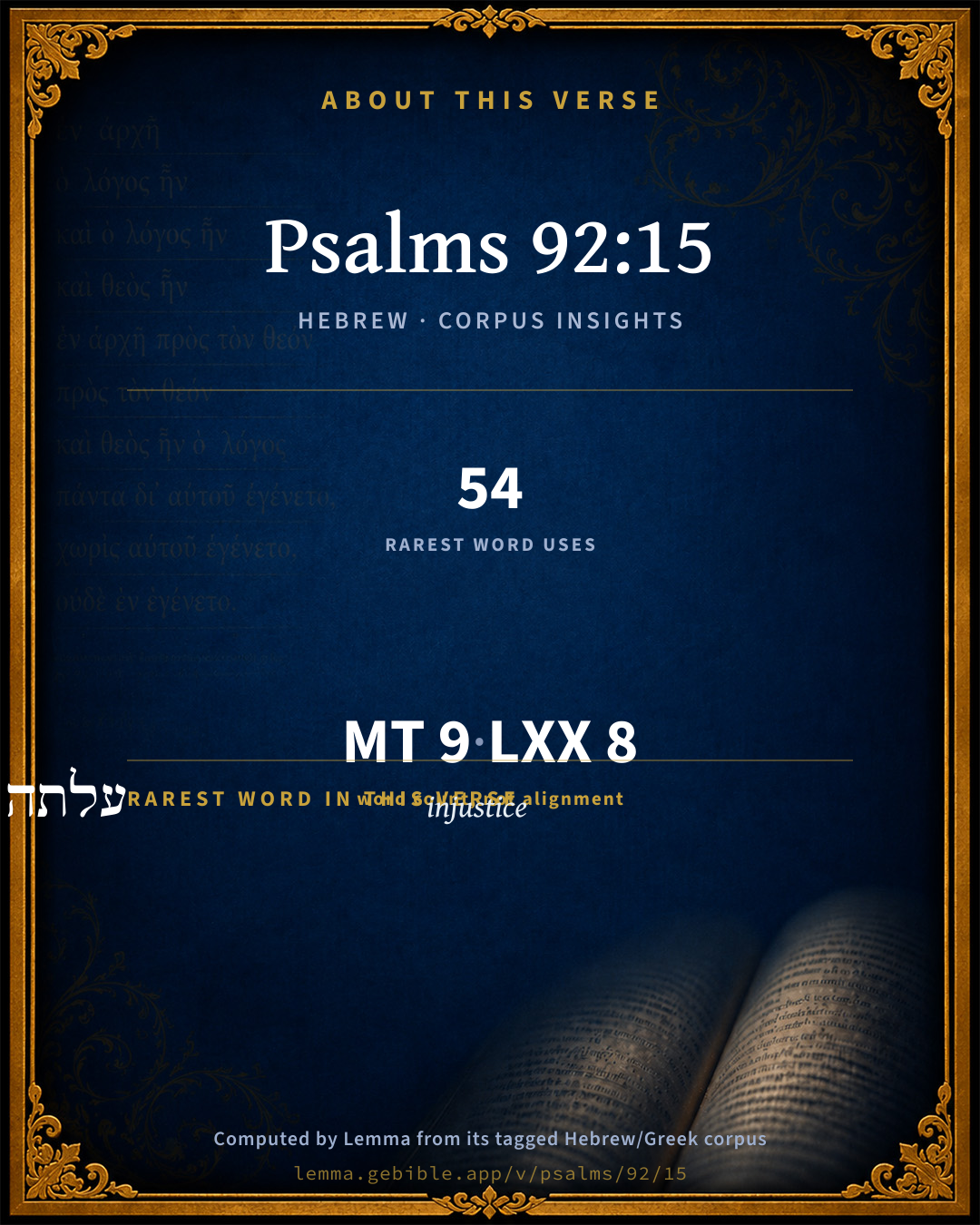
9
words
7
distinct lemmas
Wisdom
section

Shared distinctive vocabulary

עלתה injustice H5766 occurs in 51 verses of the Hebrew Bible. Also found in:

Grammatical profile

  • 1 verb
  • 4 nouns
  • 1 adjective
  • 1 preposition
  • 1 conjunction
  • 1 particle

Verb forms

  • לְ֭הַגִּיד Hiphil · Infinitive Construct

Repetition

A word recurs within this verse — often emphatic in Hebrew:

  • עלתה injustice H5766 ×2

Hebrew & Septuagint length

In English translation the verse runs 17 words from the Hebrew and 14 from the Septuagint (LXX English) — closely comparable.

A rough comparison of the two English renderings, which tokenize alike — not a word-level alignment.

Word counts can differ between the Hebrew and the Greek without any difference in meaning — e.g. the Hebrew direct-object marker אֵת has no separate Greek word, and Greek often adds the article ὁ.

In the original languages it is 9 Hebrew tokens and 8 Greek tokens — but the two are counted differently (Hebrew bundles its prefixes and suffixes into one token; the Greek is in lemma form), so that isn’t a like-for-like length.

Cross-references

14

Topical passages linked to Psalms 92:15 in the Treasury of Scripture Knowledge — connected by theme and wording, ordered by reader-vote popularity; previews shown in the World English Bible.

  • Psalms 18:2 Yahweh is my rock, my fortress, and my deliverer; My God, my rock, in whom I take refuge; My shield, and the horn of my salvation, my high tower.
  • Romans 9:14 What shall we say then? Is there unrighteousness with God? May it never be!
  • Job 34:10 "Therefore listen to me, you men of understanding: Far be it from God, that he should do wickedness, From the Almighty, that he should commit iniquity.
  • Psalms 62:6 He alone is my rock and my salvation, my fortress. I will not be shaken.
  • Deuteronomy 32:4 The Rock, his work is perfect; For all his ways are justice: A God of faithfulness and without iniquity, Just and right is he.
  • Psalms 145:17 Yahweh is righteous in all his ways, And gracious in all his works.
  • John 15:1–3 "I am the true vine, and my Father is the farmer.
  • 1 Corinthians 1:8–9 who will also confirm you until the end, blameless in the day of our Lord Jesus Christ.
  • 1 Thessalonians 5:23–24 May the God of peace himself sanctify you completely. May your whole spirit, soul, and body be preserved blameless at the coming of our Lord Jesus Christ.
  • 2 Thessalonians 1:6–7 Since it is a righteous thing with God to repay affliction to those who afflict you,
  • 1 Peter 1:4–5 to an incorruptible and undefiled inheritance that doesn't fade away, reserved in heaven for you,
  • Zephaniah 3:5 Yahweh, in the midst of her, is righteous. He will do no wrong. Every morning he brings his justice to light. He doesn't fail, but the unjust know no shame.
  • John 10:27–29 My sheep hear my voice, and I know them, and they follow me.
  • Titus 1:2 in hope of eternal life, which God, who can't lie, promised before eternal times;

Cross-references courtesy of OpenBible.info (CC BY 4.0).

Hebrew and Greek witnesses Masoretic Hebrew ↔ Greek Septuagint

The same verse in the two great witnesses to the Old Testament, shown verse-for-verse.

You’re reading Greek Psalm 91 (Hebrew Psalm 92). The Septuagint counts the superscription, so verse numbers can differ from the Hebrew — chapter-level alignment, not verse-by-verse. Numbering follows Rahlfs.

These are two independent witnesses, not word-aligned to each other, and the Septuagint is shown in lemma (dictionary) form.

Hebrew Psalms 92:15 Masoretic · Westminster Leningrad Codex

לְ֭הַגִּיד כִּֽי יָשָׁ֣ר יְהוָ֑ה צ֝וּרִ֗י וְֽלֹא עלתה עַוְלָ֥תָה בּֽוֹ

To show that Yahweh is upright. He is my rock, And there is no unrighteousness in him.

World English Bible · Public Domain

Greek LXX Greek Psalm 91:15 Septuagint · lemma form

ἔτι πληθύνω ἐν γῆρας πίων καί εὐπαθέω εἰμί

that the Lord my God is righteous, and there is no iniquity in him.

LXX2012 (modern English Septuagint) · Public Domain

Hebrew: Westminster Leningrad Codex (CC BY 4.0). Greek: Septuagint (public domain); English from LXX2012 (modern English Septuagint) (Public Domain). How the Septuagint differs from the Hebrew →

Commentary

Notes on Psalms 92:15 from classic Christian and Jewish commentators (each source and its license shown beneath its notes). The classic Christian expositions comment on the surrounding passage and are grouped to its opening verse, so a note may address several verses; the Jewish commentaries on the Tanakh (Rashi and others) are per-verse, so they appear only where the commentator wrote on this verse.

Lemma curates 59 commentaries, every one of them public domain or Creative Commons licensed, each selected and text-cleaned for this edition rather than reprinted as found. About our sources →

Adam Clarke's Commentary

Verse 15. To show that the Lord is upright] Such persons show how faithful God is to his promises, how true to his word, how kind to them who trust in him. He is the Rock, the Fountain, whence all good comes.

There is no unrighteousness in him.] He does nothing evil, nothing unwise, nothing unkind. He is both just and merciful.

ANALYSIS OF THE NINETY-SECOND PSALM

I. A general proposition, Ps 92:1: "It is good to give thanks to the Lord," c. which is explained Ps 92:2-3, and applied Ps 92:4.

II. A particular narration of such works, in which the goodness and faithfulness of God do especially consist, viz., the creation and government of the world, Ps 92:4-5. And of the last he gives two instances: -

1. One in wicked men; of their stupidity, Ps 92:6. Then of their sudden extirpation, Ps 92:7-9.

2. Another in the godly, whose prosperity is great, Ps 92:10-14, and security certain, Ps 92:15.

I. He begins with a maxim: 1. "It is good," i.e., just, profitable, pleasant, and commendable, "to give thanks to the Lord." 2. "And to sing praises (with heart and tongue) to thy glorious name, O thou Most High."

And both parts he explains. 1. That we give thanks at all times, morning and evening, in prosperity and in adversity; and in our praises especially to remember his loving-kindness and faithfulness. These must be the matter of our thanksgiving: "It is good to show forth thy loving-kindness in the morning, and thy faithfulness every night," Ps 92:2; and by all manner of means, Ps 92:3.

And thus the maxim being proposed and explained, he applies it to himself, and shows his own practice, and the reason of it: "For thou, Lord, hast made me glad through thy work; I will triumph in the works of thy hands," Ps 92:4.

1. "Thou hast made me glad." He was first delighted and affected with God's work.

2. And then he exults and triumphs in it. The heart must be first truly affected with the work of God before a man shall take any true content or delight in it.

II. He had made mention of the works of God; and now he farther opens what they are: First, The creation of the universe; Secondly, His especial providence in ordering the things of this world, particularly about man.

1. First, he begins with the work of creation, upon which he enters, not with less than an admiration: "O Lord, how great are thy works! and thy thoughts are very deep." As if he said, I cannot be satisfied in the contemplation of them. There is such a depth in them, that I cannot attain to it, nor comprehend it.

2. And he ends it, not without an indignation, that the wise men of the world, who yet in his judgment, for their disregard of it, are but fools, should not consider it. In the creature they look after nothing but profit and pleasure, in which regard they are but fools. For this brutish man knows not how great are his works; this fool understands not how deep are his cogitations.

And that he may illustrate their folly the more, from the work of creation he comes to God's work of governance of the world; and shows, that as they who would be and are reputed wise, are mistaken in the one, so also they are mistaken in the other; for they think the ungodly, and such as flourish in power and wealth, happy, and that the righteous men, sometimes oppressed, are unhappy: and upon these two instances, he insists to the end of the Psalm. First, he instances the ungodly: When the wicked spring up - rise on a sudden, (for such a time there is,) as the grass, that grows insensibly and in a night; and when all the workers of iniquity do flourish - become very conspicuous, exalted in power and pride, and abound in wealth; who would not now take them for happy men? No, saith our prophet, it is not so.

1. This their felicity is the greatest infelicity: It is, "that they may perish," be destroyed.

2. "That they may perish for ever." Remember the rich man in the Gospel.

3. And this their destruction is from God, that sits on the throne, and is immutable in his decrees and ways. They flourish and are exalted: but it is but for a moment: "But thou, Lord, art most high for evermore." And thou wilt execute thy decree upon them.

4. Which the prophet fully opens in the next verse, which the epizeuxis makes more emphatical: "For, lo, thine enemies, O Lord, for, lo, thine enemies shall perish; and all the workers of iniquity shall be scattered."

1, Behold, they were green, they flourished: but the change shall be sudden.

2. They were enemies, thy enemies, workers of iniquity; therefore cursed with a curse.

3. "They shall perish, they shall be scattered;" they rose, they flourished as grass, and they shall be scattered as dry grass, which the wind blows from the face of the earth.

His second instance is the godly, whose happy condition he demonstrates, 1. In hypothesi, or in himself, Ps 92:10-11; and, 2. In thesi; in all others that be true members of the mystical Church of Christ, Ps 92:12-15.

He instanceth in himself, that his condition is not like the ungodly. He shot not up as the fading grass, but his strength and power should be as a unicorn.

1. "But my horn shalt thou exalt as the horn of a unicorn;" that is, my power, and glory, and felicity shall still mount higher.

2. "And I shall be anointed with fresh oil." Anointed to be king over Israel, by Samuel, with a horn of oil; - by God, with the gracious oil of his Spirit.

3. And that which adds to my flourishing estate: "My eye shall see my desire upon my enemies, and my ears shall hear my desire of the wicked that rise up against me;" which David lived to see and hear in the ruin of Saul and his house.

And that which the prophet said of himself he now transfers to all just and righteous men, whom he compares to the palm and cedar.

1. "The righteous shall flourish like a palm-tree." So a good Christian; the greater weight he carries, the more he flourishes.

2. "He shall grow like a cedar in Lebanon Cedar-wood is not consumed by worms or time; nor the Church by antiquity nor persecution. The gates of hell shall not prevail against it, nor any true member of it.

Of which the reason is, because these palms and cedars - these righteous men, are planted, set by faith, watered by the word and sacraments, rooted by charity in the Church, which is the house of the Lord; and therefore they shall flourish - be green and vigorous, in the courts of our God.

Nay, which is yet more, they shall be full of sap and laden with fruit.

1. "They shall bring forth fruit in their old age." It shall be contrary to them, as with other trees. Those grow fruitless, and bear not when they grow old; these are then most laden with the fruits of grace.

2. "They shall be fat and flourishing." Other trees, when old, are hard and dry; these then are fat in juice, and flourish in good works.

3. And the reason of this vigour, of the continuance of this radical and vital moisture to old age, is, that they bring forth fruit, which is specified in the last verse: "That they might show forth God's faithfulness, praise him for that," as it is in the second verse. 1. "That they might show that the Lord is upright," - just and righteous in himself. 2. "That he is a Rock," - a sure, stable foundation to trust to. 3. "And that there is no unrighteousness in him," - no injustice; though for a time he suffer the wicked to flourish, and the just to be under the cross. For in his good time he will show his justice in rewarding the just, and punishing the unjust.

Adam Clarke's Commentary on the Bible (1810–1826) — public domain. Text from a community e-Sword/MySword module.

Trapp's Complete Commentary

John Trapp

Psa 92:15 To shew that the LORD [is] upright: [he is] my rock, and [there is] no unrighteousness in him.

Ver. 15. To show that, &c.] This is one of their principal fruits, to give God a testimonial, such as good old Moses doth, Deu 32:4.

John Trapp, A Commentary or Exposition upon All the Books of the Old and New Testament (1647–1656) — public domain. Text from a community e-Sword module.

Joseph Benson's Commentary

Psa 92:15. To show that the Lord is upright, &c. — That he is true to his promises, and faithful to every word that he hath spoken, and therefore does not leave nor forsake those that cleave to him, but carries on the work which he has begun. As it is by his promises that believers first partake of a divine nature, so it is by his promises that that divine nature is preserved and maintained, and therefore the power it exerts is an evidence that the Lord is upright, and such he will show himself to be with an upright man, Psa 18:25. He is my rock — I have chosen him for my rock, on which to build my confidence and hopes for time and eternity, and in the clefts of which to take shelter in the time of danger: and I have found him a rock, strong and steadfast, and his word firm and stable. And there is no unrighteousness in him — He is as able, and will be as kind, as his word represents him to be. All that ever trusted in God have found him faithful and all-sufficient, and none were ever made ashamed of their hope in him. He is just and upright in his dealings with his intelligent creatures, “immoveable in his counsels, and determined to punish the wicked and reward the good; so that, when his proceedings shall come to be unfolded at the last day, it will appear to men and angels that there is no unrighteousness in him.” — Horne.

Joseph Benson's Commentary on the Old and New Testaments (1811–1818) — public domain. Text from a community e-Sword module.

J. A. Alexander on Psalms

Joseph Addison Alexander

16. (Psa 92:15) To declare that Jehovah is just—my Rock--and no unrighteousness in Him. See above on Psa 18:2, and compare Deu 32:4. The epithet just denotes the essential rectitude of God, including his veracity and faithfulness to his engagements. See above, on Psa 25:8. My Rock may be simply in apposition with Jehovah, Jehovah my Rock is just, or a second predicate, Jehovah is just (and) my Rock.

Joseph Addison Alexander, The Psalms Translated and Explained (1850) — public domain. Text from a community e-Sword module.

Tyndale Open Study Notes

Tyndale Open Resources

92:15 There is no evil in him! The Lord is consistently just; he rightly judges everyone (see Zeph 3:5).

Tyndale Open Study Notes — © Tyndale Open Resources, licensed CC BY-SA 4.0. Text via the HelloAO Bible API.

John Calvin's Commentaries

15. That they may show that Jehovah is upright. It is evident from this verse that the great object of the Psalmist is, to allay that disquietude of mind which we are apt to feel under the disorder which reigns apparently in the affairs of this world; and to make us cherish the expectation, (under all that may seem severe and trying in our lot, and though the wicked are in wealth and power, flourish, and abound in places and distinctions,) that God will bring light and order eventually out of confusion. That they may show, it is said particularly, that the Lord is upright; for through the influence of our corruption we are apt to conclude, when things do not proceed as we would wish in the world, that God is chargeable not only with neglect but with unrighteousness, in abandoning his people, and tolerating the commission of sin. When God displays his justice in proceeding to execute vengeance upon the wicked, it will be seen at once, that any prosperity which they enjoyed was but the forerunner of a worse destruction in reserve for them. The Psalmist, in calling God his rock, shows a second time that he reckoned himself amongst the number of those in whom God would illustrate his justice by extending towards them his protection.

John Calvin's Commentaries (1540-1563) — public domain. Text from the Calvin Translation Society English edition (1840s-50s) via the Christian Classics Ethereal Library (ccel.org). Calvin's coverage is partial (roughly two-thirds of the Bible); uncommented books and verses are honest gaps, never fabricated. The 19th-century editor's footnotes and remarks are omitted so the notes are faithfully Calvin's own voice.

The Cambridge Bible for Schools and Colleges

gen. ed. J. J. S. Perowne

15. To shew &c.] To witness by their prosperity to the faithfulness and justice of Jehovah. The verse is based on Deu_32:4.

The Cambridge Bible for Schools and Colleges (gen. ed. J. J. S. Perowne; Cambridge University Press, 1878–1918) — public domain. Text from a community e-Sword module.

Albert Barnes' Notes on the Bible

To shew that the Lord is upright - That is, This will be a proof that God is faithful to his promises; that he is the true friend of his people. The fact that they live long - that they are happy and useful even in old age, will be a demonstration that God is the friend of virtue, and that he deals with people according to their character.

He is my rock - He is my defense; that which constitutes my security. See the notes at Psa 18:2. This is language of strong confidence in view of all that is said in the psalm.

And there is no unrighteousness in him - This is said in the most absolute form - implying the most entire confidence. God is altogether to be trusted. There is no evil or wrong in his character or in his dealings. In all respects he is worthy of confidence: “worthy” to be loved, trusted, adored, obeyed, by the inhabitants of all worlds. What a sublime thought is this! What a consolatory truth! What would the universe be if God, a Being of infinite POWER, were not a Being of perfect RIGHTEOUSNESS, and could not be trusted by the creatures which he has made!

Albert Barnes' Notes on the Bible (1834–1885) — public domain. Text from a community e-Sword/MySword module.

Matthew Poole's English Annotations

This glorious work of God in compensating the short prosperity of the wicked with everlasting punishments, and of exchanging the momentary afflictions of the just with eternal glory and happiness, doth clearly demonstrate that God is just and blameless in all the dispensations of his providence in the world.

Matthew Poole's English Annotations on the Holy Bible (1683–1685) — public domain. Text from a community e-Sword/MySword module.

The Treasury of David

Charles H. Spurgeon

Ver. 15. This mercy to the aged proves the faithfulness of their God, and leads them

to shew that the Lord is upright, by their cheerful testimony to his ceaseless goodness. We do not serve a Master who will run back from his promise. Whoever else may defraud us, he never will. Every aged Christian is a letter of commendation to the immutable fidelity of Jehovah.

He is my rock, and there is no unrighteousness in him. Here is the psalmist's own seal and sign manual; still was he building upon his God, and still was the Lord a firm foundation for his trust. For shelter, for defence, for indwelling, for foundation, God is our rock; hitherto he has been to us all that he said he would be, and we may be doubly sure that he will abide the same even unto the end. He has tried us, but he has never allowed us to be tempted above what we are able to bear: he has delayed our reward, but he has never been unrighteous to forget our work of faith and labour of love. He is a friend without fault, a helper without fail. Whatever he may do with us, he is always in the right; his dispensations have no flaw in them, no, not the most minute. He is true and righteous altogether, and so we weave the end of the psalm with its beginning, and make a coronet of it, for the head of our Beloved.

It is a good thing to sing praises unto the Lord, for "he is my rock, and there is no unrighteousness in him."

Ver. 15. He is my rock, and there is no unrighteousness in, him. Implying that God can no more be moved or removed from doing righteously, than a rock can be removed out of its place. Joseph Caryl.

Ver. 15-16. The reason and the pledge of final perseverance. C.A. Davis.

Charles H. Spurgeon's The Treasury of David (1869–1885) — public domain. Psalms only. Text from a community e-Sword/MySword module.

Whedon's Commentary on the Bible

Daniel D. Whedon

15. To show that the Lord is upright—To vindicate the truth of his promises, and the rectitude of his ways with those who fear him.

He is my rock—A precious confession, coming from the depths of a grateful and triumphant soul.

There is no unrighteousness in him—Moses had said the same, after a long life of wonderful experience. Deu_32:4. Evil may present various forms of apparent contradiction of God’s faithfulness, but the deeper insight of faith apprehends, and the result proves, that God is justified in his sayings, and will overcome when he judges. Psa_51:4; Rom_3:4.

Daniel D. Whedon (gen. ed.), Commentary on the Old and New Testaments (1874–1909) — public domain. Text from a community e-Sword module.

The Pulpit Commentary

To show that the Lord is upright. The happy and flourishing old age of the righteous (ver. 14; comp. Psa_91:16) is a strong indication of God"s faithfulness and truth, showing, as its does, that he keeps his promises, and never forsakes those that put their trust in him. (comp. Psa_27:10 Psa_37:25 Isa_41:17, etc.) He is my Rock rather, that he is my Rockand that there is no unrighteousness in him. Both clauses depend on the "show" of the preceding hemistich.

The Pulpit Commentary (1880–1919), ed. H.D.M. Spence-Jones & Joseph S. Exell — public domain. Text from a community e-Sword module.

Rashi

Rabbi Shlomo Yitzchaki (Rashi)

will...grow Heb. ישגה, will grow.

fat Heb. דשנים, They will be fat and fresh, and then they will declare that the Lord is upright.

Rashi on the Tanakh — English translations: “The Judaica Press complete Tanach with Rashi, translated by A. J. Rosenberg” (CC BY 4.0); “Pentateuch with Rashi's commentary by M. Rosenbaum and A.M. Silbermann, 1929-1934” (public domain); “The Metsudah Tanach series, Lakewood, N.J” (CC BY 4.0); and “The Book of Joshua, Metsudah Publications, 1997” (CC BY 4.0). Text via Sefaria.

Lesson kit

Teaching starters — assembled from the data on this page, not authored interpretation. Every prompt links to the verse data it draws on. Edit before teaching.

Psalms, in the Wisdom, opens this verse with 9 words (7 distinct Hebrew lemmas). Its most distinctive word is ʻevel (“injustice”). A historical commentator’s framing appears above. Read the whole chapter for the surrounding context.

Discussion questions

  1. How does “injustice” (ʻevel) shape what this verse is saying?
  2. How does Leviticus 19:15, which shares the word «injustice», read alongside this verse?
  3. What does the repetition of “injustice” (2× in this one verse) do in this verse?
  4. These translations render this verse differently; the difference is in the English rendering, not the original. What questions does that raise?
  5. «לְ֭הַגִּיד» is a Hiphil Infinitive Construct verb. How does that grammatical form shape the action described?
  6. Compare how Adam Clarke's Commentary and Trapp's Complete Commentary read this verse. Where do they agree or differ?

Things to notice

Reading settings

Reading text

Shown beneath each verse's original-language words.

Old Testament
Old Testament edition

Read the OT as the Masoretic Hebrew (MT) or the Greek Septuagint (LXX).

English shown for the Greek Septuagint (in the Hebrew ↔ Greek comparison).

Comparing translations? Open the Compare panel on any verse page to stack up to four side by side.